Drugs, Health Technologies, Health Systems
Reimbursement Review
Tirzepatide (Zepbound)
Sponsor: Eli Lilly Canada Inc.
Therapeutic area: Chronic weight management
Summary
What Is Obesity and Overweight?
Obesity and overweight are complex chronic diseases in which excess body fat impairs health and increases the risk of long-term health complications. They are traditionally measured using body mass index (BMI), with overweight defined as a BMI between of 25.0 kg/m2 and 29.9 kg/m2, and obesity defined as a BMI of 30 kg/m2 or higher.
Up to 68% of adults in Canada aged 18 to 79 years were living with either overweight or obesity between 2022 and 2024 based on their BMI, which represented an 8% increase from 2016 to 2019.
Prediabetes, a condition in which blood sugar levels are higher than the normal range but not high enough to be diagnosed as type 2 diabetes mellitus (T2DM), is common among adults living with overweight or obesity. Although there is a lack of Canadian-specific data for the prevalence of prediabetes among patients living with overweight or obesity, studies based in the US and France suggest that prediabetes prevalence ranges between 14.3% and 36.9% for adults with obesity, and between 9.6% and 20.7% for adults with overweight.
What Are the Treatment Goals and Current Treatment Options for Obesity and Overweight?
The clinical experts and the clinician group indicated that the primary goals of treatment are to achieve sustainable weight loss of at least 5% of total body weight; improve comorbidities (e.g., T2DM, hypertension, dyslipidemia, sleep apnea, cardiovascular disease, metabolic dysfunction-associated steatotic liver disease, joint disease, Alzheimer disease, and cancer); and enhance quality of life, physical function, mobility, and psychosocial well-being while preventing weight regain.
Treatment options include:
Lifestyle therapy: Medical nutrition therapy, physical activity, and behavioural therapy, typically delivered by primary care teams and dietitians.
Pharmacotherapy: Semaglutide (Ozempic), semaglutide (Wegovy), orlistat, liraglutide, and naltrexone-bupropion are currently available in Canada. Semaglutide (Wegovy) plus diet and exercise was previously recommended for public reimbursement by the Canadian Drug Expert Committee for patients with a BMI of 27 kg/m2 or higher and established cardiovascular disease. Orlistat is currently reimbursed by at least 1 public drug program for patients with a BMI of 27 kg/m2 or higher and T2DM but is not widely used. Semaglutide (Ozempic) is publicly reimbursed for the treatment of T2DM but may be used off label for weight management in a subset of patients with overweight or obesity. Liraglutide and naltrexone-bupropion were not recommended for public reimbursement and are not publicly reimbursed for weight management.
Bariatric surgery: Indicated for patients with a BMI of 40 kg/m2 or higher, or a BMI of 35 kg/m2 or higher with comorbidities.
What Is Zepbound and Why Did Canada’s Drug Agency Conduct This Review?
Zepbound is a long-acting dual gastric inhibitory polypeptide (glucose-dependent insulinotropic polypeptide) and glucagon-like peptide-1 (GLP-1) receptor agonist that is administered by subcutaneous injection. Health Canada has approved Zepbound for once-weekly administration for chronic weight management, including weight loss and weight maintenance, as an adjunct to a reduced-calorie diet and increased physical activity, in adults with an initial BMI of:
30 kg/m2 or greater (obesity) or
27 kg/m2 to less than 30 kg/m2 (overweight) in the presence of at least 1 weight-related comorbid condition (e.g., hypertension, dyslipidemia, prediabetes, T2DM, obstructive sleep apnea, or cardiovascular disease).
Canada’s Drug Agency (CDA-AMC) reviewed Zepbound to inform a recommendation to the participating public drug programs on whether the drug should be reimbursed for the Health Canada–approved indication. The sponsor is seeking reimbursement for once-weekly administration for chronic weight management, including weight loss and weight maintenance, as an adjunct to a reduced-calorie diet and increased physical activity, in adults with an initial BMI of 27 kg/m2 or greater and prediabetes.
How Did CDA-AMC Evaluate Zepbound?
CDA-AMC reviewed the clinical evidence on the beneficial and harmful effects, as well as the economic evidence, for Zepbound versus other treatments used in Canada for chronic weight management. Diet and exercise were considered as relevant treatments to compare with Zepbound when reviewing the clinical evidence for the full Health Canada indication. Additional relevant comparators in subpopulations include semaglutide (Ozempic) or orlistat, in combination with diet and exercise, for a subset of patients with T2DM, and semaglutide (Wegovy) plus diet and exercise for a subset of patients with established cardiovascular disease. There are no additional comparators for the prediabetes subpopulation.
CDA-AMC identified equity and ethical considerations relevant to Zepbound and chronic weight management.
The review was informed by materials submitted by the sponsor, which included clinical and economic evidence.
The review was also informed by 4 patient group submissions and 3 clinician group submissions in response to the CDA‑AMC call for input, and by input from the participating public drug programs around issues that may impact their ability to implement a recommendation.
Two endocrinologists with representation from Quebec were consulted as part of the review process.
What Were the Findings?
Clinical Evidence
CDA-AMC reviewed 3 pivotal phase III randomized controlled trials included in the sponsor’s systematic review:
The SURMOUNT-1 trial compared Zepbound 5 mg, 10 mg, and 15 mg with placebo over 72 weeks in 2,539 patients with overweight or obesity with at least 1 weight-related comorbid condition, excluding diabetes. The SURMOUNT-1 trial included a prediabetes subgroup of 1,032 patients who were followed over 176 weeks.
The SURMOUNT-2 trial compared Zepbound with placebo over 72 weeks in 938 patients with obesity or overweight and with T2DM.
The SURMOUNT-4 trial, a withdrawal study, compared Zepbound with placebo over 52 weeks in 670 patients, similar to the SURMOUNT-1 trial.
For the comparison of Zepbound versus placebo in adults with overweight or obesity with at least 1 weight-related comorbid condition, excluding diabetes:
SURMOUNT-1 trial:
The trial demonstrated moderate-certainty evidence that treatment with tirzepatide 5 mg, 10 mg, and 15 mg likely results in a clinically important reduction in body weight and a clinically important increase in the proportion of patients achieving 5% or greater loss in body weight at 72 weeks.
These results remained consistent in the subgroup of patients with prediabetes at baseline through 176 weeks, and treatment with tirzepatide likely led to a clinically meaningful reduction in the proportion of patients with prediabetes that progressed to T2DM. The 95% confidence interval for progression to diabetes was not reported, so the precision of the absolute effect is not known.
There was moderate-certainty evidence indicating an improvement in quality of life and functioning at 72 weeks, and this result was maintained in the prediabetes subgroup at 176 weeks. However, the clinical importance of this improvement is unclear.
SURMOUNT-4 trial:
The trial demonstrated moderate-certainty evidence that tirzepatide at a maximum tolerated dose of 10 mg or 15 mg likely results in a clinically important decrease in body weight and a clinically important increase in the proportion of patients who achieved 5% or greater loss in body weight at 52 weeks.
There was moderate-certainty evidence indicating an improvement in quality of life and functioning over 52 weeks; however, the clinical importance of this improvement is unclear.
Among patients who had already lost at least 5% of their baseline weight, those who received a maximum tolerated dose of tirzepatide (10 mg or 15 mg) experienced a lower probability of returning to more than 95% of their baseline weight; however, the absolute between-group difference and 95% confidence interval were not reported, so the precision of the absolute effect is not known.
For the comparison of Zepbound versus placebo in adults with overweight or obesity with T2DM:
The SURMOUNT-2 trial demonstrated moderate-certainty evidence that treatment with tirzepatide 10 mg or 15 mg likely results in a clinically important reduction in body weight and a clinically important increase in the proportion of patients achieving 5% or greater loss in body weight at 72 weeks.
There was moderate-certainty evidence indicating an improvement in quality of life and functioning at 72 weeks, although the clinical importance of this improvement is unclear.
Based on the evidence submitted to CDA-AMC for this review, the effect of tirzepatide on important long-term outcomes such as major adverse cardiovascular events, osteoarthritis, obstructive sleep apnea, or premature mortality is unknown.
Across trials, there were no notable safety signals identified, and the safety profile of tirzepatide appears to be manageable according to the clinical experts, although harms occurring with longer duration of treatment are not known.
There was no submitted evidence to inform how Zepbound compares with semaglutide (Ozempic) in adults with overweight or obesity and T2DM, or with semaglutide (Wegovy) in adults with overweight or obesity and established cardiovascular disease.
Economic Evidence
Zepbound is available as 2.5 mg, 5 mg, 7.5 mg, 10 mg, 12.5 mg, and 15 mg per 0.6 mL solution for subcutaneous injection in multidose prefilled pens. At the submitted price of $300.00 per 2.5 mg or 5 mg multidose prefilled pen, $420.00 per 7.5 mg or 10 mg multidose prefilled pen, and $540.00 per 12 mg or 15 mg multidose prefilled pen, the annual cost of Zepbound is expected to range from $3,913 to $7,044 per patient, depending on dose.
Key clinical efficacy data (weight, systolic blood pressure, high-density lipoprotein, total cholesterol, reversal of prediabetes) used to inform the economic model were derived from the SURMOUNT-1 trial, which compared tirzepatide to placebo on a background of diet and exercise. The risks of complications of obesity and associated clinical events were estimated by the sponsor using predictive risk equations.
The results of the CDA-AMC base case for the Health Canada–indicated population suggest:
Zepbound is predicted to be associated with higher costs to the health care system than diet and exercise alone over a lifetime horizon (incremental costs = $69,235 to $140,927, depending on dose), primarily driven by drug acquisition costs associated with Zepbound.
Compared to diet and exercise, Zepbound may be associated with a gain of 0.11 to 0.14 life-years and 0.66 to 0.87 quality-adjusted life-years (QALYs) over a lifetime horizon, depending on dose.
The incremental cost-effectiveness ratio (ICER) of Zepbound 5 mg compared to diet and exercise was $105,609 per QALY gained, while the ICERs for Zepbound 10 mg and Zepbound 15 mg were $129,856 and $161,860 per QALY gained, respectively, in the CDA-AMC base case.
In the CDA-AMC scenario analysis reflecting the requested reimbursement population, the ICERs compared to diet and exercise were $77,871 per QALY gained for Zepbound 5 mg, $97,940 per QALY gained for Zepbound 10 mg, and $123,265 per QALY gained for Zepbound 15 mg.
In both the Health Canada–indicated and the requested reimbursement populations, the estimated ICERs are highly uncertain due to a lack of evidence supporting the impact of Zepbound on clinical events and limitations associated with the model structure. Of the incremental benefit compared to diet and exercise (0.66 to 0.98 incremental QALYs), approximately 92% to 97% of the benefit was predicted to be accrued after the treatment duration of the SURMOUNT-1 trial. If the incremental QALYs with Zepbound are lower than predicted in the CDA-AMC base case, further price reductions than those presented in this report may be required.
CDA-AMC estimates that the budget impact of reimbursing Zepbound for use in combination with diet and exercise for chronic weight management in the Health Canada–indicated population will be approximately $5.8 billion over the first 3 years of reimbursement compared to the amount currently spent on comparators (expenditure on Zepbound: $6.2 billion). For the requested reimbursement population, CDA-AMC estimates that the budget impact of reimbursing Zepbound will be approximately $2.4 billion over the first 3 years (expenditure on Zepbound: $2.4 billion). In both populations, the actual budget impact of reimbursing Zepbound will depend on the prevalence of weight-related comorbidities and distribution of the tirzepatide doses used in clinical practice.
The economic feasibility of adoption must be addressed, given that the estimated incremental budget impact of reimbursing Zepbound is predicted to be greater than $40 million in years 1, 2, and 3, and given the magnitude of uncertainty in the estimated budget impact.
Abbreviations
AE
adverse event
BMI
body mass index
CDA-AMC
Canada’s Drug Agency
CI
confidence interval
CVD
cardiovascular disease
FSG
fasting serum glucose
GLP-1
glucagon-like peptide 1
GRADE
Grading of Recommendations Assessment, Development and Evaluation
HDL
high-density lipoprotein
HRQoL
health-related quality of life
ICER
incremental cost-effectiveness ratio
ITT
intention to treat
IWQOL-Lite-CT
Impact of Weight on Quality of Life-Lite Clinical Trials Version
KM
Kaplan-Meier
MID
minimal important difference
MMRM
mixed model for repeated measures
MTD
maximum tolerated dose
OGTT
oral glucose tolerance test
OSA
obstructive sleep apnea
QALY
quality-adjusted life-year
RCT
randomized controlled trial
SD
standard deviation
T1DM
type 1 diabetes mellitus
T2DM
type 2 diabetes mellitus
TEAE
treatment-emergent adverse event
Background
Introduction
The objectives of this report are as follows:
Review and critically appraise the evidence submitted by the sponsor on the beneficial and harmful effects of tirzepatide 2.5 mg, 5 mg, 10 mg, and 15 mg once-weekly subcutaneous injection, in the treatment of adults for chronic weight management, including weight loss and weight maintenance, as an adjunct to a reduced-calorie diet and increased physical activity, with an initial body mass index (BMI) of 30 kg/m2, or greater (obesity) or 27 kg/m2 to less than 30 kg/m2 (overweight) in the presence of at least 1 weight-related comorbid condition (e.g., hypertension, dyslipidemia, prediabetes, type 2 diabetes mellitus, obstructive sleep apnea [OSA], or cardiovascular disease [CVD]). The focus will be placed on comparing tirzepatide to relevant comparators in clinical practice in Canada and identifying gaps in the current evidence, and this focus is outlined in Table 1.
Review and critically appraise the economic information submitted by the sponsor, including a cost-effectiveness analysis and budget impact analysis. The focus of the Economic Review is aligned with the scope of the Clinical Review, unless otherwise stated. For most reviews, a CDA-AMC base case is developed and informed by clinical expert input, the available clinical evidence, and the best interpretation of the economic evidence based on the information provided by the sponsor.
Table 1: Information on the Application Submitted for Review and on the CDA-AMC Review
Item | Description |
|---|---|
Information on the application submitted for review | |
Drug | Tirzepatide (Zepbound), 2.5 mg/0.6 mL, 5 mg/0.6 mL, 7.5 mg/0.6 mL, 10 mg/0.6 mL, 12.5 mg/0.6 mL, and 15 mg/0.6 mL, solution in a multidose prefilled pen for subcutaneous use |
Sponsor | Eli Lilly Canada Inc. |
Health Canada indication | For once-weekly administration for chronic weight management, including weight loss and weight maintenance, as an adjunct to a reduced-calorie diet and increased physical activity, in adults with an initial BMI of:
|
Health Canada approval status | NOC |
Health Canada review pathway | Standard |
NOC date | May 13, 2025 |
Mechanism of action | Tirzepatide is a long-acting dual GIP and GLP-1 receptor agonist that selectively binds to and activates both receptors. Both GIP and GLP-1 receptors are important to appetite regulation and caloric intake. Additionally, in human adipocytes, tirzepatide binds to and activates GIP receptors to regulate glucose uptake and modulate fat utilization. |
Recommended dosage | The recommended starting dosage is 2.5 mg injected subcutaneously once weekly. After 4 weeks, increase the dosage to 5 mg injected subcutaneously once weekly. If additional weight management is needed, increase the dosage in 2.5 mg increments after at least 4 weeks on the current dose. The recommended maintenance dosages in adults are 5 mg, 10 mg, or 15 mg injected subcutaneously once weekly. The maximum dosage is 15 mg injected subcutaneously once weekly. No dose adjustment is needed for renal or hepatic insufficiency or in geriatric patients. |
Submission type | Initial |
Sponsor’s reimbursement request | For once-weekly administration for chronic weight management, including weight loss and weight maintenance, as an adjunct to a reduced-calorie diet and increased physical activity, in adults with an initial body mass index (BMI) of equal to or greater than 27 kg/m2 and prediabetes. |
Submitted price | $300.00 per 2.5 mg/0.6 mL or 5 mg/0.6 mL multidose prefilled pen $420.00 per 7.5 mg/0.6 mL or 10 mg/0.6 mL multidose prefilled pen $540.00 per 12.5 mg/0.6 mL or 15 mg/0.6 mL multidose prefilled pen |
Information on the CDA-AMC review | |
Review type | Standard |
Clinical review focusa | Population: As defined in the Health Canada indication Subgroups: Baseline BMI, prediabetes Intervention: Per recommended dosage Comparators:
Outcomes:
|
BMI = body mass index; CDA-AMC = Canada’s Drug Agency; CVD = cardiovascular disease; GIP = glucose-dependent insulinotropic polypeptide; GLP-1 = glucagon-like peptide 1; IWQOL-Lite-CT = Impact of Weight on Quality of Life-Lite Clinical Trials Version; NOC = Notice of Compliance; T2DM = type 2 diabetes mellitus; TEAE = treatment-emergent adverse event.
aThe Economic Review aligns with the scope of the Clinical Review, unless otherwise stated.
Submission History for the Drug Under Review
CDA-AMC has not previously reviewed tirzepatide (Zepbound) for chronic weight management through the Reimbursement Review process.
Sources of Information
The contents of the Reimbursement Review report are informed by materials submitted by the sponsor, input received from interested parties (patient groups, clinician groups, and drug programs), and input from the clinical experts consulted for this review.
Calls for patient group and clinician group input are issued for each Reimbursement Review. Four patient group submissions (from Diabetes Canada, Gastrointestinal Society, Obesity Matters, and Obesity Canada) and 3 clinician group submissions (from LMC Diabetes and Endocrinology [5 clinicians]; a joint submission from Obesity Canada, Diabetes Canada, Canadian Society of Endocrinology and Metabolism, Canadian Association of Bariatric Physicians and Surgeons, and Canadian Cardiovascular Society [22 clinicians]; and York Weight Loss Clinical and Internal Medicine Clinic [2 clinicians]) were received. Three patient groups conducted online surveys of patients living with diabetes (Diabetes Canada [270 respondents]) or patients living with obesity or with overweight in Canada (Obesity Matters [155 respondents] and Obesity Canada [147 respondents]). In addition to its survey, Obesity Canada gathered input from its online peer-support community, which consisted of more than 3,500 individuals. The Gastrointestinal Society compiled patient input from several surveys, focus groups, and interactions with patients (in person, online, or by phone). Each of the clinician groups compiled responses for the input form provided by CDA-AMC. The full submissions received are available on the CDA-AMC project landing page in the consolidated input document. The drug programs provide input on each drug being reviewed through the Reimbursement Review process by identifying issues that may impact their ability to implement a recommendation.
Input from patient and clinician groups is considered throughout the review, including in the selection of outcomes to include in the Clinical Review and in the interpretation of the clinical and economic evidence. Relevant patient and clinician group input is summarized in the Disease Background, Current Management, and Unmet Needs and Existing Challenges sections of the Supplemental Material document.
Each review team includes at least 1 clinical expert with expertise regarding the diagnosis and management of the condition for which the drug is indicated. Clinical experts are a critical part of the review team and are involved in all phases of the review process. Two endocrinologists with expertise in the diagnosis and expertise in the diagnosis of overweight and obesity and chronic weight management participated as part of the review team, with representation from Quebec.
Disease Background
Obesity and overweight are complex chronic diseases in which excess body fat impairs health and increases the risk of long-term health complications.1 They are traditionally measured using BMI, with overweight defined as a BMI of between 25.0 kg/m2 and 29.9 kg/m2, and obesity defined as a BMI of 30 kg/m2 or higher.1,2 Obesity is a multifactorial disease influenced by several determinants that include physical activity, diet, socioeconomic status, ethnicity, and environmental factors.3,4 Obesity is associated with an increased risk of several health complications,5 including but not limited to type 2 diabetes mellitus (T2DM), CVD, dyslipidemia, heart failure with preserved ejection fraction, osteoarthritis, and certain types of cancer.6-8 The prevalence of obesity is high in Canada and has continued to increase over the past decade. Between 2022 and 2024, up to 68% of adults in Canada aged 18 to 79 years were living with either overweight or obesity based on their BMI, which represented an 8% increase from 2016 to 2019.9
Prediabetes, a condition in which blood sugar levels are higher than the normal range but not high enough to be diagnosed as T2DM, is common among adults living with overweight or obesity.10 According to guidelines from Diabetes Canada, prediabetes is defined as the presence of 1 of the following: a glycated hemoglobin (hemoglobin A1C) level between 6.0% and 6.4%, a fasting plasma glucose level between 6.1 mmol/L and 6.9 mmol/L, or a 75 g oral glucose tolerance test (OGTT) 2-hour blood glucose level between 7.8 mmol/L and 11.0 mmol/L.11 However, guidelines from the American Diabetes Association indicate that prediabetes is defined as having a hemoglobin A1C level of between 5.7% and 6.4%, a fasting plasma glucose level of between 5.6 mmol/L and 6.9 mmol/L, or a 2-hour plasma blood glucose level during a 75 g OGTT of between 7.8 mmol/L and 11.0 mmol/L.12 Compared with individuals with normal blood sugar levels, those with prediabetes are at higher risk of developing T2DM and other health complications as well as premature mortality.13-15 There is a lack of Canadian-specific data on the prevalence of prediabetes among patients living with overweight or obesity. However, studies based in the US and France suggest that prediabetes prevalence ranges from 14.3% to 36.9% for adults with obesity, and from 9.6% to 20.7% for adults with overweight.16,17
Patient group input: Patients living with overweight or obesity often experience negative impacts on several aspects of their well-being, such as emotional (low self-esteem, anxiety, depression), physical (mobility issues, pain, low energy) and social aspects (stigma, strained relationships, social isolation). The patient group input also noted the high economic burden associated with poor obesity management, which consists of several direct (hospital and emergency department costs related to comorbidities) and indirect (lost productivity, absenteeism, disability) costs.
Current Management
Treatment Goals
Patient group input: In addition to weight loss, the patient groups expressed that important treatment goals for weight management included improvements in mobility and energy, pain reduction, and the prevention and control of obesity-related conditions. Patient groups also expressed that they seek improvements in mental health, self-esteem, and overall quality of life. The submission from Obesity Matters highlighted the importance of weight-loss medications being able to control “food noise” (i.e., constant, intrusive thoughts about food) and help regulate hunger and satiety signals. Input from Diabetes Canada indicated that important goals of treatment for diabetes include consistent regulation of blood sugar levels and blood pressure, reduction in risk of heart problems, avoidance or reduction in weight gain, and avoidance of gastrointestinal side effects.
Clinician input: The clinical experts indicated that the primary goals of treatment are to achieve sustainable weight loss of at least 5% to 10% of total body weight; improve comorbidities (e.g., T2DM, hypertension, dyslipidemia, sleep apnea, CVD, and nonalcoholic fatty liver disease); and enhance quality of life, physical function, mobility, and psychosocial well-being while maintaining long-term weight and preventing weight regain.
The joint submission from Obesity Canada, Diabetes Canada, Canadian Society of Endocrinology and Metabolism, Canadian Association of Bariatric Physicians and Surgeons, and Canadian Cardiovascular Society noted several treatment goals for obesity. These included improvement in the neuroendocrine pathways central to weight and appetite regulation, with the aim of preventing or reversing adipose tissue dysfunction; improvement in physical conditions impacted by excess adipose tissue (e.g., sleep apnea, osteoarthritis, pain); improvements in mental health outcomes; and alignment with patients’ values and preferences. The other 2 clinician input submissions did not further elaborate on treatment goals for obesity.
Current Treatment Options
The clinical experts indicated that adults with a BMI greater than 30 kg/m2, or a BMI of 27 kg/m2 to 30 kg/m2 with at least 1 weight-related comorbidity, qualify for chronic weight-management interventions in Canada. They noted that obesity is recognized as a chronic disease requiring long-term, structured management that should be individualized, balancing efficacy, tolerability, and patient response, rather than systematically aiming for the highest approved drug-treatment dose in all patients. Treatment options include:
Lifestyle therapy: Medical nutrition therapy, physical activity, and behavioural therapy, typically delivered by primary care teams and dietitians.
Pharmacotherapy: Semaglutide (Ozempic, Wegovy), orlistat, liraglutide, and naltrexone-bupropion are currently available in Canada. Semaglutide (Wegovy) plus diet and exercise was previously recommended for public reimbursement by the Canadian Drug Expert Committee for patients with a BMI of 27 kg/m2 or higher and established CVD. Orlistat is currently reimbursed via the Exceptional Access Program in Ontario for patients with a BMI of 27 kg/m2 or higher and T2DM but is not widely used. Semaglutide (Ozempic) is publicly reimbursed for the treatment of T2DM. The clinical experts noted that semaglutide (Ozempic) may be used off label for weight management in a subset of patients with T2DM and obesity or overweight. Liraglutide and naltrexone-bupropion were not recommended for public reimbursement and are not publicly reimbursed for weight management.
Bariatric surgery: Indicated for patients with a BMI of 40 kg/m2 or greater, or a BMI of 35 kg/m2 or greater with comorbidities.
The experts noted that these approaches align with the Canadian Adult Obesity Clinical Practice Guidelines,18 which support long-term pharmacotherapy alongside lifestyle therapy. They indicated that patients are typically followed by primary care physicians, endocrinologists, or obesity-medicine specialists, often within multidisciplinary teams (e.g., dietitians, psychologists, kinesiologists). Follow-up occurs every 1 to 3 months during initiation and every 3 to 6 months during maintenance. They noted that monitoring includes:
Anthropometrics: Weight, BMI, waist circumference.
Metabolic markers: Blood pressure, hemoglobin A1C, fasting glucose, lipids, liver enzymes.
Comorbidities: Sleep apnea symptoms, mobility issues, osteoarthritis, polycystic ovary syndrome, fertility problems.
Treatment factors: Tolerability (especially gastrointestinal effects), adherence.
Lifestyle: Exercise (with emphasis on strength training), protein intake.
Patient-reported outcomes: Quality of life, hunger, satiety, functional status.
Key characteristics of tirzepatide are summarized with other treatments available for chronic weight management in the Supplemental Material document (available on the CDA-AMC project landing page), in the Key Characteristics table in Appendix 1.
Unmet Needs and Existing Challenges
Patient group input: Patients with obesity often face numerous challenges related to their physical and emotional health and social relationships. The patient group input indicated that living with obesity can predispose patients to a wide array of health issues, which range from other chronic diseases (T2DM, CVD) to increased risk of complications from infections. Although lifestyle changes are recommended as the initial treatment for obesity, patient groups have indicated that these strategies are often ineffective for losing weight or maintaining weight loss and do not address the underlying biological causes of obesity. Moreover, patients often felt dismissed by the health care system and face stigma due to the widespread belief that obesity is not a medical condition and can be cured with diet and exercise. Despite the growing availability of weight-loss medications in recent years, patients indicated that these are costly and often have undesirable side effects. Although considered to be effective for weight loss, patients consider surgery to be a last-resort option due to cost, long wait times, and the potential for serious complications.
Clinician input: The clinical experts indicated that current obesity treatments often fall short in achieving adequate and sustained weight loss because many patients experience plateaus and eventual weight regain. Treatment tolerability is another major limitation: gastrointestinal side effects, loss of muscle mass and sarcopenia, fatigue, hair loss, and macro- and micronutrient deficiencies can hinder long-term use, especially when appetite is significantly reduced without proper nutritional guidance. They also noted that certain patient subgroups face higher risks, including older adults, individuals with gastrointestinal disorders, and those with liver-related conditions such as gallstones and pancreatitis (particularly relevant for glucagon-like peptide 1 [GLP-1] receptor agonists). Patients with severe obesity may also experience limited therapeutic benefit.
The clinician groups that submitted input to CDA-AMC noted that patients often do not have coverage for drugs that treat obesity. The joint submission from Obesity Canada, Diabetes Canada, Canadian Society of Endocrinology and Metabolism, Canadian Association of Bariatric Physicians and Surgeons, and Canadian Cardiovascular Society elaborated that limited coverage of these drugs often leads to inequities in access among patients with low socioeconomic status, those living in rural and remote communities, and populations already disproportionately impacted by obesity-related complications. They further noted that there is a need for additional treatment options to address obesity earlier in its course, before the onset of complications and other comorbidities. The joint submission also noted limitations of nondrug treatments, such as behavioural interventions (fragmented access and limited effectiveness) and bariatric surgery (lack of scalability).
Considerations for Using the Drug Under Review
Contents within this section have been informed by input from the clinical experts consulted for the purpose of this review and from clinician groups, and by the reimbursement conditions proposed by the sponsor (refer to the Initiation, Renewal, Discontinuation, and Prescribing Conditions Proposed by the Sponsor table in Appendix 1 in the Supplemental Material document). The implementation questions from the public drug programs and corresponding responses from the clinical experts consulted for this review are summarized in the Supplemental Material document in the Summary of Drug Program Input and Clinical Expert Responses table in Appendix 1. The following has been summarized by the review team.
Place in Therapy
The clinical experts indicated that tirzepatide fits into the current obesity-treatment paradigm as a disease-modifying therapy that targets neurohormonal pathways and improves metabolic outcomes. In their opinion, its greater weight-loss efficacy compared to existing treatments and significant metabolic benefits — particularly for individuals with prediabetes — position it to potentially shift current practice. The experts indicated that tirzepatide would likely be used as a first-line pharmacologic option alongside lifestyle interventions. The clinical experts suggested that the impact on patient outcomes could be even greater if the therapy is reimbursed for patients with prediabetes, supporting earlier intervention and prevention of progression to T2DM. The experts also noted that prediabetes should not be the sole requirement for treatment eligibility. Obesity itself — especially when accompanied by weight-related comorbidities — is a chronic disease that warrants early intervention. Limiting access to therapy until prediabetes develops may delay appropriate care and reduce opportunities to prevent future complications. The experts also noted that it would not be necessary to require failure of multiple other pharmacologic treatments before initiating tirzepatide.
The clinician groups that submitted input to CDA-AMC agreed that tirzepatide would be suitable as a first-line pharmacologic treatment for patients with obesity. The joint submission from Obesity Canada, Diabetes Canada, Canadian Society of Endocrinology and Metabolism, Canadian Association of Bariatric Physicians and Surgeons, and Canadian Cardiovascular Society indicated that tirzepatide would be used in combination with adjunct therapies, medical nutrition therapy, and physical activity. The submission further noted that tirzepatide would be expected to cause a shift in the treatment paradigm for weight management.
Patient Population
The clinical experts noted that adults with overweight or obesity who show established or worsening metabolic complications — such as prediabetes, insulin resistance, or multiple cardiometabolic risk factors — are the highest-priority group for tirzepatide treatment due to their elevated risk of progressing to T2DM or CVD. They indicated that other high-need groups include individuals with obesity-related comorbidities (e.g., hypertension, dyslipidemia, sleep apnea, nonalcoholic fatty liver disease, functional impairment), as well as those experiencing rapid weight gain, worsening glycemia, declining quality of life, psychological burden, or delays in accessing bariatric surgery. They noted that these populations require timely access to effective treatment. The experts also indicated that clinical practice often involves offering both medication and lifestyle interventions simultaneously, depending on patient needs and provider assessment. The experts indicated that the patients least suitable for treatment with tirzepatide include those with contraindications to incretin-based therapies, such as patients with a history of medullary thyroid cancer, multiple endocrine neoplasia type 2, pancreatitis, severe hypersensitivity, significant gastrointestinal disease, or poor tolerability to side effects. Treatment is also inappropriate for people who are pregnant or planning pregnancy, and it may be unsuitable for those of advanced age with frailty or complex comorbidities.
The experts noted that the patients best suited for tirzepatide are identified through clinical assessment supported by routine measures such as BMI, waist circumference, blood pressure, and laboratory tests (e.g., hemoglobin A1C, fasting glucose, lipids, liver enzymes) to evaluate cardiometabolic risk. They noted that diagnosis is not technically challenging because the required tests are widely accessible. However, underdiagnosis of obesity and prediabetes is common due to inadequate screening, stigma, and limited access to preventive care, which can delay the identification of eligible patients.
The experts agreed with the sponsor’s proposed treatment initiation criteria of targeting adults with overweight or obesity and prediabetes and supported early intervention to prevent disease progression. However, they did not support limiting treatment eligibility solely to patients with prediabetes. They indicated that requiring that therapy be used alongside lifestyle modification is consistent with current clinical practice and guidelines. However, the experts noted that limiting the initial authorization of tirzepatide to a single year is too short because obesity is a chronic, relapsing condition that requires ongoing treatment to maintain benefits and prevent weight regain. A 1-year limit may disrupt continuity of care and create administrative burdens for both clinicians and patients due to repeated reassessment and reauthorization requirements.
The clinician groups that submitted input to CDA-AMC agreed that adult patients with overweight or obesity would benefit from treatment with tirzepatide. The clinician groups added that among those patients, treatment would especially be suited for those with prediabetes and adiposity-related chronic changes or conditions. The joint submission from Obesity Canada, Diabetes Canada, Canadian Society of Endocrinology and Metabolism, Canadian Association of Bariatric Physicians and Surgeons, and Canadian Cardiovascular Society indicated that tirzepatide should be used with caution among patients with or at risk for pancreatitis, cholelithiasis, renal insufficiency, severe gastrointestinal disease, malnutrition, hypoglycemia, history of suicide attempt or active suicidal ideation, and heart failure. This clinician group also noted that the underdiagnosis of obesity is common due to weight bias, inconsistent screening, and inadequate training of providers. They attributed underdiagnosis to systemic issues that underscore the importance of improving access to effective therapies and training of medical prescribers.
Assessing the Response to Treatment
The clinical experts noted that the metrics for assessing treatment response include change in body weight and percentage weight loss from baseline, improvements in metabolic parameters such as hemoglobin A1C, fasting glucose, blood pressure, and lipid profile, and patient-reported outcomes, including reduction in hunger, improved satiety, functional status, quality of life, and tolerability, as well as improvement in weight-related comorbidities (e.g., sleep apnea, mobility issues). They noted that these outcomes are aligned with those used in clinical trials. The experts indicated that a clinically meaningful response would be a sustained loss of 5% to 10% in body weight from baseline, with greater benefit at 10% or greater, accompanied by improvement or normalization of glycemic measures (e.g., hemoglobin A1C, fasting glucose) and reduction in cardiometabolic risk. They indicated that follow-up should occur every 1 to 3 months during initiation and every 3 to 6 months during maintenance. The experts also noted that although no validated tool predicts individual response, those with earlier-stage disease, significant appetite dysregulation, and fewer advanced complications tend to respond better to treatment. The experts agreed with the sponsor’s proposed treatment renewal criteria, as outlined in Appendix 1 in the Supplemental Material document.
Input from clinician groups agreed that the outcomes used in clinical practice are aligned with those used in clinical trials for weight management. These include weight-related outcomes (e.g., BMI reduction, waist circumference), improvement in comorbidities (e.g., prediabetes, CVD) and clinical symptoms (e.g., sleep apnea, heart failure), and improvement in patient-reported outcome measures (e.g., physical function, mental health). The joint submission from Obesity Canada, Diabetes Canada, Canadian Society of Endocrinology and Metabolism, Canadian Association of Bariatric Physicians and Surgeons, and Canadian Cardiovascular Society noted that in clinical practice, clinicians are recommended to focus on clinical indicators and patient-reported outcome measures rather than on weight-loss indicators alone. The clinician groups did not provide further details on the timing of response assessments among patients treated with tirzepatide.
Discontinuing Treatment
The clinical experts indicated that treatment may be discontinued if patients experience intolerable or serious adverse effects, experience a lack of meaningful response (e.g., less than a 5% reduction in body weight after an adequate trial of 3 months), become pregnant or are planning pregnancy, or have other contraindications. The experts agreed with the sponsor’s proposed criteria of having no conditions for discontinuing treatment.
Input from the clinician groups was aligned with the reasons for discontinuing tirzepatide outlined by the clinical experts consulted by CDA-AMC. The joint submission from Obesity Canada, Diabetes Canada, Canadian Society of Endocrinology and Metabolism, Canadian Association of Bariatric Physicians and Surgeons, and Canadian Cardiovascular Society noted that additional reasons for discontinuing tirzepatide may include significant nutrient deficiencies, emerging sarcopenia or frailty, hypersensitivity reactions, surgical procedures requiring general anesthesia, diagnosis of a terminal illness, or the emergence or exacerbation of suicidal thoughts or behaviours. They further noted that tirzepatide may be discontinued if the medication becomes financially inaccessible due to a change in circumstances, or a more suitable alternative therapy becomes available.
Prescribing Considerations
The clinical experts noted that tirzepatide could be prescribed in primary care or specialty obesity and endocrinology clinics. They noted that a specialist is not specifically required; however, endocrinologists or obesity-medicine specialists (e.g., internist) may be needed for patients with complex needs and multiple comorbidities. They noted that some patients may not have equitable access, given barriers such as cost, lack of reimbursement, inadequate resources in clinics, and limited access to care in rural areas compared with urban settings. The experts agreed with the sponsor’s proposed criteria of having no conditions for prescribing treatment.
Input from the clinician groups generally indicated that tirzepatide should be administered in primary care and community- and hospital-based metabolic medicine settings. LMC Diabetes and Endocrinology noted that any setting would be appropriate for the administration of tirzepatide because patients can self-administer the injection at home. The clinician groups agreed that a specialist is not required for the diagnosis and monitoring of patients who receive tirzepatide.
Clinical Review
Methods
The review team considered studies in the sponsor’s systematic review (pivotal studies and randomized controlled trials [RCTs]), sponsor-submitted long-term extensions (LTEs), indirect treatment comparisons, and studies addressing gaps in the evidence for inclusion. Eligible studies for the systematic review included published and unpublished pivotal studies and phase III and IV RCTs. Relevant patients and interventions were defined by the indication and the recommended dosage in the product monograph. According to the clinical experts, BMI (< 30 kg/m2, ≥ 30 kg/m2 and < 35 kg/m2, ≥ 35 kg/m2 and < 40 kg/m2, ≥ 40 kg/m2) and glycemic status (normoglycemia and prediabetes) at baseline were considered as potentially important subgroups for informing the reimbursement recommendation. Relevant comparators were drugs used in clinical practice in Canada to treat patients described in the indication under review. These included diet and exercise for the full Health Canada indication, semaglutide (Ozempic) or orlistat plus diet and exercise for a subset of patients with T2DM, and semaglutide (Wegovy) plus diet and exercise for a subset of patients with established CVD. There are no additional comparators for the prediabetes population. LTEs of included pivotal studies and RCTs were included, regardless of whether there was a comparison group. Indirect treatment comparisons and studies submitted by the sponsor to address gaps were included when they filled an identified gap in the systematic review evidence (e.g., missing comparator, longer follow-up time).
The review team selected outcomes (and follow-up times) for review considering the sponsor’s Summary of Clinical Evidence, clinical expert input, and patient and clinician group input. Included outcomes are those considered relevant to expert committee deliberations, and they were selected in consultation with committee members. Evidence from the systematic review for the most important outcomes was assessed using the Grading of Recommendations Assessment, Development and Evaluation (GRADE) approach. Outcome measures that were selected for GRADE assessment (i.e., percent change in body weight, percentage of patients achieving a ≥ 5% reduction in body weight, and time to onset of T2DM) were related to the treatment goals for chronic weight management identified by patient groups, clinician groups, and the clinical expert input, and are used in clinical practice to assess patients. The Impact of Weight on Quality of Life-Lite Clinical Trials Version (IWQOL-Lite-CT) total score (a disease-specific health-related quality of life [HRQoL] measure) and proportion of patients reporting 1 or more serious treatment-emergent adverse events (TEAEs), were also included because patients’ quality of life and burden from disease and treatment were considered important outcomes in the patient group input. Additional outcomes selected for inclusion in the report (but not evaluated in the GRADE assessment) were mean change in hemoglobin A1C, systolic blood pressure, and high-density lipoprotein (HDL) because they informed the economic evidence. Moreover, because maintenance of weight loss was considered important by the clinicians and patients, the report summarized the time to first occurrence of participants returning to more than 95% of baseline weight among those who had already lost 5% or more of their body weight since week 0; this outcome was reported in the SURMOUNT-4 trial only.
Methods for data extraction, the risk of bias appraisal, and the certainty of evidence assessment are in the Supplemental Material document in Appendix 2.
Clinical Evidence
In this report, the following sources of evidence submitted by the sponsor are reviewed and appraised:
Three pivotal phase III RCTs included in the systematic review:
The SURMOUNT-1 trial compared tirzepatide 5 mg, 10 mg, and 15 mg with placebo over 72 weeks in 2,539 patients with obesity or with overweight and at least 1 weight-related comorbid condition, excluding diabetes.
The SURMOUNT-1 trial included a prediabetes subgroup of 1,032 patients followed over 176 weeks.
The SURMOUNT-2 trial compared tirzepatide with placebo over 72 weeks in 938 patients with obesity or overweight and with T2DM.
The SURMOUNT-4 trial, a withdrawal study, compared tirzepatide with placebo over 52 weeks in 670 patients. It was similar to the SURMOUNT-1 trial.
The sponsor excluded 3 relevant studies from the submission and the sponsor’s rationale was as follows:
“The SURMOUNT-5 trial compared tirzepatide with semaglutide (Wegovy) over 72 weeks in patients with overweight or obesity with at least 1 weight-related comorbid condition, excluding diabetes.
The sponsor noted that Wegovy was excluded as a comparator from the submitted systematic literature review. SURMOUNT-5 was a trial in which patients were randomized to either Zepbound or Wegovy, with no placebo arm. Therefore, the SURMOUNT-5 trial was out of scope of the submitted systematic literature review. The reasons for Wegovy’s exclusion from the submitted systematic literature review are as follows:
Wegovy is not presently reimbursed by any publicly funded drug plan in Canada following a pan-Canadian Pharmaceutical Alliance (pCPA) negotiation that concluded on December 1, 2025, “without agreement (manufacturer declined negotiation),” as noted in the pCPA Negotiations database. The sponsor recognizes that this does not indefinitely preclude Wegovy from public reimbursement and, should reimbursement of Wegovy occur at a future time, the remaining rationale that follows remains true.
CDA-AMC recommended Wegovy for reimbursement specifically in adults with a “BMI of at least 27 kg/m2 and established CVD (prior myocardial infarction, prior stroke, or symptomatic peripheral artery disease),” while Zepbound is presently being requested for reimbursement in adults with a “BMI of equal to or greater than 27 kg/m2 and prediabetes.” There is minimal overlap between the CDA-AMC–recommended population for Wegovy and the population requested for reimbursement for Zepbound. In the SURMOUNT-1 trial, just 4.6% of patients with prediabetes also had atherosclerotic CVD.
CDA-AMC’s reimbursement review procedures, which require consideration of not only the requested population for reimbursement for Zepbound, but also the full Health Canada–approved population, the logic in point (b) above is consistent. There is minimal overlap between the CDA-AMC-recommended population for Wegovy and the population indicated by Health Canada for Zepbound. In the SURMOUNT-1 study, just 3.1% of all trial patients also had atherosclerotic CVD.
The sponsor agrees that the SURMOUNT-5 trial answers an important scientific question, with the New England Journal of Medicine publication concluding that, “Among participants with obesity but without diabetes, treatment with tirzepatide was superior to treatment with semaglutide with respect to reduction in body weight and waist circumference at week 72.” However, for the reasons outlined above, any comparison to Wegovy, which would include the SURMOUNT-5 trial, was seen as less relevant clinical data to decision-makers compared to the data submitted.
The SURMOUNT-3 trial compared tirzepatide with placebo over 72 weeks in patients with overweight or obesity and at least 1 weight-related comorbid condition, excluding diabetes, following an initial 12-week intensive lifestyle intervention.
The sponsor noted that while this study seems to address the correct population (i.e., aligned with the approved indication), the study included a 12-week lead-in period for all patients that involved an “intensive lifestyle intervention” that included 8 consultations with a dietician in 12 weeks. After this 12-week lead-in, patients were randomized to tirzepatide or placebo for 72 weeks. Given that, in a short period before randomization, all patients received 8 consultations with a dietician, which is not a publicly reimbursed service in Canada, the sponsor does not believe that the SURMOUNT-3 trial’s patient population accurately reflects the average patient in Canada with overweight or obesity who is covered by a public drug plan.
SURMOUNT-OSA Study 1 and SURMOUNT-OSA Study 2 compared tirzepatide with placebo over 52 weeks in patients with obesity and moderate to severe OSA, excluding diabetes.
The sponsor noted that, first, Zepbound was currently under Health Canada review for a standalone indication for the treatment of OSA in adults with obesity, with the NOC anticipated to be issued in mid 2026. Second, the sponsor filed a pre-NOC request for a CDA-AMC reimbursement review for the standalone OSA indication in March-April 2026. The main clinical evidence supporting both the Health Canada and CDA-AMC applications is the SURMOUNT‑OSA trials. Recognizing the very close succession of these 2 submissions to CDA-AMC, and the likely overlap in the CDA-AMC timelines for its review of the 2 Zepbound reimbursement review requests, the sponsor viewed it as unproductive for CDA-AMC to review, and the sponsor to report, the same study twice.”
Systematic Review
Description of Studies
Study Characteristics
Study characteristics of the included trials are summarized in the Supplemental Material document in Appendix 3.
SURMOUNT-1 trial: This study was a phase III, randomized, placebo-controlled, double-blind multicentre trial performed at 118 sites across 9 countries, including Argentina, Brazil, China, India, Japan, Mexico, the Russian Federation, Taiwan, and the US.19 The objective of the trial was to assess the efficacy and safety of tirzepatide 5 mg, 10 mg, and 15 mg subcutaneous injection once weekly versus placebo for weight management in adults with obesity (BMI ≥ 30 kg/m2) or overweight (BMI ≥ 27 kg/m2) with at least 1 weight-related comorbid condition. Comorbid conditions included OSA, hypertension, dyslipidemia, and CVD.
Enrolled patients had to have a history of at least 1 self-reported unsuccessful dietary effort to lose weight. Patients were excluded from the trial if they had diabetes (type 1 diabetes mellitus [T1DM] or T2DM), a change in body weight of more than 5 kg within 90 days before screening, previous or planned surgical treatment for obesity, or treatment with a medication that promotes weight loss within 90 days before screening. During the 2-week screening period, glycemic status was evaluated using hemoglobin A1C, fasting serum glucose (FSG), and 2-hour glucose values from an OGTT. At randomization, participants were classified as having either normoglycemia or prediabetes, according to the 2019 ADA Standards of Medical Care in Diabetes. Normoglycemia was defined as an FSG level of less than 100 mg/dL (< 5.6 mmol/L, obtained either alone or at baseline during an OGTT), a 2-hour OGTT glucose level of less than 140 mg/dL (< 7.8 mmol/L), and a hemoglobin A1C level of less than 5.7%. Prediabetes was defined as the presence of 2 or more abnormal values among the following: FSG of 100 mg/dL to 125 mg/dL (5.6 mmol/L to 6.9 mmol/L), 2-hour OGTT glucose level of 140 mg/dL to 199 mg/dL (7.8 mmol/L to 11.0 mmol/L), and/or hemoglobin A1C of 5.7% to 6.4%.
Patients were randomly assigned in a 1:1:1:1 ratio using interactive response technology to receive tirzepatide 5 mg, 10 mg, 15 mg, or placebo. Treatment in all groups was used in conjunction with a reduced-calorie diet and increased physical activity, including lifestyle counselling sessions delivered by a dietitian or a qualified health care professional to help patients adhere to a deficit of 500 calories per day, and at least 150 minutes of physical activity per week. The treatment period included a dose-escalation phase of up to 20 weeks, and tirzepatide (or matching placebo) was initiated at 2.5 mg once a week and increased by 2.5 mg every 4 weeks to reach the assigned maintenance dose of up to 15 mg once a week by week 20. The maintenance dose of 5 mg, 10 mg, or 15 mg was continued through week 72. Modification of the dose of the study drug was not permitted except for management of intolerable gastrointestinal symptoms. Randomization was stratified by country, sex, and glycemic status (normoglycemia or prediabetes). After the 72-week treatment period, patients with normoglycemia at randomization proceeded to a 4-week safety follow-up period. Patients with prediabetes at randomization (i.e., the prediabetes subgroup) continued in their original treatment group for an additional 104-week treatment period (176 weeks in total) and a 17-week safety follow-up period to detect potential differences in progression to T2DM and long-term effects on body weight.
The relevant outcomes for this review included the percentage change in body weight from baseline, a reduction of 5% or more in body weight, the time to onset of T2DM (prediabetes subgroup only), HRQoL measured using IWQOL-Lite-CT total score, and serious TEAEs. Database lock was on April 14, 2022, and August 07, 2024, for the 72-week and 176-week treatment periods, respectively.
SURMOUNT-2 trial: This study was a phase III, randomized, placebo-controlled, double-blind multicentre trial performed at 77 sites across 7 countries, including Argentina, Brazil, China, India, Japan, the Russian Federation, Taiwan, and the US.20 The objective of the trial was to assess the efficacy and safety of tirzepatide 10 mg and 15 mg, subcutaneous injection once weekly, versus placebo for weight management in adults with T2DM and a BMI of 27 kg/m2 or higher.
Enrolled patients had a hemoglobin A1C of 7% to 10% (53 mmol/mol to 86 mmol/mol), were on stable therapy (defined as either diet and exercise alone or oral antihyperglycemic medication for at least 3 months before screening), and had a history of at least 1 self-reported unsuccessful dietary effort to lose weight. Patients were excluded if they had T1DM, a change in body weight of more than 5 kg within 3 months before screening, previous or planned surgical treatment for obesity, or treatment with antiobesity medications, dipeptidyl peptidase-4 (DPP-4) inhibitors, oral GLP-1 receptor agonists, or any injectable therapy for T2DM within 3 months before screening.
Treatment in both groups included a reduced-calorie diet and increased physical activity, as described in the SURMOUNT-1 trial. Patients were randomly assigned in a 1:1:1 ratio using interactive response technology to receive tirzepatide 10 mg or 15 mg or placebo. Dose escalation during the treatment period was aligned with that of the SURMOUNT-1 trial, and the maintenance dose was either 10 mg or 15 mg through week 72. Randomization was stratified by country, sex, and antihyperglycemic medication. After the 72-week treatment period, patients proceeded to a 4-week safety follow-up period.
The relevant outcomes of interest were the same as those for the SURMOUNT-1 trial, excluding time to onset for T2DM. Database lock was on April 13, 2023.
SURMOUNT-4 trial: This study was a phase III, randomized, placebo-controlled, double-blinded multicentre trial performed at 66 sites across 4 countries (no sites were in Canada).21 The objective of the trial was to assess the impact of the maximum tolerated dose (MTD) of tirzepatide (10 and 15 mg), compared with placebo, on the maintenance of weight loss after an initial 36-week open-label tirzepatide lead-in treatment period. The inclusion and exclusion criteria for the SURMOUNT-4 trial aligned with those of the SURMOUNT-1 study (i.e., adults living with obesity [BMI of at least 30 kg/m2], or overweight [BMI of at least 27 kg/m2] with at least 1 weight-related comorbidity, excluding diabetes).
The SURMOUNT-4 trial consisted of a 2-week screening phase, 36-week lead-in and dose-escalation phase, 52-week double-blind treatment phase, and 4-week safety follow-up phase. After 2 weeks of screening, all patients in the trial received open-label tirzepatide in a 20-week dose-escalation phase to reach an MTD of either 10 mg or 15 mg; the dose-escalation phase of the SURMOUNT-4 trial was aligned with those of the SURMOUNT-1 and SURMOUNT-2 trials. For patients who were unable to tolerate any dose of tirzepatide between 7.5 mg and 15 mg, a dose de-escalation and re-escalation step was taken to reach a dose of either 10 mg or 15 mg on or before week 36. Those who did not tolerate up to 10 mg of tirzepatide by week 36 discontinued from the study.
At week 36, patients who completed the open-label lead-in period were randomly assigned in a 1:1 ratio using interactive web response technology to continue tirzepatide at their MTD or switch to placebo. Patients who were able to tolerate 15 mg by week 36 continued on 15 mg as their MTD. Even after 1 de-escalation and re-escalation attempt, patients who tolerated 10 mg but did not tolerate 12.5 mg or 15 mg by week 36 received 10 mg as their MTD dose. Those who tolerated 12.5 mg but did not tolerate 15 mg by week 36 also received 10 mg as their MTD. Randomization was stratified by country, sex, and tirzepatide MTD at week 36, and percentage of total body weight lost at 36 weeks (i.e., < 10% versus ≥ 10%). All patients, investigators, site staff, clinical monitors, and sponsor staff involved in the conduct of the trial were blinded to treatment assignment. After the 88-week treatment phase, patients entered the safety follow-up phase.
The relevant outcomes of interest were similar to those of the SURMOUNT-1 trial, excluding time to onset of T2DM. In addition, the SURMOUNT-4 trial measured the time to first occurrence of patients returning to greater than 95% baseline weight for those who had already lost 5% or greater of their body weight since week 0. This outcome pertained to the maintenance of weight loss over time and was measured from week 36 to week 88. The database lock for the primary end points of the SURMOUNT-4 trial was on July 11, 2023.
Statistical Testing and Analysis Populations
SURMOUNT-1 trial: Considering the randomization ratio, type I error rate for the coprimary and secondary end points, and assumptions about the effect sizes and dropout rate, it was estimated that approximately 2,400 patients would provide greater than 90% power to demonstrate the superiority of tirzepatide 10 mg and 15 mg versus placebo for the primary (percentage change in body weight and a ≥ 5% reduction in body weight) and key secondary end points, and superiority of tirzepatide (all doses combined) versus placebo for delaying T2DM onset in patients with prediabetes. The overall type I familywise error rate for testing the coprimary and key secondary outcomes was controlled at the 2-sided 0.05 significance level using a sequential multiple comparisons procedure. The coprimary outcomes were tested first, and key secondary outcomes were tested using a prespecified multiple-testing procedure that allocated and reallocated the alpha. Outcomes outside the sequential procedure were assessed using nominal 2-sided P values at the 0.05 significance level and 95% confidence interval (CI), without multiplicity adjustment. The efficacy analyses summarized in this report represent the treatment regimen estimand, defined as the average treatment effect among all randomized patients (i.e., intention-to-treat [ITT] population). The HRQoL analysis was based on the modified ITT population (patients who were randomly assigned and received at least 1 dose of the study drug) that had a baseline value and at least 1 postbaseline value. Safety analyses were based on the safety analysis set, defined as data obtained during the treatment period plus the safety follow-up period from the modified ITT population, regardless of adherence to the study drug.
SURMOUNT-2 trial: This trial used assumptions for sample size and power calculation similar to those in the SURMOUNT-1 trial, except that the evaluation of the superiority of tirzepatide 10 mg and 15 mg over placebo would be conducted in parallel, each at a 2-sided significance level of 0.025. With these assumptions, approximately 900 participants (300 per group) would provide greater than 90% power to demonstrate the superiority of tirzepatide 10 mg and 15 mg versus placebo. The overall type I familywise error rate for testing the coprimary and key secondary outcomes and the definitions of analysis populations were the same as in the SURMOUNT-1 trial. The efficacy analyses summarized in this report represent the treatment regimen estimand (i.e., ITT population), defined as the average treatment effect among all randomized patients regardless of adherence to treatment or initiation of rescue medication for hyperglycemia. The HRQoL and safety analyses were based on the modified ITT population and safety analysis set, respectively, as defined in the SURMOUNT-1 trial.
SURMOUNT-4 trial: Considering the randomization ratio, prespecified significance level, and assumed treatment effect, randomizing approximately 600 patients would provide greater than 90% power to demonstrate the superiority of tirzepatide MTD versus placebo. The overall type I familywise error rate for testing the primary outcome (percentage change in body weight) and key secondary outcomes was the same as that described for the SURMOUNT-1 and SURMOUNT-2 trials. The analyses for the primary and key secondary end points (e.g., percentage of patients reaching a ≥ 5% reduction in body weight, time to first occurrence of patients returning to greater than 95% baseline weight for those who had already lost ≥ 5% of their body weight since week 0) summarized in this report represent the treatment regimen estimand (i.e., ITT population). Analyses for all of the other secondary end points summarized (e.g., least squares mean change in IWQOL-Lite-CT, mean change in systolic blood pressure, mean change in HDL, and mean change in hemoglobin A1C level) represent the efficacy estimand (i.e., modified ITT population, defined as all randomized patients who had remained on their assigned treatment for the 88-week treatment duration). Safety outcomes were measured using the safety analysis set, which included data collected between randomization and the end date of study participation, regardless of adherence to the study intervention.
Patient Disposition
SURMOUNT-1 trial: Of the 3,238 patients screened for eligibility, 2,539 were randomly assigned to receive tirzepatide 5 mg (n = 630), tirzepatide 10 mg (n = 636), tirzepatide 15 mg (n = 630), or placebo (n = 643), which constituted the ITT population. After 72 weeks, 83.5% to 85.7% of patients across the tirzepatide groups and 73.6% of patients in the placebo group completed treatment. The most common reasons for treatment discontinuation were patient withdrawal (tirzepatide groups = 4.4% to 5.4%; placebo = 13.5%) and adverse events (AEs) (tirzepatide groups = 4.3% to 7.1%; placebo = 2.6%). The sponsor noted that for the placebo group, withdrawal was often due to lack of efficacy. More patients in the placebo group (23.0%) discontinued from the study compared with the tirzepatide groups (14.3% to 16.4%). The most common reasons for study discontinuation were lost to follow-up (tirzepatide groups = 2.4% to 3.1%; placebo = 6.4%), withdrawal by patient (tirzepatide groups = 3.5% to 4.6%; placebo = 10.6%), and “other” reasons (tirzepatide groups = 0.8% to 1.9%; placebo = 3.4%). Overall, 14.0% (n = 355) of patients had at least 1 important protocol deviation, with rates being similar across groups. The most common important protocol deviations were related to the investigational product (9.0%), eligibility (3.3%), and informed consent (0.2%).
Among the 2,539 randomized patients, 1,032 (40.6%) had prediabetes at baseline and were included in the 176-week subgroup analyses of the tirzepatide 5 mg (n = 262), tirzepatide 10 mg (n = 253), tirzepatide 15 mg (n = 247) and placebo (n = 270) groups. After 176 weeks, 29.8% to 30.8% of patients with prediabetes across the tirzepatide groups and 51.5% of patients in the placebo group discontinued treatment. The most common reasons for treatment discontinuation were patient withdrawal (8.4% to 12.6% across the tirzepatide groups and 27% in the placebo group) and AEs (6.5% to 11.5% across the tirzepatide groups and 4.8% in the placebo group). Across the tirzepatide groups, 27.3% to 30.4% of patients discontinued from the study compared with 49.6% in the placebo group. The most common reasons for study discontinuation were patient withdrawal (8.3% to 13.8% across the tirzepatide groups and 25.2% in the placebo group), AEs (4.0% to 6.7% across the tirzepatide groups and 3.3% in the placebo group), lost to follow-up (4.5% to 7.3% across the tirzepatide groups and 11.1% in the placebo group), and “other” reasons (3.8% to 5.3% across the tirzepatide groups and 6.3% in the placebo group).
SURMOUNT-2 trial: Among the 1,514 patients screened, 938 were randomly assigned to receive tirzepatide 10 mg (n = 312), tirzepatide 5 mg (n = 311), or placebo (n = 315), which together constituted the ITT population. After 72 weeks, 88.4% of patients in the tirzepatide groups and 85.1% of patients in the placebo group completed treatment. The most common reason for treatment discontinuation was AEs (10 mg = 3.8% and 15 mg = 7.4% in the tirzepatide groups compared with 3.8% in the placebo group) and patient withdrawal (6.7% in the placebo group compared with 3.2% in the tirzepatide 10 mg group and 2.6% in the tirzepatide 15 mg group). The rates of study discontinuation in both tirzepatide groups was 7.2% and 10.8% in the placebo group. The most common reason for study discontinuation was withdrawal by patient (tirzepatide groups = 2.2% to 3.2%; placebo = 5.1%). Overall, 17.6% (n = 165) of patients had at least 1 important protocol deviation, with rates being comparable across groups. The most common important protocol deviations were related to study procedure compliance (4.6%), treatment assignment or randomization (related to stratification; 4.6%), and informed consent (3.7%).
SURMOUNT-4 trial: Among the 952 patients screened, 783 were enrolled in the open-label lead-in phase. Of these patients, 670 achieved their tirzepatide MTD and were randomized to either continue receiving their tirzepatide MTD or switch to placebo in the double-blind treatment period at week 36. The most common reasons for treatment discontinuation during the open-label lead-in phase were AEs (6.8%), withdrawal by patient (4.1%), and lost to follow-up (1.5%). During this phase, 9.2% (n = 72) of patients had at least 1 important protocol deviation. The most common important protocol deviations were related to informed consent (6.3%), investigational product or device (1.7%), and eligibility criteria (1.1%).
During the double-blind treatment and safety follow-up phase, 10.4% of patients who received tirzepatide MTD and 17.9% of patients who received placebo discontinued treatment. The most common reasons for treatment discontinuation during this period were withdrawal by patient (3.9% for tirzepatide MTD versus 7.8% for placebo), other reasons (0.6% for tirzepatide MTD versus 5.7% for placebo), and lost to follow-up (1.5% for tirzepatide MTD versus 2.4% for placebo).
More patients discontinued the study in the placebo group (13.4%) compared with the tirzepatide MTD group (7.5%). The most common reasons for study discontinuation were withdrawal by patient (3.9% for tirzepatide MTD compared with 6.6% for placebo), lost to follow-up (2.4% for tirzepatide MTD compared with 3.0% for placebo), and other reasons (0% for tirzepatide MTD compared with 2.7% for placebo). During this period, 9.9% (n = 66) of patients had at least 1 important protocol deviation, with rates being similar between the 2 treatment groups (9.6% for tirzepatide MTD versus 10.1% for placebo). The most common important protocol deviations were related to informed consent (4.5% for tirzepatide MTD versus 2.7% for placebo), investigational product or device (3.3% for tirzepatide MTD versus 2.4% for placebo), and concomitant medications (0.3% for tirzepatide MTD versus 2.7% for placebo).
Baseline Characteristics
The baseline characteristics outlined are limited to those considered most relevant to this review or that were felt to affect the outcomes or interpretation of the study results.
SURMOUNT-1 trial: A summary of key baseline patient characteristics of the ITT population is in Table 2.
In general, the key baseline characteristics were comparable between treatment groups. Patients had a mean age of 45 years (standard deviation [SD] = 12.5 years), a mean BMI of 38.0 kg/m2 (SD = 6.8 kg/m2), a mean weight of 104.8 kg (SD = 22.1 kg), and an average duration of obesity of 14.4 years (SD = 10.8 years). Most patients were white (70.6%), 10.9% were of Asian origin, 10.1% were of American Indian or Alaska Native origin, 7.9% were of Black or African American origin, and 1.2% were of multiple origins. Most patients were female (67.5%) and had a BMI of 30 kg/m2 or higher (94.5%). Overall, 40.6% had prediabetes at baseline, and nearly two-thirds had 1 or more other weight-related comorbidities. The most reported weight-related comorbidities other than prediabetes were hypertension (32.3%), dyslipidemia (29.8%), anxiety or depression (16.6%), osteoarthritis (12.8%), and asthma or chronic obstructive pulmonary disease (10.5%); 7.8% had OSA and 3.1% had atherosclerotic CVD. Among patients in the prediabetes subgroup, the key baseline characteristics were comparable between treatment groups and similar to those of the overall population. However, the mean age (48.2 years; SD = 11.8 years) and mean weight (107.3 kg; SD = 23.4 kg) were slightly higher across groups.
Table 2: Summary of Baseline Characteristics for ITT Population — SURMOUNT-1 Trial
Characteristic | SURMOUNT-1 | |||
|---|---|---|---|---|
Placebo | Tirzepatide 5 mg | Tirzepatide 10 mg | Tirzepatide 15 mg | |
Prediabetes, n (%) | ||||
No | 373 (58.0) | 383 (60.8) | 374 (58.8) | 377 (59.8) |
Yes | 270 (42.0) | 247 (39.2) | 262 (41.2) | 253 (40.2) |
Age (years) | ||||
Age, mean ± SD | 44.4 ± 12.5 | 45.6 ± 12.7 | 44.7 ± 12.4 | 44.9 ± 12.3 |
Sex, n (%) | ||||
Female | 436 (67.8) | 426 (67.6) | 427 (67.1) | 425 (67.5) |
Male | 207 (32.2) | 204 (32.4) | 209 (32.9) | 205 (32.5) |
Race, n (%) | ||||
American Indian or Alaska Native | 58 (9.0) | 56 (8.9) | 58 (9.1) | 59 (9.4) |
Asian | 71 (11.0) | 68 (10.8) | 71 (11.2) | 66 (10.5) |
Black or African American | 55 (8.6) | 48 (7.6) | 47 (7.4) | 51 (8.1) |
Multiple | 7 (1.1) | 9 (1.4) | 6 (0.9) | 8 (1.3) |
Native Hawaiian or other Pacific Islander | 2 (0.3) | 2 (0.3) | 2 (0.3) | 3 (0.5) |
White | 450 (70.0) | 447 (71.0) | 452 (71.1) | 443 (70.3) |
Body weight (kg) | ||||
Mean ± SD | 104.8 ± 21.4 | 102.9 ± 20.7 | 105.8 ± 23.3 | 105.6 ± 22.9 |
BMI (kg/m2) | ||||
Mean ± SD | 38.2 ± 6.9 | 37.4 ± 6.6 | 38.2 ± 7.0 | 38.1 ± 6.7 |
Categories, n (%) | ||||
< 30 | 24 (3.7) | 38 (6.0) | 38 (6.0) | 40 (6.3) |
≥ 30 to < 35 | 227 (35.3) | 241 (38.3) | 209 (32.9) | 199 (31.6) |
≥ 35 to < 40 | 180 (28.0) | 174 (27.6) | 187 (29.4) | 179 (28.4) |
≥ 40 | 212 (33.0) | 177 (28.1) | 202 (31.8) | 212 (33.7) |
Waist circumference (cm) | ||||
Mean ± SD | 114.0 ± 14.9 | 113.2 ± 14.3 | 114.8 ± 15.8 | 114.4 ± 15.6 |
Hemoglobin A1C (%) | ||||
Mean ± SD | 5.6 ± 0.37 | 5.6 ± 0.36 | 5.5 ± 0.37 | 5.6 ± 0.40 |
Fasting serum glucose (mmol/L) | ||||
Mean ± SD | 5.31 ± 0.53 | 5.30 ± 0.54 | 5.30 ± 0.59 | 5.29 ± 0.57 |
Duration of obesity (year) | ||||
Mean ± SD | 14.0 ± 10.7 | 14.0 ± 10.8 | 14.7 ± 11.1 | 14.8 ± 10.8 |
Blood pressure (mm Hg) | ||||
Mean systolic ± SD | 122.9 ± 12.8 | 123.6 ± 12.5 | 123.8 ± 12.8 | 123.0 ± 12.9 |
Mean diastolic ± SD | 79.6 ± 8.0 | 79.3 ± 8.1 | 79.9 ± 8.3 | 79.3 ± 8.2 |
Lipid levels (mmol/L) | ||||
Mean ± SD | ||||
Total cholesterol | 4.95 ± 1.01 | 4.94 ± 1.03 | 5.02 ± 1.00 | 4.94 ± 0.98 |
HDL cholesterol | 1.25 ± 0.34 | 1.27 ± 0.35 | 1.27 ± 0.34 | 1.27 ± 0.33 |
LDL cholesterol | 2.95 ± 0.87 | 2.93 ± 0.83 | 3.03 ± 0.85 | 2.95 ± 0.84 |
Triglycerides | 1.66 ± 0.93 | 1.69 ± 1.69 | 1.61 ± 0.97 | 1.61 ± 0.92 |
eGFR (CKD-EPI), | ||||
Mean ± SD | 98.1 ± 18.3 | 97.6 ± 17.9 | 98.3 ± 18.3 | 98.2 ± 17.7 |
Categories, n (%) | ||||
≥ 30 to < 45 | 1 (0.2) | 1 (0.2) | 1 (0.2) | 2 (0.3) |
≥ 45 to < 60 | 6 (0.9) | 7 (1.1) | 10 (1.6) | 16 (2.5) |
≥ 60 to < 90 | 194 (30.2) | 224 (35.6) | 184 (28.9) | 171 (27.1) |
≥ 90 | 442 (68.7) | 398 (63.2) | 441 (69.3) | 441 (70.0) |
Comorbidities, n (%) | ||||
Hypertension | 199 (30.9) | 205 (32.5) | 208 (32.7) | 207 (32.9) |
Dyslipidemia | 186 (28.9) | 201 (31.9) | 188 (29.6) | 182 (28.9) |
ASCVD | 21 (3.3) | 16 (2.5) | 20 (3.1) | 21 (3.3) |
PCOS | 13 (2.0) | 7 (1.1) | 13 (2.0) | 6 (1.0) |
Obstructive sleep apnea | 59 (9.2) | 41 (6.5) | 51 (8.0) | 46 (7.3) |
Osteoarthritis | 76 (11.8) | 87 (13.8) | 86 (13.5) | 77 (12.2) |
Anxiety or depression | 108 (16.8) | 119 (18.9) | 101 (15.9) | 94 (14.9) |
NAFLD | 46 (7.2) | 42 (6.7) | 44 (6.9) | 48 (7.6) |
Asthma or COPD | 78 (12.1) | 72 (11.4) | 64 (10.1) | 53 (8.4) |
Gout | 35 (5.4) | 35 (5.6) | 34 (5.3) | 32 (5.1) |
ASCVD = atherosclerotic cardiovascular disease; BMI = body mass index; CKD-EPI = Chronic Kidney Disease Epidemiology Collaboration; COPD = chronic obstructive pulmonary disease; eGFR = estimated glomerular filtration rate; HDL = high-density lipoprotein; LDL = low-density lipoprotein; NAFLD = nonalcoholic fatty liver disease; PCOS = polycystic ovary syndrome; SD = standard deviation.
Note: Racial categories used in the table are as reported in the source and may not align with Canada's Drug Agency inclusive language guidelines.
Sources: SURMOUNT-1 Clinical Study Report.19 Details included in the table are from the sponsor’s Summary of Clinical Evidence.
SURMOUNT-2 trial: A summary of the key baseline patient characteristics of the ITT population is in Table 3. In general, the key baseline characteristics were comparable between treatment groups. Patients had a mean age of 54.2 years (SD = 10.6 years), a mean BMI of 36.1 kg/m2 (SD = 6.6 kg/m2), a mean weight of 100.7 kg (SD = 21.1 kg), an average duration of obesity of 17.7 years (SD = 11.5 years), and an average duration of T2DM of 8.5 years (SD = 6.5 years). Most patients were white (75.7%), 13.3% were of Asian origin, 8.2% were of Black or African American origin, 2.5% were of multiple origins, and 0.3% were of Native Hawaiian or other Pacific Islander origin [from original source]. Most patients had a BMI of 30 kg/m2 or higher (82.8%), and 50.7% were female. The most reported weight-related comorbidities were hypertension (66.1%), dyslipidemia (61.1%), nonalcoholic fatty liver disease (17.3%), osteoarthritis (15.2%), anxiety or depression (11.8%), and atherosclerotic CVD (10.3%); 8.4% had OSA.
Table 3: Summary of Baseline Characteristics for ITT Population — SURMOUNT-2 Trial
Characteristic | SURMOUNT-2 | ||
|---|---|---|---|
Placebo | Tirzepatide 10 mg | Tirzepatide 15 mg | |
Age (years) | |||
Mean ± SD | 54.7 ± 10.5 | 54.3 ± 10.7 | 53.6 ± 10.6 |
Sex, n (%) | |||
Female | 159 (50.5) | 158 (50.6) | 159 (51.1) |
Male | 156 (49.5) | 154 (49.4) | 152 (48.9) |
Race, n (%) | |||
Asian | 39 (12.4) | 44 (14.1) | 42 (13.5) |
Black or African American | 22 (7.0) | 33 (10.6) | 22 (7.1) |
Multiple | 5 (1.6) | 6 (1.9) | 12 (3.9) |
Native Hawaiian or other Pacific Islander | 1 (0.3) | 1 (0.3) | 1 (0.3) |
White | 248 (78.7) | 228 (73.1) | 234 (75.2) |
Body weight (kg) | |||
Mean ± SD | 101.7 ± 22.3 | 100.9 ± 20.9 | 99.6 ± 20.1 |
BMI (kg/m2) | |||
Mean ± SD | 36.6 ± 7.3 | 36.0 ± 6.4 | 35.7 ± 6.1 |
Categories, n (%) | |||
< 30 | 52 (16.5) | 60 (19.2) | 51 (16.4) |
≥ 30 to < 35 | 105 (33.3) | 92 (29.5) | 114 (36.7) |
≥ 35 to < 40 | 71 (22.5) | 94 (30.1) | 85 (27.3) |
≥ 40 | 87 (27.6) | 66 (21.2) | 61 (19.6) |
Waist circumference (cm) | |||
Mean ± SD | 116.0 ± 15.7 | 114.2 ± 14.1 | 114.6 ± 13.1 |
Hemoglobin A1C (%) | |||
Mean ± SD | 8.0 ± 0.8 | 8.0 ± 0.8 | 8.1 ± 1.0 |
Fasting serum glucose (mmol/L) | |||
Mean ± SD | 8.8 ± 2.6 | 8.8 ± 2.4 | 9.0 ± 2.7 |
Duration of obesity (year) | |||
Mean ± SD | 18.1 ± 11.7 | 17.6 ± 12.0 | 17.5 ± 11 |
Duration of diabetes (year) | |||
Mean ± SD | 8.8 ± 6.2 | 8.8 ± 6.9 | 8.0 ± 6.4 |
Blood pressure (mm Hg) | |||
Mean systolic ± SD | 131.0 ± 11.9 | 130.6 ± 12.2 | 130.0 ± 12.3 |
Mean diastolic ± SD | 79.4 ± 8.4 | 80.2 ± 8.1 | 79.7 ± 8.7 |
Lipid levels (mg/dL), geometric mean (% CV) | |||
Total cholesterol | 174.9 (23.5) | 173.9 (24.2) | 167.0 (25.1) |
HDL cholesterol | 42.7 (25.9) | 43.8 (27.0) | 42.2 (25.2) |
LDL cholesterol | 92.4 (39.0) | 90.5 (44.3) | 85.7 (47.2) |
Triglycerides | 165.0 (53.6) | 158.8 (54.5) | 158.5 (49.2) |
eGFR (CKD-EPI), (mL/min/1.73 m2) | |||
Mean ± SD | 93.5 ± 19.1 | 95.9 ± 17.8 | 96.2 ± 17.5 |
Categories, n (%) | |||
≥ 30 to < 45 | 2 (0.6) | 4 (1.3) | 3 (1.0) |
≥ 45 to < 60 | 16 (5.1) | 7 (2.2) | 3 (1.0) |
≥ 60 to < 90 | 100 (31.7) | 83 (26.6) | 89 (28.6) |
≥ 90 | 197 (62.5) | 218 (69.9) | 216 (69.5) |
Comorbidities, n (%) | |||
Hypertension | 217 (68.9) | 201 (64.4) | 202 (65.0) |
Dyslipidemia | 210 (66.7) | 181 (58.0) | 182 (58.8) |
ASCVD | 44 (14.0) | 24 (7.7) | 29 (9.3) |
PCOS | 2 (1.3) | 3 (1.9) | 1 (0.6) |
Obstructive sleep apnea | 29 (9.2) | 23 (7.4) | 26 (8.4) |
Osteoarthritis | 58 (18.4) | 41 (13.1) | 44 (14.1) |
Anxiety or depression | 34 (10.8) | 43 (13.8) | 34 (10.9) |
NAFLD | 54 (17.1) | 49 (15.7) | 59 (19.0) |
Asthma or COPD | 30 (9.5) | 21 (6.7) | 27 (8.7) |
Gout | 19 (6.0) | 18 (5.8) | 17 (5.5) |
ASCVD = atherosclerotic cardiovascular disease; BMI = body mass index; CKD-EPI = Chronic Kidney Disease Epidemiology Collaboration; COPD = chronic obstructive pulmonary disease; CV = coefficient of variation; eGFR = estimated glomerular filtration rate; HDL = high-density lipoprotein; ITT = intention to treat; LDL = low-density lipoprotein; NAFLD = nonalcoholic fatty liver disease; PCOS = polycystic ovary syndrome; SD = standard deviation.
Note: Racial categories used in the table are as reported in the source and may not align with Canada's Drug Agency inclusive language guidelines.
Sources: SURMOUNT-2 Clinical Study Report.20 Details included in the table are from the sponsor’s Summary of Clinical Evidence.
SURMOUNT-4 trial: A summary of the baseline characteristics of patients at the time of enrolment in the open-label, lead-in phase (week 0) and at the time following randomization at week 36 of the SURMOUNT-4 trial is presented in Table 4. At week 0, patients had a mean age of 47.7 years (SD = 12.6 years), a mean BMI of 38.4 kg/m2 (SD = 6.6 kg/m2), a mean body weight of 107.3 kg (SD = 22.3 kg), and a mean duration of obesity of 15.5 years (SD = 11.8 years).
Following randomization at week 36, the baseline demographic and clinical characteristics were well balanced between tirzepatide MTD and placebo groups. Patients had a mean age of 48.7 years (SD = 12.6 years), a mean BMI of 30.5 kg/m2 (SD = 6.4 kg/m2), a mean weight of 85.2 kg (SD = 21.1 kg), and an average duration of obesity of 15.5 years (SD = 11.8 years). Most patients were white (80.1%), 7.2% were of Asian origin, 11.2% were of Black or African American origin, 1.2% were of multiple origins, and 0.3% were of Native Hawaiian or other Pacific Islander origin [from original source]. Most patients had a BMI of 30 kg/m2 or higher (45.6%), and 70.6% were female. The most reported weight-related comorbidities were hypertension (35.2%), dyslipidemia (31.6%), OSA (12.1%), and atherosclerotic CVD (6.1%). The proportion of patients with prediabetes in the SURMOUNT-4 trial is not known.
Table 4: Summary of Baseline Characteristics for Patients Enrolled in the Open-Label, Lead‑in Phase and Subsequently Randomized at Week 36 — SURMOUNT‑4 Trial
Characteristic | Week 0 | Week 36 | |
|---|---|---|---|
TZP lead-in | Placebo | TZP MTD | |
Age (years) | |||
Mean ± SD | 47.7 ± 12.6 | 48.1 ± 12.4 | 49.2 ± 12.8 |
Sex, n (%) | |||
Female | 473 (70.6) | 237 (70.7) | 236 (70.4) |
Male | 197 (29.4) | 98 (29.3) | 99 (29.6) |
Race, n (%) | |||
Asian | 48 (7.2) | 22 (6.6) | 26 (7.8) |
Black or African American | 75 (11.2) | 36 (10.7) | 39 (11.6) |
Multiple races | 8 (1.2) | 3 (0.9) | 5 (1.5) |
Native Hawaiian or other Pacific Islander | 2 (0.3) | 1 (0.3) | 1 (0.3) |
White | 537 (80.1) | 273 (81.5) | 264 (78.8) |
Hispanic or Latino | 296 (44.2) | 155 (46.3) | 141 (42.1) |
Body weight (kg) | |||
Mean ± SD | 107.3 ± 22.3 | 85.8 ± 22.3 | 84.6 ± 19.8 |
BMI (kg/m2) | |||
Mean ± SD | 38.4 ± 6.6 | 30.7 ± 6.8 | 30.3 ± 6.0 |
Categories, n (%) | |||
< 25 | 0 | 63 (18.8) | 59 (17.6) |
≥ 25 to < 30 | 18 (2.7) | 120 (35.8) | 122 (36.4) |
≥ 30 to < 35 | 212 (31.6) | 75 (22.4) | 88 (26.3) |
≥ 35 to < 40 | 215 (32.1) | 43 (12.8) | 41 (12.2) |
≥ 40 | 225 (33.6) | 34 (10.1) | 25 (7.5) |
Waist circumference, cm | |||
Mean ± SD | 115.2 ± 14.5 | 98.2 ± 16.0 | 96.8 ± 14.1 |
Hemoglobin A1C (%) | |||
Mean ± SD | 5.5 ± 0.4 | 5.1 ± 0.3 | 5.1 ± 0.3 |
Fasting serum glucose (mmol/L) | |||
Mean ± SD | 5.3 ± 0.6 | 4.7 ± 0.4 | 4.7 ± 0.4 |
Duration of obesity (years) | |||
Mean ± SD | 15.5 ± 11.8 | 15.2 ± 11.4 | 15.9 ± 12.1 |
Blood pressure (mm Hg) | |||
Mean systolic ± SD | 126.1 ± 13.1 | 114.8 ± 12.1 | 115.0 ± 13.2 |
Mean diastolic ± SD | 80.9 ± 8.1 | 76.2 ± 8.8 | 75.4 ± 8.7 |
Lipid levels (mg/dL), geometric mean (% CV) | |||
Total cholesterol | 188.4 (20.6) | 177.2 (21.5) | 175.3 (20.5) |
HDL cholesterol | 50.2 (25.4) | 47.6 (23.6) | 47.9 (23.0) |
LDL cholesterol | 108.2 (34.3) | 108.5 (32.2) | 105.1 (31.6) |
Triglycerides | 120.6 (48.0) | 85.2 (42.6) | 90.6 (40.9) |
eGFR (CKD-EPI), (mL/min/1.73 m2) | |||
Mean ± SD | 97.8 ± 17.2 | 97.9 ± 17.9 | 96.4 ± 18.8 |
Categories, n (%) | |||
≥ 30 to < 45 | 2 (0.3) | 1 (0.3) | 2 (0.6) |
≥ 45 to < 60 | 12 (1.8) | 7 (2.1) | 7 (2.1) |
≥ 60 to < 90 | 189 (28.2) | 89 (26.6) | 108 (32.2) |
≥ 90 | 467 (69.7) | 238 (71.0) | 218 (65.1) |
Comorbidities, n (%) | |||
Hypertension | 236 (35.2) | 117 (34.9) | 119 (35.5) |
Dyslipidemia | 212 (31.6) | 99 (29.6) | 113 (33.7) |
Obstructive sleep apnea | 81 (12.1) | 41 (12.2) | 40 (11.9) |
Osteoarthritis | 133 (19.9) | 63 (18.8) | 70 (20.9) |
Anxiety or depression | 151 (22.5) | 78 (23.3) | 73 (21.8) |
Asthma or COPD | 69 (10.3) | 35 (10.4) | 34 (10.1) |
Nonalcoholic fatty liver disease | 48 (7.2) | 26 (7.8) | 22 (6.6) |
Atherosclerotic cardiovascular disease | 41 (6.1) | 23 (6.9) | 18 (5.4) |
Polycystic ovary syndrome | 23 (4.9) | 14 (5.9) | 9 (3.8) |
Gout | 24 (3.6) | 9 (2.7) | 15 (4.5) |
BMI = body mass index; CKD-EPI = Chronic Kidney Disease Epidemiology Collaboration; COPD = chronic obstructive pulmonary disease; CV = coefficient of variation; eGFR = estimated glomerular filtration rate; HDL = high-density lipoprotein; LDL = low-density; lipoprotein; MTD = maximum tolerated dose; SD = standard deviation; TZP = tirzepatide.
Note: Racial categories used in the table are as reported in the source and may not align with Canada's Drug Agency inclusive language guidelines.
Sources: SURMOUNT-4 Clinical Study Report.21 Details included in the table are from the sponsor’s Summary of Clinical Evidence.
Treatment Exposure and Concomitant Medications
SURMOUNT-1 trial: The mean duration of treatment and number of missed doses were comparable between groups. During the 72-week primary treatment period, mean treatment exposure was 65.4 to 66.8 weeks for the tirzepatide groups and 61.9 weeks for placebo. Over the 176-week treatment period for the prediabetes population, the mean exposure across the tirzepatide groups was similar (143.3 to 144.6 weeks) and was higher than in the placebo group (117.5 weeks). The rate of treatment adherence, defined as patients who took 75% of the required doses before any permanent discontinuation of the study drug, was 97.4% during the 72-week period and 97.0% during the 176-week period for the prediabetes population, with similar rates across treatment groups. Overall, 5.5% of patients missed 3 or more consecutive doses of the study drug (4.3% to 7.0% across the tirzepatide groups and 5.4% in the placebo group). The number of patients requiring dose de-escalation was higher in the tirzepatide groups (2.2% to 7.8%) compared to the placebo group (0.2%). During the 72-week primary period, 90.2% of patients used at least 1 concomitant medication, with similar rates across treatment groups. The most frequently reported concomitant medications were COVID-19 vaccine (34.1%), paracetamol (13.2%), and omeprazole (12.5%).
SURMOUNT-2 trial: The mean duration of treatment was comparable between groups. During the 72-week treatment period, the mean treatment exposure was 66.3 to 67.7 weeks for the tirzepatide groups and 65.1 weeks for placebo. Treatment adherence, as defined in the SURMOUNT-1 study, was 97.4% during the 72-week period, with similar rates across treatment groups. Across the tirzepatide groups, 4.5% to 7.1% of patients missed 3 or more consecutive doses of the study drug versus 3.8% in the placebo group. The number of patients requiring dose de-escalation was higher in the tirzepatide groups (4.8% to 7.7%) compared to the placebo group (0%). During the treatment period, 99.0% of patients used at least 1 concomitant medication, with similar rates across treatment groups. The most frequently reported concomitant medications were metformin (approximately 89.0%), COVID-19 vaccine (approximately 27.0%), atorvastatin (approximately 22.0%), and losartan (approximately 24.0%). More patients in the placebo group (32.1%) required rescue therapy due to persistent hyperglycemia compared to the tirzepatide groups (2.6% to 2.9%).
SURMOUNT-4 trial: In the open-label lead-in phase, the mean duration of treatment exposure was 33.5 weeks, and treatment adherence (as defined in the SURMOUNT-1 and SURMOUNT-2 trials) among patients was 98.7%. Dose de-escalation occurred in 11.5% of enrolled patients in the open-label lead-in phase. During this phase, 87.6% of enrolled patients used at least 1 concomitant medication. The most frequently reported concomitant medications in this phase were the COVID-19 vaccine (20.3%), ondansetron (16.5%), multivitamins (13.8%), and levothyroxine (11.9%).
Across treatment groups in the double-blind treatment phase, the mean treatment exposure (48.5 weeks for tirzepatide MTD versus 46.5 weeks for placebo) and rate of treatment adherence (96.1% for tirzepatide MTD versus 97.9% for placebo) were similar. The highest dose of tirzepatide was 10 mg and 15 mg for 7.5% and 92.5% of patients in the tirzepatide MTD arm, respectively. Only 3.3% of patients receiving tirzepatide MTD and 3.6% of patients receiving placebo missed 3 or more consecutive doses of the study drug during the double-blinded treatment phase. During this phase, 83.6% of patients receiving tirzepatide MTD and 84.5% of those receiving placebo used at least 1 concomitant medication. The most frequently reported concomitant medications in this phase were multivitamins (11.9% for tirzepatide MTD versus 17.6% for placebo), levothyroxine (13.1% for tirzepatide MTD versus 10.1% for placebo), ibuprofen (9.9% for tirzepatide MTD versus 13.1% for placebo), and paracetamol (11.9% for tirzepatide MTD versus 11.0% for placebo).
Critical Appraisal
SURMOUNT-1 Trial
Internal validity: Randomization and concealment procedures (via interactive response technology), including stratification by country, sex, and glycemic status (normoglycemia or prediabetes), were appropriate for limiting the risk of bias arising from the randomization process. The key patient baseline characteristics appeared balanced between groups in both the overall population and the prediabetes subgroup.
Sample size and power calculations were based on the coprimary outcomes of change in body weight and a reduction in body weight of 5% or more, and the trial was powered to detect significant differences for these outcomes. The primary and key secondary outcomes (onset of T2DM, systolic blood pressure, HDL) were appropriately controlled for multiple comparisons. All other analyses were descriptive. The results of the prespecified subgroup analyses relevant to this review (BMI and glycemic status at baseline) were directionally aligned with the primary analysis. The trial was not powered to compare individual tirzepatide doses to one another; therefore, the dose-response effect of treatment is unclear. For the outcome of onset of T2DM, the 95% CI for the absolute effect was not reported, preventing a comprehensive assessment of precision. Instead, the 95% CI for the relative effect was used to judge the precision.
Rates of study and treatment discontinuation were higher in the placebo group (23.0% and 26.4%, respectively) versus across the tirzepatide groups (11.6% to 10.2% and 16.5% to 14.3%, respectively), with the most common reason being patient withdrawal due to lack of efficacy (placebo = 13.5%; tirzepatide groups = 4.4% to 5.4%); this was also the case in the prediabetes subgroup, although this reason was more pronounced in the longer follow-up period of 176 weeks. While this difference between groups may reflect what occurs in practice and, although the trial was double-blinded, considering the relatively large treatment effect on weight and the gastrointestinal AEs associated with tirzepatide, it is plausible that some patients may have inferred their treatment assignment. Such inferences could have increased the rate of treatment withdrawal in the placebo group due to a perceived lack of efficacy. This potential for inferred treatment assignment could bias the results, although the direction and magnitude of any resulting bias remain unclear. The primary, key secondary, and secondary outcomes of body weight, onset of T2DM, systolic blood pressure, HDL and hemoglobin A1C are objective outcome measures, and, thus, measurement bias is unlikely to have impacted these study results. However, given that some patients may have inferred their treatment assignment, there could be a potential risk of bias in the measurement of the HRQoL outcome (IQWOL-Lite-CT) and subjective harms. The use of concomitant therapies was generally balanced between the treatment groups.
Hybrid imputation techniques were used to impute missing values at week 72; for values that were missing due solely to COVID-19, the missing at random assumption was used for imputation, and for values that were missing due to other intercurrent events, multiple imputation with retrieved dropouts was used. Retrieved dropouts were defined as observed primary outcome measurements from patients in the same treatment group who had their primary outcome measurement collected after early discontinuation of the study drug. This approach assumes that results for patients with postdiscontinuation data are equivalent to those for patients with missing data (e.g., due to early trial discontinuations). This assumption may not be plausible and cannot be verified based on the available trial data, introducing uncertainty into the results. For the coprimary outcomes, the sensitivity analyses included using the full analysis set, guided by the treatment-regimen estimand, in which all missing data at 72 weeks were imputed using the retrieved-dropouts approach. Although the sensitivity analysis produced results similar to those of the primary analysis, it relied on the same retrieved-dropouts method for handling missing outcome data and therefore does not provide additional confidence in the primary findings.
HRQoL was assessed by the IWQOL-Lite-CT total score, which has been validated in patients with chronic weight management, although no between-group minimal important differences (MIDs) were identified in the literature. For this outcome, mixed models for repeated measures (MMRMs) were applied to estimate the efficacy estimand (i.e., modified ITT population), which assessed the impact of adhering to the intervention. Given that patients who did not adhere to the interventions were excluded, and that patients who did not adhere to the intervention might have differed systematically between groups, it is likely that randomization was not maintained. As such, there is the potential that the results were driven by, at least in part, prognostic differences between groups rather than solely treatment effects. In addition, the MMRM method assumes missing data occur randomly and are unrelated to observed or unobserved variables. However, this assumption is often unrealistic and, if violated, the imputed values may be biased, especially when differences between groups are pronounced. The result of this outcome was subject to potential bias due to missing outcome data (approximately 15% across the tirzepatide groups and 25% in the placebo group), although the direction and magnitude of the bias are unclear.
Duration of follow-up, 72 weeks for the primary analysis and 176 weeks for the prediabetes subgroup analysis, was considered adequate to examine change in body weight and the onset of diabetes, respectively. However, the trial was not designed to examine longer-term weight-related comorbidities (e.g., major adverse cardiovascular events, osteoarthritis, and OSA) or mortality.
External validity: The trial population, which included patients with obesity or with overweight and at least 1 weight-related comorbid condition (e.g., hypertension, dyslipidemia, OSA, or CVD), aligned with the approved Health Canada indication, except that patients with obesity or with overweight and T2DM were excluded; those patients were evaluated in the SURMOUNT-2 trial. The population requested for reimbursement is a subpopulation of the Health Canada indication, given that the sponsor’s reimbursement request is for patients with overweight or obesity and prediabetes. This population was studied in a prespecified subgroup of patients as part of the SURMOUNT-1 trial. The clinical experts indicated that tirzepatide would potentially benefit the patients described in the approved Health Canada indication and not just those with prediabetes.
The clinical experts consulted for this review noted that the racial breakdown of patients in the trial does not completely reflect Canadian clinical practice, where they often see a more diverse patient population than that of the trial, including patients of South Asian descent, who they noted are also more likely to have prediabetes and T2DM with a lower BMI. Also, no Canadian study sites were included; patients of Indigenous descent, who in Canada have a higher prevalence of obesity and T2DM compared with patients of non-Indigenous descent, were not represented in the trial. Furthermore, they noted that the proportion of patients in the trial with a BMI of more than 30 kg/m2 may be higher than they would see in clinical practice; only 5.5% of patients in the trial had a BMI of 27 kg/m2 to less than 30 kg/m2 (i.e., with overweight). As such, the results are most applicable to patients with obesity. There was also limited representation of patients with atherosclerotic CVD and OSA in the trials, although the experts indicated they had no concerns regarding generalizability. No comparative evidence for tirzepatide versus bariatric surgery in this patient population was submitted.
The dosing and administration of tirzepatide was consistent with the approved product monograph. Tirzepatide was administered subcutaneously in the abdomen or thigh if self-administered or in the upper arm if administered by a caregiver, as would be expected to occur in practice. The placebo comparator used in the trial was considered acceptable. Semaglutide (Wegovy) was previously recommended for public reimbursement by the Canadian Drug Expert Committee for patients with a BMI of 27 kg/m2 or greater and established CVD. The absence of direct and indirect comparative evidence between tirzepatide and semaglutide (Wegovy) in patients with a BMI of 27 kg/m2 or greater and established CVD represents a gap in the available evidence.
The outcomes measured in the trial were aligned with key treatment goals identified to be important based on patient and clinical group inputs and deemed relevant by the clinical experts. The duration of the trial ranged from 72 weeks for all patients and 176 weeks for patients with prediabetes. As such, the efficacy and safety of tirzepatide beyond 1.5 years for patients with weight-related comorbid conditions other than prediabetes is unknown for each dose.
The coprimary and key secondary outcomes of weight and hemoglobin A1C are surrogate outcomes; therefore, the submitted trials provide no information on the effect of tirzepatide on important long-term outcomes such as major adverse cardiovascular events, osteoarthritis, OSA, and premature mortality. Time to the onset of T2DM is an intermediate outcome whose ability to predict patient-important final outcomes, like the prevention of micro- and macrovascular complications and premature death, will depend on subsequent disease management. Further, the extent of delay to a T2DM diagnosis required to result in clinically meaningful changes in these final outcomes is not known based on the evidence reviewed.
SURMOUNT-2 Trial
Internal validity: Overall, the internal validity critical appraisal points for the SURMOUNT-2 trial are similar to those of the SURMOUNT-1 trial. Randomization and concealment procedures (via interactive response technology) were appropriate, and key patient baseline characteristics appeared balanced between groups. The trial used assumptions for sample size and power calculation similar to those in the SURMOUNT-1 trial, and the coprimary (change in body weight and patients achieving a ≥ 5% reduction in body weight) and key secondary (change in hemoglobin A1C, systolic blood pressure, and HDL) outcomes were appropriately controlled for multiple comparisons. All other analyses were descriptive.
The coprimary and key secondary outcomes are summarized based on the treatment-regimen estimand, defined as the average treatment effect among all randomized patients regardless of adherence to treatment or initiation of rescue medication for hyperglycemia. More patients in the placebo group (32.1%) required rescue therapy due to persistent hyperglycemia compared to the tirzepatide groups (2.6% to 2.9%), which could bias the results toward the null. However, the magnitude of this bias on weight-related outcomes, which is the primary focus of this review, is unclear.
All other critical appraisal points are similar to those of the SURMOUNT-1 trial. These include the use of hybrid imputation techniques for missing values, including imputation based on retrieved dropouts, the assumptions of which cannot be verified with the available data; the risk of bias due to missing outcome data for the IWQOL-Lite-CT total score; the potential that patients could infer their treatment assignment due to weight change and AEs (e.g., gastrointestinal AEs), which may have contributed to risk of bias due to deviations from the intended interventions, and in the reporting of subjective efficacy outcomes (i.e., HRQoL) and AEs; and a lack of data on long-term weight-related comorbidities or mortality.
External validity: The trial population, which included patients with T2DM with overweight or obesity, aligned with a subset of the approved Health Canada indication. The population requested for reimbursement (i.e., patients with overweight or obesity and prediabetes) was not captured in the SURMOUNT-2 trial.
The evidence submitted to CDA-AMC did not include direct or indirect evidence comparing tirzepatide with semaglutide (Ozempic), which is currently reimbursed by the public drug programs for the treatment of T2DM but can be used off label for chronic weight management in a subset of patients with overweight or obesity. This represents a gap in the available evidence. No comparative evidence for tirzepatide versus bariatric surgery in this patient population was submitted.
All other critical appraisal points are similar to those of the SURMOUNT-1 trial. These include the limited racial diversity among the trial patients and the small proportion of patients with a BMI under 30 kg/m2, the dosing and administration of tirzepatide, and the importance of the study outcomes to patients and clinicians.
SURMOUNT-4 Trial
Internal validity: The SURMOUNT-4 trial was designed such that all enrolled patients received tirzepatide for 36 weeks and were subsequently randomized to receive either the MTD of tirzepatide or placebo. Given that the trial aimed to assess the effect of tirzepatide on the maintenance of weight loss, the trial design was deemed appropriate. Because the results for efficacy were not stratified by dose or MTD for tirzepatide (i.e., 10 mg versus 15 mg), conclusions could be drawn only for the MTD, not for any specific dose.
During the double-blind treatment and safety follow-up phases, the rates of study and treatment discontinuation were higher in the placebo group (13.4% and 17.9%, respectively) compared with the tirzepatide MTD group (7.5% and 10.4%, respectively). The most common reason in both groups for both study and treatment discontinuation was withdrawal by patient (study discontinuations: 3.9% for tirzepatide MTD versus 6.6% for placebo; treatment discontinuation: 3.9% for tirzepatide MTD versus 7.8% for placebo). Notably, a higher proportion of patients who received placebo discontinued the study due to “other” reasons compared with those who received tirzepatide MTD (0.6% for tirzepatide MTD versus 5.7% for placebo). Based on additional information provided by the sponsor, the imbalance in other reasons was due to a higher proportion of patients in the placebo arm discontinuing the study due to a lack of efficacy (0.0% for tirzepatide MTD versus 5.1% for placebo). As per the SURMOUNT-1 and SURMOUNT-2 trials, despite the double-blind design, there is a risk that patients could have inferred their treatment assignments due to notable differences in efficacy (particularly change in weight) and known harms (e.g., gastrointestinal harms). This raises some concerns for risk of bias due to deviations from the intended interventions arising due to the trial context (e.g., treatment withdrawal due to inferred assignment to the placebo group). However, the direction and extent of bias cannot be predicted.
The efficacy estimand (e.g., use of the modified ITT population) was used to measure several outcomes of interest to this review, including HRQoL, mean change in systolic blood pressure, and mean percent changes in HDL and hemoglobin A1C levels. The efficacy estimand is the average treatment effect of tirzepatide versus placebo among those patients who remained on treatment for the 88-week treatment duration; patients who withdrew from treatment were excluded. Therefore, results for these end points represent the effect of adherence to the intervention, rather than assignment to the intervention, which is the more relevant estimand for decision-making.22 Further, because patients who withdrew from placebo may differ systematically from those who withdrew from tirzepatide, it is likely that randomization was not maintained for these analyses; as such, it is possible that the results are driven by, at least in part, prognostic differences between groups rather than solely treatment effects. Compared with the treatment regimen estimand (ITT analysis), the efficacy estimand will overestimate the treatment effect; however, the magnitude of bias cannot be predicted.
For mean change in systolic blood pressure and mean percent changes in HDL and hemoglobin A1C levels, missing data were handled using MMRM, which assumes that data are missing at random. Missing data for HRQoL were handled using the last observation carried forward method, which assumes that a patient’s last recorded measurement remains constant following the last observation. However, both these assumptions are likely unrealistic. Given the limitations of the methods for the handling of missing data, the results for these outcomes were subject to potential bias, although the direction and magnitude of the bias are unclear.
A large proportion of patients in both arms were censored in the analysis of the time to first occurrence of returning to at least 95% of baseline weight among patients who had already lost at least 5% or more of their body weight since week 0 (98.5% for tirzepatide MTD versus 70.6% for placebo). While most patients in both arms were censored due to completing the randomized period without an event, a larger proportion of patients were censored in the placebo arm due to discontinuing from the randomized period (10.1% for tirzepatide MTD versus 21.6% for placebo). Reasons for discontinuation driving this imbalance included withdrawal by patient (30.3% for tirzepatide MTD versus 40.0% for placebo) and other (0% for tirzepatide MTD versus 14.0% for placebo). These reasons for discontinuation were not further described in the submitted materials. Therefore, there is a risk of bias due to informative censoring for this end point; the direction and extent of bias are unclear. Of note, neither the CIs for the probabilities in each group nor the between-group difference with CIs were reported for the Kaplan-Meier (KM) estimates of this outcome. The lack of this information limits the ability to fully appraise the precision of the effect of tirzepatide MTD on the time to first occurrence of returning to at least 95% of baseline weight among patients who had already lost at least 5% or more of their body weight since week 0.
All of the other critical appraisal points were similar to those raised for the SURMOUNT-1 and SURMOUNT-2 trials. These included randomization and treatment allocation methods, appropriateness of sample size and power calculations for the primary and key secondary outcomes, the use of hybrid imputation of missing data for the primary and key secondary outcomes, and the potential that patients could infer their treatment assignment due to weight change and AEs.
External validity: The trial population, which included patients with obesity or with overweight and at least 1 weight-related comorbid condition (e.g., hypertension, dyslipidemia, OSA, or CVD), aligned with the approved Health Canada indication. The effect of tirzepatide on the maintenance of weight loss in patients with diabetes is unknown due to the exclusion of these patients. Moreover, the proportion of patients with prediabetes in this trial is unknown, limiting the ability to assess the generalizability of the trial results to these patients. In addition, the SURMOUNT-4 trial randomized patients who were able to tolerate tirzepatide after an open-label dose-escalation period of 36 weeks. Thus, the trial results are not generalizable to all patients who begin treatment with tirzepatide (e.g., those who discontinue treatment after less than 36 weeks).
The dosing schedule to achieve the MTD of tirzepatide during the open-label dose-escalation phase of the SURMOUNT-4 trial was aligned with the Health Canada product monograph for Zepbound. In addition to similar outcomes captured by the SURMOUNT-1 and SURMOUNT-2 trials, the SURMOUNT-4 study measured the maintenance of weight loss over time, which was considered important by patients and clinicians. The randomized period for the SURMOUNT-4 trial, which compared continued treatment versus the withdrawal of tirzepatide, lasted for 52 weeks. The clinical experts consulted by CDA-AMC agreed that this length of follow-up was sufficient for assessing the maintenance of weight loss over time and serious AEs.
All other points regarding the external validity for the SURMOUNT-4 study were generally similar to those raised for the SURMOUNT-1 and SURMOUNT-2 trials. These included the generalizability of the trial eligibility criteria and baseline patient characteristics to patients in clinical practice with overweight and obesity, limited race diversity among the patients in the trial, and the unclear effect of tirzepatide on long-term weight-related comorbidities (e.g., cardiovascular health) and premature mortality.
Results
The key efficacy and harms results and findings from the GRADE assessment are presented in this section. Detailed efficacy and harms results can be found in Appendix 4 in the Supplemental Material document.
Efficacy
Summary of findings and certainty of the evidence: A reduction of at least 5% in body weight among patients living with overweight or obesity has been considered clinically meaningful in Canadian clinical practice guidelines and prior weight-management intervention studies. The clinical experts suggested that a between-group difference of 5% in the change from baseline in body weight when comparing tirzepatide versus placebo could be considered clinically meaningful. (Refer to the summary of outcome measures in Appendix 3 of the Supplemental Material document.) In the absence of literature-based MID estimates, a 5% threshold for a clinically meaningful between-group difference, as suggested by the clinical experts consulted for this review, was also used for the binary outcome of the proportion of patients with a reduction in body weight of 5% or more. In the absence of a known threshold, the certainty in the presence of a non-null effect was rated for time to onset of T2DM, mean change from baseline in IWQOL-Lite-CT total score, and serious TEAEs. The GRADE summary of findings is presented in Table 5 and Table 6.
Subgroup analysis across trials: For the SURMOUNT-1 trial, the results for percentage change in body weight and a reduction in body weight of 5% or more were directionally consistent across the subgroup analyses of interest by BMI (< 30 kg/m2, ≥ 30 kg/m2 and < 35 kg/m2, ≥ 35 kg/m2 and < 40 kg/m2, ≥ 40 kg/m2) and glycemic status (normoglycemia and prediabetes) at baseline, favouring the tirzepatide groups. The same was true for the BMI status subgroup analysis in the SURMOUNT-2 trial. For the SURMOUNT-4 trial, the results for percentage change in body weight were consistent across the subgroup analyses of interest by BMI at randomization (< 25 kg/m2, ≥ 25 kg/m2 and < 30 kg/m2, ≥ 30 kg/m2 and < 35 kg/m2, ≥ 35 kg/m2 and < 40 kg/m2, ≥ 40 kg/m2).
SURMOUNT-1 trial prediabetes subgroup: At 176 weeks, the results for percentage change in body weight, proportion of patients achieving a loss in body weight of 5% or greater, and change from baseline in IWQOL-Lite-CT total score in the prediabetes subgroup remained consistent with the primary analysis, favouring tirzepatide over placebo. The estimated between-group difference in percentage change in body weight was −11.0% (95% CI, −14.4% to −7.8%) for the tirzepatide 5 mg group, −17.5% (95% CI, −23.6% to −11.3%) for the tirzepatide 10 mg group, and −18.4% (95% CI, −22.2% to −14.7%) for the tirzepatide 15 mg group. For a reduction in body weight of 5% or more, the estimated between-group odds ratio was 8.6 (95% CI, 4.79 to 15.5; P < 0.0001) for the tirzepatide 5 mg group, 14.4 (95% CI, 6.09 to 34.1; P < 0.0001) for the tirzepatide 10 mg group, and 17.4 (95% CI, 7.72 to 39.03; P < 0.0001) for the tirzepatide 15 mg group. Absolute between-group differences with CIs were not reported. The estimated between-group difference in IWQOL-Lite-CT total score for the pooled tirzepatide groups (5 mg, 10 mg, and 15 mg) compared to placebo was 8.9 (95% CI, 6.0 to 11.8) (efficacy estimand).
Additional outcomes (not evaluated using GRADE): Additional outcomes summarized in this report included change in hemoglobin A1C, systolic blood pressure, HDL, and time to first occurrence of patients returning to more than 95% baseline weight for those who had already lost 5% or more of their body weight since week 0. All 3 trials reported the first 4 outcomes, whereas only the SURMOUNT-4 trial reported the latter outcome.
SURMOUNT-1 trial:
The estimated between-group difference in mean change in hemoglobin A1C at 72 weeks favoured the tirzepatide groups versus placebo (5 mg: −0.28%; 95% CI, −0.32% to −0.23%; P < 0.001. 10 mg: −0.35%; 95% CI, −0.40% to −0.31%; P < 0.001. 15 mg: −0.36%; 95% CI, −0.40% to −0.31%; P < 0.001). The estimated between-group difference in mean change in systolic blood pressure at 72 weeks favoured the pooled tirzepatide doses (5 mg, 10 mg, 15 mg) versus placebo (−6.2 mm Hg; 95% CI, −7.7 mm Hg to −4.8 mm Hg; P < 0.001). The same was true for the between-group difference in mean percent change in HDL (8.8%; 95% CI, 6.1% to 11.5%; P < 0.001).
SURMOUNT-2 trial:
The estimated between-group difference in mean change in hemoglobin A1C at 72 weeks favoured the tirzepatide groups versus placebo (10 mg: −1.55%; 95% CI, −1.74% to −1.37%; P < 0.001. 15 mg: −1.57%; 95% CI, −1.76% to −1.37%; P < 0.001). The estimated between-group difference in mean change in systolic blood pressure at 72 weeks favoured the pooled tirzepatide doses (10 mg, 15 mg) versus placebo (−6.19 mm Hg; 95% CI, −7.97 mm Hg to −4.41 mm Hg; P < 0.001). The same was true for the between-group difference in mean change in HDL (8.71 mg/dL; 95% CI, 5.30 mg/dL to 12.2 mg/dL; P < 0.001).
SURMOUNT-4 trial:
The estimated between-group difference in percent mean change in hemoglobin A1C from 36 weeks (i.e., randomization) to 88 weeks favoured the tirzepatide MTD group versus the placebo group (−0.33%; 95% CI, −0.38% to −0.28%). The estimated between-group difference in mean change in systolic blood pressure from 36 weeks (i.e., randomization) to 88 weeks favoured the tirzepatide MTD (10 mg or 15 mg) group versus the placebo group (−6.4 mm Hg; 95% CI, −8.1 mm Hg to −4.6 mm Hg). The same was true for the between-group difference in mean percent change in HDL (3.2%; 95% CI, 0.6% to 5.8%).
The hazard ratio for time to returning to more than 95% of baseline weight among those who had already lost 5% or more of their body weight since week 0 was 0.013 (95% CI, 0.004 to 0.046; P < 0.001), favouring tirzepatide. The KM-estimated probability of remaining event-free at 52 weeks for this outcome was 98.8% for patients who received tirzepatide MTD (10 mg or 15 mg) versus 75.0% for those who received placebo. Neither the CIs for the probabilities in each group nor the between-group difference with CI were reported. The KM curve for this outcome is presented in Figure 1.
Figure 1: Time to First Occurrence of Patients Returning to Greater Than 95% of Baseline Weight
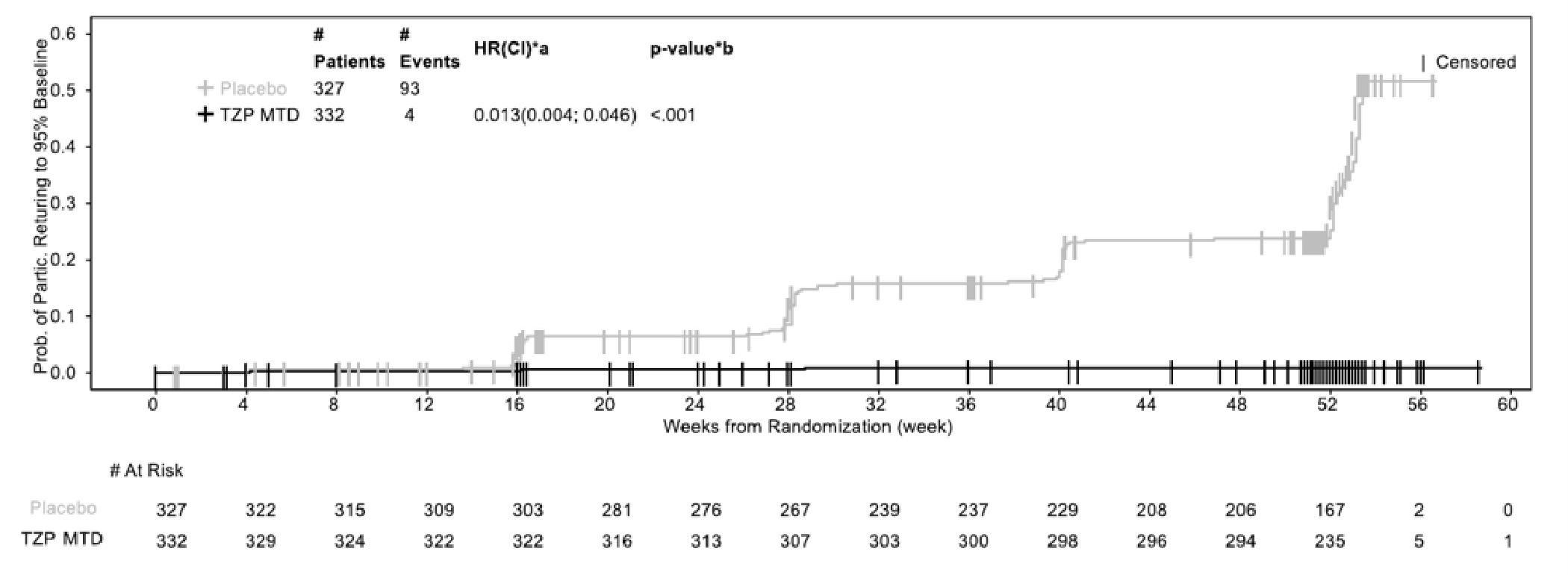
CI = confidence interval; DB = double blind; HR = hazard ratio; IWRS = interactive web response system; MI = myocardial infarction; MTD = maximum tolerated dose; NAFLD = nonalcoholic fatty liver disease; OSA = obstructive sleep apnea; T2DM = type 2 diabetes mellitus.
aUnstratified HR from Cox proportional hazard model with baseline weight (kg) for lead-in and analysis, with country, sex, IWRS MTD dose at week 36, and baseline weight (kg) for DB phase as covariates and 95% CI.
bLog-rank unstratified P value (2-sided) for comparison of treatment versus placebo based on model, with baseline weight (kg) for lead-in and analysis, with country, sex, IWRS MTD dose at week 36, and baseline weight (kg) for DB phase as covariates.
Source: SURMOUNT-4 Clinical Study Report.21
Harms
SURMOUNT-1 Trial
Key harm results at 72 weeks include the following:
Most patients in all groups reported at least 1 TEAE (tirzepatide 5 mg, 10 mg, and 15 mg: 78.9% to 81.8%; placebo: 72.0%). The most frequently reported TEAEs (≥ 5% in either group) in the tirzepatide groups were nausea (24.6% to 31.3% versus 9.5% in the placebo group), diarrhea (18.7% to 23.0% versus 7.3% in the placebo group), constipation (11.7% to 17.1% versus 5.8% in the placebo group) and COVID-19 (13.0% to 15.4% versus 14.0% in the placebo group); the incidence of these events, except for COVID-19, were higher across the tirzepatide groups versus the placebo group.
The incidence of 1 or more serious TEAEs was similar between the tirzepatide (5.1% to 6.9%) and placebo (6.8%) groups. No serious TEAE occurred in more than 1% of patients in any group.
Study treatment discontinuation due to TEAEs or death occurred among 4.8% to 7.2% of patients across the tirzepatide groups compared with 3.3% in the placebo group. The most frequently reported TEAE leading to treatment discontinuation across the tirzepatide groups was gastrointestinal disorders (1.9% to 4.4% versus 0.5% in the placebo group). All other TEAEs leading to treatment discontinuation occurred in less than 1% of patients in any group.
For notable harms, 1.3% to 3.0% of patients across the tirzepatide groups and 1.2% of patients in the placebo group reported hepatobiliary disorders. Severe gastrointestinal events occurred among 1.7% to 3.3% of patients across the tirzepatide groups and 1.1% of patients in the placebo group. The incidence of severe hypoglycemia, major adverse cardiovascular events, supraventricular arrhythmias and cardiac conduction disorders, renal disorders, major depressive disorders or suicidal behaviour and ideation, pancreatic events, C-cell hyperplasia and thyroid malignancies, and allergic or hypersensitivity reactions were similar and infrequent between groups.
The incidence of deaths was infrequent and similar between the tirzepatide (0.2% to 0.6%) and placebo (0.6%) groups.
SURMOUNT-2 Trial
Key harm results at 72 weeks include the following:
Most patients in all groups reported at least 1 TEAE (tirzepatide 10 mg and 15 mg: 71.4% to 77.6%; placebo: 75.9%). The most frequently reported TEAEs (≥ 5% in either group) in the tirzepatide groups were nausea (20.2% to 21.9% in the tirzepatide groups versus 6.3% in the placebo group), diarrhea (19.9% to 21.5% in the tirzepatide groups versus 8.9% in the placebo group), COVID-19 (10.6% to 17.0% in the tirzepatide groups versus 16.8% in the placebo group), vomiting (10.9% to 13.2% in the tirzepatide groups versus 3.2% in the placebo group), and decreased appetite (9.6% to 10.0% in the tirzepatide groups versus 2.2% in the placebo group). The incidence of these events, except for COVID-19, were higher across the tirzepatide groups versus the placebo group.
The incidence of 1 or more serious TEAEs was similar between the tirzepatide (5.8% to 8.7%) and placebo (7.3%) groups. No serious TEAE occurred in more than 2% of patients in any group.
Study treatment discontinuation due to TEAEs or death occurred among 4.5% to 7.4% of patients across the tirzepatide groups and 3.8% of patients in the placebo group. The most frequently reported TEAE across the tirzepatide groups was gastrointestinal disorders (1.0% to 4.5% in the tirzepatide groups versus 0.6% in the placebo group). All other TEAEs leading to treatment discontinuation occurred in less than 2% of patients in any group.
For notable harms, serious or severe gastrointestinal events occurred among 1.6% to 3.2% of patients across the tirzepatide groups and 1.3% of patients in the placebo group. All other notable harms were either infrequent or null, and this was similar between groups.
Two deaths were reported in the tirzepatide 10 mg group, and no deaths were reported in the placebo group.
SURMOUNT-4 Trial
Key harm results from week 36 to week 88 plus the 4-week safety follow-up include the following:
Most patients in all groups reported at least 1 TEAE (tirzepatide MTD [10 mg or 15 mg]: 60.3%; placebo: 55.8%). The most frequently reported TEAEs (≥ 5% in either group) in the tirzepatide MTD group were COVID-19 (14.0% for tirzepatide MTD versus 14.9% for placebo), diarrhea (10.7% for tirzepatide MTD versus 4.8% for placebo), nausea (8.1% for tirzepatide MTD versus 2.7% for placebo), and vomiting (5.7% for tirzepatide MTD versus 1.2% for placebo); the incidence of these events, except for COVID-19, were higher across the tirzepatide MTD group versus the placebo group.
The incidence of 1 or more serious TEAEs was similar between the tirzepatide MTD and placebo groups (3.0% in each group). No serious TEAEs occurred in more than 1% of patients in any group.
Study treatment discontinuation due to TEAEs or death occurred among 1.8% of patients in the tirzepatide MTD group compared with 0.9% of patients in the placebo group. The most frequently reported TEAE leading to study treatment discontinuation for the tirzepatide group was gastrointestinal disorders (1.2% for tirzepatide MTD versus 0% for placebo).
For notable harms, serious or severe gastrointestinal events occurred among 1.8% of patients in the tirzepatide MTD group and 0.3% of patients in the placebo group. All other notable harms were either infrequent or null and were similar between groups.
One death was reported in each of the tirzepatide MTD and placebo groups.
Table 5: Summary of Findings for Tirzepatide vs. Placebo for Patients With Obesity or Overweight With at Least 1 Weight‑Related Comorbid Condition
Outcome and follow‑up | Patients (studies), N | Relative effect OR (95% CI) | Absolute effects (95% CI) | Certainty | What happens | ||
|---|---|---|---|---|---|---|---|
Placebo | Tirzepatide | Difference | |||||
Weight outcomes (ITT population) | |||||||
Body weight, LS mean percent change from baseline Follow-up: 72 weeks | 2,539 (1 RCT: SURMOUNT-1) | NA | −3.1 | 5 mg: −15.0 (−15.9 to −14.2) 10 mg: −19.5 (−20.4 to −18.5) 15 mg: −20.9 (−21.8 to −19.9) | 5 mg: −11.9 (−13.4 to −10.4) 10 mg: −16.4 (−17.9 to −14.8) 15 mg: −17.8 (−19.3 to −16.3) | 5 mg: Moderate (serious study limitation)a 10 mg: Moderate (serious study limitation)a 15 mg: Moderate (serious study limitation)a | Tirzepatide 5 mg, 10 mg, and 15 mg likely result in a clinically important decrease in body weight at 72 weeks in patients with at least 1 weight-related comorbid condition (excluding T2DM) when compared with placebo. |
Body weight, LS mean percent change from baseline Follow-up: 72 weeks | 938 (1 RCT: SURMOUNT-2, patients with T2DM) | NA | −3.2 | 10 mg: −12.8 (NR) 15 mg: −14.7 (NR) | 10 mg: −9.6 (−11.1 to −8.1) 15 mg: −11.6 (−13.0 to −10.1) | 10 mg: Moderate (serious study limitation)a 15 mg: Moderate (serious study limitation)a | Tirzepatide 10 mg and 15 mg likely result in a clinically important decrease in body weight at 72 weeks in patients with T2DM when compared with placebo. |
Percentage of patients reaching ≥ 5% body weight reduction Follow-up: 72 weeks | 2,539 (1 RCT: SURMOUNT-1) | 5 mg: 23.9 (17.4 to 33.0) 10 mg: 73.6 (47.0 to 115.4) 15 mg: 75.5 (47.9 to 119.0) | 345 per 1,000 | 5 mg: 851 per 1,000 (81.6 to 88.6) 10 mg: 889 per 1,000 (85.9 to 91.9) 15 mg: 851 per 1,000 (81.6 to 88.6) | 5 mg: 504 more per 1,000 (445 more to 563 more) 10 mg: 546 more per 1,000 (492 more to 600 more) 15 mg: 565 more per 1,000 (600 more to 619 more) | 5 mg: Moderate (serious study limitation)a 10 mg: Moderate (serious study limitation)a 15 mg: Moderate (serious study limitation)a | Tirzepatide 5 mg, 10 mg, and 15 mg likely result in a clinically important increase in the proportion of patients with at least 1 weight-related comorbidity (excluding T2DM) who achieve ≥ 5% weight loss at 72 weeks when compared with placebo. |
Percentage of patients reaching ≥ 5% body weight reduction Follow-up: 72 weeks | 938 (1 RCT: SURMOUNT-2; patients with T2DM) | 10 mg: 8.30 (5.6 to 12.3) 15 mg: 10.50 (6.8 to 16.1) | 325 per 1,000 | 10 mg: 792 per 1,000 (NR) 15 mg: 828 per 1,000 (NR) | 10 mg: 469 more per 1,000 (397 more to 542 more) 15 mg: 505 more per 1,000 (432 more to 578 more) | 10 mg: Moderate (serious study limitation)a 15 mg: Moderate (serious study limitation)a | Tirzepatide 10 mg and 15 mg likely result in a clinically important increase in the proportion of patients with T2DM achieving ≥ 5% weight loss at 72 weeks when compared with placebo. |
Onset of T2DM (ITT population) | |||||||
Onset of T2DM Follow-up: 176 weeks | 1,032 (1 RCT: SURMOUNT-1, prediabetes subgroup) | NA | 182 per 1,000 | Pooled group (5 mg, 10 mg, 15 mg): 16 per 1,000 (8 to 30 per 1,000) | 166 fewer per 1,000 (NR) | Moderate (serious study limitation)b | Tirzepatide (5 mg, 10 mg, or 15 mg) likely result in a clinically important decrease in the proportion of patients whose condition progressed from prediabetes to T2DM at 176 weeks when compared with placebo. |
HRQoL measured by IWQOL-Lite-CT (modified ITT population) | |||||||
Total score, LS mean change from baseline; total scores range from 0 to 100, with higher scores indicating better quality of life and functioning Follow-up: 72 weeks | 2,096 (1 RCT: SURMOUNT-1) | NA | 10.5 | 5 mg: 18.6 (NR) 10 mg: 21.2 (NR) 15 mg: 22.6 (NR) | 5 mg: 8.1 (6.3 to 9.9) 10 mg: 10.7 (8.9 to 12.5) 15 mg: 12.1 (10.3 to 13.9) | 5 mg: Moderate (serious study limitation)c 10 mg: Moderate (serious study limitation)c 15 mg: Moderate (serious study limitation)c | Tirzepatide 5 mg, 10 mg, and 15 mg likely result in an increase in quality of life and functioning at 72 weeks in patients with at least 1 weight-related comorbid condition (excluding T2DM) when compared with placebo. The clinical importance of this increase is unclear. |
Total score, LS mean change from baseline; total scores range from 0 to 100, with higher scores indicating better quality of life and functioning Follow-up: 72 weeks | 821 (1 RCT: SURMOUNT-2, patients with T2DM) | NA | 7.9 | 10 mg: 12.8 (NR) 15 mg: 14.4 (NR) | 10 mg: 5.0 (2.9 to 7.0) 15 mg: 6.5 (4.5 to 8.5) | 10 mg: Moderate (serious study limitation)c 15 mg: Moderate (serious study limitation)c | Tirzepatide 10 mg and 15 mg likely result in an increase in quality of life and functioning at 72 weeks in patients with T2DM when compared with placebo. The clinical importance of this increase is unclear. |
Harms (safety analysis set) | |||||||
Proportion of patients with ≥ 1 serious TEAE Follow-up: 72 weeks | 2,539 (1 RCT: SURMOUNT-1) | NA | 68 per 1,000 | 5 mg: 63 per 1,000 (NR) 10 mg: 69 per 1,000 (NR) 15 mg: 51 per 1,000 (NR) | 5 mg: 3 fewer per 1,000 (30 fewer to 24 more) 10 mg: 1 more per 1,000 (26 fewer to 28 more) 15 mg: 17 fewer per 1,000 (42 fewer to 9 more) | 5 mg: Moderate (serious imprecision)d 10 mg: Moderate (serious imprecision)d 15 mg: Moderate (serious imprecision)d | Tirzepatide 5 mg, 10 mg, and 15 mg likely result in little to no difference in the proportion of patients experiencing serious TEAEs among those with at least 1 weight-related comorbid condition (excluding T2DM), at 72 weeks when compared with placebo. |
Proportion of patients with ≥ 1 serious TEAE Follow-up: 72 weeks | 938 (1 RCT: SURMOUNT-2, patients with T2DM) | NA | 73 per 1,000 | 10 mg: 58 per 1,000 (NR) 15 mg: 87 per 1,000 (NR) | 10 mg: 15 fewer per 1,000 (54 fewer to 23 more) 15 mg: 14 more per 1,000 (29 fewer to 56 more) | 10 mg: Moderate (serious imprecision)d 15 mg: Moderate (serious imprecision)d | Tirzepatide 10 mg and 15 mg likely result in little to no difference in the proportion of patients experiencing serious TEAEs at 72 weeks when compared with placebo. |
CDA-AMC = Canada’s Drug Agency; CI = confidence interval; HRQoL = health-related quality of life; IWQOL-Lite-CT = Impact of Weight on Quality of Life-Lite Clinical Trials Version; ITT = intention to treat; LS = least squares; NA = not applicable; NR = not reported; OR = odds ratio; RCT = randomized controlled trial; T2DM = type 2 diabetes mellitus; TEAE = treatment-emergent adverse event; vs. .= versus.
Note: Study limitations (which refer to internal validity or risk of bias), indirectness, imprecision of effects, and publication bias were considered when assessing the certainty of the evidence. All serious concerns in these domains that led to the rating down of the level of certainty are documented in the table footnotes.
aRated down 1 level for serious study limitations due to missing outcome data and deviations from the intended interventions. For the weight outcomes, a between-group difference of 5% at 72 weeks was clinically meaningful, according to the clinical experts.
bRated down 1 level for serious study limitations due to missing outcome data and deviations from the intended interventions. The clinical experts could not suggest a threshold for a clinically meaningful difference. In the absence of a known threshold for a clinically meaningful effect, the null was used as the threshold. Because the 95% CI of the absolute between-group difference was not reported, the 95% CI for the relative effect (hazard ratio) was used to judge the precision. The clinical meaningfulness of values within the 95% CI for the absolute between-group difference is unknown; however, the clinical experts suggested that the point estimate was clinically meaningful. The CDA-AMC team did not rate down the certainty of the evidence due to the unknown 95% CI.
cRated down 1 level for serious study limitations due to missing outcome data and deviations from the intended interventions. There was no known minimal important difference, so the target of certainty appraisal was any effect.
dRated down 1 level for serious imprecision due to the relatively small number of events contributing to the analyses. There was no known minimal important difference, so the target of certainty appraisal was any effect.
Sources: SURMOUNT-1 and SURMOUNT-2 Clinical Study Reports.19,20 Details included in the table are from the sponsor’s Summary of Clinical Evidence and additional information provided in the submission.
Table 6: Summary of Findings for Tirzepatide vs. Placebo for Patients With Obesity or Overweight With at Least 1 Weight-Related Comorbid Condition, Excluding T2DM (SURMOUNT-4 Trial)
Outcome and follow‑up | Patients (studies), N | Relative effect OR (95% CI) | Absolute effects (95% CI) | Certainty | What happens | ||
|---|---|---|---|---|---|---|---|
Placebo | Tirzepatide MTD (10 mg or 15 mg) | Difference | |||||
Weight outcomes (ITT population) | |||||||
Body weight, LS mean percent change from randomization (week 36) to week 88 Follow-up: 52 weeksa | 670 (1 RCT) | NA | 14.0 | −5.5 (−6.8 to −4.2) | −19.4 (−21.2 to −17.7) | Moderateb | Tirzepatide MTD likely results in a clinically important decrease in body weight at 88 weeks when compared with placebo. |
Percentage of patients reaching ≥ 5% body weight reduction from baseline (week 0) at week 88 Follow-up: 88 weeks | 670 (1 RCT) | 20.29 (7.72 to 53.33) | 703 per 1,000 | 973 per 1,000 (NR) | 203 more per 1,000 (77 to 533 more per 1,000) | Moderateb | Tirzepatide MTD likely results in a clinically important increase in the proportion of patients attaining 5% weight loss or greater at 88 weeks when compared with placebo. |
HRQoL measured by IWQOL-Lite-CT (modified ITT population) | |||||||
Total score, LS mean change from randomization (week 36) to week 88; total scores range from 0 to 100, with higher scores indicating better quality of life and functioning) Follow-up: 52 weeksa | 579 (1 RCT) | NA | −6.4 | 4.7 (NR) | 11.1 (8.9 to 13.3) | Moderatec | Tirzepatide MTD likely results in an increase in quality of life and functioning at 88 weeks when compared with placebo. The clinical importance of this increase is unclear. |
Harms (safety analysis set) | |||||||
Proportion of patients with ≥ 1 serious TEAEs Follow-up: 56 weeksd | 670 (1 RCT) | NA | 30 per 1,000 | 30 per 1,000 | < 1 fewer per 1,000 (26 fewer to 26 more per 1,000) | Moderatee | Tirzepatide MTD likely results in little to no difference in the proportion of patients with serious TEAEs when compared with placebo. |
CI = confidence interval; HRQoL = health-related quality of life; ITT = intention to treat; IWQOL-Lite-CT = Impact of Weight on Quality of Life-Lite Clinical Trials Version; LS = least squares; MTD = maximum tolerated dose; NA = not applicable; NR = not reported; OR = odds ratio; RCT = randomized controlled trial; T2DM = type 2 diabetes mellitus; TEAE = treatment-emergent adverse event.
Note: Study limitations (which refer to internal validity or risk of bias), inconsistency across studies, indirectness, imprecision of effects, and publication bias were considered when assessing the certainty of the evidence. All serious concerns in these domains that led to the rating down of the level of certainty are documented in the table footnotes.
aIn the SURMOUNT-4 trial, this outcome is measured during the randomized period (e.g., from week 36 to week 88).
bRated down 1 level for serious study limitations due to missing outcome data and deviations from the intended interventions. For the weight outcomes, a between-group difference of 5% was clinically meaningful, according to the clinical experts.
cRated down 1 level for serious risk of bias due to missing outcome data at 88 weeks. There was no known minimal important difference, so the target of certainty appraisal was any effect.
dIn the SURMOUNT-4 trial, safety data were collected over the randomized period (e.g., from week 36 to week 88) plus the 4 months of safety follow-up.
eRated down 1 level for serious imprecision due to the relatively small number of events contributing to the analyses. There was no known minimal important difference, so the target of certainty appraisal was any effect.
Sources: SURMOUNT-4 Clinical Study Report.21 Details included in the table are from the sponsor’s Summary of Clinical Evidence.
Long-Term Extension Studies
No long-term extension studies were submitted.
Indirect Evidence
No indirect treatment comparisons were submitted.
Studies Addressing Gaps in the Systematic Review Evidence
No studies addressing gaps were submitted.
Discussion
Three pivotal phase III, randomized, double-blind, placebo-controlled trials (SURMOUNT-1, SURMOUNT-2, and SURMOUNT-4) met the inclusion criteria for the systematic review conducted by the sponsor and have been summarized in this report.
The objective of the SURMOUNT-1 trial (N = 2,539) was to assess the efficacy and safety of tirzepatide 5 mg, 10 mg, and 15 mg, subcutaneous injection once weekly, versus placebo for weight management in adults with obesity (BMI ≥ 30 kg/m2) or with overweight (BMI ≥ 27 kg/m2) and at least 1 weight-related comorbid condition, excluding diabetes. All treatment groups received the intervention alongside a reduced-calorie diet and increased physical activity. Patients were required to have at least 1 self-reported unsuccessful dietary attempt to lose weight. Key exclusion criteria included a diagnosis of T1DM or T2DM, a change in body weight greater than 5 kg within 90 days before screening, previous or planned bariatric surgery for obesity, or use of weight-loss medications within 90 days before screening. At randomization, patients were classified as having either normoglycemia or prediabetes, according to the 2019 American Diabetes Association Standards of Medical Care in Diabetes. Those with prediabetes at randomization (i.e., prediabetes subgroup) continued in their assigned treatment group for an additional 104-week treatment period (176 weeks total), followed by a 17-week safety follow-up period, to assess progression to T2DM and long-term effects on body weight. The approved Health Canada indication aligned with the trial’s population, and the prediabetes subgroup aligned with the sponsor’s reimbursement request. Outcomes relevant to this review included percentage change in body weight from baseline, proportion of patients reaching a loss in body weight of 5% or more, onset of T2DM (prediabetes subgroup only), HRQoL measured by the IWQOL-Lite-CT total score, and serious TEAEs. Key baseline characteristics were generally well balanced across treatment groups. Patients had a mean age of 45 years (SD = 12.5 years), a mean BMI of 38.0 kg/m2 (SD = 6.8 kg/m2), a mean weight of 104.8 kg (SD = 22.1 kg), and an average obesity duration of 14.4 years (SD = 10.8 years). The majority were female (67.5%) and had a BMI of 30 kg/m2 or higher (94.5%). Overall, 40.6% had prediabetes at baseline, and nearly two-thirds had 1 or more weight-related comorbidities. The most common comorbidities were hypertension (32.3%), dyslipidemia (29.8%), anxiety or depression (16.6%), osteoarthritis (12.8%), and asthma or chronic obstructive pulmonary disease (10.5%). Additionally, 7.8% had OSA and 3.1% had atherosclerotic CVD.
The objective of the SURMOUNT-2 trial (N = 938) was to assess the efficacy and safety of once-weekly subcutaneous tirzepatide 10 mg and 15 mg compared with placebo for weight management in adults with T2DM and a BMI of 27 kg/m2 or higher. All treatment groups received the intervention alongside a reduced-calorie diet and increased physical activity. Patients were required to have a hemoglobin A1C of 7% to 10% (53 mmol/mol to 86 mmol/mol), be on stable therapy — defined as diet and exercise alone or oral antihyperglycemic medication for at least 3 months before screening — and have a history of 1 self-reported unsuccessful dietary attempt to lose weight. Key exclusion criteria included a diagnosis of T1DM, a change in body weight greater than 5 kg within 90 days before screening, previous or planned obesity-related surgery, and treatment with antiobesity medications, DPP-4 inhibitors, oral GLP-1 receptor agonists, or any injectable therapy for T2DM within 3 months before screening. Outcomes relevant to this review were the same as those in the SURMOUNT-1 trial, except for onset of T2DM. Key baseline characteristics were generally well balanced across treatment groups. Patients had a mean age of 54.2 years (SD = 10.6 years), a mean BMI of 36.1 kg/m2 (SD = 6.6 kg/m2), a mean weight of 100.7 kg (SD = 21.1 kg), an average duration of obesity of 17.7 years (SD = 11.5 years), and an average duration of T2DM of 8.5 years (SD = 6.5 years). Most patients were white (75.7%), with 13.3% of Asian origin, 8.2% of Black or African American origin, 2.5% of multiple origins, and 0.3% of Native Hawaiian or other Pacific Islander origin [from original source]. Most patients had a BMI of 30 kg/m2 or higher (82.8%) and 50.7% were female. The most reported weight-related comorbidities were hypertension (66.1%), dyslipidemia (61.1%), nonalcoholic fatty liver disease (17.3%), osteoarthritis (15.2%), anxiety or depression (11.8%), and atherosclerotic CVD (10.3%). Additionally, 8.4% had OSA and 10.3% had atherosclerotic CVD.
The objective of the SURMOUNT-4 trial was to assess the impact of tirzepatide MTD (10 mg or 15 mg), compared with placebo on the maintenance of weight loss among adults living with obesity (BMI of at least 30 kg/m2) or overweight (BMI of at least 27 kg/m2) and at least 1 weight-related comorbidity (excluding diabetes). After an initial 36-week open-label tirzepatide lead-in treatment period, patients were randomized to receive either tirzepatide MTD (10 mg or 15 mg) or placebo for 52 weeks. The inclusion and exclusion criteria of the SURMOUNT-4 trial aligned with those of the SURMOUNT-1 trial. The relevant outcomes of interest were similar to those for the SURMOUNT-1 trial, excluding time to onset of T2DM. In addition, the SURMOUNT-4 trial measured the time to first occurrence of patients returning to greater than 95% baseline weight among those who had already lost at least 5% of their body weight since week 0. Patients had a mean age of 48.7 years (SD = 12.6 years), a mean BMI of 30.5 kg/m2 (SD = 6.4 kg/m2), a mean weight of 85.2 kg (SD = 21.1 kg), and an average duration of obesity of 15.5 years (SD = 11.8 years). Most patients were white (80.1%); 7.2% were of Asian origin, 11.2% were of Black or African American origin, 1.2% were of multiple origins, and 0.3% were of Native Hawaiian or other Pacific Islander origin [from original source]. Most patients had a BMI of 30 kg/m2 or higher (45.6%) and 70.6% were female. The most reported weight-related comorbidities were hypertension (35.2%), dyslipidemia (31.6%), OSA (12.1%), and atherosclerotic CVD (6.1%). The proportion of patients with prediabetes was not reported.
Efficacy
The evidence from the 3 pivotal trials addressed treatment outcomes noted to be important by both patients and clinicians. The patient and clinician group inputs and the clinical experts indicated a need for safe and effective treatment options that achieve sustainable loss of at least 5% of body weight, improve comorbidities (such as T2DM, hypertension, dyslipidemia, sleep apnea, CVD), and enhance quality of life, physical function, mobility, and psychosocial well-being while maintaining long-term weight loss and preventing regain. The outcomes of weight are surrogate outcomes, and the effect of tirzepatide on important long-term outcomes such as major adverse cardiovascular events, osteoarthritis, OSA, and premature mortality was not evaluated. In addition, onset of T2DM is an intermediate outcome whose ability to predict patient-important final outcomes, like the prevention of micro- and macrovascular complications and premature death, will depend on subsequent disease management. Further, the extent of the delay to a T2DM diagnosis that is required to result in clinically meaningful changes in these final outcomes is not known, based on the evidence reviewed.
The SURMOUNT-1 and SURMOUNT-2 trials demonstrated that treatment with tirzepatide 5 mg, 10 mg, and 15 mg likely results in a clinically important decrease in body weight and a clinically important increase in the proportion of patients who achieved a 5% or greater loss in body weight at 72 weeks in adults with at least 1 weight-related comorbid condition or T2DM. For the GRADE assessment, a 5% between-group difference was considered by the clinical experts consulted by CDA-AMC to be clinically meaningful for both outcomes. Based on this threshold, the experts judged the effect estimates and CIs to be clinically meaningful, with moderate certainty of evidence, favouring tirzepatide. The moderate certainty was attributed to missing outcome data and deviations from the intended interventions. These results were consistent in the prediabetes subgroup at 176 weeks in the SURMOUNT-1 trial. For onset of T2DM in the prediabetes subgroup, the results demonstrated that tirzepatide likely results in a clinically important decrease in the proportion of patients with prediabetes that progressed to T2DM at 176 weeks. For the GRADE assessment, the clinical experts could not determine a threshold for a clinically meaningful between-group difference; therefore, the null was used as the threshold. The 95% CI for progression to diabetes was not reported, so the precision of the absolute effect is unknown. Because the 95% CI for the absolute between-group difference was unavailable, the 95% CI for the relative effect (hazard ratio) was used to judge the precision. Based on the point estimate, the clinical experts suggested there was likely a clinically meaningful between-group difference, with moderate certainty of evidence, favouring tirzepatide. The moderate certainty was attributed to missing outcome data and deviations from the intended interventions. In both the SURMOUNT-1 and SURMOUNT-2 trials, there was moderate certainty of evidence that tirzepatide likely results in an increase in quality of life and functioning at 72 weeks, as measured by IWQOL-Lite-CT total score. There was no established MID for this outcome; therefore, the target of certainty appraisal was any effect, and the clinical meaningfulness of the increase is uncertain. The moderate certainty was attributed to the potential risk of bias from missing outcome data and deviations from the intended interventions.
Moderate-certainty evidence from the SURMOUNT-4 trial demonstrated that treatment with tirzepatide MTD (10 mg or 15 mg) likely results in a clinically important decrease in body weight and an increase in the proportion of patients who achieved a 5% or greater loss in body weight over 52 weeks (week 36 to week 88) in adults living with obesity, or with overweight and at least 1 weight-related comorbidity, excluding diabetes. Similar to the SURMOUNT-1 and SURMOUNT-2 trials, the clinical experts consulted by CDA-AMC considered a 5% between-group difference to be clinically meaningful for both outcomes. Moreover, evidence for these outcomes was rated down for serious study limitations due to missing outcome data and deviations from the intended interventions. Moderate-certainty evidence from the SURMOUNT-4 trial demonstrated that tirzepatide MTD (10 mg or 15 mg) likely results in an increase in quality of life and functioning over 52 weeks, as measured by IWQOL-Lite-CT total score. Similar to what was noted for the SURMOUNT-1 and SURMOUNT-2 trials, there was no established between-group MID for this outcome, and the evidence was rated down 1 level due to the potential risk of bias from missing outcome data. The clinical meaningfulness of the between-group difference is uncertain. Although not formally included in the GRADE assessment, the SURMOUNT-4 trial also measured the time to first occurrence of patients returning to more than 95% of their baseline weight during week 36 and week 88 among those who had already lost 5% or more of their body weight since week 0. Among patients who had already lost 5% or more of their body weight since week 0, the probability of remaining event-free at 52 weeks was 98.8% among those who received tirzepatide and 75% among those who received placebo. The between-group difference with the CI was not reported, so the precision of the absolute effect is unknown.
All submitted RCTs assessed the treatment effects of tirzepatide plus a reduced calorie diet and increased physical activity versus a reduced calorie diet and increased physical activity alone, which is a relevant comparator for the overall population under review. However, the submission did not include direct or indirect evidence comparing tirzepatide versus the main comparators, including semaglutide (Ozempic) and semaglutide (Wegovy), in relevant subpopulations (i.e., in patients with obesity or with overweight and T2DM and in patients with obesity or with overweight and established CVD, respectively). The review team noted that the SURMOUNT-5 trial, a published head-to-head phase III trial comparing tirzepatide to semaglutide (Wegovy) for weight management in adults with obesity or with overweight and without diabetes, was not included in the submission to CDA-AMC. The sponsor noted that the SURMOUNT-5 trial was not included in the submission to CDA-AMC because Wegovy is not reimbursed by any public drug plans, the CDA-AMC recommendation for Wegovy was specifically for patients with established CVD, and there is minimal overlap with the populations in the SURMOUNT-1, SURMOUNT-2, and SURMOUNT-4 trials. Overall, the CDA-AMC review team noted that the absence of comparative evidence for tirzepatide versus semaglutide (Ozempic) and semaglutide (Wegovy) in the submission represents an important evidence gap.
Harms
Across both the SURMOUNT-1 and SURMOUNT-2 trials, most patients in all groups reported at least 1 TEAE. Patients in the tirzepatide groups reported more gastrointestinal TEAEs, particularly nausea and diarrhea, and more treatment discontinuations due to gastrointestinal TEAEs than patients in the placebo group. The clinical experts indicated that these TEAEs are generally manageable, with no consistent safety signal emerging, outside of the known gastrointestinal AEs. Serious TEAEs and deaths occurred at similar rates between groups. Based on the GRADE assessment for both the SURMOUNT-1 and SURMOUNT-2 trials, tirzepatide 5 mg, 10 mg, and 15 mg likely result in little to no difference in the proportion of patients experiencing serious TEAEs among those who had at least 1 weight-related comorbid condition. Because there was no established MID for this outcome, the target of certainty appraisal was any effect, and the moderate certainty was attributed to serious imprecision due to the relatively small number of events contributing to the analyses. All notable harms occurred in similar frequencies between groups and were infrequent or null; these included hepatobiliary disorders, severe gastrointestinal events, severe hypoglycemia, major cardiovascular events, supraventricular arrhythmias and cardiac conduction disorders, renal disorders, major depressive disorders or suicidal behaviour and ideation, pancreatic events, C-cell hyperplasia and thyroid malignancies, and allergic or hypersensitivity reactions.
During the open-label lead-in phase of the SURMOUNT-4 trial, 81% of patients experienced at least 1 TEAE, with the most common TEAEs being nausea, diarrhea, and constipation. During this phase, 2.0% of patients experienced serious TEAEs and 7.0% of patients discontinued treatment due to AEs. During the randomized period and safety follow-up phase, the proportions of patients who experienced TEAEs were similar between the tirzepatide MTD (10 mg or 15 mg) and placebo groups. The most frequently reported TEAEs (≥ 5% in either group) in the tirzepatide groups were COVID-19 (14.0% for tirzepatide MTD versus 14.9% for placebo), diarrhea (10.7% for tirzepatide MTD versus 4.8% for placebo), nausea (8.1% for tirzepatide MTD versus 2.7% for placebo), and vomiting (5.7% for tirzepatide MTD versus 1.2% for placebo). Moderate-certainty evidence from the SURMOUNT-4 trial suggested that tirzepatide MTD (10 mg or 15 mg) likely results in little to no difference in serious TEAEs compared with placebo. Similar to the SURMOUNT-1 and SURMOUNT-2 trials, there was no established MID for this outcome, and evidence was rated down for very serious imprecision due to the relatively small number of events contributing to the analyses. Because the incidence of severe or serious gastrointestinal events was low, conclusions around the comparative effect for this harm are uncertain. Rates of other AEs of special interest, which included malignancies, adjudicated major cardiovascular events, and severe or serious gallbladder disease, were low across the treatment groups.
Ethics and Equity Considerations
The clinical experts noted that the racial breakdown of patients across the 3 trials did not fully reflect Canadian clinical practice — particularly with respect to patients of Indigenous and South Asian descent, who were not represented across the trials. According to the experts, individuals facing social and geographic disadvantage — such as those with lower socioeconomic status, Indigenous Peoples, racialized communities, and people living in rural or remote regions — experience higher rates of obesity and cardiometabolic disease. They noted that this pattern is driven by a combination of structural barriers, including limited access to affordable healthy foods, fewer opportunities for physical activity, higher levels of chronic stress, and reduced access to timely or specialized medical care. The experts also noted that in Canada, access to current treatments is limited by availability in specialized or urban centres, high costs, and restricted public reimbursement. In addition, patients may face substantial burden related to accessing medication and coverage, weekly injections, frequent clinic visits, and communication with health care providers, as well as potential side effects. Once people seek help, they often encounter additional barriers: stigma, delayed diagnosis, long wait times, poor communication or follow-up, and limited public coverage for obesity medications.
Conclusion
Evidence from 3 phase III, randomized, double-blind controlled trials (SURMOUNT-1, SURMOUNT-2, and SURMOUNT-4) reported on outcomes that were important to both the patients and clinicians who provided input for this review. The trials demonstrated moderate-certainty evidence that treatment with tirzepatide 5 mg, 10 mg, and 15 mg in adults with obesity or with overweight and at least 1 weight-related comorbidity likely results in a clinically meaningful reduction in body weight and a clinically important increase in the proportion of patients achieving a 5% or greater loss in body weight at 52 to 72 weeks compared with placebo. In the SURMOUNT-1 trial, these results remained consistent in patients with prediabetes (reimbursement request population) at baseline through 176 weeks and likely led to a clinically important reduction in the proportion of patients with prediabetes that progressed to T2DM. Based on the SURMOUNT-4 trial results, more patients who discontinued tirzepatide treatment returned to more than 95% of their baseline weight compared with those who continued treatment. There was moderate-certainty evidence across trials indicating an improvement in quality of life and functioning at 52 to 72 weeks, and this result was maintained in the prediabetes subgroup of the SURMOUNT-1 trial at 176 weeks; however, the clinical meaningfulness of the between-group difference is uncertain in all 3 trials. Based on the evidence submitted to CDA-AMC, the effect of tirzepatide on important long-term outcomes such as major adverse cardiovascular events, osteoarthritis, OSA, or premature mortality is unknown. Across trials, there were no notable safety signals identified and, according to the clinical experts consulted, the safety profile of tirzepatide appears to be manageable, although harms occurring with a longer duration of treatment are not known. There was no evidence to inform how tirzepatide compares with semaglutide (Ozempic) in adults with obesity or with overweight and T2DM, or with semaglutide (Wegovy) in adults with obesity or with overweight and established CVD, representing a gap in the submitted evidence.
Economic Review
Methods
The review team appraised the pharmacoeconomic evidence submitted by the sponsor on the cost-effectiveness and budget impact of tirzepatide as an adjunct to a reduced-calorie diet and increased physical activity (diet and exercise) versus diet and exercise alone for chronic weight management in the Health Canada–indicated population (i.e., adults with an initial BMI of 30 kg/m2 or greater, or with an initial BMI of 27 kg/m2 or greater and at least 1 weight-related comorbid condition, such as hypertension, dyslipidemia, T2DM, OSA, or CVD). The sponsor also submitted analyses that assessed the cost-effectiveness of tirzepatide versus diet and exercise in the requested reimbursement population (i.e., adults with an initial BMI of 27 kg/m2 or greater and prediabetes), which is narrower than the Health Canada indication.
Summary of the Submitted Economic Evaluation
The sponsor submitted a cost-utility analysis to estimate the cost-effectiveness of tirzepatide from the perspective of a public health care payer in Canada over a lifetime horizon (maximum 100 years of age). The modelled population in the sponsor’s base case comprised patients aged 18 years or older with a BMI of 30 kg/m2 or greater or with a BMI of 27 kg/m2 or greater and at least 1 weight-related complication, which is aligned with the Health Canada indication and was based on the participants in the SURMOUNT-1 trial. The sponsor’s base-case analysis included costs related to drug acquisition, administration and monitoring, clinical events, and AE management.
In the sponsor’s base case, which reflects the Health Canada–indicated population, tirzepatide 5 mg was associated with incremental costs of $71,635 and 2.79 incremental quality-adjusted life-years (QALYs) compared with diet and exercise, resulting in an incremental cost-effectiveness ratio (ICER) of $25,682 per QALY gained. Compared to diet and exercise, tirzepatide 10 mg was associated with an ICER of $31,372 per QALY gained (incremental costs = $104,184; incremental QALYs = 3.32) and tirzepatide 15 mg was associated with an ICER of $40,433 per QALY gained (incremental costs: $146,191; incremental QALYs: 3.62).
In the sponsor’s scenario analysis that reflects the requested reimbursement population, the ICER for tirzepatide 5 mg was $22,885 per QALY gained compared to diet and exercise, while tirzepatide 10 mg and tirzepatide 15 mg were associated with ICERs of $29,192 and $38,203, respectively, per QALY gained.
Additional information about the sponsor’s submission is summarized in the Supplemental Material document, Appendix 10.
CDA-AMC identified several key issues with the sponsor’s analysis (refer to Table 7; full details are provided in the Supplemental Material document, Appendix 11).
Table 7: Key Issues With the Sponsor’s Economic Submission
Issue | What evidence is there to inform this issue? | How was this issue addressed by CDA-AMC? | Did CDA-AMC explore uncertainty in a scenario analysis? |
|---|---|---|---|
The impact of tirzepatide on clinical events is highly uncertain. | The impact of tirzepatide on clinical events was not assessed in the SURMOUNT-1 trial, with the exception of progression to T2DM. The risk of clinical events in the economic model was derived using predictive risk equations, which used surrogate outcomes from the SURMOUNT-1 trial (weight, SBP, HDL, total cholesterol, reversal of prediabetes). Whether the risk equations used by the sponsor accurately predict the risk of future events in this population is highly uncertain. Without randomized evidence, it is challenging to determine causation and correlation between weight-related comorbidities and, therefore, the impact of weight loss on such events. | CDA-AMC was unable to address this limitation due to a lack of clinical data regarding the impact of tirzepatide on clinical events. | CDA-AMC conducted a scenario analysis in which the costs and disutilities associated with clinical events were excluded (except for T2DM). |
The impact of tirzepatide on HRQoL is uncertain and is likely double counted in the sponsor’s model. | Although HRQoL data were collected in the SURMOUNT-1 trial, direct evidence on the impact of tirzepatide on HRQoL was not incorporated in the economic model. The sponsor included both BMI-specific utilities and complication-specific disutilities from the literature, which may double count the impact of some complications. | CDA-AMC excluded complication-specific disutilities for OSA, NAFLD, and poststroke because the impact of these complications was likely captured in the BMI-specific utilities used by the sponsor. | No scenario analysis was conducted. |
The impact of tirzepatide on mortality is highly uncertain. | The impact of tirzepatide on mortality was not assessed in the clinical trials submitted to CDA-AMC as part of this review. There are several issues related to how the sponsor modelled the risk of death in the economic model, including likely double counting of risk by use of both BMI-specific and complication-specific mortality risks, the assumption that a reduction in BMI leads to an immediate decrease in the risk of death, overestimated case-fatality rates, and an overestimated risk of fatal CV events. | CDA-AMC excluded BMI-specific mortality from the model, used alternative fatality rates for MI and stroke, and calibrated the risk of CV death. | No scenario analysis was conducted. |
The long-term benefits of tirzepatide are highly uncertain. | The predicted incremental gains in LYs and QALYs with tirzepatide were derived based on improvements in surrogate outcomes in the SURMOUNT-1 trial, extrapolated to the entire model horizon. Approximately 99% of QALYs were accrued in the extrapolated period of the model. Modelling assumptions resulted in the relative effectiveness of tirzepatide increasing over time after the duration of the SURMOUNT-1 trial, which is not supported by the submitted evidence. | CDA-AMC assumed that the relative effectiveness of tirzepatide vs. diet and exercise will remain constant from the end of the SURMOUNT-1 trial until the end of model horizon or death. | No scenario analysis was conducted. |
The cost-effectiveness of tirzepatide across different patient subgroups is highly uncertain. | The Health Canada indication reflects a heterogeneous group of patients, with the magnitude of benefit of tirzepatide potentially varying across subgroups based on comorbidities and weight categories. Efficacy data from the SURMOUNT-1 trial, which included patients without T2DM (mean BMI of 38.0 kg/m2), were applied to all patients in the economic model regardless of T2DM status or starting BMI. | CDA-AMC was unable to fully address heterogeneity in the modelled population. | CDA-AMC conducted a scenario analysis to explore the cost-effectiveness of tirzepatide in patients with prediabetes (requested reimbursement population). CDA-AMC also conducted scenario analyses to explore cost-effectiveness in various subgroups based on starting BMI but were unable to explore cost-effectiveness other in clinically relevant subgroups (e.g., patients with or without CV disease) owing to the structure of the sponsor’s model and the lack of clinical data to inform such analyses. |
The modelled treatment pathway does not reflect clinical practice in Canada. | Patients who lost less than 5% of body weight on tirzepatide 5 mg, 10 mg, or 15 mg were assumed to discontinue treatment and receive diet and exercise alone. The clinical experts consulted by CDA-AMC indicated that patients who do not experience adequate weight loss at lower doses of tirzepatide would be expected to trial a higher dose rather than discontinue treatment altogether. Additionally, patients who developed T2DM during the model horizon received treatment for T2DM; however, treatment was assumed to impact hemoglobin A1C levels only (and not other surrogate outcomes, including weight). | CDA-AMC was unable to address these issues. The CDA-AMC base case provides pairwise ICERs for each dose of tirzepatide vs. diet and exercise as well as sequential ICERs; however, neither approach adequately captures the dose intensification pathway likely to be used in practice.a Thus, there is no 1 ICER that could be determined for tirzepatide vs. diet and exercise. | No scenario analysis was conducted. |
The omission of semaglutide (Ozempic) as a comparator in the T2DM subgroup of the Health Canada–indicated population is inappropriate. | A subgroup of patients in the Health Canada–indicated population are expected to have T2DM and thus be eligible for semaglutide (Ozempic). The clinical experts consulted by CDA-AMC indicated that up to approximately 10% of patients with overweight and 20% of patients with obesity may have T2DM. | CDA-AMC was unable to address this issue owing to a lack of clinical evidence submitted by the sponsor to inform how tirzepatide compares with semaglutide (Ozempic) in adults with overweight or obesity and T2DM. This limitation does not apply to the reimbursement request as these patients explicitly do not have T2DM at initiation. | No scenario analysis was conducted. |
BIA = budget impact analysis; BMI = body mass index; CDA-AMC = Canada’s Drug Agency; CV = cardiovascular; HDL = high-density lipoprotein; HRQoL = health-related quality of life; LY = life-year; MI = myocardial infarction; NAFLD = nonalcoholic fatty liver disease; OSA = obstructive sleep apnea; QALY = quality-adjusted life-year; SBP = systolic blood pressure; T2DM = type 2 diabetes mellitus; vs. = versus.
Note: Full details of the issues identified by CDA-AMC are provided in Supplemental Material, Appendix 11.
aIssues regarding dose intensification are expected to impact the tirzepatide 5 mg and 10 mg analyses only because 15 mg is the maximum recommended dose.
CDA-AMC Assessment of Cost-Effectiveness
The CDA-AMC base case was derived by making changes to model parameter values and assumptions (refer to the Supplemental Material document, Appendix 11, Table 15), in consultation with clinical experts. Detailed information about the CDA-AMC base case is provided in the Supplemental Material document, Appendix 11.
Impact on Health Care Costs
Tirzepatide 5 mg, 10 mg, and 15 mg are predicted to be associated with additional health care costs compared to diet and exercise (incremental costs of $69,235, $99,788, and $140,927, respectively, over a lifetime horizon). This increase in health care spending results from the drug acquisition costs associated with tirzepatide (refer to Figure 2). Over a lifetime time horizon, cost savings to the health system related to weight-related comorbidities are estimated to be between $16,529 and $19,288 when comparing tirzepatide to diet and exercise alone, depending on tirzepatide dose. The majority (approximately 63% to 68%) of these savings come from reduced costs associated with T2DM because, in the economic analysis, tirzepatide delays and/or prevents T2DM onset.
Figure 2: Impact of Tirzepatide vs. Diet and Exercise on Health Care Costs
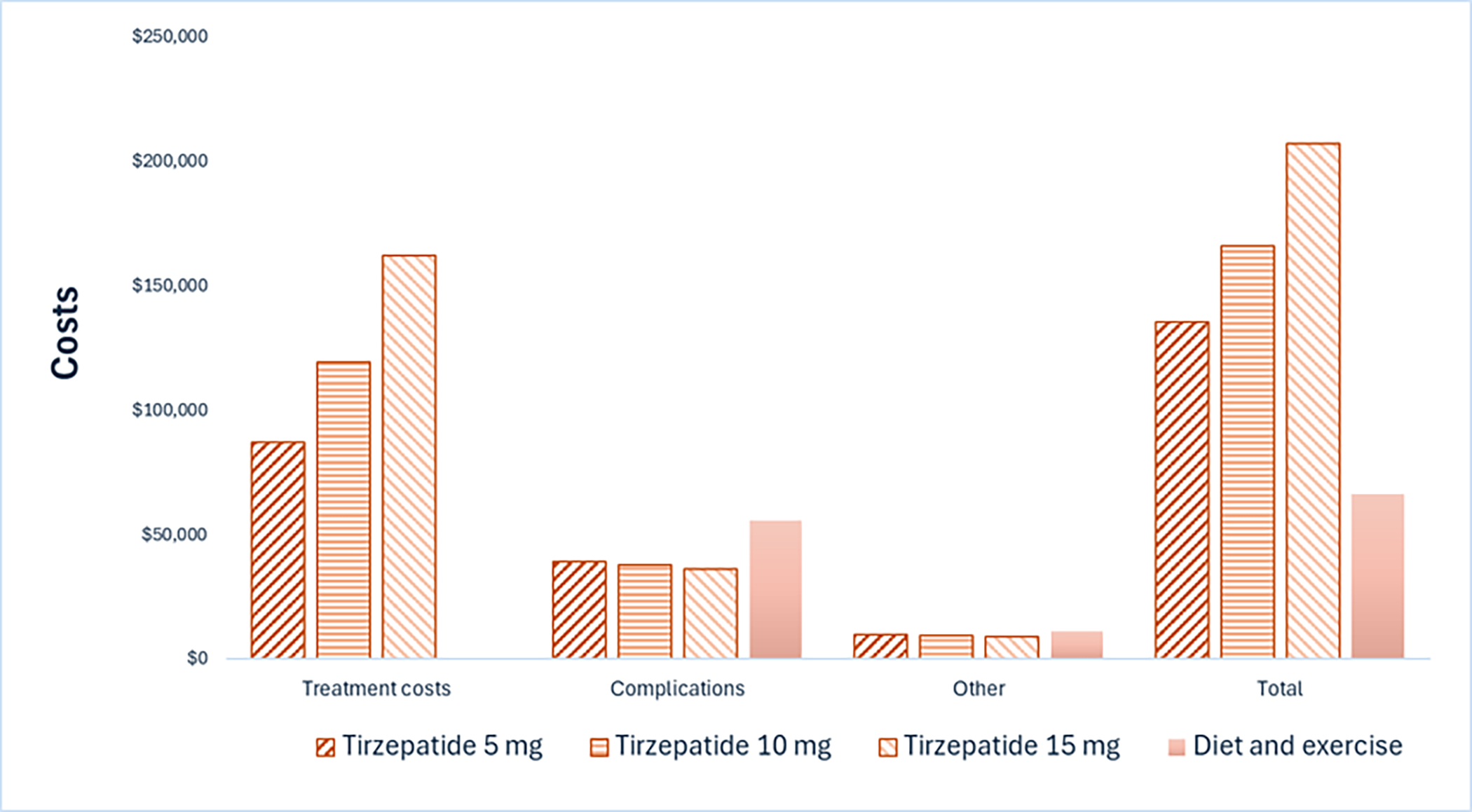
vs. = versus.
Notes: The “other” category includes costs related to administration, adverse events, and monitoring.
Based on the Health Canada–indicated population.
Impact on Health
Relative to diet and exercise, tirzepatide 5 mg, 10 mg, and 15 mg are predicted to result in 0.11, 0.12, and 0.14 additional life-years per patient, respectively, over a lifetime horizon. When considering quality and duration of life, tirzepatide 5 mg, 10 mg, and 15 mg are associated in the CDA-AMC base case with 0.66, 0.77, and 0.87 additional QALYs per patient, respectively, versus diet and exercise (refer to the Supplemental Material document, Appendix 11, Table 17). Additionally, tirzepatide 5 mg, 10 mg, and 15 mg are generally predicted to result in a lower incidence of complications (incremental difference ranging from 6 to 220 fewer events per 1,000 patients) compared to diet and exercise (refer to Figure 3).
Figure 3: Incidence of Complications in the CDA-AMC Base Case
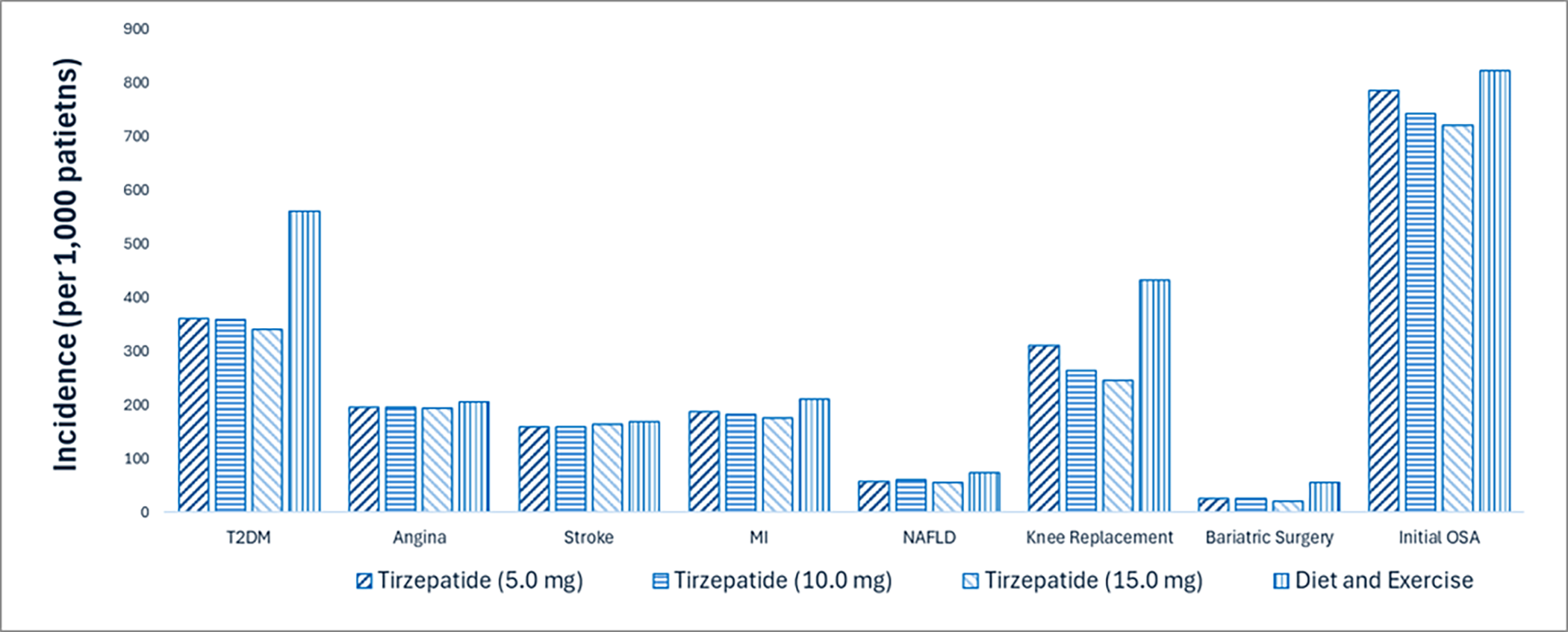
CDA-AMC = Canada’s Drug Agency; MI = myocardial infarction; NAFLD = nonalcoholic fatty liver disease; OSA = obstructive sleep apnea; T2DM = type 2 diabetes mellitus.
Note: Based on the Health Canada–indicated population.
Overall Results
Compared to diet and exercise, results of the CDA-AMC base-case analysis suggest an ICER of $105,609 per QALY gained for tirzepatide 5 mg, $129,856 per QALY gained for tirzepatide 10 mg, and $161,860 per QALY gained for tirzepatide 15 mg over a lifetime horizon (refer to Table 8).
In the scenario reflecting the requested reimbursement population, the ICERs for tirzepatide 5 mg, tirzepatide 10 mg, and tirzepatide 15 mg were $77,871 per QALY gained, $97,940 per QALY gained, and $123,265 per QALY gained, respectively, compared to diet and exercise (refer to Table 8).
Table 8: Summary of CDA-AMC Economic Evaluation Results
Drug | Total costs ($) | Total QALYs | ICER vs. diet and exercise ($/QALY) | Sequential ICER ($/QALY) |
|---|---|---|---|---|
Health Canada populationa | ||||
Diet and exercise | 66,194 | 24.88 | Reference | Reference |
Tirzepatide 5 mg | 135,428 | 25.54 | 105,609 | 105,609 vs. diet and exercise |
Tirzepatide 10 mg | 165,982 | 25.65 | 129,856 | 270,687 vs. tirzepatide 5 mg |
Tirzepatide 15 mg | 207,121 | 25.76 | 161,860 | 402,438 vs. tirzepatide 10 mg |
Requested reimbursement populationb | ||||
Diet and exercise | 78,036 | 22.98 | Reference | Reference |
Tirzepatide 5 mg | 133,553 | 23.69 | 77,871 | 77,871 vs. diet and exercise |
Tirzepatide 10 mg | 161,628 | 23.83 | 97,940 | 199,720 vs. tirzepatide 5 mg |
Tirzepatide 15 mg | 198,847 | 23.96 | 123,265 | 294,005 vs. tirzepatide 10 mg |
BMI = body mass index; CDA-AMC = Canada’s Drug Agency; ICER = incremental cost-effectiveness ratio; QALY = quality-adjusted life-year; T2DM = type 2 diabetes mellitus; vs. = versus.
Note: Results of deterministic analyses are presented, which reflect a cohort of 1,000 patients.
aAdults with an initial BMI of 30 kg/m2 or greater or adults with an initial BMI of 27 kg/m2 or greater and at least 1 weight-related comorbid condition (e.g., hypertension, dyslipidemia, T2DM, obstructive sleep apnea, or cardiovascular disease).
bAdults with an initial BMI of 27 kg/m2 or greater and prediabetes.
Uncertainty and Sensitivity
The results of the CDA-AMC base-case analyses for tirzepatide 5 mg, 10 mg, and 15 mg compared with diet and exercise are highly uncertain due to issues that could not be resolved by CDA-AMC, including a lack of clinical data to support a reduction in long-term clinical events or risk of mortality with tirzepatide and uncertainty related to the use of surrogate outcomes and predictive risk equations to estimate the risk of clinical events. Notably, approximately 97% of incremental QALYs in the CDA-AMC base case were accrued in the extrapolation period, for which there are no data to support the impact of tirzepatide on patient health. In a scenario that excluded the impact of tirzepatide on clinical events, the ICERs increased to $120,496, $146,354, and $180,283 for tirzepatide 5 mg, tirzepatide 10 mg, and tirzepatide 15 mg, respectively, compared to diet and exercise.
As noted in the Key Issues of the Submitted Economic Evaluation section of the Supplemental Material document (Appendix 11), the full Health Canada indication is a heterogeneous population, and it is uncertain whether the cost-effectiveness of tirzepatide varies across subgroups based on comorbidity and/or weight category. CDA-AMC conducted scenario analyses to explore the cost-effectiveness of tirzepatide in subgroups stratified by starting BMI (< 30 kg/m2, 30 kg/m2 to 35 kg/m2, 35 kg/m2 to 40 kg/m2, and > 40 kg/m2) but was unable to explore the cost-effectiveness of tirzepatide in subgroups based on comorbidity (other than for the requested reimbursement subgroup). In the CDA-AMC scenario analyses that explore the cost-effectiveness of tirzepatide based on starting BMI, as the starting BMI of the cohort increases, the ICER decreases, driven primarily by increased QALYs. For example, the ICER for tirzepatide 15 mg compared with diet and exercise among patients with a starting BMI of less than 30 kg/m2 was $259,436, whereas the ICER was $158,310 among patients with a starting BMI greater than 40 kg/m2, suggesting that the cost-effectiveness of tirzepatide differs, depending on starting BMI.
Finally, there are elements of the model that could not be explored in relation to expected clinical practice in Canada. For example, many patients in Canada who develop T2DM will receive semaglutide, which has clinical benefit for hemoglobin A1C control as well as weight reduction; however, patients in the economic model did not experience the weight-related benefits of such treatment. CDA-AMC could not address this issue owing to the structure of the sponsor’s model; thus, the clinical benefit predicted by the model for patients with a reduced-calorie diet and increased physical activity are underestimated and likely bias the results in favour of tirzepatide.
Summary of the Budget Impact
The sponsor submitted a budget impact analysis to estimate the 3-year (2027 to 2029) budget impact of reimbursing tirzepatide for chronic weight management in the Health Canada–indicated population (i.e., patients with an initial BMI of 30 kg/m2 or greater, or patients with a BMI of 27 kg/m2 or greater and at least 1 weight-related comorbid condition, such as hypertension, dyslipidemia, T2DM, OSA, or CVD). The sponsor additionally submitted a scenario exploring the budget impact of reimbursing tirzepatide for the requested reimbursement population (i.e., adults with a BMI of 27 kg/m2 or greater and prediabetes). The sponsor assumed that the payer would be CDA-AMC–participating public drug plans and derived the size of the eligible population using an epidemiologic approach. The price of tirzepatide was aligned with the price included in the sponsor’s economic evaluation, while the prices of comparators were based on the publicly available list prices. Additional information pertaining to the sponsor’s submission is provided in the Supplemental Material document, Appendix 12.
CDA-AMC identified a number of issues with the sponsor’s estimated budget impact and made changes to model parameters and assumptions in consultation with the clinical experts to derive the CDA-AMC base case (Supplemental Material document, Appendix 12). CDA-AMC estimated that by year 3 of reimbursement, 1,302,993 patients would be eligible for tirzepatide; of these, 495,137 patients would be expected to receive tirzepatide if reimbursed for the Health Canada–indicated population, leading to an estimated incremental budget impact of approximately $5.8 billion over the first 3 years (expenditure on tirzepatide = $6.2 billion). For the requested reimbursement population, CDA-AMC estimated the incremental budget impact to be approximately $2.4 billion over the first 3 years (expenditure on tirzepatide = $2.4 billion). The actual budget impact in both the Health Canada–indicated and requested reimbursement populations will depend on the number of people eligible for treatment and the distribution of the tirzepatide doses used in clinical practice.
Conclusion
Based on the CDA-AMC base case, tirzepatide 5 mg, 10 mg, and 15 mg would be considered cost-effective at the submitted price if the public health care system were willing to pay at least $105,609, $129,856, and $161,860, respectively, for each additional QALY gained. In the requested reimbursement population, tirzepatide 5 mg, 10 mg, and 15 mg would be considered cost-effective at the submitted price if the public health care system were willing to pay at least $77,871, $97,940, and $123,265, respectively, for each additional QALY gained. If the public health care system is not willing to pay that amount, a price reduction should be considered (refer to Figure 4). Full details of the impact of price reductions on cost-effectiveness are presented in the Supplemental Material document, Appendix 11, along with price reductions that should be considered if tirzepatide is reimbursed for the sponsor’s requested reimbursement population.
The estimated cost-effectiveness of tirzepatide compared to diet and exercise is highly uncertain due to the lack of long-term evidence to inform the impact of tirzepatide on clinical events and mortality. Owing to the lack of such long-term data, the submitted analysis, and hence the CDA-AMC base case, relies on surrogate outcomes and predictive risk equations to estimate the long-term health benefits of tirzepatide. If the impact of tirzepatide on clinical events and/or mortality is lower than predicted in the sponsor’s model, the predicted life-years and QALYs will be lower than in the CDA-AMC base case. The submitted analysis also uses the baseline population derived from the SURMOUNT-1 trial, which does not represent the distribution of patients with either obesity or overweight in the population of people in Canada with a BMI of more than 27 kg/m2 (i.e., people with a higher initial BMI [i.e., with obesity] were overrepresented in the SURMOUNT-1 trial versus in the population of Canada). As shown in the scenario analyses conducted by CDA-AMC, the cost-effectiveness of tirzepatide improves as the starting BMI of the cohort increases; therefore, all analyses not stratified by weight overestimate the cost-effectiveness of tirzepatide when applied to the population in Canada.
The budget impact to the public drug plans of reimbursing tirzepatide for the Health Canada–indicated population (i.e., adults with an initial BMI of 30 kg/m2 or greater or adults with an initial BMI of 27 kg/m2 or greater and at least 1 weight-related comorbid condition, such as hypertension, dyslipidemia, T2DM, OSA, or CVD) in the first 3 years is estimated to be approximately $5.8 billion (3-year expenditure on tirzepatide: $6.2 billion). If reimbursed for patients with a BMI of 27 kg/m2 or greater and prediabetes (the sponsor’s requested reimbursement population), CDA-AMC estimates that the 3-year budget impact will be approximately $2.4 billion (expenditure on tirzepatide: $2.4 billion). In both populations, the actual budget impact of reimbursing tirzepatide will depend on the number of eligible patients and the usage of each tirzepatide dose (i.e., the proportion of patients who receive 5 mg, 10 mg, or 15 mg).
Figure 4: Summary of the CDA-AMC Economic Analysis and Price Reduction — Health Canada–Indicated Population

CDA-AMC = Canada’s Drug Agency; ICER = incremental cost-effectiveness ratio; QALY = quality-adjusted life-year.
Note: Expenditure includes only the drug cost of tirzepatide. The term dominant indicates that a drug costs less and provides more QALYs than the comparator. For price reductions pertaining to the requested reimbursement population, refer to the Supplemental Material document, Appendix 11.
References
1.World Health Organization. Obesity. Accessed October 20, 2025. https://www.who.int/health-topics/obesity/#tab=tab_1
2.Health Canada. Obesity. 2006.
3.Canada PHAo. Executive summary: Obesity in Canada. Public Health Agency of Canada; 2017. https://www.canada.ca/en/public-health/services/health-promotion/healthy-living/obesity-canada/summary.html
4.Capoccia D, Milani I, Colangeli L, Parrotta ME, Leonetti F, Guglielmi V. Social, cultural and ethnic determinants of obesity: From pathogenesis to treatment. Nutr Metab Cardiovasc Dis. 2025;35(6):103901. doi:10.1016/j.numecd.2025.103901 PubMed
5.Yuen M, Earle R, Kadambi N. A systematic review and evaluation of current evidence reveals 236 obesity-associated disorders. New Orleans: The Obesity Society. 2016.
6.Sarma S, Sockalingam S, Dash S. Obesity as a multisystem disease: Trends in obesity rates and obesity-related complications. Diabetes Obes Metab. 2021;23 Suppl 1:3-16. doi:10.1111/dom.14290 PubMed
7.National Cancer Institute. Obesity and Cancer. 2025. https://www.cancer.gov/about-cancer/causes-prevention/risk/obesity/obesity-fact-sheet#:~:text=How%20might%20obesity%20increase%20the%20risk%20of%20cancer%3F,insulin-like%20growth%20factor%20-1%20%28IGF-1%29.%20...%20More%20items
8.Kinlen D, Cody D, O'Shea D. Complications of obesity. QJM. 2018;111(7):437-443. doi:10.1093/qjmed/hcx152 PubMed
9.Statistics Canada. Data from: Table 13-10-0373-01 Overweight and obesity based on measured body mass index, by age group and sex. 2025-10-02.
10.Diabetes Canada Clinical Practice Guidelines Expert Committee. Diabetes Canada 2018 Clinical Practice Guidelines for the Prevention and Management of Diabetes in Canada. Can J Diabetes. 2018;42(Suppl 1):S1-S325.
11.Diabetes Canada Clinical Practice Guidelines Expert Committee, Punthakee Z, Goldenberg R, Katz P. Definition, Classification and Diagnosis of Diabetes, Prediabetes and Metabolic Syndrome. Can J Diabetes. 2018;42 Suppl 1:S10-S15. doi:10.1016/j.jcjd.2017.10.003 PubMed
12.American Diabetes Association Professional Practice Committee for Diabetes. 2. Diagnosis and Classification of Diabetes: Standards of Care in Diabetes-2026. Diabetes Care. 2026;49(Supplement_1):S27-S49. doi:10.2337/dc26-S002 PubMed
13.Huang Y, Cai X, Mai W, Li M, Hu Y. Association between prediabetes and risk of cardiovascular disease and all cause mortality: systematic review and meta-analysis. BMJ. 2016;355:i5953. doi:10.1136/bmj.i5953 PubMed
14.Thiab S, Akhal T, Akeblersane M, Sheth H, Atkin SL, Butler AE. Microvascular complications in prediabetes: a systematic review & meta-analysis. Diabetes Res Clin Pract. 2025;225:112261. doi:10.1016/j.diabres.2025.112261 PubMed
15.Rooney MR, Wallace AS, Echouffo Tcheugui JB, et al. Prediabetes is associated with elevated risk of clinical outcomes even without progression to diabetes. Diabetologia. 2025;68(2):357-366. doi:10.1007/s00125-024-06315-0 PubMed
16.Hauguel-Moreau M, Hergault H, Cazabat L, et al. Prevalence of prediabetes and undiagnosed diabetes in a large urban middle-aged population: the CARVAR 92 cohort. Cardiovasc Diabetol. 2023;22(1):31. doi:10.1186/s12933-023-01761-3 PubMed
17.Andes LJ, Cheng YJ, Rolka DB, Gregg EW, Imperatore G. Prevalence of Prediabetes Among Adolescents and Young Adults in the United States, 2005-2016. JAMA Pediatr. 2020;174(2):e194498. doi:10.1001/jamapediatrics.2019.4498 PubMed
18.Wharton S, Lau DCW, Vallis M, et al. Obesity in adults: a clinical practice guideline. CMAJ. 2020;192(31):E875-E891. doi:10.1503/cmaj.191707 PubMed
19.Merck Sharp & Dohme LLC. Clinical Study Report: P015V02MK6482. A phase 2 study to evaluate the efficacy and safety of belzutifan (MK-6482, formerly PT2977) monotherapy in participants with advanced pheochromocytoma/paraganglioma (PPGL), pancreatic neuroendocrine tumor (pNET), von Hippel-Lindau (VHL) Disease-associated tumors, advanced gastrointestinal stromal tumor (wt GIST), or advanced solid tumors with HIF-2α related genetic alterations [internal sponsor's report]. October 28, 2024.
20.Eli Lilly and Company. Clinical Study Report: I8F-MC-GPHL: Efficacy and safety of tirzepatide once weekly in participants with type 2 diabetes who have obesity or are overweight: a randomized, double-blind, placebo-controlled trial (SURMOUNT-2) [internal sponsor’s report]. . 2023, April 30.
21.Eli Lilly and Company. Clinical Study Report: Efficacy and Safety of Tirzepatide Once Weekly versus Placebo for Maintenance of Weight Loss in Participants without Type 2 Diabetes Who Have Obesity or Are Overweight with Weight-Related Comorbidities: A Randomized, Double-Blind, Placebo-Controlled Trial (SURMOUNT-4) 2023.
22.Canada's Drug Agency-L'Agence des médicaments du Canada. Health Technology Review: Methods Guide for Health Technology Assessment. 2025. Accessed April 28, 2026. https://www.cda-amc.ca/sites/default/files/MG%20Methods/MG0030-Quantitative-Methods-Manual-Line-Numbered.pdf
ISSN: 2563-6596
Canada’s Drug Agency (CDA-AMC) is a pan-Canadian health organization. Created and funded by Canada’s federal, provincial, and territorial governments, we’re responsible for driving better coordination, alignment, and public value within Canada’s drug and health technology landscape. We provide Canada’s health system leaders with independent evidence and advice so they can make informed drug, health technology, and health system decisions, and we collaborate with national and international partners to enhance our collective impact.
Disclaimer: CDA-AMC has taken care to ensure that the information in this document was accurate, complete, and up to date when it was published, but does not make any guarantee to that effect. Your use of this information is subject to this disclaimer and the Terms of Use at cda-amc.ca.
The information in this document is made available for informational and educational purposes only and should not be used as a substitute for professional medical advice, the application of clinical judgment in respect of the care of a particular patient, or other professional judgments in any decision-making process. You assume full responsibility for the use of the information and rely on it at your own risk.
CDA-AMC does not endorse any information, drugs, therapies, treatments, products, processes, or services. The views and opinions of third parties published in this document do not necessarily reflect those of CDA-AMC. The copyright and other intellectual property rights in this document are owned by the Canadian Agency for Drugs and Technologies in Health (operating as CDA-AMC) and its licensors.
Questions or requests for information about this report can be directed to requests@cda-amc.ca.