Drugs, Health Technologies, Health Systems
Reimbursement Review
Ubrogepant (Ubrelvy)
Sponsor: AbbVie Corporation
Therapeutic area: Migraine
Summary
What Is Migraine?
Migraine is a common neurologic disorder characterized by recurrent, often unilateral, throbbing headaches of moderate or severe intensity that worsen with physical activity and can be accompanied by photophobia, phonophobia, nausea, and/or vomiting. It may be preceded by bothersome prodromal and/or aura symptoms.
An estimated 8.3% of people living in Canada reported being diagnosed with migraine between 2010 and 2011.
What Are the Treatment Goals and Current Acute Treatment Options for Migraine?
Prevention of medication overuse headaches (MOHs); suitability of treatments with other medical comorbidities; and effective relief, reduced frequency, and reduced intensity of migraines while maintaining functioning in activities of daily living were identified as important outcomes in the patient group input. Other important outcomes identified through clinician input included minimizing the need for repeat rescue medications or urgent or emergency care visits and reducing the incidence of acute medication overuse and transformation of episodic migraine to chronic migraine.
Current treatment options for acute migraine, with or without aura, include nonsteroidal anti-inflammatory drugs (NSAIDs), triptans, and acetaminophen.
What Is Ubrelvy and Why Did Canada’s Drug Agency Conduct This Review?
Ubrelvy is a drug that is available as an oral tablet. It is a member of the gepant family of medications that block the calcitonin gene-related peptide receptor and can end a migraine episode. Health Canada has approved Ubrelvy for the acute treatment of migraine, with or without aura, in adults.
Canada’s Drug Agency (CDA-AMC) reviewed Ubrelvy to inform a recommendation to the participating public drug programs on whether it should be reimbursed for the Health Canada–approved indication.
How Did CDA-AMC Evaluate Ubrelvy?
CDA-AMC reviewed the clinical evidence on the beneficial and harmful effects, as well as the economic evidence, of Ubrelvy versus other treatments used in Canada for the acute treatment of migraine, with or without aura, in adults. Inactive treatment (i.e., placebo), publicly funded triptans (i.e., sumatriptan, rizatriptan, zolmitriptan, almotriptan, eletriptan, and naratriptan), NSAIDs, and acetaminophen were considered as relevant treatments to compare with Ubrelvy when reviewing the clinical evidence.
CDA-AMC identified equity and ethical considerations relevant to Ubrelvy and migraine.
The review was informed by materials submitted by the sponsor, which included clinical and economic evidence.
The review was also informed by 2 patient group submissions, 2 clinician group submissions, and by input from the participating public drug programs around issues that may impact their ability to implement a recommendation.
Two neurologists with representation from Ontario were consulted as part of the review process.
What Were the Findings?
Clinical Evidence
CDA-AMC reviewed the following clinical evidence:
2 randomized controlled phase III trials (the ACHIEVE I and ACHIEVE II trials) comparing Ubrelvy 50 mg and 100 mg with placebo in 2,247 patients with migraine
1 long-term extension trial (the UBR-MD-04 study) investigating the long-term efficacy of Ubrelvy 50 mg and 100 mg and the long-term safety compared with usual care in 1,254 patients with migraine
1 network meta-analysis (NMA) comparing Ubrelvy versus publicly funded oral triptans used for the treatment of migraine (with or without aura), based on 86 randomized controlled trials identified from a systematic literature review.
For the comparison of Ubrelvy versus placebo based on the ACHIEVE I and ACHIEVE II trials, the clinical evidence demonstrated the following.
Treatment with Ubrelvy likely results in little to no difference in satisfaction with the study medication 2 hours after the initial dose compared to placebo; although there is some uncertainty due to imprecision.
Treatment with Ubrelvy likely results in clinically important increases in pain freedom 2 hours after the initial dose, sustained pain freedom from 2 to 24 hours after the initial dose, and absence of the most bothersome migraine-associated symptom 2 hours after the initial dose, although there is some uncertainty due to imprecision.
Treatment with Ubrelvy results in clinically important increases in pain relief 2 hours after the initial dose and sustained pain relief from 2 to 24 hours after the initial dose.
Ubrelvy likely results in little to no difference in treatment-emergent adverse events within 48 hours of the initial dose or optional second dose compared to placebo, although there is some uncertainty due to imprecision.
For the long-term efficacy comparison of Ubrelvy 50 mg versus 100 mg, and the safety of Ubrelvy compared with usual care based on the UBR-MD-04 trial, the clinical evidence demonstrated the following.
Across all treated migraines over 52 weeks, treatment with Ubrelvy 50 mg and 100 mg resulted in similar rates of satisfaction with study medication, pain freedom, and pain relief 2 hours after the initial dose of treatment.
No new safety concerns were identified among patients who continued to treat migraines with Ubrelvy over 52 weeks and rates of safety events were generally similar with the usual care group.
For the comparison of Ubrelvy versus oral triptans based on the NMA, the clinical evidence demonstrated the following.
Generally, results for pain freedom 2 hours after the initial dose, pain relief 2 hours after the initial dose, sustained pain freedom and relief, and treatment-emergent adverse events were variable and uncertain with wide credible intervals that crossed the null and included the potential that either treatment could be favoured.
There was substantial between-trial heterogeneity that reduces certainty in the NMA results.
There was no evidence to inform on the effect Ubrelvy had on MOH or how Ubrelvy compares with acetaminophen or NSAIDs. Despite a lack of evidence for MOH, the clinical experts consulted for this review did not anticipate Ubrelvy to cause MOH.
There is no evidence to inform on the effects of Ubrelvy beyond 52 weeks of treatment.
Economic Evidence
Ubrelvy is available as 50 mg and 100 mg tablets. At the submitted price of $16.32 per tablet, the cost per migraine treated with Ubrelvy is expected to be $16 to $33 per patient, based on the Health Canada–recommended dosage.
Key clinical efficacy outcomes in the economic analysis (pain relief at 2 hours, pain freedom at 2 hours, sustained pain relief, sustained pain freedom) were derived from a sponsor-submitted indirect treatment comparison, with the efficacy of Ubrelvy informed by the ACHIEVE I and ACHIEVE II trials. Indirect evidence submitted by the sponsor suggests that Ubrelvy may have similar efficacy compared with oral triptans among patients with moderate to severe migraine experiencing 2 to 8 migraine episodes per month; however, limitations were identified by CDA-AMC, including heterogeneity in patient characteristics, uncertainty in the distribution of effect modifiers across studies, potential differences in outcome definitions, and sparse networks with wide credible intervals and without closed loops which increase uncertainty in the results.
In the CDA-AMC base case, Ubrelvy 50 mg and Ubrelvy 100 mg were slightly less effective (difference in quality-adjusted life-years = −0.001) and more costly than rizatriptan 10 mg and eletriptan 40 mg. This conclusion was informed by data from an NMA which was deemed uncertain. If it is anticipated that Ubrelvy has similar efficacy to oral triptans, then the cost of Ubrelvy should not exceed that of oral triptans. Of note, this analysis was unable to account for potential reductions in MOHs in patients who may require triptans frequently enough to experience MOH. Patients who experienced more than 8 migraine episodes per month were excluded from the sponsor’s model.
CDA-AMC estimates that the budget impact of reimbursing Ubrelvy for the treatment of adults with acute migraine with or without aura will be approximately $543.5 million over the first 3 years of reimbursement compared to the amount currently spent on triptans, with an estimated expenditure of $575.7 million on Ubrelvy over this period. The actual budget impact of reimbursing Ubrelvy will depend on the proportion of patients for whom triptans are unsuitable yet who may take Ubrelvy, the uptake of Ubrelvy, the current market shares and displacement of the comparators, and the frequency of use of all comparators.
Abbreviations
AE
adverse event
CDA-AMC
Canada’s Drug Agency
CI
confidence interval
CrI
credible interval
DIC
deviance information criterion
GRADE
Grading of Recommendations Assessment, Development and Evaluation
ITC
indirect treatment comparison
LOCF
last observation carried forward
LTE
long-term extension
mITT
modified intention to treat
MOH
medication overuse headache
NMA
network meta-analysis
NSAID
nonsteroidal anti-inflammatory drug
PGIC
Patient Global Impression of Change
QALY
quality-adjusted life-year
RCT
randomized controlled trial
SAE
serious adverse event
SD
standard deviation
SLR
systematic literature review
TEAE
treatment-emergent adverse event
Background
Introduction
The objectives of this report are as follows.
Review and critically appraise the evidence submitted by the sponsor on the beneficial and harmful effects of ubrogepant 50 mg or 100 mg taken orally for the treatment of migraine, with or without aura, in adults. The focus will be placed on comparing ubrogepant to relevant comparators in clinical practice in Canada and identifying gaps in the current evidence, and this focus is outlined in Table 1.
Review and critically appraise the economic information submitted by the sponsor, including a cost-effectiveness analysis and budget impact analysis. The focus of the economic review is aligned with the scope of the clinical review, unless otherwise stated. For most reviews, a base case is developed by CDA-AMC, informed by clinical expert input, the available clinical evidence, and the best interpretation of the economic evidence based on the information provided by the sponsor.
Table 1: Information on the Application Submitted for Review and on the CDA-AMC Review
Item | Description |
|---|---|
Information on the application submitted for review | |
Drug | Ubrogepant (Ubrelvy), 50 mg and 100 mg oral tablets |
Sponsor | AbbVie Corporation |
Health Canada indication | For the acute treatment of migraine, with or without aura, in adults |
Health Canada approval status | NOC |
Health Canada review pathway | Standard |
NOC date | November 10, 2022 |
Mechanism of action | Ubrogepant is a small-molecule, high-affinity (Ki = 0.07 nM) CGRP receptor antagonist (gepant) that blocks the binding of CGRP to its receptor and antagonizes CGRP receptor function. |
Recommended dosage | 50 mg or 100 mg taken orally, with or without food. If needed, an optional second dose may be taken, at least 2 hours after the initial dose. The maximum daily dose is 200 mg. |
Submission type | Initial |
Sponsor’s reimbursement request | Per indication |
Submitted price | $16.32 per 50 mg and 100 mg tablet |
Information on the CDA-AMC review | |
Review type | Standard |
Clinical review focusa | Population: As defined in the Health Canada–approved indication Subgroups: Historical triptan response Intervention: Per recommended dosage Comparators: Placebo, sumatriptan, rizatriptan, zolmitriptan, almotriptan,b eletriptan,b naratriptan, NSAIDs (including diclofenac potassium, ibuprofen, naproxen, and acetylsalicylic acid), acetaminophen Outcomes: MOH, pain freedom, absence of most bothersome symptom, pain relief, use of rescue mediation, satisfaction with study medication, ability to function at regular baseline, improvement identified by the PGIC scale, and harms (including TEAEs, serious AEs, treatment withdrawals due to AEs, and deaths due to AEs) |
AE = adverse event; CDA-AMC = Canada's Drug Agency; CGRP = calcitonin gene-related peptide; MOH = medication overuse headache; NOC = Notice of Compliance; NSAID = nonsteroidal anti-inflammatory drug; PGIC = Patient Global Impression of Change; TEAE = treatment-emergent adverse event.
aThe economic review aligns with the scope of the clinical review, unless otherwise stated.
bCDA-AMC has previously issued a reimbursement recommendation for this drug for the same indication or a similar indication.
Submission History for the Drug Under Review
CDA-AMC has not previously reviewed ubrogepant through the reimbursement review process.
Sources of Information
The contents of the Reimbursement Review report are informed by materials submitted by the sponsor, input received from interested parties (patient groups, clinician groups, and drug programs), and input from clinical experts consulted for this review.
Calls for patient group and clinician group input are issued for each Reimbursement Review. Two patient group submissions were received from the Canadian Migraine Society and Migraine Canada and 2 clinician group submissions were received from the Canadian Headache Society Advocacy Committee and the National General Neurology Group. The full submissions are available on the project landing page in the consolidated input document.
Sources of information gathered to compile the patient group submission from the Canadian Migraine Society included the author’s personal experience with chronic migraine for 20 years; perspectives gathered from daily interactions from patients in migraine support groups across Canada over the past 5 years; email interviews of 27 patients who were receiving treatment with ubrogepant, conducted between October 2025 and December 2025; and polls regarding specific questions about ubrogepant among patients from the Canadian Migraine Society support group, conducted between October 2025 and December 2025. The submission from Migraine Canada was based on a national survey of individuals living with migraine in Canada, which was conducted in November 2025. The survey was promoted nationwide through Migraine Canada’s digital and social media platforms, with additional promotional support from Migraine Quebec. A total of 753 individuals responded to the survey. Among those who responded, 746 were living with migraine and 370 had experience using ubrogepant.
The clinician group submission from the Canadian Headache Society Advocacy Committee was based on published clinical evidence and compiled expert opinion from headache specialists in Canada and internationally. The National General Neurology Group gathered information from 10 clinicians on their clinical practice and experience in treating patients with migraine.
Input from patient and clinician groups is considered throughout the review, including in the selection of outcomes to include in the clinical review and in the interpretation of the clinical and economic evidence. Relevant patient and clinician group input is summarized in the Disease Background, Current Management, and Unmet Needs and Existing Challenges sections.
The drug programs provide input on each drug being reviewed through the reimbursement review process by identifying issues that may impact their ability to implement a recommendation.
Each review team includes at least 1 clinical expert with expertise regarding the diagnosis and management of the condition for which the drug is indicated. Clinical experts are a critical part of the review team and are involved in all phases of the review process. Two neurologists with expertise in the diagnosis and management of migraine participated as part of the review team, with representation from Ontario.
Disease Background
Migraine is a common neurologic disorder characterized by recurrent, often unilateral, throbbing headaches of moderate or severe intensity that worsen with physical activity and can be accompanied by photophobia, phonophobia, nausea, and/or vomiting.1-3 A single migraine has multiple stages including the prodrome, aura, migraine, and postdrome stages.2 The prodrome stage can begin hours to days before the migraine with symptoms such as fatigue, excessive yawning, food cravings, and mood changes.2 Approximately one-third of patients with migraine experience aura — visual, sensory, language, or brainstem disturbances that can occur before or during a migraine.2,3 The migraine lasts up to 72 hours and is characterized by moderate to severe throbbing pain.2,4 Finally, the postdrome stage follows the aura and migraine, lasts hours to days, and includes symptoms such as fatigue, neck discomfort, and gastrointestinal disturbances.2
Migraine is commonly categorized as episodic migraine or chronic migraine according to the frequency of migraines per month.5 Patients who have less than 15 monthly headache days are commonly classified as having episodic migraine, while chronic migraine is defined as having more than 15 monthly headaches with at least 8 days of migraine for at least 3 months.5,6 The mechanisms underlying the progression of episodic migraine to chronic migraine (called migraine chronification) are complex and not fully understood; however, overuse of acute migraine medications due to ineffective pain relief and medication overuse headache (MOH) have been shown to increase the risk for migraine chronification.7-9 MOH is defined by the International Classification of Headache Disorders, third edition, as headaches occurring on 15 or more days per month in a patient with pre-existing primary headache, due to regular overuse of acute headache medication for more than 3 months.
Between 2010 and 2011, an estimated 8.3% of people living in Canada reported being diagnosed with migraine.10 Females are more than twice as likely as males to report migraine and in both sexes the prevalence was highest among those aged 30 to 49 years, suggesting this disorder primarily affects a working population.10,11
Patient group input: Patients highlighted that migraine negatively impacts multiple areas of daily living including family life, social life, mental health, professional life, school, and physical activity. Patients living with chronic migraine highlighted they are often never without pain and symptoms because migraine cycles and phases can last more than a day. Due to high levels of pain and symptoms for extended periods of time, patients often experience isolation and difficulties maintaining family commitments and social activities. Moreover, Migraine Canada indicated that the patient experience is shaped not only by the migraine itself but also by the time between migraines; many patients live with anticipatory anxiety and reduced quality of life because of the unpredictability of their next migraine. Both patient groups also noted that patients with migraine experience productivity loss and negative financial impacts due to difficulties in career progression. The negative impacts of migraine were especially highlighted among young women, as the patient group input noted that migraine is more common in women.
Current Management
Treatment Goals
Patient group input: Both patient groups who submitted input to CDA-AMC highlighted the need for treatments that have fewer contraindications or side effects compared with existing treatment options. The Canadian Migraine Society indicated that the ability to treat migraine during its prodrome stage (rather than the acute migraine stage) was an important treatment goal. They elaborated that this would allow patients to avoid symptoms associated with the acute migraine stage and maintain functioning in activities of daily living. According to the results of the survey conducted by Migraine Canada, ideal treatments for migraine would also provide effective relief and reduce the frequency and intensity of migraines. Both patient groups indicated that the prevention of MOH was an important treatment goal for chronic migraine. Patients with chronic migraine often experience 15 or more migraines per month, whereas treatment guidance cautions against treating migraines for more than 10 days per month due to incidence of MOH.
Clinician input: The clinical experts consulted for this review and clinician input received agreed the primary goals of acute migraine treatment are aborting the migraine (including achieving pain and symptom relief), achieving sustained relief, enabling patients to return to their daily functions, minimizing the need for rescue medications or urgent care visits, reducing acute medication overuse and progression to chronic migraine, and that the treatment be well-tolerated and that it is suitable for patients with comorbidities.
Current Treatment Options
Migraine treatments are divided into 2 main types:
acute (also called abortive), which are used to stop or control the symptoms of the migraine
preventive (also called prophylactic), used to reduce the overall frequency and severity of migraines and decrease the interictal burden and overall impact of migraine on function.
According to the clinical experts consulted for this review, migraine management is generally stepwise and phenotype driven; whereby, acute therapy is used for individual migraines, preventive therapy is used when migraine frequency or disability are high or acute therapy is inadequate or overused, and nonpharmacologic and behavioural strategies are used throughout. The Canadian Headache Society published acute treatment guidelines in 2013.12 These guidelines strongly recommended early acute migraine treatment with:
nonsteroidal anti-inflammatory drugs (NSAIDs) (including diclofenac potassium, ibuprofen, naproxen, and acetylsalicylic acid)
triptans (including almotriptan, eletriptan, frovatriptan, naratriptan, rizatriptan, sumatriptan, and zolmitriptan)
acetaminophen.
Consulted clinical experts noted that while NSAIDs and acetaminophen are recommended and commonly used, these treatments reduce pain without affecting the underlying disease mechanism which can lead to overuse and MOH. The clinical experts indicated that most patients try over-the-counter NSAIDs and acetaminophen before seeking care and therefore triptans, which are a specific antimigraine medication, are typically the first-line treatment prescribed in the primary care setting for acute migraine treatment. For patients in whom triptans are ineffective, or are effective but are approaching medication overuse levels, clinical experts highlighted they would recommend the patient try gepants (such as ubrogepant or rimegepant). The experts confirmed that while gepants are not currently publicly funded for acute treatment of migraine, they are commonly used in standard clinical practice in Canada. Further, clinician input from the Canadian Headache Society stated that updated guidelines are forthcoming and anticipate they will recommend the use of gepants for acute migraine treatment. The use of dihydroergotamine, ergotamine, tramadol, and codeine-containing combination analgesics was only recommended for some patients.12
Clinical experts consulted for this review indicated that nondrug treatments included lifestyle adjustments (e.g., good sleep hygiene, regular meals, and regular aerobic exercise), the application of ice or heat, deep breathing, peppermint roll on, and the use of a neuromodulation device like a vagus nerve stimulator or an external trigeminal nerve stimulator.
Key characteristics of ubrogepant are summarized with those of other available and publicly funded treatments for the acute treatment of migraine, with or without aura, in adults in the Supplemental Material document (available on the project landing page), in the Key Characteristics table in Appendix 1.
Unmet Needs and Existing Challenges
Patient group input: Due to migraine being a complex and heterogenous disease, both patient groups noted that patients often endure the arduous process of testing several combinations of preventive and acute migraine medications until they achieve symptom control. While existing treatments for migraine, such as NSAIDs and triptans, are effective for some patients, others have reported intolerable side effects. Those who responded to the survey by Migraine Canada reported triptan-related side effects, such as fatigue, dizziness, gastrointestinal symptoms, and chest and neck pain. Moreover, both NSAIDs and triptans have contraindications among several patient populations, including older adults, patients with cardiovascular issues, and those with stomach lining issues or impaired kidney function. Given that the lack of treatment of migraines contributes to progression from episodic migraine to chronic migraine, there is a need for more treatment options among patients with contraindications to existing treatments. Both patient groups also highlighted that current treatments for migraine can only be taken for up to 10 days per month due to risk of MOH. According to this guidance, patients with chronic migraine are unable to treat many of their migraines. Among those who responded to the survey conducted by Migraine Canada, 16% and 19% required acute treatment for 11 to 14 times per month and at least 15 times per month, respectively. Both patient groups indicated that patients with migraine faced difficulties in activities of daily living and caring for their families, had higher levels of absenteeism and presenteeism, and were less able to participate in social activities. The Canadian Migraine Society also highlighted that patients with chronic migraine often require caregiver assistance in household activities (e.g., cooking, household chores, looking after children) and transportation to medical appointments. Input from Migraine Canada and Migraine Quebec highlighted that until a cure for migraine is found, patients need options that restore normalcy, reduce symptom burden, and improve quality of life.
Clinician input: Clinical experts consulted for this review agreed there is a need for better tolerated, effective, and accessible treatments that reduce disability and overuse. As in the patient group input, experts also indicated there is a need for effective acute treatment options that do not cause MOH and progressive disability. They also flagged certain medications, such as triptans and NSAIDs, are contraindicated in patients with cardiovascular issues or chronic kidney disorders and gastric problems; thereby leaving these patients with fewer treatment options. One of the clinical experts felt there was a need for an acute migraine medication that does not interact with other typical migraine medications (e.g., preventive treatments).
Clinical experts noted that migraine disproportionately impacts women and socioeconomically marginalized populations that face barriers accessing appropriate and timely care for the diagnosis, treatment, and monitoring of migraine. Experts also noted there is stigma related to the invisible and episodic nature of migraines. Further, the consulted clinical experts indicated that some patients experience barriers to accessing certain triptans and gepants due to variation in public funding. The experts felt improving equitable access to be effective, self-administered acute therapies supports dignity, reduces caregiver and system burden, and aligns with ethical principles of fairness and proportionality in health resource allocation. One of the clinical experts consulted for this review highlighted that some patients are being prescribed strong analgesics for their migraine — despite these medications not being recommended — which are potentially harmful and frequently cause MOH. Clinician groups who submitted input to CDA-AMC had expressed similar unmet needs related to migraine. The Canadian Headache Society Advocacy Committee added that because acute options may be ineffective, contraindicated, unaffordable, or difficult to access, opioid use in migraine care in Canada remains prevalent despite poor migraine-specific efficacy and well-known harms.11,13 The Canadian Headache Society Advocacy Committee felt reliable alternatives to opioids (such as ubrogepant) are required in the setting of migraine and particularly amid the ongoing opioid crisis. The National General Neurology Group indicated that perimenstrual migraine occurs in approximately one-third of female patients and is often more disabling and less responsive to treatments for acute migraine than nonmenstrual migraine.
Considerations for Using the Drug Under Review
Contents within this section have been informed by input from the clinical experts consulted for the purpose of this review and from clinician groups, as well as the reimbursement conditions proposed by the sponsor (refer to the Initiation, Renewal, Discontinuation, and Prescribing Conditions Proposed by the Sponsor table in Appendix 1 in the Supplemental Material document). The implementation questions from the public drug programs and corresponding responses from the clinical experts consulted for this review are summarized in the Supplemental Material document, in the Summary of Drug Program Input and Clinical Expert Responses table in Appendix 1. The following has been summarized by the review team.
Place in Therapy
The clinical experts consulted for this review and the clinician group agreed that ubrogepant would fill a treatment gap by offering an alternative for:
first-line acute migraine treatment in patients in whom NSAIDs and triptans are contraindicated or those at risk of MOH
second-line treatment and beyond for acute migraine for patients in whom NSAIDs and triptans are ineffective or not tolerated or those at risk of MOH.
While the consulted experts felt in clinical practice they would recommend most patients try NSAIDs or triptans before initiating ubrogepant, the choice of using a stepwise treatment paradigm for acute migraine treatment should be left up to the treating physician and patient. Additionally, clinical experts felt there are certain patients, such as those at risk of MOH, in whom they would use ubrogepant as the first-line treatment option. While the Canadian Headache Society largely agreed with the consulted clinical experts, the National General Neurology Group felt ubrogepant should be used as a first-line therapy because it has fewer side effects than currently available drugs and has very few contraindications compared to these medications.
Consulted clinical experts felt ubrogepant can be added to preventive migraine treatments. These clinicians also indicated ubrogepant could be used alone or in combination with other acute migraine medications like NSAIDs, triptans, or antiemetics for synergy. All experts felt ubrogepant would cause a shift in the treatment paradigm by expanding options for patients who experience a limited response or decreased tolerability to triptan or NSAID therapy, lowering the risk of MOHs and providing a migraine-specific acute treatment option without direct vasoconstriction concerns.
Patient Population
The clinical experts consulted for this review and clinician groups felt that all patients with migraine should be eligible for treatment with ubrogepant and this aligns with the sponsor’s proposed initiation criteria. All experts felt no specific subgroup of patients is more likely to demonstrate a clinically meaningful response to ubrogepant; however, patients with a tendency for MOH, cardiovascular risk factors, and in whom triptans are not effective are most in need of an intervention. The clinical experts consulted for this review and the Canadian Headache Society indicated that among patients with identifiable prodromal symptoms, ubrogepant may be used to intervene early to prevent migraines from fully developing.14 The consulted experts and the Canadian Headache Society felt patients with severe hepatic or renal disease might require a lower dose of ubrogepant, and patients receiving drugs that induce or inhibit the CYP3A4 enzyme require careful monitoring and possible dose adjustments or avoidance of ubrogepant. The Canadian Headache Society further indicated that patients with a history of hypersensitivity to ubrogepant and its components, who are pregnant or lactating, or aged younger than 18 years or older than 65 years are least suitable for ubrogepant treatment.
The clinical experts consulted for this review indicated that primary care physicians or primary care nurse practitioners can diagnose migraine according to the International Classification of Headache Disorders, third edition, criteria.5 Both clinician groups indicated that underdiagnosis of migraine is more common than overdiagnosis.
Assessing the Response to Treatment
The clinical experts consulted for this review and clinician groups agreed that in clinical practice response to treatment is assessed via pain freedom or pain relief at 2, 24, and 48 hours posttreatment; absence of most bothersome symptom within 2 hours of treatment; and the ability to return to baseline functioning within 2 to 24 hours from initial treatment. The clinician groups further indicated that response to treatment is assessed by the need for rescue medication within 24 to 48 hours, and the tolerability of the treatment and patient satisfaction. The experts advised that these outcomes and timing of assessments align with how response is assessed in clinical trials. The consulted clinical experts and clinician groups advised that in clinical practice, meaningful improvements vary based on patients’ expectations, patients’ subjective assessment of pain response, and the subjective interpretation of a patient’s ability to return to baseline function. In clinical practice, treatment is continued as long as the patient perceives improvements and satisfaction with the treatment and it is well-tolerated and not contraindicated. According to clinical experts consulted for this review, response to treatment is assessed after the medication has been tried with 3 separate headaches and response is assessed via patient recall and diaries.
Both of the clinical experts agreed with the sponsor’s proposal to have no treatment renewal criteria because in clinical practice they would continue prescribing treatment as long as the patient feels the treatment is effective and it is tolerable. Further, 1 of the clinical experts consulted for this review felt treatment renewal could be done by a pharmacist.
Discontinuing Treatment
While the sponsor proposed to have no discontinuation criteria, the clinical experts and the Canadian Headache Society agreed ubrogepant should be discontinued:
upon the development of contraindications, drug interaction issues, or changes in patient context (e.g., development of severe liver or kidney disease, the patient is considering pregnancy or becomes pregnant, or initiation of treatment with medications that affect the CYP3A4 system)
if the patient has intolerable side effects
if the patient feels that the medication is not providing enough benefit.
The clinical experts noted that not specifying a particular efficacy end point in the discontinuation criteria would facilitate the work of the treating physician by allowing them to use their clinical judgment in how and when to discontinue ubrogepant. The National General Neurology Group indicated that treatment with ubrogepant should be discontinued if the patient experiences side effects that are intolerable or worse than what is experienced during the migraine itself.
Prescribing Considerations
The clinical experts consulted for this review and the Canadian Headache Society agreed that ubrogepant can be prescribed in the community or primary care setting and walk-in or urgent care setting, hospital emergency department, and specialty outpatient clinics. All experts agreed that a specialist is not required for prescribing ubrogepant. Both clinician groups stipulated that in certain situations, such as complex cases, diagnostic uncertainty, or refractory cases, referral to a neurologist or headache specialist may be considered. The National General Neurology Group noted that although ubrogepant has a favourable safety and tolerability profile, clinicians should monitor for rare adverse events (AEs) and potential drug interactions, especially in patients with hepatic or renal impairment. The consulted experts agreed with the sponsor’s proposal to have no specific prescribing conditions for ubrogepant because it can be prescribed by health care providers in various settings. The experts felt ubrogepant and the associated care are expected to be equitably accessible to all eligible patients.
Clinical Review
Methods
The review team considered studies in the sponsor’s systematic review (pivotal studies and randomized controlled trials [RCTs]), sponsor-submitted long-term extension (LTE) studies, indirect treatment comparisons (ITCs), and studies addressing gaps in the evidence for inclusion. Eligible studies for the systematic review included published and unpublished pivotal studies and phase III and phase IV RCTs. Relevant patients and interventions were defined by the indication and the recommended dosage in the product monograph. Relevant comparators were drugs used in clinical practice in Canada to treat patients described in the indication under review. These included oral triptans in the sponsor’s systematic literature review (SLR). LTEs of included pivotal studies and RCTs were included, regardless of whether there was a comparison group. ITCs and studies addressing gaps submitted by the sponsor were included when they filled an identified gap in the systematic review evidence (e.g., missing comparator, longer follow-up time).
The review team selected outcomes (and follow-up times) for review considering the sponsor’s Summary of Clinical Evidence, clinical expert input, and patient and clinician group input. Included outcomes are those considered relevant to expert committee deliberations, and they were selected in consultation with committee members. Evidence from the systematic review for the most important outcomes was assessed using the Grading of Recommendations Assessment, Development and Evaluation (GRADE) approach. According to the clinical experts consulted for this review, patient satisfaction with the study medication 2 hours after the initial dose is the most important clinical outcome and was therefore assessed using GRADE. Patient group input highlighted the importance of restoring normalcy, reducing symptom burden, and improving quality of life. Achieving pain freedom and pain relief at 2 hours after initial dose, sustaining pain freedom and pain relief from 2 hours to 24 hours, absence of the most bothersome migraine-associated symptom 2 hours after the initial dose, and occurrence of MOH were assessed using GRADE because they were identified as important outcomes according to patient group input, clinician group input, and the clinical experts consulted for this review. Additionally, pain freedom, pain relief, and sustaining pain freedom and pain relief were key inputs in the sponsor’s pharmacoeconomic model. The following efficacy outcomes were not appraised using GRADE, but were considered as supportive evidence and therefore included in this clinical review: the use of rescue medication within 24 and 48 hours of the initial dose, the ability to function at regular baseline 2 hours after the initial dose, and improvements assessed by the Patient Global Impression of Change (PGIC) scale 2 hours after the initial dose. Treatment-emergent AEs (TEAEs) were considered important for expert committee deliberations and were therefore also assessed using GRADE. Subgroup analyses by historical triptan response for the coprimary end points (pain freedom and absence of the most bothersome migraine-associated symptom) were included in this clinical review report. Post hoc pooled subgroup analyses among patients who did not respond to triptan treatment were included in this clinical review as they were important inputs in the sponsor’s pharmacoeconomic model.
Methods for data extraction, risk of bias appraisal, and certainty of evidence assessment are described in the Supplemental Material, Appendix 2.
Clinical Evidence
In this report, the following sources of evidence submitted by the sponsor were reviewed and appraised:
2 RCTs included in the systematic review — the ACHIEVE I study comparing ubrogepant 50 mg and 100 mg to placebo and the ACHIEVE II study comparing ubrogepant 50 mg to placebo
1 LTE study, the UBR-MD-04 study, comparing ubrogepant 50 mg, ubrogepant 100 mg, and usual care
1 ITC.
Systematic Review
Description of Studies
Study Characteristics
Characteristics of the included studies are summarized in Table 2. Details pertaining to the eligibility criteria, interventions and comparators, and relevant outcome measures are in the Supplemental Material document, Appendix 3.
The ACHIEVE I and ACHIEVE II trials evaluated the efficacy, safety, and tolerability of ubrogepant compared with placebo for the acute treatment of a single migraine. Both trials were conducted across multiple centres in the US and had no sites in Canada. Both trials included a screening period of up to 14 days before randomization, a 60-day period in which to treat a single migraine, and a 4-week follow-up period after treatment was administered.
Patients who met the inclusion criteria in the ACHIEVE I trial were randomized 1:1:1 using interactive response technology to placebo, ubrogepant 50 mg, or ubrogepant 100 mg. Patients who met the inclusion criteria in the ACHIEVE II trial were randomized 1:1:1 using interactive response technology to placebo, ubrogepant 25 mg, or ubrogepant 50 mg. Randomization in both trials was stratified by patients’ previous response to triptans (those who responded to triptan medication, those who did not respond to triptan medication, those who have not used triptan medication; more thorough definitions are available in the Supplemental Material document, Appendix 3) and their current use of prophylactic concomitant medication for migraine (yes or no).
Patients were instructed to treat a migraine headache as soon as possible when all of the following conditions were met:
the migraine headache severity was moderate or severe
there was presence of at least 1 of the migraine-associated symptoms of photophobia, phonophobia, or nausea
the migraine headache started less than 4 hours ago
prohibited medication had not already been taken
the migraine headache was a new headache, meaning that no other headache had occurred in the previous 48 hours
the headache was not a recurrence of a previous migraine headache
the migraine headache was not already resolving on its own.
After the initial dose of investigational product (placebo or ubrogepant) was taken, patients could take an optional second dose of investigational product starting from 2 to 48 hours after the initial dose of investigational product if they continued to have a headache that was either moderate or severe, or if after initial pain relief at 2 hours (defined as a headache severity rating of no pain or mild pain) a moderate or severe headache returned within 2 to 48 hours after the initial dose. Patients who were randomized to ubrogepant groups were randomly assigned to active treatment or placebo (1:1) for the blinded optional second dose. Patients randomized to the placebo group received placebo for their blinded optional second dose. Patients who received a second dose of investigational product and were still experiencing migraine headache pain of moderate or severe intensity 2 hours after taking the second dose of investigational product could take their own rescue medication at that time.
The following medications were allowed during the study but not within 48 hours before taking investigational product: any triptan, ergot derivative, opioid, NSAID, other form of analgesic (including acetaminophen), antiemetic drug, or proton pump inhibitor.
The final patients completed their assessment in December 2017 for the ACHIEVE I study and February 2018 for the ACHIEVE II study. Efficacy measurements were based on information recorded by the patient in an e-diary up to 48 hours after the initial dose. Investigators collected e-diaries and ensured all questions and assessments were complete during day 4 posttreatment or during the early termination visit (visit 3). AEs were collected throughout the study. Relevant end points summarized in this report include:
pain freedom at 2 hours after initial dose (coprimary end point)
absence of most bothersome nonpain symptom at 2 hours after initial dose (coprimary end point)
pain relief at 2 hours after initial dose (secondary end point)
sustained pain relief from 2 to 24 hours after initial dose (secondary end point)
sustained pain relief from 2 to 48 hours after initial dose (secondary end point)
use of rescue medication, including second dose of investigational product within 24 and 48 hours of the initial dose (tertiary end point)
satisfaction with study medication at 2 hours after the initial dose (tertiary) end point
ability to function at regular baseline at 2 hours after the initial dose (tertiary end point)
improvements assessed via the PGIC scale at 2 hours (tertiary end point)
harms (including TEAEs, serious TEAEs, treatment withdrawals due to TEAEs, and deaths due to TEAEs).
In line with the Health Canada–approved product monograph and the reimbursement request under review, this report focuses on the ubrogepant 50 mg and 100 mg groups. Results from the ubrogepant 25 mg group from the ACHIEVE II trial are not presented in this report.
Table 2: Characteristics of Studies Included in the Systematic Review
Study name, design, and sample size | Key inclusion criteria | Key exclusion criteria | Intervention and comparator |
|---|---|---|---|
ACHIEVE I Multicentre, randomized, double-blind, placebo-controlled, parallel-group, single-migraine study N = 1,436 |
|
| Treatment for 1 qualifying migraine:
|
ACHIEVE II Multicentre, randomized, double-blind, placebo-controlled, parallel-group, single-migraine study N = 1,465 | Treatment for 1 qualifying migraine:
|
ECG = electrocardiogram; ICHD-3 = International Classification of Headache Disorders, third edition; QTcF = QT interval corrected for heart rate using the Fridericia formula.
aPatients with a diagnosis of chronic migraine who, in the opinion of the investigator, have fewer than 15 headache days per month due to concomitant prophylactic treatment were allowed in the study.
bResults from the ubrogepant 25 mg group are not presented in this report because the 25 mg dose has not been approved by Health Canada for this indication.
Sources: ACHIEVE I protocol and ACHIEVE II protocol.15,16 Details included in the table are from the sponsor’s Summary of Clinical Evidence.
Statistical Testing and Analysis Populations
The ACHIEVE I study planned to randomize approximately 1,650 patients (550 per treatment group) to have at least 85% power to detect the treatment difference between each of the 2 ubrogepant doses (assumed equally effective) and placebo for the coprimary efficacy end points, and at least 70% power to detect the treatment difference for the secondary efficacy end points. The ACHIEVE II study planned to randomize approximately 1,350 patients (450 per treatment group) to have at least 95% power to detect the treatment difference between each of the 2 ubrogepant doses (assumed equally effective) and placebo for the coprimary efficacy end points, and at least 80% power to detect the treatment difference for the secondary efficacy end points. Assumptions for the power calculations for the ACHIEVE I and ACHIEVE II trials are described in the Supplemental Material document, Appendix 3. Briefly, they were based on dropout rates and no administration of the investigational product, prevalence of migraine-associated symptoms, response rate after the initial dose, and the independence of end points. In both trials, based on the assumed response rate for pain freedom at 2 hours of 10% in the placebo group and 24% in the ubrogepant groups, there was greater than 99% power to detect a treatment difference. The assumed response rate for the absence of the most bothersome symptom at 2 hours was 26.7% in the placebo group and 37.7% in the ubrogepant group of both trials, resulting in an 87% to 88% power to detect a treatment difference.
In both the ACHIEVE I and ACHIEVE II trials, the following end point comparisons between each dose of ubrogepant versus placebo (summarized in this report) were controlled for multiplicity to ensure a control of family-wise type I error rate at a 2-sided alpha of 0.05:
pain freedom 2 hours after initial dose
absence of most bothersome migraine-associated symptom 2 hours after initial dose
pain relief 2 hours after initial dose
sustained pain relief from 2 to 24 hours after initial dose
sustained pain relief from 2 to 48 hours after initial dose.
The coprimary efficacy end points served as the gatekeepers of the secondary end points. Recycling of weights between the 2 doses was allowed.
The efficacy end points in the ACHIEVE I and ACHIEVE II studies were analyzed based on the modified intention-to-treat (mITT) population which included all patients who received at least 1 dose of investigational product, recorded a baseline migraine headache severity measurement, and had at least 1 postdose migraine headache severity or migraine-associated symptom measurement at or before the 2-hour time point. The safety population included patients who received at least 1 dose of investigational product.
Patient Disposition
Patient disposition for each of the included studies is summarized in the Supplemental Material document, Appendix 4.
In the ACHIEVE I trial, 2,256 patients were screened and 1,672 were randomized to either ubrogepant 50 mg (n = 556), ubrogepant 100 mg (n = 557), or placebo (n = 559). During the study period, 17.8% of patients discontinued from the ubrogepant 50 mg group, 14.0% from the ubrogepant 100 mg group, and 14.3% from the placebo group. The primary reason for study discontinuation across treatment groups was due to the lack of a qualifying event. During the study period, 1,327 patients ultimately used the study drug and qualified to enter the mITT population (n = 423 in the ubrogepant 50 mg group, n = 448 in the ubrogepant 100 mg group, and n = 456 in the placebo group).
In the ACHIEVE II trial, 2,374 patients were screened and 1,125 were randomized to either ubrogepant 50 mg (n = 562) or placebo (n = 563). During the study period, 13.3% of patients discontinued from the ubrogepant 50 mg group and 12.4% discontinued from the placebo group. The primary reason for study discontinuation across treatment groups was due to the lack of a qualifying event. During the study period, 464 patients in the ubrogepant 50 mg group and 456 patients in the placebo group ultimately used the study drug and qualified to enter the mITT population.
Baseline Characteristics and Migraine History
Baseline and migraine history characteristics are summarized in Table 3. The studies generally had similar characteristics with the exception of the ACHIEVE II study enrolling a higher percentage of patients who were Hispanic or Latino (approximately 20%) compared to the ACHIEVE I study (approximately 11%). Baseline migraine characteristics are included in the Supplemental Material document, Appendix 4.
Table 3: Summary of Baseline Characteristics From Studies Included in the Systematic Review (Safety Population)
Characteristic | ACHIEVE I study | ACHIEVE II study | |||
|---|---|---|---|---|---|
Placebo (N = 485) | Ubrogepant 50 mg (N = 466) | Ubrogepant 100 mg (N = 485) | Placebo (N = 499) | Ubrogepant 50 mg (N = 488) | |
Baseline demographics | |||||
Age (years),a mean (SD) | 40.9 (11.7) | 40.1 (11.7) | 40.6 (12.0) | 41.7 (12.1) | 41.2 (12.5) |
Sex, n (%) | |||||
Female | 430 (88.7) | 418 (89.7) | 418 (86.2) | 442 (88.6) | 444 (91.0) |
Male | 55 (11.3) | 48 (10.3) | 67 (13.8) | 57 (11.4) | 44 (9.0) |
Race, n (%) | |||||
American Indian or Alaska Native | 3 (0.6) | 3 (0.6) | 4 (0.8) | 3 (0.6) | 2 (0.4) |
Asian | 9 (1.9) | 7 (1.5) | 7 (1.4) | 7 (1.4) | 2 (0.4) |
Black or African American | 57 (11.8) | 66 (14.2) | 75 (15.5) | 82 (16.4) | 82 (16.8) |
Native Hawaiian or other Pacific Islander | 2 (0.4) | 1 (0.2) | 4 (0.8) | 1 (0.2) | 1 (0.2) |
White | 410 (84.5) | 383 (82.2) | 392 (80.8) | 399 (80.0) | 398 (81.6) |
Patients who reported ≥ 2 racesb | 4 (0.8) | 6 (1.3) | 3 (0.6) | 7 (1.4) | 3 (0.6) |
Ethnicity, n (%) | |||||
Hispanic or Latino | 53 (10.9) | 55 (11.8) | 56 (11.5) | 99 (19.8) | 107 (21.9) |
Not Hispanic or Latino | 432 (89.1) | 411 (88.2) | 429 (88.5) | 400 (80.2) | 381 (78.1) |
Weight (kg), mean (SD) | 82.3 (21.3) | 82.9 (22.5) | 84.4 (23.9) | 81.5 (22.4) | 83.5 (21.8) |
Height (cm), mean (SD) | 165.6 (7.9) | 165.6 (7.7) | 166.4 (8.7) | 165.4 (8.5) | 165.3 (8.4) |
BMI (kg/m2), mean (SD) | 30.0 (7.4) | 30.2 (8.1) | 30.4 (8.0) | 29.8 (7.7) | 30.5 (7.5) |
Cardiovascular risk,c n (%) | |||||
Category 1 (high risk) | 12 (2.5) | 11 (2.4) | 14 (2.9) | 16 (3.2) | 19 (3.9) |
Category 2 (moderate risk) | 35 (7.2) | 28 (6.0) | 46 (9.5) | 37 (7.4) | 42 (8.6) |
Category 3 (low risk) | 438 (90.3) | 427 (91.6) | 425 (87.6) | 446 (89.4) | 427 (87.5) |
Migraine history | |||||
Migraine diagnosis, n (%) | |||||
With aura | 85 (17.5) | 87 (18.7) | 86 (17.7) | 113 (22.6) | 106 (21.7) |
Without aura | 261 (53.8) | 259 (55.6) | 276 (56.9) | 264 (52.9) | 249 (51.0) |
Both | 139 (28.7) | 120 (25.8) | 123 (25.4) | 122 (24.4) | 133 (27.3) |
Migraine disorder duration (years), mean (SD) | 19.1 (12.3) | 17.9 (11.9) | 18.9 (12.3) | 19.2 (12.6) | 18.1 (12.3) |
Previous prophylaxis migraine treatment, n (%) | 216 (44.5) | 183 (39.3) | 189 (39.0) | 187 (37.5) | 188 (38.5) |
Concomitant prophylactic migraine medication at randomization, n (%) | 109 (22.5) | 103 (22.1) | 105 (21.6) | 121 (24.2) | 121 (24.8) |
Average frequency of moderate to severe migraines per month in last 3 months, mean (SD) | 4.4 (1.7) | 4.6 (1.9) | 4.6 (1.8) | 4.6 (1.8) | 4.4 (1.8) |
Acute migraine treatment,d n (%) | 480 (99.0) | 460 (98.7) | 470 (96.9) | 481 (96.4) | 470 (96.3) |
Triptan | 207 (42.7) | 205 (44.0) | 202 (41.6) | 193 (38.7) | 191 (39.1) |
Ergot or ergot combinations | 4 (0.8) | 1 (0.2) | 1 (0.2) | 4 (0.8) | 2 (0.4) |
NSAID | 334 (68.9) | 328 (70.4) | 324 (66.8) | 315 (63.1) | 324 (66.4) |
Opiate or opiate combination | 22 (4.5) | 17 (3.6) | 21 (4.3) | 19 (3.8) | 19 (3.9) |
Antiemetic drug | 33 (6.8) | 44 (9.4) | 32 (6.6) | 31 (6.2) | 21 (4.3) |
Barbiturates | 7 (1.4) | 4 (0.9) | 4 (0.8) | 4 (0.8) | 6 (1.2) |
Other | 146 (30.1) | 132 (28.3) | 139 (28.7) | 153 (30.7) | 118 (24.2) |
BMI = body mass index; NSAID = nonsteroidal anti-inflammatory drug; SD = standard deviation.
Note: Racial categories used in the table are as reported in the source and may not align with Canada's Drug Agency inclusive language guidelines.
aAge relative to informed consent date.
bPatients who report ≥ 2 races, including patients who report as white and ≥ 1 other race.
cCardiovascular risk categories: 1 (high risk) is defined as a > 20% risk of experiencing a cardiac event in the next 10 years; 2 (moderate risk) is defined as a 10% to 20% risk of experiencing a cardiac event in the next 10 years; 3 (low risk) is defined as a < 10% risk of experiencing a cardiac event in the next 10 years.
dReflects use as recorded at screening (visit 1).
Sources: ACHIEVE I Clinical Study Report and ACHIEVE II Clinical Study Report.17,18 Details included in the table are from the sponsor’s Summary of Clinical Evidence.
Treatment Exposure and Concomitant Medications
Details of patients’ treatment exposure, and use of concomitant medications in each of the included studies based on the safety population are in the Supplemental Material document, Appendix 4.
In the ACHIEVE I trial, 485 patients received at least 1 dose of placebo, 466 received at least 1 dose of ubrogepant 50 mg, and 485 received at least 1 dose of ubrogepant 100 mg. Of these patients, 39.5% (184 of 466) in the ubrogepant 50 mg group and 40.8% (198 of 485) in the ubrogepant 100 mg group received the optional second dose compared to 45.8% (222 of 485) in the placebo group.
In the ACHIEVE II trial, 499 patients received at least 1 dose of placebo and 488 received at least 1 dose of ubrogepant 50 mg. Of these patients, 38.9% (190 of 488) in the ubrogepant 50 mg group received the optional second dose compared to 44.9% (224 of 499) in the placebo group.
In both the ACHIEVE I and ACHIEVE II trials, nearly all patients received at least 1 concomitant medication over the treatment period (between 98.0% in the placebo group of the ACHIEVE II trial to 99.8% in the placebo and ubrogepant 50 mg groups of the ACHIEVE I trial). Across both trials and treatment groups, the most frequently used concomitant medications were ibuprofen (42.9% [208 of 485 patients] to 45.9% [214 of 466 patients] in the ACHIEVE I study and 43.2% [211 of 488 patients] to 43.7% [218 of 499 patients] in the ACHIEVE II study), Thomapyrin N (34.0% to 36.9% in the ACHIEVE I study and 32.7% to 33.2% in the ACHIEVE II study), and sumatriptan (24.5% to 25.1% in the ACHIEVE I study and 20.5% to 20.8% in the ACHIEVE II study).
Critical Appraisal
Internal Validity
Randomization and allocation concealment methods used in the ACHIEVE I and ACHIEVE II trials were deemed adequate by the CDA-AMC review team to limit the risk of bias in the randomization process. Randomization in the trials was stratified by previous response to triptans and current use of prophylactic concomitant medication for migraine. These stratification factors were considered appropriate by the clinical experts consulted for this review and intended to balance characteristics between treatment groups.
While the mITT population only included approximately 80% of patients in the intention-to-treat population, reasons for exclusion were similar between groups and baseline characteristics were generally balanced, so the concern that randomization was not maintained was considered low. Baseline demographics and migraine history characteristics in the safety population were generally similar across trials with the exception of the ACHIEVE II study enrolling a higher percentage of patients who were Hispanic or Latino (approximately 20%) compared to the ACHIEVE I study (approximately 11%). The clinical experts consulted for this review did not anticipate this difference to impact results. There were slight differences observed in the baseline migraine characteristics between treatment groups, such as a lower percentage of patients in the ubrogepant 50 mg group of the ACHIEVE II study with severe migraine pain (37.7%) than the placebo group (43.4%) as well as differences in the percentages of patients in the ACHIEVE I study reporting photophobia (8.8% in the placebo group versus 12.7% in the ubrogepant 100 mg group), phonophobia (19.6% in the ubrogepant 100 mg group versus 25.5% in the ubrogepant 50 mg group), and nausea (36.0% in the placebo group versus 44.0% in the ubrogepant 50 mg group). The clinical experts consulted for this review did not anticipate these differences would meaningfully impact the observed results.
Per protocol, patients with persistent moderate or severe headache, or those who achieved pain relief at 2 hours and then experienced a return of moderate to severe headache within 2 to 48 hours, could take an optional second dose of investigational product. Patients in the placebo group received placebo as their second dose while patients in the ubrogepant groups were randomized to either placebo or ubrogepant for their second dose. While efficacy outcomes in this report were either assessed at 2 hours or were based on no administration of either rescue medication or the second dose of investigational product for sustained pain relief and pain freedom, harms results assessed beyond 2 hours included the optional second dose which may risk overestimating the treatment effect.
Although the ACHIEVE I and ACHIEVE II trials were double-blinded, it is possible that patients and investigators may have inferred treatment assignment if those receiving ubrogepant experienced noticeable improvements compared to placebo. This could have led some patients to suspect their treatment allocation, introducing potential performance bias in patient-reported outcomes and subjective safety assessments. However, outcomes assessed in the trials align with those used in clinical practice where the clinical experts consulted for this review noted that patient perception of treatment efficacy is most important.
Efficacy measurements were based on information recorded by the patient in an e-diary up to 48 hours after the initial dose which could introduce recall bias. Investigators tried to mitigate this bias by providing training and instructions to patients to complete the e-diary when they experience a qualifying migraine. Therefore, the extent or direction of potential recall bias is unclear.
Pain freedom, pain relief, sustained pain freedom and relief, and absence of the most bothersome migraine-associated symptom were included in the hierarchical multiple testing procedure of the ACHIEVE I and ACHIEVE II studies and the multiplicity control was deemed to be adequate by the CDA-AMC review team. All other outcomes appraised in this report were not included in the multiple testing procedure and are therefore at an increased risk of false-positive results and considered supportive. Because the trials were designed to assess outcomes after a single migraine, the ACHIEVE trials do not capture intrapatient response variability or provide insight into the consistency of treatment effects across multiple migraines over a prolonged period.
Provided that patients had at least 1 postdose value before 2 hours after the initial dose, last observation carried forward (LOCF) was used to handle missing data for pain freedom and pain relief 2 hours after the initial dose, absence of most bothersome migraine-associated symptom 2 hours after the initial dose, and ability to function at regular baseline 2 hours after the initial dose. LOCF assumes that a patient’s last measurement is constant over time, which may not be plausible. However, as the percentage of patients with missing measurements for these outcomes was low (< 1.0%) and similar in the ubrogepant and placebo groups, the risk of bias from missing outcome data were deemed to be low. Further, sensitivity analyses for pain freedom and absence of the most bothersome symptom 2 hours after the initial dose used imputation as a patient who did not respond to treatment and a generalized linear mixed model assuming missing at random confirmed the robustness of the primary analysis results.
Sustained pain freedom and pain relief, satisfaction with the study medication, and improvement identified by the PGIC scale were based on observed data without imputation (i.e., determinable cases). The percentage of patients with missing measurements for these outcomes was low (< 7.2%) and therefore the risk of bias was deemed to also be low. Further, sensitivity analyses for sustained pain freedom and pain relief using imputation as a patient who did not respond to treatment confirmed the robustness of the primary analysis results.
The certainty of evidence for pain freedom, sustained pain freedom, absence of the most bothersome symptom, satisfaction with the study medication, and TEAEs was affected by imprecision. Although the point estimates for pain freedom, sustained pain freedom, and satisfaction with the study medication suggested clinically important effects, the 95% confidence intervals (CIs) include small differences that may not be considered clinically important. For satisfaction with the study medication and TEAEs, while the point estimates suggested little to no clinically important difference, the 95% CIs included the potential for a clinically important increase.
Subgroup analyses for the primary outcomes (pain freedom and the absence of the most bothersome migraine-associated symptom) stratified by historical triptan use had similar results to the overall population. Randomization stratified by previous response to triptans supports the robustness of these subgroup analyses and interaction testing suggested that historical triptan use was not an effect modifier in the 2 trials. However, as analyses were not adjusted for multiplicity, they are at an increased risk of false-positive results and were considered as supportive evidence. Further, while these subgroup analyses were prespecified in the ACHIEVE II trial, they appear to be post hoc in the ACHIEVE I trial and therefore results are at risk of selective reporting. While the post hoc meta-analyses among patients who did not respond to triptan treatment combining data from the ACHIEVE I and ACHIEVE II studies also had similar results to the overall population for pain freedom, pain relief, and sustained pain freedom and relief, results from this analysis are more susceptible to bias due to an increased risk of false-positive results and potential for selective reporting.
External Validity
Clinical experts consulted for this review noted the inclusion and exclusion criteria used in the ACHIEVE I and ACHIEVE II trials were appropriate for a migraine trial and to inform the sponsor’s reimbursement request. While the ACHIEVE trials limited inclusion to patients with 2 to 8 migraines per month and patients with moderate to severe headache pain, and excluded patients with chronic migraine, the experts felt results could be generalized to the overall population included in the sponsor’s reimbursement request.
While the ACHIEVE trials had no sites in Canada, the clinical experts consulted for this review indicated the baseline characteristics of the study population were generally representative of patients seen in clinical practice in Canada. The experts noted the ACHIEVE I and ACHIEVE II trials enrolled a higher percentage of female patients but did not expect this to impact the results. Some of the acute migraine treatments used in the ACHIEVE trials are not routinely used in the setting in Canada (e.g., ergots, opiates, and barbiturates); however, they were used by a relatively low percentage of patients. Further, the concomitant medications used during the trial were generally representative of those used in Canada.
The outcomes measured in the ACHIEVE trials generally addressed the key treatment goals identified by patient and clinician group inputs submitted to CDA-AMC and were deemed to be relevant by the consulted clinical experts. While the frequency of MOH, which was identified as an important outcome by patients and clinicians, was not captured in the ACHIEVE trials, the clinical experts noted that the enrolled population is not at risk of MOH due to limiting inclusion to patients with only 2 to 8 migraines per month; whereas, MOH becomes an issue when triptans are used for more than 10 days in a month. However, because headache frequency can fluctuate over time, with patients oscillating between episodic migraine and chronic migraine, patients with a prior history of preventive treatment, such as those included in the ACHIEVE trials (approximately 40% of patients), could be at risk of MOH over a longer time horizon. Because MOH develops slowly and affects patients who use medication for headaches chronically, its measurement would require a different trial design with assessment over a prolonged period, not after a single migraine. Additionally, the clinical experts noted outcome definitions and the duration of follow-up were appropriate and in line with those used in clinical practice in Canada.
Results from the ACHIEVE I and ACHIEVE II trials are limited to 1 migraine episode per patient. While the consulted clinical experts indicated that in clinical practice they would assess the efficacy of an acute migraine treatment on at least 3 episodes, they did not have concerns about generalizing results beyond 1 episode.
Placebo was the comparator used in the ACHIEVE trials; however, according to the consulted experts, the most appropriate comparators for the setting in Canada are triptans. Clinical experts noted that most patients would have tried NSAIDs and acetaminophen before seeking prescription medication, but still felt these would be relevant comparators. To partially address this gap, the sponsor submitted an ITC comparing ubrogepant to triptans.
Results
The key efficacy and harms results and findings from the GRADE assessment are presented in this section. Detailed efficacy and harms results can be found in the Supplemental Material document, Appendix 4.
Efficacy
Key results include the following:
Compared to placebo, the between-group difference in the percentage of patients reporting satisfaction with the study medication 2 hours after treatment was 12.2% (95% CI, 6.0% to 18.4%) in the ACHIEVE I study and 13.0% (95% CI, 6.9% to 19.1%) in the ACHIEVE II study for ubrogepant 50 mg, and 11.7% (95% CI, 5.6% to 17.9%) for ubrogepant 100 mg.
Compared to placebo, the between-group difference in the percentage of patients achieving pain freedom 2 hours after treatment was 7.4% (95% CI, 2.6% to 12.1%; P = 0.0024) in the ACHIEVE I study and 7.5% (95% CI, 2.6% to 12.5%; P = 0.0129) in the ACHIEVE II study for ubrogepant 50 mg, and 9.4% (95% CI, 4.6% to 14.2%; P = 0.0003) in the ACHIEVE I study for ubrogepant 100 mg. Similar results were observed in the subgroup analyses by historical triptan response and the post hoc pooled analysis among patients who did not respond to triptan treatment.
Compared to placebo, the between-group difference in the percentage of patients achieving sustained pain freedom 2 to 24 hours after treatment was 4.1% (95% CI, −0.1% to 8.2%; P = 0.0577) in the ACHIEVE I study and 6.2% (95% CI, 2.1% to 10.3%; P = 0.0129) in the ACHIEVE II study for ubrogepant 50 mg, and 6.8% (95% CI, 2.5% to 11.0%; P = 0.0037) for ubrogepant 100 mg. Similar results were observed in the post hoc pooled analysis among patients who did not respond to triptan treatment.
Compared to placebo, the between-group difference in the percentage of patients achieving pain relief 2 hours after treatment was 11.5% (95% CI, 5.0% to 18.1%; P = 0.0023) in the ACHIEVE I study and 14.5% (95% CI, 8.1% to 20.8%; P = 0.0129) in the ACHIEVE II study for ubrogepant 50 mg, and 12.3% (95% CI, 5.8% to 18.7%; P = 0.0023) for ubrogepant 100 mg. Similar results were observed in the post hoc pooled analysis among patients who did not respond to triptan treatment.
Compared to placebo, the between-group difference in the percentage of patients achieving sustained pain relief 2 to 24 hours after treatment was 15.5% (95% CI, 9.5% to 21.5%; P = 0.0023) in the ACHIEVE I study and 15.8% (95% CI, 9.9% to 21.6%; P = 0.0129) in the ACHIEVE II study for ubrogepant 50 mg, and 17.2% (95% CI, 11.3% to 23.1%; P = 0.0023) for ubrogepant 100 mg. Similar results were observed in the post hoc pooled analysis among patients who did not respond to triptan treatment.
Compared to placebo, the between-group difference in the percentage of patients achieving the absence of their most bothersome migraine-associated symptom 2 hours after treatment was 10.8% (95% CI, 4.6% to 17.0%) in the ACHIEVE I study and 11.5% (95% CI, 5.4% to 17.5%) in the ACHIEVE II study for ubrogepant 50 mg, and 10.0% (95% CI, 3.9% to 16.1%) for ubrogepant 100 mg. Subgroup analyses stratified by historical triptan response had similar results to the overall analysis.
Rescue medication within 24 hours was taken by 72% (the ACHIEVE I study) and 68% (the ACHIEVE II study) of patients in the placebo group, 55% (the ACHIEVE I study) and 53% (the ACHIEVE II study) patients in the ubrogepant 50 mg group, and 54% of patients in the ubrogepant 100 mg group. The percentage of patients using rescue medication within 48 hours was similar to results at 24 hours.
A similar percentage of patients across trials and treatment groups reported being able to function at their regular baseline 2 hours after treatment (ranging from 30% in the placebo group in the ACHIEVE I study to 43% in the ubrogepant 100 mg group in the ACHIEVE I study). Compared to placebo, between-group differences were 10.8% (95% CI, 4.5% to 17.1%) in the ACHIEVE I study and 6.3% (95% CI, 0.1% to 12.5%) in the ACHIEVE II study for ubrogepant 50 mg, and 13.0% (95% CI, 6.8% to 19.2%) for the ubrogepant 100 mg group.
Compared to placebo, the between-group difference in the percentage of patients with improvements identified by the PGIC scale 2 hours after treatment was 12.4% (95% CI, 5.3% to 19.5%) in the ACHIEVE I study and 12.7% (95% CI, 6.5% to 18.9%) in the ACHIEVE II study for ubrogepant 50 mg, and 12.3% (95% CI, 5.2% to 19.4%) for ubrogepant 100 mg.
Although MOH was considered important to this review, the included studies were not designed to capture this outcome and therefore it was not assessed.
Harms
Key results include the following:
Across treatment groups and trials, a similar percentage of patients experienced any TEAE within 48 hours and 30 days of treatment.
In the ACHIEVE I trial, 12.8% of patients (62 of 485) in the placebo group experienced a TEAE within 48 hours of treatment compared to 9.4% of patients (44 of 466) in the ubrogepant 50 mg group and 16.3% of patients (79 of 485) in the ubrogepant 100 mg group. In the ACHIEVE II trial, 10.2% of patients (51 of 499) in the placebo group experienced a TEAE within 48 hours of treatment compared to 12.9% of patients (63 of 488) in the ubrogepant 50 mg group.
In the ACHIEVE I trial, 23.3% of patients in the placebo group experienced a TEAE within 30 days compared to 27.0% in the ubrogepant 50 mg group and 28.7% in the ubrogepant 100 mg group. In the ACHIEVE II trial, 22.4% of patients in the placebo group experienced a TEAE within 30 days compared to 27.3% of patients in the ubrogepant 50 mg group.
Across treatment groups and both trials, the 3 most common TEAEs within 48 hours were nausea, somnolence, and dry mouth. In the ACHIEVE I trial, the occurrence of these was more frequent in the ubrogepant 100 mg group (ranging from 2.1% to 4.1%) than in the placebo group (ranging from 0.4% to 1.6%) and ubrogepant 50 mg group (ranging from 0.6% to 1.7%). These events occurred in a similar percentage of patients across both treatment groups of the ACHIEVE II trial. A similar pattern was observed for common TEAEs reported within 30 days of treatment.
Similar results were observed in the post hoc pooled analysis among patients who did not respond to triptan treatment.
In both the ACHIEVE I and ACHIEVE II trials, no serious AEs (SAEs) within 48 hours, withdrawals due to AEs, or deaths due to AEs occurred in any treatment groups.
The occurrence of treatment-emergent cardiac disorders was similar across treatment groups and trials. Treatment-emergent cardiac disorders occurring within 48 hours of treatment ranged from 0.0% in the placebo group of the ACHIEVE II trial to 0.4% in the ubrogepant 50 mg and 100 mg groups of the ACHIEVE I trial. Treatment-emergent cardiac disorders occurring within 30 days of treatment ranged from 0.2% in the placebo and ubrogepant 50 mg groups of the ACHIEVE II trial to 1.1% in the ubrogepant 50 group of the ACHIEVE I trial.
Summary of Findings and Certainty of the Evidence
In the absence of literature-based minimally important difference estimates, thresholds suggested by the clinical experts were used to inform the clinical meaningfulness of the between-group differences for all outcomes. These thresholds included:
satisfaction with study medication 2 hours after initial dose (threshold = 15%)
pain freedom 2 hours after initial dose (threshold = 5%)
sustained pain freedom from 2 to 24 hours after the initial dose (threshold = 5%)
pain relief 2 hours after initial dose (threshold = 5%)
sustained pain relief from 2 to 24 hours after the initial dose (threshold = 5%)
absence of the most bothersome migraine-associated symptom 2 hours after the initial dose (threshold = 5%)
any TEAE within 48 hours after the initial dose (threshold = 5%).
Table 4: Summary of Findings for Ubrogepant vs. Placebo for Adult Patients With Migraine, With or Without Aura
Outcome and follow-up | Patients (studies), N | Absolute effect (95% CI) | Certainty | What happens |
|---|---|---|---|---|
Clinical | ||||
Medication overuse headache | — | No data available | NA | There is no evidence on the effect of ubrogepant on medication overuse headache. |
Satisfaction with study medication 2 hours after the initial dose | 2,111 (2 RCTs) | ACHIEVE I
ACHIEVE II
| Moderateb (Imprecision) | Ubrogepant likely results in little to no difference in the satisfaction with the study medication 2 hours after the initial dose compared with placebo. |
Pain freedom 2 hours after initial dose | 2,246 (2 RCTs) | ACHIEVE I
ACHIEVE II
| Moderatec,d (Imprecision) | Ubrogepant likely results in a clinically important increase in the probability of being pain-free 2 hours after the initial dose is taken compared with placebo. |
Sustained pain freedom from 2 to 24 hours after the initial dose | 2,219 (2 RCTs) | ACHIEVE I
ACHIEVE II
| Moderatec,e (Imprecision) | Ubrogepant likely results in a clinically important increase in the probability of achieving sustained pain freedom from 2 to 24 hours after the initial dose is taken compared with placebo. |
Pain relief at 2 hours after the initial dose | 2,246 (2 RCTs) | ACHIEVE I
ACHIEVE II
| Highc | Ubrogepant results in a clinically important increase in the probability of having pain relief 2 hours after the initial dose compared to placebo. |
Sustained pain relief from 2 to 24 hours after the initial dose | 2,186 (2 RCTs) | ACHIEVE I
ACHIEVE II
| Highc | Ubrogepant results in a clinically important increase in the probability of achieving sustained pain relief from 2 to 24 hours after the initial dose compared to placebo. |
Absence of the most bothersome migraine-associated symptom 2 hours after the initial dose | 2,241 (2 RCTs) | ACHIEVE I
ACHIEVE II
| Moderate to highc,f (Imprecision) | Based on the ACHIEVE I study, ubrogepant likely results in a clinically important increase in the probability of being free of the most bothersome migraine-associated symptom 2 hours after the initial dose compared to placebo. Based on the ACHIEVE II study, ubrogepant results in a clinically important increase in the probability of being free of the most bothersome migraine-associated symptom 2 hours after the initial dose compared to placebo. |
Harms | ||||
TEAE within 48 hours of initial or optional second dose | 2,423 (2 RCTs) | ACHIEVE I
ACHIEVE II
| Moderatec,g (Imprecision) | Ubrogepant likely results in little to no difference in TEAEs within 48 hours of the initial dose or optional second dose compared to placebo. |
CDA-AMC = Canada’s Drug Agency; CI = confidence interval; GRADE = Grading of Recommendations Assessment, Development and Evaluation; MID = minimally important difference; NA = not applicable; RCT = randomized controlled trial; TEAE = treatment-emergent adverse event; vs. = versus.
Note: Study limitations (which refers to internal validity or risk of bias), inconsistency across studies, indirectness, imprecision of effects, and publication bias were considered when assessing the certainty of the evidence. All serious concerns in these domains that led to the rating down of the level of certainty are documented in the table footnotes.
aThis analysis was not part of the statistical analysis plan and was requested from the sponsor by CDA-AMC to facilitate the GRADE assessment.
bNo empirically derived and validated MID was identified. The clinical experts consulted for this review suggested that a 15% between-group difference would be clinically meaningful. Certainty was rated down 1 level for imprecision. The point estimates and lower bounds of the 95% CIs suggest little to no difference, while the upper bounds of the 95% CIs include the potential for clinically meaningful effects.
cNo empirically derived and validated MID was identified. The clinical experts consulted for this review suggested that a 5% between-group difference would be clinically meaningful.
dCertainty was rated down 1 level for imprecision. The point estimates and upper bounds of the 95% CIs suggest clinically meaningful effects, while the lower bounds of the 95% CIs include the potential for little to no difference.
eCertainty was rated down 1 level for imprecision. The point estimates and upper bounds of the 95% CIs for ubrogepant 100 mg and ubrogepant 50 mg in the ACHIEVE II study suggest clinically meaningful effects, while the lower bounds of the 95% CIs include the potential for little to no difference. The point estimate and lower bound of the 95% CI for ubrogepant 50 mg in the ACHIEVE I study suggest little to no difference, while the upper bound of the 95% CI includes the potential for a clinically meaningful effect. While differences were noted in the direction of the effect for ubrogepant 50 mg across trials, the point estimates were considered sufficiently consistent and the 95% CIs were considered to sufficiently overlap. Therefore, the certainty was not rated down due to inconsistency.
fCertainty was rated down 1 level for imprecision. The point estimates and upper bounds of the 95% CIs for ubrogepant 100 mg and ubrogepant 50 mg in the ACHIEVE I study suggest clinically meaningful effects, while the lower bounds of the 95% CIs include the potential for little to no difference.
gCertainty was rated down 1 level for imprecision. The point estimates suggest little to no difference, while the lower bound of the 95% CI for ubrogepant 50 mg in the ACHIEVE I study suggests a clinically meaningful decrease and the upper bound of the 95% CIs for ubrogepant 50 mg in the ACHIEVE II study and ubrogepant 100 mg in the ACHIEVE I study suggest clinically meaningful increases.
Sources: ACHIEVE I Clinical Study Report and ACHIEVE II Clinical Study Report.17,18 Details included in the table are from the sponsor’s Summary of Clinical Evidence.
LTE Studies
Description of Studies
One study (UBR-MD-04) was summarized to provide evidence regarding the long-term safety and tolerability of intermittent treatment with ubrogepant for the acute treatment of migraine over 52 weeks. The UBR-MD-04 study was a multicentre, randomized, open-label LTE of the ACHIEVE I and ACHIEVE II trials. Eligible patients must have completed 1 of the lead-in studies (ACHIEVE I and ACHIEVE II), demonstrated an acceptable degree of adherence with study procedures in their lead-in study, and not have experienced an AE that may have indicated an unacceptable safety risk for this study (according to the investigator’s clinical judgment). Patients who were excluded from the study were those who required prohibited concomitant medications, had a significant risk of self-harm or harm to others, or those with clinically significant abnormalities identified from an electrocardiogram, physical examination, or laboratory safety tests. The UBR-MD-04 trial consisted of a 52-week treatment phase and a safety follow-up phase (i.e., 4 weeks of follow-up after study exit [including early discontinuation]).
A total of 1,254 patients were randomized 1:1:1 to receive usual care, ubrogepant 50 mg, or ubrogepant 100 mg. A modified double-dummy design was used to maintain the study blinding for the ubrogepant groups; whereas randomization to the usual care group was not blinded. Patients randomized to receive usual care were instructed to treat their migraine with the medication(s) that they routinely received to relieve a migraine; these medications were identified at visit 1. At any time during the study, the patient could be instructed to change their migraine treatment by the treating physician or the investigator. There were no limitations to the number of migraines treated and no qualifiers to treat a migraine for patients in the usual care group. Patients randomized to the ubrogepant groups were to treat up to 8 migraines per 4 weeks at home throughout the course of a year (i.e., 52 weeks). If patients in these groups had either a migraine that did not respond to ubrogepant or a migraine recurrence, they had the option to take a second dose of ubrogepant; this dose was identical to the first dose of ubrogepant. Patients who chose not to take the optional second dose of ubrogepant could have instead taken rescue medication for a nonresponding headache or headache recurrence from 2 to 48 hours after the initial ubrogepant treatment. Rescue medications that were allowed in the study included analgesics (e.g., acetaminophen, NSAIDs, or opiates), antiemetics, or triptans.
Efficacy results were only collected among patients randomized to ubrogepant while harms data were collected among all patients included in the UBR-MD-04 trial. In the UBR-MD-04 trial, relevant end points summarized in this report include:
mean percentage of treated migraines with pain freedom at 2 hours after the initial dose
mean percentage of treated migraines with pain relief at 2 hours after the initial dose
percentage of treated migraines with use of rescue medication (including the second dose of ubrogepant) within 24 hours after the initial dose
mean percentage of treated migraines for which the patient reported satisfaction with study medication (i.e., “satisfied” or “extremely satisfied”) at 2 hours after each initial dose
mean percentage of treated migraines for which the patient reported ability to function at regular baseline at 2 hours after each initial dose
harms (including AEs, SAEs, AEs leading to discontinuation, and death).
Details of statistical analysis of end points in the UBR-MD-04 trial are presented in the Supplemental Material document, Appendix 5. Efficacy outcomes of the UBR-MD-04 trial were measured in the mITT population, which consisted of all randomized patients who received at least 1 dose of ubrogepant and had at least 1 posttreatment efficacy assessment in the study. Safety outcomes were measured among the safety population, which consisted of all randomized patients who received 1 or more doses of ubrogepant and all randomized patients in the usual care group.
In addition, the sponsor submitted 1 post hoc analysis to investigate the efficacy of ubrogepant in the treatment of migraine in patients with mild pain versus those with moderate or severe pain.19 The key efficacy outcomes, each assessed 2 hours after the dose, were: pain freedom, absence of key symptoms (photophobia, phonophobia, and nausea), and percentage of treated migraines for which the patient reported ability to function at their regular baseline.
Patient Disposition
Patient disposition for the UBR-MD-04 trial is summarized in the Supplemental Material document, Appendix 5.
Of the 1,310 patients who entered the screening phase, 1,254 patients entered the treatment phase and were randomized to receive treatment with either usual care (n = 417), ubrogepant 50 mg (n = 417), or ubrogepant 100 mg (n = 420). These patients comprised the intention-to-treat population. Of these patients, 935 (74.6%) completed the treatment phase (329 patients [78.9%] in the usual care group versus 291 patients [69.8%] in the ubrogepant 50 mg group versus 315 patients [75.0%] in the ubrogepant 100 mg group). The most common reasons for early discontinuation from this phase were withdrawal of consent (11.5%) (12.5% in the usual care group versus 12.2% in the ubrogepant 50 mg group versus 9.8% in the ubrogepant 100 mg group) and lost to follow-up (6.5%) (6.2% in the usual care group versus 7.2% in the ubrogepant 50 mg group versus 6.2% in the ubrogepant 100 mg group).
Baseline Characteristics
Baseline patient demographic and disease characteristics for the UBR-MD-04 trial are summarized in the Supplemental Material document, Appendix 5.
In terms of the baseline patient demographic and disease characteristics, there were no notable differences between the UBR-MD-04 trial and the parent trials. There were no major differences among treatment groups with respect to the demographic or physical characteristics.
Exposure to Study Treatments
Details of patients’ treatment exposure, study completion, and use of concomitant medications in the UBR-MD-04 trial are in the Supplemental Material document, Appendix 5.
The average number of doses taken over the study duration was 38.5 doses (standard deviation [SD] = 31.4 doses) and 40.2 doses (SD = 32.9 doses) for the ubrogepant 50 mg and ubrogepant 100 mg groups, respectively. Throughout the trial, an average of 13.2 migraines (SD = 11.7 migraines) and 14.8 migraines (SD = 12.4 migraines) were treated with 1 dose of ubrogepant 50 mg and ubrogepant 100 mg, respectively. An average of 12.3 migraines (SD = 13.8 migraines) and 12.4 migraines (SD = 14.3 migraines) were treated with 2 or more doses of ubrogepant 50 mg and ubrogepant 100 mg, respectively.
Twelve months of study participation (with varying levels of treatment exposure based on the number of migraines per individual participant) was completed by 332 patients (79.6%) in the usual care group, 292 patients (72.3%) in the ubrogepant 50 mg group, and 315 patients (77.0%) in the ubrogepant 100 mg group. Among patients in the ubrogepant groups who treated at least 2 migraines per month, 12 months of study participation was completed by 169 patients (41.8%) in the ubrogepant 50 mg group and 195 patients (47.7%) in the ubrogepant 100 mg group.
Among patients in the safety population of the UBR-MD-04 trial, 99.5% received concomitant medications during the treatment period. The most frequently used concomitant medications were ibuprofen (54.5%), Thomapyrin N (i.e., Aspirin, acetaminophen, caffeine) (36.4%), sumatriptan (27.6%), and paracetamol (25.9%).
Critical Appraisal
Internal Validity
The UBR-MD-04 trial enrolled patients who completed the ACHIEVE I and ACHIEVE II trials and excluded those who experienced an AE that may have indicated an unacceptable safety risk, according to the trial investigator. Patient selection according to these criteria may have underestimated harms and overestimated efficacy outcomes, because the trial enrolled patients who were more likely to benefit from the drug. Patient demographic and migraine history characteristics were similar between the 3 groups of the UBR-MD-04 trial. The UBR-MD-04 trial was open label, which may have introduced bias in reporting of subjective outcomes, such as AEs. In addition, patients in the usual care group were instructed to treat their migraine with medications that they routinely used to relieve a migraine. Thus, patients in the usual care group may have been more likely to tolerate their treatments, which may have overestimated harms in the ubrogepant group compared to the usual care group. There were no comparisons of ubrogepant to placebo or other active treatments for migraine for efficacy outcomes. Without such a comparison, it is unclear whether observed results can be attributed solely based on the efficacy of ubrogepant.
External Validity
Because the UBR-MD-04 trial enrolled patients who completed the ACHIEVE I and ACHIEVE II trials, the concerns regarding the generalizability of eligibility criteria of the parent trials to clinical practice are similar among those who entered the LTE study. However, unlike the ACHIEVE I and ACHIEVE II trials, the UBR-MD-04 trial included patients with migraine episodes of all types of severity, including mild severity. Thus, the results of the UBR-MD-04 trial are more generalizable to patients having migraine episodes of mild severity compared to those of the parent trials. The UBR-MD-04 trial measured outcomes that were considered important by clinicians and patients; these outcomes included pain freedom, pain relief, safety, gain of baseline function, and health-related quality of life. However, the trial did not measure incidence of MOH, which was considered important by patients and clinicians. Moreover, the trial only compared efficacy outcomes between the ubrogepant dose groups and there were no comparisons between ubrogepant and other active treatments used for migraine. Thus, the long-term efficacy of ubrogepant compared with other treatments for migraine remains unknown. Finally, the submitted study materials did not provide further details on the types of medications that were used by patients in the usual care group. Thus, it is unknown whether the usual care group was aligned with migraine treatments used in clinical practice in Canada.
Results
Efficacy
Detailed results for outcomes relevant to this review are in the Supplemental Material document, Appendix 5.
Key results include the following.
Across all treated migraines, similar rates of pain freedom between the ubrogepant groups were observed at 2 hours after the initial dose (27.4% for the ubrogepant 50 mg group versus 25.9% for the ubrogepant 100 mg group).
At 2 hours after the initial dose for all treated migraines, the post hoc pooled analysis demonstrated similar results between the 2 dosing groups in patients with mild pain and those with moderate or severe pain. Patients with mild pain demonstrated higher rates of response compared with those with moderate or severe pain.
Across all treated migraines, similar rates of pain relief between the ubrogepant groups were observed at 2 hours after the initial dose (32.6% for the ubrogepant 50 mg group and 30.1% for the ubrogepant 100 mg group).
The mean percentage of treated migraines requiring the use of at least 1 rescue medication within 24 hours after initial dose was 43.8% (SD = 31.3%) for the ubrogepant 50 mg group and 40.4% (SD = 30.6%) for the ubrogepant 100 mg group.
At 2 hours after the initial dose of ubrogepant, there were 36.2% and 34.9% of treated migraines for which the patient reported being “satisfied” or “extremely satisfied” with ubrogepant 50 mg and ubrogepant 100 mg, respectively.
At baseline, there were 27.2% of treated migraines in the ubrogepant 50 mg group and 25.1% of treated migraines in the ubrogepant 100 mg group for which the patient reported the ability to function at regular baseline according to the Functional Disability Scale. At 2 hours after the initial dose of treatment, the proportions of treated migraines for which patients reported the ability to function at their regular baseline increased to 33.7% in the ubrogepant 50 mg group and 32.5% in the ubrogepant 100 mg group.
At 2 hours after the initial dose for all treated migraines, the post hoc pooled analysis demonstrated similar results between the 2 dosing groups in patients with mild pain and those with moderate or severe pain. Patients with mild pain demonstrated higher rates of response in this outcome compared with those with moderate or severe pain.
Harms
Detailed results for harms are presented in the Supplemental Material document, Appendix 5. Key results include the following.
The proportion of patients who experienced at least 1 TEAE was 65.0%, 66.3%, and 72.6% in the usual care, ubrogepant 50 mg, and ubrogepant 100 mg groups, respectively.
The most common TEAEs observed were upper respiratory tract infection (11.5% for usual care versus 11.6% for ubrogepant 50 mg versus 10.8% for ubrogepant 100 mg), nasopharyngitis (7.9% for usual care versus 8.2% for ubrogepant 50 mg versus 11.5% for ubrogepant 100 mg), and sinusitis (6.0% for usual care versus 6.9% for ubrogepant 50 mg versus 6.4% for ubrogepant 100 mg).
The proportion of patients who experienced at least 1 on-therapy SAE was 4.1%, 2.2%, and 2.9% in the usual care, ubrogepant 50 mg, and ubrogepant 100 mg groups, respectively. No particular SAE occurred in more than 1% of patients in any of the treatment groups.
The proportion of patients who experienced at least 1 AE leading to discontinuation was 1.0%, 2.2%, and 2.7% in the usual care, ubrogepant 50 mg, and ubrogepant 100 mg groups, respectively. The AEs leading to discontinuation with the highest incidences were increased alanine aminotransferase (0.5% for the ubrogepant 100 mg group; none for the usual care or ubrogepant 50 mg groups) and increased aspartate aminotransferase (0.5% for the ubrogepant 100 mg group; none for the usual care or ubrogepant 50 mg groups).
There were no deaths in any of the groups during the UBR-MD-04 trial.
All 3 treatment groups experienced low and comparable rates of TEAEs related to cardiac arrhythmias (0.5% for the usual care group, 1.0% for the ubrogepant 50 mg group, and 1.2% for the ubrogepant 100 mg group), embolic and thrombotic events (0.5% for the usual care group, 0% for the ubrogepant 50 mg group, and 0.2% for the ubrogepant 100 mg group), and ischemic heart disease (0.5% for each of the treatment groups). The rates of TEAEs related to hypertension were 4.6%, 3.2%, and 2.7% among the usual care, ubrogepant 50 mg, and ubrogepant 100 mg groups, respectively.
Indirect Evidence
In the absence of direct evidence comparing ubrogepant to oral triptans, the sponsor submitted an ITC of RCTs related to the acute treatment of migraine (with or without aura) in adults.
Description of ITC
The sponsor submitted 1 network meta-analysis (NMA), which sought to estimate the comparative efficacy and safety of ubrogepant compared with oral triptans for the acute treatment of migraine (with or without aura) in adult patients.
Study Selection and Review Methods
The full criteria and methods of study selection for the ITC are presented in the Supplemental Material document, Appendix 6.
The sponsor conducted an SLR to identify RCTs that investigated the efficacy and safety of acute treatments among adult patients with migraine (with or without aura). The SLR was conducted in accordance with the Preferred Reporting Items for Systematic Reviews and Meta-Analyses (PRISMA) guidelines20 and guidance recommended by the National Institute for Health and Care Excellence (NICE),21 CDA-AMC,22 Institut national d'excellence en santé et en services sociaux (INESSS),23 and the Cochrane Collaboration.24 Acute treatments for migraine of interest for the NMA were restricted to ubrogepant 50 mg, ubrogepant 100 mg, and oral triptans. Outcomes of interest for the NMA included efficacy outcomes evaluated at a single episode (0.5 to 48 hours after the first dose) and safety outcomes.
Two independent reviewers screened citations identified from the systematic search of published literature, congress abstracts published from 2022 to 2025, and bibliographies of included full-text articles. Any discrepancies were resolved by a third reviewer, as needed. Data extraction of all included studies in the review was performed with the use of artificial intelligence (Grok 4 tool), except for paywalled or confidential studies (which were extracted manually by an investigator). All extracted data were independently validated for completeness and accuracy by an investigator. Quality assessments were conducted using the Cochrane Collaboration’s tool for assessing the risk of bias.
ITC Analysis Methods
The NMAs were conducted within a Bayesian framework using R software. The first set of analyses was performed without any adjustments for heterogeneity in the relative treatment effects. For these unadjusted models, both fixed and random effects NMA models were considered. The sponsor noted that placebo response trends were observed to change over time and methodological differences were present over large time spans across the included RCTs. The sponsor indicated that the publication year could be chosen as a proxy for the unidentified changes in study design and/or patient characteristics in acute migraine trials which have led to significant differences in the placebo response over time. Thus, separate analyses adjusted for the publication year were also performed. The publication year–adjusted random effects models were selected for the base-case analysis based on better model fit, and assessed based on the deviance information criterion (DIC) and the posterior mean of the residual deviance. Networks were constructed with nodes separated by drug and dose. NMAs were performed for the following outcomes: pain freedom at 2 hours, sustained pain freedom from 2 to 24 hours, pain relief at 2 hours, sustained pain relief from 2 to 24 hours, and TEAEs. No subgroup analyses were conducted for the NMA.
For additional information on the analysis methods for the NMA, please refer to the Supplemental Material document, Appendix 6.
Summary of Included Studies
The SLR identified 4,074 records and of these, 86 trials were included in the NMA. According to the Cochrane Collaboration’s tool for assessing risk of bias in randomized trials, most of the included trials had low risk of bias. However, the assessment deemed that 1 trial had high risk for detection bias, 4 trials had high risk for reporting bias, and 1 trial had high risk for performance bias. The assessment also noted that more than one-half of the included studies did not adequately describe randomization methods.
The sponsor indicated that study design was largely consistent across the included trials. All but 1 trial were double blinded. Inclusion and exclusion criteria were also largely similar across the included trials. The monthly migraine frequency range for inclusion was generally similar across trials and most trials did not exclude patients with prior exposure to study medication or have any exclusion criteria related to prior triptan use. Sample size of the included studies ranged from 80 to 2,475 patients, and the number of patients per group varied from 35 to 849. Among the included trials, the study recruitment period ranged from 1998 to 2018.
The sponsor identified several study and patient characteristics as potential effect modifiers for migraine. These included: age, sex, race, average number of migraines per month, pain severity, presence of symptoms (e.g., photophobia, phonophobia, nausea, vomiting), and disability due to migraine headache. Of these, the clinical experts consulted by CDA-AMC considered the average number of migraines per month and level of disability due to migraine as the most important treatment effect modifiers. Distribution plots for these characteristics are presented in the Supplemental Material document, Appendix 6. Most included RCTs reported details on age and sex; the mean age of the trials ranged from 30.4 to 43.8 years and the proportion of males ranged from 0% to 30%. Large variation was noted in several patient characteristics across the included trials, such as the proportion of patients with moderate pain (29.3% to 79.6%) and severe pain (9.7% to 70.7%); presence of photophobia (7.2% to 100%), phonophobia (20.5% to 100%), nausea (17.0% to 100%), and vomiting (0.5% to 81.8%); and disability due to migraine (e.g., “severe impairment” ranging from 6.7% to 81.8% of patients).
Although a few interventions were identified in forms other than oral (e.g., IV, subcutaneous) across the studies, treatments of interest to the NMAs were either ubrogepant or oral triptans. Treatment requirements and instructions were generally similar across the included studies. All included studies allowed rescue medication if the response to the first dose was inadequate; whereas some studies allowed a second dose of study medication. Most studies reported pain freedom and pain relief measured at 2 hours after the first migraine; whereas, sustained pain freedom, pain relief measured 2 to 24 hours after the first migraine, and TEAEs were less commonly reported. However, the duration over which safety data were collected was not clear across the studies. The summary of assessment of heterogeneity across the included RCTs is presented in the Supplemental Material document, Appendix 6.
The diagrams for the network of evidence for the efficacy and safety outcomes in the NMA are presented in the Supplemental Material document, Appendix 6. Networks for sustained efficacy outcomes and the incidence of TEAEs were relatively sparse. Across the networks, most of the connections between treatment nodes were informed by 1 trial per comparison. However, comparisons of several drugs versus placebo were informed by multiple studies, such as sumatriptan (50 mg, 100 mg), eletriptan (20 mg, 40 mg), and rizatriptan (5 mg, 10 mg). For most networks, closed loops were formed between placebo and different doses of the same treatment (e.g., ubrogepant 50 mg and ubrogepant 100 mg). There were no closed loops formed between any dose of ubrogepant and any of the triptans included.
Critical Appraisal of ITCs
The evidence base for the NMA was an SLR, which was conducted according to PRISMA guidelines20 and methods recommended by key health technology assessment organizations.21-23 Although most of the included trials had low risk of bias, 1 trial had a high risk for detection bias, 4 trials had a high risk for reporting bias, and 1 trial had a high risk for performance bias. Moreover, more than one-half of the included studies did not adequately describe randomization methods. No sensitivity analyses were conducted to examine the robustness of study findings based on the risk of bias assessments.
Across the included studies of the NMA, the sponsor noted an increase in placebo response (i.e., increase in efficacy and decrease in safety events) over time. As the sponsor deemed that study and patient characteristics were generally similar across the trials, they attributed this increase in placebo response to various reasons. These included an increase in general awareness about migraine as a disease state, higher expectations of treatment response due to medical advancements in treatment, the evolution of end points of clinical trials for acute treatment, and changes in the perception and stigma associated with migraine. The clinical experts consulted by CDA-AMC agreed with these reasons, although they acknowledged that there were likely other unidentified causes of increase in placebo response over time. To adjust for improved placebo response over time across the study, the NMA was adjusted for study publication year as a proxy for unidentified changes in study and patient characteristics which may have driven the change in placebo response over time. For the efficacy outcomes of pain freedom and pain relief measured at 2 hours, random effects models adjusted for study publication year provided a better fit (lower DIC by 3 points or more) compared with the unadjusted models, while for sustained efficacy outcomes and TEAEs, there were no meaningful differences in DIC between adjusted and unadjusted models. Moreover, it is uncertain if the proxy of study publication year adequately adjusts for the change in placebo response over time in the NMA.
Across the included trials, the sponsor compared several study and patient characteristics that were considered to be potential effect modifiers for migraine treatment. The consulted clinical experts agreed with the identified effect modifiers. However, they also noted that the presence of patients with chronic migraine or medication overuse could also impact results; however, the balance of these characteristics across studies is unclear because they were not formally assessed in the feasibility assessment. Of the identified effect modifiers, the clinical experts indicated that the most important were sample size, average number of migraines per month, and level of disability due to migraine. A key limitation of the NMA was the substantial heterogeneity in several patient characteristics across the included studies, potentially violating the transitivity assumption underlying the NMA. For efficacy and safety outcomes, random effects models provided better fit (lower DIC by 3 points or more) compared to fixed effect models, another indicator of heterogeneity. No meta-regression analyses to adjust for factors that may bias comparisons were conducted. Sensitivity analyses based on study design or study characteristics were not conducted, and therefore the extent or direction of potential bias could not be ascertained. Moreover, several patient characteristics were reported in less than one-half of the included studies, which limited the ability to assess the distribution of potential effect modifiers. For example, of the 86 RCTs, the average number of migraines per month was reported in 28 RCTs and disability due to migraine was reported in 19 RCTs.
The outcomes assessed in the NMA were considered relevant to patients with migraine and clinicians. However, most included studies did not report further details regarding the definition of pain freedom at 2 hours (i.e., criteria for pain freedom). Thus, it is unclear whether differences in definitions for this outcome could have further impacted the transitivity assumption and introduced uncertainty in the effect estimates. Despite minor differences in the definition of pain relief at 2 hours across studies, most studies defined this outcome as an improvement from severe or moderate pain (referred to as 3 or 2 in some studies) to mild or no pain (referred to as 1 or 0 in some studies) at 2 hours. The sponsor noted that sustained efficacy outcomes were not commonly reported across the included studies, which resulted in sparse networks for these outcomes. As a result, this could have contributed to wide credible intervals (CrIs) and uncertainty in the effect estimates. Although sustained efficacy outcomes were sparsely reported, definitions for both outcomes were generally similar across the studies that reported them. There were no closed loops formed between ubrogepant and other triptans in the network for any outcome assessed. As a result, the consistency between direct and indirect evidence could not be assessed for these comparisons. As well, outcomes in the NMAs were only assessed for the first treated migraine; thus, the longer-term (i.e., across multiple migraines) efficacy and safety of ubrogepant compared with triptans remains uncertain.
The sponsor noted several limitations in the interpretation of NMAs for the safety outcomes. Many studies included in the NMA did not report the duration over which safety data were collected. Among studies that reported duration, there was considerable heterogeneity across studies, ranging from durations of 2 hours to up to 14 days after treatment. Moreover, very few studies reported that data were collected before use of rescue medication, whereas this was not reported in other included studies. As several of the included studies allowed patients to receive a second dose of intervention or rescue medication, it is possible that data could have been collected after the additional dose. In addition, most of the included studies did not report safety results stratified by dose of study medication. Thus, the inclusion of these studies may have introduced bias in the interpretation of outcomes intended to be assessed for the first dose of study medication. Overall, while the ITC provides comparative estimates in the absence of head-to-head trials, substantial heterogeneity and imprecision limit confidence in the magnitude and precision of the findings.
Efficacy and Harms Results of ITCs
Results of efficacy outcomes for the NMA for ubrogepant 50 mg and ubrogepant 100 mg compared with placebo and triptans are presented in Table 5 and Table 6, respectively. Results for TEAEs for the NMA for both doses of ubrogepant compared with placebo and triptans are presented in Table 7. Results that suggest a difference between ubrogepant and each comparator are bolded. Further, results that may favour ubrogepant are bolded and italicized. For all other comparisons with either dose of ubrogepant and other included triptans, the 95% CrI included the null and was wide, which suggested that either treatment could be favoured.
Table 5: Summary of Efficacy Outcome Measures in the Sponsor-Submitted NMA — Ubrogepant 50 mg vs. Relevant Comparators (Publication Year-Adjusted RE Model)
Comparator | Pain freedom at 2 hours (OR [95% CrI]) | Sustained pain freedom from 2 to 24 hours (OR [95% CrI]) | Pain relief at 2 hours (OR [95% CrI]) | Sustained pain relief from 2 to 24 hours (OR [95% CrI]) |
|---|---|---|---|---|
Placebo | ██████ | ██████ | ██████ | ██████ |
Almotriptan 6.25 mg | ██████ | ██████ | ██████ | ██████ |
Almotriptan 12.5 mg | ██████ | ██████ | ██████ | ██████ |
Eletriptan 20 mg | ██████ | ██████ | ██████ | ██████ |
Eletriptan 40 mg | ██████ | ██████ | ██████ | ██████ |
Naratriptan 1 mg | ██████ | ██████ | ██████ | ██████ |
Naratriptan 2.5 mg | ██████ | ██████ | ██████ | ██████ |
Rizatriptan 5 mg | ██████ | ██████ | ██████ | ██████ |
Rizatriptan 10 mg | ██████ | ██████ | ██████ | ██████ |
Sumatriptan 25 mg | ██████ | ██████ | ██████ | ██████ |
Sumatriptan 50 mg | ██████ | ██████ | ██████ | ██████ |
Sumatriptan 100 mg | ██████ | ██████ | ██████ | ██████ |
Zolmitriptan 2.5 mg | ██████ | ██████ | ██████ | ██████ |
Zolmitriptan 5 mg | ██████ | ██████ | ██████ | ██████ |
Ubrogepant 100 mg | ██████ | ██████ | ██████ | ██████ |
CrI = credible interval; NA = not available; NMA = network meta-analysis; OR = odds ratio; RE = random effects; vs. = versus.
Note: An OR of > 1 for efficacy outcomes means that treatment with ubrogepant is favoured.
aThe upper bound of the 95% CrI approached the null and therefore there is potential for small differences that may not meet the threshold for a clinically meaningful effect.
Source: Sponsor-submitted NMA technical report.25
Table 6: Summary of Efficacy Outcome Measures in the Sponsor-Submitted NMA — Ubrogepant 100 mg vs. Relevant Comparators (Publication Year-Adjusted RE Model)
Comparator | Pain freedom at 2 hours (OR [95% CrI]) | Sustained pain freedom from 2 to 24 hours (OR [95% CrI]) | Pain relief at 2 hours (OR [95% CrI]) | Sustained pain relief from 2 to 24 hours (OR [95% CrI]) |
|---|---|---|---|---|
Placebo | ██████ | ██████ | ██████ | ██████ |
Almotriptan 6.25 mg | ██████ | ██████ | ██████ | ██████ |
Almotriptan 12.5 mg | ██████ | ██████ | ██████ | ██████ |
Eletriptan 20 mg | ██████ | ██████ | ██████ | ██████ |
Eletriptan 40 mg | ██████ | ██████ | ██████ | ██████ |
Naratriptan 1 mg | ██████ | ██████ | ██████ | ██████ |
Naratriptan 2.5 mg | ██████ | ██████ | ██████ | ██████ |
Rizatriptan 5 mg | ██████ | ██████ | ██████ | ██████ |
Rizatriptan 10 mg | ██████ | ██████ | ██████ | ██████ |
Sumatriptan 25 mg | ██████ | ██████ | ██████ | ██████ |
Sumatriptan 50 mg | ██████ | ██████ | ██████ | ██████ |
Sumatriptan 100 mg | ██████ | ██████ | ██████ | ██████ |
Zolmitriptan 2.5 mg | ██████ | ██████ | ██████ | ██████ |
Zolmitriptan 5 mg | ██████ | ██████ | ██████ | ██████ |
Ubrogepant 50 mg | ██████ | ██████ | ██████ | ██████ |
CrI = credible interval; NA = not available; NMA = network meta-analysis; OR = odds ratio; RE = random effects; vs. = versus.
Note: An OR of > 1 for efficacy outcomes means that treatment with ubrogepant is favoured. Bold text indicates where the 95% CrI does not cross the null.
aAs the lower bound of the 95% CrI approaches the null for the comparison of ubrogepant 100 mg with naratriptan 2.5 mg, there is potential for small differences that may not meet the threshold for a clinically meaningful effect.
Source: Sponsor-submitted NMA technical report.25
Table 7: Summary of TEAEs in the Sponsor-Submitted NMA — Ubrogepant 50 mg and Ubrogepant 100 mg vs. Relevant Comparators (Publication Year-Adjusted RE Model)
Comparator | Ubrogepant 50 mg vs. comparator (OR [95% CrI]) | Ubrogepant 100 mg vs. comparator (OR [95% CrI]) |
|---|---|---|
Placebo | ████ ██ ████ | ████ ██ ████ |
Almotriptan 6.25 mg | ████ ██ ████ | ████ ██ ████ |
Almotriptan 12.5 mg | ████ ██ ████ | ████ ██ ████ |
Eletriptan 20 mg | ████ ██ ████ | ████ ██ ████ |
Eletriptan 40 mg | ████ ██ ████ | ████ ██ ████ |
Naratriptan 1 mg | ████ ██ ████ | ████ ██ ████ |
Naratriptan 2.5 mg | ████ ██ ████ | ████ ██ ████ |
Rizatriptan 5 mg | ████ ██ ████ | ████ ██ ████ |
Rizatriptan 10 mg | ████ ██ ████ | ████ ██ ████ |
Sumatriptan 25 mg | ████ ██ ████ | ████ ██ ████ |
Sumatriptan 50 mg | ████ ██ ████ | ████ ██ ████ |
Sumatriptan 100 mg | ████ ██ ████ | ████ ██ ████ |
Zolmitriptan 2.5 mg | ████ ██ ████ | ████ ██ ████ |
Zolmitriptan 5 mg | ████ ██ ████ | ████ ██ ████ |
Ubrogepant 50 mg | ████ ██ ████ | ████ ██ ████ |
Ubrogepant 100 mg | ████ ██ ████ | ████ ██ ████ |
CrI = credible interval; NA = not available; NMA = network meta-analysis; OR = odds ratio; RE = random effects; TEAE = treatment-emergent adverse event; vs. = versus.
Note: An OR of < 1 for TEAEs means that treatment with ubrogepant is favoured. Bold text indicates where the 95% CrI does not cross the null.
Source: Sponsor-submitted NMA technical report.25
Studies Addressing Gaps in the Systematic Review Evidence
No additional studies to address gaps within the systematic review evidence were submitted.
Discussion
Efficacy
Patient group input collected for this review highlighted the key treatment goals for patients with migraine are to provide effective symptom relief, reduce the frequency and intensity of migraines, maintain activities of daily living, prevent MOH, and minimize contraindications and side effects. The effect of ubrogepant compared to placebo was assessed in the ACHIEVE I and ACHIEVE II trials through the assessment of pain freedom, pain relief, absence of the most bothersome migraine-associated symptom, ability to function at regular baseline, and harms. While MOH, an outcome important to patients and clinicians, was not assessed in any studies reviewed, the clinical experts consulted for this review did not expect ubrogepant to lead to MOH.
The consulted clinical experts considered patient satisfaction with the medication 2 hours after the initial dose to be the most clinically important outcome. Results showed that 2 hours after receiving the initial dose, 11.7% (ubrogepant 100 mg; 95% CI, 5.6% to 17.9%) to 13.0% (ubrogepant 50 mg in the ACHIEVE II study; 95% CI, 6.9% to 19.1%) more patients treated with ubrogepant were satisfied with their medication compared to placebo. Using the threshold of 15%, suggested by clinical experts consulted for this review, the differences suggest little to no difference in patient satisfaction compared to placebo. Using the PGIC scale, a higher percentage of patients treated with ubrogepant indicated they were “much better” or “very much better” 2 hours after the initial dose than patients treated with placebo (between-group differences ranging from 12.3%; 95% CI, 5.2% to 19.4% for ubrogepant 100 mg to 12.7%; 95% CI, 6.5% to 18.9% for ubrogepant 50 mg in the ACHIEVE II study).
Achieving pain freedom and pain relief were important outcomes according to patients and clinicians. Results for pain freedom 2 hours after the initial dose indicated ubrogepant likely results in a clinically meaningful increase compared to placebo (between-group differences of 7.4%; 95% CI, 2.6% to 12.1% for ubrogepant 50 mg and 9.4%; 95% CI, 4.6% to 14.2% for ubrogepant 100 mg in the ACHIEVE I study), with some uncertainty due to imprecision. Similar results were obtained in the ACHIEVE II study. The primary analysis used LOCF to handle missing data which was deemed an appropriate method by the CDA-AMC review team and sensitivity analyses using imputation as a patient who did not respond to treatment and a generalized linear mixed model assuming missing at random confirmed the robustness of the primary analysis. Prespecified subgroup analyses by historical triptan response were generally consistent with the primary results, albeit with small sample sizes and wide CIs. Results from the post hoc pooled analysis among patients who did not respond to triptan treatment, which are susceptible to bias due to post hoc decision-making, were consistent with the primary results. Sustained pain freedom, defined as achieving pain freedom, no administration of rescue medication or the second dose of investigational product, and no occurrence of headache from 2 to 24 hours, also showed clinically meaningful improvements when patients were treated with ubrogepant (between-group difference ranging from 4.1%; 95% CI, −0.1% to 8.2% for ubrogepant 50 mg to 6.8%; 95% CI, 2.5% to 11.0% for ubrogepant 100 mg in the ACHIEVE I study). There was some uncertainty due to imprecision, and while there was variability in the point estimates between the trials, the 95% CIs were deemed to be sufficiently overlapping.
Achieving pain relief and sustained pain relief, which used similar definitions as pain freedom albeit with less stringent pain requirements, showed clinically meaningful improvements for patients treated with ubrogepant with a high degree of certainty.
Patients treated with ubrogepant likely had a clinically important increase in the probability of being free of their most bothersome migraine-associated symptom 2 hours after the initial treatment. Ability to function at regular baseline 2 hours after the initial treatment, which was considered as supportive evidence, also suggested a likely benefit for patients treated with ubrogepant.
The UBR-MD-04 study was a multicentre, randomized, open-label trial which evaluated the long-term safety and tolerability of intermittent treatment with ubrogepant for the acute treatment of migraine over 52 weeks. The UBR-MD-04 trial enrolled patients who completed the ACHIEVE I and ACHIEVE II trials and randomized them to receive either ubrogepant 50 mg, ubrogepant 100 mg, or usual care. The results of the trial suggest that across all treated migraines over 52 weeks, the ubrogepant treatment groups experienced similar rates of pain freedom, pain relief, overall satisfaction with study medication, and the ability to function at regular baseline 2 hours after the initial dose of treatment. The 2 groups also had similar proportions of treated migraines which required rescue medication within 24 hours after the initial dose of ubrogepant. The interpretation of these conclusions may be affected by the enrolment of patients who were more likely to benefit from the drug in the parent trials. These results inform on durability of benefits across multiple migraines over a prolonged period, which was a gap identified in the parent trials. However, there were no comparisons to placebo or other active treatments for efficacy outcomes. Thus, it is unclear whether results observed for long-term efficacy of ubrogepant can be attributed to only the drug itself.
The sponsor submitted 1 NMA which aimed to estimate the comparative efficacy and safety of ubrogepant versus oral triptans for the acute treatment of adult patients with migraine (with or without aura). The evidence base for the NMA consisted of 86 trials. Results were generally uncertain with wide CrIs that crossed the null and included the potential that either ubrogepant or oral triptans could be favoured; however, some differences were noted. These differences included that treatment with:
eletriptan 40 mg may be favoured compared to either dose of ubrogepant for achieving pain relief and sustained pain relief
eletriptan 40 mg may be favoured compared to ubrogepant 50 mg for achieving pain freedom and sustained pain freedom
rizatriptan 10 mg may be favoured compared to ubrogepant 50 mg for achieving pain relief and sustained pain freedom.
However, the ability to confidently draw conclusions from the NMA was limited by several factors including heterogeneity in patient characteristics and uncertainty in the distribution of treatment effect modifiers across studies, potential differences in outcome definitions, and sparse networks for some comparisons with wide 95% CrIs and no closed loops between ubrogepant and other triptans.
Harms
There were generally a similar percentage of patients experiencing harm outcomes across treatment groups in the ACHIEVE trials. Additionally, the clinical experts consulted for this review noted the data presented did not raise any new concerns about the safety profile of ubrogepant, and the observed events were consistent with what is expected with the drug.
While a lower percentage of patients in the usual care group (65.0%) of the LTE study experienced a TEAE compared to the ubrogepant 50 mg (66.3%) and ubrogepant 100 mg (72.6%) groups, rates of SAEs and AEs leading to discontinuation were generally low and similar between the treatment groups. However, safety outcomes in the UBR-MD-04 trial were limited as patients in the usual care group used their own preferred medications to treat a migraine episode and therefore were more likely to tolerate the treatments they chose.
The results of the NMA were generally uncertain with wide CrIs that included the potential for either ubrogepant (50 mg or 100 mg) or oral triptans to result in fewer TEAEs. While the comparisons of ubrogepant 50 mg with rizatriptan 10 mg, sumatriptan 50 mg and 100 mg, and zolmitriptan 5 mg, which had tighter CrIs, suggested ubrogepant 50 mg could be favoured, various limitations, including unclear definitions, the possibility of safety data being collected after a second dose of medication, and the lack of stratification of results by dose of study medication, led to uncertainty in the safety results from the NMA.
Ethics and Equity Considerations
Previous studies have noted that migraine is more common in females than males and among those aged 30 to 49 years.10,11 The ACHIEVE I and ACHIEVE II trials were reflective of the distribution seen in clinical practice (between 86.2% [418 of 485] of patients in the ubrogepant 100 mg group of the ACHIEVE I trial and 91.0% in the ubrogepant 50 mg group of the ACHIEVE II trial were female; mean age ranged from 40.1 years in the ubrogepant 50 mg group of the ACHIEVE I trial to 41.7 years in the placebo group of the ACHIEVE II trial). In addition, the clinical experts consulted for this review highlighted that Indigenous Peoples, patients with lower socioeconomic status, those who are racialized, and those living in rural or remote settings are more likely to experience migraine. The consulted experts also noted patients with a history of physical or sexual abuse, head injury, and patients with posttraumatic stress causing anxiety and depression are also at a higher risk of migraine and migraine-like headaches. These groups experience higher disability, delayed diagnosis, reduced access to migraine-specific treatments, and worse outcomes with a greater reliance on emergency care and nonspecific or higher-risk medications. The clinical experts and patient input indicated restrictive drug coverage policies further exacerbate these inequities, underscoring the importance of accessible, migraine-specific acute treatment options to reduce disparities in care and outcomes.
According to the National General Neurology Group clinician group input, perimenstrual migraine, which occurs in approximately one-third of females, is often more disabling and less responsive to acute migraine treatment options than nonmenstrual migraine. This clinician group felt results from a post hoc analysis among patients experiencing perimenstrual migraine suggest ubrogepant provides a distinct therapeutic option to mitigate the clinical burden associated with perimenstrual migraine.
Patient group input from Migraine Canada and Migraine Quebec highlighted that migraine profoundly impacts quality of life, mental health, relationships, social interactions, and workplace productivity. These patients highlighted that while some patients living in Canada manage well with existing therapies, many others find them ineffective or poorly tolerated, leaving them with little relief. They felt that new medications, such as ubrogepant, that can be taken sooner in the migraine episode and without the risk of MOH, have the potential to reduce some of the side effects and restore functionality.
Other Considerations
Clinical experts consulted for this review noted an additional benefit of ubrogepant is the ability to take the medication during the prodrome stage which could prevent the progression to more severe migraine.14 Treating a migraine during the prodrome stage was identified as an important treatment goal for patients in the Canadian Migraine Society input. They noted this would allow patients to avoid symptoms associated with the acute stage and maintain functioning in activities of daily living.
Conclusion
Evidence from 2 double-blind, phase III RCTs comparing the efficacy and safety of ubrogepant to placebo showed that ubrogepant results in clinically meaningful improvements in pain freedom, pain relief, sustained pain freedom and relief, and freedom from the most bothersome migraine-associated symptom. While a higher percentage of patients treated with ubrogepant were satisfied with the study medication 2 hours after the initial dose compared to patients treated with placebo, the between-group difference did not meet the threshold for a clinically significant difference. The lack of any data to inform on the effects of ubrogepant on MOH precluded drawing any conclusions for this outcome. Compared to placebo, treatment with ubrogepant likely results in little to no difference in TEAEs within 48 hours of the initial dose or optional second dose compared to placebo. Clinical experts consulted for this review deemed the overall harms profile of ubrogepant to be tolerable and consistent with their expectations based on the known safety profile of ubrogepant. The results of the UBR-MD-04 LTE trial showed that treatment with ubrogepant 50 mg and 100 mg demonstrated similar rates of efficacy across treated migraines over a 52-week treatment period. There were no new safety concerns identified with ubrogepant compared with usual care during this treatment period.
In the setting in Canada, acute migraines are currently treated with triptans, NSAIDs, and acetaminophen. The sponsor submitted an NMA to inform on the comparative efficacy and safety of ubrogepant to oral triptans. Efficacy and safety results from the NMA (assessed via pain freedom, pain relief, sustained pain freedom, sustained pain relief, and TEAEs) were generally variable and uncertain with wide CrIs that crossed the null and included the potential that either ubrogepant or oral triptans could be favoured. As no evidence was provided on the efficacy and safety of ubrogepant compared to NSAIDs and acetaminophen, the comparative effectiveness of ubrogepant versus these comparators remains unknown.
Economic Review
Methods
The review team appraised the pharmacoeconomic evidence submitted by the sponsor on the cost-effectiveness and budget impact of ubrogepant compared to other relevant treatments for the acute treatment of migraine, with or without aura, in adults. The pharmacoeconomic evidence included an economic evaluation comparing the cost-effectiveness of ubrogepant to triptan comparators in the population studied in clinical trials (i.e., patients with moderate to severe migraine), which is narrower than the Health Canada–approved indication. The sponsor also submitted analyses comparing the cost-effectiveness of ubrogepant to best supportive care (i.e., no active treatment), in patients who have not responded to, have a contraindication to, or were intolerant to 1 or more triptans.
Summary of the Submitted Economic Evaluation
The sponsor submitted a cost-utility analysis to estimate the cost-effectiveness of ubrogepant from the perspective of a public health care payer in Canada over a 2-year time horizon. The modelled population comprised patients with moderate to severe migraine having 2 to 8 migraines per month lasting 4 to 72 hours if untreated, which is narrower than the Health Canada–indicated population and was based on the participants in the ACHIEVE I and ACHIEVE II trials. The sponsor’s base-case analysis included costs related to drug acquisition, MOH, and health care resource use.
In the sponsor’s base case, ubrogepant 100 mg was associated with incremental costs of $522 and 0.0043 incremental quality-adjusted life-years (QALYs) relative to rizatriptan 10 mg. This resulted in an incremental cost-effectiveness ratio of $125,511 per QALY gained. Ubrogepant 50 mg was dominated (more costly and less effective) by ubrogepant 100 mg. An additional scenario was submitted for the population for whom triptans are unsuitable, where ubrogepant 50 mg was associated with an incremental cost-effectiveness ratio of $296,490 compared to best supportive care (incremental costs = $1,290; incremental QALYs = 0.0043) while ubrogepant 100 mg was extendedly dominated through best supportive care and ubrogepant 50 mg.
CDA-AMC identified several key issues with the sponsor’s analysis (refer to Table 8; full details are provided in the Supplemental Material document, Appendix 11).
Table 8: Key Issues With the Sponsor’s Economic Submission
Issue | What evidence is there to inform this issue? | How was this issue addressed by CDA-AMC? | Did CDA-AMC explore uncertainty in a scenario analysis? |
|---|---|---|---|
The relative efficacy and safety of ubrogepant is uncertain. | The submitted NMA is associated with a number of limitations increasing uncertainty, and indirect comparative data were available for only a single dose of ubrogepant or its comparators. No evidence was submitted comparing ubrogepant to acetaminophen or NSAIDs used for acute migraine. | This issue could not be addressed. | No scenario analysis was conducted. |
The full Health Canada–indicated population was not modelled. | The sponsor’s model focused on patients consistent with those in the ACHIEVE I and ACHIEVE II trials, and thus patients with greater or fewer than 2 to 8 moderate to severe migraines per month were not considered. | This issue could not be addressed. | No scenario analysis was conducted. |
The impact of MOH was overestimated in the modelled population. | The submitted model included disutilities, costs, and discontinuations associated with MOH for the triptan comparators; however, the population modelled (those with a mean of 4.55 migraines per month) is not expected to experience MOH. | CDA-AMC excluded inputs associated with MOH from its base case. | As the indicated population is broader than the modelled population, CDA-AMC reintroduced the sponsor’s MOH assumptions in reanalysis. |
Costs of some comparators may be overestimated. | The sponsor’s use of the ODB program’s list prices for triptans, which are funded only through EAP, may not be the best proxy for actual prices paid by public plans. | CDA-AMC incorporated list prices from Saskatchewan’s Drug Plan for comparators where available. | No scenarios analysis was conducted. |
CDA-AMC = Canada’s Drug Agency; EAP = Exceptional Access Program; MOH = medication overuse headache; NMA = network meta-analysis; NSAID = nonsteroidal anti-inflammatory drug; ODB = Ontario Drug Benefit.
Note: Full details of the issues identified by CDA-AMC are provided in the Supplemental Material document, Appendix 11.
CDA-AMC Assessment of Cost-Effectiveness
The CDA-AMC base case was derived by making changes to model parameter values and assumptions, in consultation with clinical experts. Detailed information about the CDA-AMC base case is provided in the Supplemental Material document, Appendix 11.
Impact on Health Care Costs
Ubrogepant is predicted to be associated with additional health care costs compared to triptans (incremental costs range from $440 to $1,099 per patient). This increase in health care spending results from drug acquisition costs associated with ubrogepant (refer to Figure 1).
Figure 1: Impact of Ubrogepant vs. Comparators on Health Care Costs
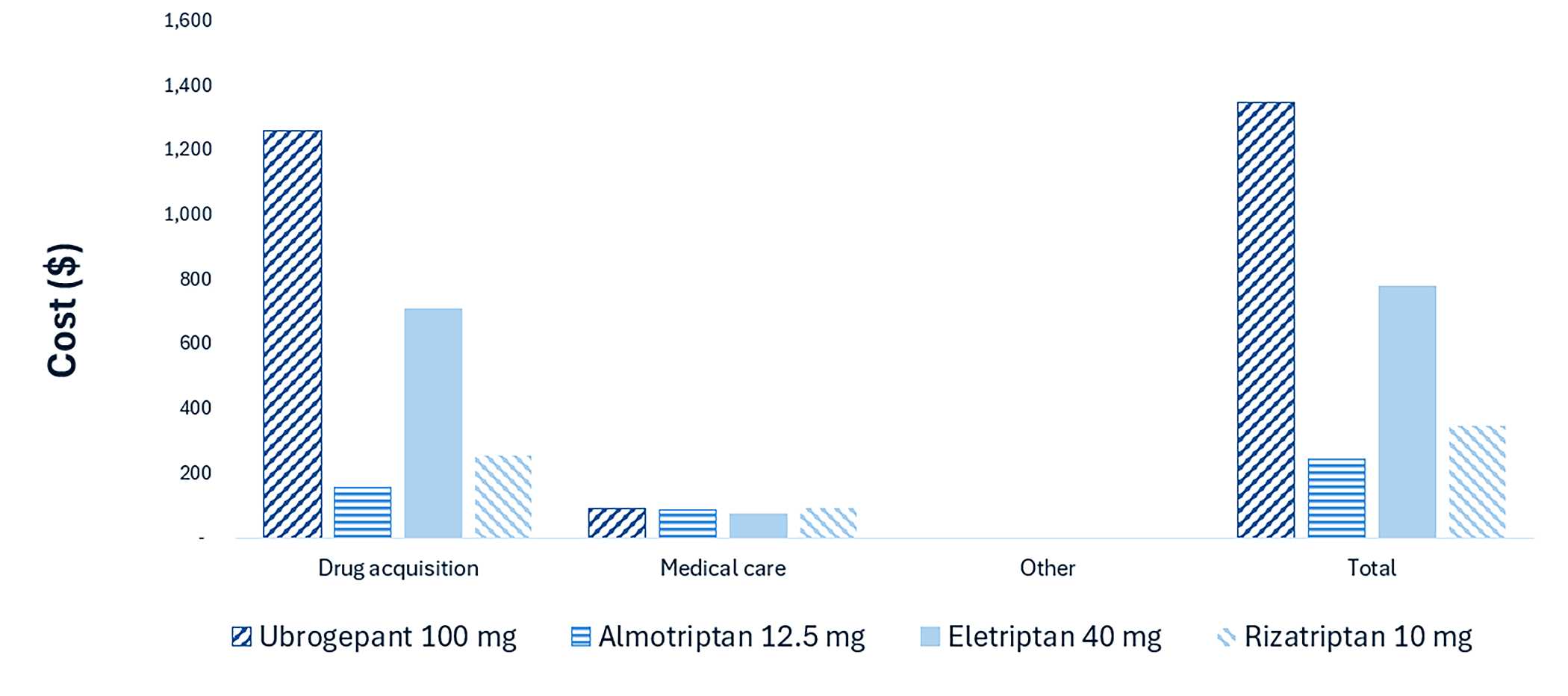
vs. = versus.
Notes: Other includes costs for treating medication overuse headaches as well as treatment-emergent adverse events. Only comparators on the cost-effectiveness frontier have been included. Refer to the Supplemental Material document, Appendix 11 for full results.
Impact on Health
Relative to the triptans, ubrogepant is predicted to result in slightly more QALYs per patient than most triptans, but slightly fewer than eletriptan 40 mg, rizatriptan 10 mg, sumatriptan 100 mg, and zolmitriptan 2.5 mg. (refer to the Supplemental Material document, Appendix 11).
Overall Results
Based on the CDA-AMC analysis, the following treatments are on the cost-effectiveness frontier (that is, they are not dominated by other treatments): almotriptan 12.5 mg, rizatriptan 10 mg, and eletriptan 40 mg. Ubrogepant 50 mg and 100 mg are both dominated (less effective and more costly) by rizatriptan 10 mg and eletriptan 40 mg (refer to Table 9). Additional details on the CDA-AMC base case are available in the Supplemental Material document, Appendix 11.
Table 9: Summary of CDA-AMC Economic Evaluation Results
Drug | Total costs ($) | Total QALYs | Sequential ICER ($/QALY) |
|---|---|---|---|
Almotriptan 12.5 mg | 243.08 | 1.8730 | Reference |
Rizatriptan 10 mg | 346.42 | 1.8765 | 29,565 |
Eletriptan 40 mg | 775.33 | 1.8777 | 354,232 |
Ubrogepant 100 mg | 1,341.50 | 1.8742 | Dominated through rizatriptan 10 mg and eletriptan 40 mg |
Ubrogepant 50 mg | 1,347.41 | 1.8734 | Dominated through rizatriptan 10 mg and eletriptan 40 mg |
CDA-AMC = Canada's Drug Agency; ICER = incremental cost-effectiveness ratio; QALY = quality-adjusted life-year.
Notes: Publicly available list prices were used for all comparators. Dominated and extendedly dominated comparators have been removed, with the exception of ubrogepant.
Uncertainty and Sensitivity
Uncertainty of the impact of MOH assumptions in the broader indicated population was explored in a scenario analysis outlined in Table 8. Refer to the Supplemental Material, Appendix 11.
Summary of the Budget Impact
The sponsor submitted a budget impact analysis to estimate the 3-year (April 2027 to March 2030) budget impact of reimbursing ubrogepant for use in the Health Canada–indicated population. The sponsor assumed that the payer would be CDA-AMC–participating public drug plans and derived the size of the eligible population using an epidemiologic approach. The price of ubrogepant was aligned with the price included in the sponsor’s economic evaluation, while the prices of comparators were based on the publicly available list prices. Additional information pertaining to the sponsor’s submission is provided in the Supplemental Material document, Appendix 12.
CDA-AMC identified a number of issues with the sponsor’s estimated budget impact and made changes to model parameters and assumptions in consultation with clinical experts to derive the CDA-AMC base case (Supplemental Material document, Appendix 12). For prevalence-based models: CDA-AMC estimated that by year 3 of reimbursement, 886,473 patients would be eligible for ubrogepant; of these, 276,721 patients are expected to receive it. The estimated incremental budget impact of reimbursing ubrogepant is predicted to be approximately $543.5 million over the first 3 years, with an expected expenditure of $575.7 million on ubrogepant. This estimate is uncertain due to uncertainties in the proportion of patients for whom triptans are unsuitable yet who may use ubrogepant, the uptake of ubrogepant, the current market shares and displacement of the comparators, and the frequency of use of all comparators.
Conclusion
Based on the CDA-AMC base case, ubrogepant would not be considered cost-effective at the submitted price as it is more costly and less effective than other funded comparators. A price reduction should be considered (refer to Figure 2; full details of the impact of price reductions on cost-effectiveness are presented in the Supplemental Material document, Appendix 11). The estimated cost-effectiveness of ubrogepant compared to oral triptans is uncertain due to uncertain relative clinical effectiveness, and uncertainty in the impact of ubrogepant on MOHs in the portion of the indicated population that was not modelled.
The budget impact to the public drug plans of reimbursing ubrogepant in the first 3 years is estimated to be approximately $543.5 million. The 3-year expenditure on ubrogepant (i.e., not accounting for current expenditure on comparators) is estimated to be $575.7 million. The estimated budget impact is uncertain due to uncertainties in the proportion of patients for whom triptans are unsuitable yet who may use ubrogepant, the uptake of ubrogepant, the current market shares and displacement of the comparators, and the frequency of use of all comparators.
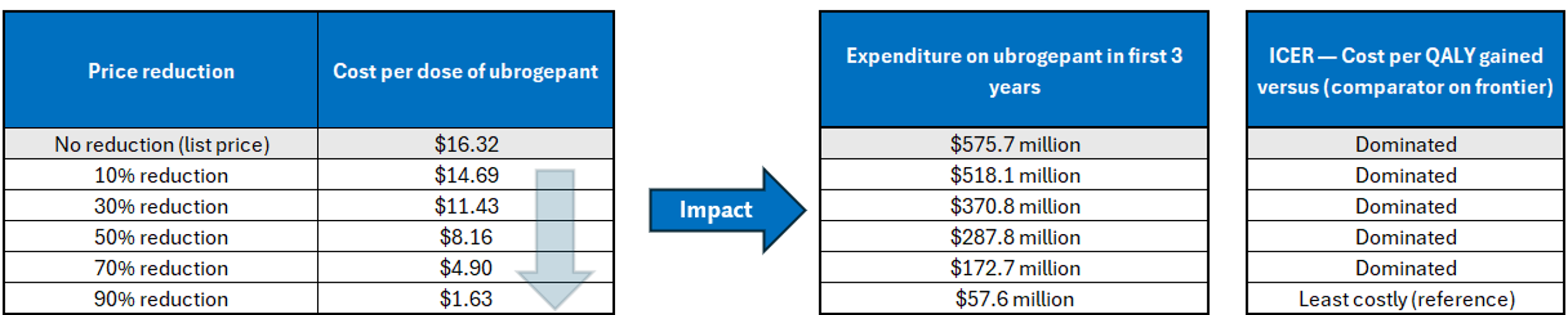
References
1.Ailani J, Burch RC, Robbins MS, Board of Directors of the American Headache S. The American Headache Society Consensus Statement: Update on integrating new migraine treatments into clinical practice. Headache. 2021;61(7):1021-1039. doi:10.1111/head.14153 PubMed
2.Dodick DW. A Phase-by-Phase Review of Migraine Pathophysiology. Headache: The Journal of Head and Face Pain. 2018;58(S1):4-16. doi:10.1111/head.13300 PubMed
3.Headache Classification Committee of the International Headache Society (IHS) The International Classification of Headache Disorders, 3rd edition. Cephalalgia. 2018;38(1):1-211. doi:10.1177/0333102417738202
4.Migraine Buddy. The stages of a migraine - migraine attack. 2018; https://migrainebuddy.com/the-stages-of-a-migraine-migraine-attack/. Accessed 26 April, 2021.
5.International Headache Society. ICHD-3: The International Classification of Headache Disorders, 3rd edition. Published online 2019 [sponsor supplied reference]. https://ichd-3.org
6.Goadsby PJ, Evers S. International Classification of Headache Disorders - ICHD-4 alpha. Cephalalgia. 2020;40(9):887-888. doi:10.1177/0333102420919098 PubMed
7.Lipton RB, Fanning KM, Serrano D, Reed ML, Cady R, Buse DC. Ineffective acute treatment of episodic migraine is associated with new-onset chronic migraine. Neurology. 2015;84(7):688-95. doi:10.1212/WNL.0000000000001256 PubMed
8.Lipton RB, Serrano D, Holland S, Fanning KM, Reed ML, Buse DC. Barriers to the diagnosis and treatment of migraine: effects of sex, income, and headache features. Headache. 2013;53(1):81-92. doi:10.1111/j.1526-4610.2012.02265.x PubMed
9.Torres-Ferrus M, Ursitti F, Alpuente A, et al. From transformation to chronification of migraine: pathophysiological and clinical aspects. J Headache Pain. 2020;21(1):42. doi:10.1186/s10194-020-01111-8 PubMed
10.Ramage-Morin PL, Gilmour H. Prevalence of migraine in the Canadian household population. Health Rep. 2014;25(6):10-6. PubMed
11.Richer L, Wong KO, Martins KJB, et al. Characteristics of Adults with Migraine in Alberta, Canada: A Population-Based Study. Can J Neurol Sci. 2022;49(2):239-248. doi:10.1017/cjn.2021.68 PubMed
12.Becker WJ, Findlay T, Moga C, Scott NA, Harstall C, Taenzer P. Guideline for primary care management of headache in adults. Can Fam Physician. 2015;61(8):670-9. PubMed
13.McMullen S, Graves E, Ekwaru P, et al. Burden of Episodic Migraine, Chronic Migraine, and Medication Overuse Headache in Alberta. Can J Neurol Sci. 2024;51(4):535-545. doi:10.1017/cjn.2023.289 PubMed
14.Dodick DW, Goadsby PJ, Schwedt TJ, et al. Ubrogepant for the treatment of migraine attacks during the prodrome: a phase 3, multicentre, randomised, double-blind, placebo-controlled, crossover trial in the USA. Lancet. 2023;402(10419):2307-2316. doi:10.1016/S0140-6736(23)01683-5 PubMed
15.Allergan Pharmaceuticals International Limited. Clinical Study Protocol: UBR-MD-02, amendment 2. A phase 3, multicenter, randomized, double-blind, placebo-controlled single attack study to evaluate the efficacy, safety, and tolerability of oral ubrogepant in the acute treatment of migraine [internal sponsor's report]. 2016.
16.Allergan Pharmaceuticals International Limited. Clinical Study Protocol: UBR-MD-01, Amendment 3. A phase 3, multicenter, randomized, double-blind, placebo-controlled single attack study to evaluate the efficacy, safety, and tolerability of oral ubrogepant in the acute treatment of migraine [internal sponsor's report]. May 19, 2017.
17.Allergan Pharmaceuticals International Limited. Clinical Study Report: UBR-MD-02 (ACHIEVE II). A phase 3, multicenter, randomized, double-blind, placebo-controlled single attack study to evaluate the efficacy, safety, and tolerability of oral ubrogepant in the acute treatment of migraine [internal sponsor's report]. August 9, 2018.
18.Allergan Pharmaceuticals International Limited. Clinical Study Report: UBR-MD-01 (ACHIEVE I). A phase 3, multicenter, randomized, double-blind, placebo-controlled single attack study to evaluate the efficacy, safety, and tolerability of oral ubrogepant in the acute treatment of migraine [internal sponsor's report]. August 13, 2018.
19.Lipton RB, Dodick DW, Goadsby PJ, et al. Efficacy of ubrogepant in the acute treatment of migraine with mild pain vs moderate or severe pain. Neurology. 2022;99(17):e1905-e1915. PubMed
20.Page MJ, McKenzie JE, Bossuyt PM, et al. The PRISMA 2020 statement: an updated guideline for reporting systematic reviews. Rev Esp Cardiol (Engl Ed). 2021;74(9):790-799. doi:10.1016/j.rec.2021.07.010 PubMed
21.National Institute for Health and Care Excellence. National Institute for Health and Care Excellence. 2014. Accessed 2025. https://www.nice.org.uk/process/pmg20
22.Cooper N SA, Achana F, Welton N. Use of Network Meta-Analysis to Inform Clinical Parameters in Economic Evaluations. 2015. https://www.cda-amc.ca/sites/default/files/pdf/RFP%20Topic-%20Use%20of%20Network%20Meta-analysis%20to%20Inform%20Clinical%20Parameters%20in%20Economic%20Evaluations.pdf
23.sociaux IIndeesees. Methodology documents. https://www.inesss.qc.ca/en/methodology/methodology-documents.html
24.Higgins J TJ, Chandler J, et al. Cochrane Handbook for Systematic Reviews of Interventions, Version 6.5. Cochrane; 2024. https://www.cochrane.org/authors/handbooks-and-manuals/handbook
25.Ubrogepant for the Acute Treatment of Migraine Systematic Literature Review and Network Meta-analysis. Medical Decision Modelling. December 1, 2025.
ISSN: 2563-6596
Canada’s Drug Agency (CDA-AMC) is a pan-Canadian health organization. Created and funded by Canada’s federal, provincial, and territorial governments, we’re responsible for driving better coordination, alignment, and public value within Canada’s drug and health technology landscape. We provide Canada’s health system leaders with independent evidence and advice so they can make informed drug, health technology, and health system decisions, and we collaborate with national and international partners to enhance our collective impact.
Disclaimer: CDA-AMC has taken care to ensure that the information in this document was accurate, complete, and up to date when it was published, but does not make any guarantee to that effect. Your use of this information is subject to this disclaimer and the Terms of Use at cda-amc.ca.
The information in this document is made available for informational and educational purposes only and should not be used as a substitute for professional medical advice, the application of clinical judgment in respect of the care of a particular patient, or other professional judgments in any decision-making process. You assume full responsibility for the use of the information and rely on it at your own risk.
CDA-AMC does not endorse any information, drugs, therapies, treatments, products, processes, or services. The views and opinions of third parties published in this document do not necessarily reflect those of CDA-AMC. The copyright and other intellectual property rights in this document are owned by the Canadian Agency for Drugs and Technologies in Health (operating as CDA-AMC) and its licensors.
Questions or requests for information about this report can be directed to Requests@CDA-AMC.ca.