Drugs, Health Technologies, Health Systems
Reimbursement Review
Tezepelumab (Tezspire)
Sponsor: AstraZeneca Canada Inc.
Therapeutic area: Chronic rhinosinusitis with nasal polyps
Clinical Review
Summary
What Is Chronic Rhinosinusitis With Nasal Polyps?
Chronic rhinosinusitis with nasal polyps (CRSwNP) is an inflammatory condition of the upper airways with noncancerous epithelial projections (nasal polyps [NPs]). It has a high symptom burden of nasal obstruction, discharge, facial pain, and loss of smell, which have a big impact on health-related quality of life.
In Canada, chronic rhinosinusitis affects around 5% of the population, and CRSwNP comprises 25% to 30% of these cases.
What Are the Treatment Goals and Current Treatment Options for CRSwNP?
Current treatment aims to both relieve symptoms and improve quality of life, as well as reduce the need for repeat NP surgery and the use of short-term systemic corticosteroids (SCS).
Improved breathing, restored smell and taste, reduced infections, and improved sleep were identified as important outcomes in the patient group input. They also identified fewer recurrent polyps requiring surgery and overall quality of life to be important. Another important outcome identified through clinical expert input included less use of SCS.
Initial treatment involves twice-daily intranasal corticosteroids (INCS). If this fails, NP surgery and/or short-term SCS are used. However, repeat surgery is frequently required, and long-term exposure to SCS has risks. Biologics like mepolizumab, dupilumab, and omalizumab are sometimes used in people whose disease does not respond to INCS, surgery, and/or SCS.
What Is Tezspire and Why Did Canada’s Drug Agency Conduct This Review?
Tezspire is a drug that is administered by subcutaneous injection. Health Canada has approved Tezspire as an add-on maintenance treatment with INCS for adult patients with severe CRSwNP inadequately controlled by SCS and/or surgery.
Canada’s Drug Agency (CDA-AMC) reviewed Tezspire to inform a recommendation to the participating public drug programs on whether it should be reimbursed as an add-on maintenance treatment with INCS for adult patients with severe CRSwNP inadequately controlled by SCS and/or surgery. The sponsor is seeking reimbursement for this patient population.
How Did CDA-AMC Evaluate Tezspire?
CDA-AMC reviewed the clinical evidence on the beneficial and harmful effects, as well as the economic evidence, of Tezspire versus other treatments used in Canada as an add-on maintenance treatment for adult patients with severe CRSwNP inadequately controlled by SCS and/or surgery. Mepolizumab, dupilumab, or omalizumab as an add-on to standard of care (SOC), and SOC alone, were considered to be relevant treatments to compare with Tezspire when reviewing the clinical evidence.
CDA-AMC identified equity and ethical considerations relevant to Tezspire and severe CRSwNP inadequately controlled by SCS and/or surgery.
The review was informed by materials submitted by the sponsor, which included clinical and economic evidence.
The review was also informed by 1 patient group submission and 1 clinician group submission in response to our call for input, and by input from the participating public drug programs around issues that may impact their ability to implement a recommendation.
Two allergists and immunologists with representation from Ontario were consulted as part of the review process.
What Were the Findings?
Clinical Evidence
CDA-AMC reviewed the following clinical evidence:
One randomized controlled phase III trial (the WAYPOINT trial) comparing Tezspire as an add-on to SOC with placebo in 410 patients with severe, uncontrolled CRSwNP
One indirect treatment comparison (ITC) comprising 1 network meta-analysis (NMA) of Tezspire compared with dupilumab or mepolizumab, each in combination with SOC.
For the comparison of Tezspire plus SOC with placebo, based on the WAYPOINT trial:
Tezspire results in clinically important improvements in NP score after 52 weeks compared with placebo.
Tezspire may result in an improvement in nasal congestion and a decrease in the proportion of patients needing SCS after 52 weeks compared to placebo, but it is uncertain whether the effect is clinically important.
Tezspire likely results in a clinically important improvement in the 22-item Sino-Nasal Outcome Test (SNOT-22) score and an increase in the proportion of patients with a SNOT-22 response after 52 weeks compared with placebo.
Tezspire likely results in a clinically important decrease in the proportion needing NP surgery after 52 weeks compared with placebo.
No new safety signals were identified, aside from those seen in clinical practice in patients with asthma treated with Tezspire. Tezspire may result in little to no difference in the risk of having at least 1 serious adverse event at 52 weeks, compared with placebo. This is because of the low event rates reported.
No long-term extension studies were submitted by the sponsor for this review.
For the comparison of Tezspire with dupilumab or mepolizumab (each in combination with SOC), based on the ITC:
The NMA results for Tezspire versus dupilumab suggested no statistically significant differences in NP score, SNOT-22 score, SNOT-22 response, time to surgery decision, SCS use, or time to SCS use; and Tezspire was statistically favoured for the proportion of patients undergoing surgery.
The NMA results for Tezspire versus mepolizumab suggested that Tezspire was statistically favoured for the NP score, SNOT-22 score, proportion of patients undergoing surgery, time to surgery decision, SCS use, and time to SCS use; SNOT-22 response showed no significant difference, and nasal congestion score and nasal obstruction score were not available.
The certainty of the NMA findings is limited by sparse networks, study heterogeneity, and wide credible intervals, which make it a challenge to come to definitive conclusions about relative efficacy.
The sponsor did not include any safety end points in the ITC.
There was no evidence comparing Tezspire with omalizumab.
Economic Evidence
Tezspire is available as a 210 mg (110 mg/mL) single-use prefilled syringe or pen. At the submitted price of $2,027.63 per prefilled syringe or pen, the annual cost of Tezspire is expected to be $26,450 per patient, based on the Health Canada–recommended dosage.
Clinical efficacy in the economic analysis was derived from the WAYPOINT trial, which compared Tezspire plus SOC with SOC alone. Evidence submitted by the sponsor indicates that Tezspire plus SOC is likely to improve clinical outcomes, including the proportion of patients with a response based on SNOT-22 scores, improvement in SNOT-22 scores from baseline, and the proportion of patients needing NP surgery after 52 weeks. The evidence was of moderate certainty for these outcomes.
Because there was no direct comparison of Tezspire plus SOC with dupilumab plus SOC or with mepolizumab plus SOC, clinical efficacy was informed by a sponsor-submitted NMA. The NMA results suggested no statistically significant differences between Tezspire plus SOC and dupilumab plus SOC for change in SNOT-22 scores or in SNOT-22 response, but Tezspire plus SOC was statistically favoured for change in SNOT-22 scores; there was no statistically significant difference in SNOT-22 response between Tezspire plus SOC and mepolizumab plus SOC. For the proportion of patients undergoing surgery, Tezspire plus SOC was statistically significantly favoured over both dupilumab plus SOC and mepolizumab plus SOC. However, the CDA-AMC clinical review noted that the NMA was associated with methodological limitations, which made it a challenge to come to definitive conclusions about the relative efficacy. No conclusions about the comparative efficacy and safety outcomes stratified by baseline disease severity (defined by SNOT-22 scores), overall survival, harms, and health-related quality of life could be drawn because these outcomes were not assessed in the sponsor-conducted NMA. Furthermore, omalizumab was not included in the sponsor-submitted NMA, so the comparative efficacy is unknown.
There is no robust evidence to suggest that Tezspire plus SOC provides a greater health benefit to patients than dupilumab plus SOC in terms of SNOT-22 response or change in SNOT-22 scores, the key outcomes informing treatment response in the economic model. Tezspire may be associated with a lower proportion of patients undergoing surgery than dupilumab plus SOC or mepolizumab plus SOC, but there are limitations with the available evidence. The sponsor’s assumptions regarding the extrapolation of short-term trial evidence over the modelled time horizon, improved survival, and limitations with the modelling approach further limit the validity of the results of the economic model. Given limitations with the clinical evidence that informed the economic model, the cost-effectiveness of Tezspire plus SOC compared with relevant comparators is uncertain. If decision-makers determine that there are no differences in health outcomes between Tezspire plus SOC and other biologics, then the total cost of Tezspire plus SOC to the health system should not exceed that of the least costly biologic as an add-on maintenance treatment in adult patients with severe CRSwNP inadequately controlled by SCS and/or surgery.
CDA-AMC estimates that the budget impact of reimbursing Tezspire plus SOC as an add-on maintenance treatment in adult patients with severe CRSwNP inadequately controlled by SCS and/or surgery will be approximately $61.7 million over the first 3 years of reimbursement, compared to the amount currently spent on comparators, with an estimated expenditure of $136.7 million on Tezspire plus SOC over this period. The actual budget impact of reimbursing Tezspire plus SOC will depend on market-share assumptions, specifically whether Tezspire plus SOC will displace market share from SOC alone. At the submitted price, the incremental budget impact of reimbursing Tezspire is predicted to be greater than $40 million in year 2 and in year 3, and the economic feasibility of adoption must be addressed. Additionally, the magnitude of uncertainty in the budget impact must be addressed to ensure the feasibility of adoption, given the difference between the sponsor’s estimate and the CDA-AMC estimate.
Abbreviations
CDA-AMC
Canada’s Drug Agency
CI
confidence interval
CrI
credible interval
CRS
chronic rhinosinusitis
CRSwNP
chronic rhinosinusitis with nasal polyps
DSS
difficulty with sense of smell
ENT
ear, nose, and throat
ESS
endoscopic sinus surgery
HR
hazard ratio
HRQoL
health-related quality of life
INCS
intranasal corticosteroids
ITC
indirect treatment comparison
LTE
long-term extension
MD
mean difference
MID
minimally important difference
NCS
nasal congestion score
NMA
network meta-analysis
NOS
nasal obstruction score
NP
nasal polyp
NPS
nasal polyp score
OR
odds ratio
QALY
quality-adjusted life-year
RCT
randomized controlled trial
SAE
serious adverse event
SCS
systemic corticosteroids
SNOT-22
22-item Sino-Nasal Outcome Test
SOC
standard of care
UPSIT
University of Pennsylvania Smell Identification Test
Background
Introduction
The objectives of this report are as follows:
Review and critically appraise the evidence submitted by the sponsor on the beneficial and harmful effects of tezepelumab, 110 mg/mL administered by subcutaneous injection, in the treatment of severe chronic rhinosinusitis with nasal polyps (CRSwNP) in adult patients. The focus will be on comparing tezepelumab to relevant comparators in clinical practice in Canada and on identifying gaps in the current evidence, as outlined in Table 1.
Review and critically appraise the economic information submitted by the sponsor, including a cost-effectiveness analysis and budget impact analysis. The focus of the Economic Review is aligned with the scope of the Clinical Review, unless otherwise stated. For most reviews, a Canada’s Drug Agency (CDA-AMC) base case is developed, informed by clinical expert input, the available clinical evidence, and the best interpretation of the economic evidence based on the information provided by the sponsor.
Table 1: Information on the Application Submitted for Review and on the CDA-AMC Review
Item | Description |
|---|---|
Information on the application submitted for review | |
Drug | Tezepelumab (Tezspire), 210 mg single-use prefilled syringe or pen (110 mg/mL solution) administered by subcutaneous injection |
Sponsor | AstraZeneca Canada Inc. |
Health Canada indication | As an add-on maintenance treatment with INCS in adult patients with severe CRSwNP inadequately controlled by systemic corticosteroids and/or surgery |
Health Canada approval status | NOC |
Health Canada review pathway | Standard |
NOC date | February 9, 2026 |
Mechanism of action | Inhibits multiple downstream pathways and cytokines by targeting TSLP, a key driver of epithelial inflammation |
Recommended dosage | 210 mg by subcutaneous injection every 4 weeks |
Submission type | Initial |
Sponsor’s reimbursement request | Per indication |
Submitted price | $2,027.63 per prefilled syringe or pen |
Information on the CDA-AMC review | |
Review type | Standard |
Clinical review focusa | Population: as defined in the Health Canada indication Subgroups: none Intervention: 210 mg by subcutaneous injection every 4 weeks Comparators: SOC (INCS with or without short-term SCS to treat symptomatic worsening), mepolizumabb plus SOC, dupilumabb plus SOC, and omalizumab plus SOC Outcomes: total nasal polyp score, nasal congestion score, difficulty with sense of smell, 22-item Sino-Nasal Outcome Test score, time to first nasal polyp surgery decision, time to first systemic corticosteroid use for nasal polyps, AEs, SAEs, WDAEs, mortality, AEs of special interestc |
AE = adverse event; CDA-AMC = Canada's Drug Agency; CRSwNP = chronic rhinosinusitis with nasal polyps, INCS = intranasal corticosteroids; NOC = Notice of Compliance, SAE = serious adverse event; SCS = systemic corticosteroids; SOC = standard of care; TSLP = thymic stromal lymphopoietin; WDAE = withdrawal due to adverse event.
aThe economic review aligns with the scope of the clinical review, unless otherwise stated.
bCDA-AMC has previously issued a reimbursement recommendation for this drug for the same indication or a similar indication.
cListed by the sponsor: anaphylactic reactions, immune complex disease, hypersensitivity reactions, malignancy, helminth infections, severe infections, injection-site reactions, opportunistic infections, Guillain-Barre syndrome.
Submission History for the Drug Under Review
CDA-AMC previously reviewed tezepelumab through the Reimbursement Review process as an add-on maintenance treatment in adults and adolescents 12 years and older with severe asthma, and issued a recommendation to reimburse with conditions.
Sources of Information
The contents of the Reimbursement Review report are informed by materials submitted by the sponsor, input received from interested parties (patient groups, clinician groups, and drug programs), and input from clinical experts consulted for this review.
Calls for patient group and clinician group input are issued for each Reimbursement Review. One patient group submission from Asthma Canada and 1 clinician group submission from the Canadian Rhinologic Society were received. Asthma Canada gathered patient input with a national online survey that received responses from 4 patients with severe CRSwNP and 1 caregiver, along with 2 one-on-one semistructured virtual interviews, each conducted with a patient living with severe CRSwNP. The clinician group gathered input through its in-depth knowledge of the disease and topic, and through case submissions from Canadian Rhinologic Society members, using clinician-reported examples. The full submissions received are available on the project landing page in the consolidated input document. The drug programs provide input on each drug being reviewed through the Reimbursement Review process by identifying issues that may impact their ability to implement a recommendation.
Input from patient and clinician groups is considered throughout the review, including in the selection of outcomes to include in the Clinical Review and in the interpretation of the clinical and economic evidence. Relevant patient and clinician group input is summarized in the Disease Background, Current Management, and Unmet Needs and Existing Challenges sections.
Each review team includes at least 1 clinical expert with expertise regarding the diagnosis and management of the condition for which the drug is indicated. Clinical experts are a critical part of the review team and are involved in all phases of the review process. Two clinical experts with expertise in the diagnosis and management of CRSwNP participated as part of the review team, with representation from Ontario.
Disease Background
CRSwNP is a subtype of chronic rhinosinusitis (CRS), a heterogeneous inflammatory condition of the upper airways characterized by symptoms persisting for at least 12 weeks, including nasal obstruction, discharge, facial pain, and loss of smell.1,2 CRSwNP is defined by the presence of noncancerous, inflammatory epithelial projections (nasal polyps [NPs]) into the nasal cavity.3 The disease is associated with a high symptom burden and significant impairment in health-related quality of life (HRQoL), including sleep disturbance, anxiety, depression, and reduced social engagement due to persistent symptoms, such as postnasal drip and anosmia (loss of smell).4-9
In Canada, CRS is diagnosed based on a reduced or altered sense of smell that persists for 8 weeks to 12 weeks, objective evidence of sinonasal inflammation, and the presence of at least 2 of the following symptoms: nasal congestion or fullness; facial pain, pressure, or fullness; nasal obstruction or blockage; purulent anterior or posterior nasal drainage.10,11 For CRSwNP, diagnosis requires the confirmation of NPs with endoscopy or bilateral mucosal disease with CT imaging.10,11 Noncontrast CT is the standard imaging modality for CRS, whereas sinonasal endoscopy remains the gold standard for detecting polyps.12 No specific laboratory tests are available for CRSwNP diagnosis, and although biomarkers may help identify inflammatory endotypes, they are not yet validated for guiding treatment.12 These diagnostic procedures (endoscopy and CT imaging) are part of routine clinical practice in Canada, so no specific diagnostic requirements are noted in the Canadian product monograph for tezepelumab.13 Initial assessment is often undertaken by primary care providers, with confirmation and ongoing evaluation by ear, nose, and throat (ENT) specialists using endoscopy and, where appropriate, CT.
The clinical experts consulted for this review and the clinician group noted inequities in access to ENT specialists and to CT imaging in Canada. These constraints may delay diagnosis and reassessment (before and after treatment), particularly when services are concentrated in large urban centres and patients in rural or remote regions must travel for endoscopy or CT. In some jurisdictions, long surgical wait times reflect broader specialist-access bottlenecks and may be accompanied by delays in diagnostic testing. The clinical experts consulted for this review noted that limited access to primary care providers also contributes to diagnostic delays, particularly for some population groups (e.g., First Nations, Inuit, and Métis Peoples), further complicating timely recognition and confirmation of CRSwNP.
In Canada, CRS affects approximately 5% of the population,1 with CRSwNP comprising 25% to 30% of these cases.3 Onset typically occurs between the ages of 40 years and 60 years, with higher prevalences observed in males than in females and in people with asthma than in those without.14 Asthma is a common comorbidity, present in up to 67% of patients with CRSwNP.15,16 Although CRSwNP is not life-limiting, it often requires long-term management and repeated interventions. This contributes to substantial health care use and economic burden.17,18
CRSwNP disproportionately affects individuals with comorbid asthma and chronic pulmonary diseases, which are more prevalent in certain equity-deserving and systematically disadvantaged populations.8,15,16,19 In Canada, asthma is more prevalent in Indigenous people; from 2017 to 2020, asthma was reported in 16% of First Nations people living off reserve, 14% of Métis, and 18% of Inuit .20 Lower socioeconomic populations experience poorer asthma outcomes; children in the lowest income quintile have hospitalization rates for asthma nearly 4 times higher than those in the highest income quintile.21 Severe asthma is more prominent in women with low incomes.22 Given the barriers to accessing specialist care, which delays diagnosis and treatment, these population groups may experience a greater burden from CRSwNP.
Patient group input: Regarding disease experience, input from 4 patients with severe CRSwNP and 1 caregiver indicated that the condition causes persistent nasal congestion, breathing difficulties, and loss of smell and taste, often accompanied by frequent infections. These symptoms disrupt daily activities, sleep, and social engagement, and are associated with emotional distress and financial strain (including concerns about out-of-pocket costs for therapies not uniformly covered), resulting in a marked reduction in quality of life for patients and caregivers. One patient noted the possible danger associated with not being able to smell dangerous odours, like those associated with a gas leak. Patients highlighted how the condition limits their social life, and 1 patient noted being self-conscious about the noises associated with severe postnasal drip.
Current Management
Treatment Goals
Patient group input: Patients and the caregiver emphasized treatment goals that focused on easier symptom management, improved long-term outcomes (avoiding recurring polyps), and reduced need for surgery. The most important outcomes included improved breathing, restored smell and taste, improved sleep, reduced risk of repeat surgery for recurring polyps, enhanced overall quality of life, and fewer infections. Affordability and sustained effectiveness were identified as critical considerations.
Clinician input: One clinical expert noted that the most important goal is to reduce symptoms of nasal congestion, discharge, and decreased sense of smell, indicating that nasal congestion can be particularly difficult at night. The clinician group agreed with the goals of improving symptoms and smell, and highlighted the importance of improving HRQoL. Another clinical expert considered the main treatment goals to be reductions in the use of oral corticosteroids and surgery, noting that there are risks associated with long-term exposure to systemic steroids. Lifetime exposure to a daily dose of 1 g of prednisone or equivalent can lead to cataracts, glaucoma, osteopenia or porosis, type 2 diabetes and hypertension, and higher dosages can increase risk of death. One clinical expert noted that reducing surgery is important because patients who undergo more than 1 surgery for polyps are more likely to need more surgery. The other clinical expert noted that 80% of polyps recur within 12 years of initial surgery.
Current Treatment Options
Current Canadian guidelines recommend a stepwise approach to treatment (refer to Figure 1). Initial treatment is usually intranasal corticosteroids (INCS).4,9 The clinical experts noted that mometasone furoate, budesonide, and ciclesonide are often used, depending on what is included in the relevant formulary. They noted that INCS are used twice daily, in either standard or high dosages, depending on what is tolerated. One expert noted that adherence to topical steroids is poor and may cause bleeding of the turbinates. A clinical expert noted that steroid sinus rinses are sometimes used, including off-label budesonide nebules or custom-made high-dose mometasone. Montelukast, which is off label for CRSwNP, is sometimes used. If symptoms worsen, short-term oral systemic corticosteroids (SCS) may be given, often prednisone and sometimes dexamethasone. Prednisone is often taken as a 10-day course around every 3 months to control symptoms.
Endoscopic sinus surgery (ESS) may be used if symptoms continue despite INCS and 1 or more courses of SCS over 2 years.4,9,23 Polyps often recur, so repeat surgery is often needed. The clinician group noted that the aim of surgery has moved from restoring drainage to improving medication delivery. It noted that corticosteroid rinses or irrigations are often used after surgery, usually budesonide nebules or compounded mometasone with saline irrigations. A biologic may be considered for patients who have undergone surgery and subsequent medical therapy that failed, and for those who are unsuitable for surgery in whom medical therapy has failed.24 Recent research has shown that using biologics before surgery may improve outcomes.25,26 The clinical experts noted that biologics are sometimes used before surgery in areas where the wait time to have surgery is long, or if patients have a contraindication to or do not want surgery.
There are 2 publicly funded biologics in Canada in some jurisdictions, and some under consideration:
Mepolizumab is widely funded across Canada (except in British Columbia) as an add-on with INCS for adult patients with severe CRSwNP inadequately controlled by INCS and surgery.27,28 The clinical experts noted that patients who receive mepolizumab have also often received SCS previously, in addition to prior surgery.
Dupilumab has received a positive reimbursement recommendation from CDA-AMC as an add-on maintenance treatment with INCS in adult patients with severe CRSwNP inadequately controlled by SCS and/or surgery.29,30 However, it is not yet routinely reimbursed by public drugs plans in Canada. The clinician group noted that monitoring is needed during dupilumab therapy because there may be side effects like arthralgia, rash, and — more rarely — eosinophilia.
Omalizumab has approval from Health Canada for CRSwNP but has not been reviewed by CDA-AMC.31 A biosimilar version is available in Saskatchewan and under the Non-Insured Health Benefits program for First Nations and Inuit for CRSwNP.32,33 Both clinical experts noted that it is not as effective as other biologics in their experience, and the clinician group noted that it is not commonly used because it requires weight-based dosing and immunoglobulin E–level assessment. One clinical expert reported only using omalizumab when other biologics are not available, and the other expert reported using it only when other biologics are not tolerated. Both experts reported using it sometimes for patients who also have allergic asthma or chronic spontaneous urticaria, if they meet the omalizumab funding criteria for that indication. One expert reported using it for patients with CRSwNP and allergic asthma when trying to improve upper airway symptoms.
Key characteristics of tezepelumab are summarized with other treatments available for severe CRSwNP in the Supplemental Material document (available on the project landing page) in the Key Characteristics table in Appendix 1.
Figure 1: Current Stepwise Treatment for CRSwNP
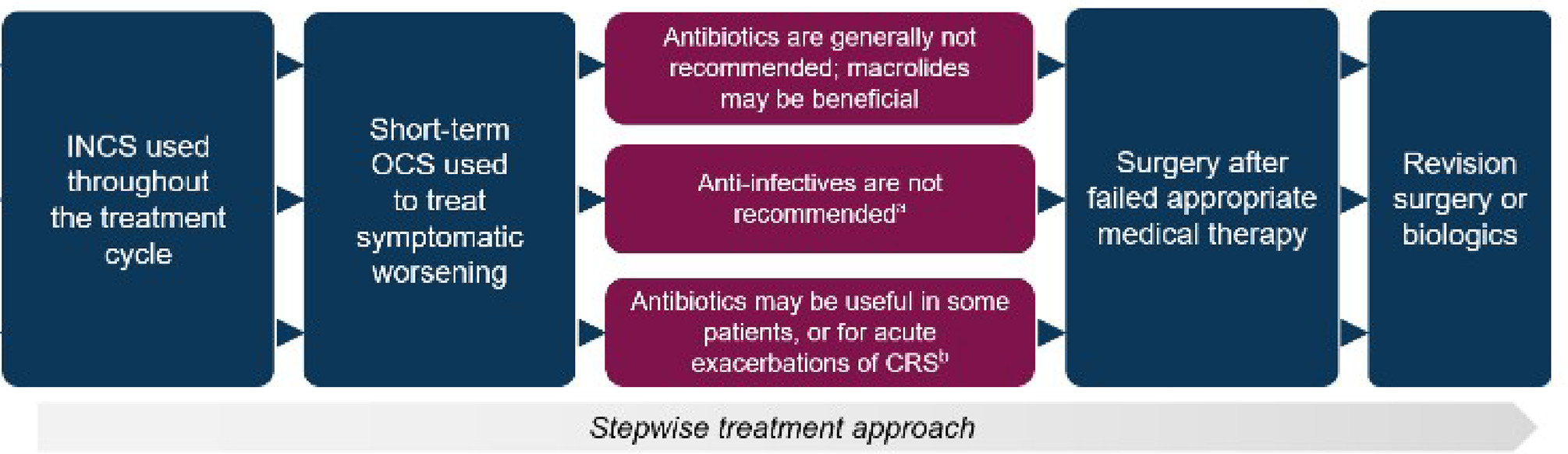
CRS = chronic rhinosinusitis; CRSwNP = chronic rhinosinusitis with nasal polyps; INCS = intranasal corticosteroids; OCS = oral corticosteroids.
aIncluding local and systemic antibiotics and local and systemic antifungals.
bAntibiotics may be useful in patients with persistent purulent drainage; sinus culture may be indicated. Additionally, topical antibiotics may be used.
Source: Adapted from sponsor’s submission.34
Unmet Needs and Existing Challenges
Patient group input: Patients and the caregiver reported that current treatments often provide only partial relief, require frequent administration, and cause side effects such as sinus infections and sleep disturbances. The lack of relief from symptoms has an impact on a patient’s whole family, including the quality of relationships and work productivity. They expressed concern about the serious long-term risks of oral corticosteroids and described surgery as burdensome, anxiety-provoking, and temporary. Most patients want to avoid surgery as much as possible. They also identified high costs and uncertainty around insurance coverage for biologics as major barriers, leaving them frustrated and underserved by existing options.
Clinician input: As noted previously, the clinical experts emphasized that surgery often needs repeating. An expert also noted that access to surgery differs across the country, with some regions having up to 4 year to 5 year wait times. In terms of biologic treatments when disease progresses after surgery, a clinical expert noted that there are gaps in access to mepolizumab and dupilumab. This is because mepolizumab can only be used after prior surgery and dupilumab is not yet publicly available. Both clinical experts noted that there are people whose disease does not respond to either mepolizumab or dupilumab, with inflammation persisting. Lack of effectiveness is particularly an issue with mepolizumab, which the clinician group highlighted as being related to olfactory recovery and the length of time to symptom control. A clinical expert noted that dupilumab is increasingly being discontinued because of side effects like eosinophilia and arthralgias, and noted that injection-site reactions are also common. Both experts noted that the biweekly injection of dupilumab is burdensome for some patients. Additionally, the clinician group highlighted concerns about the cost of biologics (particularly as a continuous treatment) compared with surgery. It noted increasing reports of the inappropriate prescribing of biologics, including as first-line treatment, where it is much less likely to be cost-effective.
A clinical expert noted that people from China do not respond as well to some treatments because they do not tend to get type 2 inflammation, which is targeted by mepolizumab and dupilumab. However, the other expert noted that the response is likely related to environmental factors, explaining that people of Chinese ethnicity who live in Canada do tend to get type 2 inflammation.
Considerations for Using the Drug Under Review
Contents within this section have been informed by input from the clinical expert(s) consulted for the purpose of this review and from clinician groups, as well as the reimbursement conditions proposed by the sponsor (refer to the Initiation, Renewal, Discontinuation, and Prescribing Conditions Proposed by the Sponsor table in Appendix 1 in the Supplemental Material document). The implementation questions from the public drug programs and corresponding responses from the clinical experts consulted for this review are summarized in the Supplemental Material document, in the Summary of Drug Program Input and Clinical Expert Responses table in Appendix 1. The following has been summarized by the review team.
Place in Therapy
The clinical experts consulted for this review said that tezepelumab, like other biologics, is expected to be considered for patients with inadequate response to INCS, who have had at least 1 course of oral corticosteroids, and/or have persistent disease despite surgery. Tezepelumab targets thymic stromal lymphopoietin (TSLP), an upstream epithelial cytokine that influences type 2 inflammation. As a result, it intervenes earlier in the inflammatory cascade. The clinical expert noted that although dupilumab, mepolizumab, and tezepelumab target type 2 inflammation, which is common with CRSwNP, tezepelumab also targets type 1 and type 3 inflammation, which can also occur in patients with NPs. As a result, tezepelumab offers a broader approach than other biologics to reduce inflammation, particularly those with mixed or noneosinophilic disease. The experts noted that it is helpful to have different biologics available because they can target different types of inflammation that can present in people with CRSwNP. Additionally, the clinical experts noted that tezepelumab is administered every 4 weeks, which may be more appealing to patients than dupilumab, which is administered every 2 weeks. One expert also noted that when tezepelumab is used for asthma or NPs, the injection appears to be less painful than when dupilumab is used. The clinician group noted that tezepelumab appears to have fewer side effects than dupilumab, but more might emerge with more frequent usage.
Patient Population
The clinical experts consulted for this assessment agreed with the sponsor’s initiation criteria (refer to Appendix 1 of the Supplemental Material document). The clinical experts noted that it is helpful if treatments required before trying tezepelumab include either SCS or surgery (rather than both). This is because there may be reasons patients cannot have 1 of these treatments. For example, SCS is contraindicated in people with uncontrolled type 2 diabetes, which disproportionately affects some equity-deserving groups — including Black population groups — and systematically disadvantages population groups, including people with low socioeconomic status and migrant populations.35,36 Surgery may be contraindicated for some people, or people may prefer not to have surgery. This criterion may enable tezepelumab to address the gap in treatment for these patients.
The clinical experts noted that people with moderate-to-severe disease, a high symptom burden, significant morbidity that requires frequent systemic steroid use and/or need for repeat surgery, and impaired quality of life would benefit from treatment with tezepelumab. They noted that people with comorbid severe asthma or with higher baseline eosinophil may benefit from tezepelumab. Furthermore, patients may also benefit if other biologics with different mechanisms of action have not sufficiently reduced symptoms, or if they have led to side effects.
The clinical experts noted that people with structural or mechanical contributors, such as septal deviation and isolated sinus obstruction, should have surgery to manage their conditions, so tezepelumab is less suitable for them. Also, people with a needle phobia may decline tezepelumab or other biologics. However, the longer, 4-weekly interval between injections with tezepelumab may be more acceptable to patients with a needle phobia than a biweekly injection like dupilumab.
The clinician group input was broadly in line with the clinical expert input. However, both noted that nasal endoscopy and a CT scan of the paranasal sinuses are needed to determine if tezepelumab is appropriate, and that elevated blood or tissue eosinophils may indicate type 2 inflammation and more severe disease, but are not necessarily required for treatment with tezepelumab.
The clinical experts noted that there are no important issues with the diagnosis of CRSwNP in clinical practice. However, there may be underdiagnosis if a patient is severely obstructed, or if a patient is assumed by a primary care physician to have chronic sinusitis without polyps. The patient group input echoed difficulties with diagnosis, with several patients explaining that they felt discouraged and frustrated by their experience obtaining a diagnosis.
Assessing the Response to Treatment
One clinical expert noted that treatment response is assessed in clinical practice by asking patients about their sense of smell, nasal congestion, and sleep. Both experts noted that the NP score (NPS) (endoscopy-based) to determine polyp size and the 22-item Sino-Nasal Outcome Test (SNOT-22) to measure HRQoL are used in clinical practice to assess response to treatment for the purpose of claiming reimbursement with the drug plan to continue treatment. However, they noted that SNOT-22 is not used routinely otherwise. The clinical experts agreed that improvements of at least 1 point on the NPS scale and 8.9 points on the SNOT-22 scale were generally considered clinically meaningful differences. However, the inequities in access to endoscopic assessments and to ENT specialists identified earlier in this report may pose challenges to the monitoring of response to treatment with tezepelumab. The clinical experts noted that other specialists (such as allergists) may be able to assess response to treatment in patients who are unable to see an ENT specialist for endoscopy, because they may be able to see that polyp inflammation has reduced after treatment.
The clinician group noted that a clinically meaningful response to treatment would be improvement in quality-of-life scores and olfaction, confirmed with endoscopy. However, improvement on endoscopy may be seen before improvement in quality-of-life scores. In addition to the scores mentioned previously, the group noted that the Patient Reported Outcomes in Chronic Rhinosinusitis (CRS-PRO) instrument is another common measure of HRQoL, and that the University of Pennsylvania Smell Identification Test (UPSIT) and the Sniffin’ Sticks Identification Test are the most common tests of olfactory function. However, the clinical experts considered that both olfactory function tests are typically used in specialist centres or in research because they are expensive. They noted that smell is covered in SNOT-22.
In terms of timing for the assessment, 1 expert reported aiming to see patients at around 9 months, but usually sees patients at 12 months by the time the appointment is scheduled. The other expert reported that 6 months is enough time to see if a patient’s disease responds, noting that response to treatment plateaued after about 6 months in the trials. However, both clinical experts indicated that the sponsor’s proposed renewal period of 12 months is reasonable and aligns with the renewal criteria for mepolizumab and dupilumab. The clinician group input also indicated that 6 months is appropriate to assess response to treatment, with a re-evaluation of the underlying diagnosis or alternative treatments for patients whose disease has not responded.
Discontinuing Treatment
The sponsor did not propose any discontinuation conditions. This is consistent with the CDA-AMC guidance for mepolizumab and dupilumab. The clinical experts noted that tezepelumab would be stopped if there were adverse events (like myalgias considered intolerable) or a lack of response. The clinician group input broadly agreed. One clinical expert specified that a lack of response would be determined by either disease progression or no improvement, and would be assessed after 1 year. One expert noted that there may be circumstances in which surgery needs to go ahead or in which breakthrough SCS are needed, but tezepelumab would not automatically be stopped in these instances. Both experts noted that the need for surgery or SCS would not necessarily indicate treatment failure; 1 expert indicated that an enquiry into the reasons for SCS would be needed in these instances.
Prescribing Considerations
The clinical experts agreed with the sponsor’s proposed conditions (which are aligned with the CDA-AMC guidance on mepolizumab and dupilumab) that tezepelumab should be prescribed by physicians with expertise in the management of severe CRSwNP (e.g., otolaryngologists, allergists, respirologists). One expert noted that the involvement of a specialist trained in nasal endoscopy is important. The clinician group indicated that an otolaryngology assessment is essential before treatment with tezepelumab to help prevent the inappropriate prescribing of biologics that has been reported, and that a multidisciplinary team that includes allergy, respirology, and otolaryngology specialists would improve the care of patients. The inequities in access to ENT specialists identified earlier in this report may pose challenges to the prescription of tezepelumab. The clinical experts noted that primary care providers would not prescribe tezepelumab but could help monitor the patient and provide updates to the prescribing physician.
In terms of combination with other drugs, the clinical experts noted that sometimes more than 1 biologic is given at the same time if they are given for different conditions (i.e., 1 for asthma and 1 for NPs). However, there is no evidence of the impact of combined biologics on CRSwNP.
Clinical Review
Methods
The review team considered studies in the sponsor’s systematic review (pivotal studies and randomized controlled trials [RCTs]), sponsor-submitted long-term extensions (LTEs), indirect treatment comparisons (ITCs), and studies addressing gaps in the evidence for inclusion. Eligible studies for the systematic review included published and unpublished phase III and phase IV RCTs. Relevant patients and interventions were defined by the indication and the recommended dosage in the product monograph. Relevant comparators were drugs used in clinical practice in Canada to treat patients described in the indication under review. These included standard of care (SOC), dupilumab plus SOC, mepolizumab plus SOC, and omalizumab plus SOC. LTEs of included pivotal studies and RCTs were included, regardless of whether there was a comparison group. ITCs and studies addressing gaps submitted by the sponsor were included when they filled an identified gap in the systematic review evidence (e.g., missing comparator, longer follow-up time). The sponsor-submitted ITC included network meta-analyses (NMAs) comparing tezepelumab, dupilumab, and mepolizumab, each in combination with SOC. Although omalizumab was approved by Health Canada and was later listed on the Saskatchewan Drug Formulary and the Non-Insured Health Benefits Program for CRSwNP under certain conditions, these listings occurred after the sponsor’s submission of this review,37 and omalizumab has not been reviewed by CDA-AMC. In the sponsor-submitted NMA, omalizumab data were available only for the less-than-30-week time point. Because the main report includes outcomes at 30 weeks or longer (only 52 weeks of data were available), as validated by the CDA-AMC pharmacoeconomic team and clinical experts, there are no indirect data for the comparison between tezepelumab and omalizumab for outcomes at time points of interest.
The review team selected outcomes (and follow-up times) for review considering the sponsor’s Summary of Clinical Evidence, clinical expert input, and patient and clinician group input. Included outcomes are those considered relevant to expert committee deliberations, and they were selected in consultation with committee members. Evidence from the systematic review for the most important outcomes was assessed using the Grading of Recommendations Assessment, Development and Evaluation (GRADE) approach. The selected outcomes are:
change from baseline in total NPS, which is commonly used in clinical practice and required in reimbursement conditions for both mepolizumab and dupilumab, and which is considered important by clinical experts and the clinician group
change from baseline in nasal congestion score (NCS) (patient-reported), which is considered very important to clinical experts. The patient group considered improved breathing an important outcome because nasal congestion influences breathing
SNOT-22, which is commonly used in clinical practice and required for reimbursement conditions for mepolizumab and dupilumab. Improvement in HRQoL was considered important by the clinical experts and by both the clinician group and the patient group. The instrument captures improvements in smell and taste and in sleep, which were considered important by the patient group, and which assess —
change from baseline
response rate, measured by SNOT-22 (i.e., proportion of patients with improvement of at least 8.9 points), which is a key input for the sponsor’s pharmacoeconomic model
time to NP surgery decision. Reducing surgery was prioritized by patient groups and clinical experts, and considered an important treatment goal for patients with CRSwNP by the clinical experts
time to SCS for NP. Reducing the use of SCS was considered important by the clinical experts because of the risks associated with increased lifetime exposure to SCS
the proportion of patients with serious adverse events (SAEs), which was considered important to the clinical experts and the patient group.
Methods for data extraction, risk of bias appraisal, and certainty of evidence assessment are in the Supplemental Material document in Appendix 2.
Clinical Evidence
In this report, the following sources of evidence submitted by the sponsor are reviewed and appraised:
1 RCT included in the systematic review, WAYPOINT
1 NMA comparing tezepelumab with mepolizumab and dupilumab.
Systematic Review
Description of Studies
Study Characteristics
Characteristics of the included study are summarized in Table 2. Details pertaining to the eligibility criteria, interventions and comparators, and relevant outcome measures are in the Supplemental Material document in Appendix 3.
The WAYPOINT trial assessed the efficacy and safety of tezepelumab in patients with severe, uncontrolled CRSwNP. It compared a 210 mg subcutaneous injection of tezepelumab administered every 4 weeks with a placebo also administered subcutaneously every 4 weeks. All patients received SOC, including INCS. There were 112 sites in Canada, China, Denmark, Germany, Hungary, Japan, Poland, Spain, the UK, and the US; the 10 sites based in Canada comprised 12% (49/410) of the randomized population. The trial included a 5-week run-in period to standardize current INCS therapy to mometasone furoate nasal spray (2 doses of 50 mcg/actuation in each nostril twice daily, totalling 400 mcg daily) or the equivalent dose (the highest approved dose) in each country. Study treatments were taken at week 0, and then every 4 weeks until week 48, for a total of 13 doses. The end-of-treatment visit was at week 52.
Participants were randomized at a 1:1 ratio, using interactive web response system technology, and they were stratified by geographic region, previous NP surgery, and coexisting asthma or nonsteroidal anti-inflammatory drug–exacerbated respiratory disease. The process was monitored to ensure that 50% to 70% of participants had coexisting asthma or nonsteroidal anti-inflammatory drug–exacerbated respiratory disease and that at least 50% had a history of NP surgery.
Participants were allowed rescue treatment with systemic glucocorticoids or NP surgery for CRSwNP that got worse. Tezepelumab was stopped in patients who underwent surgery.
Nasal endoscopy was performed at screening and every 4 weeks thereafter. A CT scan was performed at screening and then at week 52. NCS (as part of the NP symptom diary [NPSD]) was measured at screening and then every 2 weeks. SNOT-22 was measured at screening and then every 4 weeks.
Patients who completed treatment entered a follow-up phase to assess the durability of effect and safety. The phase was initially 24 weeks, but the protocol was changed during the study to shorten the period to 12 weeks. The first 200 participants were followed for 24 weeks.
The data cut presented here was on September 23, 2024 (and amended June 4, 2025, per Clinical Study Report Errata), after the last patient completed week 52. At this point, all participants in the 24-week posttreatment follow-up period had completed the study, and 50 patients were still in their 12-week follow-up. A final data cut is planned when the last participant has completed the last follow-up visit.
Table 2: Characteristics of the Study Included in the Systematic Review
Study name, design, and sample size | Key inclusion criteria | Key exclusion criteria | Intervention and comparator | Relevant end points |
|---|---|---|---|---|
WAYPOINT, multicentre, phase III, double-blind RCT Total N = 410 |
|
| Tezepelumab 210 mg, administered subcutaneously with an accessorized prefilled syringe, every 4 weeks up to week 48 as an add-on to SOC Placebo, administered subcutaneously with an accessorized prefilled syringe, every 4 weeks until week 48 as an add-on to SOC | Up to week 52:
|
AE = adverse events; AESI = adverse event of special interest; CRSwNP = chronic rhinosinusitis with nasal polyps; NCS = nasal congestion score; NP = nasal polyp; NPS = nasal polyp score; NPSD = nasal polyposis symptom diary; RCT = randomized controlled trial; SAE = serious adverse event; SCS = systemic corticosteroids; SNOT-22 = 22-item Sino-Nasal Outcome Test; SOC = standard of care.
aIncludes active lung infection, bronchiectasis, pulmonary fibrosis, cystic fibrosis, primary ciliary dyskinesia, allergic bronchopulmonary mycosis, hypereosinophilic syndromes.
bIncludes but is not limited to cardiovascular, gastrointestinal, hepatic, renal, neurologic, musculoskeletal, infectious, endocrine, metabolic, hematological, psychiatric, and major physical impairments.
cIncludes antrochoanal polyps, nasal septal deviation that occludes at least 1 nostril, acute sinusitis, nasal infection, asthma exacerbation, and upper respiratory infection at screening or in the 2 weeks before screening; Churg-Strauss syndrome (also known as eosinophilic granulomatosis with polyangiitis); Young syndrome; and Kartagener syndrome.
Sources: WAYPOINT Clinical Study Report.38 Details included in the table are from the sponsor’s Summary of Clinical Evidence.34
Statistical Testing and Analysis Populations
The WAYPOINT trial aimed to randomize approximately 400 participants, which would provide at least 95% power to detect a statistically significant difference at a 2-sided 1% alpha level on both the coprimary outcomes and the secondary outcomes, assuming the true effect of tezepelumab was:
a −1.8 point change from baseline in total NPS
a −0.87 point change from baseline in NCS
a −1 point change from baseline in loss of smell (using NPSD)
a −17.4 point change from baseline in SNOT-22 score
a 67% reduction in risk in the composite outcome of time NP surgery decision and/or SCS.
Efficacy analyses reported here used the full analysis set, based on all randomized patients who received at least 1 dose of the investigational product, irrespective of protocol adherence or continuation in the study. Safety analyses reported here used the safety analysis set, based on all randomized patients who received at least 1 dose of the investigational product. Each set comprised 203 patients treated with tezepelumab and 205 patients treated with placebo.
At 52 weeks, data on continuous outcomes (NPS, NCS, loss of smell, SNOT-22) were imputed with the following approaches:
For participants who went on to undergo NP surgery, data were imputed using the worst possible score.
For participants who went on to receive SCS or a biologic, data were imputed using the worst observation carried forward.
For participants with no postbaseline data, baseline data were used in the analysis.
For other participants who discontinued without undergoing surgery or receiving SCS, multiple imputation was used to impute missing 52-week data with the missing-at-random assumption.
Sensitivity analyses were performed to test the impact of imputation.
A multiple testing procedure was performed for all the coprimary and key secondary outcomes outlined in Appendix 3 of the Supplemental Material document to control for type I error. A truncated Holm procedure was performed at the 2-sided 5% level for key secondary end points. An additional set of tests was performed at the 1% alpha level. More detail of the testing procedure, including the order of testing, can be found in Appendix 3 of the Supplemental Material document.
For the time-to-event analyses of time to first NP surgery decision and time to first SCS use for NP, data on patients who did not have an event (i.e., surgery decision or SCS use for NP) were censored at week 52 or study withdrawal.
Subgroup analyses were performed based on demographic characteristics and baseline disease characteristics, including prior NP surgery, comorbidities, and age.
Patient Disposition
Patient disposition for the included study is summarized in the Supplemental Material, Appendix 4.
In the trial, 872 patients were screened and 410 were randomized into treatment arms. One participant in each treatment group did not receive treatment. Of those randomized who received treatment, more patients in the placebo arm than in the tezepelumab arm stopped treatment (31% [63/205] versus 4% [8/203]). Reasons for stopping treatment included:
NP surgery (12% [24/206] with placebo and 0.5% [1/203] with tezepelumab)
patient perception that the product was ineffective (9% [19/206] with placebo and 1% [2/203] with tezepelumab)
adverse events (2% [4/206] with placebo versus 0.5% [1/203] with tezepelumab)
another biologic taken or planned to be taken (2% [3/206] with placebo versus none with tezepelumab)
patient withdrawal from the study (4% [8/206] with placebo versus 1% [2/203] with tezepelumab)
protocol deviation and COVID-19 pandemic each occurred for 1 patient in each group (0.5% of patients each)
death, loss to follow-up, and investigator decision (worsening asthma and nasal polyposis) each occurred in 1 patient with placebo only (0.5% of patients each).
Of those who stopped treatment, 20% (41/205) in the placebo group and 3% (5/203) in the tezepelumab group completed the study and were included in assessments at week 52, but 11% of patients (22/205) in the placebo group and 1% (3/203) in the tezepelumab group did not complete the study.
Important protocol deviations occurred in more patients treated with placebo than with tezepelumab (30% [62/206] versus 18% [37/204] of patients had at least 1 important protocol deviation). Most of these deviations (81% [50/62] versus 57% [21/37]) were categorized by the sponsor as being because of missing assessments, like CT scan, nasal endoscopy, or NCS, at the investigational product discontinuation or end-of-treatment visit.
Baseline Characteristics
Important baseline characteristics are included in Table 3 and additional baseline characteristics are summarized in the Supplemental Material, Appendix 4.
Table 3: Summary of Baseline Characteristics From the Study Included in the Systematic Review
Characteristic | WAYPOINT | |
|---|---|---|
Tezepelumab (N = 203) | Placebo (N = 205) | |
Gender at screening visit, n (%) | ||
Female | 77 (37.9) | 65 (31.7) |
Male | 126 (62.1) | 140 (68.3) |
Age at screening visit (years) | ||
Mean (SD) | 50.1 (13.60) | 49.4 (13.69) |
Race, n (%) | ||
American Indian or Alaska Native | 0 | 0 |
Asian | 46 (22.7) | 51 (24.9) |
Black or African American | 3 (1.5) | 3 (1.5) |
Native Hawaiian or other Pacific Islander | 0 | 0 |
White | 150 (73.9) | 149 (72.7) |
Other | 4 (2.0) | 2 (1.0) |
Prior NP surgery, n (%) | 144 (70.9) | 147 (71.7) |
Time since last NP surgery, years | ||
Mean (SD) | 7.71 (6.536) | 7.68 (6.242) |
Prior SCS use for CRSwNP, n (%) | 130 (64.0) | 137 (66.8) |
Baseline comorbid asthma,a n (%) | 122 (60.1) | 126 (61.5) |
Baseline NSAID-ERD and/or AERD,a n (%) | 34 (16.7) | 37 (18.0) |
Blood eosinophil count, cells/µL | ||
Mean (SD) | 356.8 (229.41) | 359.1 (247.51) |
Baseline total serum IgE, IU/mL | ||
Mean (SD) | 171.17 (259.251) | 181.23 (308.504) |
Allergic rhinitis, n (%) | ||
Yes | 28 (13.8) | 29 (14.1) |
No | 175 (86.2) | 176 (85.9) |
AERD = Aspirin-exacerbated respiratory disease; CRSwNP = chronic rhinosinusitis with nasal polyps; IgE = immunoglobulin E; NP = nasal polyp; NSAID-ERD = nonsteroidal anti-inflammatory drug–exacerbated respiratory disease; SCS = systemic corticosteroid; SD = standard deviation.
Note: Racial categories used in the table are as reported in the source and may not align with Canada's Drug Agency inclusive language guidelines.
aIndicates patients with a diagnosis of asthma or AERD and/or NSAID-ERD. Three patients (1 in the placebo group and 2 in the tezepelumab group) reported AERD and/or NSAID-ERD but without a diagnosis of asthma.
Sources: WAYPOINT Clinical Study Report.38 Details included in the table are from the sponsor’s Summary of Clinical Evidence, with some minor textual amendments.34
Treatment Exposure and Concomitant Medications
Details of patients’ treatment exposure, and use of concomitant medications in the included study are in the Supplemental Material document, Appendix 4.
Mean treatment exposures were longer in the tezepelumab group than in the placebo group (367.5 days [standard deviation, 34.1] versus 313.4 days [standard deviation, 99.4]), and there were more complete planned administrations (77% [156/203] versus 56% [116/205]). This reflects the high number of treatment discontinuations in the placebo group.
The most frequently used permitted concomitant medications included INCS, asthma medications, selective beta-2-adrenoreceptor agonists, and anilides. More patients in the placebo arm than in the tezepelumab arm received SCS (30% [61/205] versus 5% [11/203]).
Two patients (1%) in the placebo group used disallowed medications (1 used dupilumab and 1 used omalizumab).
Critical Appraisal
Internal Validity
The randomization and allocation concealment methods used in the WAYPOINT trial appeared adequate. The tezepelumab group had slightly more females than the placebo group (38% [77/203] versus 32% [65/205]) and higher Staphylococcus aureus colonization in nasal cultures (37% [74/203] versus 28% [58/205]). Participants in the placebo group had a slightly higher mean total serum immunoglobulin E levels than those in the tezepelumab group (181.23 versus 171.17 IU/mL). It is unlikely that the slight differences would have impacted the assessment of efficacy results. Major baseline characteristics that could have impacted the efficacy results, such as disease severity (measured by NPS, NCS, or SNOT-22 total scores), prior treatment history (frequency of NP surgeries and the use of SCS in the previous year), and number of comorbidities (e.g., asthma), were well balanced between the 2 groups. The blinding of participants, the investigator, and site staff appeared adequate. However, the lack of efficacy in the placebo arm could have resulted in patients’ awareness of their treatment assignment. This could potentially bias the reporting of subjective outcomes, but the direction of this potential bias is unknown.
At 52 weeks, the efficacy assessment could have been biased toward the null because more patients in the placebo arm than in the tezepelumab arm received rescue therapy (e.g., SCS) (30% versus 5%) or underwent surgery (21% versus 0.5%) due to a lack of efficacy during the treatment period. The sponsor imputed the outcome data using the worst observation carried forward for patients who received rescue therapy and the worst possible score for patients who underwent NP surgery during the treatment period. As such, the risk of bias could be largely reduced.
There was higher proportion of early dropouts in the placebo arm than in the tezepelumab arm, which is likely a significant concern of bias.
The efficacy results summarized in this review were based on the full analysis set, for which data imputation methods were applied to 31% of patients or more in the placebo group and18% of patients or less in the tezepelumab group. The assumption that data are missing at random may not hold when missing data were much more common in the placebo arm. The missing data for efficacy outcomes is likely due to patients’ early dropout because of a lack of efficacy with placebo. This could mean that patients with missing data differ in an unknown way from the rest of the study patients. Given the significantly high rate of missing data (> 20%), such an impact might not completely be negligible. Therefore, the extent to which missing data could have biased the efficacy results is still unknown, despite that a sensitivity analysis that tested the validity of the assumption for imputation appeared to be appropriate.
The outcomes assessed in the WAYPOINT trial were considered clinically relevant and appropriate to assess efficacy by the clinical experts, and are commonly used in CRSwNP.27-30 SNOT-22 scores are classified as mild (8 to 20), moderate (> 20 to 50), or severe (> 50). The instrument is validated for use in both patients with CRS and those with allergic rhinitis. For this study, patients’ mean total SNOT-22 scores were higher than 60, indicating a more severe patient population than the general patient population. As with SNOT-22, NPS and NCS are also validated as responsive instruments for the assessment of symptoms in patients with CRS, but with high interrater and test-retest reliability. It is unlikely that all outcome assessments would be significantly biased because of different investigators across the 112 sites.
The study was appropriately powered for the coprimary and key secondary efficacy outcomes included in this report. A multiple testing procedure was performed for all efficacy outcomes, reducing the possibility of a type I error. However, the sponsor indicated that all reported P values were not adjusted for multiplicity and were considered nominal. Nevertheless, the consistent and significant differences across all the outcomes between the tezepelumab and placebo groups at 52 weeks were highly unlikely to have been due to chance.
Results of the prespecified subgroup analyses of the coprimary end points (NPS and NCS) were mostly aligned with the main analyses. There were small variations in the magnitude of the estimated effect in certain subgroups. The limited sample sizes in the subgroups analyzed are reflected in the wide confidence intervals (CIs).
External Validity
Overall, the clinical experts considered the results to be generalizable to the treatment of patients with severe CRSwNP in Canada.
The experts felt the inclusion and exclusion criteria used in the WAYPOINT trial reflected the sponsor’s reimbursement request.
Population
In terms of the comparability of patients in the trial to the population of Canada, the stringent eligibility criteria of the trial mean that around half of the patients were excluded at the screening stage (refer to patient disposition in Appendix 4 of the Supplemental Material document). This could influence the generalizability of the trial to patients in clinical practice. However, the WAYPOINT trial included a good proportion of sites and patients based in Canada (10 of 112 sites and 12% of participants) for an international multicentre trial. The experts noted that the patients in the trial were required to have had physician-diagnosed CRSwNP for at least 12 months, but noted that patients in clinical practice often have had symptoms for longer before they visit a doctor, and there may be long delays as patients wait for referrals from primary care before being treated. However, this was unlikely to reduce the generalizability of the trial results to practice in Canada, according to the clinical experts. They noted that the race of participants in the trial did not adequately reflect the population of Canada, particularly First Nations, Inuit, and Métis Peoples. As noted in the Disease Background section, CRSwNP disproportionately affects people with comorbid asthma and chronic pulmonary diseases, which are more prevalent in certain equity-deserving populations, including First Nations, Inuit, and Métis Peoples.20 However, the majority of participants in the WAYPOINT trial were Asian (23% to 25%) or white (> 70%). The limited data on population groups other than Asian or white may limit the generalizability of the WAYPOINT study findings to First Nations, Inuit, and Métis Peoples and other racial groups. The sponsor acknowledged that information based on socioeconomic status and on gender-diverse population groups was not reported, which limits understanding of the safety and effectiveness of tezepelumab based on socioeconomic status and for gender-diverse population groups. Overall, however, the clinical experts considered the baseline characteristics of the WAYPOINT study population to reflect patients in clinical practice in Canada who would be offered tezepelumab.
Intervention
The subcutaneous injection used in the WAYPOINT trial was a single-use injection of tezepelumab every 4 weeks. This is the same dosage and frequency that is expected to be available in Canada and is currently already used for asthma. As such, there are unlikely to be differences in the dosage schedule between the trial and in clinical practice in Canada. The trial used a syringe; although a pen is also available in Canada, the experts did not expect the type of subcutaneous injection to impact the generalizability of the results.
The clinical experts noted that the concomitant medications used in the trial, such as the type of INCS, were similar to those used in practice in Canada. Hence, they did not expect any concomitant medications used in the trial to limit the generalizability of the evidence to Canada.
Outcomes
Most outcomes important to patients — identified by patient and clinical groups and by the clinical experts consulted for this review — were reported in the trial. For example, some outcomes noted as important by the patient group, such as smell, taste, sleep, and overall quality of life, are all covered by SNOT-22. Reduced repeat surgery for NP and rates of infection were also identified as important by patients and reported in the study. The patient group identified improved breathing as being important, but the clinical experts noted that this is covered in the NCS. The CDA-AMC review team did not identify significant evidence gaps in terms of the types of outcome reported.
The 52-week treatment and follow-up period in the trial appears to be an adequate time to capture most disease-specific outcomes (NPS, nasal congestion, disease-related quality of life). The clinical experts noted that nearly all patients would likely demonstrate treatment response within a year, and some likely earlier. However, the longer-term safety and efficacy of a treatment taken indefinitely for a chronic condition is less certain. For example, it is not clear if the treatment effect with tezepelumab will be sustained in the longer-term. Therefore, the results from the WAYPOINT trial are limited by the relatively short time period.
Results
The key efficacy and harms results and findings from the GRADE assessment are presented in this section. Detailed efficacy and harms results can be found in Appendix 4 in the Supplemental Material document.
Efficacy
Key results reported at 52 weeks in the WAYPOINT trial are described here.
Endoscopy Findings
The between-group differences in mean change from baseline in NPS was −2.078 points, favouring tezepelumab over placebo (95% CI, −2.399 to −1.757; P < 0.0001 [P value not adjusted for multiplicity]).
NP Surgery Decision and SCS Use for NP
Tezepelumab resulted in a longer time to first NP surgery decision, favouring tezepelumab over placebo (hazard ratio [HR], 0.02; 95% CI, 0.00 to 0.09; P < 0.0001). The difference in the proportion of patients with a first NP surgery decision at 52 weeks was −22% (95% CI, █████ to █████ [P values not adjusted for multiplicity]).
Tezepelumab resulted in a longer time to first SCS use for NP, favouring tezepelumab over placebo (HR, 0.11; 95% CI, 0.04 to 0.25; P < 0.0001). The difference in the proportion of people with a first SCS use for NP at 52 weeks was −14% (95% CI, ████ to ████ [P values not adjusted for multiplicity]).
Refer to the Kaplan-Meier curve in Appendix 4 of the Supplemental Material document.
Disease-Related Symptoms and Quality of Life
The between-group differences in mean change from baseline in SNOT-22 score was −27.441, favouring tezepelumab over placebo (95% CI, −32.512 to −22.370; P < 0.0001). More people in the tezepelumab group than in the placebo group were responders (risk difference, 30%; 95% CI, 23% to 37%; P < 0.0001 [P values not adjusted for multiplicity]).
The between-group differences in mean change from baseline in difficulty with sense of smell was −1.005, favouring tezepelumab over placebo (95% CI, −1.177 to −0.834; P < 0.0001 [P values not adjusted for multiplicity]).
Other Patient-Reported Outcomes
The between-group differences in mean change from baseline in biweekly NCS was −1.039 points, favouring tezepelumab over placebo (95% CI, −1.214 to −0.865; P < 0.0001 [P value not adjusted for multiplicity]).
Harms
Key results reported at 52 weeks in the WAYPOINT trial are described here.
The proportion of patients with at least 1 treatment-emergent adverse event was similar in the tezepelumab and placebo groups (78% [159/203] versus 77% [158/205]).
The 3 most common events in the tezepelumab arm were:
COVID-19 (23% versus 20% in the placebo group)
nasopharyngitis (18% versus 10% in the placebo group)
upper respiratory infection (9% versus 5% in the placebo group).
The 3 most common events in the placebo arm were:
CRSwNP (23% versus 5% with tezepelumab)
COVID-19 (as reported for tezepelumab)
nasopharyngitis (as reported for tezepelumab).
SAEs occurred in a similar number of patients in the tezepelumab and placebo groups (5% [10/203] versus 6% [12/205]).
Overall infections and infestations occurred more often with tezepelumab than with placebo (3% [5/203] versus 2% [4/205]).
Cardiac disorders occurred in 1% of patients (2/203) in the tezepelumab group and in 2% of patients (3/205) in the placebo group.
Neoplasms occurred in 1% of patients (2/203) in the tezepelumab group (1 each of invasive lobular breast carcinoma and malignant melanoma).
Asthma occurred in 1% of patients (2/205) in the placebo group.
For other adverse events of special interest, serious hypersensitivity occurred in less than 1% of patients (1/205) in the placebo group.
Slightly more patients stopped treatment due to adverse events in the placebo group than in the tezepelumab group (2% [3/205] versus < 1% [1/203]).
There was 1 death (< 1%) in the placebo group from bacterial sepsis.
Summary of Findings and Certainty of the Evidence
Literature-based minimally important difference (MID) estimates were used as the thresholds for the following outcomes: NPS (MID, ≥ 1 points); NCS (MID, ≥ 1 points); SNOT-22 (MID, ≥ 8.9 points). Refer to the summary of outcome measures in Appendix 3 of the Supplemental Material document. In the absence of literature-based MID estimates, thresholds suggested by the clinical experts were used for the following outcomes: proportion of patients with a response on SNOT-22 (MID, ≥ 20%) and the proportion needing NP surgery (i.e., NP surgery decision) and/or SCS for NP (MID, ≥ 15% to 16% less). In the absence of a known threshold, certainty in the presence of a non-null effect was rated for the proportion with SAEs.
Table 4: Summary of Findings for Tezepelumab Versus Placebo for Patients With CRSwNP
Outcome and follow-up | Patients (studies), N | Relative effect (95% CI) | Absolute effects (95% CI) | Certainty | What happens | ||
|---|---|---|---|---|---|---|---|
Placebo | Tezepelumab | Difference | |||||
Severity of NPs | |||||||
Change from baseline in total NPS (0 [best] to 8 [worst]), LS mean difference (95% CI) Follow-up: 52 weeks | 408 (1 RCT) | NA | −0.380 points | −2.458 points (−2.681 to −2.234) | −2.078 (−2.399 to −1.757) | Higha | Tezepelumab results in a reduction in NPS score at 52 weeks when compared with placebo |
Severity of nasal congestion | |||||||
Change from baseline in biweekly NCS, if applicable (0 [best] to 6 [worst]), LS mean difference (95% CI) Follow-up: 52 weeks | 408 (1 RCT) | NA | −0.703 points | −1.743 points (−1.864 to −1.622) | −1.039 (−1.214 to −0.865)b | Lowc | Tezepelumab may result in a reduction in NCS score at 52 weeks when compared with placebo |
HRQoL | |||||||
Change from baseline in SNOT-22 score (0 [best] to 110 [worst]), LS mean difference (95% CI) Follow-up: 52 weeks | 408 (1 RCT) | NA | −17.580 points | −45.022 points (−48.572 to −41.472) | −27.441 (−32.512 to −22.370)b | Moderated | Tezepelumab likely results in a reduction in SNOT-22 score at 52 weeks when compared with placebo |
Proportion of patients with response on SNOT-22, indicated by a reduction of at least 8.9 points (95% CI) Follow-up: 52 weeks | 408 (1 RCT) | OR = 9.49 (4.77 to 18.87) | 459 per 1,000 | 828 per 1,000 | 300 more per 1,000 (225 more to 374 more per 1,000)b | Moderated | Tezepelumab likely results in an increase in the proportion of patients with a response on the SNOT-22 at 52 weeks when compared with placebo |
Time to first NP surgery decision | |||||||
Proportion of patients needing NP surgery (i.e., NP surgery decision) Follow-up: 52 weeks | 408 (1 RCT) | HR = 0.02 (0.00 to 0.09) | 220 per 1,000 | 5 per 1,000 (0 to 25 per 1,000) | 215 fewer per 1,000 (███ █████ to ███ █████ per 1,000)b | Moderatee | Tezepelumab likely results in a reduction in the proportion of patients needing NP surgery at 52 weeks when compared with placebo |
Time to first SCS use for NP | |||||||
Proportion of patients receiving SCS for NP Follow-up: 52 weeks | 408 (1 RCT) | HR = 0.11 (0.04 to 0.25) | 193 per 1,000 | 52 per 1,000 | 141 fewer per 1,000 (██ █████ to ███ █████ per 1,000)b | Lowf | Tezepelumab may result in a reduction in the proportion of patients receiving SCS for NP at 52 weeks when compared with placebo |
Harms | |||||||
Proportion of patients with at least 1 SAE Follow-up: 52 weeks | 408 (1 RCT) | NR | 59 per 1,000 | 49 per 1,000 | NAg | Lowh | Tezepelumab may result in little to no difference in the risk of at least 1 SAE at 52 weeks when compared with placebo |
CDA-AMC = Canada’s Drug Agency; CI = confidence interval; CRSwNP = chronic rhinosinusitis with nasal polyps; GRADE = Grading of Recommendations Assessment, Development and Evaluation; HR = hazard ratio; HRQoL = health-related quality of life; LS = least squares; MID = minimally important difference; NA = not applicable; NCS = nasal congestion score; NP = nasal polyp; NPS = nasal polyp score; NR = not reported; OR = odds ratio; RCT = randomized controlled trial; SAE = serious adverse event; SCS = systemic corticosteroids; SNOT-22 = 22-item Sino-Nasal Outcome Test.
Note: Study limitations (which refer to internal validity or risk of bias), inconsistency across studies, indirectness, imprecision of effects, and publication bias were considered when assessing the certainty of the evidence. All serious concerns in these domains that led to the rating down of the level of certainty are documented in the table footnotes.
aThe level of evidence was not rated down for risk of bias because of high levels of missing data or for patients in the placebo arm who had rescue therapy or NP surgery because imputation methods were conservative and reduced the risk of bias.
bIn the trial, statistical testing for this outcome was not adjusted for multiplicity. The results are considered to be supportive evidence.
cThe level of evidence was rated down 2 levels for serious study limitations and serious imprecision. There is a risk of bias in the measurement of the outcome because of imbalanced missing outcome data (differential missing data rate was 20% between arms), and an increased use of rescue therapy and NP surgery in the placebo arm, which could have led to unblinding and could have influenced the measurement of this subjective outcome. For precision, the 95% CI for the between-group difference crossed the MID identified in the literature (a change of 1 point or more).
dThe level of evidence was rated down 1 level for serious study limitations. There is a risk of bias in the measurement of the outcome from imbalanced missing outcome data (differential missing data rate was 17% between arms) and an increased use of rescue therapy and NP surgery in the placebo arm, which could have led to unblinding, and that could have influenced measurement of this subjective outcome.
eThe level of evidence was rated down by 1 level for serious study limitations. There is a risk of bias from imbalanced missing outcome data; the differential missing data rate was 21% between arms, and this was not accounted for in the analysis.
fThe level of evidence was rated down 1 level for serious study limitations and 1 level for serious risk of imprecision. There is a risk of bias from imbalanced missing outcome data; the differential missing data rate was 20% between arms, and this was not accounted for in the analysis. For precision, the 95% CI for the between-group difference crossed the MID identified by the clinical experts (at least a 15% to 16% reduction in the proportion of patients using SCS for NPs).
gThis analysis was not part of the statistical analysis plan; it was requested from the sponsor by CDA-AMC to facilitate the GRADE assessment. However, the sponsor has noted that it is not available.
hThe level of evidence was rated down 2 levels for very serious risk of imprecision. The review team was unable to identify an MID from the literature or from the clinical experts consulted for this review; therefore, the null was used to assess certainty. There was also uncertainty in the absolute effect of between-group comparison (not reported). Moreover, the number of events was very small, and the evidence is very uncertain for this outcome.
Sources: WAYPOINT Clinical Study Report and Clinical Study Report Errata.38,39 Details included in the table are from the sponsor’s Summary of Clinical Evidence with some minor textual amendments.34
Long-Term Extension Studies
No long-term extension studies were submitted by the sponsor for this review.
Indirect Evidence
Direct comparative evidence between tezepelumab and placebo (each in combination with SOC) is available from the WAYPOINT trial; however, there is no head-to-head evidence comparing tezepelumab with dupilumab, mepolizumab, or omalizumab (each in combination with SOC). Indirect comparisons were required to address this gap.
The objective of this section is to summarize and critically appraise the sponsor-submitted ITC, and to inform the pharmacoeconomic model.
Description of the ITC
The objective of the sponsor-submitted ITC report was to derive estimates of the relative efficacy and safety of tezepelumab plus SOC compared with other biologics for patients with CRSwNP, using an NMA. According to the sponsor, dupilumab and mepolizumab (each in combination with SOC) are the relevant comparators for this submission, as they represent the only treatment options currently recommended by CDA-AMC for reimbursement. Although omalizumab is a biologic approved by Health Canada and funded by Saskatchewan33 and the Non-Insured Health Benefits Program32 (Drug Identification Numbers: 02553805 and 02553813) for the treatment of CRSwNP under certain conditions, these listings occurred after the sponsor’s submission of this review, and omalizumab has not been reviewed by CDA-AMC. In the sponsor-submitted NMA, omalizumab data were available only for the less-than-30-week time point. Because the main report includes outcomes at 30 weeks or more (only 52 weeks of data were available), as validated by the CDA-AMC pharmacoeconomic team and clinical experts, there are no indirect data for the comparison between tezepelumab and omalizumab for outcomes at time points of interest. The clinical experts consulted for this review considered this approach reasonable and appropriate.
Study Selection and Review Methods
Studies included in the sponsor-submitted NMA focused on adult patients (aged 18 years or older) with CRSwNP, including key subgroups such as those with eosinophilic disease and comorbid asthma. Eligible interventions and comparators encompassed any treatment for CRSwNP, with outcomes including the Lund-Mackay CT score, nasal obstruction score (NOS), SNOT-22 score, total symptom score on a visual analogue scale, endoscopic polyp score, UPSIT, need for surgery, and adverse events. Both RCTs and nonrandomized studies (e.g., observational, single-arm, pilot studies) were eligible if published in English between January 1, 2008, and October 23, 2023, including conference abstracts from January 1, 2021 onward. Studies were excluded if they involved only pediatric populations, non-CRSwNP treatments, irrelevant outcomes, or were animal/in vitro studies, case reports, expert opinions, commentaries, or letters. Literature searches were conducted in Embase, MEDLINE, and Evidence-Based Medicine Reviews (EBMR) databases by an information specialist and peer-reviewed using the PRESS checklist.40 Two reviewers independently screened titles and abstracts in DistillerSR using predefined PICOS criteria. They then reviewed full-text articles to confirm eligibility. One reviewer extracted data using standardized templates, and the second reviewer validated the entries. One reviewer assessed the risk of bias using the Cochrane risk of bias assessment tool for RCTs,41 while the second reviewer verified the assessments. They resolved any disagreements through consensus or, when needed, with input from a third reviewer. The authors of the NMA did not perform a risk of bias assessment of eligible real-world evidence studies.
ITC Analysis Methods
For the ITC, the sponsor conducted a Bayesian NMA using summary-level data, following National Institute for Health and Care Excellence (NICE) Decision Support Unit guidance. To assess model fit, the sponsor compared fixed-effects and random-effects models using deviance information criteria. They selected fixed-effects models for the primary analysis because, as assessed by the sponsor, deviance information criteria differences were minimal and data connectivity was limited. The sponsor applied a frequentist approach for model comparison and a Bayesian framework for estimation, using binomial likelihoods for binary outcomes and normal likelihoods for continuous and time-to-event outcomes, with appropriate link functions. All analyses were anchored to placebo comparators. Nodes were constructed by treating different drugs within the same class as separate entities, whereas comparators, such as INCS and placebo, were grouped accordingly. The assessed end points included changes from baseline in SNOT-22 score, Lund-Mackay score, NOS, NPS, difficulty with sense of smell (DSS), UPSIT score (continuous), proportions of responders, surgery or SCS use (binary), and time-to-event outcomes for surgery and SCS. To address heterogeneity, the sponsor stratified analyses by follow-up duration (< 30 weeks versus ≥ 30 weeks). Subgroup analyses focused on patients receiving oral corticosteroids and sensitivity analyses evaluated the impact of background SCS therapy. The sponsor also performed a qualitative feasibility assessment to evaluate exchangeability across trials, which considered trial design, patient characteristics, and outcome definitions.
Details of the NMA analysis methods are presented in Appendix 6 of the Supplemental Material document.
Summary of Included Studies
Of the 153 RCTs identified in the clinical systematic literature review, the sponsor included 6 trials in the NMA that investigated biologics of interest against placebo; specifically, 3 trials of dupilumab and 3 trials of mepolizumab. A further 3 studies investigated ESS against medical therapy. Data for tezepelumab were obtained from a high-level summary of results and a Clinical Study Report of the WAYPOINT study.
The risk of bias for the included RCTs was assessed and was rated low across all domains: random sequence generation, allocation concealment, blinding of participants and study personnel, blinding of outcome assessment, incomplete outcome data, and selective reporting.42
Feasibility Assessment Results
The feasibility assessment focused on trials investigating biologic therapies or surgery for the treatment of CRSwNP, including dupilumab, mepolizumab, tezepelumab, and ESS. Based on assessments of heterogeneity in trial design, eligibility criteria, baseline characteristics, and outcome definitions, a total of 3 RCTs — WAYPOINT,38 SINUS-52,25 and SYNAPSE43 — were identified as suitable for inclusion in the NMAs at a follow-up of 30 weeks or longer. Details are provided in Appendix 6 of the Supplemental Material document.
Effect Modifiers
The analysis team assessed and addressed potential effect modifiers across trials included in the NMA. Eligibility criteria were generally consistent, although some variation existed in asthma inclusion, prior surgery requirements, and disease severity based on NPS. All trials enrolled adults, with most restricting age ranges and 1 not specifying an age criterion. Asthma was allowed in most trials, required in 2, and excluded in 2; the WAYPOINT trial permitted but did not require asthma. Trials varied in prior treatment requirements, including surgery and corticosteroid exposure. Baseline characteristics — such as age, sex, polyp duration, Lund-Mackay score, and eosinophil count — were largely similar, and differences in prior surgery rates were not considered a potential effect modifier by the clinical experts. Control arms included placebo alone, INCS with placebo, and INCS with additional therapies; trials involving SCS were reserved for sensitivity analyses. Outcome definitions were mostly consistent across trials for key measures like the SNOT-22 score, Lund-Mackay score, NPS, DSS, and UPSIT, although some variability existed in scales used for NOS and DSS. Most trials were randomized, blinded, and phase II or phase III, with durations ranging from 12 weeks to 56 weeks. Key sources of heterogeneity included outcome time points (less than 30 weeks versus 30 weeks or more) and background SCS use in ESS trials, which were only included in sensitivity analyses.
Evidence Networks
At 30 weeks of follow-up or longer, the main NMAs included tezepelumab, dupilumab, and mepolizumab across several outcomes, such as SNOT-22 score, Lund-Mackay score, NOS, NPS, DSS, UPSIT, and treatment response. In sensitivity analyses that incorporated trials with oral or SCS background therapy, ESS was added to the networks for SNOT-22 score, Lund-Mackay score, and NPS. However, sensitivity networks were not feasible for NOS, DSS, UPSIT, or treatment response because of insufficient data or heterogeneity in trial design.
Outcomes for the ITC
In this review, only outcomes assessed at 30 weeks or longer — NPS, NCS or NOS, SNOT-22 score, SNOT-22 response, proportion of patients with surgery, time to surgery decision, proportion of patients with SCS use, and time to SCS use — were included in the ITC, because they align with requirements for the pharmacoeconomic analysis and were considered important by the clinical experts for patient care and reimbursement deliberations. Outcomes assessed before 30 weeks are not presented in the main report. Additionally, results for SNOT-22 responders at 24 weeks are provided in Appendix 6 of the Supplemental Material document to support the pharmacoeconomic analysis.
Critical Appraisal of the ITC
The sponsor-submitted ITC followed a prespecified protocol that outlined the PICOS criteria and methodology; conducted the analysis and risk of bias assessment according to the Cochrane Handbooks;41,44 reported results per Preferred Reporting Items for Systematic Reviews and Meta-Analyses (PRISMA) guidelines;45 and assessed risk of bias using the Cochrane tool, which is considered appropriate.
The sponsor evaluated both fixed-effects and random-effects models, but reported only the fixed-effects results, citing no meaningful differences in model fit and limited data for random-effects models (often single-study connections).46 Although the methods and convergence checks appear reasonable, the reliance on fixed-effects models raises concerns, given potential heterogeneity across trials. Fixed-effects approaches assume constant treatment effects across studies, which may not hold, given the differences in patient populations, dosing regimens, and outcome definitions. This choice limits the ability to account for between-study variability and threatens the certainty of the NMA findings, leaving uncertainty that warrants cautious interpretation.
The networks were sparse, with few nodes and placebo serving as the common connector. Tezepelumab was not part of any closed loops, which prevented assessment of the consistency assumption. Most nodes were informed by only 1 or 2 trials, increasing the likelihood that comparisons were underpowered and limiting the precision of indirect estimates. These structural limitations, combined with the absence of closed loops, indicate that the evidence comparing tezepelumab with dupilumab or mepolizumab was essentially all indirect, which increases uncertainty in the estimates for each outcome. Wide credible intervals (CrIs) for several end points, especially the SNOT-22 score mean difference, further highlight the imprecision and uncertainty surrounding effect estimates.
Clinical and methodological heterogeneity across trials poses challenges for indirect comparisons. Variations in concomitant medication use, dosing schedules, and rerandomization methods, as well as definitions and measurement approaches of efficacy and safety outcomes, threaten the transitivity assumption and increase uncertainty. Baseline characteristics, such as age, sex, polyp duration, Lund-Mackay score, and eosinophil count, were generally similar across trials. Differences in prior surgery rates (100% in the SYNAPSE trial, 69% in the SINUS-52 trial, and 71% in the WAYPOINT trial) were noted; however, the clinical experts consulted for this review did not consider these differences to represent important effect modifiers. Limited reporting of key variables in some trials, including SINUS and SYNAPSE, leaves uncertainty about whether all potential effect modifiers were consistently reported or adjusted for.
The sponsor-submitted ITC did not include an NMA of safety outcomes, despite the importance of such analyses for informing patient-centred decisions. Safety is a critical consideration for biologic therapies, and the absence of comparative safety data limits the comprehensiveness of the evidence base. Although the less-than-30-week (Appendix 6 of the Supplemental Material document) and 52-week follow-up durations across included studies appear reasonable for assessing short-term to medium-term efficacy, the clinical experts consulted for this review noted that follow-up longer than 52 weeks would be needed to evaluate the durability of response and long-term safety.
Although the NMA suggested that, for most outcomes analyzed, tezepelumab showed efficacy similar to dupilumab and statistically greater effects than mepolizumab, the certainty of these findings is limited by sparse networks, study heterogeneity, and wide CrIs, which make it a challenge to draw definitive conclusions about relative efficacy. The absence of evidence for tezepelumab compared with omalizumab at 52 weeks further limits the ability to draw conclusions about their relative efficacy. Additional evidence from head-to-head trials or more connected networks would be needed to improve confidence in comparative estimates.
Efficacy and Harms Results of the ITC
Efficacy
Key efficacy results of the NMAs at 52 weeks are presented in Table 5.
NPS: There was no statistically significant difference between tezepelumab plus SOC and dupilumab plus SOC (mean difference [MD, 95% CrI], █████ ███████ to █████), and the point estimate numerically favoured dupilumab plus SOC. Tezepelumab plus SOC was statistically favoured over mepolizumab plus SOC (MD [95% CrI], █████ █████ to █████).
NCS or NOS There was no statistically significant difference between tezepelumab plus SOC and dupilumab plus SOC (MD [95% CrI], █████ █████ ██ ████), and the point estimate numerically favoured tezepelumab plus SOC. This outcome was not available for the comparison between tezepelumab plus SOC and mepolizumab plus SOC.
SNOT-22 score: There was no statistically significant difference between tezepelumab plus SOC and dupilumab plus SOC (MD [95% CrI], █████ ██████ to ████), and the point estimate numerically favoured tezepelumab plus SOC. Tezepelumab plus SOC was statistically favoured over mepolizumab plus SOC (MD [95% CrI], ██████ ██████ to █████).
SNOT-22 response: There were no statistically significant differences between tezepelumab plus SOC and dupilumab plus SOC, or between tezepelumab plus SOC and mepolizumab plus SOC (95% CrIs of the odds ratios [ORs] included 1).
Proportion of patients with surgery: Tezepelumab plus SOC was statistically favoured over dupilumab plus SOC and over mepolizumab plus SOC (ORs and their 95% CrIs were less than 1).
Time to surgery decision: There was no statistically significant difference between tezepelumab plus SOC and dupilumab plus SOC (HR [95% CrI], ████ ████ to ████), and the point estimate numerically favoured tezepelumab plus SOC. Tezepelumab plus SOC was statistically favoured over mepolizumab plus SOC (HR [95% CrI], ████ █████ to ████).
Proportion of patients with SCS use: There was no statistically significant difference between tezepelumab plus SOC and dupilumab plus SOC (OR [95% CrI], ████ ████ to ████), and the point estimate numerically favoured tezepelumab plus SOC. Tezepelumab plus SOC was statistically favoured over mepolizumab plus SOC (OR [95% CrI], ████ ████ to ████).
Time to SCS use: There was no statistically significant difference between tezepelumab plus SOC and dupilumab plus SOC (HR [95% CrI], ████ ████ to ████), and the point estimate numerically favoured tezepelumab plus SOC. Tezepelumab plus SOC was statistically favoured over mepolizumab plus SOC (HR [95% CrI], ████ ████ to ████).
The sponsor did not provide efficacy or harms results stratified by baseline disease severity (e.g., subgroup analyses by SNOT-22 severity categories) in the NMA.
Harms
The sponsor did not include any harms end points in the indirect comparison, reporting that these were not evaluated.
Table 5: Summary of NMA Results for Tezepelumab Plus SOC vs. Comparators (52 Weeks, Fixed-Effects Model)
Outcome | Comparator (Tezepelumab plus SOC vs. the comparator) | |
|---|---|---|
Dupilumab plus SOC | Mepolizumab plus SOC | |
NPS (points, 0 [best] to 8 [worst]), mean difference (95% CrI) | ███ (██ to ██)a | ███ (███ to ███)b |
NCS and/or NOS (points, 0 [best] to 3 [worst]), mean difference (95% CrI)c | ███ (███ to ██)b | NA |
SNOT-22 score (points, 0 [best] to 110 [worst]), mean difference (95% CrI) | ███ (████ to ██)b | ████ (███ to ███)b |
SNOT-22 response (proportion of patients with a change from baseline of ≥ 8.9 points in SNOT-22), OR (95% CrI), RR (95% CrI), RD (95% CrI) | OR: ███ (███ to ███)d RR: ███ (███ to ███)d RD: ███ (███ to ███) | OR: ███ (██ to ██)e RR: ███ (███ to ██)d RD: ███ (███ to ██) |
Proportion of patients with surgery, OR (95% CrI), RR (95% CrI), RD (95% CrI) | OR: ██ (██ to ███)f,g RR: ███ (██ to ██)f,g RD: ███ (███ to ███) | OR: ██ (██ to ███)f,g RR: ██ (███ to ██)f,g RD: ███ (███ to ███) |
Time to surgery decision, HR (95% CrI) | ███ (███ to ███)f | ███ (███ to ███)f |
Proportion of patients with systemic corticosteroid use, OR (95% CrI), RR (95% CrI), RD (95% CrI) | ███ (███ to ███)f RR: ███ (███ to ██)f RD: ███ (███ to ██) | OR: ███ (███ to ██)f RR: ██ (██ to ██)f RD: ███ (███ to ██) |
Time to systemic corticosteroid use, HR (95% CrI) | ███ (███ to ███)f | ███ (███ to ███)f |
CrI = credible interval; HR = hazard ratio; ITC = indirect treatment comparison; NA = not applicable; NCS = nasal congestion score; NMA = network meta-analysis; NOS = nasal obstruction score; NPS = nasal polyp score; OR = odds ratio; RD = risk difference; RR = relative risk; SCS = systemic corticosteroids; SNOT-22 = 22-item Sino-Nasal Outcome Test; SOC = standard of care; vs. = versus.
Note: All outcomes in this table were assessed at 52 weeks. Bayesian hierarchical models on the log scale were used. Networks included NPS, SNOT-22, proportion of surgery, and proportion of SCS use (1,263 patients from 3 studies: WAYPOINT, SINUS-52, SYNAPSE); NCS and/or NOS (856 patients from 2 studies: WAYPOINT, SINUS-52); SNOT-22 response (1,118 patients from 3 studies: WAYPOINT, SINUS-52, SYNAPSE); and time to surgery decision and/or SCS use (1,266 patients from 3 studies: WAYPOINT, SYNAPSE, pooled SINUS).
aA mean difference of greater than 0 indicates that results numerically favour the comparator over tezepelumab plus SOC.
bA mean difference of less than 0 indicates that results numerically favour tezepelumab plus SOC over the comparator.
cFor this analysis, NCS and NOS were considered interchangeable. In the WAYPOINT trial (tezepelumab), the NCS and/or NOS outcome included in the NMA was defined as NCS captured by an item in the nasal polyp symptom diary, in which patients rated the severity of their worst nasal congestion over the previous 24 hours using the following scale: 0 = none, 1 = mild, 2 = moderate, 3 = severe. In the SINUS-52 trial (dupilumab), the NCS and/or NOS outcome included in the NMA was defined as patient-reported daily nasal congestion severity, assessed on a scale of 0 to 3 (0 = no symptoms, 1 = mild, 2 = moderate, 3 = severe), and a monthly average was calculated from daily scores.
dAn OR, RR, or HR of less than 1 indicates that results numerically favour the comparator over tezepelumab plus SOC.
eAn OR, RR, or HR of greater than 1 indicates that results numerically favour tezepelumab plus SOC over the comparator.
fAn OR, RR, or HR of less than 1 indicates that results numerically favour tezepelumab plus SOC over the comparator.
gA specific statistical approach of correction was not applied for studies with 0 events in 1 or more treatment arms within the NMA.
Sources: Sponsor-submitted ITC,46 sponsor’s submissions.37,42 Details included in the table are from the sponsor’s Summary of Clinical Evidence.34
Studies Addressing Gaps in the Systematic Review Evidence
No other studies are included in this review. The sponsor did not identify any gaps in the systematic review evidence.
Discussion
Efficacy
Patients identified several important outcomes related to sustained symptom management, impact on quality of life, and the avoidance of repeat NP surgery. Outcomes identified by patients were reported in the trial and are captured in this report. Several symptoms identified as important by patients were captured with the SNOT-22 (improved sleep, taste and smell) or the NCS (improved breathing).
Compared with placebo, tezepelumab had a clinically meaningful benefit for most outcomes in the WAYPOINT trial (change in NPS, SNOT-22 score, SNOT response, proportion needing surgery, and proportion receiving SCS) with moderate-to-high certainty. Although all outcomes were affected by a risk of bias from missing data in the placebo arm, this was judged not to be a serious concern that would affect the certainty of the results, except for subjective outcomes, such as SNOT-22, which are more prone to bias from partial unblinding. Nevertheless, the overall high levels of missing data and the disproportionate data between groups may have influenced the overall integrity of the results.
All efficacy outcomes showed a clinically meaningful improvement for tezepelumab over placebo (with the caveat of the risk of bias mentioned); however, improvement in the NCS was less certain because of imprecision. The CI crossed 1, which was the MID. However, the clinical experts noted that the NCS is a 3-point score. One clinical expert personally felt that 0.5 may be a more realistic MID, but it is not possible to improve by less than 1 point on the score.
The SNOT-22 score incorporates severity and impact of CRS symptoms, including smell and taste, and sleep, which were identified as being important to patients.47 Although this composite score of symptoms showed clinically meaningful results favouring tezepelumab over placebo, it is less certain if smell alone, measured with the NPSD, is clinically meaningful (least squares mean difference, −1.005; 95% CI, −1.777 to −0.834, with CI crossing the MID of 1 point). However, because a patient’s experience of the disease is usually a composite of symptoms, the results from the composite SNOT-22 score may be more clinically relevant.
Subgroup analyses for the coprimary end points were generally consistent with the primary results, although older and “nonwhite” populations did not show substantial benefit. However, the small sample sizes, wide CIs, and lack of statistical testing limit conclusions that can be drawn from these analyses.
The trial was generally considered by the clinical experts to be generalizable to clinical practice in Canada, apart from the uncertainty about capturing equity-deserving groups. The population, intervention, concomitant treatments, and outcomes were considered generalizable to clinical practice. The clinical expert input slightly deviated from the clinician group input in terms of outcomes measured in clinical practice. This may reflect the difference in specialty and expertise; the clinical experts were allergists and immunologists, whereas the clinician group comprised rhinologists. For example, the clinical experts noted that some of the assessment tools were used more often in specialist centres.
Based on the sponsor-submitted ITC, an NMA compared tezepelumab with dupilumab and with mepolizumab, with all comparators evaluated as the drug plus SOC. For tezepelumab versus dupilumab at 52 weeks, the NMA suggested no statistically significant differences in NPS, SNOT-22 score, SNOT-22 response, time to surgery decision, SCS use, and time to SCS use; moreover, tezepelumab was statistically favoured for the proportion of patients undergoing surgery. For tezepelumab versus mepolizumab at 52 weeks, the NMA suggested that tezepelumab was statistically favoured for NPS, SNOT-22 score, proportion of patients with surgery, time to surgery decision, SCS use, and time to SCS use, whereas SNOT-22 response showed no significant difference and NCS and/or NOS was not available. At 24 weeks, the NMA indicated no statistically significant difference in SNOT-22 response between tezepelumab and dupilumab; the outcome was not available for the comparison between tezepelumab and mepolizumab (Appendix 6 of the Supplemental Material document).
These findings are generally consistent with published evidence48 and were considered clinically plausible by the experts consulted for this review. Some limitations were noted. The sponsor did not provide efficacy or harms results stratified by baseline disease severity (e.g., subgroup analyses by SNOT-22 severity categories) in the NMA and did not report overall survival or time to treatment discontinuation (which were relevant to the pharmacoeconomic assessment). Consequently, no conclusions can be drawn regarding comparative effects across different baseline severity levels in the ITC. Furthermore, uncertainties related to methodological limitations in the NMA remain. The networks were sparse and largely star-shaped, with tezepelumab not part of any closed loops, preventing the assessment of the consistency assumption. Most nodes were informed by only 1 or 2 trials, and wide CrIs for several outcomes (e.g., SNOT-22 score) indicate notable uncertainty. Clinical and methodological heterogeneity across trials, including differences in concomitant medications, dosing regimens, and approaches for outcome measurement, threaten the transitivity assumption. Although potential effect modifiers, such as age, sex, polyp duration, asthma status, prior surgery, prior SCS use, and disease severity, were considered, reporting was inconsistent, limiting adjustment. These factors collectively increase uncertainty and warrant cautious interpretation of the comparative efficacy estimates. There was no evidence to inform the comparison between tezepelumab and omalizumab at 52 weeks, limiting the ability to draw conclusions about their relative efficacy.
Harms
There were few notable differences in harms reported between tezepelumab and placebo in the WAYPOINT trial. The clinical experts said the safety profile, as reported in the WAYPOINT trial, was reassuring and reflected their experience with the use of tezepelumab in patients with asthma. The patient group input noted some concerns about infection rates with tezepelumab, but the rates of infection between arms at 52 weeks was relatively comparable. The clinical experts noted that there were some concerns about parasites initially with tezepelumab, based on its mechanism of action, but this has not been reported since tezepelumab was introduced for asthma several years ago. Despite the favourable safety profile up to 52 weeks, there are no data from which to draw conclusions about the longer-term safety of tezepelumab in patients with CRSwNP.
In the ITC, no safety outcomes were analyzed or reported, which restricts the ability to assess comparative harms among tezepelumab, dupilumab, mepolizumab, and omalizumab. The clinical experts noted that tezepelumab does not appear to have some of the side effects, like arthralgias, that have been reported with dupilumab, but there was no comparative evidence to corroborate or refute this.
Ethics and Equity Considerations
As noted in the Disease Background section, CRSwNP disproportionately affects people with comorbid asthma or chronic pulmonary diseases. These comorbid conditions are more prevalent in some systematically disadvantaged and equity-deserving populations. For example, there are poorer asthma outcomes in lower socioeconomic populations, such as more hospitalizations.21 Also, severe asthma is more prominent in women with low incomes.22 Additionally, asthma is more prevalent in First Nations, Inuit, and Métis Peoples, and this is further compounded by other difficulties in these communities, including accessing regular health care providers and safe housing.20
Most participants in the WAYPOINT trial were Asian or white, which may limit the generalizability of the findings to other racial groups, including First Nations, Inuit, and Métis Peoples, who may experience a higher prevalence of CRSwNP. The sponsor acknowledged that information based on socioeconomic status and for gender-diverse population groups was not reported, which limits understanding of the safety and effectiveness of tezepelumab in these groups. The lack of data on tezepelumab for these population groups will make clinical decision-making on the treatment of CRSwNP in members of these groups more difficult. However, there is no rationale or evidence to suggest that tezepelumab would perform differently in these groups.
The clinical experts noted the importance of the significant representation of people from Asian population groups in the WAYPOINT trial, because people from China may have a poorer response to current treatment options. However, it is unclear whether patients in Canada of Chinese ethnicity also have poor responses to current treatment options. It’s also unclear whether the evidence from patients of Chinese ethnicity in the trial would be applicable to patients of Chinese ethnicity in Canada.
Difficulties accessing primary care, which can be worse for First Nations, Inuit, and Métis Peoples, can lead to delays in CRSwNP diagnosis. Difficulties accessing ENT specialists who can conduct confirmatory endoscopy and CT imaging also delays diagnosis and, therefore, treatment. These difficulties can pose challenges for monitoring the response to treatment with tezepelumab. Geographic disparities in access to ENT specialists, endoscopy, and CT scans affect patients from rural or remote areas, because they are more likely to be available in larger urban centres. The patient group input emphasized that the cost of accessing biologic drugs that are not covered by drug plans can be prohibitive. The clinical experts and the patient group noted that it can be a challenge to access biologics in clinical practice because of the current reimbursement conditions, and that this may disproportionately affect some equity-deserving and systematically disadvantaged populations. For example, the clinical experts pointed out that the requirement to have had both prior NP surgery and SCS before mepolizumab restricts access to treatment for people with a contraindication to surgery or with uncontrolled type 2 diabetes who are unable to take SCS. Type 2 diabetes is well known to disproportionately affect low socioeconomic, migrant, and Black communities.35,36 The current proposed initiation criteria for tezepelumab requires either prior surgery or SCS (like dupilumab), so access to tezepelumab could help address treatment needs of some currently underserved communities.
The use of tezepelumab could reduce the overall treatment-related burden for patients. Treatment-related burden could be reduced by the less frequent injection schedule with tezepelumab (every 4 weeks) than with dupilumab (every 2 weeks). Less frequent injections with tezepelumab may be particularly useful at reducing treatment-related burdens for people with comorbidities who may be receiving multiple other treatments. Further, because tezepelumab could be used to treat both asthma and CRSwNP, which often co-occur, there may be an overall reduced treatment burden because patients may not require separate treatments for each condition. However, no evidence was presented on the overall treatment burden (such as the number of injections, polypharmacy, or clinic visits) to substantiate this assumption.
Conclusion
Overall, there is moderate-to-high certainty that tezepelumab for the treatment of CRSwNP is effective, compared with placebo, based a variety of clinical outcomes that are important to patients. No safety concern was identified. The ITC suggested that tezepelumab showed similar efficacy to dupilumab and provided a greater benefit than mepolizumab for several outcomes; however, uncertainty remains because of the absence of safety analyses and methodological limitations, including sparse networks and wide CrIs. There was no evidence to inform how tezepelumab compares with omalizumab.
Tezepelumab may address some unmet needs. The clinical experts noted that biweekly injections of dupilumab can be burdensome to patients, whereas the every-4-week administration of tezepelumab may be more appealing. Tezepelumab may potentially address more complex types of CRSwNP, such as those with mixed inflammation. Although the clinical experts noted that most people with CRSwNP have type 2 inflammation, a target of currently available biologics, tezepelumab can provide a broader approach because it targets multiple immune pathways.
For a treatment given indefinitely for a long-term condition, the 52-week evidence on tezepelumab in CRSwNP is relatively short. The clinical experts noted that no major issues were identified regarding longer-term safety in patients with asthma. Nevertheless, longer-term data are needed to make firm conclusions about the durability and overall impact of tezepelumab on patients with CRSwNP.
Economic Review
Methods
The review team appraised the submitted pharmacoeconomic evidence, which included an economic evaluation that compared the cost-effectiveness of tezepelumab plus SOC to that of dupilumab plus SOC, mepolizumab plus SOC, and SOC alone for the requested reimbursement population (i.e., as an add-on maintenance treatment in adult patients with severe CRSwNP inadequately controlled by SCS and/or surgery), which is narrower than the Health Canada indication (i.e., as an add-on maintenance treatment in adult patients with CRSwNP). The sponsor additionally submitted a budget impact analysis that assessed the budgetary impact of reimbursing tezepelumab plus SOC for the requested reimbursement population.
Summary of the Submitted Economic Evaluation
The sponsor submitted a cost-utility analysis to estimate the cost-effectiveness of tezepelumab plus SOC from the perspective of a public health care payer in Canada over a lifetime horizon (51 years). The modelled population comprised adult patients with severe CRSwNP inadequately controlled by SCS and/or surgery, which is narrower than the Health Canada population and was based on participants in the WAYPOINT trial.38 The sponsor’s base-case analysis included costs related to drug acquisition, health care resource use, surgical procedures and complications, the management of asthma and NP exacerbations, and the management of SCS-related comorbidities.
In the sponsor’s base case, tezepelumab plus SOC and SOC alone were on the cost-effectiveness frontier (mepolizumab and dupilumab were either dominated or extendedly dominated, thus not on the frontier). Tezepelumab plus SOC was associated with incremental costs of $324,793 and 0.78 incremental quality-adjusted life-years (QALYs) relative to SOC alone. This resulted in an incremental cost-effectiveness ratio of $416,939 per QALY gained. Of the incremental benefit compared to SOC (0.78 incremental QALYs), approximately 97% of the benefit was predicted to be accrued after the observation period of the WAYPOINT trial (maximum follow-up: 52 weeks). Additional information about the sponsor’s submission is summarized in Appendix 10 of the Supplemental Material document.
CDA-AMC identified several key issues with the sponsor’s analysis (refer to Table 6; full details are provided in Appendix 11 of the Supplemental Material document).
Table 6: Key Issues With the Sponsor’s Economic Submission
Issue | What evidence is there to inform this issue? | How was this issue addressed by CDA-AMC? | Did CDA-AMC explore uncertainty in a scenario analysis? |
|---|---|---|---|
The comparative efficacy and safety of tezepelumab plus SOC, dupilumab plus SOC, and mepolizumab plus SOC is uncertain. | The sponsor conducted an NMA to inform comparative efficacy in the absence of direct head-to-head comparisons. However, the CDA-AMC clinical review found that the certainty of the NMA findings was limited by sparse networks, study heterogeneity, and wide credible intervals, which made it a challenge to draw definitive conclusions about relative efficacy. The sponsor's NMA did not evaluate AEs, leaving comparative safety profiles unknown. Furthermore, the sponsor’s modelled assumption that no patients on tezepelumab will receive surgery is associated with substantial uncertainty. | CDA-AMC could not address this issue in the base case because of the lack of robust direct and indirect comparative evidence. | No scenario analysis was conducted. |
The model structure and clinical inputs are misaligned. | The sponsor’s submitted model included health states by disease severity (defined by SNOT-22 score categories), but applied NMA results on mean change in SNOT-22 scores to construct treatment-specific transition matrices. Given that the NMA reports only on average changes in SNOT-22 scores and does not show how these improvements differ for patients in different severity health states, there is no comparative evidence to support the modelled severity-specific transition probabilities. | CDA-AMC could not address this issue in the base case because of the lack of evidence on treatment effects by disease severity and limitations of the model structure. | No scenario analysis was conducted. |
The impact of tezepelumab plus SOC on overall survival is uncertain. | The sponsor estimated a survival benefit for tezepelumab plus SOC relative to dupilumab plus SOC and mepolizumab plus SOC. However, the CDA-AMC clinical review noted that the relative impact of tezepelumab plus SOC on overall survival is unknown because this outcome was not assessed in the sponsor-conducted NMA. | CDA-AMC could not address this issue in the base case because of the lack of long-term comparative evidence on overall survival. | No scenario analysis was conducted. |
Omalizumab was not included as a relevant comparator. | An omalizumab biosimilar (Omlyclo) is indicated as add-on maintenance treatment with INCS in adult patients with severe CRSwNP inadequately controlled by INCS alone. It has been recently added to public drug plan formularies for CRSwNP. Because omalizumab was not included in the sponsor's analysis, the cost-effectiveness of tezepelumab plus SOC among all relevant treatment options is unknown. | CDA-AMC could not address this issue in the base case. The cost-effectiveness of tezepelumab compared to omalizumab is unknown. | No scenario analysis was conducted. |
Health utilities are uncertain. | Health utilities for mild, moderate, and severe health states were derived from a post hoc analysis of WAYPOINT trial data. This approach is associated with methodological concerns, which introduce uncertainty in the estimated utility values. | CDA-AMC could not address this issue in the base case because of the lack of alternative health utility data by disease severity. | No scenario analysis was conducted. |
AE = adverse event; CDA-AMC = Canada’s Drug Agency; CRSwNP = chronic rhinosinusitis with nasal polyps; INCS = intranasal corticosteroids; NMA = network meta-analysis; SNOT-22 = 22-item Sino-Nasal Outcome Test; SOC = standard of care.
Note: Full details of the issues identified by CDA-AMC are provided in Appendix 11 of the Supplemental Material document.
CDA-AMC Assessment of Cost-Effectiveness
Based on the CDA-AMC clinical review of the sponsor-submitted NMA comparing tezepelumab plus SOC, dupilumab plus SOC, and mepolizumab plus SOC, there were no statistically significant differences between tezepelumab plus SOC and dupilumab plus SOC for improvement in SNOT-22 scores or SNOT-22 response. However, tezepelumab plus SOC was statistically favoured for change in SNOT-22 scores over mepolizumab plus SOC, whereas SNOT-22 response showed no statistically significant difference. For the proportion of patients undergoing surgery, tezepelumab plus SOC was statistically significantly favoured over both dupilumab plus SOC and mepolizumab plus SOC.
The certainty of the NMA findings is limited because of methodological concerns, such as sparse networks, study heterogeneity, and wide CrIs, which makes it a challenge to draw definitive conclusions about relative efficacy. The comparative impact of treatment on these outcomes stratified by baseline disease severity (defined by SNOT-22 score categories), overall survival, harms, and HRQoL is unknown because these outcomes were not assessed in the sponsor-conducted NMA. Because of these limitations, no definitive conclusions could be drawn about the relative efficacy or safety of tezepelumab plus SOC as an add-on maintenance treatment in adult patients with severe CRSwNP inadequately controlled by SCS and/or surgery. When taken into consideration alongside the limitations with the sponsor’s modelling approach, no reanalyses were performed. Appendix 8 of the Supplemental Material document outlines differences in annual drug costs among biologics, based on public list prices.
Summary of the Budget Impact
The sponsor submitted a budget impact analysis to estimate the 3-year (2027 to 2030) budget impact of reimbursing tezepelumab plus SOC as an add-on maintenance treatment in adult patients with severe CRSwNP inadequately controlled by SCS and/or surgery. The sponsor assumed that the payer would be CDA-AMC–participating public drug plans, and derived the size of the eligible population using an epidemiologic approach. The price of tezepelumab was aligned with the price included in the sponsor’s economic evaluation, whereas the prices of comparators were based on publicly available list prices. Additional information pertaining to the sponsor’s submission is provided in Appendix 12 of the Supplemental Material document.
CDA-AMC identified a number of issues with the sponsor’s estimated budget impact and made changes to model parameters and assumptions in consultation with the clinical experts to derive the CDA-AMC base case (Appendix 12 of the Supplemental Material document). CDA-AMC estimated that by year 3 of reimbursement, 15,627 patients would be eligible for tezepelumab plus SOC; of these, 2,084 patients would be expected to receive tezepelumab plus SOC. The estimated incremental budget impact of reimbursing tezepelumab plus SOC is predicted to be approximately $61.7 million over the first 3 years, with an expected expenditure of $136.7 million on tezepelumab plus SOC. The actual budget impact will depend on the number of people eligible for treatment and market-share assumptions.
Conclusion
Based on the CDA-AMC clinical review of the WAYPOINT trial, tezepelumab plus SOC is effective compared with placebo plus SOC, whereas the sponsor-submitted NMA suggested that tezepelumab showed similar efficacy to dupilumab and provided a greater benefit than mepolizumab for several outcomes; however, uncertainty remains because of the absence of safety analyses and methodological limitations, including sparse networks and wide CrIs. There was no evidence to inform how tezepelumab compares with omalizumab. Given the limitations with the clinical evidence informing the economic model, the cost-effectiveness of tezepelumab plus SOC compared with relevant comparators is uncertain. If decision-makers determine there are no differences in health outcomes between tezepelumab plus SOC and biologics plus SOC, then the total cost of tezepelumab plus SOC to the health system should not exceed that of relevant comparators plus SOC as an add-on maintenance treatment in adult patients with severe CRSwNP inadequately controlled by SCS and/or surgery.
The budget impact of reimbursing tezepelumab plus SOC on the public drug plans in the first 3 years is estimated to be approximately $61.7 million. The 3-year expenditure on tezepelumab plus SOC (i.e., not accounting for current expenditure on comparators) is estimated to be $136.7 million. The estimated budget impact is highly uncertain because of market-share assumptions.
References
1.Chen Y, Dales R, Lin M. The epidemiology of chronic rhinosinusitis in Canadians. Laryngoscope. 2003;113(7):1199-205. doi:10.1097/00005537-200307000-00016 PubMed
2.Fokkens WJ, Viskens AS, Backer V, et al. EPOS/EUFOREA update on indication and evaluation of Biologics in Chronic Rhinosinusitis with Nasal Polyps 2023. Rhinology. 2023;61(3):194-202. doi:10.4193/Rhin22.489 PubMed
3.Stevens WW, Schleimer RP, Kern RC. Chronic Rhinosinusitis with Nasal Polyps. J Allergy Clin Immunol Pract. 2016;4(4):565-72. doi:10.1016/j.jaip.2016.04.012 PubMed
4.Fokkens WJ, Lund VJ, Hopkins C, et al. European Position Paper on Rhinosinusitis and Nasal Polyps 2020. Rhinology. 2020;58(Suppl S29):1-464. doi:10.4193/Rhin20.600 PubMed
5.Claeys N, Teeling MT, Legrand P, et al. Patients Unmet Needs in Chronic Rhinosinusitis With Nasal Polyps Care: A Patient Advisory Board Statement of EUFOREA. Front Allergy. 2021;2:761388. doi:10.3389/falgy.2021.761388 PubMed
6.Vennik J, Eyles C, Thomas M, et al. Chronic rhinosinusitis: a qualitative study of patient views and experiences of current management in primary and secondary care. BMJ Open. 2019;9(4):e022644. doi:10.1136/bmjopen-2018-022644 PubMed
7.Erskine SE, Philpott CM. An unmet need: Patients with smell and taste disorders. Clin Otolaryngol. 2020;45(2):197-203. doi:10.1111/coa.13484 PubMed
8.Mullol J, Azar A, Buchheit KM, Hopkins C, Bernstein JA. Chronic Rhinosinusitis With Nasal Polyps: Quality of Life in the Biologics Era. J Allergy Clin Immunol Pract. 2022;10(6):1434-1453.e9. doi:10.1016/j.jaip.2022.03.002 PubMed
9.Orlandi RR, Kingdom TT, Smith TL, et al. International consensus statement on allergy and rhinology: rhinosinusitis 2021. Int Forum Allergy Rhinol. 2021;11(3):213-739. doi:10.1002/alr.22741 PubMed
10.Desrosiers M, Evans GA, Keith PK, et al. Canadian clinical practice guidelines for acute and chronic rhinosinusitis. Allergy Asthma Clin Immunol. 2011;7(1):2. doi:10.1186/1710-1492-7-2 PubMed
11.Kaplan A. Canadian guidelines for chronic rhinosinusitis: Clinical summary. Can Fam Physician. 2013;59(12):1275-81, e528-34.
12.Chin CJ, Scott JR, Lee JM. Diagnosis and management of chronic rhinosinusitis. CMAJ. 2025;197(6):E148-e154. doi:10.1503/cmaj.241101 PubMed
13.AstraZeneca Canada Inc. TEZSPIRE® (tezepelumab): solution for injection, 110 mg/mL, subcutaneous use, 210 mg single-use, pre-filled syringe, 210 mg single-use, pre-filled pen [draft product monograph]. March 28, 2025.
14.Benson VS, Germain G, Chan RH, et al. Elucidating the Real-World Burden of Chronic Rhinosinusitis With Nasal Polyps in Patients in the USA. OTO Open. 2022;6(4):2473974x221128930. doi:10.1177/2473974x221128930
15.Khan AH, Gouia I, Kamat S, Johnson R, Small M, Siddall J. Prevalence and Severity Distribution of Type 2 Inflammation-Related Comorbidities Among Patients with Asthma, Chronic Rhinosinusitis with Nasal Polyps, and Atopic Dermatitis. Lung. 2023;201(1):57-63. doi:10.1007/s00408-023-00603-z PubMed
16.Laidlaw TM, Mullol J, Woessner KM, Amin N, Mannent LP. Chronic Rhinosinusitis with Nasal Polyps and Asthma. J Allergy Clin Immunol Pract. 2021;9(3):1133-1141. doi:10.1016/j.jaip.2020.09.063 PubMed
17.Malvezzi L, Seccia V, Moffa A, et al. The Impact and Burden of Chronic Rhinosinusitis with Nasal Polyps on Patients and Their Family Caregivers: A Nationally Representative Survey. Healthcare (Basel). 2025;13(4). doi:10.3390/healthcare13040430 PubMed
18.Rudmik L, Smith TL, Schlosser RJ, Hwang PH, Mace JC, Soler ZM. Productivity costs in patients with refractory chronic rhinosinusitis. Laryngoscope. 2014;124(9):2007-12. doi:10.1002/lary.24630 PubMed
19.Szabo S, Gendron A, Deighton A, et al. Patient characteristics and treatment of chronic rhinosinusitis with nasal polyps (CRSwNP) in Canada. Eur Respir J. 58(suppl 65):PA3107. doi:10.1183/13993003.congress-2021.PA3107
20.Yangzom KM, H.; Hahmann, T. Primary health care access among First Nations people living off reserve, Métis and Inuit, 2017 to 2020. 2023. https://www150.statcan.gc.ca/n1/pub/41-20-0002/412000022023005-eng.htm
21.Canadian Institute for Health Information. Socio-economic inequalities affect asthma hospitalization rates for kids. 2025. Accessed December 10, 2025. https://www.cihi.ca/en/socio-economic-inequalities-affect-asthma-hospitalization-rates-for-kids
22.Schyllert C LA, Hedman L, Stridsman C, Andersson M, Ilmarinen P, Piirilä P, Krokstad S, Lundbäck B, Rönmark E, Backman H. Low socioeconomic status relates to asthma and wheeze, especially in women. ERJ Open Res. 2020;6(3):00258-2019. doi:10.1183/23120541.00258-2019 PubMed
23.Hellings PW, Alobid I, Anselmo-Lima WT, et al. EUFOREA/EPOS2020 statement on the clinical considerations for chronic rhinosinusitis with nasal polyps care. Allergy. 2024;79(5):1123-1133. doi:10.1111/all.15982 PubMed
24.Thamboo AV, Lee M, Bhutani M, et al. Canadian multidisciplinary expert consensus on the use of biologics in upper airways: a Delphi study. J Otolaryngol Head Neck Surg. 2023;52(1):30. doi:10.1186/s40463-023-00626-9 PubMed
25.Bachert C, Han JK, Desrosiers M, et al. Efficacy and safety of dupilumab in patients with severe chronic rhinosinusitis with nasal polyps (LIBERTY NP SINUS-24 and LIBERTY NP SINUS-52): results from two multicentre, randomised, double-blind, placebo-controlled, parallel-group phase 3 trials. Lancet. 2019;394(10209):1638-1650. doi:10.1016/s0140-6736(19)31881-1 PubMed
26.Lipworth BJ, Han JK, Desrosiers M, et al. Tezepelumab in Adults with Severe Chronic Rhinosinusitis with Nasal Polyps. N Engl J Med. 0(0). doi:10.1056/NEJMoa2414482 PubMed
27.CADTH Reimbursement Recommendation: Mepolizumab (Nucala). Can J Health Technol. 2022;2(12). doi:10.51731/cjht.2022.515
28.GlaxoSmithKline Inc. NUCALA (mepolizumab), 100 mg/mL lyophilized powder for subcutaneous injection [product monograph] 28 November 2023 [sponsor supplied reference]. https://ca.gsk.com/media/6195/nucala-pm-en.pdf
29.Reimbursement Recommendation: Dupilumab (Dupixent). Can J Health Technol. 2025;5(8). August 6, 2025. doi:10.51731/cjht.2025.1186
30.Sanofi-aventis Canada Inc. DUPIXENT (dupilumab), solution for subcutaneous injection [product monograph] 18 November 2024 [sponsor supplied reference]. https://www.sanofi.com/assets/countries/canada/docs/products/prescription-products/dupixent-en.pdf
31.Novartis Pharmaceuticals Canada Inc. XOLAIR (omalizumab), solution for subcutaneous injection [product monograph] [sponsor supplied reference]. February 4, 2025. https://pdf.hres.ca/dpd_pm/00080108.PDF
32.Indigenous Services Canada. Non-Insured Health Benefits (NIHB) program formulary. Clinical Directives for Omlyclo (omalizumab) 150 MG/1 ML injection (DIN: 02553813). 2025. Accessed December 5, 2025. https://nihb-ssna.express-scripts.ca/en/0205140506092019/16/160407
33.Government of Saskatchewan. Saskatchewan Drug Plan: search formulary. 2025. Accessed January 13, 2026. http://formulary.drugplan.ehealthsask.ca/SearchFormulary
34.AstraZeneca Canada Inc. Sponsor's clinical summary report title [internal sponsor's report]. In: Drug Reimbursement Review sponsor submission: TEZSPIRE® (tezepelumab), solution for injection, 110 mg/mL, subcutaneous use, 210 mg single-use, pre-filled syringe, 210 mg single-use, pre-filled pen. October 6, 2025.
35.Canada PHAo. Inequalities in diabetes and related risk factors: Comparing Canadian adults by income level 2022. Accessed December 10. https://www.canada.ca/en/public-health/services/publications/science-research-data/inequalities-diabetes-related-risk-factors-comparing-adults-levels-income.html
36.Cénat JM, Dromer É, Beogo I, et al. Prevalence and factors related to type 2 diabetes among Black individuals in Canada: A systematic review and meta-analysis. Diabetes & Metabolic Syndrome: Clinical Research & Reviews. 2025;19(7):103269. doi:https://doi.org/10.1016/j.dsx.2025.103269 PubMed
37.AstraZeneca Canada Inc. AstraZeneca Canada Inc. response to Canada's Drug Agency request for additional information regarding Tezspire review on December 4, 2025 [internal additional sponsor's information]. December 11, 2025.
38.AstraZeneca AB. Clinical Study Report: D5242C00001. A Multicentre, Randomised, Double-Blind, Parallel-Group, Placebo-Controlled Phase 3 Efficacy and Safety Study of Tezepelumab in Participants with Severe Chronic Rhinosinusitis with Nasal Polyposis (WAYPOINT) [internal sponsor's report]. January 23, 2025.
39.AstraZeneca AB. Clinical Study Report Errata List: D5242C00001. A Multicentre, Randomised, Double-Blind, Parallel-Group, Placebo-Controlled Phase 3 Efficacy and Safety Study of Tezepelumab in Participants with Severe Chronic Rhinosinusitis with Nasal Polyposis (WAYPOINT) [internal sponsor's report]. June 4, 2025.
40.McGowan J, Sampson M, Salzwedel DM, Cogo E, Foerster V, Lefebvre C. PRESS Peer Review of Electronic Search Strategies: 2015 Guideline Statement. J Clin Epidemiol. 2016;75:40-6. doi:10.1016/j.jclinepi.2016.01.021 PubMed
41.Higgins JP, Altman DG, Gøtzsche PC, et al. The Cochrane Collaboration's tool for assessing risk of bias in randomised trials. BMJ. 2011;343:d5928. doi:10.1136/bmj.d5928 PubMed
42.AstraZeneca Canada Inc. AstraZeneca Canada Inc. response to Canada's Drug Agency request for additional information regarding Tezspire review on November 14, 2025 [internal additional sponsor's information]. November 21, 2025.
43.Han JK, Bachert C, Fokkens W, et al. Mepolizumab for chronic rhinosinusitis with nasal polyps (SYNAPSE): a randomised, double-blind, placebo-controlled, phase 3 trial. Lancet Respir Med. 2021;9(10):1141-1153. doi:10.1016/s2213-2600(21)00097-7 PubMed
44.Higgins JPT, Thomas J, Chandler J, Cumpston M, Li T, Page MJ, et al, editor(s). Cochrane Handbook for Systematic Reviews of Interventions. 2nd Edition. Chichester (UK): John Wiley & Sons, 2019.
45.Page MJ, McKenzie JE, Bossuyt PM, et al. The PRISMA 2020 statement: an updated guideline for reporting systematic reviews. BMJ. 2021;372:n71. doi:10.1136/bmj.n71 PubMed
46.Eversana. Network Meta-Analysis Report in CRSwNP, August 2025. Unpublished [sponsor supplied reference].
47.Sino-Nasal Outcome Test (SNOT-22) Washington University in St. Louis; 2009. Accessed January 1, 2026. https://otolaryngologyoutcomesresearch.wustl.edu/research/clinical-research/sinusitus/sino-nasal-outcome-tests-snot/
48.Safia A, Khater A, Abd Elhadi U, Merchavy S, Karam M. Optimizing Biologic Treatment Selection in Chronic Rhinosinusitis with Nasal Polyps: A Network Meta-Analysis of Efficacy and Safety Across 22 RCTs. Pharmaceuticals (Basel). 2025;18(10). doi:10.3390/ph18101455 PubMed
ISSN: 2563-6596
Canada’s Drug Agency (CDA-AMC) is a pan-Canadian health organization. Created and funded by Canada’s federal, provincial, and territorial governments, we’re responsible for driving better coordination, alignment, and public value within Canada’s drug and health technology landscape. We provide Canada’s health system leaders with independent evidence and advice so they can make informed drug, health technology, and health system decisions, and we collaborate with national and international partners to enhance our collective impact.
Disclaimer: CDA-AMC has taken care to ensure that the information in this document was accurate, complete, and up to date when it was published, but does not make any guarantee to that effect. Your use of this information is subject to this disclaimer and the Terms of Use at cda-amc.ca.
The information in this document is made available for informational and educational purposes only and should not be used as a substitute for professional medical advice, the application of clinical judgment in respect of the care of a particular patient, or other professional judgments in any decision-making process. You assume full responsibility for the use of the information and rely on it at your own risk.
CDA-AMC does not endorse any information, drugs, therapies, treatments, products, processes, or services. The views and opinions of third parties published in this document do not necessarily reflect those of CDA-AMC. The copyright and other intellectual property rights in this document are owned by the Canadian Agency for Drugs and Technologies in Health (operating as CDA-AMC) and its licensors.
Questions or requests for information about this report can be directed to Requests@cda-amc.ca.