Drugs, Health Technologies, Health Systems
Reimbursement Review
Palopegteriparatide (Yorvipath)
Sponsor: Pendopharm, division of Pharmascience Inc.
Therapeutic area: Chronic hypoparathyroidism
Summary
What Is Hypoparathyroidism?
Hypoparathyroidism is a rare endocrine deficiency disease diagnosed by low serum ionized or albumin-corrected calcium (hypocalcemia) with low or inappropriately normal parathyroid hormone levels. Global incidence is estimated at 0.8 to 2.3 per 100,000 people per year, with an estimated prevalence of between 6.4 and 37 per 100,000 people.
Patients experience debilitating physical symptoms (e.g., paresthesia, muscle cramps, spasms) and cognitive symptoms (e.g., brain fog, anxiety, cognitive dysfunction), collectively reducing quality of life (QoL), physical functioning, and emotional well-being.
What Are the Treatment Goals and Current Treatment Options for Hypoparathyroidism?
The international best practice recommendations for the diagnosis and management of hypoparathyroidism published in 2025 identified the following treatment goals: relieve symptoms while avoiding hypercalcemia and symptomatic hypocalcemia; maintain normal urine calcium, serum phosphorus, and serum magnesium; preserve kidney function; avoid kidney stones and calcium deposits in the kidneys; and improve QoL.
Clinicians and clinical experts identified these key outcomes for evaluating new therapies: replace missing parathyroid hormone, maintain stable normal serum calcium and phosphate levels, prevent all hypocalcemia symptoms (including acute episodes), prevent long-term complications, and restore bone mineral density balance.
The international best practice recommendations suggest conventional therapy, comprising oral calcium supplements and calcitriol (active vitamin D), as first-line treatment for patients with chronic hypoparathyroidism. Treatment may also include off-label thiazide diuretics to reduce urine calcium excretion (hypercalciuria), which is an essential part of standard of care but is likely underused because 24-hour urine collection is not routinely performed in practice.
The international clinical practice guidelines advise considering parathyroid hormone replacement therapy for patients whose disease is not adequately controlled (NAC) on conventional therapy, defined by any 1 of the following: symptomatic hypocalcemia, hyperphosphatemia, renal insufficiency, hypercalciuria, or poor QoL. However, teriparatide, a parathyroid replacement therapy, is not routinely used in Canada due to challenges with access, cost, its short duration of action, and the fact that the therapy is not approved for the indication under review.
What Is Yorvipath and Why Did Canada’s Drug Agency Conduct This Review?
Yorvipath is a drug that is administered by subcutaneous injection. Health Canada has approved Yorvipath, a parathyroid hormone replacement therapy, for the treatment of chronic hypoparathyroidism in adults.
Canada’s Drug Agency (CDA-AMC) reviewed Yorvipath to inform a recommendation to the participating public drug programs on whether it should be reimbursed as a parathyroid hormone replacement therapy for the treatment of chronic hypoparathyroidism in adults. The sponsor is seeking reimbursement for adults with chronic hypoparathyroidism whose disease is NAC with conventional therapy.
How Did CDA-AMC Evaluate Yorvipath?
CDA-AMC reviewed the clinical evidence on the beneficial and harmful effects, as well as the economic evidence, of Yorvipath versus other treatments used in Canada for chronic hypoparathyroidism. Conventional therapy comprising oral calcium supplements and calcitriol (or alfacalcidol) was considered as relevant treatments to compare with Yorvipath when reviewing the clinical evidence.
CDA-AMC identified equity and ethical considerations relevant to Yorvipath and chronic hypoparathyroidism.
The review was informed by materials submitted by the sponsor, which included clinical and economic evidence. The review was also informed by 1 patient group submission and 4 clinician group submissions in response to the CDA-AMC call for input, and by input from the participating public drug programs around issues that may impact their ability to implement a recommendation. Three endocrinologists with representation from across Canada were consulted as part of the review process.
What Were the Findings?
Clinical Evidence
CDA-AMC reviewed 1 randomized, controlled, phase III, 26-week trial with a 156-week open-label extension (the PaTHway trial) comparing Yorvipath with placebo, both coadministered with conventional therapy comprising oral calcium supplements and calcitriol (or alfacalcidol), in 84 adults with chronic hypoparathyroidism.
For the comparison of Yorvipath versus conventional therapy (and certainty of assessments based on the Grading of Recommendations Assessment, Development and Evaluation approach), Yorvipath:
results in an increase in the percentage of patients who experienced a treatment response, defined as normocalcemia and independence from conventional therapy (high certainty)
likely results in an improvement in physical and cognitive symptoms of hypoparathyroidism, based on patient-reported Hypoparathyroidism Patient Experience Scale domain scores (moderate certainty due to imprecision of effect)
may result in an improvement in physical functioning (low certainty due to concerns with the test-retest reliability of the Hypoparathyroidism Patient Experience Scale-Impact physical functioning subscale and imprecision of effect)
likely results in an improvement in QoL, based on the patient-reported Hypoparathyroidism Patient Experience Scale domain score (moderate certainty due to imprecision of effect).
Evidence on hypocalcemia and hypercalcemia events associated with Yorvipath is very uncertain due to the short trial duration and few observed events. However, this aligns with expectations for Yorvipath given that few hypocalcemia events were expected because patients had normal blood calcium levels at week 26, and hypercalcemia events occurred during Yorvipath titration and coadministration with conventional therapy. Overall, adverse events were more frequent with Yorvipath compared with conventional therapy at week 26, though it is difficult to discern adverse events from symptoms of hypoparathyroidism based on the available evidence. No new safety signals were reported through week 156.
Evidence for the population with disease that is NAC is less certain, though findings in the overall trial population are likely generalizable to the subpopulation given that nearly all patients in the trial met at least 1 NAC criterion at baseline. The effect of Yorvipath on physical functioning was an exception because the evidence is very uncertain, and Yorvipath may result in little to no difference in QoL for the population with NAC disease.
Economic Evidence
Yorvipath is available as a prefilled pen containing 168 mcg/0.56 mL, 294 mcg/0.98 mL, or 420 mcg/1.4 mL solution for subcutaneous injection. At the submitted price of $6,450.00 per prefilled pen, the annual cost of palopegteriparatide is expected to be $168,161 per patient for those receiving 30 mcg per day or less (1 pen daily), and $336,321 per patient for those receiving greater than 30 mcg per day (2 pens daily), based on the Health Canada–recommended dosage. The dosage required is individualized based on serum calcium, with the optimal dose after titration being the minimum dose required to prevent hypocalcemia.
Key clinical efficacy data (the proportion of patients with adequate control of hypoparathyroidism) used to inform the economic model were derived from the subgroup of patients with NAC disease in the PaTHway trial.
The results of the CDA-AMC base case suggest the following:
Yorvipath is predicted to be associated with higher costs to the health care system than conventional therapy (incremental costs = $2,694,621) over a lifetime (52-year) horizon, primarily driven by increased costs associated with the drug acquisition cost of Yorvipath.
Yorvipath is not predicted to have an impact on length of life. When considering QoL impacts associated with a patient’s hypoparathyroidism being adequately controlled, Yorvipath is predicted to be associated with a gain of 1.59 quality-adjusted life-years (QALYs) compared to conventional therapy over a lifetime (52‑year) horizon.
The incremental cost-effectiveness ratio (ICER) of Yorvipath compared to conventional therapy was $1,696,159 per QALY gained in the CDA-AMC base case. The estimated ICER was highly sensitive to assumptions about the impact of Yorvipath on complications associated with hypoparathyroidism. Of the incremental benefit compared to conventional therapy (1.59 incremental QALYs), approximately 99% of the benefit was predicted to be accrued after the treatment duration of the PaTHway trial (26 weeks). If the incremental QALYs with Yorvipath are lower than predicted in the CDA-AMC base case, further price reductions than those presented in this report may be required.
Given limitations with the estimation of productivity costs and caregiver impacts, an analysis using a societal perspective was only presented as a scenario analysis. In this analysis, the ICER decreased to $1,561,649 per QALY gained.
CDA-AMC estimates that the budget impact of reimbursing Yorvipath for the requested reimbursement population (adults whose hypoparathyroidism is NAC by conventional therapy) will be approximately $549 million over the first 3 years of reimbursement compared to the amount currently spent on conventional therapy, with an estimated expenditure of $551 million on Yorvipath over this period. The actual budget impact of reimbursing Yorvipath will depend on the proportion of patients with hypoparathyroidism that is NAC by conventional therapy, the proportion of patients with public drug plan coverage, the market uptake of palopegteriparatide, and the proportion of patients who require 33 mcg to 60 mcg palopegteriparatide per day.
The economic feasibility must be addressed, given that the predicted incremental budget impact of reimbursing Yorvipath for the requested reimbursement population is predicted to be greater than $40 million in all 3 years and given the magnitude of uncertainty in the estimated budget impact.
Abbreviations
AE
adverse event
ANCOVA
analysis of covariance
BIA
budget impact analysis
CDA-AMC
Canada’s Drug Agency
CI
confidence interval
eGFR
estimated glomerular filtration rate
GRADE
Grading of Recommendations Assessment, Development and Evaluation
HPES
Hypoparathyroidism Patient Experience Scale
HPES-Impact
Hypoparathyroidism Patient Experience Scale-Impact
HPES-Symptom
Hypoparathyroidism Patient Experience Scale-Symptom
ICER
incremental cost-effectiveness ratio
ITT
intention to treat
LSM
least squares mean
LTE
long-term extension
MID
minimal important difference
NAC
not adequately controlled
OLE
open-label extension
OR
odds ratio
QALY
quality-adjusted life-year
QoL
quality of life
RCT
randomized controlled trial
SAE
serious adverse event
SD
standard deviation
SE
standard error
Background
Introduction
The objectives of this report are as follows:
Review and critically appraise the evidence submitted by the sponsor on the beneficial and harmful effects of palopegteriparatide 168 mcg/0.56 mL, 294 mcg/0.98 mL, and 420 mcg/1.4 mL subcutaneous injection as parathyroid hormone replacement therapy for the treatment of chronic hypoparathyroidism for adults. The focus will be placed on comparing palopegteriparatide to relevant comparators in clinical practice in Canada and identifying gaps in the current evidence; this focus is outlined in Table 1.
Review and critically appraise the economic information submitted by the sponsor, including a cost-effectiveness analysis and budget impact analysis (BIA). The focus of the economic review is aligned with the scope of the clinical review, unless otherwise stated. For most reviews, a Canada’s Drug Agency (CDA-AMC) base case is developed, informed by clinical expert input, the available clinical evidence, and the best interpretation of the economic evidence based on the information provided by the sponsor.
Table 1: Information on the Application Submitted for Review and on the CDA-AMC Review
Item | Description |
|---|---|
Information on the application submitted for review | |
Drug | Palopegteriparatide (Yorvipath) 168 mcg/0.56 mL, 294 mcg/0.98 mL, and 420 mcg/1.4 mL solution for subcutaneous injection |
Sponsor | Pendopharm, division of Pharmascience Inc. |
Health Canada indication | For the treatment of chronic hypoparathyroidism in adults |
Health Canada approval status | NOC |
Health Canada review pathway | Standard |
NOC date | January 28, 2026 |
Mechanism of action | Palopegteriparatide is a prodrug with similar affinity to and activation of cell surface parathyroid hormone receptors as endogenous parathyroid hormone. Activation of these receptors stimulates bone turnover, increases renal calcium reabsorption and phosphate excretion, and facilitates synthesis of active vitamin D (calcitriol). |
Recommended dosage | The recommended starting dose is 18 mcg once daily with dose adjustments in 3 mcg increments or decrements thereafter. The dose range is 6 mcg to 60 mcg per day. |
Submission type | Initial |
Sponsor’s reimbursement request | For the treatment of chronic hypoparathyroidism in adults whose disease is not adequately controlled with conventional therapy |
Submitted price | Palopegteriparatide:a
|
Information on the CDA-AMC review | |
Review type | Complex |
Clinical review focusb | Population: As defined in the Health Canada indication Subgroups: As defined in the reimbursement request Intervention: Per recommended dosage Comparators: Oral calcium supplements and calcitriol (or alfacalcidol) Outcomes: Serum calcium levels, treatment burden, hypercalciuria, QoL, cognitive and physical symptoms, renal function, risk of long-term complications, and standard harms |
CDA-AMC = Canada’s Drug Agency; NOC = Notice of Compliance; QoL = quality of life.
aEach prefilled pen includes 30 disposable needles for 28 days of treatment.
bThe economic review aligns with the scope of the clinical review, unless otherwise stated.
Submission History for the Drug Under Review
CDA-AMC has not previously reviewed palopegteriparatide through the reimbursement review process.
Sources of Information
The contents of the Reimbursement Review report are informed by materials submitted by the sponsor, input received from interested parties (patient groups, clinician groups, and drug programs), and input from clinical experts consulted for this review.
Calls for patient group and clinician group input are issued for each reimbursement review. One patient group submission from the HypoPARAthyroidism Association was received. In February 2025, the HypoPARAthyroidism Association conducted the first of a series of surveys aimed at capturing the experience of adults living with hypoparathyroidism in Canada (N = 14). The next survey aimed to capture their experience with palopegteriparatide (N = 12). Among those who responded to the surveys, 10 participants were followed up with in a 1-hour interview. Four clinician group submissions were received from Canadian Endocrine Update and Canadian Endocrine Review Course; Dalhousie University Division of Endocrinology; Garneau Endocrinology; and Metabolic Bone Diseases and Osteoporosis Clinic, St Joseph’s Health Care London. A total of 11 clinicians submitted input for this review based on literature review and clinical experience. The full submissions received are available on the project landing page in the consolidated input document. Input from patient and clinician groups is considered throughout the review, including in the selection of outcomes to include in the clinical review and in the interpretation of the clinical and economic evidence. Relevant patient and clinician group input is summarized in the Disease Background, Current Management, and Unmet Needs and Existing Challenges sections.
The drug programs provide input on each drug being reviewed through the reimbursement review process by identifying issues that may impact their ability to implement a recommendation.
Each review team includes at least 1 clinical expert with expertise regarding the diagnosis and management of the condition for which the drug is indicated. Clinical experts are a critical part of the review team and are involved in all phases of the review process. Given that the review was accepted as a complex drug submission, 3 clinical experts participated as part of the review team to characterize unmet therapeutic needs, promote the early identification of potential implementation challenges, gain further insight into the clinical management of patients living with the condition, and explore the potential place in therapy of the drug. The clinical experts are endocrinologists with expertise in the diagnosis and management of hypoparathyroidism with representation from across Canada.
Disease Background
Hypoparathyroidism is a rare endocrine deficiency disease diagnosed by low serum ionized or albumin-corrected calcium (hypocalcemia) with low or inappropriately normal levels of parathyroid hormone.1,2 Worldwide, the estimated incidence ranges between 0.8 and 2.3 per 100,000 people per year. The estimated prevalence of chronic hypoparathyroidism ranges between 6.4 and 37 per 100,000 people.2,3
Parathyroid hormone regulates blood calcium and phosphate levels with the involvement of the parathyroid calcium-sensing receptor. In hypoparathyroidism, the destruction or dysfunction of the parathyroid glands leads to deficient parathyroid hormone secretion and the loss of parathyroid hormone signalling in target tissues (e.g., bone, kidney) expressing parathyroid hormone receptors.1 Additionally, renal production of calcitriol (active vitamin D) is reduced, limiting intestinal calcium absorption to passive, which is at a lower rate compared to active absorption.1
Hypoparathyroidism can affect nearly every organ system in the body over time.1 The key clinical features of the disease are neuromuscular symptoms due to hypocalcemia and ectopic calcifications in the kidney, brain, eye, or vasculature over time due to hyperphosphatemia (high levels of phosphate in the blood).1 Patients, clinicians, and clinical experts highlighted acute hypocalcemia (commonly referred to as sudden calcium crashes) in hypoparathyroidism, which can be severe and life-threatening by causing prolonged QT interval, cardiac arrhythmias, seizures, laryngospasm, and tetany. Respondents to the HypoPARAthyroidism Association survey reported frequent episodes (1 to > 4 times per week) of acute hypocalcemia.
Patients report debilitating physical symptoms (e.g., fatigue, paresthesia, muscle cramps, spasms) and cognitive symptoms (e.g., brain fog, anxiety, cognitive dysfunction), collectively reducing quality of life (QoL) and physical functioning. Patients noted the emotional burden of living with hypoparathyroidism and raised concerns about the anxiety related to the progression of the disease.
The most common cause (75%) of hypoparathyroidism in adults is postsurgical (the removal of or permanent functional damage to the parathyroid glands during parathyroid, thyroid, laryngeal, or other neck surgeries), with an estimated 3% to 30% of patients with postoperative hypocalcemia developing chronic hypoparathyroidism.1 An estimated 20% to 30% of patients develop transient hypoparathyroidism and 1% to 7% develop permanent hypoparathyroidism (clinical features persist for 6 months to 12 months) after total thyroidectomy.1 Other causes of hypoparathyroidism include autoimmune destruction of the parathyroid glands, genetic defects in the embryonic development of the parathyroid glands, and idiopathic etiology.1
Although the relationship between bone mineral density and fracture risk in hypoparathyroidism is not well understood, the international best practice recommendations for the diagnosis and management of hypoparathyroidism2,3 advise monitoring bone health because of the high prevalence of osteoporosis and prior fragility fracture in this population, especially in those with postmenopausal status and those aged 50 years or older. Hypoparathyroidism is associated with reduced bone remodelling — lower rates of bone resorption and formation — resulting in slightly more bone being deposited than removed.1 Patients with hypoparathyroidism generally have low bone turnover markers and high bone mineral density (compared with age- and sex-matched controls) but normal trabecular bone score (an indirect measure of trabecular microarchitecture).4,5
Hypoparathyroidism is associated with an increased risk of renal complications (e.g., nephrolithiasis [kidney stones], nephrocalcinosis [calcification of the renal parenchyma], renal insufficiency, chronic kidney disease, estimated glomerular filtration rate [eGFR] decline, a need for dialysis) in patients receiving long-term treatment with oral calcium supplements and calcitriol (or alfacalcidol).2,6 Treatment with oral calcium supplements and calcitriol (or alfacalcidol) is associated with an increased risk of hypercalciuria, a key risk factor for renal complications.1,6 Other complications of hypoparathyroidism include but are not limited to cardiac events (arrhythmias and prolonged QT interval due to hypocalcemia), ophthalmic events (increased cataract incidence), and infections (respiratory, urinary tract, and urogenital system infections).2
Current Management
Treatment Goals
The international clinical practice guidelines and best practice recommendations for the diagnosis and management of hypoparathyroidism published in 20227 and 20252 advise maintaining albumin-adjusted serum calcium levels in the lower half of the normal reference range or slightly below the normal reference range. This is to balance benefits (alleviate some symptoms of hypocalcemia) versus risks (minimize the risk of hypercalciuria and hyperphosphatemia, which increase with the titration of oral calcium supplements and use of calcitriol or alfacalcidol).2,7
The international best practice recommendations2 suggest the following treatment goals: relieve symptoms while avoiding hypercalcemia and symptomatic hypocalcemia (serum ionized calcium < 1.00 mmol/L); target normal urine calcium, normal serum phosphorus, and normal serum magnesium; preserve renal function; avoid renal stones and nephrocalcinosis; and improve QoL.
Patients identified key outcomes for evaluating new therapies: improve QoL (including daily life and function) and improve (physical and cognitive) symptom control.
Clinicians and clinical experts additionally identified key outcomes for evaluating new therapies: replace missing parathyroid hormone, maintain stable normal serum calcium and phosphate, prevent all hypocalcemia symptoms (including acute episodes), prevent long-term complications, and restore bone mineral density balance.
Current Treatment Options
The international clinical practice guidelines and best practice recommendations for the diagnosis and management of hypoparathyroidism2,7 suggest conventional therapy, comprising oral calcium supplements (calcium carbonate or calcium citrate) and active vitamin D (calcitriol or alfacalcidol), in conjunction with dietary recommendations, as first-line therapy for patients with chronic hypoparathyroidism. Note as well that calcium supplements (with meals) can act as phosphate binders to reduce serum phosphate and also contribute to increased intestinal calcium absorption and hypercalciuria. For refractory hyperphosphatemia, the guidelines suggest considering phosphate binders. The guidelines indicate that treatment may also include supplementation with cholecalciferol or ergocalciferol to address vitamin D inadequacy, supplementation with magnesium (as tolerated) to address magnesium level abnormalities, and off-label use of thiazide diuretics (hydrochlorothiazide) to treat hypercalciuria (to reduce urine calcium excretion).2,7 Clinical experts indicated that thiazide therapy is an essential part of standard of care but is likely underused because 24-hour urine collection is not routinely performed in practice.
The international clinical practice guidelines7 advise considering parathyroid hormone replacement therapy for patients whose disease is not adequately controlled (NAC) on conventional therapy, defined by any 1 of the following: symptomatic hypocalcemia, hyperphosphatemia, renal insufficiency, hypercalciuria, or poor QoL. The guidelines suggest that patients with any 1 of the following may also benefit from parathyroid replacement therapy: poor adherence, malabsorption, intolerance of large doses of conventional therapy, or requiring high doses of conventional therapy (i.e., calcium > 2 g per day or calcitriol > 2 mcg per day).
Clinicians and clinical experts indicated that parathyroid hormone replacement therapy is not routinely used in Canada due to challenges with access. Specifically, teriparatide (parathyroid hormone [1-34]) is not routinely used for hypoparathyroidism in Canada due to challenges with access, cost, and pharmacokinetics (a short half-life requiring multiple daily injections) and because it is approved for osteoporosis only. Abaloparatide (an analogue of parathyroid hormone–related protein) is similarly short-acting, approved for osteoporosis only, and is not available in Canada. Parathyroid hormone (1-84) (intact parathyroid hormone) was approved in some countries for the treatment of hypoparathyroidism but is no longer manufactured worldwide.
Key characteristics of palopegteriparatide are summarized with other treatments available in Canada for chronic hypoparathyroidism in the Supplemental Material document, available on the project landing page, in the Key Characteristics table in Appendix 1.
Unmet Needs and Existing Challenges
Patients, clinicians, and clinical experts identified the following unmet needs and challenges with oral calcium supplements and calcitriol (or alfacalcidol):
they do not address the underlying hormone deficiency
they do not adequately manage symptoms of hypoparathyroidism
they do not prevent (and may even contribute to) long-term complications of hypoparathyroidism (renal and skeletal complications and ectopic calcifications are summarized in the Disease Background section)
they do not effectively maintain stable normal serum calcium (and phosphorus) levels
they elevate urine calcium excretion measured by 24-hour urine tests
they contribute to high treatment burden (requiring frequent blood tests, dose adjustments, and clinic visits)
they are associated with high pill burden (57.1% of respondents [8 of 14] to the HypoPARAthyroidism Association survey reported requiring 6 pills to 15 pills per day, and 42.9% of survey respondents [6 of 14] reported using rescue calcium 1 to 2 times per week)
they are associated with adverse effects, particularly constipation that can progress to obstipation
they are associated with poor QoL.
Importantly, clinicians indicated that patients may become refractory to current treatment options.
The HypoPARAthyroidism Association noted that the long-term cost of inadequate treatment for hypoparathyroidism, including increased caregiver dependence, health care utilization, and strain on social services, may exceed the cost of appropriate therapy. Notably, 35.7% of survey respondents (5 of 14) were reported to be initially misdiagnosed or dismissed, and 21.4% of survey respondents (3 of 14) were reported to be diagnosed only after a medical emergency.
Considerations for Using the Drug Under Review
Contents within this section have been informed by input from the clinical experts consulted for the purpose of this review and from clinician groups, as well as the reimbursement conditions proposed by the sponsor (refer to the Initiation, Renewal, Discontinuation, and Prescribing Conditions Proposed by the Sponsor table in Appendix 1 in the Supplemental Material document, available on the project landing page). The implementation questions from the public drug programs and corresponding responses from the clinical experts consulted for this review are summarized in the Supplemental Material document, in the Summary of Drug Program Input and Clinical Expert Responses table in Appendix 1. The following has been summarized by the review team.
Place in Therapy
Clinicians and clinical experts anticipate palopegteriparatide will cause a shift in the current treatment paradigm. This is because the mechanism of action of palopegteriparatide addresses the underlying cause of the disease, whereas conventional therapy targets symptoms and requires balancing the benefits and risks associated with its use.
Two clinician groups and clinical experts advocated for palopegteriparatide to be used in the first-line setting for all patients with hypoparathyroidism (i.e., similar to other endocrine deficiencies, where treatment with the deficient hormone is the standard of care) and particularly for patients with disease refractory to conventional therapy. Two other clinician groups suggested the use of palopegteriparatide in the second-line setting — that is, conventional therapy remains first-line treatment for practical reasons due to costs and adherence to daily subcutaneous injections.
Patient Population
In accordance with the guidelines,7 the sponsor is seeking reimbursement of palopegteriparatide in adults with chronic hypoparathyroidism NAC on conventional therapy. The sponsor estimated that for 20% of patients with hypoparathyroidism, their disease is NAC with conventional therapy due to persistent symptoms and the inability to stabilize serum calcium. In contrast, the clinical experts consulted by CDA-AMC for this review indicated that most patients receiving conventional therapy have inadequately controlled disease (i.e., subject to ongoing constitutional, cognitive, and some hypocalcemic symptoms and long-term complications). Clinical experts suggested that all patients with chronic hypoparathyroidism are suited for treatment with palopegteriparatide because it addresses the underlying cause of the disease. Clinical experts noted that patients in most need of palopegteriparatide are those with frequent symptoms of hypocalcemia, signalling the potential for acute hypocalcemia.
When considering the patient population best suited for treatment with palopegteriparatide, clinicians suggested aligning with the international clinical practice guidelines7 on the use of parathyroid replacement therapy in patients with chronic hypoparathyroidism NAC on conventional therapy (summarized in the Current Treatment Options section). Clinicians indicated that clinical assessment based on history, physical examination, laboratory work, and imaging can be used to identify patients who are best suited for treatment with palopegteriparatide.
Clinical experts advised that parathyroid hormone replacement therapy should not be considered for patients with secondary hyperparathyroidism (the patients do not have parathyroid deficiency) or pseudohypoparathyroidism (the patients have a genetic resistance to parathyroid hormone) because their disease will not respond to exogenous parathyroid hormone. Pseudohypoparathyroidism is recognized by high levels of parathyroid hormone and impaired renal responsiveness to parathyroid hormone, in addition to genetic testing.
Assessing Response to Treatment
Clinicians and clinical experts indicated that the following outcome measures are monitored in clinical practice to assess response to treatment: biochemical markers (e.g., serum calcium, albumin, phosphate, creatinine, magnesium, 24-hour urine calcium, eGFR), the requirement of oral calcium supplements and calcitriol, a kidney ultrasound (for nephrolithiasis or nephrocalcinosis), bone mineral density (for osteoporosis), a CT head scan (for basal ganglia calcifications), and QoL.
Clinicians suggested that the cessation of calcitriol (or alfacalcidol), the reduction in oral calcium supplements to less than or equal to 600 mg daily, and improvement in QoL and renal function are considered clinically meaningful responses to treatment. Clinical experts are of the opinion that a dose reduction of 25% in oral calcium supplements and calcitriol with improvement in symptoms and/or 24-hour urine calcium excretion suggests an underlying benefit. Alternatively, stable normal serum albumin-adjusted or ionized calcium and the absence of hypercalciuria would also suggest an underlying benefit to justify the continuation of therapy. Importantly, clinical experts raised the concern that patients who require increasing dose titration may need longer (e.g., 1 year) to demonstrate treatment response.
Discontinuing Treatment
Clinicians and clinical experts warned that abruptly stopping parathyroid hormone replacement therapy is hazardous and must be carefully undertaken with close monitoring. This is aligned with the warnings and precautions identified in the product monograph for palopegteriparatide — the risk of hypocalcemia is highest when treatment is abruptly discontinued, though it may occur at any time.8 The product monograph advises measuring serum calcium during treatment and monitoring patients for signs and symptoms of hypocalcemia.8 If severe hypocalcemia occurs, the product monograph advises providing appropriate treatment and considering dose adjustment of palopegteriparatide and conventional therapy.8
Clinical experts suggested that potential discontinuation criteria beyond 6 months include being on a maximally tolerated dose and requiring reinstitution or increased doses of oral calcium supplements and/or calcitriol (or alfacalcidol) compared to baseline.
Prescribing Considerations
Clinicians and clinical experts indicated that an endocrinologist or internist with expertise in calcium and bone disorders is best suited to initiate, titrate, and monitor patients who receive palopegteriparatide. Family physicians, internal medicine physicians, and nurse practitioners with appropriate training and experience should be able to prescribe palopegteriparatide to patients on a stable dose.
Clinical Review
Methods
The review team considered studies in the sponsor’s systematic review (pivotal studies and randomized controlled trials [RCTs]), sponsor-submitted long-term extensions (LTEs), and studies addressing gaps in the evidence for inclusion. Eligible studies for the systematic review included published and unpublished pivotal trials and phase III and phase IV RCTs. Relevant patients and interventions were defined by the indication and the recommended dosage in the product monograph. Adults with chronic hypoparathyroidism whose disease is NAC with conventional therapy were considered potentially important for informing the reimbursement recommendation. Relevant comparators were drugs used in clinical practice in Canada to treat patients described in the indication under review. These included conventional therapy, primarily consisting of oral calcium supplements and calcitriol (or alfacalcidol). LTEs of included pivotal studies and RCTs were included, regardless of whether there was a comparison group. Studies addressing gaps submitted by the sponsor were included when they filled an identified gap in the systematic review evidence (e.g., missing comparator, longer follow-up time).
The review team selected outcomes (and follow-up times) for review considering the sponsor’s Summary of Clinical Evidence,9 clinical expert input, and patient and clinician group input. Included outcomes are those considered relevant to expert committee deliberations, and they were selected in consultation with committee members. Evidence from the systematic review for the most important outcomes was assessed using the Grading of Recommendations Assessment, Development and Evaluation (GRADE) approach. The selected outcomes were considered important for this review because they address the main treatment goals for chronic hypoparathyroidism and are considered important to patients, as discussed in the Background section.
Methods for data extraction, the risk-of-bias appraisal, and the certainty of evidence assessment are detailed in the Supplemental Material document in Appendix 2.
Clinical Evidence
In this report, the following sources of evidence submitted by the sponsor were reviewed and appraised:
1 pivotal trial included in the systematic review, the PaTHway trial
1 LTE study
post hoc analyses of the PaTHway trial addressing gaps in the evidence.
Systematic Review
Description of the Study
Study Characteristics
The PaTHway trial is a phase III, double-blind, placebo-controlled, parallel group, 26-week RCT, with an open-label extension (OLE) of 156 weeks, evaluating the efficacy, safety, and tolerability of palopegteriparatide 18 mcg once daily subcutaneous injection, coadministered with conventional therapy (calcium supplements and calcitriol or alfacalcidol), in adults with chronic hypoparathyroidism compared to placebo subcutaneous injection, coadministered with conventional therapy. Notably, thiazide and loop diuretics were prohibited during the trial. Characteristics of the included study are summarized in Table 2. Further details on the interventions, comparators, and relevant outcome measures are described in the Supplemental Material document in Appendix 3.
The primary objective of the trial was to assess the treatment effect of palopegteriparatide on serum calcium levels and therapeutic doses of calcitriol (or alfacalcidol) and calcium at week 26 compared to placebo. The primary composite end point was the proportion of patients meeting all of the following criteria at week 26:
having normocalcemia, defined as albumin-adjusted serum calcium within the normal range of 8.3 mg/dL to 10.6 mg/dL (2.07 mmol/L to 2.64 mmol/L)
having independence from calcitriol (or alfacalcidol), defined as all daily standing doses of calcitriol equal to 0 and the use of as-needed or rescue doses on 7 days or less
having independence from therapeutic doses of calcium, defined as an average daily standing dose of elemental calcium of 600 mg or less and the use of as-needed or rescue doses on 7 days or less
being without an increase in the prescribed study drug within 4 weeks.
The trial was conducted at 21 sites across 7 countries, including Canada. At each site, patients who met eligibility requirements (all inclusion criteria and no exclusion criteria) were randomly assigned in a 3:1 ratio to receive palopegteriparatide or placebo, coadministered with conventional therapy. Randomization via an interactive web randomization system (a computer program used to assign each patient to a randomization number that is linked to a treatment group and study drug number) was stratified by the etiology of hypoparathyroidism (postsurgical versus all other etiology). Patients were eligible to enter the extension period to receive open-label treatment with palopegteriparatide after completing the double-blind, placebo-controlled period.
This section presents data for the 26-week, double-blind, placebo-controlled period up to the data cut-off date of January 12, 2022.
Table 2: Characteristics of the Study Included in the Systematic Review
Study name, design, and sample size | Key inclusion criteria | Key exclusion criteria | Intervention and comparator | Relevant end points for this review |
|---|---|---|---|---|
PaTHway study Phase III, double-blind, RCT with an OLE Total N = 84 |
|
| Intervention: Palopegteriparatide 18 mcg once daily SC injection, coadministered with conventional therapy (calcitriol or alfacalcidol and calcium supplements) Comparator: Placebo SC injection, coadministered with conventional therapy Administration: SC injections were self-administeredf 26-week, double-blind, placebo-controlled period: All patients started with study drug 18 mcg once daily and were individually and progressively titrated to an optimal dose of 6 mcg to 60 mcg once daily to achieve independence from conventional therapy and normocalcemia in dose increments of 3 mcg per day. Study drug, calcium, and calcitriol (or alfacalcidol) were titrated according to the titration algorithm (refer to Appendix 3 in the Supplemental Material document) on each occasion serum calcium was measured. 156-week OLE period: All patients received open-label palopegteriparatide | Primary composite end point: Proportion of patients with the primary composite end point criteria at week 26g Key secondary end points: Change from baseline in the following HPES domain scores at week 26 —
Other secondary end points: Change from baseline in the following outcome measures at week 26 —
Notable safety end point: Proportion of patients with normal 24-hour urine calcium excretion (≤ 250 mg/ 24 hours) or ≥ 50% reduction from baseline at week 26 Standard harms: Frequency of AEs, SAEs, WDAEs, mortality Notable harms: Frequency of hypercalcemia and hypocalcemia |
AE = adverse event; BMD = bone mineral density; CTx = C-terminal telopeptide; DEXA = dual energy X-ray absorptiometry; eGFR = estimated glomerular filtration rate; HPES = Hypoparathyroidism Patient Experience Scale; OLE = open-label extension; PINP = procollagen type I N-terminal propeptide; PTH = parathyroid hormone; RCT = randomized controlled trial; SAE = serious adverse event; SC = subcutaneous; TBS = trabecular bone score; TSH = thyroid-stimulating hormone; WDAE = withdrawal due to adverse event.
aDiagnosis of hypoparathyroidism was established based on a history of hypocalcemia in the setting of inappropriately low serum PTH levels. Hypocalcemia was defined as a value below the reference range for normal at the performing laboratory. Inappropriately low serum PTH levels were defined as at or below the median value of the reference range for normal at the performing laboratory while the concomitant serum calcium was low.
bRequirement for a total daily dose of calcitriol ≥ 0.5 mcg per day or alfacalcidol ≥ 1.0 mcg per day and elemental calcium ≥ 800 mg per day (e.g., calcium citrate, calcium carbonate) for at least 12 weeks before screening. In addition, the dose of calcitriol (or alfacalcidol) or calcium had to be stable for at least 5 weeks before screening; this did not preclude occasional as-needed doses of calcium and/or calcitriol (or alfacalcidol) for symptomatic hypocalcemia (≤ 2 doses per week). Patients could also be on cholecalciferol (vitamin D3) and magnesium supplements as part of their hypoparathyroidism treatment or to meet the recommended daily allowance as needed to maintain the target ranges of each.
cDuring the screening period, adjustments to doses of hypoparathyroidism-related supplements (calcitriol, alfacalcidol, calcium, magnesium, and cholecalciferol [vitamin D3]) were made to meet the following laboratory levels: 25(OH) vitamin D levels of 20 ng/mL to 80 ng/mL (49 nmol/L to 200 nmol/L) and a magnesium level within the normal range, or just below the normal range (i.e., ≥ 1.3 mg/dL [0.53 mmol/L]), and an albumin-adjusted or ionized serum calcium level within the normal range, or just below the normal range (i.e., an albumin-adjusted serum calcium level of 7.8 mg/dL to 10.6 mg/dL [or 1.95 mmol/L to 2.64 mmol/L] and an ionized serum calcium level of 4.40 mg/dL to 5.29 mg/dL [or 1.10 mmol/L to 1.32 mmol/L]).
Therapeutic doses of hypoparathyroidism-related supplements were adjusted after initial screening laboratory results were received. Follow-up laboratory assessments of the aforementioned values were performed 3 days after every dose adjustment during the screening period. The 25(OH) vitamin D level could be rechecked ≥ 7 days from any dose change.
dA 24-hour urine calcium excretion of ≥ 125 mg per 24 hours on a sample collected within 52 weeks before or during screening. Although 24-hour urine samples before screening could be done on or off thiazide therapy, thiazide therapy was prohibited during the clinical trial; the 24-hour urine collection scheduled before visit 1 had to be done while off thiazides for at least 4 weeks before collection.
eHistory of seizures that occurred in the setting of hypocalcemia was not exclusionary.
fStudy staff provided training on prefilled pen injectors. All doses greater than 30 mcg once daily were delivered in 2 single doses injected one after another at different injection sites using 2 pens of the same pen presentation, except for the 45 mcg once daily dose, which was delivered as a combination of the mid-dose and high-dose pen presentations.
gSerum calcium was based on laboratory data. The use of conventional therapy was derived from diary data.
hBone turnover markers were based on laboratory data.
Sources: Details included in the table are from the sponsor’s Clinical Executive Summary and Clinical Study Report on the PaTHway trial.9,10
Statistical Testing and Analysis Populations
Statistical and analytical plans: In general, the Cochran-Mantel-Haenszel test controlling for the randomization stratification factor (the etiology of hypoparathyroidism: postsurgical versus other) was used for the primary analysis and other categorical efficacy end points, while an analysis of covariance (ANCOVA) model was used to analyze the continuous efficacy end points. The continuous end point of interest or change from baseline was included in the model as a response variable, treatment assignment and the etiology of hypoparathyroidism were entered as fixed effects, and the baseline value of the variable of interest was entered as a covariate.
For the primary analysis of the primary composite end point, the 2-sided Cochran-Mantel-Haenszel test controlling for the etiology of hypoparathyroidism (postsurgical versus other) was conducted to test the null hypothesis (the odds of meeting the primary composite end point in the palopegteriparatide group compared to the odds in the placebo group) with an alpha of 0.05.
The following 7 sensitivity analyses of the primary composite end point were performed to evaluate the impact of:
restricting the population analyzed to patients in the intention-to-treat (ITT) population who completed treatment in the 26-week, double-blind, placebo-controlled period and had data on all components for the primary composite end point (sensitivity analysis 1)
modifying the requirement for the average daily standing dose of elemental calcium of 600 mg or less to not requiring any (sensitivity analysis 2)
using the 2-sided Cochran-Mantel-Haenszel test controlling for sex (sensitivity analysis 3)
extending the serum calcium range criterion and changing calcium and vitamin D criteria to a 50% or greater reduction relative to baseline (sensitivity analysis 4)
excluding the use of as-needed doses (sensitivity analysis 5)
excluding the use of as-needed doses and defining patients who do not have a disease response by missing calcitriol (or alfacalcidol) or calcium data (post hoc sensitivity analysis 6)
extending the serum calcium range to 7.5 mg/dL to 10.6 mg/dL (post hoc sensitivity analysis 7).
For the main analysis of the key secondary end points, ANCOVA models with unequal variance were used to test the null hypothesis (the mean change from baseline in the key secondary end points for the palopegteriparatide group compared to the placebo group).
All statistical tests were 2-sided and tested at a statistically significant level of 0.05. Confidence intervals (CIs) were 2-sided 95% CIs.
Multiple testing procedure: Multiplicity adjustment was applied to control the familywise type I error rate for all key secondary end points. The primary end point and the 5 key secondary end points were tested sequentially to control the overall significance level at 0.05. When a null hypothesis could not be rejected, the statistical significance for the associated end point would not be declared, but the test results would still be reported.
Specifically, the change from baseline at week 26 in the following Hypoparathyroidism Patient Experience Scale (HPES) and Short Form (36) Health Survey scores were key secondary end points with alpha protection:
key secondary end point 1 — Hypoparathyroidism Patient Experience Scale-Symptom (HPES-Symptom) physical domain score
key secondary end point 2 — HPES-Symptom cognitive domain score
key secondary end point 3 — Hypoparathyroidism Patient Experience Scale-Impact (HPES-Impact) physical functioning domain score
key secondary end point 4 — HPES-Impact daily life domain score
key secondary end point 5 — Short Form (36) Health Survey physical functioning subscale score.
No adjustments were planned for multiple testing and comparisons in the other secondary and exploratory end points.
Sample size and power calculation: For sample size and power calculation, the investigator assumed a disease response rate of 70% for palopegteriparatide and 15% for placebo for the primary composite end point at week 26 and a total of 68 patients randomized in a 3:1 ratio to receive palopegteriparatide or placebo. Based on these assumptions, there would be an approximate statistical power of 99% at an alpha of 0.05, and 95% at an alpha of 0.01 (2-sided) to demonstrate a statistically significant difference between palopegteriparatide versus placebo. The investigator further assumed a dropout rate of 10%, which led to a final target total sample size of 76 patients.
The Clinical Study Report indicated that the assumption of a 70% disease response rate for palopegteriparatide was conservative because an estimated 86% of patients receiving palopegteriparatide (with efficacy data) would meet the primary composite end point in the PaTHway trial, based on 6-month data from the TCP-201 study (a phase II trial).
Analysis populations: Efficacy analyses were conducted for the ITT population, comprising all patients who were randomized to a treatment group and received at least 1 dose of blinded study drug. Patients were analyzed according to the assigned study drug per randomization.
Safety analyses were conducted for the safety analysis population, comprising of all patients who were randomized to a treatment group and received at least 1 dose of blinded study drug. Patients were analyzed according to the actual study drug received.
Post hoc subgroup analysis (population with NAC disease): The sponsor is seeking reimbursement in the population of patients with chronic hypoparathyroidism whose disease is NAC on conventional therapy. Evidence from a post hoc subgroup analysis evaluating outcomes in this subgroup was submitted by the sponsor. No formal statistical testing was performed.
The sponsor indicated that for the analysis of the population with NAC disease, the diseases of ██ of 82 enrolled patients met the definition of NAC on conventional therapy. Using the original protocol assumptions for sample size and power calculation, the sponsor indicated that ██ patients whose disease was NAC on conventional therapy would provide greater than 95% power at an alpha of 0.05 (2-sided) to detect treatment effect.9
The definition of NAC was derived from the guidelines from the second international workshop on hypoparathyroidism published in 20227 and applied to the trial population during the run-in phase.
Patient Disposition
A total of 106 patients were screened for trial enrolment. A total of 63 patients were randomized to receive palopegteriparatide and 21 patients were randomized to receive placebo. Two patients (3.2%) did not receive treatment with palopegteriparatide as assigned — 1 patient withdrew consent and 1 patient was diagnosed with recurrence of thyroid cancer. One patient (1.6%) in the palopegteriparatide group and 2 patients (9.5%) in the placebo group discontinued treatment due to an adverse event (AE). Three patients (4.8%) in the palopegteriparatide group discontinued the trial due to withdrawal by patient, an AE, and other reason. Two patients (9.5%) in the placebo group discontinued the trial due to withdrawal by patient and AEs. A total of 60 patients (95.2%) in the palopegteriparatide group and 19 patients (90.5%) in the placebo group completed the 26-week, double-blind, placebo-controlled period.
Major protocol deviations: A total of 17 patients (27.9%) in the palopegteriparatide group and 8 patients (38.1%) in the placebo group had at least 1 major protocol deviation during the double-blind, placebo-controlled period. The most frequently reported major protocol deviation in the palopegteriparatide group pertained to informed consent (7 patients [11.5%]), followed by the study drug (6 patients [9.8%]). The most frequently reported major protocol deviation in the placebo group pertained to the study drug (6 patients [28.6%]), followed by informed consent (4 patients [19.0%]). Most major protocol deviations pertaining to the study drug were deviations from the titration algorithm.
Population with NAC disease: The proportion of patients who met each of the NAC criteria is summarized in Table 3. Of the 82 patients in the ITT population, ██ ████████ ███████ met the criteria for NAC. Of those, ██ ████████ ███████ completed the 26-week, double-blind, placebo-controlled period.
Table 3: Proportion of Patients Meeting Any Criterion for NAC at Baseline From the PaTHway Trial (ITT Population)
NAC criteria from the second international workshop on hypoparathyroidism | PaTHway study (N = 82) |
|---|---|
Met any criterion for NAC at baseline | ██ ██████ |
Symptomatic hypocalcemia (per medical history) | ██ ██████ |
Hyperphosphatemia (> 1.45 mmol/L) | ██ ██████ |
Renal insufficiency (< 60 mL/min, renal stone, and so forth as per criteria) | ██ ██████ |
Hypercalciuria | ██ ██████ |
Poor QoL (SF-36 < 40) | ██ ██████ |
High dose of calcium ≥ 2,000 mg daily | ██ ██████ |
ITT = intention to treat; NAC = not adequately controlled; QoL = quality of life; SF-36 = Short Form (36) Health Survey.
Note: The criteria for NAC were based on the guidelines from the second international workshop published in 2022.7
Source: Details included in the table are from the sponsor’s Clinical Executive Summary.9
Baseline Characteristics
Baseline characteristics from the included PaTHway study are summarized in Table 4.
Table 4: Summary of Baseline Characteristics From the Study Included in the Systematic Review
Characteristic | PaTHway study (ITT population) | PaTHway study (population with NAC disease) | ||
|---|---|---|---|---|
Palopegteriparatide (N = 61) | Placebo (N = 21) | ██████ ██████ | ██████ ██████ | |
Demographic characteristics | ||||
Age (years) | ||||
Mean (SD) | 49.0 (13.13) | 47.3 (11.43) | ██████ | ██████ |
Median (range) | 50.0 (19 to 75) | 44.0 (34 to 78) | ██████ | ██████ |
Sex, n (%) | ||||
Female | 46 (75.4) | 18 (85.7) | ██████ | ██████ |
Male | 15 (24.6) | 3 (14.3) | ██████ | ██████ |
Race,a n (%) | ||||
Asian | 3 (4.9) | 2 (9.5) | ██████ | ██████ |
White | 57 (93.4) | 19 (90.5) | ██████ | ██████ |
Other | 1 (1.6) | 0 | ██████ | ██████ |
BMI (kg/m2) | ||||
Mean (SD) | 27.27 (5.813) | 29.47 (5.691) | ██████ | ██████ |
Median (range) | 25.90 (17.6 to 40.0) | 29.40 (17.4 to 38.4) | ██████ | ██████ |
Menopausal status, n of N (%) | ||||
Premenopausal | 27 of 46 (58.7) | 15 of 18 (83.3) | ██████ | ██████ |
Postmenopausal | 19 of 46 (41.3) | 3 of 18 (16.7) | ██████ | ██████ |
Disease characteristics | ||||
Etiology of hypoparathyroidism, n (%) | ||||
Acquired from neck surgery | 52 (85.2) | 18 (85.7) | ██████ | ██████ |
Idiopathic disease | 4 (6.6) | 3 (14.3) | ██████ | ██████ |
Intrinsic genetic defects of the parathyroid glands | 3 (4.9) | 0 | ██████ | ██████ |
Autoimmune disease | 1 (1.6) | 0 | ██████ | ██████ |
Other | 1 (1.6) | 0 | ██████ | ██████ |
Duration of hypoparathyroidism (years), median (range) | 9.0 (1 to 56) | 8.0 (1 to 33) | ██████ | ██████ |
Relevant medical history, n (%) | ||||
Kidney stone | 15 (24.6) | 4 (19.0) | ██████ | ██████ |
Renal insufficiency | 5 (8.2) | 1 (4.8) | ██████ | ██████ |
Cataract | 3 (4.9) | 0 | ██████ | ██████ |
Brain calcification | 1 (1.6) | 0 | ██████ | ██████ |
Vascular calcification | 1 (1.6) | 0 | ██████ | ██████ |
Seizure | 0 | 1 (4.8) | ██████ | ██████ |
Ectopic calcification | 0 | 0 | ██████ | ██████ |
24-hour urine calcium (mg/day)b | ||||
Mean (SD) | 391.95 (175.365) | 328.95 (140.042) | ██████ | ██████ |
Median (range) | 381.00 (102.0 to 924.0) | 322.00 (64.0 to 587.0) | ██████ | ██████ |
Glomerular filtration rate adjusted for body surface area (mL/min/1.73 m2) | ||||
Mean (SD) | 67.53 (13.771) | 72.70 (14.642) | ██████ | ██████ |
Median (range) | 66.90 (38.7 to 103.4) | 71.70 (44.2 to 107.6) | ██████ | ██████ |
Hypoparathyroidism supplements (total daily dose at baseline) | ||||
Elemental calcium (mg) | ||||
Patients, n | 61 | 21 | ██████ | ██████ |
Mean (SD) | 1,748.0 (903.88) | 2,104.8 (1,382.47) | ██████ | ██████ |
Median (range) | 1,625.0 (600 to 5,000) | 1,800.0 (800 to 7,200) | ██████ | ██████ |
Calcitriol (mcg) | ||||
Patients, n | 53 | 17 | ██████ | ██████ |
Mean (SD) | 0.764 (0.3447) | 0.691 (0.3251) | ██████ | ██████ |
Median (range) | 0.750 (0.50 to 2.00) | 0.500 (0.50 to 1.75) | ██████ | ██████ |
Alfacalcidol (mcg) | ||||
Patients, n | 8 | 4 | ██████ | ██████ |
Mean (SD) | 2.50 (0.886) | 2.00 (0.408) | ██████ | ██████ |
Median (range) | 2.50 (1.0 to 4.0) | 2.00 (1.5 to 2.5) | ██████ | ██████ |
Cholecalciferol (mcg) | ||||
Patients, n | 34 | 11 | ██████ | ██████ |
Mean (SD) | 76.971 (57.5533) | 64.885 (36.7776) | ██████ | ██████ |
Median (range) | 55.000 (10.71 to 250.00) | 75.000 (20.73 to 137.50) | ██████ | ██████ |
Magnesium (mg) | ||||
Patients, n | 21 | 7 | ██████ | ██████ |
Mean (SD) | 547.249 (475.9280) | 940.000 (705.4313) | ██████ | ██████ |
Median (range) | 400.000 (2.49 to 2,250.00) | 750.000 (160.00 to 2,250.00) | ██████ | ██████ |
Prior medications (safety population) | ||||
Diuretics, n (%)b | 10 (16.4) | 5 (23.8) | ██████ | ██████ |
Thiazides | 7 (11.5) | 4 (19.0) | ██████ | ██████ |
Aldosterone antagonists | 3 (4.9) | 0 | ██████ | ██████ |
Low-ceiling diuretics and potassium-sparing drugs | 1 (1.6) | 0 | ██████ | ██████ |
Other potassium-sparing drugs | 1 (1.6) | 0 | ██████ | ██████ |
Thiazides and potassium | 0 | 1 (4.8) | ██████ | ██████ |
BMI = body mass index; ITT = intention to treat; NAC = not adequately controlled; NR = not reported; SD = standard deviation.
aRacial categories used in the table are as reported in the source and may not align with Canada's Drug Agency inclusive language guidelines.
bThiazides were permitted at screening but prohibited within 4 weeks before the 24-hour urine collection scheduled to occur within 1 week before the first visit.
Sources: Details included in the table are from the sponsor’s Clinical Executive Summary, the Clinical Study Report on the PaTHway trial, and the post hoc analysis report on the PaTHway trial.9-11
Treatment Exposure and Concomitant Medications
Treatment exposure: The mean daily dose of palopegteriparatide was 20.123 mcg (standard deviation [SD] = 5.0128 mcg) and the median daily dose was 20.867 mcg (range, 9.68 mcg to 34.07 mcg). Details of the study drug daily dose over time through week 52 are summarized in the LTE Study section.
The mean number of doses received in the palopegteriparatide group was 175.4 doses (SD = 12.66 doses) and the median number was 178.0 doses (range, 104 to 205 doses). The mean number of doses received in the placebo group was 158.9 doses (SD = 43.23 doses) and the median number was 176.0 doses (range, 24 to 188 doses).
Adherence to the study drug and conventional therapy was assessed based on a review of the patient diary and returned pens at each visit. A total of 56 patients (91.8%) in the palopegteriparatide group and 18 patients (85.7%) in the placebo group demonstrated a greater than 90% adherence to the assigned treatment regimen. One patient in each group was 80% or less adherent to their assigned treatment.
Concomitant medications: All patients reported using at least 1 concomitant medication. The most frequently reported (> 30%) concomitant medications in the palopegteriparatide group were thyroid hormones (49 of 61 patients [80.3%]), vitamin D and analogues (43 of 61 patients [70.5%]), magnesium (27 of 61 patients [44.3%]), and anilides (19 of 61 patients [31.1%]). The most frequently reported (> 30%) concomitant medications in the placebo group were thyroid hormones (17 of 21 patients [81.0%]), vitamin D and analogues (14 of 21 patients [66.7%]), and magnesium (11 of 21 patients [52.0%]). Concomitant treatment with calcium was reported in 7 patients (11.5%) in the palopegteriparatide group and 5 patients (23.8%) in the placebo group.
Critical Appraisal
Internal Validity
The PaTHway trial: Randomization was stratified by the etiology of hypoparathyroidism, which was identified as a potential treatment effect modifier by the clinical experts consulted by CDA-AMC for this review. Although there was an apparent imbalance in menopausal status between groups, the clinical experts suggested that it was a potential treatment effect modifier mainly for the interpretation of bone turnover and bone mineral density outcomes. There is a possibility that prognostic balance between groups may not have been achieved due to the small sample size (e.g., hypoparathyroidism due to activating mutations in the calcium-sensing receptor is associated with significant hypercalciuria due to the loss of the sensor in the kidney tubules); however, recruitment difficulties are an inherent challenge in studies of rare diseases.
Possible unblinding was identified as a concern because investigators titrated the study drug to achieve independence from conventional therapy, which most patients in the palopegteriparatide group attained at week 26 compared with the placebo group. However, unblinding would be expected to have minimal impact on objective laboratory-based assessments in the trial. No patients discontinued due to a lack of effect and most patients were adherent to their assigned treatment, suggesting that any possible unblinding had minimal impact on patient-reported outcomes.
The primary and key secondary end points were tested sequentially in the ITT population and all key secondary end points were statistically significant. The primary composite end point findings in all additional analyses were supportive of the main analysis in the ITT population. These additional analyses included a total of 7 sensitivity analyses (to evaluate the impact of how missing data were handled — though information about missing diary data was not reported — and how treatment response was defined in the trial) and prespecified subgroup analyses (to evaluate the robustness of the treatment effect across subgroups). Similarly, the key secondary end point findings in all additional analyses were supportive of the findings in the main analysis in the ITT population. These additional analyses included a repeat analysis in the ANCOVA model using multiple imputation (to evaluate the impact of how missing data were handled) and prespecified subgroup analyses.
Clinical experts identified the following as potential treatment effect modifiers: the etiology of the disease (in the assessment of symptoms), menopausal status (in the assessment of bone turnover and bone mineral density), and baseline eGFR (in the assessment of eGFR). Although subgroup analyses showed consistency in effect, interpretation was limited by small sample sizes, potential imbalances across subgroups, reduced power to find differences, and the absence of statistical tests for interaction (i.e., there was uncertainty regarding whether the main findings can be fully generalized to the prespecified subgroups).
Serum calcium levels and therapeutic doses of calcitriol (or alfacalcidol) and calcium outcome: As noted by the sponsor, there is no national or international guidance on recommended end points for new drug development for hypoparathyroidism. The sponsor indicated that the primary composite end point provided a measure of treatment efficacy and a direct surrogate of stable mineral balance and reduced treatment burden and reflected treatment goals.
Patients, clinicians, and clinical experts agreed that stable normal serum calcium levels, reduced pill burden (specifically, fewer doses of oral calcium supplements and calcitriol or alfacalcidol), and a lowered risk of complications (particularly renal complications) are clinically important outcomes. Thus, the surrogate outcomes (components of the primary end point) are clinically important, but there is a lack of evidence beyond the short-term evidence on urine calcium excretion for the effect of palopegteriparatide on the risk of renal complications. In consultation with the clinical experts, it was concluded that long-term trials (≥ 5 years) are needed to confirm that sustained biochemical control and a reduction in or cessation of oral calcium supplements and calcitriol (or alfacalcidol) lead to a lowered risk of renal complications in patients with chronic hypoparathyroidism.
HPES: Patients, clinicians, and clinical experts agreed that improved QoL and better cognitive and physical symptom control are all clinically important outcomes.
The FDA noted some concerns with HPES subscales and advised removing concepts unrelated to patient experience with hypoparathyroidism and simplifying response options to improve reliability and responsiveness.12 Psychometric evaluation of HPES-Symptom and HPES-Impact, based on data from 1 observational study (N = 300) and 1 phase II trial (N = 59) in patients with hypoparathyroidism, suggested the scales were likely valid, reliable, and responsive to change.13 The exception was for the HPES-Impact physical functioning subscale, for which the evidence suggested test-retest reliability was not acceptable (the intraclass correlation coefficient value was less than the 0.70 criterion).13 Details on the relevant outcome measures are in the Supplemental Material document in Appendix 3.
Summaries of mean scores by visit (change over time) for each HPES domain (presented in the Supplemental Material document in Appendix 4) were post hoc summaries. Therefore, these findings cannot confirm causality because they are exploratory.14-16 This limitation is also applicable to the post hoc summaries of mean bone turnover markers over time.
Bone mineral density, trabecular bone score, and bone turnover markers: Clinicians and clinical experts agreed that bone-related outcomes are clinically important because of their relationship with fracture risk (skeletal complication). These outcomes were not assessed using the GRADE approach because they were considered supportive evidence (i.e., aid in the interpretation of the primary composite end point — specifically, maintenance of serum calcium in the normal range). Although there is biological plausibility linking these as surrogate outcomes for skeletal complications, long-term trials are needed to confirm this in patients with chronic hypoparathyroidism.
The Clinical Study Report indicated that numerous regions were measured, but the results for bone mineral density were focused on 4 regions of interest to the investigators — lumbar spine (adjusted total), forearm (radius one-third distal), hip (femoral neck), and hip (total) — though they were not prespecified in the protocol.
Importantly, there is an inflated probability of false positives (type I error) from multiple comparisons without multiplicity adjustment. No sensitivity analysis was conducted to evaluate the impact of missing data. Although analyses were conducted for the overall trial population only (except for type I collagen C-telopeptides), the findings in the overall trial population are likely generalizable to the population with NAC disease, given that nearly ███ ███████ ████████ in the ITT population met at least 1 NAC criterion at baseline.
24-hour urine calcium excretion: Patients, clinicians, and clinical experts agreed that reducing the risk of hypercalciuria (assessed by 24-hour urine calcium excretion) is a clinically important outcome. Although there is biological plausibility linking 24-hour urine calcium excretion as a surrogate outcome for renal complications, long-term trials (≥ 5 years) are needed to confirm this in patients with chronic hypoparathyroidism.
Clinical experts noted that the target for normal 24-hour urine calcium excretion (≤ 250 mg per 24 hours) is more stringent than expectations in practice and that the clinical importance of a 50% reduction from baseline is uncertain. Clinical experts suggested that both measures remain relevant because the latter accounts for patients with high baseline values.
Notably, this safety end point was added via the first amendment to the trial protocol dated March 16, 2021. Importantly, the results are considered as supportive evidence because statistical testing for this outcome was not adjusted for multiplicity in the trial. Although the safety end point findings in the prespecified subgroup analyses were supportive of the main analysis in the safety population, interpretation was limited by small sample sizes and potential imbalances across subgroups.
Post hoc subgroup analysis in the population with NAC disease: The evidence to support the sponsor's reimbursement request is largely derived from a post hoc subgroup analysis in the population with NAC disease. Although overall, the population with NAC disease is similar in terms of sample size and characteristics to the full trial population, notable concerns arise regarding the use of post hoc subgroup analyses:14-16
There is a high risk of bias and confounding because subgroups are not prespecified before examining the data and randomization may be lost if the subgroups of interest are not included as stratification variables in the randomization process.
There is an inflated probability of false positives (type I error) from multiple comparisons without multiplicity adjustment.
Causality cannot be confirmed because findings are considered exploratory, and subgroup P values may be misleading and should require replication in subsequent trials irrespective of plausibility or significance.
Given the notable limitations of post hoc subgroup analyses, there is uncertainty about the interpretation of these findings in the population with NAC disease. However, interpretation of the evidence should also consider the following: nearly all (██████ patients in the ITT population met at least 1 NAC criterion at baseline and the primary end point finding in the population with NAC disease was supportive of the main analysis in the ITT population. Thus, many of the concerns associated with post hoc subgroup analyses are mitigated, though there remains an overall concern of an inflated type I error due to multiple comparisons without multiplicity adjustment in the population with NAC disease.
External Validity
Population: Clinical experts agreed that the trial population was representative of patients with chronic hypoparathyroidism (Health Canada indication) seen in practice. That is, the diagnosis of chronic hypoparathyroidism was supported by inclusion criteria, such as including patients with elevated 24-hour urine calcium excretion.
The sponsor is seeking reimbursement in the population of patients with chronic hypoparathyroidism whose disease is NAC on conventional therapy. Most of the NAC criteria (used in the post hoc subgroup analysis) were objective and clinical experts agreed that they are applicable for identifying those with chronic hypoparathyroidism whose disease is NAC on conventional therapy in clinical practice. The exception is the QoL criterion because it is subjective as a patient-reported outcome and QoL scales are not used in practice for logistical reasons, as per clinical expert input. The reasons that led to patients being identified with chronic hypoparathyroidism NAC on conventional therapy were aligned with what is observed in clinical practice; however, more than 7% of patients are expected to present with symptomatic hypocalcemia as per clinical expert input.
Eligibility for the PaTHway trial required patients to be on stable doses of conventional therapy before screening and for hypoparathyroidism-related supplements to be optimized during screening. The sponsor clarified that this was to ensure that patients entered the trial on a consistent treatment regimen with an established baseline and a reduced risk of significant hypocalcemia, and not to imply that the trial population was adequately controlled based on biochemical parameters at entry. In consultation with the clinical experts, this was considered reasonable because in practice, many patients with chronic hypoparathyroidism present with hypercalcemia or normal serum calcium levels (as opposed to the lower half of the normal reference range or slightly below the reference range as per the guidelines2,7). Clinical experts further noted that requiring conventional therapy doses at or above a minimum threshold excluded patients with mild parathyroid hormone deficiency, which they deemed appropriate because those patients may not need treatment with palopegteriparatide.
Intervention: The titration algorithm (presented in Appendix 3 in the Supplemental Material document) used in the trial aligned with the dose adjustment and maintenance of palopegteriparatide in the product monograph for palopegteriparatide. There were reports of major protocol deviations from the titration algorithm in both groups. Given the small number and lack of additional information, the impact of these deviations was difficult to interpret.
During the OLE period, patients with disease not responding to palopegteriparatide could be evaluated for treatment discontinuation (details are summarized in Appendix 3 in the Supplemental Material document). Nonresponse to palopegteriparatide was defined as a patient who received the maximum dose of palopegteriparatide 60 mcg once daily for at least 39 weeks and whose disease did not respond in order to be able to reduce standing or as-needed doses of conventional therapy as compared to baseline requirements. The Clinical Study Report stated that the selection of a 39-week duration recognized rare cases of significant accelerated clearance of palopegteriparatide that is expected to spontaneously resolve by 26 weeks to 35 weeks. Clinical experts indicated that the definition of nonresponse used as a discontinuation criterion in the trial is relevant to clinical practice.
Comparator: Patients, clinicians, and clinical experts confirmed that in Canada, conventional therapy primarily consists of oral calcium supplements and calcitriol (or alfacalcidol used to a lesser extent), with thiazide therapy (used off label to treat hypercalciuria) considered an essential part of standard of care. Thus, patients in the placebo group may have received suboptimal therapy because thiazides were prohibited in the trial to avoid confounding on urinary calcium excretion, as opposed to permitting their use if indicated to reflect current practice. Thus, there are concerns that trial results — including treatment differences and particularly the 24-hour urine calcium excretion outcome — may not reflect clinical practice, where patients may be better managed with the current standard of care, including the use of thiazides.
Outcomes: Clinical experts indicated that treatment response (disease control) should be defined by normal albumin-adjusted serum calcium and phosphorus as well as by normal 24-hour urine calcium excretion, and require no supplemental calcium or calcitriol. However, clinical experts also noted that the components of the primary composite end point assessed in the trial, which does not include 24-hour urine calcium excretion, are still acceptable for defining disease control because 24-hour urine calcium excretion is not commonly collected in practice. Clinical experts further suggested that maintaining normal albumin-adjusted serum calcium and requiring little supplemental calcium or calcitriol (reduced from baseline) is also clinically meaningful and could be indicative of partial disease control. Importantly, clinicians and clinical experts indicated that several biochemical markers and imaging are monitored in practice to assess treatment response and inform clinical treatment decisions.
While QoL and symptom scales are useful in clinical trials to provide evidence on key outcomes important to patients, clinical experts indicated that such scales are not used in clinical practice for logistical reasons. Instead, clinical experts indicated that health care professionals follow up with patients by asking about hypocalcemia symptoms, energy levels, cognition, physical well-being, and the requirement for IV calcium supplementation or hospitalization.
Remaining gaps in the systematic review evidence: In consultation with the clinical experts, it was concluded that the 26-week, double-blind, placebo-controlled period was considered a short trial duration for the assessment of harms. The complete 156-week Clinical Study Report was not available from the sponsor for this review. Instead, the sponsor submitted a 52-week interim analysis from the OLE period of the PaTHway trial, which is summarized in the LTE Study section.
Clinicians and clinical experts agreed that improving renal function (assessed by eGFR) is also a clinically important outcome. The sponsor identified this as an evidence gap and submitted post hoc analyses of the PaTHway trial, which are summarized in the studies addressing gaps in the systematic review evidence section.
Results
The key efficacy and harms results and findings from the GRADE assessment are summarized in this section. Detailed results are presented in the Supplemental Material document in Appendix 4.
Efficacy
Adjusted serum calcium levels and therapeutic doses of calcitriol (or alfacalcidol) and calcium: In the PaTHway trial, treatment response was defined as meeting all components of the primary composite end point, which included the following: normal albumin-adjusted serum calcium, independence from calcitriol (or alfacalcidol) and therapeutic doses of calcium, and no increase in the prescribed study drug within 4 weeks.
In the ITT population, 78.7% of patients or 48 of 61 (95% CI, 66.3% to 88.1%) in the palopegteriparatide group and 4.8% of patients or 1 of 21 (95% CI, 0.1% to 23.8%) in the placebo group met all components of the primary composite end point at week 26. A numerically greater proportion of patients in the palopegteriparatide group met each component of the primary composite end point compared to the placebo group. Based on the primary analysis, palopegteriparatide was favoured over placebo (odds ratio [OR] = 81.9; 95% CI, 9.5 to 709.3; P value < 0.0001). The treatment difference between palopegteriparatide versus placebo in the percentage of patients with a treatment response was 74% (95% CI, 60% to 88%) at week 26. The primary composite end point findings in all 5 sensitivity analyses and 2 post hoc sensitivity analyses were supportive of the main analysis findings at week 26. The primary composite end point findings in the prespecified subgroups (age, sex, the etiology of hypoparathyroidism, the duration of hypoparathyroidism, region, and menopausal status) were generally supportive of the main analysis findings at week 26.
In the population with NAC disease, ███████ ██ ██ █████████ ██ ███ █████ ██ ██████ in the palopegteriparatide group and ████ ██ ███████████ ███ ███ ████ ██ ██████ in the placebo group met all components of the primary composite end point at week 26. Based on the post hoc subgroup analysis, the OR was ████ ████ ███ ███ ██ ███████ The treatment difference between palopegteriparatide versus placebo in the percentage of patients with a treatment response was ███ ████ ███ ███ ██ ████ at week 26.
HPES-Symptom physical symptom domain: HPES-Symptom is a disease-specific, patient-reported outcome that was developed and validated by the sponsor. The symptom domains assess hypoparathyroidism-related physical and cognitive symptoms,17 while the impact domains assess the impact of those symptoms on function and well-being.18 A decrease in the score indicates improvement.
In the ITT population, the mean baseline score on the HPES-Symptom physical symptom domain was 41.393 (SD = 22.7852) in the palopegteriparatide group and 47.718 (SD = 25.9281) in the placebo group. Based on the primary analysis, the treatment difference between palopegteriparatide versus placebo in the least squares mean (LSM) change from baseline was –16.196 (standard error [SE] = 5.0253; 95% CI, –26.606 to –5.787; P value = 0.0038) at week 26, in favour of palopegteriparatide. The key secondary end point findings in the ANCOVA model that used data imputation and in the prespecified subgroups were generally supportive of the main analysis findings at week 26.
Based on the post hoc subgroup analysis in the population with NAC disease, the treatment difference between palopegteriparatide versus placebo in the LSM change from baseline in the HPES-Symptom physical symptom domain score was ███████ ███ █ ███████ ███ ███ ███████ ██ ██████ at week 26. The key secondary end point findings in the ANCOVA model that used data imputation were supportive of the main post hoc subgroup analysis finding at week 26.
Post hoc summaries of mean scores by visit (change over time) are presented in the Supplemental Material document in Appendix 4.
HPES-Symptom cognitive symptom domain: In the ITT population, the mean baseline score on the HPES-Symptom cognitive symptom domain was 39.344 (SD = 28.4089) in the palopegteriparatide group and 38.333 (SD = 23.9965) in the placebo group. Based on the primary analysis, the treatment difference between palopegteriparatide versus placebo in the LSM change from baseline was –14.329 (SE = 4.6731; 95% CI, –23.998 to –4.661; P value = 0.0055) at week 26, in favour of palopegteriparatide. The key secondary end point findings in the ANCOVA model that used data imputation and in the prespecified subgroups were generally supportive of the main analysis findings at week 26.
Based on the post hoc subgroup analysis in the population with NAC disease, the treatment difference between palopegteriparatide versus placebo in the LSM change from baseline in the HPES-Symptom cognitive symptom domain score was ███████ ███ █ ███████ ███ ███ ███████ ██ ███████ at week 26. The key secondary end point findings in the ANCOVA model that used data imputation were supportive of the main post hoc subgroup analysis finding at week 26.
HPES-Impact physical functioning domain: In the ITT population, the mean baseline score on the HPES-Impact physical functioning domain was 35.902 (SD = 25.6987) in the palopegteriparatide group and 40.714 (SD = 27.5357) in the placebo group. Based on the primary analysis, the treatment difference between palopegteriparatide versus placebo in the LSM change from baseline was –17.277 (SE = 5.4975; 95% CI, –28.663 to –5.890; P value = 0.0046) at week 26, in favour of palopegteriparatide. The key secondary end point findings in the ANCOVA model that used data imputation and in the prespecified subgroups were generally supportive of the main analysis findings at week 26.
Based on the post hoc subgroup analysis in the population with NAC disease, the treatment difference between palopegteriparatide versus placebo in the LSM change from baseline in the HPES-Impact physical functioning domain score was ███████ ███ █ ███████ ███ ███ ███████ ██ ██████) at week 26. The key secondary end point findings in the ANCOVA model that used data imputation were supportive of the main post hoc subgroup analysis finding at week 26.
HPES-Impact QoL domain: In the ITT population, the mean baseline score on the HPES-Impact daily life domain was 31.279 (SD = 24.7618) in the palopegteriparatide group and 34.609 (SD = 28.2080) in the placebo group. Based on the primary analysis, the treatment difference between palopegteriparatide versus placebo in the LSM change from baseline was –17.288 (SE = 5.6682; 95% CI, –29.082 to –5.494; P value = 0.0061) at week 26, in favour of palopegteriparatide. The key secondary end point findings in the ANCOVA model that used data imputation and in the prespecified subgroups were generally supportive of the main analysis findings at week 26.
Based on the post hoc subgroup analysis in the population with NAC disease, the treatment difference between palopegteriparatide versus placebo in the LSM change from baseline in the HPES-Impact daily life domain score was ███████ ███ █ ███████ ███ ███ ███████ ██ ███████ at week 26. The key secondary end point findings in the ANCOVA model that used data imputation were supportive of the main post hoc subgroup analysis finding at week 26.
Bone mineral density and trabecular bone score by dual energy X-ray absorptiometry: In the ITT population, the difference in the LSM change from baseline in bone mineral density between palopegteriparatide versus placebo at week 26 was as follows —
lumbar spine (adjusted total) corrected z score: –0.883 (SE = 0.0917; 95% CI, –1.066 to –0.700)
forearm (radius one-third distal) corrected z score: 0.021 (SE = 0.0818; 95% CI, –0.142 to 0.184)
hip (femoral neck) corrected z score: –0.598 (SE = 0.0727; 95% CI, –0.743 to –0.453)
hip (total) corrected z score: –0.549 (SE = 0.0529; 95% CI, –0.655 to –0.444).
The difference between palopegteriparatide versus placebo in the LSM change from baseline in the trabecular bone score for lumbar spine (adjusted total) was –0.016 (SE = 0.0168; 95% CI, –0.050 to 0.017) at week 26.
Detailed results are presented in the Supplemental Material document in Appendix 4. These outcome measures were not evaluated in the population with NAC disease.
Bone turnover markers: In the ITT population, a numeric increase was observed between palopegteriparatide versus placebo in the LSM change from baseline in procollagen type I N-terminal propeptide and type I collagen C-telopeptide (bone turnover markers) at week 26.
In the population with NAC disease, a ███████ ████████ was observed between palopegteriparatide versus placebo in the LSM change from baseline in type I collagen C-telopeptide at week 26; procollagen type I N-terminal propeptide was not assessed in the population with NAC disease.
Detailed results and post hoc summaries of bone turnover markers by visit (change over time) are presented in the Supplemental Material document in Appendix 4.
Harms
In total, 82.0% of patients (50 of 61) in the palopegteriparatide group and 100% of patients (21 of 21) in the placebo group were reported with at least 1 AE. The most frequently reported (> 20%) AEs in the palopegteriparatide group were injection site reaction (31.1% of patients [19 of 61]) and headache (21.3% of patients [13 of 61]), while the most frequently reported AEs in the placebo group were hypocalcemia (42.9% of patients [9 of 21]) and fatigue (23.8% of patients [5 of 21]).
In total, 8.2% of patients (5) in the palopegteriparatide group and 14.3% of patients (3) in the placebo group were reported with at least 1 serious adverse event (SAE). Each of the following SAEs was reported in 1 patient in the palopegteriparatide group: colitis, cardiac arrest, hypercalcemia, hypocalcemia, and rectal hemorrhage. Each of the following SAEs was reported in 1 patient in the placebo group: bipolar disorder, endometrial disorder, and invasive breast carcinoma.
One patient (1.6%) in the palopegteriparatide group discontinued the study drug due to cardiac arrest leading to death, and 2 patients (9.5%) in the placebo group discontinued the study drug due to bipolar disorder and invasive breast carcinoma (1 patient each).
One death was reported in the palopegteriparatide group. This patient had a medical history of hypertension, high cholesterol, and obesity, and experienced cardiac arrest on day 111. The event was recorded as a grade 4 SAE with a fatal outcome and was not considered related to the study drug per investigator assessment.
In total, 13.1% of patients (8) in the palopegteriparatide group and no patients in the placebo group were reported with at least 1 AE of special interest (as reported in the Clinical Study Report). In the palopegteriparatide group, AEs of postural dizziness and postural orthostatic tachycardia syndrome were each reported in 2 patients. AEs of orthostatic decreased blood pressure, headache, orthostatic hypotension, palpitations, and syncope were each reported in 1 patient. There were no reports of persistent severe hypocalcemia or hypercalcemia.
24-Hour Urine Calcium Excretion
In the safety population, 67.2% of patients or 41 of 61 (95% CI, 54.0% to 78.7%) in the palopegteriparatide group and 28.6% of patients or 6 of 21 (95% CI, 11.3% to 52.2%) in the placebo group had normal 24-hour urine calcium excretion (≤ 250 mg per 24 hours) or a 50% or greater reduction from baseline at week 26. The treatment difference between palopegteriparatide versus placebo in the percentage of patients with normal 24-hour urine calcium excretion or a 50% or greater reduction from baseline was 38.6% (95% CI, 5.5% to 59.0%) at week 26. The safety end point findings in the prespecified subgroups (with a baseline 24-hour urine calcium excretion > 250 mg per 24 hours and > 300 mg per 24 hours) were generally supportive of the main analysis findings at week 26.
In the population with NAC disease, █████ ███ ██ ██ █████████ ███ ███ █████ ██ ██████ in the palopegteriparatide group and █████ ██ ██ ██ █████████ ███ ███ ████ ██ ██████ in the placebo group had normal 24-hour urine calcium excretion (≤ 250 mg per 24 hours) or a 50% or greater reduction from baseline at week 26. The treatment difference between palopegteriparatide versus placebo in the percentage of patients with normal 24-hour urine calcium excretion or a 50% or greater reduction from baseline was █████████ ███ █████ ████████ at week 26. The safety end point findings in the prespecified subgroups were generally supportive of the main analysis findings at week 26.
Summary of Findings and Certainty of the Evidence
Literature-based minimal important difference (MID) estimates were used as the thresholds for the following outcomes:19 the HPES-Symptom physical symptom domain (MID = 8.7 points), the HPES-Symptom cognitive symptom domain (MID = 10.0 points), the HPES-Impact physical functioning domain (MID = 15.0 points), and the HPES-Impact daily life domain (MID = 15.6 points). Additional details pertaining to the literature-based MID estimates are summarized in Appendix 3 of the Supplemental Material document.
In the absence of literature-based MID estimates, thresholds suggested by the clinical experts were used for the following outcomes: percentage of patients with treatment response (threshold = 25%).
For all other outcomes, the clinical experts were unable to suggest a specific threshold for a clinically important effect. In the absence of a known threshold, the certainty in the presence of a non-null effect was rated for these outcomes.
Table 5: Summary of Findings for Palopegteriparatide vs. Placebo for Patients With Chronic Hypoparathyroidism
Outcome and follow-up | Patients (studies), N | Relative effect (95% CI) | Absolute effects | Certainty | What happens | ||
|---|---|---|---|---|---|---|---|
Conventional therapy | Palopegteriparatide (95% CI) | Difference (95% CI) | |||||
Adjusted serum calcium levels and therapeutic doses of calcitriol (or alfacalcidol) and calcium | |||||||
Patients meeting all components of the primary composite end point (defining treatment response as reported in the PaTHway trial) Follow-up: Week 26 | 84 (1 RCT) | OR = 81.9 (9.5 to 709.3) | 5 per 100 | 79 per 100 (66 to 88 per 100) | 74 more per 100 (60 more to 88 more per 100) | Higha | Palopegteriparatide results in an increase in the percentage of patients with treatment response as defined in the trial compared to conventional therapy. |
Hypoparathyroidism symptoms | |||||||
Change from baseline in the HPES-Symptom physical domain score (a decrease in the score indicates improvement) Follow-up: Week 26 | 84 (1 RCT) | NA | –4.811 | –21.007 (–25.410 to –16.604) | –16.196 (–26.606 to –5.787) | Moderate (serious concerns with imprecision of effect)b | Palopegteriparatide likely results in an improvement in the HPES-Symptom physical domain score from baseline compared to conventional therapy. |
Change from baseline in the HPES-Symptom cognitive domain score (a decrease in the score indicates improvement) Follow-up: Week 26 | 84 (1 RCT) | NA | –6.160 | –20.489 (–25.666 to –15.312) | –14.329 (–23.998 to –4.661) | Moderate (serious concerns with imprecision of effect)c | Palopegteriparatide likely results in an improvement in the HPES-Symptom cognitive domain score from baseline compared to conventional therapy. |
Physical functioning | |||||||
HPES-Impact physical functioning domain score (a decrease in the score indicates improvement) Follow-up: Week 26 | 84 (1 RCT) | NA | –1.010 | –18.287 (–23.589 to –12.985) | –17.277 (–28.663 to –5.890) | Low (serious concerns with study limitations and imprecision of effect)d | Palopegteriparatide may result in an improvement in the HPES-Impact physical functioning domain score from baseline compared to conventional therapy. |
Quality of life | |||||||
Change from baseline in the HPES-Impact daily life domain score (a decrease in the score indicates improvement) Follow-up: Week 26 | 84 (1 RCT) | NA | –0.362 | –17.650 (–22.387 to –12.913) | –17.288 (–29.082 to –5.494) | Moderate (serious concerns with imprecision of effect)e | Palopegteriparatide likely results in an improvement in the HPES-Impact daily life domain score from baseline compared to conventional therapy. |
24-hour urine calcium excretion | |||||||
Patients with normal 24-hour urine calcium excretion (≤ 250 mg per 24 hours) or ≥ 50% reduction from baseline Follow-up: Week 26 | 84 (1 RCT) | NR | 29 per 100 | 67 per 100 (54 to 79 per 100) | 39 more per 100 (6 more to 59 more per 100)f | Moderate (serious concerns with indirectness)g | Palopegteriparatide likely results in an increase in the percentage of patients with normal 24-hour urine calcium excretion or ≥ 50% reduction from baseline compared to conventional therapy. |
Harms | |||||||
Patients with an adverse event of hypocalcemia Follow-up: Week 26 | 84 (1 RCT) | NR | 43 per 100 | 10 per 100 (NR) | 33 less per 100 (57 less to 8 less per 100) | Very low (serious concerns with study limitations and very serious concerns with imprecision of effect)h | The evidence is very uncertain about the effect of palopegteriparatide on the frequency of hypocalcemia when compared to conventional therapy. |
Patients with an adverse event of hypercalcemia Follow-up: Week 26 | 84 (1 RCT) | NR | 0 | 10 per 100 (NR) | 10 more per 100 (8 less to 21 more per 100) | Very low (serious concerns with study limitations and very serious concerns with imprecision of effect)i | The evidence is very uncertain about the effect of palopegteriparatide on the frequency of hypercalcemia when compared to conventional therapy. |
CDA-AMC = Canada’s Drug Agency; CI = confidence interval; GRADE = Grading of Recommendations Assessment, Development and Evaluation; HPES-Impact = Hypoparathyroidism Patient Experience Scale-Impact; HPES-Syndrome = Hypoparathyroidism Patient Experience Scale-Syndrome; NA = not applicable; NR = not reported; OR = odds ratio; RCT = randomized controlled trial; vs. = versus.
Note: Study limitations (which refer to internal validity or risk of bias), inconsistency across studies, indirectness, the imprecision of effects, and publication bias were considered when assessing the certainty of the evidence. All serious concerns in these domains that led to the rating down of the level of certainty are documented in the table footnotes.
aThe 95% CI for the between-group difference included only the possibility of clinically important benefit based on an estimated threshold of 25% (25 per 100), as informed by the clinical experts consulted by CDA-AMC for this review. This analysis was not part of the statistical analysis plan and was requested from the sponsor by CDA-AMC to facilitate the GRADE assessment.
bRated down 1 level for serious imprecision. The 95% CI for the between-group difference included the possibility of little to no clinically important difference based on an estimated threshold of 8.7 points, as informed by the literature.19
cRated down 1 level for serious imprecision. The 95% CI for the between-group difference included the possibility of little to no clinically important difference based on an estimated threshold of 10.0 points, as informed by the literature.19
dRated down 1 level for serious study limitations. The HPES-Impact physical functioning domain subscale did not demonstrate acceptable test-retest reliability (the intraclass correlation coefficient value was less than the 0.70 threshold for acceptable test-retest reliability). Rated down 1 level for serious imprecision. The 95% CI for the between-group difference included the possibility of little to no clinically important difference based on an estimated threshold of 15.0 points, as informed by the literature.19
eRated down 1 level for serious imprecision. The 95% CI for the between-group difference included the possibility of little to no clinically important difference based on an estimated threshold of 15.6 points, as informed by the literature.19
fIn the trial, statistical testing for this outcome was not adjusted for multiplicity. The results are considered as supportive evidence.
gRated down 1 level for serious indirectness. Thiazides were prohibited in the trial but are considered an essential part of standard of care in Canada. There was no known threshold for a clinically important effect, and the clinical experts consulted by CDA-AMC for this review could not estimate the threshold of a clinically important difference. In the absence of a known threshold, the null was used as the threshold to inform the clinical importance and precision of the effect estimate. This analysis was not part of the statistical analysis plan and was requested from the sponsor by CDA-AMC to facilitate the GRADE assessment.
hRated down 1 level for serious study limitations. The 26-week, double-blind, placebo-controlled period was considered a short trial duration for the assessment of harms. Rated down 2 levels for very serious imprecision. Few events were observed to inform a higher certainty judgment. There was no known threshold for a clinically important effect, and the clinical experts consulted by CDA-AMC for this review could not estimate the threshold of a clinically important difference. In the absence of a known threshold, the null was used as the threshold to inform the clinical importance and precision of the effect estimate. This analysis was not part of the statistical analysis plan and was requested from the sponsor by CDA-AMC to facilitate the GRADE assessment.
iRated down 1 level for serious study limitations. The 26-week, double-blind, placebo-controlled period was considered a short trial duration for the assessment of harms. Rated down 2 levels for very serious imprecision. Few events were observed to inform a higher certainty judgment. There was no known threshold for a clinically important effect, and the clinical experts consulted by CDA-AMC for this review could not estimate the threshold of a clinically important difference. In the absence of a known threshold, the null was used as the threshold to inform the clinical importance and precision of the effect estimate. This analysis was not part of the statistical analysis plan and was requested from the sponsor by CDA-AMC to facilitate the GRADE assessment.
Sources: Details included in the table are from the sponsor’s Clinical Executive Summary, the Clinical Study Report on the PaTHway trial, and the sponsor response to the request by CDA-AMC for additional information regarding palopegteriparatide review on September 24, 2025, October 22, 2025, and November 3, 2025.9,10,20-22
Table 6: Summary of Findings for Palopegteriparatide vs. Placebo for Patients With Chronic Hypoparathyroidism NAC on Conventional Therapy
Outcome and follow-up | Patients (studies), N | Relative effect (95% CI) | Absolute effects | Certainty | What happens | ||
|---|---|---|---|---|---|---|---|
Conventional therapy | Palopegteriparatide (95% CI) | Difference (95% CI) | |||||
Adjusted serum calcium levels and therapeutic doses of calcitriol (or alfacalcidol) and calcium | |||||||
Patients meeting all components of the primary composite end point (defining treatment response as reported in the PaTHway trial) Follow-up: Week 26 | 84 (1 RCT) | OR = 71.4 (8.2 to 622.4) | 5 per 100 | 77 per 100 (64 to 87 per 100) | 72 more per 100 (58 more to 86 more per 100) | Moderate (serious concerns with study limitations)a | Palopegteriparatide likely results in an increase in the percentage of patients with treatment response as defined in the trial compared to conventional therapy. |
Hypoparathyroidism symptoms | |||||||
Change from baseline in the HPES-Symptom physical domain score (a decrease in the score indicates improvement) Follow-up: Week 26 | 84 (1 RCT) | NA | –5.614 | –20.550 (–25.234 to –15.865) | –14.935 (–25.888 to –3.982) | Low (serious concerns with study limitations and imprecision of effect)b | Palopegteriparatide may result in an improvement in the HPES-Symptom physical domain score from baseline compared to conventional therapy. |
Change from baseline in the HPES-Symptom cognitive domain score (a decrease in the score indicates improvement) Follow-up: Week 26 | 84 (1 RCT) | NA | –6.671 | –19.323 (–24.621 to –14.026) | –12.653 (–22.322 to –2.983) | Low (serious concerns with study limitations and imprecision of effect)c | Palopegteriparatide may result in an improvement in the HPES-Symptom cognitive domain score from baseline compared to conventional therapy. |
Physical functioning | |||||||
Change from baseline in the HPES-Impact physical functioning domain score (a decrease in the score indicates improvement) Follow-up: Week 26 | 84 (1 RCT) | NA | –3.561 | –18.003 (–23.686 to –12.319) | –14.442 (–25.307 to –3.576) | Very low (very serious concerns with study limitations and serious concerns with imprecision of effect)d | The evidence is very uncertain about the effect of palopegteriparatide in the HPES-Impact physical functioning domain score when compared to conventional therapy. |
Quality of life | |||||||
Change from baseline in the HPES-Impact daily life domain score (a decrease in the score indicates improvement) Follow-up: Week 26 | 84 (1 RCT) | NA | –2.555 | –17.200 (–22.308 to –12.092) | –14.645 (–26.060 to –3.229) | Low (serious concerns with study limitations and imprecision of effect)e | Palopegteriparatide may result in little to no difference in the HPES-Impact daily life domain score from baseline compared to conventional therapy. |
24-hour urine calcium excretion | |||||||
Patients with normal 24-hour urine calcium excretion (≤ 250 mg per 24 hours) or ≥ 50% reduction from baseline Follow-up: Week 26 | 84 (1 RCT) | NR | 25 per 100 | 70 per 100 (57 to 82 per 100) | 45 more per 100 (15 more to 65 more per 100)f | Low (serious concerns with study limitations and indirectness)g | Palopegteriparatide may result in an increase in the percentage of patients with normal 24-hour urine calcium excretion or ≥ 50% reduction from baseline compared to conventional therapy. |
Harms | |||||||
Patients with an adverse event of hypocalcemia Follow-up: Week 26 | 84 (1 RCT) | NR | 40 per 100 | 11 per 100 (NR) | 30 less per 100 (54 less to 3 less per 100) | Very low (very serious concerns with study limitations and imprecision of effect)h | The evidence is very uncertain about the effect of palopegteriparatide on the frequency of hypocalcemia when compared to conventional therapy. |
Patients with an adverse event of hypercalcemia Follow-up: Week 26 | 84 (1 RCT) | NR | 0 | 11 per 100 (NR) | 11 more per 100 (8 less to 22 more per 100) | Very low (very serious concerns with study limitations and imprecision of effect)i | The evidence is very uncertain about the effect of palopegteriparatide on the frequency of hypercalcemia when compared to conventional therapy. |
CDA-AMC = Canada’s Drug Agency; CI = confidence interval; GRADE = Grading of Recommendations Assessment, Development and Evaluation; HPES-Impact = Hypoparathyroidism Patient Experience Scale-Impact; HPES-Symptom = Hypoparathyroidism Patient Experience Scale-Symptom; NA = not applicable; ; NAC = not adequately controlled; NR = not reported; OR = odds ratio; RCT = randomized controlled trial; vs. = versus.
Note: Study limitations (which refer to internal validity or risk of bias), inconsistency across studies, indirectness, the imprecision of effects, and publication bias were considered when assessing the certainty of the evidence. All serious concerns in these domains that led to the rating down of the level of certainty are documented in the table footnotes.
aRated down 1 level for serious study limitations associated with a post hoc analysis. The 95% CI for the between-group difference included only the possibility of clinically important benefit based on an estimated threshold of 25% (25 per 100), as informed by the clinical experts consulted by CDA-AMC for this review. This analysis was not part of the statistical analysis plan and was requested from the sponsor by CDA-AMC to facilitate the GRADE assessment.
bRated down 1 level for serious study limitations associated with a post hoc analysis. Rated down 1 level for serious imprecision. The 95% CI for the between-group difference included the possibility of little to no clinically important difference based on an estimated threshold of 8.7 points, as informed by the literature.19
cRated down 1 level for serious study limitations associated with a post hoc analysis. Rated down 1 level for serious imprecision. The 95% CI for the between-group difference included the possibility of little to no clinically important difference based on an estimated threshold of 10.0 points, as informed by the literature.19
dRated down 2 levels for serious study limitations associated with a post hoc analysis and because the HPES-Impact physical functioning domain subscale did not demonstrate acceptable test-retest reliability (the intraclass correlation coefficient value was less than the 0.70 threshold for acceptable test-retest reliability). Rated down 1 level for serious imprecision. The 95% CI for the between-group difference included the possibility of clinically important benefit based on an estimated threshold of 15.0 points, as informed by the literature.19
eRated down 1 level for serious study limitations associated with a post hoc analysis. Rated down 1 level for serious imprecision. The 95% CI for the between-group difference included the possibility of clinically important benefit based on an estimated threshold of 15.6 points, as informed by the literature.19
fIn the PaTHway trial, statistical testing for this outcome was not adjusted for multiplicity. The results are considered as supportive evidence.
gRated down 1 level for serious study limitations associated with a post hoc analysis. Rated down 1 level for serious indirectness. Thiazides were prohibited in the trial but are considered an essential part of standard of care in Canada. There was no known threshold for a clinically important effect, and the clinical experts consulted by CDA-AMC for this review could not estimate the threshold of a clinically important difference. In the absence of a known threshold, the null was used as the threshold to inform the clinical importance and precision of the effect estimates. This analysis was not part of the statistical analysis plan and was requested from the sponsor by CDA-AMC to facilitate the GRADE assessment.
hRated down 2 levels for very serious study limitations associated with a post hoc analysis and because the 26-week, double-blind, placebo-controlled period was considered a short trial duration for the assessment of harms. Rated down 2 levels for very serious imprecision. Few events were observed to inform a higher certainty judgment. There was no known threshold for a clinically important effect, and the clinical experts consulted by CDA-AMC for this review could not estimate the threshold of a clinically important difference. In the absence of a known threshold, the null was used as the threshold to inform the clinical importance and precision of the effect estimate. This analysis was not part of the statistical analysis plan and was requested from the sponsor by CDA-AMC to facilitate the GRADE assessment.
iRated down 2 levels for very serious study limitations associated with a post hoc analysis and because the 26-week, double-blind, placebo-controlled period was considered a short trial duration for the assessment of harms. Rated down 2 levels for very serious imprecision. Few events were observed to inform a higher certainty judgment. There was no known threshold for a clinically important effect, and the clinical experts consulted by CDA-AMC for this review could not estimate the threshold of a clinically important difference. In the absence of a known threshold, the null was used as the threshold to inform the clinical importance and precision of the effect estimate. This analysis was not part of the statistical analysis plan and was requested from the sponsor by CDA-AMC to facilitate the GRADE assessment.
Sources: Details included in the table are from the sponsor’s Clinical Executive Summary, the post hoc analysis report on the PaTHway trial, and the sponsor response to the request by CDA-AMC for additional information regarding palopegteriparatide review on September 24, 2025, October 22, 2025, and November 3, 2025.9,11,20-22
LTE Study
The sponsor identified the long-term effect of palopegteriparatide on efficacy and safety outcomes as a gap in the systematic review evidence.
In this section, a 52-week interim analysis from the OLE period of the PaTHway trial based on the study published by Clarke et al.23 is summarized to provide evidence regarding the long-term effect of palopegteriparatide on efficacy and safety outcomes in adults with chronic hypoparathyroidism. The complete 156-week Clinical Study Report was not available from the sponsor for this review. This section also includes a summary of 2 abstracts24,25 presenting results from a post hoc analysis of the trial at week 104 and 1 presentation slide deck26 accompanied by 1 sponsor-submitted document27 presenting results from a post hoc analysis of the trial at week 156.
Description of Study
Details of the PaTHway trial are summarized in the Systematic Review section.
Details regarding treatment assignment for the OLE period are presented in Appendix 5 in the Supplemental Material document. All patients entering the OLE period received open-label treatment with palopegteriparatide and subsequently followed the same titration algorithm used in the double-blind, placebo-controlled period (presented in Appendix 3 in the Supplemental Material document).
The key multicomponent efficacy end point was defined as the proportion of patients with a normal albumin-adjusted serum calcium level (8.3 mg/dL to 10.6 mg/dL), independence from calcitriol (with a standing dose of calcitriol equal to 0 on the day before the week 52 visit), and independence from therapeutic doses of calcium (with a standing dose of elemental calcium intake of 600 mg per day or less on the day before the week 52 visit) at week 52.
Other efficacy end points that are relevant to this review included change from baseline in HPES domain scores, bone mineral density, trabecular bone score, and bone turnover markers at week 52. Standard harms were reported, including 24-hour urine calcium excretion.
Patient Disposition
Of the 84 patients who were initially randomized in the trial, 79 patients (94.0%) entered the OLE period (60 patients in the palopegteriparatide group and 19 patients in the placebo group). One patient withdrew from the trial during the OLE period due to relocation. A total of 78 patients completed week 52, with 59 patients in the palopegteriparatide-to-palopegteriparatide group and 19 patients in the placebo-to-palopegteriparatide group.
Baseline Characteristics
Baseline characteristics of patients evaluated at the 52-week interim analysis from the OLE period were similar to the baseline characteristics summarized in the Systematic Review section.
Treatment Exposure and Concomitant Medications
Treatment exposure: A summary of the study drug daily dose (mcg) over time up to week 52 is presented in Appendix 5 in the Supplemental Material document. Notably, between week 26 and week 52, the line graph shows the study drug daily dose increasing over time for the pooled (palopegteriparatide-to-palopegteriparatide and placebo-to-palopegteriparatide) group of patients in the OLE period. The study drug daily dose was approximately 20 mcg at week 26 and approximately 25 mcg at week 52.
Concomitant medications: All patients reported using at least 1 concomitant medication during the OLE period. The most frequently reported (> 30%) concomitant medications in the palopegteriparatide-to-palopegteriparatide group were thyroid hormones, and vitamin D and analogues (49 of 61 patients [80.3%]), magnesium (27 of 61 patients [44.3%]), anilides (23 of 61 patients [37.7%]), calcium (21 of 61 patients [34.4%]), and other viral vaccines (19 of 61 patients [31.1%]).
The most frequently reported (> 30%) concomitant medications in the placebo-to-palopegteriparatide group were calcium (12 of 19 patients [63.2%]), vitamin D and analogues (11 of 19 patients [57.9%]), and thyroid hormones (6 of 19 patients [31.6%]).
Critical Appraisal
The sponsor is seeking reimbursement in the population of patients with chronic hypoparathyroidism whose disease is NAC on conventional therapy. Although analyses from the OLE period were conducted for the overall trial population only (i.e., no subgroup analysis was conducted for the population with NAC disease), the findings in the overall trial population are likely generalizable to the population with NAC disease given ████ ██████ ███ ███████ patients in the ITT population met at least 1 NAC criterion at baseline.
All patients entering the OLE period received open-label treatment with palopegteriparatide. Therefore, no relevant randomized comparator was available, precluding causal conclusions. Further, the interim analysis relied solely on descriptive statistics, with no formal hypothesis testing or inferential comparisons.
The open-label design may have introduced potential bias given that treatment awareness could influence perceived improvements or harms, particularly for patient-reported outcomes including diary data and HPES domain scores.
For the summaries of HPES domain mean scores and bone turnover markers by visit up to week 52, data from both treatment groups were pooled — combining patients in the palopegteriparatide-to-palopegteriparatide group with those who switched from placebo to palopegteriparatide and required dose titration data. The 2-year and 3-year results were only available in abstracts and presentation slides, and the data were also pooled to reflect all patients who received open-label palopegteriparatide. This pooled analysis makes it difficult to interpret the effect of palopegteriparatide on these outcomes due to uncertainty in the impact of differing treatment exposure duration on the pooled results.
The mean daily dose of palopegteriparatide trended upward through week 52. The increase may have been confounded by patients who were switched from placebo to palopegteriparatide, but that is difficult to determine based on the results for up to 52 weeks. Whether the daily dose would stabilize or require further drug titration and/or the resumption of conventional therapy to maintain normal serum calcium levels is uncertain without longer-term data for this review.
External validity of the PaTHway trial is presented in the Systematic Review section.
Results
The key efficacy and harms results are summarized in this section. Detailed results are presented in the Supplemental Material document in Appendix 5.
All efficacy analyses were performed in the ITT population, and all safety analyses were performed in the safety population unless otherwise stated. No long-term data were available for the population with NAC disease.
Efficacy
Adjusted serum calcium levels and therapeutic doses of calcitriol (or alfacalcidol) and calcium: At week 52, a total of 81.4% of patients or 48 of 59 (95% CI, 69.1% to 90.3%) in the palopegteriparatide-to-palopegteriparatide group and 78.9% of patients or 15 of 19 (95% CI, 54.4% to 93.9%) in the placebo-to-palopegteriparatide group met the criteria for the multicomponent efficacy end point, comprising a normal albumin-adjusted serum calcium level (8.3 mg/dL to 10.6 mg/dL) and independence from conventional therapy (an elemental calcium intake ≤ 600 mg per day and no calcitriol supplementation).
HPES-Symptom physical symptom domain: At week 52, the mean change from baseline in the HPES-Symptom physical domain score was –17.421 (SE = 2.2730) in the palopegteriparatide-to-palopegteriparatide group and –18.171 (SE = 3.7954) in the placebo-to-palopegteriparatide group.
HPES-Symptom cognitive symptom domain: At week 52, the mean change from baseline in the HPES-Symptom cognitive domain score was –19.052 (SE = 3.1533) in the palopegteriparatide-to-palopegteriparatide group and –13.056 (SE = 3.1086) in the placebo-to-palopegteriparatide group.
HPES-Impact physical functioning domain: At week 52, the mean change from baseline in the HPES-Impact physical functioning domain score was –15.965 (SE = 2.4347) in the palopegteriparatide-to-palopegteriparatide group and –16.667 (SE = 3.8135) in the placebo-to-palopegteriparatide group.
HPES-Impact QoL domain: At week 52, the mean change from baseline in the HPES-Impact daily life domain score was –15.233 (SE = 2.4079) in the palopegteriparatide-to-palopegteriparatide group and –12.649 (SE = 4.0638) in the placebo-to-palopegteriparatide group.
Bone mineral density and trabecular bone score by dual energy X-ray absorptiometry: At week 52, a numeric decrease from baseline was observed in bone mineral density — specifically, the lumbar spine adjusted total, hip (femoral neck), and hip (total) corrected z scores — for both the palopegteriparatide-to-palopegteriparatide and placebo-to-palopegteriparatide groups. At week 52, the mean change from baseline in the forearm (radius one-third distal) corrected z score was –0.024 (SE = 0.0470) in the palopegteriparatide-to-palopegteriparatide group and –0.031 (SE = 0.0574) in the placebo-to-palopegteriparatide group. Detailed results are presented in the Supplemental Material document in Appendix 5.
At week 52, the mean change from baseline in the trabecular bone score for lumbar spine (adjusted total) was –0.036 (SE = 0.0065) in the palopegteriparatide-to-palopegteriparatide group and –0.034 (SE = 0.0093) in the placebo-to-palopegteriparatide group.
Bone turnover markers: At week 52, a numeric increase from baseline was observed in procollagen type I N-terminal propeptide and type I collagen C-telopeptide for both the palopegteriparatide-to-palopegteriparatide and placebo-to-palopegteriparatide groups. Detailed results are presented in the Supplemental Material document in Appendix 5.
Harms
In total, 56 of 61 patients (91.8%) in the palopegteriparatide-to-palopegteriparatide group and 16 of 19 patients (84.2%) in the placebo-to-palopegteriparatide group were reported with at least 1 AE. The most frequently reported (≥ 10%) AEs in the palopegteriparatide-to-palopegteriparatide group were COVID‑19 (22 patients [36.1%]), injection site reaction (20 patients [32.8%]), headache (15 patients [24.6%]), paresthesia (14 patients [23.0%]), and fatigue and muscle spasms (13 patients [21.3% for each event]). The most frequently reported (≥ 10%) AEs in the placebo-to-palopegteriparatide group were COVID‑19 (6 patients [31.6%]) and hypocalcemia (4 patients [21.1%]).
In total, 5 patients (8.2%) in the palopegteriparatide-to-palopegteriparatide group and 3 patients (15.8%) in the placebo-to-palopegteriparatide group were reported with at least 1 SAE. Each of the following SAEs was reported in 1 patient in the palopegteriparatide-to-palopegteriparatide group: colitis, cardiac arrest, hypercalcemia, hypocalcemia, and rectal hemorrhage. Each of the following SAEs was reported in 1 patient in the placebo-to-palopegteriparatide group: hypercalcemia, hypocalcemia, pneumonia, oropharyngeal cancer, and endometrial disorder.
One patient (1.6%) in the palopegteriparatide-to-palopegteriparatide group discontinued the study drug. One death was reported in the palopegteriparatide-to-palopegteriparatide group.
The following AEs of special interest were reported in the palopegteriparatide-to-palopegteriparatide group: postural orthostatic tachycardia syndrome (4 patients [6.6%]), orthostatic hypotension (3 patients [4.9%]), postural dizziness (2 patients [3.3%]), and orthostatic decreased blood pressure, headache, palpitations, and syncope (1 patient each). One AE of special interest was reported in the placebo-to-palopegteriparatide group: postural orthostatic tachycardia syndrome.
24-Hour Urine Calcium Excretion
In the safety population, the proportion of patients who had normal 24-hour urine calcium excretion (≤ 250 mg per 24 hours) or a 50% or greater reduction from baseline at week 52 was 75.4% of patients (46 of 61) in the palopegteriparatide-to-palopegteriparatide group and 61.9% of patients (13 of 21) in the placebo-to-palopegteriparatide group.
Post Hoc Analysis
The following sources of evidence were submitted by the sponsor to address gaps in the systematic review evidence. Though limited, the following long-term data were identified and thus summarized in this section:
2 abstracts presenting results from a post hoc analysis of the PaTHway trial examining the effect of palopegteriparatide on renal function at week 104 in adults with chronic hypoparathyroidism24,25
1 presentation slide deck accompanied by 1 sponsor-submitted document presenting results from a post hoc analysis of the PaTHway trial examining the effect of palopegteriparatide on renal function at week 156 in adults with chronic hypoparathyroidism.26,27
Two-Year Results From the PaTHway Trial
A total of 93% of patients (76 of 82) remained in the trial at week 104. Of those, 82% of patients (62 of 76) had normal albumin-adjusted serum calcium levels (2.07 mmol/L to 2.64 mmol/L), 97% of patients (74 of 76) were independent of conventional therapy, and no patients required calcitriol (or alfacalcidol).24,25
The authors of the abstracts indicated no cases of nephrolithiasis were reported with palopegteriparatide and no new safety signals were identified at week 104.24,25 The sponsor’s Clinical Executive Summary9 reported a total of 93.8% of patients (75 of 80) had an AE, 17.5% of patients (14 of 80) had an SAE, and 1.3% of patients (1 of 80) died due to an AE; withdrawal of treatment due to any AE was not reported.9
Three-Year Results From the PaTHway Trial
A total of 89% of patients (73 of 82) completed treatment through week 156.26 No efficacy data were presented.
The authors of the presentation slide deck reported that no new safety signals were identified at week 156. A total of 95.0% of patients (76 of 80) had an AE, 23.8% of patients (19 of 80) had an SAE, 3.8% of patients (3 of 80) discontinued study drug due to an AE, and 1.3% of patients (1 of 80) died due to an AE.26
A summary of 24-hour urine calcium through week 156 in the safety population is as follows (note that the decimal places are as reported in the sponsor-submitted document):27
The mean baseline 24-hour urine calcium was 391.95 mg per day (SD = 175.365 mg per day) in the palopegteriparatide group and was 328.95 mg per day (SD = 140.042 mg per day) in the placebo group.
The mean change from baseline in 24-hour urine calcium was –170.24 mg per day (SD = 184.719 mg per day) in the palopegteriparatide group and was –36.59 mg per day (SD = 124.733 mg per day) in the placebo group, at week 26.
The mean baseline 24-hour urine calcium was 375.62 mg per day (SD = 168.389 mg per day) in the pooled group (representing all patients who received open-label palopegteriparatide).
The mean change from baseline in 24-hour urine calcium was –176.04 mg per day (SD = 198.987 mg per day) in the pooled group at week 52.
The mean change from baseline in 24-hour urine calcium was –207.02 mg per day (SD = 173.628 mg per day) in the pooled group at week 104.
The mean change from baseline in 24-hour urine calcium was –215.03 mg per day (SD = 187.397 mg per day) in the pooled group at week 156.
Note that the outcome measure for 24-hour urine calcium presented in this section was not aligned with the selected outcome measure (normal 24-hour urine calcium excretion [≤ 250 mg per 24 hours] or a 50% or greater reduction from baseline) in the Systematic Review section.
Indirect Evidence
The sponsor did not conduct an indirect treatment comparison because there are currently no other Health Canada–approved pharmacological therapies for the treatment of hypoparathyroidism.
Studies Addressing Gaps in the Systematic Review Evidence
Summary of Gaps in the Systematic Review Evidence
The sponsor identified the effect of palopegteriparatide on renal function as a gap in the systematic review evidence. Although eGFR was calculated throughout the PaTHway trial, eGFR was not formally evaluated in the trial.
In this section, the following sources of evidence submitted by the sponsor are summarized to provide evidence regarding the longitudinal effect of palopegteriparatide on renal function in adults with chronic hypoparathyroidism:
1 full-text article presenting results from a post hoc analysis of the PaTHway trial at week 26 and week 5228
2 abstracts presenting results from a post hoc analysis of the PaTHway trial at week 10424,25
1 presentation slide deck presenting results from a post hoc analysis of the PaTHway trial at week 15626
1 sponsor-submitted document presenting results from a post hoc analysis of the PaTHway trial through week 156.27
Description of Studies
Characteristics of the included studies are summarized in Table 7.
Table 7: Characteristics of Studies Addressing Gaps in Systematic Review Evidence
Study name, design, and sample size | Patient population | Intervention and comparator | Relevant end points |
|---|---|---|---|
Post hoc analyses of the PaTHway trial Total N = 82 | Refer to Table 2 for key inclusion and exclusion criteria for the PaTHway trial. Briefly, the trial population was adults with chronic hypoparathyroidism. | Refer to Table 2 for details pertaining to the intervention and comparator in the PaTHway trial. Intervention: Palopegteriparatide, coadministered with calcitriol (or alfacalcidol) and calcium Comparator: Placebo, coadministered with calcitriol (or alfacalcidol) and calcium After completing the 26-week, double-blind, placebo-controlled period, all patients who entered the 156-week extension period received open-label palopegteriparatide. | Renal function at week 26, week 52, week 104, and week 156, assessed by:a
|
eGFR = estimated glomerular filtration rate.
aRenal function was assessed by eGFR, calculated according to the Modified Diet in Renal Disease equation.
Source: Details included in the table are from the sponsor’s Summary of Clinical Evidence.9
Critical Appraisal
Improving renal function (assessed by eGFR) was identified as a clinically important outcome by clinicians and the clinical experts consulted by CDA-AMC. Consistent with the rationale for the 24-hour urine calcium excretion outcome discussed in the Systematic Review section, both types of outcome measure of eGFR were deemed relevant.
The authors cited 2 studies to support an MID of 5 mL/min/1.73 m2. The first study concluded that a difference of 5 mL/min/1.73 m2 in eGFR was associated with an increased risk of death-censored graft failure in patients with renal transplant.29 The second study found that a difference of 5 mL/min/1.73 m2 in eGFR was associated with an increased risk of end-stage renal disease and cardiovascular events in patients with chronic kidney disease.30 Notably, these MIDs were estimated in patient populations different from chronic hypoparathyroidism. Therefore, there is uncertainty in the generalizability of the estimated MID to patients with chronic hypoparathyroidism.
The limitations of post hoc analyses identified in the Systematic Review section and the limitations of OLEs identified in the LTE Study section apply to these post hoc analyses.
All renal outcome measures were assessed for the ITT population and stratified by baseline renal function (eGFR < 60 mL/min/1.73 m2 and ≥ 60 mL/min/1.73 m2). The mean baseline eGFR was numerically lower in patients randomized to receive palopegteriparatide compared with placebo. Although findings in the prespecified subgroups by baseline eGFR were generally supportive of the main analysis findings at week 26 for change from baseline in eGFR, interpretation is limited by small sample sizes and potential imbalances across subgroups.
Clinical experts suggested that time points beyond week 52 are most relevant for assessing treatment effect on renal function, noting that earlier time points are subject to transient changes in eGFR. However, comparative evidence was only available up to week 26.
Importantly, data from the abstracts and presentation slides could not be fully appraised due to limited information provided. The sponsor-submitted document presented data by original randomization groups for the double-blind, placebo-controlled period (up to week 26), and subsequently by a single total palopegteriparatide group to reflect all patients receiving open-label palopegteriparatide from week 26 through week 156. Given that data from both groups were pooled — combining patients in the palopegteriparatide-to-palopegteriparatide group with patients who switched from placebo to palopegteriparatide and required titrating to an optimal dose — it is challenging to interpret the effect of palopegteriparatide on renal outcomes due to uncertainty in the impact of differing duration of treatment exposure on the results.
A post hoc summary of change from baseline in eGFR up to week 52 for the population with NAC disease is presented in the Supplemental Material document in Appendix 7. These findings cannot confirm causality because they are exploratory. Although analyses were conducted for the overall trial population only, findings in the overall trial population are likely generalizable to the population with NAC disease given that nearly ███ ██████) patients in the ITT population met at least 1 NAC criterion at baseline.
Results
Efficacy
Renal function: The key efficacy results for renal function in the double-blind, placebo-controlled period (at week 26) and in the OLE period (beyond week 26) are summarized in this section. Note that the decimal places are as reported in the sponsor-submitted materials.
Change from baseline in eGFR:
The mean baseline eGFR was 67.3 mL/min/1.73 m2 (SD = 13.7 mL/min/1.73 m2) in the palopegteriparatide group and 72.7 mL/min/1.73 m2 (SD = 14.6 mL/min/1.73 m2) in the placebo group.28
The mean change from baseline in eGFR in the palopegteriparatide group was 7.9 mL/min/1.73 m2 (SD = 10.4 mL/min/1.73 m2; 95% CI, 5.2 to 10.6 mL/min/1.73 m2) and –1.9 mL/min/1.73 m2 (SD = 8.6 mL/min/1.73 m2; 95% CI, –6.1 to 2.2 mL/min/1.73 m2) in the placebo group, at week 26.28
The treatment difference in the LSM change from baseline in eGFR between palopegteriparatide versus placebo was 8.8 mL/min/1.73 m2 (SE = 2.5 mL/min/1.73 m2) at week 26.28
The findings in the prespecified subgroups (a baseline eGFR threshold of 60 mL/min/1.73 m2) were generally supportive of the main analysis findings at week 26.28
The mean change from baseline in eGFR in the palopegteriparatide-to-palopegteriparatide group was 9.3 mL/min/1.73 m2 (SD = 11.7 mL/min/1.73 m2; 95% CI, 6.2 to 12.3 mL/min/1.73 m2) and 7.6 mL/min/1.73 m2 (SD = 8.7 mL/min/1.73 m2; 95% CI, 3.4 mL/min/1.73 m2 to 11.8 mL/min/1.73 m2) in the placebo-to-palopegteriparatide group, at week 52.28
The mean baseline eGFR in the pooled group was not reported. The mean change from baseline in eGFR was 9.03 mL/min/1.73 m2 (SD = 10.261 mL/min/1.73 m2) in the pooled group at week 104.24,25,27
The mean change from baseline in eGFR was 8.76 mL/min/1.73 m2 (SD = 11.906 mL/min/1.73 m2) in the pooled group at week 156.26,27
Increase from baseline in eGFR of 5 mL/min/1.73 m2 or greater:
The percentage of patients who met this criterion was 57.4% of patients (35 of 61) in the palopegteriparatide group and 23.8% of patients (5 of 21) in the placebo group, at week 26.27,28
The percentage of patients who met this criterion was 63.9% of patients (39 of 61) in the palopegteriparatide-to-palopegteriparatide group and 52.4% of patients (11 of 21) in the placebo-to-palopegteriparatide group at week 52.28
The percentage of patients who met this criterion was 61% of patients (37 of 61) in the palopegteriparatide-to-palopegteriparatide group and 62% of patients (13 of 21) in the placebo-to-palopegteriparatide group at week 104.9,24,25
The percentage of patients who met this criterion was 58.5% of patients (48 of 82) in the pooled group at week 156.26,27
Discussion
Efficacy
The international clinical practice guidelines and recommendations2,7 suggest conventional therapy, comprising oral calcium supplements and calcitriol (or alfacalcidol) as first-line treatment for adults with chronic hypoparathyroidism. The guidelines2,7 advise considering parathyroid hormone replacement therapy for patients with disease NAC on conventional therapy, defined by any 1 of the following: symptomatic hypocalcemia, hyperphosphatemia, renal insufficiency, hypercalciuria, or poor QoL. A retrospective medical chart review showed patients with chronic hypoparathyroidism receiving conventional therapy had a high disease burden — symptoms, comorbidities, and health care resource use — which was greater for those with disease NAC on conventional therapy, suggesting an unmet need in the population with NAC disease.31 However, parathyroid hormone replacement therapy (teriparatide) is not routinely used in Canada due to challenges with access, cost, its short duration of action, and the fact that the therapy is not approved for the indication under review.
In accordance with the guidelines7 and unmet needs in the population with NAC disease,31 the sponsor is seeking reimbursement of palopegteriparatide in adults with chronic hypoparathyroidism whose disease is NAC on conventional therapy. The sponsor’s systematic review included 1 randomized, controlled, phase III, 26-week trial with a 156-week OLE (the PaTHway trial) comparing palopegteriparatide with placebo, both coadministered with conventional therapy comprising oral calcium supplements and calcitriol (or alfacalcidol), in patients with chronic hypoparathyroidism.
For the comparison of palopegteriparatide versus conventional therapy, the PaTHway trial demonstrated that 26 weeks of treatment with palopegteriparatide results in an increase in the percentage of patients with treatment response as defined in the trial by normocalcemia and independence from conventional therapy (a high certainty based on assessment of the outcome using the GRADE approach). This finding was supported by an increase observed in the percentage of patients with normal 24-hour urine calcium excretion or a 50% or greater reduction from baseline. However, the magnitude of the palopegteriparatide effect in clinical practice may be smaller than estimated in the trial, given that patients who received conventional therapy may have received suboptimal therapy because thiazides (which are part of standard of care in Canada) were prohibited in the trial. Although individual components of the primary composite end point were not formally evaluated, a relatively lower achievement rate for normocalcemia was observed within the palopegteriparatide group compared to other components. This is noteworthy given the clinical importance of normocalcemia in assessing treatment response in practice.
Patients, clinicians, and clinical experts agreed that improved QoL and better cognitive and physical symptom control are all clinically important outcomes in chronic hypoparathyroidism. Patients highlighted that conventional therapy does not adequately manage symptoms of hypoparathyroidism and is associated with poor QoL. Clinical experts highlighted that patients receiving conventional therapy may still have ongoing symptoms of hypoparathyroidism that impact QoL and physical functioning. The PaTHway trial demonstrated that 26 weeks of treatment with palopegteriparatide likely results in an improvement in physical and cognitive symptoms of hypoparathyroidism and QoL (moderate certainty due to imprecision of effect) and may result in an improvement in physical functioning (low certainty due to concerns with the test-retest reliability of the relevant subscale and imprecision of effect) based on patient-reported HPES domain scores.
Clinical experts noted that bone-related outcomes are clinically important because of their relationship with fracture risk. The trial showed that palopegteriparatide may be associated with a reduction in bone mineral density, an increase in bone turnover markers, and little to no change in trabecular bone score compared with conventional therapy at week 26, though the Clinical Study Report indicated that the bone mineral density values were still above the age- and sex-matched reference ranges. Clinical experts indicated that these findings may suggest potential benefits with palopegteriparatide, signalling a return to near physiological levels of parathyroid hormone over 24 hours and a return to normal bone formation and resorption.
Clinical experts noted that conventional therapy does not prevent long-term complications of hypoparathyroidism (summarized in the Disease Background section). The PaTHway trial demonstrated palopegteriparatide effect on relevant surrogate outcomes, with the primary composite end point comprising key markers used by clinicians to assess treatment response (disease control). However, evidence on other important clinical outcomes — such as nephrocalcinosis, nephrolithiasis, renal insufficiency, or fracture risk — is lacking. Despite there being biological plausibility, long-term trials (≥ 5 years) are needed to confirm that sustained biochemical control, a reduction or discontinuation of oral calcium supplements and calcitriol (or alfacalcidol), and reduced urine calcium excretion lead to long-term clinical benefit, including renal and skeletal complications, for patients with chronic hypoparathyroidism.
Due to the chronicity of hypoparathyroidism and associated long-term complications, clinical experts noted the clinical importance of evidence regarding the long-term effect of palopegteriparatide on efficacy and safety outcomes. The findings in the 52-week interim analysis from the OLE of the PaTHway trial suggested a continued benefit of palopegteriparatide on key outcome measures in patients who only received palopegteriparatide. However, without a comparator, causal conclusions cannot be drawn.
A post hoc analysis of the PaTHway trial showed that palopegteriparatide may be associated with an increase in eGFR at week 26 compared with conventional therapy. The clinical experts suggested that time points beyond week 52 are most relevant to confirm treatment effect on renal function due to possible transient early changes in eGFR. However, longer-term effects on renal function remain uncertain because comparative data were limited to week 26, and data beyond week 52 up to week 156 were only available in abstracts and presentation slides and presented by a pooled group of patients who all received open- label palopegteriparatide.
The sponsor has requested reimbursement for the treatment of chronic hypoparathyroidism in adults with disease that is NAC on conventional therapy. Evidence from the population with NAC disease is of lower certainty due to notable limitations of a post hoc subgroup analysis (discussed in the Systematic Review section). Findings in the population with NAC disease where available were generally consistent with the main analysis findings in the full population at week 26. However, most of the bone-related and eGFR outcomes and OLE analyses were not performed in the population with NAC disease. Given that nearly all patients in the ITT population met at least 1 NAC criterion at baseline, overall, the findings in the ITT population are likely generalizable to the population with NAC disease. Exceptions include the following: the evidence was very uncertain regarding the palopegteriparatide effect on the HPES-Impact physical functioning domain score, and palopegteriparatide may result in little to no difference in the HPES-Impact daily life domain score compared with conventional therapy for the population with NAC disease.
Harms
Regarding harms associated with palopegteriparatide, the evidence is very uncertain about the frequency of hypocalcemia and hypercalcemia events when compared to conventional therapy due to the short trial duration and the few observed events. However, clinical experts suggested there was a clinically important decrease in hypocalcemia events with palopegteriparatide at week 26 compared with conventional therapy. At week 26, approximately 80% of patients in the palopegteriparatide group and 48% of patients in the placebo group met the normocalcemia component of the primary composite end point. Clinical experts indicated that this finding supports the few observed hypocalcemia events.
Regarding hypercalcemia events, clinical experts indicated that this was within their expectations of initiating palopegteriparatide, coadministered with conventional therapy. This is aligned with the warnings and precautions identified in the product monograph for palopegteriparatide — the risk of hypercalcemia is highest when starting or increasing the dose.8 The product monograph advises measuring serum calcium during treatment and monitoring patients for signs and symptoms of hypercalcemia.8 If severe hypercalcemia occurs, the product monograph advises providing appropriate treatment and considering dose adjustment of palopegteriparatide.8
In general, AEs were more frequent with palopegteriparatide compared to conventional therapy at week 26; however, many overlapped with disease symptoms (including hypocalcemia). This introduces uncertainty to interpreting the harms associated with palopegteriparatide. Overall, observed SAEs, treatment discontinuations due to any AE, and deaths were infrequent in the trial. Clinical experts indicated that this was within their expectations for palopegteriparatide, and noted that a longer trial (e.g., ≥ 5 years) with a larger sample size would be needed to confirm the frequency of other AEs of interest, such as cardiac-related events.
No new safety signals were reported at the 52-week interim analysis, and no new safety signals were identified up to week 156 as per the authors of the abstracts and presentation slides.
Ethics and Equity Considerations
Inequities in the diagnosis of chronic hypoparathyroidism were identified in the survey conducted by the HypoPARAthyroidism Association, where 35.7% of respondents (5 of 14) reported being initially misdiagnosed or dismissed, and 21.4% of respondents (3 of 14) reported being diagnosed only after a medical emergency.
The use of palopegteriparatide may introduce additional inequities due to travel and costs associated with monitoring requirements. Clinical experts noted that patients with low socioeconomic status or no insurance, or living in remote communities, may face barriers to treatment access, injection training, and follow-up care.
Regarding treatment burden, there is uncertainty about the frequency of blood tests, dose adjustments, and clinic visits due, given that mean dose trended upward through week 52. Because of this, there is uncertainty about whether the dose of palopegteriparatide would stabilize or require titration or the resumption of conventional therapy.
Palopegteriparatide may help meet some nonclinical needs by reducing the high pill burden of oral calcium supplements and calcitriol. In the survey conducted by the HypoPARAthyroidism Association, 57.1% of respondents (8 of 14) reported requiring 6 pills to 15 pills per day, and 42.9% of respondents (6 of 14) reported using rescue calcium 1 to 2 times per week. However, some patients may be averse to subcutaneous injections.
Conclusion
The sponsor is requesting the reimbursement of palopegteriparatide for adults with chronic hypoparathyroidism whose disease is NAC on conventional therapy (oral calcium supplements and calcitriol or alfacalcidol). Evidence submitted by the sponsor included 1 randomized, controlled, phase III, 26-week trial with a 156-week OLE (the PaTHway trial) evaluating palopegteriparatide as parathyroid hormone replacement for adults with chronic hypoparathyroidism by comparing palopegteriparatide with placebo, both coadministered with conventional therapy. The trial demonstrated that 26 weeks of treatment with palopegteriparatide results in an increase in the proportion of patients with treatment response (normocalcemia and independence from conventional therapy). Palopegteriparatide likely results in an improvement in physical and cognitive symptoms and QoL and may result in an improvement in physical functioning based on patient-reported HPES domain scores. However, the magnitude of palopegteriparatide effect in practice may be smaller than estimated in the trial given that patients who received conventional therapy may have received suboptimal therapy because thiazides (which are part of standard of care in Canada) were prohibited in the trial. Evidence for the population with NAC disease is less certain, though findings in the overall trial population are likely generalizable to the subpopulation given that nearly all patients in the trial met at least 1 NAC criterion at baseline. The effect of palopegteriparatide on physical functioning was an exception because the evidence is very uncertain, and palopegteriparatide may result in little to no difference in QoL for the population with NAC disease. Palopegteriparatide effect on renal function in the overall trial population is uncertain due to methodological limitations (post hoc analyses and pooled data at later but relevant time points). The trial did not assess other important clinical outcomes, including long-term renal and skeletal complications associated with chronic hypoparathyroidism.
Evidence on hypocalcemia and hypercalcemia events associated with palopegteriparatide is very uncertain due to the short trial duration and few observed events. However, this aligns with expectations for palopegteriparatide because few hypocalcemia events were expected given that patients had normal blood calcium levels at week 26, and hypercalcemia events occurred during palopegteriparatide titration and coadministration with conventional therapy. Overall, AEs were more frequent with palopegteriparatide compared with conventional therapy at week 26, though it is difficult to discern AEs from symptoms of hypoparathyroidism based on the available evidence. No new safety signals were reported through week 156.
Economic Review
Methods
The review team appraised the pharmacoeconomic evidence submitted by the sponsor, which included an economic evaluation comparing the cost-effectiveness of palopegteriparatide to conventional therapy for the requested reimbursement population (i.e., for the treatment of chronic hypoparathyroidism in adults whose disease is NAC with conventional therapy), which is narrower than that of the Health Canada indication. The sponsor additionally submitted a BIA assessing the budgetary impact of reimbursing palopegteriparatide for the full Health Canada indication (i.e., for the treatment of chronic hypoparathyroidism in adults) and a scenario analysis for the impact in the requested reimbursement population. Palopegteriparatide is being reviewed by CDA-AMC through the complex review pathway; as such, CDA-AMC has appraised 2 cost-effectiveness analyses submitted by the sponsor, 1 adopting a publicly funded health care payer perspective and 1 adopting a societal perspective.
Summary of the Submitted Economic Evaluation
The sponsor submitted a cost-utility analysis to estimate the cost-effectiveness of palopegteriparatide versus conventional therapy, which was defined in the economic model by the sponsor as active vitamin D (calcitriol and alfacalcidol), calcium supplements (calcium carbonate), and thiazide diuretics.32 The sponsor submitted analyses from the perspective of a public health care payer in Canada and from a societal perspective over a lifetime horizon (52 years). The modelled population comprised adults with chronic hypoparathyroidism whose disease is NAC on conventional therapy, which is narrower than the Health Canada population and was based on the NAC subgroup of the PaTHway trial. The sponsor’s base-case analysis included costs related to drug acquisition, health care resource use, and AEs. The sponsor’s societal analysis additionally included costs associated with productivity loss and caregiver time.
In the sponsor’s base case, which adopted a health care payer perspective, palopegteriparatide was associated with incremental costs of $4,182,399 and 2.31 incremental quality-adjusted life-years (QALYs) relative to conventional therapy, resulting in an incremental cost-effectiveness ratio (ICER) of $1,282,929 per QALY gained. From a societal perspective, the ICER was $1,166,407 per QALY gained. Of the incremental benefit compared to conventional therapy in the health care payer perspective (2.31 incremental QALYs), approximately 98% of benefit was predicted to be accrued after the observation period of the PaTHway trial (observation period = 26 weeks). Additional information about the sponsor’s submission is summarized in the Supplemental Material document, Appendix 10.
CDA-AMC identified several key issues with the sponsor’s analysis (refer to Table 8; full details are provided in the Supplemental Material document, Appendix 11).
Table 8: Key Issues With the Sponsor’s Economic Submission
Issuea | What evidence is there to inform this issue? | How was this issue addressed by CDA‑AMC? | Did CDA-AMC explore uncertainty in a scenario analysis? |
|---|---|---|---|
The comparative efficacy of palopegteriparatide vs. CT is uncertain. | The sponsor’s assumption that 94% of patients who received palopegteriparatide and 0% of patients who received CT would achieve adequate disease control by the end of the first year of treatment is inconsistent with observations from the PaTHway trial. Patients who received CT in the PaTHway trial may have received suboptimal therapy because thiazides (part of standard of care in Canada) were prohibited in the trial. | In the CDA-AMC base case, the proportion of patients with adequate disease control was aligned with observations from the PaTHway trial (palopegteriparatide = ████%; CT = █████%). | No scenario analysis was conducted. |
The long-term effectiveness of palopegteriparatide vs. CT is uncertain. | Approximately 96% of the incremental QALYs gained with palopegteriparatide vs. CT were accrued in the extrapolated period. Treatment effectiveness waning was not considered in the model. | CDA-AMC was unable to address this limitation due to the lack of long-term clinical evidence. | No scenario analysis was conducted. |
The impact of palopegteriparatide on complications of hypoparathyroidism is uncertain. | The impact of palopegteriparatide on complications was not assessed in the PaTHway trial. Information about the risk of complications was obtained from a study that used different definitions of NAC and adequately controlled disease vs. the modelled health states. | CDA-AMC was unable to address this limitation due to the lack of clinical data. | CDA-AMC conducted a scenario analysis in which disutilities related to complications were excluded. Costs related to complications could not be excluded because they were included in HCRU costs. |
The impact of palopegteriparatide on costs associated with managing AEs is overestimated. | The sponsor assumed that all hypocalcemia and hypercalcemia events would incur the cost of hospitalization. Clinical experts consulted by CDA-AMC indicated that only severe events would require hospitalization and that this is rare in clinical practice. | In the CDA-AMC base case, only SAEs were assumed to result in hospitalization. | No scenario analysis was conducted. |
The acquisition cost of palopegteriparatide is uncertain. | The sponsor applied the year 3 distribution of palopegteriparatide dosages (6 mcg to 30 mcg vs. 33 mcg to 60 mcg)b to each year remaining in the model horizon. Evidence submitted by the sponsor suggests that the proportion of patients who require a higher dose of palopegteriparatide increased year over year in the first 3 years, and it is uncertain whether this proportion will be stable long-term. | CDA-AMC was unable to address this limitation due to the lack of long-term data. | No scenario analysis was conducted. |
Work productivity losses were uncertain in the societal perspective analysis. | The sponsor assumed that a patient’s productivity losses persisted until age 65, after which informal caregivers incurred productivity losses until death of the patient. Productivity estimates were based on an international survey with very limited Canadian representation, and baseline labour-force participation was likely overestimated. | CDA-AMC did not present a societal perspective base case due to these issues. | A scenario analysis was conducted from a societal perspective. |
AC = adequately controlled; AE = adverse event; CDA-AMC = Canada’s Drug Agency; CIHI = Canadian Institute for Health Information; CT = conventional therapy; HCRU = health care resource use; NAC = not adequately controlled; OLE = open-label extension; QALY = quality-adjusted life-year; SAE = serious adverse event; vs. = versus.
Note: Full details of the issues identified by CDA-AMC are provided in the Supplemental Material document, Appendix 11.
aAdditional key issues are described in the Supplemental Material document, Appendix 11.
bFor daily doses exceeding 30 mcg, multiple pens are required, which doubles the annual acquisition cost (refer to the Supplemental Material document, Appendix 8).
CDA-AMC Assessment of Cost-Effectiveness
The CDA-AMC base case was derived by making changes to model parameter values and assumptions (refer to the Supplemental Material document, Appendix 11), in consultation with clinical experts. Detailed information about the CDA-AMC base case is provided in the Supplemental Material document, Appendix 11.
Impact on Health Care Costs
Palopegteriparatide is predicted to be associated with additional health care costs compared to conventional therapy (incremental costs = $2,694,621). This increase in health care spending results from drug acquisition costs associated with palopegteriparatide (refer to Figure 1).
Figure 1: Impact of Palopegteriparatide vs. Conventional Therapy on Health Care Costs
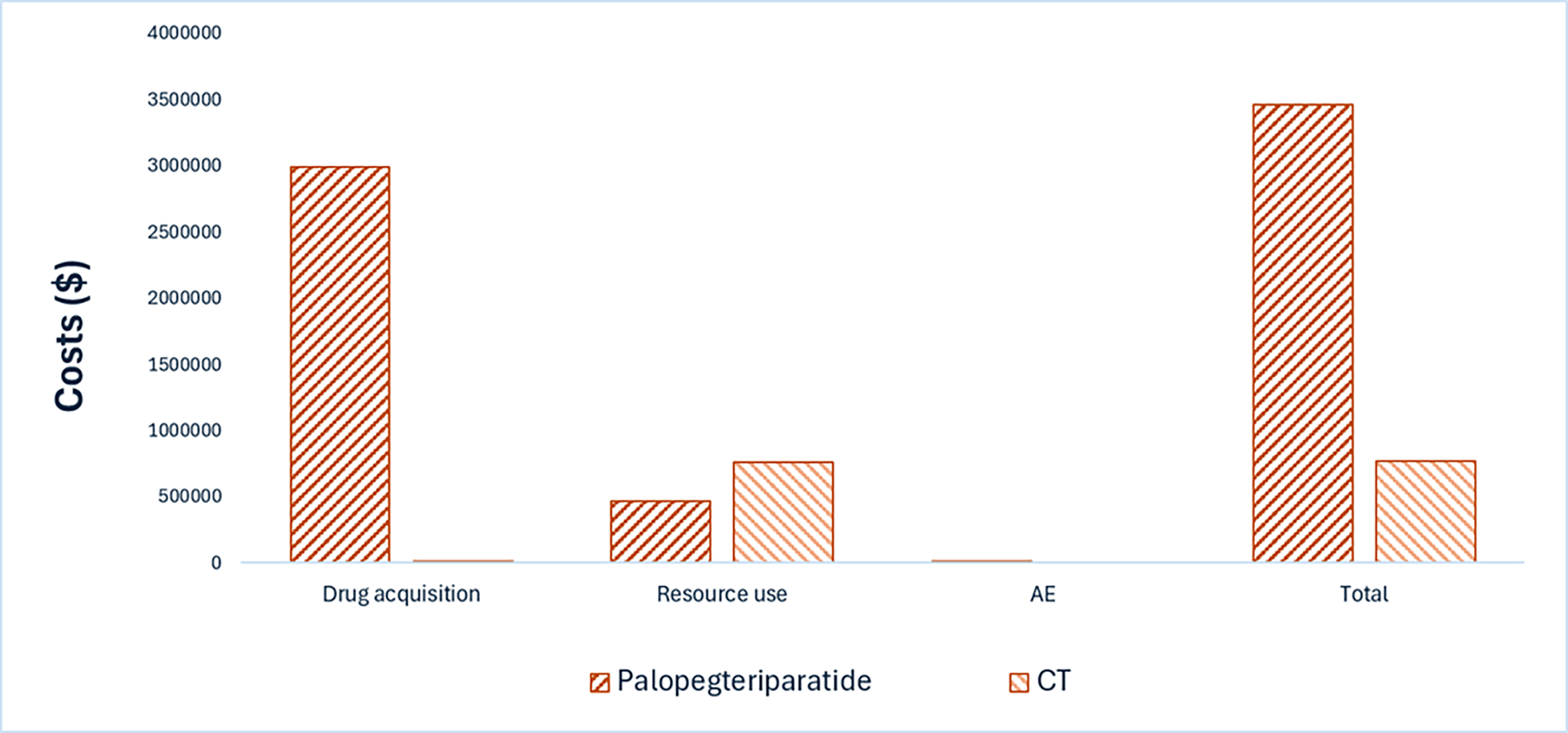
AE = adverse event; CT = conventional therapy; vs. = versus.
Impact on Health
Palopegteriparatide is predicted to result in 1.59 additional QALYs per patient compared to conventional therapy. Approximately 99% of the predicted incremental benefit was accrued on the basis of extrapolation.
Figure 2: Impact of Palopegteriparatide vs. Conventional Therapy on Patient Health
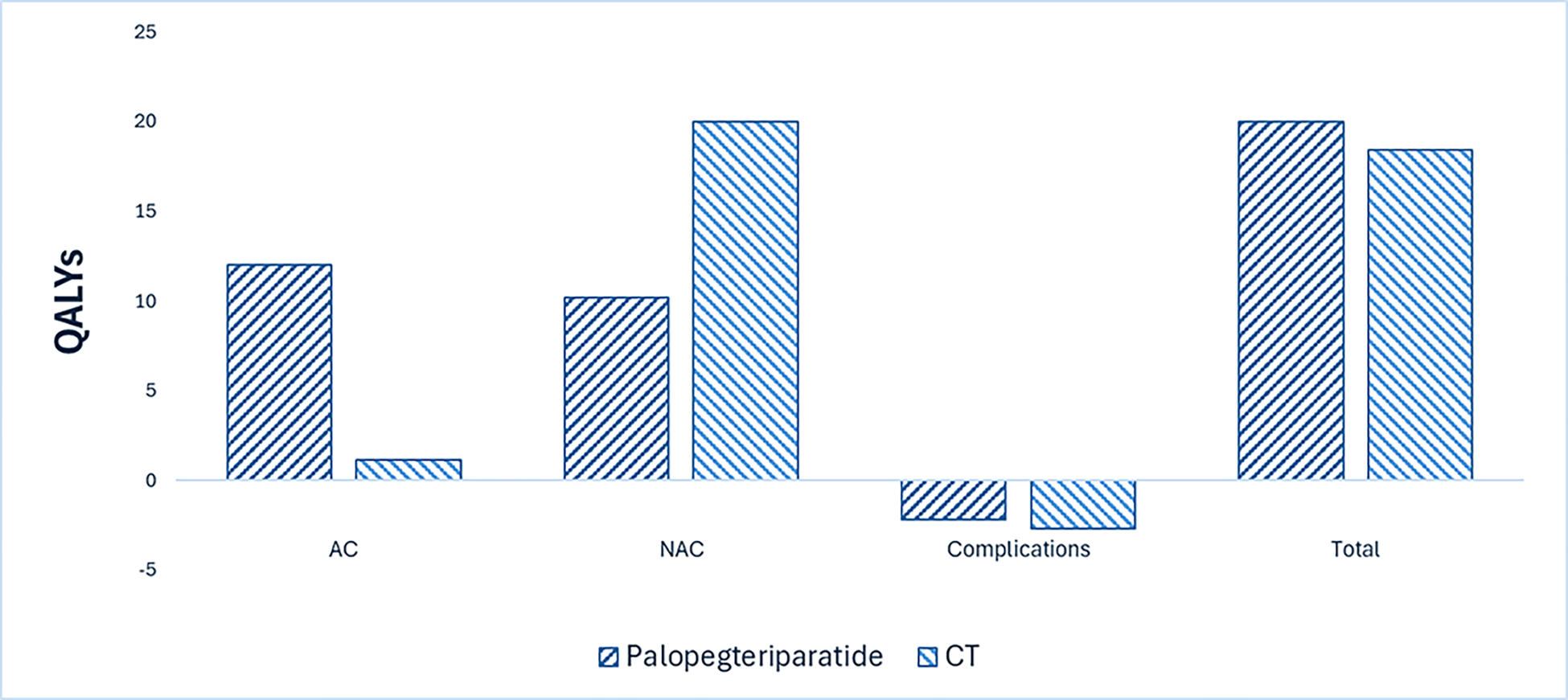
AC = adequately controlled; CT = conventional therapy; NAC = not adequately controlled; QALY = quality-adjusted life-year; vs. = versus.
Overall Results
The results of the CDA-AMC base case suggest an ICER of $1,696,159 per QALY gained for palopegteriparatide compared to conventional therapy (refer to Table 9). Additional details on the CDA-AMC base case are available in the Supplemental Material document, Appendix 11.
Table 9: Summary of the CDA-AMC Economic Evaluation Results
Drug | Total costs ($) | Total QALYs | ICER vs. CT ($/QALY) |
|---|---|---|---|
CT | 769,953 | 18.43 | Reference |
Palopegteriparatide | 3,464,574 | 20.02 | 1,696,159 |
CDA-AMC = Canada’s Drug Agency; CT = conventional therapy; ICER = incremental cost-effectiveness ratio; QALY = quality-adjusted life-year; vs. = versus.
Note: Publicly available list prices were used for all comparators.
Uncertainty and Sensitivity
Uncertainty was explored in scenario analyses outlined in Table 8. The exclusion of disutilities for complications related to hypoparathyroidism had the largest impact on cost-effectiveness.
Summary of the Budget Impact
The sponsor submitted a BIA to estimate the 3-year (2027 to 2029) budget impact of reimbursing palopegteriparatide for use in combination with conventional therapy for the treatment of chronic hypoparathyroidism in adults as well as for the requested reimbursement population (restricted to patients whose disease is NAC by conventional therapy). The sponsor assumed that the payer would be CDA-AMC–participating public drug plans (excluding Quebec) as well as the Non-Insured Health Benefits Program. The sponsor derived the size of the eligible population using an epidemiologic approach. The price of palopegteriparatide was aligned with the price included in the sponsor’s economic evaluation, while the prices of comparators were based on the publicly available list prices. Additional information pertaining to the sponsor’s submission is provided in the Supplemental Material document, Appendix 12.
CDA-AMC identified several issues with the sponsor’s estimated budget impact and made changes to model parameters and assumptions in consultation with clinical experts to derive the CDA-AMC base case (refer to the Supplemental Material document, Appendix 12). CDA-AMC estimated that by year 3 of reimbursement, 2,917 patients would be eligible for palopegteriparatide in the requested reimbursement population; of these, 1,312 patients are expected to receive palopegteriparatide. The estimated incremental budget impact of reimbursing palopegteriparatide for this population is predicted to be approximately $549 million over the first 3 years, with an expected expenditure of $551 million on palopegteriparatide. If reimbursed for the full Health Canada–indicated population, the budget impact is predicted to be approximately $582 million over the first 3 years (expenditure on palopegteriparatide = $583 million). The actual budget impact will depend on the proportion of patients with hypoparathyroidism that is NAC by conventional therapy, the proportion of patients with public drug plan coverage, the market uptake of palopegteriparatide, and the proportion of patients who require 33 mcg to 60 mcg palopegteriparatide per day.
Conclusion
Based on the CDA-AMC base case, palopegteriparatide would be considered cost-effective in the requested reimbursement population at the submitted price if the public health care system was willing to pay at least $1,696,159 for each additional QALY gained. If the public health care system is not willing to pay that amount, a price reduction should be considered (refer to Figure 3; full details of the impact of price reductions on cost-effectiveness are presented in the Supplemental Material document, Appendix 11).
The estimated cost-effectiveness of palopegteriparatide compared to conventional therapy is highly uncertain due to uncertainty in the comparative clinical evidence, the absence of long-term comparative data, and uncertainty about the impact of palopegteriparatide on the complications associated with hypoparathyroidism. Notably, the magnitude of difference in effectiveness between palopegteriparatide and conventional therapy in clinical practice in Canada may be smaller than estimated in the PaTHway trial because patients who received conventional therapy in the trial may have received suboptimal therapy. Additionally, although the PaTHway trial suggests treatment effects on relevant surrogate outcomes, evidence for the impact of palopegteriparatide on important clinical outcomes (e.g., renal complications) is unavailable. As such, the CDA-AMC base case may overestimate QALYs gained relative to clinical practice. If the incremental QALYs with palopegteriparatide are lower than predicted in the CDA-AMC base case, further price reductions than those presented in this report may be required.
The budget impact of reimbursing palopegteriparatide to the public drug plans in the first 3 years is estimated to be approximately $549 million for the requested reimbursement population. The 3-year expenditure on palopegteriparatide (i.e., not accounting for current expenditure on comparators) is estimated to be $551 million. The actual budget impact will depend on the proportion of patients with hypoparathyroidism that is NAC by conventional therapy, the proportion of patients with public drug plan coverage, the market uptake of palopegteriparatide, and the proportion of patients who require 33 mcg to 60 mcg palopegteriparatide per day.
Figure 3: Summary of the CDA-AMC Economic Analysis and Price Reduction
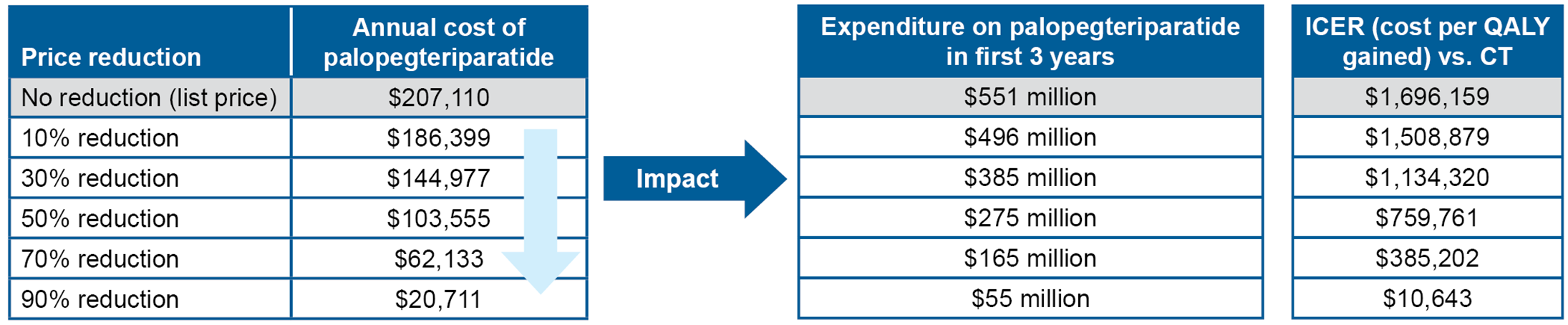
CDA-AMC = Canada’s Drug Agency; CT = conventional therapy; ICER = incremental cost-effectiveness ratio; QALY = quality-adjusted life-year; vs. = versus.
Note: Expenditure on palopegteriparatide includes only the drug cost of palopegteriparatide. The annual cost of palopegteriparatide was based on the dose distribution of year 3 from the open-label extension of the PaTHway trial (████% receiving ≤ 30 mcg per day; ████% receiving > 30 mcg per day).
References
1.Shoback DM, Bilezikian JP, Costa AG, et al. Presentation of Hypoparathyroidism: Etiologies and Clinical Features. J Clin Endocrinol Metab. 2016;101(6):2300-12. doi:10.1210/jc.2015-3909 PubMed
2.Khan AA, Ali DS, Bilezikian JP, et al. Best practice recommendations for the diagnosis and management of hypoparathyroidism. Metabolism. 2025;171:156335. doi:10.1016/j.metabol.2025.156335 PubMed
3.Bjornsdottir S, Ing S, Mitchell DM, et al. Epidemiology and Financial Burden of Adult Chronic Hypoparathyroidism. J Bone Miner Res. 2022;37(12):2602-2614. doi:10.1002/jbmr.4675 PubMed
4.Gosmanova EO, Houillier P, Rejnmark L, Marelli C, Bilezikian JP. Renal complications in patients with chronic hypoparathyroidism on conventional therapy: a systematic literature review: Renal disease in chronic hypoparathyroidism. Rev Endocr Metab Disord. 2021;22(2):297-316. doi:10.1007/s11154-020-09613-1 PubMed
5.Gosmanova EO, Chen K, Rejnmark L, et al. Risk of Chronic Kidney Disease and Estimated Glomerular Filtration Rate Decline in Patients with Chronic Hypoparathyroidism: A Retrospective Cohort Study. Adv Ther. 2021;38(4):1876-1888. doi:10.1007/s12325-021-01658-1 PubMed
6.Mitchell DM, Regan S, Cooley MR, et al. Long-term follow-up of patients with hypoparathyroidism. J Clin Endocrinol Metab. 2012;97(12):4507-14. doi:10.1210/jc.2012-1808 PubMed
7.Khan AA, Bilezikian JP, Brandi ML, et al. Evaluation and Management of Hypoparathyroidism Summary Statement and Guidelines from the Second International Workshop. J Bone Miner Res. 2022;37(12):2568-2585. doi:10.1002/jbmr.4691 PubMed
8.Pendopharm, a division of Pharmascience Inc. Yorvipath (palopegteriparatide injection): sterile solution, 168 mcg/0.56 mL, 294 mcg/0.98 mL, or 420 mcg/1.4 mL, subcutaneous injection [product monograph]. January 17, 2025.
9.Pendopharm, a division of Pharmascience Inc. Clinical Executive Summary: Yorvipath (Palopegteriparatide) [internal sponsor's report]. In: Drug Reimbursement Review sponsor submission: Yorvipath (palopegteriparatide injection), sterile solution, 168 mcg/0.56 mL, 294 mcg/0.98 mL, or 420 mcg/1.4 mL, subcutaneous injection. September 3, 2025.
10.Ascendis Pharma Inc. Clinical Study Report: TransCon PTH TCP-304. PaTHway TRIAL: A Phase 3, Multicenter, Randomized, Double-Blind, Placebo-Controlled, Parallel Group Trial, with an Open-Label Extension, Investigating the Safety, Tolerability and Efficacy of TransCon PTH Administered Subcutaneously Daily in Adults with Hypoparathyroidism [internal sponsor's report]. July 15, 2022.
11.Ascendis Pharma. Post Hoc Analysis: PaTHway Study Not Adequately Controlled (NAC) HypoPT patients [sponsor supplied reference]. 2025.
12.CENTER FOR DRUG EVALUATION AND RESEARCH. Multi-Disciplinary Review and Evaluation: Yorvipath (Palopegteriparatide). August 8, 2024. Accessed November 7, 2025. https://www.accessdata.fda.gov/drugsatfda_docs/nda/2024/216490Orig1s000MultidisciplineR.pdf
13.Brod M, McLeod L, Markova D, et al. Psychometric validation of the Hypoparathyroidism Patient Experience Scales (HPES). J Patient Rep Outcomes. 2021;5(1):70. doi:10.1186/s41687-021-00320-2 PubMed
14.Wang R, Lagakos SW, Ware JH, Hunter DJ, Drazen JM. Statistics in medicine--reporting of subgroup analyses in clinical trials. N Engl J Med. 2007;357(21):2189-94. doi:10.1056/NEJMsr077003 PubMed
15.Assmann SF, Pocock SJ, Enos LE, Kasten LE. Subgroup analysis and other (mis)uses of baseline data in clinical trials. Lancet. 2000;355(9209):1064-9. doi:10.1016/s0140-6736(00)02039-0 PubMed
16.Rothwell PM. Treating individuals 2. Subgroup analysis in randomised controlled trials: importance, indications, and interpretation. Lancet. 2005;365(9454):176-86. doi:10.1016/s0140-6736(05)17709-5 PubMed
17.Brod M, Waldman LT, Smith A, Karpf D. Assessing the Patient Experience of Hypoparathyroidism Symptoms: Development of the Hypoparathyroidism Patient Experience Scale-Symptom (HPES-Symptom). Patient. 2020;13(2):151-162. doi:10.1007/s40271-019-00388-5 PubMed
18.Brod M, Waldman LT, Smith A, Karpf D. Living with hypoparathyroidism: development of the Hypoparathyroidism Patient Experience Scale-Impact (HPES-Impact). Qual Life Res. 2021;30(1):277-291. doi:10.1007/s11136-020-02607-1 PubMed
19.Pendopharm a division of Pharmascience Inc. EMA MCID estimate [Data on file] [sponsor supplied reference].
20.Pendopharm, a division of Pharmascience Inc. Pendopharm, a division of Pharmascience Inc., response to Canada's Drug Agency request for additional information regarding palopegteriparatide review on October 22, 2025 [internal additional sponsor's information].
21.Pendopharm, a division of Pharmascience Inc. Pendopharm, a division of Pharmascience Inc., response to Canada's Drug Agency request for additional information regarding palopegteriparatide review on November 3, 2025 [internal additional sponsor's information].
22.Pendopharm, a division of Pharmascience Inc. Pendopharm, a division of Pharmascience Inc., response to Canada's Drug Agency request for additional information regarding palopegteriparatide review on September 24, 2025 [internal additional sponsor's information].
23.Clarke BL, Khan AA, Rubin MR, et al. Efficacy and Safety of TransCon PTH in Adults With Hypoparathyroidism: 52-Week Results From the Phase 3 PaTHway Trial. J Clin Endocrinol Metab. 2025;110(4):951-960. doi:10.1210/clinem/dgae693 PubMed
24.Kamenicky P, Schwarz P, Rejnmark L, et al. Sustained improvement in renal function with palopegteriparatide in adults with chronic hypoparathyroidism: 2-year results from the phase 3 PaTHway trial. Ann Endocrinol (Paris). 2024;85(5):412-413. doi:https://doi.org/10.1016/j.ando.2024.08.165
25.Schwarz P, Rejnmark L, Gosmanova E, et al. Sustained improvement in renal function with palopegteriparatide in adults with chronic hypoparathyroidism: 2-year results from the phase 3 PaTHway trial. Endocrine Abstracts. 2024;99:OC2.2. doi:10.1530/endoabs.99.OC2.2
26.Pendopharm, a division of Pharmascience Inc. Efficacy and Safety of Palopegteriparatide Treatment in Adults With Hypoparathyroidism: 3-Year Results From the Phase 3 PaTHway Trial [sponsor submitted reference; presentation slide deck]. In: Drug Reimbursement Review sponsor submission: Yorvipath (palopegteriparatide injection), sterile solution, 168 mcg/0.56 mL, 294 mcg/0.98 mL, or 420 mcg/1.4 mL, subcutaneous injection. September 19, 2025.
27.Pendopharm, a division of Pharmascience Inc. PaTHway Week 156 Renal Analyses Tables [sponsor submitted reference in response to Canada's Drug Agency request for additional information regarding palopegteriparatide review on October 28, 2025]. In: Drug Reimbursement Review sponsor submission: Yorvipath (palopegteriparatide injection), sterile solution, 168 mcg/0.56 mL, 294 mcg/0.98 mL, or 420 mcg/1.4 mL, subcutaneous injection.
28.Rejnmark L, Gosmanova EO, Khan AA, et al. Palopegteriparatide Treatment Improves Renal Function in Adults with Chronic Hypoparathyroidism: 1-Year Results from the Phase 3 PaTHway Trial. Adv Ther. 2024;41(6):2500-2518. doi:10.1007/s12325-024-02843-8 PubMed
29.Mayne TJ, Nordyke RJ, Schold JD, Weir MR, Mohan S. Defining a minimal clinically meaningful difference in 12-month estimated glomerular filtration rate for clinical trials in deceased donor kidney transplantation. Clin Transplant. 2021;35(7):e14326. doi:10.1111/ctr.14326 PubMed
30.Ku E, Xie D, Shlipak M, et al. Change in Measured GFR Versus eGFR and CKD Outcomes. J Am Soc Nephrol. 2016;27(7):2196-204. doi:10.1681/ASN.2015040341 PubMed
31.Chen K, Krasner A, Li N, Xiang CQ, Totev T, Xie J. Clinical burden and healthcare resource utilization among patients with chronic hypoparathyroidism, overall and by adequately vs not adequately controlled disease: a multi-country chart review. J Med Econ. 2019;22(11):1141-1152. doi:10.1080/13696998.2019.1624081 PubMed
32.Pendopharm, a division of Pharmascience Inc. Pharmacoeconomic evaluation [internal sponsor's report]. In: Drug Reimbursement Review sponsor submission: Yorvipath (palopegteriparatide injection), sterile solution, 168 mcg/0.56 mL, 294 mcg/0.98 mL, or 420 mcg/1.4 mL, subcutaneous injection. August 25, 2025.
ISSN: 2563-6596
Canada’s Drug Agency (CDA-AMC) is a pan-Canadian health organization. Created and funded by Canada’s federal, provincial, and territorial governments, we’re responsible for driving better coordination, alignment, and public value within Canada’s drug and health technology landscape. We provide Canada’s health system leaders with independent evidence and advice so they can make informed drug, health technology, and health system decisions, and we collaborate with national and international partners to enhance our collective impact.
Disclaimer: CDA-AMC has taken care to ensure that the information in this document was accurate, complete, and up to date when it was published, but does not make any guarantee to that effect. Your use of this information is subject to this disclaimer and the Terms of Use at cda-amc.ca.
The information in this document is made available for informational and educational purposes only and should not be used as a substitute for professional medical advice, the application of clinical judgment in respect of the care of a particular patient, or other professional judgments in any decision-making process. You assume full responsibility for the use of the information and rely on it at your own risk.
CDA-AMC does not endorse any information, drugs, therapies, treatments, products, processes, or services. The views and opinions of third parties published in this document do not necessarily reflect those of CDA-AMC. The copyright and other intellectual property rights in this document are owned by the Canadian Agency for Drugs and Technologies in Health (operating as CDA-AMC) and its licensors.
Questions or requests for information about this report can be directed to Requests@cda-amc.ca.