Drugs, Health Technologies, Health Systems
Reimbursement Review
Sarilumab (Kevzara)
Sponsor: Sanofi-Aventis Canada Inc.
Therapeutic area: Polymyalgia rheumatica
Summary
What Is Polymyalgia Rheumatica?
Polymyalgia rheumatica (PMR) is an inflammatory rheumatic disorder that causes muscle pain and stiffness — mainly in the neck, shoulder, and hip areas — and has an extensive impact on patients’ day-to-day life and quality of life (QoL). PMR has been reported as the second most common rheumatic disease after rheumatoid arthritis (RA).1,2 In a study conducted in Canada, the prevalence of PMR among individuals aged 50 years or older was estimated to be 641.5 cases per 100,000 in urban areas and 864.2 cases per 100,000 in rural areas.3
What Are the Treatment Goals and Current Treatment Options for PMR?
The treatment goals for PMR include immediate relief of symptoms, sustained remission or low disease activity with no flares or recurrence while tapering corticosteroids, avoidance of steroid-induced side effects, and improvement of QoL. Outcomes identified as important in the input from patients and clinicians included increased and sustained remission of symptoms and fewer side effects associated with corticosteroid use.
In Canada (following the 2015 guideline developed by the European League Against Rheumatism [EULAR] and American College of Rheumatology [ACR]),4 oral corticosteroids, typically prednisone 15 to 25 mg daily, are usually considered as the initial treatment for PMR. Patients with PMR will start a gradual tapering of corticosteroids after clinical improvement, until remission or relapse.
What Is Kevzara and Why Did Canada’s Drug Agency Conduct This Review?
Kevzara is an IL-6 inhibitor that is administered by subcutaneous injection. Health Canada has approved Kevzara for the treatment of adult patients with PMR who have had an inadequate response to corticosteroids, or who have experienced a relapse during corticosteroid taper.
Canada’s Drug Agency (CDA-AMC) reviewed Kevzara to inform a recommendation to the participating public drug programs on whether it should be reimbursed for the Health Canada–approved indication.
How Did CDA-AMC Evaluate Kevzara?
CDA-AMC reviewed the clinical evidence on the beneficial and harmful effects, as well as the economic evidence, of Kevzara versus other treatments used in Canada for the treatment of adult patients with PMR who have had an inadequate response to corticosteroids, or who have experienced a relapse during corticosteroid taper. Corticosteroids were considered relevant treatments to compare with Kevzara when reviewing the clinical evidence.
The review was informed by materials submitted by the sponsor, which included clinical and economic evidence. CDA-AMC also identified equity and ethical considerations relevant to Kevzara and PMR.
The review was also informed by 2 patient group submissions and 2 clinician group submissions in response to our call for input, and by input from the participating public drug programs on issues that may impact their ability to implement a recommendation.
Two rheumatologists, representing Ontario and the Prairies, were consulted as part of the review process.
What Were the Findings?
Clinical Evidence
CDA-AMC reviewed the following clinical evidence:
1 randomized controlled phase III trial (the SAPHYR trial) comparing Kevzara plus 14-week prednisone taper with placebo plus 52-week prednisone taper in 118 patients with PMR who had an inadequate response or experienced relapse during prednisone taper.
For the comparison of Kevzara plus 14-week prednisone taper versus placebo plus 52-week prednisone taper:
The evidence demonstrated an added clinical benefit of Kevzara plus 14-week prednisone taper in patients with PMR who had an inadequate response or relapse during corticosteroid taper, compared to placebo plus 52-week prednisone taper. Kevzara plus 14-week taper may result in a clinically meaningful increase in the sustained remission at week 52, in comparison with placebo plus 52-week taper.
Kevzara plus 14-week prednisone taper may result in a clinically meaningful increase in the proportion of patients who achieve a sustained CRP reduction at week 52, compared to placebo plus 52‑week prednisone taper.
Sarilumab plus 14-week prednisone taper likely results in a clinically meaningful increase in the proportion of patients who are absent of any PMR signs or symptoms at week 52, compared to placebo plus 52‑week prednisone taper.
Sarilumab plus 14-week prednisone taper may result in a clinically meaningful increase in the probability of being PMR flare–free up to 52 weeks (i.e., time to first PMR flare), compared to placebo plus 52‑week prednisone taper.
Compared to placebo plus 52-week prednisone taper, Kevzara plus 14-week prednisone taper may result in a clinically meaningful improvement in Health Assessment Questionnaire Disability Index (HAQ-DI) standardized score (measuring a person’s functional ability to perform activities of daily living), from baseline to week 52.
Compared to placebo plus 52-week prednisone taper, Kevzara plus 14-week prednisone taper may result in an improvement in the pain score of the HAQ-DI (measuring the presence and severity of pain) using a visual analogue scale (VAS), from baseline to week 52. However, the clinical meaningfulness was uncertain.
The difference between the expected and actual cumulative corticosteroid dose was lower in the group receiving Kevzara plus 14‑week prednisone taper than it was in the group receiving placebo plus 52‑week prednisone taper (297.6 mg versus 455.1 mg) and signalled that Kevzara might lead to a reduced use of corticosteroids. However, it should be noted that, because of the study design of the SAPHYR trial, the expected cumulative corticosteroid dose was lower (1,780.6 mg versus 741.9 mg) and the duration of corticosteroid taper was shorter (14‑week taper versus 52‑week taper) in the group receiving Kevzara plus 14‑week taper than it was in the group receiving placebo plus 52‑week taper.
The safety profile of Kevzara (subcutaneous injection at a dose of 200 mg once every 2 weeks for 52 weeks) plus 14‑week prednisone taper was acceptable. However, safety evidence from further studies with a larger sample size and a longer follow-up period is needed, given that the median duration of follow-up of the SAPHYR trial was relatively short (i.e., 363 days) and the sample size was small.
Economic Evidence
Kevzara is available as 150 mg and 200 mg prefilled syringes or pens. At the submitted price of $745.69 per 200 mg, the annual cost of Kevzara is expected to be $19,388 per patient based on the Health Canada–recommended dosage, and $19,413 per patient in combination with prednisone.
Key clinical efficacy data used to inform the economic model were derived from post hoc analyses of the SAPHYR trial. It is highly uncertain whether the observed differences in the post hoc analyses favouring Kevzara plus 14-week corticosteroid taper compared to placebo plus 52-week corticosteroid taper represent meaningful treatment effects. This uncertainty arises from several compounding limitations with the source data, including the absence of formal statistical inferences; post hoc, exploratory nature; significant censoring with unstable late estimates; potential for prognostic imbalances; and inclusion of duplicate patients or events.
The results of the CDA-AMC base case suggest the following:
Kevzara plus 14-week corticosteroid taper is predicted to be associated with higher costs to health care systems than placebo plus 52-week corticosteroid taper (incremental costs = $17,053), primarily driven by increased costs associated with drug acquisition.
Kevzara plus 14-week corticosteroid taper is predicted to be associated with a gain of 0.19 quality-adjusted life-years (QALYs) compared to placebo plus 52-week corticosteroid taper (88% of the incremental benefit was based on extrapolation).
The incremental cost-effectiveness ratio (ICER) of Kevzara plus 14-week corticosteroid taper compared to placebo plus 52‑week corticosteroid taper was $88,975 per QALY gained in the CDA-AMC base case. The estimated ICER was highly sensitive to the remission benefits extrapolated from the post hoc analyses and to the length of treatment with Kevzara. Remaining uncertainty in the clinical data informing the cost-utility analysis (CUA) and the lack of long-term data to inform retreatment indicate that a higher price reduction may be warranted.
CDA-AMC estimates that the budget impact of reimbursing sarilumab plus 14-week corticosteroid taper for the treatment of patients with PMR who have had an inadequate response to corticosteroids, or who have experienced a relapse during corticosteroid taper, will be approximately $334 million over the first 3 years of reimbursement compared to the amount currently spent on 52-week corticosteroid taper and methotrexate plus corticosteroid taper, with an estimated expenditure of $335 million on sarilumab over this period. The actual budget impact of reimbursing sarilumab will depend on the number of people eligible for treatment and its uptake. Economic feasibility must be addressed, given that the predicted incremental budget impact of reimbursing sarilumab is greater than $40 million (in year 1, year 2, and year 3 of reimbursement), and given the difference between the sponsor’s estimate and the CDA-AMC estimate.
Abbreviations
ACR
American College of Rheumatology
AE
adverse event
AESI
adverse event of special interest
BIA
budget impact analysis
CDA-AMC
Canada’s Drug Agency
CHMP
Committee for Medicinal Products for Human Use
CI
confidence interval
CUA
cost-utility analysis
DMARD
disease-modifying antirheumatic drug
EMA
European Medicines Agency
ESR
erythrocyte sedimentation rate
EULAR
European League Against Rheumatism
GCA
giant cell arteritis
GRADE
Grading of Recommendations Assessment, Development and Evaluation
HAQ-DI
Health Assessment Questionnaire Disability Index
HR
hazard ratio
ICER
incremental cost-effectiveness ratio
ITT
intention to treat
LS
least squares
LY
life-year
MID
minimal important difference
MMRM
mixed model for repeated measures
PMR
polymyalgia rheumatica
QALY
quality-adjusted life-year
QoL
quality of life
RA
rheumatoid arthritis
RCT
randomized controlled trial
SD
standard deviation
SE
standard error
SF-36v2
Short Form (36) Health Survey version 2
TEAE
treatment-emergent adverse event
TESAE
treatment-emergent serious adverse event
VAS
visual analogue scale
Background
Introduction
The objectives of this report are as follows:
Review and critically appraise the evidence submitted by the sponsor on the beneficial and harmful effects of sarilumab (Kevzara), 150 mg/1.14 mL or 200 mg/1.14 mL, subcutaneous injection, for the treatment of polymyalgia rheumatica (PMR) in adult patients who have had an inadequate response to corticosteroids or who have experienced a relapse during corticosteroid taper. The focus will be placed on comparing sarilumab injection to relevant comparators in clinical practice in Canada and identifying gaps in the current evidence, and this focus is outlined in Table 1.
Review and critically appraise the economic information submitted by the sponsor, including a cost-effectiveness analysis and budget impact analysis (BIA). The focus of the Economic Review is aligned with the scope of the Clinical Review, unless otherwise stated. For most reviews, a Canada’s Drug Agency (CDA-AMC) base case is developed, informed by clinical expert input, the available clinical evidence, and the best interpretation of the economic evidence based on the information provided by the sponsor.
Table 1: Information on the Application Submitted for Review and on the CDA‑AMC Review
Item | Description |
|---|---|
Information on the application submitted for review | |
Drug | Sarilumab (Kevzara), 150 mg/1.14 mL or 200 mg/1.14 mL, as a single-dose prefilled syringe or prefilled pen, subcutaneous injection |
Sponsor | Sanofi-Aventis Canada Inc. |
Health Canada indication | Sarilumab injection is indicated in the treatment of adult patients with polymyalgia rheumatica (PMR) who have had an inadequate response to corticosteroids, or who have experienced a relapse during corticosteroid taper. |
Health Canada approval status | NOC |
Health Canada review pathway | Standard review pathway |
NOC date | May 9, 2025 |
Mechanism of action | Sarilumab is a fully human immunoglobulin G1 monoclonal antibody that inhibits IL‑6‑mediated signalling. Sarilumab potently binds to human IL‑6RAlpha to block IL‑6‑induced receptor signalling. |
Recommended dosage | The recommended dose of sarilumab is 200 mg once every 2 weeks (given as a subcutaneous injection) in combination with a tapering course of systemic corticosteroids. Sarilumab can be used as monotherapy following discontinuation of corticosteroids. |
Submission type | Initial submission |
Sponsor’s reimbursement request | Per indication |
Submitted price | $745.69 per 200 mg or 150 mg prefilled syringe or pen |
Information on the CDA-AMC review | |
Review type | Standard review |
Clinical Review focusb | Population: As defined in the Health Canada indication Intervention: Per recommended dosage Comparators: Corticosteroids (e.g., prednisone) Outcomes: Proportion of patients achieving sustained remission at 52 weeks, proportion of patients achieving sustained reduction of CRP from week 12 through week 52, proportion of patients who were absent from any PMR signs and symptoms at week 52, time to first PMR flare up to 52 weeks, LS mean change in HAQ-DI standardized score from baseline to week 52 and LS mean change in pain score measured via HAQ-DI by a VAS from baseline to week 52, and harms outcomes. |
HAQ-DI = Health Assessment Questionnaire Disability Index; LS = least squares; NOC = Notice of Compliance; PMR = polymyalgia rheumatica; VAS = visual analogue scale.
aCDA-AMC previously issued a reimbursement recommendation for this drug for the same indication or a similar indication.
bThe Economic Review aligns with the scope of the Clinical Review, unless otherwise stated.
Submission History for the Drug Under Review
CDA-AMC previously reviewed sarilumab through the Reimbursement Review process for the treatment of adults with moderately to severely active rheumatoid arthritis (RA) who have had an inadequate response or intolerance to 1 or more biologic or nonbiologic disease-modifying antirheumatic drugs (DMARDs), as monotherapy or in combination with methotrexate or another nonbiologic DMARD, and issued a recommendation to reimburse with clinical criteria and/or conditions.
Sources of Information
The contents of the Reimbursement Review report are informed by materials submitted by the sponsor, input received from interested parties (patient groups, clinician groups, and drug programs), and input from clinical experts consulted for this review.
Calls for patient group and clinician group input are issued for each Reimbursement Review. Two patient group submissions (1 from the Arthritis Consumer Experts and 1 joint submission from the Canadian Arthritis Patient Alliance, Vasculitis Foundation Canada, and Arthritis Society Canada) as well as 2 clinician group submissions (1 from the Canadian Rheumatology Association and 1 from the Canadian Rheumatologists With an Interest in PMR) were received. The Arthritis Consumer Experts gathered input from 6 people living with PMR in Canada who participated anonymously in their survey programs in 2024 and 2025. The Canadian Arthritis Patient Alliance, Vasculitis Foundation Canada, and Arthritis Society Canada gathered input from a survey that was jointly developed by the 3 patient organizations, conducted among people living in Canada, and included 17 people with PMR and 1 caregiver. The clinician groups provided input based on a literature search and the expert opinions of 2 clinicians from the Canadian Rheumatology Association and 10 clinicians from the Canadian Rheumatologists With an Interest in PMR. The full submissions received are available on the project landing page. The drug programs provide input on each drug being reviewed through the Reimbursement Review process by identifying issues that may impact their ability to implement a recommendation.
Input from patient and clinician groups is considered throughout the review, including in the selection of outcomes to include in the Clinical Review and in the interpretation of the clinical and economic evidence. Relevant patient and clinician group input is summarized in the Disease Background, Current Management, and Unmet Needs and Existing Challenges sections.
Each review team includes at least 1 clinical expert with expertise regarding the diagnosis and management of the condition for which the drug is indicated. Clinical experts are a critical part of the review team and are involved in all phases of the review process. Two clinical experts with expertise in the diagnosis and management of PMR participated as part of the review team, with representation from Ontario and the Prairies.
Disease Background
PMR is an immune-mediated, inflammatory rheumatic disorder of unclear etiology5-7 that has been reported as the second most common rheumatic disease after RA.1,2 Patients with PMR typically experience symmetric bilateral pain and stiffness in the neck, shoulder, and hip areas.7,8 PMR-related pain and stiffness are more pronounced in the morning or after periods of inactivity and tend to improve with physical movement.7,9 Most often, PMR occurs in adults older than 50 years.7,10 In a population-based study in the US, the lifetime risk of PMR was estimated to be 2.4% for women and 1.7% for men.2 In a study conducted in Canada, the prevalence of PMR among individuals aged 50 years or older was estimated to be 641.5 cases per 100,000 in urban areas and 864.2 cases per 100,000 in rural areas.3
The patient group input from the Canadian Arthritis Patient Alliance, Vasculitis Foundation Canada, and Arthritis Society Canada, as well as the patient group input from Arthritis Consumer Experts, noted that the symptoms of PMR (such as muscle pain, fatigue, and stiffness) had an extensive impact on their day-to-day life and quality of life (QoL). For instance, the majority of respondents surveyed by the Canadian Arthritis Patient Alliance, Vasculitis Foundation Canada, and Arthritis Society Canada reported that PMR significantly impacted their mental health (81%), ability to work (73%), and participation in hobbies (73%). The respondents also reported missed work, with estimates of lost workdays per month ranging from 3 to 7 days.
Current Management
Treatment Goals
According to the patient input jointly submitted by the Canadian Arthritis Patient Alliance, Vasculitis Foundation Canada, and Arthritis Society Canada, the treatment goals for PMR include better symptom management (e.g., better remission rates) with fewer side effects; improvement in daily function and long-term well-being; and, most importantly, enhancement of patients’ QoL.
According to the clinical experts consulted by the CDA-AMC review team, the goals in treating PMR include immediate relief of symptoms (as quickly as possible with the least amount of corticosteroid) like shoulder and hip girdle pain and stiffness, normalization of erythrocyte sedimentation rate (ESR) and CRP levels, sustained remission or low disease activity with no flares or recurrence while tapering corticosteroids, and avoidance of steroid-induced side effects (e.g., osteoporosis, hypertension, worsening glycemic control, weight gain, or fat redistribution).
Based on the input from the Canadian Rheumatology Association, the treatment goal for PMR in the clinical setting is for patients to be symptom-free (including markers of systemic inflammation) and without the use of corticosteroid therapy.
Current Treatment Options
The Canadian Rheumatology Association noted that they do not have guidelines on the management of PMR. In Canada, following the 2015 guideline developed by the European League Against Rheumatism (EULAR) and American College of Rheumatology (ACR),4 oral corticosteroids (typically prednisone 15 to 25 mg daily) are usually considered as the initial treatment for PMR. For some patients, such as those with a low adherence to oral therapies, intramuscular methylprednisolone can be administered.4 Patients with PMR will start a gradual tapering of corticosteroids after clinical improvement, until remission or relapse.4
Corticosteroid-sparing agents, such as methotrexate, have been used with the aim of avoiding disease relapses and reducing patients’ exposure to corticosteroids to decrease side effects associated with corticosteroid use (e.g., osteoporosis, hypertension, weight gain, diabetes, and cataracts).11 According to the 2015 EULAR-ACR guideline,4 methotrexate — which is currently used off-label for PMR in Canada — may be considered for the treatment of patients with PMR who are at a high risk of relapse or prolonged corticosteroid therapy; patients who have risk factors, comorbidities, or concomitant medications that make corticosteroid-related adverse events (AEs) more likely; patients who experience a relapse or have no significant response to corticosteroids; and patients who have corticosteroid-related AEs during follow-up. The clinical experts consulted by the CDA-AMC review team noted that methotrexate is rarely used in their clinical practice and that it has shown a lack of effectiveness in patients with PMR.
A 2024 guideline from the French Society of Rheumatology suggests the use of IL-6 inhibitors (e.g., tocilizumab, sarilumab) before methotrexate for patients with corticosteroid dependence or those who are unable to reduce corticosteroid use.12 According to the clinical experts consulted by the CDA-AMC review team, tocilizumab is currently not approved by Health Canada for patients with PMR and can only occasionally be used off-label for patients with PMR in Canada through compassionate use programs.
According to the input from the group of Canadian Rheumatologists With an Interest in PMR, nonpharmacological treatments for PMR include physical therapy and exercise to maintain patients’ function and independence as well as to reduce corticosteroid-related complications.
Key characteristics of sarilumab are summarized with other treatments available for PMR in the Supplemental Material document (available on the project landing page), in the Key Characteristics table in Appendix 1.
Unmet Needs and Existing Challenges
The joint patient group input from the Canadian Arthritis Patient Alliance, Vasculitis Foundation Canada, and Arthritis Society Canada noted that there is an unmet need for effective, safe, tolerable, and accessible treatment alternatives to corticosteroids. The input from the Arthritis Consumer Experts and from the Canadian Arthritis Patient Alliance, Vasculitis Foundation Canada, and Arthritis Society Canada identified several challenges associated with currently available treatments for PMR, including longer-term impacts (e.g., osteoporosis, cataracts, broken bones, infections requiring antibiotics) of taking corticosteroids, experiencing intolerable treatment-related side effects, having difficulty in tapering off corticosteroids, being unable to afford the medications for PMR, and encountering barriers to accessing treatments or attending appointments.
According to the clinical experts consulted by the CDA-AMC review team, current PMR management primarily relies on corticosteroid use. Long duration of corticosteroid treatment is associated with increased risk of side effects, such as infection, osteoporosis, diabetes, accelerated atherosclerosis, weight gain, adipose redistribution, cataract formation, and avascular necrosis. As a result, there is an unmet need for safe and effective treatment options that can reduce or replace corticosteroids.
According to the input from the Canadian Rheumatology Association and the Canadian Rheumatologists With an Interest in PMR, there are several challenges associated with currently available treatments for patients with PMR. For instance, there are currently no available treatments in Canada that can reverse the underlying disease process. There is a lack of corticosteroid-sparing treatments that can effectively achieve sustained remission, prevent disease relapses, and reduce the risk of prolonged corticosteroid therapy and associated complications (e.g., osteoporosis, diabetes, hypertension, cardiovascular disease, infection, weight gain, mood changes, and negative impact on patients’ QoL).
Considerations for Using the Drug Under Review
Contents within this section have been informed by input from the clinical experts consulted for the purpose of this review and from clinician groups, as well as the reimbursement conditions proposed by the sponsor (refer to the Initiation, Renewal, Discontinuation, and Prescribing Conditions Proposed by the Sponsor table in Appendix 1 of the Supplemental Material document). The implementation questions from the public drug programs and corresponding responses from the clinical experts consulted for this review are also summarized in the Supplemental Material document, in the Summary of Drug Program Input and Clinical Expert Responses table in Appendix 1. The following has been summarized by the review team. Of note, for this review, the sponsor opted not to propose any reimbursement conditions.
Place in Therapy
According to the clinical experts consulted by the CDA-AMC review team, sarilumab is considered the first corticosteroid-sparing option (replacing methotrexate’s position in current treatment paradigm) for patients with PMR whose disease is not responsive to corticosteroids or who are experiencing AEs with corticosteroids, and it therefore may cause a shift in the treatment paradigm. Both the clinical experts and the group of Canadian Rheumatologists With an Interest in PMR noted that sarilumab is a DMARD that targets the underlying disease process through IL-6 inhibition, rather than only providing symptomatic relief of pain and inflammation.
Patient Population
According to the clinical experts consulted by the CDA-AMC review team, patients most in need of sarilumab are those with PMR who cannot taper corticosteroids below safe doses or who repeatedly experience disease relapse; those with comorbidities (e.g., osteoporosis, hypertension, coronary artery disease) that are exacerbated by prolonged corticosteroid use; and those with sensitivities to corticosteroids, including exacerbation of depression and anxiety. The clinical experts noted that PMR is a homogeneous condition, and therefore most patients with PMR — including those who require long-term use of corticosteroids and those who experience flares when tapering prednisone — would be best suited to receive treatment with sarilumab. The clinical experts noted that patients with PMR who would be least suited for treatment with sarilumab include those with pre-existing liver disease or pre-existing neutropenia, patients with needle phobia who cannot tolerate a subcutaneous injection or IV infusion, and patients with recurrent infections. Caution should be taken in using sarilumab in patients with any ongoing infection (e.g., bronchitis, sinusitis, cellulitis, or active or latent tuberculosis).
According to the clinical experts consulted by the CDA-AMC review team, the diagnosis of PMR is typically confirmed by clinical assessment and levels of ESR and/or CRP. The clinical experts noted that diagnosis of PMR is generally straightforward, although a minority of patients may later show PMR-onset RA, which requires further testing (i.e., rheumatoid factor and anticyclic citrullinated peptide) to exclude a diagnosis of RA. ESR and CRP measurements are available in standard, quick blood tests that are widely available across Canada with no companion diagnostic required; however, while CRP and ESR measurements are valuable at the onset of PMR diagnosis, they are not as useful over the course of the disease, given that normal levels can be found while a patient has significant symptoms requiring increases in or reintroduction of prednisone. The clinical experts noted that overall PMR is a very distinct clinical rheumatic disease that is unlikely to be underdiagnosed in clinical practice.
Input from both of the clinician groups indicated that they anticipate adult patients with PMR who experience a relapse (defined as a return of PMR symptoms accompanied by an ESR greater than 30 mm/hour or a CRP level greater than 10 mg/L) during glucocorticoid tapering or who have an inadequate response or intolerance to glucocorticoids at doses greater than 7.5 mg/day would be eligible for sarilumab. The Canadian Rheumatology Association highlighted the following patients as those who would be most likely to benefit from treatment with sarilumab: patients with recurrent PMR who need high doses of corticosteroids based on their previous PMR treatment course, and patients with comorbidities associated with a higher risk of AEs of corticosteroid therapy that warrants a faster prednisone taper. The Canadian Rheumatologists With an Interest in PMR noted that patients with alternative diagnoses (e.g., giant cell arteritis, RA), well-controlled PMR while taking less than 7.5 mg/day of prednisone, or contraindications to IL-6 blockade (e.g., diverticulitis, neutropenia, serious infections) would not be considered appropriate candidates for treatment with sarilumab.
Assessing the Response to Treatment
According to the clinical experts consulted by the CDA-AMC review team, outcomes used to determine whether a patient’s PMR is responding to treatment in clinical practice include resolution of clinical symptoms of PMR, levels of ESR and CRP, and sustainability of symptom resolution with continued normal CRP and ESR levels and no flares (i.e., no recurrence of the PMR symptoms). There is no value in additional imaging for ongoing monitoring. The clinical experts noted that a clinically meaningful response refers to a quick (within days), sustained, and significant improvement in or resolution of symptoms (e.g., proximal shoulder and hip stiffness and pain) and associated normalization of ESR and CRP, as well as patients being able to resume normal QoL. According to the clinical experts, the current standard of care for PMR (not considering sarilumab) involves frequent clinical assessments (which vary depending on severity as well as patient factors, like where they live), approximately every 1 to 3 months at the beginning of treatment, to facilitate corticosteroid dose and monitor the presence and severity of side effects. Depending on the severity of side effects due to corticosteroid use, the clinician may consider a corticosteroid-sparing drug, such as methotrexate. However, switching to methotrexate is uncommon in practice because it is ineffective in the majority of cases, but these scenarios would be where methotrexate might be considered. In most cases, clinicians would adjust the dose of prednisone during these assessments. Subsequent follow-up after the first 3 to 6 months varies in practice but typically occurs from every 1 to 3 months if disease is still active, or less frequently if the disease is stable (every 3 to 6 months). If sarilumab is made available as a publicly funded treatment option, the frequency of assessments is expected to be similar. The clinical experts further noted that there is a risk of infection when using IL-6 inhibitors; therefore, monitoring every 3 months is likely necessary, but patients would be counselled to contact their clinician if there are signs of infection (e.g., fever or productive cough and/or discharge).
According to the input from the Canadian Rheumatology Association and the Canadian Rheumatologists With an Interest in PMR, patients with PMR are evaluated for treatment response (i.e., clinical remission) based on the resolution of clinical symptoms (e.g., pain and stiffness) as well as normalization or reduction of inflammatory markers (e.g., ESR and/or CRP). The Canadian Rheumatologists With an Interest in PMR noted that, in the event of a flare, patients are reassessed clinically, and inflammatory markers are retested. The Canadian Rheumatologists With an Interest in PMR noted that not all patients in clinical practice will meet the definition of sustained remission used in the SAPHYR trial, which was considered strict. In routine practice, achieving clinical remission — defined as a corticosteroid dose of 5 mg or less per day — is considered a successful outcome. The Canadian Rheumatology Association, following the 2015 EULAR‑ACR guideline, noted that follow-up visits should be scheduled every 4 to 8 weeks in the first year, every 8 to 12 weeks in the second year, and as indicated in cases of relapse. The Canadian Rheumatologists With an Interest in PMR noted that treatment response is typically monitored monthly during the first 3 months, then every 3 months once a stable taper is established.
Discontinuing Treatment
According to the clinical experts consulted by the CDA-AMC review team, PMR typically does not remain a chronic disease, unlike RA, which requires indefinite treatment. Patients with PMR usually require 1 to 2 years of corticosteroid treatment to attain and maintain remission. The clinical experts noted that they anticipate sarilumab to be used for at least 1 year to 18 months before discontinuing treatment (irrespective of the time to discontinuation of corticosteroids).
According to the input from the Canadian Rheumatology Association and the Canadian Rheumatologists With an Interest in PMR, sarilumab should be discontinued in the event of intolerable side effects, such as drug hypersensitivity, anaphylaxis, bowel perforation, persistent diarrhea, uncontrolled infection, neutropenia with or without superimposing infection, thrombocytopenia, or elevation of liver enzymes. The Canadian Rheumatologists With an Interest in PMR noted that sarilumab could be discontinued after 12 months of sustained clinical remission; for patients unable to taper off corticosteroids completely, sarilumab could be continued to help minimize glucocorticoid burden.
Prescribing Considerations
According to the clinical experts consulted by the CDA-AMC review team, a rheumatologist is typically required to diagnose PMR. Treatment initiation and management should be under the care of clinicians or health care practitioners specializing in rheumatology rather than any other specialty. Exceptions may be needed in scenarios where PMR diagnosis and treatment(s) are managed by family physicians or internal medicine physicians in rural areas where access to rheumatologists may be limited.
According to the input from the Canadian Rheumatology Association and the Canadian Rheumatologists With an Interest in PMR, in an outpatient setting, rheumatologists or internists with specific expertise in PMR should be responsible for prescribing sarilumab and monitoring its efficacy and safety.
Clinical Review
Methods
The review team considered studies in the sponsor’s systematic review (pivotal studies and randomized controlled trials [RCTs]) in the evidence for inclusion. The submission did not include any long-term extension studies, indirect treatment comparisons, or studies addressing gaps. Eligible studies for the systematic review included published and unpublished pivotal studies and phase III and IV RCTs. Relevant patients and interventions were defined by the indication and recommended dosage in the product monograph. Relevant comparators were drugs used in clinical practice in Canada to treat patients described in the indication under review. These included corticosteroids, such as prednisone.
The review team selected outcomes (and follow-up times) for review considering the sponsor’s Summary of Clinical Evidence, clinical expert input, and patient and clinician group input. Included outcomes are those considered relevant to expert committee deliberations, and they were selected in consultation with committee members. Evidence from the systematic review for the most important outcomes was assessed using the Grading of Recommendations Assessment, Development and Evaluation (GRADE) approach. The following outcomes were assessed with GRADE as they are efficacy or safety measures that address 1 of the main treatment goals for PMR and were considered important to patients, according to patient and clinician group input:
proportion of patients achieving sustained remission at 52 weeks, proportion of patients achieving sustained reduction of CRP from week 12 through week 52, and proportion of patients who did not show any PMR signs and symptoms at week 52 (not excluding patients who had rescue therapy), all of which addressed the main treatment goals for PMR
probability of being PMR flare–free (i.e., from clinical remission to first PMR flare after clinical remission) up to 52 weeks, which provided the source for a key input in the sponsor’s pharmacoeconomic model
least squares (LS) mean change in Health Assessment Questionnaire Disability Index (HAQ-DI) standardized score from baseline to week 52 and LS mean change in pain score measured via HAQ-DI using a visual analogue scale (VAS) from baseline to week 52, which the clinical experts considered to be important patient-reported outcomes
infections and infestations as well as treatment-emergent serious adverse events (TESAEs), which the clinical experts considered to be important harms outcomes to assess the safety of sarilumab.
Methods for data extraction, risk of bias appraisal, and certainty of evidence assessment are in the Supplemental Material document, in Appendix 2.
Clinical Evidence
In this report, the following source of evidence submitted by the sponsor was reviewed and appraised:
1 RCT included in the systematic review, the SAPHYR trial.
Systematic Review
Description of Studies
Study Characteristics
One study (the SAPHYR trial) was identified in the sponsor-conducted systematic literature review and included for this Reimbursement Review. Characteristics of the SAPHYR trial are summarized in Table 2. Details pertaining to the eligibility criteria, interventions and comparators, and relevant outcome measures are in the Supplemental Material document, in Appendix 3.
The SAPHYR trial was a pivotal phase III, multicentre, randomized, double-blind, placebo-controlled trial investigating the efficacy and safety of sarilumab in the treatment of patients with PMR who had experienced a relapse during corticosteroid taper. Overall, 118 patients from 17 countries (including 4 patients in Canada) met the study eligibility criteria and were randomized at a ratio of 1:1 to either the group receiving sarilumab plus 14-week prednisone taper (hereafter referred to as the sarilumab group) (n = 60) or the group receiving placebo plus 52-week prednisone taper (hereafter referred to as the placebo group) (n = 58). The randomization procedure was performed centrally via an interactive response technology, and the randomization was not stratified. The primary end point of the SAPHYR trial was the proportion of patients achieving sustained remission at week 52, a composite end point consisting of 4 components: achievement of disease remission no later than week 12, absence of disease flare from week 12 through week 52, sustained reduction of CRP from week 12 through week 52, and successful adherence to the corticosteroid taper from week 12 through week 52. A patient needed to meet all 4 components to be considered as having achieved sustained remission.
The screening and recruitment activities for the SAPHYR trial were suspended in March 2020 due to the COVID-19 pandemic, and the sponsor decided to terminate the SAPHYR trial in July 2020. Patients who were enrolled in the SAPHYR trial were allowed to complete the study per protocol, and the last patient’s last visit occurred on May 19, 2021. Due to this decision to terminate, the SAPHYR trial protocol was amended (in SAPHYR Amended Clinical Trial Protocol 2, dated April 19, 2021), in which the total expected sample size was changed from 280 to 118 and the statistical significance level was changed from 0.01 to 0.05.
Table 2: Characteristics of Studies Included in the Systematic Review
Study name, design, and sample size | Key inclusion criteria | Key exclusion criteria | Intervention and comparator | Relevant end points |
|---|---|---|---|---|
SAPHYR (phase III, multicentre, randomized, double‑blind, placebo-controlled trial) Total N = 118 |
|
| Intervention: Sarilumab 200 mg subcutaneous injection every 2 weeks plus prednisone taper or placebo for 52 weeksb Prednisone taper schedule:
Comparator: Placebo plus prednisone taper for 52 weeksb Prednisone taper schedule:
|
|
ACR = American College of Rheumatology; EULAR = European League Against Rheumatism; ESR = erythrocyte sedimentation rate; GCA = giant cell arteritis; HAQ‑DI = Health Assessment Questionnaire Disability Index; MCS = mental component summary; PCS = physical component summary; PMR = polymyalgia rheumatica; RA = rheumatoid arthritis; SF-36v2 = Short Form (36) Health Survey version 2; VAS = visual analogue scale.
aUnequivocal symptoms of PMR flare were defined as shoulder and/or hip girdle pain associated with inflammatory stiffness.
bFrom week 0 to week 51 following randomization.
cThe proportion of patients achieving sustained remission at week 52 is a composite end point, consisting of 4 components: achievement of disease remission no later than week 12, absence of disease flare from week 12 through week 52, sustained reduction of CRP from week 12 through week 52, and successful adherence to the corticosteroid taper from week 12 through week 52. A patient needed to meet all 4 components to be considered as having achieved sustained remission.
dAdjusted for multiplicity.
eAbsence of any PMR signs and symptoms is not a primary, secondary, or exploratory end point; it is a supplementary analysis of the trial.
fAnalyses of time to first PMR flare included the prespecified analysis of time from randomization to first PMR flare after clinical remission and the post hoc analysis of time from remission to first PMR flare after clinical remission.
Source: SAPHYR Clinical Study Report.13 Details included in the table are from the sponsor’s Summary of Clinical Evidence.14
Statistical Testing and Analysis Populations
The sample size calculations were based on the primary efficacy variable of sustained remission at week 52 compared between the sarilumab group and the placebo group. The hypothesis to be tested on the primary end point was that sarilumab plus 14-week prednisone taper is superior to placebo plus 52-week prednisone taper, based on the proportion of patients achieving sustained remission at week 52.
Originally, a 25% difference from the placebo plus 52-week prednisone taper response rate was considered clinically relevant, and the sample size of 140 per group (280 in total) would provide at least 90% power to detect such a difference, regardless of the placebo plus 52-week prednisone taper response rate (i.e., assuming 5% to 50% placebo plus 52-week prednisone taper response rates), using a 2-sided chi-square test at a significance level of 0.01. However, as described previously, the SAPHYR trial was terminated early in July 2020 due to low enrolment during the COVID-19 pandemic. All enrolled patients were permitted to complete the trial according to the protocol. Before the database lock, the statistical significance level was changed from 0.01 to 0.05 because of the reduced sample size. With an alpha level of 0.05, the enrolment of 118 patients (59 per group) provided the trial with at least 85% power to detect a between-group difference in the primary outcome of 25 percentage points, and at least 95% power to detect a difference of 30 percentage points. These power calculations assumed a response of 5% to 15% in the placebo group based on a 2-sided chi-square test with a significance level of 0.05.
The primary end point (the proportion of patients in sustained remission at week 52) was analyzed using a 2-sided Fisher's exact test. The difference between proportions and 95% Wald asymptotic confidence intervals (CIs) were calculated. Patients who did not achieve remission, who received rescue treatment with open-label prednisone (or corticosteroid dose equivalents), who withdrew from the study before week 52, or who had missing data that prevented assessment of the primary end point were considered to be nonresponders. Multiplicity was controlled by a hierarchical testing procedure with an overall type I error rate of 0.05 (2-sided) for the primary end point (tested first) and the secondary end point of total cumulative corticosteroid dose (tested if the primary end point reached statistical significance at the 0.05 level). There was no multiplicity adjustment for the rest of the secondary and exploratory end points.
Two analysis populations in the SAPHYR trial were reported in the review, including the intention-to-treat (ITT) population (defined as the population who were analyzed according to the treatment group allocated by randomization) for all efficacy analyses, and the safety analysis population (defined as the randomized population who received at least 1 dose or part of a dose of the study drug analyzed according to the treatment actually received) for all safety analyses.
Patient Disposition
Patient disposition for the SAPHYR trial is summarized in the Supplemental Material document, in Appendix 4.
In the SAPHYR trial, 196 participants were screened for eligibility, with 78 patients being excluded. The 118 eligible patients were randomized to the sarilumab group (n = 60) and the placebo group (n = 58). The proportion of patients who discontinued from the study treatment was 28.3% in the sarilumab group and 37.9% in the placebo group. The most common reason for study treatment discontinuation in either group was lack of efficacy (6.7% in the sarilumab group versus 15.5% in the placebo group), followed by AEs not related to COVID-19 (10.0% in the sarilumab group versus 5.2% in the placebo group). The proportion of patients who discontinued from the study was similar between groups (25.0% in the sarilumab group versus 25.9% in the placebo group). However, 10.0% of patients in the sarilumab group (versus 1.7% in the placebo group) discontinued from the study due to AEs and 22.4% of patients in the placebo group (versus 15.0% in the sarilumab group) discontinued from the study due to other reasons unrelated to COVID-19 (mostly due to withdrawal of consent to continue study participation and not related to safety, according to the Clinical Study Report). A greater proportion of patients in the placebo group than the sarilumab group received corticosteroid rescue therapy (58.6% versus 31.7%) or add-on prednisone before week 12 (12.1% versus 6.7%). All patients were alive at the last study contact.
Overall, 43.3% of patients in the sarilumab group and 55.2% in the placebo group had any critical or major protocol deviation. Some imbalances were identified between groups. The proportion of patients who had critical or major protocol deviations due to informed consent procedures was 11.7% in the sarilumab group and 6.9% in the placebo group; the proportion of patients who had protocol deviations due to assessment procedures (e.g., study procedure performed by unqualified or unauthorized personnel) was 15.0% in the sarilumab group and 27.6% in the placebo group; and the proportion of patients who had protocol deviations due to clinical safety issues (e.g., failure to report) was 8.3% in the sarilumab group and 13.8% in the placebo group.
Baseline Characteristics
Detailed baseline characteristics are summarized in the Supplemental Material document, in Appendix 4. The mean age of patients in the SAPHYR trial was 68.9 years (standard deviation [SD] = 8.1). The majority of patients were female (69.5%), while 30.5% were male.
Table 3: Summary of Baseline Characteristics in the SAPHYR Trial (ITT Population)
Characteristic | Sarilumab plus 14-week prednisone taper (n = 60) | Placebo plus 52-week prednisone taper (n = 58) |
|---|---|---|
Age (years) | ||
Mean (SD) | 68.8 (7.8) | 69.1 (8.5) |
Median (range) | 69.0 (51 to 88) | 70. 0 (52 to 88) |
Age group, n (%) | ||
≥ 50 to < 65 years | 16 (26.7) | 15 (25.9) |
≥ 65 to < 75 years | 34 (56.7) | 26 (44.8) |
≥ 75 to < 85 years | 9 (15.0) | 16 (27.6) |
≥ 85 years | 1 (1.7) | 1 (1.7) |
Sex, n (%) | ||
Female | 45 (75.0) | 37 (63.8) |
Male | 15 (25.0) | 21 (36.2) |
Duration of morning stiffness (minutes) | ||
Mean (SD) | 85.2 (61.4) | 143.0 (215.0) |
Median (range) | 60.0 (10 to 270) | 90.0 (15 to 1,440) |
Baseline CRP (mg/L) | ||
Mean (SD) | 9.97 (9.79) | 8.92 (11.20) |
Median (range) | 6.76 (0.5 to 38.2) | 5.69 (0.1 to 62.3) |
Baseline ESR (mm/hour), mean (SD) | ||
Mean (SD) | 31.15 (24.55) | 26.93 (17.09) |
Median (range) | 25.00 (2.0 to 115.0) | 22.00 (5.0 to 85.0) |
Prednisone or equivalent dose for PMR at baseline (mg/day)a | ||
Mean (SD) | 12.33 (3.90) | 11.31 (3.29) |
Median (range) | 11.25 (7.5 to 20.0) | 10.00 (7.5 to 20.0) |
Duration of corticosteroid taperb for PMR from 24 weeks before screening up to baseline (days) | ||
Mean (SD) | 144.0 (36.4) | 154.8 (24.5) |
Median (range) | 168.0 (41 to 168) | 168.0 (78 to 168) |
ESR = erythrocyte sedimentation rate; ITT = intention to treat; PMR = polymyalgia rheumatica; SD = standard deviation.
aIncludes prednisone or equivalent dose.
bTotal duration of the corticosteroid use excluding any gap between the doses.
Source: SAPHYR Clinical Study Report.13
Treatment Exposure and Concomitant Medications
Details of patients’ treatment exposure, adherence, prior medications, concomitant medications, and rescue therapies in the included study are in the Supplemental Material document, in Appendix 4.
The cumulative exposure to subcutaneous injection of sarilumab or placebo was 47.37 patient years in the sarilumab group and 45.36 patient years in the placebo group. The median treatment duration was 363 days (range, 13 days to 373 days) for the sarilumab group and 363 days (range, 27 days to 371 days) for the placebo group. The percentage of patients with an 80% or greater compliance rate for subcutaneous injection of sarilumab or placebo was 94.9% in the sarilumab group and 96.6% in the placebo group. The percentage of participants with an 80% or greater compliance rate for oral prednisone was 100.0% in the sarilumab group and 98.3% in the placebo group. The compliance rate was defined as the number of administrations the patient actually received divided by the total number of planned administrations the patient had to take on or before the last dose date during the double-blind treatment period.
Approximately 3.3% (2 out of 60) of the patients in the sarilumab group and 15.5% (9 out of 58) in the placebo group had received prior methotrexate since PMR diagnosis and discontinued it before receiving study treatment. Approximately 96.7% (58 out of 60) of the patients in the sarilumab group and 98.3% (57 out of 58) in the placebo group received concomitant medications. In consultation with the clinical experts, it was determined that there were no meaningful differences in the use of concomitant medications relevant to PMR between the 2 groups.
Critical Appraisal
Internal Validity
The randomization procedure of the SAPHYR trial was performed centrally via interactive response technology. After randomization, imbalance was observed in several baseline patient and disease characteristics between the sarilumab group and the placebo group, such as patients aged between 65 and 75 years (56.7% in the sarilumab group versus 44.8% in the placebo group) or between 75 and 85 years (15.0% versus 27.6%), patient sex (female 75% versus 63.8%, male 25.0% versus 36.2%), weight (74.44 kg versus 83.49 kg), duration of morning stiffness (85.2 minutes versus 143 minutes), pain in shoulders (71.7% versus 82.8%), limited range of motion of the shoulders (56.7% versus 63.8%), duration of PMR from diagnosis date to baseline (660 days versus 600 days), and history of methotrexate use (3.3% versus 15.5%). The clinical experts consulted by the review team noted that most of these baseline characteristics would not bias the treatment effect estimates in a clinically meaningful way; however, a higher proportion of patients in the placebo group who had a history of receiving methotrexate might indicate a more severe disease status at baseline among patients in the placebo group. Overall, the CDA‑AMC review team determined that the methods were considered appropriate for minimizing the risk of bias in the randomization process, but there was an increased risk that the prognostic balance was not achieved due to the small trial sample size (N = 118). Consequently, there was an increased risk that the estimated treatment effects were influenced, at least in part, by the prognostic differences between groups; however, the direction and magnitude of the influence remain unknown.
The SAPHYR trial was terminated prematurely due to challenges in recruiting eligible patients during the COVID‑19 pandemic. As a result, the sample size of SAPHYR was reduced from 280 participants (estimated in the original sample size calculation) to 118 participants (randomized at the time of trial termination). The trial protocol had major amendments to maintain the statistical power to detect a 25% or 30% between-group difference with a smaller sample size. This included a decrease in response rates in the placebo group, as well as an increase in the risk of type I error, which increases the chance of a true null hypothesis being incorrectly rejected in a statistical test (i.e., false-positive results). Consistent with the assessment made by Health Canada and the European Medicines Agency (EMA) Committee for Medicinal Products for Human Use (CHMP),15,16 the CDA‑AMC review team determined that the premature termination of the SAPHYR trial introduced uncertainty in the validity of the trial findings while acknowledging that the changes in study protocol and statistical analysis plan were made as a result of unforeseen events (i.e., the COVID-19 pandemic) rather than an unblinded data analysis. In the SAPHYR trial, type I error was controlled for by a hierarchical testing procedure for the primary end point and only 1 secondary end point (i.e., cumulative corticosteroid dose during treatment period). Any statistical significance (P values) for the rest of the efficacy end points was not adjusted for multiplicity and only considered nominal. Thus, evidence on these end points was considered as supportive.
Approximately 33.1% of the total trial population in the SAPHYR trial discontinued during the study treatment period. The primary analysis of the primary end point (the proportion of patients who achieved sustained remission at week 52) was conducted in the ITT population, and patients who did not achieve remission, who received rescue treatment with open-label prednisone (or corticosteroid dose equivalents), who withdrew from the study before week 52, or who had missing data that prevented assessment were considered nonresponders. The strategies of handling missing data aimed to preserve the benefit of randomization and would generate a conservative treatment effect estimate. However, uncertainty remains, given the differential discontinuation rates; the proportion of patients who discontinued from the study treatment was 28.3% in the sarilumab group and 37.9% in the placebo group. Furthermore, 6.7% of the patients in the sarilumab group and 15.5% in the placebo group withdrew due to lack of efficacy, while 10.0% in the sarilumab group and 5.2% in the placebo group withdrew due to AEs not related to COVID-19. The differential loss of patients could still bias the treatment effect estimates derived from the ITT analysis, as the assumption for the ITT analysis about data missing at random likely did not hold. There was also a risk of bias due to missing outcome data in patient-reported end points (HAQ-DI standard score, VAS pain measure by HAQ-DI, Short Form (36) Health Survey [SF-36]). At baseline, only data for 77 out of 118 patients (65%) were available. Although the mixed model for repeated measures (MMRM) approach was used in the statistical models, it depended heavily on the assumption that the missing data were missing at random. The missing at random assumption is by nature not verifiable and unlikely to be valid in the SAPHYR trial, given the differential loss of patients described previously.
The sponsor conducted several prespecified sensitivity analyses to test the robustness of the results of the primary end point, including a sensitivity analysis excluding acute phase reactants (CRP and ESR) from the 4 components of sustained remission definition, a sensitivity analysis excluding patients who discontinued treatment as they were incorrectly diagnosed as having PMR or newly diagnosed as having RA during the study, and a tipping point analysis to test how robust the results were to assumptions about missing data. One post hoc sensitivity analysis, which excluded successful adherence to the corticosteroid taper from week 12 through week 52 from the 4 components of the definition of sustained remission, was also conducted at the request of the EMA CHMP.15 Overall, the results of these sensitivity analyses were consistent with the results of the primary analysis. However, in the tipping point analysis, the superiority of the sarilumab group disappeared (i.e., stopped being statistically significant) when the placebo group had 2 more responders. The small tipping point (i.e., 2 more responders) indicated that the treatment effect estimate of the primary end point might be sensitive to the missing data.
The survival analyses presented by the sponsor for time to first PMR flare had several methodological concerns and were expected to result in biased estimates, due to the inclusion of patients who were not at risk for a flare at baseline (i.e., only patients in remission at baseline could experience a flare); however, the ITT population included patients not in remission who could not meet this end point. Both the sponsor’s prespecified analytical approach (with which they would censor those who were not in remission at the randomization day) and the revised post hoc approach (with which they imputed those not in remission as having a flare at randomization day) represent substantial assumptions that are problematic and would be expected to artificially distort the Kaplan-Meier estimates and median survival times. Censoring at baseline inflated survival estimates by treating patients who could not experience the event as if they were at risk and simply had no event during follow-up, while assigning those not in remission as having a flare at baseline, created clinically inappropriate and immediate drops in the survival curves and artificially shortened the median survival times. Although the proportion of patients who were not at risk was balanced between treatment groups due to randomization, this balance did not justify the inclusion in a survival analysis framework where the fundamental assumption that all individuals must be at risk at time zero was violated. Although both approaches resulted in similar estimates, both were expected to be biased (albeit with the direction of bias being uncertain). Of note, in addition to the prespecified and post hoc analyses for time to first PMR flare, the sponsor submitted additional analyses (data not shown) at the feedback stage to demonstrate consistent benefit observed with sarilumab compared to placebo. Per the CDA-AMC Procedures for Reimbursement Reviews, no additional data will be assessed at the feedback stage; thus, the additional analyses were not formally reviewed and appraised.
Eleven subgroups were prespecified in the SAPHYR study protocol. Moreover, the sponsor classified patients post hoc based on remission or nonremission at baseline for the pharmacoeconomic model. The randomization was not stratified based on any of the factors; consequently, prognostic balance that had been achieved by randomization might not be preserved. The SAPHYR trial was not statistically designed to test subgroup differences: the sample size was not calculated based on any of the previously noted factors and there was no formal statistical test for interaction. Altogether, the analyses based on subgroups or remission or nonremission at baseline were considered exploratory (i.e., hypothesis generation rather than hypothesis confirmation), and no definitive conclusions could be drawn.
External Validity
The clinical experts consulted by the review team determined that findings of the SAPHYR trial are overall generalizable to the patients indicated in the Health Canada indication. However, some potential issues were also identified.
First, the SAPHYR trial adopted the EULAR-ACR classification criteria to select patients with PMR. According to clinical experts, the EULAR-ACR classification criteria were primarily developed for the clinical trial setting to ensure a homogeneous patient population is enrolled. It is not routine clinical practice to use the EULAR-ACR classification criteria to diagnose patients with PMR. The clinical experts noted that few rheumatologists in Canada would consciously apply the EULAR-ACR classification criteria to diagnose their patients with PMR. In clinical practice, the diagnosis of PMR is typically confirmed by clinical assessment and levels of ESR or CRP. Furthermore, the EULAR-ACR classification criteria for PMR apply only to patients aged 50 years or older, while the Health Canada indication includes adult patients regardless of age. According to the clinical experts, a diagnosis of PMR in people younger than 50 years is extremely rare, and the diagnosis requires ruling out many other conditions that can mimic the symptoms of PMR, such as other rheumatic diseases. Both clinical experts agreed that sarilumab should be restricted to patients older than 50 years.
Second, the clinical experts consulted by the review team noted that the trial eligibility criteria, which were used to define “inadequate responders to corticosteroids” and those who “have experienced a relapse during corticosteroid taper” in the Health Canada indication, were, “Patient must have had at least one episode of unequivocal PMR flare while attempting to taper prednisone at a dose that is ≥ 7.5 mg/day (or equivalent) within the past 12 weeks prior to screening. (Unequivocal symptoms of PMR flare defined as shoulder and/or hip girdle pain associated with inflammatory stiffness.)” The clinical experts noted that, in clinical practice, it is appropriate to mandate that patients show unequivocal symptoms of PMR. Although the clinical experts consulted by the CDA-AMC review team considered the prednisone dosing threshold of 7.5 mg/day to be appropriate overall, an assessment made by Health Canada determined that there is a lack of “definitive evidence” and “it is not clear whether there is a more appropriate level to define as a threshold…”.16
Third, the clinical experts consulted by the review team noted that the definition of the level of abnormality for CRP or ESR (i.e., that a patient must have an ESR ≥ 30 mm/hour or CRP level ≥ 10 mg/L) used in in SAPHYR trial was reasonable. However, the clinical experts noted that while elevated ESR and CRP levels are typical inflammatory markers of PMR, a subset of patients who meet the Health Canada indication can present with normal ESR and/or CRP levels despite having unequivocal symptoms of PMR. Thus, levels of CRP or ESR should not be used to identify patients eligible for sarilumab.
Fourth, the clinical experts consulted by the review team noted that the 14-week corticosteroid taper used in the sarilumab group was appropriate. However, the clinical experts also noted that, in clinical practice, the schedule and dosing of a corticosteroid taper along with sarilumab could vary and might be adjusted for individual patients. Similarly, the 52-week corticosteroid taper in the placebo group was considered by the clinical experts as overall representative of treatment in clinical practice, although again, the schedule and dosing of corticosteroids is variable and individualized.
Finally, the Health Canada indication does not specify the scenario in which patients with PMR have concurrent giant cell arteritis (GCA) at the time of diagnosis or develop GCA after PMR diagnosis. According to the clinical experts, treatment of GCA takes priority over the treatment of PMR, regardless of when GCA is confirmed. This is because GCA is a more severe condition than PMR, especially in terms of the risk to vision, and because in rare instances, GCA can be life-threatening. As such, although the 2 conditions may be seen concurrently, sarilumab is unlikely to be the treatment of choice for patients with a diagnosis of PMR and GCA, given that sarilumab is currently not approved by Health Canada for the treatment of GCA.
Results
The key efficacy and harms results and findings from the GRADE assessment are presented in this section. Detailed efficacy and harms results can be found in Appendix 4 in the Supplemental Material document.
Efficacy
Key results from the SAPHYR trial are summarized as follows. Supportive outcomes are summarized in the Supplemental Material document, in Appendix 4.
Sustained Remission at Week 52
In the ITT population of the SAPHYR trial, 28.3% (17 out of 60) of the patients in the sarilumab group and 10.3% (6 out of 58) of those in the placebo group achieved sustained remission at week 52, a composite end point consisting of 4 components. The between-group difference in the proportion was 18.0% (95% CI, 4.15% to 31.82%; P = 0.0193). Consistent with the primary analysis, the between-group difference was 17.9% (95% CI, 3.13% to 32.61%; P = 0.0280) in the sensitivity analysis excluding acute phase reactants (CRP and ESR) from the 4 components of the sustained remission definition, as well as 18.4% (95% CI, 4.08% to 32.72%; P = 0.0193) in the sensitivity analysis excluding patients who discontinued treatment as they were incorrectly diagnosed as having PMR or newly diagnosed as having RA during the study.
In terms of the results for the 4 components of sustained remission:
66.7% (40 out of 60) of the patients in the sarilumab group and 44.8% (26 out of 58) of patients in the placebo group achieved sustained remission reduction of CRP from week 12 through week 52; the between-group difference was reported for the proportion of patients who achieved sustained reduction of CRP from week 12 through week 52, which was ██████ ████ ███ ████ ██ ██████ | | ███████
46.7% (28 out of 60) of the patients in the sarilumab group and 37.9% (22 out of 58) of those in the placebo group achieved disease remission within 12 weeks
55.0% (33 out of 60) of the patients in the sarilumab group and 32.8% (19 out of 58) of those in the placebo group were did not experience disease flares from week 12 through week 52
50.0% (30 out of 60) of the patients in the sarilumab group and 24.1% (14 out of 58) of those in the placebo group showed successful adherence to the prednisone taper from week 12 through week 52.
Absence of Any PMR Signs and Symptoms at Week 52
Forty-eight of the 60 patients in the sarilumab group and 46 of the 58 patients in the placebo group contributed to the analysis of absence of any PMR signs and symptoms at week 52. In total, 81.3% (39 out of 48) of the patients in the sarilumab group and 56.5% (26 out of 46) of those in the placebo group did not have any PMR signs or symptoms at week 52. The between-group difference in the proportion of patients who did not show any PMR signs and symptoms at week 52 was ██████ ████ ██████ ██ █████████████. Excluding those who had rescue therapy, 84.4% (27 out of 32) of the patients in the sarilumab group and 47.1% (8 out of 17) of those in the placebo group did not show any PMR signs or symptoms at week 52. The between-group difference was ██████ ████ ███ ████ ██ █████████████.
Time to First PMR Flare After Clinical Remission Up to 52 Weeks
The proportion of patients who had a PMR flare after achieving clinical remission was 16.7% (10 out of60) in the sarilumab group and 29.3% (17 out of 58) in the placebo group. In the prespecified analysis, the median time from randomization to PMR flare was not reached (95% CI, 93 days to not reached) for the sarilumab group and 99 days (95% CI, 1 day to 154 days) for the placebo group. The hazard ratio (HR) was 0.56 (95% CI, 0.35 to 0.90; P = 0.0153). In the post hoc analysis, the median time from clinical remission to PMR flare was ███ ███████ ████ ███ ██ ████ ██ ███ ████████ for the sarilumab group and ██ ████ ████ ███ █ ██ ████ for the placebo group. The HR was ████ ████ ███ ████ ██ ███████████. The between-group difference in the probability of being event-free at week 52 was █████ ████ ███ █████ ██ ██████ for the prespecified analysis and █████ ███ ██ ██████████ for the post hoc analysis.
Cumulative Corticosteroid Dose During Treatment Period
During the median treatment duration of 363 days (range, 17 days to 373 days), the mean difference between actual and expected cumulative corticosteroid dose was lower in the sarilumab group than in the placebo group (297.6 mg versus 455.1 mg; P = 0.0189). The proportion of patients who had rescue corticosteroid therapy was 32.2% (19 out of 59, excluding 1 patient who was randomized but did not receive treatment) in the sarilumab group and 58.6% (34 out of 58) in the placebo group.
HAQ-DI Standardized Score at Week 52
At baseline and week 52, 42 of 60 patients in the sarilumab group and 35 of 58 patients in the placebo group were assessed. At week 52, the LS mean change from baseline HAQ-DI score was −0.39 (standard error [SE] = 0.09) for the sarilumab group and −0.15 (SE = 0.09) in the placebo group. The between-group difference in the LS mean change from baseline score was −0.246 (95% CI, −0.496 to 0.005; P = 0.0543).
Pain Score at Week 52 Measured Via HAQ-DI Using a VAS
At baseline and week 52, 42 of 60 patients in the sarilumab group and 35 of 58 patients in the placebo group were assessed. At week 52, the LS mean change from baseline pain score was −20.57 (SE = 4.13) for the patients in the sarilumab group and −12.04 (SE = 4.49) in the placebo group. The between-group difference in the LS mean change from baseline score was −8.534 (95% CI, −20.776 to 3.708; P = 0.1698).
Harms
Treatment-Emergent Adverse Events
The median treatment duration in the SAPHYR safety population was 363 days (range, 17 days to 373 days). The proportion of patients experiencing a treatment-emergent adverse event (TEAE) was higher in the sarilumab group than in the placebo group (94.9% [56 out of 59] versus 84.5% [49 out of 58]). The most frequently reported TEAEs included neutropenia (15.3% [9 out of 59] in the sarilumab group versus 0 in the placebo group), arthralgia (15.3% [9 out of 59] versus 5.2% [3 out of 58]), diarrhea (11.9% [7 out of 59] versus 1.7% [1 out of 58]) insomnia (10.2% [6 out of 59] versus 15.5% [9 out of 58]), hypertension (10.2% [6 out of 59] versus 3.4% [2 out of 58]), osteoarthritis (10.2% [6 out of 59] versus 8.6% [8 out of 58]), and nasopharyngitis (3.4% [2 out of 59] versus 10.3% [6 out of 58]).
Treatment-Emergent Serious Adverse Events
The proportion of patients experiencing a TESAE was lower in the sarilumab group than in the placebo group (13.6% [8 out of 59] versus 20.7% [12 out of 58]). The most common TESAE was neutropenia (3.4% [2 out of 58] in the sarilumab group versus 0 in the placebo group), followed by COVID-19 (0 in the sarilumab group versus 3.4% [2 out of 58] in the placebo group).
TEAEs Leading to Treatment Discontinuation or Death
A higher proportion of patients in the sarilumab group discontinued treatment due to AEs than in the placebo group (11.9% [7 out of 59] versus 6.9% [4 out of 58]). No death events occurred in either group.
Notable Harms
Regarding the occurrence of adverse events of special interest (AESIs) specified in the study protocol, the incidence was higher in the sarilumab group than in the placebo group (11.9% [7 out of 59] versus 8.6% [5 out of 58]). About 5.1% (3 out of 59) of the patients in the sarilumab group had an absolute neutrophil count decrease leading to permanent discontinuation (versus 0 in the placebo group); 3.4% (2 patients) in each group had opportunistic infections; 3.4% (2 patients) in each group had infections requiring prolonged medication; and 1.7% in the sarilumab group had infections requiring parenteral treatment (versus 0 in the placebo group). The proportion of patients who had infections or infestations was 37.3% (22 out of 59) in the sarilumab group and 50.0% (29 out of 58) in the placebo group.
Summary of Findings and Certainty of the Evidence
No literature-based minimal important difference (MID) estimates were used as the thresholds.
In the absence of literature-based MID estimates, thresholds suggested by the clinical experts were used for the following outcomes:
proportion of patients achieving sustained remission at 52 weeks (threshold: 5%)
proportion of patients achieving sustained reduction of CRP from week 12 through week 52 (threshold: 5%)
proportion of patients without any PMR signs or symptoms at week 52 (threshold: 5%)
probability of being PMR flare–free (i.e., from clinical remission to first PMR flare after clinical remission) up to 52 weeks (threshold: 10%)
LS mean change in HAQ-DI standardized score from baseline to week 52 (threshold: 0.22 points on a scale from 0 to 3)
LS mean change in pain score on the HAQ-DI measured using a VAS from baseline to week 52 (threshold: 20 points on a scale from 0 to 100).
In the absence of a known threshold, the certainty in the presence of a nonnull effect was rated for harms outcomes (i.e., infections and infestations and TESAEs).
Table 4: Summary of Findings for Sarilumab Plus 14-Week Prednisone Taper vs. Placebo Plus 52-Week Prednisone Taper for Patients With PMR Showing an Inadequate Response or Relapse During Prednisone Taper
Outcome and follow-up | Patients (studies), N | Relative effect (95% CI) | Absolute effects (95% CI) | Certainty | What happens | ||
|---|---|---|---|---|---|---|---|
Placebo plus 52‑week prednisone taper | Sarilumab plus 14‑week prednisone taper | Difference | |||||
Disease remission | |||||||
Proportion of patients achieving sustained remission at 52 weeks Median follow-up: 363 days in the trial population | 118 (1 RCT) | NR | 103 per 1,000 | 283 per 1,000 (NR) | 180 more per 1,000 (42 more to 318 more per 1 000) | Lowa | Sarilumab plus 14-week prednisone taper may result in a clinically meaningful increase in the proportion of patients who achieve sustained remission at week 52, compared to placebo plus 52-week prednisone taper. |
Proportion of patients achieving sustained reduction of CRP from week 12 through week 52 Median follow-up: 363 days in the trial population | 118 (1 RCT) | NR | 448 per 1,000 | 667 per 1,000 (NR) | ███ ████ | Lowb | Sarilumab plus 14-week prednisone taper may result in a clinically meaningful increase in the proportion of patients who achieve a sustained CRP reduction at week 52, compared to placebo plus 52-week prednisone taper. |
Proportion of patients without any PMR signs and symptoms at week 52 (not excluding patients who had rescue therapy) Median follow-up: 363 days in the trial population | 94 (1 RCT) | NR | 565 per 1,000 | 813 per 1,000 | ███ ████ | Moderatec | Sarilumab plus 14-week prednisone taper likely results in a clinically meaningful increase in the proportion of patients without any PMR signs or symptoms at week 52, compared to placebo plus 52-week prednisone taper. |
Probability of being PMR flare–free (i.e., from randomization to first PMR flare after clinical remission) up to 52 weeks Median follow-up: 363 days in the trial population | 118 (1 RCT) | NR | 224 per 1,000 | 517 per 1,000 (NR) | ███ ████ | Lowd | Sarilumab plus 14-week prednisone taper may result in a clinically meaningful increase in the probability of being PMR flare–free up to 52 weeks, compared to placebo plus 52-week prednisone taper. |
Patient-reported outcomes | |||||||
LS mean change in HAQ-DI standardized score from baseline to week 52 (0 [best] to 3 [worst]) Median follow-up: 363 days in the trial population | 105 (1 RCT) | NA | −0.15 (SE = 0.09) | −0.39 (SE = 0.09) | −0.246 (−0.496 to 0.005) | Lowe | Sarilumab plus 14-week prednisone taper may result in a clinically meaningful improvement in LS mean change in HAQ-DI standardized score from baseline to week 52, compared to placebo plus 52-week prednisone taper. |
LS mean change in pain score measured via HAQ-DI using a VAS from baseline to week 52 (0 [best] to 100 [worst]) Median follow-up: 363 days in the trial population | 105 (1 RCT) | NA | −12.04 (SE = 4.49) | −20.57 (SE = 4.13) | −8.534 (−20.776 to 3.708) | Lowf | Sarilumab plus 14-week prednisone taper may result in an improvement in the LS mean change in pain score measured via HAQ-DI using a VAS from baseline to week 52, compared to placebo plus 52-week prednisone taper. However, the clinical meaningfulness is uncertain. |
Harms | |||||||
Infections and infestations (consisting of but not limited to cystitis, gastroenteritis, nasopharyngitis, upper respiratory trat infection, and influenza) Median follow-up: 363 days in the trial population | 118 (1 RCT) | NR | 500 per 1,000 | 373 per 1,000 | ███ ████ | Lowg | Sarilumab plus 14-week prednisone taper may result in little to no difference in the occurrence of infections and infestations, compared to placebo plus 52-week prednisone taper. |
TESAEs Median follow-up: 363 days in the trial population | 118 (1 RCT) | NR | 136 per 1,000 | 207 per 1,000 | ███ ████ | Lowg | Sarilumab plus 14-week prednisone taper may result in little to no difference in the occurrence of TESAEs, compared to placebo plus 52-week prednisone taper. |
CDA-AMC = Canada’s Drug Agency; CI = confidence interval; HAQ-DI = Health Assessment Questionnaire Disability Index; ITT = intention to treat; LS = least squares; MID = minimal important difference; MMRM = mixed model for repeated measures; NA = not applicable; NR = not reported; PMR = polymyalgia rheumatica; RCT = randomized controlled trial; SE = standard error; TESAE = treatment-emergent serious adverse event; VAS = visual analogue scale; vs. = versus.
Note: Study limitations (which refer to internal validity or risk of bias), inconsistency across studies, indirectness, imprecision of effects, and publication bias were considered when assessing the certainty of the evidence. All serious concerns in these domains that led to the rating down of the level of certainty are documented in the table footnotes.
aRated down 1 level for serious risk of bias. Prognostic balance between groups might not have been achieved due to small sample size, as was evidenced by multiple imbalances observed in demographic and disease characteristics at baseline. Rated down 1 level for serious imprecision. No between-group MIDs were identified for the end point in the literature. The clinical experts consulted by the CDA-AMC review team considered a between-group difference of 5% (i.e., 50 per 1,000) clinically meaningful. The point estimate of the between-group difference (i.e., 180 per 1,000) was greater than the MID. However, the 95% CI crossed the MID, suggesting a possibility of benefit or clinically meaningful benefit.
bRated down 1 level for serious risk of bias. Prognostic balance between groups might not have been achieved due to small sample size, as was evidenced by multiple imbalances observed in demographic and disease characteristics at baseline. Rated down1 level for imprecision. No between-group MIDs were identified for the end point in the literature. The clinical experts consulted by the CDA-AMC review team considered a between-group difference of 5% (i.e., 50 per 1,000) clinically meaningful. The point estimate of the between-group difference (i.e., ███ ███ █████) was greater than the MID. However, the 95% CI crossed the MID, suggesting a possibility of benefit or clinically meaningful benefit.
cRated down 1 level for serious risk of bias. Prognostic balance between groups might not have been achieved due to small sample size, as was evidenced by multiple imbalances observed in demographic and disease characteristics at baseline. Missing outcome data were also identified: only 48 out of 60 patients in the sarilumab group and 46 out of 58 patients in the placebo group contributed to the analysis at week 52. Not rated down for imprecision. No between-group MIDs were identified for the end point in the literature. The clinical experts consulted by the CDA-AMC review team considered a between-group difference of 5% (i.e., 50 per 1,000) clinically meaningful.
dRated down 2 levels for very serious risk of bias. Prognostic balance between groups might not have been achieved due to small sample size, as was evidenced by multiple imbalances observed in demographic and disease characteristics at baseline. More importantly, there was a serious concern regarding the analytical approaches used to handle patients who never achieved clinical remission. Instead of censoring them, counting patients who never achieved clinical remission as “having a flare” raised a critical methodological concern regarding the handling of individuals who were not at risk for the outcome event in the Kaplan-Meier survival analysis. Misclassifying individuals who were not at risk as events or nonevents would artificially inflate the observed event rate, leading to significant bias in the true survival probabilities. This approach violated the fundamental assumptions of the time-to-event analysis by conflating true events with nonevents, potentially resulting in misleading conclusions. Not rated down for serious imprecision. No between-group MIDs were identified for the end point in the literature. One clinical expert consulted by the CDA-AMC review team considered a between-group difference of 5% to 10% (i.e., 50 to 100 per 1,000) clinically meaningful, while the other clinical expert considered 20% (i.e., 200 per 1,000) clinically meaningful; 10% was used as the MID.
eRated down 1 level for serious risk of bias. Prognostic balance between groups might not have been achieved due to small sample size, as was evidenced by multiple imbalances observed in demographic and disease characteristics at baseline. Missing outcome data were identified. Although the MMRM approach was adopted, it depended heavily on the assumption that the missing data were missing at random, which is not verifiable and might not be valid in the SAPHYR trial. Rated down 1 level for serious imprecision. No MIDs were identified for the end point in the literature. Based on their knowledge of the research on rheumatoid arthritis, the clinical experts consulted by the CDA-AMC review team considered a 0.22-point change on a scale from 0 to 3 clinically meaningful. Although the point estimate of the LS mean change in HAQ-DI standardized score from baseline to week 52 was greater than the MID, the 95% CI crossed the MID, suggesting a possibility of benefit or clinically meaningful benefit.
fRated down 1 level for serious risk of bias. Prognostic balance between groups might not have been achieved due to small sample size, as was evidenced by multiple imbalances observed in demographic and disease characteristics at baseline. Missing outcome data were identified. Although the MMRM approach was adopted, it depended heavily on the assumption that the missing data were missing at random, which is not verifiable and might not be valid in the SAPHYR trial. Rated down 1 level for serious imprecision. No MIDs were identified for the end point in the literature. Based on their clinical experience, the clinical experts consulted by the CDA-AMC review team considered a 20-point change on a 0 to 100 scale clinically meaningful. The point estimate of the LS mean change in pain score measured via HAQ-DI using a VAS from baseline to week 52 favoured the sarilumab group but was less than the MID. The 95% CI crossed the MID and the null (i.e., 0), suggesting a possibility of benefit and harm.
gRated down 2 levels for very serious imprecision. The 95% CI of the between-group difference crossed the null (i.e., 0), suggesting harm and no harm.
Source: SAPHYR Clinical Study Report,13 Drug Reimbursement Review sponsor submission.16
Long-Term Extension Studies
No long-term extension studies were identified for this review.
Indirect Evidence
No indirect evidence was identified for this review.
Studies Addressing Gaps in the Systematic Review Evidence
No studies addressing gaps in the systematic review evidence were identified for this review.
Discussion
Efficacy
Both patients and clinicians identified effective disease remission with the least amount of corticosteroid, sustained remission or low disease activity with no flares or recurrence while tapering corticosteroids, and improvement in QoL as important goals in the treatment of PMR. In the SAPHYR trial, these treatment needs were addressed by evaluation of efficacy end points, such as sustained remission at week 52, absence of any PMR signs and symptoms, time to first PMR flare, cumulative corticosteroid dose, HAQ-DI score, and SF-36 score.
Sustained remission at week 52 was investigated as the primary outcome in the SAPHYR trial. Sarilumab plus 14-week prednisone taper may have resulted in a clinically meaningful increase in the proportion of patients who achieved sustained remission at week 52. One source of evidence uncertainty was imprecision. Sustained remission at week 52 was a composite end point consisting of 4 components, including achievement of disease remission no later than week 12, absence of disease flare from week 12 through week 52, sustained reduction of CRP from week 12 through week 52, and successful adherence to the corticosteroid taper from week 12 through week 52. The findings on the 4 individual components were consistent with the results of the composite end point. Sustained reduction of CRP from week 12 through week 52 was assessed using the GRADE approach and determined to have a low certainty of evidence. The between-group treatment effect estimate for sustained reduction of CRP was considered imprecise, as the 95% CI crossed the MID range suggested by the clinical experts, indicating a possibility of benefit or clinically meaningful benefit.
According to the clinical experts consulted and the clinician group input received for this review, the definition of the composite primary end point (sustained remission) was stringent from a clinical perspective. This was reflected in the remission rate in the group receiving placebo plus 52-week prednisone taper; 10.3% of the patients in this group achieved sustained remission at week 52, representing a lower remission rate than what the clinical experts would expect for treatment with sarilumab. Among the 4 components of sustained remission, the treatment effect within the group receiving placebo plus 52-week prednisone taper ranged between 24.1% and 44.8%, higher than the 10.3% for the composite sustained remission. However, as the stringent criteria also applied to the patients in the sarilumab group, the risk that the relative treatment effect (i.e., between-group difference of 18.0%) was underestimated remains low; this was also corroborated by the similar between-group differences of the 4 individual components, which ranged between 17.2% and 25.9%.
The absence of any PMR signs and symptoms was investigated in the SAPHYR trial by excluding patients who received corticosteroid rescue therapy and by including these patients in the sensitivity analysis. Results were generally consistent between these 2 approaches. The clinical experts noted that the absence of any PMR signs and symptoms is a clinically important outcome, and that the analysis that included the patients who received rescue therapy was more reflective of their clinical practice. Findings from the SAPHYR trial suggest that sarilumab plus 14-week prednisone taper likely resulted in a clinically meaningful increase in the proportion of patients who did not have any PMR signs or symptoms at week 52. As described in the previous Internal Validity section, missing outcome data without additional analyses to account for their impact contributed to the moderate certainty of evidence.
Findings on the time to first PMR flare favoured the sarilumab group over the placebo group. However, the evidence is of low certainty, mainly due to the very serious risk of bias. As discussed in the Internal Validity section, counting patients who never achieved clinical remission as “having a flare” — instead of censoring them — raised a critical methodological concern regarding the handling of individuals who were not at risk for the outcome event in the Kaplan-Meier survival analysis. If such individuals were incorrectly coded as having or not having experienced the event, rather than being appropriately censored, this would introduce substantial bias into the survival estimates. Specifically, misclassifying individuals who were not at risk as having events or nonevents would artificially inflate the observed event rate, leading to significant bias in the true survival probabilities. This approach violated the fundamental assumptions of time-to-event analyses by conflating true events with nonevents, potentially leading to misleading conclusions.
Evidence to support the pharmacoeconomic analysis was not submitted for the clinical submission and was not included in the Clinical Study Report for the SAPHYR trial. Multiple post hoc analyses derived from the “time to first PMR flare” outcome were conducted and provided by the sponsor separately to inform the pharmacoeconomic model. The post hoc analyses for the pharmacoeconomic model and the detailed appraisal conducted by the CDA-AMC review team are summarized in Appendix 8. The post hoc analyses classified patients as patients with remission and patients with nonremission, which was not identified by the clinical experts as a known effect modifier. Overall, the evidence from the post hoc analyses was highly uncertain due to multiple compounding limitations, such as the absence of formal statistical inferences; the post hoc, exploratory nature of the study; significant censoring with unstable late estimates; the potential for prognostic imbalance; and the inclusion of duplicate patients and events. The evidence in its current form should be considered exploratory only, which precludes any definitive conclusion.
The clinical experts consulted by the review team noted that cumulative corticosteroid dose is a clinically relevant end point, given that an important treatment goal for PMR is to reduce the use of corticosteroids. According to the study protocol of the SAPHYR trial, the investigators planned to give the patients in the sarilumab group a 14-week corticosteroid taper with an expected cumulative corticosteroid dose of 741.9 mg, and give the patients in the placebo group a 52-week corticosteroid taper (starting from 15 mg/day at day 1 and tapering to 1 mg/day at week 52) with an expected cumulative corticosteroid dose of 1,780 mg. In other words, based on the study design of the SAPHYR trial, patients in the sarilumab group were supposed to receive a smaller amount of corticosteroids for a shorter period than patients in the placebo group. Findings from the SAPHYR trial showed that the difference between the expected dose planned in the study protocol and the actual dose of corticosteroids administered during the treatment period was smaller in the sarilumab group than it was in the placebo group (297.6 mg versus 455.1 mg; P = 0.0189). Findings from the SAPHYR trial also showed that the proportion of patients who received corticosteroids as rescue therapy in the sarilumab group was lower than it was in the placebo group (32.2% versus 58.6%). All of these findings signalled that adding sarilumab to corticosteroid treatment might lead to a reduced use of corticosteroids for patients with PMR. However, the study design of the SAPHYR trial precludes any definitive conclusion.
In the SAPHYR trial, patient QoL was assessed using several measurement instruments, such as the HAQ-DI, SF-36, Functional Assessment of Chronic Illness Therapy – Fatigue (FACIT-F), and EQ-5D-3L. The SF-36, FACIT-T, and EQ-5D-3L are generic measurement tools. Although these generic tools can be used to evaluate QoL with many types of diseases, they may not be able to capture the symptoms and/or psychological aspects specific to a disease or condition and may result in incomplete or misleading assessments.17 In addition, the clinical experts consulted by the review team noted that these generic QoL measurement tools are mainly intended for research purposes and are not usually interpreted in the clinical setting. The HAQ-DI was primarily developed for patients with RA and is not a PMR-specific instrument.18 There are potential limitations of using the HAQ-DI in patients with PMR. For instance, the HAQ-DI may not be able to capture the full disease experience in patients with PMR, as some items of key importance to patients with PMR (such as fatigue and sleep disturbance) are missing from the standard HAQ-DI.19-21 Additionally, some items on the HAQ-DI may not be relevant in older patients with PMR.19,20 Despite the potential limitations, the HAQ-DI has been psychometrically validated in patients with PMR.22-25 According to the clinical experts, in clinical practice, clinicians sometimes use the HAQ-DI for patients with conditions such as RA and PMR, although this is not routine. QoL evidence generated from the HAQ-DI was selected and assessed using the GRADE approach in this review. The findings indicated that sarilumab plus 14‑week prednisone taper might improve the HAQ-DI standardized score and the pain score of the HAQ-DI measured by VAS, at week 52, compared to placebo plus 52-week taper. The clinical meaningfulness for both end points, however, was uncertain due to imprecision based on the MIDs suggested by the clinical experts. SF‑36 results were generally consistent with HAQ‑DI results. However, findings for all QoL end points, including HAQ-DI and SF‑36 scores, were only considered supportive, given that multiplicity was not adjusted for, and any statistical significance detected was only considered nominal. In summary, there is low certainty that sarilumab plus 14-week prednisone taper may result in an improvement in patient QoL outcomes versus placebo plus 52-week prednisone taper.
Harms
Although a higher proportion of patients in the sarilumab group had TEAEs than the placebo group (94.9% versus 84.5%), the proportion of patients having at least 1 TESAE was lower in the sarilumab group (13.6% versus 20.7%). More patients in the sarilumab group discontinued treatment due to AEs than in the placebo group (7 [11.9%] versus 4 [6.9%]), which was mainly due the occurrence of neutropenia (3 versus 0 patients).
The clinical experts consulted by the review team noted that the risk of infection is a critical consideration in evaluating the safety of sarilumab, and they considered infection-related end points to be notable harms. The proportion of patients who had opportunistic infections, infections requiring prolonged medication, or infections that required parenteral treatment was similar between treatment groups. In terms of infections and infestations (including but not limited to cystitis, gastroenteritis, nasopharyngitis, upper respiratory tract infection, and influenza), the incidence was lower in the sarilumab group than it was in the placebo group (37.3% versus 50%).
Overall, the safety profile of sarilumab plus 14-week taper was acceptable, according to the clinical experts consulted by the review team. However, some limitations were also identified from the safety data in the SAPHYR trial. First, the duration of follow-up for safety was the 52-week treatment period (median = 363 days). There were no long-term safety data available beyond this period. Furthermore, the safety data in the SAPHYR trial came from a small sample (117 patients in the safety analysis population). The clinical experts consulted by the review team noted that long-term safety data related to IL-6 inhibitors for other diseases, such as RA, are available and can shed light on the long-term safety profile of sarilumab for the treatment of PMR.
Ethics and Equity Considerations
According to the clinical experts consulted by the review team, PMR can impair a patient’s autonomy due to physical limitations related to proximal shoulder and hip girdle pain and stiffness. Some patients with PMR may be unable to participate in activities of daily living during active disease. There is an increased burden for caregivers and family members who help these patients with activities of daily living. Long-term use of corticosteroids (e.g., prednisone) to treat PMR can lead to multiple side effects, including but not limited to hypertension, worsening glycemic control, and weight gain or fat redistribution. Adding sarilumab to corticosteroid treatment could potentially improve patients’ symptoms, ease the disease burden, and reduce exposure to long-term corticosteroid treatment. However, sarilumab is not a treatment for all patients with PMR; it was only studied in and indicated by Health Canada for patients with PMR for whom corticosteroid treatment is insufficient.
The clinical experts consulted by the review team noted that the mode of administration of sarilumab is typically subcutaneous injection once every 2 weeks, which is not currently the standard of care and may add a layer of complexity compared to daily oral corticosteroids. However, the overall burden to patients and caregivers would still be considered low, as it can be mitigated by providing patient support programs to facilitate injections, teaching patients and/or caregivers how to administer sarilumab, and training for pharmacists and physicians to administer the treatment or arrange home care services for administration when appropriate. The clinical experts noted that injection site reactions occur in a small percentage of the patient population, and rheumatologists usually have strategies to mitigate this. Patients receiving sarilumab need to do lab tests (e.g., complete blood count and differential, liver tests) to monitor drug safety. However, the clinical experts noted that the additional tests would not require significantly more vials of blood. Sarilumab would not impose a greater frequency of lab monitoring, which could be an additional burden for the patient or caregiver; lab monitoring would typically be stretched to every 3 months when disease activity is low.
The clinical experts consulted by the review team noted that females may be disproportionately impacted by PMR. Females are 2 to 3 times more likely to be affected by PMR than males.26 In addition, osteoporosis is about 4 times more common in females than males;27 therefore, long-term corticosteroid treatment for females with PMR carries greater risk for the sequelae of worsening osteoporosis. In the SAPHYR trial, about 69.5% of individuals in the trial population were female, which adequately represented the female patient population. Sarilumab may fulfill the unmet for the female patient population as an effective treatment option with fewer side effects compared to corticosteroids.
People living in rural or remote communities represent another group that may be disproportionately affected by PMR, according to the clinical experts. Evidence suggests that there is a higher prevalence of PMR in people living in rural areas compared to those in urban areas of Canada; the prevalence of PMR among individuals aged 50 years or older has been estimated to be 641.5 per 100,000 in urban areas and 864.2 per 100,000 in rural areas.3 In the SAPHYR trial, however, no demographic information on whether patients lived in a rural or urban area was identified. Living in a rural or remote area may pose challenges regarding the subcutaneous injection of sarilumab due to limited access to health care services and potential transportation barriers.
Conclusion
Evidence from 1 phase III, double-blind RCT (the SAPHYR trial, N = 118) was submitted by the sponsor and assessed by the CDA-AMC review team. Overall, there may be added clinical benefit of sarilumab plus 14-week prednisone taper in patients with PMR who have had an inadequate response or relapse during corticosteroid taper, compared to placebo plus 52-week prednisone taper. Sarilumab plus 14-week taper may result in a clinically meaningful increase in sustained remission at week 52, relative to placebo plus 52-week taper. A treatment effect in favour of sarilumab plus 14-week taper was also observed in other efficacy end points and QoL outcomes, such as sustained reduction of CRP level from week 12 through week 52, absence of any PMR signs and symptoms, time to first PMR flare, HAQ-DI standardized score, and pain score as measured by HAQ-DI using a VAS. The certainty of the evidence varies from moderate to low for the aforementioned efficacy end points due to several limitations identified in the SAPHYR trial, such as potential prognostic imbalance, missing outcome data, and invalid assumptions for time-to-event analyses.
The safety profile of sarilumab (subcutaneous injection at a dose of 200 mg once every 2 weeks for 52 weeks) plus 14-week taper was acceptable. However, safety evidence from further studies with a larger sample size and a longer follow-up period is needed, as the median duration of follow-up of the SAPHYR trial was relatively short (i.e., 363 days) and the sample size was small.
Despite the limitations that have been described, sarilumab may represent a treatment option for patients who have had an inadequate response to corticosteroids, or who have experienced a relapse during corticosteroid taper.
Economic Review
Methods
The review team appraised the pharmacoeconomic evidence submitted by the sponsor on the cost-effectiveness and budget impact of sarilumab plus 14-week corticosteroid taper compared to placebo plus 52-week corticosteroid taper for adult patients with PMR who have had an inadequate response to corticosteroids, or who have experienced a relapse during corticosteroid taper.
Summary of the Submitted Economic Evaluation
The sponsor submitted a cost-utility analysis to estimate the cost-effectiveness of sarilumab plus 14-week corticosteroid taper from the perspective of a public health care payer in Canada over a lifetime horizon (20 years). The modelled population comprised patients with PMR who have had an inadequate response to corticosteroids or who have experienced relapse during corticosteroid taper, which is aligned with the Health Canada indication and was based on the participants in the SAPHYR trial. The sponsor’s base-case analysis included costs related to drug acquisition and administration, AEs, and health care resource utilization.
In the sponsor’s base case, sarilumab plus 14-week corticosteroid taper was associated with incremental costs of $8,618 and 0.34 incremental QALYs relative to placebo plus 52-week corticosteroid taper. This resulted in an ICER of $25,191 per QALY gained. Approximately 88% of the incremental benefit compared to placebo plus 52-week corticosteroid taper (0.34 incremental QALYs), was predicted to be accrued after the 52-week observation period of the SAPHYR trial. Additional information about the sponsor’s submission is summarized in the Supplemental Material document, in Appendix 11.
CDA-AMC identified several key issues with the sponsor’s analysis (refer to Table 5; full details are provided in the Supplemental Material document, in Appendix 12).
Table 5: Key Issues With the Sponsor’s Economic Submission
Issue | What evidence is there to inform this issue? | How was this issue addressed by CDA-AMC? | Did CDA-AMC explore uncertainty in a scenario analysis? |
|---|---|---|---|
The comparative efficacy of sarilumab in the model is highly uncertain and the derivation of transition probabilities is methodologically flawed. | The transitions between health states were informed by post hoc subgroup analyses of the SAPHYR trial (52 weeks) and subsequently extrapolated over 18 years. This is highly uncertain due to several compounding methodological limitations with the post hoc analyses, including the absence of formal statistical inference, significant censoring, and the violation of the assumption of independent observations, which underlies the Kaplan-Meier estimator, potentially exaggerating the apparent treatment benefit when comparing subgroups. | The treatment differences for the transition from nonremission at baseline to remission post-baseline were retained, as they appeared not to be affected by duplicate patient records. CDA‑AMC removed any other treatment differences for transitions between other health states. Nonetheless, uncertainty in the underlying clinical data remains unresolved. | A scenario analysis was conducted using a 10‑year time horizon. This assumes no difference in costs and health benefits after 10‑years. |
The maximum treatment duration with sarilumab of 12 months is uncertain. | At 52 weeks, 75% were on treatment with sarilumab (based on the TTD curve), yet 40% remained in nonremission states or were still taking prednisone (based on the sponsor’s model). Clinical experts advised CDA‑AMC that clinicians are unlikely to discontinue sarilumab at week 52 in patients still taking corticosteroids or with residual PMR symptoms. Even those in remission and off corticosteroids may remain on treatment to ensure stable, corticosteroid-free remission. Overall, experts estimated typical treatment durations up to 18 to 24 months. | CDA-AMC assumed that patients would be treated with sarilumab for 18 months. | CDA-AMC explored the impact of a 24‑month treatment duration in a scenario analysis. |
The sponsor excluded the possibility of retreatment with sarilumab. | In the CUA, no costs associated with sarilumab retreatment were included. Clinical experts engaged by CDA‑AMC advised that clinicians are likely to re-treat patients with sarilumab if they subsequently experience a flare after being successfully treated with sarilumab. No evidence exists for the efficacy of retreatment. | CDA-AMC was unable to address this issue. | CDA-AMC explored the impact of another 12 months of costs to a proportion of patients. |
The impact of sarilumab plus 14‑week corticosteroid taper on QoL is uncertain. | Treatment with sarilumab plus 14‑week corticosteroid taper generated additional QALYs compared to placebo plus 52‑week corticosteroid taper, largely driven by a potentially overestimated remission benefit. The CDA-AMC Clinical Review concluded, with low certainty, that this regimen may improve QoL outcomes. | CDA-AMC was unable to address this issue. | No scenario analysis was conducted. |
The model lacked transparency due to poor modelling practice. | The submitted model had numerous IFERROR statements that resulted in the automatized overwriting of errors. | CDA-AMC was unable to address this issue. | No scenario analysis was conducted. |
CDA-AMC = Canada’s Drug Agency; CUA = cost-utility analysis; QoL = quality of life; TTD = time to discontinuation; vs. = versus.
Note: Full details of the issues identified by CDA-AMC are provided in the Supplemental Material document, in Appendix 12.
CDA-AMC Assessment of Cost-Effectiveness
The CDA-AMC base case was derived by making changes to model parameter values and assumptions (refer to the Supplemental Material document, Appendix 12, Table 14), in consultation with clinical experts. Detailed information about the CDA-AMC base case is provided in the Supplemental Material document, in Appendix 12.
Impact on Health Care Costs
Sarilumab plus 14-week corticosteroid taper is predicted to be associated with additional health care costs compared to placebo plus 52-week corticosteroid taper (incremental costs = $17,053). This increase in health care spending is largely driven by increased drug acquisition costs associated with sarilumab (incremental drug costs = $21,539). Some cost savings associated with reduced health care resource use are anticipated ($3,346) (refer to Figure 1).
Figure 1: Impact of Sarilumab Plus 14-Week Corticosteroid Taper vs. Placebo Plus 52‑Week Corticosteroid Taper on Health Care Costs
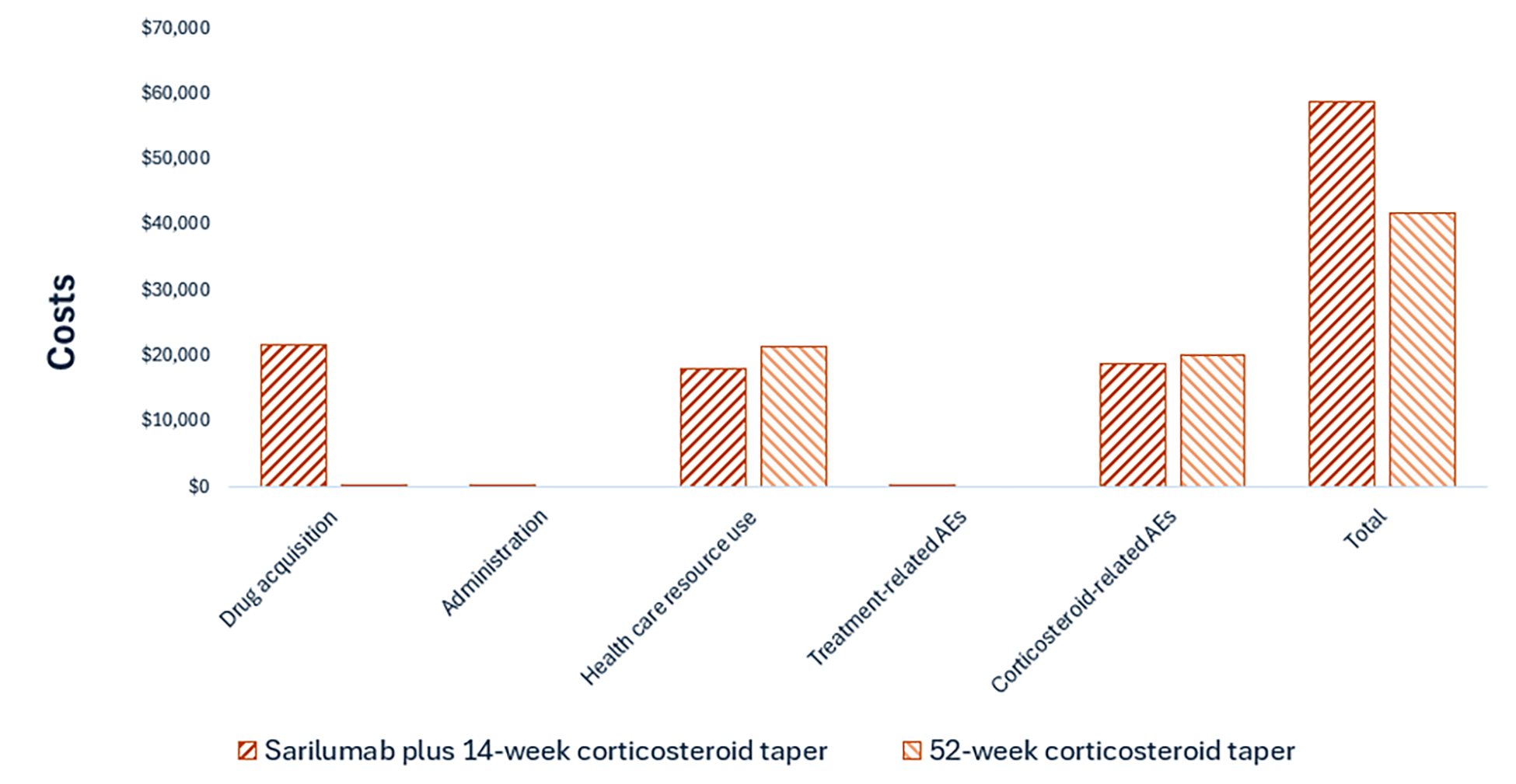
AE = adverse event; vs. = versus.
Note: Health care resource use includes costs associated with outpatient visits, specialist visits, and hospitalizations.
Impact on Health
There are no anticipated impacts on length of life, meaning patients who receive sarilumab are expected to have the same life expectancy as those who do not receive it. Relative to placebo plus 52-week corticosteroid taper, sarilumab plus 14-week corticosteroid taper is predicted to decrease the amount of time a patient remains in the nonremission at baseline health state by approximately 2.9 years. Considering the impact of treatment on both quality and length of life, sarilumab plus 14-week corticosteroid taper is predicted to result in 0.19 additional QALYs per patient compared to 52-week corticosteroid taper (refer to Figure 2). Approximately 88% of the predicted incremental benefit was accrued based on extrapolation.
Figure 2: Impact of Sarilumab Plus 14-Week Corticosteroid Taper vs. Placebo Plus 52‑Week Corticosteroid Taper on Patient Health
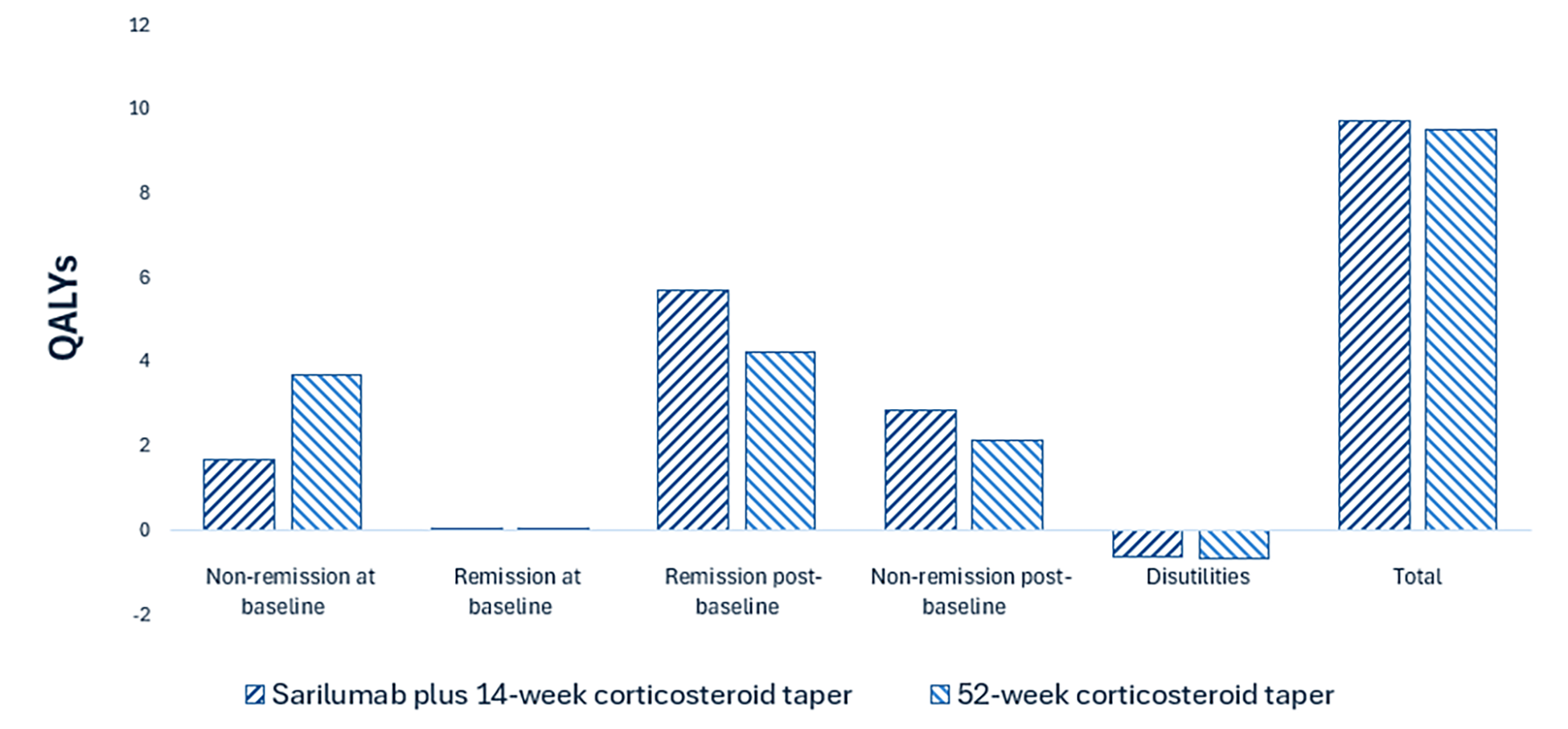
QALY = quality-adjusted life-year; vs. = versus.
Overall Results
The results of the CDA-AMC base case suggest an ICER of $88,975 per QALY gained for sarilumab plus 14‑week corticosteroid taper compared to placebo plus 52-week corticosteroid taper (refer to Table 6). Additional details on the CDA-AMC base case are available in the Supplemental Material, in Appendix 12.
Table 6: Summary of CDA-AMC Economic Evaluation Results
Drug | Total costs ($) | Total QALYs | ICER vs. 52-week corticosteroid taper ($/QALY) |
|---|---|---|---|
Placebo plus 52-week corticosteroid taper | 41,668 | 9.53 | Reference |
Sarilumab plus 14-week corticosteroid taper | 58,720 | 9.72 | 88,975 |
ICER = incremental cost-effectiveness ratio; QALY = quality-adjusted life-year; vs. = versus.
Note: Publicly available list prices were used for all comparators.
Uncertainty and Sensitivity
Uncertainty was explored in scenario analyses outlined in Table 5. Assumptions pertaining to retreatment with sarilumab and long-term costs and health benefits had the largest impact on cost-effectiveness conclusions (refer to Appendix 12, Table 18 in the Supplemental Material document).
Summary of the Budget Impact
The sponsor submitted a BIA to estimate the 3-year (2026 to 2028) budget impact of reimbursing sarilumab in combination with 14-week corticosteroid taper for use in the Health Canada–indicated population. The sponsor assumed that the payer would be CDA-AMC–participating public drug plans and derived the size of the eligible population using an epidemiologic approach. The price of sarilumab was aligned with the price included in the sponsor’s economic evaluation, while the prices of comparators were based on the publicly available list prices. Additional information pertaining to the sponsor’s submission is provided in the Supplemental Material document, in Appendix 13.
CDA-AMC identified a number of issues with the sponsor’s estimated budget impact and made changes to model parameters and assumptions in consultation with clinical experts to derive the CDA-AMC base case (Appendix 13 in the Supplemental Material document). CDA-AMC estimated that, in the first 3 years of reimbursement, 47,387 patients would be eligible for sarilumab plus 14-week corticosteroid taper; of these, 11,491 patients are expected to receive sarilumab plus 14-week corticosteroid taper. The estimated incremental budget impact of reimbursing sarilumab plus 14-week corticosteroid taper is predicted to be approximately $334 million over the first 3 years, with an expected expenditure of $335 million on sarilumab. The actual budget impact will depend on the number of people eligible for treatment and its uptake.
Conclusion
Based on the CDA-AMC base case, sarilumab plus 14-week corticosteroid taper would be considered cost-effective at the submitted price if the public health care system were willing to pay at least $88,975 for each additional QALY gained. If the public health care system is not willing to pay that amount, a price reduction should be considered (refer to Figure 3; full details of the impact of price reductions on cost-effectiveness are presented in the Supplemental Material document, Appendix 12, Table 17). The majority of the benefit of sarilumab in the economic model is derived from improvement in remission based on subgroup post hoc analyses of the SAPHYR trial, which could not be validated and potentially exaggerates the apparent treatment benefit when comparing subgroups. The cost-effectiveness of sarilumab is also uncertain due to remaining uncertainty around treatment duration and the possibility of retreatment. If the remission benefit is not realized or sarilumab is used for longer than 18 months over a patient’s lifetime, additional price reductions may be required at given willingness-to-pay thresholds.
The budget impact of reimbursing sarilumab plus 14-week corticosteroid taper to the public drug plans in the first 3 years is estimated to be approximately $334 million. The 3-year expenditure on sarilumab (i.e., not accounting for current expenditure on comparators or corticosteroid taper) is estimated to be $335 million. Uncertainty in the number of eligible patients for sarilumab and expected uptake contributes to significant uncertainty in the estimated budget impact.
Figure 3: Summary of the CDA-AMC Economic Analysis and Price Reduction

CDA-AMC = Canada’s Drug Agency; ICER = incremental cost-effectiveness ratio; QALY = quality-adjusted life-year.
Note: Expenditure includes only the drug cost of sarilumab. The term dominant indicates that a drug costs less and provides more QALYs than the comparator.
References
1.Rosenberg H, Halman S, Yadav K. Polymyalgia rheumatica. CMAJ. Nov 22 2021;193(46):E1770. doi:10.1503/cmaj.210541 Medline PubMed
2.Crowson CS, Matteson EL, Myasoedova E, et al. The lifetime risk of adult-onset rheumatoid arthritis and other inflammatory autoimmune rheumatic diseases. Arthritis Rheum. Mar 2011;63(3):633-9. doi:10.1002/art.30155 Medline PubMed
3.Bernatsky S, Joseph L, Pineau CA, et al. Polymyalgia rheumatica prevalence in a population-based sample. Arthritis Rheum. Sep 15 2009;61(9):1264-7. doi:10.1002/art.24793 Medline PubMed
4.Dejaco C, Singh YP, Perel P, et al. 2015 Recommendations for the management of polymyalgia rheumatica: a European League Against Rheumatism /American College of Rheumatology collaborative initiative. Ann Rheum Dis. Oct 2015;74(10):1799-807. doi:10.1136/annrheumdis-2015-207492 Medline PubMed
5.Dasgupta B, Cimmino MA, Kremers HM, et al. 2012 Provisional classification criteria for polymyalgia rheumatica: a European League Against Rheumatism /American College of Rheumatology collaborative initiative. Arthritis Rheum. Apr 2012;64(4):943-54. doi:10.1002/art.34356 Medline PubMed
6.Gonzalez-Gay MA, Matteson EL, Castaneda S. Polymyalgia rheumatica. Lancet. Oct 7 2017;390(10103):1700-1712. doi:10.1016/S0140-6736(17)31825-1 Medline PubMed
7.Acharya S, Musa R. Polymyalgia Rheumatica [Updated June 21, 2022]. StatPearls. 2025.
8.Lundberg IE, Sharma A, Turesson C, Mohammad AJ. An update on polymyalgia rheumatica. J Intern Med. Nov 2022;292(5):717-732. doi:10.1111/joim.13525 Medline PubMed
9.Mahmood SB, Nelson E, Padniewski J, Nasr R. Polymyalgia rheumatica: An updated review. Cleve Clin J Med. Aug 31 2020;87(9):549-556. doi:10.3949 /ccjm.87a.20008. Medline PubMed
10.Salvarani C, Muratore F. Clinical manifestations and diagnosis of polymyalgia rheumatica. UpToDate. Accessed Oct 9, 2025. https://www. uptodate.com/contents/clinical-manifestations-and-diagnosis-of-polymyalgia-rheumatica.
11.Espígol-Frigolé G, Dejaco C, Mackie SL, Salvarani C, Matteson EL, Cid MC. Polymyalgia rheumatica. The Lancet. 2023/10/21/ 2023;402(10411):1459-1472. doi:https://doi.org/10.1016/S0140-6736(23)01310-7
12.Wendling D, Al Tabaa O, Chevet B, et al. Recommendations of the French Society of Rheumatology for the management in current practice of patients with polymyalgia rheumatica. Joint Bone Spine. Jul 2024;91(4):105730. doi:10.1016/j.jbspin.2024.105730 Medline PubMed
13.Sanofi-Aventis Recherche & Développement. Clinical Study Report: EFC15160. A randomized, double-blind, placebo-controlled study to evaluate the efficacy and safety of sarilumab in patients with polymyalgia rheumatica [internal sponsor's report]. November 15, 2021.
14.Sanofi-aventis Canada Inc. Sponsor's clinical summary report [internal sponsor's report]. In: Drug Reimbursement Review sponsor submission: Kevzara (sarilumab): solution for subcutaneous injection in a single-dose pre-filled syringe or pre-filled pen 150 mg/1.14 mL or 200 mg/1.14 mL. July 1, 2025.
15.Committee for Medicinal Products for Human Use (CHMP). Assessment report: Kevzara. October 17, 2024. Accessed November 30, 2025. https://www.ema.europa.eu/en/documents/variation-report/kevzara-h-c-004254-ii-0044-epar-assessment-report-variation_en.pdf
16.Sanofi-aventis Canada Inc. Drug Reimbursement Review sponsor submission: Kevzara (sarilumab): solution for subcutaneous injection in a single-dose pre-filled syringe or pre-filled pen 150 mg/1.14 mL or 200 mg/1.14 mL [internal sponsor's package]. July 1, 2025.
17.Dumbuya JS, Ahmad B, Zeng C, Chen X, Lu J. Assessing the effectiveness of measurement scales in evaluating the health-related quality of life in rare disease patients after treatment: a systematic review. Health Qual Life Outcomes. Dec 19 2024;22(1):108. doi:10.1186/s12955-024-02324-0 Medline PubMed
18.Fries JF, Spitz P, Kraines RG, Holman HR. Measurement of patient outcome in arthritis. Arthritis Rheum. Feb 1980;23(2):137-45. doi:10.1002/art.1780230202 Medline PubMed
19.Owen CE, Yates M, Twohig H, et al. Toward a Core Outcome Measurement Set for Polymyalgia Rheumatica: Report from the OMERACT 2018 Special Interest Group. J Rheumatol. Oct 2019;46(10):1360-1364. doi:10.3899/jrheum.181050 Medline PubMed
20.Manzo C, Castagna A, Sargin B. Not just pain and morning stiffness duration in the daily experience of patients with polymyalgia rheumatica. Does the rheumatologist listen to all patient-reported outcomes? Reumatologia. 2021;59(3):200-202. doi:10.5114/reum.2021.106221 Medline PubMed
21.Leung JL, De Ross B, Gianoudis J, et al. More Than Pain and Stiffness: Persistent Fatigue and Sleep Disturbance in Polymyalgia Rheumatica. J Rheumatol. Jul 1 2025;52(7):704-712. doi:10.3899/jrheum.2024-0980 Medline PubMed
22.Kalke S, Mukerjee D, Dasgupta B. A study of the health assessment questionnaire to evaluate functional status in polymyalgia rheumatica. Rheumatology (Oxford). Aug 2000;39(8):883-5. doi:10.1093/rheumatology/39.8.883 Medline PubMed
23.Leeb BF, Bird HA, Nesher G, et al. EULAR response criteria for polymyalgia rheumatica: results of an initiative of the European Collaborating Polymyalgia Rheumatica Group (subcommittee of ESCISIT). Ann Rheum Dis. Dec 2003;62(12):1189-94. doi:10.1136/ard.2002.002618 Medline PubMed
24.Leung JL, Twohig H, Muller S, et al. Test-retest reliability of pain VAS/NRS, stiffness VAS/NRS, HAQ-DI and mHAQ in polymyalgia rheumatica: An OMERACT study. Semin Arthritis Rheum. Oct 2023;62:152239. doi:10.1016/j.semarthrit.2023.152239 Medline PubMed
25.Matteson EL, Maradit-Kremers H, Cimmino MA, et al. Patient-reported outcomes in polymyalgia rheumatica. J Rheumatol. Apr 2012;39(4):795-803. doi:10.3899/jrheum.110977 Medline PubMed
26.Michet CJ, Matteson EL. Polymyalgia rheumatica. BMJ. Apr 5 2008;336(7647):765-9. doi:10.1136/bmj.39514.653588.80 Medline PubMed
27.Alswat KA. Gender Disparities in Osteoporosis. J Clin Med Res. May 2017;9(5):382-387. doi:10.14740/jocmr2970w Medline PubMed
ISSN: 2563-6596
Canada’s Drug Agency (CDA-AMC) is a pan-Canadian health organization. Created and funded by Canada’s federal, provincial, and territorial governments, we’re responsible for driving better coordination, alignment, and public value within Canada’s drug and health technology landscape. We provide Canada’s health system leaders with independent evidence and advice so they can make informed drug, health technology, and health system decisions, and we collaborate with national and international partners to enhance our collective impact.
Disclaimer: CDA-AMC has taken care to ensure that the information in this document was accurate, complete, and up to date when it was published, but does not make any guarantee to that effect. Your use of this information is subject to this disclaimer and the Terms of Use at cda-amc.ca.
The information in this document is made available for informational and educational purposes only and should not be used as a substitute for professional medical advice, the application of clinical judgment in respect of the care of a particular patient, or other professional judgments in any decision-making process. You assume full responsibility for the use of the information and rely on it at your own risk.
CDA-AMC does not endorse any information, drugs, therapies, treatments, products, processes, or services. The views and opinions of third parties published in this document do not necessarily reflect those of CDA-AMC. The copyright and other intellectual property rights in this document are owned by the Canadian Agency for Drugs and Technologies in Health (operating as CDA-AMC) and its licensors.
Questions or requests for information about this report can be directed to Requests@CDA-AMC.ca.