Drugs, Health Technologies, Health Systems
Reimbursement Recommendation
Sarilumab (Kevzara)
Indication: For the treatment of adult patients with polymyalgia rheumatica (PMR) who have had an inadequate response to corticosteroids, or who have experienced a relapse during corticosteroid taper.
Sponsor: Sanofi-Aventis Canada Inc.
Recommendation: Reimburse with conditions
Summary
What Is the Reimbursement Recommendation for Kevzara?
Canada’s Drug Agency (CDA-AMC) recommends that Kevzara be reimbursed by public drug plans for adult patients with polymyalgia rheumatica (PMR) whose disease has responded inadequately to corticosteroids, or whose disease has relapsed during corticosteroid taper, if certain conditions are met.
Why Did CDA-AMC Recommend Reimbursement?
The Canadian Drug Expert Committee (CDEC) determined it is uncertain whether Kevzara demonstrates acceptable clinical value versus corticosteroid taper in adult patients with PMR whose disease has responded inadequately to corticosteroids, or whose disease has relapsed during corticosteroid taper. Given that Kevzara is expected to be an additive to corticosteroid taper, acceptable clinical value refers to added value versus corticosteroid taper alone.
Evidence from 1 phase III, double-blind, randomized controlled trial (the SAPHYR trial, N = 118) demonstrated that treatment with Kevzara plus a 14-week prednisone taper may result in added clinical benefit in patients with PMR whose disease has responded inadequately or has relapsed during corticosteroid taper, compared to treatment with placebo plus a 52-week prednisone taper. Kevzara plus a 14-week prednisone taper, compared to placebo plus a 52-week prednisone taper, may lead to a clinically meaningful increase in the proportion of patients who achieve sustained remission at week 52. Despite the positive findings favouring Kevzara, there was uncertainty in the evidence due to several limitations identified in the SAPHYR trial, such as a potential prognostic imbalance between study groups, missing outcome data, and invalid assumptions for time-to-event analyses.
Symptoms of PMR, such as muscle pain, fatigue, and stiffness, had an extensive impact on patients’ quality of life. Further, long duration of corticosteroid treatment is associated with an increased risk of side effects, such as infection, osteoporosis, diabetes, accelerated atherosclerosis, weight gain, adipose redistribution, cataract formation, and avascular necrosis. Kevzara plus a 14-week prednisone taper may meet some of patients’ unmet clinical needs with an acceptable level of certainty in clinical value, notably increasing sustained symptom remission and improving patients’ health-related quality of life. Based on all the preceding considerations, CDEC recommended that Kevzara be reimbursed.
Which Patients Are Eligible for Coverage?
Kevzara should only be reimbursed if it is initiated in adults aged 50 years or older with a confirmed diagnosis of PMR who have been treated with prednisone at a dose of at least 10 mg/day (or equivalent) for at least 8 weeks, have experienced at least 1 documented PMR flare within the previous 12 weeks while tapering prednisone at a dose of at least 7.5 mg/day (or equivalent), and have evidence of active disease (erythrocyte sedimentation rate ≥ 30 mm/hour or CRP levels ≥ 10 mg/L) within the same period. Kevzara must not be used in patients with a concurrent diagnosis of giant cell arteritis.
What Are the Conditions for Reimbursement?
Kevzara should only be reimbursed if initiated in combination with a tapering course of corticosteroids, and if the cost of Kevzara is reduced. The recommended period for initial reimbursement is 14 weeks. Initial renewal is recommended to be based on improvements in the signs and symptoms of PMR and normalization of CRP levels (< 10 mg/L), with subsequent renewals requiring sustained improvement of signs and symptoms with resolution by 1 year and continued normalization of CRP levels. Renewal assessments should occur at least every 3 months to confirm ongoing clinical benefit. When a patient’s condition is stable, assessment for renewal should occur at least every 6 months. Reimbursement must be discontinued if there are unacceptable side effects, after 18 months of treatment, or if PMR has been in remission for at least 1 year after starting Kevzara.
Review Background
Disease background: PMR is an inflammatory rheumatic disorder that causes muscle pain and stiffness, mainly in the neck, shoulder, and hip areas. PMR has been reported as the second most common rheumatic disease after rheumatoid arthritis. In a study conducted in Canada, the prevalence of PMR among individuals aged 50 years or older was estimated to be 641.5 cases per 100,000 in urban areas and 864.2 cases per 100,000 in rural areas.
Indication and reimbursement request: Sarilumab (Kevzara) has been approved by Health Canada for the treatment of adult patients with PMR who have had an inadequate response to corticosteroids, or who have experienced a relapse during corticosteroid taper. The sponsor is seeking reimbursement for this patient population.
Drug under review: Sarilumab is a fully human immunoglobulin G1 monoclonal antibody. It is available as 150 mg per 1.14 mL or 200 mg per 1.14 mL in a single-dose prefilled syringe or prefilled pen, administered by subcutaneous injection. The dosage recommended in the product monograph is 200 mg once every 2 weeks in combination with a tapering course of systemic corticosteroids. Sarilumab can be used as monotherapy following the discontinuation of corticosteroids.
Treatment costs: At the submitted price of $745.69 per 200 mg, the annual cost of sarilumab is expected to be $19,388 per patient, based on the Health Canada–recommended dosage. Sarilumab is indicated for use in combination with corticosteroids; the annual cost of the regimen is expected to be $19,413 per patient.
Highlights of Input From Interested Parties
The patient groups that provided input (Arthritis Consumer Experts, Arthritis Society Canada, the Canadian Arthritis Patient Alliance, and Vasculitis Foundation Canada) noted the following points regarding impacts of the disease, unmet needs, and important outcomes:
The symptoms of PMR, such as muscle pain, fatigue, and stiffness, have an extensive impact on patients’ day-to-day life and quality of life.
The treatment goals for PMR include better symptom management (e.g., better remission rates) with fewer side effects, improvement in daily function and long-term well-being, and, most importantly, enhancement of patients’ quality of life.
There is an unmet need for effective, safe, tolerable, accessible treatment alternatives to corticosteroids.
The clinician groups (the Canadian Rheumatology Association and Canadian rheumatologists with an interest in PMR) and the clinical experts consulted by CDA-AMC noted the following points regarding unmet needs arising from the disease and the place in therapy for the drug under review:
Current PMR management primarily relies on corticosteroid use. Long duration of corticosteroid treatment is associated with an increased risk of side effects, such as infection, osteoporosis, diabetes, accelerated atherosclerosis, weight gain, adipose redistribution, cataract formation, and avascular necrosis. There is an unmet need for safe and effective treatment options that can reduce or replace corticosteroids.
Sarilumab is considered the first corticosteroid-sparing option (replacing methotrexate’s position in the current treatment paradigm) for the indicated patient population.
The participating public drug programs raised potential implementation issues related to considerations for initiation, renewal, discontinuation, and prescribing of therapy; generalizability of trial populations to broader populations; care provision issues; and system and economic issues.
Recommendation
With a vote of 14 to 1, CDEC recommends that sarilumab be reimbursed for the treatment of adult patients with PMR whose disease has responded inadequately to corticosteroids, or whose disease has relapsed during corticosteroid taper, only if the conditions listed in Table 1 are met.
Table 1: Reimbursement Conditions and Reasons
Reimbursement condition | Reason | Implementation guidance |
|---|---|---|
Initiation | ||
1. Treatment with sarilumab should be reimbursed when initiated in adults who meet all the following criteria: 1.1. are aged 50 years or older 1.2. have a confirmed clinical diagnosis of PMR 1.3. have a history of PMR that was treated with prednisone at a dose of ≥ 10 mg/day (or equivalent) for at least 8 weeks 1.4. have had at least 1 episode of unequivocal PMR flare while attempting to taper prednisone at a dose of ≥ 7.5 mg/day (or equivalent) within the previous 12 weeks 1.5. have an ESR ≥ 30 mm/hr or CRP levels ≥ 10 mg/L associated with PMR disease activity within the previous 12 weeks. | Evidence from the SAPHYR trial demonstrated that treatment with sarilumab plus a 14-week prednisone taper resulted in clinical benefit compared to placebo plus a 52-week prednisone taper in patients with these characteristics. | Condition 1.1: Based on clinical experts' input, CDEC noted that a diagnosis of PMR in people aged younger than 50 years is rare, and the diagnosis requires ruling out many other conditions that can mimic the symptoms of PMR, such as other rheumatic diseases. Based on the input from clinical experts, CDEC recognized that sarilumab should be restricted to patients aged 50 years or older. Condition 1.2: CDEC noted that EULAR/ACR classification criteria were used in the SAPHYR trial to identify patients with PMR. According to clinical experts’ input, CDEC recognized that in clinical practice in Canada, the EULAR/ACR classification criteria are not typically formally applied when diagnosing PMR, but rather the diagnosis of PMR is typically confirmed by clinical assessment and ESRs or CRP levels. Furthermore, CDEC noted that all patients being considered for sarilumab treatment would already have a diagnosis of PMR, as these patients had been treated with corticosteroids for PMR. Conditions 1.3 and 1.4: Though the schedule and dosing of corticosteroids are variable and individualized in clinical practice, a period of 8 weeks was considered a reasonable duration of corticosteroid trial before patients were determined to have an inadequate disease response. Condition 1.4: Based on input from the clinical experts, CDEC agreed that the definition of unequivocal PMR flare in the SAPHYR trial, which was “shoulder and/or hip girdle pain associated with inflammatory stiffness,” was appropriate. Patients were enrolled in the trial and initiated therapy if they had had at least 1 episode of unequivocal PMR flare while attempting to taper prednisone at a dose ≥ 7.5 mg/day (or equivalent). CDEC noted that this represents a population of patients whose disease is harder to treat or more refractory to corticosteroid treatment. Condition 1.4: Drug plans may consider reimbursement for patients who are unable to begin tapering corticosteroid treatment before initiation of sarilumab (i.e., those with confirmed PMR that has not sufficiently responded to corticosteroids). Condition 1.5: Elevated ESRs or CRP levels are used to confirm that symptoms associated with a flare or inadequate response to treatment are most likely due to PMR. |
2. Treatment with sarilumab should be initiated in combination with a tapering course of corticosteroids. | In the SAPHYR trial, patients in the sarilumab group were treated with prednisone for 14 weeks, from week 0 to week 13 after the start of sarilumab. | Clinician judgment should be used to guide individualized tapering of corticosteroids. |
3. Treatment with sarilumab should not be initiated in patients who have a concurrent diagnosis of giant cell arteritis. | In the SAPHYR trial, patients who had giant cell arteritis were excluded. | According to input from the clinical experts, treatment of giant cell arteritis takes priority over the treatment of PMR because giant cell arteritis is a more severe disease condition than PMR, especially in terms of the risk to vision. In occasional instances, giant cell arteritis could be life-threatening. The clinical experts noted that sarilumab is currently not approved by Health Canada for the treatment of giant cell arteritis. |
4. The maximum duration of initial authorization for sarilumab is 14 weeks. | In the SAPHYR trial, achievement of disease remission by week 12 after starting sarilumab was a component of the composite end point, sustained remission at week 52. Results from the SAPHYR trial showed that 46.7% of patients in the group receiving sarilumab and a 14-week prednisone taper achieved disease remission by week 12. | Based on input from the clinical experts, CDEC noted that an initial authorization period of 14 weeks is a reasonable duration of treatment before assessment of patients’ disease response to sarilumab. |
Renewal | ||
5. For renewal after initial authorization, reimbursement of sarilumab should be continued if all the following criteria are met: 5.1. improvement of signs and symptoms of PMR 5.2. normalization of CRP levels (i.e., < 10 mg/L). | The SAPHYR trial assessed achievement of disease remission no later than week 12, with the definition of disease remission being resolution of signs and symptoms of PMR and normalization of CRP levels (i.e., < 10 mg/L). CDEC noted that the resolution of signs and symptoms of PMR is an important target; however, CDEC noted that improvement of signs and symptoms of PMR was identified as a meaningful response to treatment at week 14. | CDEC recognized that CRP levels are not a PMR-specific marker and CRP levels rise in response to inflammation. CDEC noted that to determine PMR disease remission, clinicians should confirm whether patients’ elevated CRP levels are related to PMR or not. CDEC noted that in the SAPHYR trial, signs and symptoms of PMR included the following:
|
6. For subsequent renewal, reimbursement of sarilumab should be continued if all the following criteria are met: 6.1. sustained improvement of signs and symptoms of PMR, with resolution by 1 year 6.2. normalization of CRP levels (i.e., < 10 mg/L). | The SAPHYR trial assessed the composite end point of sustained disease remission at week 52, which required patients to demonstrate sustained reductions of CRP levels (decreases to < 10 mg/L) between weeks 12 and 52. At week 52, a total of 66.7% of patients in the sarilumab treatment group had experienced sustained reductions of CRP levels. Sustained improvement of signs and symptoms of PMR over time was identified as a clinically meaningful outcome. In the SAPHYR trial, 84.4% of patients in the sarilumab treatment group reported the absence of any PMR signs and symptoms at week 52. | Refer to the implementation guidance for condition 5. |
7. Subsequent renewals should be assessed at least every 3 months to ensure clinical benefit, as defined in condition 6. When a patient’s condition is stable, assessment for renewal should occur at least every 6 months. | This is to ensure the treatment is used for those benefiting from therapy, that the use of concomitant corticosteroids is managed appropriately, and to reduce the risk of unnecessary treatment. | Based on input from the clinical experts, CDEC noted that the frequency of follow-up varies between 3 and 6 months if the disease is stable. CDEC noted that monitoring patients every 3 months is necessary given there is a risk of infection when using IL-6 inhibitors. Based on input from the clinical experts, CDEC noted that in clinical practice, stable disease conditions could be determined using outcomes such as resolution of clinical symptoms of PMR, ESRs and CRP levels, and the sustainability of the resolution with continued normal ESRs and CRP levels and no flares (i.e., no recurrence of the PMR symptoms). |
Discontinuation | ||
8. Reimbursement of sarilumab should be discontinued upon occurrence of any of the following: 8.1. unacceptable side effects 8.2. the patient has been treated with sarilumab for 18 months 8.3. PMR has been in remission for at least 1 year following initiation of treatment with sarilumab. | According to the clinical experts’ input, it would be reasonable to discontinue sarilumab in most patients with PMR in remission for at least 1 year after initiation of treatment given that PMR is a condition that is often limited to 1 year to 2 years. Based on the clinical experts’ input, sarilumab is anticipated to be used for at least 1 year to 18 months before discontinuation of treatment because PMR typically does not remain a chronic disease and therefore does not require indefinite treatment. | — |
Prescribing | ||
9. Sarilumab should be prescribed by a rheumatologist or a clinician with expertise in managing PMR. | This ensures that sarilumab is prescribed only for appropriate patients and adverse effects are managed in an optimized and timely manner. | — |
Pricing | ||
10. A reduction in price. | Using the CDA-AMC base-case analysis, the ICER for sarilumab plus a 14-week corticosteroid taper was $88,975 per QALY gained when compared with a 52-week corticosteroid taper in the indicated population. A band 2a price reduction would be required to achieve cost-effectiveness at a $50,000 per QALY gained threshold. No price reduction would be required to achieve cost-effectiveness at a $100,000 per QALY gained threshold. Price reductions for any given willingness-to-pay threshold are available in the CDA‑AMC Main Report and the Supplemental Material document. | The CDA-AMC analysis is based on public list prices for all treatments and remaining uncertainty concerning the clinical evidence extrapolation of remission benefits and length of treatment or re-treatment. Further price reductions may be required if there are price arrangements (discounts) currently in place for any treatment included in the economic analysis and if re-treatment with sarilumab becomes more common. Likewise, further price reductions may be required to address economic feasibility of adoption. |
Feasibility of adoption | ||
11. The economic feasibility of the adoption of sarilumab plus a 14-week corticosteroid taper must be addressed. | At the submitted price, the incremental budget impact of sarilumab plus a 14-week corticosteroid taper and the magnitude of uncertainty in the budget impact must be addressed to ensure the feasibility of adoption. This is particularly important given the difference between the sponsor’s estimate and the CDA‑AMC estimate(s), and the fact that the budget impact is expected to be greater than $40 million in year 1, year 2, and year 3. | — |
ACR = American College of Rheumatology; CDA-AMC = Canada’s Drug Agency; CDEC = Canadian Drug Expert Committee; ESR = erythrocyte sedimentation rate; EULAR = European League Against Rheumatism; ICER = incremental cost-effectiveness ratio; PMR = polymyalgia rheumatica; QALY = quality-adjusted life-year.
aFor the statement regarding the size of the price reduction required, band 1 = 1% to 24%, band 2 = 25% to 49%, band 3 = 50% to 74%, and band 4 = 75% or greater.
Rationale for the Recommendation
Clinical Value
Based on the totality of the presented clinical evidence, CDEC concluded that it is uncertain whether sarilumab demonstrates acceptable clinical value compared with appropriate comparators (corticosteroid taper) in adult patients with PMR whose disease has responded inadequately to corticosteroids, or whose disease has relapsed during corticosteroid taper. Given that sarilumab is expected to be an additive treatment to corticosteroid taper, acceptable clinical value refers to added value versus a corticosteroid taper alone.
Evidence from 1 phase III, double-blind, randomized controlled trial (the SAPHYR trial, N = 118) demonstrated that treatment with sarilumab plus a 14-week prednisone taper may result in added clinical benefit in patients with PMR whose disease has responded inadequately or relapsed during corticosteroid taper, compared to treatment with placebo plus a 52-week prednisone taper. Results from the SAPHYR trial showed that sarilumab plus a 14-week prednisone taper, compared to placebo plus a 52-week prednisone taper, may have led to a clinically meaningful increase in the proportion of patients who achieved sustained remission at week 52, with a between-group difference of 18.0% (95% confidence interval [CI], 4.2% to 31.8%; P = 0.0193). Sustained remission at week 52 was a composite end point consisting of 4 individual components: achievement of disease remission no later than week 12, absence of disease flare from week 12 through week 52, sustained reduction of CRP levels from week 12 through week 52, and successful adherence to the corticosteroid taper from week 12 through week 52. The findings for the 4 individual components were consistent with the results of the composite end point — sustained remission at week 52. A treatment effect in favour of treatment with sarilumab plus a 14-week prednisone taper was also observed in other efficacy end points and quality of life outcomes, including absence of any PMR signs and symptoms, time to first PMR flare, Health Assessment Questionnaire Disability Index (HAQ-DI) standardized score, and pain score as measured by HAQ-DI on a visual analogue scale (VAS). Despite the positive findings favouring sarilumab, CDEC noted uncertainty in the evidence due to several limitations identified in the SAPHYR trial, such as potential prognostic imbalance between study groups, missing outcome data, and invalid assumptions for time-to-event analyses.
Further information on the committee’s discussion around clinical value is provided in the Summary of Deliberation section.
Considering Significant Unmet Clinical Need
Based on patients’ input, symptoms of PMR, such as the muscle pain, fatigue, and stiffness, had an extensive impact on patients’ quality of life. According to the input from the clinical experts, CDEC recognized that long duration of corticosteroid treatment is associated with increased risk of side effects, such as infection, osteoporosis, diabetes, accelerated atherosclerosis, weight gain, adipose redistribution, cataract formation, and avascular necrosis.
Patient groups, clinician groups, and clinical experts consulted by CDA-AMC identified a need for effective and accessible treatments with minimal side effects that can lead to immediate relief of symptoms; result in sustained remission or low disease activity with no flares or recurrence while tapering corticosteroids; avoid or reduce corticosteroid-induced side effects; and improve patient quality of life. CDEC concluded that treatment with sarilumab plus 14-week prednisone taper may meet some of the needs, notably increasing sustained symptom remission and improving patients’ quality of life with acceptable safety profile. However, CDEC was unable to draw any conclusion on whether adding sarilumab to corticosteroid taper could reduce the use of corticosteroid as by study design of the SAPHYR trial, patients in the sarilumab group were supposed to receive less corticosteroids for a shorter period, compared to patients in the comparison group.
CDEC concluded sarilumab addresses a significant unmet clinical need with an acceptable level of certainty in clinical value.
Further information on the committee’s discussion around unmet clinical need is provided in the Summary of Deliberation section.
Developing the Recommendation
Due to the uncertainty in clinical value, CDEC could not recommend whether to reimburse sarilumab or not based on clinical value alone. Therefore, it also considered whether sarilumab addresses a significant unmet clinical need. CDEC concluded that sarilumab addresses a significant unmet clinical need with an acceptable level of certainty. Based on the preceding considerations, CDEC recommended that sarilumab be reimbursed. As part of the deliberation on whether to recommend reimbursement or not, the committee also considered unmet nonclinical needs and health inequity. Information on this discussion is provided in the Distinct Social and Ethical Considerations domain in the Summary of Deliberation section.
Because CDEC recommended that sarilumab be reimbursed, the committee also deliberated on whether reimbursement conditions should be added to address important economic considerations, health system impacts, or social and ethical considerations, or to ensure clinical value is realized. The resulting reimbursement conditions, with accompanying reasons and implementation guidance, are stated in Table 1.
Summary of Deliberation
CDEC considered all domains of value of the deliberative framework before developing its recommendation: clinical value, unmet clinical need, distinct social and ethical considerations, economic considerations, and impacts on health systems. For further information on the domains of value, refer to Expert Committee Deliberation at Canada’s Drug Agency.
The sponsor requested a minor reconsideration of the initial draft recommendation (to reimburse with conditions) for sarilumab for PMR. There were 3 issues outlined by the sponsor in the request for reconsideration that were discussed by a CDEC subpanel. The issues are summarized in the Request for Reconsideration section of this document.
The committee considered the following key discussion points, organized by the 5 domains of value.
Clinical Value
Appropriate comparators: The 52-week prednisone taper used in the SAPHYR trial as the comparator was appropriate and overall representative of the corticosteroid taper used in clinical practice in Canada. CDEC acknowledged that in clinical practice, the schedule and dosing of corticosteroid tapers could vary and may be adjusted for individual patients. CDEC discussed 2 additional corticosteroid-sparing drugs — methotrexate and tocilizumab — but noted neither drug is approved by Health Canada for PMR and both are only occasionally used off label in Canada. Therefore, CDEC agreed with input from clinical experts that methotrexate and tocilizumab are not relevant comparators to sarilumab.
Efficacy versus 52-week prednisone taper: CDEC discussed the evidence from the pivotal SAPHYR trial submitted for this review, which informed the assessment of efficacy compared to tapered prednisone. As noted in the rationale, the results from the SAPHYR trial demonstrated an added clinical benefit when compared to the 52-week prednisone taper based on the composite primary end point — the proportion of patients who achieved sustained remission at week 52, which favoured the sarilumab group with statistical significance. The committee also discussed the results of the 4 individual components, which were overall consistent with the results of the composite end point. Among them, the between-group difference was reported for the proportions of patients who achieved sustained reduction of CRP from week 12 through week 52, which was ██████ ████ ███ ████ ██ ██████████. The between-group difference in the proportions of patients who experienced an absence of any PMR signs and symptoms at week 52 was ██████ ████ ███ ████ ██ ██████████, favouring the sarilumab group with statistical significance. In terms of time from randomization to first PMR flare, the between-group difference in the probability of being event free at week 52 was █████ ████ ███ █████ ██ ██████ █ █████ ███ █████████, in favour of the sarilumab group. At week 52, the least squares mean change from baseline in the HAQ-DI score was −0.39 (standard error [SE] = 0.09) for the patients in the group receiving sarilumab plus a 14-week prednisone taper group and −0.15 (SE = 0.09) in the group receiving placebo plus a 52-week prednisone taper, favouring the former with a between-group difference of −0.246 (95% CI, −0.496 to 0.005; P = 0.0543). At week 52, the least squares mean change from baseline in the pain score measured by HAQ-DI on a VAS was −20.57 (SE = 4.13) for the patients in the group receiving sarilumab plus a 14-week prednisone taper and −12.04 (SE = 4.49) in the group receiving placebo plus a 52-week prednisone taper, with a between-group difference of −8.534 (95% CI, −20.776 to 3.708; P = 0.1698), favouring the sarilumab group.
Clinical importance of treatment effects: CDEC discussed the input received from patients and clinicians, which indicated that achieving sustained remission is an important treatment goal for patients with PMR. CDEC recognized that sustained remission at week 52 was a clinically relevant and important end point. A minimal important difference (MID) of 5% informed by clinical expert opinion was adopted for sustained remission at week 52 as well as 1 of its components — sustained reduction of CRP levels from week 12 through week 52. CDEC determined that the between-group difference in the proportions of patients who achieved sustained remission at week 52 or in the proportions of patients who achieved sustained reduction of CRP levels from week 12 through week 52 in favour of the sarilumab group may be clinically meaningful, as the 95% CI for either end point was wide and crossed the MID. CDEC determined that the between-group difference in the proportions of patients who experienced an absence of any PMR signs or symptoms at week 52 favouring the sarilumab group was clinically meaningful as the 95% CI excluded the MID (i.e., 5% informed by clinical expert opinion). According to the MID of 10% provided by the clinical experts for time from randomization to first PMR flare, CDEC determined that the between-group difference in the probability of being event free was clinically meaningful, as the 95% CI excluded the MID. A between-group difference of 0.22 points on a scale of 0 to 3 points was suggested by the clinical experts as the MID for the HAQ-DI standardized score. Given that the point estimate of the between-group difference in HAQ-DI was greater than the MID yet the 95% CI crossed the MID, CDEC determined that the treatment effect may be clinically meaningful. Finally, CDEC was unable to determine whether the improvement in the pain score as measured by HAQ-DI on a VAS favouring the sarilumab group was clinically meaningful or not because the point estimate of the pain score was smaller than the MID (i.e., 20 points on a VAS ranging from 0 to 100 points informed by clinical expert opinion).
Safety versus a 52-week prednisone taper: Overall, CDEC concluded that the safety profile of sarilumab was acceptable. A higher proportion of patients in the group receiving sarilumab plus a 14-week prednisone taper had treatment-emergent adverse events (AEs) than in the group receiving placebo plus a 52-week prednisone taper (94.9% versus 84.5%, respectively); however, the proportion of patients having at least 1 treatment-emergent serious AE was lower in the group receiving sarilumab plus a 14-week prednisone taper (13.6% versus 20.7%, respectively). CDEC recognized that risk of infection is a critical aspect to evaluate the safety of sarilumab, which was highlighted by input from clinical experts, and considered infection-related end points as notable harms. In terms of infections and infestations as a category (consisting of but not limited to cystitis, gastroenteritis, nasopharyngitis, upper respiratory tract infection, and influenza), the incidence was lower in the group receiving sarilumab plus a 14-week prednisone taper compared to the group receiving placebo plus a 52-week prednisone taper (37.3% versus 50%, respectively). CDEC noted some limitations of the safety data in the SAPHYR trial. The median duration of follow-up for safety was about 363 days in the SAPHYR trial, and there were no long-term safety data available beyond this period. The safety data in the SAPHYR trial came from a relatively small sample size (117 patients in the safety analysis population).
Certainty of the evidence: CDEC discussed the Grading of Recommendations Assessment, Development and Evaluation (GRADE) certainty of evidence assessment of the SAPHYR trial. CDEC noted that the certainty of evidence for all the efficacy end points assessed using the GRADE approach was low, except for the proportion of patients who experienced an absence of any PMR signs and symptoms at week 52. One of the major sources of uncertainty was the serious potential risk of bias due to prognostic differences between study groups, missing outcome data, and/or invalid assumptions for time-to-event analyses. CDEC noted that HAQ-DI was primarily developed for patients with rheumatoid arthritis and is not a PMR-specific instrument.
Place in therapy: CDEC noted that the sponsor chose not to propose the place in therapy for sarilumab. Acknowledging the input received from the clinical experts, CDEC noted that sarilumab may cause a shift in the treatment paradigm as sarilumab is considered the first corticosteroid-sparing option (replacing methotrexate’s position in the current treatment paradigm) for the indicated patient population. However, based on current evidence submitted by the sponsor, CDEC was unable to draw any conclusion on whether sarilumab could replace the use of corticosteroids, as both treatment groups in the SAPHYR trial received corticosteroids. Furthermore, CDEC could not draw any definitive conclusion about the extent to which sarilumab could reduce the use of corticosteroids and reduce AEs associated with corticosteroids based on the available evidence. Although the SAPHYR trial assessed cumulative corticosteroid dose as an end point, CDEC noted that the study design of the SAPHYR trial meant that patients in the group receiving sarilumab plus prednisone taper were expected to receive lower amounts of corticosteroids due to a faster 14-week prednisone taper, compared to patients in the group receiving placebo plus a 52-week prednisone taper. CDEC noted that based on the study design of the SAPHYR trial, sarilumab is expected to be an additive treatment to corticosteroid taper; therefore, acceptable clinical value refers to added value versus corticosteroid taper. However, sarilumab is a corticosteroid-sparing drug and, ideally, treatment with sarilumab would result in independence from corticosteroids and would therefore be considered an alternative to corticosteroids over time.
Clinical value: Based on all the preceding considerations, the committee determined that the clinical value of sarilumab versus appropriate comparators (prednisone taper) was uncertain.
Initial authorization and renewal criteria: During the feedback period on the draft recommendation, the sponsor requested that the initial authorization period be extended from 14 weeks to 6 months, that renewal criteria be revised to be based on improvement of signs and symptoms rather than complete remission, and that the subsequent renewal interval be increased from 3 months to 6 months. The CDEC subpanel considered the sponsor’s request to extend the initial authorization period. It was concluded that the assessment at 14 weeks was intended to ensure appropriate use of the drug and health care resources by confirming that a patient derives meaningful benefit from a drug before continued reimbursement. It is also based on evidence from the SAPHYR trial, which included evaluated disease remission by week 12 and the ability to taper off corticosteroids over 14 weeks. The subpanel also discussed the renewal criteria, and the members acknowledged that while disease remission is an important goal for patients, an improvement of signs and symptoms alongside an objective marker such as CRP levels is also an appropriate, clinically relevant outcome to demonstrate response to treatment at 14 weeks. However, the subpanel noted that improvements should be maintained over time and symptoms are expected to resolve after 1 year of treatment, which aligns with the SAPHYR trial results and clinical expectations. Finally, the subpanel discussed the renewal intervals and acknowledged there may be some access challenges; however, the 3-month follow-up period is most appropriate to ensure assessment of effectiveness, impacts of the corticosteroid taper, and patient safety.
Unmet Clinical Need
Input on unmet clinical need: According to the input from patients and clinicians, there is an unmet need for safe and effective treatment options that can reverse the underlying disease process of PMR; result in immediate symptom relief (as quickly as possible with the least amount of corticosteroids), such as shoulder and hip girdle pain and stiffness; normalize erythrocyte sedimentation rates and CRP levels; lead to sustained remission or low disease activity with no flares or recurrence while tapering corticosteroids; prevent or reduce corticosteroid-induced side effects (e.g., osteoporosis, hypertension, worsening glycemic control, weight gain, or fat redistribution); and improve quality of life. Based on the evidence reviewed, CDEC concluded that treatment with sarilumab plus a 14-week prednisone taper may meet some of the unmet clinical needs (i.e., increasing sustained symptom remission and improving patients’ quality of life with an acceptable safety profile).
Severity of the disease: CDEC discussed the input received from patient groups, who noted that the symptoms of PMR, such as muscle pain, fatigue, and stiffness, had a substantial impact on their day-to-day lives. CDEC noted that in contrast to other inflammatory rheumatic conditions like rheumatoid arthritis, PMR typically does not remain a chronic disease that requires long-term treatment; however, CDEC acknowledged that living with PMR is associated with increased morbidity and reduced quality of life.
Availability of treatment options: CDEC noted input received from the clinical experts, who indicated that oral corticosteroids, typically prednisone taken as 15 mg to 25 mg daily, are usually considered the initial treatment for PMR. Further, patients with PMR will start a gradual tapering of corticosteroids after clinical improvement until disease remission or relapse. CDEC acknowledged that long duration of corticosteroid treatment is associated with an increased risk of side effects, such as infection, osteoporosis, diabetes, accelerated atherosclerosis, weight gain, adipose redistribution, cataract formation, and avascular necrosis. CDEC also acknowledged input received from the clinical experts about the use of methotrexate and tocilizumab. These are corticosteroid-sparing drugs that may be considered for treatment of PMR in patients who are at a high risk for relapse or prolonged corticosteroid therapy; patients who have risk factors, comorbidities, or concomitant medications that make corticosteroid-related AEs more likely; patients who experience disease relapse or whose disease does not have a significant response to corticosteroids; patients who have corticosteroid-related AEs during follow-up; patients who have corticosteroid dependence; or patients who are not able to reduce corticosteroid use. However, the committee also noted that methotrexate and tocilizumab are not approved by Health Canada for patients with PMR and are only occasionally used off label in Canada.
Significant unmet clinical need: Based on the preceding considerations, the committee determined that sarilumab may meet some unmet clinical need in terms of increasing sustained symptom remission and improving patients’ quality of life with an acceptable safety profile.
Distinct Social and Ethical Considerations
Input on unmet nonclinical need: CDEC discussed input received from patients, who noted that PMR can impair a patient’s autonomy due to physical limitations of proximal shoulder and hip girdle pain and stiffness. Some patients with PMR may be unable to attend to their own activities of daily living during active disease, which increases the burden for caregivers and family members. CDEC noted that adding sarilumab to corticosteroid treatment could potentially ease the disease burden for patients whose disease has responded inadequately to corticosteroids, or who have experienced a disease relapse during corticosteroid taper.
Equity considerations: CDEC discussed the input received from clinical experts, who indicated that PMR can disproportionately affect females and people living in rural or remote areas. One study was identified that showed that females are 2 to 3 times more likely to be affected by PMR than males. Another study conducted in Canada indicated that there is a higher prevalence of PMR in people living in rural areas compared to those in urban areas in Canada (864.2 cases per 100,000 in rural areas versus 641.5 cases per 100,000 in urban areas). Living in a rural or remote area may also pose challenges regarding the subcutaneous injection of sarilumab due to limited access to health care services and potential transportation barriers. CDEC noted that female patients with PMR were adequately represented in the SAPHYR trial, as about 69.5% of the trial population were females and 30.5% of the trial population were males. Sarilumab may fulfill unmet needs of patients who are female as an effective treatment option with fewer side effects compared to corticosteroids. However, no demographic information on whether patients lived in rural or urban areas was identified in the SAPHYR trial.
Ethical implications: CDEC did not identify any significant ethical implications related to the use or implementation of sarilumab.
Economic Considerations
Health impacts of sarilumab plus a 14-week corticosteroid taper versus a 52-week corticosteroid taper: Sarilumab plus a 14-week corticosteroid taper is predicted to be associated with a gain of 0.19 quality-adjusted life-years (QALYs) compared to a 52-week corticosteroid taper over a lifetime horizon (20 years).
Cost of sarilumab plus a 14-week corticosteroid taper versus a 52-week corticosteroid taper: Sarilumab plus a 14-week corticosteroid taper is predicted to be associated with higher costs to the health care system than a 52-week corticosteroid taper (incremental costs = $17,053) over a lifetime horizon (20 years), primarily driven by increased costs associated with drug acquisition.
Key findings of the economic evaluation: Based on the submitted evidence using the sponsor’s cost-utility analysis, the CDA-AMC base-case analysis estimated that the incremental cost-effectiveness ratio (ICER) for sarilumab plus a 14-week corticosteroid taper in patients with PMR was $88,975 per QALY gained when compared with a 52-week corticosteroid taper over a lifetime horizon (20 years) (Figure 1).
Figure 1: Estimate of the ICER Used by CDEC to Inform the Price Condition
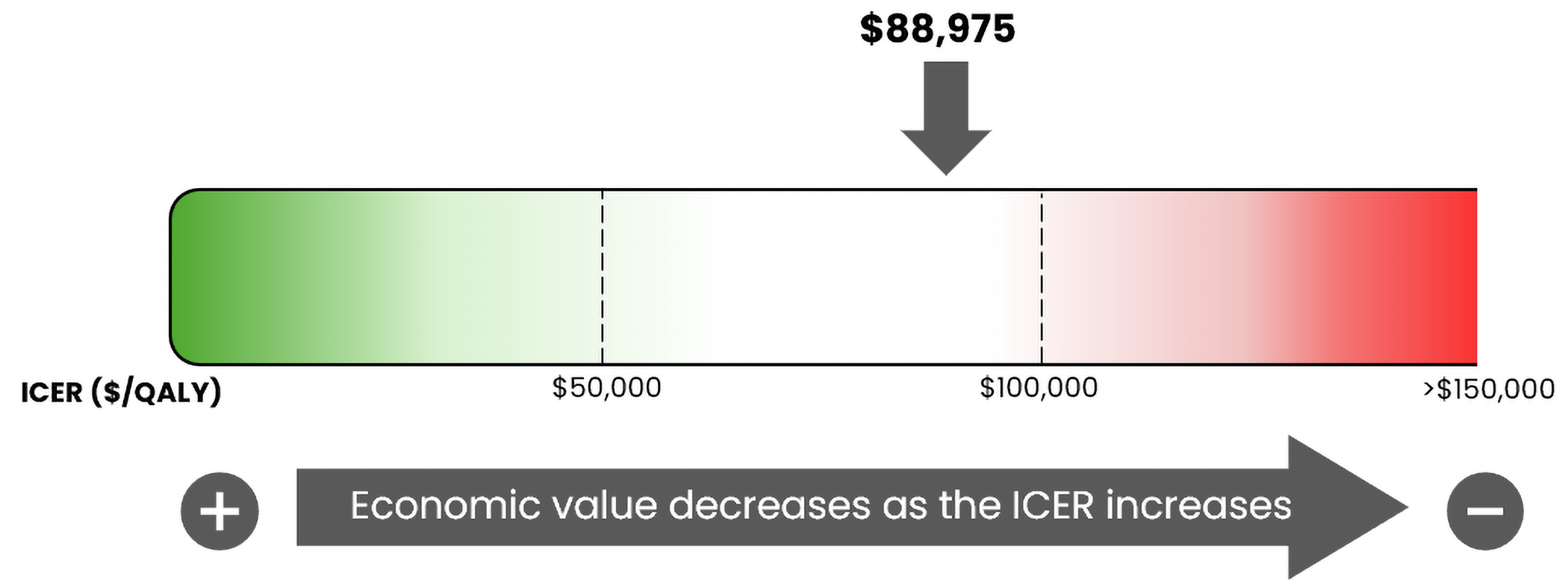
CDEC = Canadian Drug Expert Committee; ICER = incremental cost-effectiveness ratio; QALY = quality-adjusted life-year.
Certainty of the evidence: CDEC noted that the certainty of the evidence supporting reimbursement of sarilumab is limited due to uncertainty in remission benefits extrapolated from post hoc analyses of the SAPHYR trial, as well as uncertainty in the length of treatment or re-treatment with sarilumab. At the submitted price, sarilumab was associated with high incremental cost ($17,053 per patient) for a relatively modest incremental benefit (0.19 additional QALYs), yielding an ICER of approximately $88,975 per QALY gained over a lifetime horizon (20 years). However, these results are highly uncertain because the economic analysis hinges on the extrapolation of improvements in remission (with 88% of the incremental benefit based on extrapolation) and a total of 18 months of costs with sarilumab. This is particularly important given the projected financial impact, with an estimated budget impact of approximately $334 million over 3 years assuming 18 months of treatment with sarilumab and under moderate uptake expectations (50% of market capture by year 3), and $445 million over 3 years assuming 24 months of treatment with sarilumab. According to the clinical experts’ input, CDEC noted that re-treatment with sarilumab could occur in patients who have been successfully treated with sarilumab (e.g., having achieved disease remission for 1 year after the start of treatment with sarilumab) and whose disease relapsed subsequently. However, CDEC noted that there is no evidence available from the SAPHYR trial for the committee to either support or oppose re-treatment because the SAPHYR trial population did not include such patients. The decision to re-treat should be made on a case-by-case basis by the treating clinician and the drug plans. In a scenario analysis in which total treatment duration was assumed to be 24 months, or another 12 months of sarilumab costs were added to account for potential re-treatment, the ICERs increased to $112,620 per QALY gained and $166,519 per QALY gained, respectively. If the remission benefit is not realized or if sarilumab is used for longer than 18 months over a patient’s lifetime, additional price reductions may be required at given willingness-to-pay thresholds.
Other considerations: CDEC could not draw any definitive conclusion about the extent to which sarilumab could reduce the use of corticosteroids and reduce AEs associated with corticosteroids based on the available evidence. Given this uncertainty, CDEC considered a simplified scenario analysis conducted by CDA-AMC in which costs and disutilities related to corticosteroid-attributable AEs were assumed to be equal between sarilumab plus a 14-week corticosteroid taper versus a 52-week corticosteroid taper. This scenario yields an ICER of approximately $110,273 per QALY gained.
Impacts on Health Systems
Anticipated budget impact: CDA-AMC estimates that in the first 3 years of reimbursement, 47,387 patients would be eligible for sarilumab and, of them, 11,491 patients would be expected to receive sarilumab. The budget impact of reimbursing sarilumab plus a 14-week corticosteroid taper for the treatment of patients with PMR whose disease has responded inadequately to corticosteroids, or who have experienced disease relapse during corticosteroid taper, will be approximately $334 million over the first 3 years of reimbursement compared to the amount currently spent on a 52-week corticosteroid taper and methotrexate plus a corticosteroid taper, with an estimated expenditure of $335 million on sarilumab during this period. The actual budget impact of reimbursing sarilumab will depend on the number of people eligible for treatment and its uptake. Economic feasibility must be addressed, given that the incremental budget impact of reimbursing sarilumab is predicted to be greater than $40 million (in year 1, year 2, and year 3 of reimbursement) and the difference between the sponsor’s estimate and the CDA-AMC estimate.
If the proportion of confirmed PMR patients eligible to start sarilumab before initiating corticosteroid tapering exceeds the 10% rate of patients without a treatment response assumed in the budget impact analysis, the budget impact may be underestimated, as a larger treated population would increase expected costs.
Sources of Information Used by the Committee
To make its recommendation, the committee and/or subpanel considered the following information (links to the full documents for the review can be found on the project web page):
the CDA-AMC review of the clinical and pharmacoeconomic evidence submitted by the sponsor, as well as relevant ethical issues related to sarilumab (refer the Main Report and the Supplemental Material document)
the sponsor’s comments on the draft report and the CDA-AMC responses
patients’ perspectives gathered by 4 patient groups — Arthritis Consumer Experts, Arthritis Society Canada, the Canadian Arthritis Patient Alliance, and Vasculitis Foundation Canada(refer to the Patient and Clinician Group Input document)
input from 2 clinician groups, the Canadian Rheumatology Association and Canadian rheumatologists with an interest in PMR (refer to the Patient and Clinician Group Input document)
input from public drug programs that participate in the reimbursement review process (refer to the Supplemental Material document)
input from 2 clinical experts with expertise in the management of PMR consulted by CDA-AMC.
Request for Reconsideration
The sponsor filed a request for reconsideration of the draft recommendation for sarilumab for the treatment of adult patients with PMR who have had an inadequate response to corticosteroids, or who have experienced a relapse during corticosteroid taper. In their request, the sponsor identified the following issues:
The sponsor stated that reimbursement condition 4 does not reflect the study design of the SAPHYR trial a sarilumab’s observed trajectory of clinical benefit. The sponsor asked to revise reimbursement condition 4 by adjusting the initial authorization duration to a period of 24 weeks.
The sponsor stated that reimbursement condition 5 emphasizes continuation of sarilumab based on disease remission and normalization of CRP levels. As improvement in pain, stiffness, and function may be gradual and continuous, exclusive reliance on complete remission to determine renewal does not capture all clinical benefits. The sponsor asked to revise reimbursement condition 5 by adjusting the renewal condition to recognize ongoing improvement and stabilization, rather than requiring complete remission within a fixed early window.
The sponsor stated that reimbursement condition 6 may place unnecessary strain on an already overburdened health care system. The sponsor asked to revise reimbursement condition 6 to allow a 6-month renewal interval for subsequent renewals, as it balances appropriate monitoring with system-level feasibility and reduces the risk of treatment interruption driven by access constraints rather than by loss of benefit.
In the meeting to discuss the sponsor’s request for reconsideration, CDEC considered the following information:
information submitted as part of the sponsor’s request for reconsideration
information from the initial submission related to the issues identified by the sponsor
feedback from 2 clinical specialists with expertise in the diagnosis and treatment of patients with PMR
feedback on the draft recommendation from 1 clinician group (Canadian rheumatologists with an interest in PMR)
feedback on the draft recommendation from the public drug programs that participate in the reimbursement review process
feedback on the draft recommendation from the sponsor.
All feedback received in response to the draft recommendation is available on the CDA-AMC project web page.
CDEC Information
Members of the Committee
Dr. Peter Jamieson (Chair), Dr. Kerry Mansell (Vice-Chair), Sally Bean, Daryl Bell, Dan Dunsky, Dr. Ran Goldman, Dr. Trudy Huyghebaert, Dr. Dennis Ko, Dr. Christine Leong, Alicia McCallum, Dr. Srinivas Murthy, Dr. Nicholas Myers, Dr. Krishnan Ramanathan, Dr. Marco Solmi, Carla Velastegui, Dr. Edward Xie, and Dr. Peter Zed.
Meeting date: February 25, 2026
Regrets: One expert committee member did not attend.
Conflicts of interest: None
Minor reconsideration CDEC subpanel meeting date: June 29, 2026
ISSN: 2563-6596
Canada’s Drug Agency (CDA-AMC) is a pan-Canadian health organization. Created and funded by Canada’s federal, provincial, and territorial governments, we’re responsible for driving better coordination, alignment, and public value within Canada’s drug and health technology landscape. We provide Canada’s health system leaders with independent evidence and advice so they can make informed drug, health technology, and health system decisions, and we collaborate with national and international partners to enhance our collective impact.
Disclaimer: CDA-AMC has taken care to ensure that the information in this document was accurate, complete, and up to date when it was published, but does not make any guarantee to that effect. Your use of this information is subject to this disclaimer and the Terms of Use at cda-amc.ca.
The information in this document is made available for informational and educational purposes only and should not be used as a substitute for professional medical advice, the application of clinical judgment in respect of the care of a particular patient, or other professional judgments in any decision-making process. You assume full responsibility for the use of the information and rely on it at your own risk.
CDA-AMC does not endorse any information, drugs, therapies, treatments, products, processes, or services. The views and opinions of third parties published in this document do not necessarily reflect those of CDA-AMC. The copyright and other intellectual property rights in this document are owned by the Canadian Agency for Drugs and Technologies in Health (operating as CDA-AMC) and its licensors.
Questions or requests for information about this report can be directed to Requests@CDA-AMC.ca.