Drugs, Health Technologies, Health Systems
Health Technology Review
Outpatient Parenteral Antibiotic Therapy
Key Messages
What Is the Issue?
Outpatient parenteral antibiotic (or antimicrobial) therapy (OPAT) refers to the administration of IV antimicrobials outside of inpatient settings, without hospitalization. There are numerous delivery models, the most common being infusion centre–based, skilled nursing facility–based, and home-based.
Evidence suggests OPAT is safe and effective for treating infections, reducing hospital stays, as well as lowering health care costs and improving patient flow. However, there is a need to evaluate the variability between different models of OPAT.
There is variability between OPAT delivery models and their components. Therefore, it is important to examine these models of care to better understand how their outcomes compare. Decision-makers have requested evidence to inform decisions regarding OPAT delivery models and their components.
What Did We Do?
To inform decisions on the use of different OPAT models for adult populations who require IV antimicrobials, we conducted a rapid review to summarize the evidence comparing the clinical and cost-effectiveness of OPAT to inpatient care, and different OPAT delivery models. We also sought to identify evidence-based guidelines regarding the use of OPAT for adults and models of OPAT care in Canada.
We searched key resources, including journal citation databases, and conducted a focused internet search for relevant evidence published since 2018.
The purpose of this report is to summarize and critically appraise the available evidence on the topic, but it does not provide formal recommendations on the implementation of OPAT. The report was externally reviewed by a clinical expert with experience in outpatient care and monitoring.
What Did We Find?
We identified 3 studies conducted in Ontario and British Columbia that provided details about OPAT models of care in Canada. Two programs had OPAT rapid referral clinics, which were staffed with infectious diseases physicians and a nurse. One program was emergency department–facilitated and supervised by emergency department physicians and infectious diseases physicians on a part-time basis.
We identified 1 health technology assessment, 3 systematic reviews, and 8 retrospective studies that showed that OPAT may be a safe and effective alternative option to inpatient care. However, findings were mixed and inconsistent. In studies that compared different OPAT models, self-administered OPAT appeared to be a safe and feasible alternative to health care–administered OPAT as well as to telemedicine-facilitated OPAT.
However, the studies had several limitations, including being generally of low quality, which impacts the interpretation of their findings. There were statistically significant differences between treatment groups, meaning that patients who were systematically healthier were prescribed OPAT. Only 1 study was conducted in Canada, limiting the generalizability and applicability of findings in the Canadian context.
Some studies included older adults and people who inject drugs; however, there were no studies that compared the clinical effectiveness of OPAT in these patient populations.
No economic evaluations were identified, so the cost-effectiveness of OPAT compared to inpatient care and to different delivery models remains uncertain.
Two guidelines were identified that consistently recommend the importance of a qualified infectious diseases professional as part of the OPAT team responsible for patient selection, treatment planning, and ongoing monitoring. The guidelines also recommend that there be a formal multidisciplinary OPAT team with clear governance structures. Regular follow-ups and ongoing monitoring are also recommended.
The guidelines also recommend that older adults and people who inject drugs should not be excluded from OPAT and note that older adults can be considered for self-administered OPAT, with regular monitoring. One guideline also supports the use of telemedicine in home-based OPAT.
What Does This Mean?
The quality of evidence was generally low and findings inconsistent across studies, thus limiting our confidence in the results.
Findings were mixed and inconclusive, with no consistent differences in clinical outcomes and safety between OPAT and inpatient care. Self-administered OPAT showed similar effects on clinical outcomes compared to health care–administered OPAT. Likewise, evidence suggests that telemedicine-managed OPAT is a feasible option compared to conventional OPAT.
Evidence suggests that patient selection is crucial for safe and effective OPAT across different delivery models.
Decision-makers may wish to consider local resources, infrastructure, patient population, staffing capacity, availability of infectious disease specialists, and access to community-based services before OPAT implementation or expansion.
Evidence describing models of OPAT care in Canada was limited, with details retrieved from metropolitan areas.
Abbreviations
AGREE
Appraisal of Guidelines for Research and Evaluation
BSAC
British Society for Antimicrobial Chemotherapy
ED
emergency department
HTA
health technology assessment
ID
infectious diseases
IDSA
Infectious Diseases Society of America
IPAT
inpatient parenteral antibiotic (or antimicrobial) therapy
OPAT
outpatient parenteral antibiotic (or antimicrobial) therapy
PWID
people who inject drugs
RCT
randomized controlled trial
RoBANS
Risk of Bias Assessment Tool for Nonrandomized Studies
SR
systematic review
Research Questions
What models of outpatient parenteral antibiotic (or antimicrobial) therapy (OPAT) care exist across Canada?
What is the clinical effectiveness of OPAT compared to inpatient parenteral antibiotic (or antimicrobial) therapy (IPAT) and alternate OPAT delivery models?
What is the cost-effectiveness of OPAT compared to IPAT and alternate OPAT delivery models in Canada?
What are the evidence-based guidelines regarding the delivery of OPAT for adults that require antibiotic therapy?
Context and Policy Issues
OPAT refers to the administration of IV antibiotics on at least 2 days without being admitted to the hospital and without requiring hospitalization between treatments.1 OPAT can be appropriate for treating both short-term conditions (e.g., cystitis, tonsillitis) and long-term infectious conditions (e.g., diabetic foot infection, infective endocarditis).2 Individuals who may be eligible to receive OPAT include those who require ongoing treatment of complex infections but no longer require hospitalization and are not eligible for oral therapy.2
Components of OPAT programs generally consist of a formal multidisciplinary OPAT team, assessment of the patient's suitability and care requirements, and education on the OPAT treatment plan.2-4 Components also include assessment by an infectious diseases (ID) specialist and pharmacist to identify patients eligible for oral therapy, as well as monitoring and communication between the patient and care team about treatment progress.2-4 Lastly, programs typically include monitoring of the overall quality of care and outcomes, including hospital readmissions, complications, and adverse events.2-4
What Are the Delivery Models?
There are numerous OPAT delivery models, each with their own advantages and disadvantages. Three of the most common models are infusion centre–based, skilled nursing facility–based, and home-based.2-5
For infusion centre models, health care providers administer OPAT in outpatient health care facilities such as physicians’ offices, free-standing infusion centres, or extensions of acute care facilities.2,5 Patients are not required to self-administer any treatment in this model; however, they must be able to access the infusion centre, which would likely require some travel.2,5 This model may not be practical for individuals who require multiple antimicrobial doses per day.2,5
In skilled nursing facility models, patients are admitted to a facility where onsite nurses administer antimicrobial infusions.2,5 In this model, the nurses are also able to perform other related care activities such as wound care.2,5 Given that this model is provided at a health care facility, patients may be at a higher risk of exposure to nosocomial pathogens (i.e., infections associated with patients receiving health care, like Clostridium difficile).2,5
Home-based models of OPAT are carried out in the patient’s place of residence. OPAT is administered by either the patient, a care partner, or a home health nurse. In these models, patients do not need to travel to receive treatment but require a certain level of competency and comfort to self-administer treatment.2,5
Why Is It Important to Do This Review?
Hospitals and inpatient settings are facing increasing capacity pressures. Outpatient treatment options may help alleviate this strain while maintaining high-quality patient care.3,4 OPAT may have benefits for both patients and the health care system. Evidence suggests that OPAT can safely and effectively treat infection and improve patient satisfaction while also reducing hospital stays, which can lower health care costs and improve patient flow. However, there is variability between delivery models of OPAT.3-5 Due to this variability, it is important to examine the models of care and their specific components to better understand how outcomes compare. Decision-makers have requested evidence to inform decisions regarding OPAT delivery models and their components.
Objectives
To support decision-making, we conducted a rapid review to summarize and critically appraise available evidence regarding clinical effectiveness, cost-effectiveness, and evidence-based guidelines about OPAT models of care. Additionally, we provide an overview of OPAT models in Canada identified in the literature.
Methods
An information specialist conducted a customized literature search, balancing comprehensiveness with relevancy, of multiple sources and grey literature on April 2, 2026.
One reviewer screened citations and selected studies based on the inclusion criteria presented in Table 1 and critically appraised included publications using 3 critical appraisal tools, depending on study design.6-8 A MeaSurement Tool to Assess systematic Reviews 2 (AMSTAR 2) was used for systematic reviews (SRs) and the health technology assessment (HTA),6 the Risk of Bias Assessment Tool for Nonrandomized Studies (RoBANS) was used for nonrandomized studies,8 and the Appraisal of Guidelines for Research and Evaluation (AGREE II)7 was used to appraise guidelines.
Appendix 1 presents a detailed description of methods and selection criteria for included studies.
Criteria | Description |
|---|---|
Population | Adults with infections that require antibiotic therapy |
Intervention | OPAT |
Comparator | Q1 and Q4: NA Q2 and Q3: IPAT or alternative delivery model of OPAT |
Outcomes | Q1 and Q4: Recommendations and information related to:
Q2:
Q3:
|
Study designs | Q1: HTAs, SRs, RCTs, NRSs, economic evaluations, evidence-based guidelines Q2: HTAs, SRs, RCTs, NRSs Q3: economic evaluations in Canada Q4: evidence-based guidelines |
Publication date | January 1, 2018, to April 2, 2026 |
CADD = continuous ambulatory delivery device; ED = emergency department; FTE = full-time equivalent; HTA = health technology assessment; ICER = incremental cost-effectiveness ratio; ICUR = incremental cost-utility ratio; IPAT = inpatient parenteral antibiotic (or antimicrobial) therapy; NA = not applicable; NRS = nonrandomized study; OPAT = outpatient parenteral antibiotic (or antimicrobial) therapy; PICC = peripherally inserted central catheter; QALY = quality-adjusted life-year; RCT = randomized controlled trial; SR = systematic review.
Summary of Evidence
Quantity of Research Available
This report includes 17 publications that met our inclusion criteria, including 1 HTA,9 3 SRs,10-12 11 nonrandomized studies,13-20 and 2 guidelines.1,21
Three publications22-24 (3 nonrandomized studies) addressed question 1.
Twelve publications (1 HTA,9 3 SRs,10-12 8 nonrandomized studies) 13-20 addressed question 2.
Two publications (2 evidence-based guidelines)1,21 addressed question 4.
No economic evaluations were found that addressed question 3. However, 2 nonrandomized studies18,25 that did not meet our inclusion criteria but may provide relevant costing considerations are described in Appendix 6. Following completion of the literature search, a more recent edition21 of an included guideline26 was identified that met the eligibility criteria. This publication was subsequently included in the report, despite being published after the search date. One HTA9 and 1 SR10 had broader inclusion criteria than this report. These publications included studies with both a pediatric and adult population. We reported on the characteristics and results from the subset of relevant studies that were only focused on adults who require IV antibiotics. Appendix 2 presents the Preferred Reporting Items for Systematic reviews and Meta-Analyses (PRISMA)27 flow chart of the study selection.
A detailed summary of study characteristics can be found in Appendix 3. Additional references of potential interest that did not meet the inclusion criteria are provided in Appendix 8.
Summary of Study Characteristics
We identified 3 studies that provide insights into the models of OPAT care in Canada, conducted in Ontario (2 studies) and British Columbia (1 study). We identified 12 publications, 1 HTA, 3 SRs with meta-analyses, and 8 retrospective cohort studies. Studies were conducted in Australia, Canada (1 study), Spain, the UK, and the US. All studies included adults who require prolonged IV antimicrobial therapy, with patients ranging in age from 18 to 92 years. A range of infections were represented, including bone and joint infections, osteomyelitis, urinary tract infections, and infective endocarditis. Several OPAT delivery models were represented, including those that were home-based, facility-based, telemedicine-managed, and community nurse–led. Two evidence-based guidelines were identified that were produced by the British Society of Antimicrobial Chemotherapy (BSAC) in the UK in 2026 and by the Infectious Diseases Society of America (IDSA) in the US in 2019. A detailed summary of study characteristics organized by research question can be found in Appendix 3.
Summary of Critical Appraisal
Overall, the HTA and SRs were of moderate quality. Strengths include the comprehensive search strategies, adequate reporting of the characteristics of included studies, and appropriate risk of bias assessments in the 3 SRs. In the 3 SRs that included a meta-analysis, appropriate methods were used for the statistical pooling of results;10-12 however, there was heterogeneity between included studies. Key limitations include limited reporting regarding the establishment of review methods before the conduct of the review, limited details regarding data extraction,9,12 and no justifications for the inclusion of specific study designs or exclusion of studies.9,12
All nonrandomized studies were assessed as having a high risk of bias. Selection bias was the highest risk in all studies due to statistically significant differences in baseline characteristics as well as differences in patient selection between the treatment groups.13,14 The risk of performance bias was rated low in each study because interventions and outcome measures were confirmed from trustworthy sources such as medical records or administrative databases. The risk of detection bias was also rated low or unclear in most studies. If blinding of outcome assessors was not conducted, objective outcomes were assessed, such as hospital readmission or death.13,16-20 Attrition bias was reported as unclear in all studies, as it was not reported whether or not missing data affected outcomes. The risk of reporting bias was also low in all studies due to the fact that expected and previously determined relevant outcomes were fully reported.
Overall, the guidelines were of moderate quality. Strengths include clearly defined objectives, a multidisciplinary guideline development group, rigour of guideline development, as well as explicit links between recommendations and supporting evidence. Recommendations were also clear, specific, and unambiguous. However, only 1 group reported the quality of the evidence and the strength of recommendations.
A detailed summary of the critical appraisal, including details about strengths and limitations of the included publications, can be found in Appendix 4.
Summary of Findings
Evidence regarding models of OPAT care in Canada was identified from 2 jurisdictions, Ontario and British Columbia. OPAT care is provided.
Two centres operate a rapid referral OPAT clinic, and in 1 centre in British Columbia, OPAT is facilitated by the emergency department. ID physicians were staffed in all clinics, along with nurses and physicians. Infusion locations include the patient’s home, outpatient clinics, or the emergency department.
Evidence from 5 publications that compared OPAT to inpatient treatment was mixed and inconclusive for readmission and clinical cure but was similar regarding the impact of OPAT for mortality, adverse events, and treatment duration.
Evidence from 8 publications that compared different OPAT delivery models was limited and had mixed conclusions. Some studies found that self-administered OPAT and telemedicine-managed OPAT may be feasible options for patients. However, findings were not consistent across outcomes.
Guidelines support the use of OPAT for appropriately selected patients. Guidelines consistently recommend that OPAT be delivered through a formal multidisciplinary program with involvement of an ID specialist along with careful patient selection, treatment planning, and ongoing monitoring. The guidelines also support the provision of OPAT to PWID and older adults.
Guidelines also support the prescription of self-administered OPAT with careful patient selection, patient education, and regular monitoring. Telemedicine was also supported.
No cost-effectiveness or cost-utility evaluations performed within the health systems in Canada were identified.
Question 1: Models of OPAT Care in Canada
Evidence regarding models of OPAT care in Canada was available from 3 nonrandomized studies.22-24 Across studies, 2 centres22 had an OPAT clinic that works as a rapid referral clinic and 1 care centre had an OPAT being run by the emergency department (ED).24 Details regarding operational and structural characteristics of OPAT programs were extracted from studies and not confirmed with OPAT programs via a questionnaire or consultation. Therefore, programs may have been updated or modified since the time of study publication.
The rapid referral clinics operate in Ontario at the Civic campus of The Ottawa Hospital and in Toronto at the Sunnybrook Health Sciences Centre.22,23 The OPAT clinic at the Sunnybrook Health Sciences Centre operates during business hours 5 days a week.22 Both clinics receive referrals from the ED,23 hospitalized patients that have been assessed by an inpatient ID consult, or other outpatient providers affiliated with the same institution (Sunnybrook Health Sciences Centre).22 ID physicians are staffed at both clinics, where they assess patients within 48 to 96 hours to determine the need for ongoing IV treatment,23 review referrals,22 as well as arrange follow-up and outpatient monitoring. 22 Patients are then discharged home to receive either infusion at a community clinic,22,23 by a home care nurse at home,22,23 or trained by a nurse to self-administer treatment.22 At The Ottawa Hospital OPAT clinic, patients are discharged home with a peripheral IV line and an order for community IV antibiotics for 7 days. Whether or not a patient is prescribed an infusion of antibiotics at home or at a community clinic depends on the ability of the patient to travel. If a patient is able to travel, they are contacted via telephone to receive daily IV doses at a clinic near their home, and if they are not able to travel, they are assigned a home care nurse who administers IV antibiotics daily at the patient’s home.23 Both clinics are also staffed with nurses:
At the Civic campus of The Ottawa Hospital, 1 nurse works 3 half days on Monday, Wednesday, and Friday.23
At the Sunnybrook Health Sciences Centre, a specialist nurse (0.25 full-time equivalent) is employed and is often shared with other rapid referral clinics.22
The OPAT clinic at the Sunnybrook Health Sciences Centre is also staffed with an administrative assistant.22 At the Sunnybrook Health Sciences Centre, the antimicrobials were coordinated and funded by Ontario Local Health Integration Networks (now Ontario Health).22 At The Ottawa Hospital, the choice of antimicrobials is at the discretion of the ED physician.23
At Vancouver General Hospital in British Columbia, OPAT is facilitated and run by the ED. IV antibiotics are infused and received, usually once daily under the supervision of ED physicians. ED physicians are encouraged to refer patients to an ID physician after 5 days of treatment, but ultimately the decision to include an ID physician in patient care is at the discretion of the ED physician. During the study period, ID physicians were assigned to the OPAT program each week, Monday to Friday from 9:00 a.m. to 12:00 p.m. Outside those hours, ED physicians supervise the OPAT program.24
Additional details can be found in Table 2.
Table 2: Models of OPAT Programs in Canada
Study citation, province | OPAT model | Infusion location | Health care professional involvement | Patient characteristics | Patient training | Comments |
|---|---|---|---|---|---|---|
Yadav et al. (2021) Civic campus of The Ottawa Hospital Ottawa, Ontario | Clinic or home-based | Community clinic or home | At referral clinic:
Health care providers at community clinics or home care nurses would administer doses. | Accepts referrals for ED patients with nonpurulent cellulitis treated with IV antibioticsa | NA | Choice of antibiotics is at the discretion of the ED physician. Patients referred to the OPAT clinic were discharged home with a peripheral IV line and an order for community IV antibiotics for a maximum of 7 days. |
Yan et al. (2020)22 Sunnybrook Health Sciences Centre Toronto, Ontario | Infusion clinic or home-based | Community-based infusion clinic or at home (nurse- or self-administered) | The OPAT clinic:
| Receives referrals to the SHSC OPAT clinic that are hospitalized patients who have been seen by an inpatient ID consult service and determined to be appropriate for OPAT by an ID physician | Nurse-trained | For the OPAT clinic at SHSC: Hours of operation: business hours, 5 days per week Also staffed with an administrative assistant |
McSweeney et al. (2024)24 Vancouver General Hospital Vancouver, British Columbia | ED-facilitated OPAT | ED | OPAT is supervised by ED and ID physicians. | Patients with cellulitisa | NA | ID physicians assigned to OPAT program each week (M-F, 9am to noon). Outside of ID hours, ED physician on shift supervised OPAT. |
ED = emergency department; ID = infectious diseases; NA = not applicable; OPAT = outpatient parenteral antimicrobial (or antimicrobial) therapy; SHSC = Sunnybrook Health Sciences Centre.
aPatient characteristics of the cited study, which may not represent all patients seen by the OPAT program.
Question 2: Clinical Effectiveness of OPAT Compared to IPAT and Alternative OPAT Delivery Models
Appendix 5 presents additional details regarding the main study findings.
Evidence regarding the clinical effectiveness of OPAT compared to inpatient care was available from 5 studies (1 HTA, 1 SR, and 3 primary studies), and evidence of clinical effectiveness of alternative OPAT delivery models compared to each other was available from 8 studies (1 HTA, 2 SRs, and 5 primary studies)
Readmission
OPAT Versus Inpatient Care
Three studies compared the readmission of patients who received OPAT with those who received inpatient IV antibiotic treatment.9,17,20 One study found that the 30-day readmission due to cellulitis was statistically significantly lower in patients with acute uncomplicated cellulitis (no major complications or comorbidities) who received OPAT compared to inpatient standard of care (in 0.5% versus 3.6% of patients, P = 0.02).17 One study found that there was no difference in 90-day readmission of any cause or due to adverse reactions (catheter- or drug-related) in patients with infective endocarditis who received OPAT or hospital-based antibiotic treatment.20 One HTA found that evidence regarding the impact of OPAT on the hospital readmission of patients compared to inpatient treatment was inconclusive (some studies found OPAT superior, some found it inferior to inpatient care, and others showed no difference between the 2 delivery models).9 Results comparing specific OPAT delivery models and inpatient care were also mixed and inconclusive regarding the impact on hospital readmission:9
Two studies that compared self-administered OPAT to inpatient treatment found no statistically significant difference between the 2.
Two studies found that hospital readmission was statistically significantly lower in patients who received inpatient treatment versus patients who received district or community nurse–administered OPAT (i.e., OPAT was inferior to inpatient treatment).
Studies comparing specialist OPAT nurse–administered OPAT to inpatient treatment were mixed and inconclusive, with 2 studies finding OPAT superior (hospital readmissions were statistically significantly lower with OPAT compared to inpatient treatment) and 1 study finding no statistically significant difference between delivery model and inpatient care.
Tele-OPAT Versus Conventional OPAT
Two studies compared OPAT managed with telemedicine to conventional OPAT without telemedicine. Telemedicine-managed OPAT can either be in the form of video or telephone consultations during the delivery of parenteral antibiotics in the patient’s home or in clinics. Telehealth can be facilitated calls by ID specialists for consultation or follow-up after hospital discharge. The SR that compared tele-OPAT to conventional OPAT found that patients receiving tele-OPAT had a statistically significantly lower risk of all-cause unplanned readmission compared to patients who received conventional OPAT. Another study compared OPAT managed by an ID physician via telehealth to patients who did not receive tele-OPAT. This study found that there was no statistically significant difference in readmissions for any cause or due to a complication between the 2 groups.
Home- Versus Facility-Based OPAT
One systematic review found that there was no statistically significant difference in readmission (30- and 90-day readmission, as well as readmission during the course of OPAT) between patients who received home-based OPAT compared to patients who received facility-based OPAT.
More details can be found in Table 10.
Clinical Cure
OPAT Versus Inpatient Care
One HTA found that evidence comparing OPAT to inpatient treatment was inconclusive regarding cure and improvement rates.9 Results comparing specific OPAT delivery models to inpatient treatment were also mixed and inconclusive:9
A study comparing clinic-based OPAT versus inpatient treatment found that OPAT was inferior to inpatient treatment in improving infections.
Three studies found that self-administered OPAT and specialist OPAT nurse–administered treatment were superior at cure and improvement rates compared to inpatient treatment.
Two studies showed no difference between district or community nurse–administered OPAT and inpatient treatment on its impact on cure or improvement.
Self-Administered OPAT Versus Other OPAT Delivery Models
Two studies compared the clinical benefit of self-administered OPAT to other OPAT delivery models.15,19 One study compared the cure rate, defined as no treatment failure during treatment or within 28 days of treatment completion, between self-administered OPAT and health care–administered OPAT. Results showed that there was a statistically significant difference in cure rates, with higher rates in patients who had self-administered OPAT (80% of patients prescribed health care–administered OPAT versus 91% of patients who were prescribed self-administered OPAT, P = 0.02).15 Another study assessed the factors associated with OPAT success, defined as completion of therapy with no change in antimicrobial agent, minimal or no adverse events, and improvement of infection.19 This study found that patients who received OPAT via OPAT clinics were statistically significantly associated with improved OPAT success compared to those who were prescribed self-administered OPAT (odds ratio = 2.1; 95% CI, 1.03 to 2.25; P = 0.02). There was no difference in likelihood of OPAT success between self-administered OPAT and community nurse–led OPAT.19
Additional details can be found in Table 14.
Harms: Adverse Events and Complications
OPAT Versus Inpatient Treatment
Three studies compared the harms associated with treatment between OPAT and inpatient treatment.9,10,18 One SR and MA found that in adult participants there was no statistically significant difference in adverse drug reactions related to microbials or administration devices between OPAT and inpatient treatment.10 One HTA found that evidence on drug-related side effects or venous access complications was mixed, with some studies suggesting OPAT is superior at causing drug-related side effects (2 studies) and others finding no difference between the 2 (6 studies).9 One matched retrospective cohort study compared the incidence of composite adverse events within 90 days of initial hospital admission. Composite adverse events included acute kidney injury, venous thromboembolism, C. difficile diarrhea, neutropenia, unplanned hospital readmission, and death.18 Authors found that the risk of composite adverse outcomes was similar in both groups and there was no statistically significant difference in the risk of composite adverse events. When comparing the incidence of each adverse event between the 2 groups, there was no statistical difference between patients who received OPAT and IPAT in the risk of acute kidney injury, venous thromboembolism, and neutropenia.18 Patients who received OPAT had a statistically significant lower risk of developing C. difficile diarrhea than patients who received IPAT.18
Tele-OPAT Versus Conventional OPAT
One study found that there was no statistically significant difference in any OPAT complication or adverse drug reactions between ID telehealth–managed OPAT and non-ID telehealth–managed OPAT. However, this study also found that patients who received ID telehealth–managed OPAT had a statistically significant chance of getting a line-related complication compared to patients who did not have telehealth-managed OPAT.14
Health Care–Administered OPAT Versus Self-Administered OPAT
Four studies that compared self-administered OPAT to health care–administered OPAT found that there was no statistically significant difference in drug-, device-, or line-related adverse events.9,13,15
Community-Led OPAT Versus OPAT Delivered Via Other Models (Hospital Wards, Clinics, Self-Administered)
One study compared the risk of developing complications in patients receiving community IV antibiotic service and OPAT delivered in other ways, such as in hospital wards or self-administered, and found no statistically significant difference between the models of OPAT delivery.16 Another study found that community nurse–led OPAT was associated with more OPAT-related adverse events compared to self-administered OPAT (no statistical analysis). This study also found that the patients who had self-administered OPAT had more OPAT-related adverse events compared to patients who had treatment in OPAT clinics.19
Additional details can be found in Table 11.
Mortality
OPAT Versus Inpatient Treatment
Four studies, including 1 SR,101 HTA,9 and 2 retrospective cohort studies,18,20 assessed the difference in mortality between OPAT and inpatient treatment. The SR found no difference in the risk of death in adults receiving IV antimicrobial treatment.10 The HTA found that the evidence was mixed, with 5 studies showing no difference in death and 1 study finding that OPAT is inferior to inpatient treatment in mortality.9 The 2 studies found that death was statistically significantly higher in patients that received IPAT (2% of patients receiving OPAT and 8.8% of patients receiving IPAT, adjusted P < 0.001)18 and hospital-based treatment (7.7% of patients receiving OPAT and 12.5% of patients receiving hospital-based treatment, P = 0.004) compared to those who received OPAT.20
Tele-OPAT Versus Conventional OPAT
One study found that all-cause mortality was statistically significantly lower in patients who received ID telehealth-managed OPAT compared to patients who did not.14
Additional details can be found in Table 12.
Duration of Therapy
One SR found that there was no difference in the duration of antimicrobial treatment between patients who received OPAT and those who received inpatient treatment.10 One HTA found evidence that there is no difference in the days of therapy between OPAT and inpatient treatment (8 studies).9
Question 3: Cost-Effectiveness of OPAT Compared to IPAT and Alternative OPAT Delivery Models
No cost-effectiveness or cost-utility evaluations in the health systems in Canada were identified. Therefore, no summary can be provided.
Question 4: Recommendations Regarding the Delivery of OPAT
Detailed recommendations can be found in Table 16. The strength of recommendations and quality of evidence associated with recommendations are provided if they were reported by the guideline.
ID Physician Oversight and Involvement
BSAC recommends that a medically qualified ID clinician or specialist be included in the OPAT team.21 The strength of the recommendation and quality of evidence were not reported. BSAC also recommends that the inclusion and exclusion criteria for OPAT be created by an infection specialist.21 IDSA recommends that all patients be reviewed by an ID expert before the start of OPAT; this is a strong recommendation based on very low-quality evidence.1
Telemedicine
BSAC recommends that OPAT services consider the role of telemedicine and remote monitoring for supporting patients who get OPAT at home.21
Delivery Model
Both BSAC and IDSA recommend that self-administered or caregiver-administered OPAT be considered for patients for whom it is appropriate, after education and with adequate support (IDSA: strong recommendation based on low-quality evidence).1,21 BSAC recommends that training of patients and caregivers in IV administration comply with published standards and be carried out by a qualified member of the OPAT team.21 Likewise, IDSA notes that patients or caregivers can proceed without the need for a nurse visiting the home if there is a system in place for the monitoring of adverse events or complications (weak recommendation based on low-quality evidence).1 BSAC recommends that patients and caregivers should be fully informed about the OPAT delivery model and be given the chance to accept or decline the model.21
IDSA and BSAC both recommend that the first dose of an antimicrobial be administered under the supervision of a health care professional (IDSA)1 or competent personnel (BSAC)21 who can identify and respond to anaphylactic reactions. BSAC recommends that this can be in the person’s home33 and IDSA recommends it can happen in the patient’s home, for patients with no prior history of antimicrobials that belong in the same class (weak recommendation based on very low-quality evidence).1
OPAT for Older Adults, PWID, or People Who Are Unhoused
Older Adults
BSAC recommends that OPAT should be considered for “hard-to-reach” individuals, such as PWID or older adults, after an individual risk assessment. It also recommends collaboration of OPAT with community-based services or care providers such as services for substance use disorders or frailty to support treatment adherence and completion.21 IDSA also recommends that older adults be allowed to receive OPAT at home (strong recommendation based on low-quality evidence). IDSA noted that decisions about OPAT for PWID should be made on a case-by-case basis, but no recommendation was made because of low-quality evidence.1
Vascular Access
BSAC recommends that the OPAT team be responsible for the choice of IV access, in collaboration with the referring team. It recommends that teams referring patients for OPAT liaise with the vascular access and OPAT teams before IV access is obtained.21
Medication Administration Devices
BSAC recommends that a member of the OPAT team with appropriate competency be responsible for selection of the drug delivery device. It recommends that antimicrobial agents should only be used in pumps or elastomeric devices if there is robust drug stability data that meets national standards and protocols.21
OPAT Team and Governance
BSAC recommends that OPAT be delivered within a formal OPAT service with clear governance structures21,32,33 and clear managerial lines of responsibility.21 BSAC recommends that OPAT be delivered within a formal OPAT service with clear pathways for early discharge or admission avoidance.21 In addition, BSAC recommends that the OPAT team have an identifiable lead clinician and team.21
Follow-Up and Monitoring
Both groups provide recommendations for patient monitoring and follow-up tests.1,21 BSAC recommends that OPAT teams develop protocols for monitoring patients, including frequency and type of blood test monitoring.21 Likewise, IDSA also notes that the treating physicians should dictate the frequency of office visits based on patient characteristics, nature of infection, patient tolerance, and response to therapy, as well as patient social factors.1 BSAC recommends that patients have blood tests performed weekly, including full blood count and C-reactive protein. BSAC recommends that patients with skin and soft tissue infections be reviewed daily by the OPAT team to determine the transition to oral antibiotics.21 IDSA recommends that serial laboratory testing be monitored for patients receiving OPAT, although they cannot recommend specific tests or frequencies (strong recommendation based on high-quality evidence).1
Limitations
Methodology and Engagement Approach
As the nature and scope of the request was focused on reviewing published clinical data, we did not conduct direct engagement with patients, caregivers, or providers. We also did not search for or include literature on perspectives, experiences, or other evidence relevant to underserved groups. This review therefore did not address patient and/or caregiver experiences with OPAT care and may not fully capture the benefits, challenges, and acceptability of OPAT and alternative OPAT delivery models. Because of this, we have missed including the lived and living experience of individuals who have limited access to OPAT (patients living in rural or remote areas) or who have historically been excluded from OPAT criteria (older adults or PWID). We acknowledge this as a limitation of our work and that this rapid review may not highlight or identify perspectives from and evidence related to these groups in Canada. We also recognize that the research team consists of settler researchers, and we come to this work with our individual privileges and biases. Understanding the perspectives and priorities of First Nations, Inuit, and Métis Peoples and other underserved groups in OPAT care can support informed health care decision-making.
Risk of Bias of Included Studies
All nonrandomized studies had a high risk of bias due to the fact that there were statistically significant differences in patient baseline characteristics between treatment groups.13-20 Patients who were older, had more chronic conditions, or multiple comorbidities were assigned to OPAT models with greater health care professional involvement or inpatient IV administration.13,18 Although this likely reflects how clinicians tailor treatments to patients’ clinical needs, these baseline differences may have influenced the observed outcomes. As a result, findings should be interpreted cautiously. Although some studies tried to minimize confounding,16,18 in studies comparing OPAT with inpatient care, patients selected for OPAT were systematically healthier; therefore, this may have influenced the differences in outcomes compared to differences in the intervention. In addition, the SRs also included low-quality studies (i.e., conference abstracts, nonrandomized studies)11 in their meta-analyses, which also warrant careful interpretation of findings.
Evidence Gaps
Although there is a high volume of literature regarding OPAT and the effectiveness of different OPAT delivery models, important gaps remain in the evidence base. There are limited high-quality RCTs or trials that report on the impacts of different OPAT delivery models on patients receiving IV antimicrobials in outpatient settings. In situations in which RCTs are not able to be conducted, well-designed nonrandomized studies, with matched cohorts for instance,18 are limited. In addition, there are limited studies that adjust and control confounders that can greatly impact outcomes, such as disease severity or comorbidities. Most studies identified had smaller sample sizes. Future studies with larger sample sizes that are adequately powered are needed to detect meaningful differences.
There is limited evidence available on the effectiveness of different delivery models for older adults, PWID, or populations that are unhoused. In our analysis, some studies had participants that fit these criteria, but results were not separated. In some instances, PWID were excluded from analysis. Therefore, it is unknown if findings can be generalized to these population groups. We identified guidelines1,21 that recommend the prescription or consideration of OPAT for older adults, PWID, and people who are unhoused; however, the evidence base remains limited. We found 1 study that addressed OPAT in rural or small communities;14 however, studies that compare the effectiveness of different OPAT models in this setting would be useful to identify the most effective and feasible models.
Telemedicine-managed OPAT seems to be a viable option; however, there is limited moderate-to-high-quality evidence on the effectiveness or feasibility of the use of telemedicine in OPAT. In addition, 1 guideline, BSAC, provided recommendations about the use of telemedicine.21 If telemedicine were a viable option, OPAT teams would benefit from best practice considerations and recommendations regarding OPAT.
Although we identified studies conducted in Canada that compared the costs of OPAT and IPAT18,25, we did not identify any cost-effectiveness or cost-utility analyses performed in Canada that compared OPAT with IPAT or evaluated the value of different OPAT delivery models.
Multiple studies assessed the impact of different OPAT delivery methods on hospital readmission, but very few assessed the impact of OPAT on ED visits. Therefore, we cannot draw conclusions on the impact of OPAT on ED diversion or ED utilization.
Generalizability
Only 1 study identified was conducted in Canada.18 Other studies were conducted in Australia, Spain, the UK, and the US. In addition, none of the guidelines were developed by groups in Canada, for use in Canada. Although the patient populations in the included studies may be relatively similar between other countries and Canada or across jurisdictions, crucial differences in demographics or health care systems limit the applicability of findings to Canada. For instance, there are differences between health system structures, funding models, availability of home care and infusion services, availability of infrastructure for OPAT, or access and availability of ID clinicians or consultants. In addition, there are also differences in OPAT delivery between jurisdictions, which may limit the applicability of the findings for the study conducted in British Columbia compared to other jurisdictions. For example, in British Columbia, ID physicians are incentivized to supervise OPAT, which may not be representative of practices in other jurisdictions.18 One nonrandomized study was included in our analysis that focused on the use of oritavancin in OPAT for patients with acute uncomplicated cellulitis.17 This drug was approved by Health Canada in September 2025, but it is unclear how it is marketed in Canada. Therefore, the findings from this study may have limited applicability to current clinical practice in Canada.
We also found 3 studies from 2 jurisdictions (Ontario and British Columbia) that described the model of OPAT care in Canada.22-24 Information regarding models of care was available from 3 metropolitan areas, Ottawa, Toronto, and Vancouver. Therefore, this may not reflect care programs in smaller communities, rural or remote regions, or northern jurisdictions. Furthermore, access to OPAT may differ for populations that face barriers to health care, such as people living in remote regions; First Nations, Inuit, and Métis Peoples; PWID; and individuals with limited access to specialist care. We found some evidence in international contexts that addressed the impact of different delivery models in people who are underinsured13 or who live in small communities.14 However, findings should be interpreted with caution when applying them to the Canadian context.
Conclusions and Implications for Decision- or Policy-Making
This rapid review evaluated the literature regarding the clinical and cost-effectiveness of OPAT compared to IPAT and alternative OPAT delivery models for adults who require IV antimicrobials outside the hospital setting. This review also looked at the models of OPAT care in Canada and guidelines regarding OPAT. We identified 3 nonrandomized studies22-24 for question 1; 1 HTA,9 3 SRs,10-12 and 8 nonrandomized studies for question 2; and 2 guidelines for question 4.1,21 No relevant studies were identified for question 3.
Summary of Evidence
Models of OPAT Care in Canada
Evidence regarding the models of OPAT care in Canada was found for 2 jurisdictions, and 2 models were identified — rapid referral OPAT clinics22,23 and ED-facilitated OPAT.24 Infusion locations were the patient’s home (self- or health care professional–administered), clinics (including community-based), or the ED.22-24 ID physicians are involved in all clinics. In 1 clinic, involvement of an ID physician is at the discretion of ED physicians.24 In addition, the clinics are staffed by nurses and ED physicians who are responsible for OPAT supervision (British Columbia).24 An administrative assistant is also staffed at 1 clinic. The rapid referral clinics received referrals from the ED,23 hospitalized patients who have been assessed by an inpatient ID consult, or other outpatient providers.22
Clinical Effectiveness
Findings were mixed and inconclusive, with no consistent differences demonstrated between OPAT and inpatient care regarding clinical outcomes or patient safety. Generally, the quality of evidence is low, and conclusions should be interpreted cautiously. Evidence regarding hospital readmissions was inconsistent, with some studies reporting that OPAT is associated with lower readmission rates, whereas others report no statistically significant differences between OPAT and inpatient care.9,17,20 Likewise, evidence regarding mortality is also mixed, with some studies showing no difference in the risk of death between patients who received OPAT or inpatient treatment and some studies showing that the incidence of death was statistically significantly lower in patients prescribed OPAT compared to inpatient care.9,10,18,20 Evidence regarding adverse events indicates that OPAT does not result in more harm than inpatient care.9,10,18 Across studies, there was generally no difference in adverse events (drug- or device-related) or complications.9,10,18 Some evidence suggests that OPAT may be a safe alternative to inpatient antimicrobial therapy for patients, but findings are mixed, and no definitive conclusions can be made. There was no difference in the duration of treatment between treatment groups.9,10
Evidence comparing different OPAT delivery models was limited and heterogeneous. Findings suggest that telemedicine-managed OPAT is a feasible option that does not cause more harm to patients compared to conventional OPAT with no telemedicine.11,14 However, findings were based on a small number of low-quality studies. One study showed no differences in the incidence of adverse events and mixed effects on hospital readmission; death was lower in patients who received tele-OPAT.14 In addition, self-administered OPAT was associated with clinical outcomes similar to health care–administered OPAT.9,13,15 Some studies showed that there were similar rates of adverse events and higher treatment success compared to health care–administered OPAT.9,13,15
Most studies were nonrandomized (even in SRs and the HTA) and retrospective in nature, with a high risk of selection bias and residual confounding. Patients who were prescribed OPAT were often systematically healthier and clinically stable to receive outpatient care compared to patients who remained hospitalized or treated by health care professionals. Therefore, findings should be interpreted with caution.
Cost-Effectiveness
No cost-effectiveness or cost-utility evaluations performed within the health systems in Canada were identified.
Evidence from 2 Canadian nonrandomized studies suggests that OPAT may have lower total health care costs per patient relative to IPAT ($7,394 lower per patient in Ottawa25 and $17,579 lower per patient in British Columbia18); although OPAT costs remained higher ($651 per patient) than for patients receiving community-based IV antibiotics with return to the ED as needed in Ottawa.25
Although these findings suggest that OPAT may be a less costly alternative to inpatient care, the evidence is limited to nonrandomized studies reporting costs only. Because no studies assessed cost-effectiveness or cost-utility by jointly considering costs and health outcomes, the overall economic value of OPAT and alternative OPAT delivery models remains unknown. Furthermore, the generalizability of these cost findings across Canadian jurisdictions may be limited by differences in funding arrangements, availability of different OPAT delivery models, and infrastructure across provinces and territories. Therefore, available cost estimates should be interpreted with caution.
Guidelines
Two guidelines supported the use of OPAT as a safe and effective option for antimicrobial therapy for appropriately selected patients.1,21 Common recommendations included delivery of OPAT through a formal multidisciplinary program with clear governance structures, as well as involvement of an ID specialist or consultant in the management of OPAT, patient selection, treatment planning, and ongoing monitoring. Regular follow-up and monitoring of treatment response, adverse events, and complications were also commonly recommended.1,21 Self-administered OPAT was encouraged for all patients, with each guideline emphasizing the importance of patient selection, education, and monitoring.1,21 One guideline21 endorsed the use of telemedicine to support home-based OPAT services and provided recommendations for patients who have been historically excluded from OPAT — PWID and older adults.1,21
Considerations for Future Research
To understand the impact of different OPAT delivery models on patients, higher quality evidence is needed. Future studies with larger sample sizes and populations that are historically excluded from OPAT, such as older adults and PWID, should be conducted. This will allow the evidence base to grow and support the development of strong recommendations to guide OPAT care for these populations. Studies also need to stratify results between the different populations so that details about adverse events or treatment success in vulnerable populations can be gained and suitable models of OPAT delivery can be established for different patient groups. There is also limited evidence regarding the use of OPAT in rural or remote settings. Evidence regarding the effectiveness of different delivery models would be useful for health facilities that cover smaller geographical areas. In addition, there is a lack of evidence on how telemedicine can be used in OPAT and its effectiveness in different delivery models on patient outcomes.
There is limited evidence on physician, caregiver, or patient satisfaction with different OPAT delivery models. High satisfaction with different delivery models will facilitate the adoption of less resource-heavy OPAT models. However, there is limited evidence on how OPAT teams feel about the use of telemedicine or how patients and caregivers feel about increased responsibilities associated with self-administered OPAT.
Cost-effectiveness and cost-utility analyses in Canada would be helpful in understanding the value of OPAT compared to inpatient care as well as different OPAT delivery models. This can provide useful data to jurisdictions about the most cost-effective models of OPAT delivery as well as ways to reduce costs associated with OPAT.
Limited evidence described the landscape of OPAT care in Canada. Future research could include a national survey that aims to show the availability of OPAT programs, different delivery models, operational and structural characteristics, along with implementation considerations. This could help identify variations in practice and inform the development or expansion of OPAT services in Canadian jurisdictions. There was also limited comparative research assessing the effectiveness of different OPAT delivery models in Canada. To address current evidence gaps, more studies could be done to assess patient-centred outcomes, patient (and caregiver) satisfaction, and the impact of OPAT on metrics such as ED visits. The development of local, provincial, or national OPAT registries may facilitate future research as well as help identify areas for quality improvement.
Most studies included in this review evaluated OPAT delivered in a formalized program with structured teams and processes; however, this may not be representative of how patients receive OPAT. Many patients across Canada may not have access to dedicated OPAT teams; therefore, it remains unclear if the benefits observed in formalized programs are generalizable to OPAT delivered outside of a formalized program. Future research could compare these models to determine impacts on patient outcomes, health care utilization, cost-effectiveness, and patient and caregiver experiences.
Considerations for Clinical Practice or Considerations for Decision- or Policy-Making
This rapid review suggests that, among appropriately selected adult patients who require IV antimicrobial therapy outside inpatient settings, OPAT may be a safe and effective alternative to inpatient care. However, the evidence did not consistently demonstrate differences in clinical outcomes and patient safety between OPAT and inpatient care, or between different OPAT delivery models. Likewise, evidence suggests that self-administered OPAT may be an option to health care–administered OPAT for appropriately selected patients. The location and setting of OPAT administration appear to be less important than the selection of patients. Guidelines consistently recommend the importance of clear criteria for patient selection, which is supervised or developed by an ID specialist (i.e., physician). Decision-makers may therefore wish to consider the processes and resources required to support patient assessment, selection, and monitoring for OPAT implementation or expansion. However, it is also crucial to note that the identified evidence is generally of low quality and was conducted outside of Canada, which may limit its applicability to Canadian contexts.
Evidence generated in Canada suggests that OPAT may be associated with lower direct health care costs than IPAT.18,25 Limited evidence also indicates that costs may vary across OPAT delivery models, with some community-based approaches (i.e., community IV antibiotics with return to ED if necessary) potentially associated with lower costs than OPAT clinic-based care.25 However, no cost-effectiveness or cost-utility analyses performed in Canada were identified. As a result, the relative value for money of OPAT compared with IPAT, and of alternative OPAT delivery models compared with one another in Canada, remains unknown. Decision-makers may wish to consider other limitations of the available evidence — which is limited to nonrandomized studies reporting costs only and does not account for the impact of OPAT on health outcomes. They may also wish to consider costs that may fall outside the health care system perspective, including those borne by patients, caregivers, and community health care providers. In addition, implementation of OPAT programs may require investments in infrastructure, care coordination, and hospital pharmacy services, which could affect the overall cost implications of adopting or expanding OPAT programs.
The guidelines identified in this review underscored the importance of ID specialists in OPAT teams playing a role in patient selection, treatment planning, and ongoing monitoring. In addition, a formal multidisciplinary team was recommended with clear governance structures. One guideline also supported the use of telemedicine to support home-based OPAT. Therefore, decision-makers may wish to consider the availability of ID specialists, specialist or trained OPAT nurses, pharmacists, and community health care resources (home care nurses) within their jurisdiction. Furthermore, guidelines also consistently recommended regular follow-ups and ongoing monitoring regardless of delivery models, which has implications for staff capacity and infrastructure.
Both guidelines encouraged the prescription of self-administered OPAT for appropriately selected patients. These guidelines also specified that patients and caregivers should receive adequate training and support by qualified OPAT team members. However, there is a paucity of evidence on the satisfaction of patients and caregivers regarding this model of care, as well as the impacts of treatment burden or caregiver well-being of expanded adoption of home-based OPAT. Decision-makers may wish to consider these factors when deciding which OPAT programs to prescribe, given that home-based treatment may transfer some responsibilities to patients and caregivers. Likewise, there is limited to no evidence on health care providers’ acceptance, experience, and satisfaction with the use of telemedicine in OPAT.
BSAC recommends that oral antimicrobial therapy be used in preference to IV therapy when the 2 therapies have equivalent efficacy and there is an absence of concerns such as toxicity, lack of oral route, allergies, or drug-to-drug interactions. Recent evidence suggests that oral regimens can be used to manage and treat infections that were treated with prolonged IV antibiotics.34 As a result, health care systems have developed newer models of OPAT, such as complex outpatient antimicrobial therapy, that integrate oral and IV antimicrobial therapy. Decision-makers may wish to consider that OPAT care is evolving, and future service planning may need to consider emerging models, like complex outpatient antimicrobial therapy models with patients also receiving oral antimicrobial therapy.
This review did not assess environmental outcomes. However, during screening, some literature was identified that suggests that OPAT, namely home-based OPAT, may be associated with reduced carbon emissions, waste generation, transportation requirements (of patients at home), and water use. Decision-makers may wish to consider these factors, along with clinical and economic outcomes, if interested in sustainable health care delivery.35
Evidence describing models of OPAT care in Canada was limited, and results were retrieved from programs in metropolitan cities. There are differences in health care delivery, availability of specialists, and access to community-based services across jurisdictions. Decision-makers may therefore wish to consider local infrastructure, patient populations, and health care system capacity when interpreting and applying the findings of this review.
Acknowledgements
The authors would like to thank the content expert who externally reviewed this document and who has granted permission to be cited.
Philip Lam, MD, MSc, FRCPC
Medical Director of Antimicrobial Stewardship, Sunnybrook Health Sciences Centre
References
1.Norris AH, Shrestha NK, Allison GM, et al. 2018 Infectious Diseases Society of America Clinical Practice Guideline for the Management of Outpatient Parenteral Antimicrobial Therapy. Clin Infect Dis. 2019;68(1):e1-e35. doi:10.1093/cid/ciy745 PubMed
2.UpToDate. Outpatient parenteral antimicrobial therapy. 2024. https://www.uptodate.com/contents/outpatient-parenteral-antimicrobial-therapy
3.Mohammed SA, Roberts N, Nicolas D, et al. Implementation of outpatient parenteral antimicrobial therapy program in the contemporary health care system: A narrative review of the evidence. Journal of Infection and Public Health. 2025;18(10):102938. doi:10.1016/j.jiph.2025.102938 PubMed
4.Reidy P, Breslin T, Muldoon E. Outpatient parenteral antimicrobial therapy (OPAT) across the world: a comparative analysis-what lessons can we learn? JAC Antimicrob Resist. 2024;6(4):dlae111. doi:10.1093/jacamr/dlae111 PubMed
5.Azhir A, Chapman M. Delivery models, efficacy, safety, and cost reduction of outpatient parenteral antimicrobial therapy in British Columbia. BCMJ. 2022;64:160-5.
6.Shea BJ, Reeves BC, Wells G, et al. AMSTAR 2: a critical appraisal tool for systematic reviews that include randomised or non-randomised studies of healthcare interventions, or both. BMJ. 2017;358:j4008. doi:10.1136/bmj.j4008 PubMed
7.Agree Next Steps Consortium. The AGREE II Instrument. AGREE Enterprise; 2017. Accessed January 1, 1800. https://www.agreetrust.org/wp-content/uploads/2017/12/AGREE-II-Users-Manual-and-23-item-Instrument-2009-Update-2017.pdf
8.Seo HJ, Kim SY, Lee YJ, Park JE. RoBANS 2: A Revised Risk of Bias Assessment Tool for Nonrandomized Studies of Interventions. Korean J Fam Med. 2023;44(5):249-260. doi:10.4082/kjfm.23.0034 PubMed
9.Harbour J DM, Herbert P, Miller C, Mac Gann T, Stewart J SHTG Recommendation No 01-21 Outpatient parenteral antimicrobial therapy (OPAT). . Scottish Health Technologies Group; 2021. Accessed May 20, 2026. https://www.healthcareimprovementscotland.org/our_work/technologies_and_medicines/shtg/health_technologies_assessed.aspx
10.Mohammed SA, Roberts JA, Cotta MO, et al. Safety and efficacy of outpatient parenteral antimicrobial therapy: A systematic review and meta-analysis of randomized clinical trials. Int J Antimicrob Agents. 2024;64(2):107263. doi:10.1016/j.ijantimicag.2024.107263 PubMed
11.Durojaiye OC, Jibril I, Kritsotakis EI. Effectiveness of telemedicine in outpatient parenteral antimicrobial therapy (Tele-OPAT): A systematic review. J Telemed Telecare. 2024;30(8):1230-1237. doi:10.1177/1357633x221131842 PubMed
12.Hasegawa S, Tholany J, Healy H, Suzuki H. Patient outcomes following home-based outpatient parenteral antimicrobial therapy and facility-based outpatient parenteral antimicrobial therapy: a systematic review and meta-analysis. Antimicrob Steward Healthc Epidemiol. 2023;3(1):e169. doi:10.1017/ash.2023.458 PubMed
13.Johnson K, Alvarez KS, Jaybanks A, et al. Rates of line associated bloodstream infections in self-administered outpatient parenteral antimicrobial therapy compared to standard of care: 11 years of data at a safety net hospital. Infect Control Hosp Epidemiol. 2026:1-3. doi:10.1017/ice.2026.10425 PubMed
14.Veillette JJ, May SS, Tinker N, et al. Infectious Diseases Telehealth Outcomes and Opportunities for Outpatient Parenteral Antimicrobial Therapy (OPAT) Patients Discharged From 18 Small Community Hospitals. Open Forum Infectious Diseases. 2025;12(12):ofaf703. doi:10.1093/ofid/ofaf703 PubMed
15.Brand H, Fryer M, Mehdi AM, et al. Home nursing and self-administered outpatient parenteral antimicrobial treatment: a comparison of demographics and outcomes from a large regional hospital in Queensland, Australia. Intern Med J. 2024;54(8):1351-1359. doi:10.1111/imj.16394 PubMed
16.Schwiebert DR, Atanze DS, Iroegbu DU, Wilkins DM, Sandoe D. Outpatient parenteral antibiotic treatment for infective endocarditis: A retrospective observational evaluation. Clin Med (Northfield Il). 2024;24(3):100213. doi:10.1016/j.clinme.2024.100213 PubMed
17.Williams B, Muklewicz J, Steuber TD, Williams A, Edwards J. Comparison of Inpatient Standard-of-Care to Outpatient Oritavancin Therapy for Patients With Acute Uncomplicated Cellulitis. J Pharm Pract. 2023;36(1):27-32. doi:10.1177/08971900211021258 PubMed
18.Staples JA, Ho M, Ferris D, et al. Outpatient Versus Inpatient Intravenous Antimicrobial Therapy: A Population-Based Observational Cohort Study of Adverse Events and Costs. Clin Infect Dis. 2022;75(11):1921-1929. doi:10.1093/cid/ciac298 PubMed
19.Hatcher J, Costelloe C, Cele R, et al. Factors associated with successful completion of outpatient parenteral antibiotic therapy (OPAT): A 10-year review from a large West London service. Int J Antimicrob Agents. 2019;54(2):207-214. doi:10.1016/j.ijantimicag.2019.04.008 PubMed
20.Perica SJ, Llopis J, Gonzalez-Ramallo V, et al. Outpatient Parenteral Antibiotic Treatment for Infective Endocarditis: A Prospective Cohort Study From the GAMES Cohort. Clin Infect Dis. 2019;69(10):1690-1700. doi:10.1093/cid/ciz030 PubMed
21.Noble AL, Patel S, Birnie E, et al. 2026 Updated good practice recommendations for outpatient parenteral antimicrobial therapy (OPAT) in adults and children in the UK. JAC Antimicrob Resist. 2026;8(2):dlag044. doi:10.1093/jacamr/dlag044 PubMed
22.Yan M, Lam PW, Andany N, et al. Assessing the utilization and impact of a newly established outpatient parenteral antimicrobial therapy (OPAT) program. J Assoc Med Microbiol Infect Dis Can. 2020;5(2):70-76. doi:10.3138/jammi.2019-0018 PubMed
23.Yadav K, Mattice AMS, Yip R, et al. The impact of an outpatient parenteral antibiotic therapy (OPAT) clinic for adults with cellulitis: an interrupted time series study. Intern Emerg Med. 2021;16(7):1935-1944. doi:10.1007/s11739-021-02631-0 PubMed
24.McSweeney C, Steiner T, Grant JM. Quantitative analysis of the impact of infectious disease physicians on patients in the emergency department fast-track parenteral antibiotics program. BMC Infect Dis. 2024;24(1):655. doi:10.1186/s12879-024-09305-0 PubMed
25.Yadav K, Kumar S, Chhabra S, et al. Outpatient parenteral antibiotic therapy (OPAT) and inpatient treatment strategies for emergency department patients with cellulitis: a cost analysis. CJEM, Can. 2022;24(5):520-528. doi:10.1007/s43678-022-00320-1 PubMed
26.Chapman ALN, Patel S, Horner C, et al. Updated good practice recommendations for outpatient parenteral antimicrobial therapy (OPAT) in adults and children in the UK. JAC Antimicrob Resist. 2019;1(2):dlz026. doi:10.1093/jacamr/dlz026 PubMed
27.Page MJ, Moher D, Bossuyt PM, et al. PRISMA 2020 explanation and elaboration: updated guidance and exemplars for reporting systematic reviews. BMJ. 2021;372:n160. doi:10.1136/bmj.n160 PubMed
28.Guyatt GH, Oxman AD, Kunz R, et al. Going from evidence to recommendations. BMJ. 2008;336(7652):1049-51. doi:10.1136/bmj.39493.646875.AE PubMed
29.Guyatt GH, Oxman AD, Kunz R, et al. Incorporating considerations of resources use into grading recommendations. BMJ. 2008;336(7654):1170-3. doi:10.1136/bmj.39504.506319.80 PubMed
30.Guyatt GH, Oxman AD, Kunz R, Vist GE, Falck-Ytter Y, Schünemann HJ. What is “quality of evidence” and why is it important to clinicians? BMJ. 2008;336(7651):995-8. doi:10.1136/bmj.39490.551019.BE PubMed
31.Guyatt GH, Oxman AD, Vist GE, et al. GRADE: an emerging consensus on rating quality of evidence and strength of recommendations. BMJ. 2008;336(7650):924-6. doi:10.1136/bmj.39489.470347.AD PubMed
32.Sweeney E, Curtin N, de Barra E, et al. National Guidelines on the Provision of Outpatient Parenteral Antimicrobial Therapy (OPAT). Ir Med J. 2020;113(7):123. PubMed
33.Chapman ALN, Patel S, Horner C, Gilchrist M, Seaton RA. Outpatient parenteral antimicrobial therapy: updated recommendations from the UK. J Antimicrob Chemother. 2019;74(11):3125-3127. doi:10.1093/jac/dkz343 PubMed
34.Seaton RA, Ritchie ND, Robb F, Stewart L, White B, Vallance C. From 'OPAT' to 'COpAT': implications of the OVIVA study for ambulatory management of bone and joint infection. J Antimicrob Chemother. 2019;74(8):2119-2121. doi:10.1093/jac/dkz122 PubMed
35.Cole A, Aspin J, Laird S, Acri F, Galley S, Collins M. The environmental impact of intravenous antimicrobial therapies: a comparison of OPAT and in-patient administration care pathways-right-to-reply. JAC Antimicrob Resist. 2025;7(6):dlaf193. doi:10.1093/jacamr/dlaf193 PubMed
36.O'Neill J, Tabish H, Welch V, et al. Applying an equity lens to interventions: using PROGRESS ensures consideration of socially stratifying factors to illuminate inequities in health. J Clin Epidemiol. 2014;67(1):56-64. doi:10.1016/j.jclinepi.2013.08.005 PubMed
37.Canada’s Drug Agency. Canada's Drug Agency Style: A Guide for Authors and Editors. 2025. Accessed January 1, 1800. https://www.cda-amc.ca/sites/default/files/pdf/style_guide_2025_digital.pdf
38.Bhavan KP, Brown LS, Haley RW. Self-Administered Outpatient Antimicrobial Infusion by Uninsured Patients Discharged from a Safety-Net Hospital: A Propensity-Score-Balanced Retrospective Cohort Study. PLoS Med. 2015;12(12):e1001922. doi:10.1371/journal.pmed.1001922 PubMed
39.Information CIfH. Patient Cost Estimator: Methodology Notes and Glossary 2023. Accessed July 21, 2026. https://www.cihi.ca/sites/default/files/document/patient-cost-estimator-meth-notes-en.pdf
Appendix 1: Detailed Methods and Selection of Included Studies
Please note that this appendix has not been copy-edited.
What Is a Rapid Review?
Rapid reviews are based on accelerated and abbreviated SR methods, balancing timeliness with rigour, to allow for timely decision-making. Due to these abbreviated methods, rapid reviews have some limitations. For example, in the initial scoping, an evidence-based guideline by the Infectious Diseases Society of America was identified that was published in 2019. To capture this guideline document and in consultation with the external requestor, we set our search time frame from January 2018 onward. Unlike SRs, a single reviewer was required to include, extract data, and appraise studies. In addition, we included studies published from 2018, excluding older studies. We attempted to mitigate this by searching for and including relevant SRs published in the past 8 years that included older studies. Focusing on more recently published articles may also be more reflective of current practices. Our rapid review intends to summarize the available evidence, rather than provide recommendations. These findings should not be interpreted as prescriptive guidance.
Literature Search Methods
An information specialist conducted a literature search on key resources including MEDLINE, the Cochrane Database of Systematic Reviews, the International HTA Database, the websites of health technology assessment agencies in Canada and major international HTA agencies, as well as a focused internet search. The search approach was customized to retrieve a limited set of results, balancing comprehensiveness with relevance. The search strategy comprised both controlled vocabulary, such as the US National Library of Medicine’s MeSH (Medical Subject Headings), and keywords. Search concepts were developed based on the elements of the research questions and selection criteria. The main search concepts were outpatient parenteral antibiotic therapy. The search was completed on April 2, 2026, and limited to English-language documents published since January 1, 2018. The search strategy is available on request.
Selection Criteria and Methods
One reviewer screened citations and selected studies. In the first level of screening, titles and abstracts were reviewed and potentially relevant articles were retrieved and assessed for inclusion. The final selection of full-text articles was based on the inclusion criteria presented in Table 1.
Exclusion Criteria
Articles were excluded if they:
did not meet the selection criteria outlined in Table 1
were duplicate publications or were published before January 2018
were SRs in which all relevant studies were captured in other more recent or more comprehensive SRs
were primary studies captured in 1 or more included SRs
were guidelines with unclear methodology or published in languages other than English
were economic evaluations conducted outside of Canada
Critical Appraisal of Individual Studies
The included publications were critically appraised by 1 reviewer using the following tools as a guide: A MeaSurement Tool to Assess systematic Reviews 2 (AMSTAR 2)6 for SRs, the Revised Risk of Bias Assessment Tool for Nonrandomized Studies of Interventions (RoBANS 2) 8 for nonrandomized studies, and the Appraisal of Guidelines for Research and Evaluation (AGREE) II instrument7 for guidelines. Summary scores were not calculated for the included studies; rather, the strengths and limitations of each included publication were described narratively.
Data Extraction
One reviewer extracted data directly into standardized tables created in Microsoft Word, which were modified as necessary. The extracted information included study characteristics, methodology (e.g., study design), population, intervention, comparator, and results regarding the outcomes of interest.
One reviewer extracted information from the included studies using the PROGRESS-Plus36 tool to describe different population groups. Each included study was checked to determine if PROGRESS-Plus55 criteria were reported by study authors to describe the participants; detailed characteristics, if available, were then extracted and reported in tables in Appendix 2. The main PROGRESS-Plus36 criteria include place of residence; race, ethnicity, culture, and/or language; occupation; gender and/or sex; religion; education; socioeconomic status; and social capital. As part of report writing, we discuss these characteristics across the evidence, where available, when presenting results within the text.
When reporting on sex, gender, race, or ethnicity in this rapid review, we planned to retain the language used by the original study authors, and, whenever possible, we referred to these groups based on guidance from Canada’s Drug Agency Style: A Guide for Authors and Editors37 at the time this rapid review was conducted, with an understanding that language is constantly evolving.
External Review
The final report was externally reviewed by a content expert with experience in antimicrobial stewardship.
Appendix 2: Selection of Included Studies
Please note that this appendix has not been copy-edited.
Figure 1: Selection of Included Studies — PRISMA27 Flow Chart of Selected Reports
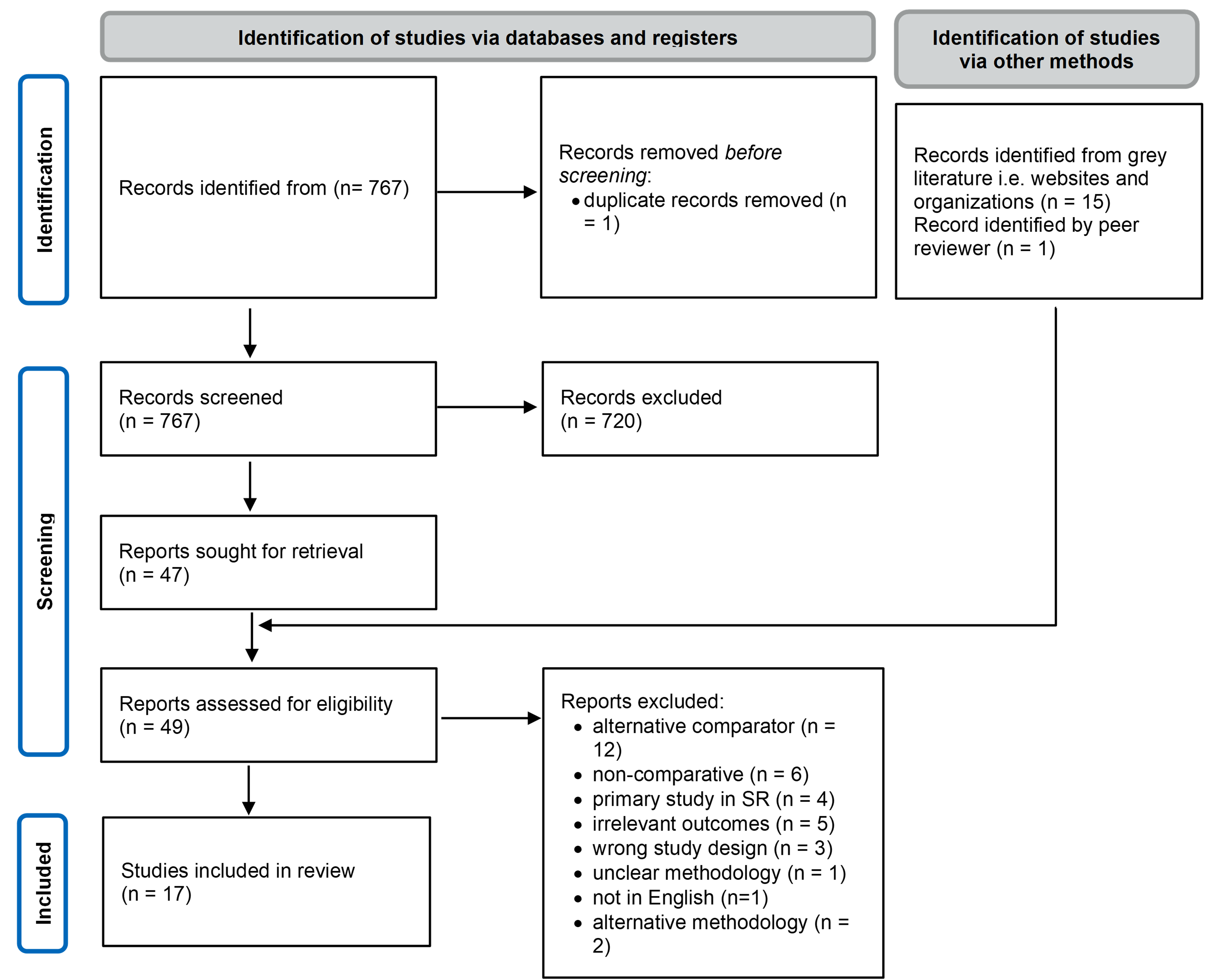
PRISMA = Preferred Reporting Items for Systematic Reviews and Meta-Analyses.
Appendix 3: Characteristics of Included Publications
Please note that this appendix has not been copy-edited.
Included Studies for Question 1: Models of OPAT Care in Canada
We identified 3 nonrandomized studies addressing this question.22-24 Two studies were retrospective cohorts22,24 and 1 was an interrupted time series.23 All 3 studies were conducted in Canada, 2 in Ontario (Ottawa23 and Toronto 22) and 1 in Vancouver, British Columbia24. All studies were conducted in academic health sciences,22 care,24 or medical centres.23
All studies reported the infusion locations and the type of health care professionals who work in the program or clinic. Two studies22,23 reported details on patient referrals as well as work hours of ID physicians24 and nurses.23
Included Studies for Question 2: Clinical Effectiveness of OPAT Compared to IPAT and Alternate OPAT Delivery Models
We identified 12 publications that addressed this question, 1 HTA,9 3 SRs,10-12 and 8 primary studies.13-20 The 3 SRs included meta-analyses.10-12 The HTA was conducted by the Scottish Health Technologies Group9 and the SRs were conducted by groups in Australia,10 US,12 and the UK.11 The HTA included only SRs,9 1 SR only included RCTs10 and 2 SRs included all study designs, namely nonrandomized studies (observational).11,12 1 SR also included conference abstracts and case series due to the limited nature of studies regarding the use of telemedicine in OPAT.11 The overlap in primary studies between SRs is reported in Appendix 7. The 3 SRs searched for published literature from inception to July 202211 and April 2023.12 One SR10 did not report search dates but reported they had no restrictions on publication year and the HTA9 did not report search dates. 1 SR11 restricted their studies to only those published in English. Eight primary studies were identified which were all retrospective cohort studies.13-20 Studies were conducted in Canada,18 US,13,14,17 UK,16,19 Australia,15 and Spain.20
All studies included adult participants who required IV antibiotic therapy. Two SRs10,11 also included studies with pediatric populations but only data regarding adult participants was included in this report. Studies reported population characteristics in varying detail. One SR provided the age range of the study population and the sex distribution.10 The number of participants in the SRs ranged from 2 to 636 and the number of participants in the primary studies ranged from 101 to 1,861 with ages ranging from 18 to 92 years. Most primary studies included patients older than 65 years. Some studies had participants with a median age of older than 65 years.14,16,20 Two studies reported that around 44%18 and 51%15 of the study population was older than 65 years. One study only reported the total OPAT episodes in the study period, 7,612.13. For all studies, authors provided the number or percentage of female and/or male participants; other genders were not reported. For the studies that reported on the sex distribution, study populations included more males ranging from 53% to 70.6% of the total study population.10,13,15,16,18,20 Two studies included people who inject drugs (PWID), but results were not separated between PWID and those that do not.10,16 Likewise, 1 study included patients with opioid abuse at index admission.18 One study had a self-administered OPAT program for patients who were uninsured or underinsured.13 Another study reported the neighbourhood household income and urban residence of participants in both the intervention and comparator.18 Likewise, 1 study was conducted in small community hospitals each with less than 200 beds that received telemedicine consultations.14 Only 1 study reported the body mass index, ethnicity and race of participants, as well as the percentage of participants that spoke Spanish or other languages (not specified).13 None of the studies provided information on education, occupation, religion, or social capital.
Some studies reported on patients with only 1 infection and some studies included patients with multiple infection types. Infections of patients included were:
The interventions in the included studies were OPAT. The models of OPAT found in the studies were:
Home-based (health care administered via home health service and self-administered after being trained by health care professional)12,13,15,18,20
Facility-based (clinic led, infusion centre, or ED)9,12,17,18
Health care–administered OPAT refers to any IV antimicrobials delivered by trained health care personnel at the patient’s home via home health services, infusion centres or at skilled nursing facilities.13,15,20 Self-administered OPAT refers to patients or caregivers administering IV antimicrobials at the patient’s home. Patients are trained on how to administer IV antimicrobials before being discharged.13,15 With self-administered OPAT, patients are still required to attend the clinic for monitoring and laboratory tests to ensure they are not experiencing any adverse events.13 Facility-based OPAT refers to any OPAT that occurs at clinics, hospital wards, or in the ED.12,17 Tele-OPAT refers to the use of telemedicine in the provision of OPAT services. This can either be in the form of video or telephone consultations during the delivery of parenteral antibiotics in the patient’s home or in clinics.11 This can also be telehealth facilitated calls by ID clinicians or consultants for consultation or follow-up after hospital discharge.14 Community facilitated OPAT services refer to a dedicated team of clinicians (nurses, doctors, pharmacists) that administer antibiotics in the patient’s home.
Comparisons were made between:
OPAT versus inpatient or hospital-based care including IPAT (5 studies)9,10,17,18,20
Health care–administered versus self-administered in the patient’s home (2 studies)13,15
Tele-OPAT versus conventional OPAT without the use of telemedicine (2 studies)11,14
Community-led OPAT versus other models of OPAT i.e., ward based or self-administered (2 studies)16,19
Self-administered OPAT versus non-self-administered OPAT at the clinic (1 study)19
Facility versus home-based OPAT (1 study)12
IPAT or hospital-based parenteral antimicrobial therapy refers to IV antimicrobials administered to patients in inpatient settings, while still being admitted in the hospital. Conventional OPAT refers to OPAT administered without the use of telemedicine at any stage.11,14
Clinical effectiveness and safety outcomes assessed in the studies were:
Readmission (30 day or 90-day readmission, all-cause unplanned readmission, readmission due to complication, risk of readmission) (6 studies)9,11,12,14,17,20
Safety (adverse drug reactions, device-related adverse reactions, complications, bloodstream infections, risk of developing complications, acute kidney injury, venous thromboembolism, C. difficile diarrhea, neutropenia) (8 studies)9,10,13-16,18,19
Laboratory results monitoring and ID clinic follow-up (1 study)12
OPAT failure or treatment failure was defined in various ways across studies including a worsening of infection or an adverse event that results in a death or readmission during the OPAT period.14,19 An OPAT success or clinical cure was defined variably across studies as improvement in infection or completed therapy with no change in antimicrobial or adverse events.19
Additional study details can be found in Appendix 3. Additional references of potential interest that did not meet the inclusion criteria are provided in Appendix 8.
Included Studies for Question 3: Cost-Effectiveness of OPAT Compared to IPAT and Alternate OPAT Delivery Models
No economic evaluations conducted in Canada were identified to address this question.
However, 2 nonrandomized retrospective cohort studies18,25 performed in health care settings in Canada were identified that provide context on the costs of OPAT compared with IPAT in British Columbia18 and Ottawa.25 While these studies offer insights into resource use and costs within the Canadian context, they do not assess the cost-effectiveness or value of the intervention. Therefore, they were not included in our analysis. Additional details are provided in Appendix 6.
Included Studies for Question 4: Recommendations Regarding the Delivery of OPAT
Two evidence-based guidelines1,21 were identified to address this question. The guidelines were produced by the:
British Society for Antimicrobial Chemotherapy (BSAC)21 in the UK in 2026
Infectious Diseases Society of America (IDSA)1 in US in 2019
Two guidelines conducted a systematic literature review to create the evidence base for recommendation.1,21 Databases were searched for published studies from 2017 to 2025 for BSAC21 and 1946 to publication year for IDSA.1 For the BSAC recommendations, recommendations were developed based on systematic review and expert consensus from a panel of OPAT specialist physicians, nurses, and pharmacists.21 Evidence was appraised by the core working group who then created a draft list of recommendations that were sent for consultation to external partners.21 IDSA used the Grading of Recommendations, Assessment, Development, and Evaluation (GRADE)28-31 approach to develop recommendations and received feedback from external peer reviewers.1 The quality of evidence and strength of recommendations were reported by 1 guideline group, IDSA.1 Evidence informing a question and recommendation was rated “high quality” if it included RCTs and was rated “low quality” if it only included nonrandomized clinical trials or observational studies. The strength of recommendations reflected the benefits and harms, as well as level of evidence available for each recommendation.1
The intended users of the guidelines were OPAT teams including clinicians who prescribe or oversee the provision of any IV antimicrobials outside of the inpatient setting. One guideline group specified the intended users.1,32 Each guideline was created for people who require IV antimicrobials outside of the inpatient setting. Recommendations were provided regarding the governance and structure of OPAT teams;21 ID physician or specialist involvement;1,21 follow-up and monitoring requirements for each patient.1,21 Furthermore, recommendations for OPAT for specific populations that were previously excluded from OPAT (i.e., older adults, PWID) were provided by both groups.1 Both groups also provided recommendations regarding self-administered OPAT and BSAC provided a recommendation regarding telemedicine use.1,21
Additional references of potential interest that did not meet the inclusion criteria are provided in Appendix 8.
Table 3: Characteristics of Systematic Reviews
Study citation, country, funding source | Study designs and numbers of relevant primary studies included | Population characteristics | Intervention and comparator(s) | Clinical outcomes, length of follow-up |
|---|---|---|---|---|
Durojaiye et al. (2024)11 UK Funding source: None | Study design: SR with MA (10 relevant studies) Number of relevant included studies: 10 (4 full text and 6 conference abstracts, all nonrandomized studies) 4 NRS: 1 retrospective cohort, 3 cohort (2 matched and 1 unmatched) 6 conference abstracts: 2 pre-post studies, 3 unmatched cohorts, and 1 case series Country: Australia (2 studies), US (8 studies) Search dates: inception to 24 July 2022 | N: 1,684 participants (adult) Whole study population (pediatric and adult population): 2,573 participants with 1,245 that had telemedicine (sample sizes ranged from 2 to 636) Range: Sample size ranged from 2 to 636 Sex: NR Infections: NR Telemedicine use: Real time, synchronous (10 studies), videoconferencing in 6 studies and telephone calls in 3 studies. Technology use was not specified in 1 study | Intervention: Tele-OPAT Video or telephone consultation in the delivery of parenteral antibiotics in the home or outpatient settings Comparator: Conventional OPAT or IPAT | Outcomes: clinical cure, rehospitalization, AEs, costs, length of hospitalization, patient satisfaction Follow-up: NR |
Mohammed et al. (2024)10 Australia Funding source: NA | Study design: SR with MA of RCTs Number of relevant included studies: 10 relevant RCTs on adults older than 14 years (1 RCT), 16 (3 RCTs), and 18 (6 studies) Country: Australia, Chile, New Zealand, Turkey, US, and 1 in multiple countries (Argentina, Colombia, Israel, Peru, South Africa, and Spain) Search dates: NR but no restrictions on publication year | N: 1,310 participants and 1,363 treatment episodesa N participants per trial ranged from 20 to 200. Age: 6 months to 94 years *included participants for all RCTs included in the SR with 2 RCTs with pediatric patients* Sex: 53.2% were male (697/1310)a Infections: acute illnessesb (including pneumonia, endocarditis, osteomyelitis, DVT); cellulitis, severe injecting drug use related infections, febrile neutropenia, peritonsillar abscess, Staphylococcus aureus bacteremia and IE, cystic fibrosis, methicillin resistant S aureus; infectious diseases* i.e., UTI, cellulitis, pneumonia, osteomyelitis, mycobacterial infection, cystic fibrosis, bronchiectasis | Intervention: parenteral antimicrobial therapy in an outpatient setting (all models considered: self or carer administers at patients’ place of residence, physician- or nurse-administered OPAT, OPAT administered in outpatient clinic or infusion centre). Administration of antimicrobials in any ambulatory setting including fixed clinics, EDs, and/or patients’ place of residence Comparator: parenteral antimicrobial therapy in an inpatient setting | Outcomes: mortality, treatment failure, adverse drug reactions related to antimicrobials, complications related to the use of medication administration devices, and duration of antimicrobial treatment Follow-up: NR |
Hasegawa et al. (2023)12 US Funding source: None | Study design: SR with MA Number of relevant included studies: 22 NRS (18 retrospective cohort, 2 quasi-experimental, and 2 case-control studies) Country: US (20 studies), the Netherland (1 study), and France (1 study) Search dates: inception to 12 April 2023 | N: 11, 396 (home OPAT = 7,539 and facility-OPAT = 3,857) Range: sample size ranged from 67 to 228 Sex: NR Infections: Bone and joint infection were the most common indication. Other sources of infection include IE, CKD, history of drug-resistant organism; genitourinary infection, gastrointestinal infection, osteomyelitis, intra-abdominal infection, bacteremia, SSTI. | Intervention: home OPAT Comparator: facility OPAT | Outcomes: Readmission rate, treatment failure, laboratory monitoring and ID clinic follow-up Follow-up: NR |
Harbour et al. (2021)9 SHTG Scottish Health Technologies Group Funding source: SHTG is funded by the NHS Scotland | Study design: HTA Number of relevant included studies:
Search dates: NR (Search carried out on 9 to 10 July 2020) | N: 2 SRs with 6 to 21 potentially relevant primary studies Adult patients 1 SR also included studies of patients older than 65 years | Intervention: OPAT Comparator: inpatient care, other delivery models of OPAT (e.g., self-administration, administered by general nurse or specialist nurse, and OPAT clinic) | Clinical effectiveness outcomes: infection cure rate, improvement rate, duration of therapy, mean hospital readmission rates, mortality, drug-related side effects, venous access line-related complications, costs, perceived benefits and concerns of OPAT, as well as barriers and facilitators Economic outcomes: cost-effectiveness Recommendations for NHS Scotland regarding OPAT Follow-up: NR |
AE = adverse event; CKD = chronic kidney disease; DVT = deep vein thrombosis ID = infectious diseases; IE = infective endocarditis IPAT = inpatient parenteral antimicrobial therapy; MA = meta-analysis; NA = not applicable; NR = not reported; NRS = nonrandomized studies; OPAT = outpatient parenteral antimicrobial therapy; RCT = randomized controlled trial; SR = systematic review; SSTI = skin and soft tissue infection; UTI = urinary tract infection; vs. = versus.
aThis N included participants for all RCTs included in the SR with 2 RCTs with pediatric patients.
bInfection type were reported as acute illnesses and infectious diseases and then broken down*
Table 4: Characteristics of Included Nonrandomized Studies
Study citation, country, funding source | Study design and period | Population characteristics | Intervention and comparator(s) | OPAT Model(s) and description | Clinical or cost outcomes, length of follow-up |
|---|---|---|---|---|---|
Johnson et al. (2026).13 US Funding source: None reported | Retrospective cohort October 2012 to December 2023 | Total OPAT episodes: 7,612 H OPAT: 3,523 OPAT episodes (46.3%) S OPAT: 4,089 OPAT episodes (53.7%) Uninsured or underinsured patients at a safety net hospital in Dallas, Texas. Patients had to had to have stable housing, running water, reliable transport, and no history of IV drug use. Gender: % H OPAT Female: 32.7% Male: 67.3% S OPAT Female: 36.0% Male: 64.0% Age: H OPAT: 54.0 ± 14.0 years S OPAT: 49.8 ± 13.8 years Infections: NR; micro-organisms were provided and reported as proportions of total OPAT episodes per treatment group. | Intervention: H OPAT Comparator: S OPAT | H OPAT: OPAT delivered by trained health care personnel via home health services, infusion/hemodialysis centres, or skilled nursing facilities. S OPAT: OPAT without assistance from home health services. Patients continue IV medications at home while attending weekly clinic visits for line care, laboratory monitoring, and medication supply. | Outcomes: BSIa rates as a safety marker bloodstream infection. Follow-up: 90 days |
Veillette et al. (2025)14 US Funding source: None | Retrospective cohort May 2022 to May 2023 | Participants: 405 patients ID telephone consultation: 168 patients (41%) Non IDt OPAT: 237 (59%) Sex: Male: 49.6% IDt OPAT: 55.9% Non IDt OPAT: 45.1% Age: median age (IQR) 66 years (53 to 75) IDt OPAT: 65 years (53 to 72) Non IDt OPAT: 67 years (55 to 76 years) Infections: BJI:40%; UTI: 21%; SSTI: 11%; intra-abdominal: 6%; respiratory 5%; endovascular: 5%; bacteremia unknown source: 5%; line-related bacteremia: 5%; and other: 2% | Intervention: ID telehealth-managed OPAT Comparator: Non IDt managed OPAT by a variety of other services, such as orthopedics, general surgery, urology or primary care. Telemedicine use *IDt provided remote inpatient ID consultation and AMS support to 18 small community hospitals each with hospitals with < 200 beds* | Inpatient IDt consultation were provided via video visit or asynchronous electronic consultation as well as a follow-up outpatient IDt physician video visit within 2 to 4 weeks of discharge (either direct-to-patient or facilitated by nursing facility caregivers). IDt OPAT coordination and laboratory monitoring were performed by a nurse and 3 medical assistants, who were shared resources with the ID division at Intermountain Medical Center. IDt pharmacists were available for drug-related questions as needed. | Outcomes: OPAT failure: composite of clinical failure (recurrence or progression of infection at the primary site); ED/Hospital readmission due to OPAT complications (e.g., line-related thrombosis and antibiotic related neutropenia); all-cause 90-day readmissions; all-cause 90-day mortality; and OPAT complications (including those that did not cause readmissions) Follow-up: 90 days |
Brand et al. (2024)15 Australia Funding source: None | Retrospective cohort March 2017 to December 2019 | N = 267 patient care episodes H OPAT = 165 patients S OPAT = 100 patients Patients enrolled in H and S OPAT managed by the ID service in Queensland Australia Sex: Male = 63% Age: median age: 64 years, range: 19 to 95 years *49.4% were younger than 64 years Infections: (% patients) Bone and joint infections (septic arthritis and osteomyelitis) without diabetes: 37.4%; diabetic foot infection with osteomyelitis: 13.2%; bacteremia: 9.4% | Intervention: health care–administered OPAT in the patient’s home Comparator: S OPAT by a trained patient in their own home | Patients were reviewed for suitability for OPAT delivery model based on the discretion of the ID consultant. Once deemed fit for discharge, patients were referred to either H- or S OPAT care. IV access was through a peripherally inserted central catheter inserted by the Vascular Access and Surveillance Education team. For H OPAT, patients were seen weekly at the ID outpatient clinic for the review of pathology results, dressing changes, and clinical assessment. For S OPAT, patients received additional training on antimicrobial administration before hospital discharge | Outcomes: overall cure rate, complications rate, readmission, duration of treatment Follow-up: 28 days |
Schwiebert et al. (2024)16 UK Funding source: None | Retrospective descriptive service evaluation January 1, 2006, to December 31, 2019 | Participants: 101 patients CIVAS: 62% patients Patients managed by the Leed endocarditis services and had at least 1 day of IV therapy for IE Sex: 69% Male, 31% female Age: 68 years, range 18 to 92 years) Infections: patients with definite or possible IE according to the modified Duke’s criteria 2% PWID | Intervention: CIVAS, community IV antibiotic service Comparator: other OPAT service models i.e., through a hospital ward or clinic, dialysis services for patients that already required renal replacement therapy, or self- administered OPAT | CIVAS: dedicated team run by nurses, doctors, and pharmacists that administer antibiotics at a patient’s place of residence. | Outcomes: risk of developing complications Follow-up: 1 year |
Williams et al. (2023)17 US Funding source: None | Retrospective observational cohort February 2015 to December 2018 | Participants: 1,549 patients Inpatient SOC: 1,348 patients OPAT oritavancin: 201 patients Sex: NR Age: NR Infections: acute uncomplicated cellulitis | Intervention: Outpatient oritavancin therapy Comparator: Inpatient SOC which is inpatient IV treatment of cellulitis with other antimicrobials such as vancomycin | Oritavancin administered to outpatients via a hospital owned infusion centre or ED with the consultation of an ID physician | Outcomes: 30-day readmission due to cellulitis for the inpatient SOC cohort or admission to the hospital due to cellulitis 30 days after oritavancin infusion Follow-up: 30 days |
Staples et al. (2022)18 British Columbia, Canada Funding source: None | Retrospective matched cohort study June 1, 2012, to 31 March 2018. *patients were matched based on infection type (exact matches only) and IDIVA implied duration of IV antimicrobials (± 5 days) | Participants: 1,842 matched patients (921 patients in each cohort) Patients with an unplanned hospital admission who require prolonged IV antimicrobials Sex OPAT: 67.8% male IPAT: 61.0% male Age: Younger than 65 years: 1,028 participants (55.8%) Older than 65 years: 814 participants (44.2%) Infections: prosthetic joint infection, osteomyelitis, native joint infection, epidural abscess, endocarditis, Staphylococcus aureus sepsis, or pneumococcal meningitis | Intervention: OPAT Comparator: IPAT, hospital-based | OPAT is administered by publicly funded acute care hospitals and their regional health authority. Teams typically include an ID specialist physician, an OPAT pharmacist, homecare nurses, and an OPAT clinic or an ED OPAT pathway. Referrals are accepted from hospital physicians, and in some centres eligible patients are proactively identified and recruited. Eligibility for OPAT is evaluated according to IDSA guidelines. Hospital care and OPAT occur without cost to the patient | Outcomes: Composite adverse events occurring within 90 days of index hospital admission. This outcome includes AKI, VTE, Clostridioides difficile diarrhea, neutropenia, unplanned hospital readmission, and death; total number of days in the hospital Direct health care costs over the 90-day outcomes interval from the perspective of a health care funder or insurer. The mean cumulative 90-day outcome interval cost was estimated as the sum of component costs divided by the number of patients. Components include estimated index and readmission hospitalization costs; ED visit costs; physician costs; OPAT specific costs i.e., outpatient IV antimicrobial costs, outpatient nursing labour costs, weekly outpatient laboratory costs. Cost savings associated with OPAT Follow-up: 90 days |
Hatcher et al. (2019)19 UK Funding source: NIHR Career Development Fellowship | Retrospective chart review January 1, 2008, to December 31, 2017 | N = 1,793 patients with available OPAT outcome data Self-administration = 252 Community nurse–led = 1,165 OPAT clinic = 376 Sex: NR Age: mean age: 56.4 ± 17.8 years Mean duration of treatment: 15 days Infections: SSTI skin and soft tissue infections: 22.6%; UTI: 10.8%; osteomyelitis: 8.9%; respiratory tract infection: 7.3%; device-related joint infection: 6.7%; intra-abdominal infection: 7.1%; CNS infection: 8.4%; device-related osteomyelitis: 6.6%; and cardiac infection: 6.4%. | Intervention: self-administered OPAT Comparator: Community nurse–led OPAT OPAT clinic | NR | Outcomes: OPAT success (completed therapy with no change in antimicrobial agent, no AEs, cure or improvement of infection, and no readmission OR completed therapy in OPAT with either change in antimicrobial agent or AE not requiring admission) and OPAT failure (readmission due to infection worsening or due to an AE or death by any cause during OPAT) Follow-up: no follow-up beyond OPAT episode |
Pericà et al. (2019)20 Spain Funding source: Ministerio de Economia and Competitividad (Madrid, Spain); (FIS NCT00871104, Instituto de Salud Carlos III); Instituto de Salud Carlos III; The European Society for Clinical Microbiology and Infectious Diseases; and the Federation of European Microbiological Societies; the Institut d’Investigacions Biomèdiques Pi i Sunyer. | Retrospective analysis from a multicenter prospective cohort study of 2000 consecutive IE patients in 25 Spanish hospital 2008 to 2012 | Participants: HBAT = 1,432 OPAT = 429 Sex: Hospital-based: 70% male OPAT: 70.6% male Age: Hospital-based: median age 68.6 years, IQR 56.6 to 76.3 years) OPAT: median age 67.8 years, IQR 55.9 years to 76.4 years) Infections: definite or possible IE diagnosed according to the modified Duke criteria | Intervention: OPAT Comparator: hospital-based antibiotic treatment | OPAT was home-based administration of IV antibiotic therapy, with a daily visit by skilled nurses and at least 2 visits per week by the attending physician. The decision to prescribe OPAT or hospital-based antibiotic treatment (HBAT) was taken independently by the attending physicians in each hospital, according to the criteria in line with the recommendations for OPAT by the Spanish Society of Clinical Microbiology and Infectious Diseases | Outcomes: 90-day readmission, relapses, and 1 year mortality Follow-up: 90 days to 1 year |
AE = adverse event; AKI = acute kidney injury; BJI = bone and joint infections; BSI = bloodstream infections; CIVAS = community IV antibiotic service; CNS = central nervous system; ED = emergency department; H OPAT = health care–administered OPAT; ID = infectious diseases; IDt = telehealth-managed OPAT; IE = infective endocarditis; NA = not applicable; NR = not reported; OPAT = outpatient parenteral antimicrobial therapy; S OPAT = self-administered OPAT; SOC = standard of care; SSTI = skin and soft tissue infection; UTI = urinary tract infection; VTE = venous thromboembolism.
aBSI is defined as microbiologically confirmed BSIs diagnosed within 90 days of hospital discharge for H OPAT or BSIs diagnosed before the end of the treatment period for S -OPAT patients for central line, peripheral catheters or midline removals tall beyond central line-associated BSI surveillance
Table 5: Characteristics of Included Guidelines
Intended users, target population | Intervention and practice considered | Major outcomes considered | Evidence collection, selection, and synthesis | Evidence quality assessment | Recommendations development and evaluation | Guideline validation |
|---|---|---|---|---|---|---|
BSAC (2026)21 | ||||||
Intended users: OPAT teams Target population: People who require IV antibiotics in noninpatient settings UK | OPAT | Clinical effectiveness and safety of OPAT | Literature review (8 databases were comprehensively searched; search dates: January 1, 2017, to April 17, 2024). References were grouped into key groups | Levels of evidence were not included in the review due to nature of the evidence reviewed (noninterventional, observational studies or case series) Evidence was appraised by core working group | Systematic review and expert panel consensus (evidence was appraised by core working group and a draft list of recommendations were created and sent to working group). | Draft list was sent for consultation to external partners and uploaded onto BSAC website for feedback for a formal 4-week consultation process. |
IDSA (2019)1 | ||||||
Intended users: health care professionals who prescribe and oversee the provision of OPAT Target population: People who require IV antibiotics in noninpatient settings US | OPAT | Clinical and cost-effectiveness, and safety | Systematic literature review (from 1946 to present) | GRADE | Systematic review and GRADE approach. Recommendations were made considering the strength of the evidence available, the net benefits, next harms, or trade-offs resulting from interventions. | Feedback from 3 external peer reviewers; reviewed and approved by the IDSA Standards and Practice Guidelines Committee and IDSA Board of Directors |
BSAC = British Society for Antimicrobial Chemotherapy; GRADE = Grading of Recommendations, Assessment, Development, and Evaluation; IDSA = Infectious Diseases Society of America; NR = not reported; OPAT = outpatient parenteral antimicrobial therapy.
Appendix 4: Critical Appraisal of Included Publications
Please note that this appendix has not been copy-edited.
Included Studies for Question 1: Models of OPAT Care in Canada
The nonrandomized studies identified were used in this report to retrieve details regarding the models of OPAT care but not on the impact of OPAT on patient outcomes. Therefore, no critical appraisal of studies was conducted.
Included Studies for Question 2: Clinical Effectiveness of OPAT Compared to IPAT and Alternative OPAT Delivery Models
AMSTAR 26 was used to appraise the HTA and SRs and RoBANS 28 was used for nonrandomized studies.
HTA and Systematic Reviews
Two SRs,10,11 included all components of PICO in their research questions and inclusion criteria. This increases the transparency of methodology and reproducibility. One SR12 did not include details about the population and the HTA9 only included details about the intervention and outcomes in the research question and inclusion criteria. Three SRs10-12 had their protocols registered in PROSPERO and the HTA9 reported the review questions that guided the report. This minimizes the risk of reporting bias even though none of the publications had an explicit statement that review methods were established before the conduct of the review. Three publications9,10,12 did not explain the selection and inclusion of specific study designs in their reviews. One SR on telemedicine in OPAT reported their reason for the inclusion of lower quality sources such as conference abstracts and case series — a paucity of research on the use of telemedicine in OPAT.11
All publications searched at least 5 databases, thus minimizing the risk of missing relevant studies. Two SRs10,11also searched the reference lists of included studies of included studies and review articles. One SR also searched trial and study registries.11 The Scottish Health Technologies Group also broadened their search to websites for relevant publications such as guidelines, patient experiences, policy documents, and so forth.9 Two publications restricted their search to studies published in English, which could have led to missing relevant data in other languages and introduced selection bias.9,11 One SR provided a justification for the restriction — lack of interpreters or translators on the team.11 At least 2 authors performed study selection independently and in duplicate in all SRs, thus decreasing the risk of inaccuracies and reduction in human error during screening. One SR also reported that data extraction was performed in duplicate, which increases the likelihood that extracted data was more accurate and complete.11 Another SR reported that 1 author performed data extraction which was reviewed and verified by another.10 It was unclear if study selection and data extraction was conducted independently and in duplicate in 1 SR.12 No details about study selection and data extraction were provided in the HTA.9 Two SRs10,11 provided a list of excluded studies and the reasons for exclusions while the other 2 publications did not, which increases transparency and allowed us to ensure that the relevant studies were included in the review.
All publications provided adequate detail about included studies. Review authors provided details about the included studies population characteristic, study design, outcomes, and interventions. As a result, it was easier to assess the applicability and relevance of included studies. Sources of funding of included studies were not provided in all publications. Three SRs also used a satisfactory technique to assess the risk of bias of included studies. Mixed Methods Appraisal Tool,11 Cochrane Risk of Bias,10 and Downs and Black12 were used. The HTA did not provide details about the technique used to assess the quality of included SRs, but they did report on the risk of bias tools used by the review authors of the included SRs. 9
Three systematic reviews conducted a meta-analysis.10-12 Appropriate methods were used for the statistical combination of results, including random-effects model with inverse variance weighting in 1 SR12. Heterogeneity of studies was assessed with the I-squared statistic in all SRs. One SR12 also used the Cochran’s Q statistic to assess heterogeneity, and 1 SR10 also conducted sensitivity and subgroup analyses. Publication bias was investigated in 2 SRs with a funnel plot10,12 and an Egger’s regression test.10 The potential risk of bias of individual studies and heterogeneity between studies was discussed and accounted for when interpreting results in all publications.
All publications reported potential sources of conflict of interest.
Nonrandomized Studies
All nonrandomized studies were assessed as having a high risk of bias. Selection bias was the highest risk in all studies due to statistically significant differences in baseline characteristics, as well as differences in patient selection between the treatment groups.13,14 Therefore, differences in treatment groups may have influenced the observed outcomes, making it difficult to determine the impact of OPAT on patient outcomes. Four studies13,15,16,18 tried to account for main confounders to minimize selection bias, however, not all confounders were adjusted for such as race or severity of infection.13,14 One study conducted in Canada also tried to minimize confounding with a matched cohort study design, whereby participants were matched based on infection types (exact matches) and implied duration of IV antimicrobials.18 Other studies also tried to minimize selection bias by including participants with 1 infection type, for instance only patients with acute uncomplicated cellulitis17 or infective endocarditis.16 In addition, 1 study conducted consecutive recruitment of patients that met the inclusion criteria to minimize selection bias.16 However, conclusions need to be interpreted cautiously as there may still be residual confounding.
Performance bias was rated low in each study as interventions and outcome measures were confirmed from trustworthy sources such as medical records or administrative databases. Therefore, it is likely that outcome and treatment data were accurately captured. Detection bias was also rated low or unclear in most studies. Where blinding of outcome assessors was not conducted, objective outcomes were assessed, such as hospital readmission or death.13,16-20 In some instances, there was a high risk of detection bias due to nonobjective outcome measurement (outcomes that relied on the judgment of clinician and criteria was not available via patient medical records) or no blinding done on investigators collecting data (i.e., reviewers were not blinded to study objectives).14,19 In these instances, the lack of blinding may have affected outcome measurement.
Attrition bias was reported as unclear in all studies, as it was not reported whether or not missing data affected outcomes. Reporting bias was also low in all studies due to the fact that expected and previously determined relevant outcomes were fully reported. This reduces the likelihood that there was selective reporting.
Included Studies for Question 3: Cost-Effectiveness of OPAT Compared to IPAT and Alternative OPAT Delivery Models
No economic evaluations conducted in Canada were identified, therefore no summary can be provided.
Included Studies for Question 4: Recommendations Regarding the Delivery of OPAT
Two guidelines were identified about OPAT. The AGREE II tool was used to critically appraise them.7
The overall objectives and scope covered by guidelines were specifically described in both guidelines.1,21 In addition, the population to whom the guideline is meant to apply to was specifically described — people who require IV antibiotics in outpatient settings.1,21 Both guidelines also provided recommendations for individuals previously excluded from OPAT including older adults. One guideline clearly defined the target users of the guideline — clinicians who prescribe and oversee the provision of OPAT.1,21 All guidelines were developed by individuals from all relevant professional groups, including ID physicians, clinical microbiologists, OPAT nurses, and program managers. Thus, recommendations are more likely to balanced, applicable, and acceptable to all professionals who the guideline were developed for. It was unclear if the views and preferences of the target population were sought for each guideline.
The guideline groups used systematic methods to search for evidence, therefore increasing the likelihood that recommendations were informed by comprehensive assessments of literature.1,21 However, the quality of evidence was assessed in only 1 guideline, the IDSA.1 BSAC noted that they did not include levels of evidence in the guideline due to the nature of most studies (namely observational studies, case series, and noninterventional).21 Both guidelines clearly described how they developed and created recommendations and considered the health benefits, side effects and risks when formulating recommendations. In addition, there was an explicit link between recommendations and supporting evidence provided in both guidelines. When there was limited evidence for a particular recommendation, BSAC noted it.
Both guidelines were reviewed externally before their publication, however details about the update procedure were provided by 1 group, IDSA.1,21 BSAC did not provide procedures for updating their recommendations, but this edition was an update of a previous publication.26 Recommendations were specific and unambiguous in each guideline with key recommendations easily identifiable.1,21
All guidelines provided advice and tools on how recommendations can be put into practice. In addition, each group provided resource implications of applying the recommendations such as staffing requirement, need for specialized staff and infrastructure needed. Each guideline also provided monitoring criteria.
The BSAC guideline group reported that the views of the funding body did not influence the content of the guideline; this was not clear from other guidelines.26 Both groups also recorded and addressed the competing interests of the guideline development group.1,21
Table 6: Strengths and Limitations of Systematic Reviews Using AMSTAR 26
Strengths | Limitations |
|---|---|
Durojaiye et al. (2024)11 | |
|
|
Mohammed et al. (2024)10 | |
|
|
Hasegawa et al. (2023)12 | |
|
|
SHTG9 | |
|
|
AMSTAR 2 = A MeaSurement Tool to Assess systematic Reviews 2; OPAT = outpatient parenteral antimicrobial therapy; RCT = randomized controlled trial; RoB = risk of bias; SHTG = Scottish Health Technologies Group.
Table 7: Summary of the Strengths and Limitations of Nonrandomized Intervention Studies Using the RoBANS 28 checklist
Outcome | Risk of bias domains | ||||||||||
|---|---|---|---|---|---|---|---|---|---|---|---|
Comparability of the target group | Target group selection | Confounders | Measurement of intervention/ exposure | Blinding of assessors | Outcome assessment | Incomplete outcome data | Selective outcome reporting | Overall | |||
Johnson (2026)13 | |||||||||||
BSIs | High | High | Unclear | Low | Low | Low | Unclear | Low | High | ||
Veillette (2025)14 | |||||||||||
All-cause unplanned readmission | High | High | High | Low | Low | Low | Unclear | Low | High | ||
All-cause mortality | High | High | High | Low | Low | Low | Unclear | Low | High | ||
Any OPAT complication | High | High | High | Low | High | Unclear | Unclear | Low | High | ||
Brand (2024)15 | |||||||||||
Complications | High | Unclear | High | Low | Unclear | Low | Unclear | Low | High | ||
Cure rate | High | Unclear | High | Low | Unclear | Low | Unclear | Low | High | ||
Schwiebert (2024)16 | |||||||||||
Risk of developing complications | Unclear | Low | Unclear | Low | Low | Low | Unclear | Low | Unclear | ||
Williams (2023)17 | |||||||||||
30-day inpatient readmission or hospital admission within 30 days of discharge | Unclear | High | High | Low | Low | Low | Unclear | Low | High | ||
Staples (2022)18 | |||||||||||
Composite adverse outcome | High | Low | Unclear | Low | Low | Unclear | Unclear | Low | High | ||
Readmission | High | Low | Unclear | Low | Low | Low | Unclear | Low | High | ||
Death | High | Low | Unclear | Low | Low | Low | Unclear | Low | High | ||
Days in hospital | High | Low | High | Low | Low | Low | Unclear | Low | High | ||
Hatcher (2019)19 | |||||||||||
OPAT success | Unclear | Unclear | High | Low | High | Low | Unclear | Low | High | ||
AEs | Unclear | Unclear | High | Low | Low | Low | Unclear | Low | High | ||
Pericà (2019)20 | |||||||||||
90-day readmission | High | Low | High | Low | Low | Low | Unclear | Low | High | ||
1 year mortality | High | Low | High | Low | Low | Low | Unclear | Low | High | ||
AE = adverse event; BSI = bloodstream infection; OPAT = outpatient parenteral antimicrobial therapy; RoBANS 2 = revised Risk of Bias Assessment Tool for Nonrandomized Studies.
Table 8: Strengths and Limitations of Nonrandomized Intervention Studies Using the RoBANS 2 Checklist8
Risk of bias domains | Outcome(s) | Description | Risk of bias judgment |
|---|---|---|---|
Johnson (2026)13 | |||
Comparability of the target group | |||
Selection bias due to the selection of an inappropriate comparison target group | BSIs (both line- and non–line-related, as well as secondary to IV access) | H OPAT patients were significantly older, had a higher proportion of men, and included more patients with end stage renal disease than S OPAT. | High |
Target group selection | |||
Selection bias due to inappropriate intervention or inappropriate selection of exposure group or patient group | BSIs (both line- and non–line-related, as well as secondary to IV access) | Details regarding how patients were selected were not reported in this study. However, in a previous study, criteria for patients assigned S or H OPAT were different. Patients with no insurance who met criteria were assigned to the S OPAT group and patients with insurance were assigned to H OPAT.38 | High |
Confounders | |||
Selection bias due to inappropriate confounder confirmation and consideration | BSIs (both line- and non–line-related, as well as secondary to IV access) | A multivariable analysis was conducted controlling the confounders including age, gender, ability to speak English, and diabetes and results were similar, both showing a nonsignificant difference in outcomes. However, authors did not adjust for all confounders including race and comorbidities which could have a large impact on which OPAT model is prescribed on patients. | Unclear |
Measurement of intervention or exposure | |||
Performance bias due to inappropriate intervention or inappropriate exposure measurement | BSIs (both line- and non–line-related, as well as secondary to IV access) | Patients and delivery models were identified and classified via a retrospective chart review. Both OPAT models were defined, identified, and described appropriately. | Low |
Blinding of assessors | |||
Detection bias due to inappropriate blinding of assessors | BSIs (both line- and non–line-related, as well as secondary to IV access) | No blinding was used to assess outcomes but objective outcomes, BSI, were studied between treatment groups. | Low |
Outcome assessment | |||
Detection bias due to inappropriate outcome assessment methods | BSIs (both line- and non–line-related, as well as secondary to IV access) | Outcome, BSI, was collected from medical records for all patients in both groups. They used the definition in the CDC patient safety manual and applied the CLABSI criteria to peripheral catheters. | Low |
Incomplete outcome data | |||
Attrition bias due to inappropriate handling of incomplete data | BSIs (both line- and non–line-related, as well as secondary to IV access) | Missing outcomes data were not reported and their impact on outcomes is unclear. | Unclear |
Selective outcome reporting | |||
Reporting bias due to selective outcome reporting | BSIs (both line- and non–line-related, as well as secondary to IV access) | Expected outcome included and fully reported. | Low |
Overall bias | |||
Risk of bias judgment | — | There were significant differences between the 2 groups (associated with age, gender, race, and comorbidity) and different eligibility criteria for patients in the S OPAT cohort compared to H OPAT, such as stable housing, reliable transportation, and no history of IV drug use. In addition, different criteria were used to assign patients to H or S OPAT. Confounding was minimized with a multivariable analysis that controlled for some of the baseline characteristics that differed between treatment groups but not all of them, i.e., race and comorbidities. | High |
Veillette (2025)14 | |||
Comparability of the target group | |||
Selection bias due to the selection of an inappropriate comparison target group | All-cause unplanned readmission, any OPAT complication, all-cause mortality | Patients treated with IDt had more bone/joint and endovascular infections, longer treatment durations, and fewer comorbidities compared to patients treated with OPAT managed by other services (P < 0.05). | High |
Target group selection | |||
Selection bias due to inappropriate intervention or inappropriate selection of exposure group or patient group | All-cause unplanned readmission, any OPAT complication, all-cause mortality | Some patients in the Non IDt group had inpatient telehealth consultation with an outpatient ID doctor before being discharged to OPAT managed by another service i.e., general surgery. | High |
Confounders | |||
Selection bias due to inappropriate confounder confirmation and consideration | All-cause unplanned readmission and all-cause mortality | A propensity score was calculated for infection type and discharge facility to mitigate indication bias and a stabilized IPTW was also used to adjust for the comorbidity score and infection type. There was no adjustment of severity of infection or other demographic characteristics such as age, gender and so forth that were statistically significant between groups. | High |
Any OPAT complication | No confounder analysis or adjustment conducted for this outcome. | High | |
Measurement of intervention or exposure | |||
Performance bias due to inappropriate intervention or inappropriate exposure measurement | All-cause unplanned readmission, any OPAT complication, all-cause mortality | Both OPAT delivery models were clearly defined based on who managed the OPAT. Outcomes and delivery models were confirmed from a trustworthy source —medical records/discharge documentation. | Low |
Blinding of assessors | |||
Detection bias due to inappropriate blinding of assessors | All-cause unplanned readmissions and all-cause mortality | Reviewers were not blinded to the study objectives, and the clinical review and data collection were also performed by 1 ID pharmacist. However, objective measures were assessed: all-cause mortality and readmissions. | Low |
Any OPAT complication | Reviewers were not blinded to study objectives, and 1 ID pharmacist performed data collection. Some examples of what constitutes an OPAT complication were provided that are objective (line-related thrombosis and antibiotic neutropenia) but it is not clear whether other complications or conditions were considered. | High | |
Outcome assessment | |||
Detection bias due to inappropriate outcome assessment methods | All-cause unplanned readmission and all-cause mortality | Outcomes were confirmed by manual review of electronic medical records for both groups. | Low |
Any OPAT complication | Authors note that they were unable to capture adverse events that were not documented as data collection was limited to EMR documentation. | Unclear | |
Incomplete outcome data | |||
Attrition bias due to inappropriate handling of incomplete data | All-cause unplanned readmission, any OPAT complication, all-cause mortality | Some patients were lost to follow-up and excluded from analysis however it is not specified which treatment group they belonged to. Effects on outcomes is unclear. | Unclear |
Selective outcome reporting | |||
Reporting bias due to selective outcome reporting | All-cause unplanned readmission, any OPAT complication, all-cause mortality | Relevant expected outcomes were included and fully reported. | Low |
Overall bias | |||
Risk of bias judgment | — | There were differences between the 2 treatment groups, as some patients in the non-IDt group had an inpatient telehealth consultation before discharge. There is also a concern of detection bias, as 1 ID pharmacist reviewed the medical records. Confounding was minimized with propensity score and IPTW. | High |
Brand (2024)15 | |||
Comparability of the target group | |||
Selection bias due to the selection of an inappropriate comparison target group | Complications and cure rate | H OPAT patients were significantly older. Patients > 65 years had higher odds of being referred to H OPAT as opposed to S OPAT. H OPAT patients also had more cardiovascular and chronic liver disease. H OPAT also had significantly higher number of comorbidities compared to S OPAT; patients with more comorbidities were likely to be referred to H OPAT. | High |
Target group selection | |||
Selection bias due to inappropriate intervention or inappropriate selection of exposure group or patient group | Complications and cure rate | Although patients in both treatment groups had the same criteria for OPAT inclusion and were seen weekly for tests, patients were assigned a particular OPAT delivery model based on the discretion of the ID consultant. The criteria the ID consultant used was not reported. | Unclear |
Confounders | |||
Selection bias due to inappropriate confounder confirmation and consideration | Complications and cure rate | Key confounders were acknowledged in the limitations but there was no formal analysis done to adjust for main confounders. | High |
Measurement of intervention or exposure | |||
Performance bias due to inappropriate intervention or inappropriate exposure measurement | Complications and cure rate | Both OPAT delivery models were defined and described appropriately, as well as confirmed from patient medical records (used to identify and classify patients for both treatment groups). | Low |
Blinding of assessors | |||
Detection bias due to inappropriate blinding of assessors | Cure rate | It is unclear whether outcome assessors were blinded. Some relevant key outcomes were subjective, requiring clinical judgment from treating nurse or physician, such as clinical deterioration during or after treatment. | Unclear |
Complications | It is unclear whether outcome assessors were blinded however some of the measures were subjective relying on clinical judgment i.e., inadequate response. | Unclear | |
Outcome assessment | |||
Detection bias due to inappropriate outcome assessment methods | Complications and cure rate | Outcomes were retrieved from patient medical records consistently for both groups. | Low |
Incomplete outcome data | |||
Attrition bias due to inappropriate handling of incomplete data | Complications and cure rate | Two episodes were excluded due to incomplete data. It was not reported which treatment group they belonged to and it is unclear if data would have influenced data. | Unclear |
Selective outcome reporting | |||
Reporting bias due to selective outcome reporting | Complications and cure rate | Relevant expected outcomes were included and fully reported. | Low |
Overall bias | |||
Risk of bias judgment | — | There are major sources of selection bias due to significant differences in baseline demographics and burden of comorbidities. Confounders were also not controlled for but acknowledged in the limitations section. There is also a risk of detection bias due to the subjective nature of some of the outcomes. | High |
Schwiebert (2024)16 | |||
Comparability of the target group | |||
Selection bias due to the selection of an inappropriate comparison target group | Risk of developing complications | Baseline characteristics of patients were not stratified by OPAT service models used. | Unclear |
Target group selection | |||
Selection bias due to inappropriate intervention or inappropriate selection of exposure group or patient group | Risk of developing complications | All patients were selected based on the same criteria for all treatment groups. There was also consecutive recruitment of patients and patient selection was carried out without knowledge of outcomes. | Low |
Confounders | |||
Selection bias due to inappropriate confounder confirmation and consideration | Risk of developing complications | It was not reported whether and how main confounders were handled during the stages of planning or analysis. | High |
Measurement of intervention or exposure | |||
Performance bias due to inappropriate intervention or inappropriate exposure measurement | Risk of developing complications | OPAT models were defined and described appropriately. Patient information and classification data were confirmed a trustworthy source, an in-house registry – the Leeds Infective Endocarditis Service electronic database. | Low |
Blinding of assessors | |||
Detection bias due to inappropriate blinding of assessors | Risk of developing complications | Blinding not mentioned but objective outcomes and outcome measures were assessed such as readmission, death, BSI, endocarditis relapse and so forth. | Low |
Outcome assessment | |||
Detection bias due to inappropriate outcome assessment methods | Risk of developing complications | Outcomes were retrieved from registry consistently for all models of OPAT. | Low |
Incomplete outcome data | |||
Attrition bias due to inappropriate handling of incomplete data | Risk of developing complications | Reasons for excluded patient data are given, and it is unclear if they have no impact on outcomes reported. | Unclear |
Selective outcome reporting | |||
Reporting bias due to selective outcome reporting | Risk of developing complications | Relevant expected outcome was included and fully reported. Reasons why other outcomes were not reported for each OPAT model were explained due to low numbers for subgroup analyses. | Low |
Overall bias | |||
Risk of bias judgment | Risk of developing complications | There was an attempt to minimize selection bias via patient selection through consecutive recruitment. However, it is unclear if there were differences in baseline characteristics between different OPAT delivery models. In addition, it is unclear what the main confounders are and if they were not handled during the planning and analysis stage. | Unclear |
Williams (2023)17 | |||
Comparability of the target group | |||
Selection bias due to the selection of an inappropriate comparison target group | 30-day inpatient readmission or hospital admission within 30 days of discharge | Baseline characteristics of patients in both treatment groups were not provided. Although, patients with 1 condition – acute uncomplicated cellulitis – were selected, details regarding differences in disease severity or presence/burden of other comorbidities were not captured. | Unclear |
Target group selection | |||
Selection bias due to inappropriate intervention or inappropriate selection of exposure group or patient group | 30-day inpatient readmission or hospital admission within 30 days of discharge | Criteria for inpatient and outpatient IV therapy was also different for the 2 treatment groups. Patients who were able to be managed in outpatient settings among other criteria were eligible to be included in the outpatient group. The decision for whether patients were to be treated in an outpatient clinic or receive inpatient IV therapy was left to the prescriber. | High |
Confounders | |||
Selection bias due to inappropriate confounder confirmation and consideration | 30-day inpatient readmission or hospital admission within 30 days of discharge | Only patients with cellulitis without major complication or comorbidity were chosen, however main confounders were not handled during the planning or analysis stage, to control for disease severity or differences in demographic characteristics or comorbidities. | High |
Measurement of intervention or exposure | |||
Performance bias due to inappropriate intervention or inappropriate exposure measurement | 30-day inpatient readmission or hospital admission within 30 days of discharge | Both treatment groups were defined and described appropriately. They were confirmed from a trustworthy source, patient medical records. | Low |
Blinding of assessors | |||
Detection bias due to inappropriate blinding of assessors | 30-day inpatient readmission or hospital admission within 30 days of discharge | Blinding was not mentioned but objective outcome was assessed including 30-day hospital admission or readmission. | Low |
Outcome assessment | |||
Detection bias due to inappropriate outcome assessment methods | 30-day inpatient readmission or hospital admission within 30 days of discharge | Outcome details were retrieved from patient medical records consistently for both treatment groups. | Low |
Incomplete outcome data | |||
Attrition bias due to inappropriate handling of incomplete data | 30-day inpatient readmission or hospital admission within 30 days of discharge | Reasons why patients were excluded were given as well as the number of patients excluded from each treatment group (154 from inpatient SOC and 71 from outpatient IV therapy). Their impact on outcomes was not reported and remains unclear. | Unclear |
Selective outcome reporting | |||
Reporting bias due to selective outcome reporting | 30-day inpatient readmission or hospital admission within 30 days of discharge | Relevant expected outcomes were included and fully reported. | Low |
Overall bias | |||
Risk of bias judgment | 30-day inpatient readmission or hospital admission within 30 days of discharge | Although patients with uncomplicated cellulitis (no major comorbidities or complications) were the population for this study for both treatment groups, there is a major risk of selection bias due to differences in disease severity not being captured as well as the baseline characteristics not being reported for each treatment group. One prescriber was also responsible for determining if patients received inpatient or outpatient IV therapy. No formal confounder analysis conducted. | High |
Staples (2022)18 | |||
Comparability of the target group | |||
Selection bias due to the selection of an inappropriate comparison target group | Composite adverse outcome, readmission, death, and days in hospital | There were differences between OPAT and IPAT patients. OPAT patients were less likely to be at extremes of age, less likely to have been hospitalization in the prior year, less likely to have comorbidities such as opioid abuse, dementia, liver disease or a documentation of antimicrobial resistant organism (P < 0.05). | High |
Target group selection | |||
Selection bias due to inappropriate intervention or inappropriate selection of exposure group or patient group | Composite adverse outcome, readmission, death, and days in hospital | All patients were selected with the same criteria but only differed in whether they received 1 or more G33655 services in the first 14 days after index hospital discharge. IPAT patients were those that did not receive G33655 OPAT supervision services during the study period. Eligibility for OPAT was also evaluated using evidence-based guidelines (by IDSA). | Low |
Confounders | |||
Selection bias due to inappropriate confounder confirmation and consideration | Composite adverse outcomes | A matched study cohort created using 1:1 nearest neighbour matching without replacement based on infection type (exact matches only) and implied duration of IV antimicrobials (± 5 days). Sensitivity analyses were also conducted and suggested that results were robust to changes in study design. For their analysis, they adjusted for infection type, implied duration of IV antimicrobials, age and morbidity (Charlson score). Despite this, authors note that they lacked data on other confounders such as individual patient microbiology and identity of specific IV antimicrobials. | Unclear |
Readmission | A matched study cohort created using 1:1 nearest neighbour matching without replacement based on infection type (exact matches only) and implied duration of IV antimicrobials (± 5 days). Sensitivity analyses were also conducted and suggested that results were robust to changes in study design. For their analysis, they adjusted for infection type, implied duration of IV antimicrobials, age and morbidity (Charlson score). Despite this, authors note that they lacked data on other confounders such as individual patient microbiology and identity of specific IV antimicrobials. | Unclear | |
Death | A matched study cohort created using 1:1 nearest neighbour matching without replacement based on infection type (exact matches only) and implied duration of IV antimicrobials (± 5 days). Sensitivity analyses were also conducted and suggested that results were robust to changes in study design. For their analysis, they adjusted for infection type, implied duration of IV antimicrobials, age and morbidity (Charlson score). Despite this, authors note that they lacked data on other confounders such as individual patient microbiology and identity of specific IV antimicrobials. | Unclear | |
Days in hospital | A matched study cohort created using 1:1 nearest neighbour matching without replacement based on infection type (exact matches only) and implied duration of IV antimicrobials (± 5 days). However, no sensitivity analyses were conducted for this outcome and there was no adjustment for confounders. | High | |
Measurement of intervention or exposure | |||
Performance bias due to inappropriate intervention or inappropriate exposure measurement | Composite adverse outcome, readmission, death, and days in hospital | Both treatment groups were defined and described appropriately. They were confirmed from trustworthy sources – administrative data. De-identified individual level data (i.e., demographics, vital status, hospitalizations, and so forth) was retrieved from population-based administrative databases. | Low |
Blinding of assessors | |||
Detection bias due to inappropriate blinding of assessors | Composite adverse outcome | Blinding of assessors was not mentioned but objective outcomes were measured – composite of adverse outcomes. Authors also note that some adverse events were difficult to identify or link to antimicrobial exposure, using administrative data. | Unclear |
Readmission, death, and days in hospital | Blinding of assessors was not mentioned but objective outcomes were measured – composite of adverse outcomes. They were identified from diagnostic codes during index hospitalization, during 90-day outcome interval and after the index hospitalization. | Low | |
Outcome assessment | |||
Detection bias due to inappropriate outcome assessment methods | Composite adverse outcome, readmission, death, and days in hospital | Outcomes were confirmed via population-based administrative databases consistently for both groups. | Low |
Incomplete outcome data | |||
Attrition bias due to inappropriate handling of incomplete data | Composite adverse outcome, readmission, death, and days in hospital | Reasons were given why patients were excluded and numbers of excluded patients from each group were provided. Missing or incomplete data were not reported and their impact on the analysis is unclear. | Unclear |
Selective outcome reporting | |||
Reporting bias due to selective outcome reporting | Composite adverse outcome, readmission, death, and days in hospital | Relevant expected outcomes were included and reported. | Low |
Overall bias | |||
Risk of bias judgment | NA | Although there were differences in baseline characteristics of the 2 groups, confounders were minimized and adjusted for, as well as the matched cohort based on infection type and implied duration of IV antimicrobials. Key confounders were also discussed in the limitations with the caveat that OPAT patients might be systematically healthier than IPAT patients. | High |
Hatcher (2019) | |||
Comparability of the target group | |||
Selection bias due to the selection of an inappropriate comparison target group | OPAT success and adverse events | Baseline characteristics were not stratified by OPAT delivery methods. | Unclear |
Target group selection | |||
Selection bias due to inappropriate intervention or inappropriate selection of exposure group or patient group | OPAT success and AEs | It is unclear how patients or hospital trusts determined which patients received OPAT and which delivery method they were prescribed. There is mention of the BSAC that and adherence to recommendations but details about how these were applied to patients in this analysis were not reported. | Unclear |
Confounders | |||
Selection bias due to inappropriate confounder confirmation and consideration | AEs | Inherent assumptions were made that conditions would have enough similarity to perform statistical analyses, as investigators grouped individual infection diagnoses. There is mention of possible key confounders in the discussion but due to the real-world nature of the study, there were no formal or explicit confounder analyses conducted. | High |
OPAT success | A multivariable logistic regression was conducted that included factors showing an association in the univariate analysis and a priori defined clinically important factors such as age, venous access, duration of treatment, antibiotic class and OPAT delivery method. However, confounders such as disease/infection severity or comorbidities were not included in the model (as assumptions were made that the conditions were enough similarity). | High | |
Measurement of intervention or exposure | |||
Performance bias due to inappropriate intervention or inappropriate exposure measurement | OPAT success and AEs | OPAT delivery methods were confirmed using hospital local databases and they were mapped to the BSAC recommendations. OPAT delivery models were not clearly described and defined. | Low |
Blinding of assessors | |||
Detection bias due to inappropriate blinding of assessors | OPAT success | Although success was defined by some objective measures (no readmission, AEs not requiring admission or no change in antimicrobial agent), some of the measures were subjective, relying on clinical judgment such as “improvement of infection” or “partial resolution of infection.” In addition, missing data were added from clinic notes by 2 investigators. | High |
AEs | Most of the measures to determine OPAT-related AEs were objective (any leading to readmission, led to anaphylaxis or line-related bacteremia), minimizing investigator influence. | Low | |
Outcome assessment | |||
Detection bias due to inappropriate outcome assessment methods | OPAT success and AEs | Outcomes are consistently defined for both groups and confirmed via hospital local databases and clinic notes. Outcomes were also mapped to BSAC recommendations. | Low |
Incomplete outcome data | |||
Attrition bias due to inappropriate handling of incomplete data | OPAT success and AEs | OPAT outcome data were assessed separately with a subset of OPAT patients being included in the final analysis. Reasons were given for exclusion but not stratified by delivery method therefore, it is hard to determine if missing participants differed between groups. Missing or incomplete data were not reported for both outcomes. | Unclear |
Selective outcome reporting | |||
Reporting bias due to selective outcome reporting | OPAT success | Expected relevant outcomes were reported by delivery model as well as in the multivariable analysis. | Low |
AEs | Expected relevant outcome was reported whereby AEs severity was reported. Line reported AEs were stratified by OPAT delivery method, but this was not done for other AEs and was not previously determined. | Low | |
Overall bias | |||
Risk of bias judgment | NA | This study has a high risk of selection bias. A multivariable analysis was conducted for OPAT success but there may still be some confounding due to the fact that inherent assumptions about the condition similarity were made for statistical analysis. confounders were not adjusted for. There may also be risk of detection bias with the inclusion of subjective outcomes and review of clinic notes for missing data. | High |
Pericà (2019)20 | |||
Comparability of the target group | |||
Selection bias due to the selection of an inappropriate comparison target group | 90-day readmission and 1 year mortality | There were differences between the hospital-based antibiotic group and OPAT group. Hospital-based group had more patients with liver disease and long-term dialysis, as well as new onset heart failure and rate of cardiac surgery. Patients who were also included for the hospital-based group had more severe sequelae at discharge compared to OPAT patients and higher rates of poor heart function. Fewer OPAT patients also received certain IV treatments compared to hospital-based for instance vancomycin and gentamicin. | High |
Target group selection | |||
Selection bias due to inappropriate intervention or inappropriate selection of exposure group or patient group | 90-day readmission and 1 year mortality | All patients had the same inclusion and exclusion criteria. The decision to assign a patient to a particular treatment group was done by an attending physician independently using the recommendations for OPAT by the Spanish Society of Clinical Microbiology and Infectious Diseases. | Low |
Confounders | |||
Selection bias due to inappropriate confounder confirmation and consideration | 90-day readmission and 1 year mortality | Only patients with definite or possible IE were included but major confounders were not adjusted for and there was no matching of hospital-based and OPAT patients. | High |
Measurement of intervention or exposure | |||
Performance bias due to inappropriate intervention or inappropriate exposure measurement | 90-day readmission and 1 year mortality | OPAT was defined clearly as well as confirmed through data collection from a central registration depository, along with the outcomes of 90-day readmission and mortality. | Low |
Blinding of assessors | |||
Detection bias due to inappropriate blinding of assessors | 90-day readmission and mortality | Blinding of outcome assessors not mentioned but objective outcomes were assessed, 90-day readmissions of any cause and death. | Low |
Outcome assessment | |||
Detection bias due to inappropriate outcome assessment methods | 90-day readmission and death | Both outcomes were retrieved through collection of data via a specific central registration depository consistently for both groups. | Low |
Incomplete outcome data | |||
Attrition bias due to inappropriate handling of incomplete data | 90-day readmission and mortality | Non-IV drug users were excluded from the analysis from both treatment groups due to IDSA criteria, these may have had an impact on outcome data. Reasons were given why other patients were excluded. | Unclear |
Selective outcome reporting | |||
Reporting bias due to selective outcome reporting | 90-day readmission and mortality | There was no protocol provided but relevant expected outcomes were included and reported. | Low |
Overall bias | |||
Risk of bias judgment | NA | Although objective outcomes were assessed, there is a high risk of selection bias due to the differences in comorbidities and lack of adjustment for confounders. There was also no matching of patients between the 2 treatment groups. | High |
AE = adverse events; BSAC = British Society for Antimicrobial Chemotherapy; BSI = bloodstream infect; CIVAS = community IV antibiotic service; CLABSI = central line-associated bloodstream infection; H OPAT = health care–administered OPAT; ID = infectious diseases; IDSA = Infectious Diseases Society of America; IDt = telehealth OPAT managed by ID consultant; IE = infective endocarditis; IPAT = inpatient parenteral antimicrobial therapy; IPTW = inverse probability of treatment weighting; OPAT = outpatient parenteral antimicrobial therapy; RoBANS 2 = revised Risk of Bias Assessment Tool for Nonrandomized Studies; SOC = standard of care.
Note: G33665 fee is paid to ID physicians in collaboration with OPAT program staff in British Columbia to incentivize supervision of OPAT.
Table 9: Evidence-Based Guidelines for OPAT — Strengths and Limitations of Guidelines Using AGREE II7
Item | BSAC (2026)21 | IDSA (2019)1 |
|---|---|---|
Domain 1: Scope and purpose | ||
1. The overall objective(s) of the guideline is (are) specifically described. | Yes | Yes |
2. The health question(s) covered by the guideline is (are) specifically described. | Partial Yes | Partial yes – questions include population and intervention |
3. The population (patients, public, and so on) to whom the guideline is meant to apply is specifically described. | Yes | Yes |
Domain 2: Stakeholdera involvement | ||
4. The guideline development group includes individuals from all relevant professional groups. | Yes | Yes |
5. The views and preferences of the target population (patients, public, and so on) have been sought. | NR; unclear | NR; unclear |
6. The target users of the guideline are clearly defined. | No | Yes |
Domain 3: Rigour of development | ||
7. Systematic methods were used to search for evidence. | Yes – 8 databases were comprehensively searched | Yes |
8. The criteria for selecting the evidence are clearly described. | No | Yes |
9. The strengths and limitations of the body of evidence are clearly described. | No | Yes |
10. The methods for formulating the recommendations are clearly described. | Yes | Yes |
11. The health benefits, side effects, and risks have been considered in formulating the recommendations. | Partial yes | Yes |
12. There is an explicit link between the recommendations and the supporting evidence. | Yes | Yes |
13. The guideline has been externally reviewed by experts before its publication. | Yes | Yes |
14. A procedure for updating the guideline is provided. | NR, this is an update of previous recommendation due to expansion of OPAT in the UK and globally, but there is no statement on the procedure for updating. | Yes |
Domain 4: Clarity of presentation | ||
15. The recommendations are specific and unambiguous. | Yes | Yes |
16. The different options for management of the condition or health issue are clearly presented. | Yes | Yes |
17. Key recommendations are easily identifiable. | Yes | Yes |
Domain 5: Applicability | ||
18. The guideline describes facilitators and barriers to its application. | No | No |
19. The guideline provides advice and/or tools on how the recommendations can be put into practice. | Yes, additional resources are provided | Yes |
20. The potential resource implications of applying the recommendations have been considered. | Partial yes, resource implications are weaved into the text | Yes |
21. The guideline presents monitoring and/or auditing criteria. | Yes | Yes |
Domain 6: Editorial independence | ||
22. The views of the funding body have not influenced the content of the guideline. | Yes, BSAC had no involvement in content of recommendations | Unclear |
23. Competing interests of guideline development group members have been recorded and addressed. | Yes, there was a transparency declaration | Yes |
AGREE II = Appraisal of Guidelines for Research and Evaluation II; BSAC = British Society for Antimicrobial Chemotherapy; ID = infectious diseases; IDSA = Infectious Diseases Society of America; NA = not applicable; NR = not reported; OPAT = outpatient parenteral antimicrobial therapy.
Note: Categories Yes, Partial Yes, and No were determined using the Likert Scale on the AGREE II tool. Yes (Scores 5 to 7); Partial Yes (Scores 3 to 4); No (Scores 1 to 2).
aLanguage used in original source.
Appendix 5: Main Study Findings
Please note that this appendix has not been copy-edited.
Table 10: Summary of Findings by Outcome — Readmission
Study citation | Study design | Outcome | Intervention | Comparator | Outcome Result and/or sample size | Effect estimate (95% CI) | P value |
|---|---|---|---|---|---|---|---|
Durojaiye et al. (2024)11 | SR with 6 cohort studies | Risk of readmission | Tele-OPAT | Conventional OPAT *may also include cohort of patients who received IPAT* | N = 1,051 patients | RR, 0.58; 95% CI, 0.38 to 0.88 | 0.01 |
Hasegawa et al. (2023)12 | SR + MA with 18 studies | Readmission | Home OPAT | Facility OPAT | N = NR | OR, 0.95 (0.77 to 1.18) | 0.64 |
SHTG (2021)9 | SR (8 studies) | Hospital readmission | OPAT | Inpatient treatment | Approx. N = 11 801 Inconclusive 2 studies found OPAT superior. 3 studies found no difference. Some studies incorrectly referenced | NR | NR |
SHTG (2021)9 | SR (2 studies) | Hospital readmission | S OPAT | Inpatient treatment | N = 231 No difference | NR | NR |
SHTG (2021)9 | SR (2 studies) | Hospital readmission | District or community nurse–administered OPAT | Inpatient treatment | N = 243 OPAT inferior | NR | NR |
SHTG (2021)9 | SR (4 studies) | Hospital readmission | Specialist OPAT nurse | Inpatient treatment | Approx. N = 11,327 2 studies found OPAT superior 1 study found no difference 1 study incorrectly referenced. | NR | NR |
Veillette et al. (2025) 14 | Retrospective cohort | All-cause unplanned readmission | IDt managed OPAT | Non IDt managed OPAT | IDt OPAT = 76/168 (45%) Non IDt OPAT = 124/237 (52%) | OR 1.02 (0.92 to 1.14) IPTW | Unadjusted = 0.19 |
Veillette et al. (2025)14 | Retrospective cohort | Readmission for OPAT complication | IDt managed OPAT | Non IDt managed OPAT | IDt OPAT = 33/168 (20%) Non IDt OPAT = 33/237 (14%) | OR 0.97 (0.88 to 1.07) IPTW | Unadjusted = 0.13 |
Williams et al. (2023)17 | Retrospective cohort | 30d hospital readmission or admission due to cellulitis | Outpatient oritavancin therapy | Inpatient SOC | Outpatient: 1/201 (0.5%) Inpatient: 49/1348 (3.6%) | NR | 0.02 |
Pericà et al. (2019)20 | Retrospective analysis | 90d readmission | OPAT | Hospital-based antibiotic therapy | OPAT = 47/429 (10.9%) Hospital-based = 101/1003 (10.0%) | NR | 0.614 |
Pericà et al. (2019)20 | Retrospective analysis | 90d readmission due to catheter or antibiotics | OPAT | Hospital-based antibiotic therapy | OPAT = 5/429 (1.2%) Hospital-based = 5/1003 (0.50%) | NR | 0.199 |
CI = confidence interval; IDt = telehealth by infectious disease physician; IPAT – inpatient parenteral antimicrobial therapy; IPTW = inverse probability of treatment weighting; MA = meta-analysis; NA = not applicable; NR = not reported; OPAT = outpatient parenteral antimicrobial therapy; OR = odds ratio RR = risk ratio; SOC = standard of care; SR = systematic review.
Note: P < 0.05 = significant difference
Table 11: Summary of Findings by Outcome — Safety
Study citation | Study design | Outcome | Intervention | Comparator | Outcome result or sample size | Effect estimate (95% CI) | P value |
|---|---|---|---|---|---|---|---|
Mohammed et al. (2024)10 | SR with 6 RCTs Including children (2) | ADR related to microbials | OPAT | IPAT | OPAT, N = 291 IPAT, N = 278 Total N = 569 | RR, 0.89; 95% CI, 0.69 to 1.15 | 0.38 |
Mohammed et al. (2024)10 | SR with 4 RCTs For adult population | ADR related to microbials | OPAT | IPAT | OPAT, N = 211 IPAT, N = 202 Total N = 413 | 0.86 (0. 66 to 1.11) | 0.25 |
Mohammed et al. (2024)10 | SR +MA 4 RCTs | Adverse reaction related to administration devices | OPAT | IPAT | OPAT = 118 IPAT = 115 Total = 233 | RR, 0.58 (0.17 to 1.98) | 0.39 |
SHTG (2021)9 | SR (10 studies) | Drug- related side effects | OPAT | Inpatient treatment | Approx. N = 898 2 studies found OPAT superior 6 studies found no difference 1 study referenced incorrectly 1 study did not clearly report drug-related side effects | NA | NA |
SHTG (2021)9 | SR (1 study) | Drug-related side effects | Outpatient clinic OPAT | Inpatient treatment | N = 84 OPAT is superior | NA | NA |
SHTG (2021)9 | SR (4 studies) | Drug-related side effects | S OPAT | Inpatient treatment | N = 223 No difference | NA | NA |
SHTG (2021)9 | SR (1 study) | Drug-related side effects | District or community nurse–administered OPAT | Inpatient treatment | N = 49 No difference | NA | NA |
SHTG (2021)9 | SR (4 studies) | Drug-related side effects | Specialist OPAT nurse | Inpatient treatment | Approx. N = 543 Inconclusive 1 study OPAT superior 1 study no difference 1 study incorrectly referenced 1 study no clear reporting of effects | NA | NA |
SHTG (2021)9 | SR (1 study) | Drug-related side effects | H OPAT | S OPAT | 2039 episodes of care No difference between groups (12.2% for H OPAT and 12.5% S OPAT) | NA | NA |
SHTG (2021)9 | SR (4 studies) Venous access complications | Venous access complications | OPAT | Inpatient treatment | N = 221 Inconclusive 2 studies found no difference 2 studies found OPAT inferior | NA | NA |
SHTG (2021)9 | SR (3 studies) | Venous access complications | S OPAT | Inpatient treatment | N = 172 Inferior 2 studies found OPAT inferior and 1 study found no difference | NA | NA |
SHTG (2021)9 | SR (1 study) | Venous access complications | District or community nurse–administered OPAT | Inpatient treatment | N = 49 No difference | NA | NA |
SHTG (2021)9 | SR (1 study) | Venous access complications | H OPAT | S OPAT | N = 2039 episodes of care No difference between groups (0.5% for H OPAT and 1.0% for S OPAT) | NA | NA |
Johnson et al. (2026)13 | Retrospective cohort | BSIs secondary to IV access | H OPAT | S OPAT | H OPAT = 32/3523,0.9% S OPAT = 25/4089, 0.6% | NA | 0.134 |
Johnson et al. (2026)13 | Retrospective cohort | BSIs (line-related and non–line-related) | H OPAT | S OPAT | N = 7,612 | aOR = 0.68 (0.32 to 1.44) *Multivariable analysis for BSIs controlling for age, gender, English/non-English speaking end stage renal disease, and diabetes* | 0.31 |
Veillette et al. (2025)14 | Retrospective cohort | Any OPAT complication | IDt managed OPAT | Non IDt managed OPAT | IDt OPAT = 59/168 (35%) Non IDt OPAT = 64/237 (27%) | NR | Unadjusted = 0.10 |
Veillette et al. (2025)14 | Retrospective cohort | Line-related complication | IDt managed OPAT | Non IDt managed OPAT | IDt OPAT = 23/168 (14%) Non IDt OPAT = 17/237 (7%) | NR | Unadjusted = 0.04 |
Veillette et al. (2025)14 | Retrospective cohort | ADR | IDt managed OPAT | Non IDt managed OPAT | IDt OPAT = 45/168 (27%) Non IDt OPAT = 49/237 (21%) | NR | Unadjusted = 0.15 |
Brand et al. (2024)15 | Retrospective cohort | Complications *classified as readmission, source control, drug complications, inadequate response, line-related complications or Clostridium difficile infection* | S OPAT | H OPAT | S OPAT = 83/100 (83%) H OPAT = 132/165 (80%) N = 265 | NR | P = 0.63 |
Schwiebert et al. (2024)16 | Retrospective, descriptive, service evaluation | Risk of developing complications | CIVAS | OPAT attended at hospital wards, clinics, dialysis services, or self-administered | N = 101 | RR 1.65 (NR) | 0.52 |
Staples et al. (2022)18 | Retrospective matched cohort study | Composite adverse outcome within 90 days of index admission date | OPAT | IPAT | OPAT = 328/921 (35.6%) IPAT = 359/921 (39%) | aOR 1.04 (0.83 to 1.30)a | 0.732 |
Staples et al. (2022)18 | Retrospective matched cohort study | AKI | OPAT | IPAT | OPAT = 73/921 (7.9%) IPAT = 104/921 (11.3%) | Crude OR 0.68 (0.50 to 0.92) aOR 0.77 (0.56 to 1.06)a | Crude P = 0.013 Adjusted P = 0.112a |
Staples et al. (2022)18 | Retrospective matched cohort study | VTE | OPAT | IPAT | OPAT = 29/921 (3.1%) IPAT = 23/921 (2.5%) | Crude OR 1.27 (0.72 to 2.23) aOR 1.23 (0.71 to 2.16)a | Crude P = 0.407 Adjusted P = 0.458a |
Staples et al. (2022)18 | Retrospective matched cohort study | C. difficile diarrhea | OPAT | IPAT | OPAT = 11/921 (1.2%) IPAT = 29/921 (3.1%) | Crude OR 0.37 (0.18 to 0.75) aOR 0.43 (0.20 to 0.09)a *As reported in the publication | Crude P = 0.006 Adjusted P = 0.025a |
Staples et al. (2022)18 | Retrospective matched cohort study | Neutropenia | OPAT | IPAT | OPAT = < 5/921 IPAT = 12/921 (1.3%) | Crude OR 0.33 (0.11 to 1.03) aOR 0.32 (0.10 to 1.02)a | Crude P = 0.057 Adjusted P = 0.055a |
Hatcher et al. (2019)19 | Retrospective chart review | OPAT-related AEs | S OPAT | Community nurse–led | S OPAT = 16/1793 patient episodes (0.9%) Community nurse–led = 45/1793 patient episodes (2.5%) | NR | NR |
Hatcher et al. (2019)19 | Retrospective chart review | OPAT-related AEs | S OPAT | OPAT clinic | S OPAT = 16/1793 patient episodes (0.9%) OPAT clinic = 7/1793 (0.4%) | NR | NR |
ADR = adverse drug reaction; AE = adverse event; AKI = acute kidney injury; BSI = bloodstream infection; CIVAS = community IV antibiotic service; MA = meta-analysis; H OPAT = health care–administered OPAT; ID = infectious diseases; IDt = telehealth-managed OPAT by ID physician; IPAT = inpatient parenteral antimicrobial therapy; NA = not applicable; NR = not reported; OPAT = outpatient parenteral antimicrobial therapy; OR = odds ratio; RCT = randomized controlled trial; RR = risk ratio; S OPAT = self-administered OPAT; SR = systematic review; VTE = venous thromboembolism.
Note: P < 0.05 is significant difference between 2 groups
aAdjusted analyses presented account for infection type, IDIVA, age, and Charlson (comorbidity score).
Table 12: Summary of Findings by Outcome — Mortality
Study citation | Study design | Outcome | Intervention | Comparator | Outcome Result, sample size | Effect estimate (95% CI) | P value |
|---|---|---|---|---|---|---|---|
Mohammed et al. (2024)10 | SR with 8 RCTs Includes 2 RCTs with children | Mortality | OPAT | IPAT | OPAT = 401 IPAT = 411 Total: 812 | RR, 0.54; 95% CI, 0.23 to 1.26 | 0.16 |
Mohammed et al. (2024)10 | SR 7 RCTs For adult population | Mortality | OPAT | IPAT | OPAT, N = 262 IPAT, N = 282 Total = 544 | RR, 0.62 (0.18 to 2.17) | 0.46 |
SHTG (2021)9 | SR (6 studies) | Mortality | OPAT | Inpatient treatment | N = 11,259 5 studies found no difference 1 study found OPAT inferior | NA | NA |
SHTG (2021)9 | SR (1 study) | Mortality | Outpatient clinic OPAT | Inpatient treatment | N = 84 OPAT inferior | NA | NA |
SHTG (2021)9 | SR (2 studies) | Mortality | S OPAT | Inpatient treatment | N = 142 No difference | NA | NA |
SHTG (2021)9 | SR (1 study) | Mortality | District or community nurse–administered OPAT | Inpatient treatment | N = 49 No difference | NA | NA |
SHTG (2021)9 | SR (2 studies) | Mortality | Specialist OPAT nurse | Inpatient treatment | N = 10, 984 No difference | NA | NA |
Veillette et al. (2025)14 | Retrospective cohort | All-cause mortality | IDt managed OPAT | Non IDt managed OPAT | IDt OPAT = 4/168 (2%) Non IDt OPAT = 18/237 (8%) | OR 0.94 (0.90 to 0.99) *IPTW accounting for Charlson comorbidity score and infection type to estimate the impact of IDt-management on OPAT failure, readmission, and mortality* | Unadjusted = 0.03 |
Staples et al. (2022)18 | Retrospective matched cohort study | Death | OPAT | IPAT | OPAT = 18/921 (2%) IPAT = 81/921 (8.8%) | Crude OR 0.21 (0.12 to 0.35) aOR 0.21 (0.12 to 0.37)a | Crude P < 0.001 Adjusted P < 0.001a |
Pericà et al. (2019)20 | Retrospective analysis | 1 year mortality | OPAT | Hospital-based antibiotic therapy | OPAT = 33/429 (7.7%) Hospital-based = 125/1003 (12.5%) | NR | 0.004 |
CI = confidence interval; IDt = telehealth by infectious disease physician; IPAT = inpatient parenteral antimicrobial therapy; IPTW = inverse probability of treatment weighting; MA = meta-analysis; NA = not applicable; NR = not reported; OPAT = outpatient parenteral antimicrobial therapy; OR = odds ratio RR = risk ratio; SHTG = Scottish Health Technologies Group; SOC = standard of care; SR = systematic review.
Note: P < 0.05 is significant difference between 2 groups
aAdjusted analyses presented account for infection type, IDIVA, age, and Charlson (comorbidity score).
Table 13: Summary of Findings by Outcome — Treatment Failure
Study citation | Study design | Outcome | Intervention | Comparator | Outcome Result, sample size | Effect estimate (95% CI) | P value |
|---|---|---|---|---|---|---|---|
Mohammed et al. (2024)10 | SR +MA with 11 RCTs 4 RCTS with children | Treatment failure | OPAT | IPAT | OPAT = 401 and IPAT = 411 | RR, 1.00; (0.59 to 1.72) | 0.99 |
Mohammed et al. (2024)10 | SR with 7 RCTs For adult population | Treatment failure | OPAT | IPAT | OPAT, N = 262 IPAT, N = 282 | RR; 1.07 (0.53 to 2.17) | 0.85 |
Mohammed et al. (2024)10 | SR +MA, 4 RCTs (1 with children) | Treatment failure | Physician- or nurse-administered OPAT at patient home | IPAT | H OPAT N = 215 IPAT = 229 | RR 1.60 (0.77 to 3.32) | NR |
Mohammed et al. (2024)10 | SR with1 RCT | Treatment failure | Self or carer-administered OPAT at patient home | IPAT | S OPAT = 38 IPAT = 42 | RR, 2.21 (0.43 to 11.29) | NR |
Hasegawa et al. (2023)12 | SR with 4 studies | Treatment failure | Home OPAT | Facility OPAT | N = NR | OR, 1.34 (0.85 to 2.12) | 0.21 |
Veillette et al. (2025)14 | Retrospective cohort | OPAT failure | IDt managed OPAT | Non IDt managed OPAT | IDt OPAT = 55/168 (33%) Non IDt OPAT = 85/237 (36%) | OR 0.97 (0.88 to 1.07) IPTW | Unadjusted = 0.53 |
Brand et al. (2024)15 | Retrospective cohort | Treatment failure *defined as: readmission for source control or clinical deterioration during treatment or within 28 days of treatment completion* | S OPAT | H OPAT | S OPAT = 7/100 (7%) H OPAT = 21/165 (13%) N = 265 | NR | P = 0.16 FDR = 0.16 False discovery rate |
Hatcher et al. (2019)19 | Retrospective chart review | OPAT failure *patients readmitted due to infection worsening or due to an AE or death by any cause during OPAT* | S OPAT | Community nurse–led | S OPAT = 19/148 (12.8%) Community nurse–led = 115/148 (77.7%) | NR | NR |
OPAT clinic | S OPAT = 19/148 (12.8%) OPAT clinic = 14/148 (9.5%) | NR | NR |
CI = confidence interval; IDt = telehealth by infectious disease physician; H OPAT = health care–administered OPAT; IPAT = inpatient parenteral antimicrobial therapy; IPTW = inverse probability of treatment weighting; MA = meta-analysis; NA = not applicable; NR = not reported; OPAT = outpatient parenteral antimicrobial therapy; OR = odds ratio; RR = risk ratio; S OPAT = self-administered OPAT; SOC = standard of care; SR = systematic review.
Note: P < 0.05 is significant difference between 2 groups
Table 14: Summary of Findings by Outcome — Success and Cure
Study citation | Study design | Outcome | Intervention | Comparator | Outcome Result, sample size | Effect estimate (95% CI) | P value |
|---|---|---|---|---|---|---|---|
SHTG (2021)9 | SR (6 studies) | Cure and Improvement | OPAT | Inpatient treatment | N = 639 Inconclusive 2 studies found OPAT superior 1 study found nonsignificant difference favouring OPAT 1 study found OPAT inferior 2 studies found no difference | NA | NA |
SHTG (2021)9 | SR (1 study) | Cure and Improvement | Outpatient clinic OPAT | Inpatient treatment | N = 84 OPAT inferior | NA | NA |
SHTG (2021)9 | SR (1 study) | Cure and Improvement | S OPAT | Inpatient treatment | N = 111 OPAT superior | NA | NA |
SHTG (2021)9 | SR (2 studies) | Cure and Improvement | District or community nurse–administered OPAT | Inpatient treatment | N = 243 No difference between to treatment groups | NA | NA |
SHTG (2021)9 | SR (2 studies) | Cure and Improvement | Specialist OPAT nurse | Inpatient treatment | N = 201 OPAT superior found in 1 study and 1 study found a nonsignificant difference favouring OPAT | NA | NA |
Brand et al. (2024)15 | Retrospective cohort | Cure rate *defined as no failure during treatment and within 28 days of completion of IV therapy* | S OPAT | H OPAT | S OPAT = 91/100 (91%) H OPAT = 132/165 (80%) N = 265 | NR | P = 0.02 |
Hatcher et al. (2019)19 | Retrospective chart review | OPAT success *patients completed therapy with no change in antimicrobial agent, no AEs, cure or improvement of infection, and no readmission OR completed therapy in OPAT with eitherchange in antimicrobial agent or AE not requiring admission* | S OPAT | Community nurse–led | S OPAT = 233/1645 (14.2%) Community nurse–led = 1050/1645 (63.8%) | OR 0.75 (0.45 to 1.23) Multivariable analysis | 0.2 |
Hatcher et al. (2019)19 | Retrospective chart review | OPAT success *patients completed therapy with no change in antimicrobial agent, no AEs, cure or improvement of infection, and no readmission OR completed therapy in OPAT with either change in antimicrobial agent or AE not requiring admission* | S OPAT | OPAT clinic | S OPAT = 233/1645 (14.2%) OPAT clinic = 362/1645 (22%) | OR 2.1 (1.03 to 2.25) Multivariable analysis | 0.02 |
CI = confidence interval; H OPAT = health care–administered OPAT; IPAT = inpatient parenteral antimicrobial therapy; NA = not applicable; NR = not reported; OPAT = outpatient parenteral antimicrobial therapy; OR = odds ratio; RR = risk ratio; S OPAT = self-administered OPAT; SHTG = Scottish Health Technologies Group; SOC = standard of care.
Note: P < 0.05 is significant difference between 2 groups
Table 15: Summary of Findings by Outcome — Other Outcomes
Study citation | Study design | Outcome | Intervention | Comparator | Outcome Result, sample size | Effect estimate (95% CI) | P value |
|---|---|---|---|---|---|---|---|
Duration of antimicrobial treatment | |||||||
Mohammed et al. (2024)10 | SR +MA 2 RCTs | Duration of antimicrobial treatment | OPAT | IPAT | OPAT N = 113 IPAT, N = 107 N = 220 participants | MD 14.03 (8.12 to 19.94) *favours IPAT* | < 0.01 |
SHTG (2021)9 | SR (9 studies) | Days of therapy | OPAT | Inpatient treatment | N = 11,523 8 studies found no difference 1 study the duration of treatment was not clearly reported | NA | NA |
SHTG (2021)9 | SR (1 study) | Days of therapy | Outpatient clinic OPAT | Inpatient treatment | N = 84 No difference | NA | NA |
SHTG (2021)9 | SR (3 studies) | Days of therapy | S OPAT | Inpatient treatment | N = 143 No difference | NA | NA |
SHTG (2021)9 | SR (2 studies) | Days of therapy | District or community nurse–administered OPAT | Inpatient treatment | N = 243 No difference | NA | NA |
SHTG (2021)9 | SR (2 studies) | Days of therapy | Specialist OPAT nurse | Inpatient treatment | N = 11,085 No difference | NA | NA |
Laboratory results monitoring | |||||||
Hasegawa et al. (2023)12 | SR +MA 3 studies | Laboratory results monitoring | Home OPAT | Facility OPAT | N = NR | OR, 3.67 (1.65 to 8.14) | 0.001 |
ID clinic follow-up | |||||||
Hasegawa et al. (2023)12 | SR 1 study | 21-day ID clinic follow-up rate | Home OPAT | Facility OPAT | Home OPAT = 35.8% Facility OPAT = 31.9% | NR | 0.11 |
Days in hospital | |||||||
Staples et al. (2022)18 | Retrospective matched cohort study | Median days in hospital *LOS for index hospital and total LOS for all hospital readmissions during the 90 day follow-up* | OPAT | IPAT | Unadjusted median days (25th and 75th percentiles): OPAT = 14 (8 and 23) IPAT = 45 (31 and 61 days) | NR | < 0.0001 *Wilcoxon signed rank test for paired samples |
Staples et al. (2022)18 | Retrospective matched cohort study | Crude median ratio of total hospital days | OPAT | IPAT | 0.316 (0.182 and 0.544) *25th and 75th percentile | NR | NR |
Staples et al. (2022)18 | Retrospective matched cohort study | Difference in days in hospital | OPAT | IPAT | 32.5 fewer days in the hospital for patients who received OPAT vs. IPAT | 32.7 fewer days (30.2 to 34.9 fewer days) | < 0.001 |
Pericà et al. (2019)20 | Retrospective analysis | Relapse *a new episode of IE due to the same micro-organism within 6 months following the initial episode* | OPAT | Hospital-based antibiotic therapy | OPAT = 6/429 (1.4%) Hospital-based = 32/1003 (3.2%) | NR | 0.053 |
CI = confidence interval; ID = infectious diseases; H OPAT = health care–administered OPAT; IPAT = inpatient parenteral antimicrobial therapy; IPTW = inverse probability of treatment weighting; LOS = length of stay; MA = meta-analysis; NA = not applicable; NR = not reported; OPAT = outpatient parenteral antimicrobial therapy; OR = odds ratio; RCT = randomized controlled trial; RR = risk ratio; S OPAT = self-administered OPAT; SHTG = Scottish Health Technologies Group; SOC = standard of care; SR = systematic review; vs. = versus.
Note: P < 0.05 is significant difference between 2 groups
Table 16: Summary of Recommendations in the Included Guidelines
Recommendations | Supporting evidence | Quality of evidence and strength of recommendations |
|---|---|---|
BSAC (2026)21 | ||
“In non-inpatient settings, including virtual wards and hospital at home services, intravenous antibiotics should be administered through, or in conjunction with a formal OPAT service with clear pathways for early discharge or admission avoidance, in order to ensure patient safety.” | Evidence from NRS that discusses the clinical effectiveness, safety, and cost implications of different OPAT delivery models | Quality of evidence: NR |
“The first dose of a new antimicrobial should be administered in a supervised setting. This may be the patient's own home if the antimicrobial is administered by a person competent and equipped to identify and manage anaphylaxis” | Evidence from NRS that discusses the clinical effectiveness, safety, and cost implications of different OPAT delivery models | Quality of evidence: NR |
“The OPAT multidisciplinary team should include, as a minimum, a medically qualified clinician (e.g. an ID physician, acute/ambulatory/general/primary care physician), cystic fibrosis physician, paediatrician or a surgeon with an infection interest), a medically qualified infection specialist (infectious diseases physician/paediatric infectious diseases specialist or clinical microbiologist), a specialist nurse and a clinical antimicrobial pharmacist.” | Evidence supporting a multidisciplinary OPAT team was provided including evidence reporting the impact on adherence with the involvement of an ID specialist, as well as the impact of a formal OPAT on readmission, mortality, and so forth. An evidence gap was noted regarding the appropriate time commitment of OPAT team members. | Quality of evidence: NR |
“The OPAT team should have clear managerial and clinical governance lines of responsibility.” “The OPAT team should have an identifiable lead clinician. All OPAT team members should have identified time for OPAT in their job plans.” | ||
“OPAT services should consider the role of telemedicine, and where appropriate remote monitoring, for supporting suitably identified patients at home.” | Evidence from SR and NRS that indicates that tele-OPAT may be comparable to conventional OPAT as well as may improve likelihood of readmission. | Quality of evidence: NR |
“OPAT may be considered for hard-to-reach groups, depending on individual risk assessment. Collaboration with other community-based services/ care providers, such as substance misuse services, social/residential care teams, etc., is recommended to support treatment adherence and completion.” | Evidence that shows there are comparable outcomes between PWID and those who do not, as well as evidence that shows that drug use should not be a reason to exclude patients from OPAT. Evidence regarding the impact of a collaboration between OPAT and addiction services, local frailty services suggests that this may improve outcomes in previously excluded groups. | Quality of evidence: NR |
“It is the responsibility of the infection specialist to agree specific infection-related inclusion and exclusion criteria for OPAT. These should incorporate specific infection severity criteria where appropriate.” | NR | NA |
“There should be agreed and documented OPAT patient suitability criteria incorporating physical, social and logistic criteria. These should take into account additional risk factors for treatment failure, for example, co-morbidities, lifestyle issues, etc. These should be documented for each patient.” | Evidence regarding the importance of careful patient selection was provided with mention of its role in improving patient outcomes and safety. | Quality of evidence: NR |
“Initial assessment for OPAT should be performed by a competent member of the OPAT team.” | NR | NA |
“Self-administered or parent/carer-administered OPAT should be considered for appropriate patients at home, following adequate patient or carer education and with clearly defined support.” | Evidence from NRSs as well as survey that indicates that S OPAT may be a safe and effective delivery model compared to other delivery models. | Quality of evidence: NR |
“Patients and carers should be fully informed about the nature of OPAT and should be given the opportunity to decline or accept this mode of therapy.” | NR | NA |
“OPAT patients and/or carers should be educated on their antimicrobial therapy, including dose, administration, side effects and natural history of disease. They should also be given information on their vascular access device, including awareness of potential complications.” | Based on 2 recent publications that outline quality indicators for OPAT. | Quality of evidence: NR |
“The treatment plan is the responsibility of the OPAT infection specialist, following discussion with the referring clinician. It should include choice and dose of antimicrobial agent, frequency of administration and duration of therapy and, where appropriate, should take into account flexibility based on clinical response.” The infection treatment plan should be agreed between the OPAT team and the referring clinician before commencement of OPAT.” | NR | NA |
“Prescribing for individuals within OPAT should be assessed by an antimicrobial pharmacist.” | Evidence regarding the importance of a pharmacist in improving adherence as well as improved patient safety. | Quality of evidence: NR |
“Teams referring patients for prolonged IV antimicrobial therapy should liaise with the vascular access and OPAT teams, ideally before IV access is obtained, regarding need for and type of IV access for the patient.” | NR | NA |
“The OPAT team, in collaboration with referring team, is responsible for the choice of intravascular access for each patient.” “Insertion and care of the intravascular access device must comply with published RCN standards, and with local and national infection prevention and control guidance.” | Evidence regarding the feasibility of an out-of-hospital nurse-led service for insertion of PICCs was provided, as well as evidence regarding line complications. | Quality of evidence: NR |
A member of the OPAT team with the appropriate competencies is responsible for selection of the drug delivery device; use of these must comply with published RCN standards and local hospital guidelines. “Antimicrobial agents should only be used in pumps or elastomeric devices if there are robust drug stability data meeting the standards of the NHS ‘Standard Protocol for Deriving and Assessment of Stability’.” | Evidence regarding the efficacy and safety of drug delivery and infusion devices was provided. Studies that reported patient and clinician satisfaction of different drug delivery systems were provided. | Quality of evidence: NR |
“Training of patients or carers in the administration of intravenous medicines must comply with published RCN standards and should be carried out by a member of the OPAT team with the relevant competencies. Both the OPAT nurse specialist and patient/carer must be satisfied of competence, and this should be documented.” | Evidence regarding the expansion of the delivery of OPAT in other settings different from acute hospitals was provided. Studies report the importance of the involvement and oversight of OPAT staff. | Quality of evidence: NR |
“OPAT teams should develop protocols for monitoring patients on complex oral, subcutaneous and long-acting IV antimicrobial therapy, including frequency and type of blood test monitoring.” | Evidence that indicates that it is more feasible to develop an individualized approach to blood test monitoring. | Quality of evidence: NR |
“Patients with skin and soft tissue infection should be reviewed daily by the OPAT team to optimize speed of intravenous to oral switch.” “Patients should have blood tests performed at least weekly. Blood tests should include full blood count, renal and liver function, C-reactive protein (CRP) and therapeutic drug monitoring where appropriate. Other tests may be required for specific indications or therapies.” | Evidence regarding the importance of monitoring was provided, given the fact that there are well documented and described risks of OPAT. In addition, evidence regarding the importance of clinical review due OPAT was provided, as it could lead to complications or longer duration of treatment. Likewise, evidence regarding laboratory weekly monitoring was provided with emphasis on the benefits associated with monitoring for early detection of AEs and ADRs. | Quality of evidence: NR |
“There should be an annual review of the service to ensure compliance with national recommendations.” | NR | NA |
IDSA (2019)1 | ||
“Patients (or their caregivers) should be allowed to self-administer OPAT.” | 3 observational studies that compared effectiveness of self-administered OPAT compared to health care–administered OPAT were found that show that S OPAT works as well as H OPAT and there was no increase in readmission risk for patients who ha S OPAT vs. H OPAT. | Strong recommendation, low-quality evidence. |
“Patients (or their caregivers) may be allowed to self-administer OPAT at home without visiting nurse support as long as there is a system in place for effective monitoring for vascular access complications and antimicrobial adverse events.” | Low-quality evidence was identified that showed effectiveness of self-administered OPAT without nursing support vs. usual care. S OPAT patients or caregivers were trained to administer IV antimicrobials. There is no increase in the risk of readmission. | Weak recommendation, low-quality evidence. |
“No recommendation can be made about whether PWID may be treated with OPAT at home. Decisions should be made on a case by-case basis.” | There is insufficient evidence to make a recommendation for impact of OPAT on PWID. | No recommendation, low-quality evidence. |
“Elderly patients should be allowed to be treated with OPAT at home. This recommendation assumes that potential challenges to OPAT in the elderly, such as cognition, mobility, and dexterity, have been duly considered and that the patient or caregiver is able to communicate with the treatment team if necessary.” | 11 observational studies of low quality were identified that showed the equivalence in readmission and adverse events between older and younger patients in OPAT as well as very low-quality evidence that compared the clinical improvement. | Strong recommendation, low-quality evidence |
“In patients with no prior history of allergy to antimicrobials in the same class, the first dose of a new parenteral antimicrobial may be administered at home under the supervision of healthcare personnel who are qualified and equipped to respond to anaphylactic reactions.” | Reports of anaphylaxis related to OPAT administration have been rare. Using a prior UK Good practice recommendations shoed that a patient’s home is suitable for the first dose administration. | Weak recommendation, very low-quality evidence |
“In adult patients needing short courses of OPAT (less than 14 days), a MC may be used rather than a central venous Catheter.” | 4 studies comparing complications of MCs vs. PICCs in OPAT patients were identified, with low-quality evidence, that showed an increased risk of complication with midline catheters compared to PICCs during OPAT. | Weak recommendation, very low-quality evidence |
“Serial laboratory testing should be monitored in patients receiving OPAT. Data are insufficient to make evidence-based recommendations about specific tests and specific frequencies of monitoring for individual antimicrobials used in OPAT.” | 2 studies were identified. High-quality evidence was found that showed that effective monitoring of OPAT laboratory results were associated with reduced risk of readmission. | Strong recommendation, high-quality evidence. |
“No generalized recommendation on frequency of outpatient follow-up can be made for patients treated with OPAT. The treating physician should dictate the frequency of office visits, giving consideration to patient characteristics, the nature of the infection, the patient’s tolerance of and response to therapy, and individual patient social factors.” | No published evidence was identified. | No recommendation, no evidence. |
“All patients should have ID expert review prior to initiation of OPAT.” | 3 observational studies were identified that compared outcomes with and without ID expert review. Moderate and very low-quality evidence was associated with a lower risk of readmission, improvement in clinical cure or reduction in ED visits. | Strong recommendation, very low-quality evidence |
SHTG recommendations for NHSScotland (2021)9 | ||
“Outpatient parenteral antimicrobial therapy (OPAT) services should be offered to clinically appropriate patients with serious infections who do not require hospitalisation beyond their need for antimicrobial therapy.” | 3 SRs that assess effectiveness of OPAT compared to inpatient care and 3 economic evaluations and a de novo cost minimization analysis | NA |
“NHS Scotland Boards should aim to offer a flexible OPAT service with multiple care pathways designed to meet individual patient needs within the context of local resources and geography. Alternative care pathways include outpatient clinics, nurse visits to patients’ homes, or patient or carer self-administration at home.” | 3 SRs that assess effectiveness of OPAT compared to inpatient care and 3 economic evaluations and a de novo cost minimization analysis | NA |
“NHS Scotland Boards should aim to offer a flexible OPAT service with multiple care pathways designed to meet individual patient needs within the context of local resources and geography. Alternative care pathways include outpatient clinics, nurse visits to patients’ homes, or patient or carer self-administration at home.” | 3 SRs that assess effectiveness of OPAT compared to inpatient care and 3 economic evaluations and a de novo cost minimization analysis | NA |
ADR = adverse drug reaction; AE = adverse event; AWMF = Association of the Scientific Medical Societies; BSAC = British Society for Antimicrobial Chemotherapy; H OPAT = health care–administered OPAT; ID = infectious diseases; IDSA = Infectious Diseases Society of America; MC = midline catheters; NA = not applicable; NR = not reported; NRS = nonrandomized studies OPAT = outpatient parenteral antibiotic therapy; PICC = peripherally inserted central catheter; PWID = people who inject drugs; S OPAT = self-administered OPAT; SHTG = Scottish Health Technologies Group; SR = systematic reviews; vs. = versus.
Note: The strength of the consensus was classified as “strong consensus” when more than 95% of participants in the guideline development group agreed, “consensus” when 75% to 95% of participants agreed, “majority agreement” if 50% to 75% of participants agreed, and “no consensus” if less than 50% of participants agreed.
Appendix 6: Costing Studies Summary of Study Characteristics
Please note that this appendix has not been copy-edited.
Two nonrandomized retrospective cohort studies conducted in Canada were excluded from the main report but described here that provide some economic considerations as they provided information regarding costs.18,25 One study included adult patients diagnosed with cellulitis and discharged from the ED and the other included adult patients with an unplanned hospital admission that had a bacterial infection that required extended IV antimicrobials. These studies included primary cost comparisons between OPAT and IPAT18,25 from health care systems in Canada (British Columbia18 and Ottawa25), and reported their results in 201525 and 2018 Canadian dollars.18The study by Yadav et al. (2022) compared health care costs between patients receiving their IV antibiotics in the OPAT clinic,23 patients returning to the ED to receive their antibiotics, or patients admitted into the hospital for IV antibiotic treatment.25
The study by Staples et al. (2022) (British Columbia) estimated health care costs from the health care funder or insurer perspective. Hospitalization costs were estimated using costs of a standard hospital stay and the resource intensity weight. This is a value that describes the expected resources used by a patient.39 Costs associated with OPAT were modelled based on actual costs in British Columbia such as regional drug formulary costs or unit costs set by the BC Ministry of Health. The study by Yadav et al. (2022) conducted a cost analysis from a Canadian public payer perspective. Total costs were both direct and indirect. Direct were costs incurred by the hospital with a fee code linked to a patient chart; individual patients were not charged for the care they received, rather the costs were assumed by the health system. Indirect costs were overhead fees associated with services provided by the hospital. Costs were extracted from hospitals’ health administrative databases and electronic medical records.
The outcomes assessed were:
Cost savings associated with OPAT18
Costs associated with ED visits 18
Estimated mean total direct health system costs within 90 days of index admission18
Costs of OPAT18
Mean total health system costs for each treatment strategy (including costs associated with index ED visit, ID physician consultation, OPAT clinic, return ED visits, inpatient care, and community IV antibiotics)25
Incremental costs per patient for the OPAT treatment strategy compared to hospital admission and return to ED strategies25
Summary of Critical Appraisal
Both studies were assessed as having a high risk of bias. There was a high risk of selection bias due to statistically significant differences in baseline characteristics between treatment groups, thus showing that differences in patient characteristics may have influenced outcomes. Both studies tried to minimize confounding by controlling for main confounders such as age and comorbidities. The study by Staples et al. (2022) also used a matched cohort study design whereby participants were matched based on infection types (exact matches) and implied duration of IV antimicrobials. However, conclusions needs to be interpreted cautiously as there may still be residual confounding. Performance bias was rated low-risk due to the intervention and outcomes being confirmed from trustworthy sources such as medical records and administrative databases. Therefore, it is likely that outcome and treatment data were accurately captured. Detection buas was low as objective outcomes were assessed. In the study by Yadav et al. (2022) patient level costs were assessed and used in the analysis. The study by Staples et al. (2022) modelled studies based on regional costs. It is unclear whether missing data affected outcomes for both studies. Reporting bias was also rated as low-risk as expected or prespecified outcomes were fully reporting, reducing the likelihood of selective reporting.
Summary of Findings
The study conducted in British Columbia18 (reported in 2018 CA$) found that the estimated mean total direct health system costs within 90 days of initial hospitalization were statistically significantly lower for patients that received OPAT compared to IPAT ($ 30,166 for OPAT versus $50,039 for IPAT). The mean cost difference between the 2 strategies was $17 579 (95% CI, $14,131 to $21,027, cost ratio = 0.60). In addition, OPAT was also associated with statistically significantly lower costs for ED visits and direct costs of OPAT (via IV antimicrobials, nursing, and laboratory) compared to IPAT.
Another study conducted in Ottawa25 (reported in 2015 CA$) found that the mean total care costs per patient were highest for patients admitted to the hospital for IV antibiotic treatment ($10,145; 95% CI $8,668 to $11,622), followed by those managed through an OPAT clinic ($2,170; 95% CI $1,905 to $2,436), and lowest for those receiving community IV antibiotics with return to ED if necessary ($1,493; 95% CI $1,264 to $1,722). The difference in total cost of care (per patient) when these patients were managed through the OPAT clinic was approximately $651 (95% CI $367 to $935) higher than when they were managed through returns to the ED; and approximately $7,394 lower (95% CI $6,154 to $8,633) than when they are admitted into the hospital for IV antibiotic administration – both differences between groups were statistically significant.
Additional details can be found in Table 17.
Table 17: Summary of Findings by Outcome — Cost
Study citation and design | Study design | Outcome | Intervention (sample size) | Comparator sample size | Outcome Mean Result (95% CI – if available) | Mean Difference between interventions (95% CI) | P value |
|---|---|---|---|---|---|---|---|
Staples et al. (2022)18 Canada Costs are expressed in 2018 CA$. | Retrospective matched cohort study | Costs associated with ED visits | OPAT (n = 921) | IPAT (n = 921) | OPAT: $312 IPAT: $241 | Crude ratio of OPAT to IPAT costs: $1.30 Crude mean cost savings associated with OPAT (95% CI): – $72 (– $132 to – $11), Adjust mean cost savings associated with OPAT –$434 (– $456 to –$411) | NA Crude P = 0.021 Adjusted P < 0.001 |
Staples et al. (2022)18 Canada Costs are expressed in 2018 CA$. | Retrospective matched cohort study | Mean total direct health system costs within 90 days of index admission date | OPAT (n = 921) | IPAT (n = 921) | OPAT: $30,166 IPAT: $50,039 | Crude ration OPAT: IPAT costs = $0.60 Crude cost savings associated with OPAT: $19,874 ($16,680 to $23,067) Average adjusted cost savings associated with OPAT: $17,579 ($14,131 to $21,027) | NA Crude P < 0.001 Adjusted P < 0.001 |
Staples et al. (2022)18 Canada Costs are expressed in 2018 CA$. | Retrospective matched cohort study | Direct costs of OPAT | OPAT (n = 921) | IPAT (n = 921) | OPAT: $3,683 IPAT: $0 | Crude cost savings associated with OPAT: – $3,683 (– $3,858 to – 3,508), Adjust cost savings associated with OPAT: – $2,649 (– $2,796 to –$2,502) | Crude: P < 0.001 Adjusted: P < 0.001 |
Yadav et al. (2022)25 Canada Costs are expressed at 2015 Canadian dollars | Retrospective cohort study with cost benefit analysis | Total cost of care per patient | OPAT clinic (n = 341) | Return to ED (n = 228) | Mean $, (95% CI): OPAT clinic: $2,170 ($1,905 to $2,436) Return to ED: $1,493 ($1,264 to CA$1,722) | Incremental costs per patient -adjusted for age, sex, and comorbidities (95% CI): $ 651 ($367 to $935) | < 0.001 |
Yadav et al. (2022)25 Canada Costs are expressed at 2015 Canadian dollars | Retrospective cohort study with cost benefit analysis | Total cost of care per patient | OPAT clinic (n = 341) | Hospital admissions (n = 239) | OPAT clinic: $2,170 ($1,905 to $2,436) Hospital admission: $10,145 ($ 8,668 to $11, 622) | Incremental costs per patient -adjusted for age, sex, and comorbidities (95% CI): -$7,394 (-$8,633 to −$6,154) | < 0.001 |
CI = confidence interval; ED = emergency department; ID = infectious diseases; IPAT = inpatient parenteral antimicrobial therapy; NR = not reported; OPAT = outpatient parenteral antimicrobial therapy.
Note: P < 0.05 is statistically significant difference between 2 groups
Appendix 7: Overlap Between Included Systematic Reviews
Please note that this appendix has not been copy-edited.
Table 18: Overlap in Relevant Primary Studies Between Included Systematic Reviews
Primary study citation | Durojaiye (2024)11 | Mohammed (2024)10 | Hasegawa (2023)12 |
|---|---|---|---|
Hendricks AM, et al. (2011) J Clin Oncol 2011; 29: 3984–9. | — | — | — |
Donati MA et al. J Pediatr 1987; 111: 28–33. | — | — | — |
Yadav K et al. (2022) J Emerg Med 2022; 24: 520–8. | — | — | — |
Tan SJ, et al. .J Antimicrob Chemother 2017; 72: 2898–2901. | Yes | — | — |
Eron L et al. Clin Infect Dis 2004; 39: 1175–1181. | Yes | — | — |
Greenup EP et al. Telemed J E Health 2017; 23: 763–765. | Yes | — | — |
Huggins CE et al. Hosp Pharm 2022; 57: 107–111. | Yes | — | — |
Swartwood MJ et al. Open Forum Infect Dis 2020; 7:S308. | Yes | — | — |
Cortes-Penfield NW et al. Open Forum Infect Dis 2021; 8: S405. | Yes | — | — |
Felder K et al. Vaz L, Barnes P, et al. Open Forum Infect Dis 2017; 4: S333. | Yes | — | Yes |
Sheridan KR et al. Open Forum Infect Dis 2020; 7: S359–S360. | Yes | — | — |
Sheridan KR et al. Open Forum Infect Dis 2020; 7: S373–S374. | Yes | — | — |
Boerneke RA et al. Open Forum Infect Dis 2020; 7: S370. | Yes | — | — |
Caplan GA et al. Med J Aust 1999;170:156–60 . | — | Yes | — |
Corwin P et al. BMJ 2005;330:129. | — | Yes | — |
Fanucchi LC et al. Clin Infect Dis 2020;70:1226–9. | — | Yes | — |
Orme LM et al. Pediatr Blood Cancer 2014;61:1427–33. | — | Yes | — |
Ozbek C et al.Ear Nose Throat J 2005;84:366–8. | — | Yes | — |
Rapoport BL et al. Chemotherapy 1999;45:466–76. | — | Yes | — |
Rehm S et al. J Antimicrob Chemother 2009;63:1034–42. | — | Yes | — |
Santolaya ME et al. J Clin Oncol 2004;22:3784–9. | — | Yes | — |
Talcott JA et al. J Clin Oncol 2011;29:3977–83. | — | Yes | — |
Wolter JM et al. Eur Respir J 1997;10:896–900. | — | Yes | — |
Wolter JM et al. J Infect 2004;48:263–8. | — | Yes | — |
Brenneman E et al. JAC Antimicrob Resist 2023;5:dlad019. | — | — | Yes |
Schmidt M et al. Open Forum Infect Dis 2017;4:ofx086. | — | — | Yes |
Huang V et al., BMC Pharmacol Toxicol 2018;19:50. | — | — | Yes |
Huck D et al.J Antimicrob Chemother 2014;69:228–233. | — | — | Yes |
Palms DL et al. Clin Infect Dis Off Publ Infect Dis Soc Am 2020;70:67–74. | — | — | Yes |
Saini E et al. Clin Infect Dis Off Publ Infect Dis Soc Am 2019;69: 865–868. | — | — | Yes |
Al Alawi S et al. Infect Drug Resist 2015; 8: 279–285. | — | — | — |
Antoniskis A et al., . West J Med 1978; 128: 203–206. | — | — | — |
Bernard et al. J Clin Pharm Ther 2001; 26: 445–451. | — | — | — |
Chapman AL et al. . J Antimicrob Chemother 2009; 64: 1316–1324. | — | — | — |
Connors WJ et al. BMC Infect Dis 2017; 17: 202. | — | — | — |
González-Ramallo VJ et al. Int J Antimicrob Agents 2017; 50: 114–118. | — | — | — |
Gray A et al. J Antimicrob Chemother 2012; 67: 2297–2302. | — | — | — |
Grizzard MB et al. Rev Infect Dis 1991; 13 Suppl 2: S174-S179. | — | — | — |
Harrison J et al. Saudi J Kidney Dis Transpl 2015; 26: 1121–1129. | — | — | — |
Heintz BH et al. Ann Pharmacother 2011; 45: 1329–1337. | — | — | — |
Kieran J et al. Eur J Clin Microbiol Infect Dis 2009; 28: 1369–1374. | — | — | — |
Lacroix A et al., P. Med Mal Infect 2014; 44: 327–330. | — | — | — |
Malone M, Diabetes Metab Res Rev 2015; 31: 638–645. | — | — | — |
Nathwani D et al. J Antimicrob Chemother 2003; 51: 391–396. | — | — | — |
Nguyen HH. Clin Infect Dis 2010; 51 Suppl 2: S220-S223. | — | — | — |
Ruh CA et al., Clin Ther 2015; 37: 2527–2535. | — | — | — |
Seaton RA et al. Eur J Clin Microbiol Infect Dis 2014; 33: 305–311. | — | — | — |
Sims AL et al.Surg Infect (Larchmt) 2013; 14: 293–296. | — | — | — |
Theocharis G et al. Eur J Clin Microbiol Infect Dis 2012; 31: 2957–2961. | — | — | — |
Wai AO et al. Pharmacoeconomics 2000; 18: 451–457. | — | — | — |
Yong C et al. Int J Antimicrob Agents 2009; 33: 46–51. | — | — | — |
Appendix 8: References of Potential Interest
Please note that this appendix has not been copy-edited.
Systematic Reviews
Alternative Outcomes
Cole A, Aspin J, Laird S, Acri F, Galley S, Collins M. The environmental impact of intravenous antimicrobial therapies: a comparison of OPAT and inpatient administration care pathways. JAC Antimicrob Resist. 2025;7(2):dlaf030. doi:10.1093/jacamr/dlaf030 PubMed
Mohammed SA, Roberts JA, Miron-Rubio M, et al. Quantifying cost savings from outpatient parenteral antimicrobial therapy programme: a systematic review and meta-analysis. JAC Antimicrob Resist. 2025;7(2):dlaf049. doi:10.1093/jacamr/dlaf049 PubMed
Mohammed SA, Cotta MO, Assefa GM, Erku D, Sime F. Barriers and facilitators for the implementation and expansion of outpatient parenteral antimicrobial therapy: a systematic review. J Hosp Infect. 2024;147:1-16. doi:10.1016/j.jhin.2024.02.006 PubMed
Boese CK, Lechler P, Frink M, Hackl M, Eysel P, Ries C. Cost-analysis of inpatient and outpatient parenteral antimicrobial therapy in orthopaedics: A systematic literature review. World j. 2019;7(14):1825-1836. doi:10.12998/wjcc.v7.i14.1825
Nonrandomized Studies
Alternative Comparators
Reidy P, Breslin T, Muldoon E. Outpatient parenteral antimicrobial therapy (OPAT) across the world: a comparative analysis-what lessons can we learn? JAC Antimicrob Resist. 2024;6(4):dlae111. doi:10.1093/jacamr/dlae111 PubMed
Brzozowski K, Datta R, Canterino J, Malinis M, Juthani-Mehta M. Adverse Events and Healthcare Utilization Associated With Outpatient Parenteral Antimicrobial Therapy Among Older Versus Younger Adults. Open Forum Infectious Diseases. 2020;7(10):ofaa358. doi:10.1093/ofid/ofaa358 PubMed
Beieler A, Magaret A, Zhou Y, Schleyer A, Wald A, Dhanireddy S. Outpatient Parenteral Antimicrobial Therapy in Vulnerable Populations-- People Who Inject Drugs and the Homeless. Journal of Hospital Medicine (Online). 2019;14(2):105-109. doi:10.12788/jhm.3138 PubMed
Vazirian M, Jerry JM, Shrestha NK, Gordon SM. Outcomes of Outpatient Parenteral Antimicrobial Therapy in Patients With Injection Drug Use. Psychosomatics. 2018;59(5):490-495. doi:10.1016/j.psym.2018.02.005 PubMed
Guidelines
Alternative Methodology
Tometten L, Trost U, Jurgens L, et al. Practice guidelines for outpatient parenteral antimicrobial therapy (OPAT) in Germany. Infection. 2025;53(6):2701-2715. doi:10.1007/s15010-025-02619-4 PubMed
Provides recommendations on ID specialist oversight and involvement; OPAT for older adults, unhoused individuals, and PWID; OPAT team structure and governance; and follow-up and monitoring of patients.
Sweeney E, Curtin N, de Barra E, et al. National Guidelines on the Provision of Outpatient Parenteral Antimicrobial Therapy (OPAT). Ir Med J. 2020;113(7):123. PubMed
Provides recommendations on ID specialist oversight and involvement; OPAT for older adults; OPAT delivery models; OPAT team structure and governance; and follow-up and monitoring of patients.
Full Guideline in Spanish
Lopez Cortes LE, Mujal Martinez A, Fernandez Martinez de Mandojana M, et al. Executive summary of outpatient parenteral antimicrobial therapy: Guidelines of the Spanish Society of Clinical Microbiology and Infectious Diseases and the Spanish Domiciliary Hospitalisation Society. Enferm Infecc Microbiol Clin. 2019;37(6):405 to 409. doi:10.1016/j.eimc.2018.03.012
Additional References
Qualitative Study
Solomon DA, Beieler AM, Levy S, et al. Perspectives on the Use of Outpatient Parenteral Antibiotic Therapy for People who Inject Drugs: Results From an Online Survey of Infectious Diseases Clinicians. Open Forum Infectious Diseases. 2023;10(7):ofad372. doi:10.1093/ofid/ofad372 PubMed
Keller SC, Tamma P, Salinas A, Williams D, Cosgrove SE, Gurses AP. Engaging Patients and Caregivers in a Transdisciplinary Effort to Improve Outpatient Parenteral Antimicrobial Therapy. Open Forum Infectious Diseases. 2020;7(6):ofaa188. doi:10.1093/ofid/ofaa188 PubMed
Mansour O, Arbaje AI, Townsend JL. Patient Experiences With Outpatient Parenteral Antibiotic Therapy: Results of a Patient Survey Comparing Skilled Nursing Facilities and Home Infusion. Open Forum Infectious Diseases. 2019;6(12):ofz471. doi:10.1093/ofid/ofz471 PubMed
Cross Sectional Survey
Hassanzai M, Adanc F, Koch BCP, et al. Best practices, implementation and challenges of outpatient parenteral antimicrobial therapy: results of a worldwide survey among healthcare providers. Therapeutic Advances in Infectious Disease. 2023;10:20499361231214901. doi:10.1177/20499361231214901 PubMed
Commentary
Seaton RA, Ritchie ND, Robb F, Stewart L, White B, Vallance C. From 'OPAT' to 'COpAT': implications of the OVIVA study for ambulatory management of bone and joint infection. J Antimicrob Chemother. 2019;74(8):2119-2121. doi:10.1093/jac/dkz122 PubMed
ISSN: 2563-6596
Canada’s Drug Agency (CDA-AMC) is a pan-Canadian health organization. Created and funded by Canada’s federal, provincial, and territorial governments, we’re responsible for driving better coordination, alignment, and public value within Canada’s drug and health technology landscape. We provide Canada’s health system leaders with independent evidence and advice so they can make informed drug, health technology, and health system decisions, and we collaborate with national and international partners to enhance our collective impact.
Disclaimer: CDA-AMC has taken care to ensure that the information in this document was accurate, complete, and up to date when it was published, but does not make any guarantee to that effect. Your use of this information is subject to this disclaimer and the Terms of Use at cda-amc.ca.
The information in this document is made available for informational and educational purposes only and should not be used as a substitute for professional medical advice, the application of clinical judgment in respect of the care of a particular patient, or other professional judgments in any decision-making process. You assume full responsibility for the use of the information and rely on it at your own risk.
CDA-AMC does not endorse any information, drugs, therapies, treatments, products, processes, or services. The views and opinions of third parties published in this document do not necessarily reflect those of CDA-AMC. The copyright and other intellectual property rights in this document are owned by the Canadian Agency for Drugs and Technologies in Health (operating as CDA-AMC) and its licensors.
Questions or requests for information about this report can be directed to Requests@CDA-AMC.ca.