Drugs, Health Technologies, Health Systems
Reimbursement Review
Pembrolizumab (Keytruda)
Sponsor: Merck Canada Inc.
Therapeutic area: Muscle-invasive bladder cancer
For supplemental material related to this review, refer to the project landing page.
Summary
What Is Muscle-Invasive Bladder Cancer?
Muscle-invasive bladder cancer (MIBC) is a serious type of bladder cancer in which the tumour grows into the muscle layer of the bladder. This growth makes it more likely to spread to other parts of the body.
Approximately 13,200 new cases of bladder cancer were expected in Canada in 2026, and approximately 25% of these were expected to be MIBC at the time of diagnosis.
What Are the Treatment Goals and Current Treatment Options for MIBC?
The most important treatment goals identified in the patient group and clinician input are to improve overall survival (OS), control disease progression, and prevent recurrence. Additional important outcomes include maintaining health-related quality of life, managing adverse effects, and alleviating symptoms of the disease.
Patients with MIBC who have contraindications to cisplatin-based combination neoadjuvant chemotherapy proceed directly to radical local therapy. Local therapy options include radical cystectomy with bilateral pelvic lymph node dissection or bladder preservation with trimodal therapy. Patients who have undergone surgery and are at high risk of recurrence are offered adjuvant immunotherapy with nivolumab.
What Is Keytruda and Why Did Canada’s Drug Agency Conduct This Review?
Keytruda is a drug that is administered by IV infusion. Health Canada has approved Keytruda, “in combination with enfortumab vedotin, as neoadjuvant treatment and then continued after radical cystectomy as adjuvant treatment, for the treatment of adult patients with MIBC who are ineligible for cisplatin-containing chemotherapy.”
Canada’s Drug Agency (CDA-AMC) reviewed Keytruda to inform a recommendation to the participating public drug programs on whether it should be reimbursed for the indication under review by Health Canada.
How Did CDA-AMC Evaluate Keytruda?
CDA-AMC reviewed the clinical evidence on the beneficial and harmful effects, as well as the economic evidence, of Keytruda versus other treatments used in Canada for the treatment of adult patients with MIBC who are ineligible for cisplatin-containing chemotherapy. Surgery with or without adjuvant nivolumab was considered a relevant treatment to compare with Keytruda when reviewing the clinical evidence.
CDA-AMC identified equity and ethical considerations relevant to Keytruda and MIBC.
The review was informed by materials submitted by the sponsor, which included clinical and economic evidence.
The review was also informed by 1 patient group submission, 2 clinician group submissions, and by input from the participating public drug programs around issues that may impact their ability to implement a recommendation.
One medical oncologist and 1 urologic oncologist with representation from Quebec and Ontario were consulted as part of the review process.
What Were the Findings?
Clinical Evidence
CDA-AMC reviewed the following clinical evidence:
One randomized, controlled, phase III trial (the KEYNOTE-905 trial) comparing perioperative enfortumab vedotin plus Keytruda and radical cystectomy plus pelvic lymph node dissection (“enfortumab vedotin plus Keytruda and surgery”) with radical cystectomy plus pelvic lymph node dissection (“surgery alone”) in 344 patients with MIBC who were ineligible for (n = 281) or declined cisplatin-based chemotherapy (n = 63). After a November 2022 protocol amendment, patients in the surgery alone group who were at high risk of recurrence following radical cystectomy plus pelvic lymph node dissection could receive adjuvant nivolumab per the approved product label and investigator judgment, if locally available.
The certainty of evidence was rated using the Grading of Recommendations Assessment, Development and Evaluation (GRADE) approach.
For the comparison of enfortumab vedotin plus Keytruda and surgery versus surgery alone, the KEYNOTE-905 study demonstrated:
a clinically important increase in the probability of OS and event-free survival at 24 months (high certainty)
a likely clinically important increase in pathological complete response rates (moderate certainty).
Although the observed harms were significant, these were consistent with the known safety profile of enfortumab vedotin plus Keytruda and can be managed through standard clinical practices and established guidelines. No new safety signals were identified.
These findings are derived from an interim analysis. Longer-term follow-up data will be forthcoming.
The information provided was not valid due to multiple sources of bias; therefore, a conclusion on HRQoL could not be drawn.
There were no data from the trial to inform on the applicability of the findings to patients undergoing bladder-sparing treatment approaches.
Economic Evidence
Keytruda is available as a solution for infusion (100 mg per 4 mL vial). At the submitted price of $4,400.00 per 100 mg per 4 mL vial, the cost of Keytruda per 28 days is expected to be $11,733 per patient using a fixed dosage (200 mg once every 3 weeks) and $8,917 per patient using a weight-based dosage (2 mg/kg [up to 200 mg] once every 3 weeks). When Keytruda is used in combination with enfortumab vedotin, the expected 28-day cost is $25,097 per patient using fixed dosage and $22,281 per patient using weight-based dosage.
Key clinical efficacy parameters in the economic analysis for enfortumab vedotin plus Keytruda and surgery versus surgery alone were derived from the KEYNOTE-905 trial. Evidence submitted by the sponsor indicates that enfortumab vedotin plus Keytruda administered as neoadjuvant therapy followed by adjuvant treatment after radical cystectomy results in a clinically important increase in the probability of OS and EFS at 24 months compared to surgery alone with high certainty among adult patients with MIBC who are ineligible for cisplatin-containing chemotherapy.
The results of the CDA-AMC base case suggest:
Enfortumab vedotin plus Keytruda and surgery is predicted to be associated with higher costs to the health care system than surgery with or without adjuvant nivolumab (incremental costs = $8,750) over a lifetime (28-year) horizon. The increased health care costs are primarily associated with initial treatment drug acquisition costs (incremental initial drug costs = $91,360), which are offset by decreased drug costs of subsequent therapies ($71,520 in cost offsets) due to avoided disease progression for patients treated with enfortumab vedotin plus Keytruda and surgery.
Enfortumab vedotin plus Keytruda and surgery is predicted to be associated with a gain of 3.19 life-years and may result in a gain of 2.69 quality-adjusted life-years (QALYs) compared to surgery with or without adjuvant nivolumab over a lifetime (28-year) horizon.
The incremental cost-effectiveness ratio of enfortumab vedotin plus Keytruda and surgery compared to surgery with or without adjuvant nivolumab was $3,247 per QALY gained in the CDA-AMC base case. The long-term efficacy of enfortumab vedotin plus Keytruda remains uncertain due to the lack of long-term data. Approximately 86% of the incremental QALYs were estimated based on extrapolations outside the trial period.
CDA-AMC estimates that the budget impact of reimbursing enfortumab vedotin plus Keytruda for the indicated population will be approximately $49 million over the first 3 years of reimbursement compared to the amount currently spent on comparators. The expenditure on Keytruda in the neoadjuvant and adjuvant setting is predicted to be $43.6 million (enfortumab vedotin plus Keytruda = $88.8 million) over this period. The actual budget impact of reimbursing Keytruda will depend on the proportion of patients who undergo surgery in practice and the market share of enfortumab vedotin plus Keytruda and surgery.
Abbreviations
AE
adverse event
BCI
Bladder Cancer Index
CDA-AMC
Canada’s Drug Agency
CI
confidence interval
CPS
combined positive score
ECOG
Eastern Cooperative Oncology Group
EFS
event-free survival
eGFR
estimated glomerular filtration rate
FACT-Bl-Cys
Functional Assessment of Cancer Therapy – Bladder – Cystectomy
GRADE
Grading of Recommendations Assessment, Development and Evaluation
HR
hazard ratio
HRQoL
health-related quality of life
ICER
incremental cost-effectiveness ratio
ITT
intention to treat
MIBC
muscle-invasive bladder cancer
MID
minimal important difference
OS
overall survival
pCR
pathological complete response
PRO
patient-reported outcome
QALY
quality-adjusted life-year
RCT
randomized controlled trial
SAE
serious adverse event
TURBT
transurethral resection of bladder tumour
Background
Introduction
The objectives of this report are as follows:
Review and critically appraise the evidence submitted by the sponsor on the benefits and harms of pembrolizumab 100 mg per 4 mL vial solution for IV infusion in combination with enfortumab vedotin, as neoadjuvant treatment and then continued after radical cystectomy as adjuvant treatment of muscle-invasive bladder cancer (MIBC) in adult patients who are ineligible for cisplatin-containing chemotherapy. The review will focus on the effects of enfortumab vedotin plus pembrolizumab compared to comparators relevant to clinical practice in Canada and identify gaps in the evidence available for this review. A summary of information about the submission and Canada’s Drug Agency (CDA-AMC) review focus is outlined in Table 1 and Table 2.
Identify and describe ethical and equity considerations associated with the use of enfortumab vedotin plus pembrolizumab in the treatment of MIBC in adult patients who are ineligible for cisplatin-containing chemotherapy.
Review and critically appraise the economic information submitted by the sponsor, including a cost-effectiveness analysis and budget impact analysis. The focus of the Economic Review is aligned with the scope of the Clinical Review, unless otherwise stated. For most reviews, a CDA-AMC base case is developed, informed by clinical expert input, the available clinical evidence, and the best interpretation of the economic evidence based on the information provided by the sponsor.
Table 1: Information on the Application Submitted for Review
Item | Description |
|---|---|
Drug | Pembrolizumab (Keytruda), 100 mg per 4 mL vial, solution for IV infusion |
Sponsor | Merck Canada Inc. |
Health Canada indication | Pembrolizumab, in combination with enfortumab vedotin, as neoadjuvant treatment and then continued after radical cystectomy as adjuvant treatment, is indicated for the treatment of adult patients with MIBC who are ineligible for cisplatin-containing chemotherapy. |
Health Canada approval status | NOC |
Health Canada review pathway | Priority review – ORBIS B |
NOC date | June 5, 2026 |
Mechanism of action | Pembrolizumab is a humanized monoclonal antibody that binds to PD-1 receptor and blocks the interaction with its ligands PD-L1 and PD-L2, resulting in the activation of tumour-specific cytotoxic T lymphocytes to detect and destroy tumour cells. |
Recommended dosage | Neoadjuvant: Administer pembrolizumab 200 mg every 3 weeks for 3 doses in combination with enfortumab vedotin 1.25 mg/kg on days 1 and 8 of each 21-day cycle for 3 cycles or until disease progression that precludes radical cystectomy or unacceptable toxicity. Adjuvant: Administer pembrolizumab 200 mg every 3 weeks for 14 doses or 400 mg every 6 weeks for 7 doses in combination with enfortumab vedotin 1.25 mg/kg on days 1 and 8 of each 21-day cycle for 6 cycles or until disease recurrence or unacceptable toxicity. |
Submission type | Initial submission |
Sponsor’s reimbursement request | Per indication |
Submitted price | $8,800.00 per 2 vials (100 mg per 4 mL per vial) |
CDA-AMC review type | Standard |
CDA-AMC = Canada’s Drug Agency; MIBC = muscle-invasive bladder cancer; NOC = Notice of Compliance; PD-L = programmed death-ligand.
Table 2: Scope of the Submitted Application and CDA-AMC Review Focus
Item | Sponsor’s clinical submission | Sponsor’s economic evaluation | Sponsor’s BIA | CDA-AMC clinical review focusa |
|---|---|---|---|---|
Population | The scope of the systematic review is as defined in the Health Canada indication. | The scope of the economic evaluation is as defined in the KEYNOTE-905 trial, which included adult patients (aged 18 years or older) with a histologically confirmed diagnosis of MIBC who were eligible for radical cystectomy but were ineligible for or declined cisplatin-containing chemotherapy. Based on correspondence between Merck and CDA-AMC, CDA-AMC flagged that patients who decline cisplatin-containing chemotherapy is broader than the Health Canada–indicated population. On April 15, 2026, Merck confirmed that the indication under review does not include patients eligible for cisplatin but decline the treatment. Thus, the KEYNOTE-905 trial population is broader than the indicated population. | The scope of the budget impact analysis is different from that defined in the Health Canada indication. In the BIA, the sponsor included patients who were eligible for but declined cisplatin-containing chemotherapy. Based on correspondence between Merck and CDA-AMC, CDA-AMC flagged that patients who decline cisplatin-containing chemotherapy is broader than the Health Canada–indicated population. On April 15, 2026, Merck confirmed that the indication under review does not include patients eligible for cisplatin but decline the treatment. Thus, the KEYNOTE-905 trial population is broader than the indicated population. | The scope of the CDA-AMC clinical review is as defined in the Health Canada indication. |
Comparators | The submitted clinical evidence includes comparisons with the following:
| The economic evaluation includes the following comparators:
| The BIA includes the following comparators:
| Radical cystectomy with or without adjuvant nivolumabb for patients who are at high risk of recurrence after surgery |
Outcomes | Not applicable | Not applicable | Not applicable |
|
BIA = budget impact analysis; CDA-AMC = Canada’s Drug Agency; EFS = event-free survival; HRQoL = health-related quality of life; MIBC = muscle-invasive bladder cancer; OS = overall survival; pCR = pathological complete response; SAE = serious adverse event.
aThe Economic Review aligns with the scope of the clinical review unless otherwise stated.
bCDA-AMC has previously issued a reimbursement recommendation for this drug for the same indication or a similar indication.
Submission History for the Drug Under Review
CDA-AMC previously reviewed pembrolizumab through the Reimbursement Review process for a number of different therapeutic areas, including urothelial carcinoma.
CDA-AMC previously reviewed pembrolizumab for locally advanced or metastatic urothelial carcinoma and issued a recommendation to reimburse with clinical criteria and/or conditions for the treatment of patients with locally advanced or metastatic urothelial carcinoma who have disease progression during or following platinum-containing chemotherapy or within 12 months of completing neoadjuvant or adjuvant platinum-containing chemotherapy. Funding should be for patients with good performance status. The final recommendation is available on the project landing page.
CDA-AMC previously reviewed pembrolizumab for the first-line treatment of metastatic urothelial carcinoma and issued a recommendation of do not reimburse “for the treatment of adult patients with locally advanced or metastatic urothelial carcinoma who are not eligible for cisplatin-containing chemotherapy and whose tumours express programmed death-ligand 1 (PD-L1) (combined positive score [CPS] ≥ 10), as determined by a validated test, or for patients who are not eligible for any platinum-containing chemotherapy, regardless of PD-L1 status.” The final recommendation is available on the project landing page.
CDA-AMC previously reviewed enfortumab vedotin in combination with pembrolizumab for the treatment of metastatic urothelial cancer and issued a recommendation to reimburse with clinical criteria and/or conditions for adult patients with locally advanced urothelial cancer or metastatic urothelial cancer with no prior systemic therapy for metastatic urothelial cancer. The final recommendation is available on the project landing page.
Sources of Information
The contents of the Reimbursement Review report are informed by materials submitted by the sponsor, input received from interested parties (i.e., patient groups, clinician groups, and drug programs), and input from clinical experts consulted for this review. Input from patient and clinician groups is considered throughout the review, including in the selection of outcomes to include in the clinical review and in the interpretation of the clinical and economic evidence. Relevant patient and clinician group input is summarized in the Disease Background, Current Management, and Unmet Needs and Existing Challenges sections. The drug programs provide input on each drug being reviewed through the Reimbursement Review process by identifying issues that may affect their ability to implement a recommendation.
Calls for patient group and clinician group input are issued for each Reimbursement Review. One patient group submission from Bladder Cancer Canada and 2 clinician group submissions from the British Columbia Genitourinary Tumour Group and the Ontario Health (Cancer Care Ontario) Genitourinary Cancer Drug Advisory Committee were received. The full submissions received are available on the project landing page in the consolidated input document.
Bladder Cancer Canada collected data for its submission through an online survey conducted between January 21 and February 16, 2026, as well as through one-to-one telephone interviews. A total of 20 individuals participated, comprising 19 patients and 1 caregiver responding on behalf of a patient. Of these respondents, 19 were living in Canada, with representation from Alberta, British Columbia, Ontario, Quebec, and Saskatchewan, and 1 respondent was living in the US. All respondents were patients with MIBC or represented a patient with MIBC, and 4 respondents reported experience with the drug under review.
A total of 8 clinicians from the British Columbia Genitourinary Tumour Group and 6 clinicians from the Ontario Health (Cancer Care Ontario) Genitourinary Cancer Drug Advisory Committee participated in the clinician group input for this review.
Each review team includes at least 1 clinical expert with expertise regarding the diagnosis and management of the condition for which the drug is indicated. Clinical experts are a critical part of the review team and are involved in all phases of the review process. This includes providing insight into unmet therapeutic needs, clinical management of patients living with the condition, and potential place in therapy and implementation challenges for the drug under review, as well as assisting in the critical appraisal of clinical evidence and interpretation of the clinical relevance of the results. One medical oncologist and 1 urologic oncologist with expertise in the diagnosis and management of MIBC participated as part of the review team, with representation from Quebec and Ontario.
Disease Background
Bladder cancer is the most common malignancy of the urinary system. It originates from cells lining the interior of the urinary tract.1 The most common histologic form of bladder cancer is urothelial carcinoma. Urothelial carcinoma was previously referred to as transitional cell carcinoma. It represents more than 90% of all cases of bladder cancer.2,3 Other histologic subtypes, including squamous cell and adenocarcinoma of the bladder, are uncommon and account for fewer than 5% of all cases.4 Clinically, urothelial carcinoma is categorized into non–muscle-invasive bladder carcinoma (NMIBC), MIBC, and metastatic urothelial carcinoma; these are differentiated based on the extent of tumour growth into the bladder wall and the detection of distal metastases.5,6 Compared to NMIBC, MIBC permeates the deeper (detrusor) muscle layers of the bladder, and is associated with a high rate of recurrence and a poor overall prognosis, despite aggressive local and systemic therapies.5 Patients with MIBC often present with increased urinary frequency, urgency, and dysuria; pain secondary to lymphadenopathy or ureteric obstruction; weight loss; fatigue; anorexia; poor health-related quality of life (HRQoL); and a diminished ability to perform activities of daily living.5,7 The stage at which bladder cancer is diagnosed is a key predictor of patient outcomes.8 International guidelines recommend detailed history-taking, physical examination (including bimanual palpation), cystoscopy (to look inside the bladder), urinary cytology (to look for cancer cells in the urine), cross-sectional CT imaging of the chest, abdomen and pelvis, and transurethral resection of bladder tumour (TURBT) to establish the diagnosis of MIBC and determine appropriate treatment and prognosis.9 The 2025 Canadian Urological Association Guidelines recommended similar approach, strongly recommending good-quality TURBT that includes the muscularis propria in the sample confirming muscle invasion.10 The guidelines also suggest MRI as an option to determine the local extent of disease, as well as bone scans for elevated alkaline phosphatase, hypercalcemia, or bony pain.10 Cystectomy samples need to be assessed by a pathologist to determine the presence and extent of muscle invasion as well as the presence of mutations or alterations in the FGFR gene, which may affect treatment selection in the metastatic setting.
In 2026, approximately 13,200 people in Canada were projected to be diagnosed with bladder cancer; the age-standardized incidence rate was projected to be 30.1 per 100,000, with an age-standardized mortality rate of 5.5 per 100,000.11 The 2022 Canadian Cancer Statistics special report indicated that the number of people living with bladder cancer within the previous 2 years was 17,595, while the 5-year prevalence was 37,315.12 Among individuals diagnosed with bladder cancer, 25% have MIBC.12 In 2019, the 5-year mortality rate for MIBC was approximately 40% to 50%,13 imposing a significant burden on health care systems in Canada.
Respondents to the online survey conducted by Bladder Cancer Canada reported that the most common symptoms of MIBC include hematuria, urinary frequency, and urgency. Additional symptoms reported included fatigue, dysuria, and back pain.
Current Management
Treatment Goals
Respondents to the online survey conducted by Bladder Cancer Canada indicated that the most important treatment goals are to control disease progression and prevent recurrence. Additional important outcomes include maintaining HRQoL, managing adverse effects, and alleviating symptoms of the disease.
According to the clinician group input and consultation with the clinical experts, the most important treatment goal is to close the survival gap between patients who are eligible for cisplatin and those who are not. Additional important goals include providing a disease-modifying neoadjuvant treatment option, reducing micrometastatic disease burden before surgery, increasing pathological complete response (pCR) rates, improving event-free survival (EFS), reducing the risk of distant metastatic recurrence, and ensuring tolerability in a population of patients who are older with comorbidities.
Current Treatment Options
Patients with cT2-T4a N0 M0 urothelial carcinoma of the bladder who have contraindications to cisplatin-based combination neoadjuvant chemotherapy (i.e., gemcitabine plus cisplatin; dose-dense methotrexate, vinblastine, doxorubicin, and cisplatin; or gemcitabine plus cisplatin plus durvalumab) proceed directly to radical local therapy.10 Local therapy options include radical cystectomy with bilateral pelvic lymph node dissection or bladder preservation with trimodal therapy.10
The absolute contraindications to cisplatin-based neoadjuvant chemotherapy are an Eastern Cooperative Group (ECOG) Performance Status of 2 or higher, grade 2 hearing loss or neuropathy, untreated infection, New York Heart Association class III or IV heart failure, and an estimated glomerular filtration rate (eGFR) of 50 mL/min/1.73 m2 or less.10 The relative contraindications are eGFR of 50 mL/min/1.73 m2 to 60 mL/min/1.73 m2, history of recurrent infection, and concomitant immunosuppression.10 The clinical experts noted that the criteria related to infections and concomitant immunosuppression are not standard in real-world practice.
Patients who have undergone surgery and are at high risk of recurrence (pT3/4 or pN1 to 3 disease; or ypT2 to 4 or ypN1 to 3 disease) are offered adjuvant immunotherapy with nivolumab.10 The clinician groups and clinical experts consulted by CDA-AMC noted that adjuvant immunotherapy with nivolumab does not have level 1 evidence demonstrating an overall survival (OS) benefit.
Patients with MIBC who responded to the Bladder Cancer Canada online survey reported receiving cystectomy and TURBT as well as gemcitabine, cisplatin, and pembrolizumab. They reported that the most common adverse effect of current treatment options is fatigue, followed by nausea, constipation, anemia, and hair loss. Some survey respondents noted that chemotherapy was more difficult to tolerate than immunotherapy.
The key characteristics of pembrolizumab are summarized with those of other treatments available for MIBC in the Supplemental Material document (available on the project landing page), in the Key Characteristics table in Appendix 1.
Unmet Needs and Existing Challenges
Patients with MIBC who have contraindications to cisplatin-based combination neoadjuvant chemotherapy proceed directly to radical local therapy.10 According to the patient group, clinician groups, and clinical experts consulted by CDA-AMC, these patients do not receive disease-modifying systemic therapy in the preoperative setting because there is currently no approved neoadjuvant systemic treatment option in Canada for this population. While surgery can remove the localized tumour burden, it does not eradicate occult metastatic disease or reduce the risk of distant recurrence before dissemination. In addition, adjuvant immunotherapy with nivolumab is limited to patients who are at high risk of recurrence. Clinicians have noted that adjuvant nivolumab does not have level 1 evidence demonstrating an OS benefit. Consequently, these patients remain at high risk of recurrence and micrometastatic disease and experience poor survival outcomes following cystectomy alone.
Accordingly, the patient group, clinician groups, and the clinical experts consulted by CDA-AMC have all identified an unmet clinical need for effective neoadjuvant and adjuvant therapies. Specifically, there is an unmet clinical need for therapies to improve survival and maintain HRQoL, particularly through therapies with a manageable safety profile and that can be administered to patients with impaired renal function or other comorbidities that preclude cisplatin-based chemotherapy. Based on clinician group input and sponsor-submitted materials, this population — patients with MIBC who have contraindications to cisplatin-based combination therapy — is estimated to represent approximately 40% to 50% of patients with MIBC.14 The clinical experts consulted by CDA-AMC noted that some centres use a lower eGFR threshold to define cisplatin ineligibility, which would reduce the estimate of the cisplatin-ineligible patient population.
Considerations for Using the Drug Under Review
Contents within this section have been informed by input from the clinical experts consulted for the purpose of this review and from clinician groups, as well as the reimbursement conditions proposed by the sponsor (refer to the Initiation, Renewal, Discontinuation, and Prescribing Conditions Proposed by the Sponsor table in Appendix 1 in the Supplemental Material document available on the project landing page). The clinical experts consulted by CDA-AMC indicated that, overall, the reimbursement conditions proposed by the sponsor are readily implementable in clinical practice.
The input from the public drug programs, including their questions and corresponding responses from the clinical experts consulted for this review, is included in the Supplemental Material document, in the Summary of Drug Program Input and Clinical Expert Responses table in Appendix 1.
The following has been summarized by the review team.
Place in Therapy
The clinician groups noted that enfortumab vedotin plus pembrolizumab is expected to address a major gap in the current treatment paradigm by providing the first evidence-based neoadjuvant systemic therapy option for patients with MIBC who have contraindications to cisplatin-based combination therapy. The regimen would be initiated in the neoadjuvant setting and continued after cystectomy in the adjuvant setting, as studied in the KEYNOTE-905 trial. The clinician groups and clinical experts anticipated that enfortumab vedotin plus pembrolizumab will become the new standard of care for patients who currently undergo upfront surgical management without receiving systemic therapy in the preoperative setting, representing a shift in the treatment paradigm. The clinician groups also noted that perioperative enfortumab vedotin plus pembrolizumab is likely to displace the use of adjuvant nivolumab.
Patient Population
According to the clinician group input, the patients best suited for treatment with the regimen under review are consistent with those included in the KEYNOTE 905 trial. These include adult patients with nonmetastatic MIBC (clinical stage T2-T4aN0M0 or T1-T4aN1M0), with predominant (≥ 50%) urothelial histology, an ECOG Performance Status of 0 to 2, who are candidates for radical cystectomy plus pelvic lymph node dissection, and who are deemed ineligible for cisplatin based on the criteria outlined in A Consensus Definition of Patients With Metastatic Urothelial Carcinoma Who Are Unfit for Cisplatin-Based Chemotherapy (Galsky et al. [2011]).15
The clinician groups indicated that these patients can be identified through pathological confirmation via TURBT, cross-sectional imaging (CT of the chest, abdomen, and pelvis to rule out metastases), assessment of renal function, and evaluation of ECOG Performance Status.
Specifically, patients would be considered unfit for cisplatin-based chemotherapy if they meet at least 1 of the following criteria: ECOG Performance Status of 2, creatinine clearance of less than 60 mL/min, grade 2 or higher audiometric hearing loss or peripheral neuropathy according to the Common Terminology Criteria for Adverse Events (CTCAE) version 4, or New York Heart Association (NYHA) class III heart failure.15
The clinician group input also highlighted patients who decline cisplatin (refer to the Other Important Considerations section of this report for discussion of this patient population). However, the sponsor indicated that the population of patients who are eligible for but decline treatment with cisplatin is not aligned with the indication under review or the reimbursement request and is therefore out of scope for this review.
According to the clinician group input, patients least suited for treatment with the regimen under review include those who are unfit for systemic therapy, have contraindications to immunotherapy or enfortumab vedotin, have uncontrolled comorbidities, are unfit for radical cystectomy, or have an ECOG Performance Status of 3 or higher.
Assessing the Response to Treatment
In clinical practice, clinician groups indicated that treatment response is assessed using imaging during and after neoadjuvant therapy, including CT scans, MRI, and/or bone scans. pCR is determined at cystectomy. Postoperatively, surveillance imaging is typically performed every 3 to 6 months. In alignment with the recommendation for enfortumab vedotin with pembrolizumab in the advanced or metastatic setting (available on the project landing page), the clinician groups indicated that imaging assessment should not be overly prescriptive and should instead be guided by patient-specific factors, prescriber experience, and whether treatment is being administered in the early- or late-stage setting.
Discontinuing Treatment
The clinician groups indicated that treatment should be discontinued upon documented disease progression, clinical deterioration that precludes surgery, unacceptable toxicity (e.g., grade 3 or 4 severe neuropathy, uncontrolled hyperglycemia, severe dermatologic toxicity), unacceptable patient intolerance despite dose modifications, disease recurrence, or patient preference.
In alignment with the recommendation for enfortumab vedotin with pembrolizumab in the advanced or metastatic setting (available on the project landing page), the clinician groups indicated that the implementation guidance regarding the discontinuation of enfortumab vedotin with pembrolizumab — independent of each component — can be reasonably adapted for the current indication, as studied in the KEYNOTE-905 trial.
Prescribing Considerations
The clinician groups identified the following settings as appropriate for treatment with the regimen under review: academic cancer centres, regional cancer centres, and hospital-based outpatient oncology clinics. Treatment delivery in community settings is also feasible where oncology infrastructure exists. Importantly, the clinician groups noted that, given the known complications associated with enfortumab vedotin plus pembrolizumab, initial treatment should be administered in centres where there is experience using therapies that carry a risk of extravasation.
The clinician groups noted that management should involve medical oncologists and urologists with experience in providing perioperative treatment for urothelial cancer. The clinical experts noted that management should be multidisciplinary and include a radiation oncologist. Specialist involvement is required for diagnosis, administration of systemic therapy, toxicity monitoring, and surgical coordination. After the initial prescription, ongoing care may be continued by general practice oncologists for patients receiving care outside of major cancer centres.
Clinical Review
Methods
The review team considered studies in the sponsor’s systematic review (pivotal studies and randomized controlled trials [RCTs]), sponsor-submitted long-term extension studies, indirect treatment comparisons, and studies addressing gaps in the evidence for inclusion. Eligible studies for the systematic review included published and unpublished pivotal studies and phase III and IV RCTs. Relevant patients and interventions were defined by the indication and recommended dosage in the product monograph. The population specified in the indication under review is adult patients with MIBC who are ineligible for cisplatin-based chemotherapy. Relevant comparators were drugs and nondrug treatments used in clinical practice in Canada to treat patients described in the indication under review. These included surgery with radiotherapy and/or systemic therapy administered in the perioperative or neoadjuvant setting, and surgery alone. Long-term extension studies of included pivotal studies and RCTs were included, regardless of whether there was a comparison group. Indirect treatment comparisons and studies addressing gaps submitted by the sponsor were included when these filled an identified gap in the systematic review evidence (e.g., missing comparator, longer follow-up time).
The review team selected outcomes (and follow-up times) for review considering the sponsor’s Summary of Clinical Evidence, clinical expert input, and patient and clinician group input. The included outcomes are those considered relevant to the expert committee deliberations; these were selected in consultation with committee members. Evidence from the systematic review for the most important outcomes was assessed using the Grading of Recommendations Assessment, Development and Evaluation (GRADE) approach.
Each outcome measure was selected for assessment with GRADE because it was considered important to patients, according to patient group input and clinician input.
Methods for data extraction, risk of bias appraisal, and certainty of evidence assessment are in the Supplemental Material document in Appendix 2.
Clinical Evidence
In this report, the following source of evidence submitted by the sponsor was reviewed and appraised: 1 RCT included in the systematic review, the KEYNOTE-905 trial.
The sponsor also submitted results from a phase III, multicentre, parallel-group, open-label RCT (the KEYNOTE-B15 study16) that were presented at the American Society of Clinical Oncology Genitourinary Cancers Symposium (February 28, 2026). The KEYNOTE-B15 study evaluated perioperative enfortumab vedotin plus pembrolizumab versus neoadjuvant gemcitabine and cisplatin in patients with MIBC who were eligible for cisplatin. However, the patient population eligible for treatment with cisplatin is not aligned with the indication under review or the reimbursement request and is therefore out of scope for this review.
Systematic Review
Description of Study
Study Characteristics
Characteristics of the included study are summarized in Table 3. Details pertaining to interventions and comparators, relevant outcome measures, and statistical analysis methods are in the Supplemental Material document in Appendix 3.
One ongoing phase III, multicentre, parallel-group, open-label RCT (the KEYNOTE-905 trial; N = 595) evaluates perioperative pembrolizumab or perioperative enfortumab vedotin plus pembrolizumab, each administered in combination with radical cystectomy and pelvic lymph node dissection, versus radical cystectomy and pelvic lymph node dissection alone in adult patients with MIBC (cT2-T4aN0M0 or cT1-T4aN1M0) who are ineligible for or decline cisplatin-based chemotherapy. The primary study objective was to compare EFS for perioperative enfortumab vedotin plus pembrolizumab plus radical cystectomy and pelvic lymph node dissection versus radical cystectomy and pelvic lymph node dissection alone.
At screening, a tumour specimen from a TURBT or biopsy performed within 60 days (+ 14 days) before enrolment was submitted for central pathology review, including confirmation of histology, presence of muscle invasion (i.e., at least T2 disease), or presence of a non–muscle-invasive tumour (i.e., T1 disease) in N1 before randomization.
Randomization was stratified based on centrally determined (pathology and imaging) tumour stage (T2N0 or T3/T4aN0 or T1-T4aN1), cisplatin eligibility (ineligible for cisplatin or eligible but declined), and geographic region (the US, the European Union, or most of world). Protocol amendment 5, issued in January 2022, broadened the study population to include patients eligible for but decline cisplatin-based chemotherapy and added stratification by cisplatin eligibility status.
Patients were randomized across 156 study sites in 24 countries, including 8 study sites in Canada. A total of 595 patients with previously untreated MIBC were randomized in 2 stages as outlined:
Stage 1: The study originally had 2 treatment groups, and patients were enrolled in a 1:1 ratio to
perioperative pembrolizumab plus radical cystectomy plus pelvic lymph node dissection (“pembrolizumab and surgery”)
radical cystectomy plus pelvic lymph node dissection (“surgery alone”).
Stage 2: Protocol amendment 2 (issued August 2020) added a third treatment group, and patients were enrolled in a 1:1:1 ratio to one of the following
pembrolizumab and surgery
surgery alone
perioperative enfortumab vedotin plus pembrolizumab plus radical cystectomy plus pelvic lymph node dissection (“enfortumab vedotin plus pembrolizumab and surgery”).
Nivolumab was approved for the adjuvant treatment of patients with MIBC who are at high risk of recurrence after radical surgery by the FDA in August 2021 and the European Union (restricted to those with PD-L1 expression level ≥ 1%) in April 2022. Protocol amendment 8 (issued November 2022) permitted patients in the surgery alone group who were at high risk of recurrence after radical cystectomy and pelvic lymph node dissection (defined as ≥ pT3 and/or pN+ disease at surgery for patients who had not received neoadjuvant chemotherapy) to receive adjuvant nivolumab per the approved product label and investigator judgment, if locally available.
The first patient’s first visit date was July 24, 2019. The KEYNOTE-905 study is ongoing; the results presented in this report reflect interim analysis 1 based on the data cut-off date of June 6, 2025, with a database lock date of July 9, 2025.
Data are not presented for the study group not aligned with the indication under review (i.e., pembrolizumab and surgery). Data are presented only for patients randomized to enfortumab vedotin plus pembrolizumab and surgery or to surgery alone in stage 2. Additionally, the sponsor indicated that the population of patients who were eligible for cisplatin but declined it is not aligned with the indication under review or the reimbursement request; therefore, it is out of scope for this review.
Table 3: Characteristics of the Study Included in the Systematic Review
Characteristic | KEYNOTE-905 study |
|---|---|
Study design | Ongoing, phase III, multicentre, parallel-group, open-label RCT |
Sample size | Total N = 595 Total ITT2a population = 344 |
Key inclusion criteria |
|
Key exclusion criteria |
|
Relevant intervention | Perioperative pembrolizumab IV infusion 200 mg every 3 weeks (3 cycles in the neoadjuvant phase and 14 cycles in the adjuvant phase) plus enfortumab vedotin IV infusion 1.25 mg/kg on days 1 and 8 every 3 weeks (3 cycles in the neoadjuvant phase and 6 cycles in the adjuvant phase) and radical cystectomy plus pelvic lymph node dissection. Any patient who refused or did not undergo surgery did not receive further study treatment. |
Comparator | Radical cystectomy plus pelvic lymph node dissection. Patients who were at high risk of recurrence after radical cystectomy plus pelvic lymph node dissection (defined as ≥ pT3 and/or pN+ disease at surgery for patients who had not received neoadjuvant chemotherapy) could receive adjuvant nivolumab per the approved product label and investigator judgment, if locally available. |
Relevant end pointsd | Primary: EFSe Key secondary: OSf and pCR rateg Exploratory: FACT-Bl-Cys and BCIh Harms: Standard harms (AEs, grade 3 to 5 AEs, SAEs, WDAEs, deaths, notable harms) |
AE = adverse event; BCI = Bladder Cancer Index; BICR = blinded independent central review; CTCAE = Common Terminology Criteria for Adverse Events; ECOG PS = Eastern Cooperative Oncology Group Performance Status; EFS = event-free survival; FACT-Bl-Cys = Functional Assessment of Cancer Therapy – Bladder – Cystectomy; ITT = intent to treat; MIBC = muscle-invasive bladder cancer; NMIBC = non–muscle-invasive bladder cancer; NYHA = New York Heart Association; OS = overall survival; pCR = pathological complete response; PD-L = programmed death-ligand; RCT = randomized controlled trial; SAE = serious adverse event; WDAE = withdrawal due to adverse event.
aThe efficacy analysis population for the relevant comparison for the review, which includes patients who were randomized to enfortumab vedotin plus pembrolizumab and surgery or surgery alone in stage 2.
bCalculated using the Cockcroft-Gault method or Modification of Diet in Renal Disease equation, or measured by 24-hour urine collection.
cPrior treatment for NMIBC with intravesical instillation therapy was permitted. Prior systemic treatment for NMIBC was not permitted.
dThese are the end points relevant to the review based on the clinical review focus. Other efficacy end points evaluated in the KEYNOTE-905 study included disease-free survival and pathological downstaging rate. Another patient-reported outcome end point was the EQ-5D-5L.
eEFS was defined as the time from randomization to the first occurrence of any of the following events: radiographic disease progression precluding curative-intent surgery, as assessed by BICR, before radical cystectomy and pelvic lymph node dissection; failure to undergo surgery in patients with residual muscle-invasive disease and any radiographic disease present (biopsy-proven MIBC was considered an event regardless of radiographic findings); gross residual disease remaining at time of surgery (surgeon was unable to complete curative-intent surgery due to an unresectable tumour or newly discovered metastatic disease); local or distant recurrence after radical cystectomy plus pelvic lymph node dissection, as assessed by CT or MRI (through BICR) and/or biopsy (if biopsy was not feasible due to patient safety, CT or MRI alone was sufficient); or death due to any cause. For the EFS end point, a nonurothelial second primary malignancy was not considered an event. Patients who developed high-risk NMIBC (in addition to MIBC) of the upper tract or remaining urothelium after radical cystectomy and pelvic lymph node dissection were considered as having an event.
fOS was defined as the time from randomization to death due to any cause.
gpCR rate was defined as the proportion of patients with pCR, which was defined as the absence of viable tumour (pT0N0) in examined tissue from radical cystectomy plus pelvic lymph node dissection, based on central pathologic review.
hThe FACT-Bl-Cys and BCI are disease-specific, patient-reported outcome instruments used to assess HRQoL in patients with bladder cancer.
Sources: Clinical Study Report for the KEYNOTE-905 study17 and the sponsor’s Summary of Clinical Evidence.18
Statistical Testing and Analysis Populations
Sample size and power calculations: The study was event-driven. As of the data cut-off date of June 6, 2025, the study had completed enrolment, with a total of 344 patients randomized in stage 2 to the enfortumab vedotin plus pembrolizumab and surgery group or surgery alone group.
For enfortumab vedotin plus pembrolizumab and surgery versus surgery alone:
For the EFS end point, based on 344 patients, a target number of 173 events, and 1 interim analysis at 77% of the target number of events, the study has 93% power to detect a hazard ratio (HR) of 0.59 at an overall alpha level of 2.5% (1-sided) within a group sequential setting.
For the OS end point, based on 344 patients, a target number of 174 events, and 2 interim analyses at 63% and 84% of the target number of events, the study has 93% power to detect an HR of 0.59 at an overall alpha level of 2.475% (1-sided) within a group sequential setting.
For the pCR rate end point, based on 344 patients, the study has 99% power to detect a treatment difference of 27%, assuming an underlying pCR rate of 13.5% in the surgery alone group at an overall alpha level of 0.025% (1-sided) and accounting for 10% of patients without disease who do not undergo surgery.
Multiple testing procedure: The overall type I error rate was controlled at 2.5% (1-sided) across multiple hypotheses and interim analyses using the Hwang-Shih-DeCani19 group sequential methods and the graphical approach of Maurer and Bretz.20 According to this approach, study hypotheses may be tested more than once, and when a particular null hypothesis is rejected, the alpha allocated to that hypothesis can be reallocated to other hypothesis tests. For enfortumab vedotin plus pembrolizumab and surgery versus surgery alone, the null hypotheses for OS and pCR rate can only be tested when the null hypothesis for EFS is rejected.
Relevant analysis populations: Efficacy analyses were based on the intention-to-treat 2 (ITT2) population, which comprised all patients randomized to either enfortumab vedotin plus pembrolizumab and surgery or to surgery alone in stage 2, regardless of whether treatment was administered. Patients were included in the treatment group to which they were randomized.
Safety analyses were based on the all-patients-as-treated 2 population, which comprised all patients in the ITT2 population who received at least 1 dose of study intervention (including surgery). Patients were included in the treatment group corresponding to the study intervention they actually received for the analysis of safety data. At the interim analyses, patients who were randomized to surgery alone, but were waiting for surgery, although not treated, were included in the safety analysis.
Patient-reported outcome (PRO) analyses were based on the PRO full analysis set (FAS) 2 population, which comprised all patients in the ITT2 population who had PRO assessments at both baseline and at the specified postbaseline time point for the specific end point and had received a study intervention. The baseline visit was defined as the study visit for neoadjuvant cycle 1, day 1 or presurgery. Patients were analyzed in the treatment group to which they were randomized.
Interim analysis 1: Two efficacy interim analyses and 1 final analysis were planned. An external data monitoring committee was the primary reviewer of interim analysis results, which were prepared by an internal, unblinded statistician. Interim analysis 1 was planned for when all patients in the ITT2 population had the opportunity for radical cystectomy plus pelvic lymph node dissection with pCR evaluation, 133 EFS events were observed in the ITT2 population, and there were 12 months follow-up after the last patient randomized.
Interim analysis 1 served as the final pCR analysis, the interim EFS analysis, and the interim OS analysis for the comparison of enfortumab vedotin plus pembrolizumab and surgery versus surgery alone. If the EFS null hypotheses were rejected before the final analysis, the external data monitoring committee could advise stopping the study early for EFS follow-up, but OS follow-up would continue. If the null hypothesis for EFS in ITT2 was rejected at interim analysis 1, then interim analysis 2 could be triggered by OS events (approximately 145 OS events) in ITT2. Interim analysis 2 would serve as the final EFS analysis and interim OS analysis. The final analysis would serve as the final OS analysis. The study was not planned to be stopped for futility.
No change was made to the planned analysis of the study following unblinding and database lock. No post hoc analysis was performed.
Patient Disposition
Patient disposition by treatment phase for the KEYNOTE-905 study at the data cut-off date of June 6, 2025, is summarized in the Supplemental Material document, Appendix 4.
A total of 984 patients were screened for all 3 treatment groups. Of these patients, 389 patients were not randomized because they did not meet inclusion criteria or they met exclusion criteria. The most common (> 5%) reasons for ineligibility were not meeting the tumour staging criteria — that is, having clinically nonmetastatic bladder cancer (N0M0) (8.7%; 34 of 389 patients) or having a histologically confirmed diagnosis of urothelial carcinoma or MIBC (cT2-T4aN0M0 or T1-T4aN1M0) with predominant (≥ 50%) urothelial histology (6.2%; 24 patients).
A total of 170 patients were randomized to the group receiving enfortumab vedotin plus pembrolizumab and surgery, while 174 patients were randomized to the surgery alone group.
A total of 23.5% (40 of 170) of patients in the enfortumab vedotin plus pembrolizumab and surgery group discontinued the study; the most common (> 5%) reason was death (21.8%; 37 patients). A total of 42.0% (73 of 174) of patients in the surgery alone group discontinued the study; the most common (> 5%) reason was also death (37.9%; 66 patients).
A total of 68.2% (116 of 170) of patients in the enfortumab vedotin plus pembrolizumab and surgery group discontinued all study treatments; the most common (> 5%) reasons were adverse events (AEs) (34.7%; 59 patients), followed by withdrawal by patient (18.2%; 31 patients) and relapse or recurrence (7.1%; 12 patients). A total of 12.4% (21 of 170) of patients did not undergo surgery in the enfortumab vedotin plus pembrolizumab and surgery group. A total of 10.3% (18 of 174) of patients in the surgery alone group did not undergo surgery and 4.5% (7 of 156) of patients in the surgery alone group discontinued study treatment due to incomplete surgery.
Protocol Deviations
In the ITT2 population, important protocol deviations (as defined in the protocol) were reported in 10.6% (18 of 170) of patients in the enfortumab vedotin plus pembrolizumab and surgery group and for 6.3% (11 of 174) of patients in the surgery alone group. All protocol deviations pertained to safety reporting (i.e., the patient had a reportable safety event and/or a follow-up safety event that was not reported per the timelines outlined in the protocol).
Baseline Characteristics
A summary of baseline characteristics from the KEYNOTE-905 study is presented in Table 4.
Table 4: Baseline Characteristics From the Study Included in the Systematic Review
Characteristics at baseline | KEYNOTE-905 study (ITT2 population) | |
|---|---|---|
Enfortumab vedotin plus pembrolizumab and surgery (N = 170) | Surgery alone (N = 174) | |
Age | ||
Age (years), n (%) | ||
< 65 | 29 (17.1) | 29 (16.7) |
≥ 65 | 141 (82.9) | 145 (83.3) |
Age (years), mean (SD) | 72.1 (7.9) | 71.6 (7.8) |
Age (years), median (range) | 74.0 (47 to 87) | 72.5 (46 to 87) |
Sex, n (%) | ||
Female | 33 (19.4) | 43 (24.7) |
Male | 137 (80.6) | 131 (75.3) |
Race, n (%) | ||
American Indian or Alaska Native | 0 (0.0) | 1 (0.6) |
Asian | 31 (18.2) | 25 (14.4) |
Black or African American | 2 (1.2) | 2 (1.1) |
White | 132 (77.6) | 136 (78.2) |
Multiple | 4 (2.4) | 7 (4.0) |
Missing | 1 (0.6) | 3 (1.7) |
ECOG Performance Status, n (%) | ||
0 | 102 (60.0) | 95 (54.6) |
1 | 47 (27.6) | 53 (30.5) |
2 | 21 (12.4) | 26 (14.9) |
PD-L1 status (actual), n (%) | ||
CPS ≥ 10 | 80 (47.1) | 83 (47.7) |
CPS < 10 | 87 (51.2) | 90 (51.7) |
Missing | 3 (1.8) | 1 (0.6) |
Cisplatin status (actual) | ||
Cisplatin ineligible, n (%) | 142 (83.5) | 139 (79.9) |
Patients meeting ≥ 1 of the following criteria, N | 142 | 139 |
CrCl of 30 mL/min to 59 mL/min, n (%) | 103 (72.5) | 99 (71.2) |
ECOG Performance Status of 2, n (%) | 18 (12.7) | 29 (20.9) |
Grade ≥ 2 audiometric hearing loss, n (%) | 28 (19.7) | 31 (22.3) |
Grade ≥ 2 peripheral neuropathy, n (%) | 0 (0.0) | 0 (0.0) |
NYHA class III heart failure, n (%) | 7 (4.9) | 4 (2.9) |
Patients meeting multiple criteria, n (%) | 13 (9.2) | 24 (17.3) |
Cisplatin eligible but declined, n (%) | 28 (16.5) | 35 (20.1) |
Tumour stage at baseline (actual), n (%) | ||
T2N0 | 30 (17.6) | 32 (18.4) |
T3/T4aN0 | 133 (78.2) | 132 (75.9) |
T1-4aN1 | 7 (4.1) | 10 (5.7) |
Histology of tumour, n (%) | ||
Urothelial carcinoma | 152 (89.4) | 161 (92.5) |
Urothelial carcinoma with glandular differentiation | 6 (3.5) | 3 (1.7) |
Urothelial carcinoma with squamous differentiation | 9 (5.3) | 6 (3.4) |
Urothelial carcinoma with variant histology | 3 (1.8) | 4 (2.3) |
Smoking status, n (%) | ||
Has never smoked | 55 (32.4) | 44 (25.3) |
Has smoked | 82 (48.2) | 86 (49.4) |
Currently smokes | 33 (19.4) | 44 (25.3) |
Weight | ||
Weight (kg), n (%) | ||
≤ 100 kg | 152 (89.4) | 168 (96.6) |
> 100 kg | 18 (10.6) | 6 (3.4) |
Weight (kg), mean (SD) | 76.5 (18.1) | 73.8 (15.6) |
Weight (kg), median (range) | 75.0 (38.0 to 140.0) | 72.0 (36.0 to 142.2) |
Renal function | ||
CrCl (mL/min), n (%) | ||
≥ 60 mL/min | 68 (40.0) | 72 (41.4) |
≥ 30 60 mL/min and < 60 mL/min | 102 (60.0) | 101 (58.0) |
< 30 mL/min | 0 (0.0) | 1 (0.6) |
Hemoglobin A1C | ||
Hemoglobin A1c (%), n (%) | ||
< 5.7% | 70 (41.2) | 79 (45.4) |
≥ 5.7% and < 6.5% | 68 (40.0) | 69 (39.7) |
≥ 6.5% | 28 (16.5) | 21 (12.1) |
Missing | 4 (2.4) | 5 (2.9) |
Mean (SD) | 5.9 (0.7) | 5.8 (0.6) |
Median (range) | 5.8 (4.4 to 9.1) | 5.7 (4.1 to 7.8) |
Time from current diagnosis to randomization (days) | ||
Mean (SD) | 61.4 (34.9) | 58.9 (24.6) |
Median (range) | 57.0 (12.0 to 407.0) | 57.5 (1.0 to 203.0) |
CPS = combined positive score; CrCL = creatinine clearance; ECOG = Eastern Cooperative Oncology Group; ITT = intent to treat; NYHA = New York Heart Association; PD-L1 = programmed death-ligand 1; SD = standard deviation.
Notes: The intervention group received perioperative enfortumab vedotin plus pembrolizumab and radical cystectomy plus pelvic lymph node dissection (“enfortumab vedotin plus pembrolizumab and surgery”). The comparator group received radical cystectomy plus pelvic lymph node dissection (“surgery alone”).
Racial categories used in the table are as reported in the source and may not align with Canada’s Drug Agency inclusive language guidelines.
Sources: Clinical Study Report for the KEYNOTE-905 study17 and the sponsor’s Summary of Clinical Evidence.18
Treatment Exposure, Concomitant Medications, and Subsequent Treatment
Treatment exposure: Patients in the surgery alone group did not receive study medications, hence they were not included in the treatment exposure summary.
In the preoperative phase, the median duration of exposure was 1.6 months (range, 0.03 to 2.8 months; median of 3.0 cycles; range, 1.0 to 3.0 cycles) for enfortumab vedotin, and 1.4 months (range, 0.03 to 2.7 months; median of 3.0 cycles; range, 1.0 to 3.0 cycles) for pembrolizumab.
In the postoperative phase, the median duration of exposure was 3.7 months (range, 0.03 to 7.6 months; median of 6 cycles; range, 1.0 to 6.0 cycles) for enfortumab vedotin, and 8.5 months (range, 0.03 to 12.9 months; median of 12 cycles; range, 1.0 to 14.0 cycles) for pembrolizumab.
The median time from randomization to surgery was 12.1 weeks (range, 0.4 to 37.3 weeks) in the enfortumab vedotin plus pembrolizumab and surgery group and 4.6 weeks (range, 0.3 to 24.3 weeks) in the surgery alone group. In the enfortumab vedotin plus pembrolizumab and surgery group, the median time from the last dose of preoperative treatment to surgery was 5.0 weeks (range, 2.0 to 29.6 weeks), and the median time from surgery to the first dose of postoperative treatment was 8.4 weeks (range, 6.1 to 20.9 weeks).
Among patients who underwent surgery, 12.1% (18 of 149) of patients in the enfortumab vedotin plus pembrolizumab and surgery group and 16.0% (25 of 156) of patients in the surgery alone group experienced a delay in undergoing surgery (defined as time from last preoperative treatment to surgery [or time from randomization to surgery if no preoperative treatment received] > 8 weeks). The reasons for surgery delay (for the enfortumab vedotin plus pembrolizumab and surgery and surgery alone groups, respectively) were adverse experience (4.0% and 0.6%), scheduling change (3.4% and 0.6%), nonadherence (1.3% and 0.6%), other (0.7% and 0.6%), and reason was missing (2.7% and 13.5%).
Concomitant medications: A total of 99.4% (166 of 167) of patients in the enfortumab vedotin plus pembrolizumab and surgery group and 95.0% (151 of 159) of patients in the surgery alone group received at least 1 concomitant medication. The most common (> 20%) concomitant medications in any treatment group were paracetamol (43.7% in the enfortumab vedotin plus pembrolizumab and surgery group versus 26.4% in the surgery alone group), sodium chloride (26.9% versus 15.1%), acetylsalicylic acid (25.7% versus 23.9%), enoxaparin sodium (24.0% versus 16.4%), levothyroxine sodium (23.4% versus 10.1%), and omeprazole (21.6% versus 15.7%).
Subsequent treatment: Subsequent oncologic therapies by surgery status for the KEYNOTE-905 study at the data cut-off date of June 6, 2025, are summarized in the Supplemental Material document, Appendix 4.
A total of 14.1% (24 of 170) of patients in the enfortumab vedotin plus pembrolizumab and surgery group and 48.9% (85 of 174) of patients in the surgery alone group initiated subsequent oncologic therapy. For patients who underwent surgery, the most common (> 2%) adjuvant therapy in any treatment group was anti-PD-1/PD-L1 (0.6% in the enfortumab vedotin plus pembrolizumab and surgery group versus 16.7% in the surgery alone group), including nivolumab (0% versus 16.7%) and pembrolizumab (0% versus 0.6%), and chemotherapy (3.5% versus 1.7%).
Also, for patients who underwent surgery, the most common (> 2%) therapy to treat recurrent or metastatic disease in any treatment group was chemotherapy (2.9% in the enfortumab vedotin plus pembrolizumab and surgery group versus 19.5% in the surgery alone group), anti-PD-1/PD-L1 therapies (0.6% versus 12.1%), radiation therapy (1.2% versus 6.3%), and enfortumab vedotin (0% versus 5.2%).
Adjuvant nivolumab: A total of 59.6% (93 of 156) of patients in the surgery alone group were at high risk of recurrence after surgery (defined by patients with ≥ pT3 and/or pN+ disease at surgery who had not received neoadjuvant chemotherapy). Of the 93 patients who were at high risk of recurrence after surgery, 23.7% (22 patients) received adjuvant nivolumab.
Results
The key efficacy and harms results and findings from the GRADE assessment are presented in this section. Detailed efficacy (including subgroup analysis results by cisplatin eligibility) and harms results can be found in the Supplemental Material document, Appendix 4.
Efficacy
The KEYNOTE-905 study efficacy outcomes reported in this review report were based on data from the ITT2 population at interim analysis 1, with a database cut-off date of June 6, 2025. The total median follow-up duration was 18.5 months (range, 0.6 to 53.7 months). The median follow-up duration was 20.4 months (range, 1.4 to 52.6 months) in the enfortumab vedotin plus pembrolizumab and surgery group and 17.1 months (range, 0.6 to 53.7 months) in the surgery alone group.
Key results are presented in Table 6 and the Kaplan-Meier curves can be found in the Supplemental Material document, Appendix 4. Key results include the following:
The median EFS (based on BICR assessment) for enfortumab vedotin plus pembrolizumab and surgery was not reached (95% confidence interval [CI], 37.3 months to not reached); for surgery alone, it was 15.7 months (95% CI, 10.3 to 20.5 months). Enfortumab vedotin plus pembrolizumab and surgery was favoured over surgery alone (HR = 0.40; 95% CI, 0.28 to 0.57; P value < 0.0001). EFS was formally tested in the ITT2 population with the multiplicity-adjusted, 1-sided P value boundary of 0.00968 at interim analysis 1.
The median OS for enfortumab vedotin plus pembrolizumab and surgery was not reached; for surgery alone, it was 41.7 months (95% CI, 31.8 months to not reached). Enfortumab vedotin plus pembrolizumab and surgery was favoured over surgery alone (HR = 0.50; 95% CI, 0.33 to 0.74; P value = 0.0002). Because the EFS null hypothesis in the ITT2 population was rejected, OS was formally tested with the multiplicity-adjusted, 1-sided P value boundary of 0.00488.
The pCR (based on BICR assessment) rate was 57.1% (95% CI, 49.3% to 64.6%) in the enfortumab vedotin plus pembrolizumab and surgery group and 8.6% (95% CI, 4.9% to 13.8%) in the surgery alone group. Enfortumab vedotin plus pembrolizumab and surgery was favoured over surgery alone (risk difference = 48.3%; 95% CI, 39.5% to 56.5%; P value < 0. 000001). Because the EFS null hypothesis in the ITT2 population was rejected, the pCR rate was formally tested with the multiplicity-adjusted, 1-sided P value boundary of 0.00025.
The prespecified subgroup analysis results by cisplatin status (cisplatin ineligible) for EFS, OS, and pCR rate were generally consistent with the overall treatment effect in the ITT2 population. Specifically, the point estimates were consistent in direction; however, the estimated effect in the population that was cisplatin eligible but declined was smaller than the overall population and associated with a wide CI that crossed the null.
Consistent with the protocol, the Clinical Study Report presented only descriptive summaries of mean change from baseline in PROs (i.e., the Functional Assessment of Cancer Therapy – Bladder – Cystectomy [FACT-Bl-Cys] and Bladder Cancer Index [BCI]) for each treatment group separately, without between-group comparisons. The sponsor indicated that this was due to unequal timing of baseline PRO assessments across the groups being compared.
Harms
The KEYNOTE-905 study harms outcomes reported in this review report are based on data from the all-patients-as-treated 2 population in the combined preoperative and surgical-plus-postoperative phases at the database cut-off date of June 6, 2025.
The overall occurrence of AEs, grade 3 to 5 AEs, deaths, serious adverse events (SAEs), and AEs leading to treatment discontinuation in each treatment group are summarized in Table 5. Key results include the following:
The most common (≥ 30%) AEs in any treatment group were pruritus (47.3% in the enfortumab vedotin plus pembrolizumab and surgery group versus 0% in the surgery alone group), alopecia (34.7% versus 0%), diarrhea (34.1% versus 3.1%), fatigue (32.3% versus 4.4%), and anemia (30.5% versus 11.9%).
The most common (≥ 5%) grade 3 to 5 AEs in any group were urinary tract infection (12.0% in the enfortumab vedotin plus pembrolizumab and surgery group and 10.7% in the surgery alone group), anemia (9.0% versus 6.3%), and neutropenia (6.0% versus 0%).
Each AE resulting in death was not reported in more than 3 patients in each treatment group.
The most common (≥ 5%) SAE in any group was urinary tract infection (10.2% in the enfortumab vedotin plus pembrolizumab and surgery group and 9.4% in the surgery alone group).
The most common (≥ 2%) AE leading to discontinuation of enfortumab vedotin was peripheral sensory neuropathy (2.4%); the most common (≥ 2%) AE leading to discontinuation of pembrolizumab was diarrhea (4.2%).
Data for AEs of special interest (as reported in the Clinical Study Report) for enfortumab vedotin and pembrolizumab are presented in the Supplemental Material document, Appendix 4. No new safety concern was observed for the combination beyond the known or expected risks associated with the individual drugs, as reported in the Clinical Study Report.
Table 5: High-Level Summary of Harms Results From the Study Included in the Systematic Review
Adverse events | KEYNOTE-905 study APaT2 population (combined preoperative and surgical-plus-postoperative phases) | |
|---|---|---|
Enfortumab vedotin plus pembrolizumab and surgery (N = 167) | Surgery alone (N = 159) | |
Patients with ≥ 1 AE, n (%) | 167 (100) | 103 (64.8) |
Patients with ≥ 1 grade 3 to 5 AE,a n (%) | 119 (71.3) | 73 (45.9) |
Deaths, n (%) | 13 (7.8) | 9 (5.7) |
Patients with ≥ 1 SAE, n (%) | 97 (58.1) | 65 (40.9) |
Patients with ≥ 1 AE leading to treatment discontinuation,b n (%) | 81 (48.5) | NA |
Discontinued enfortumab vedotin | 69 (41.3) | NA |
Discontinued pembrolizumab | 57 (34.1) | NA |
AE = adverse events; APaT2 = all patients as treated 2; CTCAE = Common Terminology Criteria for Adverse Events; NA = not applicable; SAE = serious adverse event.
Notes: The intervention group received perioperative enfortumab vedotin plus pembrolizumab and radical cystectomy plus pelvic lymph node dissection (“enfortumab vedotin plus pembrolizumab and surgery”). The comparator group received radical cystectomy plus pelvic lymph node dissection (“surgery alone”).
For patients in the enfortumab vedotin plus pembrolizumab and surgery group, AEs included all events in the preoperative and/or surgical phase and postoperative phase. For patients in the surgery alone group, AEs included all events in the preoperative and/or surgical phase only.
Database cut-off date: June 6, 2025.
aGrades are based on National Cancer Institute CTCAE version 4.03.
bPatients in the surgery alone group did not receive any preoperative or postoperative study medication. For this reason, AEs resulting in treatment discontinuation, interruption, or dose reduction were not applicable for the surgery alone group. Treatment included study medications and surgery.
Sources: Clinical Study Report for the KEYNOTE-905 study17 and the sponsor’s Summary of Clinical Evidence.18
Critical Appraisal
Internal Validity
Study design: The sponsor generated the randomized allocation schedule, and patients were centrally assigned using an interactive response technology system. Randomization was stratified based on tumour stage, cisplatin eligibility, and geographic region. The clinical experts consulted by CDA-AMC indicated that the stratification factors were appropriate: tumour stage is a known prognostic factor, and cisplatin eligibility may be an indirect prognostic factor through its association with comorbidities. The prespecified sensitivity analysis (evaluating the impact of unstratified analysis) results for EFS and OS were generally consistent with the overall treatment effect in the ITT2 population, suggesting the main findings were robust.
Protocol amendment 5 removed stratification by PD-L1 CPS. The Clinical Study Report stated that the amendment was made to reflect the lack of strong predictive value across studies in bladder cancer. The clinical experts consulted by CDA-AMC were in agreement with the sponsor’s rationale and further indicated that PD-L1 CPS is not routinely assessed in bladder cancer in Canada. The prespecified sensitivity analysis (evaluating the impact of PD-L1 expression) results for EFS and OS were generally consistent with the overall treatment effect in the ITT2 population, suggesting the main findings were robust.
Differences between groups in baseline characteristics were considered to be small, suggesting randomization achieved prognostic balance in the trial. Overall, no major concerns were identified regarding the adequacy of the allocation concealment; therefore, there is a low risk of bias in the randomization process.
The KEYNOTE-905 study used an open-label design to avoid delays in time to surgery in the surgery alone group, as reported in the Clinical Study Report.
Overall, the definition of EFS was based on largely objective events. The sponsor confirmed that all images were used for the efficacy analysis, without discrimination between scans obtained at scheduled versus unscheduled time points, and that all scans were verified by BICR and assessed according to Response Evaluation Criteria in Solid Tumours Version 1.1 (RECIST 1.1) criteria. The verification by BICR reduces concerns about risk of bias in the measurement of the outcome. In the context of the open-label design, a potential imbalance between groups in imaging performed at unscheduled time points would raise concerns. While a breakdown of unscheduled imaging resulting in an EFS event was not provided, this is unlikely to have a significant impact on the certainty of the findings, given the information provided by the sponsor.
Radical cystectomy plus pelvic lymph node dissection tissue specimens were sent to the central vendor for review and confirmation of pCR. Thus, no major concerns were identified regarding the adequacy of the outcome measurement method for pCR in the open-label design.
HRQoL outcomes were assessed using PROs. The open-label design represents a major limitation, with a high risk of bias due to subjectivity in the measurement of the outcome.
Differences between groups in patient disposition were expected, according to the clinical experts consulted by CDA-AMC, noting that there are multiple factors that can influence decisions to discontinue treatment or to decline surgery or postoperative medications. For example, in real-world practice, patients may discontinue treatment with enfortumab vedotin due to toxicities or choose not to surgically remove the bladder or not to receive postoperative medications following a complete response. Consistent with this, a relatively large proportion of patients discontinued enfortumab vedotin and/or pembrolizumab due to AEs. In addition, a relatively large proportion of patients who underwent surgery did not receive postoperative treatment, whether due to AE, patient withdrawal, or physician decision. Importantly, no major concern was identified to suggest that the treatment effect was overestimated in the study based on the ITT2 analysis, despite some patients not receiving the assigned treatment.
The 2025 Canadian Urological Association Expert Report: Muscle-invasive bladder cancer advises performing cystectomy 4 to 6 weeks after completing neoadjuvant chemotherapy and no later than 10 weeks after the last dose of chemotherapy to avoid compromising survival.10 For patients who do not receive neoadjuvant chemotherapy, radical cystectomy should be performed within 6 weeks of TURBT.10 In this context, the median time to surgery observed in each treatment group was considered reasonable. In addition, the time from diagnosis to randomization was similar between treatment groups. In consultation with the clinical experts, no major concerns were identified to suggest that time to surgery meaningfully affected study outcomes.
EFS and OS: The sponsor confirmed that interim analysis 1 was the final formal analysis for pCR, EFS, and OS in the ITT2 population of the KEYNOTE-905 study because statistical significance criteria were met for these end points. The overall type I error rate was adequately controlled at 2.5% (1-sided) across multiple hypotheses and interim analyses by the Hwang-Shih-DeCani19 group sequential methods using the graphical approach of Maurer and Bretz.20 The sponsor stated that the analysis of ITT2 end points later in time would be descriptive only. Overall, the sponsor’s approach for the statistical analysis that has been described was considered appropriate.
Interim analysis results remain subject to change with further follow-up. At the time of the first interim analysis, 83% (143 of 173) of the total number of events planned for the final EFS analysis and 61% (106 of 174) of the total number of events planned for the final OS analysis had occurred. Additionally, the median was not reached for either EFS or OS in the enfortumab vedotin plus pembrolizumab and surgery group, suggesting that more follow-up is needed to understand the possible long-term trajectory of these outcomes. Interim analyses are at risk of overestimating the overall treatment effect.21 Based on visual assessment by the review team, the Kaplan-Meier curves separated early in the trial, and there did not appear to be a serious violation of the proportional hazards assumption, suggesting that subsequent overlap is unlikely. Few patients remain at risk past 24 months, resulting in increasing uncertainty in the Kaplan-Meier estimates beyond that time point.
Imbalanced (administrative) censoring is expected when there are more events in the comparator group versus the intervention group. In the main analysis, most censoring rules were appropriate. However, patients who did not undergo surgery and did not experience an EFS event were censored. In open-label trials, it is possible that patients stop protocolized treatments early due to disappointment in the treatment allocation (the most common reason in the surgery alone group was withdrawal by patient), which could introduce bias. However, the distribution of censoring by reason in the main analysis suggests that there is a low risk of informative censoring. The prespecified sensitivity analysis (evaluating the impact of different sets of censoring rules for missing data, refusal or inability to undergo surgery, subsequent treatment, and adjuvant nivolumab) results for EFS were generally consistent with the overall treatment effect in the ITT2 population, suggesting the main findings were robust.
The sponsor confirmed that verification of disease progression or recurrence (a process of expedited reads by the imaging contract research organization and communication to investigational sites from the imaging contract research organization) was not active through protocol amendments 2 to 9 (issued August 2020 and June 2023, respectively). The sponsor stated that this was because the likelihood of discordance between central and local assessment was considered low in the postsurgical setting. The sponsor further confirmed that the verification process was reinstituted with protocol amendment 10 (issued September 2024) to reduce the risk of premature imaging discontinuation before a BICR-assessed event had occurred. While there is some concern regarding the adequacy of the outcome measurement, this is unlikely to have a significant impact on the certainty of the findings. The sponsor confirmed that all imaging that informed on disease status that was conducted for patients during their participation in the study was submitted for blinded assessment. The sensitivity analysis (evaluating the impact of investigator assessment) results for EFS were generally consistent with the results based on BICR assessment, further mitigating the concern.
pCR rate: Patients with missing pCR data were imputed as not having a pCR (i.e., disease not responding to treatment). The reason for missing data in 12.4% of patients in the enfortumab vedotin plus pembrolizumab and surgery group and 10.3% in the surgery alone group was that they did not have surgery. Although the between-group difference in this reason for missing data is small, the assumption that patients who refused or were unable to undergo surgery and had missing data did not have pCR is unlikely to be valid because patients in the surgery alone group also achieved pCR in the trial. This assumption was applied in the analysis of pCR rates, raising concerns about potential risk of bias in the findings. No sensitivity analyses were conducted to assess the impact of missing data on the pCR results.
PROs: Evidence supporting the validity and reliability of the FACT-Bl-Cys and the BCI instruments used to assess HRQoL in patients with bladder cancer undergoing different surgical approaches22-25 are summarized in the Supplemental Material document, Appendix 3. Although the study was not designed to assess the relative contributions of the neoadjuvant versus adjuvant components of enfortumab vedotin plus pembrolizumab,26 uncertainty remains regarding the adequacy of the HRQoL outcome measurement for each component of therapy because the instruments used were validated in patients who received surgery only.
As reported in the Clinical Study Report, the rationale for the assessment time point for PROs was that postsurgery week 18 was the latest time point at which the completion rate was 60% and the adherence rate was 80%, based on blinded review before database lock for any PRO analysis. Although this was prespecified in the protocol and the clinical experts consulted by CDA-AMC considered postsurgery week 18 to be a reasonable time point to assess change in HRQoL, there remains a high risk of bias due to the extent (≥ 20%) of missing data. The clinical experts further indicated that presurgery would also be an assessment time point of interest to consider the impact of neoadjuvant therapy, but this was not assessed in the study.
Consistent with the protocol, the Clinical Study Report presented only descriptive summaries of mean change from baseline in PROs for each treatment group separately, without between-group comparisons. The sponsor stated that between-group comparisons were not performed due to the potential for ascertainment bias. The potential ascertainment bias stems from the unequal timing of the baseline assessments for PROs: neoadjuvant cycle, 1 day 1 for the enfortumab vedotin plus pembrolizumab and surgery group versus presurgery for the surgery alone group, with surgery to occur within 8 weeks of randomization. The sponsor stated that this difference in baseline assessment timing could systematically influence the observed changes from baseline and therefore limit the interpretability of any direct between-group comparisons. This explanation may be reasonable, given that HRQoL may change across the presurgery period. However, the inability to validly compare this patient-important outcome across groups is an important limitation in the design of the study.
Harms: By design, no AEs were collected in the surgery alone group except during the surgical phase. In contrast, AEs were collected during the entire neoadjuvant, surgical, and adjuvant phases for the enfortumab vedotin plus pembrolizumab and surgery group. As a result, there was no comparable time window for treatment comparison, and there is a high risk of bias due to the lack of ascertainment of harms in the surgery alone group in the preoperative and postoperative phases. The open-label study design may also bias the reporting of subjective harms. More harms with enfortumab vedotin plus pembrolizumab and surgery are expected according to the clinical experts consulted by CDA-AMC; however, the magnitude is difficult to quantify, and the estimate is likely to be an overestimate.
External Validity
Population: The clinical experts consulted by CDA-AMC stated that the study population was representative of patients with MIBC in clinical practice. The clinical experts noted that most (approximately 77%) of the study population had aggressive disease at baseline (T3/T4aN0), which supports the clinical relevance of the study findings.
The clinical experts consulted by CDA-AMC identified 2 groups of patients they would consider eligible for treatment with enfortumab vedotin plus pembrolizumab and surgery (i.e., these patients are also expected to derive clinical benefit in real-world practice), but who were excluded from the study. The first group comprises patients who have previously received an anti–PD-1, anti–PD-L1, or anti–PD-L2 drug, or a drug targeting stimulatory or coinhibitory T-cell receptors (including prior exposure in the non–muscle-invasive setting). The second group includes patients who have previously received radiation therapy. While there is no evidence for these patient populations due to their exclusion from the trial, the clinical experts were of the opinion that the trial results may be generalizable to these patients in clinical practice.
With the addition of the enfortumab vedotin plus pembrolizumab and surgery group and the risk of worsening peripheral neuropathy with enfortumab vedotin, the first protocol amendment (issued June 2020) removed grade 2 or higher peripheral neuropathy from the inclusion criteria and added it to the exclusion criteria. The clinical experts consulted by CDA-AMC felt that the exclusion of patients with ongoing grade 2 or higher sensor or motor neuropathy was appropriate for the conduct of the trial. However, they noted that, in clinical practice, treatment decisions would be made using a shared decision-making process with patients, including a careful weighing of potential benefits and harms. The balance between benefit and toxicity (e.g., neuropathy) was noted to be highly patient-dependent.
Protocol amendment 5 implemented changes to include patients who were eligible for but declined cisplatin-based chemotherapy. The rationale, as reported in the Clinical Study Report, was to broaden the eligibility criteria and potentially enhance enrolment. The Clinical Study Report stated that the amendment was based on the expectation that the overall clinical outcomes in patients who are eligible or ineligible for cisplatin will be similar, as observed in the metastatic urothelial carcinoma setting with first-line treatment with a PD-L1 inhibitor. In consultation with the clinical experts, no major concern with the sponsor’s rationale was identified. Additionally, no major concern was identified for the generalizability of study results to the population identified in the indication under review (cisplatin ineligible) because this subgroup comprised approximately 80% of the study population. The prespecified subgroup analysis results for EFS, OS, and pCR rate in patients who were ineligible for cisplatin were generally consistent with the overall treatment effect in the ITT2 population. Regarding the population of patients who were eligible for cisplatin but declined it: although the point estimate was consistent in direction with the main analysis, there is uncertainty in the effect estimate for this subgroup due to the small sample size and the wide CI crossing the null. A detailed discussion of this population is provided in the Other Important Considerations section of this report.
Intervention: The main analysis estimates an overall treatment effect that reflects the drug under review and subsequent oncologic therapies. Differences between the study population and current clinical practice in the use of subsequent oncologic therapies (except for adjuvant nivolumab, which is discussed in the following section focusing on the comparator group) were considered small by the clinical experts consulted by CDA-AMC and were not expected to have a significant impact on survival outcomes. The prespecified sensitivity analysis suggested that subsequent treatments had little impact on the EFS results.
The Canadian Urological Association Expert Report notes that contemporary care should include discussion of bladder-preserving options, such as trimodal therapy.10 A detailed discussion of bladder-sparing therapies is provided in the Ethics and Equity Considerations section of this report.
Comparator: Overall, the comparator group reflected the current standard of care in Canada for patients with MIBC who are ineligible for cisplatin-based chemotherapy, namely radical cystectomy with or without adjuvant nivolumab in patients who meet the criteria for high-risk disease.
Nivolumab was approved by Health Canada in June 2022 as monotherapy for the adjuvant treatment of adult patients with urothelial carcinoma who are at high risk of recurrence after undergoing radical resection of urothelial carcinoma.27 It is publicly reimbursed in Canada (a restricted benefit). Protocol amendment 8 (issued November 2022) permitted patients in the surgery alone group who were at high risk of recurrence after radical cystectomy plus pelvic lymph node dissection to receive adjuvant nivolumab per the approved product label and investigator judgment, if locally available. No patients in the enfortumab vedotin plus pembrolizumab and surgery group and 16.7% (29 of 174) of patients in the surgery alone group received adjuvant nivolumab. The clinical experts consulted by CDA-AMC noted that the use of adjuvant nivolumab in the study was lower compared to real-world practice; they estimated 25% to 30% of all patients with MIBC received adjuvant nivolumab in Canada at the time the study was conducted.
The sponsor maintains that the use of adjuvant nivolumab in the trial is representative of contemporary clinical practice. The sponsor indicated that 23.7% (22 of 93) of patients who were at high risk of recurrence after surgery) in the surgery alone group received adjuvant nivolumab. Additionally, the sponsor indicated that global real-world evidence demonstrated that real-world uptake of adjuvant nivolumab is modest (19% to 26% among patients with high-risk MIBC in the US, and 7% to 14% in Germany and France). This is consistent with the lack of strong recommendations in clinical guidelines and the biomarker-restricted label in some countries.28-30
Because the trial spanned a period during which adjuvant nivolumab was initially unavailable, then introduced and gradually adopted by treating physicians, there is concern that the treatment effect on EFS may have been overestimated, although the magnitude of any overestimation is difficult to quantify. While the prespecified sensitivity analysis suggested that adjuvant nivolumab had little impact on the EFS results, it does not exclude the possibility that greater use of adjuvant nivolumab in the comparator group could have influenced the findings (i.e., reduced the magnitude of estimated benefit). However, the clinical experts consulted by CDA-AMC did not anticipate the lower-than-expected use of adjuvant nivolumab in the study would meaningfully affect the findings, and the additional information submitted by the sponsor supports the use of adjuvant nivolumab in the trial is representative of contemporary clinical practice. Importantly, because an OS benefit with adjuvant nivolumab has not been demonstrated,31 any impact on OS in the study is likely to be small.
Outcomes: Respondents to the online survey conducted by Bladder Cancer Canada indicated that their most important treatment goals are to control disease progression and prevent recurrence. Additional important outcomes include maintaining HRQoL, managing adverse effects, and alleviating symptoms. According to clinician group input and consultation with the clinical experts, the most important treatment goal is to close the survival gap between patients who are eligible for cisplatin and those who are ineligible. The clinician groups indicated that pCR is determined at cystectomy in clinical practice.
Both EFS and pCR are considered surrogate end points for OS. In consultation with the clinical experts, a 24-month time point was selected to assess survival probability using GRADE because recurrences typically occur within 2 to 3 years when they do occur, and this time point provides information on the durability of treatment effect.
Although an instrument is not typically used to measure change in HRQoL in real-world practice, the patient and clinician input identified HRQoL as an important goal of treatment for MIBC. The FACT-Bl-Cys questionnaire was administered to patients enrolled before protocol amendment 1, and the BCI questionnaire was administered to all newly enrolled patients after protocol amendment 1. In consultation with the clinical experts, the review team concluded that the FACT-Bl-Cys and BCI instruments were complementary, and there was no valid rationale for excluding either instrument from this review.
Summary of Findings and Certainty of the Evidence
Literature-based minimal important difference (MID) estimates were used as the thresholds for the following outcomes:
The estimated within-group MID in the FACT-General total score was 7.34 points in patients with advanced urothelial cancer.32 No MID for the FACT-Bl-Cys has been estimated.
The estimated within-group MIDs in patients with bladder cancer who underwent radical cystectomy were 6 to 9 points in the urinary domain, 5 to 8 points in the bowel domain, and 7 to 11 points in the sexual domain of the BCI.33
For detailed information on the literature-based MID estimates, refer to the summary of outcome measures in Appendix 3 of the Supplemental Material document.
In the absence of literature-based MID estimates, thresholds suggested by the clinical experts consulted by CDA-AMC for this review were used for the following outcomes:
EFS (threshold: 10% to 15% at 24 months)
OS (threshold: 5% at 24 months)
pCR rate (threshold: 20% to 25%).
For all other outcomes, the clinical expert was unable to suggest a specific threshold for a clinically important effect; however, with their input the review team judged whether the point estimates and relevant bounds of the CI represented clinically important effects.
Table 6: Summary of Findings for Enfortumab Vedotin Plus Pembrolizumab and Surgery vs. Surgery Alone for Patients With MIBC Who Are Ineligible for Cisplatin-Based Chemotherapy or Eligible But Decline
Outcome and follow-up | Patients (studies), N | Relative effect (95% CI) | Absolute effects (95% CI) | Certainty | What happens | ||
|---|---|---|---|---|---|---|---|
Surgery alone | Enfortumab vedotin plus pembrolizumab and surgery | Difference | |||||
EFS | |||||||
Kaplan-Meier estimate of the probability of EFS at 24 months Median follow-up: 18.5 months | 344 (1 RCT) | Not applicable | 394 per 1,000 | 747 per 1,000 (669 to 808 per 1,000) | ███ | Higha | Enfortumab vedotin plus pembrolizumab and surgery results in an increase in the probability of EFS at 24 months when compared with surgery alone. |
OS | |||||||
Kaplan-Meier estimate of the probability of OS at 24 months Median follow-up: 18.5 months | 344 (1 RCT) | Not applicable | 631 per 1,000 | 797 per 1,000 (725 to 853 per 1,000) | ███ | Highb | Enfortumab vedotin plus pembrolizumab and surgery results in an increase in the probability of OS at 24 months when compared with surgery alone. |
pCR rate | |||||||
pCR rate Median follow-up: 18.5 months | 344 (1 RCT) | NR | 86 per 1,000 | 571 per 1,000 (493 to 646 per 1,000) | 483 more per 1,000 (395 to 565 more per 1,000) | Moderatec (serious risk of bias) | Enfortumab vedotin plus pembrolizumab and surgery likely results in an increase in the pCR rate when compared with surgery alone. |
FACT-Bl-Cys | |||||||
FACT-Bl-Cys change from baseline at postsurgery week 18 (0 [lower HRQoL] to 68 [higher HRQoL]); median follow-up: 18.5 months | |||||||
FACT-G total score | 261 (1 RCT) | Not applicable | –2.84 | –2.73 (–6.22 to 0.75) | No information | Very lowd (extremely serious risk of bias) | The evidence is very uncertain about the effect of enfortumab vedotin plus pembrolizumab and surgery on HRQoL when compared with surgery alone. |
Bl-Cys - The Bladder Cancer-Specific Subscale/Symptom Index | 261 (1 RCT) | Not applicable | 1.85 | 1.31 (–0.70 to 3.32) | No information | ||
FACT-Bl-Cys TOI | 261 (1 RCT) | Not applicable | –0.58 | –1.89 (–5.61 to 1.84) | No information | ||
BCI | |||||||
BCI change from baseline at postsurgery week 18 (0 [worse functioning and HRQoL] to 100 [better functioning and HRQoL]); median follow-up: 18.5 months | |||||||
Urinary domain score | 254 (1 RCT) | Not applicable | –0.05 | –2.03 (–6.12 to 2.07) | No information | Very lowd (extremely serious risk of bias) | The evidence is very uncertain about the effect of enfortumab vedotin plus pembrolizumab and surgery on HRQoL when compared with surgery alone. |
Bowel domain score | 254 (1 RCT) | Not applicable | –4.27 | –4.75 (–8.73 to –0.77) | No information | ||
Sexual domain score | 254 (1 RCT) | Not applicable | –17.88 | –15.46 (–20.53 to –10.39) | No information | ||
Harms | |||||||
SAEs Median follow-up: 18.5 months | 326 (1 RCT) | NR | 409 per 1,000 | 581 per 1,000 (NR) | ███ | Lowe | Enfortumab vedotin plus pembrolizumab and surgery may result in an increase in SAEs when compared with surgery alone. |
AE = adverse event; BCI = Bladder Cancer Index; CI = confidence interval; EFS = event-free survival; FACT-BI = Bladder Index; FACT-Bl-Cys = Functional Assessment of Cancer Therapy – Bladder – Cystectomy; FACT-G = Functional Assessment of Cancer Therapy – General; GRADE = Grading of Recommendations Assessment, Development and Evaluation; HRQoL = health-related quality of life; MIBC = muscle-invasive bladder cancer; NR = not reported; OS = overall survival; pCR = pathological complete response; PRO = patient-reported outcome; RCT = randomized controlled trial; SAE = serious adverse event; TOI = trial outcome index; vs. = versus.
Notes: Study limitations (which refer to internal validity or risk of bias), indirectness, imprecision of effects, and publication bias were considered when assessing the certainty of the evidence. All serious concerns in these domains that led to the rating down of the level of certainty are documented in the table footnotes.
The intervention group received perioperative enfortumab vedotin plus pembrolizumab and radical cystectomy plus pelvic lymph node dissection (“enfortumab vedotin plus pembrolizumab and surgery”). The comparator group received radical cystectomy plus pelvic lymph node dissection (“surgery alone”).
Database cut-off date: June 6, 2025.
aThe 95% CI for the between-group difference included only the possibility of clinically important benefit based on an estimated (conservative) threshold of 15% (i.e., 150 per 1,000 patients), as informed by the clinical experts consulted by CDA-AMC for this review. The clinical experts noted that the use of adjuvant nivolumab in the study was lower than in real-world practice, which raises concerns that the treatment effect on EFS may have been overestimated in the trial, although the magnitude of any overestimation is difficult to quantify. However, the clinical experts did not anticipate the lower-than-expected use of adjuvant nivolumab in the study would meaningfully affect the findings. Moreover, as an OS benefit with adjuvant nivolumab has not been demonstrated,31 any impact on OS in the study is likely to be small. Hence the certainty of evidence was not rated down because the overall concern in the indirectness domain was not considered serious.
bThe 95% CI for the between-group difference included only the possibility of clinically important benefit based on an estimated threshold of 5% (i.e., 50 per 1,000 patients), according to the clinical experts consulted by CDA-AMC for this review. Although subsequent treatment with nivolumab among patients at high risk was lower than expected, the certainty of the evidence was not rated down in the indirectness domain because impact on OS is likely to be small given that an OS benefit with adjuvant nivolumab has not been demonstrated.
cThe 95% CI for the between-group difference included only the possibility of clinically important benefit based on an estimated (conservative) threshold of 25% (250 per 1,000 patients), as informed by the clinical experts consulted by CDA-AMC for this review. In accordance with GRADE methodology, the review team rated the certainty of evidence down by 1 level due to serious risk of bias, as the handling of missing data in patients who refused or were unable to undergo surgery in both treatment groups raised concerns about the potential for risk of bias in the findings. No sensitivity analysis was carried out to evaluate the impact of missing data on the analysis of pCR rate.
dInformation provided by the sponsor was not valid to draw a conclusion due to multiple sources of bias. The sponsor stated that between-group comparisons were not performed because unequal timing of baseline PRO assessments could introduce ascertainment bias, potentially influencing observed changes from baseline and limiting the interpretability of any direct between-group comparisons. In accordance with GRADE methodology, the review team rated the certainty of the evidence down by 3 levels due to extremely serious risk of bias. HRQoL was assessed using PROs, but the open-label design is a major limitation, with a high risk of bias due to subjectivity in the measurement of outcomes. Although the study was not designed to assess the relative contributions of the neoadjuvant vs. adjuvant components, uncertainty remains regarding the adequacy of the HRQoL measurements for each component of therapy because the instruments used were validated in patients who received surgery only. In addition, there is a high risk of bias due to the extent of missing data.
eIn accordance with GRADE methodology, the review team rated the certainty of evidence down by 2 levels due to very serious risk of bias due to the lack of ascertainment of harms in the surgery alone group during the preoperative and postoperative phases. By design, no AEs were collected in the surgery alone group except during the surgical phase. In contrast, AEs were collected during the entire neoadjuvant, surgical, and adjuvant phases for the enfortumab vedotin plus pembrolizumab and surgery group. As a result, there was no comparable time window for treatment comparison. More harms with enfortumab vedotin plus pembrolizumab and surgery are expected, according to the clinical experts consulted by CDA-AMC; however, the magnitude is difficult to quantify, and the estimate is likely to be an overestimate. Additionally, the open-label design may have biased the ascertainment of subjective harms.
Sources: Clinical Study Report for the KEYNOTE-905 study, the sponsor’s Summary of Clinical Evidence, and the sponsor’s response to the Canada’s Drug Agency request for additional information regarding the Keytruda review on April 8, 2026.17,18,34
Long-Term Extension Studies
No long-term extension study was submitted by the sponsor for the review.
Indirect Evidence
No indirect evidence was submitted by the sponsor for the review.
Studies Addressing Gaps in the Systematic Review Evidence
No other study was submitted by the sponsor for the review.
Discussion
Efficacy
Current guidelines advise that patients with MIBC who have contraindications to cisplatin-based, combination neoadjuvant chemotherapy proceed directly to radical local therapy.10 These patients do not receive disease-modifying systemic therapy in the preoperative setting because there is currently no approved neoadjuvant systemic treatment option in Canada for this population. While surgery can remove the localized tumour burden, it does not eradicate occult metastatic disease or reduce the risk of distant recurrence before dissemination. In addition, adjuvant immunotherapy with nivolumab is limited to patients at high risk of recurrence. Consequently, patients with contraindications to cisplatin-based combination neoadjuvant chemotherapy remain at high risk of recurrence and micrometastatic disease and experience poor survival outcomes following cystectomy alone.
Accordingly, the patient group, clinician groups, and clinical experts consulted by CDA-AMC all identified an unmet clinical need for effective neoadjuvant and adjuvant therapies that improve survival while maintaining a manageable safety profile and HRQoL, and that can be administered to patients with impaired renal function or other comorbidities that preclude cisplatin-based chemotherapy. Based on clinician group input and sponsor-submitted materials, this population — patients with MIBC who have contraindications to cisplatin-based combination therapy — is estimated to represent approximately 40% to 50% of patients with MIBC.14
The sponsor is seeking reimbursement for pembrolizumab, in combination with enfortumab vedotin, as neoadjuvant treatment and then continued after radical cystectomy as adjuvant treatment, in adult patients with MIBC who are ineligible for cisplatin-containing chemotherapy. The sponsor’s systematic review included 1 ongoing, phase III, multicentre, parallel-group, open-label RCT. The KEYNOTE-905 trial evaluated pembrolizumab and surgery and enfortumab vedotin plus pembrolizumab and surgery versus surgery alone in adult patients with MIBC (tumour stage cT2-T4aN0M0 or cT1-T4aN1M0) who were ineligible for or declined cisplatin-based chemotherapy. Following a protocol amendment (November 2022), patients in the surgery alone group who were at high risk of recurrence following radical cystectomy plus pelvic lymph node dissection could receive adjuvant nivolumab per the approved product label and investigator judgment, if locally available. The primary objective was to compare enfortumab vedotin plus pembrolizumab and surgery versus surgery alone in EFS. The evidence appraisal was based on interim analysis 1 with a database cut-off date of June 6, 2025. The median follow-up duration was 18.5 months (range, 0.6 to 53.7 months).
In consultation with the clinical experts, a 24-month time point was selected to assess survival probabilities using GRADE because recurrences typically occur within 2 to 3 years following initiation of treatment, and this time point provides information on the durability of treatment effect. The KEYNOTE-905 study demonstrated that enfortumab vedotin plus pembrolizumab and surgery results in a clinically important increase in the probability of being alive (i.e., OS) at 24 months when compared with surgery alone. The OS benefit was supported by findings in the surrogate end points: enfortumab vedotin plus pembrolizumab and surgery results in a clinically important increase in the probability of being alive and event-free (i.e., EFS) at 24 months and likely results in a clinically important increase in the proportion of patients with disease that lacks all signs of cancer in the tissue (i.e., pCR rate) when compared with surgery alone. As outlined in the critical appraisal, the concern in the indirectness domain related to the lower-than-expected use of adjuvant nivolumab as a subsequent treatment could have resulted in overestimation of the EFS benefit compared to present-day clinical practice, but the concern was not considered serious and, as a result, the certainty of evidence was not rated down. Adjuvant nivolumab has not demonstrated a survival benefit; therefore, the impact on OS is expected to be minimal.31 However, the certainty of evidence for the pCR rate was rated as moderate due to serious risk of bias because the handling of missing data in both treatment groups raised concerns about the potential risk of bias in the pCR rate results.
The sponsor confirmed that interim analysis 1 was the final formal analysis for pCR, EFS, and OS in the ITT2 population because the statistical significance criteria were met for these end points. Results from the interim analyses based on early data remain subject to change with additional follow-up. Although the Kaplan-Meier curves separated early in the trial — suggesting approximate proportional hazards and that subsequent overlap is unlikely — the overall treatment benefit (i.e., the HR) may be less pronounced with longer follow-up durations. Few patients remain at risk beyond 24 months, suggesting increasing uncertainty in the Kaplan-Meier estimates beyond that time point.
Although an instrument is not routinely used to measure change in HRQoL in real-world practice, the patient and clinician input identified HRQoL as an important goal of treatment for MIBC because surgery removes the bladder. In consultation with the clinical experts, the FACT-Bl-Cys and BCI instruments were considered complementary because both are disease-specific and used to assess HRQoL based on various relevant domains; there was no justification to exclude either instrument from this review. The FACT-Bl-Cys questionnaire evaluates 5 domains (physical well-being, social well-being and family well-being, emotional well-being, and functional well-being, and a bladder and cystectomy subscale that assesses bowel, bladder, and sexual symptoms following cystectomy). The BCI questionnaire evaluates 3 domains (urinary, bowel, and sexual), each of which includes 2 subdomains (function and bother). The clinical experts noted that if a patient experiences an improvement in their cancer, such as tumour shrinkage, related symptoms may also improve. This can include reductions in urinary urgency, burning, pain, and incontinence because these factors are closely interconnected. However, the information provided by the sponsor was not valid to draw a conclusion due to multiple sources of bias. The sponsor stated that between-group comparisons were not performed because the baseline PRO assessments were measured at different time points, which could introduce ascertainment bias, potentially influencing observed changes from baseline and limiting the interpretability of any direct between-group comparisons. Additional concerns include the use of subjective PRO measures in an open-label study design, the extent of missing data, and uncertainty regarding the adequacy of HRQoL outcome measurements for each component of therapy. However, the study was not designed to assess the relative contributions of the neoadjuvant versus adjuvant components of enfortumab vedotin plus pembrolizumab.26
The study protocol was amended to include patients who were eligible for but declined cisplatin-based chemotherapy. As outlined in the critical appraisal, no major concern was identified regarding the generalizability of the findings to clinical practice in Canada or to the population identified in the indication under review (i.e., patients who were ineligible for cisplatin). Patients who were ineligible for cisplatin comprised approximately 80% of the study population, and the study population was representative of patients with MIBC in clinical practice. Prespecified subgroup analyses by cisplatin eligibility for EFS, OS, and pCR rate were generally consistent with the overall treatment effects observed in the main analysis.
Harms
The clinical experts emphasized that this is a curative setting; therefore, any AE resulting in death is clinically significant. Refer to the Efficacy section for a discussion of OS.
There are challenges with the interpretation of harms from the KEYNOTE-905 study. By design, AEs were collected in the surgery alone group only during the surgical phase, whereas AEs were collected across the neoadjuvant, surgical, and adjuvant phases in the enfortumab vedotin plus pembrolizumab and surgery group. Consequently, there was no comparable time window for assessing harms between groups. The certainty of evidence for SAEs was therefore rated as low due to risk of bias arising because harms data were not collected in the surgery alone group during the preoperative and postoperative phases. As observed in the trial, and as noted by the clinical experts consulted by CDA-AMC, more harms — including overall AEs, grade 3 to 5 AEs, and SAEs — are expected with enfortumab vedotin plus pembrolizumab and surgery; however, the magnitude of these is difficult to quantify, and the estimates are likely to be overestimated. The open-label design may have also affected the reporting of subjective harms.
The clinical experts noted that, while the risks (AEs) associated with enfortumab vedotin plus pembrolizumab are significant, these can be managed through standard clinical practices and established guidelines (given that the regimen is the standard of care in the first-line metastatic setting across Canada); the clinical experts suggested that the risks are likely acceptable to patients with MIBC. Consistent with this, Bladder Cancer Canada emphasized that patients generally prioritize meaningful health outcomes — such as controlling disease progression or improving OS — over concerns about tolerating adverse effects. Importantly, no new safety concern was identified for enfortumab vedotin plus pembrolizumab compared to the known harm profiles of these drugs. In addition, the clinical experts noted that only a small proportion of patients in the enfortumab vedotin plus pembrolizumab and surgery group experienced delays to surgery due to adverse effects.
The clinical experts noted that there are multiple factors that can influence decisions to discontinue treatment or decline surgery or postoperative medications. For example, in real-world practice, a patient may discontinue treatment with enfortumab vedotin due to toxicities (e.g., neuropathy), choose not to undergo radical cystectomy (and instead opt for a bladder-preserving approach), or choose not to receive adjuvant therapy following a complete response in the neoadjuvant setting. Consistent with this, respondents to the online survey conducted by Bladder Cancer Canada indicated that trade-offs between potential clinical benefit and treatment intensity are reflected in their decisions about whether to proceed with therapy in the absence of evidence of disease following surgery. In the trial, although peripheral neuropathy (any grade) occurred frequently with enfortumab vedotin plus pembrolizumab and surgery compared with surgery alone (38.9% versus 1.9%), events of grade 3 or higher peripheral neuropathy were rare (3.0% versus 0%), and relatively few patients discontinued enfortumab vedotin for this reason (2.4% and not reported for the surgery alone group). The balance between benefit and toxicity (e.g., neuropathy) was noted by the clinical experts to be highly patient-dependent.
Ethics and Equity Considerations
Radical cystectomy often results in permanent changes to urinary function, including the need to live with a urostomy, as well as changes in body image, self-esteem, and sexual function.35 The Canadian Urological Association Expert Report notes that contemporary care should include discussion of bladder-preserving options, such as trimodal therapy, which consists of radical TURBT plus external beam radiotherapy and concurrent chemotherapy.10 Trimodal therapy may be offered to patients who wish to preserve their bladder, are unfit for cystectomy, or decline cystectomy.10 The clinical experts consulted by CDA-AMC noted that improvements in pCR rates with neoadjuvant therapy could potentially increase the number of patients eligible for bladder-preserving treatment approaches. The clinical experts noted that patients may choose not to undergo radical cystectomy and instead opt for a bladder-preserving approach following a complete response in the neoadjuvant setting. They noted that increasing the opportunity for bladder-sparing therapies, rather than bladder removal, is clinically important.
The clinician groups noted that patients with a pCR on neoadjuvant enfortumab vedotin plus pembrolizumab may opt for trimodal therapy as a means of bladder preservation. This scenario was not explored in the KEYNOTE-905 trial; therefore, the effect of the adjuvant component of enfortumab vedotin plus pembrolizumab in this scenario is unknown. The clinician groups and clinical experts have advocated for the inclusion of this scenario in the funding recommendation because they consider that adjuvant enfortumab vedotin plus pembrolizumab may still provide benefit in the trimodal therapy setting; however, there is no evidence beyond expert opinion to inform on this matter. The clinical experts emphasized that patients should be offered a choice between radical cystectomy and bladder-preserving approaches, such as trimodal therapy, without having to forgo potential survival benefits from adjuvant treatment if bladder preservation is preferred.
Access to bladder-sparing therapies remains limited to certain centres in Canada, raising equity concerns. Patients in remote or less-specialized settings are more likely to undergo cystectomy and are less likely to receive trimodal therapy due to limited local expertise. In addition, patients who face structural or socioeconomic barriers may have difficulties attending the daily radiation treatments required for bladder-sparing approaches. These barriers may reduce the accessibility of such treatments and, in turn, affect the likelihood of completing therapy.
Other considerations beyond procedures involving the bladder that were noted by the clinical experts were that perioperative enfortumab vedotin plus pembrolizumab may be less commonly considered in rural settings because many centres are not equipped to manage its associated toxicities. The clinician groups noted that, given the known complications associated with enfortumab vedotin plus pembrolizumab, initial treatment should be administered in centres where there is experience using such therapies that carry a risk of extravasation.
Bladder Cancer Canada indicated that living with MIBC substantially increases the number of times that patients have to interact with the health system for urologist visits, cystoscopies, treatments, and surgical procedures. However, Bladder Cancer Canada did not expect perioperative enfortumab vedotin plus pembrolizumab to significantly change the number of times that patients would have to interact with the health system.
Other Important Considerations
The clinical experts consulted by CDA-AMC noted that, since the publication of the Galsky criteria (applied in the KEYNOTE-905 study) in A consensus definition of patients with metastatic urothelial carcinoma who are unfit for cisplatin-based chemotherapy (2011),15 the eGFR threshold for defining cisplatin eligibility has evolved in real-world practice based on clinical experience and emerging evidence. According to expert opinion, the eGFR cut-off commonly used in clinical practice has been lowered from 60 mL/min/1.73 m2 to 50 mL/min/1.73 m2, with added hydration, and is reflected in the current guidelines as absolute versus relative contraindications.10 Additionally, according to expert opinion, the threshold may be further lowered to 40 mL/min/1.73 m2 based on the NIAGARA trial,36 although current clinical practice guidelines have not been updated to reflect this at this time. Patients with a creatinine clearance of 40 mL/min/1.73 m2 to 60 mL/min/1.73 m2 received a split dose of cisplatin in the NIAGARA trial.36 Conflicting opinion between the guidelines and evolving clinical practice based on recent evidence introduces uncertainty regarding comparators that are relevant to clinical practice in Canada for this patient population, including uncertainty in the relevance of neoadjuvant gemcitabine plus cisplatin plus durvalumab, followed by adjuvant durvalumab after radical cystectomy. Aside from the considerations related to eGFR, both the clinician group input and consultations with the clinical experts indicated that the Galsky criteria are largely applied in clinical practice.
The clinical experts emphasized that, regardless of renal function or comorbidities, patients with MIBC who are eligible for cisplatin-based combination neoadjuvant chemotherapy with or without durvalumab also represent an unmet clinical need, as platinum-based chemotherapy is considered suboptimal. In addition, the clinical experts noted that it is appropriate for a patient to decline cisplatin-based chemotherapy for reasons such as the risk of toxicity — particularly in patients with comorbidities — and the potential delay to surgery in patients whose disease does not respond to chemotherapy. Additionally, the clinician group input indicated that the patients best suited for treatment with the regimen under review are consistent with those included in the KEYNOTE 905 trial, including patients who decline cisplatin.
In a subgroup analysis comparing patients who were ineligible for cisplatin with those who were eligible for cisplatin but declined, the point estimate for the cisplatin eligible but declined group was aligned in direction with the analysis of the overall study population, but the potential benefit appeared smaller than what was estimated in the cisplatin ineligible group. However, the trial was not designed to enable credible conclusions about effect modification. Results of the cisplatin eligible but declined population are based on a small sample size and very few events (i.e., 21 EFS and 12 OS events), which results in unstable effect estimates and wide 95% CIs that substantially cross the null value, resulting in high uncertainty from the KEYNOTE-905 study regarding treatment effects in this subgroup.
The sponsor also submitted results from a phase III, multicentre, parallel-group, open-label RCT (the KEYNOTE-B15 study16) that were presented at the American Society of Clinical Oncology Genitourinary Cancers Symposium (February 28, 2026). The KEYNOTE-B15 study evaluated perioperative enfortumab vedotin plus pembrolizumab versus neoadjuvant gemcitabine and cisplatin in patients with MIBC who were eligible for cisplatin. However, the sponsor indicated that the patient population eligible for cisplatin and the population eligible for but decline treatment with cisplatin are not aligned with the indication under review or the sponsor’s reimbursement request and are therefore out of scope for this review.
Conclusion
One ongoing, phase III, multicentre, open-label RCT (KEYNOTE-905) provided evidence for the efficacy and safety of enfortumab vedotin plus pembrolizumab and surgery versus surgery alone in patients with MIBC who are ineligible for or decline cisplatin-based chemotherapy. The study population was broadly representative of patients in clinical practice in Canada who are ineligible for cisplatin, consistent with the indication under review. The KEYNOTE-905 study demonstrated a clinically important increase in the probability of OS and EFS at 24 months, as well as a likely clinically important increase in pCR rates compared to surgery alone. A conclusion on HRQoL could not be drawn because the information in the study was not valid due to multiple sources of bias. Although the observed harms were significant, these were consistent with the known safety profile of enfortumab vedotin plus pembrolizumab and can be managed through standard clinical practices and established guidelines; no new safety signals were identified. These findings are derived from an interim analysis; longer-term follow-up data will be forthcoming. There were no data from the trial to inform on the applicability to patients undergoing bladder-sparing treatment approaches. Overall, although the risks of treatment must be weighed against the potential benefits through shared decision-making, the evidence of clinically important improvements in OS and EFS is supportive of perioperative enfortumab vedotin plus pembrolizumab as a treatment option for patients with MIBC who are not eligible for cisplatin.
Economic Review
Methods
The review team appraised the pharmacoeconomic evidence submitted by the sponsor on the cost-effectiveness and budget impact of enfortumab vedotin plus pembrolizumab administered as neoadjuvant therapy followed by adjuvant treatment after radical cystectomy compared to surgery with or without adjuvant nivolumab (used for patients with a high risk of recurrence) for the treatment of adult patients with MIBC who are ineligible for cisplatin-containing chemotherapy.
Summary of the Submitted Economic Evaluation
The sponsor submitted a cost-utility analysis to estimate the cost-effectiveness of enfortumab vedotin plus pembrolizumab and surgery from the perspective of a public health care payer in Canada over a lifetime horizon (28 years). The modelled population comprised adult patients with a histologically confirmed diagnosis of MIBC who are eligible for radical cystectomy plus pelvic lymph node dissection, but who are ineligible for or decline cisplatin-containing chemotherapy and was based on the participants in the KEYNOTE-905 trial.37 The modelled population is not fully aligned with the Health Canada indication or the reimbursement request, which are restricted to patients who are ineligible (but not those who decline) cisplatin-based treatment. The sponsor’s base-case analysis included costs related to drug acquisition and administration in neoadjuvant and adjuvant therapy, initial surgery, subsequent systemic therapy and radiotherapy in the disease recurrence state, AE management, disease management by health state, and terminal care.
In the sponsor’s base case, enfortumab vedotin plus pembrolizumab and surgery was associated with incremental cost of $10,310 and 2.72 incremental quality-adjusted life-years (QALYs) relative to surgery with or without adjuvant nivolumab. This resulted in an incremental cost-effectiveness ratio (ICER) of $3,797 per QALY gained. Of the incremental benefit compared to surgery with or without adjuvant nivolumab (2.72 incremental QALYs), approximately 86% of the benefit was predicted to be accrued after the observation period of the KEYNOTE-905 trial (maximum follow-up time: 4 years). Additional information about the sponsor’s submission is summarized in the Supplemental Material document, Appendix 10.
CDA-AMC identified several key issues with the sponsor’s analysis (refer to Table 7; full details are provided in the Supplemental Material document, Appendix 11).
Table 7: Key Issues With the Sponsor’s Economic Submission
Issue | What evidence is there to inform this issue? | How was this issue addressed by CDA-AMC? | Did CDA-AMC explore uncertainty in a scenario analysis? |
|---|---|---|---|
The model did not include a cure assumption in the base case. | The sponsor’s extrapolations suggested ongoing recurrence with enfortumab vedotin plus pembrolizumab and surgery beyond 5 years, whereas clinical experts noted that the vast majority of patients who did not experience disease progression after 5 years may be considered cured. | CDA-AMC conducted a reanalysis incorporating a cure assumption at year 10, based on clinical expert input and literature. This assumption results in approximately 5% of patients experiencing recurrence after year 5. | No scenario analysis was conducted. |
Uncertainty in long-term efficacy. | The sponsor’s long-term extrapolations showed the majority of the EFS and OS benefits occurring beyond the trial observation period, which is uncertain. The assumption of sustained treatment effect throughout the model horizon is not supported by the available data, and the long-term magnitude of pembrolizumab benefit remains unknown. | CDA-AMC was unable to validate long-term EFS and OS extrapolation due to the lack of clinical evidence. | No scenario analysis was conducted. |
The censoring rule applied in the model introduced bias. | The sponsor applied extrapolations based on the EFS censoring rule (i.e., patients were censored at the last disease assessment) for both the EFS and OS transitions, which may underestimate the benefit of treatment in both arms due to underestimating OS. | This issue could not be addressed because both censoring approaches introduce uncertainty in different directions. | A scenario analysis was conducted by using an alternative censoring rule. |
Duration of treatment with nivolumab in the comparator arm is uncertain. | The sponsor used a Weibull model informed by an external US cohort that included patients with prior neoadjuvant chemotherapy exposure, which was inconsistent with the population characteristics in the KEYNOTE-905 study’s comparator arm. This approach would potentially bias nivolumab drug cost estimates because prior exposure to neoadjuvant chemotherapy may influence patients’ subsequent treatment tolerance, discontinuation patterns, and durations of adjuvant therapy. | CDA-AMC conducted a reanalysis using time-on-treatment data from the KEYNOTE-905 trial. | No scenario analysis was conducted. |
The dosing regimen of pembrolizumab does not reflect the public drug plans’ implementation strategy. | The sponsor assumed fixed dosing (200 mg IV every 3 weeks); however, drug plans and clinical expert input indicated weight-based dosing will likely be adopted in practice. | CDA-AMC applied weight-based dosing (2 mg/kg every 3 weeks) in the base case. | No scenario analysis was conducted. |
The comparator for patients with an eGFR between 40 mL/min/1.73 m2 and 60 mL/min/1.73 m2 is uncertain. | Although the eGFR threshold of 60 mL/min/1.73 m2 can be used as a definition of cisplatin eligibility, the eGFR threshold for cisplatin eligibility has evolved in clinical practice: patients with an eGFR between 40 mL/min/1.73 m2 and 60 mL/min/1.73 m2 could be considered eligible to receive cisplatin-based regimens. Cisplatin-based regimens were not included as comparators in the model and the cost-effectiveness of enfortumab vedotin plus pembrolizumab and surgery vs. cisplatin-based regimens is therefore unknown. | This limitation could not be addressed by CDA-AMC. | No scenario analysis was conducted. |
CDA-AMC = Canada’s Drug Agency; EFS = event-free survival; eGFR = estimated glomerular filtration rate; OS = overall survival; vs. = versus.
Note: Full details of the issues identified by CDA-AMC are provided in the Supplemental Material document, Appendix 10.
CDA-AMC Assessment of Cost-Effectiveness
The CDA-AMC base case was derived by making changes to model parameter values and assumptions (refer to the Supplemental Material document, Appendix 11) in consultation with clinical experts. Detailed information about the CDA-AMC base case is provided in the Supplemental Material document, Appendix 11.
Impact on Health Care Costs
Enfortumab vedotin plus pembrolizumab and surgery is predicted to be associated with additional health care costs compared to surgery with or without adjuvant nivolumab (incremental cost = $8,750). This increase in health care spending results from drug acquisition costs associated with enfortumab vedotin plus pembrolizumab and surgery in neoadjuvant and adjuvant treatment. Enfortumab vedotin plus pembrolizumab and surgery is predicted to be associated with lower subsequent treatment costs compared with surgery (with or without adjuvant nivolumab) because a lower proportion of patients are predicted to experience disease progression and receive subsequent treatment (refer to Figure 1).
Figure 1: Impact of Enfortumab Vedotin Plus Pembrolizumab and Surgery vs. Surgery With or Without Adjuvant Nivolumab on Health Care Costs
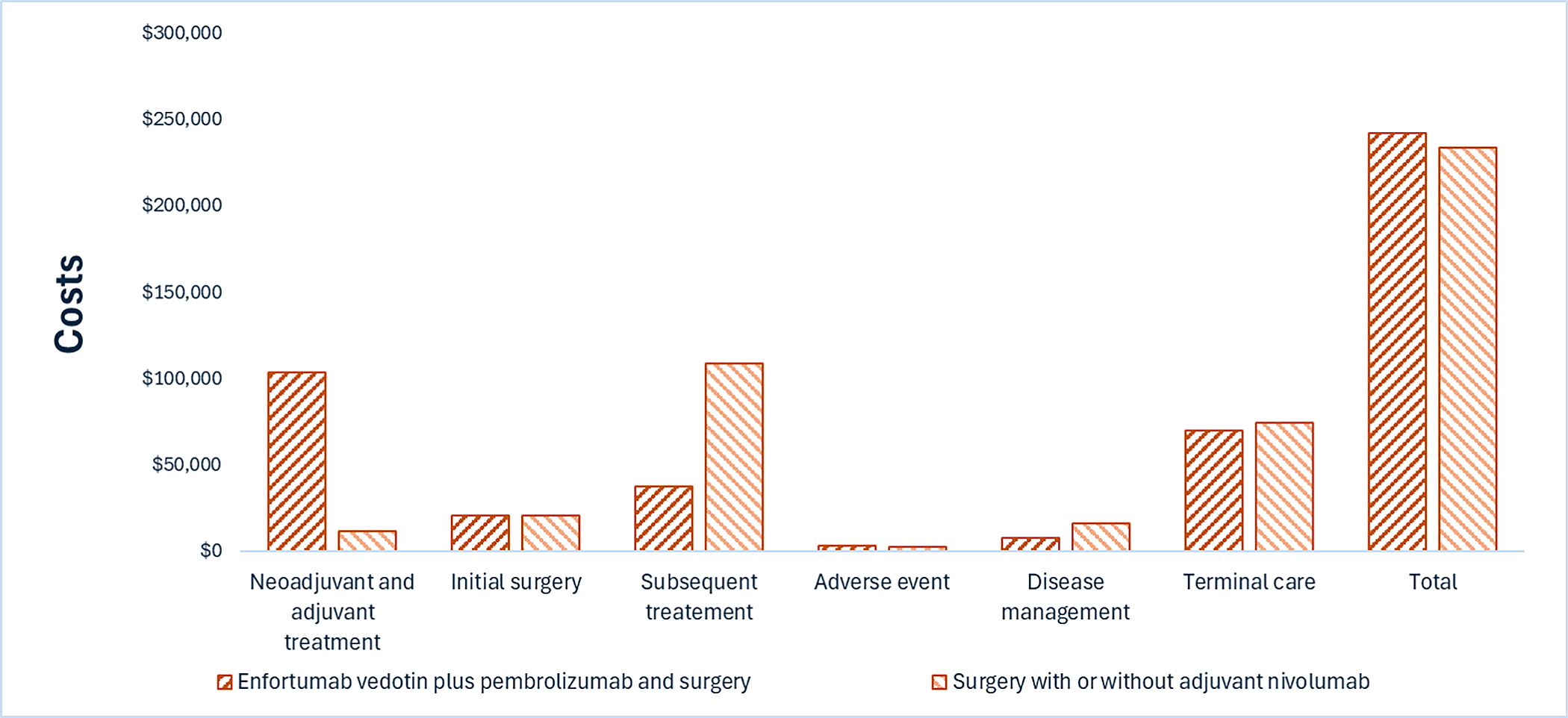
vs. = versus.
Note: Adjuvant nivolumab was used in patients with a high risk of recurrence after radical cystectomy.
Impact on Health
Relative to surgery with or without adjuvant nivolumab, enfortumab vedotin plus pembrolizumab and surgery is predicted to increase the amount of time a patient remains in the event-free health state by approximately 4.09 years and to extend OS by 3.19 years (refer to Figure 2). Enfortumab vedotin plus pembrolizumab and surgery is predicted to result in 2.69 additional QALYs per patient compared to surgery with or without adjuvant nivolumab. The analysis predicts fewer patients will have disease recurrence if treated with enfortumab vedotin plus pembrolizumab and surgery. Because disease recurrence is associated with increased mortality risk, the delay in disease recurrence results in improved survival, which is the key driver of the predicted health benefits. Approximately 85% of the predicted incremental benefit was accrued on the basis of extrapolation.
Figure 2: Impact of Enfortumab Vedotin Plus Pembrolizumab and Surgery vs. Surgery With or Without Adjuvant Nivolumab on Patient Health
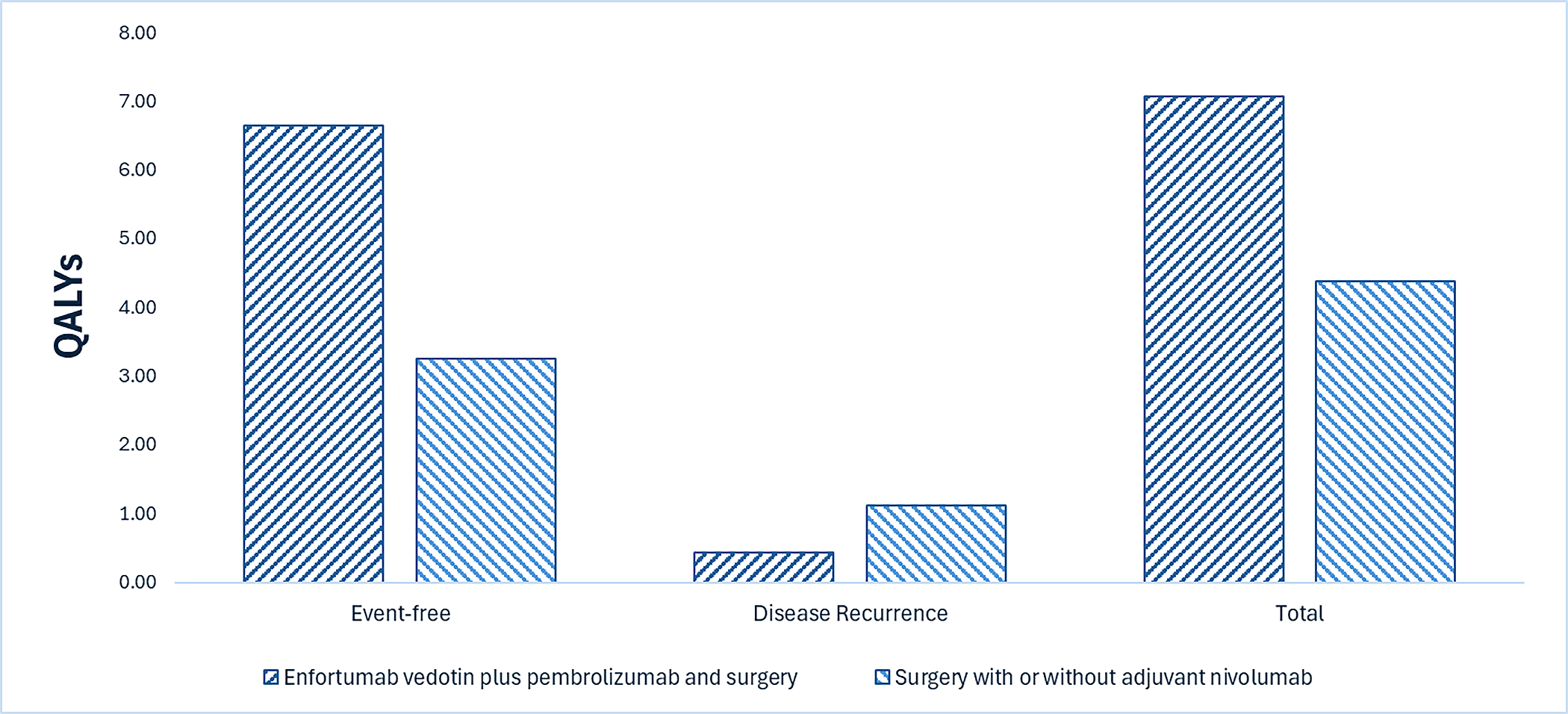
QALY = quality-adjusted life-year; vs. = versus.
Note: Adjuvant nivolumab was used in patients with a high risk of recurrence after radical cystectomy.
Overall Results
The results of the CDA-AMC base case suggest an ICER of $3,247 per QALY gained for enfortumab vedotin plus pembrolizumab and surgery compared to surgery with or without adjuvant nivolumab (refer to Table 8). Additional details on the CDA-AMC base case are available in the Supplemental Material document, Appendix 11.
Table 8: Summary of CDA-AMC Economic Evaluation Results
Drug | Total costs ($) | Total LYs | Total QALYs | ICER vs. surgery with or without adjuvant nivolumab ($/QALY) |
|---|---|---|---|---|
Surgery with or without adjuvant nivolumab | 233,467 | 5.38 | 4.38 | Reference |
Enfortumab vedotin plus pembrolizumab and surgery | 242,217 | 8.57 | 7.07 | 3,247 |
ICER = incremental cost-effectiveness ratio; LY = life-year; QALY = quality-adjusted life-year; vs. = versus.
Note: Publicly available list prices were used for all comparators.
Summary of the Budget Impact
The sponsor submitted a budget impact analysis to estimate the 3-year (2027 to 2029) budget impact of reimbursing enfortumab vedotin plus pembrolizumab administered as neoadjuvant therapy followed by adjuvant treatment after radical cystectomy among adult patients with MIBC who are ineligible for or decline cisplatin-containing chemotherapy.38 This approach was not consistent with the scope of the reimbursement request or the Health Canada indication, for which the target population only includes adult patients with MIBC who are ineligible for cisplatin-containing chemotherapy. The sponsor assumed that the payer would be CDA-AMC–participating public drug plans and derived the size of the eligible population using an epidemiologic approach. The price of enfortumab vedotin plus pembrolizumab and surgery was aligned with the price included in the sponsor’s economic evaluation, while the prices of enfortumab vedotin and comparators were based on the publicly available list prices. Additional information pertaining to the sponsor’s submission is provided in the Supplemental Material document, Appendix 12.
CDA-AMC identified a number of issues with the sponsor’s estimated budget impact and made changes to model parameters and assumptions in consultation with clinical experts to derive the CDA-AMC base case (refer to the Supplemental Material document, Appendix 12). CDA-AMC estimated that 1,611 patients would be eligible for enfortumab vedotin plus pembrolizumab and surgery over a 3-year period (year 1 = 532; year 2 = 537; year 3 = 542), of whom 1,013 are expected to receive enfortumab vedotin plus pembrolizumab and surgery (year 1 = 204; year 2 = 403; year 3 = 407). The estimated incremental budget impact of reimbursing enfortumab vedotin plus pembrolizumab and surgery is predicted to be approximately $49 million over the first 3 years, with an expected expenditure of $43.6 million on pembrolizumab in neoadjuvant and adjuvant settings.
Conclusion
Based on the CDA-AMC base case, enfortumab vedotin plus pembrolizumab and surgery would be considered cost-effective at the submitted price if the public health care system was willing to pay at least $3,247 for each additional QALY gained. If the public health care system is not willing to pay that amount, a price reduction should be considered (refer to Figure 3; full details of the impact of price reductions on cost-effectiveness are presented in the Supplemental Material document, Appendix 11). Given the fixed duration of treatment (maximum 17 cycles for pembrolizumab and 9 cycles for enfortumab vedotin), the estimated drug acquisition costs are expected to be relatively certain. As such, the certainty of this finding depends on the magnitude and duration of posttreatment benefit over long-term horizon.
The budget impact of reimbursing enfortumab vedotin plus pembrolizumab and surgery to the public drug plans in the first 3 years is estimated to be approximately $49 million. The 3-year expenditure on pembrolizumab in the neoadjuvant and adjuvant settings (i.e., not accounting for current expenditure on comparators) is estimated to be $43.6 million (enfortumab vedotin plus pembrolizumab = $88.8 million). The estimated budget impact is uncertain due uncertainty regarding the eligibility of patients who undergo bladder-sparing surgery and the market share of enfortumab vedotin plus pembrolizumab and surgery.
Figure 3: Summary of the CDA-AMC Economic Analysis and Price Reduction
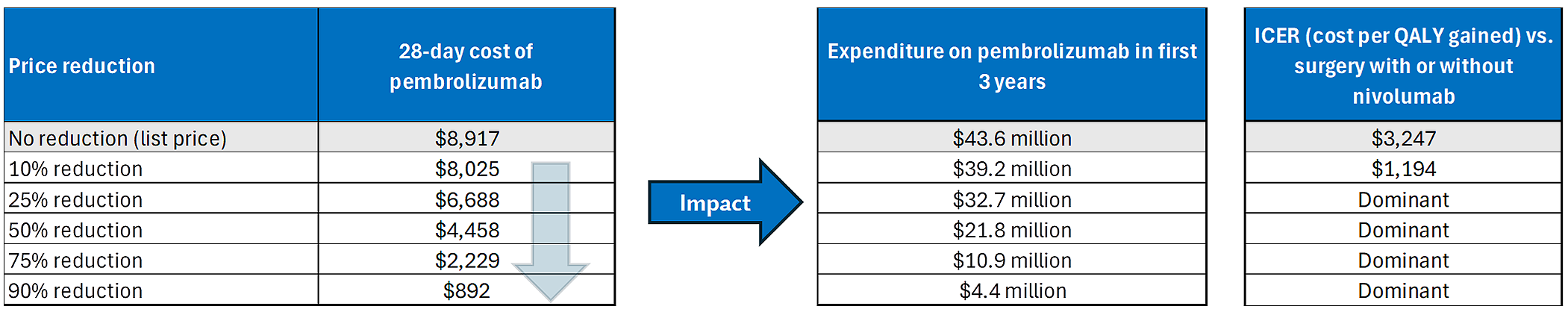
CDA-AMC = Canada’s Drug Agency; ICER = incremental cost-effectiveness ratio; QALY = quality-adjusted life-year; vs. = versus.
Note: Expenditure includes only the drug cost of pembrolizumab. The term dominant indicates that a drug costs less and provides more QALYs than the comparator.
References
1.Sung H, Ferlay J, Siegel RL, et al. Global Cancer Statistics 2020: GLOBOCAN Estimates of Incidence and Mortality Worldwide for 36 Cancers in 185 Countries. CA Cancer J Clin. 2021;71(3):209-249. doi:10.3322/caac.21660 PubMed
2.Dawood EE, Awadalla A, Hashem A, Shokeir AA, Abdel-Aziz AF. Evaluation of molecular signatures in the urinary bladder and upper tract urothelial carcinomas: a prospective controlled clinical study. J Egypt Natl Canc Inst. 2022;34(1):47. doi:10.1186/s43046-022-00148-x PubMed
3.Govindasamy R, Selvi SK, Srivani S, Ivan EA. Rare histological types of bladder carcinoma from a tertiary care hospital: Case reports. Journal of Medical and Scientific Research. 2023;11(1):60-63. doi:10.17727/jmsr.2023/11-12
4.American Cancer Society: What Is Bladder Cancer? [sponsor supplied reference]. March 2024; https://www.cancer.org/cancer/types/bladder-cancer/about/what-is-bladder-cancer.html. Accessed on 31 Jan 2025.
5.Park JC, Citrin DE, Agarwal PK, Apolo AB. Multimodal management of muscle-invasive bladder cancer. Curr Probl Cancer. 2014;38(3):80-108. doi:10.1016/j.currproblcancer.2014.06.001 PubMed
6.Krishna SR, Konety BR. Current concepts in the management of muscle invasive bladder cancer. Indian J Surg Oncol. 2017;8(1):74-81. doi:10.1007/s13193-016-0586-1 PubMed
7.Jakus D, Solic I, Juric I, Borovac J, Situm M. The impact of the initial clinical presentation of bladder cancer on histopathological and morphological tumor characteristics. J Clin Med. 2023;12(13):4259. doi:10.3390/jcm12134259. PubMed
8.Morra M, Chung D, Kassouf W, et al. MP08-15 BLADDER CANCER STAGE AT DIAGNOSIS IN RURAL VERSUS URBAN PATIENTS IN CANADA: RESULTS FROM THE CANADIAN BLADDER CANCER INFORMATION SYSTEM (CBCIS). J Urol. 2025;213(5S):e248.
9.Alfred Witjes J, Max Bruins H, Carrion A, et al. European Association of Urology guidelines on muscle-invasive and metastatic bladder cancer: Summary of the 2023 guidelines. Eur Urol. 2024;85(1):17-31. doi:10.1016/j.eururo.2023.08.016 PubMed
10.Kulkarni GS, Black PC, Sridhar SS, et al. 2025 Canadian Urological Association Expert Report: Muscle-invasive bladder cancer. Can Urol Assoc J. 2025;19(1):E1-e16. doi:10.5489/cuaj.9096 PubMed
11.Brenner DR, Gillis J, Demers AA, et al. Projected estimates of cancer in Canada in 2026. CMAJ. 2026;198(14):E526-e534. doi:10.1503/cmaj.252152 PubMed
12.Canadian Cancer Statistics Advisory Committee, Canadian Cancer Society, Statistics Canada, Public Health Agency of Canada. Canadian Cancer Statistics: a 2024 special report on the economic impact of cancer in Canada. Canadian Cancer Society; 2024. Accessed January 1, 1800. https://cdn.cancer.ca/-/media/files/research/cancer-statistics/2024-statistics/2024-special-report/2024_pdf_en.pdf
13.Kulkarni G, Urbach D, Austin P, Fleshner N, Laupacis A. Higher surgeon and hospital volume improves long‐term survival after radical cystectomy. Cancer 2013;119 (19):3546-3554. PubMed
14.Kim KH, Phan DTT, Ha HK, Jung EH, Song G, Seo HK. Treatment strategies for cisplatin-ineligible metastatic bladder cancer: Emerging therapies and future perspectives. Investig Clin Urol. 2025;66(6):471-481. doi:10.4111/icu.20250316 PubMed
15.Galsky MD, Hahn NM, Rosenberg J, et al. A consensus definition of patients with metastatic urothelial carcinoma who are unfit for cisplatin-based chemotherapy. Lancet Oncol. 2011;12(3):211-4. doi:10.1016/s1470-2045(10)70275-8 PubMed
16.Galsky MD, Valderrama BP, Maruzzo M, et al. Neoadjuvant and adjuvant enfortumab vedotin (EV) plus pembrolizumab (pembro) for participants with muscle-invasive bladder cancer (MIBC) who are eligible for cisplatin: Randomized, open-label, phase 3 KEYNOTE-B15 study. J Clin Oncol. 2026;44(7_suppl):LBA630-LBA630. doi:10.1200/JCO.2026.44.7_suppl.LBA630
17.Merck Sharp & Dohme LLC. Clinical Study Report: P905V01MK3475. A Randomized Phase 3 Study Evaluating Cystectomy with Perioperative Pembrolizumab and Cystectomy with Perioperative Enfortumab Vedotin and Pembrolizumab versus Cystectomy Alone in Participants who are Cisplatin-Ineligible or Decline Cisplatin with MuscleInvasive Bladder Cancer (KEYNOTE-905/EV-303) [internal sponsor's report]. September 25, 2025.
18.Merck Canada Inc. Sponsor summary of clinical evidence [internal sponsor's report]. In: Drug Reimbursement Review sponsor submission: Keytruda (pembrolizumab), 100 mg/4 mL vial, intravenous infusion. February 18, 2026.
19.Hwang IK, Shih WJ, De Cani JS. Group sequential designs using a family of type I error probability spending functions. Stat Med. 1990;9(12):1439-45. doi:10.1002/sim.4780091207 PubMed
20.F. MWB. Multiple testing in group sequential trials using graphical approaches. Stat Biopharm Res 2013;5(4):311-20.
21.Bassler D, Briel M, Montori VM, et al. Stopping randomized trials early for benefit and estimation of treatment effects: systematic review and meta-regression analysis. JAMA. 2010;303(12):1180-7. doi:10.1001/jama.2010.310 PubMed
22.Cookson MS, Dutta SC, Chang SS, Clark T, Smith JA, Jr., Wells N. Health related quality of life in patients treated with radical cystectomy and urinary diversion for urothelial carcinoma of the bladder: development and validation of a new disease specific questionnaire. J Urol. 2003;170(5):1926-30. doi:10.1097/01.ju.0000092830.03247.ef PubMed
23.Anderson CB, Feurer ID, Large MC, et al. Psychometric characteristics of a condition-specific, health-related quality-of-life survey: the FACT-Vanderbilt Cystectomy Index. Urology. 2012;80(1):77-83. doi:10.1016/j.urology.2012.01.090 PubMed
24.Gilbert SM, Dunn RL, Hollenbeck BK, et al. Development and validation of the Bladder Cancer Index: a comprehensive, disease specific measure of health related quality of life in patients with localized bladder cancer. J Urol. 2010;183(5):1764-9. doi:10.1016/j.juro.2010.01.013 PubMed
25.Gilbert SM, Wood DP, Dunn RL, et al. Measuring health-related quality of life outcomes in bladder cancer patients using the Bladder Cancer Index (BCI). Cancer. 2007;109(9):1756-62. doi:10.1002/cncr.22556 PubMed
26.Vulsteke C, Adra N, Danchaivijitr P, et al. Perioperative Enfortumab Vedotin and Pembrolizumab in Bladder Cancer. N Engl J Med. 2026;394(13):1257-1269. doi:10.1056/NEJMoa2511674 PubMed
27.Bristol-Myers Squibb Canada. PRODUCT MONOGRAPH INCLUDING PATIENT MEDICATION INFORMATION OPDIVO® nivolumab for injection, Intravenous Infusion, 10 mg nivolumab /mL vial, 40 mg and 100 mg single-use vials, Antineoplastic. Date of Authorization: July 16, 2025 [sponsor supplied reference].
28.Squires P, Tepsick JG, Coutinho F, Rogiers A, Ramamurthy C, Li H, Morgan T. Real-World Adjuvant Nivolumab Utilization in Surgically Treated Muscle Invasive Bladder Cancer Patients within U.S. Community Oncology Practice. Presented at ISPOR 2025.
29.Stuart J, Zhuleku E, Mevius A, et al. Characteristics, Treatment Patterns, and Outcomes of Patients with Muscle-Invasive Bladder Cancer Undergoing Radical Cystectomy: A Retrospective Analysis of Health Insurance Claims Data in Germany. Oncol Ther. 2026;14(1):373-388. doi:10.1007/s40487-025-00413-8 PubMed
30.Squires P, Meng K, Hu X, et al. Perioperative Treatment Patterns for Muscle-Invasive Bladder Cancer Patients Undergoing Radical Cystectomy in the Adjuvant Immunotherapy Era: A Retrospective Analysis of US Community Oncology Practice. Oncol Ther. 2026. doi:10.1007/s40487-026-00441-y PubMed
31.Galsky MD, Gschwend JE, Milowsky MI, et al. Adjuvant nivolumab versus placebo for high-risk muscle-invasive urothelial carcinoma: 5-year efficacy and ctDNA results from CheckMate 274. Ann Oncol. 2026;37(1):69-78. doi:10.1016/j.annonc.2025.09.139 PubMed
32.Degboe A, Ivanescu C, Rohay JM, Turner RR, Cella D. Validity and performance of the Functional Assessment of Cancer Therapy-Bladder (FACT-Bl) among advanced urothelial cancer patients. Support Care Cancer. 2019;27(11):4189-4198. doi:10.1007/s00520-019-04709-0 PubMed
33.Peyton CC, Henriksen C, Reich RR, Azizi M, Gilbert SM. Estimating Minimally Important Differences for the Bladder Cancer Index Using Distribution and Anchor Based Approaches. J Urol. 2019;201(4):709-714. doi:10.1016/j.juro.2018.10.008 PubMed
34.Merck Canada Inc. Drug Reimbursement Review sponsor submission: Keytruda (pembrolizumab), 100 mg/4 mL vial, intravenous infusion [internal sponsor's package]. February 18, 2026.
35.Canadian Cancer Society. Supportive care for bladder cancer. Accessed April 21, 2026. https://cancer.ca/en/cancer-information/cancer-types/bladder/supportive-care
36.Powles T, Catto JWF, Galsky MD, et al. Perioperative Durvalumab with Neoadjuvant Chemotherapy in Operable Bladder Cancer. N Engl J Med. 2024;391(19):1773-1786. doi:10.1056/NEJMoa2408154 PubMed
37.Merck Sharp & Dohme. Clinical Study Report: A Randomized Phase 3 Study Evaluating Cystectomy with Perioperative Pembrolizumab and Cystectomy with Perioperative Enfortumab Vedotin and Pembrolizumab versus Cystectomy Alone in Participants who are Cisplatin-Ineligible or Decline Cisplatin with Muscle-Invasive Bladder Cancer (KEYNOTE-905/EV-303) [sponsor supplied reference]. 2025.
38.Merck Canada Inc. Budget Impact Analysis [internal sponsor's report]. In: Drug Reimbursement Review sponsor submission: Keytruda (pembrolizumab), 100 mg/4 mL vial, intravenous infusion. February 18, 2026.
ISSN: 2563-6596
Canada’s Drug Agency (CDA-AMC) is a pan-Canadian health organization. Created and funded by Canada’s federal, provincial, and territorial governments, we’re responsible for driving better coordination, alignment, and public value within Canada’s drug and health technology landscape. We provide Canada’s health system leaders with independent evidence and advice so they can make informed drug, health technology, and health system decisions, and we collaborate with national and international partners to enhance our collective impact.
Disclaimer: CDA-AMC has taken care to ensure that the information in this document was accurate, complete, and up to date when it was published, but does not make any guarantee to that effect. Your use of this information is subject to this disclaimer and the Terms of Use at cda-amc.ca.
The information in this document is made available for informational and educational purposes only and should not be used as a substitute for professional medical advice, the application of clinical judgment in respect of the care of a particular patient, or other professional judgments in any decision-making process. You assume full responsibility for the use of the information and rely on it at your own risk.
CDA-AMC does not endorse any information, drugs, therapies, treatments, products, processes, or services. The views and opinions of third parties published in this document do not necessarily reflect those of CDA-AMC. The copyright and other intellectual property rights in this document are owned by the Canadian Agency for Drugs and Technologies in Health (operating as CDA-AMC) and its licensors.
Questions or requests for information about this report can be directed to Requests@CDA-AMC.ca.