Drugs, Health Technologies, Health Systems
Reimbursement Review
Tafasitamab (Minjuvi)
Sponsor: Incyte Biosciences Canada Corporation
Therapeutic area: Relapsed or refractory follicular lymphoma
Summary
What Is Follicular Lymphoma?
Follicular lymphoma (FL) is a form of non-Hodgkin lymphoma that originates from a type of white blood cell, called B cells, which form abnormal clusters (i.e., follicles) within lymph nodes. FL is a heterogeneous disease with a diverse clinical trajectory; its symptoms and psychosocial impacts can have a negative effect on health-related quality of life (HRQoL). Given the relapsing and remitting course of FL, patients may require multiple intermittent treatments during their lifetime. According to WHO classification, grades 1 to 3a FL are considered indolent (whereas grade 3b FL is more aggressive and is typically treated in a different manner).
In the US, FL has an estimated incidence of 3.18 cases per 100,000 people, and the estimated incidence in Europe is 2.18 cases per 100,000 people per year. Published FL prevalence and incidence statistics from Canada were not available.
What Are the Treatment Goals and Current Treatment Options for Relapsed or Refractory FL?
The main goals in the treatment of relapsed or refractory FL are to prolong survival, induce remission, prevent or delay disease relapse, control the disease and symptoms, prevent or delay next treatment, improve quality of life, and mitigate adverse effects.
A standard of care or optimal treatment for grade 1, 2, or 3a relapsed or refractory FL has not been determined; the choice of treatment is individualized, taking into consideration patient and disease characteristics, prior therapies, treatment access and reimbursement, and other factors. Treatment options include rituximab-based or obinutuzumab-based chemoimmunotherapy, autologous stem cell transplant (ASCT), and rituximab plus lenalidomide. CAR T-cell therapy may be used in the third-line or later setting.
What Is Minjuvi and Why Did Canada’s Drug Agency Conduct This Review?
Minjuvi is a drug administered by IV infusion. At the time of the sponsor’s submission to Canada’s Drug Agency (CDA-AMC), Health Canada was reviewing Minjuvi in combination with rituximab plus lenalidomide for the treatment of adult patients with relapsed or refractory FL. During the course of the review, the indication under review by Health Canada was updated to Minjuvi “in combination with rituximab and lenalidomide for the treatment of adult patients with Grade 1, 2, or 3a relapsed or refractory follicular lymphoma (FL).”
CDA-AMC reviewed Minjuvi to inform a recommendation to the participating public drug programs on whether it should be reimbursed in combination with rituximab plus lenalidomide for the treatment of adult patients with grade 1, 2, or 3a relapsed or refractory FL. The sponsor is seeking reimbursement for this patient population.
How Did CDA-AMC Evaluate Minjuvi?
CDA-AMC reviewed the clinical evidence on the beneficial and harmful effects, as well as the economic evidence, of the use of Minjuvi in combination with rituximab plus lenalidomide versus other treatments used in Canada to treat relapsed or refractory FL. The following were considered relevant treatments to compare with Minjuvi in combination with rituximab plus lenalidomide when reviewing the clinical evidence: rituximab plus lenalidomide, rituximab-based or obinutuzumab-based chemoimmunotherapy (bendamustine plus rituximab; rituximab, cyclophosphamide, vincristine, and prednisone [R-CVP]; rituximab, cyclophosphamide, doxorubicin, vincristine, and prednisone [R-CHOP]; rituximab, gemcitabine, cisplatin, and dexamethasone [R-GDP]; bendamustine plus obinutuzumab; obinutuzumab, cyclophosphamide, vincristine, and prednisone [O-CVP]; obinutuzumab, cyclophosphamide, doxorubicin, vincristine, and prednisone [O-CHOP]; obinutuzumab, gemcitabine, cisplatin, and dexamethasone [O-GDP]), ASCT, and CAR T-cell therapy (tisagenlecleucel [tisa-cel], axicabtagene ciloleucel [axi-cel]).
CDA-AMC identified equity and ethical considerations relevant to Minjuvi and relapsed or refractory FL.
The review was informed by materials submitted by the sponsor, which included clinical and economic evidence.
The review was also informed by 1 patient group submission and 3 clinician group submissions in response to the CDA-AMC call for input and by input from the participating public drug programs around issues that may impact their ability to implement a recommendation.
Two hematologists from Ontario and Alberta were consulted as part of the review process.
What Were the Findings?
Clinical Evidence
CDA-AMC reviewed the following clinical evidence:
one randomized controlled phase III trial (the inMIND trial) comparing Minjuvi plus rituximab plus lenalidomide with placebo plus rituximab plus lenalidomide in 548 patients with grade 1, 2, or 3a relapsed or refractory FL
four matching-adjusted indirect comparisons (MAICs) of Minjuvi plus rituximab plus lenalidomide versus bendamustine plus rituximab, bendamustine plus obinutuzumab, tisa-cel, and axi-cel.
Findings for the comparison of Minjuvi plus rituximab plus lenalidomide versus placebo plus rituximab plus lenalidomide included the following:
Minjuvi plus rituximab plus lenalidomide demonstrated clinically important increases in the probability of progression-free survival (PFS) compared with placebo plus rituximab plus lenalidomide at 12 months and 2 years, with high and moderate certainty in the findings at these time points, respectively.
Based on the results of an interim analysis, Minjuvi plus rituximab plus lenalidomide may result in little to no difference in the probability of overall survival (OS) at 12 months and may result in a clinically important increase in the probability of OS at 2 years compared with placebo plus rituximab plus lenalidomide. The certainty in the findings at both time points is low due to imprecision and study limitations because the duration of follow-up is insufficient to adequately assess this outcome.
Minjuvi plus rituximab plus lenalidomide likely results in a clinically important increase in overall response rate compared with placebo plus rituximab plus lenalidomide, with moderate certainty in the findings.
HRQoL was measured by the change from baseline in the Functional Assessment of Cancer Therapy–Lymphoma total score. The findings indicated that little to no difference in HRQoL was shown at the end of treatment between Minjuvi plus rituximab plus lenalidomide and placebo plus rituximab plus lenalidomide, with low certainty in the evidence due to imprecision and study limitations.
The evidence suggested that Minjuvi plus rituximab plus lenalidomide likely results in an increase in the proportion of patients who experience at least 1 serious treatment-emergent adverse event compared with placebo plus rituximab plus lenalidomide, with moderate certainty in the findings due to imprecision. The adverse events reported in the inMIND trial are considered by the clinical experts consulted by CDA-AMC to be generally manageable in practice.
Conclusions could not be drawn regarding the comparative efficacy of Minjuvi plus rituximab plus lenalidomide versus bendamustine plus rituximab, bendamustine plus obinutuzumab, tisa-cel, and axi-cel because the MAICs were subject to considerable limitations and uncertainty. There was no evidence to inform how the safety of Minjuvi plus rituximab plus lenalidomide compares to these treatments because this was not assessed in the MAICs.
There was no evidence to inform how Minjuvi plus rituximab plus lenalidomide compares with other treatments for relapsed or refractory FL that are used in clinical practice (i.e., R-CVP, R-CHOP, R-GDP, O-CVP, O-CHOP, O-GDP, and ASCT).
Economic Evidence
Minjuvi is available as a 200 mg single-use vial for IV infusion. At the submitted price of $1,167.86 per vial, the per-28-day cycle cost of Minjuvi is expected to be $23,357.20 per patient in cycles 1 to 3 and $11,678.60 in cycles 4 to 12, based on the Health Canada–recommended dosage. The per-28-day cycle cost of Minjuvi plus rituximab plus lenalidomide is expected to be $33,899 per patient in cycle 1; $27,552 in cycles 2 to 3; $15,873 in cycles 4 to 5; and $13,794 in cycles 6 to 12, based on the Health Canada–recommended dosage.
Key clinical efficacy outcomes in the economic analysis (PFS and OS) for Minjuvi plus rituximab plus lenalidomide versus rituximab plus lenalidomide alone were derived from the inMIND trial, which enrolled patients receiving treatment in the second-line and later setting. Evidence submitted by the sponsor indicates that Minjuvi plus rituximab plus lenalidomide results in a clinically important increase in the probability of PFS at 12 months and 2 years compared with rituximab plus lenalidomide alone, with high and moderate certainty in the findings at these time points, respectively. Evidence submitted by the sponsor indicates that Minjuvi plus rituximab plus lenalidomide may result in little to no difference in the probability of OS at 12 months and may result in a clinically important increase in the probability of OS at 2 years compared with rituximab plus lenalidomide alone; the certainty in the findings at both time points is low due to imprecision and study limitations because the duration of follow-up is insufficient to adequately assess this outcome. Other therapies used in the second-line and later setting include bendamustine plus obinutuzumab and bendamustine plus rituximab. Clinical efficacy versus these comparators was informed by sponsor-submitted indirect treatment comparisons (ITCs). Considerable limitations in the MAICs, including heterogeneity across the comparisons, were identified by CDA-AMC, which prevented any firm conclusions being made regarding the efficacy of Minjuvi plus rituximab plus lenalidomide versus these comparators. The sponsor also submitted ITCs to explore the efficacy of Minjuvi plus rituximab plus lenalidomide versus relevant comparators used only in the third-line or later setting (tisa-cel and axi-cel); however, these ITCs were associated with the same limitations, meaning that no conclusions could be drawn.
The results of the CDA-AMC base case suggest:
Minjuvi plus rituximab plus lenalidomide is predicted to be associated with higher costs to health care systems than rituximab plus lenalidomide alone (incremental costs = $167,150) over a lifetime (40 year) horizon, primarily driven by increased costs associated with drug acquisition.
Minjuvi plus rituximab plus lenalidomide is predicted to be associated with a gain of 1.18 life-years compared to rituximab plus lenalidomide alone and may result in a gain of 1.01 quality-adjusted life-years compared to rituximab plus lenalidomide alone over a lifetime (40 year) horizon.
The incremental cost-effectiveness ratio of Minjuvi plus rituximab plus lenalidomide compared to rituximab plus lenalidomide alone was $164,872 per quality-adjusted life-year gained in the CDA-AMC base case. The estimated incremental cost-effectiveness ratio was highly sensitive to the long-term treatment effect of Minjuvi plus rituximab plus lenalidomide and the proportion of patients receiving subsequent treatment. Of the incremental benefit compared to rituximab plus lenalidomide alone, approximately 99% of the benefit was predicted to be accrued on the basis of extrapolation.
Due to considerable uncertainty associated with the sponsor’s submitted ITCs, comparative efficacy between Minjuvi plus rituximab plus lenalidomide and bendamustine plus obinutuzumab and bendamustine plus rituximab was too uncertain to determine. If it is anticipated that there will be no differences in health outcomes with Minjuvi plus rituximab plus lenalidomide versus bendamustine plus obinutuzumab and bendamustine plus rituximab, then the cost of Minjuvi plus rituximab plus lenalidomide should not exceed that of those comparators for the treatment of adult patients with relapsed or refractory FL.
Rituximab plus lenalidomide, bendamustine plus obinutuzumab, and bendamustine plus rituximab were the only comparators included in the cost-utility analysis in the second-line and later setting, and tisa-cel and axi-cel were included in the third-line or later setting. Clinical expert input indicated that O-CHOP, R-CHOP, O-CVP, R-CVP, O-GDP, R-GDP, and ASCT were also relevant comparators in this indication. The cost-effectiveness of Minjuvi plus rituximab plus lenalidomide versus these comparators is unknown. If it is anticipated there will be no differences in health outcomes between Minjuvi plus rituximab plus lenalidomide and O-CHOP, R-CHOP, O-CVP, R-CVP, O-GDP, R-GDP, and ASCT, then the cost of Minjuvi plus rituximab plus lenalidomide should not exceed that of these comparators.
Rituximab plus lenalidomide is not funded across all provinces in Canada (i.e., it is not funded in Newfoundland and Labrador, Prince Edward Island, Nova Scotia, New Brunswick, or Ontario,). In provinces where rituximab plus lenalidomide is not funded, rituximab-based or obinutuzumab-based regimens such as R-CHOP, O-CHOP, R-CVP, O-CVP, bendamustine plus obinutuzumab, or bendamustine plus rituximab were considered the most relevant comparators to Minjuvi plus rituximab plus lenalidomide according to clinical expert input.
CDA-AMC estimates that the budget impact of reimbursing Minjuvi for use in combination with rituximab plus lenalidomide for the treatment of adults with relapsed or refractory FL will be approximately $134.5 million over the first 3 years of reimbursement compared to the amount currently spent on comparators. The expenditure on Minjuvi over this period is predicted to be $132.1 million (Minjuvi plus rituximab plus lenalidomide = $163.8 million). The actual budget impact of reimbursing Minjuvi will depend on the market uptake of Minjuvi plus rituximab plus lenalidomide and the rate of displacement of existing comparators by Minjuvi plus rituximab plus lenalidomide. The incremental budget impact of reimbursing Minjuvi plus rituximab plus lenalidomide is predicted to be greater than $40 million in year 2 and year 3, and the economic feasibility of adoption must be addressed.
Abbreviations
AE
adverse event
ASCT
autologous stem cell transplant
axi-cel
axicabtagene ciloleucel
CDA-AMC
Canada’s Drug Agency
CI
confidence interval
CMH
Cochran-Mantel-Haenszel
CR
complete response
DAC
Drug Advisory Committee
DCO
data cut-off
DLBCL
diffuse large B-cell lymphoma
DOR
duration of response
ECOG PS
Eastern Cooperative Oncology Group Performance Status
EOT
end of treatment
FACT-Lym
Functional Assessment of Cancer Therapy–Lymphoma
FL
follicular lymphoma
FLIPI
Follicular Lymphoma International Prognostic Index
GELF
Groupe d’Etude des Lymphomes Folliculaires
GRADE
Grading of Recommendations Assessment, Development and Evaluation
HR
hazard ratio
HRQoL
health-related quality of life
IRC
independent review committee
ITC
indirect treatment comparison
LLSC
Leukemia & Lymphoma Society of Canada
MAIC
matching-adjusted indirect comparison
MID
minimal important difference
MZL
marginal zone lymphoma
NE
not evaluable
NHL
non-Hodgkin lymphoma
O-CHOP
obinutuzumab, cyclophosphamide, doxorubicin, vincristine, and prednisone
O-CVP
obinutuzumab, cyclophosphamide, vincristine, and prednisone
O-GDP
obinutuzumab, gemcitabine, cisplatin, and dexamethasone
OH (CCO)
Ontario Health (Cancer Care Ontario)
OR
odds ratio
ORR
overall response rate
OS
overall survival
PFS
progression-free survival
POD24
progression of disease within 24 months
QALY
quality-adjusted life-year
QoL
quality of life
R-CHOP
rituximab, cyclophosphamide, doxorubicin, vincristine, and prednisone
RCT
randomized controlled trial
R-CVP
rituximab, cyclophosphamide, vincristine, and prednisone
R-GDP
rituximab, gemcitabine, cisplatin, and dexamethasone
SD
standard deviation
SLR
systematic literature review
TEAE
treatment-emergent adverse event
tisa-cel
tisagenlecleucel
TTNT
time to next treatment
Background
Introduction
The objectives of this report are as follows:
Review and critically appraise the evidence submitted by the sponsor on the beneficial and harmful effects of tafasitamab 200 mg single-use vial (lyophilized powder for solution) for IV infusion, used in combination with rituximab plus lenalidomide, in the treatment of adult patients with grade 1, 2, or 3a relapsed or refractory follicular lymphoma (FL). The focus will be placed on comparing tafasitamab in combination with rituximab plus lenalidomide to relevant comparators in clinical practice in Canada and identifying gaps in the current evidence; this focus is outlined in Table 1.
Review and critically appraise the economic information submitted by the sponsor, including a cost-effectiveness analysis and a budget impact analysis. The focus of the Economic Review is aligned with the scope of the Clinical Review, unless otherwise stated. For most reviews, a Canada’s Drug Agency (CDA-AMC) base case is developed, informed by clinical expert input, the available clinical evidence, and the best interpretation of the economic evidence based on the information provided by the sponsor.
The application was submitted by the sponsor before receiving a Notice of Compliance from Health Canada. This report reflects the anticipated indication and recommended dosage for tafasitamab during the initial CDA-AMC review period.
Table 1: Information on the Application Submitted for Review and on the CDA-AMC Review
Item | Description |
|---|---|
Information on the application submitted for review | |
Drug | Tafasitamab (Minjuvi), 200 mg single-use vial, lyophilized powder for solution for IV infusion |
Sponsor | Incyte Biosciences Canada Corporation |
Health Canada indicationa | In combination with rituximab and lenalidomide for the treatment of adult patients with Grade 1, 2, or 3a relapsed or refractory follicular lymphoma (FL) |
Health Canada approval status | NOC |
Health Canada review pathway | Standard; Project Orbis |
NOC date | April 17, 2026 |
Mechanism of action | Fc-enhanced, humanized monoclonal antibody against the B-cell CD19 antigen |
Recommended dosage | Tafasitamab 12 mg/kg, 12 cyclesb (cycles 1 to 3: q.w.; cycles 4 to 12: q.2.w.), IV Rituximab 375 mg/m2, 5 cyclesb (cycle 1: q.w.; cycles 2 to 5: q.4.w.), IV Lenalidomide 20 mg/day, days 1 to 21 for 12 cycles,b oral |
Submission type | Initial |
Sponsor’s reimbursement request | Per indication |
Submitted price | Tafasitamab: $1,167.8600 per 200 mg single-use vial |
Information on the CDA-AMC review | |
Review type | Standard |
Clinical Review focusc | Population: Adult patients with grade 1, 2, or 3a relapsed or refractory FL Intervention: Per recommended dosage Comparators:
Outcomes: PFS, OS, ORR, DOR, TTNT, HRQoL (FACT-Lym), harms outcomes (TEAEs, SAEs, WDAEs, deaths, AESIs) |
AESI = adverse event of special interest; ASCT = autologous stem cell transplant; axi-cel = axicabtagene ciloleucel; CDA-AMC = Canada’s Drug Agency; DOR = duration of response; FACT-Lym = Functional Assessment of Cancer Therapy - Lymphoma; Fc = fragment crystallizable; FL = follicular lymphoma; HRQoL = health-related quality of life; NOC = Notice of Compliance; O-CHOP = obinutuzumab, cyclophosphamide, doxorubicin, vincristine, and prednisone; O-CVP = obinutuzumab, cyclophosphamide, vincristine, and prednisone; O-GDP = obinutuzumab, gemcitabine, cisplatin, and dexamethasone; ORR = overall response rate; OS = overall survival; PFS = progression-free survival; q.2.w. = every 2 weeks; q.4.w. = every 4 weeks; q.w. = every week; R-CHOP = rituximab, cyclophosphamide, doxorubicin, vincristine, and prednisone; R-CVP = rituximab, cyclophosphamide, vincristine, and prednisone; R-GDP = rituximab, gemcitabine, cisplatin, and dexamethasone; SAE = serious adverse event; TEAE = treatment-emergent adverse event; tisa-cel = tisagenlecleucel; TTNT = time to next treatment; WDAE = withdrawal due to adverse event.
aAt the time of the sponsor’s submission to CDA-AMC, Health Canada was reviewing tafasitamab in combination with rituximab plus lenalidomide for the treatment of adult patients with relapsed or refractory FL. During the course of the CDA-AMC review, the indication under review by Health Canada for tafasitamab was updated to be “in combination with rituximab and lenalidomide for the treatment of adult patients with Grade 1, 2, or 3a relapsed or refractory follicular lymphoma (FL).” The NOC was issued by Health Canada for the updated indication.
bEach cycle is 28 days.
cThe Economic Review aligns with the scope of the Clinical Review, unless otherwise stated.
dCDA-AMC has previously issued a reimbursement recommendation for this drug for the same indication or a similar indication.1-3
Sources: Sponsor’s summary of clinical evidence;4 product monograph for Minjuvi.5
Submission History for the Drug Under Review
CDA-AMC previously reviewed tafasitamab through the reimbursement review process for diffuse large B-cell lymphoma (DLBCL) and issued a recommendation of do not reimburse.6
Sources of Information
The contents of the Reimbursement Review report are informed by materials submitted by the sponsor, input received from interested parties (patient groups, clinician groups, and drug programs), and input from the clinical experts consulted for this review.
Calls for patient group and clinician group input are issued for each Reimbursement Review. One patient group submission from Lymphoma Canada and 3 clinician group submissions from the Leukemia & Lymphoma Society of Canada (LLSC) Nurses Network, the Ontario Health (Cancer Care Ontario) (OH [CCO]) Hematology Cancer Drug Advisory Committee (DAC), and the Lymphoma Canada – Clinician Group were received. The patient group collected information through an online anonymous patient survey conducted between October 30 and November 28, 2025. Seventy-nine responses were collected from this survey, with 2 patients confirming experience with tafasitamab in combination with rituximab plus lenalidomide. The OH (CCO) Hematology Cancer DAC collected information via email, the LLSC Nurses Network gathered information through individual interviews and written feedback from nurses working in cancer centres across Canada, and the Lymphoma Canada – Clinician Group gathered information via email from lymphoma physicians across Canada. Eighteen people (2 registered nurses and 16 clinicians) submitted their input for the clinician group submissions. The full submissions received are available on the project landing page in the Patient and Clinician Group Input document. The drug programs provide input on each drug being reviewed through the reimbursement review process by identifying issues that may impact their ability to implement a recommendation.
Input from patient and clinician groups is considered throughout the review, including in the selection of outcomes to include in the Clinical Review and in the interpretation of the clinical and economic evidence. Relevant patient and clinician group input is summarized in the Disease Background, Current Management, and Unmet Needs and Existing Challenges sections.
Each review team includes at least 1 clinical expert with expertise in the diagnosis and management of the condition for which the drug is indicated. Clinical experts are a critical part of the review team and are involved in all phases of the review process. Two hematologists with expertise in the diagnosis and management of FL participated as part of the review team, with representation from Ontario and the Prairies.
Disease Background
FL is a form of non-Hodgkin lymphoma (NHL) that originates from B cells, a type of white blood cell crucial for immune response. It is characterized by the formation of abnormal clusters of these cells, known as follicles, within lymph nodes (extranodal disease in the bone marrow is also commonly reported). FL is the second most common form of NHL and the leading subtype of indolent NHL, accounting for about 35% of all cases of NHL and 70% of indolent lymphomas.7,8 In the US as a whole, FL has an estimated incidence of 3.18 cases per 100,000 people. The estimated incidence in Europe is 2.18 cases per 100,000 people per year. The incidence in populations who are white is more than twice that in populations in Africa and Asia.9 Published FL prevalence and incidence statistics from Canada were not available.
Most patients with FL present with asymptomatic generalized lymphadenopathy, characterized by enlarged lymph nodes, which may wax and wane for several years.8,10 As a result, patients usually present with advanced disease, which is considered treatable but incurable with currently available systemic drugs.8,11 Commonly affected areas include the lymph nodes in the armpit, neck, and groin areas.12 Only 20% of patients with FL will experience systemic symptoms such as night sweats, fever, and weight loss.10
Diagnostic assessment for FL includes physical examination, laboratory tests, imaging, lymph node biopsy, immunohistochemistry, and cytogenetics. WHO classification uses a 1 to 3 grading system based on the number of centroblasts per high-power field, with grade 3 divided into 3a and 3b.10 Grades 1 to 3a are considered indolent, while grade 3b is more aggressive and is typically treated like DLBCL.13,14
Despite advances in treatment, which have improved overall survival (OS), FL shortens life expectancy compared with the general population.15 FL is a chronic disease that requires long-term management of its relapsing course, with most patients requiring 3 or more lines of treatment. As a result, survival, response rates, and durations of response (DORs) all decrease with each subsequent line of therapy.16 Approximately 20% of patients with FL experience disease progression within 2 years of initial diagnosis or systemic treatment;17 such progression is associated with poorer prognosis, including reduced OS, shorter DORs, and increased number of treatment lines.18
Despite being an indolent disease, quality of life (QoL) for people with FL is lower than for people with other NHLs.19 QoL is also lower for people with relapsed FL than for those with newly diagnosed FL because the former live with a constant fear of disease relapse and disease progression.20 Additionally, the QoL of patients with FL declines with successive lines of therapy.19
Patient group input: Patients reported fatigue, enlarged lymph nodes, abdominal pain or indigestion, night sweats, and bodily aches and pains to have significant impact on their QoL. When asked about experiencing psychosocial impacts, those who responded indicated that they were impacted by the stress of diagnosis, anxiety or worry, fear of progression, difficulty sleeping, frequency of health care appointments, and inability to continue daily activities.
Current Management
Treatment Goals
Patient group input: Factors such as longer survival, control of disease and symptoms, longer remission, improved QoL to perform daily activities, and fewer side effects are important to patients when considering a new treatment. Eighty percent of patients indicated that it is very or extremely important for them to have a choice in which drug to take based on known side effects and expected outcomes of treatment. Eighty percent of patients also indicated that they would be willing to tolerate side effects for a new and effective treatment if they were short term, and 78% of patients felt there was a need for more therapy options for patients with FL.
Clinician input: The clinical experts consulted by CDA-AMC stated that the general goals of treatment for patients with FL are to induce remission, prevent or delay disease relapse and next treatment, prolong survival, mitigate toxicity, and improve QoL. The clinician groups noted that the primary goals of treatment for patients with FL are to achieve durable disease control, delay progression, prolong survival while maintaining QoL, minimize adverse effects, support day-to-day functioning, and reduce the overall burden on both patients and their caregivers. The OH (CCO) Hematology Cancer DAC also highlighted that clinicians aim to minimize treatment-related toxicity, especially in older adults or those with comorbidities, and to avoid repeated exposure to chemotherapy when possible. The LLSC Nurses Network highlighted similar points, noting that chemotherapy-sparing therapies in this setting could provide effective disease control while limiting cumulative toxicity, treatment-related fatigue, infections, and hospital visits. The group added that less time-intensive regimens could allow patients to maintain independence, preserve future treatment options, and continue daily routines, thus aiming to balance treatment efficacy with patients’ QoL and functional well-being.
Current Treatment Options
FL is a heterogeneous disease with a diverse clinical trajectory. Given the relapsing and remitting course of FL, patients may require multiple intermittent treatments during their lifetime.21 According to Canadian and international guidelines, systemic therapy is indicated for patients with disease characteristics such as B symptoms (e.g., fever, night sweats, weight loss), significant lymphadenopathy, splenomegaly, impending organ compromise, or cytopenias or can be initiated based on patient preference (because of anxiety and poor QoL without treatment). In clinical trial settings, the Groupe d’Etude des Lymphomes Folliculaires (GELF) criteria are an established standardized set of criteria for the level of tumour burden requiring systemic therapy.22 A “watch and wait” approach involving follow-up clinical assessments and/or CT scans may be used for patients who do not fulfill the requirements for therapy.23-25
According to guidelines from Canada, the preferred first-line systemic therapy for grade 1, 2, or 3a FL is bendamustine plus rituximab followed by maintenance therapy with rituximab for 2 years for patients who experience disease response. Alternative first-line systemic therapies include rituximab monotherapy, rituximab-chemotherapy regimens (rituximab, cyclophosphamide, vincristine, and prednisone [R-CVP]; rituximab, cyclophosphamide, doxorubicin, vincristine, and prednisone [R-CHOP]), alkylator therapy (chlorambucil), obinutuzumab-chemotherapy regimens (obinutuzumab, cyclophosphamide, vincristine, and prednisone [O-CVP]; obinutuzumab, cyclophosphamide, doxorubicin, vincristine, and prednisone [O-CHOP]), and rituximab plus lenalidomide. Radiotherapy may be used for patients with peripheral stage IA or contiguous nonbulky stage IIA FL.23,25
The clinical experts consulted by CDA-AMC indicated that first-line treatment for FL is dependent on stage and disease burden and may include definitive radiation therapy for localized disease; active surveillance or rituximab monotherapy for patients with asymptomatic, low tumour burden advanced-stage FL; and chemoimmunotherapy (most commonly bendamustine plus rituximab) followed by optional maintenance rituximab for patients with symptomatic or high tumour burden disseminated disease.
Guidelines from Canada note that the standard of care or optimal treatment for grade 1, 2, or 3a relapsed or refractory FL has not been determined. The choice of treatment is individualized, taking into consideration factors such as patient age, comorbidities, fitness level, and symptoms; disease stage, sites of involvement, and grade; prior therapies; disease-free interval; preservation of future options; assessment of risks versus benefits; and treatment access and reimbursement. Treatment options include (repeat) rituximab-based chemoimmunotherapy (R-CHOP, bendamustine plus rituximab, R-CVP) or obinutuzumab-based chemoimmunotherapy (O-CHOP, bendamustine plus obinutuzumab, O-CVP); high-dose therapy autologous stem cell transplant (ASCT) (for patients with relapsed disease within 2 years of initial treatment who do not have significant comorbidities and are able to tolerate treatment); and rituximab plus lenalidomide. In the third-line or later setting, CAR T-cell therapy (tisagenlecleucel [tisa-cel] or axicabtagene ciloleucel [axi-cel]) may be used. Radiotherapy may be considered as palliative symptomatic care.23,25
Similarly, the clinical experts indicated that management of relapsed or refractory FL is individualized because no single standard of care exists and approaches vary across clinicians and institutions. They noted that the choice of treatment is generally dictated by patient goals and fitness levels, the duration of the previous remission, the pace of disease growth, volume, symptoms, and available therapies. The clinical experts stated that continued observation may occur for patients who experience asymptomatic, low-burden relapse of FL. For patients who experience symptomatic or high tumour burden relapse, the clinical experts indicated that the treatment options include chemoimmunotherapy (e.g., rituximab-based or obinutuzumab-based regimens such as bendamustine plus obinutuzumab, bendamustine plus rituximab, R-CVP, R-CHOP, O-CVP, or O-CHOP), ASCT (particularly for patients with progression of disease within 24 months [POD24] of initial treatment or for younger, fit [wording from original source] individuals seeking a durable remission), or rituximab plus lenalidomide (which is reimbursed in some but not all jurisdictions in Canada).
According to the clinical experts consulted by CDA-AMC, third-line treatment options for patients who experience further disease relapse include additional chemoimmunotherapy, rituximab plus lenalidomide, or CAR T-cell therapy. They noted that access to CAR T-cell therapy remains limited in many regions in Canada due to toxicity concerns, resource constraints, and geographic or logistical barriers.
The clinical experts consulted by CDA-AMC emphasized that many novel drugs used internationally for FL (e.g., CD20×CD3 bispecific antibodies, tazemetostat, and combinations such as zanubrutinib plus obinutuzumab) are not yet approved, reimbursed, and/or readily accessible in Canada.
The input from the clinician groups regarding current treatment options for relapsed or refractory FL was aligned with previously noted recommendations from the guidelines23,25 from Canada and with input from the clinical experts consulted by CDA-AMC, noting that sensitivity to rituximab and disease progression within 24 months impact decision-making around second-line treatment. The OH (CCO) Hematology Cancer DAC also noted that in the second line, patients who qualify may have access to ASCT or an alternative anti-CD20 monoclonal antibody like obinutuzumab with chemotherapy. The LLSC Nurses Network highlighted that patients who have undergone multiple chemotherapy lines often experience frailty and have longer recovery needs, making additional chemotherapy more difficult to tolerate. This observation reinforces the importance of chemotherapy-sparing options that are easier on patients and help maintain QoL.
Patients who completed the Lymphoma Canada survey were asked how many lines of treatment they had received to treat their FL. The majority of patients who responded indicated that they had received 1 or 2 lines of treatment (36% and 27%, respectively), and 22% of patients indicated that they had received 3 lines or more. In the first-line setting, 34% of patients received combination chemotherapy with bendamustine plus rituximab, 28% received R-CHOP, and 9% received R-CVP. In the second-line treatment setting and beyond, therapies varied and included repeat chemoimmunotherapy (e.g., R-CVP, R-CHOP, bendamustine plus rituximab), obinutuzumab with or without bendamustine, radiation therapy, and rituximab plus lenalidomide. Approximately one-half of patients who responded (54%) indicated they were very satisfied or satisfied with their frontline treatment options; 38% gave the same rating for their second-line treatment, and 19% for their third-line treatment. This trend suggests that patients are less satisfied with treatment options in later lines of therapy, reflecting both the smaller number of options and the potentially more complex disease management.
Key characteristics of tafasitamab, along with those of other treatments available for grade 1, 2, or 3a relapsed or refractory FL, are summarized in the Supplemental Material document, Appendix 1, Table 1.
Unmet Needs and Existing Challenges
Patient group input: While describing their disease experience, 59% of patients who responded to the survey indicated that they required immediate treatment at diagnosis, while 41% reported being on “watch and wait” following their diagnosis. Twenty-one percent of those who responded indicated that their ability to access their treatment was “somewhat challenging,” and 7% of patients indicated that they lived in a community without a cancer centre. The most common financial implications of treatment reported by these patients were travelling costs (35%), absence from work (31%), and supplementary drug costs for side effects (20%). Two patients reported receiving tafasitamab in combination with rituximab plus lenalidomide: 1 reported experiencing hematologic and general side effects, including low platelet counts (thrombocytopenia) and fatigue, and the other reported experiencing gastrointestinal effects, including diarrhea, alongside fatigue and neutropenia. The patient group also noted that on a scale of 1 (no impact) to 5 (significant impact), 32% of patients rated fatigue at a 4 out of 5 level of impact and 21% rated body aches and pains at a 4 out of 5 level of impact. Patients also indicated that they had recently experienced mental health challenges such as fear of progression or disease relapse (66%), anxiety or worry (59%), difficulty sleeping (45%), and stress of having cancer (43%). Additionally, patients with FL rated several factors that impacted their daily life on a scale of 1 (no impact) to 5 (very significant impact). The following were rated at level 4 or higher: the ability to work, attend school, or volunteer (27% of patients); the ability to travel (25%); the ability to concentrate (18%); the ability to contribute financially (16%); and the ability to perform day-to-day activities (16%).
Clinician input: The clinical experts consulted by CDA-AMC indicated that most treatments for FL are not curative and that many patients will ultimately experience disease relapse and need multiple additional lines of therapy throughout their lifetime. The clinical experts reported that repeated courses of chemoimmunotherapy have been the mainstay of treatment for relapsed FL in Canada, mainly due to limited access to novel drugs. They noted that with each successive line of chemoimmunotherapy, the duration of remission typically shortens and the risk of cumulative toxicity (e.g., cytopenias, infections, immunosuppression, and secondary malignancies) increases. The clinical experts commented that, although CAR T-cell therapy is a highly effective and approved third-line option in Canada for relapsed or refractory FL, many patients are ineligible due to advanced age, comorbidities, experiencing frailty, or significant geographic and logistical barriers to accessing specialized centres. They added that CAR T-cell therapy is an intensive treatment associated with significant risks (e.g., cytokine release syndrome, immune effector cell–associated neurotoxicity syndrome, intensive care unit admission, infections, secondary malignancies, and nonrelapse mortality) and requires inpatient hospitalization, the availability of a dedicated caregiver, driving restrictions, and the need for prolonged time off work, which represent additional barriers to treatment. According to the clinical experts, as a result, there remains a critical unmet need in Canada for effective, well-tolerated, feasible, chemotherapy-free therapies in the second-line and later settings for patients with relapsed or refractory FL.
The OH (CCO) Hematology Cancer DAC noted that many patients experience limited durability of response, particularly those who have experienced early disease relapse or resistance to anti-CD20 therapy. The group also highlighted the significant toxicity associated with chemotherapy-based regimens, which can be challenging for older patients or patients experiencing frailty. They further noted the lack of targeted, immune-enhancing therapies for patients with relapsed or refractory FL. The LLSC Nurses Network noted similar issues, indicating the inconveniences associated with traditional chemoimmunotherapy regimens, which require prolonged chair time, frequent visits to centralized cancer centres, and complex management of treatment-related toxicities. The group highlighted that travel to specialized centres adds further challenges for patients living in rural or remote communities or for those facing financial and/or logistical constraints. The group added that managing complex treatment schedules, multiple routes of administration, and new side effect profiles further increases patient burden and can affect adherence. The group emphasized the need for therapies that can be delivered safely in community settings or with shorter visits, such as subcutaneous or oral components, thus reducing travel-related burdens and improving continuity of care. The group referred to the hardship for patients who have been heavily treated with chemotherapy but experienced disease relapse within 3 to 6 months of their last regimen, highlighting that issues such as fatigue, deconditioning, appetite changes, and blood count suppression can make subsequent treatment more difficult for these patients to tolerate. The group further noted the need for chemotherapy-sparing options with predictable toxicity that can be safely administered in community-based settings. The Lymphoma Canada – Clinician Group stated that there is a major unmet clinical need for effective therapy that is well-tolerated and that maintains good clinical status for those who wish to consider CAR T-cell therapy in the third-line or later setting or as an alternative to CAR T-cell therapy for patients for whom this treatment is not suitable or who are not willing to accept its toxicity. Additionally, repeated courses of chemotherapy increase the risk of myelodysplastic syndrome or acute myeloid leukemia in later life. Patients whose disease has progressed soon after chemoimmunotherapy and are not eligible for ASCT are optimally managed with a therapy that uses a different mechanism of action than chemotherapy (e.g., lenalidomide, rituximab, tafasitamab). Repeated courses of chemotherapy and/or high-dose chemotherapy plus ASCT are also associated with high rates of infectious complications.
Considerations for Using the Drug Under Review
The contents within this section have been informed by input from the clinical expert(s) consulted for the purpose of this review and from clinician groups, as well as by the reimbursement conditions proposed by the sponsor (refer to the Supplemental Material document, Appendix 1, Table 2). The implementation questions from the public drug programs and corresponding responses from the clinical experts consulted for this review are summarized in the Supplemental Material document, Appendix 1, Table 3. The following has been summarized by the review team.
Place in Therapy
The clinical experts consulted by CDA-AMC stated that tafasitamab plus rituximab plus lenalidomide would represent a well-tolerated, outpatient, time-limited, chemotherapy-free treatment option for patients requiring second-line or later therapy for relapsed or refractory FL. According to the clinical experts, patients would need to have received at least 1 prior systemic therapy for FL to receive tafasitamab plus rituximab plus lenalidomide, as reflected in the clinical trial eligibility criteria and indication; however, alternative second-line options would not be required before patients could receive tafasitamab plus rituximab plus lenalidomide. The clinical experts expected that tafasitamab plus rituximab plus lenalidomide would replace rituximab plus lenalidomide alone in current practice due to the improved efficacy with the addition of tafasitamab and the similar safety profile and would likely replace chemoimmunotherapy to a great extent. They added that the favourable safety profile of tafasitamab plus rituximab plus lenalidomide makes this combination particularly appealing for older adults and individuals with comorbidities who are not eligible for chemotherapy, ASCT, or third-line CAR T-cell therapy. The clinical experts noted that tafasitamab targets CD19 and thereby offers a novel chemotherapy-free mechanism of action that is complementary to CD20-directed approaches and spares patients from the cumulative toxicities and impaired QoL associated with repeated courses of chemotherapy. The clinical experts added that tafasitamab in combination with rituximab plus lenalidomide would also be suitable for patients with high-risk disease features, such as POD24 or rituximab-refractory disease, particularly if they are ineligible for or decline intensive options such as ASCT. The clinical experts noted that tafasitamab plus rituximab plus lenalidomide would be an appealing second-line option for patients who may proceed to CAR T-cell therapy in the third-line setting because tafasitamab plus rituximab plus lenalidomide is unlikely to impair T-cell fitness to the same extent as chemotherapy-based approaches, particularly bendamustine. One clinical expert added that the use of CD19-targeting therapies such as tafasitamab is not as well studied pre-CD19–targeting CAR T-cell therapy. The clinical experts indicated that, in practice, they would not consider prior use of tafasitamab a contraindication to using CAR T-cell therapy; however, there is insufficient data to determine whether it is beneficial or not.
The clinician groups noted that tafasitamab in combination with rituximab plus lenalidomide represents a chemotherapy-free regimen and would fit into the current treatment paradigm as a second-line or later option for patients with relapsed or refractory FL, particularly those whose disease has been refractory to prior anti-CD20 therapy or who are seeking alternatives to chemotherapy.
Patient Population
The clinical experts consulted by CDA-AMC stated that most therapies for FL are not curative and that the majority of patients ultimately experience disease relapse requiring multiple additional lines of treatment over their lifetime. They noted that a subset of patients with relapsed FL may remain asymptomatic with low tumour burden and can be safely observed for a period of time, but the majority will develop high tumour burden, symptoms, cytopenias, or organ compromise and require prompt intervention. The clinical experts indicated that patients in particular need of intervention include those with early progression (e.g., POD24) and individuals with heavily pretreated FL who experience short remission durations or refractory disease and have exhausted most available standard therapies. According to the clinical experts, all patients with relapsed FL who have received at least 1 prior line of therapy could be considered potential candidates for tafasitamab in combination with rituximab plus lenalidomide at some point during their disease course. They noted that tafasitamab plus rituximab plus lenalidomide may be used in place of chemoimmunotherapy, ASCT, or CAR T-cell therapy, or following disease relapse after these treatments, depending on the patient’s age, comorbidities, functional status, and treatment preferences. In the opinion of the clinical experts, tafasitamab plus rituximab plus lenalidomide is anticipated to be used in both younger and older patients and in those with higher-risk and lower-risk disease. The clinical experts stated that patients would be identified for treatment with tafasitamab plus rituximab plus lenalidomide based on standard clinical assessments, including laboratory parameters (e.g., complete blood counts), physical examination for signs of disease relapse, radiographic imaging (e.g., CT or PET), and biopsy when indicated to confirm recurrent disease. They added that no companion diagnostic test is required because CD19 is expressed in most cases of FL. According to the clinical experts, patients would generally not be considered for treatment with tafasitamab plus rituximab plus lenalidomide if they have previously untreated FL, have previously experienced refractoriness to or intolerable toxicity from rituximab plus lenalidomide, are pregnant, or are unable or unwilling to receive multiple IV infusions. In addition, the clinical experts indicated that patients with transformed FL or grade 3b FL would not be considered for tafasitamab plus rituximab plus lenalidomide because these conditions are typically managed as DLBCL. The clinical experts noted that the initiation conditions proposed by the sponsor are appropriate and aligned with the clinical trial eligibility criteria and indication and that there should be no difficulty implementing these conditions. They stated that, in addition, patients should meet standard criteria for treatment initiation (e.g., high tumour burden, symptoms, cytopenias, organ compromise). They noted that although the GELF criteria may generally be used to guide the decision to initiate treatment, there are patients who will start treatment based on other factors (e.g., pace of disease, patient preference, duration of prior remission) without strictly meeting the GELF criteria. One of the clinical experts noted that, in the inMIND trial, 8% of patients who were enrolled had received anti-CD20 monotherapy as their only previous treatment26 and that the pan-Canadian Oncology Drug Review Expert Review Committee could consider discussing whether the initiation criteria should include 1 prior systemic anti-CD20 chemoimmunotherapy because frontline anti-CD20 monotherapy (which is typically used for asymptomatic, low-burden disease) is not standard of care in many jurisdictions in Canada. However, the other clinical expert noted that rituximab monotherapy was considered a prior line of therapy for the purpose of enrolment in the inMIND trial, has a defined response rate and remission durability, and is used in some parts of Canada for patients with low tumour burden or who are not candidates for chemotherapy due to age, comorbidities, or experiencing frailty.
According to the OH (CCO) Hematology Cancer DAC group, patients who are best suited for tafasitamab plus rituximab plus lenalidomide include adults with relapsed or refractory FL. The LLSC Nurses Network noted that the combination of tafasitamab plus rituximab plus lenalidomide is best suited for adult patients with grade 1, 2, or 3a relapsed or refractory FL who have received prior systemic therapy. Patients who may experience significant toxicity from conventional chemotherapy or who face challenges with prolonged hospital visits may particularly benefit from this regimen, given its chemotherapy-sparing and less time-intensive profile. Patients who may be unable to receive bispecific antibody therapies due to monitoring requirements or who live in regions without access to tertiary centres may be well suited for tafasitamab. Its monoclonal antibody profile, absence of ramp-up dosing, and lower risk of acute immune toxicities make it feasible for administration in community oncology settings, supporting access and reducing caregiver and travel burden. Patients with active or chronic infections would not be suitable for many immune-based therapies. Caregiver support is an important factor for chemotherapy-sparing immunotherapy adherence because caregivers help with monitoring symptoms and managing treatment logistics. Conversely, patients who are unable to adhere to a mixed schedule of IV, subcutaneous, and oral therapies may be less suitable for this regimen. The Lymphoma Canada – Clinician Group noted that any patient who requires therapy for relapsed or refractory FL would be a candidate for this treatment. This clinician group also stated that young patients who wish to consider high-dose therapy and stem cell rescue may not be offered this therapy in the second line but that if such a patient were to experience disease relapse, they would be candidates for this treatment in the third line. The group added that tafasitamab plus rituximab plus lenalidomide would be appropriate in the second-line or later setting for patients who are not eligible for ASCT.
Assessing the Response to Treatment
To determine whether a patient is responding to treatment in clinical practice, the clinical experts consulted by CDA-AMC indicated that standard outcomes would be used, such as overall response rate (ORR) and complete response (CR) rate (defined by Lugano criteria), progression-free survival (PFS), time to next treatment (TTNT), and OS. According to 1 of the clinical experts, a clinically meaningful response to treatment for relapsed or refractory FL would typically be defined as achieving a partial response or ideally a CR, per the standard Lugano criteria, which usually translates into improvement in symptoms and reduction of disease burden and is a prerequisite for achieving a durable remission. This clinical expert noted that some patients who only experience stable disease may still continue treatment if they are deriving clinical benefit. The other clinical expert consulted by CDA-AMC stated that a clinically meaningful response to treatment is best defined by improvement in symptoms and associated reduction in disease burden and that TTNT is also an important metric that should be considered. According to the clinical experts, assessment for response to treatment would follow standard clinical practice, incorporating clinical evaluation and radiographic imaging (e.g., CT or PET) at interim time points (typically after several cycles) and again at the completion of therapy to confirm remission.
Clinician groups stated that assessing the response is based on standard testing, including imaging and peripheral blood and bone marrow tests. A clinically meaningful response is characterized by both evidence of disease control in lab or imaging findings and the patient’s sustained well-being, without excessive toxicity or treatment-related complications.
Discontinuing Treatment
According to the clinical experts, treatment with tafasitamab plus rituximab plus lenalidomide should be discontinued upon completion of planned time-limited therapy (i.e., after 12 cycles) or upon disease progression or unacceptable toxicities, if these occur beforehand. Disease progression would be assessed per the standard Lugano criteria.
The clinician groups noted that treatment should be discontinued due to disease progression, significant deterioration in QoL, intolerance, unacceptable toxicity, or completion of 12 cycles of therapy. The LLSC Nurses Network noted that, in addition to clinical indicators, psychosocial and logistical factors such as challenges with transportation, caregiver support, or the management of complex treatment schedules should be considered because these factors can significantly impact adherence and overall treatment safety. Regular assessment of both clinical and patient-reported outcomes is essential to ensure that discontinuation decisions are appropriate and patient centred.
Prescribing Considerations
According to the clinical experts consulted by CDA-AMC, tafasitamab plus rituximab plus lenalidomide should be prescribed by a hematologist or oncologist experienced in the management of FL and the administration of anticancer therapies. They reported that tafasitamab is a well-tolerated monoclonal antibody that can be readily administered in any cancer centre or infusion unit capable of delivering similar drugs such as rituximab and also noted that it is advantageous that treatment with tafasitamab plus rituximab plus lenalidomide is straightforward to implement and highly feasible in community hospitals and rural treatment sites. The clinical experts noted that the prescribing conditions proposed by the sponsor are appropriate and may be readily implemented.
The OH (CCO) Hematology Cancer DAC noted that this treatment should be administered in specialized oncology or hematology centres. The LLSC Nurses Network added that tafasitamab in combination with rituximab plus lenalidomide can be safely administered in both outpatient and community oncology clinic settings. While specialist oversight by hematology or oncology physicians is required to initiate therapy, evaluate eligibility, and monitor overall treatment response, the routine administration of the regimen can be supported by trained nursing staff in community settings. This model allows patients to receive effective therapy closer to home, reducing travel burden while maintaining appropriate clinical supervision and safety monitoring. According to the Lymphoma Canada – Clinician Group, tafasitamab did not have unexpected side effects and could be administered in any centre that currently provides other monoclonal antibodies.
Clinical Review
Methods
The review team considered studies in the sponsor’s systematic review (pivotal studies and randomized controlled trials [RCTs]) and indirect treatment comparisons (ITCs). Eligible studies for the systematic review included phase III and IV RCTs. Relevant patients and interventions were defined by the reimbursement request and the recommended dosage in the product monograph. Relevant comparators were drugs and nondrug treatments used in clinical practice in Canada to treat patients described in the indication under review. These treatments included rituximab plus lenalidomide, chemoimmunotherapy, ASCT, and CAR T-cell therapy, as listed in Table 1. ITCs were included when they filled an identified gap in the systematic review evidence (e.g., missing comparator).
The review team selected outcomes (and follow-up times) for review considering the sponsor’s summary of clinical evidence, clinical expert input, and patient and clinician group input. The included outcomes are those considered relevant to expert committee deliberations; they were selected in consultation with committee members. Evidence from the systematic review for the most important outcomes was assessed using the Grading of Recommendations Assessment, Development and Evaluation (GRADE) approach. The following outcomes, identified by patient and clinician groups and clinical experts as efficacy measures that address the main treatment goals for relapsed or refractory FL, were assessed with GRADE: PFS by investigator assessment, OS, ORR by investigator assessment, and health-related quality of life (HRQoL) (as measured by the Functional Assessment of Cancer Therapy–Lymphoma [FACT-Lym]). PFS and OS were also key inputs in the sponsor’s pharmacoeconomic model.
Methods for data extraction, the risk of bias appraisal, and the certainty of evidence assessment are detailed in the Supplemental Material document, Appendix 2.
Clinical Evidence
In this report, the following sources of evidence submitted by the sponsor are reviewed and appraised:
one pivotal study included in the systematic review, the inMIND RCT
four ITCs.
Systematic Review
Description of Study
Study Characteristics
The characteristics of the inMIND trial are summarized in Table 2, and the study design is presented in Figure 1. Details pertaining to the eligibility criteria and relevant outcome measures can be found in the Supplemental Material document, Appendix 3.
The inMIND trial is an ongoing phase III RCT that enrolled adults diagnosed with relapsed or refractory FL or relapsed or refractory marginal zone lymphoma (MZL) who had received at least 1 prior systemic anti-CD20 immunotherapy or chemoimmunotherapy. The primary end point was to compare the efficacy of tafasitamab plus rituximab plus lenalidomide versus placebo plus rituximab plus lenalidomide in terms of PFS by investigator assessment in patients with relapsed or refractory FL. The secondary end points included OS, PFS by independent review committee (IRC) assessment, ORR, DOR, HRQoL, and safety in patients with relapsed or refractory FL.4,27 While the trial enrolled patients with MZL, only the population of patients with FL is aligned with the sponsor’s reimbursement request, and this Clinical Review only focuses on results for this population. The inMIND trial was conducted at 210 centres (199 centres for patients with FL) in 26 countries, including 24 patients enrolled across 6 study sites in Canada, all of whom had FL. The first participant began study treatment on April 16, 2021.4,27 The study included a screening period of up to 28 days, a treatment period of up to twelve 28-day cycles, and a follow-up period of up to 5 years after the end of treatment (EOT) (either completion of the last treatment cycle or treatment discontinuation).4,27,28 The total study duration from the first patient’s first visit to the last patient’s last visit is expected to be approximately 8 years, and the total duration for each patient is up to approximately 6 years.4,28
Eligible participants were randomized 1:1 by interactive response technology to either tafasitamab in combination with rituximab plus lenalidomide or placebo in combination with rituximab plus lenalidomide for up to 12 cycles, and randomization was applied separately for patients with FL (N = 548) and MZL (N = 106).4,27,28 Among patients with FL, randomization was stratified by POD24 after initial diagnosis (yes versus no), refractoriness to prior anti-CD20 monoclonal antibody therapy (yes versus no), and the number of prior lines of therapy (< 2 versus ≥ 2).4,28 Disease assessments were made according to the response criteria for malignant lymphoma based on the guidelines of the Lugano classification.4,28,29 Response assessments occurred every 3 months during the first year, every 4 months in the second and third year, and every 6 months in the fourth to sixth year. Safety assessments for adverse events (AEs) occurred at each treatment and at the safety follow-up. Reasons for treatment discontinuation included unacceptable toxicity, disease progression, lack of efficacy, withdrawal of consent, investigator decision, pregnancy, study termination, and loss to follow-up.4,28
The follow-up phase of the trial included the safety, efficacy, and survival follow-up periods, as applicable. The safety follow-up period was defined as the interval between the EOT date and the safety follow-up visit (90 ± 7 days after the EOT visit). During the efficacy follow-up period, patients who discontinued treatment for reasons other than disease progression continued with efficacy assessments (e.g., scans) at the protocol-defined intervals until disease progression, initiation of a new anticancer therapy, loss to follow-up, withdrawal of consent, or death. Patients with confirmed progressive disease moved to the survival follow-up period, in which survival status was recorded every 12 weeks (± 4 weeks) until death, loss to follow-up, withdrawal of consent for survival follow-up, completion of the 5-year follow-up phase, or the end of the study (occurring after the last participant completed at least 5 years of posttreatment follow-up).4,28
In this report and accompanying appendices, the efficacy and safety results are presented for the time of the primary efficacy analysis, with a data cut-off (DCO) date of February 23, 2024.4,27
Table 2: Characteristics of the Study Included in the Systematic Review
Study name, design, and sample size | Key inclusion criteria | Key exclusion criteria | Intervention and comparator | Relevant end pointsa |
|---|---|---|---|---|
inMIND trial Multicentre, phase III, double-blind, randomized, placebo-controlled, parallel-group study:
|
|
| Intervention: Tafasitamab plus rituximab plus lenalidomide
Comparator: Placebo plus rituximab plus lenalidomide
| Primary end point:
Key secondary end point:
Other secondary end points:
Exploratory end point:
|
CNS = central nervous system; CR = complete response; DOR = duration of response; ECOG PS = Eastern Cooperative Oncology Group Performance Status; FACT-Lym = Functional Assessment of Cancer Therapy–Lymphoma; FL = follicular lymphoma; GELF = Groupe d’Etude des Lymphomes Folliculaires; HRQoL = health-related quality of life; IRC = independent review committee; MZL = marginal zone lymphoma; ORR = overall response rate; OS = overall survival; PFS = progression-free survival; POD24 = progression of disease within 24 months after initial diagnosis; PR = partial response; q.d. = once a day; TEAE = treatment-emergent adverse event; TTNT = time to next treatment.
Note: The definition of POD24 in the inMIND trial was progression of disease within 24 months after initial diagnosis. The clinical experts consulted by CDA-AMC noted that definitions of POD24 may vary across studies but agreed that the definition of POD24 generally used is progression of disease within 24 months of the start of initial treatment.
aAll relevant end points pertain to assessment in the population of patients with FL.
bParticipants were randomized at a 1:1 ratio to receive either tafasitamab plus rituximab plus lenalidomide or placebo plus rituximab plus lenalidomide. Participants with FL or MZL were randomized separately using different stratification factors (i.e., number of prior lines of therapy, POD24, refractoriness to prior anti-CD20 therapy for FL, and number of prior lines of therapy for MZL).
cA limited number of patients with MZL were enrolled, but the study was not powered for this population. Only results for the population of patients with FL are included in this report.
dThe inclusion criteria in the inMIND study protocol specify “expression of CD19+ and CD20+ on lymphoma cells must be documented for all participants, FL and MZL, prior to randomization.”
eRelapsed lymphoma is defined as relapsed after an initial CR or PR ≥ 6 months after prior therapy. Refractory lymphoma is defined as having experienced less than PR to the last treatment or having experienced a CR or PR that lasted < 6 months. Progressive lymphoma is defined as progressive disease after initial response of stable disease to prior therapy.
fUsing the Lugano 2014 criteria.29
Source: Clinical Study Report for the inMIND trial;27 Clinical Study Protocol for the inMIND trial.28 The details included in the table are from the sponsor’s summary of clinical evidence.4
Figure 1: The inMIND Study Design
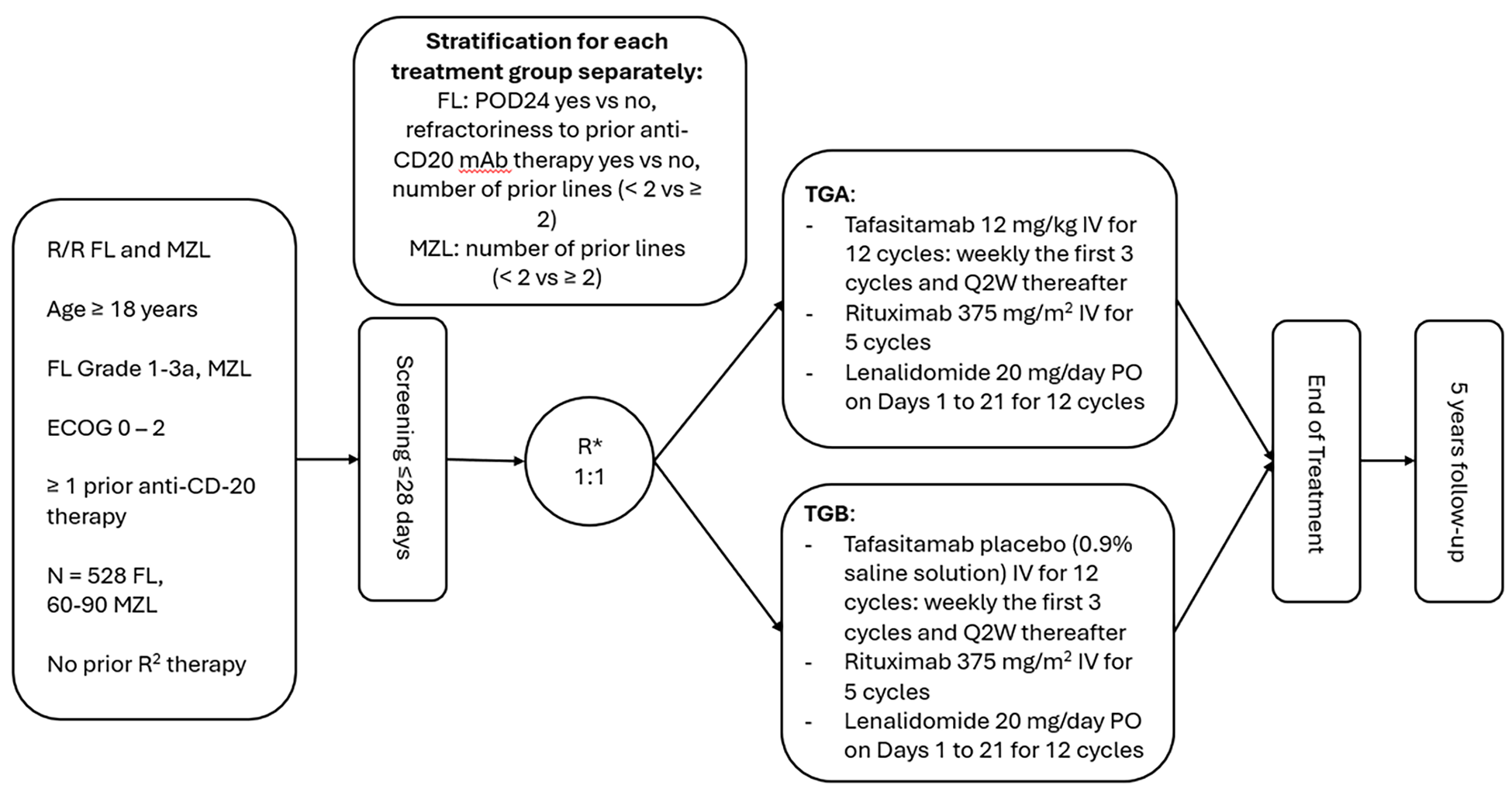
ECOG = Eastern Cooperative Oncology Group; FL = follicular lymphoma; mAb = monoclonal antibody; MZL = marginal zone lymphoma; PO = orally; POD24 = progression of disease within 24 months after initial diagnosis; Q2W = every 2 weeks; R/R = relapsed or refractory; R = randomization; R2 = rituximab plus lenalidomide; TGA = treatment group A (tafasitamab + R2); TGB = treatment group B (placebo + R2).
Note: Refractoriness to anti-CD20 mAb therapy is defined as not experiencing a complete response or partial response to a prior regimen containing anti-CD20 mAb or disease progression occurring during treatment with, or relapse within 6 months after the last dose of, anti-CD20 mAb.
*Randomization was applied separately for populations of patients with FL and MZL.
Sources: Clinical Study Report for the inMIND trial;27 Clinical Study Protocol for the inMIND trial.28
Statistical Testing and Analysis Populations
The inMIND sample size calculation was based on the primary end point of PFS by investigator assessment in the population of patients with FL. To detect a hazard ratio (HR) of 0.65 with 80% power at the primary analysis, using a 2-sided log-rank test at an alpha level of 5% and a 1:1 randomization ratio between the 2 treatment groups, a total of 174 PFS events were required in the population of patients with FL. Assuming a median PFS of 27.8 months for the placebo plus rituximab plus lenalidomide group, 21 months of enrolment, an accrual rate of 0.1 participants per site per month, 12 months of follow-up for PFS, and a 15% dropout rate, 528 evaluable participants with FL needed to be randomized.4,30
The primary end point and 3 key secondary end points in the inMIND trial were tested with inferential statistics.30 To maintain the study-wise type I error rate at 2-sided 5% significance level, a hierarchical testing procedure was implemented for the key secondary end points, with the primary end point of PFS by investigator assessment serving as a gatekeeper. If the primary null hypothesis was rejected, the key secondary end points were tested in the following fixed order:
PFS by investigator assessment in the overall population (FL and MZL)
PET-CR rate by investigator assessment in the population of patients with FL
In the planned analyses, if the null hypothesis was not rejected, formal sequential testing would be stopped, and the P values for the remaining key secondary end points would be reported for exploratory and illustrative purposes. No multiplicity adjustment was implemented for other secondary or exploratory end points. Any hypothesis testing for other secondary end points and exploratory end points was performed using a 2-sided 5% significance level and was for exploratory purposes.4,30
The primary analysis was to be performed after approximately 174 PFS events by investigator assessment were observed in the FL full analysis set (including a 5% margin to account for loss of events due to censoring of a new antilymphoma treatment). Recruitment stopped when the required 528 participants with FL for the primary analysis were randomized.4,30
At the time of the PFS primary analysis, an interim analysis for futility was performed for OS using a nonbinding rule, with HR estimated. A final analysis will be performed at the end of the study (planned to occur after the last participant has completed at least 5 years of posttreatment follow-up), which is expected approximately 8 years after the first participant was enrolled.4,30
Efficacy analyses were performed in the full analysis set, defined as all participants who were randomized, with treatment groups for this population determined according to the assigned treatment at the time of randomization. The per-protocol set, used for sensitivity analyses of the primary end point, was defined as the subset of participants in the full analysis set who were compliant with the requirements of the protocol and had no important protocol deviations. Safety analyses were performed in the safety population, defined as all participants who were randomized who received at least 1 dose of the study drug, with treatment groups for this population determined according to the actual treatment the participant received regardless of the assigned treatment at the time of randomization.4,30
The inMIND statistical analysis plan specified that the primary and key secondary end points would be analyzed in the following subgroups (relevant to the population of patients with FL): baseline natural killer cell count, POD24, and the population of patients living in Japan. The statistical analysis plan also noted that additional subgroup analyses may include age group, sex, race, ethnicity, geographic region, and other stratification factors, including refractoriness to prior anti-CD20 monoclonal antibody therapy and number of prior lines of therapy. No adjustment for multiplicity was performed for the subgroup analyses.30
Patient Disposition
Patient disposition information from the included study is summarized in the Supplemental Material, Appendix 4. In the inMIND trial, 817 patients were screened (includes those with FL and those with MZL); of the patients with FL, 548 were randomized. At the DCO date of February 23, 2024, 222 of 273 patients (81.3%) in the tafasitamab plus rituximab plus lenalidomide arm and 231 of 275 patients (84.0%) in the placebo plus rituximab plus lenalidomide arm had discontinued the study treatment. Completion of the planned treatment was the primary reason for treatment discontinuation for 146 patients (53.5%) in the tafasitamab plus rituximab plus lenalidomide arm and 118 patients (42.9%) in the placebo plus rituximab plus lenalidomide arm. Progressive disease was the primary reason for discontinuation for 30 patients (11.0%) in the tafasitamab plus rituximab plus lenalidomide arm and 84 patients (30.5%) in the placebo plus rituximab plus lenalidomide arm, and AEs were the primary reason for 24 patients (8.8%) and 15 patients (5.5%) in the tafasitamab plus rituximab plus lenalidomide arm and the placebo plus rituximab plus lenalidomide arm, respectively.
At the DCO date of February 23, 2024, 29 patients (10.6%) in the tafasitamab plus rituximab plus lenalidomide arm and 46 patients (16.7%) in the placebo plus rituximab plus lenalidomide arm had withdrawn from the study. Death was the primary reason for withdrawal from the study for 15 patients (5.5%) in the tafasitamab plus rituximab plus lenalidomide arm and 22 patients (8.0%) in the placebo plus rituximab plus lenalidomide arm, and withdrawal by participant was the primary reason for 11 patients (4.0%) and 19 patients (6.9%) in the tafasitamab plus rituximab plus lenalidomide arm and the placebo plus rituximab plus lenalidomide arm, respectively.4
Baseline Characteristics
Table 3: Summary of Baseline Characteristics From the inMIND Trial (FL FAS)
Characteristic | Tafasitamab plus rituximab plus lenalidomide (N = 273) | Placebo plus rituximab plus lenalidomide (N = 275) | Total (N = 548) |
|---|---|---|---|
Age (years), mean (SD) | 64.6 (10.89) | 63.7 (11.69) | 64.2 (11.29) |
Age < 65 years, n (%) | 137 (50.2) | 139 (50.5) | 276 (50.4) |
Age ≥ 65 years, n (%) | 136 (49.8) | 136 (49.5) | 272 (49.6) |
Female, n (%) | 123 (45.1) | 126 (45.8) | 249 (45.4) |
Male, n (%) | 150 (54.9) | 149 (54.2) | 299 (54.6) |
Race, n (%) | |||
Asian | 40 (14.7) | 42 (15.3) | 82 (15.0) |
White | 219 (80.2) | 219 (79.6) | 438 (79.9) |
ECOG PS score at screening visit, n (%) | |||
0 | 181 (66.3) | 192 (69.8) | 373 (68.1) |
1 | 85 (31.1) | 75 (27.3) | 160 (29.2) |
2 | 7 (2.6) | 8 (2.9) | 15 (2.7) |
FL grade at study entry, n (%) | |||
Grade 1 | 61 (22.3) | 51 (18.5) | 112 (20.4) |
Grade 2 | 142 (52.0) | 152 (55.3) | 294 (53.6) |
Grade 3 | 67 (24.5) | 71 (25.8) | 138 (25.2) |
Missing | 3 (1.1) | 1 (0.4) | 4 (0.7) |
CD19+ expression at study entry, n (%) | 273 (100.0) | 275 (100.0) | 548 (100.0) |
CD20+ expression at study entry, n (%) | 273 (100.0) | 275 (100.0) | 548 (100.0) |
Ann Arbor stage at study entry, n (%) | |||
Stage I | 10 (3.7) | 13 (4.7) | 23 (4.2) |
Stage II | 42 (15.4) | 37 (13.5) | 79 (14.4) |
Stage III | 72 (26.4) | 63 (22.9) | 135 (24.6) |
Stage IV | 149 (54.6) | 162 (58.9) | 311 (56.8) |
No CNS involvement, n (%) | 273 (100.0) | 275 (100.0) | 548 (100.0) |
Relapsed or refractory status to the most recent prior therapy,a n (%) | |||
Relapsed | 148 (54.2) | 164 (59.6) | 312 (56.9) |
Refractory | 112 (41.0) | 97 (35.3) | 209 (38.1) |
Indeterminate | 13 (4.8) | 14 (5.1) | 27 (4.9) |
FLIPI score, n (%) | |||
Low (0 to 1) | 57 (20.9) | 57 (20.7) | 114 (20.8) |
Intermediate (2) | 79 (28.9) | 67 (24.4) | 146 (26.6) |
High (≥ 3) | 137 (50.2) | 150 (54.5) | 287 (52.4) |
Missing | 0 (0.0) | 1 (0.4) | 1 (0.2) |
GELF criteria assessment at study entry, n (%) | |||
Participants with ≥ 1 fulfilled GELF criterion | 222 (81.3) | 232 (84.4) | 454 (82.8) |
Participants with no fulfilled GELF criteria | 51 (18.7) | 41 (14.9) | 92 (16.8) |
Participants with missing assessment | 0 (0.0) | 2 (0.7) | 2 (0.4) |
Participants who had received prior radiation for FL, n (%) | 52 (19.0) | 46 (16.7) | 98 (17.9) |
Participants who had received prior surgery for FL,b n (%) | 88 (32.2) | 71 (25.8) | 159 (29.0) |
Participants who had received prior ASCT for FL, n (%) | 13 (4.8) | 15 (5.5) | 28 (5.1) |
Number of prior lines of systemic anticancer therapy per participant | |||
Mean (SD) | 1.8 (1.13) | 1.8 (1.16) | 1.8 (1.15) |
Median (range) | 1.0 (1 to 7) | 1.0 (1 to 10) | 1.0 (1 to 10) |
Participants who had received prior lines of systemic anticancer therapy, n (%) | |||
1 line | 147 (53.8) | 153 (55.6) | 300 (54.7) |
2 lines | 66 (24.2) | 71 (25.8) | 137 (25.0) |
3 lines | 39 (14.3) | 30 (10.9) | 69 (12.6) |
4 lines | 12 (4.4) | 11 (4.0) | 23 (4.2) |
> 4 lines | 9 (3.3) | 10 (3.6) | 19 (3.5) |
Number of prior anti-CD20–containing lines of therapy per participant | |||
Mean (SD) | 1.6 (0.87) | 1.6 (0.91) | 1.6 (0.89) |
Median (range) | 1.0 (1 to 5) | 1.0 (1 to 6) | 1.0 (1 to 6) |
Participants who had received anti-CD20–containing line of therapy, n (%) | |||
1 line | 168 (61.5) | 168 (61.1) | 336 (61.3) |
2 lines | 66 (24.2) | 70 (25.5) | 136 (24.8) |
3 lines | 30 (11.0) | 25 (9.1) | 55 (10.0) |
4 lines | 5 (1.8) | 7 (2.5) | 12 (2.2) |
> 4 lines | 4 (1.5) | 5 (1.8) | 9 (1.6) |
Time between last prior regimen end date and randomization date, n (%) | |||
0 to ≤ 2 years | 147 (53.8) | 157 (57.1) | 304 (55.5) |
> 2 to ≤ 5 years | 87 (31.9) | 66 (24.0) | 153 (27.9) |
> 5 to ≤ 10 years | 32 (11.7) | 34 (12.4) | 66 (12.0) |
> 10 years | 7 (2.6) | 18 (6.5) | 25 (4.6) |
Participants with rituximab-refractory or relapsed disease,c n (%) | |||
Refractory | 112 (41.0) | 103 (37.5) | 215 (39.2) |
Relapsed | 143 (52.4) | 155 (56.4) | 298 (54.4) |
Indeterminated | 7 (2.6) | 4 (1.5) | 11 (2.0) |
Not applicablee | 11 (4.0) | 13 (4.7) | 24 (4.4) |
CNS = central nervous system; ECOG PS = Eastern Cooperative Oncology Group Performance Status; FAS = full analysis set; FL = follicular lymphoma; FLIPI = Follicular Lymphoma International Prognostic Index; GELF = Groupe d’Etude des Lymphomes Folliculaires; SD = standard deviation.
aRelapsed lymphoma is defined as relapsed disease after an initial complete response or partial response ≥ 6 months after prior therapy. Refractory lymphoma is defined as having experienced less than a partial response to the last treatment or a complete response or partial response that lasted < 6 months.
bPrior surgery or surgical procedures may include bone marrow aspirations, biopsies, or other surgeries.
cRituximab-refractory disease is defined as progressive disease within 6 months from the last dose of rituximab or a best overall response of stable disease following the last prior regimen that contained rituximab.
dIndeterminate includes participants whose best overall response to prior lines of therapy was not evaluated or was unknown and for whom the date of prior progression of disease could not be derived.
eNot applicable includes participants who did not receive a prior rituximab-containing therapy.
Source: Clinical Study Report for the inMIND trial.27 Details included in the table are from the sponsor’s summary of clinical evidence.4
Treatment Exposure and Concomitant Medications
Details of patients’ treatment exposure and use of concomitant medications and subsequent treatments in the included study can be found in the Supplemental Material document, Appendix 4.
In the FL full analysis set, at the DCO date of February 23, 2024, the median PFS follow-up time was 14.32 months (95% confidence interval [CI], 11.83 months to 14.95 months) in the tafasitamab plus rituximab plus lenalidomide group and 14.13 months (95% CI, 11.53 months to 15.01 months) in the placebo plus rituximab plus lenalidomide group. The median OS follow-up time was 15.80 months (95% CI, 14.55 months to 16.92 months) and 14.62 months (95% CI, 13.04 months to 15.93 months), respectively.27 The mean duration of treatment with tafasitamab in the tafasitamab plus rituximab plus lenalidomide arm was 263.5 days (standard deviation [SD] = 90.75 days), and the mean duration of treatment with placebo in the placebo plus rituximab plus lenalidomide arm was 247.6 days (SD = 95.13 days). The mean total number of tafasitamab cycles in the tafasitamab plus rituximab plus lenalidomide arm was 9.9 (SD = 3.15), and the mean total number of placebo cycles in the placebo plus rituximab plus lenalidomide arm was 9.4 (SD = 3.33). The mean relative dose intensity of tafasitamab was 87.92% (SD = 13.66%).4 The mean duration of treatment with rituximab was 103.9 days (SD = 26.40 days) in the tafasitamab plus rituximab plus lenalidomide arm and 103.0 days (SD = 26.21 days) in the placebo plus rituximab plus lenalidomide arm. The mean total number of rituximab cycles was 4.6 (SD = 0.95) in the tafasitamab plus rituximab plus lenalidomide arm and 4.6 (SD = 0.94) in the placebo plus rituximab plus lenalidomide arm. The mean duration of treatment with lenalidomide was 262.9 days (SD = 96.05 days) in the tafasitamab plus rituximab plus lenalidomide arm and 249.4 days (SD = 97.97 days) in the placebo plus rituximab plus lenalidomide arm.27
The most frequently received classes of concomitant medications (by WHO drug class) in the tafasitamab plus rituximab plus lenalidomide and placebo plus rituximab plus lenalidomide groups were anilides (99.6% and 98.2%, respectively), glucocorticoids (98.9% and 98.2%), platelet aggregation inhibitors excluding heparin (76.6% and 76.0%), nucleosides and nucleotides excluding reverse transcriptase inhibitors (60.4% and 57.1%), and proton pump inhibitors (56.4% and 57.1%). The most frequently received medications (by WHO drug term) in the tafasitamab plus rituximab plus lenalidomide and placebo plus rituximab plus lenalidomide groups were paracetamol (99.6% and 98.2%, respectively), acetylsalicylic acid (73.3% and 68.7%), allopurinol (43.2% and 47.3%), sulfamethoxazole with trimethoprim (45.1% and 42.9%), methylprednisolone (42.1% and 42.2%), filgrastim (32.6% and 34.5%), and acyclovir (35.5% and 31.6%).4,27
As of the DCO date of February 23, 2024, 36 patients (13.2%) in the tafasitamab plus rituximab plus lenalidomide arm and 78 patients (28.4%) in the placebo plus rituximab plus lenalidomide arm had received posttreatment systemic antilymphoma therapy, most of whom received 1 posttreatment therapy (27 patients [9.9%] and 59 patients [21.5%], respectively).4 The most commonly received posttreatment systemic antilymphoma treatment regimens in the tafasitamab plus rituximab plus lenalidomide and placebo plus rituximab plus lenalidomide arms (≥ 2% of patients in either group) were CAR T-cell therapy (2.9% and 3.6%, respectively), bendamustine plus rituximab (0.7% and 5.5%), R-CHOP (0.7% and 2.5%), investigational (0.4% and 2.9%), and mosunetuzumab (0.7% and 2.2%).27
Critical Appraisal
Internal Validity
The inMIND trial is an ongoing randomized, double-blind, placebo-controlled trial. Methods of randomization and treatment allocation were adequate for limiting risk of bias in the randomization process. For participants with FL, baseline demographic and disease characteristics and prior treatments were generally balanced across treatment arms. Study participants, investigators, study team members, and the IRC were all blinded to treatment allocation.26,28 At the primary analysis DCO date (February 23, 2024), a slightly lower proportion of patients had discontinued study treatment in the tafasitamab plus rituximab plus lenalidomide arm (81.3%) than in the placebo plus rituximab plus lenalidomide arm (84.0%). There were low rates of loss to follow-up in both treatment arms. Specific reasons for withdrawal by participant were not provided; however, the rates were low and it is unlikely that any differences in reasons for withdrawal between groups would be a significant source of bias. The clinical experts consulted by CDA-AMC commented that the rates and reasons for discontinuation appear reasonable and as would be expected in clinical practice. Comparable durations of treatment and numbers of rituximab plus lenalidomide treatment cycles were reported in the 2 study arms. Therefore, the observed differences in efficacy outcomes were likely mainly due to tafasitamab alone compared to placebo. Patients in both study arms received posttreatment systemic antilymphoma therapy, including CAR T-cell therapy. These treatments would not affect outcomes assessed before or at disease progression or next treatment, but the impact of posttreatment systemic therapies on the OS effect estimates is uncertain.
The inMIND trial was adequately powered for the primary end point of PFS by investigator assessment in the population of patients with FL. A prespecified hierarchical testing procedure was applied for the primary end point and 2 of the 3 key secondary end points (which are not of interest to this Clinical Review) at the primary analysis, which would have minimized the risk of inflated type I error rate. The evaluation of OS is planned at the final analysis; the results presented for OS at the primary analysis DCO date are immature.31 Other secondary end points and exploratory end points were not adjusted for multiplicity, and these analyses were considered supportive evidence.
The most commonly received concomitant medications were generally balanced across the treatment groups; it is unlikely that concomitant medications would have an impact on the interpretation of the efficacy or harms results.
At the primary analysis, important protocol deviations overall (17.9% in the tafasitamab plus rituximab plus lenalidomide arm; 17.1% in the placebo plus rituximab plus lenalidomide arm) and by category were generally balanced across treatment arms and were unlikely to impact the results. The CDA-AMC review team did not identify any major protocol amendments that would impact the interpretation of the results.
Sensitivity analyses evaluating model assumptions were performed. A significant goodness-of-fit test indicated slight deviations from the proportional hazards assumption; however, qualitative assessment of the Kaplan-Meier curves supported the assumption and the restricted mean survival time analysis demonstrated a significant treatment effect. The interpretation of the results was considered valid by the sponsor. The treatment effect estimates of the prespecified subgroup analyses for the primary end point of PFS by investigator assessment were generally consistent with the main analysis.
The primary end point was PFS by investigator assessment; secondary end points included assessments by investigator and by an IRC. Although assessment by investigator is more generalizable to a clinical practice setting, the results of assessment by an IRC are less prone to bias and are generally preferred in the context of health technology assessment. In the inMIND trial, the outcomes of PFS, ORR, and DOR by both investigator and IRC assessment were defined per the Lugano criteria.4,28,29
DOR was assessed in patients who experienced response to treatment (i.e., experienced an objective CR or partial response). The results for this outcome are susceptible to selection bias because this population is a nonrandom subset of the study population that may have inherent differences that could influence prognosis. Therefore, DOR results may not accurately reflect the overall trial population of patients with FL.
Published evidence exists to support the psychometric properties (validity, reliability, responsiveness) of the FACT-Lym outcome measure in patients with NHL who were receiving or who had received treatment.32-34 A range of minimal important difference (MID) estimates across varying methodologies have been published for patients with relapsed or refractory mantle cell lymphoma; however, the reference article does not specify if these are within-patient or between-group estimates.35 MID estimates specific to the population of patients with relapsed or refractory FL were not available. One of the clinical experts consulted by CDA-AMC noted that, in the absence of evidence for FL or other indolent lymphomas, it is reasonable to extrapolate these MID estimates to FL. For HRQoL outcomes, missing data were not imputed. For the end point of FACT-Lym total score at EOT, there was missing data for 30% of patients in the tafasitamab plus rituximab plus lenalidomide group and 32% of patients in the placebo plus rituximab plus lenalidomide group. Therefore, these results are at risk of bias due to missing outcome data, and the direction of bias is uncertain.
External Validity
The approved Health Canada indication for tafasitamab is in combination with rituximab plus lenalidomide for the treatment of adult patients with grade 1, 2, or 3a relapsed or refractory FL, which is aligned with the population of patients with FL in the inMIND trial and the sponsor’s reimbursement request.
The clinical experts consulted by CDA-AMC indicated that, in general, the eligibility criteria used in the inMIND trial appropriately captured patients who would be considered candidates for tafasitamab in clinical practice and are generally standard for a trial of this type of therapy. However, they noted that certain criteria may not apply in clinical practice. For example, testing for CD19 expression on lymphoma cells varies across labs and jurisdictions in Canada and may not be done routinely. The clinical experts stated that CD19 is almost universally expressed in FL and that not having confirmation of CD19 expression before administration of tafasitamab would not be of concern in clinical practice. The clinical experts also noted that different definitions of refractory disease may be used by trials (including the inMIND trial) and in clinical practice; however, they did not have concerns regarding the generalizability of the inMIND trial results based on these differences. Regarding the exclusion criteria, the clinical experts acknowledged that clinical trial criteria tend to be more restrictive and include patients with more favourable clinical profile than seen in practice. However, they indicated that because the safety profile of tafasitamab is generally manageable, it would be reasonable — based on physician judgment and patient counselling — to treat patients with less favourable or more complex or variable clinical profiles with tafasitamab. Patients who had previously received rituximab plus lenalidomide were excluded from in the inMIND trial. The clinical experts commented that patients would generally not be considered for treatment with tafasitamab plus rituximab plus lenalidomide if they had previously experienced refractoriness to or intolerable toxicity from rituximab plus lenalidomide. They noted that it is not uncommon to treat relapses in FL with repeated courses of chemoimmunotherapy. Patients experiencing disease relapse many years after treatment with rituximab plus lenalidomide could potentially experience disease that is sensitive to re-treatment; however, the clinical experts stated that there is limited evidence to inform this approach.
The clinical experts stated that the demographic and disease characteristics of the population of patients with FL who were randomized in the inMIND trial were generally reflective of patients with relapsed or refractory FL seen in practice in Canada. They noted that the median age of patients would likely be older in practice and that more racial diversity would exist among patients with FL in Canada than observed in the trial. The clinical experts commented that FL is a heterogeneous disease and that the inMIND trial enrolled patients with higher-risk disease, those who had experienced early disease relapse and late disease relapse, those who had received multiple prior treatments, and those whose disease was refractory to rituximab or whose disease was sensitive to rituximab. Representation of all of these patients within the trial is reflective of patients with relapsed or refractory FL in practice. The clinical experts agreed that the proportion of patients who had received prior radiation or ASCT treatment for FL was generally reflective of clinical practice in Canada, although ASCT may be used more frequently in some areas. In the inMIND trial, 55% of patients had received 1 prior line of systemic anticancer therapy and 25% of patients had received 2 prior lines. The clinical experts commented that they expect the tafasitamab regimen will be used most often in the second-line setting but that it will also be used in the third-line and later settings (e.g., for patients who are ineligible for CAR T-cell therapy). Regarding the previous systemic therapy regimens received by patients in the inMIND trial, the clinical experts noted that chemoimmunotherapy as the most commonly received prior treatment is reflective of clinical practice; however, a higher proportion of patients than was seen in the study would generally have received bendamustine plus rituximab (with or without rituximab maintenance) rather than R-CHOP, and single-drug rituximab is not routinely used in all provinces. Regarding the subsequent therapies received by trial participants, according to the clinical experts consulted by CDA-AMC, it is not unreasonable that 22% of patients in the placebo plus rituximab plus lenalidomide arm of the inMIND trial required 1 new treatment at the relatively early follow-up time point of the primary analysis.
The tafasitamab dosing regimen used in the inMIND trial aligns with the recommended dosing in the tafasitamab product monograph.5 The clinical experts consulted by CDA-AMC confirmed that the dosing of rituximab plus lenalidomide used in the trial aligns with that used in clinical practice in Canada, but depending on the province or territory and site, rituximab may be administered subcutaneously instead of intravenously. They commented that the 2 formulations are considered interchangeable. According to the clinical experts, administration of subcutaneous rituximab takes less time than an IV infusion and carries a lower risk of infusion reactions but a slightly increased risk of injection site reactions, which are usually mild and manageable.
The clinical experts consulted by CDA-AMC indicated that there is no standard of care for relapsed or refractory FL and that treatment is individualized and varies across institutions. They agreed that rituximab plus lenalidomide is a relevant comparator and considered it to be the most relevant comparator for this Clinical Review; however, they noted that this regimen is not reimbursed in all jurisdictions in Canada. The clinical experts stated that chemoimmunotherapy is also commonly used, confirming that the comparator regimens proposed by the sponsor (and outlined in Table 1) are relevant to clinical practice (although rituximab, gemcitabine, cisplatin, and dexamethasone [R-GDP] and obinutuzumab, gemcitabine, cisplatin, and dexamethasone [O-GDP] regimens are used less commonly than others). The clinical experts also agreed that ASCT and CAR T-cell therapy (CAR T-cell therapy in the third-line or later setting) are relevant comparators in clinical practice in Canada. They noted that zanubrutinib plus obinutuzumab is not widely used across Canada. Although various options exist for the treatment of relapsed or refractory FL, direct comparative evidence regarding the efficacy and safety of tafasitamab plus rituximab plus lenalidomide is only available with rituximab plus lenalidomide alone as the comparator.
According to the input from patient and clinician groups and the clinical experts consulted by CDA-AMC, the main goals in the treatment of relapsed or refractory FL are to prolong survival, induce remission, prevent or delay disease relapse, control the disease and symptoms, prevent or delay next treatment, improve QoL, and mitigate adverse effects. Given this, the key efficacy and harms outcomes assessed in the inMIND trial align with outcomes of importance to patients and clinicians. The clinical experts consulted by CDA-AMC stated that the approach to assessing response in FL is fairly standardized and that the principles of the Lugano criteria are generally closely followed in clinical practice. According to the clinical experts, the inMIND trial assessed disease response more regularly than would occur in clinical practice, where radiological imaging may or may not be performed after a few cycles of therapy (e.g., 3 cycles) and would routinely occur at the EOT. The clinical experts acknowledged that the follow-up for disease response within the trial was sufficient because response to treatment should be observable at the time of the initial response assessment scan. Regarding PFS and OS, the clinical experts noted that longer follow-up than had occurred by the inMIND primary analysis will be important to assess these outcomes; however, the PFS estimate at 12 months provides a reliable time point estimate because it closely corresponds to the 14-month follow-up duration for this outcome. As previously noted, the clinical experts commented that the follow-up time of the primary analysis is insufficient to adequately assess OS benefit. No evidence was submitted that addressed the efficacy and safety of tafasitamab plus rituximab plus lenalidomide beyond the follow-up duration at the DCO date for the primary analysis.
Results
The key efficacy and harms results, including findings from the GRADE assessment, are presented in this section for the DCO date for the primary analysis of February 23, 2024. Detailed efficacy and harms results, including Kaplan-Meier plots for PFS, OS, and TTNT, can be found in the Supplemental Material document, Appendix 4.
Efficacy
Outcomes Assessed Using GRADE
PFS by investigator assessment: At the primary analysis (median follow-up: 14.32 months for the tafasitamab plus rituximab plus lenalidomide group and 14.13 months for the placebo plus rituximab plus lenalidomide group), the probability of PFS by investigator assessment at 12 months was 79.0% (95% CI, 72.8% to 84.0%) in the tafasitamab plus rituximab plus lenalidomide arm and 54.0% (95% CI, 47.1% to 60.5%) in the placebo plus rituximab plus lenalidomide arm; the difference between groups was ██████ ████ ███ █████ ██ ██████. The probability of PFS by investigator assessment at 2 years was 41.7% (95% CI, 28.4% to 54.6%) and 31.8% (95% CI, 23.6% to 40.2%) for the 2 groups, respectively, with a difference between groups of █████ ████ ███ █████ ██ ██████.
Overall survival: At the primary analysis (median follow-up: 15.80 months for the tafasitamab plus rituximab plus lenalidomide arm and 14.62 months for the placebo plus rituximab plus lenalidomide arm), the probability of OS at 12 months was 96.4% (95% CI, 92.8% to 98.2%) in the tafasitamab plus rituximab plus lenalidomide arm and 93.7% (95% CI, 90.0% to 96.1%) in the placebo plus rituximab plus lenalidomide arm; the difference between groups was █████ ████ ███ █████ ██ █████. The probability of OS at 2 years was 92.5% (95% CI, 87.0% to 95.8%) and 85.5% (95% CI, 76.2% to 91.4%) for the 2 groups, respectively, with a difference between groups of █████ ████ ███ █████ ██ ██████.
ORR by investigator assessment: The ORR by investigator assessment was 83.5% (95% CI, 78.57% to 87.72%) in the tafasitamab plus rituximab plus lenalidomide arm and 72.4% (95% CI, 66.67% to 77.56%) in the placebo plus rituximab plus lenalidomide arm; the difference between groups was ██████ ████ ███ ████ ██ ██████ and the odds ratio (OR) by stratified Cochran-Mantel-Haenszel (CMH) test was 2.0 (95% CI, 1.30 to 3.02; stratified CMH test P value = 0.0014). This end point has not been adjusted for multiplicity.
Health-related quality of life: At baseline, the mean FACT-Lym total score was 128.4 (SD = 21.81) in the tafasitamab plus rituximab plus lenalidomide arm and 128.6 (SD = 21.27) in the placebo plus rituximab plus lenalidomide arm. At the EOT (February 23, 2024, analysis), the mean change from baseline was −0.8 in the tafasitamab plus rituximab plus lenalidomide arm and −3.0 in the placebo plus rituximab plus lenalidomide arm, with a difference between groups of ████ ████ ███ █████ ██ █████.
Other Key Outcomes Not Assessed Using GRADE
Other results from the inMIND trial are reported in the following list. PFS by investigator assessment in the population of patients with FL was the primary end point, and OS in the population of patients with FL was a key secondary end point. The results for median PFS and median OS and the HRs and 95% CIs are presented here but did not contribute to the certainty of the evidence appraisals.
PFS (median) by investigator assessment: The median PFS by investigator assessment was 22.37 months (95% CI, 19.22 months to not evaluable [NE]) in the tafasitamab plus rituximab plus lenalidomide arm and 13.93 months (95% CI, 11.53 months to 16.39 months) in the placebo plus rituximab plus lenalidomide arm; the difference between groups was ████ ██████ ████ ███ ████ ██ ██████ and the HR was 0.434 (95% CI, 0.324 to 0.580; stratified log-rank test P value < 0.0001).
PFS (median) by IRC assessment: The median PFS (in months) by IRC assessment was NE (95% CI, 19.29 months to NE) in the tafasitamab plus rituximab plus lenalidomide arm and 16.00 months (95% CI, 13.86 months to 21.06 months) in the placebo plus rituximab plus lenalidomide arm; the difference between groups was ██ ████ ███ ██ ██ ███ and the HR was 0.407 (95% CI, 0.294 to 0.563; stratified log-rank test P value < 0.0001). This end point has not been adjusted for multiplicity.
PFS (probability) by IRC assessment: The probability of PFS by IRC assessment at 12 months was 83.1% (95% CI, 77.1% to 87.7%) in the tafasitamab plus rituximab plus lenalidomide arm and 59.8% (95% CI, 52.9% to 66.1%) in the placebo plus rituximab plus lenalidomide arm; the difference between groups was ██████ ████ ███ █████ ██ ██████. The probability of PFS by IRC assessment at 2 years was 53.9% (95% CI, 41.9% to 64.4%) and 35.0 % (95% CI, 24.7% to 45.6%) for the 2 groups, respectively, with a difference between groups of ██████████████ ██ ██████.
OS (median): The median OS (in months) was NE (95% CI, 27.93 months to NE) in the tafasitamab plus rituximab plus lenalidomide arm and NE (95% CI, NE to NE) in the placebo plus rituximab plus lenalidomide arm; the difference between groups was ██ ████ ███ ██ ██ ███ and the HR was 0.587 (95% CI, 0.306 to 1.128; stratified log-rank test P value = 0.1061).
ORR by IRC assessment: The ORR by IRC assessment was 85.7% (95% CI, 80.99% to 89.64%) in the tafasitamab plus rituximab plus lenalidomide arm and 73.5% (95% CI, 67.82% to 78.58%) in the placebo plus rituximab plus lenalidomide arm; the difference between groups was ██████ ████ ███ ████ ██ ██████ and the OR by stratified CMH test was 2.2 (95% CI, 1.43 to 3.43; stratified CMH test P value = 0.0003). This end point has not been adjusted for multiplicity.
Complete response: CR by investigator assessment occurred in 52.0% of patients in the tafasitamab plus rituximab plus lenalidomide arm and 40.7% of patients in the placebo plus rituximab plus lenalidomide arm. CR by IRC assessment occurred in 52.4% of patients in the tafasitamab plus rituximab plus lenalidomide arm and 43.6% of patients in the placebo plus rituximab plus lenalidomide arm.
DOR by investigator assessment: The median DOR by investigator assessment was 21.19 months (95% CI, 19.48 months to NE) in the tafasitamab plus rituximab plus lenalidomide arm and 13.60 months (95% CI, 12.42 months to 18.56 months) in the placebo plus rituximab plus lenalidomide arm, with a difference between groups of ████ ██████ ████ ███ ████ ██ █████.
DOR by IRC assessment: The median DOR (in months) by IRC assessment was NE (95% CI, 19.02 months to NE) in the tafasitamab plus rituximab plus lenalidomide arm and 18.23 months (95% CI, 12.94 months to NE) in the placebo plus rituximab plus lenalidomide arm; the difference between groups was ██ ████ ███ ██ ██ ███.
Time to next treatment: The median TTNT (in months) by investigator assessment was NE (95% CI, NE to NE) in the tafasitamab plus rituximab plus lenalidomide arm and 28.81 months (95% CI, 20.73 months to NE) in the placebo plus rituximab plus lenalidomide arm; the difference between groups was ██ ████ ███ ██ ██ ███ and the HR was 0.447 (95% CI, 0.314 to 0.638; stratified log-rank test P value < 0.0001). This end point has not been adjusted for multiplicity.
Harms
AEs were recorded until 90 days after the last dose of treatment or until the start of a new anticancer therapy, whichever occurred first. Participants whose disease relapsed or progressed and/or who prematurely discontinued the study treatment were followed for second primary malignancy throughout the study.28 Key harms results include the following for the primary analysis:
At least 1 treatment-emergent AE (TEAE) was reported for 272 of 274 patients (99%) in the tafasitamab plus rituximab plus lenalidomide arm and 270 of 272 patients (99%) in the placebo plus rituximab plus lenalidomide arm. TEAEs that occurred in at least 20% of patients in either the tafasitamab plus rituximab plus lenalidomide or placebo plus rituximab plus lenalidomide group were neutropenia (49% and 45% for the 2 groups, respectively), diarrhea (38% and 28%), COVID-19 (31% and 24%), constipation (29% and 25%), rash (22% and 21%), and fatigue (21% and 16%).
At least 1 serious TEAE was reported for 99 patients (36%) in the tafasitamab plus rituximab plus lenalidomide arm and 86 patients (32%) in the placebo plus rituximab plus lenalidomide arm. Serious TEAEs that occurred in at least 2% of patients in either the tafasitamab plus rituximab plus lenalidomide or placebo plus rituximab plus lenalidomide group were pneumonia (7.7% and 4.8% for the 2 groups, respectively), COVID-19 (6.9% and 2.6%), COVID-19 pneumonia (5.1% and 1.8%), acute kidney injury (2.9% and 1.5%), febrile neutropenia (2.6% and 2.2%), and pyrexia (1.5% and 2.6%).
At least 1 grade 3 or 4 TEAE was reported for 195 patients (71%) in the tafasitamab plus rituximab plus lenalidomide arm and 189 patients (70%) in the placebo plus rituximab plus lenalidomide arm. Grade 3 or 4 TEAEs that occurred in at least 5% of patients in either the tafasitamab plus rituximab plus lenalidomide or the placebo plus rituximab plus lenalidomide group were neutropenia (39.8% and 37.5% for the 2 groups, respectively), pneumonia (8.4% and 5.1%), thrombocytopenia (6.2% and 7.4%), COVID-19 (5.8% and 2.2%), and decreased neutrophil count (5.8% and 6.6%).
TEAEs leading to permanent discontinuation of tafasitamab or placebo were reported for 30 patients (10.9%) in the tafasitamab plus rituximab plus lenalidomide arm and 18 patients (6.6%) in the placebo plus rituximab plus lenalidomide arm. TEAEs leading to permanent discontinuation of rituximab occurred in 8 patients (2.9%) in each group, and TEAEs leading to permanent discontinuation of lenalidomide occurred in 39 patients (14.2%) in the tafasitamab plus rituximab plus lenalidomide arm and 31 patients (11.4%) in the placebo plus rituximab plus lenalidomide arm.
Fatal TEAEs were reported for 6 patients (2.2%) in each study arm. In the tafasitamab plus rituximab plus lenalidomide arm, fatal TEAEs were COVID-19 (occurred in 2 patients), death, sepsis, gastric adenocarcinoma, and carcinoid tumour in the large intestine. Fatal TEAEs in the placebo plus rituximab plus lenalidomide arm were COVID-19 (occurred in 2 patients), cardiac failure, bronchopulmonary aspergillosis, pneumonia, and sepsis.
At least 1 TEAE of special interest was reported for 21 patients (7.7%) in the tafasitamab plus rituximab plus lenalidomide arm and 12 patients (4.4%) in the placebo plus rituximab plus lenalidomide arm. The category of infusion-related reactions (Common Terminology Criteria for Adverse Events grade ≥ 3) was the most frequently reported TEAE of special interest and occurred in 16 patients (5.8%) in the tafasitamab plus rituximab plus lenalidomide arm and 7 patients (2.6%) in the placebo plus rituximab plus lenalidomide arm.
Summary of Findings and Certainty of the Evidence
Literature-based MID estimates were used as the threshold for the FACT-Lym total score (MID range, 6.5 points to 11.2 points).35 This MID range was estimated across varying methodologies for patients with relapsed or refractory mantle cell lymphoma (refer to the Supplemental Material document, Appendix 3, Table 5). One of the clinical experts consulted by CDA-AMC noted that, in the absence of evidence for FL or other indolent lymphomas, it is reasonable to extrapolate these MID estimates to FL. In the absence of literature-based MID estimates, the following thresholds for clinically meaningful between-group differences selected in consultation with the clinical experts were applied: 10 percentage points for the probability of PFS at 12 months and 2 years, 4 to 5 percentage points for the probability of OS at 12 months and 2 years, and 10 percentage points for ORR. In the absence of a known threshold, the certainty in the presence of a non-null effect was rated for serious TEAEs.
Table 4: Summary of Findings for Tafasitamab Plus Rituximab Plus Lenalidomide vs. Placebo Plus Rituximab Plus Lenalidomide for Patients With Relapsed or Refractory FL
Outcome and follow-up | Patients (studies), N | Relative effect (95% CI) | Absolute effects (95% CI) | Certainty | What happens | ||
|---|---|---|---|---|---|---|---|
Placebo plus rituximab plus lenalidomide | Tafasitamab plus rituximab plus lenalidomide | Difference | |||||
PFS by investigator assessment per Lugano classification | |||||||
Probability of PFS at 12 months Median follow-up: 14.32 months for tafasitamab plus rituximab plus lenalidomide; 14.13 months for placebo plus rituximab plus lenalidomide | 548 (1 RCT) | NA | 540 per 1,000 | 790 per 1,000 (728 to 840 per 1,000) | █████a | High | Tafasitamab plus rituximab plus lenalidomide results in a clinically important increase in the probability of PFS at 12 months compared to placebo plus rituximab plus lenalidomide. |
Probability of PFS at 2 years Median follow-up: 14.32 months for tafasitamab plus rituximab plus lenalidomide; 14.13 months for placebo plus rituximab plus lenalidomide | 548 (1 RCT) | NA | 318 per 1,000 | 417 per 1,000 (284 to 546 per 1,000) | █████a | Moderateb (serious imprecision) | Tafasitamab plus rituximab plus lenalidomide likely results in a clinically important increase in the probability of PFS at 2 years compared to placebo plus rituximab plus lenalidomide. |
OS | |||||||
Probability of OS at 12 monthsc Median follow-up: 15.80 months for tafasitamab plus rituximab plus lenalidomide; 14.62 months for placebo plus rituximab plus lenalidomide | 548 (1 RCT) | NA | 937 per 1,000 | 964 per 1,000 (928 to 982 per 1,000) | █████a | Lowd,e (serious imprecision and study limitations) | Tafasitamab plus rituximab plus lenalidomide may result in little to no difference in the probability of OS at 12 months compared to placebo plus rituximab plus lenalidomide. |
Probability of OS at 2 yearsc Median follow-up: 15.80 months for tafasitamab plus rituximab plus lenalidomide; 14.62 months for placebo plus rituximab plus lenalidomide | 548 (1 RCT) | NA | 855 per 1,000 | 925 per 1,000 (870 to 958 per 1,000) | █████a | Lowd,e (serious imprecision and study limitations) | Tafasitamab plus rituximab plus lenalidomide may result in a clinically important increase in the probability of OS at 2 years compared to placebo plus rituximab plus lenalidomide. |
ORR by investigator assessment per Lugano classification | |||||||
ORR Median follow-up: 14.32 months for tafasitamab plus rituximab plus lenalidomide; 14.13 months for placebo plus rituximab plus lenalidomide | 548 (1 RCT) | OR = 2.0 (1.30 to 3.02) | 724 per 1,000 | 835 per 1,000 (786 to 877 per 1,000) | █████a | Moderateb (serious imprecision) | Tafasitamab plus rituximab plus lenalidomide likely results in a clinically important increase in ORR compared to placebo plus rituximab plus lenalidomide. |
HRQoL | |||||||
FACT-Lym total score, mean change from baseline (0 [worst] to 168 [best]) Follow-up: end of treatment | 359 (1 RCT) | NA | −3.0 | −0.8 (NR) | █████a | Lowf,g (serious risk of bias and serious imprecision) | Tafasitamab plus rituximab plus lenalidomide may result in little to no difference in HRQoL at end of treatment compared to placebo plus rituximab plus lenalidomide. |
Harms | |||||||
Patients with ≥ 1 serious TEAE Median follow-up: 14.32 months for tafasitamab plus rituximab plus lenalidomide; 14.13 months for placebo plus rituximab plus lenalidomide | 546 (1 RCT) | NR | 316 per 1,000 | 361 per 1,000 | █████a | Moderateh (serious imprecision) | Tafasitamab plus rituximab plus lenalidomide likely results in an increase in the proportion of patients who experience ≥ 1 serious TEAE compared to placebo plus rituximab plus lenalidomide. |
CDA-AMC = Canada’s Drug Agency; CI = confidence interval; DCO = data cut-off; FACT-Lym = Functional Assessment of Cancer Therapy–Lymphoma; FL = follicular lymphoma; GRADE = Grading of Recommendations Assessment, Development and Evaluation; HRQoL = health-related quality of life; MID = minimal important difference; NA = not applicable; NR = not reported; OR = odds ratio; ORR = overall response rate; OS = overall survival; PFS = progression-free survival; RCT = randomized controlled trial; TEAE = treatment-emergent adverse event; vs. = versus.
Note: Study limitations (which refer to internal validity or risk of bias), inconsistency across studies, indirectness, imprecision of effects, and publication bias were considered when assessing the certainty of the evidence. All serious concerns in these domains that led to the rating down of the level of certainty are documented in the table footnotes.
aThis analysis was not part of the statistical analysis plan and was requested from the sponsor by CDA-AMC to facilitate the GRADE assessment.
bRated down 1 level for serious imprecision. The wide 95% CI for the difference between groups includes the 10 percentage point threshold for clinically meaningful difference suggested by the clinical experts consulted by CDA-AMC.
cThe OS end point was not part of the hierarchical testing procedure in this analysis (DCO: February 23, 2024).
dRated down 1 level for serious imprecision. The wide 95% CI for the difference between groups includes the 4 to 5 percentage point threshold for clinically meaningful difference suggested by the clinical experts consulted by CDA-AMC.
eRated down 1 level due to study limitations because the results for OS at this DCO date were based on an interim analysis for futility; the data are immature.
fRated down 1 level for serious risk of bias due to missing outcome data.
gRated down 1 level for serious imprecision. The 95% CI for the difference between groups includes the possibility of little to no clinically meaningful difference, as informed by literature-based MID estimates.
hRated down 1 level for serious imprecision. There is no known MID, so the target of the certainty assessment was any effect. The 95% CI for the difference between groups includes the possibility of both benefit and harm.
Sources: Sponsor’s summary of clinical evidence;4 Clinical Study Report for the inMIND trial;27 sponsor’s response to CDA-AMC request for additional information.36,37
Long-Term Extension Studies
No long-term extension studies were included in the sponsor’s submission.
Indirect Evidence
Direct comparative evidence exists between tafasitamab in combination with rituximab plus lenalidomide and rituximab plus lenalidomide alone from the inMIND trial, but there is a gap in the evidence comparing tafasitamab in combination with rituximab plus lenalidomide to other relevant treatment options. ITCs were required to address this gap, and an appraisal of indirect evidence was used to inform the pharmacoeconomic model.
Description of ITCs
ITCs were submitted by the sponsor comparing tafasitamab plus rituximab plus lenalidomide with other treatments for relapsed or refractory grade 1, 2, or 3a FL in adult patients across the end points of PFS, OS, ORR, CR, and TTNT. ITCs were conducted by the sponsor for the following comparators: bendamustine plus rituximab, bendamustine plus obinutuzumab, tisa-cel, axi-cel, and zanubrutinib plus obinutuzumab.4 Although the sponsor submitted an ITC for zanubrutinib plus obinutuzumab, this comparison was not included in the Clinical Review. Zanubrutinib plus obinutuzumab was not considered a relevant comparator because the combination has not been previously reviewed by CDA-AMC38 and is not currently reimbursed by any jurisdiction.
Study Selection and Review Methods
The ITC was informed by a systematic literature review (SLR) of evidence in adult patients diagnosed with relapsed or refractory grade 1, 2, or 3a FL or relapsed or refractory MZL who had received at least 1 prior anti-CD20 therapy. Although the population of interest in the SLR included patients with relapsed or refractory MZL, per the patient population of the inMIND trial, ITC analyses were only conducted for patients with relapsed or refractory FL, in alignment with the anticipated Health Canada indication and reimbursement request. Eligible studies included those with the following interventions: rituximab plus lenalidomide, rituximab in combination with chemotherapy, bendamustine plus obinutuzumab, axi-cel, tisa-cel, zanubrutinib plus obinutuzumab, and stem cell transplant (autologous or allogenic). Radiotherapy was excluded.4 Comparators were identified by the sponsor through a review of clinical practice guidelines from Canada and validation by clinical experts in Canada.4,39 Relevant outcomes for the SLR included any efficacy outcome, any survival outcome, OS, PFS, event-free survival, response, CR (including PET-CR rate), ORR, disease control rate, TTNT, DOR, and time to progression. Eligible study designs included RCTs and non-RCTs. Observational trials, case series, case reports, editorials or notes, comments or letters, phase I preclinical trials, validation trials, and protocols were excluded. English-language publications were eligible.4
The database search in the Embase, PubMed, and Cochrane databases was originally conducted from January 12 to 15, 2024. An updated search was conducted on April 16, 2025, and covered literature published from January 1, 2024, to April 16, 2025.40 Articles were screened independently by 2 researchers. Data extraction was performed by 1 researcher and validated by another independent researcher. Quality appraisals of the publications and risk of bias for all the included studies were performed using validated checklists and risk of bias tools. Quality assessment of the RCTs was performed using the Cochrane Collaboration Risk of Bias 2.0; the Cochrane ROBINS-I tool was used for all the nonrandomized trials.4
ITC Analysis Methods
The sponsor conducted an ITC feasibility assessment, which identified the similarities and differences between the inMIND trial and comparator trials identified in the SLR in terms of trial characteristics, inclusion and exclusion criteria, patient baseline characteristics, and clinical end points. While there were differences, the sponsor-conducted feasibility assessment concluded that all of the studies pertaining to relevant comparators for the CDA-AMC submission were suitable for inclusion in the ITCs. Because the SLR did not identify any suitable sources of data for certain potentially relevant comparators (e.g., other chemoimmunotherapy regimens, ASCT), additional feasibility assessments were explored, and alternative sources of comparator evidence were identified through targeted literature reviews and real-world evidence. The studies identified for inclusion in the feasibility assessment were for comparison to additional chemotherapy regimens (R-CHOP, R-CVP) and ASCT; however, the assessments concluded that none of the studies were suitable to support robust or reliable ITCs. This was due to differences in patient populations leading to low effective sample size following matching and differences in study design, end point definitions, and data maturity.4,36
No common treatment arm existed across the included studies; therefore, pairwise, population-adjusted ITC techniques that adjust for observed differences in patient baseline characteristics were required to estimate relative treatment effects. The ITCs used the matching-adjusted indirect comparison (MAIC) approach; due to the lack of common treatment arm between the inMIND trial and comparator trials, only unanchored MAICs were possible. To identify prognostic factors and treatment effect modifiers for inclusion in the MAICs, the sponsor’s assessment included the following: a targeted literature review to identify prognostic factors and treatment effect modifiers in relapsed or refractory FL, consultation with clinical experts, and patient-level data analyses of the inMIND trial data. Many characteristics were considered for adjustment; however, not all were included as matching characteristics in the MAICs. Characteristics that were adjusted for varied by MAIC and included age, Eastern Cooperative Oncology Group Performance Status (ECOG PS), Ann Arbour stage, Follicular Lymphoma International Prognostic Index (FLIPI) risk score, time since diagnosis, prior lines of therapy, prior ASCT, refractoriness of disease to rituximab, and refractoriness of disease to last prior therapy.4 Weights for the MAIC were derived using a form of propensity score weighting,4,41 a propensity score logistic regression model that estimates the odds of being enrolled in the inMIND trial or the comparative trial. The model was estimated based on patient-level data available for patients treated with tafasitamab plus rituximab plus lenalidomide in the inMIND trial (DCO date: February 23, 2024) and based on the published summary data available for the sources of comparative evidence.4
For additional information on the analysis methods used for the ITCs, refer to the Supplemental Material document, Appendix 6.
Summary of Included Studies
Overview
Seventy-nine trials were considered for inclusion in the ITC analysis: the inMIND trial plus 78 trials identified from the SLR. Inclusion in the ITC analysis depended on the relevance of investigated treatments (most of the trials were excluded because the comparator was not relevant), the comparability of the trial design, eligibility criteria, baseline characteristics, and the availability of appropriate outcome data for each trial.40 Five of the trials that included comparators considered by the sponsor to be applicable to the CDA-AMC submission (6 including the inMIND trial) were suitable for inclusion in the ITCs (as concluded by the feasibility assessment). These studies assessed bendamustine plus rituximab (BRB trial; N = 40), bendamustine plus obinutuzumab (GADOLIN trial; N = 164), tisa-cel (ELARA trial; N = 97), axi-cel (ZUMA-5 trial; N = 127), and zanubrutinib plus obinutuzumab (ROSEWOOD trial; N = 145).4 As previously noted, zanubrutinib plus obinutuzumab was not considered a relevant comparator by CDA-AMC and was not included in the Clinical Review. The bendamustine arm of the GADOLIN trial was not included in the ITCs because the sponsor considered this to not be a priority comparator.4 A summary of the trials included in the MAICs is presented in Table 5.
Study Characteristics
All studies included in the MAICs were multicentre, multinational studies, with the exception of the GADOLIN trial, which was a multicentre, single-country study conducted in Japan. There were differences in study design among the trials included in the MAICs. The inMIND trial was a phase III, double-blind RCT; the GADOLIN trial was a phase III, open-label RCT; and the BRB, ELARA, and ZUMA-5 trials were all phase II, open-label, single-arm studies.
There were no differences in the definition of a PFS event between the inMIND trial and the comparator trials; however, some trials measured PFS from a different time point than the inMIND trial. For comparator trials that reported OS, there was no difference in the definition of the outcome between these trials and the inMIND trial. For the other outcomes of ORR, CR, and TTNT, there were reported differences in the definition between the inMIND trial and some of the comparator trials or, in some cases, the definition of the outcome was not reported. The median follow-up time in the comparator trials ranged from 14.0 months (BRB trial) to 53.7 months (ZUMA-5 trial). The results of the risk of bias assessments for the included studies were not reported.
Patient Characteristics
The enrolled patient population varied among the included trials, with 2 trials that enrolled patients with indolent NHL, 1 trial that enrolled only patients with FL, and 1 trial that enrolled patients with FL and MZL (the inMIND trial also enrolled patients with FL or MZL). The MAICs were conducted using only groups (or subgroups) from the trials that consisted of patients who had FL. In 2 of the trials (BRB and GADOLIN trials), the enrolled patients had received 1 or more prior treatments, and these trials required prior treatments with a rituximab-containing regimen. In the remaining trials (ELARA and ZUMA-5 trials), patients were required to have received 2 or more prior treatments, which were required to include an anti-CD20 antibody and an alkylator; the MAIC for these comparisons used the subgroup from the inMIND trial of patients who had received 2 or more prior therapies.
All trials enrolled patients with an ECOG PS score of 0 to 2, with the exception of the ZUMA-5 trial, which limited enrolment to patients with an ECOG PS score of 0 to 1. All trials enrolled patients with relapsed or refractory disease, except that the GADOLIN trial only enrolled patients whose disease was refractory to rituximab. The inMIND trial included patients with relapsed or refractory FL, including patients with non–rituximab-refractory disease. According to the sponsor, the population demographics were generally similar between the inMIND trial and each of the comparator trials, with some differences noted in the proportion of patients with certain characteristics. While many of these characteristics were adjusted for in the MAICs, some of them (e.g., POD24) were not. Tables summarizing the baseline characteristics of patients in the inMIND trial (including after weighting) and each comparator trial are presented in the Supplemental Material document, Appendix 6.
Table 5: Summary of the Trials Included in the MAICs
Trial | Treatment setting | Treatment | Comparator | PFS | TTNT | OS | ORR | CR |
|---|---|---|---|---|---|---|---|---|
InMIND | 2L+ FL | Tafasitamab plus rituximab plus lenalidomide | Rituximab plus lenalidomide | Yes | Yes | Yes | Yes | Yes |
BRB42 | 2L+ FL | Bendamustine plus rituximab | NA (single arm) | Yes | No | No | Yes | Yes |
GADOLIN43 | 2L+ FL | Bendamustine plus obinutuzumab | Bendamustinea | Yes | Yes | Yes | Yes | No |
ELARA44 | 3L+ FL | Tisa-cel | NA (single arm) | Yes | Yes | Yes | Yes | Yes |
ZUMA-545 | 3L+ FL | Axi-cel | NA (single arm) | Yes | Yes | Yes | No | No |
2L+ = second line and later; 3L+ = third line and later; axi-cel = axicabtagene ciloleucel; CR = complete response; FL = follicular lymphoma; ITC = indirect treatment comparison; NA = not applicable; ORR = overall response rate; OS = overall survival; PFS = progression-free survival; tisa-cel = tisagenlecleucel; TTNT = time to next treatment.
aITCs versus the bendamustine control arm of the GADOLIN trial were not a priority for ITCs given that ITCs were conducted between tafasitamab plus rituximab plus lenalidomide and bendamustine plus obinutuzumab, and the GADOLIN trial showed that bendamustine plus obinutuzumab provides improved outcomes versus bendamustine. Therefore, if ITCs show tafasitamab plus rituximab plus lenalidomide improves outcomes compared with bendamustine plus obinutuzumab, this implies tafasitamab plus rituximab plus lenalidomide improves outcomes versus bendamustine.
Source: Indirect treatment comparison technical report.40 Details included in the table are from the sponsor’s summary of clinical evidence.4
Critical Appraisal of ITCs
The sponsor’s SLR was comprehensive, and methods for study selection, data extraction, and risk of bias appraisal were appropriate. The rationale for each excluded study was provided and reasonable (e.g., the comparator was not relevant to this review), including for studies that were excluded after feasibility assessments. The approach of using unanchored MAICs was appropriate because there was no common comparator across the identified trials.
Heterogeneity existed between the inMIND trial and each comparator trial. The inMIND trial enrolled patients with FL or MZL, while patients with a broader range of lymphoma types (e.g., indolent NHL, MZL) were enrolled in many of the comparator trials; however, all MAICs were conducted for the subgroup of adult patients from the trials who had FL. As was the case for the inMIND trial, the studies for bendamustine plus rituximab and bendamustine plus obinutuzumab also enrolled patients who had received 1 or more prior treatments. For the comparisons with tisa-cel and axi-cel, the trials enrolled patients who had received 2 or more prior therapies; therefore, the MAICs used the subgroup of patients from the inMIND trial who had also received 2 or more prior therapies. Differences existed in the type of prior treatment required in the comparator trials and the inMIND trial, which specified that prior treatment must have been with systemic anti-CD20 immunotherapy or chemoimmunotherapy. The trial for bendamustine plus rituximab (BRB trial) required prior treatment with a rituximab-containing chemotherapy regimen, and the trial for bendamustine plus obinutuzumab (GADOLIN trial) required prior treatment with at least 1 rituximab-containing regimen, including up to 4 chemotherapy-containing regimens. The trials for tisa-cel (ELARA trial) and axi-cel (ZUMA‑5 trial) both required prior treatment including an anti-CD20 antibody and an alkylator. These differences could not be adjusted for in the MAICs.
The sponsor used an appropriate process to identify treatment effect modifiers and prognostic factors, which was based on a targeted literature review, expert opinion, and analysis of patient-level data from the inMIND trial. The clinical experts consulted by CDA-AMC identified the following as important treatment effect modifiers: POD24, number of prior lines of therapy, duration of remission, refractoriness to prior treatment, transformation to DLBCL, age, ECOG PS, and frailty. The clinical experts identified POD24, time from diagnosis to disease relapse, refractoriness to prior treatment, transformation to DLBCL, and age as important prognostic factors. Certain variables between the inMIND trial and the comparator trials — such as patient age, ECOG PS, Ann Arbor stage, FLIPI risk score, and refractoriness to rituximab or to last prior treatment — were adjusted for in the MAICs. However, adjustments were not made for other important variables. For example, data for duration of the previous response or remission or for response to last prior therapy were not available for the inMIND trial and therefore could not be adjusted for in the MAICs. In addition, POD24 was reported in comparator trials and was considered an important variable by the clinical experts consulted by CDA-AMC, but it was not included as a matching variable because the definitions were not comparable to the definition used in the inMIND trial. To maintain a sufficient effective sample size, some characteristics were also excluded from the matching; variables that were prioritized by the sponsor for adjustment were based on the strength of the evidence to support whether the variable was prognostic or effect modifying and the degree to which the variable was unbalanced between the inMIND and comparator trials. Because not all variables could be adjusted for in the analyses (including some of the variables identified as important by the clinical experts consulted by CDA-AMC), there is the potential for bias in the relative treatment effect estimates due to unmeasured confounding. Analyses for residual bias were not reported, leading to further uncertainty in the amount of bias.
Other sources of heterogeneity could not be adjusted for in the MAICs. The inMIND trial was a phase III, double-blind RCT; however, all comparator trials were open label, and many were phase II studies (all except the GADOLIN trial, which was phase III) and/or single-arm studies (the BRB, ELARA, and ZUMA-5 trials). Lack of blinding in the comparator trials creates the potential for bias to be introduced for the subjective outcomes assessed by investigators; however, the extent of this possible bias cannot be determined. Phase differences may affect the diversity and number of enrolled patients. All studies were multicentre, and all were multinational except for the BRB trial, which was a single-country trial conducted only in Japan. In the BRB trial, potential differences in clinical practice or patient characteristics (e.g., race, body mass index) could have impacted the observed treatment effects. There were also some differences in how the outcomes were measured and in the follow-up durations between the inMIND trial and the comparator trials that could not be adjusted for in the MAICs. For example, the BRB trial (bendamustine plus rituximab comparator) used the International Working Group criteria for response, while the inMIND trial used the Lugano classification. Per the International Working Group criteria (but not the Lugano classification), patients could be classified as having unconfirmed CR; therefore, analyses for ORR and CR were conducted with and without the inclusion of patients with unconfirmed CR. In the ELARA and ZUMA-5 trials, PFS was measured from infusion, whereas the inMIND trial measured PFS from randomization; the immortal time bias for the comparator trials was not adjusted for in the MAICs. The median follow-up time in the inMIND trial was 14.3 months and ranged in the comparator trials from 14.0 months (BRB trial) to 53.7 months (ZUMA-5 trial). Updated results for the ELARA trial (median follow-up: 61.0 months) and the ZUMA-5 trial (median follow-up: 64.6 months) are available but could not be included in the MAICs because they were published shortly before the sponsor’s submission to CDA-AMC.46,47 These sources of heterogeneity limit meaningful interpretation of the results.
The distribution of the estimated weights was explored using histograms; for the comparison between the inMIND trial and each comparator trial, the sponsor reported that there was no evidence of extreme weighting that might distort the MAIC results. The effective sample size was low for all comparisons, ranging from ███ for the comparison with the GADOLIN trial (bendamustine plus obinutuzumab) to ███ for the ZUMA-5 trial (axi-cel), indicating greater loss in precision and a greater influence of subsets of patients in the index trial. Following the adjustments, the patient populations were generally well balanced in regard to the matching variables (e.g., ECOG PS, prior lines of therapy, refractoriness to last prior therapy). For the BRB trial (bendamustine plus rituximab), the reduction in sample size was likely driven by differences in ECOG PS: a higher proportion of patients in the BRB trial (90%) than in the inMIND trial (66%) had an ECOG PS score of 0. For the GADOLIN trial (bendamustine plus obinutuzumab), the reduction in sample size was likely due to the refractory status of the patients’ disease: a higher proportion of patients in the GADOLIN trial had disease that was refractory to rituximab (100%) and that was refractory to the patient’s last prior regimen (94%) than in the inMIND trial (41% for each category). For the ELARA trial (tisa-cel), the reduction in sample size was likely attributable to differences in age, prior lines of therapy, and refractory status to last line of therapy: a lower proportion of patients in the ELARA trial than in the inMIND trial were aged 65 years or older (25% versus 50%); a higher proportion of patients had received 3 or more prior lines of therapy than in the inMIND trial (75% versus 48%); and a higher proportion of patients had disease that was refractory to the patient’s last prior therapy than in the inMIND trial (78% versus 48%). For the ZUMA-5 trial (axi-cel), the reduction in sample size reflects some differences in the matching characteristics of the unadjusted population.
The insufficient duration of follow-up in the inMIND trial and some of the other trials for the outcomes of OS and TTNT introduce additional uncertainty. Median OS was not reached in any of the trials, and median TTNT was only reached for the GADOLIN trial (bendamustine plus obinutuzumab), which limits the ability to draw conclusions from the available data. For PFS, the inMIND trial had shorter duration of follow-up (except in comparison to the BRB trial) and high levels of censoring. Longer duration of follow-up in the inMIND trial is needed for more reliable estimates for OS, PFS, and TTNT.
All comparisons were conducted for patients with FL, and most comparator trials (except the GADOLIN trial) enrolled patients whose disease was relapsed or refractory. The maximum patient age in the BRB trial (bendamustine plus rituximab) was 71 years, most patients (90%) had an ECOG PS score of 0, and a lower proportion of patients had a high FLIPI risk, which are limitations for the generalizability of the results to older patients, those with poorer ECOG PS, or those whose disease was considered high risk. The GADOLIN trial (bendamustine plus obinutuzumab) only enrolled patients whose disease was refractory to rituximab, and the trial had a lower proportion of patients with a high FLIPI risk than the inMIND trial, which are limitations for the generalizability of the results to patients whose disease is relapsed or nonrituximab refractory or those whose disease was considered high risk. The tisa-cel and axi-cel comparator trials only enrolled patients who had received 2 or more prior treatments, which restricts the generalizability of the MAIC results to patients receiving treatment in the third-line or later setting. For the ELARA trial (tisa-cel), there are limitations with the generalizability of the results to older patients and those whose disease was not refractory to their last prior therapy. Key clinical efficacy outcomes important to patients (e.g., OS, PFS, ORR) were included in the MAICs; however, evidence for these end points was not available for all comparisons. Because harms were not assessed in the MAICs, there is no evidence to inform how the safety of tafasitamab plus rituximab plus lenalidomide compares to the treatments included in the MAICs. Because ITCs were not feasible for other comparators, there is no evidence available to inform the comparative efficacy of tafasitamab plus rituximab plus lenalidomide to other treatments commonly used in clinical practice, particularly other chemoimmunotherapy regimens.
Results of ITCs
Efficacy
The key efficacy results of the MAICs are presented in Table 6.
BRB trial (bendamustine plus rituximab): PFS, ORR, and CR end points were assessed. The OR for ORR, which was assessed excluding unconfirmed CR, was statistically significant in favour of tafasitamab plus rituximab plus lenalidomide, and the HR estimate for PFS and the OR estimate for CR were directionally aligned but not statistically significant.
GADOLIN trial (bendamustine plus obinutuzumab): PFS, TTNT, OS, and ORR end points were assessed, none of which reached statistical significance. The HR and OR estimates were not consistently in the same direction for this comparison.
ELARA trial (tisa-cel): PFS, TTNT, OS, ORR, and CR end points were assessed. Of these, the OR for CR was statistically significant in favour of tisa-cel. The HRs for PFS and TTNT were not directionally aligned with the results for OS, ORR, and CR.
ZUMA-5 trial (axi-cel): PFS, TTNT, and OS end points were assessed, none of which reached statistical significance. The HR for TTNT was not directionally aligned with the HRs for PFS and OS.
The variables that were included in the adjusted models were as follows:
BRB trial (bendamustine plus rituximab): Age, ECOG PS, Ann Arbor stage, FLIPI risk score.
GADOLIN trial (bendamustine plus obinutuzumab): Age, FLIPI risk score, time since diagnosis, prior lines of therapy, rituximab-refractory disease, refractoriness to last prior therapy.
ELARA trial (tisa-cel): Age, ECOG PS, Ann Arbor stage, FLIPI risk score, prior lines of therapy, refractoriness to last prior therapy.
ZUMA-5 trial (axi-cel): Age, ECOG PS, FLIPI risk score, prior lines of therapy, prior ASCT, refractoriness to last prior therapy (high tumour burden per GELF criteria was an available variable for this trial but excluded from the matching because its inclusion led to extreme weights being estimated for some patients).
Table 6: Summary of MAIC Results for Tafasitamab Plus Rituximab Plus Lenalidomide vs. Each Comparator Treatment
Trial | Comparator treatment | Line of therapy | ESS (% of original sample size) | Hazard ratio (95% CI) | Odds ratio (95% CI) | |||
|---|---|---|---|---|---|---|---|---|
PFS | TTNT | OS | ORR | CR | ||||
BRB trial | Bendamustine plus rituximab | 2L+ | ████ | ████ a,b | NA | NA | Including CRu: ██ Excluding CRu: ██ | ████ |
GADOLIN trial | Bendamustine plus obinutuzumab | 2L+ | ████ | ████ c | ████ | ████ | ████ | NA |
ELARA trial | Tisa-cel | 3L+ | ████ | ████ a,c | ████ a | ████ | ████ | ████ |
ZUMA‑5 trial | Axi-cel | 3L+ | ████ | ████ a,b | ████ a | ████ | NA | NA |
2L+ = second line and later; 3L+ = third line and later; axi-cel = axicabtagene ciloleucel; CI = confidence interval; CR = complete response; CRu = complete response unconfirmed; ESS = effective sample size; MAIC = matching-adjusted indirect comparison; NA = not applicable; ORR = overall response rate; OS = overall survival; PFS = progression-free survival; tisa-cel = tisagenlecleucel; TTNT = time to next treatment; vs. = versus.
Note: A hazard ratio < 1 favours tafasitamab plus rituximab plus lenalidomide; an odds ratio > 1 favours tafasitamab plus rituximab plus lenalidomide. Results are considered statistically significant if the 95% CI excludes 1 (indicated in bold font). Results are presented for the analysis using the robust sandwich estimator to estimate the 95% CI.
aEvidence to suggest the proportional hazards assumption is not appropriate.
bEvaluated by investigator assessment.
cEvaluated by independent review committee assessment.
Source: Indirect treatment comparison technical report.40 Details included in the table are from the sponsor’s summary of clinical evidence.4
Harms
Harms were not assessed in the ITCs.
Studies Addressing Gaps in the Systematic Review Evidence
No studies addressing gaps in the systematic review evidence were included in the sponsor’s submission.
Discussion
Efficacy
According to input from patient and clinician groups and the clinical experts consulted by CDA-AMC, the main goals in the treatment of relapsed or refractory FL are to prolong survival, induce remission, prevent or delay disease relapse, control the disease and symptoms, prevent or delay next treatment, improve QoL, and mitigate adverse effects. Given this, the key efficacy and harms outcomes assessed in the inMIND trial align with outcomes of importance to patients and clinicians. According to interested parties, there is an unmet need in relapsed or refractory FL for treatments that are effective, chemotherapy-free, well-tolerated, and more convenient and feasible for administration in a community setting and that maintain good clinical status in order to preserve future treatment options.
Evidence from the inMIND trial demonstrated that treatment with tafasitamab plus rituximab plus lenalidomide resulted in improvement in the primary end point, median PFS by investigator assessment, in patients with grade 1, 2, or 3a relapsed or refractory FL compared to patients who received placebo plus rituximab plus lenalidomide. The clinical experts noted that, although there is limited experience with rituximab plus lenalidomide in Canada to draw from, the 14-month median PFS observed in the placebo plus rituximab plus lenalidomide group reasonably aligns with what would be expected in the population enrolled in the trial (i.e., patients who generally had higher-risk FL). Clinically important increases in the probability of PFS by investigator assessment were demonstrated for tafasitamab plus rituximab plus lenalidomide compared to placebo plus rituximab plus lenalidomide at 12 months and 2 years, with high and moderate certainty at these time points, respectively. The certainty of the point estimate for the between-group difference in the probability of PFS by investigator assessment at 2 years was affected by imprecision. The Kaplan-Meier plot for PFS by investigator assessment (refer to the Supplemental Material document, Appendix 4) showed separation of the curves between 2 and 4 months, with a higher proportion of patients in the tafasitamab plus rituximab plus lenalidomide arm experiencing PFS over time than in the placebo plus rituximab plus lenalidomide arm. Separation of the curves is maintained over time, indicating a sustained PFS benefit of tafasitamab plus rituximab plus lenalidomide. PFS by IRC assessment was a secondary end point in the inMIND trial. The results for PFS by IRC assessment, including the HR, were generally consistent with the results for PFS by investigator assessment. The CDA-AMC review team observed a lack of concordance in the between-group differences in PFS rate at 2 years across the investigator and IRC assessments for PFS. Information was received from the sponsor that the lack of concordance between these estimates may be explained by high censoring rates that occurred at this time point, which resulted in the absolute PFS estimates being sensitive to analytic factors (e.g., assessment timing). The sponsor also noted that the observed differences likely reflect imprecision in the Kaplan-Meier estimates at this later time point.36 Given that the assessments by IRC have greater internal validity, the lack of concordance was not of significant concern because the 2-year estimates by investigator assessment were more conservative than those by IRC assessment.
OS was a key secondary end point in the inMIND trial. The available results for OS at the primary analysis (DCO date: February 23, 2024) are based on an interim analysis for futility. The median OS was NE at the primary analysis. The evidence at this analysis suggested that compared with placebo plus rituximab plus lenalidomide, tafasitamab plus rituximab plus lenalidomide may result in little to no difference in the probability of OS at 12 months and may result in a clinically important increase in the probability of OS at 2 years. The CDA-AMC review team rated the certainty in the probability of OS at each time point as low due to imprecision and study limitations (OS data are immature). The thresholds used to judge the clinical meaningfulness of the estimated effects are based on input from the clinical experts consulted by CDA-AMC. The clinical experts commented that, due to the indolent nature of FL, long-term follow-up duration and large numbers of patients are typically needed to demonstrate an OS benefit in clinical trials. As a result, other outcomes, including PFS, TTNT, and AEs, will often guide decision-making regarding the treatment of relapsed or refractory FL in clinical practice. The clinical experts added that in the context of the relatively short follow-up duration of the primary analysis for the inMIND trial, it is not unexpected that an OS benefit of tafasitamab plus rituximab plus lenalidomide was not demonstrated.
Evidence from the inMIND trial demonstrated that compared with placebo plus rituximab plus lenalidomide, tafasitamab plus rituximab plus lenalidomide likely results in a clinically important increase in ORR by investigator assessment in patients with grade 1, 2, or 3a relapsed or refractory FL. The CDA-AMC review team rated the certainty in the evidence as moderate due to imprecision. The results for ORR by IRC assessment were generally consistent with the results for ORR by investigator assessment. The analyses for the ORR end points did not adjust for multiplicity, and these results are considered supportive evidence.
The median DOR by investigator assessment was greater in the tafasitamab plus rituximab plus lenalidomide arm than in the placebo plus rituximab plus lenalidomide arm (the median DOR by IRC assessment was NE). This end point was not assessed using the GRADE instrument. Interpretation of these results should take into consideration that they are considered supportive evidence because the analyses did not adjust for multiplicity; they are also susceptible to selection bias (this population is a nonrandom subset of the study population) and may not accurately reflect the overall trial population of patients with FL.
TTNT was identified as an important end point in FL by the clinical experts consulted by CDA-AMC, noting that relapses detected in a clinical trial setting where there is frequent surveillance imaging may not necessarily require immediate treatment (e.g., relapse may be asymptomatic). The median TTNT was NE in the tafasitamab plus rituximab plus lenalidomide group in the inMIND trial. The clinical experts considered the between-group differences in the Kaplan-Meier estimates of TTNT at early follow-up times of 12 and 18 months to be clinically meaningful. Interpretation of these results should take into consideration that they are supportive evidence because the analyses did not adjust for multiplicity and because TTNT was an exploratory end point in the trial.
Although PET-CR rate by investigator assessment in the population of patients with fluorodeoxyglucose-avid FL was a key secondary end point in the inMIND trial, results for this outcome are not reported in this Clinical Review because it was not identified as an outcome of key importance by patients or clinicians. The clinical experts consulted by CDA-AMC noted that not all centres have access to PET scan and/or use PET scan in clinical practice and that, although this end point is perhaps a surrogate for PFS, PFS is a more clinically relevant end point.
At EOT, both groups experienced a small decline in the mean FACT-Lym total score from baseline (a lower score is indicative of a worsening of QoL). The evidence suggested that tafasitamab plus rituximab plus lenalidomide may result in little to no difference in HRQoL (as measured by the FACT-Lym total score) at EOT compared with placebo plus rituximab plus lenalidomide. The certainty in the evidence was rated as low due to imprecision and risk of bias (i.e., missing data). The clinical experts consulted by CDA-AMC noted that standardized HRQoL assessments are not typically performed in routine clinical practice.
Regarding the generalizability of the results of the inMIND trial, the clinical experts consulted by CDA-AMC commented that the eligibility criteria in the trial were appropriate to ensure that the trial included patients who would be candidates for tafasitamab in clinical practice and were generally standard for a trial of this type of therapy. They commented that certain criteria may not apply in clinical practice, such as testing for CD19 expression, and that patients who were experiencing frailty or have more complex comorbidities may be treated with tafasitamab in practice, based on physician judgment and counselling with patients. Although patients who had previously received rituximab plus lenalidomide were excluded from in the inMIND trial, the clinical experts stated that certain patients may have disease that is sensitive to re-treatment with rituximab plus lenalidomide; however, there is limited evidence to inform this re-treatment. According to the clinical experts, the patients enrolled in the inMIND trial were generally reflective of the population of patients with relapsed or refractory FL in Canada, noting that FL is a heterogeneous disease, which is in alignment with the range of disease characteristics and treatment histories represented in the trial. They added that the age of patients tends to be older in practice and that more racial diversity would exist among patients with FL in Canada than was observed in the trial. As occurred in the trial, the clinical experts expect that the tafasitamab regimen will be used most often in the second-line setting but that it will also be used in the third-line and later settings in clinical practice. The clinical experts also commented that although rituximab was administered intravenously in the inMIND trial, the subcutaneous formulation may be administered in practice, depending on the province or territory and site.
Direct comparative evidence is available from the inMIND trial for the efficacy and safety of tafasitamab plus rituximab plus lenalidomide versus placebo plus rituximab plus lenalidomide. The clinical experts considered rituximab plus lenalidomide the most relevant comparator for this review; however, this regimen is not reimbursed in all jurisdictions in Canada, and other comparators (e.g., chemoimmunotherapy) are commonly used. As a result, there remains a gap in the evidence regarding the efficacy and safety of tafasitamab plus rituximab plus lenalidomide compared to other available treatment options for relapsed or refractory FL. The clinical experts commented that longer follow-up than occurred in the inMIND trial will be important to assess long-term PFS effects and that the current duration of follow-up is insufficient to adequately assess OS benefit. No evidence was submitted that addressed the efficacy and safety of tafasitamab plus rituximab plus lenalidomide beyond the DCO date of February 23, 2024.
MAICs were conducted to address the gap in the evidence regarding how the efficacy of tafasitamab plus rituximab plus lenalidomide compares to other relevant treatment options. MAICs were feasible for the following relevant comparators: bendamustine plus rituximab, bendamustine plus obinutuzumab, tisa-cel, and axi-cel. Heterogeneity existed between the inMIND trial and each comparator trial. There is the potential for bias in the relative treatment effect estimates for each comparison because adjustments were not made for some important variables, including characteristics identified as important by the clinical experts consulted by CDA-AMC. Other sources of heterogeneity could not be adjusted for in the MAICs, which further limits meaningful interpretation of the results. The effective sample size was low for all comparisons, indicating greater loss in precision and a greater influence of subsets of patients in the index trial. Imprecision in the estimates was also reflected in the wide 95% CIs associated with most of the results. Additional uncertainty exists for the OS results due to the short duration of follow-up in the inMIND trial and the insufficient duration of the OS follow-up for most of the comparator trials.
Across most of the analyses, the results of the MAICs did not reach statistical significance. In addition, there was a lack of consistency in the direction of the relative treatment effect estimates across all assessed outcomes for each of the MAICs. Due to the considerable limitations, especially heterogeneity across comparisons, no firm conclusions could be made regarding comparative efficacy or regarding which treatment is favoured. The clinical experts consulted by CDA-AMC expected that CAR T-cell therapy would be more effective than tafasitamab plus rituximab plus lenalidomide; the effect estimates of the MAICs for tisa-cel and axi-cel do not fully align with these expectations, adding to the uncertainty in the results. Because ITCs were not feasible for other comparators, there is no evidence available to inform the comparative efficacy of tafasitamab plus rituximab plus lenalidomide versus other treatments commonly used in clinical practice, particularly other chemoimmunotherapy regimens.
According to input from interested parties, there is a need for treatments for relapsed or refractory FL that are more convenient and feasible for administration in a community setting. Reduced overall burden on patients and caregivers was noted as a goal of therapy. According to the clinical experts consulted by CDA-AMC, tafasitamab can be readily administered in cancer centres or infusion units capable of delivering similar drugs such as rituximab. They added that it is an important advantage that the tafasitamab regimen can be administered in community hospitals and rural treatment sites, unlike treatments that are more logistically complex, such as CAR T-cell therapy. One of the clinical experts added that the tafasitamab regimen requires a greater number of infusions than the rituximab plus lenalidomide regimen, which would result in additional time (e.g., transportation, chair time) and commitment for patients and caregivers.
Harms
Patient group input indicated that known side effects are an important consideration when deciding on a treatment, and most patients stated that they would be willing to tolerate side effects for a new and effective treatment if the side effects were short term. Nearly all patients (99% in each arm) in the inMIND trial experienced a TEAE. The clinical experts noted that some of the TEAEs that occurred at a higher frequency in the tafasitamab plus rituximab plus lenalidomide arm (e.g., diarrhea, pain in extremity, pruritus) would not necessarily be expected from tafasitamab; instead, these may be attributable to ongoing treatment with lenalidomide because patients in the intervention arm had a longer duration of therapy. However, the clinical experts stated that the higher frequency of infectious TEAEs was expected in the tafasitamab plus rituximab plus lenalidomide arm due to increased immunosuppression from adding a third medication to the regimen. The clinical experts indicated that the AE profile of tafasitamab plus rituximab plus lenalidomide is familiar to clinicians treating patients with FL and that the AEs (including infectious AEs) are considered generally manageable in practice. The evidence suggested that tafasitamab plus rituximab plus lenalidomide likely results in an increase in the proportion of patients who experience at least 1 serious TEAE compared to placebo plus rituximab plus lenalidomide, with moderate certainty in the findings due to imprecision. The tafasitamab product monograph contains serious warnings and precautions about the risks of infection, myelosuppression, progressive multifocal leukoencephalopathy, and hepatitis B virus reactivation.5 The clinical experts commented that these AEs are well known and monitored in patients receiving a rituximab plus lenalidomide regimen. The clinical experts stated that the AE profile indicates that tafasitamab is well-tolerated and has advantages from a safety perspective compared to more toxic treatment options such as intensive chemotherapy or CAR T-cell therapy.
Ethics and Equity Considerations
According to the clinical experts consulted by CDA-AMC, FL predominantly affects older patients, many of whom may have comorbidities, functional limitations, or social barriers that can impact access to timely and optimal care. Although FL occurs more commonly in populations who are white than in populations in Africa and Asia,9 the inMIND trial had underrepresentation of patients with ethnicities other than white. Clinician group input indicated that travel to specialized centres for FL treatment creates challenges for patients living in rural or remote communities or for those facing financial and/or logistical constraints. Patient group input indicated that some patients with FL currently experience challenges accessing treatment. Financial implications of treatment were also reported, including travel costs, having to take time off from work, and costs of medications to manage side effects. The clinical experts added that, in Canada, structural inequities such as geographic distance from tertiary cancer centres, limited availability of specialized lymphoma services, socioeconomic barriers, language or cultural challenges, and lack of caregiver support can disproportionately affect equity-deserving populations and may impede access to advanced therapies such as CAR T-cell therapy. They commented that this highlights the need for novel, well-tolerated second-line and later therapies that can be delivered in an outpatient setting and are more broadly accessible to all patients, such as tafasitamab. The clinical experts did not have specific ethical concerns regarding the use of tafasitamab in relapsed or refractory FL, apart from the need to ensure equitable access to this therapy for patients across all regions of Canada, with 1 of the experts noting that the administration schedule of tafasitamab is less convenient than that of rituximab.
Conclusion
Evidence from the inMIND trial demonstrated that, compared with placebo plus rituximab plus lenalidomide, treatment with tafasitamab plus rituximab plus lenalidomide demonstrated a clinically important benefit in PFS for patients with grade 1, 2, or 3a relapsed or refractory FL. The evidence suggested that compared with placebo plus rituximab plus lenalidomide, tafasitamab plus rituximab plus lenalidomide may result in little to no difference in the probability of OS at 12 months and may result in a clinically important increase in the probability of OS at 2 years. The certainty in the findings at each time point was rated low, and the duration of follow-up is insufficient to adequately assess this outcome. Compared with placebo plus rituximab plus lenalidomide, tafasitamab plus rituximab plus lenalidomide likely results in a clinically important increase in ORR, with moderate certainty in the findings. Little to no difference in HRQoL was shown at the EOT between tafasitamab plus rituximab plus lenalidomide and placebo plus rituximab plus lenalidomide, with low certainty. Tafasitamab plus rituximab plus lenalidomide likely results in an increase in the proportion of patients who experience at least 1 serious TEAE compared with placebo plus rituximab plus lenalidomide. The clinical experts consulted by CDA-AMC noted that the AE profile of tafasitamab plus rituximab plus lenalidomide is familiar to clinicians treating patients with FL and that the AEs are considered generally manageable in practice.
The indirect comparisons of tafasitamab plus rituximab plus lenalidomide with bendamustine plus rituximab, bendamustine plus obinutuzumab, tisa-cel, and axi-cel were subject to considerable limitations and uncertainty, preventing any firm conclusions from being made regarding comparative efficacy. There was no evidence to inform how the safety of tafasitamab plus rituximab plus lenalidomide compares to these treatments because this was not assessed in the MAICs. There remains a gap in the evidence regarding the efficacy and harms of tafasitamab plus rituximab plus lenalidomide compared to other treatments commonly used in clinical practice.
Economic Review
Methods
The review team appraised the pharmacoeconomic evidence submitted by the sponsor on the cost-effectiveness of tafasitamab plus rituximab plus lenalidomide compared to rituximab plus lenalidomide alone, bendamustine plus obinutuzumab, and bendamustine plus rituximab for the requested reimbursement population (i.e., adult patients with grade 1, 2, or 3a relapsed or refractory FL), which is aligned with the Health Canada indication. The review team also appraised the pharmacoeconomic evidence submitted by the sponsor on the cost-effectiveness of tafasitamab plus rituximab plus lenalidomide compared to tisa-cel and axi-cel for the third-line setting. Although the sponsor submitted an ITC for zanubrutinib plus obinutizumab, this regimen was not considered a relevant comparator because the combination has not been previously reviewed by CDA-AMC and is not currently reimbursed by any jurisdiction.
Summary of the Submitted Economic Evaluation
The sponsor submitted a cost-utility analysis to estimate the cost-effectiveness of tafasitamab plus rituximab plus lenalidomide from the perspective of a public health care payer in Canada over a lifetime horizon (40 years). The modelled population comprised adult patients with grade 1, 2, or 3a relapsed or refractory FL, which is aligned with the reimbursement request and the Health Canada population and was based on the participants in the inMIND trial. The sponsor’s base-case analysis included costs related to drug acquisition, administration, subsequent treatment, disease management, end of life, and AEs.
In the sponsor’s base case, tafasitamab plus rituximab plus lenalidomide was associated with incremental costs of $135,694 and 2.71 incremental quality-adjusted life-years (QALYs) relative to rituximab plus lenalidomide alone. This resulted in an incremental cost-effectiveness ratio of $50,060 per QALY gained. Of the incremental benefit compared to rituximab plus lenalidomide alone (2.71 incremental QALYs), approximately 99% of the benefit was predicted to be accrued after the observation period of the inMIND trial (upper 95% CI OS follow-up: 16.9 months). Additional information about the sponsor’s submission is summarized in the Supplemental Material document, Appendix 3.
CDA-AMC identified several key issues with the sponsor’s analysis (refer to Table 7; full details are provided in the Supplemental Material document, Appendix 11).
Table 7: Key Issues With the Sponsor’s Economic Submission
Issue | What evidence is there to inform this issue? | How was this issue addressed by CDA-AMC? | Did CDA-AMC explore uncertainty in a scenario analysis? |
|---|---|---|---|
Exclusion of relevant comparators to the indicated population was inappropriate. | Based on Canadian treatment guidelines for relapsed or refractory FL and clinical expert feedback, options for treatment in the 2L+ setting include rituximab-based chemoimmunotherapy (R-CHOP, bendamustine plus rituximab, R-CVP, R-GDP) and obinutuzumab-based chemoimmunotherapy (O-CHOP, bendamustine plus obinutuzumab, O-CVP, O-GDP), ASCT, and rituximab plus lenalidomide. The sponsor’s cost-utility analysis did not include O-CHOP, R-CHOP, O-CVP, R-CVP, O-GDP, R-GDP, or ASCT due to a lack of direct or indirect evidence to inform comparative efficacy. | In the absence of available evidence to inform comparative efficacy, this issue could not be addressed. | No scenario analysis was conducted. |
Comparative efficacy estimates derived from MAICs are highly uncertain. | The sponsor submitted unanchored MAICs to inform comparative efficacy estimates between tafasitamab plus rituximab plus lenalidomide and each comparator for which an ITC was deemed feasible (i.e., bendamustine plus obinutuzumab and bendamustine plus rituximab in the 2L+ setting; tisagenlecleucel and axicabtagene ciloleucel in the 3L+ setting as a scenario analysis). The CDA-AMC clinical review team noted that the unanchored MAIC findings are subject to considerable limitations and uncertainty due to heterogeneity across the comparisons, low effective sample sizes, and insufficient durations of follow-up. Thus, no firm conclusions could be made regarding the efficacy of tafasitamab plus rituximab plus lenalidomide vs. these comparators. | In the absence of available evidence to inform comparative efficacy, this issue could not be addressed. | No scenario analysis was conducted. |
The use of PFS by IRC assessment in the cost-utility analysis was inappropriate. | The sponsor used PFS by IRC assessment data from the inMIND trial to inform PFS over the model time horizon (lifetime). While assessment by IRC could be less prone to bias, assessment by investigator is more generalizable to a clinical practical setting, and it is the primary end point in the inMIND trial. Because of that, only PFS by investigator assessment was assessed using GRADE by the clinical review team. | CDA-AMC adopted an alternative extrapolation for PFS as a base-case change, using PFS by investigator assessment. This extrapolation better reflects clinical expectation. | No scenario analysis was conducted. |
The long-term treatment effect of tafasitamab plus rituximab plus lenalidomide is overestimated. | The sponsor assumed that the treatment effect of tafasitamab plus rituximab plus lenalidomide on both PFS and OS would be sustained indefinitely. Based on the sponsor’s choice of extrapolation, both PFS and OS estimates exceed clinical expectations. Furthermore, no known mechanism exists to support the sustained treatment effect of tafasitamab plus rituximab plus lenalidomide. | CDA-AMC also considered treatment effect waning in the base-case analysis such that the treatment effect of tafasitamab plus rituximab plus lenalidomide on PFS and OS wanes over a 12-month period, beginning at 5 years. | Given the lack of long-term data, the impact of tafasitamab plus rituximab plus lenalidomide on PFS is highly uncertain. CDA-AMC explored treatment waning beginning at the end of trial follow-up (16.9 months) and at 10 years in scenario analyses. |
The proportion of patients receiving subsequent treatment is underestimated. | In the sponsor’s base case, subsequent treatments were applied as a 1-time cost based on the proportion of patients who had received subsequent therapy in the inMIND trial (13.2%, 28.4%, and 20.8% for tafasitamab plus rituximab plus lenalidomide, rituximab plus lenalidomide alone, and comparators, respectively). The analysis did not account for patients who require additional lines of therapy beyond the trial period. Feedback from the clinical experts noted that most patients with relapsed or refractory FL would require subsequent therapy and that many would require multiple lines of subsequent therapy over a lifetime. | CDA-AMC applied the per-cycle method for including subsequent treatment costs and increased the proportion of patients receiving subsequent therapy to 75% for tafasitamab plus rituximab plus lenalidomide and rituximab plus lenalidomide alone. | No scenario analysis was conducted. |
The use of RDI underestimated drug acquisition costs. | In the sponsor’s base-case analysis, the mean RDI observed in the inMIND trial was used to derive the drug acquisition cost for tafasitamab plus rituximab plus lenalidomide and rituximab plus lenalidomide alone and was assumed to be 100% for other treatments, thereby underestimating the incremental cost of tafasitamab plus rituximab plus lenalidomide vs. other comparators in real-world clinical practice. | In the CDA-AMC base case, RDI was assumed to be 100% for all treatments. | No scenario analysis was conducted. |
The impact of AEs on HRQoL against comparators is highly uncertain. | In the sponsor’s analysis, the frequency of AEs was incorporated via naive comparison. It is not possible to determine whether observed differences were due to the treatment or other confounding factors. | CDA-AMC could not address this limitation due to an absence of evidence. | No scenario analysis was conducted. |
2L+ = second line or later; 3L+ = third line or later; AE = adverse event; ASCT = autologous stem cell transplant; CDA-AMC = Canada’s Drug Agency; FL = follicular lymphoma; GRADE = Grading of Recommendations Assessment, Development and Evaluation; HRQoL = health-related quality of life; IRC = independent review committee; ITC = indirect treatment comparison; MAIC = matching-adjusted indirect comparison; O-CHOP = obinutuzumab, cyclophosphamide, doxorubicin, vincristine, and prednisone; O-CVP = obinutuzumab, cyclophosphamide, vincristine, and prednisone; O-GDP = obinutuzumab, gemcitabine, cisplatin, and dexamethasone; OS = overall survival; PFS = progression-free survival; R-CHOP = rituximab, cyclophosphamide, doxorubicin, vincristine, and prednisone; R-CVP = rituximab, cyclophosphamide, vincristine, and prednisone; RDI = relative dose intensity; R-GDP = rituximab, gemcitabine, cisplatin, and dexamethasone; vs. = versus.
Note: Full details of the issues identified by CDA-AMC are provided in the Supplemental Material document, Appendix 3.
CDA-AMC Assessment of Cost-Effectiveness
The CDA-AMC base case was derived by making changes to model parameter values and assumptions, in consultation with the clinical experts. Due to the limitations identified with the MAICs, which prevented any firm conclusions being made regarding the comparative efficacy of tafasitamab plus rituximab plus lenalidomide versus bendamustine plus obinutuzumab and bendamustine plus rituximab, the results in this section will be presented for tafasitamab plus rituximab plus lenalidomide versus rituximab plus lenalidomide alone. Detailed information about the CDA-AMC base case is provided in the Supplemental Material document, Appendix 11. No analysis was conducted versus therapies only used in the third-line or later setting due to limitations with the submitted MAICs.
Impact on Health Care Costs
Tafasitamab plus rituximab plus lenalidomide is predicted to be associated with additional health care costs compared to rituximab plus lenalidomide alone (incremental costs = $167,150). This increase in health care spending primarily results from increased drug acquisition costs associated with tafasitamab plus rituximab plus lenalidomide (incremental drug costs = $154,166), with an increase also associated with treatment administration (incremental administration costs = $13,856) (refer to Figure 2).
Figure 2: Impact of Tafasitamab Plus Rituximab Plus Lenalidomide vs. Rituximab Plus Lenalidomide Alone on Health Care Costs
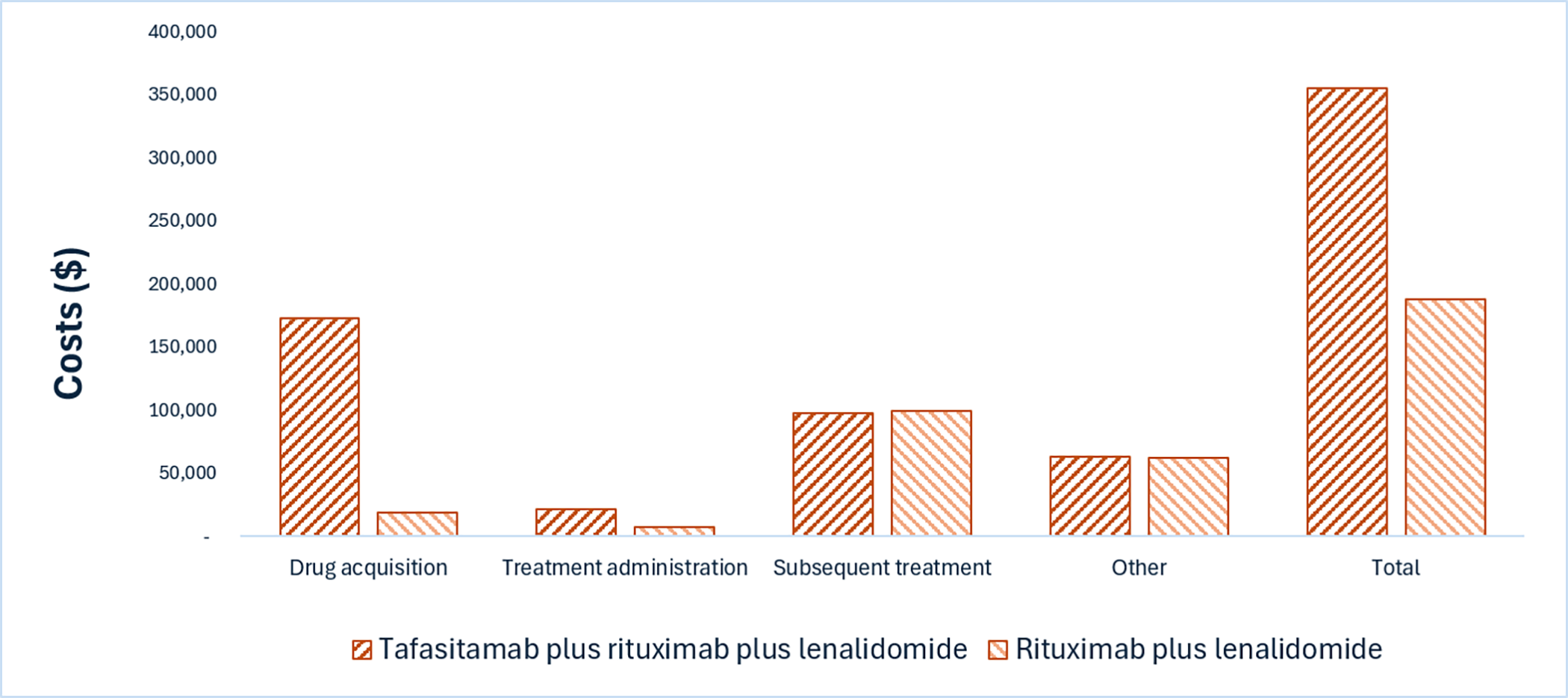
vs. = versus.
Note: Other includes costs associated with adverse events, resource use, and end of life.
Impact on Health
Relative to rituximab plus lenalidomide alone, tafasitamab plus rituximab plus lenalidomide is predicted to increase the amount of time a patient remains in the progression-free state by approximately 1.2 years and to extend OS by 1.2 years (refer to Figure 3). Considering the impact of treatment on both quality and length of life, tafasitamab plus rituximab plus lenalidomide is predicted to result in 1.01 additional QALYs per patient compared to rituximab plus lenalidomide alone. Approximately 99% of the predicted incremental benefit was accrued on the basis of extrapolation.
Figure 3: Impact of Tafasitamab Plus Rituximab Plus Lenalidomide vs. Rituximab Plus Lenalidomide Alone on Patient Health
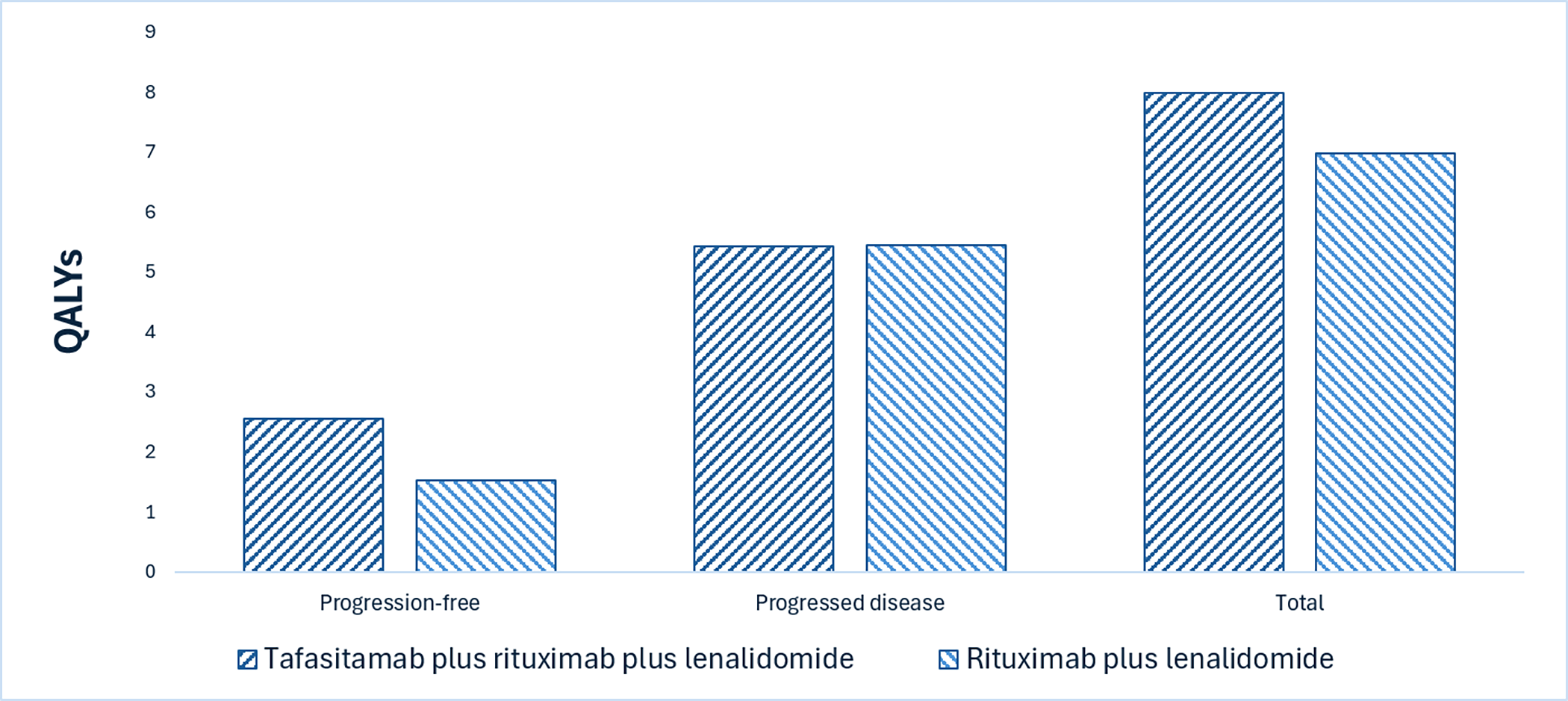
QALY = quality-adjusted life-year; vs. = versus.
Overall Results
The results of the CDA-AMC base case suggest an incremental cost-effectiveness ratio of $164,872 per QALY gained for tafasitamab plus rituximab plus lenalidomide compared to rituximab plus lenalidomide alone (refer to Table 8). Additional details on the CDA-AMC base case are available in the Supplemental Material document, Appendix 11.
Table 8: Summary of CDA-AMC Economic Evaluation Results
Drug | Total costs ($) | Total LYs | Total QALYs | ICER vs. rituximab plus lenalidomide ($/QALY) |
|---|---|---|---|---|
Rituximab plus lenalidomide | 187,940 | 8.30 | 6.97 | Reference |
Tafasitamab plus rituximab plus lenalidomide | 355,089 | 9.48 | 7.98 | 164,872 |
CDA-AMC = Canada’s Drug Agency; ICER = incremental cost-effectiveness ratio; LY = life-year; QALY = quality-adjusted life-year; vs. = versus
Note: Publicly available list prices were used for all comparators.
Uncertainty and Sensitivity
Due to immature data and the lack of long-term evidence, the extrapolation of OS and duration of effect of tafasitamab plus rituximab plus lenalidomide was uncertain. The impact of uncertainty on long-term OS for patients receiving tafasitamab plus rituximab plus lenalidomide was explored in a scenario analysis (refer to the Supplemental Material document, Appendix 11).
Summary of the Budget Impact
The sponsor submitted a budget impact analysis to estimate the 3-year (July 2027 to June 2030) budget impact of reimbursing tafasitamab plus rituximab plus lenalidomide for use in the reimbursement-requested population. The sponsor assumed that the payer would be CDA-AMC–participating public drug plans and derived the size of the eligible population using an epidemiologic approach. The price of tafasitamab was aligned with the price included in the sponsor’s economic evaluation, and the prices of comparators were based on the publicly available list prices. Additional information pertaining to the sponsor’s submission is provided in the Supplemental Material document, Appendix 12.
CDA-AMC identified a number of issues with the sponsor’s estimated budget impact and made changes to the model parameters and assumptions in consultation with the clinical experts to derive the CDA-AMC base case (refer to the Supplemental Material document, Appendix 12). CDA-AMC estimated that by year 3 of reimbursement, 699 patients would be eligible for tafasitamab plus rituximab plus lenalidomide; of these, 293 patients are expected to receive tafasitamab plus rituximab plus lenalidomide. The estimated incremental budget impact of reimbursing tafasitamab plus rituximab plus lenalidomide is predicted to be approximately $134.5 million over the first 3 years, with an expected expenditure of $132.1 million (tafasitamab plus rituximab plus lenalidomide = $163.8 million). The actual budget impact of reimbursing tafasitamab will depend on the market uptake of tafasitamab plus rituximab plus lenalidomide and the rate of displacement of existing comparators by tafasitamab plus rituximab plus lenalidomide.
Conclusion
Based on the CDA-AMC base case, tafasitamab plus rituximab plus lenalidomide would be considered cost-effective at the submitted price if the public health care system was willing to pay at least $164,872 for each additional QALY gained. If the public health care system is not willing to pay that amount, a price reduction should be considered (refer to Figure 4; full details of the impact of price reductions on cost-effectiveness are presented in the Supplemental Material document, Appendix 11). The estimated cost-effectiveness of tafasitamab plus rituximab plus lenalidomide in relation to rituximab plus lenalidomide alone is uncertain due to uncertainty in the duration of the treatment effect of tafasitamab plus rituximab plus lenalidomide and in the magnitude of OS benefit associated with tafasitamab plus rituximab plus lenalidomide.
Rituximab plus lenalidomide funding varies across provinces in Canada (i.e., it is not funded in Newfoundland and Labrador, Prince Edward Island, Nova Scotia, New Brunswick, or Ontario). In provinces where rituximab plus lenalidomide is not funded, rituximab-based or obinutuzumab-based regimens, such as R-CHOP, O-CHOP, R-CVP, O-CVP, bendamustine plus obinutuzumab, or bendamustine plus rituximab, were considered the most relevant comparators to tafasitamab plus rituximab plus lenalidomide based on clinical expert input. Due to the limitations and uncertainty of the submitted ITCs, no conclusion can be drawn regarding the comparative efficacy between tafasitamab plus rituximab plus lenalidomide versus bendamustine plus obinutuzumab or bendamustine plus rituximab. In addition, no comparative efficacy evidence was submitted for relevant comparators such as O-CHOP, R-CHOP, O‑CVP, R-CVP, O-GDP, R-GDP, and ASCT. If it is anticipated that there are no differences in health outcomes between treatment with tafasitamab plus rituximab plus lenalidomide versus chemoimmunotherapies, then the cost of tafasitamab plus rituximab plus lenalidomide should not exceed that of those comparators.
The budget impact to the public drug plans of reimbursing tafasitamab plus rituximab plus lenalidomide in the first 3 years is estimated to be approximately $134.5 million. The 3-year expenditure on tafasitamab (i.e., not accounting for current expenditure on comparators) is estimated to be $132.1 million (tafasitamab plus rituximab plus lenalidomide = $163.8 million). The estimated budget impact is highly uncertain due to uncertainty in the uptake of tafasitamab plus rituximab plus lenalidomide and the rate of displacement of existing comparators by tafasitamab plus rituximab plus lenalidomide.
Figure 4: Summary of the CDA-AMC Economic Analysis and Price Reduction

CDA-AMC = Canada’s Drug Agency; ICER = incremental cost-effectiveness ratio; QALY = quality-adjusted life-year; vs. = versus.
Note: Expenditure includes only the drug cost of tafasitamab. The price reductions in this table are applied only to tafasitamab.
References
1.Canada's Drug Agency-L'Agence des médicaments du Canada. pCODR Expert Review Committee (pERC) Final Recommendation: Obinutuzumab (Gazyva). August 13, 2019. Accessed January 6, 2026. https://www.cda-amc.ca/sites/default/files/pcodr/pcodr_obinutuzumab_gazyva_fl_fn_rec.pdf
2.Canada's Drug Agency-L'Agence des médicaments du Canada. CADTH Reimbursement Recommendation: Tisagenlecleucel (Kymriah). September 2023. Accessed January 6, 2026. https://www.cda-amc.ca/sites/default/files/DRR/2023/PG0306%20Kymriah%20-%20Final%20CADTH%20Recommendation.pdf
3.Canada's Drug Agency-L'Agence des médicaments du Canada. CADTH Reimbursement Recommendation: Axicabtagene ciloleucel (Yescarta). November 2023. Accessed January 6, 2026. https://www.cda-amc.ca/sites/default/files/DRR/2023/PG0314%20Yescarta%20-%20Final%20CADTH%20Recommendation.pdf
4.Incyte Biosciences Canada. Tafasitamab in combination with rituximab and lenalidomide for the treatment of adult patients with relapsed or refractory follicular lymphoma [internal sponsor's report]. In: Drug Reimbursement Review sponsor submission: Minjuvi (tafasitamab for injection): lyophilized powder for solution for infusion (200 mg single-use vial. November 21, 2025.
5.Incyte Corporation. Minjuvi (tafasitamab for injection): lyophilized powder for solution for infusion 200 mg single-use vial [product monograph] [sponsor submitted reference]. April 17, 2026.
6.Canada's Drug Agency-L'Agence des médicaments du Canada. PC0266-000 Tafasitamab (Minjuvi). February 10, 2023. Accessed December 9, 2025. https://www.cda-amc.ca/tafasitamab
7.Dada R. Diagnosis and management of follicular lymphoma: A comprehensive review. Eur J Haematol. 2019;103(3):152-163. doi:10.1111/ejh.13271 PubMed
8.Jacobsen E. Follicular lymphoma: 2023 update on diagnosis and management. Am J Hematol. 2022;97(12):1638-1651. doi:10.1002/ajh.26737 PubMed
9.Freedman AS. Lister A, ed. Clinical manifestations, pathologic features, diagnosis, and prognosis of follicular lymphoma. UpToDate; November 18, 2025. Accessed November 27, 2025. http://www.uptodate.com
10.Kaseb H, Ali MA, Gasalberti DP, Koshy NV. Follicular Lymphoma. StatPearls. 2025.
11.National Cancer Institute. Non-Hodgkin lymphoma treatment (PDQ®)–Health Professional Version [sponsor submitted reference]. Accessed July 17, 2025. https://www.cancer.gov/types/lymphoma/hp/adult-nhl-treatment-pdq
12.National Comprehensive Cancer Network. NCCN Clinical Practice Guidelines in Oncology (NCCN Guidelines): B-cell Lymphomas. Version 3.2025 [sponsor submitted reference]. https://www.nccn.org/guidelines/guidelines-detail?category=1&id=1480
13.Dreyling M, Ghielmini M, Rule S, et al. Newly diagnosed and relapsed follicular lymphoma: ESMO Clinical Practice Guidelines for diagnosis, treatment and follow-up. Ann Oncol. 2016;27(suppl 5):v83-v90. doi:10.1093/annonc/mdw400 PubMed
14.Lymphoma Canada. Understanding Follicular Lymphoma [sponsor submitted reference]. Accessed July 17, 2025. https://www.lymphoma.ca/wp-content/uploads/2021/08/LymphomaCanada_FactSheet_FL_Digital.pdf
15.Rajamaki A, Hujo M, Sund R, et al. Mortality among patients with low-grade follicular lymphoma: A binational retrospective analysis. Cancer. 2022;128(13):2474-2482. doi:10.1002/cncr.34221 PubMed
16.Ghione P, Palomba ML, Ghesquieres H, et al. Treatment patterns and outcomes in relapsed/refractory follicular lymphoma: results from the international SCHOLAR-5 study. Haematologica. 2023;108(3):822-832. doi:10.3324/haematol.2022.281421 PubMed
17.Casulo C, Byrtek M, Dawson KL, et al. Early Relapse of Follicular Lymphoma After Rituximab Plus Cyclophosphamide, Doxorubicin, Vincristine, and Prednisone Defines Patients at High Risk for Death: An Analysis From the National LymphoCare Study. J Clin Oncol. 2015;33(23):2516-22. doi:10.1200/JCO.2014.59.7534 PubMed
18.Wasterlid T, Dietrich CE, Oksanen A, et al. Treatment sequencing and impact of number of treatment lines on survival in follicular lymphoma: A national population-based study. EJHaem. 2024;5(3):516-526. doi:10.1002/jha2.904 PubMed
19.Johnson PC, Bailey A, Ma Q, et al. Quality of Life Evaluation in Patients with Follicular Cell Lymphoma: A Real-World Study in Europe and the United States. Adv Ther. 2024;41(8):3342-3361. doi:10.1007/s12325-024-02882-1 PubMed
20.Pettengell R, Donatti C, Hoskin P, et al. The impact of follicular lymphoma on health-related quality of life. Ann Oncol. 2008;19(3):570-6. doi:10.1093/annonc/mdm543 PubMed
21.Singh D, Singh A, Mukkamalla SKR. Relapsed and Refractory Follicular Lymphoma. StatPearls. StatPearls Publishing Copyright © 2025, StatPearls Publishing LLC.; 2025.
22.Barraclough A, Agrawal S, Talaulikar D, et al. Impact and utility of follicular lymphoma GELF criteria in routine care: an Australasian Lymphoma Alliance study. Haematologica. 2024;109(10):3338-3345. doi:10.3324/haematol.2023.284538 PubMed
23.Alberta Health Services. Lymphoma, Clinical Practice Guideline LYHE-002 V20. August 2025. Accessed January 6, 2026. https://www.albertahealthservices.ca/assets/info/hp/cancer/if-hp-cancer-guide-lyhe002-lymphoma.pdf
24.ESMO Guidelines Committee, Eyre TA, Cwynarski K, et al. Lymphomas: ESMO Clinical Practice Guideline for diagnosis, treatment and follow-up. Ann Oncol. 2025;36(11):1263-1284. doi:10.1016/j.annonc.2025.07.014 PubMed
25.UHN Princess Margaret Cancer Center. Indolent Lymphomas. September 2023. Accessed January 6, 2026. https://www.uhn.ca/PrincessMargaret/Health_Professionals/Programs_Departments/Documents/CPG_Lymphoma_IndolentLymphomas.pdf
26.Sehn LH, Hübel K, Luminari S, et al. Tafasitamab, lenalidomide, and rituximab in relapsed or refractory follicular lymphoma (inMIND): a global, phase 3, randomised controlled trial. Lancet. 2026;407(10524):133-146. doi:10.1016/s0140-6736(25)01778-7 PubMed
27.Incyte Corporation. Clinical Study Report: INCMOR 0208-301. A Phase 3, Randomized, Double-Blind, Placebo-Controlled, Multicenter Study to Evaluate the Efficacy and Safety of Tafasitamab Plus Lenalidomide in Addition to Rituximab Versus Lenalidomide in Addition to Rituximab in Patients With Relapsed/Refractory (R/R) Follicular Lymphoma Grade 1 to 3a or R/R Marginal Zone Lymphoma [internal sponsor's report]. December 3, 2024.
28.Incyte Corporation. Clinical Study Protocol: INCMOR 0208-301. A Phase 3, Randomized, Double-Blind, Placebo-Controlled, Multicenter Study to Evaluate the Efficacy and Safety of Tafasitamab Plus Lenalidomide in Addition to Rituximab Versus Lenalidomide in Addition to Rituximab in Patients With Relapsed/Refractory (R/R) Follicular Lymphoma Grade 1 to 3a or R/R Marginal Zone Lymphoma [internal sponsor's report]. April 18, 2023.
29.Cheson BD, Fisher RI, Barrington SF, et al. Recommendations for initial evaluation, staging, and response assessment of Hodgkin and non-Hodgkin lymphoma: the Lugano classification. J Clin Oncol. 2014;32(27):3059-68. doi:10.1200/JCO.2013.54.8800 PubMed
30.Incyte Corporation. Statistical Analysis Plan: INCMOR 0208-301. A Phase 3, Randomized, Double-Blind, Placebo-Controlled, Multicenter Study to Evaluate the Efficacy and Safety of Tafasitamab Plus Lenalidomide in Addition to Rituximab Versus Lenalidomide in Addition to Rituximab in Patients With Relapsed/Refractory (R/R) Follicular Lymphoma Grade 1 to 3a or R/R Marginal Zone Lymphoma [internal sponsor's report]. June 25, 2024.
31.Bassler D, Briel M, Montori VM, et al. Stopping randomized trials early for benefit and estimation of treatment effects: systematic review and meta-regression analysis. JAMA. 2010;303(12):1180-7. doi:10.1001/jama.2010.310 PubMed
32.Hlubocky FJ, Webster K, Cashy J, Beaumont J, Cella D. The Development and Validation of a Measure of Health-Related Quality of Life for Non-Hodgkin’s Lymphoma: The Functional Assessment of Cancer Therapy—Lymphoma (FACT-Lym). Lymphoma. 2013;2013(1):147176.
33.Cella D, Webster K, Cashy J, et al. Development of a Measure of Health-Related Quality of Life for Non-Hodgkin’s Lymphoma Clinical Research: The Functional Assessment of Cancer Therapy - Lymphoma (FACT-Lym). Blood. 2005;106(11):750-750. doi:10.1182/blood.V106.11.750.750
34.Georgakopoulos A, Kontodimopoulos N, Chatziioannou S, Niakas D. EORTC QLQ-C30 and FACT-Lym for the assessment of health-related quality of life of newly diagnosed lymphoma patients undergoing chemotherapy. Eur J Oncol Nurs. 2013;17(6):849-55. doi:10.1016/j.ejon.2013.05.006 PubMed
35.Carter GC, Liepa AM, Zimmermann AH, Morschhauser F. Validation of the Functional Assessment of Cancer Therapy-Lymphoma (FACT-LYM) in Patients with Relapsed/Refractory Mantle Cell Lymphoma. Blood. 2008;112(11):2376.
36.Incyte Biosciences Canada Corporation. Incyte Biosciences Canada response to Canada's Drug Agency request for additional information regarding Minjuvi review on February 5, 2026 [internal additional sponsor's information]. February 11, 2026.
37.Incyte Biosciences Canada Corporation. Incyte Biosciences Canada response to Canada's Drug Agency request for additional information regarding Minjuvi review on December 22, 2025 [internal additional sponsor's information]. January 8, 2026.
38.Canada's Drug Agency-L'Agence des médicaments du Canada. NS0037-000 Brukinsa (Zanubrutinib). July 24, 2024. Accessed March 9, 2026. https://www.cda-amc.ca/zanubrutinib-2
39.Canadian Clinical Expert Feedback [sponsor submiteed reference], (2025).
40.Lumanity. PRJ005360: ITCs for Tafasitamab Plus Rituximab and Lenalidomide in R/R Follicular Lymphoma – Technical Report Update [internal sponsor's report]. In: Drug Reimbursement Review sponsor submission: Minjuvi (tafasitamab for injection): lyophilized powder for solution for infusion (200 mg single-use vial September 5, 2025.
41.R Core Team. R: A language and environment for statistical computing [sponsor submitted reference]. Accessed February 17, 2025. https://www.R-project.org/
42.Matsumoto K, Takayama N, Aisa Y, et al. A phase II study of bendamustine plus rituximab in Japanese patients with relapsed or refractory indolent B-cell non-Hodgkin lymphoma and mantle cell lymphoma previously treated with rituximab: BRB study. Int J Hematol. 2015;101(6):554-62. doi:10.1007/s12185-015-1767-3 PubMed
43.Sehn LH, Chua N, Mayer J, et al. Obinutuzumab plus bendamustine versus bendamustine monotherapy in patients with rituximab-refractory indolent non-Hodgkin lymphoma (GADOLIN): a randomised, controlled, open-label, multicentre, phase 3 trial. Lancet Oncol. 2016;17(8):1081-1093. doi:10.1016/S1470-2045(16)30097-3 PubMed
44.Fowler NH, Dickinson M, Dreyling M, et al. Tisagenlecleucel in adult relapsed or refractory follicular lymphoma: the phase 2 ELARA trial. Nat Med. 2022;28(2):325-332. doi:10.1038/s41591-021-01622-0 PubMed
45.Jacobson CA, Chavez JC, Sehgal AR, et al. Axicabtagene ciloleucel in relapsed or refractory indolent non-Hodgkin lymphoma (ZUMA-5): a single-arm, multicentre, phase 2 trial. Lancet Oncol. 2022;23(1):91-103. doi:10.1016/S1470-2045(21)00591-X PubMed
46.Neelapu SS, Chavez JC, Sehgal AR, et al. Five-Year Follow-Up Analysis of ZUMA-5: Axicabtagene Ciloleucel in Relapsed/Refractory Indolent Non-Hodgkin Lymphoma. J Clin Oncol. 2025;43(33):3573-3577. doi:10.1200/jco-25-00668 PubMed
47.Schuster SJ, Thieblemont C, Dickinson MJ, et al. Five-Year Update of the Phase 2 ELARA Trial of Tisagenlecleucel in Patients (pts) with relapsed/refractory Follicular Lymphoma (r/r FL). Transplant Cell Ther. 2026;32(2):S49-S50. doi:10.1016/j.jtct.2025.12.077
ISSN: 2563-6596
Canada’s Drug Agency (CDA-AMC) is a pan-Canadian health organization. Created and funded by Canada’s federal, provincial, and territorial governments, we’re responsible for driving better coordination, alignment, and public value within Canada’s drug and health technology landscape. We provide Canada’s health system leaders with independent evidence and advice so they can make informed drug, health technology, and health system decisions, and we collaborate with national and international partners to enhance our collective impact.
Disclaimer: CDA-AMC has taken care to ensure that the information in this document was accurate, complete, and up to date when it was published, but does not make any guarantee to that effect. Your use of this information is subject to this disclaimer and the Terms of Use at cda-amc.ca.
The information in this document is made available for informational and educational purposes only and should not be used as a substitute for professional medical advice, the application of clinical judgment in respect of the care of a particular patient, or other professional judgments in any decision-making process. You assume full responsibility for the use of the information and rely on it at your own risk.
CDA-AMC does not endorse any information, drugs, therapies, treatments, products, processes, or services. The views and opinions of third parties published in this document do not necessarily reflect those of CDA-AMC. The copyright and other intellectual property rights in this document are owned by the Canadian Agency for Drugs and Technologies in Health (operating as CDA-AMC) and its licensors.
Questions or requests for information about this report can be directed to Requests@CDA-AMC.ca.