Drugs, Health Technologies, Health Systems
Reimbursement Review
Inavolisib (Itovebi)
Sponsor: Hoffmann-La Roche Limited
Therapeutic area: Advanced or metastatic breast cancer
This multi-part report includes:
Clinical Review
TPA Review
Pharmacoeconomic Review
Clinical Review
Abbreviations
ABE
abemaciclib
AE
adverse event
BCC
Breast Cancer Canada
BICR
blinded independent central review
CBCN
Canadian Breast Cancer Network
CDA-AMC
Canada’s Drug Agency
CI
confidence interval
CR
complete response
CrI
credible interval
ctDNA
circulating tumour DNA
ECOG PS
Eastern Cooperative Oncology Group Performance Status
EORTC QLQ-C30
European Organisation for Research and Treatment of Cancer Qualify of Life Questionnaire Core 30
FUL
fulvestrant
GHS
global health status
GRADE
Grading of Recommendations Assessment, Development and Evaluation
HR
hazard ratio
HRQoL
health-related quality of life
INA
inavolisib
IQR
interquartile range
ITC
indirect treatment comparison
KM
Kaplan-Meier
LHRH
luteinizing hormone–releasing hormone
NGS
next-generation sequencing
NMA
network meta-analysis
OH (CCO)
Ontario Health (Cancer Care Ontario)
OS
overall survival
PAL
palbociclib
PBO
placebo
PCR
polymerase chain reaction
PFS
progression-free survival
PFS2
second objective disease progression
PR
partial response
QoL
quality of life
RCT
randomized controlled trial
REAL
Research Excellence Active Leadership
RECIST 1.1
Response Evaluation Criteria in Solid Tumours Version 1.1
RIB
ribociclib
SAE
serious adverse event
SD
standard deviation
Executive Summary
An overview of the submission details for the drug under review is provided in Table 1.
Table 1: Background Information of Application Submitted for Review
Item | Description |
|---|---|
Drug product | Inavolisib (Itovebi), 3 mg and 9 mg, film-coated oral tablet |
Sponsor | Hoffmann-La Roche Limited |
Indication | Inavolisib in combination with palbociclib and fulvestrant is indicated for the treatment of adult patients with endocrine-resistant, PIK3CA‑mutated, hormone receptor (HR)–positive, human epidermal growth factor receptor 2 (HER2)‑negative, locally advanced or metastatic breast cancer, following recurrence on or after completing adjuvant endocrine treatment. |
Reimbursement request | Inavolisib, in combination with a CDK4/6 inhibitor and fulvestrant, for the treatment of adult patients with endocrine-resistant, PIK3CA-mutated, hormone receptor–positive, HER2-negative, locally advanced or metastatic breast cancer, following recurrence on or after completing adjuvant endocrine treatment. |
Health Canada approval status | NOC |
Health Canada review pathway | Priority review, Orbis |
NOC date | February 14, 2025 |
Recommended dosage | Dosage recommendation:
Dosing considerations: Patients with hormone receptor–positive, HER2-negative, locally advanced or metastatic breast cancer should be selected for treatment with inavolisib based on the presence of 1 or more PIK3CA mutations using a validated test. PIK3CA mutation status should be established before initiation of therapy with inavolisib. Duration of treatment: It is recommended that patients be treated with inavolisib until disease progression or unacceptable toxicity. |
LHRH = luteinizing hormone–releasing hormone; NOC = Notice of Compliance.
Sources: Product monograph for inavolisib (Itovebi).1 Details included in the table are from the sponsor’s Summary of Clinical Evidence.2
Introduction
Breast cancer is the most commonly diagnosed cancer among females in Canada and remains a leading cause of cancer-related death worldwide.3 In 2024, it is estimated that more than 30,000 women in Canada were diagnosed with breast cancer, and 5,000 were expected to die from the disease.4 Common symptoms include bloody or watery discharge from the breast, and redness, scaling, or inflammation of the nipple.5 As the cancer progresses or metastasizes, patients may experience systemic symptoms, including nausea, weight loss, muscle weakness, and bone pain.6 Hormone receptor–positive, HER2-negative breast cancer is the most prevalent subtype, accounting for 70% of all cases.7 The estimated 5-year survival rate in patients with hormone receptor–positive, HER2-negative metastatic breast cancer is 34%.7,8 An estimated 40% of these patients have mutations in the PIK3CA gene, which are associated with reduced response to endocrine therapy and worse overall prognosis.9-12
International guidelines are used in practice, as there is no Canadian guideline specifying standard of care for patients with PIK3CA-mutated, hormone receptor–positive, HER2-negative breast cancer.13-15 The preferred first-line treatment option for this population, regardless of PIK3CA-mutation status, includes a CDK4/6 inhibitor combined with endocrine therapy (and a luteinizing hormone–releasing hormone [LHRH] agonist, depending on menopausal status). Examples of CDK4/6 inhibitors include palbociclib (PAL) and ribociclib (RIB); abemaciclib (ABE) does not have public funding.13,16,17 The December 2024 Provisional Funding Algorithm for hormone receptor–positive, HER2-negative breast cancer, including HER2-low breast cancer, is available on the project website. The clinical experts consulted for this review indicated that capivasertib plus fulvestrant (FUL) could be considered in patients with previous adjuvant treatment with CDK4/6 inhibitors, depending on public funding. Further, this combination could be considered in patients with an AKT, PTEN, or PIK3CA mutation.
There is a clinical unmet need for evidence-based, first-line treatment in patients with endocrine-resistant, PIK3CA-mutated, hormone receptor–positive, HER2-negative locally advanced or metastatic breast cancer. There is also a nonclinical unmet need for standard PIK3CA mutation testing across Canada. This companion diagnostic is required to assess suitability for the treatment under review. Lack of testing poses a barrier to access and can delay treatment.
The objective of this report is to review and critically appraise the evidence submitted by the sponsor on the beneficial and harmful effects of inavolisib (INA) 3 mg and 9 mg film-coated oral tablets (in combination with PAL plus FUL) in the treatment of adults with endocrine-resistant, PIK3CA-mutated, hormone receptor–positive, HER2-negative, locally advanced or metastatic breast cancer, following recurrence on or after completing adjuvant endocrine treatment.
Perspectives of Patients, Clinicians, and Drug Programs
The information in this section is a summary of input provided by the patient and clinician groups who responded to a call for input and from clinical experts consulted by for the purpose of this review.
Patient Input
Input for this review was submitted by 3 patient groups: Breast Cancer Canada (BCC), Canadian Breast Cancer Network (CBCN), and Rethink Breast Cancer. BCC is a national organization that educates and advocates for precision oncology in breast cancer research. CBCN is a patient-directed national health charity aiming to improve care for individuals with breast cancer in Canada through education, advocacy, and informational resources. Rethink Breast Cancer is a national charity that educates, empowers, and advocates for system changes to improve the experience and outcomes for individuals with breast cancer. To gather information, BCC conducted 2 surveys: 1 from July 6 to 21, 2023 (171 responses), targeting patients with hormone receptor–positive, HER2-negative metastatic breast cancer and their caregivers; and the second from February 15 to 23, 2025 (169 responses, 54 receiving first-line treatment for hormone receptor–positive, HER2-negative metastatic disease). CBCN gathered information from medical literature, past patient input submissions (e.g., for alpelisib), and the 2022 Triple Negative Breast Cancer Patient Survey (981 responses, 30 receiving first-line treatment for metastatic hormone receptor–positive, HER2-negative breast cancer). Rethink Breast Cancer gathered information from patient meetings, a survey (2018 to 2019) of 78 patients with metastatic breast cancer, and a February 2025 interview with 1 patient with metastatic breast cancer who had experience using INA.
Patients with hormone receptor–positive, HER2-negative metastatic breast cancer experience a wide range of debilitating symptoms that vary based on site of metastasis. Symptoms include fatigue, shortness of breath, nausea, pain, bone fractures, and reduced mobility, all of which greatly impact daily functioning. These physical challenges often restrict patients’ ability to work, care for children, maintain relationships, and participate in their communities. Patients also report a profound emotional toll when faced with processing a life-limiting diagnosis, with fear of recurrence, financial insecurity, body image concerns, anxiety about the impact of their illness on their children, concern about burdening caregivers, and isolation being common among patients. Rethink Breast Cancer noted that patients aged 20 to 40 years can face more aggressive breast cancer and experience additional challenges related to fertility, pregnancy, parenting, and career interruptions.
Treatment goals primarily involve delaying disease progression and improving quality of life (QoL). The patient groups noted that treatment options and effectiveness vary based on the type and location of cancer and on the degree of symptoms. For patients with hormone receptor–positive, HER2-negative metastatic breast cancer, current treatments, primarily endocrine therapy and CDK4/6 inhibitors, aim to maintain QoL as long as possible before the patient switches to chemotherapy. The patient groups noted that chemotherapies are given sequentially, and progression-free survival (PFS) typically diminishes with later lines of therapy. The patient groups highlighted that there are currently no reimbursed treatments for patients with hormone receptor–positive, HER2-negative metastatic breast cancer and a PIK3CA mutation who have experienced a recurrence within 12 months of being treated for early-stage breast cancer.
Patients with metastatic breast cancer primarily seek to extend their life and delay progression without sacrificing QoL. Generally, patients value long-term health outcomes over immediate concerns such as reducing symptoms or managing adverse events (AEs). Even a few additional months is considered a meaningful improvement, with 1 patient noting, “Those months could be the difference that lets me see my son start kindergarten. They could be the ones that give me time to get him off diapers before it all falls on dad. Or they could be the first time he says, ‘I love you.’ While a few months are short on time, they are bursting with possibility.”
One patient, diagnosed with hormone receptor–positive, HER2-negative metastatic breast cancer in 2004 and having received 7 lines of treatment, had direct experience with INA for 18 months through a 2018 phase I clinical trial. The patient reported good energy levels while on treatment, which enabled the patient to continue working, and the patient felt that the treatment addressed an unmet need. While the patient experienced hyperglycemia while on therapy, it was managed through metformin and a ketogenic diet.
Patient groups support PIK3CA genomic testing as standard of care in Canada for all patients with hormone receptor–positive, HER2-negative breast cancer who may benefit from INA, provided that access is timely, equitable, and publicly funded.
Clinician Input
Input From Clinical Experts Consulted for This Review
When considering clinical unmet needs, the clinical experts highlighted the lack of evidence for first-line treatment in the subset of patients with PIK3CA-mutated disease, which, alongside endocrine resistance, is associated with poor outcomes related to breast cancer and limited duration of response. When considering nonclinical unmet needs, the clinical experts suggested that the once-daily dosing of INA is more convenient for some patients compared with a twice-daily dosing schedule for other drugs. It is also more convenient than endocrine therapy, which necessitates frequent monitoring and intramuscular injections. Testing for PIK3CA mutation is not yet standard across Canada. This companion diagnostic is required to assess suitability for the treatment. The clinical experts identified lack of testing as a barrier to access and a cause of treatment delay. The clinical experts also indicated that diagnosing in a timely manner poses a challenge, as symptoms of recurrent disease are often unrecognized, leading to delays in treatment. However, the clinical experts indicated that the disease is usually slow-growing and, therefore, underdiagnosis is not expected to be a major issue.
If INA + PAL + FUL (triplet therapy) were approved for public reimbursement, the clinical experts anticipated this would change the current treatment paradigm, and the combination would be considered in the first-line treatment setting for adults with endocrine-resistant, PIK3CA-mutated, hormone receptor–positive, HER2-negative locally advanced or metastatic breast cancer. As response rate, duration of response, and duration of PFS become shorter with each subsequent line of therapy, the clinical experts indicated there would be an ethical concern if this therapy was used in later lines, where it would likely be less effective. Hence, the clinical experts indicated that the therapy under review would be offered before other treatments. Notably, the clinical experts indicated that, if patients are treated with this combination, then subsequent therapy would not include a PIK3CA inhibitor. The clinical experts advised that there is currently no evidence for subsequently targeting similar pathways.
The clinical experts advised that the patient population that would be best suited for treatment with INA + PAL + FUL aligns with the INAVO120 study population — adults with endocrine-resistant, PIK3CA-mutated, hormone receptor–positive, HER2-negative locally advanced or metastatic breast cancer who had not received any prior systemic therapy for metastatic breast cancer. The clinical experts additionally highlighted that patients best suited for INA + PAL + FUL include those who have not had previous adjuvant treatment with CDK4/6 inhibitors and who have a good Eastern Cooperative Oncology Group Performance Status (ECOG PS) and good renal and hepatic function.
The clinical experts noted that ABE is the only CDK4/6 inhibitor currently available for adjuvant treatment in the high-risk patient population. Thus, the clinical experts anticipated that, as CDK4/6 inhibitors become increasingly available in the adjuvant setting, there will be fewer patients who have not had previous adjuvant treatment with CDK4/6 inhibitors and who experience disease relapse. Of note, the clinical experts felt that prior exposure to CDK4/6 inhibitors should be clearly defined in possible reimbursement criteria because some patients do not tolerate adjuvant treatment. For example, if a patient receiving a CDK4/6 inhibitor experienced clinically significant AEs resulting in withdrawal of treatment and did not therefore have significant exposure to the CDK4/6 inhibitor, the clinical experts felt that such patients should have access to the treatment under review if they experience disease relapse.
The clinical experts indicated that a clinically meaningful response to treatment is improvement in cancer-related symptoms (e.g., improvement in pain control, breathing, nausea, or fatigue) and improvement in performance status. In terms of imaging (e.g., CT, PET, ultrasonography), the clinical experts referred to the Response Evaluation Criteria in Solid Tumours Version 1.1 (RECIST 1.1) criteria to determine a complete response (CR), partial response (PR), stable disease, or progressive disease. The clinical experts noted that clinical benefit for more than 6 months, which includes a CR or PR and stable disease, often appears in breast cancer discussion. The clinical experts advised that bone scans are carried out 4 to 6 months after starting treatment due to bone remodelling. For an individual patient, the clinical experts suggested that an improvement in symptoms and continuation of a treatment for a meaningful length of time are considered positive outcomes. The clinical experts also suggested that being able to avoid chemotherapy for a longer period is of importance to patients. As a result, the clinical experts further suggested that minimizing symptoms from cancer and from the treatment is meaningful to patients.
The clinical experts noted that the frequency of assessment can vary, depending on disease and patient factors. In general, the clinical experts indicated that tumour assessments are conducted every 3 months initially and may be more frequent for symptomatic or rapidly growing disease or less frequent if the disease is responding to treatment or is stable. Notably, the clinical experts advised that the treatment under review requires close monitoring of fasting glucose levels to avoid severe hyperglycemia and other toxicities.
The clinical experts advised that the treatment under review should be continued until progression, as per the INAVO120 trial, in patients who are experiencing a response to treatment and tolerating the treatment. In addition to consideration for patient preference, the clinical experts advised to discontinue treatment if the therapy is not effective after 2 to 3 cycles, if there is toxicity despite supportive medications and dose adjustment, and/or if there is a negative impact on QoL.
The clinical experts advised that a medical oncologist should assess the patient, initiate the treatment under review, and provide follow-up. Medical oncologists may delegate treatment delivery and/or follow-up to trained general practice oncologists, nurse practitioners, or internal medicine specialists. The clinical experts noted that the prescribing oncologist should be available to help with toxicity management, dose changes, and treatment changes. The clinical experts advised that cancer clinics with medical oncology experts either at the site or overseeing the site are appropriate settings for treatment with INA + PAL + FUL.
Clinician Group Input
Input for this review was submitted by 2 clinician groups, the Ontario Health (Cancer Care Ontario) (OH [CCO]) Breast Cancer Drug Advisory Committee and the Research Excellence Active Leadership (REAL) Canadian Breast Cancer Alliance. The OH (CCO) Drug Advisory Committees provide timely evidence-based clinical and health system guidance on drug-related issues. REAL Canadian Breast Cancer Alliance is a committee of multidisciplinary, clinical, and academic oncologists across Canada as well as BCC, a patient organization. REAL Canadian Breast Cancer Alliance publishes national clinical consensus recommendations. Information was gathered for the input through clinical expertise, review of published literature, global conferences, and virtual discussions.
The clinician groups highlighted the prevalence of hormone receptor–positive, HER2-negative metastatic breast cancer in Canada, noting that approximately 70% of breast cancer cases are in this population. Up to 40% of this population also have PIK3CA mutation. The groups noted that PIK3CA mutations are associated with endocrine resistance and poorer prognosis. Therefore, PIK3CA is becoming recognized as an important target with unique prognostic and therapeutic implications. While targeted treatments for the PI3K pathway (e.g., alpelisib and capivasertib) do exist, data support their use, in combination with endocrine therapy, in the second-line setting only. The REAL Canadian Breast Cancer Alliance indicated that the availability of PI3K inhibitors in combination with CDK4/6 inhibitors and endocrine therapy in the first-line setting would improve PFS in this patient population. It also noted that, because overall survival (OS) benefit is challenging to demonstrate in the metastatic hormone receptor–positive population, PFS is considered globally recognized as a global end point for regulatory and funding decisions.
The clinician groups agreed that INA would be used in first line for all patients with hormone receptor–positive, HER2-negative metastatic or locally advanced breast cancer and a PIK3CA mutation following recurrence. The groups anticipate that the requested INA combination would displace second-line capivasertib in patients who did not receive an adjuvant CDK4/6 inhibitor and FUL with CDK4/6 inhibitors. OH (CCO) noted that the requested combination could also be an alternative to first-line capivasertib in those who had previously received an adjuvant CDK4/6 inhibitor. According to clinician groups, patients best suited to INA are those with hormone receptor–positive, HER2-negative metastatic or locally advanced breast cancer and a PIK3CA mutation who experience an early recurrence while on endocrine therapy. Patients less suited to INA are those without PIK3CA pathway abnormalities, those with contraindications to INA (e.g., severe, poorly controlled diabetes) or any of the drugs in the combination, those with type 1 diabetes, or those who are unable to undergo appropriate monitoring. The groups noted that toxicity and clinical response should be reassessed using clinical assessments, blood tests, and restaging scans at standard frequencies. REAL Canadian Breast Cancer Alliance noted that patients with pre-existing type 2 diabetes or those at risk of glucose intolerance should have their blood sugar levels closely monitored during treatment. Discontinuation should be considered in the event of disease progression, refractory toxicity despite dose modifications, any grade 4 toxicity, or intolerance. The groups agreed that the treatment combination could be prescribed and monitored in the outpatient setting by any oncologist with experience treating breast cancer.
OH (CCO) noted that it does not support the sponsor’s request to remove the phrase “within 12 months of completing adjuvant endocrine treatment” from eligibility criteria. In fact, the most relevant patient population would be those whose disease relapses early while on endocrine monotherapy. The group indicated that patients whose disease relapsed early while receiving CDK4/6 inhibitors should not receive the requested combination therapy, as these patients made up less than 2% of the trial population. OH (CCO) also noted concerns regarding substantial toxicity associated with this regimen, noting that there were deaths due to toxicity, which is unusual for an endocrine-based treatment. While the INAVO120 trial involved INA in combination with PAL, OH (CCO) noted that RIB is the most common CDK4/6 inhibitor used in practice. REAL Canadian Breast Cancer Alliance noted that, while the INAVO120 study included a small sample size of male patients, both male and female patients should be eligible for triplet therapy in clinical practice.
Drug Program Input
Input was obtained from the drug programs that participate in the Canada’s Drug Agency (CDA-AMC) reimbursement review process. The following were identified as key factors that could impact the implementation of a CDA-AMC recommendation for INA + PAL + FUL:
relevant comparators
considerations for initiation of therapy
considerations for prescribing therapy
generalizability
funding algorithm
care provision issues.
The clinical experts consulted by CDA-AMC provided advice on the potential implementation issues raised by the drug programs in Table 4.
Clinical Evidence
Systematic Review
Description of the Study
The INAVO120 study (N = 325) is an ongoing phase III, randomized, double-blind, placebo-controlled, multicentre, global study evaluating the efficacy and safety of INA + PAL + FUL compared with placebo (PBO) + PAL + FUL. The study included adults with endocrine-resistant, PIK3CA-mutated, hormone receptor–positive, HER2-negative locally advanced or metastatic breast cancer who had not received any prior systemic therapy for metastatic breast cancer. Notably, the trial population excluded patients with type 2 diabetes requiring ongoing systemic treatment at the time of study entry or any history of type 1 diabetes, as well as patients with known and untreated or active central nervous system metastases. The primary end point was investigator-assessed PFS, and a key secondary end point was OS.
The mean age of all patients randomized in the INAVO120 study was 54.0 years (standard deviation [SD] = 11.1 years; range, 27 years to 79 years). Most patients (63% of patients randomized) had an ECOG PS score of 0, and 36% of patients had an ECOG PS score of 1. Almost all patients (99%) had metastatic disease at study entry, while 1% of patients had locally advanced disease. Most patients (> 40%) had at least 1 lesion in the bone, lymph nodes, liver, or lung, while 20% of patients had at least 1 lesion in the pleura or peritoneum, or skin or soft tissue. Notably, less than 5% of patients had at least 1 lesion in the bone only or in the central nervous system. All patients had a PIK3CA mutation and HER2-negative disease, and most patients had secondary endocrine-resistant (64%) and estrogen receptor–positive or progesterone receptor–positive (70%) disease. Most patients (83%) had received prior adjuvant or neoadjuvant chemotherapy; 1% of patients had received prior adjuvant or neoadjuvant CDK4/6 inhibitors; and 99% of patients had received prior adjuvant or neoadjuvant endocrine therapy.
Efficacy Results
At the cut-off date for primary analysis data, the median duration of follow-up was 21.3 months for all patients (INA + PAL + FUL group = 21.3 months; interquartile range [IQR], 10.2 months to 27.2 months and PBO + PAL + FUL group = 21.5 months; IQR, 8.7 months to 26.7 months). Median duration of follow-up was defined as time from randomization to death (for patients who had died by the clinical cut-off date), or last known date alive (for patients who were alive at the clinical cut-off date). A summary of the key efficacy results at the primary analysis is presented in Table 30.
At the cut-off date for final OS analysis data, the median duration of follow-up was 34.2 months for all patients (INA + PAL + FUL group = 34.2 months; ████ ████ ██████ ██ ████ ██████ and PBO + PAL + FUL group = 32.3 months; ████ ████ ██████ ██ ████ ██████). A summary of the key efficacy results at the final OS analysis is presented in Table 19.
The following summary focuses on the results from the final OS analysis, with the exception of PFS, which includes a summary of the primary (final for PFS) analysis results.
Progression-Free Survival
PFS was defined as the time from randomization to the first occurrence of disease progression, as determined by the investigator according to RECIST 1.1, or death from any cause, whichever occurred first.
Primary analysis results: The primary analysis included the final analysis of the primary efficacy end point of investigator-assessed PFS. In this analysis, 50.9% of patients (82 of 161 patients) in the INA + PAL + FUL group and 68.9% of patients (113 of 164 patients) in the PBO + PAL + FUL group had an event (the first occurrence of disease progression or death). The median PFS was 15.0 months (95% confidence interval [CI], 11.3 months to 20.5 months) in the INA + PAL + FUL group and 7.3 months (95% CI, 5.6 months to 9.3 months) in the PBO + PAL + FUL group. INA + PAL + FUL was favoured over PBO + PAL + FUL (stratified hazard ratio [HR] = 0.43; 95% CI, 0.32 to 0.59; log-rank P < 0.0001). This result was consistent with the results from the unstratified analysis and other sensitivity and supplemental analyses (Table 31 and Table 32).
The treatment differences in PFS rates at 6 months, 12 months, and 18 months were 27.01% (95% CI, 16.87% to 37.15%), 23.28% (95% CI, 11.59% to 34.97%), and 25.14% (95% CI, 13.52% to 36.76%), respectively.
Updated results at the final OS analysis: The final OS analysis included descriptive results of the primary end point of investigator-assessed PFS. In this analysis, 64% of patients (103 patients) in the INA + PAL + FUL group and 86% of patients (141 patients) in the PBO + PAL + FUL group had an event (the first occurrence of disease progression or death). The median PFS was 17.2 months (95% CI, 11.6 months to 22.2 months) in the INA + PAL + FUL group and 7.3 months (95% CI, 5.9 months to 9.2 months) in the PBO + PAL + FUL group. The stratified HR was 0.42 (95% CI, 0.32 to 0.55) following treatment with INA + PAL + FUL versus PBO + PAL + FUL.
The treatment differences in PFS rates at 6 months, 12 months, 18 months, and 24 months were ██████ ████ ███ ██████ ██ ████████ ██████ ████ ███ ██████ ██ ████████ ██████ ████ ███ ██████ ██ ████████ ███ ██████ ████ ███ ██████ ██ ████████ respectively. The Kaplan-Meier (KM) plot for investigator-assessed PFS is presented in Figure 1.
A forest plot of HR for PFS in key subgroups by baseline characteristics is presented in Figure 8 to provide descriptive information on the consistency of the primary end point results across these baseline characteristics. The estimated effects in most prespecified subgroups were consistent with the main analysis. However, for patients aged 65 years or older, those not previously treated with adjuvant or neoadjuvant chemotherapy, and those previously treated with an aromatase inhibitor and tamoxifen, the point estimates suggested a smaller benefit, with wide 95% CIs spanning the null.
Overall Survival
OS was defined as the time from randomization to death from any cause.
In the final OS analysis, 44.7% of patients (72 patients) in the INA + PAL + FUL group and 50% of patients (82 patients) in the PBO + PAL + FUL group had an event (death). The median OS was 34.0 months (95% CI, 28.4 months to 44.8 months) in the INA + PAL + FUL group and 27.0 months (95% CI, 22.8 months to 38.7 months) in the PBO + PAL + FUL group. INA + PAL + FUL was favoured over PBO + PAL + FUL (stratified HR = 0.67; 95% CI, 0.48 to 0.94; log-rank P = 0.0190); the prespecified statistical significance boundary was P = 0.0469.
The treatment differences in OS rates at 6 months, 12 months, 18 months, 24 months, and 30 months were 6.73% (95% CI, 1.38% to 12.08%), 10.27% (95% CI, 1.80% to 18.73%), 7.15% (95% CI, –3.11% to 17.40%), 9.52% (95% CI, –1.89% to 20.93%), and 10.25% (95% CI, –2.09% to 22.59%), respectively. The KM plot for OS is presented in Figure 2.
Objective Response Rate
Objective response rate was defined as the proportion of patients with a CR or PR on 2 consecutive occasions at least 4 weeks apart, as determined by the investigator according to RECIST 1.1.
As the final OS analysis crossed the statistical significance boundary, other key secondary end points were tested hierarchically according to the prespecified, fixed order per the statistical analysis plan.
In the final OS analysis, 62.7% of patients (101 patients) in the INA + PAL + PBO group and 28.0% of patients (46 patients) in the PBO + PAL + FUL group had a confirmed objective response. INA + PAL + FUL was favoured over PBO + PAL + FUL; the treatment difference in response rate was 34.7% (95% CI, 24.5% to 44.8%; Cochran-Mantel-Haenszel test, P < 0.0001). A total of ████ of patients (██ patients) in the INA + PAL + FUL group and ████ of patients (██ patients) in the PBO + PAL + FUL group had missing data and were classified as patients with disease that did not respond to treatment.
Duration of Response
Duration of response was defined as the time from the first occurrence of a CR or PR to the first occurrence of disease progression, as determined by the investigator according to RECIST 1.1, or death from any cause, whichever occurred first.
In accordance with the statistical analysis plan, formal hypothesis testing was not performed for this outcome, given that the determination of duration of response is based on a nonrandomized subset of patients.
In the final OS analysis, 57.4% of patients (58 of 101 patients with a confirmed objective response) in the INA + PAL + FUL group and 71.7% (33 of 46 patients with a confirmed objective response) in the PBO + PAL + FUL group had a subsequent event (the first occurrence of disease progression or death). The median duration of response was 19.2 months (95% CI, 14.7 months to 28.3 months) in the INA + PAL + FUL group and 11.1 months (95% CI, 8.5 months to 20.2 months) in the PBO + PAL + FUL group. The stratified HR was 0.60 (95% CI, 0.37 to 0.97) following treatment with INA + PAL + FUL versus PBO + PAL + FUL.
Time to Confirmed Deterioration in Health-Related QoL
Time to confirmed deterioration in health-related QoL (HRQoL) was defined as the time from randomization to the first documentation of a 10-point or greater decrease from baseline in the European Organisation for Research and Treatment of Cancer Quality of Life Questionnaire Core 30 (EORTC QLQ-C30) global health status (GHS) and QoL scale (a 7-point Likert scale with higher scores indicating better GHS or QoL) that held for at least 2 consecutive cycles, or an initial decrease followed by death or treatment discontinuation within 3 weeks from the last assessment. The investigator referenced Osoba et al.,18 stating that a clinically meaningful difference in all EORTC QLQ-C30 scales is defined as a 10-point (or greater) change.
The time to confirmed deterioration in the worst pain severity end point was formally included in the testing hierarchy for the final analysis but did not reach statistical significance, thereby ending sequential testing of time to confirmed deterioration in physical functioning, role functioning, and HRQoL end points.
In the final OS analysis, 36.6% of patients (59 patients) in the INA + PAL + FUL group and 34.1% of patients (56 patients) in the PBO + PAL + FUL group had an event (confirmed deterioration in GHS and QoL measured by EORTC QLQ-C30). The median time to confirmed deterioration in HRQoL was 31.1 months (95% CI, 25.7 months to 40.3 months) in the INA + PAL + FUL group and 19.4 months (95% CI, 15.0 months to not estimable) in the PBO + PAL + FUL group. The stratified HR was 0.81 (95% CI, 0.56 to 1.19) following treatment with INA + PAL + FUL versus PBO + PAL + FUL.
The treatment differences in event-free rate at 6 months, 12 months, 18 months, and 24 months were █████ ████ ███ ██████ ██ ████████ █████ ████ ███ ███████ ██ ████████ ████ ████ ███ ██████ ██ ████████ ███ ██████ ████ ███ ██████ ██ ████████ respectively. The KM plot for time to confirmed deterioration in EORTC QLQ-C30 GHS and QoL is presented in Figure 4.
Change From Baseline in HRQoL
A plot of change from baseline in the EORTC QLQ-C30 GHS and QoL scale based on the latest clinical cut-off date of November 15, 2024, is presented in Figure 5. ██████████ █████████ ██ █████ ██ ███, scores on the EORTC QLQ-C30 GHS and QoL scale ████████ ██████████ ██████ in both groups. Scores ████████ ██████████ between treatment groups, although these were not tested statistically and between-group differences were not reported. ████ patients in the INA + PAL + FUL and PBO + PAL + FUL groups had baseline assessments (███ ███ ████ ████████████). The proportion of patients available for assessment ████████ ████████████ ██████████ ██████ ███ ███ ████ █████████████ ██ █████ █ ███ ██. Further, ████ ████ ███ of patients remained on treatment █████████ █████ ██ in the INA + PAL + FUL group and █████████ █████ in the PBO + PAL + FUL group.
Time to End of Next-Line Treatment
The primary analysis results for time to end of next-line treatment (a proxy measure for time to second objective disease progression [PFS2]) were used to inform the accompanying pharmacoeconomic analysis. A summary of the updated results at the final OS analysis are presented in Table 35. At the time of the final OS analysis, the stratified HR was 0.51 (95% CI, 0.38 to 0.68).
Harms Results
The following summary is based on the clinical cut-off date of November 15, 2024, at the final OS analysis.
Adverse Events
All patients in the study experienced at least 1 AE. The most common AEs (≥ 15% in any group) are summarized in Table 20, with neutropenia being the most common AE reported in both treatment groups (55% of patients).
Serious Adverse Events
A total of 27.3% of patients (44 of 161 patients) in the INA + PAL + FUL group and 13.5% of patients (22 of 163 patients) in the PBO + PAL + FUL group experienced at least 1 serious AE (SAE). No single SAE was reported in more than 2.5% of patients in either group.
Withdrawals Due to AEs
A total of 8.7% of patients (14 patients) in the INA + PAL + FUL group and 0.6% (1 patient) in the PBO + PAL + FUL group withdrew from any study treatment component due to any AE. No single AE led to discontinuation among more than 1% of patients in either group.
Mortality
Six patients (3.7%) in the INA + PAL + FUL group and 2 patients (1.2%) in the PBO + PAL + FUL group had an AE that led to a fatal outcome. No single AE led to a fatal outcome among more than 0.6% of patients in either group.
Notable Harms
Refer to the Withdrawals Due to AEs section.
Critical Appraisal
Internal Validity
The INAVO120 trial was appropriately designed and powered to evaluate the efficacy of INA + PAL + FUL compared with PBO + PAL + FUL. There was adequate control for type I error across the interim and final analyses. The interim analyses were undertaken by an external independent data-monitoring committee, and the trial continued to its final analysis without early stopping. Known potential prognostic factors were balanced between groups based on baseline characteristics. Hence, the methods used to achieve randomization and allocation concealment are appropriate, and the risk of bias arising from the randomization process is low.
Discontinuation from all study treatments was high, although it was primarily due to progressive disease, which is expected in oncology trials and incorporated in the PFS end point. There was an imbalance in the known AEs associated with INA + PAL + FUL observed between groups (i.e., hyperglycemia, stomatitis, and gastrointestinal AEs) as well as withdrawal from any study treatment due to AEs. Thus, there is a potential for patients to infer treatment assignment, thereby potentially influencing the patient-reported outcomes.
The sponsor provided the reasons for censoring in the analysis of all time to event end points but did not enumerate the proportion of patients censored by reason. However, there was no major concern indicative of informative censoring. An assessment of the proportional hazards assumption was not reported in the Clinical Study report. A visual inspection of the KM plots for OS, duration of response, time to deterioration in HRQoL, and time to end of next-line treatment suggested some concerns for possible deviations from the proportional hazards assumption, thereby affecting the interpretation of the HRs. The interpretation of the between-group differences in KM-estimated probabilities at clinically relevant time points (used to assess the certainty of evidence for OS and time to deterioration in HRQoL) would not be affected by this limitation.
PFS and OS were identified as important outcomes in decision-making for the treatment of patients with breast cancer. The primary analysis results of investigator-assessed PFS were consistent with the results from the sensitivity analysis of PFS assessment by blinded independent central review (BICR). Therefore, there is a low risk of bias in the measurement of the outcome. There are concerns about the credibility of the results from the subgroup analysis of investigator-assessed PFS, due to the small sample size and lack of testing for treatment by subgroup interactions. Based on a study by Lux et al.,19 only final OS results can confirm whether an intervention results in a clinically relevant difference in survival time versus a comparator in patients with hormone receptor–positive, HER2-negative metastatic breast cancer. More than 50% of patients received subsequent anticancer therapies, which were allowed under the protocol. As a result, the effect estimated is that of INA + PAL + FUL versus PBO + PAL + FUL, followed by any other anticancer therapies provided following progression.
Objective response rate and duration of response were identified as outcomes that would provide supportive information in decision-making. For objective response rate, the risk of bias due to missing outcome data were considered low because the proportion of patients with missing outcome data for this analysis was similar between groups and relatively small. However, there were concerns about risk of bias in the measurement of the outcome because this end point, as well as duration of response, were measured by the investigator and no sensitivity analysis was conducted. The analysis of duration of response included only a subset of patients with an objective response assessed by the investigator. Therefore, there is a risk of bias due to the likely loss of prognostic balance between groups. Importantly, this end point could not be formally interpreted for superiority as it was evaluated outside of the hierarchical analysis plan.
HRQoL was also identified as an important outcome in decision-making and was measured using the EORTC QLQ-C30 GHS and QoL scale in the trial. There is evidence in the literature to support the validity and reliability of this scale in patients with breast cancer,20-24 but no literature was identified to inform its responsiveness in these patients. Although evidence suggests that a 10-point within-group deterioration in the EORTC QLQ-C30 GHS and QoL score would be considered clinically important,18,25,26 there is no known threshold for a clinically important between-group difference in time to confirmed deterioration in HRQoL. There was a large amount of early censoring contributing to the risk of bias due to informative censoring. Further, ████ ████ ███ ██ ████████ ████████ █████ █████ ██ ██ ███ ████████████ █████ ███ █████ █████ █ ██ ███ ██████████ █████ for the exploratory analysis of change from baseline in HRQoL.
Time to end of next-line treatment was a proxy measure for time to PFS2. However, there is uncertain validity for this surrogate end point, and it is likely confounded by subsequent treatments. As a result, there is considerable uncertainty in this exploratory analysis, thereby precluding any conclusions based on this outcome.
External Validity
The trial population aligned with the target population in the indication and in the clinical unmet need for an evidence-based first-line treatment in patients with endocrine-resistant, PIK3CA-mutated, hormone receptor–positive, HER2-negative locally advanced or metastatic breast cancer. For specific subgroups where the treatment effect appeared smaller, credible effect modification cannot be inferred due to multiple limitations in these analyses. Thus, there is uncertainty as to whether the results can be fully generalized to these subgroups. The clinical experts advised that there are no major concerns for the generalizability of results to male patients and adults aged 65 years or older, as these patient groups are expected to respond in a similar way as their counterparts. Less than 5% of patients received adjuvant CDK4/6 inhibitor, thereby limiting the generalizability of the results to this subset of patients.
The permitted therapies in the trial are considered standard of care and reflective of clinical practice in managing the common AEs associated with the class of drug under review. The clinical experts also indicated that the list of subsequent anticancer therapies consists of both treatments that are commonly and uncommonly used in practice, which may be due to the timing of the trial.
Lengthened OS with no worsening or, in fact, improvement in QoL is the most important end point for patients with metastatic breast cancer.27 Additionally, time without disease progression, with improvements in QoL, and without added treatment toxicity is also meaningful to these patients.27
The clinical experts consulted for this review suggested that the reimbursement request for INA in combination with any CDK4/6 inhibitor and FUL can help address cases where 1 CDK4/6 inhibitor is preferred over another to optimize patient outcomes. However, there is a gap in the systematic review evidence for INA in combination with FUL and any CDK4/6 inhibitor other than PAL and for INA + PAL + FUL compared with regimens containing other CDK4/6 inhibitors.
GRADE Summary of Findings and Certainty of the Evidence
Methods for Assessing the Certainty of the Evidence
For pivotal studies and randomized controlled trials (RCTs) identified in the sponsor’s systematic review, Grading of Recommendations Assessment, Development and Evaluation (GRADE) was used to assess the certainty of the evidence for outcomes considered most relevant to inform expert committee deliberations, and a final certainty rating was determined, as outlined by the GRADE Working Group.28,29
Following the GRADE approach, evidence from the RCT started as high-certainty evidence and could be rated down for concerns related to study limitations (which refers to internal validity or risk of bias), indirectness, imprecision of effects, and publication bias.
When possible, certainty was rated in the context of the presence of an important (nontrivial) treatment effect; if this was not possible, certainty was rated in the context of the presence of any treatment effect (i.e., the clinical importance is unclear). In all cases, the target of the certainty of evidence assessment was based on the point estimate and where it was located relative to the threshold for a clinically important effect (when a threshold was available) or to the null.
The reference points for the certainty of evidence assessment for PFS and OS were set according to the presence or absence of an important effect based on thresholds informed by the clinical experts consulted for this review (Table 2). The reference points for the certainty of evidence assessment for EORTC QLQ-C30 GHS and QoL score and withdrawal of any treatment component due to AE were set according to the presence or absence of any effect based on the null.
Table 2: Summary of Findings for INA + PAL + FUL vs. PBO + PAL + FUL for Patients With Endocrine-Resistant, PIK3CA-Mutated, Hormone Receptor–Positive, HER2-Negative Locally Advanced or Metastatic Breast Cancer (Clinical Cut-Off Date of November 15, 2024)
Outcome and median follow‑up | Patients (studies), N | Relative effect | Absolute effects (95% CI) | Certainty | What happens | ||
|---|---|---|---|---|---|---|---|
PBO + PAL + FUL | INA + PAL + FUL | Difference | |||||
Investigator-assessed PFS | |||||||
Kaplan-Meier estimates of the probability of being alive without progression of disease | |||||||
Probability of PFS at 6 months Median follow‑up: 34.2 months | 325 (1 RCT) | NR | 579 per 1,000 | 834 per 1,000 (██ per 1,000) | 255 more per 1,000 (███ ) | Higha | INA + PAL + FUL results in an increase in the probability of being alive without progression of disease at 6 months and 18 months when compared with PBO + PAL + FUL. |
Probability of PFS at 18 months Median follow‑up: 34.2 months | 325 (1 RCT) | NR | 205 per 1,000 | 497 per 1,000 (██ per 1,000) | 292 more per 1,000 (███ ) | ||
OS | |||||||
Kaplan-Meier estimates of the probability of being alive | |||||||
Probability of OS at 12 months Median follow‑up: 34.2 months | 325 (1 RCT) | NR | 767 per 1,000 | 870 per 1,000 (805 to 914 per 1,000) | 103 more per 1,000 (18 more to 187 more per 1,000) | Moderateb | INA + PAL + FUL likely results in an increase in the probability of being alive at 12 months and 24 months when compared with PBO + PAL + FUL. |
Probability of OS at 24 months Median follow‑up: 34.2 months | 325 (1 RCT) | NR | 563 per 1,000 | 658 per 1,000 (573 to 730 per 1,000) | 95 more per 1,000 (19 less to 209 more per 1,000) | ||
HRQoL | |||||||
Kaplan-Meier estimates of the probability of being without deterioration in HRQoL (defined as ≥ 10-point decrease from baseline in the EORTC QLQ-C30 GHS and QoL scale held for at least 2 consecutive cycles, or an initial decrease followed by death or treatment discontinuation within 3 weeks from the last assessment) | |||||||
Probability of being without deterioration in HRQoL at 6 months Median follow‑up: 34.2 months | 325 (1 RCT) | NR | ███ ███ | ███ ███ | ███ ███ | Lowc | INA + PAL + FUL may result in an increase in the probability of being without deterioration in HRQoL at 6 months and 18 months when compared with PBO + PAL + FUL. The clinical importance of the increase is uncertain. |
Probability of being without deterioration in HRQoL at 18 months Median follow-up: 34.2 months | 325 (1 RCT) | NR | ███ ███ | ███ ███ | ███ ███ | ||
Harms | |||||||
Withdrawal of any treatment component due to AE, n Median follow‑up: 34.2 months | 325 (1 RCT) | NR | 6 per 1,000 | 87 per 1,000 (NR) | NR | Lowd | INA + PAL + FUL may result in an increase in withdrawal of any treatment component due to AE when compared with PBO + PAL + FUL. The clinical importance of the increase is uncertain. |
AE = adverse event; CI = confidence interval; EORTC QLQ-C30 = European Organisation for Research and Treatment of Cancer Quality of Life Questionnaire Core 30; FUL = fulvestrant; GHS = global health status; HRQoL = health-related quality of life; INA = inavolisib; NR = not reported; OS = overall survival; PAL = palbociclib; PBO = placebo; PFS = progression-free survival; QoL = quality of life; RCT = randomized controlled trial; vs. = versus.
Notes: Study limitations (which refer to internal validity or risk of bias), inconsistency across studies, indirectness, imprecision of effects, and publication bias were considered when assessing the certainty of the evidence. All serious concerns in these domains that led to the rating down of the level of certainty are documented in the table footnotes.
In consultation with 2 clinical experts consulted for this review, the thresholds of importance (i.e., a clinically meaningful difference) shown in the following footnotes were determined for the assessment of PFS and OS.
aData from the INAVO120 trial show that INA + PAL + FUL may provide a benefit based on a clinically meaningful difference of at least 50 more events per 1,000 patients.
bRated down 1 level for serious imprecision. The 95% CI included the potential for little to no difference and potential for important benefit. Data from the INAVO120 trial show that INA + PAL + FUL may provide a benefit based on a clinically meaningful difference of at least 50 more events per 1,000 patients.
cRated down 1 level for serious study limitations. The censoring reasons provided by the sponsor did not enumerate the proportion of patients censored due to loss to follow-up. Based on the Kaplan-Meier plot of time to deterioration in the GHS and QoL scale of the EORTC QLQ-C30, there was a large amount of early censoring, contributing to the risk of bias due to informative censoring. Rated down 1 level for serious imprecision. The 95% CI included the possibility of both benefit and harm. There was no known threshold for a clinically important effect, and the clinical experts consulted for this review could not estimate the threshold of a clinically important difference. Hence, the target of the certainty of evidence assessment was based on the point estimate and where it was located relative to the null.
dRated down 2 levels for very serious imprecision. Few events were observed to inform a higher-certainty judgment. There was no known threshold for a clinically important effect, and the clinical experts consulted for this review could not estimate the threshold of a clinically important difference. Hence, the target of the certainty of evidence assessment was based on the point estimate and where it was located relative to the null.
Source: Update Clinical Study Report of Study WO41554 (INAVO120).30
Long-Term Extension Studies
The sponsor indicated that there is no long-term extension study planned. At the time of submission, the INAVO120 trial is ongoing and has reached its clinical cut-off date of November 15, 2024. The total length of the study, from screening of the first patient to the end of the study, is expected to be 6 years.
Indirect Comparisons
Description of Network Meta-Analyses
The objective of the sponsor-submitted network meta-analyses (NMAs) was to compare INA + PAL + FUL and other CDK4/6 inhibitors in patients with previously untreated hormone receptor–positive, HER2-negative, locally advanced or metastatic breast cancer. Evidence from 6 studies were included in the NMA, and 2 networks of evidence were used to explore the potential intransitivity arising from differences in endocrine-resistance status across studies. The INAVO120 study included patients with PIK3CA-mutated disease only, 3 of the other studies included patients with PIK3CA-mutated disease, and 2 of the studies did not report this information. Importantly, the authors noted that the comparative evidence synthesized in the NMA may include patients regardless of their PIK3CA mutation status. The NMAs could be conducted for PFS and OS only due to the limited availability of outcomes data reported in the included studies. A postmenopausal subgroup analysis was conducted because of observed differences in postmenopausal status at baseline between the INAVO120 study and the 5 other included studies (60% versus 79% to 100% of patients, respectively). The median follow-up ranged from 11.1 months to 80 months across the included trials.
Efficacy Results
The PFS and OS results from the base case using the fixed-effects model, along with the sensitivity analyses using random-effects models, are presented in Table 24 for the endocrine-resistant and endocrine-sensitive network and in Table 26 for the endocrine-resistant network. The postmenopausal subgroup analysis results from the endocrine-resistant and endocrine-sensitive network are presented in Table 25 and from the endocrine-resistant network in Table 27.
Progression-Free Survival
Endocrine-resistant and endocrine-sensitive network: INA + PAL + FUL was favoured over FUL (██ █ █████ ███ ████████ ████████ ██████ ████ ██ ████), RIB + FUL (██ █ █████ ███ ████ ████ ██ ████), ABE + FUL (██ █ █████ ███ ████ ████ ██ ████), and PAL + FUL (██ █ █████ ███ ████ ████ ██ ████).
For the sensitivity analysis using random-effects model (half-normal [0.1] prior), although the point estimates for both comparisons with RIB + FUL and ABE + FUL favoured INA + PAL + FUL, the 95% credible intervals (CrIs) crossed the null, suggesting the potential for little to no difference (██ █ █████ ███ ████ ████ ██ ████ ███ ██ █ █████ ███ ████ ████ ██ ████, respectively).
Endocrine-resistant network: INA + PAL + FUL was favoured over FUL (██ █ █████ ███ ████ ████ ██ ████), ABE + FUL (██ █ █████ ███ ████ ████ ██ ████), and PAL + FUL (██ █ █████ ███ ████ ████ ██ ████).
In contrast to the base-case results, the sensitivity analysis using either random-effects model (half-normal [0.1] prior and Turner prior) showed no treatment was favoured between INA + PAL + FUL and ABE + FUL (██ █ █████ ███ ████ ████ ██ ████ ███ ██ █ █████ ███ ████ ████ ██ █████ respectively).
Overall Survival
Endocrine-resistant and endocrine-sensitive network: INA + PAL + FUL was favoured over FUL (██ █ █████ ███ ████ ████ ██ ████) and PAL + FUL (██ █ █████ ███ ████ ████ ██ ████). No treatment was favoured between INA + PAL + FUL and RIB + FUL (██ █ █████ ███ ████ ████ ██ ████). Although the point estimate for the comparison with ABE + FUL favoured INA + PAL + FUL, the 95% CrI crossed the null, suggesting the potential for little to no difference (██ █ █████ ███ ████ ████ ██ ████).
In contrast to the base-case results, the sensitivity analysis using either random-effects model showed no treatment was favoured between INA + PAL + FUL and any comparator. Although the point estimate for the comparison with FUL favoured INA + PAL + FUL (using the Turner prior), the 95% CrI included the null, suggesting the potential for little to no difference (██ █ █████ ███ ████ ████ ██ ████).
Endocrine-resistant network: INA + PAL + FUL was favoured over FUL (██ █ █████ ███ ████ ████ ██ ████), ABE + FUL (██ █ █████ ███ ████ ████ ██ ████), and PAL + FUL (█████ ███ ████ ████ ██ ████).
In contrast to the base-case results, the sensitivity analysis using either random-effects model showed no treatment was favoured between INA + PAL + FUL and any comparator, except for the sensitivity analysis using random-effects model (Turner prior) in which INA + PAL + FUL was favoured over FUL (██ █ █████ ███ ████ ████ ██ ████).
Harms Results
Harms were not assessed in the NMA.
Critical Appraisal
The systematic literature review was conducted using standard methods with defined research questions. Multiple databases were searched on March 6, 2024, and adapted in November 2024 for a supplemental systematic review, as confirmed by the sponsor. The intervention and comparator were refined for the inclusion of studies in the NMA. They are also consistent with the objective and reflective of practice in the first-line treatment setting. The risk of bias of included studies was assessed using a relevant tool. Although the authors considered most included studies to be at low risk of bias, this was assessed at the study level, rather than at the level of the reported result, which ignores the fact that risk of bias can vary, depending on the effect estimate being evaluated. Thus, the risk of bias reported by the sponsor for each study may not apply universally to OS and PFS.
A separate Bayesian NMA was conducted for each end point and network. This NMA was reported to be consistent with the National Institute for Health and Care Excellence (NICE) Decision Support Unit Technical Support Document.31 The networks were sparse, with just 1 or 2 studies contributing data to each node. Relevant comparisons were informed entirely by indirect evidence, which adds uncertainty to the results for these comparisons.
The authors indicated that, given the arbitrary nature of the informative priors and the limited data available to reliably estimate the random-effects variance, the results from the fixed-effects model were selected as the base case. A consequence of using the fixed-effects model is that it is unlikely to adequately characterize the between-study heterogeneity. As a result, the CrIs are narrower than with the random-effects model. The random-effects model accounts for within-study and between-study heterogeneity and is more likely to adequately express the uncertainty arising from this heterogeneity.32 Notably, many of the results with the fixed-effects model where the 95% CrI excluded the null were less precise in the sensitivity analyses using the random-effects models.
The sponsor indicated that the Turner priors were adopted because of their empirical basis, derived from a large compilation of meta-analyses, to provide a data-driven approach to setting priors for between-study heterogeneity. The sponsor indicated that the half-normal priors were included to align with new recommendations from the European Union’s Health Technology Assessment Regulation. These priors provide support for the robustness of the results by cross-validating with an alternative informative prior. Overall, the selected priors are acceptable, given the sparse networks to inform the heterogeneity parameter.
The authors concluded that the proportional hazards assumption was violated for the OS data from the INAVO120 study and the PFS data from the MONARCH plus study (Cohort B). However, the authors noted there was uncertainty in the power of the global Schoenfeld test and there was considerable loss to follow-up in later years, resulting in heavy censoring for the OS data. Importantly, incorporating the OS data from an interim analysis of the INAVO120 study into an NMA may be considered premature.
The authors stated that the base case included the endocrine-resistant and endocrine-sensitive network, to align with the overall populations evaluated in most of the included studies. Based on the authors’ targeted search for prognostic factors and treatment-effect modifiers, better response to previous endocrine therapy is associated with better outcomes with subsequent therapies, while resistance to multiple lines of therapy is a poor prognostic factor. Two networks of evidence were included to explore the potential bias due to intransitivity arising from differences in endocrine-resistance status across studies. However, PFS and OS results comparing INA + PAL + FUL with RIB + FUL were not reported for the endocrine-resistant network.
While the INAVO120 study included patients with PIK3CA-mutated disease, the authors noted that the other studies included in the NMA included patients regardless of their PIK3CA mutation status. Based on the authors’ targeted search for prognostic factors and treatment-effect modifiers, PIK3CA mutation may be associated with worse clinical outcomes but better response to PI3K inhibitors. As a result, heterogeneity in this patient baseline characteristic likely introduced bias in the NMA results. Further, including studies without the PIK3CA mutation is not reflective of the indication under review.
Because of observed differences in the postmenopausal status at baseline between the INAVO120 study and the other included studies, a postmenopausal subgroup analysis was conducted. However, the MONARCH-2 and PALOMA-3 studies did not report HR data for the postmenopausal subgroup. Consequently, the HRs for a mixed population of those who were menopausal were used in the analysis. As a result, if menopausal status at baseline is a treatment-effect modifier, the risk of bias in the NMA remains. The clinical experts consulted for this review advised that the treatment induces menopause. Hence, the experts said that any imbalance observed in this characteristic at baseline between groups would not be expected to influence the outcomes.
A targeted search was conducted to identify potential prognostic factors and treatment-effect modifiers — site of metastasis, PIK3CA mutation, disease-free interval, prior treatment response, circulating tumour cells, ECOG PS, age, and race. However, the authors indicated that there were limited data reported in the included studies and insufficient information to fully judge whether these patient characteristics were similar across the included studies.
The systematic literature review informing the NMA extracted outcome data exclusively for the first-line treatment setting. However, for the MONARCH plus study (Cohort B), the authors considered this study in the first-line treatment setting because it included more than 75% of patients with disease that was previously untreated. Based on clinical expert input, response rate, duration of response, and duration of PFS are reduced with each subsequent line of therapy. Therefore, differences in this potential treatment-effect modifier across the network likely introduced bias in the NMA results.
The median follow-up ranged from 11.1 months to 80 months across studies. The implications of including studies with differential follow-up in the NMA are unknown but likely introduced bias in the NMA owing to methodological heterogeneity.
Although the NMAs address a gap in the systematic review evidence by providing evidence for INA + PAL + FUL compared with RIB + FUL, there remains a lack of evidence for the treatment effect of INA + PAL + FUL versus RIB + FUL on outcomes important to patients and clinicians, including HRQoL and harms. Further, there remains a gap in the evidence for INA in combination with FUL and any CDK4/6 inhibitor other than PAL.
Studies Addressing Gaps in the Evidence From the Systematic Review
Description of the Study
The MORPHEUS-panBC trial is an ongoing, phase Ib/II, open-label, multicentre, randomized umbrella study evaluating the efficacy and safety of multiple treatment combinations in patients with locally advanced or metastatic breast cancer. The estimated total enrolment is 580 patients. The hormone receptor–positive cohort (Cohort 3) consisted of patients with locally advanced or metastatic hormone receptor–positive, HER2-negative disease with PIK3CA mutation regardless of disease progression during or following previous lines of treatment for metastatic disease. The sponsor submitted an interim safety analysis of 12 patients in Cohort 3 (INA + ABE + FUL group, n = 6 and INA + RIB + FUL group, n = 6) to inform the combination of INA and other approved CDK4/6 inhibitors, including RIB and ABE. The median follow-up was approximately 6 months.
Efficacy Results
Efficacy results of the MORPHEUS-panBC trial were not submitted. Only preliminary safety results and pharmacokinetic parameters were available in the interim analysis.
Harms Results
During the study, all patients in both groups experienced at least 1 AE. The most common AEs, occurring in at least 3 patients, in the INA + ABE + FUL group were hyperglycemia (100%), diarrhea (83%), nausea (83%), increased blood creatinine (50%), fatigue (50%), and decreased appetite (50%), and, in the INA + RIB + FUL group, hyperglycemia (83%), diarrhea (67%), vomiting (67%), and headache (50%). There were no grade 4 or 5 AEs in either treatment group. Treatment-related AEs led to dose modification and/or interruption, most commonly due to hyperglycemia and diarrhea, in 6 patients (100%) in the INA + ABE + FUL group and 2 patients (33%) in the INA + RIB + FUL group. One patient in the INA + ABE + FUL group experienced an SAE, an upper respiratory tract infection that resulted in treatment discontinuation. No AEs resulted in study withdrawal in either treatment group.
Critical Appraisal
The results of the MORPHEUS-panBC trial are based on an interim analysis with a small sample size (N = 12), which limits the certainty and generalizability of observed results. Only safety outcomes were reported, which limits the ability to determine whether the treatment combinations provide meaningful clinical benefit for outcomes important to patients, including OS, PFS, and HRQoL. Additionally, the median follow-up was short, at approximately 6 months in both groups, which may be insufficient to capture longer-term safety signals or delayed effects. As the study did not include a relevant comparator reflective of treatments used in clinical practice for the indication under review, it is impossible to assess relative safety or to infer causal effects. The absence of study sites in Canada may affect generalizability to patients living in Canada.
Conclusion
There is an unmet need for evidence-based first-line treatment in the subset of patients with PIK3CA-mutated disease. The INAVO120 trial demonstrated a clinical benefit of INA + PAL + FUL in terms of higher probability of being alive without disease progression in adults with endocrine-resistant, PIK3CA-mutated, hormone receptor–positive, HER2-negative locally advanced or metastatic breast cancer who had not received any prior systemic therapy when compared with PBO + PAL + FUL. The clinical benefit of INA + PAL + FUL in improved probability of survival without deterioration in HRQoL when compared with PBO + PAL + FUL is less certain, due to imprecision in the effect estimates. Specifically for HRQoL, there is uncertainty in the clinical importance of the treatment difference and a risk of bias due to informative censoring. The most common AEs in the trial were consistent with expectations for the class of drug under review and can generally be managed with standard of care. Concerns about SAEs and AEs leading to death were identified. Toxicity was identified as a consideration for discontinuation of therapy. Whether a patient can tolerate the therapy long enough to experience the benefit when compared with PBO + PAL + FUL is less certain. There was uncertainty in the clinical importance of the treatment difference and too few events were observed to inform a higher-certainty conclusion.
The NMA suggested that INA + PAL + FUL may have clinical benefit in terms of reducing the risk of disease progression in patients with previously untreated, hormone receptor–positive, HER2-negative, locally advanced or metastatic breast cancer when compared with RIB + FUL. However, the certainty varied across the base case and sensitivity analyses. The NMA suggested that no treatment was favoured between INA + PAL + FUL and RIB + FUL, based on OS. The NMA is associated with considerable uncertainty due to clinical (differences in PIK3CA mutation, endocrine resistance, and menopausal status at baseline) and methodological (differential follow-up) heterogeneity across the included studies, which are also limitations to interpreting the comparisons for the indicated population. Further, the proportional hazards assumption was violated for the OS and PFS data, and results from the interim analysis of OS in the INAVO120 study may be considered premature to incorporate into an NMA. The comparative effect on HRQoL and safety of INA + PAL + FUL with other relevant comparators is unknown. Importantly, there remains a gap in the evidence for the comparative efficacy and safety of INA + FUL plus any CDK4/6 inhibitor other than PAL.
Introduction
The objective of this report is to review and critically appraise the evidence submitted by the sponsor on the beneficial and harmful effects of INA 3 mg and 9 mg film-coated oral tablets (in combination with PAL + FUL) in the treatment of adults with endocrine-resistant, PIK3CA-mutated, hormone receptor–positive, HER2-negative, locally advanced or metastatic breast cancer, following recurrence on or after completing adjuvant endocrine treatment.
Disease Background
Contents within this section have been informed by materials submitted by the sponsor and clinical expert input. The following has been summarized and validated by the review team.
Breast cancer is the most commonly diagnosed cancer among females in Canada and remains a leading cause of cancer-related death worldwide.3 In 2024, more than 30,000 women in Canada were estimated to be diagnosed with breast cancer, and 5,000 were expected to die from the disease.4 Common symptoms of breast cancer include bloody or watery discharge from the breast, and redness, scaling, or inflammation of the nipple, but may also include a lump in the armpit or changes in breast shape or size.5 As the cancer progresses or metastasizes, patients may experience systemic symptoms such as nausea, weight loss, muscle weakness, and bone pain. While most patients are diagnosed with early-stage, nonmetastatic disease (a positive prognostic indicator for OS), up to 1 in 3 women are estimated to develop metastatic recurrence.6 Once breast cancer becomes locally advanced or metastatic, it is considered incurable, and the focus of care shifts to prolonging survival, managing symptoms, and maintaining QoL.
Hormone receptor–positive, HER2-negative breast cancer is the most prevalent subtype, accounting for approximately 70% of all cases.7 For patients with metastatic hormone receptor–positive, HER2-negative breast cancer, the 5-year survival rate is approximately 34%.8 An estimated 40% of these patients have mutations in the PIK3CA gene, which can drive tumour growth through dysregulation of the PI3K and AKT pathway. PIK3CA mutations are associated with reduced response to endocrine therapy and worse overall prognosis.9-12 Clinical data indicate that patients with hormone-receptor–positive, HER2-negative breast cancer and 1 or more mutations in PIK3CA experience a median PFS that is approximately 1.8 months shorter and a median OS that is 8.4 months shorter than those without the mutation.9
Breast cancer is typically diagnosed through a combination of clinical evaluation, imaging (e.g., mammography and ultrasonography), and biopsy. Additional investigations, including MRI, molecular subtyping, and genetic testing, may also be used to guide treatment decisions. PIK3CA mutations can be detected through polymerase chain reaction (PCR)-based or next-generation sequencing (NGS) assays using blood or tumour tissue, with NGS currently considered the gold standard.13,14,33 Major breast cancer treatment guidelines recommend PIK3CA mutation testing in hormone receptor–positive metastatic breast cancer. However, while mutation testing is publicly funded in several provinces, including Nova Scotia, New Brunswick, Ontario, and Quebec, it is not currently considered standard of care in Canada.
Standards of Therapy
Contents in this section have been informed by materials submitted by the sponsor and clinical expert input. The following has been summarized and validated by the review team.
The clinical experts consulted for this review identified the following as goals of therapy for locally advanced or metastatic breast cancer in practice: improve QoL, decrease cancer-related symptoms, and prolong survival while maintaining QoL with limited treatment-related toxicity.
In the absence of a Canadian guideline, international guidelines specifying standard of care in patients with PIK3CA-mutated, hormone receptor–positive, HER2-negative breast cancer are used in practice.13-15 Regardless of PIK3CA-mutation status, the preferred first-line treatment includes a CDK4/6 inhibitor with endocrine therapy (and an LHRH agonist, depending on menopausal status). Examples of CDK4/6 inhibitors include PAL and RIB; ABE does not have public funding.13,16,17 The December 2024 Provisional Funding Algorithm for hormone receptor–positive, HER2–negative breast cancer, including HER2-low breast cancer, is available on the project website.
The clinical experts indicated that RIB is the most used CDK4/6 inhibitor in Canada in 2025. However, RIB is associated with QT prolongation and necessitates conducting electrocardiograms. If a patient is unable to access electrocardiograms, then PAL would be prescribed. Further, due to the concern about increased risk of QT prolongation in polypharmacy (i.e., when a patient is receiving other medications that increase this risk), PAL would also be preferred over RIB in this setting. The clinical experts also indicated that ABE is associated with less bone marrow toxicity than RIB and PAL. As a result, it may be preferred in patients who continue to demonstrate intolerance even after decreasing the dose of RIB or PAL.
The clinical experts indicated that capivasertib plus FUL could be considered in patients with previous adjuvant treatment with CDK4/6 inhibitors, depending on public funding. This combination could be considered in patients with an AKT, PTEN, or PIK3CA mutation.
Drug Under Review
Key characteristics of INA + PAL + FUL are summarized in Table 3 with other treatments available for advanced or metastatic hormone receptor–positive HER2-negative breast cancer.
INA is a selective PI3K inhibitor that primarily functions through degradation of mutated protein p110 alpha, encoded by the PIK3CA gene, to inhibit activity of downstream PI3K pathway target AKT, reducing cell proliferation and inducing apoptosis in PIK3CA-mutated breast cancer cell lines.
INA is administered orally, at a recommended dosage of 9 mg once daily. INA was approved by Health Canada in 2025, in combination with PAL plus FUL, for the treatment of adult patients with endocrine-resistant, PIK3CA-mutated, hormone receptor–positive, HER2-negative, locally advanced or metastatic breast cancer, following recurrence on or after completing adjuvant endocrine treatment.
The sponsor is instead requesting reimbursement for INA “in combination with a CDK4/6 inhibitor and FUL for the treatment of adult patients with endocrine-resistant, PIK3CA-mutated, hormone receptor−positive, HER2-negative, locally advanced or metastatic breast cancer, following recurrence on or after completing adjuvant endocrine treatment.”
Table 3: Key Characteristics of INA + PAL + FUL, RIB + FUL, and PAL + FUL
Characteristic | INA (+ PAL + FUL) | RIB (+ FUL) | PAL (+ FUL) |
|---|---|---|---|
Mechanism of action | INA: Selective PI3K inhibitor that primarily functions through degradation of mutated protein p110 alpha, encoded by the PIK3CA gene, to inhibit activity of downstream PI3K pathway target AKT, reducing cell proliferation and inducing apoptosis in PIK3CA-mutated breast cancer cell lines | RIB: Inhibitor of CDK4/6, which results in arrest in the G1 phase of the cell cycle and reduced cell proliferation in breast cancer cells | PAL: Selective, reversible, small molecule inhibitor of CDK4/6, which results in arrest in the G1 phase of the cell cycle and reduced cell proliferation in breast cancer cells |
FUL: Estrogen-receptor antagonist that blocks trophic actions of estrogen through competitive binding to estrogen receptors, resulting in downregulation of estrogen-receptor protein | FUL: Estrogen-receptor antagonist that blocks trophic actions of estrogen through competitive binding to estrogen receptors, resulting in downregulation of estrogen-receptor protein | FUL: Estrogen-receptor antagonist that blocks trophic actions of estrogen through competitive binding to estrogen receptors, resulting in downregulation of estrogen-receptor protein | |
Indicationa | In combination with palbociclib and fulvestrant for the treatment of adult patients with endocrine-resistant, PIK3CA-mutated, hormone receptor−positive, HER2-negative, locally advanced or metastatic breast cancer, following recurrence on or after completing adjuvant endocrine treatment | In combination with fulvestrant for the treatment of postmenopausal women, with hormone receptor–positive, HER2-negative advanced or metastatic breast cancer, as initial endocrine-based therapy or following disease progression on endocrine therapy | The treatment of pre/perimenopausal or postmenopausal women, or men with hormone receptor–positive, HER2‑negative locally advanced or metastatic breast cancer in combination with fulvestrant in patients with disease progression after prior endocrine therapy |
Route of administration | INA and PAL: Oral FUL: IM | RIB: Oral FUL: IM | PAL: Oral FUL: IM |
Recommended dosage | INA: 9 mg once daily PAL: 125 mg once daily for 21 consecutive days, followed by 7 days off treatment to comprise a complete cycle of 28 days FUL: 500 mg on days 0, 14, and 28, then every 28 days thereafter | RIB: 600 mg once daily for 21 consecutive days, followed by 7 days off treatment, resulting in a complete cycle of 28 days FUL: 500 mg on days 0, 14, and 28, then every 28 days thereafter | PAL: 125 mg once daily for 21 consecutive days, followed by 7 days off treatment to comprise a complete cycle of 28 days FUL: 500 mg on days 0, 14, and 28, then every 28 days thereafter |
SAEs or safety issues | Hyperglycemia |
| Neutropenia |
FUL = fulvestrant; IM = intramuscular; INA = inavolisib; PAL = palbociclib; RIB = ribociclib; SAE = serious adverse event.
aHealth Canada–approved indication.
Sources: Inavolisib draft product monograph;1 ribociclib product monograph;34 palbociclib product monograph;35 fulvestrant product monograph.36
Perspectives of Patients, Clinicians, and Drug Programs
The full patient and clinician group submissions received are available in the consolidated patient and clinician group input document for this review on the project website.
Patient Group Input
This section was prepared by the review team based on the input provided by patient groups.
Input for this review was submitted by 3 patient groups: BCC, CBCN, and Rethink Breast Cancer. BCC is a national organization that educates and advocates for precision oncology in breast cancer research. CBCN is a patient-directed national health charity aiming to improve care for individuals with breast cancer in Canada through education, advocacy, and informational resources. Rethink Breast Cancer is a national charity that educates, empowers, and advocates for system changes to improve the experience and outcomes for individuals with breast cancer. To gather information, BCC conducted 2 surveys: 1 from July 6 to 21, 2023 (171 responses), targeting patients with hormone receptor–positive, HER2-negative metastatic breast cancer and their caregivers; and the second from February 15 to 23, 2025 (169 responses, 54 receiving first-line treatment for metastatic hormone receptor–positive, HER2-negative disease). CBCN gathered information from medical literature, past patient input submissions (e.g., for alpelisib), and the 2022 Triple Negative Breast Cancer Patient Survey (981 responses, 30 receiving first-line treatment for hormone receptor–positive, HER2-negative metastatic breast cancer). Rethink Breast Cancer gathered information from patient meetings, a survey (2018 to 2019) of 78 patients with metastatic breast cancer, and a February 2025 interview with 1 patient with metastatic breast cancer who had experience using INA.
Patients with hormone receptor–positive, HER2-negative metastatic breast cancer experience a wide range of debilitating symptoms that vary based on site of metastasis. Symptoms include fatigue, shortness of breath, nausea, pain, bone fractures, and reduced mobility, all of which greatly impact daily functioning. These physical challenges often restrict patients’ ability to work, care for children, maintain relationships, and participate in their communities. Patients also report a profound emotional toll when faced with processing a life-limiting diagnosis, with fear of recurrence, financial insecurity, body image concerns, anxiety about the impact of their illness on their children, concern about burdening caregivers, and isolation being common among patients. Rethink Breast Cancer noted that patients aged 20 to 40 years can face more aggressive breast cancer and experience additional challenges related to fertility, pregnancy, parenting, and career interruptions.
Treatment goals primarily involve delaying disease progression and improving QoL. The patient groups noted that treatment options and effectiveness vary based on the type and location of cancer and on the degree of symptoms. For patients with hormone receptor–positive, HER2-negative metastatic breast cancer, current treatments, primarily endocrine therapy and CDK4/6 inhibitors, aim to maintain QoL as long as possible before the patient switches to chemotherapy. The patient groups noted that chemotherapies are given sequentially and PFS typically diminishes with later lines of therapy. The patient groups highlighted that there are currently no reimbursed treatments for patients with hormone receptor–positive, HER2-negative metastatic breast cancer and a PIK3CA mutation who have experienced a recurrence within 12 months of being treated for early-stage breast cancer.
Patients with metastatic breast cancer primarily seek to extend their life and delay progression without sacrificing QoL. Generally, patients value long-term health outcomes over immediate concerns such as reducing symptoms or managing AEs. Even a few additional months is considered a meaningful improvement, with 1 patient noting, “Those months could be the difference that lets me see my son start kindergarten. They could be the ones that give me time to get him off diapers before it all falls on dad. Or they could be the first time he says, ‘I love you.’ While a few months are short on time, they are bursting with possibility.”
One patient, diagnosed with hormone receptor–positive, HER2-negative metastatic breast cancer in 2004 and having received 7 lines of treatment, had direct experience with INA for 18 months through a 2018 phase I clinical trial. The patient reported good energy levels while on treatment, which enabled the patient to continue working, and the patient felt that the treatment addressed an unmet need. While the patient experienced hyperglycemia while on therapy, it was managed through metformin and a ketogenic diet.
Patient groups support PIK3CA genomic testing as standard of care in Canada for all patients with hormone receptor–positive, HER2-negative breast cancer who may benefit from INA, provided that access is timely, equitable, and publicly funded.
Clinician Input
Input From Clinical Experts Consulted for This Review
All CDA-AMC review teams include at least 1 clinical specialist with expertise regarding the diagnosis and management of the condition for which the drug is indicated. Clinical experts are a critical part of the review team and are involved in all phases of the review process (e.g., assisting in the critical appraisal of clinical evidence, interpreting the clinical relevance of the results, and providing guidance on the potential place in therapy). The following input was provided by 2 clinical specialists with expertise in the diagnosis and management of advanced or metastatic breast cancer.
Unmet Needs
Clinical Unmet Needs
The clinical experts highlighted the lack of evidence for first-line treatment in the subset of patients with PIK3CA-mutated disease, which, alongside endocrine resistance, is associated with poor outcomes related to breast cancer and limited duration of response.
The clinical experts indicated that patients experience diarrhea less frequently when on INA than on other drugs targeting the same pathway. Thus, INA may meet an unmet need in patients who cannot tolerate other therapies because they cause diarrhea.
Nonclinical Unmet Needs
Because INA is administered once daily, the clinical experts suggested that INA is more convenient for some patients compared with a twice-daily dosing schedule for other drugs. It is also more convenient than endocrine therapy, which necessitates frequent monitoring and intramuscular injections.
Testing for PIK3CA mutation is not yet standard across Canada. This is a companion diagnostic required to assess suitability for the treatment. The clinical experts identified lack of testing as a barrier to access and a cause of treatment delay.
Place in Therapy
If INA + PAL + FUL is approved for public reimbursement, the clinical experts anticipated this would change the current treatment paradigm, and the combination would be considered in the first-line treatment setting for adults with endocrine‑resistant, PIK3CA‑mutated, hormone receptor–positive, HER2-negative locally advanced or metastatic breast cancer. As response rate, duration of response, and duration of PFS become shorter with each subsequent line of therapy, the clinical experts indicated there would be an ethical concern if this therapy was used in later lines, where it would likely be less effective. Hence, the clinical experts indicated that the therapy under review would be offered before other treatments.
Notably, the clinical experts indicated that, if patients are treated with this combination, then subsequent therapy would not include a PIK3CA inhibitor. (The clinical experts advised that there is currently no evidence for subsequently targeting similar pathways.)
Patient Population
The clinical experts advised that the patient population best suited for treatment with INA + PAL + FUL aligns with the INAVO120 study population — adults with endocrine-resistant, PIK3CA-mutated, hormone receptor–positive, HER2‑negative locally advanced or metastatic breast cancer who had not received any prior systemic therapy for metastatic breast cancer. The clinical experts additionally highlighted that patients best suited for INA + PAL + FUL include those who have not received adjuvant CDK4/6 inhibitors and who have a good ECOG PS and good renal and hepatic function.
The clinical experts noted that ABE is the only CDK 4/6 inhibitor currently available for adjuvant treatment in the high-risk patient population. Thus, the clinical experts anticipated that, as CDK4/6 inhibitors become increasingly available in the adjuvant setting, there will be fewer patients who have not had previous adjuvant treatment with CDK4/6 inhibitors and who experience disease relapse.
Of note, the clinical experts felt that prior exposure to CDK4/6 inhibitors should be clearly defined in possible reimbursement criteria because some patients do not tolerate adjuvant treatment. For example, if a patient receiving a CDK4/6 inhibitor experienced clinically significant AEs resulting in withdrawal of treatment and did not therefore have significant exposure to the CDK4/6 inhibitor, the clinical experts felt that such patients should have access to the treatment under review if they experience disease relapse.
Diagnosis includes clinical review of patient charts, blood tests, and testing for PIK3CA mutation. Testing for the mutation is by circulating tumour DNA (ctDNA) or by tissue testing if ctDNA testing is unavailable. The clinical experts indicated that the chance of misdiagnosing recurrent cancer is not high, as guidelines recommend rebiopsy for confirmation and there are frequent technological advancements. The main challenge is diagnosing in a timely manner, as symptoms of recurrent disease are often unrecognized, leading to delays in treatment. However, the disease is usually slow-growing and, therefore, underdiagnosis is not expected to be a major issue.
Assessing Response to Treatment
The clinical experts indicated that a clinically meaningful response to treatment is improvement in cancer-related symptoms (e.g., improvement in pain control, breathing, nausea, or fatigue) and improvement in performance status. In terms of imaging (e.g., CT, PET, ultrasonography), the clinical experts referred to the RECIST 1.1 criteria to determine CR, PR, stable disease, or progressive disease. The clinical experts noted that clinical benefit for more than 6 months, which includes CR, PR, and stable disease, often appears in breast cancer discussion. The clinical experts advised that bone scans are carried out 4 to 6 months after starting treatment due to bone remodelling.
Other outcomes of interest included physical examination (i.e., observing a reduction in the size of nodes, effusions, masses, and enlarged organs) and blood tests (i.e., observing an improvement in liver enzymes and/or other markers).
For an individual patient, the clinical experts suggested that an improvement in symptoms and continuation of a treatment for a meaningful length of time are considered positive outcomes. The clinical experts also suggested that being able to avoid chemotherapy for a longer period is of importance to patients. As a result, the clinical experts further suggested that minimizing symptoms from cancer and from the treatment is meaningful to patients.
The clinical experts noted that the frequency of assessment can vary, depending on disease and patient factors. In general, the clinical experts indicated that tumour assessments are conducted every 3 months initially and may be more frequent for symptomatic or rapidly growing disease or less frequent if the disease is responding to treatment or is stable. Notably, the clinical experts advised that the treatment under review requires close monitoring of fasting glucose levels to avoid severe hyperglycemia and other toxicities.
Discontinuing Treatment
The clinical experts advised that the treatment under review should be continued until progression, as per the INAVO120 trial, in patients who are experiencing a response to treatment and tolerating the treatment.
In addition to consideration for patient preference, the clinical experts advised to discontinue treatment if the therapy is not effective after 2 to 3 cycles, if there is toxicity despite supportive medications and dose adjustment, and/or if there is a negative impact on QoL.
Prescribing Considerations
The clinical experts advised that a medical oncologist should assess the patient, initiate the treatment under review, and provide follow-up. Medical oncologists may delegate treatment delivery and/or follow-up to trained general practice oncologists, nurse practitioners, or internal medicine specialists. The clinical experts noted that the prescribing oncologist should be available to help with toxicity management, dose changes, and treatment changes.
The clinical experts advised that cancer clinics with medical oncology experts either at the site or overseeing the site are appropriate settings for treatment with INA + PAL + FUL.
Clinician Group Input
This section was prepared by the review team based on the input provided by the clinician groups.
Input for this review was submitted by 2 clinician groups, the OH (CCO) Breast Cancer Drug Advisory Committee and the REAL Canadian Breast Cancer Alliance. The OH (CCO) Drug Advisory Committees provide timely evidence-based clinical and health system guidance on drug-related issues. REAL Canadian Breast Cancer Alliance is a committee of multidisciplinary, clinical, and academic oncologists across Canada as well as BCC, a patient organization. REAL Canadian Breast Cancer Alliance publishes national clinical consensus recommendations. Information was gathered for the input through clinical expertise, review of published literature, global conferences, and virtual discussions.
The clinician groups highlighted the prevalence of hormone receptor–positive, HER2-negative metastatic breast cancer in Canada, noting that approximately 70% of breast cancer cases are in this population. Up to 40% of this population also have PIK3CA mutation. The groups noted that PIK3CA mutations are associated with endocrine resistance and poorer prognosis. Therefore, PIK3CA is becoming recognized as an important target with unique prognostic and therapeutic implications. While targeted treatments for the PI3K pathway (e.g., alpelisib and capivasertib) do exist, data support their use, in combination with endocrine therapy, in the second-line setting only. The REAL Canadian Breast Cancer Alliance indicated that the availability of PI3K inhibitors in combination with CDK4/6 inhibitors and endocrine therapy in the first-line setting would improve PFS in this patient population. It also noted that, because OS benefit is challenging to demonstrate in the metastatic hormone receptor–positive population, PFS is considered a globally recognized as a global end point for regulatory and funding decisions.
The clinician groups agreed that INA would be used first line for all patients with hormone receptor–positive, HER2-negative metastatic or locally advanced breast cancer and a PIK3CA mutation following recurrence. The groups anticipate that the requested INA combination would displace second-line capivasertib in patients who did not receive an adjuvant CDK4/6 inhibitor and FUL with CDK4/6 inhibitors. OH (CCO) noted that the requested combination could also be an alternative to first-line capivasertib in those who had previously received an adjuvant CDK4/6 inhibitor. According to clinician groups, patients best suited to INA are those with hormone receptor–positive, HER2-negative metastatic or locally advanced breast cancer and a PIK3CA mutation, who experience an early recurrence while on endocrine therapy. Patients less suited to INA are those without PIK3CA pathway abnormalities, or those with contraindications to INA (e.g., severe, poorly controlled diabetes) or any of the drugs in the combination, those with type 1 diabetes, or those who are unable to undergo appropriate monitoring. The groups noted that toxicity and clinical response should be reassessed using clinical assessments, blood tests, and restaging scans at standard frequencies. REAL Canadian Breast Cancer Alliance noted that patients with pre-existing type 2 diabetes or those at risk of glucose intolerance should have their blood sugar levels closely monitored during treatment. Discontinuation should be considered in the event of disease progression, refractory toxicity despite dose modifications, any grade 4 toxicity, or intolerance. The groups agreed that the treatment combination could be prescribed and monitored in the outpatient setting, by any oncologist with experience treating breast cancer.
OH (CCO) noted that it does not support the sponsor’s request to remove the phrase “within 12 months of completing adjuvant endocrine treatment” from eligibility criteria. In fact, the most relevant patient population would be those who experience disease relapse early while receiving endocrine monotherapy. The group indicated that patients who experienced disease relapse early while receiving CDK4/6 inhibitors should not receive the requested combination therapy, as these patients made up less than 2% of the trial population. OH (CCO) also noted concerns regarding substantial toxicity associated with this regimen, noting that there were deaths due to toxicity, which is unusual for an endocrine-based treatment. While the INAVO120 trial involved INA in combination with PAL, OH (CCO) noted that RIB is the most common CDK4/6 inhibitor used in practice. REAL Canadian Breast Cancer Alliance noted that, while the INAVO120 study included a small sample size of male patients, both male and female patients should be eligible for triplet therapy in clinical practice.
Drug Program Input
The drug programs provide input on each drug being reviewed through the reimbursement review processes by identifying issues that may impact their ability to implement a recommendation. The implementation questions and corresponding responses from the clinical experts consulted by for this review are summarized in Table 4.
Table 4: Summary of Drug Plan Input and Clinical Expert Response
Drug program implementation questions | Clinical expert response |
|---|---|
Relevant comparators | |
The comparator in the INAVO120 trial, PBO + PAL + FUL, is consistent with the current standard of care. The alternative treatment option is CDK4/6 inhibitor + aromatase inhibitor. RIB-containing regimens are also a reasonable standard of care. At the time of this review, CDA-AMC reassessment of ABE for hormone receptor–positive, HER2-negative advanced or metastatic breast cancer is underway. The reimbursement request is for INA in combination with any CDK4/6 inhibitor and FUL — is this a reasonable treatment option? | The clinical experts suggested that an approval for INA in combination with any CDK4/6 inhibitor and FUL can help support a patient-centred approach to address cases where 1 CDK4/6 inhibitor is preferred over another to optimize patient outcomes. The clinical experts provided the following examples:
|
Considerations for initiation of therapy | |
Disease progression during adjuvant endocrine treatment or within 12 months of completing adjuvant endocrine therapy with an aromatase inhibitor or tamoxifen was an inclusion criterion in the INAVO120 trial. Should this timeline be maintained as eligibility for jurisdictional funding? | The clinical experts advised to refer to the definitions for primary and secondary endocrine resistance used in the INAVO120 trial:
|
Patients with de novo metastatic breast cancer were excluded from the INAVO120 trial. Should they be excluded from funding? | The clinical experts advised aligning with the eligibility criteria used in the INAVO120 trial due to the lack of evidence for INA + PAL + FUL in patients with de novo metastatic disease. |
Fasting glucose < 7.0 mmol/L and hemoglobin A1C < 6.0% were inclusion criteria in the INAVO120 trial. Should these be maintained as eligibility criteria for jurisdictional funding? | The clinical experts acknowledged that the INAVO120 trial excluded patients with diabetes. Nonetheless, they indicated that patients presenting with well-controlled diabetes and recurrent endocrine-resistant breast cancer can be considered for INA + PAL + FUL provided that these patients would be closely monitored. For patients with uncontrolled diabetes, the clinical experts indicated that INA + PAL + FUL would not be considered. |
Measurable disease per RECIST 1.1 was an inclusion criterion in the INAVO120 trial. Should this be maintained as an eligibility criterion for jurisdictional funding? | The clinical experts suggested excluding this criterion for funding because it is relevant to end points in clinical trials but does not reflect clinical practice, where many patients with breast cancer have bone-only disease which is usually not considered measurable. |
Considerations for prescribing therapy | |
There are scheduling differences between oral INA (continuous) and oral PAL (daily for 21 days, followed by 7 days off treatment). Proper counselling is required. | This is a comment from the drug plans to inform pERC deliberations. |
Can INA be continued if PAL and/or FUL is discontinued? | The clinical experts advised that there is currently no evidence for INA being used as a single drug and that such scenarios would be rare in clinical practice. |
Recommendations for this combination therapy should be consistent with existing recommendations for PAL or RIB + FUL and PAL or RIB + aromatase inhibitor. | This is a comment from the drug plans to inform pERC deliberations. |
Generalizability | |
Should the following patients be considered eligible for treatment?
| The clinical experts suggested that eligibility decisions should avoid restrictions based on these characteristics and medical history. Instead, the prescribing oncologist should practice their clinical judgment, as there are many related factors to consider. For example:
|
Should patients on existing treatments be switched to INA + PAL + FUL? | If the definition of existing treatment is CDK4/6 inhibitors plus endocrine therapy while waiting for PIK3CA mutation testing, then the clinical experts suggested switching can be considered in patients with less than 3 months of exposure to their existing therapy. This threshold of 3 months is associated with adequate exposure to observe benefit. |
Funding algorithm | |
Request to initiate a rapid provisional funding algorithm. | This is a comment from the drug plans to inform pERC deliberations. |
Under what clinical circumstances would INA + PAL + FUL be preferred over other existing treatments? | The clinical experts advised to refer to the study population in INAVO120 — adults with endocrine-resistant, PIK3CA‑mutated, hormone receptor–positive, HER2-negative locally advanced or metastatic breast cancer who had not received any prior systemic therapy for metastatic breast cancer. |
Should patients who received prior adjuvant endocrine therapy but whose disease progressed after more than 12 months of therapy be considered? | The clinical experts indicated there is a lack of evidence for INA + PAL + FUL in this scenario. |
Care provision issues | |
Currently, all major breast cancer treatment guidelines recommend PIK3CA mutation testing in hormone receptor–positive metastatic breast cancer through PCR or NGS assays using tumour blood (to detect circulating tumour DNA) or tumour tissue. Recent CDA-AMC reviews for testing to identify PIK3CA, AKT1, or PTEN alterations noted a cost per test for NGS of $750 (CDA-AMC Reimbursement Recommendation, Capivasertib [Truqap] – Final Recommendation). At the time of this review, funding for PIK3CA mutation testing is not uniform across the country. | This is a comment from the drug plans to inform pERC deliberations. |
ABE = abemaciclib; CDA-AMC = Canada’s Drug Agency; CNS = central nervous system; ECG = electrocardiogram; ECOG PS = Eastern Cooperative Oncology Group Performance Status; FUL = fulvestrant; INA = inavolisib; NGS = next-generation sequencing; PAL = palbociclib; PBO = placebo; PCR = polymerase chain reaction; pERC = pan-Canadian Oncology Drug Review Expert Review Committee; RECIST 1.1 = Response Evaluation Criteria in Solid Tumours Version 1.1; RIB = ribociclib.
Clinical Evidence
The objective of this Clinical Review report is to review and critically appraise the clinical evidence submitted by the sponsor on the beneficial and harmful effects of INA 3 mg and 9 mg film-coated oral tablets (in combination with PAL + FUL) in the treatment of adult patients with endocrine-resistant, PIK3CA-mutated, hormone receptor–positive, HER2-negative, locally advanced or metastatic breast cancer, following recurrence on or after completing adjuvant endocrine treatment. The focus will be placed on comparing INA to relevant comparators and identifying gaps in the current evidence.
A summary of the clinical evidence included by the sponsor in the review of INA is presented in 3 sections with CDA-AMC critical appraisal of the evidence at the end of each section. The first section, the systematic review, includes pivotal studies and RCTs that were selected according to the sponsor’s systematic review protocol. The review team’s assessment of the certainty of the evidence in this first section using the GRADE approach follows the critical appraisal of the evidence. The second section includes indirect evidence from the sponsor. The third section includes additional studies that the sponsor considered to address important gaps in the systematic review evidence.
Included Studies
Clinical evidence from the following are included in the review and appraised in this document:
1 pivotal study identified in the systematic review
1 indirect treatment comparison
1 additional study addressing gaps in the evidence.
Systematic Review
Contents in this section have been informed by materials submitted by the sponsor. The following have been summarized and validated by the review team.
Description of the Study
Characteristics of the INAVO120 study included in the sponsor systematic review are summarized in Table 5.
Table 5: Details of the INAVO120 Study Included in the Sponsor’s Systematic Review
Detail | INAVO120 study |
|---|---|
Design and population | |
Study design | Phase III, randomized, double-blind, placebo-controlled study |
Locations | 123 sites across 28 countries (Argentina, Australia, Belgium, Brazil, Canada, China, Denmark, France, Georgia Republic, Germany, Greece, Hong Kong, Hungary, Italy, Republic of Korea, Malaysia, New Zealand, Poland, Portugal, Russia, Singapore, Spain, Taiwan, Thailand, Türkiye, Ukraine, UK, and US) |
Patient enrolment dates | First patient enrolled date: January 29, 2020 Last patient enrolled date: September 14, 2023 Primary analysis data (clinical) cut-off date: September 29, 2023 |
Randomized (N) | N = 325 INA + PAL + FUL group, n = 161 PBO + PAL + FUL group, n = 164 |
Key inclusion criteria |
|
Key exclusion criteria |
|
Study treatment | |
Intervention | INA + PAL + FUL:
|
Comparator | PBO + PAL + FUL:
|
Study duration | |
Screening phase | Up to 28 days before randomization |
Treatment phase | Until disease progression as determined by the investigator, unacceptable toxicity, patient withdrawal of consent, loss to follow-up, death, or study termination |
Follow-up phase |
The total length of the study, from screening of the first patient to the end of the study, was expected to be 6 years. |
Outcomes | |
Primary end point | Investigator-assessed progression-free survival |
Secondary, safety, and exploratory end points | Secondary efficacy end points:
Exploratory efficacy end points:
Safety:
Exploratory safety:
|
Publication status | |
Clinicaltrials.gov entry | NCT04191499 |
Publication | Turner NC, Im SA, Saura C, et al. Inavolisib-Based Therapy in PIK3CA-Mutated Advanced Breast Cancer. N Engl J Med. 2024;391(17):1584-1596. doi: 10.1056/NEJMoa2404625.38 |
AE = adverse event; ASCO = American Society of Clinical Oncology; BPI-SF = Brief Pain Inventory–Short Form; CAP = College of American Pathologists; ECG = electrocardiogram; ECOG PS = Eastern Cooperative Oncology Group Performance Status; EORTC QLQ-BR23 = European Organisation for Research and Treatment of Cancer Quality of Life Questionnaire Breast Cancer Module 23; EORTC QLQ-C30 = European Organisation for Research and Treatment of Cancer Qualify of Life Questionnaire Core 30; FUL = fulvestrant; GHS = global health status; HRQoL = health-related quality of life; INA = inavolisib; LHRH = luteinizing hormone–releasing hormone; mTOR = mammalian target of rapamycin; NCI CTCAE = National Cancer Institute Common Terminology Criteria for Adverse Events; NCI PRO-CTCAE = National Cancer Institute Patient-Reported Outcomes Common Terminology Criteria for Adverse Events; PAL = palbociclib; PBO = placebo; PFS = progression-free survival; QoL = quality of life; RECIST 1.1 = Response Evaluation Criteria in Solid Tumours Version 1.1.
Sources: Primary Clinical Study Report of Study WO41554 (INAVO120).39 Details included in the table are from the sponsor’s Summary of Clinical Evidence.2
The INAVO120 study (N = 325) is an ongoing phase III, randomized, double-blind, placebo-controlled, multicentre, global trial evaluating the efficacy and safety of INA + PAL + FUL compared with PBO + PAL + FUL in adults with endocrine-resistant, PIK3CA-mutated, hormone receptor–positive, HER2-negative locally advanced or metastatic breast cancer who had not received any prior systemic therapy for metastatic breast cancer. The primary objective was to evaluate the efficacy of INA + PAL + FUL compared with PBO + PAL + FUL based on investigator-assessed PFS.
Patients were recruited from 123 centres across 28 countries, including 14 patients from 5 centres in Canada. The trial design included an optional prescreening period to conduct PIK3CA biomarker testing before the screening period. PIK3CA mutation was confirmed through blood plasma-derived ctDNA testing with an NGS assay, performed at a sponsor-designated central laboratory. Alternatively, PIK3CA mutation could be confirmed through site-directed local ctDNA or tumour tissue testing with a validated PCR or NGS assay.
Patients were randomized in a 1:1 ratio (using an interactive voice or web-based response system and a permuted-block randomization method) to either treatment group. Randomization was stratified by visceral disease (yes or no), endocrine resistance (primary or secondary as defined in the 4th European School of Oncology – European Society for Medical Oncology International Consensus Guidelines for Advanced Breast Cancer37), and geographic region (Asia, North America and Western Europe, and other regions). Primary endocrine therapy resistance was defined as disease relapse while receiving the first 2 years of adjuvant endocrine therapy. Secondary endocrine therapy resistance was defined as either disease relapse while receiving adjuvant endocrine therapy but after the first 2 years or disease relapse within 12 months of completing adjuvant endocrine therapy.37
Patients received study treatment until disease progression as determined by the investigator, unacceptable toxicity, patient withdrawal of consent, loss to follow-up, death, or study termination.
The clinical data cut-off date for the primary analysis was September 29, 2023, which included the final analysis of the primary efficacy end point of investigator-assessed PFS, the first interim analysis of the key secondary end point of OS, other secondary and exploratory end points, and a safety assessment. The clinical data cut-off date for the final OS analysis was November 15, 2024, which also included updated results for other secondary and exploratory end points as well as a descriptive analysis of the primary end point.
Population
Relevant Protocol Amendments Before Database Lock Date
Protocol Global Version 6 dated August 12, 2022, before the database lock date of November 23, 2023, included the following amendments:
The eligible threshold for hemoglobin A1C was revised from less than 5.7% to less than 6.0%, to align with the threshold for prediabetes (fasting glucose level of less than 126 mg/dL), per the American Diabetes Association.
The eligibility criterion for measurable disease per RECIST 1.1 was extended to include bone-only disease with a measurable soft tissue component.
Protocol Global Version 4 dated November 3, 2020, included the following amendment:
The exclusion criterion prohibiting prior FUL or other selective estrogen-receptor degrader was revised to allow prior FUL or other selective estrogen-receptor degrader only if received as neoadjuvant therapy in early breast cancer for less than 6 months.
Key Inclusion and Exclusion Criteria
The trial population included adults with PIK3CA-mutated, hormone receptor–positive, HER2-negative locally advanced or metastatic breast cancer with disease that progressed during adjuvant endocrine treatment or within 12 months of completing adjuvant endocrine therapy (with an aromatase inhibitor or tamoxifen). Additionally, these patients had not received any prior systemic therapy for metastatic breast cancer and had an ECOG PS score of 0 or 1.
The trial population excluded patients with type 2 diabetes requiring ongoing systemic treatment at the time of study entry or any history of type 1 diabetes. Specifically, patients had to have fasting glucose levels of less than 7.0 mmol/L and hemoglobin A1C of less than 6.0% within 14 days of starting study treatment. Patients with known and untreated or active central nervous system metastases (progressing or requiring anticonvulsants or corticosteroids for symptomatic control) were excluded from the trial.
Study Treatments
Intervention and Comparator
Patients were randomized in a 1:1 ratio to receive either treatment regimen:
Intervention group (INA + PAL + FUL):
INA 9 mg oral tablet once daily on days 1 to 28, inclusive, of each 28-day cycle, beginning on day 1 of cycle 1
PAL 125 mg oral capsule once daily on days 1 to 21, inclusive, of each 28-day cycle, beginning on day 1 of cycle 1
FUL 500 mg intramuscular injection on days 1 and 15 of cycle 1 and then on day 1 of each subsequent 28-day cycle, or every 4 weeks.
Comparator group (PBO + PAL + FUL):
PBO oral tablet once daily on days 1 to 28, inclusive, of each 28-day cycle, beginning on day 1 of cycle 1
PAL 125 mg oral capsule once daily on days 1 to 21, inclusive, of each 28-day cycle, beginning on day 1 of cycle 1
FUL 500 mg intramuscular injection on days 1 and 15 of cycle 1 and then on day 1 of each subsequent 28-day cycle, or every 4 weeks.
The guideline for dose modification of INA and its matched PBO in the management of patients with AEs during the trial is summarized in Table 6. Dose modifications were not permitted for FUL.
In general, the investigators made decisions to interrupt the dose independently for each study treatment component, but interruptions should not have exceeded 1 cycle. Based on investigator judgment, INA or PBO dosing could be resumed in patients at the same dose or at 1 level lower. Patients for whom treatment was withheld for more than 28 continuous days were withdrawn from study treatment.
Table 6: Dose Modification Guideline for INA-Related Adverse Events From the INAVO120 Study
Dose-reduction schedule | Modified dose of INA or matched PBO |
|---|---|
Starting dose | 9 mg once daily |
First dose reduction | 6 mg once daily |
Second dose reduction | 3 mg once dailya |
INA = inavolisib; PBO = placebo.
Note: These guidelines were intended to inform rather than supersede clinical judgment and the benefit-risk balance, as assessed by the investigator in managing individual cases.
aIf the patient continues to experience drug-related adverse events after the second dose reduction, then INA or PBO should be discontinued.
Sources: Primary Clinical Study Report of Study WO41554 (INAVO120).39 Details included in the table are from the sponsor’s Summary of Clinical Evidence.2
Concomitant Therapy
Permitted Therapy
In general, patients received supportive therapies as clinically indicated, according to local standard practice. Pain medications and bisphosphonate or denosumab therapy (for bone metastases, osteopenia, or osteoporosis) were permitted during the study.
LHRH agonists (e.g., goserelin, leuprolide, triptorelin) were required at least 2 weeks before initiating study treatment in patients who were premenopausal or perimenopausal. For male patients, LHRH-agonist therapy was advised at least 2 weeks before initiating study treatment.
Metformin was the preferred medication for the management of hyperglycemia. At the investigator’s discretion and according to local regulations, prophylactic metformin could be started on cycle 1, day 1 in patients at high risk of hyperglycemia.
For prophylaxis or treatment of stomatitis or mucositis, dexamethasone 0.5 mg/5 mL alcohol-free mouthwash (or an alternative mouthwash formulation or topical corticosteroids defined in the protocol) could be started concurrently with study treatment and/or used at the first appearance of symptoms.
Prohibited Therapy
In general, the following concomitant therapies were prohibited during the study and for at least 7 days before the start of study treatment, unless otherwise specified (e.g., required to treat AEs):
Investigational therapy was prohibited within 28 days before the start of study treatment and during study treatment.
Any concomitant cancer therapy (including chemotherapy, hormonal therapy, immunotherapy, biologic therapy, radiotherapy, and herbal therapy) was prohibited for various time periods before the start of study treatment, during study treatment, and until documented disease progression and study treatment discontinuation.
Hormone replacement therapy, topical estrogens (including intravaginal preparations), megestrol acetate, and selective estrogen-receptor modulators (e.g., raloxifene) were prohibited.
Quinidine and other antiarrhythmic drugs were prohibited.
Radiotherapy for progressive disease was prohibited, except for new brain metastases in the setting of systemic response, as defined in the study protocol.
Other local radiotherapy was not permitted, with exceptions defined in the study protocol.
Primary prophylactic use of hematopoietic growth factors (e.g., erythropoietins, granulocyte colony-stimulating factor, granulocyte-macrophage colony-stimulating factor) were prohibited.
Strong CYP3A4 inhibitors and inducers were prohibited.
Outcomes
A list of efficacy end points assessed in this Clinical Review report is provided in Table 7, followed by descriptions of the outcome measures. Summarized end points are based on outcomes included in the sponsor’s Summary of Clinical Evidence as well as any outcomes identified as important to this review according to the clinical experts consulted for this review and input from patient and clinician groups and public drug plans. Using the same considerations, the review team selected end points that were considered most relevant to inform expert committee deliberations and finalized this list of end points in consultation with members of the expert committee. Select efficacy end points and notable harms outcomes considered important for informing expert committee deliberations were assessed using GRADE.
Table 7: Outcomes Summarized From the INAVO120 Study
Outcome measure | Time points | INAVO120 study |
|---|---|---|
PFS | ||
Investigator-assessed PFS | At all available follow-up time points | Primary end point |
OS | ||
OS | At all available follow-up time points | Key secondary end pointa |
Response to treatment | ||
Objective response rate | At clinical cut-off date | Key secondary end pointa |
Duration of response | At all available follow-up time points | Key secondary end point |
Patient-reported HRQoL outcomes | ||
Time to confirmed deterioration in GHS and QoL, as measured by EORTC QLQ-C30 | At all available follow-up time points | Supportive secondary end pointa |
Change from baseline scores in GHS and QoL scale from the EORTC QLQ-C30 | At all available follow-up time points | Exploratory end point |
Time to end of next-line treatment | ||
Time to end of next-line treatmentb,c | At all available follow-up time points | Exploratory end point |
Safety | ||
AEs, SAEs, WDAEs, deaths, and AEs of special interest | At clinical cut-off date | Safety end point |
AE = adverse event; EORTC QLQ-C30 = European Organisation for Research and Treatment of Cancer Qualify of Life Questionnaire Core 30; GHS = global health status; HRQoL = health-related quality of life; OS = overall survival; PFS = progression-free survival; QoL = quality of life; SAE = serious adverse event; WDAE = withdrawal due to adverse event.
aStatistical testing for the secondary efficacy end points was adjusted for multiple comparisons (i.e., hierarchal testing as detailed in the statistical analysis section).
bTime to end of next-line treatment (a proxy measure for time to second objective disease progression), defined as the time from randomization to end or discontinuation of next-line treatment, or death from any cause (whichever occurred first).
cThis end point was included because the outcome informed the accompanying pharmacoeconomic analysis.
Sources: Primary Clinical Study Report of Study WO41554 (INAVO120).39 Details included in the table are from the sponsor’s Summary of Clinical Evidence.2
Progression-Free Survival
PFS was defined as the time from randomization to the first occurrence of disease progression, as determined by the investigator according to RECIST 1.1, or death from any cause, whichever occurred first.
Primary efficacy analyses were based on the tumour assessments performed by the local radiologists or investigators. Tumour assessments were performed according to RECIST 1.1 to assess response every 8 weeks (± 7 days) in the first 2 years of study treatment and every 12 weeks (± 7 days) thereafter.
Blinded Independent Central Imaging Review
A BICR of tumour assessment data were performed to support the primary end point of investigator-assessed PFS. To facilitate retrospective BICR for PFS, radiological data and photographs of skin lesions at baseline, during the treatment period, at the time of disease progression, and at the time of study treatment discontinuation (if not the same as disease progression) were sent to a central imaging vendor, contracted by the sponsor, within 2 weeks of imaging.
Overall Survival
OS was defined as the time from randomization to death from any cause.
After treatment discontinuation, all patients subsequently moved to survival follow-up every 3 months until death, withdrawal of consent, loss to follow-up, or study termination.
Response to Treatment
Objective response rate was defined as the proportion of patients with a CR or PR on 2 consecutive occasions at least 4 weeks apart, as determined by the investigator according to RECIST 1.1.
Duration of response was defined as the time from the first occurrence of a CR or PR to the first occurrence of disease progression, as determined by the investigator according to RECIST 1.1, or death from any cause, whichever occurred first.
Tumour assessments were performed according to RECIST 1.1 to assess response every 8 weeks (± 7 days) in the first 2 years of study treatment and every 12 weeks (± 7 days) thereafter.
Patient-Reported HRQoL Outcomes
Time to confirmed deterioration in HRQoL was defined as the time from randomization to the first documentation of a 10-point or greater decrease from baseline in the EORTC QLQ-C30 GHS and QoL scale (items 29 and 30 each used a 7-point Likert scale with higher scores indicating better GHS or QoL) held for at least 2 consecutive cycles, or an initial decrease followed by death or treatment discontinuation within 3 weeks from the last assessment. The investigator referenced Osoba et al.,18 stating that a clinically meaningful difference in all EORTC QLQ-C30 scales is defined as a 10-point (or greater) change.
The EORTC QLQ-C30 consists of 30 questions that assess 5 aspects of patient functioning (physical, emotional, role, cognitive, and social), 8 symptoms (fatigue, nausea and vomiting, pain, dyspnea, insomnia, appetite loss, constipation, and diarrhea), financial difficulties, and GHS and QoL. The recall period used in the trial was in the previous week. The measurement properties of and the estimated minimal important differences in the EORTC QLQ-C30 are summarized in Table 8.
Questionnaires for patient-reported outcomes were conducted at baseline, at the start of each cycle, and during the follow-up periods.
Table 8: Summary of the Measurement Properties of the EORTC QLQ‑C30
Outcome measure | Type | Conclusions about measurement properties | Estimated MID |
|---|---|---|---|
EORTC QLQ-C30 | A patient-reported, cancer-specific, 30-item HRQoL questionnaire used to assess the following 15 domains:40
| Content validity: When mapped to WHO ICF framework, 25 of the 30 items were endorsed by 21 health care professionals based on the Delphi technique (≥ 70% agreement).24 A more recent paper published in 2023 supported the content validity for the assessment of functional health, symptom burden, and HRQoL in patients with localized to advanced cancer based on a thematic analysis of interviews with 113 patients with cancer (including breast cancer) and undergoing cancer therapy.21 Discriminant validity: Spearman’s rank correlations with external parameters, such as ECOG PS, ranged from 0.02 to 0.56 in 150 patients living with metastatic breast cancer in Canada.22 Convergent validity: Spearman’s rank correlations with scores on the Profile of Mood States and Psychosocial Adjustment to Illness Scale ranged from 0.02 to 0.76 in 150 patients living with metastatic breast cancer in Canada.22 Reliability: The median kappa coefficient for patient-observer agreement across the 30 items was 0.86 (range, 0.48 to 1.00) in patients with metastatic breast cancer, representing substantial to near-perfect agreement for most items.20,23 Responsiveness: No literature was identified that assessed responsiveness in patients with breast cancer. | MID in the GHS item: In a paper synthesizing data from 21 published EORTC phase III trials enrolling 13,015 patients across 9 cancer types, the estimated anchor-based MIDs between groups in the GHS scale for breast cancer were:25
Musoro et al.25 acknowledged that early MID guidance suggested that a within-group difference of ≥ 10 points is clinically meaningful for all scales.18,26 However, Musoro et al.25 noted there is increasing evidence that the MID can differ according to the scale, direction of change, anchor, cancer type, and method for MID estimation.41,42 |
ECOG PS = Eastern Cooperative Oncology Group Performance Status; EORTC = European Organisation for Research and Treatment of Cancer; EORTC QLQ-C30 = European Organisation for Research and Treatment of Cancer Qualify of Life Questionnaire Core 30; GHS = global health status; HRQoL = health-related quality of life; ICF = International Classification of Functioning, Disability and Health; MID = minimal important difference; QoL = quality of life.
Time to End of Next-Line Treatment
Time to end of next-line treatment (a proxy measure for time to PFS2) was defined as the time from randomization to end or discontinuation of next-line treatment, or death from any cause, whichever occurred first.
Posttreatment (subsequent) anticancer therapy was collected during the posttreatment follow-up and survival follow-up every 3 months until death, loss to follow-up, withdrawal of consent, or study termination by the sponsor, whichever occurred first. The follow-up periods are described in Table 5.
Safety
AEs were graded according to National Cancer Institute Common Terminology Criteria for Adverse Events version 5.0.
Patients were monitored for AEs throughout the study treatment, following informed consent until 30 days (± 7 days) after the final dose of study treatment or until initiation of another anticancer therapy, whichever occurred first.
Statistical Analysis
Relevant Protocol Amendments Before Database Lock Date
Protocol Global Version 8, dated March 8, 2023, before the database lock date of November 23, 2023, included amendments to redefine the study sample size to address the unanticipated slow enrolment. The key changes implemented by this protocol amendment included the following:
The total planned enrolment of 400 patients was reduced to 320 patients to minimize the risk of the last patient enrolled starting the trial after the number of planned events for the primary PFS analysis was reached.
The number of PFS events to trigger the primary study readout was reduced from 227 to 194, resulting in a change in the power of PFS from 90% to 85%, which the investigators considered as adequate for the primary end point. The investigators considered the impact on the power for the secondary end point (OS) to be minimal.
Interim and final OS analyses were added to preserve the integrity of this key secondary end point.
Relevant Change in Planned Analyses Before Unblinding and Database Lock Date
The following minor change was implemented after version 2 of the statistical analysis plan:
The Clopper-Pearson method replaced the Blyth-Still-Casella method for calculating the 95% CI for the objective response rate.
Data Monitoring and Planned Interim Analyses
An external, independent data-monitoring committee was established to review safety and efficacy data (from the first patient randomized until the time of the primary analysis of PFS) and to conduct the interim analysis. The committee reviewed unblinded summaries of safety and key efficacy end points prepared by an independent data-coordinating centre. Based on their review, the committee was responsible for making relevant recommendations (e.g., modification of study conduct, enrolment hold, performance of additional interim safety analyses, changes to the inclusion and exclusion criteria or safety evaluation, and termination of the study if there was evidence of undue risk to the patients).
One interim analysis for futility of the primary end point was conducted by the data-monitoring committee after 75 PFS events (33% of information) were observed. The futility boundary was nonbinding. The futility boundary (point estimate of PFS HR > 1.1) was selected so that the probability of stopping the trial due to futility when the study would have shown a positive result at the primary analysis was small (< 3%).
An interim safety review was performed after the first 25 patients were enrolled and treated for at least 3 cycles.
An interim analysis was performed for OS at the time of the primary PFS analysis; details are summarized in the Key Secondary Outcomes section of this report.
Sample Size and Power Calculation
An estimate of the number of events required to demonstrate efficacy in PFS was based on the following assumptions:
2-sided log-rank test at the 0.05 level of significance
85% power to detect an HR for INA + PAL + FUL versus PBO + PAL + FUL of 0.65, corresponding to an improvement of 5.9 months (from 11 months to 16.9 months) in median PFS for the treatment group over the control group
exponential distribution of PFS
annual dropout rate of 15%.
Based on these assumptions, 194 PFS events were required to achieve 85% power for the primary analysis. The plan was that 320 patients would be enrolled over 43 months, and the primary analysis would be carried out 50 months after the first patient was randomized. At least 260 patients were expected to have the presence of PIK3CA mutation confirmed by central testing.
The minimal detectable difference for the PFS HR was 0.754 (i.e., an improvement of 3.6 months from 11 months to 14.6 months in median PFS for the treatment group over the control group).
Statistical Test
The primary objective was to demonstrate superiority of treatment with INA + PAL + FUL over PBO + PAL + FUL. The primary analysis was a comparison between groups based on the investigator-assessed PFS, using a stratified log-rank test at an overall 2-sided 0.05 significance level.
Per the primary estimand, intercurrent events were defined as the start of nonprotocol anticancer therapy before disease progression and early discontinuation from study treatment for any reason before a PFS event. These intercurrent events were handled by following the treatment policy strategy (i.e., the intercurrent events were ignored and tumour assessment data collected after the intercurrent events were included in the primary PFS analysis).
Data for patients without disease progression or death as of the clinical cut-off date were censored at the time of the last tumour assessment before the clinical cut-off date.
The HR was estimated using a stratified Cox proportional hazards model with 95% CI for the HR. The stratification factors were the same as the randomization stratification factors (i.e., visceral disease, endocrine resistance, and geographic region). For each treatment group, KM methodology was used to estimate the median PFS and produce curves. The Brookmeyer-Crowley method was used to construct the 95% CI for the median PFS.
Sensitivity Analyses
The following 4 sensitivity analyses of the primary estimand for the primary PFS analysis were performed.
BICR-assessed PFS: To assess the concordance of PFS assessment by investigators, the main analysis was repeated based on BICR assessment. The BICR cannot evaluate patients if baseline scans were missing. Hence, in such cases, data were censored at randomization.
Investigator-assessed PFS based on unstratified analysis: To assess the impact of stratification, the main analysis was repeated without stratification factors.
Investigator-assessed PFS in patients with PIK3CA mutation–positive status by central testing: PIK3CA-mutated tumour status was determined by either central testing of blood or local testing of blood or tumour tissue. At least 260 patients were expected to have the presence of PIK3CA mutation confirmed by central testing.
Investigator-assessed PFS based on handling of missing scheduled tumour assessments: Patients who missed 2 or more scheduled assessments immediately before the date of disease progression, as determined by the investigator per RECIST 1.1, were censored at the last tumour assessment before the missed visits.
Supplementary Analyses
To assess the impact of any nonprotocol anticancer therapy used before disease progression, the following 2 supplementary analyses using different strategies for handling of intercurrent events were performed for investigator-assessed PFS:
Hypothetical strategy: Patients who started nonprotocol anticancer therapy before disease progression were censored at the time of the last disease status assessment before the initiation of nonprotocol anticancer therapy.
Composite strategy: Use of any nonprotocol anticancer therapy before disease progression was considered a PFS event (progression) at the time the therapy was started.
If patients started any nonprotocol anticancer therapy before starting study treatment, then the data of those patients were censored at the time of randomization. The attributes of the population, variable, treatment, and population-level summary remained the same as the primary estimand. The approach for handling other intercurrent events (discontinuation of study treatment before disease progression) and analysis method were the same as for the main analysis.
Subgroup Analyses
The generalizability of PFS results was investigated as an exploratory analysis by estimating the treatment effect on subgroups based on the following baseline prognostic and stratification factors:
Age (< 65 years, ≥ 65 years) (< 65 years, ≥ 65 to < 75 years, ≥ 75 years)
Sex (female, male)
Ethnicity (Hispanic or Latino; not Hispanic or Latino)
Race (American Indian or Alaska Native, Asian, Black or African American, Native Hawaiian or other Pacific Islander, white) [from original source]
Region (Asia, North America and Western Europe, other)
ECOG Performance Status (score of 0, 1)
Menopausal status (postmenopausal, not postmenopausal)
Visceral disease (yes, no)
Liver metastasis (yes, no)
Number of organs with metastases (< 3, ≥ 3)
Endocrine resistance (primary resistance, secondary resistance)
Hormone receptor status (estrogen receptor–positive or progesterone receptor–positive, estrogen receptor–positive or progesterone receptor–negative, estrogen receptor–negative or progesterone receptor–positive)
Prior adjuvant or neoadjuvant treatment:
aromatase inhibitor only
tamoxifen only
aromatase inhibitor and tamoxifen
an endocrine-based combination with a CDK4/6 inhibitor (yes, no)
prior adjuvant or neoadjuvant chemotherapy (yes, no).
Due to the potentially limited number of patients in each subgroup, the investigators planned to present unstratified analysis results for subgroup analyses. Summaries of PFS by these subgroups were provided in forest plots, including estimates for HR and 95% CIs from unstratified Cox proportional hazard models.
Multiple Testing Procedure
To adjust for multiple statistical testing (i.e., to control the overall type I error rate at a 2-sided significance level of 5%), key secondary end points were tested hierarchically according to the prespecified, fixed order of end points, and only if the primary end point was statistically significant at the primary PFS analysis:
OS
objective response rate
best overall objective response rate
clinical benefit rate
time to confirmed deterioration in pain
time to confirmed deterioration in physical functioning
time to confirmed deterioration in role functioning
time to confirmed deterioration in GHS and QoL.
Each subsequent end point was formally tested at a 2-sided significance level of 0.05 only if all previously tested hypotheses were statistically significant.
Key Secondary Outcomes
Overall Survival
The statistical analysis methods for OS were as outlined for the primary end point. Intercurrent events were defined as the start of nonprotocol anticancer therapy before an OS event and early discontinuation from study treatment for any reason before an OS event. These intercurrent events were handled by following the treatment policy strategy (i.e., the intercurrent events were ignored).
Data for patients who were alive at the clinical cut-off date were censored at the last date they were known to be alive.
An interim analysis of OS was planned for the time of the primary analysis of PFS, and the final analysis was planned for after 153 OS events have occurred. In addition to the fixed-sequence testing approach, the overall type I error rate was controlled by using a group sequential design — Lan-DeMets (with O’Brien Fleming stopping boundaries) alpha-spending function for the secondary end point (OS) at a 5% overall level of significance. The stopping boundaries used for the efficacy test were calculated using the 2-sided alpha-spending function approach described in Lan and DeMets.43 The actual boundaries were calculated at the time of OS analysis, based on the observed information fraction (i.e., actual number of events observed at time of analysis over the total planned target number of events).
The median OS in the INA + PAL + FUL group was assumed to be 50 months, and the median OS in the PBO + PAL + FUL group was assumed to be 35 months, equating to a HR of 0.7. Based on these assumptions, 105 OS events for the interim analysis of OS were expected at the time of the primary PFS analysis, and 153 OS events for the final analysis of OS were expected 19 months later. The cumulative power was 25% at the interim analysis and 59% at the final OS analysis.
Objective Response Rate
Patients not meeting the criteria for objective response rate, including patients with no response assessments (for whatever reason) were considered patients with disease that did not respond to treatment.
An estimate of the response rate and its 95% CI were calculated using the Clopper-Pearson method for each treatment group. Response rates in the treatment group were compared using the stratified Mantel-Haenszel test. CIs for the difference in rates between groups were determined using the normal approximation to the binomial distribution. Handling of intercurrent events for objective response rate was the same as for the primary end point.
Duration of Objective Response
The analysis of duration of response included only patients with an objective response. The statistical analysis methods, including handling of intercurrent events, were the same as for the primary end point.
Data for patients without the occurrence of disease progression or death were censored at the time of the last tumour assessment.
Groups were compared using the stratified and unstratified log-rank test for descriptive purposes. As the analysis of duration of response was based on a nonrandomized subset of patients, formal hypothesis testing was not performed.
Supportive Secondary and Exploratory Outcomes
Details on the statistical analysis approach to the supportive secondary outcomes (time to confirmed deterioration in HRQoL) and exploratory outcomes (mean change from baseline in HRQoL, time to end of next-line treatment) are summarized in Table 9.
Table 9: Statistical Analysis of Efficacy End Points From the INAVO120 Study
End point | Statistical methods | Stratification factors | Censoring or handling of missing data | Sensitivity analyses |
|---|---|---|---|---|
Primary end point | ||||
Investigator-assessed PFS | Test: 2-sided stratified log-rank test HR and 95% CI: Stratified Cox proportional hazards model Median: Kaplan-Meier methodology 95% CI for median: Brookmeyer-Crowley method |
| Data for patients without disease progression or death at the clinical cut-off date were censored at the time of the last tumour assessment. Patients without a postbaseline assessment were censored at the time of randomization. |
|
Secondary end points | ||||
OS | Test: 2-sided stratified log-rank test HR and 95% CI: Stratified Cox proportional hazards model Median: Kaplan-Meier methodology 95% CI for median: Brookmeyer-Crowley method |
| Data for patients who were alive at the time of the clinical cut-off date were censored at the last date they were known to be alive. Data from patients without postbaseline information were censored at the date of randomization. | Not reported |
ORR | Test: stratified Mantel-Haenszel test ORR and 95% CI: Clopper-Pearson method Difference in ORR and 95% CI: Normal approximation to the binomial distribution |
| Patients with no response assessments (for whatever reason) were considered to be patients with disease that did not respond to treatment.. | Not reported |
Duration of response | Test: 2-sided stratified log-rank test HR and 95% CI: Stratified Cox proportional hazards model Median: Kaplan-Meier methodology 95% CI for median: Brookmeyer-Crowley method Groups were compared using stratified and unstratified log-rank test for descriptive purposes. Formal hypothesis testing was not performed. |
| Data for patients without disease progression or death were censored at the time of the last tumour assessment. | Not reported |
Time to confirmed deterioration in HRQoL, as measured by the EORTC QLQ-C30 GHS and QoL scale | Test: 2-sided stratified log-rank test HR and 95% CI: Stratified Cox proportional hazards model Median: Kaplan-Meier methodology 95% CI for median: Brookmeyer-Crowley method |
| Patients who did not have an observed deterioration at the time of the clinical cut-off date were censored at the last nonmissing assessment date. Patients without a postbaseline assessment were censored at the time of randomization. | Not reported |
Exploratory end points | ||||
Mean change from baseline scores in HRQoL, as measured by the EORTC QLQ-C30 | Summary statistics and mean change from baseline (with 95% CI using normal approximation) of linear-transformed scores were reported for each assessment time point. | Not reported | Not reporteda | Not reported |
Time to end of next-line treatment | Test: 2-sided stratified log-rank test HR and 95% CI: Stratified Cox proportional hazards model Median: Kaplan-Meier methodology 95% CI for median: Brookmeyer-Crowley method |
| Data for patients without second objective disease progression or death and patients who had not started next-line treatment were censored at the last date they were known to be alive. Data from patients without postbaseline information were censored at the date of randomization. | Not reported |
BICR = blinded independent central review; CI = confidence interval; EORTC = European Organisation for Research and Treatment of Cancer; EORTC QLQ-C30 = European Organisation for Research and Treatment of Cancer Qualify of Life Questionnaire Core 30; GHS = global health status; HR = hazard ratio; HRQoL = health-related quality of life; ORR = objective response rate; OS = overall survival; PFS = progression-free survival; QoL = quality of life.
aIf data for all questionnaire scales are incomplete and if more than 50% of the constituent items were completed, a prorated score is computed, consistent with the scoring manuals and validation papers. For scales with less than 50% of the items completed, the scale was considered as missing, in accordance with the EORTC scoring manual guidelines.
Sources: Primary Clinical Study Report of Study WO41554 (INAVO120).39 Details included in the table are from the sponsor’s Summary of Clinical Evidence.2
Analysis Populations
The populations analyzed in the trial were the full and safety analysis sets, as defined in Table 10. All efficacy analyses were performed in the full analysis set and all safety analyses were performed in the safety analysis set, unless otherwise specified.
Table 10: Analysis Populations From the INAVO120 Study
Population | Definition | Application |
|---|---|---|
Full analysis set | All patients who were randomized. Patients were included in the analysis according to the treatment they were assigned. | Efficacy analyses |
Safety analysis set | All patients who were exposed to study treatment. Patients were analyzed according to the treatment that they received. | Safety analyses |
Sources: Primary Clinical Study Report of Study WO41554 (INAVO120).39 Details included in the table are from the sponsor’s Summary of Clinical Evidence.2
Results
Patient enrolment in the INAVO120 study started on January 29, 2020, and ended on September 14, 2023.
The following is a summary of the primary analysis results with a clinical data cut-off date of September 29, 2023, which included the final analysis of the primary efficacy end point of investigator-assessed PFS, the first interim analysis of the key secondary end point of OS, other secondary and exploratory outcomes, and a safety assessment.
The following also includes a summary of the final OS analysis as well as other secondary and exploratory end points and a descriptive analysis of the primary end point using cumulative data up to the updated clinical cut-off date of November 15, 2024.
Patient Disposition
A total of 1,836 patients were prescreened, of whom 1,246 patients (67.9%) had no detectable PIK3CA mutation or did not qualify for screening due to other reasons and therefore did not move forward. A total of 590 patients were then screened, of whom 265 patients (44.9%) were ineligible for the study following screening. The most common reasons for ineligibility following screening (frequency not reported) are summarized in Table 11. Notably, 11.7% (31 of 265 patients) of patients were ineligible to enrol in the trial following screening because they had bone-only disease.
A total of 161 patients were randomized to the INA + PAL + FUL group, and 164 patients were randomized to the PBO + PAL + FUL group.
At the time of the final OS analysis, 46.6% of patients (75 of 161 patients) in the INA + PAL + FUL group and 39.6% of patients (65 of 164 patients) in the PBO + PAL + FUL group were continuing in the study, either on study treatment or in follow-up. A total of 53.4% of patients (86 patients) in the INA + PAL + FUL group and 60.4% of patients (99 patients) in the PBO + PAL + FUL group discontinued from the study. Reasons for study discontinuation are summarized in Table 11. Notably, no more than 3.0% of patients in either group discontinued the study due to loss to follow-up or AEs.
At the time of the final OS analysis, 68.9% of patients (111 patients) in the INA + PAL + FUL group and 87.8% of patients (144 patients) in the PBO + PAL + FUL group had discontinued from all study treatment. Reasons for all study treatment discontinuation are summarized in Table 11. Notably, 5.0% of patients (8 patients) in the INA + PAL + FUL group and 0.6% of patients (1 patient) in the PBO + PAL + FUL group discontinued all study treatment due to an AE.
Table 11: Summary of Patient Disposition From the INAVO120 Study (FAS; Clinical Cut-Off Date of November 15, 2024)
Patient disposition | INA + PAL + FUL (N = 161) | PBO + PAL + FUL (N = 164) |
|---|---|---|
Optional prescreened, N | 1,836 | |
Ineligible following prescreening, n (%) | 1,246 (67.9) | |
Screened, N | 590 | |
Most common reasons for ineligibility following screening (frequency NR), n (%) | 265 (44.9) | |
Biomarker ineligibility | 81 (30.6) | |
Did not have adequate hematological and organ function | 65 (24.5) | |
Measurable disease per RECIST 1.1 (patients with bone-only disease were ineligible even if the bone metastasis qualified as a measurable lesion) | 31 (11.7) | |
Entered in error | 16 (6.0) | |
Withdrew consent | 15 (5.7) | |
Randomized, N | 161 | 164 |
Received any study drug, n (%) | 160 (99.4)a | 164 (100)b |
On study status, n (%) | 75 (46.6) | 65 (39.6) |
On treatment | 49 (30.4) | 20 (12.2) |
In follow-up | 26 (16.1) | 45 (27.4) |
Discontinued from study, n (%) | 86 (53.4) | 99 (60.4) |
Death | 71 (44.1) | 79 (48.2) |
Withdrawal by patient | 7 (4.3) | 15 (9.1) |
Lost to follow-up | 4 (2.5) | 5 (3.0) |
Adverse events | 1 (0.6) | 0 |
Physician decision | 1 (0.6) | 0 |
Progressive disease | 1 (0.6) | 0 |
Symptomatic deterioration | 1 (0.6) | 0 |
Discontinued all study treatment, n (%) | █████ | █████ |
Progressive disease | █████ | █████ |
Adverse event | █████ | █████ |
Death | █████ | █████ |
Withdrawal by patient | █████ | █████ |
Loss to follow-up | █████ | █████ |
Nonadherence with study drug | █████ | █████ |
Physician decision | █████ | █████ |
Symptomatic deterioration | █████ | █████ |
FAS, N | 161 | 164 |
Safety, N | 162 | 162 |
FAS = full analysis set; FUL = fulvestrant; INA = inavolisib; NR = not reported; PAL = palbociclib; PBO = placebo; RECIST 1.1 = Response Evaluation Criteria in Solid Tumours Version 1.1.
aOne patient randomized to the intervention group withdrew consent before receiving any study drug.
bTwo patients received at least 1 dose of INA in error and were therefore included in the INA + PAL + FUL group of the safety analysis population for the safety analyses.
Sources: Primary and Update Clinical Study Report of Study WO41554 (INAVO120).30,39 Details included in the table are from the sponsor’s Summary of Clinical Evidence.2
Protocol Deviations
At the time of the final OS analysis, █████ ██ ████████ ███ ██ ███ █████████ in the INA + PAL + FUL group and █████ ██ ████████ ███ ██ ███ █████████ in the PBO + PAL + FUL group had at least 1 major protocol deviation. Major protocol deviations were categorized as procedural, medication, inclusion criteria, or exclusion criteria. The most common (> 5%) subcategories of major protocol deviations are presented in Table 12. Notably, ██ ████ ████ ████ ██ ████████ in either group had any subcategory of a major protocol deviation.
Table 12: Summary of Major Protocol Deviations From the INAVO120 Study (FAS; Clinical Cut-Off Date of November 15, 2024)
Category of major protocol deviation | INA + PAL + FUL ██ █ ████ | PBO + PAL + FUL ██ █ ████ |
|---|---|---|
At least 1 major protocol deviation, n (%) | ██ ██████ | ██ ██████ |
Procedural-related major protocol deviation, n (%) | ██ ██████ | ██ ██████ |
Most common (> 5%) subcategories, n (%) | ||
██████ ██████████ ███ ████ ██ | ██ ██████ | ██ ██████ |
██████ ██████████ ███ ████ ██ | ██ ██████ | ██ ██████ |
██████ ██████████ ███ ████ ██ | ██ ██████ | ██ ██████ |
██████ ██████████ ███ ████ ██ | ██ ██████ | ██ ██████ |
Medication-related major protocol deviation, n (%) | ██ ██████ | ██ ██████ |
Most common (> 5%) subcategories | ██ ██████ | ██ ██████ |
Inclusion criteria-related major protocol deviation, n (%) | ██ ██████ | ██ ██████ |
Most common (> 5%) subcategories | ██ ██████ | ██ ██████ |
Exclusion criteria-related major protocol deviation, n (%) | ██ ██████ | ██ ██████ |
Most common (> 5%) subcategories | ██ ██████ | ██ ██████ |
FAS = full analysis set; FUL = fulvestrant; INA = inavolisib; PAL = palbociclib; PBO = placebo.
Source: Update Clinical Study Report of Study WO41554 (INAVO120).30
Baseline Characteristics
The characteristics of patients outlined in Table 13, Table 14, and Table 15 are limited to those that are most relevant to this review or were considered to affect the outcomes or interpretation of the study results.
The mean age of all patients randomized was 54.0 years (SD = 11.1 years; range, 27 years to 79 years). Most patients (82% of 325 patients randomized) were aged younger than 65 years, while 15% of patients were aged 65 years to 74 years and 4% of patients were aged 75 years or older. Most patients (63% of those randomized) had an ECOG PS score of 0, and 36% of patients had an ECOG PS score of 1.
Almost all patients (99% of those randomized) had metastatic disease at study entry, while 1% of patients had locally advanced disease. Most patients randomized (> 40%) had at least 1 lesion in the bone, lymph nodes, liver, or lung, while 20% of patients had at least 1 lesion in the pleura or peritoneum, or skin or soft tissue. Notably, less than 5% of patients had at least 1 lesion in the bone only or central nervous system. All patients had PIK3CA mutation and HER2-negative disease, and most patients had secondary endocrine-resistant (64%) and estrogen receptor–positive or progesterone receptor–positive (70%) disease.
The mean time from initiation of adjuvant endocrine therapy to randomization was 4.1 years (SD = 3.1 years; range, 0.3 years to 24.0 years) in the INA + PAL + FUL group and 3.8 years (SD = 2.8 years; range, 0.3 years to 16.7 years) in the PBO + PAL + FUL group. Most patients (83% of randomized patients) had received prior adjuvant or neoadjuvant chemotherapy, 1% of patients had received prior adjuvant or neoadjuvant CDK4/6 inhibitor, and 99% of patients had received prior adjuvant or neoadjuvant endocrine therapy.
Table 13: Summary of Baseline Characteristics From the INAVO120 Study (FAS)
Baseline characteristic | INA + PAL + FUL (N = 161) | PBO + PAL + FUL (N = 164) |
|---|---|---|
Age | ||
Age (years), mean (SD) | 53.8 (10.9) | 54.1 (11.2) |
Age (years), median (minimum to maximum) | 53.0 (27 to 77) | 54.5 (29 to 79) |
Age group (years), n (%) | ||
< 65 | 136 (84.5) | 130 (79.3) |
65 to 74 | 19 (11.8) | 28 (17.1) |
≥ 75 | 6 (3.7) | 6 (3.7) |
Sex | ||
Female, n (%) | 156 (96.9) | 163 (99.4) |
Male, n (%) | 5 (3.1) | 1 (0.6) |
Race, n (%) | ||
Asian | 61 (37.9) | 63 (38.4) |
Black or African American | 1 (0.6) | 1 (0.6) |
White | 94 (58.4) | 97 (59.1) |
Unknown | 5 (3.1) | 3 (1.8) |
Weight | ||
Weight (kg), mean (SD) | 66.2 (15.9) | 65.4 (14.3) |
Weight (kg), median (minimum to maximum) | 62.5 (39 to 124) | 64.0 (38 to 111) |
BMI (kg/m2), n (%) | ||
< 18.5 | 8 (5.0) | 10 (6.1) |
≥ 18.5 to < 25.0 | 78 (48.4) | 75 (45.7) |
≥ 25.0 to < 30.0 | 44 (27.3) | 50 (30.5) |
≥ 30 | 29 (18.0) | 28 (17.1) |
Missing | 2 (1.2) | 1 (0.6) |
ECOG PS, n (%) | ||
0 | 100 (62.1) | 106 (64.6) |
1 | 60 (37.3) | 58 (35.4) |
Missing | 1 (0.6) | 0 |
Postmenopausal status, n (%) | ||
Postmenopausal | 91 (56.5) | 104 (63.4) |
Not postmenopausal | 65 (40.4) | 59 (36.0) |
Missinga | 5 (3.1) | 1 (0.6) |
BMI = body mass index; ECOG PS = Eastern Cooperative Oncology Group Performance Status; FAS = full analysis set; FUL = fulvestrant; INA = inavolisib; PAL = palbociclib; PBO = placebo; SD = standard deviation.
Note: Racial categories used in the table are as reported in the source and may not align with Canada's Drug Agency inclusive language guidelines.
aSix males enrolled in the study, and all were recorded with menopausal status of missing.
Sources: Primary Clinical Study Report of Study WO41554 (INAVO120).39 Details included in the table are from the sponsor’s Summary of Clinical Evidence.2
Table 14: Summary of Breast Cancer History and Baseline Disease Characteristics From the INAVO120 Study (FAS)
Baseline characteristic | INA + PAL + FUL (N = 161) | PBO + PAL + FUL (N = 164) |
|---|---|---|
AJCC disease stage at diagnosis, n (%) | ||
Stage I | 19 (11.8) | 18 (11.0) |
Stage IIA | 32 (19.9) | 38 (23.2) |
Stage IIB | 35 (21.7) | 34 (20.7) |
Stage IIIA | 36 (22.4) | 35 (21.3) |
Stage IIIB | 12 (7.5) | 13 (7.9) |
Stage IIIC | 17 (10.6) | 20 (12.2) |
Stage IV | 7 (4.3) | 5 (3.0) |
Missing | 3 (1.9) | 1 (0.6) |
Status of disease at study entry, n (%) | ||
Locally advanced | 1 (0.6) | 2 (1.2) |
Metastatic | 160 (99.4) | 162 (98.8) |
Number of organ sites involved,a n (%) | ||
1 | 21 (13.0) | 32 (19.5) |
2 | 59 (36.6) | 46 (28.0) |
≥ 3 | 81 (50.3) | 86 (52.4) |
Patients with at least 1 lesion in organ site (investigator-assessed), n (%) | ||
Bone | 107 (66.5) | 94 (57.3) |
Lymph nodes | 81 (50.3) | 76 (46.3) |
Liver | 77 (47.8) | 91 (55.5) |
Lung | 66 (41.0) | 66 (40.2) |
Pleura or peritoneum | 38 (23.6) | 32 (19.5) |
Skin or soft tissue | 32 (19.9) | 35 (21.3) |
Bone-onlyb | 5 (3.1) | 6 (3.7) |
Central nervous system | 0 | 2 (1.2) |
Otherc | 32 (19.9) | 39 (23.8) |
Visceral disease,d n (%) | ||
Yes | 127 (78.9) | 126 (76.8) |
No | 34 (21.1) | 38 (23.2) |
Endocrine resistance,e n (%) | ||
Primary | 57 (35.4) | 59 (36.0) |
Secondary | 104 (64.6) | 105 (64.0) |
HER2-negative status,f n (%) | 161 (100) | 164 (100) |
Hormone receptor status, n (%) | ||
Estrogen receptor–positive or progesterone receptor–negative | 45 (28.0) | 45 (27.4) |
Estrogen receptor–positive or progesterone receptor–positive | 113 (70.2) | 113 (68.9) |
Other | 3 (1.9) | 6 (3.7) |
PIK3CA mutation status, n (%) | 161 (100) | 164 (100) |
AJCC = American Joint Committee on Cancer; FAS = full analysis set; FUL = fulvestrant; INA = inavolisib; PAL = palbociclib; PBO = placebo; RECIST 1.1 = Response Evaluation Criteria in Solid Tumours Version 1.1.
aNumber of organ sites involved was derived from target and nontarget lesions at baseline.
bPatients with evaluable bone-only disease were ineligible for randomization in the study. However, disease that was limited to bone but had lytic or mixed lytic and blastic lesions and at least a measurable soft tissue component per RECIST 1.1 may be eligible for randomization in the study.
cOther was defined as adrenal gland, bone marrow, breast, head, neck, gastrointestinal tract (stomach, colon), genitourinary tract (renal kidney bladder), gynecologic (ovary, uterus), pancreas, and pericardium.
dVisceral disease referred to lung, liver, brain, pleural, and peritoneal involvement.
ePrimary endocrine therapy resistance was defined as disease relapse while receiving the first 2 years of adjuvant endocrine therapy. Secondary endocrine therapy resistance was defined as disease relapse while receiving adjuvant endocrine therapy but after the first 2 years or disease relapse within 12 months of completing adjuvant endocrine therapy.37
fOne patient was HER2-equivocal in the metastatic setting and was recorded as HER2-negative at the initial diagnosis. However, at study entry, the patient’s HER2-CEP17 ratio was 4.7, indicating a clear HER2-positive status. A major protocol deviation was recorded accordingly.
Sources: Primary Clinical Study Report of Study WO41554 (INAVO120).39 Details included in the table are from the sponsor’s Summary of Clinical Evidence.2
Table 15: Summary of Previous Therapy and Surgery for Cancer From the INAVO120 Study (FAS)
Therapy or surgery | INA + PAL + FUL (N = 161) | PBO + PAL + FUL (N = 164) |
|---|---|---|
Prior adjuvant or neoadjuvant chemotherapy | 132 (82) | 137 (83.5) |
Prior adjuvant or neoadjuvant CDK 4/6 inhibitor | 3 (1.9) | 1 (0.6) |
Prior adjuvant or neoadjuvant endocrine therapy | 160 (99.4) | 163 (99.4) |
Aromatase inhibitor only | 60 (37.3) | 71 (43.3) |
Tamoxifen only | 82 (50.9) | 73 (44.5) |
Both aromatase inhibitor and tamoxifen | 18 (11.2) | 19 (11.6) |
Patients with at least 1 previous surgery for breast cancer, n (%) | 153 (95.0) | 152 (92.7) |
Radical mastectomy | 44 (27.3) | 42 (25.6) |
Simple mastectomy | 38 (23.6) | 27 (16.5) |
Modified radical mastectomy | 35 (21.7) | 30 (18.3) |
Biopsy | 24 (14.9) | 21 (12.8) |
Partial mastectomy | 24 (14.9) | 27 (16.5) |
Excision | 11 (6.8) | 8 (4.9) |
Sentinel node biopsy | 7 (4.3) | 4 (2.4) |
Axillary dissection | 4 (2.5) | 10 (6.1) |
Re-excision of surgical margins | 4 (2.5) | 7 (4.3) |
Reconstructive surgery before adjuvant treatment | 3 (1.9) | 2 (1.2) |
Excisional biopsy | 2 (1.2) | 5 (3.0) |
Controlled surgery | 0 | 1 (0.6) |
Other | 19 (11.8) | 22 (13.4) |
FAS = full analysis set; FUL = fulvestrant; INA = inavolisib; PAL = palbociclib; PBO = placebo.
Source: Primary Clinical Study Report of Study WO41554 (INAVO120).39
Exposure to Treatments
Study Treatment
A summary of exposure to INA, PBO, PAL, and FUL is presented in Table 16. At the primary analysis, the median treatment duration with INA + PAL + FUL was 9 months (range, 0 to 38.8 months), while the median treatment duration with PBO + PAL + FUL was 6 months (range, 0 to 40.3 months).
At the final analysis of OS, the median treatment duration with INA + PAL + FUL was ██ ██████ ███████ █ ██ ████ ███████ while the median treatment duration with PBO + PAL + FUL was ██████ ███████ ███ ██ ████ ███████.
Table 16: Summary of Exposure to INA, PBO, PAL, and FUL From the INAVO120 Study (SAS; Clinical Cut-Off Date of November 15, 2024)
Exposure | INA + PAL + FUL (N = 161) | PBO + PAL + FUL (N = 163) | ||||
|---|---|---|---|---|---|---|
INA | PAL | FUL | PBO | PAL | FUL | |
Treatment duration (months) | ||||||
Mean (SD) | ████ | ████ | ████ | ████ | ████ | ████ |
Median (minimum to maximum) | ████ | ████ | ████ | ████ | ████ | ████ |
Relative dose intensity (%) | ||||||
Mean (SD) | ████ | ████ | ████ | ████ | ████ | ████ |
Median (minimum to maximum) | ████ | ████ | ████ | ████ | ████ | ████ |
Number of doses | ||||||
Mean (SD) | ████ | ████ | ████ | ████ | ████ | ████ |
Median (minimum to maximum) | ████ | ████ | ████ | ████ | ████ | ████ |
FUL = fulvestrant; INA = inavolisib; PAL = palbociclib; PBO = placebo; SAS = safety analysis set; SD = standard deviation.
Source: Update Clinical Study Report of Study WO41554 (INAVO120).30
Concomitant Medications Started After Baseline
A summary of concomitant medications started after baseline is summarized in Table 28 in Appendix 1, identifying the most common (> 10% of patients in any group) concomitant medications. At the primary analysis, a total of 93.8% of patients (151 of 161 patients) in the INA + PAL + FUL group and 87.8% of patients (144 of 164 patients) in the PBO + PAL + FUL group received at least 1 concomitant medication that was initiated during study treatment.
At the final analysis of OS, █████ of patients (███ patients) in the INA + PAL + FUL group and █████ of patients (███ patients) in the PBO + PAL + FUL group received at least 1 concomitant medication initiated during study treatment (Table 17).
Table 17: Summary of Concomitant Medications Started After Baseline From the INAVO120 Study (FAS; Clinical Cut-Off Date of November 15, 2024)
Concomitant medication | INA + PAL + FUL (N = 161) | PBO + PAL + FUL (N = 164) |
|---|---|---|
Patients receiving at least 1 concomitant medication initiated during study treatment, n (%) | ██ ██████ | ██ ██████ |
Most common (> 10%) concomitant medication, n (%) | ||
Dexamethasone | ██ ██████ | ██ ██████ |
Paracetamol | ██ ██████ | ██ ██████ |
Metformin | ██ ██████ | ██ ██████ |
Metformin hydrochloride | ██ ██████ | ██ ██████ |
Loperamide | ██ ██████ | ██ ██████ |
Potassium chloride | ██ ██████ | ██ ██████ |
Ibuprofen | ██ ██████ | ██ ██████ |
Denosumab | ██ ██████ | ██ ██████ |
Omeprazole | ██ ██████ | ██ ██████ |
Sodium chloride | ██ ██████ | ██ ██████ |
Loperamide hydrochloride | ██ ██████ | ██ ██████ |
Zoledronic acid | ██ ██████ | ██ ██████ |
Amoxicillin | ██ ██████ | ██ ██████ |
Filgrastim | ██ ██████ | ██ ██████ |
FAS = full analysis set; FUL = fulvestrant; INA = inavolisib; PAL = palbociclib; PBO = placebo.
Source: Update Clinical Study Report of Study WO41554 (INAVO120).30
Subsequent Anticancer Therapies
A summary of subsequent anticancer therapies administered during the study but after study treatment was discontinued is presented in Table 29 in Appendix 1. At the primary analysis, a total of 36.0% (58 of 161 patients) of patients in the INA + PAL + FUL group and 43.9% (72 of 164 patients) of patients in the PBO + PAL + FUL group received at least 1 anticancer treatment that was administered during the study but after study treatment discontinuation. Notably, 1.2% of patients (2 patients) in the INA + PAL + FUL group and 2.4% of patients (4 patients) in the PBO + PAL + FUL group received subsequent treatment with other monoclonal antibodies and antibody drug conjugates, including sacituzumab, govitecan, and AZD 8205.
At the final analysis of OS, 51.6% of patients (83 patients) and 29.8% (48 patients) in the INA + PAL + FUL group received subsequent therapy second line and third line or later line, respectively, and 66.5% of patients (109 patients) and 34.1% of patients (56 patients) in the PBO + PAL + FUL group received subsequent therapy second line and third line or later line, respectively (Table 18).
Table 18: Summary of Subsequent Anticancer Therapies Administered During Study After Study Treatment Discontinuation From the INAVO120 Study (FAS; Clinical Cut-Off Date of November 15, 2024)
Anticancer treatment | INA + PAL + FUL (N = 161) | PBO + PAL + FUL (N = 164) | ||
|---|---|---|---|---|
Second line | Third line or later line | Second line | Third line or later line | |
Patients with at least 1 anticancer treatment administered during the study but after study treatment was discontinued, n (%) | 83 (51.6) | 48 (29.8) | 109 (66.5) | 56 (34.1) |
Chemotherapy | 46 (55.4) | 41 (85.4) | 79 (72.5) | 49 (87.5) |
Capecitabine | 26 (31.3) | 14 (29.2) | 37 (33.9) | 24 (42.9) |
Antihormone therapy | 26 (31.3) | 14 (29.2) | 31 (28.4) | 18 (32.1) |
Aromatase inhibitor | 16 (19.3) | 10 (20.8) | 20 (18.3) | 14 (25.0) |
ADC | 1 (1.2) | 8 (16.7) | 1 (0.9) | 20 (35.7) |
PI3K inhibitor | 5 (6.0) | 2 (4.2) | 11 (10.1) | 3 (5.4) |
Alpelisib | 5 (6.0) | 2 (4.2) | 9 (8.3) | 2 (3.6) |
mTOR kinase inhibitor | 8 (9.6) | 4 (8.3) | 10 (9.2) | 9 (16.1) |
Everolimus | 8 (9.6) | 4 (8.3) | 10 (9.2) | 8 (14.3) |
CDK inhibitor | 8 (9.6) | 3 (6.2) | 5 (4.6) | 3 (5.4) |
Abemaciclib | 2 (2.4) | 2 (4.2) | 0 (0.0) | 2 (3.6) |
Ribociclib | 1 (1.2) | 1 (2.1) | 5 (4.6) | 0 |
PAL | 5 (6.0) | 0 | 0 | 1 (1.8) |
ADC = antibody drug conjugate; FAS = full analysis set; FUL = fulvestrant; INA = inavolisib; PAL = palbociclib; PBO = placebo.
Note: Only selected therapies are presented in the table according to the Clinical Study Report.
Source: Update Clinical Study Report of Study WO41554 (INAVO120).30
Efficacy
At the primary analysis data cut-off date, the median duration of follow-up, defined as time from randomization to death for patients who had died at the clinical cut-off date, or last known alive date for patients who were alive, was 21.3 months for all patients (INA + PAL + FUL group: 21.3 months; IQR, 10.2 months to 27.2 months and PBO + PAL + FUL group: 21.5 months; IQR, 8.7 months to 26.7 months). A summary of the key efficacy results at the primary analysis is presented in Table 30 in Appendix 1.
At the final OS analysis data cut-off date, the median duration of follow-up was 34.2 months for all patients (INA + PAL + FUL group: 34.2 months; ████ ████ ██████ ██ ████ ██████ and PBO + PAL + FUL group: 32.3 months; ████ ████ ██████ ██ ████ ██████). A summary of the key efficacy results at the final OS analysis is presented in Table 19.
Progression-Free Survival
Primary Analysis Results
At the time of the primary analysis, which included the final analysis of the primary efficacy end point of investigator-assessed PFS, 50.9% of patients (82 of 161 patients) in the INA + PAL + FUL group and 68.9% of patients (113 of 164 patients) in the PBO + PAL + FUL group had an event (the first occurrence of disease progression or death). The median PFS was 15.0 months (95% CI, 11.3 months to 20.5 months) in the INA + PAL + FUL group and 7.3 months (95% CI, 5.6 months to 9.3 months) in the PBO + PAL + FUL group. INA + PAL + FUL was favoured over PBO + PAL + FUL (stratified HR = 0.43; 95% CI, 0.32 to 0.59; log-rank P < 0.0001). This result was consistent with the results from the unstratified analysis (Table 30 in Appendix 1) and other sensitivity and supplemental analyses (Table 31 and Table 32 in Appendix 1).
The treatment differences in PFS rates at 6 months, 12 months, and 18 months were 27.01% (95% CI, 16.87% to 37.15%), 23.28% (95% CI, 11.59% to 34.97%), and 25.14% (95% CI, 13.52% to 36.76%), respectively.
Updated Results at the Final OS Analysis
At the time of the final OS analysis, which included descriptive results of the primary end point of investigator-assessed PFS, 64% of patients (103 patients) in the INA + PAL + FUL group and 86% of patients (141 patients) in the PBO + PAL + FUL group had an event (the first occurrence of disease progression or death). The median PFS was 17.2 months (95% CI, 11.6 months to 22.2 months) in the INA + PAL + FUL group and 7.3 months (95% CI, 5.9 months to 9.2 months) in the PBO + PAL + FUL group. The stratified HR was 0.42 (95% CI, 0.32 to 0.55) following treatment with INA + PAL + FUL versus PBO + PAL + FUL.
The treatment differences in PFS rates at 6 months, 12 months, 18 months, and 24 months were ██████ ████ ███ ██████ ██ ████████ ██████ ████ ███ ██████ ██ ████████ ██████ ████ ███ ██████ ██ ████████ ███ ██████ ████ ███ ██████ ██ ████████ respectively. The KM plot for investigator-assessed PFS is presented in Figure 1.
A forest plot of HR for PFS in key subgroups by baseline characteristics is presented in Figure 8 in Appendix 1 to provide descriptive information on the consistency of the primary end point results across these baseline characteristics. The estimated effects in most prespecified subgroups were consistent with the main analysis. However, for patients aged 65 years or older, those not previously treated with adjuvant or neoadjuvant chemotherapy, and those previously treated with an aromatase inhibitor and tamoxifen, the point estimates suggested a smaller benefit, with wide 95% CIs spanning the null.
Overall Survival
Primary (Interim) Analysis Results
At the time of the primary analysis, which included the first interim analysis of the key secondary efficacy end point of OS, 26.1% of patients (42 of 161 patients) in the INA + PAL + FUL group and 33.5% of patients (55 of 164 patients) in the PBO + PAL + FUL group had an event (death). The median OS was not estimable in the INA + PAL + FUL group and 31.1 months (95% CI, 22.3 months to not estimable) in the PBO + PAL + FUL group. The stratified HR was 0.64 (95% CI, 0.43 to 0.97; log-rank P = 0.0338) following treatment with INA + PAL + FUL versus PBO + PAL + FUL. Under the interim analysis stopping boundary (P ≤ 0.0098), statistical significance was not reached. Therefore, subsequent key secondary end points were not formally tested in the primary analysis.
The treatment differences in OS rates at 6 months, 12 months, 18 months, and 24 months were 7.43% (95% CI, 1.89% to 12.97%), 11.05% (95% CI, 1.47% to 20.63%), 6.24% (95% CI, –5.30% to 17.78%), and 8.40% (95% CI, –5.22% to 22.01%), respectively.
Final Analysis Results
At the time of the final OS analysis, 44.7% of patients (72 patients) in the INA + PAL + FUL group and 50% of patients (82 patients) in the PBO + PAL + FUL group had an event (death). The median OS was 34.0 months (95% CI, 28.4 months to 44.8 months) in the INA + PAL + FUL group and 27.0 months (95% CI, 22.8 months to 38.7 months) in the PBO + PAL + FUL group. INA + PAL + FUL was favoured over PBO + PAL + FUL (stratified HR = 0.67; 95% CI, 0.48 to 0.94; log-rank P = 0.0190). The prespecified statistical significance boundary was P = 0.0469.
The treatment differences in OS rates at 6 months, 12 months, 18 months, 24 months, and 30 months were 6.73% (95% CI, 1.38% to 12.08%), 10.27% (95% CI, 1.80% to 18.73%), 7.15% (95% CI, –3.11% to 17.40%), 9.52% (95% CI, –1.89% to 20.93%), and 10.25% (95% CI, –2.09% to 22.59%), respectively. The KM plot for OS is presented in Figure 2.
Objective Response Rate
Primary Analysis Results
At the time of the primary analysis, 58.4% of patients (94 of 161 patients) in the INA + PAL + FUL group and 25.0% of patients (41 of 164 patients) in the PBO + PAL + FUL group had a confirmed objective response (CR or PR). The treatment difference in response rate between INA + PAL + FUL and PBO + PAL + FUL was 33.4% (95% CI, 23.3% to 43.5%). A total of 8.7% of patients (14 patients) in the INA + PAL + FUL group and 6.1% of patients (10 patients) in the PBO + PAL + FUL group had missing data and were classified as patients with disease that did not respond to treatment.
Updated Results at the Final OS Analysis
As the final OS analysis crossed the statistical significance boundary, other key secondary end points were tested hierarchically according to the prespecified, fixed order per the statistical analysis plan.
At the time of the final OS analysis, 62.7% of patients (101 patients) in the INA + PAL + PBO group and 28.0% of patients (46 patients) in the PBO + PAL + FUL group had a confirmed objective response (CR or PR). INA + PAL + FUL was favoured over PBO + PAL + FUL. The treatment difference in response rate was 34.7% (95% CI, 24.5% to 44.8%; Cochran-Mantel-Haenszel test P < 0.0001). A total of ████ of patients (███ patients) in the INA + PAL + FUL group and ████ of patients (███ patients) in the PBO + PAL + FUL group had missing data and were classified as patients with disease that did not respond to treatment.
Duration of Response
Primary Analysis Results
In accordance with the statistical analysis plan, formal hypothesis testing was not performed for this outcome, given that the determination of duration of response is based on a nonrandomized subset of patients.
At the time of the primary analysis, 48.9% of patients (46 of 94 patients with a confirmed objective response) in the INA + PAL + FUL group and 65.9% of patients (27 of 41 patients with a confirmed objective response) in the PBO + PAL + FUL group had a subsequent event (the first occurrence of disease progression or death). The median duration of response was 18.4 months (95% CI, 10.4 months to 22.2 months) in the INA + PAL + FUL group and 9.6 months (95% CI, 7.4 months to 16.6 months) in the PBO + PAL + FUL group. The stratified HR was 0.57 (95% CI, 0.33 to 0.99) following treatment with INA + PAL + FUL versus PBO + PAL + FUL.
The event-free rates at 6 months, 12 months, and 18 months were 86.92% (95% CI, 77.61% to 92.54%), 60.05% (95% CI, 48.39% to 69.89%), and 52.29% (95% CI, 40.39% to 62.90%), respectively, in the INA + PAL + FUL group and 74.45% (95% CI, 57.71% to 85.36%), 35.72% (95% CI, 20.65% to 51.08%), and 31.26% (95% CI, 16.44% to 47.28%), respectively, in the PBO + PAL + FUL group.
Updated Results at the Final OS Analysis
At the time of the final OS analysis, 57.4% of patients (58 of 101 patients with a confirmed objective response) in the INA + PAL + FUL group and 71.7% (33 of 46 patients with a confirmed objective response) in the PBO + PAL + FUL group had a subsequent event (the first occurrence of disease progression or death). The median duration of response was 19.2 months (95% CI, 14.7 months to 28.3 months) in the INA + PAL + FUL group and 11.1 months (95% CI, 8.5 months to 20.2 months) in the PBO + PAL + FUL group. The stratified HR was 0.60 (95% CI, 0.37 to 0.97) following treatment with INA + PAL + FUL versus PBO + PAL + FUL.
The event-free rates at 6 months, 12 months, 18 months, and 24 months were ██████ ████ ███ ██████ ██ ████████ ██████ ████ ███ ██████ ██ ████████ ██████ ████ ███ ██████ ██ ████████ ███ ██████ ████ ███ ██████ ██ ████████ respectively, in the INA + PAL + FUL group and ██████ ████ ███ ██████ ██ ████████ ██████ ████ ███ ██████ ██ ████████ ██████ ████ ███ ██████ ██ ████████ ██████ ████ ███ ██████ ██ ████████ respectively, in the PBO + PAL + FUL group. The KM plot for duration of response, as assessed by the investigator, is presented in Figure 3.
Time to Confirmed Deterioration in HRQoL
Primary Analysis Results
At the time of the primary analysis, 29.8% of patients (48 of 161 patients) in the INA + PAL + FUL group and 29.9% of patients (49 of 164 patients) in the PBO + PAL + FUL group had an event (confirmed deterioration in GHS and QoL measured by EORTC QLQ-C30). The median time to confirmed deterioration in HRQoL was 29.0 months (95% CI, 15.8 months to not estimable) in the INA + PAL + FUL group and 27.4 months (95% CI, 15.0 months to not estimable) in the PBO + PAL + FUL group. The stratified HR was 0.80 (95% CI, 0.53 to 1.20) following treatment with INA + PAL + FUL versus PBO + PAL + FUL.
The treatment differences in event-free rate at 6 months, 12 months, and 18 months were 5.84% (95% CI, –4.87% to 16.54%), 0.77% (95% CI, –12.27% to 13.82%), and 2.64% (95% CI, –12.10% to 17.37%), respectively.
Updated Results at the Final OS Analysis
The time to confirmed deterioration in worst pain severity end point was formally included in the testing hierarchy for the final analysis but did not reach statistical significance, thereby ending sequential testing of time to confirmed deterioration in physical functioning, role functioning, and HRQoL end points.
At the time of the final OS analysis, 36.6% of patients (59 patients) in the INA + PAL + FUL group and 34.1% of patients (56 patients) in the PBO + PAL + FUL group had an event (confirmed deterioration in GHS and QoL measured by EORTC QLQ-C30). The median time to confirmed deterioration in HRQoL was 31.1 months (95% CI, 25.7 months to 40.3 months) in the INA + PAL + FUL group and 19.4 months (95% CI, 15.0 months to not estimable) in the PBO + PAL + FUL group. The stratified HR was 0.81 (95% CI, 0.56 to 1.19) following treatment with INA + PAL + FUL versus PBO + PAL + FUL.
The treatment difference in event-free rate at 6 months, 12 months, 18 months, and 24 months were █████ ████ ███ ██████ ██ ████████ █████ ████ ███ ███████ ██ ████████ ████ ████ ███ ██████ ██ ████████ ███ ██████ ████ ███ ██████ ██ ████████ respectively. The KM plot for time to confirmed deterioration in EORTC QLQ-C30 GHS and QoL is presented in Figure 4.
Change From Baseline in HRQoL
A plot of mean change from baseline with 95% CIs in the EORTC QLQ-C30 GHS and QoL scale based on the latest clinical cut-off date of November 15, 2024, is presented in Figure 5. ██████████ █████████ ██ █████ ██ ███, scores on the EORTC QLQ-C30 GHS and QoL scale ████████ ██████████ ██████ in both groups. Scores ████████ ██████████ between treatment groups, although these were not tested statistically and between-group differences were not reported. ████ patients in the INA + PAL + FUL and PBO + PAL + FUL groups had baseline assessments (███ ███ ████ ████████████). The proportion of patients available for assessment ████████ ████████████ ██████████ ██████ ███ ███ ████ █████████████ ██ █████ █ ███ ██. Further, ████ ████ ███ of patients remained on treatment █████████ █████ ██ in the INA + PAL + FUL group and █████████ █████ in the PBO + PAL + FUL group.
Time to End of Next-Line Treatment
Primary Analysis Results
The primary analysis results of time to end of next-line treatment (a proxy measure for time to PFS2) were used to inform the accompanying pharmacoeconomic analysis.
The time to the end of next-line treatment analysis in the primary Clinical Study report was derived from the postprogression therapies reported in the electronic case report form. The sponsor reported that it had discovered data discrepancies between the postprogression and subsequent treatment dates and the line of therapy entered by the study sites for a subset of patients. The sponsor reported that the postprogression and subsequent treatment dates appeared to be more accurate when there was a discrepancy. The study team implemented measures to reconcile these data discrepancies to more accurately capture line of therapy for postprogression therapies. Summaries of these results are presented in Table 33 and Table 34 (reconciled data discrepancies) in Appendix 1.
At the time of the primary analysis, with data discrepancies reconciled, the stratified HR was ████ ████ ███ ████ ██ █████. The treatment differences in event-free rate at 6 months, 12 months, and 18 months were ██████ ████ ███ █████ ██ ████████ ██████ ████ ███ █████ ██ ████████ ███ ██████ ████ ███ ██████ ██ ███████.
Updated Results at the Final OS Analysis
A summary of the updated results at the final OS analysis is presented in Table 35 in Appendix 1. At the time of the final OS analysis, the stratified HR was ████ ████ ███ ████ ██ █████. The treatment differences in event-free rate at 6 months, 12 months, 18 months, and 24 months were ██████ ████ ███ █████ ██ ████████ ██████ ████ ███ █████ ██ ████████ ██████ ████ ███ █████ ██ ████████ ██████ ████ ███ █████ ██ ████████ ████████████. The KM plot for time to end of next-line treatment is presented in Figure 9 in Appendix 1.
Table 19: Summary of the Updated and Final OS Analysis Results of the Key Efficacy Outcomes From the INAVO120 Study (FAS; Clinical Cut-Off Date of November 15, 2024)
Variable | INA + PAL + FUL (N = 161) | PBO + PAL + FUL (N = 164) |
|---|---|---|
PFS (investigator-assessed) | ||
Patients with event, n (%) | 103 (64) | 141 (86) |
Earliest contributing event, n (%) | ||
Death | ██ ██████ | ██ ██████ |
Disease progression | ██ ██████ | ██ ██████ |
Reasons for censoring, n (%) | ██ ██████ | ██ ██████ |
Time to event (months), median (95% CI) | ██ ██████ | ██ ██████ |
25th and 75th percentile | ██ ██████ | ██ ██████ |
Stratified analysis | ||
Stratified HR (95% CI) | 0.42 (0.32 to 0.55) | |
P value (log-rank)a | < 0.0001 | |
6 monthsb | ||
Patients remaining at risk, n (%) | ██ ██████ | ██ ██████ |
Event-free rate (%), (95% CI) | ██ ██████ | ██ ██████ |
Treatment difference in event-free rate (%), (95% CI) | ██ ██████ | |
12 monthsb | ||
Patients remaining at risk, n (%) | ██ ██████ | ██ ██████ |
Event-free rate (%), (95% CI) | ██ ██████ | ██ ██████ |
Treatment difference in event-free rate (%), (95% CI) | ██ ██████ | |
18 monthsb | ||
Patients remaining at risk, n (%) | ██ ██████ | ██ ██████ |
Event-free rate (%), (95% CI) | ██ ██████ | ██ ██████ |
Treatment difference in event-free rate (%), (95% CI) | ██ ██████ | |
24 monthsb | ||
Patients remaining at risk, n (%) | ██ ██████ | ██ ██████ |
Event-free rate (%), (95% CI) | ██ ██████ | ██ ██████ |
Treatment difference in event-free rate (%), (95% CI) | ██ ██████ | |
OS | ||
Patients with event, n (%) | 72 (44.7) | 82 (50) |
Reasons for censoring, n (%) | NR | NR |
Time to event (months), median (95% CI) | 34.0 (28.4 to 44.8) | 27.0 (22.8 to 38.7) |
25th and 75th percentile | 17.8 to 50.9 | 13.0 to 50.0 |
Stratified analysis | ||
Stratified HR (95% CI) | 0.67 (0.48 to 0.94) | |
P value (log-rank)c | 0.0190 | |
6 monthsb | ||
Patients remaining at risk, n (%) | 149 | 142 |
Event-free rate (%), (95% CI) | 96.84 (92.58 to 98.67) | 90.11 (84.37 to 93.82) |
Treatment difference in event-free rate (%), (95% CI) | 6.73 (1.38 to 12.08) | |
12 monthsb | ||
Patients remaining at risk, n (%) | 131 | 119 |
Event-free rate (%), (95% CI) | 86.98 (80.54 to 91.40) | 76.71 (69.32 to 82.55) |
Treatment difference in event-free rate (%), (95% CI) | 10.27 (1.80 to 18.73) | |
18 monthsb | ||
Patients remaining at risk, n (%) | 99 | 90 |
Event-free rate (%), (95% CI) | 74.33 (66.44 to 80.64) | 67.18 (59.15 to 73.99) |
Treatment difference in event-free rate (%), (95% CI) | 7.15 (–3.11 to 17.40) | |
24 monthsb | ||
Patients remaining at risk, n (%) | 78 | 63 |
Event-free rate (%), (95% CI) | 65.78 (57.28 to 72.99) | 56.25 (47.58 to 64.05) |
Treatment difference in event-free rate (%), (95% CI) | 9.52 (–1.89 to 20.93) | |
30 monthsb | ||
Patients remaining at risk, n (%) | 54 | 42 |
Event-free rate (%), (95% CI) | 56.54 (47.49 to 64.63) | 46.29 (37.27 to 54.82) |
Treatment difference in event-free rate (%), (95% CI) | 10.25 (–2.09 to 22.59) | |
Objective response rate (investigator-assessed) | ||
Patients with confirmed objective response (CR or PR), n (%) | 101 (62.7) | 46 (28.0) |
95% CI (Clopper-Pearson) | 54.8 to 70.2 | 21.3 to 35.6 |
Patients with CR, n (%) | ██ ██████ | ██ ██████ |
95% CI (Clopper-Pearson) | ██ ██████ | ██ ██████ |
Patients with PR, n (%) | ██ ██████ | ██ ██████ |
95% CI (Clopper-Pearson) | ██ ██████ | ██ ██████ |
Missing, n (%) | ██ ██████ | ██ ██████ |
95% CI (Clopper-Pearson) | ██ ██████ | ██ ██████ |
Stratified analysis | ||
Treatment difference in response rate (%), (95% CI [Wald, without correction]) | 34.7 (24.5 to 44.8) | |
P value (Cochran-Mantel-Haenszel test)d | < 0.0001 | |
Duration of response (investigator-assessed) | ||
Patients with confirmed objective response (CR or PR), N | 101 | 46 |
Patients with subsequent event, n (%) | 58 (57.4) | 33 (71.7) |
Earliest contributing event, n (%) | ||
Death | ██ ██████ | ██ ██████ |
Disease progression | ██ ██████ | ██ ██████ |
Reason for censoring, n/N (%) | ██ ██████ | ██ ██████ |
Time to event (months), median (95% CI) | ██ ██████ | ██ ██████ |
25th and 75th percentile | ██ ██████ | ██ ██████ |
Stratified analysis | ||
Stratified HR (95% CI) | 0.60 (0.37 to 0.97) | |
6 months | ||
Patients remaining at risk, n (%) | ██ ██████ | ██ ██████ |
Event-free rate (%), (95% CI) | ██ ██████ | ██ ██████ |
12 months | ||
Patients remaining at risk, n (%) | ██ ██████ | ██ ██████ |
Event-free rate (%), (95% CI) | ██ ██████ | ██ ██████ |
18 months | ||
Patients remaining at risk, n (%) | ██ ██████ | ██ ██████ |
Event-free rate (%), (95% CI) | ██ ██████ | ██ ██████ |
24 months | ||
Patients remaining at risk, n (%) | ██ ██████ | ██ ██████ |
Event-free rate (%), (95% CI) | ██ ██████ | ██ ██████ |
Time to confirmed deterioration in HRQoL | ||
Patients with confirmed deterioration in GHS and QoL, n (%) | 59 (36.6) | 56 (34.1) |
Reasons for censoring, n (%) | ██ ██████ | ██ ██████ |
Time to event (months), median (95% CI) | 31.1 (25.7 to 40.3) | 19.4 (15.0 to NE) |
25th and 75th percentile | ██ ██████ | ██ ██████ |
Stratified analysis | ||
Stratified HR (95% CI) | 0.81 (0.56 to 1.19) | |
P value (log rank)e | 0.2795 | |
6 monthsb | ||
Patients remaining at risk, n (%) | ██ ██████ | ██ ██████ |
Event-free rate (%), (95% CI) | ██ ██████ | ██ ██████ |
Treatment difference in event-free rate (%), (95% CI) | ██ ██████ | |
12 monthsb | ||
Patients remaining at risk, n (%) | ██ ██████ | ██ ██████ |
Event-free rate (%), (95% CI) | ██ ██████ | ██ ██████ |
Treatment difference in event-free rate (%), (95% CI) | ██ ██████ | |
18 monthsb | ||
Patients remaining at risk, n (%) | ██ ██████ | ██ ██████ |
Event-free rate (%), (95% CI) | ██ ██████ | ██ ██████ |
Treatment difference in event-free rate (%), (95% CI) | ██ ██████ | |
24 monthsb | ||
Patients remaining at risk, n (%) | ██ ██████ | ██ ██████ |
Event-free rate (%), (95% CI) | ██ ██████ | ██ ██████ |
Treatment difference in event-free rate (%), (95% CI) | ██ ██████ | |
CI = confidence interval; CR = complete response; FAS = full analysis set; FUL = fulvestrant; GHS = global health status; HR = hazard ratio; HRQoL = health-related quality of life; INA = inavolisib; NE = not estimable; NR = not reported; OS = overall survival; PAL = palbociclib; PBO = placebo; PFS = progression-free survival; PR = partial response; QoL = quality of life.
aThe analysis of the primary end point of investigator-assessed PFS was final at the initial clinical cut-off date of September 29, 2023. Therefore, P value is descriptive only.
bSummaries of PFS, OS, confirmed deterioration in HRQoL, and next-line treatment (median, percentiles) are Kaplan-Meier estimates. The 95% CI for median was computed using the method of Brookmeyer and Crowley. Hazard ratios were estimated by Cox regression. Hazard ratios and log-rank P values used stratified methods, stratifying visceral disease, endocrine resistance, and region.
cThe prespecified 2-sided alpha boundary for OS at final analysis was 0.0469.
dGiven the final OS analysis crossed the statistical significance boundary. Other secondary end points were tested hierarchically according to the prespecified and fixed order, as per the statistical analysis plan.
eTime to confirmed deterioration in worst pain severity did not cross the statistical boundary (P = 0.1296). Therefore, subsequent patient-reported outcome end points were not formally tested. P value is descriptive in nature.
Source: Update Clinical Study Report of Study WO41554 (INAVO120).30
Figure 1: KM Plot for Investigator-Assessed PFS From the INAVO120 Study (FAS; Clinical Cut-Off Date of November 15, 2024)
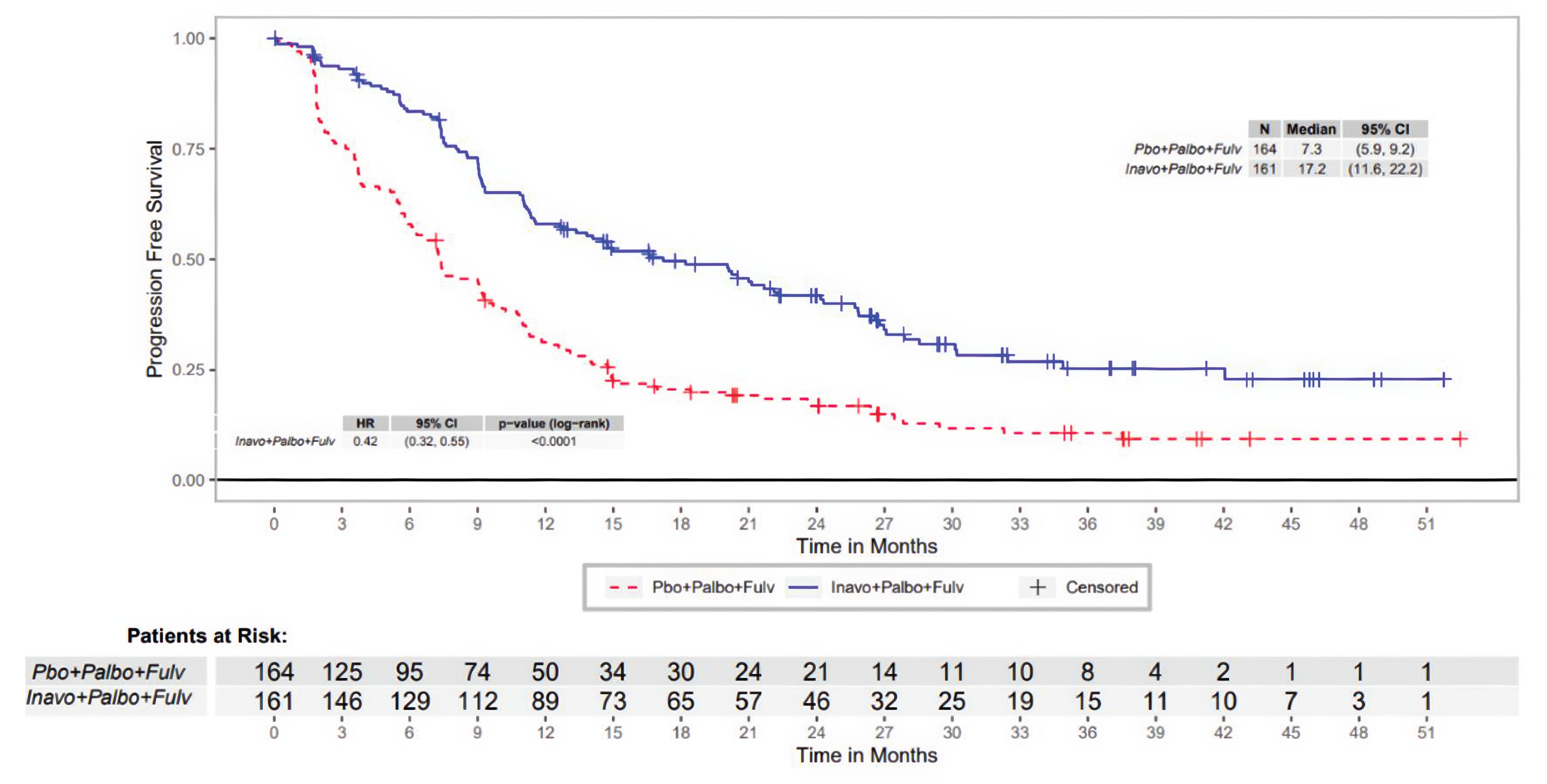
CI = confidence interval; FAS = full analysis set; FUL = fulvestrant; Fulv = fulvestrant; HR = hazard ratio; INA = inavolisib; Inavo = inavolisib; KM = Kaplan-Meier; PAL = palbociclib; Palbo = palbociclib; PBO = placebo; Pbo = placebo; PFS = progression-free survival.
Source: Update Clinical Study Report of Study WO41554 (INAVO120).30
Figure 2: KM Plot for OS From the INAVO120 Study (FAS; Clinical Cut-Off Date of November 15, 2024)
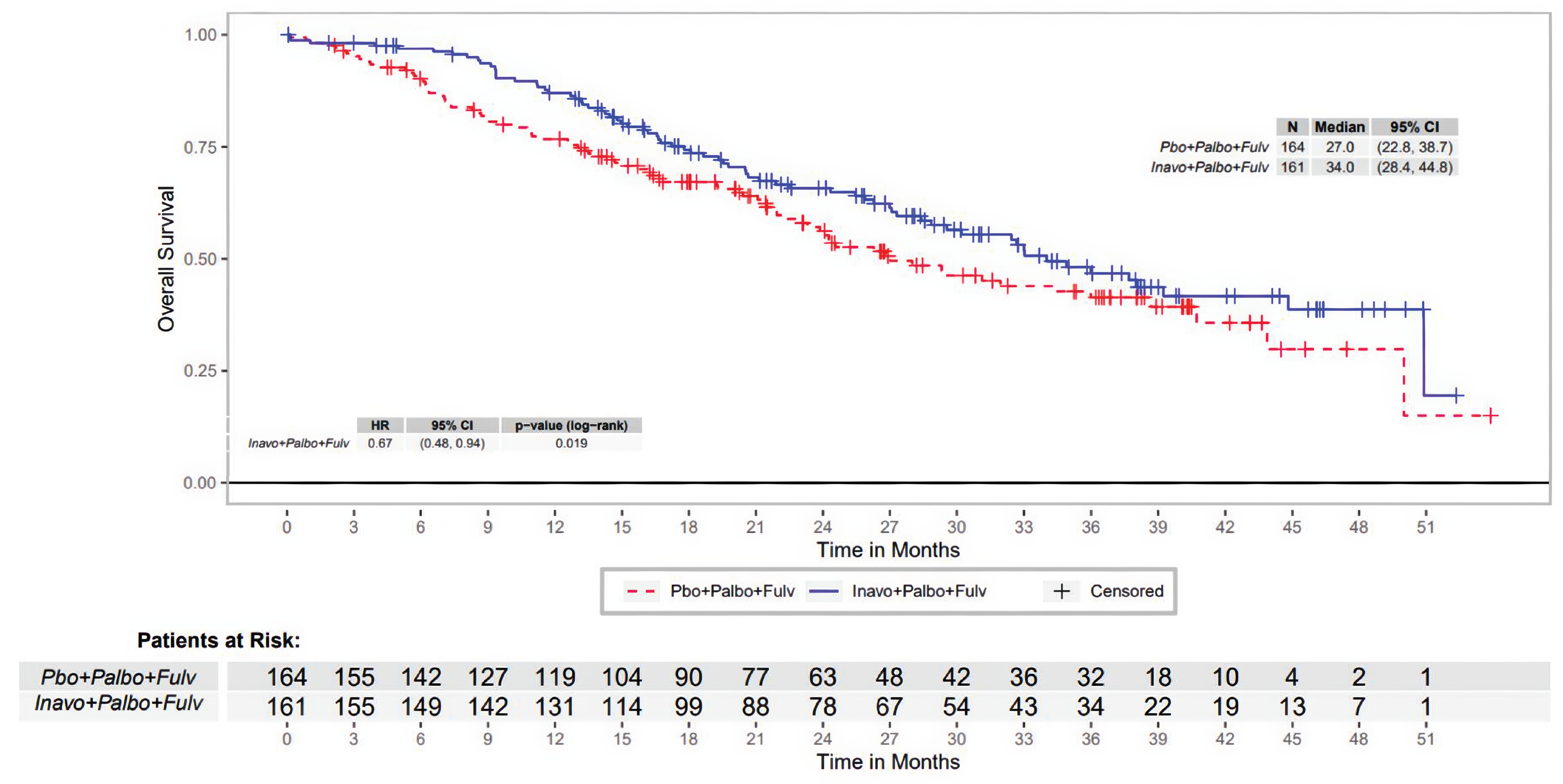
CI = confidence interval; FAS = full analysis set; FUL = fulvestrant; Fulv = fulvestrant; HR = hazard ratio; INA = inavolisib; Inavo = inavolisib; KM = Kaplan-Meier; OS = overall survival; PAL = palbociclib; Palbo = palbociclib; PBO = placebo; Pbo = placebo.
Source: Update Clinical Study Report of Study WO41554 (INAVO120).30
Figure 3: KM Plot for Duration of Response Assessed by Investigator From the INAVO120 Study (FAS; Clinical Cut-Off Date of November 15, 2024)
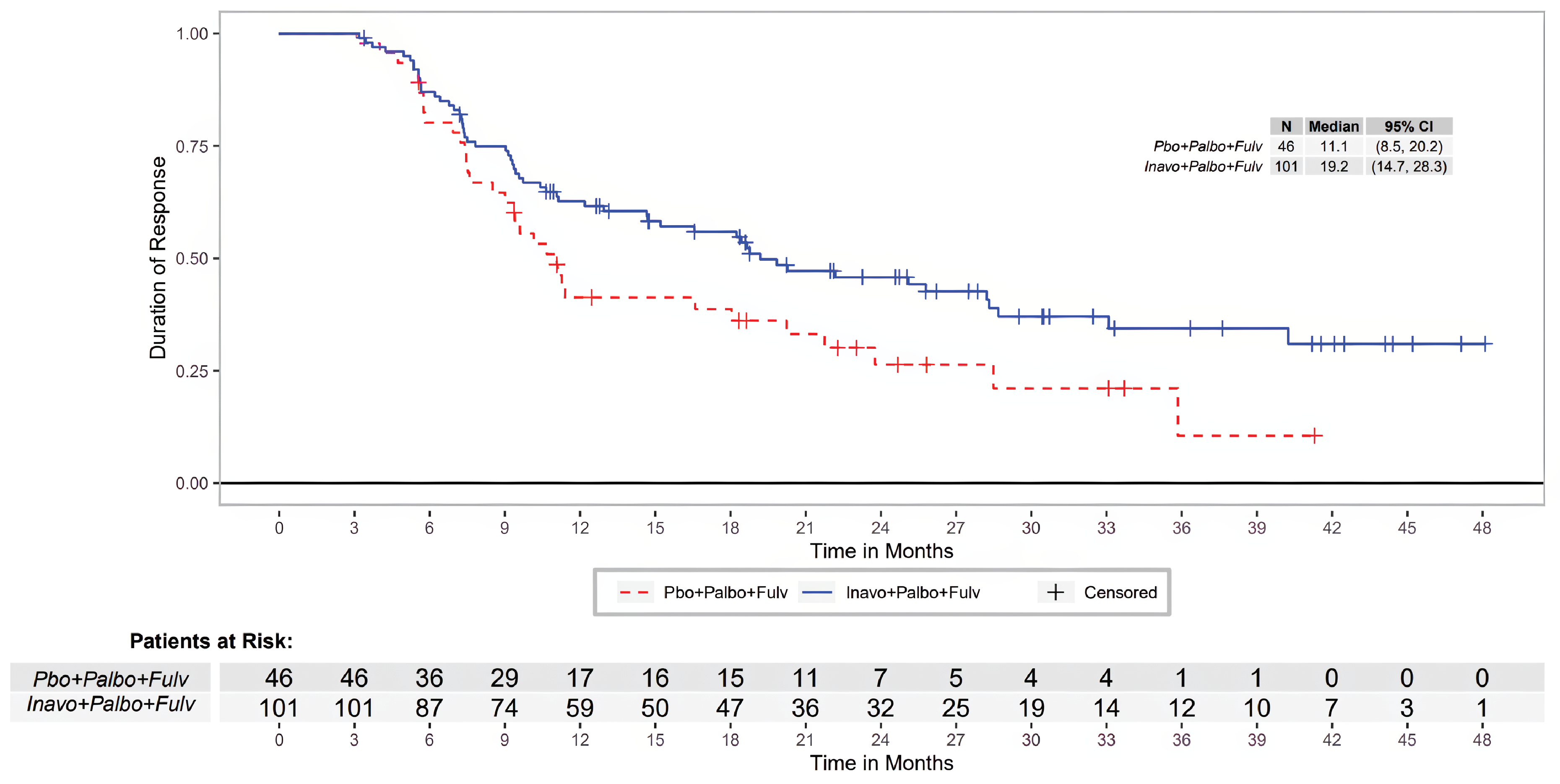
CI = confidence interval; FAS = full analysis set; FUL = fulvestrant; Fulv = fulvestrant; INA = inavolisib; Inavo = inavolisib; KM = Kaplan-Meier; PAL = palbociclib; Palbo = palbociclib; PBO = placebo; Pbo = placebo.
Source: Update Clinical Study Report of Study WO41554 (INAVO120).30
Figure 4: KM Plot for Time to Confirmed Deterioration in EORTC QLQ-C30 GHS and QoL After Randomization From the INAVO120 Study (FAS; Clinical Cut-Off Date of November 15, 2024)

EORTC QLQ-C30 = European Organisation for Research and Treatment of Cancer Quality of Life Questionnaire Core 30; FAS = full analysis set; GHS = global health status; KM = Kaplan-Meier;QoL = quality of life.
Source: Update Clinical Study Report of Study WO41554 (INAVO120).30
Figure 5: Plots of Mean Change From Baseline With 95% CIs in the EORTC QLQ-C30 GHS and QoL Scale From the INAVO120 Study (FAS; Clinical Cut-Off Date of November 15, 2024)

CI = confidence interval; EORTC QLQ-C30 = European Organisation for Research and Treatment of Cancer Quality of Life Questionnaire Core 30; FAS = full analysis set; GHS = global health status;QoL = quality of life.
Note: ████ ████ ███ ██ ███ ████████ ██████████ ████████ █████████ █████ ██ ██ ███ ███ █ ███ █ ███ █████ ███ █████████ █████ █ ██ ███ ███ █ ███ █ ███ ██████.
Source: Update Clinical Study Report of Study WO41554 (INAVO120).30
Harms
The following summary reflects the clinical cut-off date of November 15, 2024, at the time of the final OS analysis.
Adverse Events
All patients in the study experienced at least 1 AE. The most common AEs (≥ 15% in any group) are summarized in Table 20, with neutropenia being the most common AE reported in both treatment groups (55% of patients).
Serious Adverse Events
A total of 27.3% of patients (44 of 161 patients) in the INA + PAL + FUL group and 13.5% of patients (22 of 163 patients) in the PBO + PAL + FUL group experienced at least 1 SAE. No single SAE was reported in more than 2.5% of patients in either group.
Withdrawals Due to AEs
A total of 8.7% of patients (14 patients) in the INA + PAL + FUL group and 0.6% (1 patient) in the PBO + PAL + FUL group withdrew from any study treatment component due to any AE. No single AE led to discontinuation among more than 1% of patients in either group.
Mortality
Six patients (3.7%) in the INA + PAL + FUL group and 2 patients (1.2%) in the PBO + PAL + FUL group had an AE that led to a fatal outcome. No single AE led to a fatal outcome among more than 0.6% of patients in either group.
Notable Harms
Refer to Withdrawals Due to AEs in the previous subsection.
Table 20: Summary of Harms Results From the INAVO120 Study (SAS; Clinical Cut-Off Date of November 15, 2024)
Adverse event | INA + PAL + FUL (N = 161) | PBO + PAL + FUL (N = 163) |
|---|---|---|
AEs | ||
Patients with ≥ 1 AE, n (%) | 161 (100) | 163 (100) |
Most common AEs ≥ 15%, n (%) | ||
Neutropenia | 91 (56.5) | 89 (54.6) |
Hyperglycemia | 91 (56.5) | 15 (9.2) |
Diarrhea | 84 (52.2) | 26 (16.0) |
Decreased neutrophil count | 64 (39.8) | 64 (39.3) |
Anemia | 63 (39.1) | 62 (38.0) |
Stomatitis | 57 (35.4) | 30 (18.4) |
Nausea | 47 (29.2) | 32 (19.6) |
Fatigue | 46 (28.6) | 24 (14.7) |
Decreased appetite | 44 (27.3) | 18 (11.0) |
Decreased platelet count | 43 (26.7) | 38 (23.3) |
COVID-19 | 39 (24.2) | 18 (11.0) |
Headache | 39 (24.2) | 23 (14.1) |
Thrombocytopenia | 38 (23.6) | 41 (25.2) |
Decreased white blood cell count | 37 (23.0) | 37 (22.7) |
Mucosal inflammation | 33 (20.5) | 19 (11.7) |
Increased alanine aminotransferase | 31 (19.3) | 27 (16.6) |
Increased aspartate aminotransferase | 31 (19.3) | 32 (19.6) |
Weight decreased | 31 (19.3) | 1 (0.6) |
Alopecia | 29 (18.0) | 12 (7.4) |
Leukopenia | 28 (17.4) | 40 (24.5) |
Urinary tract infection | 28 (17.4) | 15 (9.2) |
Hypokalemia | 27 (16.8) | 13 (8.0) |
Rash | 27 (16.8) | 23 (14.1) |
Asthenia | 27 (16.8) | 23 (14.1) |
Constipation | 26 (16.1) | 25 (15.3) |
Vomiting | 26 (16.1) | 10 (6.1) |
Arthralgia | 22 (13.7) | 25 (15.3) |
SAEs | ||
Patients with ≥ 1 SAE, n (%) | 44 (27.3) | 22 (13.5) |
Most common SAEs ≥ 2%, n (%) | ||
COVID-19 | 4 (2.5) | 1 (0.6) |
Febrile neutropenia | 4 (2.5) | 0 |
Pyrexia | 4 (2.5) | 0 |
Patients who withdrew any study drug due to AE | ||
Patients who withdrew any study drug due to AE, n (%) | 14 (8.7) | 1 (0.6) |
Most common AEs ≥ 1%, n (%) | ||
Neutropenia | 2 (1.2) | 0 |
AEs with fatal outcome | ||
Patients with any AE that led to a fatal outcome, n (%) | 6 (3.7) | 2 (1.2) |
Acute coronary syndrome | 1 (0.6) | 0 |
Cardiac arrest | 0 | 1 (0.6) |
COVID-19 | 1 (0.6) | 0 |
COVID-19 pneumonia | 0 | 1 (0.6) |
Cerebral hemorrhage | 1 (0.6) | 0 |
Cerebrovascular accident | 1 (0.6) | 0 |
Gastrointestinal hemorrhage | 1 (0.6) | 0 |
Death (not further specified) | 1 (0.6) | 0 |
AE = adverse event; FUL = fulvestrant; INA = inavolisib; PAL = palbociclib; PBO = placebo; SAE = serious adverse event; SAS = safety analysis set.
Source: Update Clinical Study Report of Study WO41554 (INAVO120).30
Critical Appraisal
Internal Validity
The INAVO120 trial was generally appropriately designed and powered to evaluate the efficacy of INA + PAL + FUL compared with PBO + PAL + FUL. There was adequate control for type I errors across the various interim and final analyses, the interim analyses were undertaken by an external independent data-monitoring committee, and the trial continued to its final analysis without early stopping.
Randomization was achieved via interactive voice or web-based response system, a method that is sufficient for concealing treatment allocation until the time of assignment. In consultation with the clinical experts consulted for this review, the review team concluded that known potential prognostic factors were balanced between groups based on the baseline characteristics. Hence, the methods used to achieve randomization and allocation concealment are appropriate and the risk of bias arising from the randomization process is low.
The proportion of patients discontinuing from all study treatment was relatively large — 69% in the intervention group and 88% in the comparator group. However, progressive disease was the reason for discontinuing all study treatment in 53% of patients in the intervention group and 79% of patients in the comparator group, which is expected in an oncology trial and incorporated in the PFS end point. For all other reasons for discontinuing all study treatment, the distribution of by patients was similar between groups and relatively small (< 10% of patients in each group), including AEs, loss to follow-up, and symptomatic deterioration. However, there was an imbalance in the known AEs associated with INA + PAL + FUL — hyperglycemia, stomatitis, and gastrointestinal AEs — between groups. Further, there was an imbalance in withdrawal from any study treatment due to AEs between groups (9% of patients in the intervention group compared with 1% of patients in the comparator group). Thus, there is a potential for patients to infer treatment assignment in the trial, thereby potentially influencing the patient-reported outcomes (e.g., HRQoL).
The reasons for censoring in the analysis of all time to event end points provided by the sponsor did not enumerate the proportion of patients censored due to loss to follow-up, missing assessments, and intercurrent events. However, there was no major concern indicative of informative censoring. The proportion of patients discontinuing from the trial was relatively large — 53% in the intervention group and 60% in the comparator group. However, death was the reason for trial discontinuation in 44% of patients in the intervention group and 48% of patients in the comparator group, which is expected in an oncology trial and incorporated in the end points of PFS and OS. For all other reasons for trial discontinuation, the distribution of patients was similar between groups and relatively small (< 10% of patients in each group), including loss to follow-up, AEs, and symptomatic deterioration. Further, the primary analysis results for investigator-assessed PFS were consistent with the results from the sensitivity analysis on handling of missing scheduled tumour assessments and from the supplemental analyses using different strategies to handle intercurrent events. Hence, the risk of bias due to informative censoring is low.
An assessment of the proportional hazards assumption was not reported in the Clinical Study report for the trial. A visual inspection of the KM plot for investigator-assessed PFS did not suggest a major deviation from the proportional hazards assumption. However, a visual inspection of the KM plots for OS, duration of response, time to deterioration in HRQoL, and time to end of next-line treatment suggested some concerns for possible deviations from the proportional hazards assumption, thereby affecting the interpretation of the hazard ratios. The interpretation of the between-group differences in KM-estimated probabilities at clinically relevant time points (used to assess the certainty of evidence for OS and time to deterioration in HRQoL) would not be affected by this limitation.
Protocol amendments occurred before the database lock date and were therefore unlikely to have a major effect on the interpretation of results. As no more than 7.5% of patients in either group had a specific subcategory of a major protocol deviation, these deviations are unlikely to have a major influence on the results.
PFS was identified as an important outcome in decision-making. As the primary analysis results of investigator-assessed PFS were consistent with the results from the sensitivity analysis of BICR-assessed PFS, there is a low risk of bias in the measurement of the outcome. Due to the small sample size and lack of testing for treatment by subgroup interactions, there are concerns about the credibility of the results from the subgroup analysis of investigator-assessed PFS. Based on a validation of PFS as a surrogate end point for the patient-relevant outcome of OS in patients with hormone receptor–positive, HER2-negative metastatic breast cancer, Lux et al.19 concluded that it is possible to draw conclusions on a significant effect on OS from a hypothetical trial showing an upper confidence limit (surrogate threshold effect) of HR less than 0.60 for PFS. Based on 16 RCTs (N = 5,324) identified in their systematic search, Lux et al.19 also reported a Pearson correlation coefficient of 0.72 (95% CI, 0.35 to 0.90) between HRs of PFS and OS, representing a positive linear relationship. However, for the purpose of this review, it should be noted that the systematic review was not specific to patients with PIK3CA mutation, leaving uncertainty in the generalizability of the results to the population and comparison under review. Lux et al.19 concluded that only final OS results can confirm whether an intervention demonstrated a clinically relevant difference in survival time versus its comparator.
OS was also identified as an important outcome in decision-making. More than 50% of patients received subsequent anticancer therapies, which were allowed under the protocol. As a consequence, the effect estimated is that of INA + PAL + FUL versus PBO + PAL + FUL, followed by any other anticancer therapies provided following progression.
Objective response rate was identified as an outcome that would provide supportive information in decision-making. The risk of bias due to missing outcome data were considered low because the proportion of patients with missing outcome data for the analysis was similar between groups and relatively small (< 10% of patients in each group). However, there are concerns about risk of bias in the measurement of the outcome, as this end point, as well as duration of response, were measured by the investigator and no sensitivity analysis was conducted.
Duration of response was also identified as an outcome that would provide supportive information in decision-making. There is a risk of bias due to the likely loss of prognostic balance between groups, as the analysis included only a subset of patients with an objective response assessed by the investigator. Importantly, this end point could not be formally interpreted for superiority because it was evaluated in the trial outside of the hierarchical analysis plan, meaning it should be interpreted as exploratory rather than confirmatory.
HRQoL was also identified as an important outcome in decision-making and was measured using the EORTC QLQ-C30 GHS and QoL scale. There is evidence in the literature to support the validity and reliability of this scale in patients with breast cancer,20-24 but no literature was identified to inform its responsiveness in patients with breast cancer. There is evidence that a 10-point within-group deterioration in the EORTC QLQ-C30 GHS and QoL score would be considered clinically important.18,25,26 However, there is no known threshold for a clinically important between-group difference in time to confirmed deterioration in HRQoL. Based on the KM plot of time to deterioration in the GHS and QoL scale of the EORTC QLQ-C30, there was a large amount of early censoring, contributing to the risk of bias due to informative censoring.
For the exploratory analysis of change from baseline in the EORTC QLQ-C30 GHS and QoL score, ████ ████ ███ ██ ████████ ████████ █████████ █████ ██ ██ ███ ████████████ █████ ███ █████████ █████ █ ██ ███ ██████████ █████. As a result, there is a risk of attrition bias, but the direction of the bias cannot be predicted.
Time to end of next-line treatment was a proxy measure for time to PFS2 in the trial and was used to inform the accompanying pharmacoeconomic analysis. The sponsor used this end point to support the PFS benefit of INA + PAL + FUL beyond progression and during the next-line treatment. However, this surrogate end point has uncertain validity in and is likely confounded by subsequent treatments. As a result, there is considerable uncertainty in the results of this exploratory analysis, thereby precluding any conclusions based on this outcome.
External Validity
In consultation with the clinical experts, the review team concluded that the trial population aligns with the target population in the indication. The trial population also aligns with the clinical unmet need for a treatment with evidence for its use in the first-line setting in patients with endocrine-resistant (primary and secondary resistance as defined in the trial), PIK3CA-mutated, hormone receptor–positive, HER2-negative locally advanced or metastatic breast cancer. Notably, less than 5% of patients received CDK4/6 inhibitor in the adjuvant setting, thereby limiting the generalizability of the results to this subset of patients. The clinical experts and clinicians (based on their group submission) were in agreement.
For the specific subgroups where the treatment effect appeared smaller, credible effect modification cannot be inferred due to multiple limitations in these analyses, but there is uncertainty as to whether the results can be fully generalized to these subgroups. The clinical experts advised that there are no major concerns for the generalizability of results to male patients and to adults aged 65 years or older, as — in their opinion — they are expected to respond similarly to their counterparts. For more specific cases that require careful considerations of patient and disease factors and clinician judgment, a summary of clinical expert input on the use of INA + PAL + FUL in practice in patients who were underrepresented or excluded from the trial, including those with bone-only disease, diabetes, brain metastasis, and visceral crisis, is presented in Table 4.
In consultation with the clinical experts, the review team concluded that the permitted therapies are considered standard of care and reflective of clinical practice in managing the common AEs associated with the class of drug under review. The clinical experts also indicated that the list of subsequent anticancer therapies includes both treatments that are commonly and uncommonly used in practice, which may be due to the timing of the trial.
Based on round table discussions and patient interviews exploring the global patient perceptions of PFS and its relation to QoL,27 lengthened OS with no worsening or, in fact, improvement in QoL is the most important end point to patients with metastatic breast cancer. Additionally, time without disease progression, with improvements in QoL, and without added treatment toxicity are also meaningful to patients with metastatic breast cancer.27
The clinical experts suggested that a reimbursement recommendation for INA in combination with any CDK4/6 inhibitor and FUL (as requested by the sponsor) can help address cases where 1 CDK4/6 inhibitor is preferred over another to optimize patient outcomes — a summary of these example scenarios is presented in Table 4. However, there is a gap in the systematic review evidence for INA in combination with FUL and with any CDK4/6 inhibitor other than PAL and for INA + PAL + FUL compared with regimens containing other CDK4/6 inhibitors.
GRADE Summary of Findings and Certainty of the Evidence
Methods for Assessing the Certainty of the Evidence
For pivotal studies and RCTs identified in the sponsor’s systematic review, GRADE was used to assess the certainty of the evidence for outcomes considered most relevant to inform expert committee deliberations, and a final certainty rating was determined, as outlined by the GRADE Working Group:28,29
High certainty: We are very confident that the true effect lies close to that of the estimate of the effect.
Moderate certainty: We are moderately confident in the effect estimate — The true effect is likely to be close to the estimate of the effect, but there is a possibility that it is substantially different. We use the word “likely” for evidence of moderate certainty (e.g., “X intervention likely results in Y outcome”).
Low certainty: Our confidence in the effect estimate is limited — The true effect may be substantially different from the estimate of the effect. We use the word “may” for evidence of low certainty (e.g., “X intervention may result in Y outcome”).
Very low certainty: We have very little confidence in the effect estimate — The true effect is likely to be substantially different from the estimate of effect. We describe evidence of very low certainty as “very uncertain.”
Following the GRADE approach, evidence from the RCT started as high-certainty evidence and could be rated down for concerns related to study limitations (which refers to internal validity or risk of bias), indirectness, imprecision of effects, and publication bias.
When possible, certainty was rated in the context of the presence of an important (nontrivial) treatment effect. If this was not possible, certainty was rated in the context of the presence of any treatment effect (i.e., the clinical importance is unclear). In all cases, the target of the certainty of evidence assessment was based on the point estimate and where it was located relative to the threshold for a clinically important effect (when a threshold was available) or to the null.
The reference points for the certainty of evidence assessment for PFS and OS were set according to the presence or absence of an important effect based on thresholds informed by the clinical experts consulted for this review (Table 2). The reference points for the certainty of the evidence assessment for EORTC QLQ-C30 GHS and QoL score and withdrawal of any treatment component due to AE were set according to the presence or absence of any effect based on the null.
Results of GRADE Assessments
Table 2 presents the GRADE summary of findings for INA + PAL + FUL versus PBO + PAL + FUL.
Long-Term Extension Studies
Contents in this section have been informed by materials submitted by the sponsor. The following has been summarized and validated by the review team.
The sponsor indicated that there is no long-term extension study planned. At the time of submission, the INAVO120 trial is ongoing and has reached its clinical cut-off date of November 15, 2024. The total length of the study, from screening of the first patient to the end of the study, is expected to be 6 years.
Indirect Evidence
Contents in this section have been informed by materials submitted by the sponsor. The following have been summarized and validated by the review team.
Objective for the Summary of Indirect Evidence
Because the INAVO120 study only evaluated the efficacy and safety of INA + PAL + FUL compared with PBO + PAL + FUL, there is a lack of evidence for INA + PAL + FUL compared with other relevant comparators in adult patients with endocrine-resistant, PIK3CA-mutated, hormone receptor–positive, HER2-negative locally advanced or metastatic breast cancer, following recurrence on or after completing adjuvant endocrine treatment (indication under review). To address this evidence gap, the sponsor submitted indirect evidence, consisting of an NMA.
Description of Indirect Comparison
Objective of the Network Meta-Analysis
The objective of the NMA was to compare INA + PAL + FUL with regimens containing other CDK4/6 inhibitors in patients with previously untreated, hormone receptor–positive, HER2-negative locally advanced or metastatic breast cancer.
Study Selection Methods
A systematic literature review of clinical evidence of interventions in this patient population was conducted on March 6, 2024, and adapted in November 2024, with further inclusion criteria for a supplemental systematic review, as confirmed by the sponsor.
Relevant citations were retrieved according to a structured search strategy and supplemented by pragmatic searches. A summary of the predefined inclusion and exclusion criteria based on the population, intervention, comparator, outcome, and study design (PICOS) framework is presented in Table 21.
Table 21: Study Selection Criteria and Methods for Indirect Treatment Comparison Submitted by the Sponsor
Characteristics | Inclusion criteria | Exclusion criteria |
|---|---|---|
Population | Adults with hormone receptor–positive, HER2-negative locally advanced or metastatic breast cancer Line of treatment: No prior systemic treatment for advanced or metastatic disease Subgroups:
|
|
Intervention | CDK4/6 inhibitors (PAL, RIB, ABE, and INA) + FUL Note: The NMA narrowed the intervention to INA + PAL + FUL, while other CDK4/6 inhibitors were considered comparators. |
|
Comparator | PBO + FUL | |
Outcomes | Efficacy outcomes:
Safety outcomes:
HRQoL and PROs: Any scale |
|
Study designs | RCTs |
|
Publication characteristics |
|
|
Publication time frame |
| Conference proceedings before 2021 |
Geography | Global | Not applicable |
Language | Only English-language articles | Non-English articles |
Databases searched |
| Not applicable |
Selection process |
| Not applicable |
Data extraction process |
| Not applicable |
Quality assessment | NICE checklist for risk of bias in RCTs was used in the quality assessment of included studies.a | Not applicable |
ABE = abemaciclib; AE = adverse event; ASCO = American Society of Clinical Oncology; EBCC = European Breast Cancer Conference; ESMO = European Society for Medical Oncology; EU-CTR = European Union Clinical Trials Register; FUL = fulvestrant; HRQoL = health-related quality of life; ICTRP = International Clinical Trials Registry Platform; INA = inavolisib; NICE = National Institute for Health and Care Excellence; NMA = network meta-analysis; PAL = palbociclib; PBO = placebo; PFS2 = second objective disease progression; PRO = patient-reported outcome; RCT = randomized controlled trial; RIB = ribociclib; SABCS = San Antonio Breast Cancer Symposium; SLR = systematic literature review.
aIt is unclear how many reviewers were involved at this stage, whether they worked independently, and how consensus was reached.
Sources: Systematic Literature Review and Feasibility Assessment report submitted by the sponsor.44 Details included in the table are from the sponsor’s Summary of Clinical Evidence.2
Indirect Treatment Comparison Design
Feasibility Assessment
Following the results of the systematic literature review, the authors assessed whether it would be feasible and credible to conduct indirect treatment comparisons (ITCs) or NMAs in patients with hormone receptor–positive, HER2-negative locally advanced or metastatic breast cancer.
The feasibility assessment consisted of 2 parts:
First, a series of network plots of the evidence base, strength of the evidence, and projected evidence base from planned and ongoing studies were presented for endocrine-resistant, hormone receptor–positive, HER2-negative locally advanced or metastatic breast cancer.
These plots were used to identify common comparators, disconnected treatments, and any assumptions that might be required to connect the network.
Second, a qualitative assessment of heterogeneity across studies was conducted based on the systematic review results, including a comparison of inclusion and exclusion criteria, baseline characteristics, duration of follow-up, treatment scheduling, study design, quality assessment, and end point definitions.
A targeted search of prognostic studies and subgroup analyses conducted in previous NMAs was conducted to identify potential prognostic factors and treatment-effect modifiers (site of metastasis, PIK3CA mutation, disease-free interval, prior treatment response, circulating tumour cells, ECOG PS, age, and race).
The authors concluded that an NMA was favoured to evaluate the comparative effectiveness of INA + PAL + FUL versus regimens containing other CDK 4/6 inhibitors in the first-line treatment of hormone receptor–positive, HER2-negative locally advanced or metastatic breast cancer, given the connected network of evidence and similarities across study designs and patient characteristics.
NMA Methods
For inclusion in the NMA, studies had to be in a connected network with INA + PAL + FUL via the comparators, PAL + FUL and PBO + PAL + FUL, which were assumed to be equivalent by the authors for the purpose of the analysis. The studies had to report either HRs or count data (i.e., number of patients alive and total number of patients).
Where multiple statistics were reported, the authors used the HRs rather than count data because HR statistics provide information about time to event and censoring. All studies reported HRs for OS except the FLIPPER study, which reported count data only. Inclusion of this study required an assumption of constant proportional hazards and application of the methodology described in Woods et al.45 for combining HR and count statistics; this method was selected to avoid potential selection bias.
KM plots were extracted for PFS and OS (if reported for first-line treatment only) to assess proportional hazards and suitability of applying a Cox proportional hazards model for the analysis.
Due to the observed differences in the postmenopausal status at baseline between the INAVO120 study and the 5 other studies included in the NMA (60% compared with 79% to 100% of patients, respectively), a subgroup analysis for PFS and OS was conducted using the postmenopausal only subgroup analysis results from the INAVO120 study. Outcome data (PFS and OS stratified HRs) for the postmenopausal subgroup were calculated from individual patient data from the INAVO120 study that was made available by the sponsor on a confidential basis. The MONARCH-2 and PALOMA-3 studies did not report HR data for the postmenopausal subgroup; consequently, the HRs for a mixed population of individuals who were menopausal were used in the analyses.
A summary of the NMA methods is presented in Table 22.
Methods | Description |
|---|---|
Analysis methodsa | The NMA was conducted using Bayesian MCMC methods and in accordance with NICE Decision Support Unit Technical Support Document.31 The analysis model for log HR end points was normal likelihood with identity link and for binary end points was binomial likelihood with logit link. If binary and HR data were combined, the methodology described in Woods et al.45 was used. |
Priors | In both the fixed-effects and random-effects models, a vague normal (0, 10,000) prior distribution was used for the trial-specific baselines and treatment effects in the first instance. The wide variance (10,000) reflected minimal prior knowledge and allowed the data to dominate the inference. For the between-study heterogeneity parameter in the random-effects models, a half-normal (0.1) informative prior described in Lilienthal et al.46 and empirical log-normal priors described in Turner et al. (2015)47 were used.
The following informative priors were selected from Table 4 in Turner et al. (2015)47 for pharmacological vs. pharmacological intervention comparisons: |
Assessment of model fit | The overall residual deviance and DIC were used to assess goodness of model fit. The DIC was used to compare the fit between the fixed-effects and random-effects models. |
Assessment of consistency | As there are no loops in the network, an evaluation of network internal consistency between direct and indirect evidence was not applicable. |
Assessment of convergence | For each model, a burn-in of 20,000 iterations plus another 20,000 for estimation was used and convergence statistics were examined. |
Outcomesb | PFS and OS |
Follow-up time points | Where data were reported at multiple time points, the longest follow-up was used. |
Construction of nodes | Most nodes were constructed based on information from a single study and, as a result, each node corresponded to a unique treatment. Where multiple studies informed a node, information was pooled. |
Sensitivity analysis | Random-effects model results |
Subgroup analysis | Postmenopausal only subgroup — outcome data (PFS and OS stratified HRs) for the postmenopausal subgroup were calculated from individual patient data from the INAVO120 trial, made available by the sponsor on a confidential basis. The MONARCH-2 and PALOMA-3 studies did not report HR data for the postmenopausal subgroup; consequently, the HRs for a mixed population of individuals who were menopausal were used in the analyses. |
Reporting | Report details included comparative effectiveness, assessment of heterogeneity, and the probabilities of treatment ranking. For time to event outcomes, HRs were presented with 95% CIs. Forest plots and ranking probability plots were included where applicable. |
CI = confidence interval; DIC = deviance information criterion; HR = hazard ratio; HTA = health technology assessment; MCMC = Markov chain Monte Carlo; NICE = National Institute for Health and Care Excellence; NMA = network meta-analysis; OS = overall survival; PFS = progression-free survival; SAP = statistical analysis plan; vs. = versus.
aThere was insufficient evidence that hazards were nonproportional. The authors stated that any further analysis on nonproportional hazards will be considered as an addendum to the NMA report when the final OS data become available.
bThere was limited availability of outcomes data reported in the PALOMA-3 and FLIPPER studies that connected the INAVO120 trial to the network of studies.
Sources: Technical Report of the NMA submitted by the sponsor.48 Details included in the table are from the sponsor’s Summary of Clinical Evidence.2
Results of the Network Meta-Analysis
Summary of Included Studies
The systematic literature review search yielded 2,746 records. After screening, 35 records representing 6 unique studies (INAVO120,38 MONARCH-2,49 MONARCH plus,50 FLIPPER,51 PALOMA-3,52 and MONALEESA-353) were included in the NMA.
An assessment of homogeneity for study, outcome, and patient characteristics across studies included in the NMA are summarized in Table 23. With respect to other potential treatment-effect modifiers (disease stage, disease-free interval, circulating tumour cell, measurable disease, and bone disease), the authors indicated that there were limited data reported in the included studies.
Table 23: Assessment of Homogeneity for the NMA
Characteristics | Description and handling of potential treatment-effect modifiers |
|---|---|
Study characteristics | |
Study design |
|
Population |
|
Intervention and comparator in the included studies |
|
Follow-up duration | The median follow-up duration was 11.1 months, 21.3 months, 28.6 months, 70.8 months, 73.3 months, and 80 months in the MONARCH plus (Cohort B), INAVO120, FLIPPER, MONALEESA-3, PALOMA-3, and MONARCH-2 studies, respectively. |
PFS outcome | Data on PFS in the first-line treatment of hormone receptor–positive, HER2-negative locally advanced or metastatic breast cancer were available from all 6 trials. The definition of PFS, reported in 4 trials (INAVO120, MONARCH-2, MONARCH plus, PALOMA-3), was the time from randomization to the date of first documented RECIST 1.1-defined disease progression or death from any cause, whichever occurred first. In the FLIPPER study, the primary objective was to compare the 1-year PFS rate, defined as the rate of patients free of PD at year 1 (according to RECIST 1.1 and assessed by the investigators), between the PAL + FUL and PBO + FUL groups. PFS was assessed by the investigator in all studies (and by BICR in the INAVO120 trial). Across the 6 trials, PFS data were reported as follows:
|
OS outcome | Data for OS in the first-line treatment of hormone receptor–positive, HER2-negative locally advanced or metastatic breast cancer were available from 5 trials (INAVO120, MONARCH-2, FLIPPER, PALOMA-3, and MONALEESA-3). The definition of OS, reported in 4 trials (INAVO120, MONARCH-2, PALOMA-3, and MONALEESA-3), was time from date of randomization until death due to any cause. Across 5 studies, OS data were reported as follows:
|
Patient characteristics | |
Age | The median age of patients in any treatment group ranged from 53.0 years (INAVO120 trial) to 64.0 years (FLIPPER study). |
Disease stage |
|
ECOG PS |
|
Endocrine resistance or endocrine sensitivity | Endocrine resistant:
Endocrine sensitive:
Endocrine resistant and endocrine sensitive (mixed):
The authors of the NMA indicated that data on patients who were endocrine resistant from the MONALEESA-3 study were not available for the analysis. However, the authors indicated that a subgroup analysis from the MONALEESA-3 study suggests that there was no effect modification based on endocrine status in the first-line setting. Handling of potential treatment-effect modifier: The authors advised on 2 networks of evidence to explore the potential bias due to confounding from endocrine-resistance status. |
Locally advanced or metastatic disease |
|
Menopausal status |
Handling of potential treatment-effect modifier: The authors of the SLR advised on a scenario analysis using the postmenopausal only subgroup analysis results from the INAVO120 trial due to observed differences in postmenopausal status at baseline between the INAVO120 trial and the 5 other included studies (60% compared with 79% to 100% of patients, respectively). |
PIK3CA mutation status |
|
Prior treatment and line of treatment | Adjuvant or neoadjuvant:
Advanced or metastatic disease:
Handling of potential treatment-effect modifier: The authors indicated that the MONARCH-2, PALOMA-3, and MONALEESA-3 studies reported data for the first-line treatment setting separately. The SLR extracted outcome data exclusively for the first-line treatment setting (ITT population or subgroup). The authors also considered MONARCH plus (Cohort B) as a study in the first-line treatment setting for the purpose of their review because > 75% of patients had disease that was previously untreated. |
Visceral disease | INAVO120, MONARCH-2, MONARCH plus (Cohort B), PALOMA-3, FLIPPER, MONALEESA-3: Most patients (ranging from 55% to 82%) had visceral disease |
Sample sizee |
MONALEESA-3: RIB + FUL (n = 237) compared with PBO + FUL (n = 128) |
Risk of bias | |
Risk of bias assessment | Each RCT was assessed and rated for risk of bias for various parameters using NICE checklist, from low to unclear. The authors of the SLR concluded that there was a low risk of bias for all parameters (random sequence generation, allocation concealment, comparability of groups, blinding, imbalance in dropouts, selective reporting, and incomplete reporting) for all included studies, except for 2 parameters (random sequence generation and allocation concealment) for the FLIPPER study, for which they concluded the risk of bias was unclear. |
ABE = abemaciclib; BICR = blinded independent central review; CI = confidence interval; ECOG PS = Eastern Cooperative Oncology Group Performance Status; FUL = fulvestrant; INA = inavolisib; ITT = intention-to-treat; NICE = National Institute for Health and Care Excellence; NMA = network meta-analysis; OS = overall survival; PAL = palbociclib; PBO = placebo; PD = progressive disease; PFS = progression-free survival; RCT = randomized controlled trial; RECIST 1.1 = Response Evaluation Criteria in Solid Tumours Version 1.1; RIB = ribociclib; SLR = systematic literature review.
aBased on input from the sponsor, the authors of the SLR concluded that the first-line subgroup presented in the PALOMA-3 study likely included only patients with endocrine resistance; endocrine-resistance status was not reported in study publications.
bThe authors of the SLR indicated that there were patients with PIK3CA mutation included in the MONARCH-2, PALOMA-3, and MONALEESA-3 studies. The authors of the NMA noted that the studies and data used in the NMA were based on all-comer populations (i.e., the comparative evidence synthesized in the NMA may include patients regardless of their PIK3CA mutation status).
cThe authors of the SLR indicated that only the INAVO120 and FLIPPER studies evaluated the drug regimens in the first-line treatment setting.
dThe authors of the SLR indicated that the MONARCH-2, MONARCH plus (Cohort B), PALOMA-3, and MONALEESA-3 studies evaluated in a mixed line of treatment setting.
eThe sample sizes are based on the data used in the NMA base case regardless of endocrine resistance.
Sources: Systematic Literature Review and Feasibility Assessment report submitted by the sponsor and Technical Report of the NMA submitted by the sponsor.44,48 Details included in the table are from the sponsor’s Summary of Clinical Evidence.2
Evidence Networks
Based on the feasibility assessment, 2 networks of evidence were considered to explore the potential bias due to potential violation of the transitivity assumption arising from differences across studies in endocrine-resistance status.
Endocrine-Resistant and Endocrine-Sensitive Networks
The primary evidence network, which included studies regardless of whether certain end points were reported and of endocrine-resistance status, showed a connected evidence base of 6 RCTs: INAVO120, MONARCH-2, PALOMA-3, FLIPPER, MONALEESA-3, and Cohort B in MONARCH plus (Figure 6).
Endocrine-Resistant Networks
To align with the INAVO120 trial population, the authors of the NMA considered the studies of endocrine-resistant disease separately (Figure 7). This primary network showed a connected evidence base of 4 RCTs: INAVO120, MONARCH-2, PALOMA-3, and Cohort B in MONARCH plus. Only the PALOMA-3 study connected the INAVO120 trial to the MONARCH study.
Figure 6: Primary Evidence Network of RCTs in First-Line Treatment of Hormone Receptor–Positive, HER2-Negative, Locally Advanced or Metastatic Breast Cancer, Irrespective of Endocrine-Resistance Status
![A connected evidence base of 6 RCTs in the first-line treatment setting anchored by the FUL node. INA + PAL + FUL connects to RIB + FUL (evaluated in the MONALEESA-3 study) and ABE + FUL (evaluated in the MONARCH-2 and MONARCH plus [Cohort B] studies) through the PALOMA-3 and FLIPPER studies. The authors assumed the comparators, PAL + FUL and PBO + PAL + FUL, were equivalent for the purpose of the analysis. The comparison of ABE + NSAI versus PBO + NSAI in Cohort A from the MONARCH plus study was not relevant to the review.](https://canjhealthtechnol.ca/index.php/cjht/article/download/PC0382r/version/1406/3264/12573/PC0382-Clinical_Review-fig06.png)
ABE = abemaciclib; FUL = fulvestrant; INA = inavolisib; NSAI = nonsteroidal aromatase inhibitor; PAL = palbociclib; PBO = placebo; RCT = randomized controlled trial; RIB = ribociclib.
Note: The primary evidence network includes studies regardless of whether particular end points were reported. The thickness of the connecting lines is indicative of the number of studies informing the comparison between 2 nodes (interventions). However, the size of the intervention nodes is noninformative (i.e., they do not reflect the study size or total number of patients).
Source: Technical Report of the NMA submitted by the sponsor.48
Figure 7: Primary Evidence Network of RCTs in Endocrine-Resistant, Hormone Receptor–Positive, HER2-Negative Locally Advanced or Metastatic Breast Cancer
![A connected evidence base of 4 RCTs that included patients with disease resistant to endocrine therapy, anchored by the FUL node. INA + PAL + FUL connects to ABE + FUL (evaluated in the MONARCH-2 and MONARCH plus [Cohort B] studies) through the PALOMA-3 study. The authors assumed the comparators, PAL + FUL and PBO + PAL + FUL, were equivalent for the purpose of the analysis.](https://canjhealthtechnol.ca/index.php/cjht/article/download/PC0382r/version/1406/3264/12574/PC0382-Clinical_Review-fig07.png)
ABE = abemaciclib; FUL = fulvestrant; INA = inavolisib; NMA = network meta-analysis; PAL = palbociclib; PBO = placebo; RCT = randomized controlled trial; RIB = ribociclib.
Note: The primary evidence network includes studies regardless of whether particular end points were reported. The thickness of the connecting lines is indicative of the number of studies informing the comparison between 2 nodes (interventions); however, the size of the intervention nodes is noninformative (i.e., they do not reflect the study size or total number of patients).
Source: Technical Report of the NMA submitted by the sponsor.48
Efficacy
The PFS and OS results from the base case using the fixed-effects model are presented along with the sensitivity analyses using random-effects models in Table 24 for the endocrine-resistant and endocrine-sensitive network and in Table 26 for the endocrine-resistant network.
The postmenopausal subgroup analysis results from the endocrine-resistant and sensitive network are presented in Table 25 and from the endocrine-resistant network in Table 27.
Progression-Free Survival
Endocrine-resistant and endocrine-sensitive network: INA + PAL + FUL was favoured over FUL (██ █ █████ ███ ████ ████ ██ ████), RIB + FUL (██ █ █████ ███ ████ ████ ██ ████), ABE + FUL (██ █ █████ ███ ████ ████ ██ ████), and PAL + FUL (██ █ █████ ███ ████ ████ ██ ████).
For the sensitivity analysis using random-effects model (half-normal [0.1] prior), although the point estimates for both comparisons with RIB + FUL and ABE + FUL favoured INA + PAL + FUL, the 95% CrIs crossed the null, suggesting the potential for little to no difference (██ █ █████ ███ ████ ████ ██ ████ ███ ██ █ █████ ███ ████ ████ ██ ████, respectively).
Endocrine-resistant network: INA + PAL + FUL was favoured over FUL (██ █ █████ ███ ████ ████ ██ ████), ABE + FUL (██ █ █████ ███ ████ ████ ██ ████), and PAL + FUL (██ █ █████ ███ ████ ████ ██ ████).
In contrast to the base-case results, the sensitivity analysis using either random-effects model (half-normal [0.1] prior and Turner prior) showed no treatment was favoured between INA + PAL + FUL and ABE + FUL (██ █ █████ ███ ████ ████ ██ ████ ███ ██ █ █████ ███ ████ ████ ██ █████ respectively).
Overall Survival
Endocrine-resistant and endocrine-sensitive network: INA + PAL + FUL was favoured over FUL (██ █ █████ ███ ████ ████ ██ ████) and PAL + FUL (██ █ █████ ███ ████ ████ ██ ████). No treatment was favoured between INA + PAL + FUL and RIB + FUL (██ █ █████ ███ ████ ████ ██ ████). Although the point estimate for the comparison with ABE + FUL favoured INA + PAL + FUL, the 95% CrI crossed the null, suggesting the potential for little to no difference (██ █ █████ ███ ████ ████ ██ ████).
In contrast to the base-case results, the sensitivity analysis using either random-effects model showed no treatment was favoured between INA + PAL + FUL and any comparator. Although the point estimate for the comparison with FUL favoured INA + PAL + FUL (using the Turner prior), the 95% CrI included the null, suggesting the potential for little to no difference (██ █ █████ ███ ████ ████ ██ ████).
Endocrine-resistant network: INA + PAL + FUL was favoured over FUL (██ █ █████ ███ ████ ████ ██ ████), ABE + FUL (██ █ █████ ███ ████ ████ ██ ████), and PAL + FUL (██ █ █████ ███ ████ ████ ██ ████).
In contrast to the base-case results, the sensitivity analysis using either random-effects model showed no treatment was favoured between INA + PAL + FUL and any comparator, except for the sensitivity analysis using random-effects model (Turner prior) in which INA + PAL + FUL was favoured over FUL (██ █ █████ ███ ████ ████ ██ ████).
Table 24: Summary of Estimated Treatment Effects for Each Pairwise Comparison in the NMA (PFS and OS Results From the Endocrine-Resistant and Endocrine-Sensitive Network)
Comparator | PFS | OS | ||||
|---|---|---|---|---|---|---|
INA + PAL + FUL vs. comparator, HR (95% CrI) | INA + PAL + FUL vs. comparator, HR (95% CrI) | |||||
FE model (base case) | RE model (HN [0.1] prior) | RE model (Turner prior) | FE model (base case) | RE model (HN [0.1] prior) | RE model (Turner prior) | |
FUL | █████ | █████ | █████ | █████ | █████ | █████ |
RIB + FUL | █████ | █████ | █████ | █████ | █████ | █████ |
ABE + FUL | █████ | █████ | █████ | █████ | █████ | █████ |
PAL + FUL | █████ | █████ | █████ | █████ | █████ | █████ |
ABE = abemaciclib; CrI = credible interval; FE = fixed-effect; FUL = fulvestrant; HN = half-normal; HR = hazard ratio; INA = inavolisib; NMA = network meta-analysis; OS = overall survival; PAL = palbociclib; PFS = progression-free survival; RE = random-effects; RIB = ribociclib; vs. = versus.
Note: Results where the 95% CrI excludes the null are shaded in grey and indicated in bold text (redacted).
Sources: Technical Report of the NMA submitted by the sponsor.48 Details included in the table are from the sponsor’s Summary of Clinical Evidence.2
Table 25: Summary of Estimated Treatment Effects for Each Pairwise Comparison in the NMA (PFS and OS Results From the Postmenopausal Subgroup Analysis in the Endocrine-Resistant and Endocrine-Sensitive Network)
Comparator | PFS | OS | ||||
|---|---|---|---|---|---|---|
INA + PAL + FUL vs. comparator, HR (95% CrI) | INA + PAL + FUL vs. comparator, HR (95% CrI) | |||||
FE model (base case) | RE model (HN [0.1] prior) | RE model (Turner prior) | FE model (base case) | RE model (HN [0.1] prior) | RE model (Turner prior) | |
FUL | █████ | █████ | █████ | █████ | █████ | █████ |
RIB + FUL | █████ | █████ | █████ | █████ | █████ | █████ |
ABE + FUL | █████ | █████ | █████ | █████ | █████ | █████ |
PAL + FUL | █████ | █████ | █████ | █████ | █████ | █████ |
ABE = abemaciclib; CrI = credible interval; FE = fixed-effect; FUL = fulvestrant; HN = half-normal; HR = hazard ratio; INA = inavolisib; NMA = network meta-analysis; OS = overall survival; PAL = palbociclib; PFS = progression-free survival; RE = random-effects; RIB = ribociclib; vs. = versus.
Note: Results where the 95% CrI excludes the null are shaded in grey and indicated in bold text (redacted).
Sources: Technical Report of the NMA submitted by the sponsor.48 Details included in the table are from the sponsor’s Summary of Clinical Evidence.2
Table 26: Summary of Estimated Treatment Effects for Each Pairwise Comparison in the NMA (PFS and OS Results From the Endocrine-Resistant Network)
Comparator | PFS | OS | ||||
|---|---|---|---|---|---|---|
INA + PAL + FUL vs. comparator, HR (95% CrI) | INA + PAL + FUL vs. comparator, HR (95% CrI) | |||||
FE model (base case) | RE model (HN [0.1] prior) | RE model (Turner prior) | FE model (base case) | RE model (HN [0.1] prior) | RE model (Turner prior) | |
FUL | █████ | █████ | █████ | █████ | █████ | █████ |
RIB + FULa | █████ | █████ | █████ | █████ | █████ | █████ |
ABE + FUL | █████ | █████ | █████ | █████ | █████ | █████ |
PAL + FUL | █████ | █████ | █████ | █████ | █████ | █████ |
ABE = abemaciclib; CrI = credible interval; FE = fixed-effect; FUL = fulvestrant; HR = hazard ratio; INA = inavolisib; NMA = network meta-analysis; OS = overall survival; PAL = palbociclib; PFS = progression-free survival; RE = random-effects; RIB = ribociclib; vs. = versus.
Note: Results where the 95% CrI excludes the null are shaded in grey and indicated in bold text (redacted).
aThe authors of the NMA indicated that data on endocrine-resistant disease from the MONALEESA-3 study were unavailable for the analysis.
Sources: Technical Report of the NMA submitted by the sponsor.48 Details included in the table are from the sponsor’s Summary of Clinical Evidence.2
Table 27: Summary of Estimated Treatment Effects for Each Pairwise Comparison in the NMA (PFS and OS Results From the Postmenopausal Subgroup Analysis in the Endocrine-Resistant Network)
Comparator | PFS | OS | ||||
|---|---|---|---|---|---|---|
INA + PAL + FUL vs. comparator, HR (95% CrI) | INA + PAL + FUL vs. comparator, HR (95% CrI) | |||||
FE model (base case) | RE model (HN [0.1] prior) | RE model (Turner prior) | FE model (base case) | RE model (HN [0.1] prior) | RE model (Turner prior) | |
FUL | █████ | █████ | █████ | █████ | █████ | █████ |
RIB + FULa | █████ | █████ | █████ | █████ | █████ | █████ |
ABE + FUL | █████ | █████ | █████ | █████ | █████ | █████ |
PAL + FUL | █████ | █████ | █████ | █████ | █████ | █████ |
ABE = abemaciclib; CrI = credible interval; FE = fixed-effects; FUL = fulvestrant; HR = hazard ratio; INA = inavolisib; NMA = network meta-analysis; OS = overall survival; PAL = palbociclib; PFS = progression-free survival; RE = random-effects; RIB = ribociclib; vs. = versus.
Note: Results where the 95% CrI excludes the null are shaded in grey and indicated in bold text (redacted).
aThe authors of the NMA indicated that data on endocrine-resistant disease from the MONALEESA-3 study were not available for the analysis.
Sources: Technical Report of the NMA submitted by the sponsor.48 Details included in the table are from the sponsor’s Summary of Clinical Evidence.2
Harms
Safety outcomes were not evaluated in the NMAs.
Critical Appraisal
Studies included in the NMA were selected from those identified in the systematic literature review. The systematic literature review was conducted using standard methods with defined research questions specified a priori. Multiple databases were searched on March 6, 2024, and adapted in November 2024, for a supplemental systematic review, as confirmed by the sponsor. The intervention and comparator were refined for the inclusion of studies in the NMA. They are consistent with the objective and reflective of practice in the first-line treatment setting. The methods for study selection and data extraction were sufficient to limit the risk of error and bias in these procedures. The risk of bias of included studies was assessed using a relevant tool. Although the authors considered most included studies to be at low risk of bias, this was assessed at the study level, rather than at the level of the reported result (i.e., for each outcome). This method ignores the fact that risk of bias can vary depending on the effect estimate being evaluated, particularly for such domains as performance, detection, attrition, and reporting bias. As a result, the risk of bias reported by the sponsor for each study may not apply universally to OS and PFS.
A separate Bayesian NMA was conducted for each end point and network and was reportedly consistent with the National Institute for Health and Care Excellence (NICE) Decision Support Unit Technical Support Document.31 The networks were sparse, with just 1 or 2 studies contributing data to each node. Relevant comparisons were informed entirely by indirect evidence (there were no closed loops), which adds uncertainty to the results for these comparisons.
The authors indicated that, given the arbitrary nature of the informative priors and the limited data available to reliably estimate the random-effects variance, the results from the fixed-effects model were selected as the base case. A consequence of the fixed-effects model is that it is unlikely to adequately characterize the between-study heterogeneity (i.e., the assumption that all studies share a single true effect size is unlikely reasonable). Thus, the CrIs are narrower than with the random-effects model. The random-effects model accounts for within-study and between-study heterogeneity and is therefore more likely to adequately express the uncertainty arising from this heterogeneity (i.e., wider 95% CrIs).32 While exploring areas of uncertainty in the NMA results, the review team noted that many of the results in the fixed-effects model (where the 95% CrI excluded the null) were less precise than those in the sensitivity analyses using the random-effects models.
The sponsor indicated that it had adopted the Turner priors because of their empirical basis, derived from a large compilation of meta-analyses, to provide a data-driven approach to setting priors for between-study heterogeneity. The sponsor indicated that the half-normal priors were included to align with new recommendations from the European Union’s Health Technology Assessment Regulation and provide support for the robustness of the results by cross-validating with an alternative informative prior. Overall, the selected priors are acceptable, given the sparse networks to inform the heterogeneity parameter.
The authors conducted an assessment of the proportional hazards assumption to evaluate the suitability of applying a Cox proportional hazards model for the analysis. Based on their visual inspection of the KM plots and the log cumulative hazards plot, the authors concluded that the proportional hazards assumption was violated for the OS data from the INAVO120 study and the PFS data from the MONARCH plus study (Cohort B). However, the authors felt that this conclusion was uncertain because the power of the global Schoenfeld test was uncertain and there was considerable loss to follow-up in later years, resulting in heavy censoring for the OS data from the INAVO120 study. The authors indicated that the proportional hazards assumption was not violated in other studies with longer follow-up (e.g., follow-up of up to 78 months in MONALEESA-3 and follow-up of up to 60 months in MONARCH-2). No PFS or OS KM curves were available for the PALOMA-3 subgroup by first-line treatment setting. Therefore, this likely introduced uncertainty in the NMA results. Importantly, the results of this NMA are from an interim analysis of OS in the INAVO120 study and, as a result, may be considered premature to incorporate into an NMA.
The authors stated that the base case included the endocrine-resistant and endocrine-sensitive network to align with the overall populations evaluated in most of the included studies. Based on the authors’ targeted search for prognostic factors and treatment-effect modifiers in hormone receptor–positive, HER2-negative metastatic breast cancer, better response to previous endocrine therapy is associated with better outcomes of subsequent therapies, while resistance to multiple lines of therapy is a poor prognostic factor. The clinical experts agreed. The review team acknowledged that the authors handled this potential treatment-effect modifier by including 2 networks of evidence to explore the potential bias due to intransitivity arising from differences in endocrine-resistance status across studies. However, PFS and OS results comparing INA + PAL + FUL with RIB + FUL (the most used CDK4/6 inhibitor in current practice based on input from the clinical experts and clinicians) were not reported for the endocrine-resistant network (of interest to align with the indication), as data for endocrine-resistant disease were not reported in the MONALEESA-3 study.
While the INAVO120 study included patients with PIK3CA-mutated disease, the authors noted that the other studies included in the NMA included patients regardless of their PIK3CA mutation status. Based on the authors’ targeted search for prognostic factors and treatment-effect modifiers, the presence of PIK3CA mutation may be associated with worse clinical outcomes but better response to PI3K inhibitors; the clinical experts agreed. Regarding handling of this potential treatment-effect modifier, the authors indicated that there were limited data reported for PIK3CA mutation status. As a result, heterogeneity in this patient baseline characteristic likely introduced bias in the NMA results. Further, including studies without the PIK3CA mutation is not reflective of the indication under review.
Due to the observed differences in the postmenopausal status at baseline between the INAVO120 study and the 5 other studies included in the NMA, a postmenopausal subgroup analysis was conducted. Although outcome data (PFS and OS stratified HRs) for the postmenopausal subgroup were available from the INAVO120 study, the MONARCH-2 and PALOMA-3 studies did not report HR data for a postmenopausal subgroup. Consequently, the HRs for a mixed population of individuals who were menopausal were used in the analyses. Consequently, there remains a risk of bias in the NMA results if, in fact, menopausal status at baseline is a treatment-effect modifier. The clinical experts consulted for this review advised that a part of the treatment is to induce menopause (i.e., all patients become postmenopausal). Hence, the clinical experts are of the opinion that any imbalance observed in this characteristic at baseline between groups would not be expected to influence the outcomes.
The authors conducted a targeted search of prognostic studies and subgroup analyses from previous NMAs to identify potential prognostic factors and treatment-effect modifiers — site of metastasis, PIK3CA mutation, disease-free interval, prior treatment response, circulating tumour cells, ECOG PS, age, and race. However, the authors indicated that there were limited data reported in the included studies. Hence, there was insufficient information to fully judge whether these patient characteristics were similar across the included studies.
The systematic literature review informing the NMA extracted outcome data exclusively for the first-line treatment setting. The authors indicated that the INAVO120 and FLIPPER studies were evaluated in the first-line treatment setting, whereas the MONARCH-2, PALOMA-3, and MONALEESA-3 studies reported data for the first-line treatment setting separately. For the MONARCH plus study (Cohort B), the authors considered this study in the first-line treatment setting because more than 75% of patients included in the cohort had disease that was previously untreated. Based on clinical expert input, the response rate, duration of response, and duration of PFS becomes shorter with each subsequent line of therapy. Therefore, differences in this potential treatment-effect modifier across the network likely introduced bias in the NMA results.
Notably, the median follow-up duration ranged from 11.1 months in the MONARCH plus study (Cohort B) to 80 months in the MONARCH-2 study. In consultation with the clinical experts, the review team concluded that including studies with differential follow-up in the NMA likely introduced bias in the results due to methodological heterogeneity.
Although the results from the NMAs address a gap in the systematic review evidence by providing evidence for INA + PAL + FUL compared with RIB + FUL, there remains a lack of evidence for the treatment effect of INA + PAL + FUL versus RIB + FUL on outcomes important to patients and clinicians, including HRQoL and harms. Further, there remains a gap in the evidence for INA in combination with FUL and any CDK4/6 inhibitor other than PAL.
Studies Addressing Gaps in the Systematic Review Evidence
Contents in this section have been informed by materials submitted by the sponsor. The following have been summarized and validated by the review team.
Description of the Study
The MORPHEUS-panBC study (NCT03424005)54 is a phase Ib/II, open-label, multicentre, randomized umbrella study to evaluate the efficacy and safety of multiple treatment combinations in patients with locally advanced or metastatic breast cancer. The study is ongoing, with an estimated total enrolment of 580 patients. The study will be performed in 2 stages. In stage 1, patients are assigned to several treatment arms. In stage 2, patients may be eligible to switch to a different treatment combination if disease progression, loss of benefit, or toxicity occurs during stage 1. Four patient cohorts will be enrolled in the study. However, Cohort 3 was the population of interest for the purposes of this review, as it consisted of patients with locally advanced or metastatic hormone receptor–positive, HER2-negative disease with PIK3CA mutation who may or may not have had disease progression during or following previous lines of treatment for metastatic disease (hormone receptor–positive cohort). As interim safety analyses were available for 12 patients in Cohort 3, the study is briefly summarized here to provide additional data on the combination of INA with other approved CDK4/6 inhibitors, RIB and ABE. The clinical data cut-off for the preliminary safety analysis was September 9, 2024.
Patients enrolled in Cohort 3 were randomized to 1 of 2 experimental arms:
Experimental group (INA + ABE + FUL):
INA: 9 mg oral tablet once daily
ABE: 150 mg oral tablet twice daily on days 1 to 28 of each 28-day cycle
FUL: 500 mg intramuscular injection (administered in clinic) on days 1 and 15 of cycle 1 and then on day 1 of each subsequent 28-day cycle.
Experimental group (INA + RIB + FUL)
INA: 9 mg oral tablet once daily
RIB: 400 mg oral tablet once daily on days 1 to 21 of each 28-day cycle
FUL: 500 mg intramuscular injection (administered in clinic) on days 1 and 15 of cycle 1 and then on day 1 of each subsequent 28-day cycle.
The primary end point in the MORPHEUS-panBC study is objective response rate, defined as the proportion of patients with a CR or a PR on 2 consecutive occasions at least 4 weeks apart, as determined by the investigator according to RECIST 1.1. Secondary end points include PFS and OS. Safety outcomes included incidence, nature, and severity of AEs as well as laboratory abnormalities. Only preliminary safety results and pharmacokinetic parameters were available in the interim analysis.
A total of 6 patients were randomized to the INA + ABE + FUL arm and 6 to the INA + RIB + FUL group. The median age of patients was 59.5 years (range, 33 years to 67 years) in the INA + ABE + FUL group and 39.5 years (range, 33 years to 75 years) in the INA + RIB + FUL group. All patients were female and white, and all had prior cancer radiotherapy. Of all patients who were enrolled, 67% of the INA + ABE + FUL group and 50% of the INA + RIB + FUL group had a prior cancer surgery. Most patients in the INA + ABE + FUL group had trialled more than 4 prior lines of therapy for metastatic disease (67%), whereas patients in the INA + RIB + FUL group most often had trialled 1 prior line (50%). The most common metastatic sites in the INA + ABE + FUL and INA + RIB + FUL groups, occurring in at least 50% of patients, were bone (67% and 100%, respectively), liver (67% and 50%, respectively), and lymph node (0% and 50%, respectively). The number of metastatic sites for patients in the INA + ABE + FUL group ranged from 0 to more than 4, whereas all patients in the INA + RIB + FUL had from 2 to more than 4 metastatic sites.
Two of 6 patients in the INA + ABE + FUL group and 3 of 6 in the INA + RIB + FUL group had discontinued all study drugs. All treatment discontinuations were due to progressive disease. Median duration of safety follow-up was 6.0 months (range, 2.3 months to 10.1 months) in the INA + ABE + FUL group and 6.2 months (range, 4.7 months to 7.4 months) in the INA + RIB + FUL group.
Efficacy
Efficacy results of the MORPHEUS-panBC study were not submitted.
Harms
In the preliminary safety analysis of the MORPHEUS-panBC study,55 all patients in both groups experienced at least 1 AE. The most common AEs, occurring in at least 3 patients, in the INA + ABE + FUL group were hyperglycemia (100%), diarrhea (83%), nausea (83%), increased blood creatinine (50%), fatigue (50%), and decreased appetite (50%), and in the INA + RIB + FUL group, hyperglycemia (83%), diarrhea (67%), vomiting (67%), and headache (50%). There were no grade 4 or 5 AEs in either treatment group. Treatment-related AEs led to dose modification and/or interruption, most commonly due to hyperglycemia and diarrhea, in 6 patients (100%) in the INA + ABE + FUL group and 2 patients (33%) in the INA + RIB + FUL group. One patient in the INA + ABE + FUL group experienced a serious AE, an upper respiratory tract infection that resulted in treatment discontinuation. No AEs resulted in study withdrawal in either treatment group.
Critical Appraisal
The results of the MORPHEUS-panBC study are based on an interim analysis with a small sample size (N = 12), which limits the certainty and generalizability of observed results. Only safety outcomes were reported, which limits the ability to determine whether the treatment combinations provide meaningful clinical benefit pertaining to outcomes outlined as important to patients, including OS, PFS, and HRQoL. Additionally, the median follow-up duration was short, at approximately 6 months in both groups, which may be insufficient to capture longer-term safety signals or delayed effects. As the study did not include a relevant comparator reflective of treatments used in clinical practice for the indication under review, it is impossible to assess relative safety or to infer causal effects. Finally, the absence of study sites in Canada may affect generalizability to patients living in Canada.
Discussion
Summary of Available Evidence
The INAVO120 study (N = 325) is an ongoing phase III, randomized, double-blind, placebo-controlled, multicentre, global study evaluating the efficacy and safety of INA + PAL + FUL compared with PBO + PAL + FUL in adults with endocrine-resistant, PIK3CA-mutated, hormone receptor–positive, HER2-negative locally advanced or metastatic breast cancer who had not received any prior systemic therapy for metastatic breast cancer. Notably, the trial population excluded patients with type 2 diabetes requiring ongoing systemic treatment at the time of study entry, or any history of type 1 diabetes, as well as patients with known and untreated or active central nervous system metastases. The primary end point was investigator-assessed PFS, and a key secondary end point was OS. At the final OS analysis data cut-off date, the median duration of follow-up was 34.2 months for all patients (INA + PAL + FUL group: 34.2 months; ████ ████ ██████ ██ ████ ██████ and PBO + PAL + FUL group: 32.3 months; ████ ████ ██████ ██ ████ ██████).
The mean age of all patients randomized in the INAVO120 study was 54.0 years (SD = 11.1 years; range, 27 years to 79 years). Most patients (63% of patients randomized) had an ECOG PS score of 0, and 36% of patients had an ECOG PS score of 1. Almost all patients (99% of patients randomized) had metastatic disease at study entry, while 1% of patients had locally advanced disease. Most patients randomized (> 40%) had at least 1 lesion in the bone, lymph nodes, liver, or lung, while 20% of patients had at least 1 lesion in the pleura or peritoneum, or skin or soft tissue. Notably, less than 5% of patients had at least 1 lesion in the bone only or central nervous system. All patients had PIK3CA mutation and HER2-negative disease, and most patients had secondary endocrine-resistant (64%) and estrogen receptor–positive or progesterone receptor–positive (70%) disease. Most patients (83% of randomized patients) received prior adjuvant or neoadjuvant chemotherapy, 1% of patients received prior adjuvant or neoadjuvant CDK4/6 inhibitor, and 99% of patients received prior adjuvant or neoadjuvant endocrine therapy.
The objective of the sponsor-submitted NMA was to compare INA + PAL + FUL and other CDK4/6 inhibitors in patients with previously untreated hormone receptor–positive, HER2-negative, locally advanced or metastatic breast cancer. Evidence from 6 studies were included in the NMA, and 2 networks of evidence were used to explore the potential intransitivity arising from differences in endocrine-resistance status across studies. The INAVO120 study included patients with PIK3CA-mutated disease only, 3 of the included studies included patients with PIK3CA-mutated disease, and 2 of the included studies did not report this information. Importantly, the authors noted that the comparative evidence synthesized in the NMA may include patients regardless of their PIK3CA mutation status. The NMAs could be conducted only for PFS and OS due to the limited availability of outcomes data reported in the included studies. A postmenopausal subgroup analysis was conducted due to observed differences in postmenopausal status at baseline between the INAVO120 study and the 5 other included studies (60% versus 79% to 100% of patients, respectively). The median follow-up duration ranged from 11.1 months to 80 months across the included trials.
The MORPHEUS-panBC trial is an ongoing, phase Ib/II, open-label, multicentre, randomized umbrella study evaluating the efficacy and safety of multiple treatment combinations in patients with locally advanced or metastatic breast cancer; the estimated total enrolment is 580 patients. The hormone receptor–positive cohort (Cohort 3) consisted of patients with locally advanced or metastatic hormone receptor–positive, HER2-negative disease with PIK3CA mutation who may or may not have had disease progression during or following previous lines of treatment for metastatic disease. The sponsor submitted an interim safety analysis of 12 patients in Cohort 3 (INA + ABE + FUL group, n = 6 and INA + RIB + FUL group, n = 6) to inform on the combination of INA with other approved CDK4/6 inhibitors, including RIB and ABE. The median follow-up was approximately 6 months.
Interpretation of Results
Efficacy
The clinical experts consulted for this review highlighted the lack of evidence for first-line treatment in the subset of patients with PIK3CA-mutated disease, which, alongside endocrine resistance, is associated with poor outcomes related to breast cancer and limited duration of response. The INAVO120 trial population aligned with the target population in the indication and in the clinical unmet need for a treatment with evidence for its use in the first-line setting in patients with endocrine-resistant (primary and secondary resistance as defined in the trial), PIK3CA-mutated, hormone receptor–positive, HER2-negative locally advanced or metastatic breast cancer.
Based on a clinically meaningful difference of at least 50 more events per 1,000 patients suggested by the clinical experts, the INAVO120 trial showed that INA + PAL + FUL results in an increase in the probability of being alive without progression of disease at 6 months and 18 months when compared with PBO + PAL + FUL in adults with endocrine-resistant, PIK3CA-mutated, hormone receptor–positive, HER2-negative locally advanced or metastatic breast cancer who had not received any prior systemic therapy for metastatic breast cancer. The clinical experts suggested that PFS can be used as an indicator of stable disease and response to treatment and possibly as an early indicator of prolongation of survival. Although evidence suggests a positive linear relationship between HRs of PFS and OS in patients with hormone receptor–positive, HER2-negative metastatic breast cancer, only final OS results can confirm whether an intervention demonstrated a clinically relevant difference in survival time versus its comparator.19 In the context of advanced or metastatic disease with progression and worsening of symptoms until death, patients have expressed that they would be willing to try new treatments even if the benefit may be as small as a 6-month extension in PFS. Specifically, time without disease progression, with improvements in QoL, and without added treatment toxicity are meaningful to patients with metastatic breast cancer.27
The INAVO120 trial suggested that INA + PAL + FUL likely results in an increase in the probability of being alive at 12 months and 24 months when compared with PBO + PAL + FUL. There is uncertainty in the evidence because the 95% CI included the potential for little to no difference and the potential for important benefit. More than 50% of patients received subsequent anticancer therapies, which were allowed under the protocol. As a result, the effect estimated is that of INA + PAL + FUL versus PBO + PAL + FUL, followed by any other anticancer therapies provided following progression. The clinical experts indicated that the list of subsequent anticancer therapies includes both treatments commonly and uncommonly used in practice, which may be due to the timing of the trial. Nonetheless, the clinical experts suggested that as little as 50 more events per 1,000 patients is clinically meaningful for the trial population with poor outcomes related to breast cancer and limited duration of response. Further, lengthened OS with no worsening or, in fact, improvement in QoL is the most important end point to patients with metastatic breast cancer.27
The INAVO120 trial suggested that INA + PAL + FUL result in an increase in the objective response rate and may result in a decrease in the risk of death or disease progression following a CR or PR when compared with PBO + PAL + FUL. For both outcomes, there is risk of bias because they are measured by the investigator only, introducing uncertainty in the evidence. For duration of response, specifically, there is uncertainty in the evidence due to the likely loss of prognostic balance between groups and possible deviations from the proportional hazards assumption. Importantly, duration of response could not be formally interpreted for superiority because the end point was evaluated outside of the hierarchical analysis plan, meaning it should be interpreted as exploratory rather than confirmatory. Nonetheless, the clinical experts suggested that these outcomes can be used as an indicator of shrinking in the tumour, which is often associated with improvement in cancer-related symptoms. Both tumour shrinking and improved symptoms are clinically meaningful to patients and clinicians and provide supportive evidence for the benefit of INA + PAL + FUL.
The INAVO120 trial suggested that INA + PAL + FUL may result in an increase in the probability that patients would not have deterioration in HRQoL at 6 months and 18 months when compared with PBO + PAL + FUL. The clinical importance of the increase is uncertain. Although evidence suggests that a 10-point within-group deterioration in the EORTC QLQ-C30 GHS and QoL score would be considered clinically important,18,25,26 there was no known threshold for a clinically important between-group difference in time to confirmed deterioration in HRQoL. The clinical experts consulted for this review could not estimate the threshold of a clinically important difference. Hence the target of the certainty of evidence (GRADE) assessment was based on the point estimate relative to the null. The 95% CI included the possibility of both benefit and harm. Additionally, the potential for patients to infer treatment assignment and the risk of bias due to informative censoring were identified, further contributing to the uncertainty in the evidence. Nonetheless, patients have expressed that they value a therapy that can preserve QoL while on treatment.
The clinical experts advised that it is important to interpret HRQoL as an evolution through treatment rather than at a single time point, with the goal of maintaining HRQoL while receiving the new treatment. However, the INAVO120 trial did not estimate the between-group difference in HRQoL, as assessed by the change from baseline in the EORTC QLQ-C30 GHS and QoL score. Further, there was a risk of bias due to attrition, leaving uncertainty about the effect of INA + PAL + FUL compared with PBO + PAL + FUL on HRQoL throughout treatment. The direction of the bias cannot be predicted.
The clinical experts and clinicians consistently indicated that RIB is the most used CDK4/6 inhibitor in practice, while CDA-AMC reassessment of ABE is underway at the time of this review. The NMA suggested that INA + PAL + FUL may result in a decrease in the risk of death or disease progression when compared with RIB + FUL in patients with previously untreated hormone receptor–positive, HER2-negative, locally advanced or metastatic breast cancer, although the certainty of the effect estimates varied across the base case (using a fixed-effects model) and sensitivity analyses (using random-effects models). Although the point estimate from the sensitivity analysis using the random-effects model (half-normal [0.1] prior) for the comparison with RIB + FUL favoured INA + PAL + FUL, the 95% CrI crossed the null, suggesting the potential for little to no difference. The random-effects models were more often imprecise (i.e., the 95% CrIs more often included the potential for no difference or that the comparator was favoured) but better reflect the likely heterogeneity across studies, while the fixed-effects model underestimates the uncertainty due to between-study heterogeneity. The NMA also suggested that no treatment was favoured between INA + PAL + FUL and RIB + FUL based on the outcome of OS. NMAs could not be conducted to compare INA + PAL + FUL with RIB + FUL for PFS and OS in the endocrine-resistant network. The NMA results are associated with considerable uncertainty due to clinical heterogeneity (e.g., differences in PIK3CA mutation, endocrine resistance, and menopausal status at baseline) and methodological heterogeneity (differential follow-up) across the included studies. There was insufficient information on a number of potential treatment-effect modifiers reported across the included studies to determine whether heterogeneity existed, limiting the ability to confirm whether the transitivity assumption is reasonable. Further, the proportional hazards assumption was violated for the OS data from the INAVO120 study and the PFS data from the MONARCH plus study (Cohort B). Importantly, the results of this NMA are from an interim analysis of OS in the INAVO120 study. It may be considered premature to incorporate the OS data from the study into an NMA. Further, the authors noted that the comparative evidence synthesized in the NMA may include patients regardless of their PIK3CA mutation status. This is a limitation to interpreting the comparisons for the indicated population.
Although the results from the NMAs address a gap in the systematic review evidence by providing evidence for INA + PAL + FUL compared with RIB + FUL, these results are subject to substantial uncertainties. There remains a lack of evidence for the treatment effect of INA + PAL + FUL versus RIB + FUL on outcomes important to patients and clinicians, including HRQoL and harms. Further, there remains a gap in the evidence for INA in combination with FUL and any CDK4/6 inhibitor other than PAL. No efficacy result from the MORPHEUS-panBC trial was available at the time of submission. The clinical experts suggested that approval of INA in combination with any CDK4/6 inhibitor and FUL (as requested by the sponsor) can support a patient-centred approach to address cases where 1 CDK4/6 inhibitor is preferred over another to optimize patient outcomes. Scenarios are summarized in Table 4.
Harms
All patients in the INAVO120 trial experienced at least 1 AE. The clinical experts indicated that hyperglycemia, stomatitis, mucosal inflammation, diarrhea, nausea, and rash are common with the class of drug under review but can be managed in practice with concomitant standard of care therapies.
The clinician groups expressed concern about the safety profile of INA + PAL + FUL, specifically the 24% of patients (39 of 162 patients) who had experienced SAEs and 3.7% of patients (6 of 162 patients) who had died due to an AE in the INA + PAL + FUL group by the clinical cut-off date for the primary analysis. The product monograph of INA stated that none of the fatal AEs reported in the INAVO120 trial were assessed as related to study treatment.1 According to the clinician groups, death due to toxicity is unusual for first-line endocrine-based therapy. Nonetheless, the clinician groups indicated that the anticipated place in the current treatment paradigm for INA + PAL + FUL is the first-line setting. They also indicated that the regimen is best suited to patients who meet the INAVO120 trial eligibility criteria, including early disease relapse while receiving endocrine therapy (i.e., endocrine resistant) but not early disease relapse while receiving a CDK4/6 inhibitor, as very few patients had adjuvant CDK4/6 inhibitor in the study. The clinical experts elaborated on the issue raised in the clinician input section of this report about defining endocrine resistance (Table 4) and about adjuvant CDK4/6 inhibitor. Both clinicians and clinical experts agreed that toxicity is considered when deciding to discontinue treatment with INA + PAL + FUL.
In the context of metastatic incurable disease, the clinical experts advised that whether a patient can tolerate the treatment long enough to experience benefit is an important consideration for use in practice. The INAVO120 trial suggested that INA + PAL + FUL may result in an increase in withdrawal of any treatment component due to AEs when compared with PBO + PAL + FUL. However, too few events were observed to inform a higher-certainty judgment, and the clinical importance of the increase is uncertain. There was no known threshold for a clinically important effect, and the clinical experts consulted for this review could not estimate the threshold of a clinically important difference. Hence, the target of the certainty of evidence (GRADE) assessment was based on the point estimate relative to the null. Nonetheless, the clinical experts felt that the data from the INAVO120 trial suggested the treatment was reasonably tolerated in the trial.
Results from the exploratory analysis of time to end of next-line treatment were a proxy measure for time to PFS2 in the INAVO120 trial and were used to inform the accompanying pharmacoeconomic analysis. There is considerable uncertainty in the evidence due to uncertain validity of this surrogate end point. This evidence is likely confounded by subsequent therapy, thereby precluding any conclusions based on this outcome. The clinical experts suggested that this outcome may be used as an indicator that there is no possible harm with INA + PAL + FUL in terms of response to later lines of treatments.
Harms were not assessed in the NMA; therefore, the harms of INA + PAL + FUL relative to other relevant comparator treatments is unknown.
The results of the MORPHEUS-panBC study are based on an interim analysis with a small sample size (N = 12), which limits the certainty in and generalizability of the observed results. Further, the median follow-up duration was short (6 months), which may be insufficient to capture longer-term safety signals or delayed effects. Importantly, the study did not include a relevant comparator and therefore precludes any conclusion about relative safety.
Conclusion
There is an unmet need for evidence-based first-line treatment in the subset of patients with PIK3CA-mutated disease. The INAVO120 trial demonstrated that INA + PAL + FUL compared with PBO + PAL + FUL has added clinical benefit in terms of the probability of being alive without progression of disease in adults with endocrine-resistant, PIK3CA-mutated, hormone receptor–positive, HER2-negative locally advanced or metastatic breast cancer who had not received any prior systemic therapy for metastatic breast cancer. The added clinical benefit of INA + PAL + FUL in terms of improvement in the probability of survival without deterioration in HRQoL is less certain. There is imprecision in the effect estimates, uncertainty in the clinical importance of the treatment difference for HRQoL, and a risk of bias due to informative censoring. The most common AEs in the trial were consistent with expectations for the class of drug under review and can generally be managed with standard of care. Concerns with SAEs and AEs leading to death were identified; toxicity was identified as a consideration for discontinuation of therapy. Whether a patient can tolerate the therapy long enough to experience the added benefit compared with PBO + PAL + FUL is less certain, due to uncertainty in the clinical importance of the treatment difference and the small number of events that were observed to inform a higher-certainty judgment.
The NMA suggested that INA + PAL + FUL may have added clinical benefit in terms of reducing the risk of disease progression in patients with previously untreated, hormone receptor–positive, HER2-negative, locally advanced or metastatic breast cancer when compared with RIB + FUL, although the certainty varied across the base case and sensitivity analyses. The NMA suggested that no treatment was favoured between INA + PAL + FUL and RIB + FUL based on OS. The NMA is associated with considerable uncertainty due to clinical heterogeneity (differences in PIK3CA mutation, endocrine resistance, and menopausal status at baseline) and methodological heterogeneity (differential follow-up) across the included studies, which are also limitations to interpreting the comparisons for the indicated population. Further, the proportional hazards assumption was violated for the OS and PFS data, and results from the interim analysis of OS in the INAVO120 study may be considered premature to incorporate into an NMA. The effect on HRQoL and safety of INA + PAL + FUL compared with other relevant comparators is unknown. Importantly, there remains a gap in the evidence for the comparative efficacy and safety of INA plus FUL plus any CDK4/6 inhibitor other than PAL.
References
1.Itovebi (inavolisib): tablets, 3 mg and 9mg, oral [product monograph]. Hoffmann-La Roche Limited. 2025.
2.Limited H-LR. Clinical Evidence Template (CET) for ITOVEBI® (inavolisib) in combination with a CDK4/6 inhibitor and fulvestrant for the treatment of adult patients with endocrine resistant, PIK3CA-mutated, hormone receptor (HR)-positive, human epidermal growth factor receptor 2 (HER2)-negative, locally advanced or metastatic breast cancer, following recurrence on or after completing adjuvant endocrine treatment [internal sponsor's report]. In: Drug Reimbursement Review sponsor submission: Itovebi (inavolisib), 3 mg and 9 mg, oral tablet. 2025.
3.Canadian Cancer Statistics Advisory Committee, Canadian Cancer Society, Statistics Canada, Public Health Agency of Canada. Canadian cancer statistics 2023. Canadian Cancer Society; 2023. Accessed January 1, 1800. https://cdn.cancer.ca/-/media/files/cancer-information/resources/publications/canadian-cancer-statistics-2023/2023pdfen.pdf
4.Brenner DR, Gillis J, Demers AA, et al. Projected estimates of cancer in Canada in 2024. CMAJ. 2024;196(18):E615-E623. doi: 10.1503/cmaj.240095 PubMed
5.BC Cancer Breast Cancer [Accessed by the sponsor; no date provided]. 2022.
6.Colleoni M, Sun Z, Price KN, et al. Annual Hazard Rates of Recurrence for Breast Cancer During 24 Years of Follow-Up: Results From the International Breast Cancer Study Group Trials I to V. J Clin Oncol. 2016;34(9):927-35. doi: 10.1200/JCO.2015.62.3504 PubMed
7.American Cancer Society, Breast Cancer Facts and Figures 2022-2024 [Accessed by the sponsor; no date provided].
8.Surveillance, Epidemiology, and End Results (SEER) 2023 [Accessed by the sponsor; no date provided].
9.Fillbrunn M, Signorovitch J, Andre F, et al. PIK3CA mutation status, progression and survival in advanced HR + /HER2- breast cancer: a meta-analysis of published clinical trials. BMC Cancer. 2022;22(1):1002. doi: 10.1186/s12885-022-10078-5 PubMed
10.Saal LH, Holm K, Maurer M, et al. PIK3CA mutations correlate with hormone receptors, node metastasis, and ERBB2, and are mutually exclusive with PTEN loss in human breast carcinoma. Cancer Res. 2005;65(7):2554-9. doi: 10.1158/0008-5472-CAN-04-3913 PubMed
11.Stemke-Hale K, Gonzalez-Angulo AM, Lluch A, et al. An integrative genomic and proteomic analysis of PIK3CA, PTEN, and AKT mutations in breast cancer. Cancer Res. 2008;68(15):6084-91. doi: 10.1158/0008-5472.CAN-07-6854 PubMed
12.Cristofanilli M, Rugo HS, Im SA, et al. Overall Survival with Palbociclib and Fulvestrant in Women with HR+/HER2- ABC: Updated Exploratory Analyses of PALOMA-3, a Double-blind, Phase III Randomized Study. Clin Cancer Res. 2022;28(16):3433-3442. doi: 10.1158/1078-0432.CCR-22-0305 PubMed
13.Network NCC. Nationale Comprehensive Cancer Network (NCCN) Clinical Practice Guidelines in Oncology (NCCN Guidelines®). Breast Cancer Version 1. 2025. 2025.
14.Oncology ASoC. Breast Cancer Guidelines. 2021.
15.Cardoso F, Paluch-Shimon S, Senkus E, et al. 5th ESO-ESMO international consensus guidelines for advanced breast cancer (ABC 5). Ann Oncol. 2020;31(12):1623-1649. doi: 10.1016/j.annonc.2020.09.010 PubMed
16.Gennari A, Andre F, Barrios CH, et al. ESMO Clinical Practice Guideline for the diagnosis, staging and treatment of patients with metastatic breast cancer. Ann Oncol. 2021;32(12):1475-1495. doi: 10.1016/j.annonc.2021.09.019 PubMed
17.Cda AMC. Provisional Funding Algorithm: Breast cancer that is hormone receptor (HR) positive, human epidermal growth factor receptor 2 (HER2) negative, with inclusion of HER2 low [Accessed by sponsor; no date provided]. 2024. https://www.cda-amc.ca/sites/default/files/DRR/2024/PH0053-HRPositive-HER2-Breast-Cancer.pdf
18.Osoba D, Rodrigues G, Myles J, Zee B, Pater J. Interpreting the significance of changes in health-related quality-of-life scores. J Clin Oncol. 1998;16(1):139-44. doi: 10.1200/jco.1998.16.1.139 PubMed
19.Lux MP, Böhme S, Hücherig S, Jeratsch U, Kürschner N, Lüftner D. Surrogate threshold effect based on a meta-analysis for the predictive value of progression-free survival for overall survival in hormone receptor-positive, HER2-negative metastatic breast cancer. Breast Cancer Res Treat. 2019;176(3):495-506. doi: 10.1007/s10549-019-05262-4 PubMed
20.Landis JR, Koch GG. The measurement of observer agreement for categorical data. Biometrics. 1977;33(1):159-74. PubMed
21.Cocks K, Wells JR, Johnson C, et al. Content validity of the EORTC quality of life questionnaire QLQ-C30 for use in cancer. Eur J Cancer. 2023;178:128-138. doi: 10.1016/j.ejca.2022.10.026 PubMed
22.McLachlan SA, Devins GM, Goodwin PJ. Validation of the European Organization for Research and Treatment of Cancer Quality of Life Questionnaire (QLQ-C30) as a measure of psychosocial function in breast cancer patients. Eur J Cancer. 1998;34(4):510-7. doi: 10.1016/s0959-8049(97)10076-4 PubMed
23.Groenvold M, Klee MC, Sprangers MA, Aaronson NK. Validation of the EORTC QLQ-C30 quality of life questionnaire through combined qualitative and quantitative assessment of patient-observer agreement. J Clin Epidemiol. 1997;50(4):441-50. doi: 10.1016/s0895-4356(96)00428-3 PubMed
24.Letellier ME, Dawes D, Mayo N. Content verification of the EORTC QLQ-C30/EORTC QLQ-BR23 with the International Classification of Functioning, Disability and Health. Qual Life Res. 2015;24(3):757-68. doi: 10.1007/s11136-014-0791-8 PubMed
25.Musoro JZ, Coens C, Sprangers MAG, et al. Minimally important differences for interpreting EORTC QLQ-C30 change scores over time: A synthesis across 21 clinical trials involving nine different cancer types. Eur J Cancer. 2023;188:171-182. doi: 10.1016/j.ejca.2023.04.027 PubMed
26.King MT. The interpretation of scores from the EORTC quality of life questionnaire QLQ-C30. Qual Life Res. 1996;5(6):555-67. doi: 10.1007/bf00439229 PubMed
27.Mertz S, Benjamin C, Girvalaki C, et al. Progression-free survival and quality of life in metastatic breast cancer: The patient perspective. Breast. 2022;65:84-90. doi: 10.1016/j.breast.2022.07.006 PubMed
28.Balshem H, Helfand M, Schünemann HJ, et al. GRADE guidelines: 3. Rating the quality of evidence. J Clin Epidemiol. 2011;64(4):401-6. doi: 10.1016/j.jclinepi.2010.07.015 PubMed
29.Santesso N, Glenton C, Dahm P, et al. GRADE guidelines 26: informative statements to communicate the findings of systematic reviews of interventions. J Clin Epidemiol. 2020;119:126-135. doi: 10.1016/j.jclinepi.2019.10.014 PubMed
30.Ltd H-LR. Update Clinical Study Report: Study WO41554 (INAVO120). A Phase III, Randomized, Double-Blind, Placebo-Controlled Study Evaluating the Efficacy and Safety of Inavolisib plus Palbociclib and Fulvestrant versus Placebo plus Palbociclib and Fulvestrant in Patients with PIK3CA-Mutant, Hormone Receptor-Positive, HER2-Negative Locally Advanced or Metastatic Breast Cancer. Report No. 1136291 April 2025 [internal sponsor's report]. 2025.
31.Dias S, Welton NJ, Sutton AJ, Ades AE NICE DSU Technical Support Document 2: A generalised linear modelling framework for pairwise and network meta-analysis of randomised controlled trials. 2011; updated April 2014. http://www.nicedsu.org.uk [Accessed by sponsor; no date provided].
32.Zhai C, Guyatt G. Fixed-effect and random-effects models in meta-analysis. Chin Med J (Engl). 2024;137(1):1-4. doi: 10.1097/cm9.0000000000002814 PubMed
33.Oncology ESfM. Metastatic Breast Cancer Living Guidelines v1.1. 2023.
34.Inc NPC. KISQALI Product Monograph. In: Monograph KP, editor. 2018.
35.Inc PC. IBRANCE Product Monograph. 2018.
36.Inc AC. FASLODEX Product Monograph. 2020.
37.Cardoso F, Senkus E, Costa A, et al. 4th ESO-ESMO International Consensus Guidelines for Advanced Breast Cancer (ABC 4)†. Ann Oncol. 2018;29(8):1634-1657. doi: 10.1093/annonc/mdy192 PubMed
38.Turner NC, Im SA, Saura C, et al. Inavolisib-Based Therapy in PIK3CA-Mutated Advanced Breast Cancer. N Engl J Med. 2024;391(17):1584-1596. doi: 10.1056/NEJMoa2404625 PubMed
39.Hoffmann-La Roche Limited. Primary Clinical Study Report: WO41554 (INAVO120) A Phase III, Randomized, Double-Blind, Placebo-Controlled Study Evaluating the Efficacy and Safety of Inavolisib plus Palbociclib and Fulvestrant versus Placebo plus Palbociclib and Fulvestrant in Patients with PIK3CA-Mutant, Hormone Receptor-Positive, HER2-Negative Locally Advanced or Metastatic Breast Cancer. Report No. 1126696 [internal sponsor's report]. 2024.
40.Aaronson NK, Ahmedzai S, Bergman B, et al. The European Organization for Research and Treatment of Cancer QLQ-C30: a quality-of-life instrument for use in international clinical trials in oncology. J Natl Cancer Inst. 1993;85(5):365-76. doi: 10.1093/jnci/85.5.365 PubMed
41.Cocks K, King MT, Velikova G, Fayers PM, Brown JM. Quality, interpretation and presentation of European Organisation for Research and Treatment of Cancer quality of life questionnaire core 30 data in randomised controlled trials. Eur J Cancer. 2008;44(13):1793-8. doi: 10.1016/j.ejca.2008.05.008 PubMed
42.Cocks K, King MT, Velikova G, et al. Evidence-based guidelines for interpreting change scores for the European Organisation for the Research and Treatment of Cancer Quality of Life Questionnaire Core 30. Eur J Cancer. 2012;48(11):1713-21. doi: 10.1016/j.ejca.2012.02.059 PubMed
43.Lan KKG and DeMets DL. Discrete Sequential Boundaries for Clinical Trials. Biometrika. 1983;70:659. [Accessed by sponsor, no date provided].
44.Hoffmann-La Roche Limited. Systematic Literature Review (SLR) and Feasibility Assessment (FA) of Inavolisib in Hormone ReceptorPositive (HR+), Human Epidermal Growth Factor Receptor 2-Negative (HER2-) Locally-Advanced/Metastatic Breast Cancer[internal sponsor's report]. 2025.
45.Woods BS, Hawkins N, Scott DA. Network meta-analysis on the log-hazard scale, combining count and hazard ratio statistics accounting for multi-arm trials: a tutorial. BMC Med Res Methodol. 2010;10:54. doi: 10.1186/1471-2288-10-54 PubMed
46.Lilienthal J, Sturtz S, Schürmann C, et al. Bayesian random-effects meta-analysis with empirical heterogeneity priors for application in health technology assessment with very few studies. Res Synth Methods. 2024;15(2):275-287. doi: 10.1002/jrsm.1685 PubMed
47.Turner RM, Jackson D, Wei Y, Thompson SG, Higgins JP. Predictive distributions for between-study heterogeneity and simple methods for their application in Bayesian meta-analysis. Stat Med. 2015;34(6):984-98. doi: 10.1002/sim.6381 PubMed
48.Hoffmann-La Roche Limited. Network meta-analysis of Inavolisib in Hormone Receptor-Positive (HR+), Human Epidermal Growth Factor Receptor 2-Negative (HER2-) Locally-Advanced/Metastatic Breast Cancer [internal sponsor's report]. 2025.
49.Sledge GW, Jr., Toi M, Neven P, et al. MONARCH 2: Abemaciclib in Combination With Fulvestrant in Women With HR+/HER2- Advanced Breast Cancer Who Had Progressed While Receiving Endocrine Therapy. J Clin Oncol. 2017;35(25):2875-2884. doi: 10.1200/JCO.2017.73.7585 PubMed
50.Zhang QY, Sun T, Yin YM, et al. MONARCH plus: abemaciclib plus endocrine therapy in women with HR+/HER2- advanced breast cancer: the multinational randomized phase III study. Ther Adv Med Oncol. 2020;12:1758835920963925. doi: 10.1177/1758835920963925 PubMed
51.Albanell J, Martinez MT, Ramos M, et al. Randomized phase II study of fulvestrant plus palbociclib or placebo in endocrine-sensitive, hormone receptor-positive/HER2-advanced breast cancer: GEICAM/2014-12 (FLIPPER). Eur J Cancer. 2022;161:26-37. doi: 10.1016/j.ejca.2021.11.010 PubMed
52.Turner NC, Ro J, André F, et al. Palbociclib in Hormone-Receptor-Positive Advanced Breast Cancer. N Engl J Med. 2015;373(3):209-19. doi: 10.1056/NEJMoa1505270 PubMed
53.Slamon DJ, Neven P, Chia S, et al. Phase III Randomized Study of Ribociclib and Fulvestrant in Hormone Receptor-Positive, Human Epidermal Growth Factor Receptor 2-Negative Advanced Breast Cancer: MONALEESA-3. J Clin Oncol. 2018;36(24):2465-2472. doi: 10.1200/JCO.2018.78.9909 PubMed
54.Hoffmann-La Roche Limited. Protocol: CO40115. A phase Ib/II, open-label, multicenter, randomized umbrella study evaluating the efficacy and safety of multiple treatment combinations in patients with metastatic breast cancer (MORPHEUS-panBC) [internal sponsor's report]. 2024.
55.Sonnenblick A, Loi S, Martin H, et al. Preliminary safety analysis of the inavolisib + fulvestrant + ribociclib/abemaciclib arms in MORPHEUS-pan BC: a phase Ib/II study evaluating the efficacy and safety of multiple treatment combinations in patients with metastatic or locally advanced breast cancer. 2024. Accessed by sponsor; no date provided. https://medically.roche.com/global/en/oncology/sabcs-2024/medical-material/SABCS-2024-poster-sonnenblick-preliminary-safety-analysis-of-the-inavolisib-pdf.html
Pagebreak
56.Limited H-LR. Hoffmann-La Roche Limited response to Canada's Drug Agency request for additional information regarding Itovebi review on April 16, 2025: [internal additional sponsor's information]. 2025.
57.INAVO120 (WO41554) PFS2 Data Addendum. October 2024. Roche Data on File.
Appendix 1: Detailed Outcome Data
Please note that this appendix has not been copy-edited.
Table 28: Summary of Concomitant Medications Started After Baseline From the INAVO120 Study (FAS; Clinical Cut-Off Date of September 29, 2023)
Concomitant medication | INA + PAL + FUL (N = 161) | PBO + PAL + FUL (N = 164) |
|---|---|---|
Patients receiving at least 1 concomitant medication initiated during study treatment, n (%) | 151 (93.8) | 144 (87.8) |
Most common (> 10%) concomitant medication, n (%) | ||
Dexamethasone | 54 (33.5) | 33 (20.1) |
Metformin | 45 (28.0) | 6 (3.7) |
Paracetamol | 43 (26.7) | 31 (18.9) |
Metformin hydrochloride | 32 (19.9) | 1 (0.6) |
Loperamide | 28 (17.4) | 8 (4.9) |
Potassium chloride | 23 (14.3) | 10 (6.1) |
Denosumab | 18 (11.2) | 17 (10.4) |
Ibuprofen | 18 (11.2) | 14 (8.5) |
Loperamide hydrochloride | 18 (11.2) | 4 (2.4) |
Zoledronic acid | 16 (9.9) | 17 (10.4) |
FUL = fulvestrant; INA = inavolisib; PAL = palbociclib; PBO = placebo.
Sources: Primary Clinical Study Report of Study WO41554 (INAVO120).39 Details included in the table are from the sponsor’s Summary of Clinical Evidence.2
Table 29: Summary of Subsequent Anticancer Therapies Administered During the Study but After Study Treatment Discontinuation From the INAVO120 Study (FAS; Clinical Cut-Off Date of September 29, 2023)
Anticancer treatment | INA + PAL + FUL (N = 161) | PBO + PAL + FUL (N = 164) |
|---|---|---|
Patients with at least 1 anticancer treatments administered during the study but after study treatment discontinuation, n (%) | 58 (36.0) | 72 (43.9) |
Pyrimidine analogues | 26 (16.1) | 39 (23.8) |
Taxanes | 21 (13.0) | 26 (15.9) |
Platinum compounds | 11 (6.8) | 12 (7.3) |
Aromatase inhibitors | 9 (5.6) | 15 (9.1) |
mTOR kinase inhibitors, selective immunosuppressants (everolimus) | 7 (4.3) | 8 (4.9) |
Antiestrogens | 6 (3.7) | 10 (6.1) |
CDK inhibitors | 6 (3.7) | 5 (3.0) |
Radiotherapy | 6 (3.7) | 13 (7.9) |
HER2 inhibitors | 5 (3.1) | 6 (3.7) |
Nitrogen mustard analogues | 4 (2.5) | 4 (2.4) |
VEGF or VEGFR inhibitors | 4 (2.5) | 6 (3.7) |
Vinca alkaloids and analogues | 4 (2.5) | 7 (4.3) |
Anthracyclines and related substances | 3 (1.9) | 6 (3.7) |
Antineovascularization drugs (bevacizumab) | 3 (1.9) | 6 (3.7) |
PD-1 or PDL-1 inhibitors | 2 (1.2) | 4 (2.4) |
PI3K inhibitors | 2 (1.2) | 9 (5.5) |
PARP inhibitors (olaparib) | 2 (1.2) | 0 |
Bisphosphonates (zoledronic acid) | 1 (0.6) | 0 |
Folic acid analogues, other gynecologicals, other immunosuppressants (methotrexate) | 1 (0.6) | 0 |
HER2 tyrosine kinase inhibitors (tucatinib) | 1 (0.6) | 0 |
Podophyllotoxin derivatives (etoposide) | 1 (0.6) | 0 |
VEGFR tyrosine kinase inhibitors (rivoceranib mesylate) | 1 (0.6) | 0 |
Gonadotropin-releasing hormones (leuprorelin acetate) | 0 | 1 (0.6) |
Gonadotropin-releasing hormone analogues | 0 | 4 (2.4) |
MEK inhibitors (mirdametinib) | 0 | 1 (0.6) |
Other | ||
Other cardiac preparations (paclitaxel) | 12 (7.5) | 15 (9.1) |
Other antineoplastic drugsa | 9 (5.6) | 12 (7.3) |
Other monoclonal antibodies and antibody drug conjugatesb | 2 (1.2) | 4 (2.4) |
Other drugs affecting bone structure and mineralization (denosumab) | 1 (0.6) | 1 (0.6) |
Other cytotoxic antibioticsc | 0 | 3 (1.8) |
Other protein kinase inhibitors (lenvatinib) | 0 | 2 (1.2) |
Otherd | 11 (6.8) | 14 (8.5) |
FAS = full analysis set; FUL = fulvestrant; INA = inavolisib; PAL = palbociclib; PARP = poly (ADP-ribose) polymerase; PBO = placebo.
aOther antineoplastic drugs included eribulin and eribulin mesylate.
bOther monoclonal antibodies and antibody drug conjugates included sacituzumab govitecan and AZD 8205.
cOther cytotoxic antibiotics included depoxythilone and ixabepilone.
dOther included eribulin, unspecified herbal and traditional medicine, AZD 8205, DB 1303, mirdametinib, and paxalisib.
Source: Primary Clinical Study Report of Study WO41554 (INAVO120).39
Table 30: Summary of the Primary and Interim OS Analysis Results of the Key Efficacy Outcomes From the INAVO120 Study (FAS; Clinical Cut-Off Date of September 29, 2023)
Variable | INA + PAL + FUL (N = 161) | PBO + PAL + FUL (N = 164) |
|---|---|---|
PFS (investigator-assessed) | ||
Patients with event, n (%) | 82 (50.9) | 113 (68.9) |
Earliest contributing event, n (%) | ||
Death | 7 (8.5) | 8 (7.1) |
Disease progression | 75 (91.5) | 105 (92.9) |
Reasons for censoring, n (%) | ||
Last tumour assessment | 68 (42.2) | 43 (26.2) |
Randomization | 11 (6.8) | 8 (4.9) |
Time to event (months), median (95% CI) | 15.0 (11.3 to 20.5) | 7.3 (5.6 to 9.3) |
25th and 75th percentile | 8.0 to 30.1 | 3.2 to 14.9 |
Stratified analysis | ||
Stratified HR (95% CI) | 0.43 (0.32 to 0.59) | |
P value (log-rank) | < 0.0001 | |
Unstratified (sensitivity) analysis | ||
HR (95% CI) | 0.50 (0.38 to 0.67) | |
P value (log-rank) | < 0.0001 | |
6 monthsa | ||
Patients remaining at risk, n (%) | 111 (68.9) | 77 (47.0) |
Event-free rate (%), (95% CI) | 82.93 (75.60 to 88.23) | 55.92 (47.55 to 63.48) |
Treatment difference in event-free rate (%), (95% CI) | 27.01 (16.87 to 37.15) | |
12 monthsa | ||
Patients remaining at risk, n (%) | 66 (41.0) | 40 (24.4) |
Event-free rate (%), (95% CI) | 55.89 (46.87 to 63.98) | 32.61 (24.86 to 40.57) |
Treatment difference in event-free rate (%), (95% CI) | 23.28 (11.59 to 34.97) | |
18 monthsa | ||
Patients remaining at risk, n (%) | 41 (25.5) | 19 (11.6) |
Event-free rate (%), (95% CI) | 46.24 (37.07 to 54.90) | 21.10 (14.26 to 28.84) |
Treatment difference in event-free rate (%), (95% CI) | 25.14 (13.52 to 36.76) | |
OS | ||
Patients with event, n (%) | 42 (26.1) | 55 (33.5) |
Reasons for censoring, n (%) | ||
Last known alive during study | ███ ██████ | ███ ██████ |
Randomization | ███ ██████ | ███ ██████ |
Time to event (months), median (95% CI) | NE (27.3 to NE) | 31.1 (22.3 to NE) |
25th and 75th percentile | 16.6 to NE | 11.1 to NE |
Stratified analysis | ||
Stratified HR (95% CI) | 0.64 (0.43 to 0.97) | |
P value (log-rank)b | 0.0338 | |
Unstratified analysis | ||
HR (95% CI) | 0.68 (0.45 to 1.02) | |
P value (log-rank) | 0.0583 | |
6 monthsa | ||
Patients remaining at risk, n (%) | 127 (78.9) | 120 (73.2) |
Event-free rate (%), (95% CI) | 97.30 (92.93 to 98.98) | 89.87 (83.73 to 93.78) |
Treatment difference in event-free rate (%), (95% CI) | 7.43 (1.89 to 12.97) | |
12 monthsa | ||
Patients remaining at risk, n (%) | 101 (62.7) | 87 (53.0) |
Event-free rate (%), (95% CI) | 85.90 (78.50 to 90.90) | 74.85 (66.52 to 81.39) |
Treatment difference in event-free rate (%), (95% CI) | 11.05 (1.47 to 20.63) | |
18 monthsa | ||
Patients remaining at risk, n (%) | 69 (42.9) | 61 (37.2) |
Event-free rate (%), (95% CI) | 73.73 (64.64 to 80.83) | 67.49 (58.47 to 74.97) |
Treatment difference in event-free rate (%), (95% CI) | 6.24 (–5.30 to 17.78) | |
24 monthsa | ||
Patients remaining at risk, n (%) | 38 (23.6) | 33 (20.1) |
Event-free rate (%), (95% CI) | 64.11 (53.88 to 72.65) | 55.72 (45.33 to 64.90) |
Treatment difference in event-free rate (%), (95% CI) | 8.40 (–5.22 to 22.01) | |
Objective response rate (investigator-assessed) | ||
Patients with confirmed objective response (CR or PR), n (%) | 94 (58.4) | 41 (25.0) |
95% CI (Clopper-Pearson) | 50.4 to 66.1 | 18.6 to 32.3 |
Patients with CR, n (%) | 7 (4.3) | 1 (0.6) |
95% CI (Clopper-Pearson) | 1.77 to 8.75 | 0.02 to 3.35 |
Patients with PR, n (%) | 87 (54.0) | 40 (24.4) |
95% CI (Clopper-Pearson) | 46.02 to 61.91 | 18.03 to 31.70 |
Missing, n (%) | 14 (8.7) | 10 (6.1) |
95% CI (Clopper-Pearson) | 4.84 to 14.16 | 2.96 to 10.93 |
Stratified analysis | ||
Treatment difference in response rate (%), (95% CI [Wald, without correction]) | 33.4 (23.3 to 43.5) | |
P value (Cochran-Mantel-Haenszel test)c | < 0.0001 | |
Duration of response (investigator-assessed) | ||
Patients with confirmed objective response (CR or PR), N | 94 | 41 |
Patients with subsequent event, n (%) | 46 (48.9) | 27 (65.9) |
Earliest contributing event, n (%) | ||
Death | 3 (6.5) | 1 (3.7) |
Disease progression | 43 (93.5) | 26 (96.3) |
Reason for censoring, n/N (%) | ||
Last tumour assessment | █████ ██████ | █████ ██████ |
Time to event (months), median (95% CI) | 18.4 (10.4 to 22.2) | 9.6 (7.4 to 16.6) |
25th and 75th percentile | 7.4 to NE | 5.8 to 23.8 |
Stratified analysis | ||
Stratified HR (95% CI) | 0.57 (0.33 to 0.99) | |
Unstratified analysis | ||
HR (95% CI) | 0.62 (0.38 to 1.00) | |
P value | NR | |
6 months | ||
Patients remaining at risk, n (%) | 71 (44.1) | 29 (17.7) |
Event-free rate (%), (95% CI) | 86.92 (77.61 to 92.54) | 74.45 (57.71 to 85.36) |
12 months | ||
Patients remaining at risk, n (%) | 43 (26.7) | 12 (7.3) |
Event-free rate (%), (95% CI) | 60.05 (48.39 to 69.89) | 35.72 (20.65 to 51.08) |
18 months | ||
Patients remaining at risk, n (%) | 29 (18.0) | 7 (4.2) |
Event-free rate (%), (95% CI) | 52.29 (40.39 to 62.90) | 31.26 (16.44 to 47.28) |
Time to confirmed deterioration in HRQoL | ||
Patients with confirmed deterioration in GHS and QoL, n (%) | 48 (29.8) | 49 (29.9) |
Reasons for censoring, n (%) | ||
Last assessment | ███ ██████ | ███ ██████ |
No postbaseline assessment | ███ ██████ | ███ ██████ |
Randomization | ███ ██████ | ███ ██████ |
Time to event (months), median (95% CI) | 29.0 (15.8 to NE) | 27.4 (15.0 to NE) |
25th and 75th percentile | 7.4 to NE | 3.9 to NE |
Stratified analysis | ||
Stratified HR (95% CI) | 0.80 (0.53 to 1.20) | |
P value (log-rank)c | 0.2681 | |
Unstratified analysis | ||
HR (95% CI) | 0.85 (0.57 to 1.27) | |
P value (log-rank) | 0.4268 | |
6 monthsa | ||
Patients remaining at risk, n (%) | 85 (52.8) | 64 (39.0) |
Event-free rate (%), (95% CI) | 76.08 (67.97 to 82.40) | 70.24 (61.48 to 77.37) |
Treatment difference in event-free rate (%), (95% CI) | 5.84 (–4.87 to 16.54) | |
12 monthsa | ||
Patients remaining at risk, n (%) | 46 (28.6) | 33 (20.1) |
Event-free rate (%), (95% CI) | 63.73 (53.93 to 71.98) | 62.96 (52.79 to 71.52) |
Treatment difference in event-free rate (%), (95% CI) | 0.77 (–12.27 to 13.82) | |
18 monthsa | ||
Patients remaining at risk, n (%) | 26 (16.1) | 17 (10.4) |
Event-free rate (%), (95% CI) | 60.35 (49.92 to 69.27) | 57.71 (45.87 to 67.86) |
Treatment difference in event-free rate (%), (95% CI) | 2.64 (–12.10 to 17.37) | |
CI = confidence interval; CR = complete response; FAS = full analysis set; FUL = fulvestrant; GHS = global health status; HR = hazard ratio; HRQoL = health-related quality of life; INA = inavolisib; NE = not estimable; NR = not reported; OS = overall survival; PAL = palbociclib; PBO = placebo; PFS = progression-free survival; PR = partial response; QoL = quality of life.
aSummaries of PFS, OS, confirmed deterioration in HRQoL, and next-line treatment (median, percentiles) are Kaplan-Meier estimates. 95% CI for median was computed using the method of Brookmeyer and Crowley. Hazard ratios were estimated by Cox regression. HRs and log-rank P values used stratified methods by stratifying visceral disease, endocrine resistance, and region.
bThe prespecified interim analysis of 2-sided alpha boundary for OS was 0.0098.
cAs the secondary end points were tested hierarchically, and OS did not cross the OS boundary, the P value reported in this table is descriptive only.
Sources: Primary Clinical Study Report of Study WO41554 (INAVO120)39 and sponsor-provided additional information requested on April 16, 2025.56 Details included in the table are from the sponsor’s Summary of Clinical Evidence.2
Table 31: Summary of Results From a Sensitivity Analysis of Blinded Independent Central Review–Assessed Progression-Free Survival From the INAVO120 Study (FAS; Clinical Cut-Off Date of September 29, 2023)
Variable | INA + PAL + FUL (N = 161) | PBO + PAL + FUL (N = 164) |
|---|---|---|
PFS (BICR-assessed) | ||
Patients with event, n (%) | 77 (47.8) | 98 (59.8) |
Earliest contributing event, n (%) | ||
Death | 17 (22.1) | 15 (15.3) |
Disease progression | 60 (77.9) | 83 (84.7) |
Time to event (months), median (95% CI) | 16.4 (11.1 to 22.0) | 7.4 (5.8 to 9.2) |
25th and 75th percentile | 7.4 to NE | 2.5 to 22.3 |
Stratified analysis | ||
Stratified HR (95% CI) | 0.50 (0.36 to 0.68) | |
P value (log-rank) | < 0.0001 | |
Unstratified analysis | ||
HR (95% CI) | 0.56 (0.41 to 0.75) | |
P value (log-rank) | 0.0001 | |
6 monthsa | ||
Patients remaining at risk, n (%) | 107 | 71 |
Event-free rate (%), (95% CI) | 81.23 (73.63 to 86.82) | 56.22 (47.64 to 63.93) |
Treatment difference in event-free rate (%), (95% CI) | 25.01 (14.54 to 35.48) | |
12 monthsa | ||
Patients remaining at risk, n (%) | 59 | 36 |
Event-free rate (%), (95% CI) | 54.79 (45.61 to 63.06) | 35.38 (27.08 to 43.75) |
Treatment difference in event-free rate (%), (95% CI) | 19.41 (7.27 to 31.56) | |
18 monthsa | ||
Patients remaining at risk, n (%) | 39 | 20 |
Event-free rate (%), (95% CI) | 47.54 (38.19 to 56.30) | 28.20 (20.10 to 36.83) |
Treatment difference in event-free rate (%), (95% CI) | 19.34 (6.90 to 31.78) | |
BICR = blinded independent central review; CI = confidence interval; FAS = full analysis set; FUL = fulvestrant; HR = hazard ratio; INA = inavolisib; NE = not estimable; PAL = palbociclib; PBO = placebo; PFS = progression-free survival.
aSummaries of PFS (median, percentiles) are Kaplan-Meier estimates. 95% CI for median was computed using the method of Brookmeyer and Crowley. HRs were estimated by Cox regression. Hazard ratios and log-rank P values used stratified methods by stratifying visceral disease, endocrine resistance, and region.
Source: Primary Clinical Study Report of Study WO41554 (INAVO120).39
Table 32: Summary of Results From Sensitivity and Supplemental Analyses of Investigator-Assessed Progression-Free Survival From the INAVO120 Study (FAS; Clinical Cut-Off Date of September 29, 2023)
Variable | INA + PAL + FUL (N = 161) | PBO + PAL + FUL (N = 164) |
|---|---|---|
Sensitivity analysis: Patients with PIK3CA mutation–positive status by central testing | ||
PFS (months), median (95% CI) | 16.6 (████ ██ ████) | 7.3 (███ ██ ███) |
Stratified HR (95% CI) | 0.44 (0.31 to 0.62) | |
Sensitivity analysis: Impact of patients missing 2 or more tumour assessments before progressive disease | ||
PFS (months), median (95% CI) | 15.0 (████ ██ ████) | 7.4 (███ ██ ███) |
Stratified HR (95% CI) | 0.44 (0.32 to 0.60) | |
Supplemental analysis: Impact of use of nonprotocol therapy based on the hypothetical strategy | ||
PFS (months), median (95% CI) | 16.6 (████ ██ ████) | 7.4 (███ ██ ███) |
Stratified HR (95% CI) | 0.44 (0.32 to 0.60) | |
Supplemental analysis: Impact of use of nonprotocol therapy based on the composite strategy | ||
PFS (months), median (95% CI) | 14.6 (████ ██ ████) | 7.3 (███ ██ ███) |
Stratified HR (95% CI) | 0.46 (0.34 to 0.63) | |
CI = confidence interval; FAS = full analysis set; FUL = fulvestrant; HR = hazard ratio; INA = inavolisib; PAL = palbociclib; PBO = placebo; PFS = progression-free survival.
Source: Primary Clinical Study Report of Study WO41554 (INAVO120).39
Table 33: Summary of Results From the Primary Analysis of Time to End of Next-Line Treatment From the INAVO120 Study (FAS; Clinical Cut-Off Date of September 29, 2023)
Variable | INA + PAL + FUL (N = 161) | PBO + PAL + FUL (N = 164) |
|---|---|---|
Time to end of next-line treatment (proxy for time to second objective disease progression) | ||
Patients with event, n (%) | 59 (36.6) | 80 (48.8) |
Earliest contributing event, n (%) | ||
Death | 20 (33.9) | 25 (31.2) |
Next-line treatment | 39 (66.1) | 55 (68.8) |
Time to event (months), median (95% CI) | 24.0 (18.6 to NE) | 15.1 (13.5 to 22.3) |
25th and 75th percentile | 14.2 to NE | 7.3 to NE |
Stratified analysis | ||
Stratified HR (95% CI) | 0.54 (0.38 to 0.77) | |
P value (log-rank)a | 0.0005 | |
Unstratified analysis | ||
HR (95% CI) | 0.59 (0.42 to 0.83) | |
P value (log-rank) | 0.0019 | |
6 monthsb | ||
Patients remaining at risk, n (%) | 126 (78.3) | 110 (67.1) |
Event-free rate (%), (95% CI) | 95.88 (91.04, 98.13) | 80.96 (73.60, 86.46) |
Treatment difference in event-free rate (%), (95% CI) | 14.92 (7.78 to 22.07) | |
12 monthsb | ||
Patients remaining at risk, n (%) | 92 (57.1) | 74 (45.1) |
Event-free rate (%), (95% CI) | 77.39 (69.07 to 83.74) | 62.92 (54.14 to 70.49) |
Treatment difference in event-free rate (%), (95% CI) | 14.47 (3.51 to 25.44) | |
18 monthsb | ||
Patients remaining at risk, n (%) | 58 (36.0) | 43 (26.2) |
Event-free rate (%), (95% CI) | 61.35 (51.77 to 69.59) | 46.16 (37.00 to 54.83) |
Treatment difference in event-free rate (%), (95% CI) | 15.18 (2.51 to 27.86) | |
CI = confidence interval; FAS = full analysis set; FUL = fulvestrant; HR = hazard ratio; INA = inavolisib; NE = not estimable; PAL = palbociclib; PBO = placebo.
aP value was not adjusted for multiple testing.
bSummaries of next-line treatment (median, percentiles) are Kaplan-Meier estimates. 95% CI for median was computed using the method of Brookmeyer and Crowley. HRs were estimated by Cox regression. HRs and log-rank P values used stratified methods by stratifying visceral disease, endocrine resistance, and region.
Source: Primary Clinical Study Report of Study WO41554 (INAVO120).39
Table 34: Summary of Updated Results From the Primary Analysis of Time to End of Next-Line Treatment From the INAVO120 Study (FAS; Clinical Cut-Off Date of September 29, 2023)
Variable | INA + PAL + FUL ██ █ ████ | PBO + PAL + FUL ██ █ ████ |
|---|---|---|
Time to end of next-line treatment (proxy for time to second objective disease progression) | ||
Patients with event, n (%) | █████ | █████ |
Earliest contributing event, n (%) | ||
Death | █████ | █████ |
Next-line treatment | █████ | █████ |
Reason for censoring, n (%) | ||
Last known alive | █████ | █████ |
Time to event (months), median (95% CI) | █████ | █████ |
25th and 75th percentile | █████ | █████ |
Stratified analysis | ||
Stratified HR (95% CI) | ████ █████ ██ █████ | |
P value (log-rank)a | ████ █████ ██ █████ | |
Unstratified Analysis | ||
HR (95% CI) | ████ █████ ██ █████ | |
P value (log-rank) | ████ █████ ██ █████ | |
6 monthsb | ||
Patients remaining at risk, n (%) | █████ | █████ |
Event-free rate (%), (95% CI) | █████ | █████ |
Treatment difference in event-free rate (%), (95% CI) | ████ █████ ██ █████ | |
12 monthsb | ||
Patients remaining at risk, n (%) | █████ | █████ |
Event-free rate (%), (95% CI) | █████ | █████ |
Treatment difference in event-free rate (%), (95% CI) | ████ █████ ██ █████ | |
18 monthsb | ||
Patients remaining at risk, n (%) | █████ | █████ |
Event-free rate (%), (95% CI) | █████ | █████ |
Treatment difference in event-free rate (%), (95% CI) | ████ █████ ██ █████ | |
CI = confidence interval; FAS = full analysis set; FUL = fulvestrant; HR = hazard ratio; INA = inavolisib; NE = not estimable; PAL = palbociclib; PBO = placebo.
Note: The time to the end of next-line treatment (a proxy measure for time to second objective disease progression) analysis in the primary Clinical Study Report was derived from the postprogression therapies reported in the electronic case report form. Data discrepancies were reportedly discovered between the postprogression and subsequent treatment dates and the line of therapy entered by the study sites for a subset of patients. The sponsor reported that the postprogression and subsequent treatment dates appeared to be more accurate when there was a discrepancy. The study team implemented measures to reconcile these data discrepancies to more accurately capture line of therapy for postprogression therapies.
aP value is not adjusted for multiple testing.
bSummaries of next-line treatment (median, percentiles) are Kaplan-Meier estimates. 95% CI for median was computed using the method of Brookmeyer and Crowley. Hazard ratios were estimated by Cox regression. Hazard ratios and log-rank P values used stratified methods by stratifying visceral disease, endocrine resistance, and region.
Sources: Addendum. INAVO120 rationale and impact for updating the proxy PFS2 analysis.57 Details included in the table are from the sponsor’s Summary of Clinical Evidence.2
Table 35: Summary of Updated Results for Time to End of Next-Line Treatment From the INAVO120 Study (FAS; Clinical Cut-Off Date of November 14, 2024)
Variable | INA + PAL + FUL ██ █ ████ | PBO + PAL + FUL ██ █ ████ | |
|---|---|---|---|
Time to end of next-line treatment (proxy for time to second objective disease progression) | |||
Patients with event, n (%) | █████ | █████ | |
Earliest contributing event, n (%) | |||
Death | █████ | █████ | |
Next-line treatment | █████ | █████ | |
Reason for censoring, n (%) | █████ | █████ | |
Time to event (months), median (95% CI) | █████ | █████ | |
25th and 75th percentile | █████ | █████ | |
Stratified analysis | |||
Stratified HR (95% CI) | ████ █████ ██ █████ | ||
P value (log-rank)a | ████ █████ ██ █████ | ||
6 monthsb | |||
Patients remaining at risk, n (%) | █████ | █████ | |
Event-free rate (%), (95% CI) | █████ | █████ | |
Treatment difference in event-free rate (%), (95% CI) | ████ █████ ██ █████ | ||
12 monthsb | |||
Patients remaining at risk, n (%) | █████ | █████ | |
Event-free rate (%), (95% CI) | █████ | █████ | |
Treatment difference in event-free rate (%), (95% CI) | ████ █████ ██ █████ | ||
18 monthsb | |||
Patients remaining at risk, n (%) | █████ | █████ | |
Event-free rate (%), (95% CI) | █████ | █████ | |
Treatment difference in event-free rate (%), (95% CI) | ████ █████ ██ █████ | ||
24 monthsb | |||
Patients remaining at risk, n (%) | █████ | █████ | |
Event-free rate (%), (95% CI) | █████ | █████ | |
Treatment difference in event-free rate (%), (95% CI) | ████ █████ ██ █████ | ||
CI = confidence interval; FAS = full analysis set; FUL = fulvestrant; HR = hazard ratio; INA = inavolisib; NR = not reported PAL = palbociclib; PBO = placebo.
aP value is not adjusted for multiple testing.
bSummaries of next-line treatment (median, percentiles) are Kaplan-Meier estimates. 95% CI for median was computed using the method of Brookmeyer and Crowley. Hazard ratios were estimated by Cox regression. Hazard ratios and log-rank P values used stratified methods by stratifying visceral disease, endocrine resistance, and region.
Source: Updated Clinical Study Report of Study WO41554 (INAVO120).30
Figure 8: Forest Plots of HRs With 95% CIs For Subgroup Analyses of Investigator-Assessed PFS From the INAVO120 Study (FAS; Clinical Cut-Off Date of November 15, 2024)
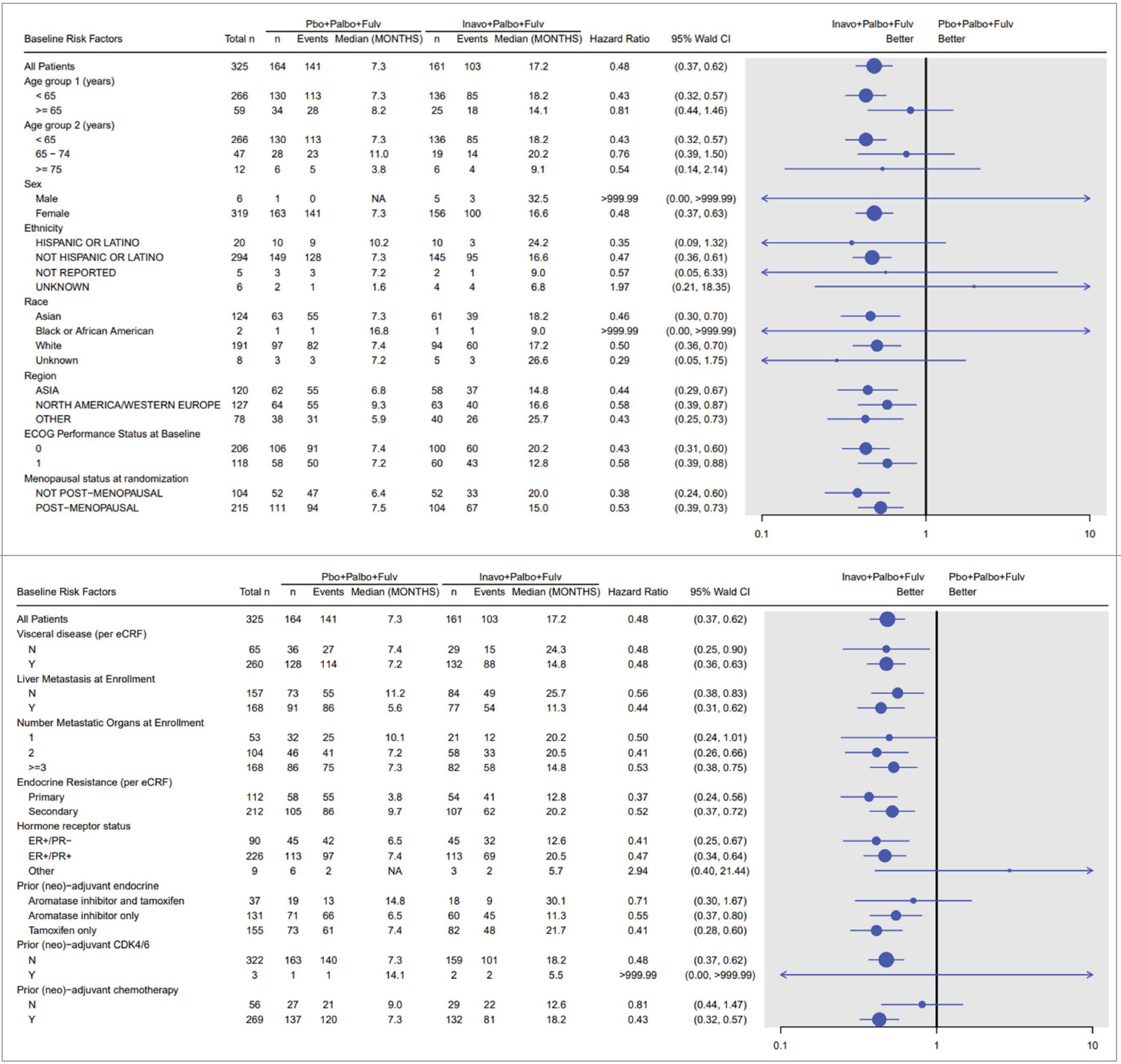
CI = confidence interval; ECOG = Eastern Cooperative Oncology Group; eCRF = electronic case report form; ER = estrogen receptor; FAS = full analysis set; FUL = fulvestrant; Fulv = fulvestrant; HR = hazard ratio; INA = inavolisib; Inavo = inavolisib; PAL = palbociclib; Palbo = palbociclib; PBO = placebo; Pbo = placebo; PFS = progression-free survival; PR = progesterone receptor.
Source: Update Clinical Study Report of Study WO41554 (INAVO120).30
Figure 9: Kaplan-Meier Plot for Time to End of Next-Line Treatment From the INAVO120 Study (FAS; Clinical Cut-Off Date of November 15, 2024)

FAS = full analysis set.
Source: Update Clinical Study Report of Study WO41554 (INAVO120).30
TPA Review
Abbreviations
CDA-AMC
Canada’s Drug Agency
CGP
comprehensive genomic profiling
ctDNA
circulating tumour DNA
HTA
health technology assessment
NGS
next-generation sequencing
PCR
polymerase chain reaction
Objective
The objective of this Testing Procedure Assessment is to identify and describe important health system implications of testing for PIK3CA mutations in adult patients with endocrine-resistant, hormone receptor–positive, HER2-negative, locally advanced or metastatic breast cancer, following recurrence on or after completing adjuvant endocrine treatment to determine eligibility for inavolisib in combination with a CDK4/6 inhibitor and fulvestrant.
Methods
The contents within this section have been informed by materials submitted by the sponsor, a literature search, and clinical expert input as well as input from patient and clinician groups collected as part of the review.
Materials submitted by the sponsor related to the diagnostic test were validated when possible and summarized by the review team.
The literature search strategy used in this report is an update of one developed for a previous report by Canada’s Drug Agency (CDA-AMC).1 For the current report, an information specialist conducted a literature search on key resources including MEDLINE, the Cochrane Database of Systematic Reviews, the International HTA Database, the websites of health technology assessment (HTA) agencies in Canada and major international HTA agencies, as well as a focused internet search. The search approach was customized to retrieve a limited set of results, balancing comprehensiveness with relevancy. The search strategy comprised both controlled vocabulary, such as the National Library of Medicine’s MeSH (Medical Subject Headings), and keywords. The main search concept was PIK3CA testing. The initial search was limited to English-language documents published between January 1, 2019, and March 12, 2024. For the current report, the original database search was revised and rerun on March 14, 2025, to capture any documents specifically about PIK3CA published or made available since the initial search date. The grey literature search was also updated to include documents published since March 2024.
Clinical expert input was provided by 2 clinical specialists with expertise in the diagnosis and management of breast cancer. Input from 4 patient groups (Breast Cancer Canada, the McPeak-Sirois Group for Clinical Research in Breast Cancer, the Canadian Breast Cancer Network, and Rethink Breast Cancer) was used to inform patients’ perspectives on access to PIK3CA mutation testing in breast cancer.
Context
What Are PIK3CA Mutations?
The PI3K pathway, part of the larger PI3K-AKT-mTOR pathway, is 1 step in a signalling cascade that is important for cell metabolism, growth, proliferation, and survival.2-5 Activation of the PI3K pathway has been linked to oncogenesis across multiple tumour types, such as endometrial, breast, and lung.6 Key enzymes in this pathway include a group of lipid kinases, collectively known as PI3K.4,6 Activating mutations in the PIK3CA gene results in the hyperactivation of p110 alpha subunit, increasing PI3K enzymatic activity, which in turn, trigger downstream effects in the larger PI3K-AKT-mTOR pathway.5
PIK3CA mutations are present in an estimated 40% of hormone receptor–positive, HER2-negative breast cancers.7-11 PIK3CA mutated advanced breast cancer is associated with poorer outcomes, such as decreased overall survival, shorter progression free survival, and chemoresistance.9,12,13 In addition, individuals with PIK3CA mutations are more likely to have endocrine-resistant breast cancer.3
Although mutations can occur anywhere along the PIK3CA gene, most pathogenic variants seen in breast cancer are found in a few hotspot locations, notably in exons 20 and 9.2,4,7,10,14 The INAVO120 trial prespecified a selection of more than 50 activating PIK3CA mutations for inclusion eligibility, including frequently encountered mutations in exon 20 (e.g., H1047R variant) and exon 9 (e.g., E545K and E542K variants).14,15 The H1047R, E545K, and E542K variants are found in 38%, 21%, and 13% of PIK3CA-mutated advanced breast cancers, respectively.14 More than 1 PIK3CA variant is present in approximately 12% of PIK3CA-mutated tumours.10
How Are PIK3CA Mutations Identified?
PIK3CA mutations can be detected in tumour cells using genomic testing methods, such as next-generation sequencing (NGS) and polymerase chain reaction (PCR). The number and types of PIK3CA variants identified can differ by the panel used for testing. NGS methods range from comprehensive genomic profiling (CGP), which will generally test the entirety of the protein-coding regions of the hundreds of genes, to targeted panels with more limited gene and exon coverage included in the specific panel.16,17 NGS can be used to identify a variety of mutation types, including single nucleotide variants, small indels, copy number variants, rearrangements, and fusions.14,16,17 Conversely, PCR-based hotspot mutation panels can be used to detect a limited number and type of variants.17
DNA for genomic testing can be extracted from formalin-fixed paraffin-embedded tissue samples obtained through core or excisional biopsy of the primary or metastatic tumour.18,19 Circulating tumour DNA (ctDNA), collected using a peripheral blood sample, can also be used to test for mutations using NGS.20 Testing using ctDNA could be an alternative for patients in whom a traditional biopsy is contraindicated or challenging to perform.21 The clinical experts noted that ctDNA testing could be a promising option if a rebiopsy is needed, since it is less invasive and has a quicker turnaround time compared to tissue biopsy. However, it should be noted that the current guidelines recommend validating a negative ctDNA result with tumour tissue testing due to the lower sensitivity of ctDNA testing.22
In the INAVO120 trial, PIK3CA mutations were identified by either a blood or tissue sample representative of a metastatic site of disease and tested with a validated PCR-based or NGS-based assay.15 International guidelines recommend NGS testing of tumour or plasma samples as standard of care in patients with advanced hormone receptor–positive, HER2-negative breast cancer.22,23 NGS is preferred over PCR since it can test for multiple biomarkers at once rather than sequentially, which saves time, consumes less tissue, and could pre-emptively identify biomarker status to inform eligibility for future targeted therapies.17,21
What Is the Current Testing Practice for Breast Cancer in Canada?
In Canada, the hormone receptor and HER2 phenotype is determined using tissue from the core needle biopsy or the surgically resected tumour as part of the initial diagnostic work-up.18,19,24 After the completion of primary treatment, if cancer recurrence is suspected, a tissue biopsy is recommended, when feasible, to confirm the cancer is truly recurrent and not a new primary lesion.19,25
An expert review of recommended practice in Canada for hormone receptor–positive, HER2-negative advanced breast cancer treatment in the first-line setting advised that hormone receptor and HER2 phenotype reassessment should be done at the time of cancer progression to advanced or metastatic cancer.26 Mutational status testing of PIK3CA may also be done at this time, to determine eligibility for targeted treatment. Tissues from either the recent metastatic biopsy or archival tissue from the primary tumour can be used to determine PIK3CA mutation status. At the time of this review, testing for PIK3CA mutations in breast cancer is not standard of care in Canada. The clinical experts consulted for this review mentioned that, when PIK3CA mutation status is tested, it is mostly conducted at the time of metastatic diagnosis. They also noted that, in Canada, PIK3CA mutation testing is usually performed using NGS.
Testing Procedure Considerations
What Are Some Health System-Related Considerations?
Number of Individuals in Canada Expected to Require the Test
Breast cancer is the most common type of cancer among females in Canada.27 In 2024, an estimated 30,500 females and 290 males were diagnosed with breast cancer.27,28 Among them, an estimated 64.8% would have hormone receptor–positive, HER2-negative breast cancer.29 According to materials provided by the sponsor, about 1,100 individuals with hormone receptor–positive, HER2-negative locally advanced or metastatic disease are estimated to experience disease relapse with endocrine resistance yearly in Canada, excluding Quebec. The sponsor assumed only those with non–diabetes-related disease would be tested (in alignment with the INAVO120 exclusion criteria) and a testing uptake of 80%.15,30 This corresponds to around 747 individuals who would receive testing for PIK3CA mutations in 2025 to determine eligibility for treatment with inavolisib in combination with a CDK4/6 inhibitor and fulvestrant.30
As the clinical experts noted, at present, testing mostly occurs around the time of diagnosis of hormone receptor–positive, HER2-negative metastatic breast cancer. This corresponds to an estimated testing population of around 1,940 individuals, regardless of diabetes status or endocrine resistance, with metastatic disease relapse who have received chemotherapy and adjuvant endocrine therapy.30 A 2024 review from CDA-AMC estimated that 2,757 individuals with de novo or disease relapse would be tested for PIK3CA mutations at metastatic diagnosis to inform eligibility for a targeted second-line treatment.1 The experts agreed with the sponsor’s assumption that 80% of those eligible for testing would receive testing. They also remarked that if inavolisib were to be funded, the number of individuals with breast cancer getting tested for PIK3CA mutations would likely increase. Clinicians would likely also want to test as early as possible to direct future treatment planning.
Availability and Reimbursement Status of PIK3CA Mutation Testing in Jurisdictions Across Canada
Comprehensive NGS testing panels that include PIK3CA gene sequencing are available at large clinical centres throughout Canada. The type of panel available in each jurisdiction can be found in Table 1. However, although the diagnostic capability to test for PIK3CA mutations exists across Canada, several provinces send samples out of province for testing. For example, a clinical expert noted that samples from Manitoba, Saskatchewan, and British Columbia are currently being sent out of province to Alberta for PIK3CA testing through a drug manufacturer-sponsored testing access program, even though NGS panels are available in those provinces. PIK3CA testing using PCR is done in Canada; however, at the time of this review, details regarding its use are unclear.
Table 1: Available NGS Testing Panels for PIK3CA Mutation Detection per Province in Canada
Province | Panel |
|---|---|
Newfoundland and Labrador | Out-of-province testing in Nova Scotia |
Prince Edward Island | Out-of-province testing in New Brunswick |
Nova Scotia | AmpliSeq Focus Panel (Illumina) |
New Brunswick | Oncomine Comprehensive Assay Plus (Thermofisher) |
Quebec31 | AmpliSeq Focus Panel (Illumina) |
Ontario32 | Variable, but mostly Oncomine Comprehensive Assay V3 (Thermofisher) |
Manitoba33 | QIAseq Targeted DNA Panel (Qiagen) |
Saskatchewan | Oncomine Comprehensive Assay V3 (Thermofisher) |
Alberta34 | Cancer Biomarker Comprehensive DNA Panel |
British Columbia35 | Oncopanel (custom panel – Illumina sequencing) |
Yukon | Out-of-province testing |
Northwest Territories | Out-of-province testing |
Nunavut | Out-of-province testing |
NGS = next-generation sequencing.
Source: Adapted from CDA-AMC Reimbursement Review for capivasertib.1
NGS testing for patients with advanced or metastatic breast cancer is subject to various funding arrangements within Canada.1,36 According to the sponsor, public funding for PIK3CA mutation testing in breast cancer is available in Nova Scotia, New Brunswick, Quebec, and Ontario. A clinical expert consulted for this review mentioned that funded PIK3CA testing using NGS is currently being set up in Manitoba, Saskatchewan, and British Columbia. It is unclear if there are any impending provincial funding programs for the other provinces and territories. In jurisdictions where PIK3CA mutation testing is not publicly funded, patients may have to rely on other options, such as testing access programs, clinical trials, private insurance, or out-of-pocket payment. The clinical experts noted that funding from drug manufacturers may be available in some jurisdictions.
At present, PIK3CA testing using ctDNA is not publicly funded anywhere in Canada for breast cancer and the scope of its availability across the country is unclear. Some jurisdictions already have ctDNA panels that include PIK3CA mutation testing available for other cancer types, but it is unclear if these are suitable for use in breast cancer.37 One clinical expert noted that Manitoba and British Columbia are looking into publicly funded access to ctDNA testing for PIK3CA mutations in patients with breast cancer.
Expected Timing and Frequency of PIK3CA Mutation Testing
International guidelines recommend testing for PIK3CA mutations at the time of new or recurrent metastatic breast cancer diagnosis as part of routine clinical practice.38-41 In Canada, the timing of PIK3CA mutation testing on primary or metastatic tumour tissue in current practice is variable and can depend on centre-specific protocols. For example, the clinical experts described how some centres will proactively test for PIK3CA mutations at metastatic diagnosis, whereas other centres will test only when considering second-line therapy. In areas of the country where testing is not routinely done, oncologists would need to specifically request this test, which could also lead to variability in the timing of testing. The clinical experts agreed with the guidelines to test at the time of metastatic diagnosis to potentially benefit from any future targeted therapies developed for this patient population as they become available. The clinical experts also mentioned that to fully leverage future targeted therapy options, the optimal timing for testing could potentially be at the initial diagnosis of hormone receptor–positive, HER2-negative breast cancer. This would be consistent with biomarker testing practices seen in other cancer types such as lung.42
PIK3CA mutations tend to arise early in the tumorigenesis process and usually stay stable once they occur.11,43,44 This has several implications for testing. First, genomic testing could be done at any point during the treatment pathway, including on the initial biopsy or surgical resection specimen, before cancer progression or endocrine resistance occurs. Second, if a PIK3CA mutation is identified, the test would not need to be repeated. Similarly, a PIK3CA mutation found using archival tissue would be considered actionable. If the testing is done at the first diagnosis of hormone receptor–positive, HER2-negative breast cancer and no mutation is found using the primary tumour tissue, the clinical experts remarked that retesting for PIK3CA mutations can be performed if the cancer progresses to more advanced disease. This can be done either on a new tissue biopsy sample of the primary or metastatic tumours, or on ctDNA collected using a peripheral blood sample. The clinical experts remarked that it is routine practice in Canada to do a tissue biopsy to confirm suspected recurrence of breast cancer.
Expected Impacts of Testing for PIK3CA Mutations in Metastatic Hormone Receptor–Positive, HER2-Negative Breast Cancer to Human and Other Health Care Resources
Implementation of testing for PIK3CA mutations in individuals with hormone receptor–positive, HER2-negative locally advanced or metastatic breast cancer may have substantial resource and infrastructure impacts. These impacts include increased workloads for laboratory and clinical personnel, increased demand for genetic counselling services, and upscaling of existing capacities and workflows to meet an increase in testing.1 The clinical experts mentioned that pathology laboratory workloads would likely increase with the increased uptake in testing as more targeted treatments become available for this patient population. They also mentioned that there is currently momentum to get PIK3CA mutation testing established as the standard of care in this patient population, but this has yet to be fully realized. Regions or centres without established PIK3CA testing will have to address these implementation challenges as the clinical landscape evolves.
What Are Some Patient-Related Considerations?
Accessibility of PIK3CA Mutation Testing in Jurisdictions Across Canada
The clinical experts said that, previously, PIK3CA mutation testing for individuals with metastatic hormone receptor–positive, HER2-negative breast cancer was available through testing access programs or clinical trials; however, these are now being discontinued. The clinical experts did confirm that they are seeing an increase in testing uptake in their jurisdictions. Access still varies between and within jurisdictions. Input from patient groups echoed this, citing that timely, equitable, and publicly funded access to biomarker testing is a concern for patients with breast cancer in Canada. Furthermore, individuals living in rural or remote areas may experience increased difficulties in accessing biopsy and genomic testing services.21 If inavolisib were to be funded, patients may experience access issues in the short-term while funding and infrastructure are established. However, this will likely resolve over time since, according to the clinical experts, testing for PIK3CA mutations in breast cancer is expected to become standard of care in Canada.
Additionally, access to ctDNA testing is currently limited in Canada. According to the clinical experts, very few individuals in Canada are receiving PIK3CA mutation testing by ctDNA. They cited the main barriers were availability and financial concerns. Access to ctDNA testing for individuals with breast cancer in Canada is mainly acquired through testing access programs, clinical trials, private funding, or out-of-pocket payment.
Expected Turnaround Times for PIK3CA Mutation Testing
According to the clinical experts consulted for this review, turnaround time for a comprehensive NGS panel or focused hotspot mutation testing is around 1 to 2 weeks, which is an acceptable time frame. Due to the variability in the timing of testing, certain individuals with hormone receptor–positive, HER2-negative metastatic breast cancer may start on CDK4/6 and endocrine therapy before their PIK3CA mutation status is known. The clinical experts confirmed that inavolisib could be added afterward once eligibility is established, but this should occur within 2 to 3 months of starting CDK4/6 and endocrine therapy. A 2024 patient survey on access to biomarker and CGP testing in Canada found that 40% of patients, across multiple tumour sites, waited over 4 weeks from testing to results.17 Delays in turnaround time can occur for a variety of reasons, such as when samples need to be sent out of centre or out of province for testing, or when a repeat biopsy is needed due to insufficient tissue.17,21 The clinical experts mentioned that funded access to ctDNA testing could help mitigate testing delays when a repeat sample is required, since a blood sample is easier and less invasive to procure, and more efficient to ship and process.
Burden Associated With PIK3CA Mutation Testing for Patients, Families, and/or Caregivers
The clinical experts consulted for this review mentioned that there could be psychological burden on patients related to testing such as anxiety of waiting, and possible distress if results were unfavourable. Conversely, availability of a targeted treatment option may alleviate some of this burden.45 The experts noted that a skilled care team, including a knowledgeable treating physician or oncologist and access to genetic counselling if desired, is crucial to help patients navigate the possible emotional effects of biomarker testing.16,21
Some patients may require an additional tumour biopsy in instances where there is not enough biopsy tissue available from the primary lesion or metastatic lesion to test for PIK3CA mutations. Patients who require an additional biopsy may experience potential adverse events from the procedure, including pain or emotional distress. They may also face time or financial burden due to, for example, the need to take time off work or arrange travel to the clinical centre.17
What Are Some Clinical Considerations?
Clinical Utility and Diagnostic Accuracy of PIK3CA Mutation Testing
The sponsor claimed that PCR testing can identify approximately 85% to 90% of actionable PIK3CA mutations.46 A 2023 study that analyzed the PIK3CA mutations detected by CGP using the FoundationOne or FoundationOne CDx assays in tissue samples of patients with advanced breast cancer found that around 19.5% of PIK3CA mutations identified by CGP would not have been identified by the therascreen PIK3CA PCR assay that covers 11 hotspot mutations of the PIK3CA gene.14 A subanalysis comparing the therascreen PIK3CA PCR assay to CGP as a reference standard found the sensitivity of the PCR assay to detect the 11 prespecified PIK3CA mutations was 86%. The sensitivity was 70% when considering all PIK3CA mutations.14 Another study found that 5 of 18 patients with hormone receptor–positive, HER2-negative advanced breast cancer (28%) had PIK3CA mutations that were not covered by the therascreen PIK3CA PCR kit.10 The FoundationOne CDx and therascreen assays are both companion diagnostic devices for other therapies developed for PIK3CA-mutated advanced or metastatic breast cancer.14 The clinical experts acknowledged that using hotspot assays with partial gene coverage may miss some PIK3CA mutations. Patients who would otherwise be eligible for inavolisib, may not receive the drug if they have a PIK3CA variant not covered by the test. Conversely, more comprehensive NGS profiling can potentially identify PIK3CA mutations that were not specified in the INAVO120 trial. The clinical experts stated that they would consider any PIK3CA mutation actionable in clinical practice in the current absence of granular data for each variant.
Concordance between tissue-based and liquid-based assays can vary but is generally high.7 A comparison of a plasma-based CGP assay (FoundationOne Liquid CDx) to the tissue CGP (FoundationOne CDx) showed a positive percent agreement to detect PIK3CA mutations of 77% (95% confidence interval, 65% to 86%) and a negative percent agreement of 90% (95% confidence interval, 84% to 94%). The positive percent agreement improved to 95% when the ctDNA fraction was greater than 2%.14 The FoundationOne Liquid CDx assay was used in the INAVO120 trial.15
There is evidence supporting the clinical utility of using NGS testing to identify actionable mutations in breast cancer. A retrospective review of patients with breast cancer or gynecological malignancies found that NGS results aided in clinical decision-making in 41% of patients with breast cancer, although this may not have translated into an increase in overall survival.47 Another retrospective review found that NGS results guided the treatment recommendations for 32% of patients with metastatic breast cancer.48 It should be noted that the CDA-AMC review team has not critically appraised these publications.
What Are Some Cost Considerations?
Projected Cost of PIK3CA Mutation Testing
Testing costs will depend on the type of testing used. A recent CDA-AMC review on another targeted therapy in individuals with hormone receptor–positive, HER2-negative advanced or metastatic breast cancer reported an estimated cost of $750 per test for an NGS panel.1 A similar review from the Institut national d’excellence en santé et en services sociaux (INESSS) estimated that, depending on the NGS panel used to identify PIK3CA mutations, the weighted cost (that includes all resource costs) would range from $524 to $772 per test.49 The FoundationOne Liquid CDx assay costs US$3,500 by private pay.50 It is unclear if there are locally available ctDNA options that are less expensive. PCR-based tests generally cost less than NGS testing methods. For example, a PCR-based assay available in Quebec covering 11 PIK3CA mutations across exons 7, 9, and 20 has a weighted cost of $235.51 One clinical expert noted that as the number of PIK3CA mutation testing increases, NGS testing costs per sample could decrease since NGS testing panels can be run on multiple patient samples in parallel. At present, patients in locations without available publicly funded testing may have to access PIK3CA testing through private payment options.
References
1.Canada's Drug Agency. Reimbursement Review: Capivasertib (Truqap). Can J Health Technol. 2025;vol 5(iss 1). doi: DOI https://doi.org/10.51731/cjht.25.1055
2.Chang DY, Ma WL, Lu YS. Role of Alpelisib in the Treatment of PIK3CA-Mutated Breast Cancer: Patient Selection and Clinical Perspectives. Ther Clin Risk Manag. 2021;17(0):193-207. doi: 10.2147/TCRM.S251668 PubMed
3.Nunnery SE, Mayer IA. Targeting the PI3K/AKT/mTOR Pathway in Hormone-Positive Breast Cancer. Drugs. 2020;80(16):1685-1697. doi: 10.1007/s40265-020-01394-w PubMed
4.Samuels Y, Velculescu VE. Oncogenic mutations of PIK3CA in human cancers. Cell Cycle. 2004;3(10):1221-4. doi: 10.4161/cc.3.10.1164 PubMed
5.Tufail M, Hu JJ, Liang J, et al. Predictive, preventive, and personalized medicine in breast cancer: targeting the PI3K pathway. J Transl Med. 2024;22(1):15. doi: 10.1186/s12967-023-04841-w PubMed
6.Thorpe LM, Yuzugullu H, Zhao JJ. PI3K in cancer: divergent roles of isoforms, modes of activation and therapeutic targeting. Nat Rev Cancer. 2015;15(1):7-24. doi: 10.1038/nrc3860 PubMed
7.Anderson EJ, Mollon LE, Dean JL, et al. A Systematic Review of the Prevalence and Diagnostic Workup of PIK3CA Mutations in HR+/HER2- Metastatic Breast Cancer. Int J Breast Cancer. 2020;2020(1):3759179. doi: 10.1155/2020/3759179 PubMed
8.Stemke-Hale K, Gonzalez-Angulo AM, Lluch A, et al. An integrative genomic and proteomic analysis of PIK3CA, PTEN, and AKT mutations in breast cancer. Cancer Res. 2008;68(15):6084-91. doi: 10.1158/0008-5472.CAN-07-6854 PubMed
9.Fillbrunn M, Signorovitch J, Andre F, et al. PIK3CA mutation status, progression and survival in advanced HR + /HER2- breast cancer: a meta-analysis of published clinical trials. BMC Cancer. 2022;22(1):1002. doi: 10.1186/s12885-022-10078-5 PubMed
10.Martinez-Saez O, Chic N, Pascual T, et al. Frequency and spectrum of PIK3CA somatic mutations in breast cancer. Breast Cancer Res. 2020;22(1):45. doi: 10.1186/s13058-020-01284-9 PubMed
11.Park J, Cho SY, Chang ES, et al. Analysis of PIK3CA Mutation Concordance and Frequency in Primary and Different Distant Metastatic Sites in Breast Cancer. Cancer Res Treat. 2023;55(1):145-154. doi: 10.4143/crt.2022.001 PubMed
12.Mosele F, Stefanovska B, Lusque A, et al. Outcome and molecular landscape of patients with PIK3CA-mutated metastatic breast cancer. Ann Oncol. 2020;31(3):377-386. doi: 10.1016/j.annonc.2019.11.006 PubMed
13.Mollon LE, Anderson EJ, Dean JL, et al. A Systematic Literature Review of the Prognostic and Predictive Value of PIK3CA Mutations in HR(+)/HER2(-) Metastatic Breast Cancer. Clin Breast Cancer. 2020;20(3):e232-e243. doi: 10.1016/j.clbc.2019.08.011 PubMed
14.Rugo HS, Raskina K, Schrock AB, et al. Biology and Targetability of the Extended Spectrum of PIK3CA Mutations Detected in Breast Carcinoma. Clin Cancer Res. 2023;29(6):1056-1067. doi: 10.1158/1078-0432.Ccr-22-2115 PubMed
15.INAVO120 (WO41554) Study Protocol. Version 8. 2019. Roche Data on File.
16.Yip S, Christofides A, Banerji S, et al. A Canadian guideline on the use of next-generation sequencing in oncology. Curr Oncol. 2019;26(2):e241-e254. doi: 10.3747/co.26.4731 PubMed
17.Sheffield BS, Banerji S, Chankowsky A, et al. Toward Timely and Equitable Advanced Biomarker Testing for Patients with Metastatic Cancer in Canada. Curr Oncol. 2025;32(3). doi: 10.3390/curroncol32030141 PubMed
18.Cancer Care Ontario. Breast Cancer Screening and Diagnosis Pathway Map Version 2024.10. 2024. Accessed April 01, 2025. https://www.cancercareontario.ca/sites/ccocancercare/files/assets/BreastCancerScreeningandDiagnosisPathwayMap.pdf
19.BC Cancer. Breast Cancer Management Guidelines. 2017. Accessed April 01, 2025. https://www.bccancer.bc.ca/books/breast
20.Amato O, Giannopoulou N, Ignatiadis M. Circulating tumor DNA validity and potential uses in metastatic breast cancer. NPJ Breast Cancer. 2024;10(1):21. doi: 10.1038/s41523-024-00626-6 PubMed
21.Snow S, Brezden-Masley C, Carter MD, et al. Barriers and Unequal Access to Timely Molecular Testing Results: Addressing the Inequities in Cancer Care Delays across Canada. Curr Oncol. 2024;31(3):1359-1375. doi: 10.3390/curroncol31030103 PubMed
22.Henry NL, Somerfield MR, Dayao Z, et al. Biomarkers for Systemic Therapy in Metastatic Breast Cancer: ASCO Guideline Update. J Clin Oncol. 2022;40(27):3205-3221. doi: 10.1200/jco.22.01063 PubMed
23.Mosele MF, Westphalen CB, Stenzinger A, et al. Recommendations for the use of next-generation sequencing (NGS) for patients with advanced cancer in 2024: a report from the ESMO Precision Medicine Working Group. Ann Oncol. 2024;35(7):588-606. doi: 10.1016/j.annonc.2024.04.005 PubMed
24.Cancer Care Ontario. Breast Cancer Treatment Pathway Map Version 2024.04. 2024. Accessed April 01, 2025. https://www.cancercareontario.ca/sites/ccocancercare/files/assets/BreastCancerTreatmentPathwayMap.pdf
25.Cancer Care Ontario. Breast Cancer Follow‐up Pathway Map Version 2024.04. 2024. Accessed April 01, 2025. https://www.cancercareontario.ca/sites/ccocancercare/files/assets/BreastCancerFollowUpPathwayMap.pdf
26.Jerzak KJ, Bouganim N, Brezden-Masley C, et al. HR+/HER2- Advanced Breast Cancer Treatment in the First-Line Setting: Expert Review. Curr Oncol. 2023;30(6):5425-5447. doi: 10.3390/curroncol30060411 PubMed
27.Canadian Cancer Society. Breast cancer statistics. 2024.
28.Brenner DR, Gillis J, Demers AA, et al. Projected estimates of cancer in Canada in 2024. CMAJ. 2024;196(18):E615-E623. doi: 10.1503/cmaj.240095 PubMed
29.Seung SJ, Traore AN, Pourmirza B, Fathers KE, Coombes M, Jerzak KJ. A population-based analysis of breast cancer incidence and survival by subtype in Ontario women. Curr Oncol. 2020;27(2):e191-e198. doi: 10.3747/co.27.5769 PubMed
30.Hoffmann-La Roche Limited. Budget Impact Analysis [internal sponsor's report]. In: Drug Reimbursement Review sponsor submission: inavolisib, 3 mg and 9mg, oral tablets. 2025.
31.Centre Universitaire de Santé Mcgill. AmpliSeq Focus Panel – Preparation and Shipping Guidelines. 2023. Accessed April 01, 2025. https://muhc.ca/sites/default/files/docs/m-Labs/ampliseq-focus-panel-test-information-instructions-en.pdf
32.Eastern Ontario Regional Laboratory Association. Molecular Oncology Diagnostics - NGS biomarkers info sheet. 2022. Accessed April 01, 2025. https://www.eorla.ca/wp-content/uploads/2022/04/Molecular-Oncology-Diagnostics-NGS-biomarkers-info-sheet.pdf
33.Cancer Care Manitoba. 2022 Provincial Cancer Care Conference: Deciphering Anticancer Drugs The Increasing Role of Pharmacogenomics and Pharmacogenetics in Treatment Optimization – Danica Wasney. 2022. Accessed April 01, 2025. https://www.cancercare.mb.ca/export/sites/default/For-Health-Professionals/.galleries/files/Provincial-Cancer-Care-Conference/Deciphering-Anticancer-Drugs-Danica-Wasney-November-18-2022.pdf
34.Alberta Precision Laboratories. Cancer Biomarker Comprehensive DNA Panel, Tumor. 2024. Accessed April 01, 2025. https://www.albertahealthservices.ca/webapps/labservices/indexAPL.asp?id=9362&tests=&zoneid=1&details=true
35.BC Cancer. OncoPanel. Updated April 01, 2025. https://cancergeneticslab.ca/genes/oncopanel/
36.Weymann D, Dragojlovic N, Pollard S, Regier DA. Allocating healthcare resources to genomic testing in Canada: latest evidence and current challenges. J Community Genet. 2022;13(5):467-476. doi: 10.1007/s12687-019-00428-5 PubMed
37.Alberta Precision Laboratories. Tumour Cell Free DNA NGS Testing (Referred Test). 2025. Accessed April 01, 2025. https://www.albertahealthservices.ca/webapps/labservices/indexAPL.asp?id=9470&tests=&zoneid=1&details=true
38.European Society for Medical Oncology. ESMO Metastatic Breast Cancer Living Guideline, v1.2 April 2025. 2025. Accessed April 15, 2025. https://www.esmo.org/living-guidelines/esmo-metastatic-breast-cancer-living-guideline
39.Gennari A, André F, Barrios CH, et al. ESMO Clinical Practice Guideline for the diagnosis, staging and treatment of patients with metastatic breast cancer. Ann Oncol. 2021;32(12):1475-1495. doi: 10.1016/j.annonc.2021.09.019 PubMed
40.Network NCC. Nationale Comprehensive Cancer Network (NCCN) Clinical Practice Guidelines in Oncology (NCCN Guidelines®). Breast Cancer Version 1. 2025. 2025.
41.Oncology ASoC. Breast Cancer Guidelines. 2021.
42.Ionescu DN, Stockley TL, Banerji S, et al. Consensus Recommendations to Optimize Testing for New Targetable Alterations in Non-Small Cell Lung Cancer. Curr Oncol. 2022;29(7):4981-4997. doi: 10.3390/curroncol29070396 PubMed
43.Miron A, Varadi M, Carrasco D, et al. PIK3CA mutations in in situ and invasive breast carcinomas. Cancer Res. 2010;70(14):5674-8. doi: 10.1158/0008-5472.Can-08-2660 PubMed
44.Wang Y, Li X, Zhang S, et al. Analysis of PIK3CA mutations in the primary and recurrent tumors of hormone receptor positive/human epidermal growth factor receptor 2 negative breast cancer. Jpn J Clin Oncol. 2024;54(9):1024-1031. doi: https://dx.doi.org/10.1093/jjco/hyae072 PubMed
45.NICE. Alpelisib with fulvestrant for treating hormone receptor-positive, HER2-negative, PIK3CAmutated advanced breast cancer. 2022. https://www.nice.org.uk/guidance/ta816/resources/alpelisib-with-fulvestrant-for-treating-hormone-receptorpositive-her2negative-pik3camutated-advanced-breast-cancer-pdf-82613313714373
46.Hoffmann-La Roche-Health Canada Meeting Minutes [internal report]. Drug Reimbursement Review sponsor submission: inavolisib, 3 mg and 9mg, oral tablets. Hoffmann-La Roche Limited; 2025.
47.Jones TE, Zou J, Tseng GC, Roy S, Bhargava R. The Utility of Next-Generation Sequencing in Advanced Breast and Gynecologic Cancers. Am J Clin Pathol. 2021;156(3):455-460. doi: 10.1093/ajcp/aqaa256 PubMed
48.Hempel D, Ebner F, Garg A, et al. Real world data analysis of next generation sequencing and protein expression in metastatic breast cancer patients. Sci Rep. 2020;10(1):10459. doi: 10.1038/s41598-020-67393-9 PubMed
49.INESSS. Test compagnon de Truqap. 2024. Accessed April 01, 2025. https://www.inesss.qc.ca/fileadmin/doc/INESSS/Inscription_medicaments/Avis_au_ministre/Novembre_2024/Truqap_TC_2024_10.pdf
50.Medicine F. Patient FAQs. 2025. Accessed April 01, 2025. https://www.foundationmedicine.com/faq/patient-faqs
51.MSSS. Répertoire québécois et système de mesure des procédures de biologie médicale – Édition 2024-2025. 2024. Accessed April 01, 2025. https://publications.msss.gouv.qc.ca/msss/document-003725/
Pharmacoeconomic Review
Abbreviations
ABE
abemaciclib
BIA
budget impact analysis
CAP
capivasertib
CDA-AMC
Canada’s Drug Agency
FUL
fulvestrant
ICER
incremental cost-effectiveness ratio
INA
inavolisib
NMA
network meta-analysis
ODB
Ontario Drug Benefit
OS
overall survival
PAL
palbociclib
PBO
placebo
pCPA
pan-Canadian Pharmaceutical Alliance
PD1
first progressive disease
PD2
second progressive disease
PFS
progression-free survival
PFS2
second objective disease progression
QALY
quality-adjusted life-year
RIB
ribociclib
Economic Review
The objective of the economic review undertaken by Canada’s Drug Agency (CDA-AMC) is to review and critically appraise the pharmacoeconomic evidence submitted by the sponsor on the cost-effectiveness and budget impact of inavolisib in combination with palbociclib and fulvestrant (INA + PAL + FUL) compared to placebo plus palbociclib plus fulvestrant (PBO + PAL + FUL), ribociclib plus fulvestrant (RIB + FUL), and abemaciclib plus fulvestrant (ABE + FUL) for the treatment of adult patients with endocrine-resistant, PIK3CA-mutated, hormone receptor–positive, HER2-negative, locally advanced or metastatic breast cancer, following recurrence on or after completing adjuvant endocrine treatment.1 The sponsor submitted a cost-effectiveness analysis for the requested reimbursement population — patients receiving INA with a CDK4/6 inhibitor and FUL. This reimbursement request is broader than the Health Canada indication, which specifies PAL as the CDK4/6 inhibitor.2
Item | Description |
|---|---|
Drug product | Inavolisib (Itovebi), 3 mg and 9 mg tablets |
Indication | Inavolisib, in combination with palbociclib and fulvestrant, is indicated for the treatment of adult patients with endocrine-resistant, PIK3CA-mutated, hormone receptor (HR)–positive, human epidermal growth factor receptor 2 (HER2)–negative, locally advanced or metastatic breast cancer, following recurrence on or after completing adjuvant endocrine treatment |
Submitted price | Inavolisib: $298.79 per 3 mg tablet Inavolisib: $597.57 per 9 mg tablet |
Health Canada approval status | NOC |
Health Canada review pathway | Priority review, Orbis |
NOC date | February 14, 2025 |
Reimbursement request | Inavolisib in combination with a CDK4/6 inhibitor and fulvestrant for the treatment of adult patients with endocrine-resistant, PIK3CA-mutated, hormone receptor (HR)–positive, human epidermal growth factor receptor 2 (HER2)-negative, locally advanced or metastatic breast cancer, following recurrence on or after completing adjuvant endocrine treatment |
Sponsor | Hoffmann-La Roche Limited |
Submission history | Previously reviewed: No |
NOC = Notice of Compliance.
Summary
INA is available as 3 mg and 9 mg tablets.2 At the submitted price of $298.79 per 3 mg tablet and $597.57 per 9 mg tablet, the cost of INA per 28-day cycle is expected to be $16,732 per patient, based on the Health Canada–recommended dosage. When INA is used in combination with PAL and FUL, the 28-day cycle cost is expected to range from $19,806 to $20,214 per patient.
Clinical efficacy in the economic analysis was derived from the INAVO120 trial, which compared INA + PAL + FUL with PBO + PAL + FUL.3 Evidence from the INAVO120 trial suggests that INA + PAL + FUL results in an increase in progression-free survival (PFS) and likely results in an increase in overall survival (OS) compared with PBO + PAL + FUL among patients with endocrine-resistant, hormone receptor–positive, HER2-negative, locally advanced or metastatic breast cancer with a PIK3CA mutation whose disease progressed on or after completing adjuvant endocrine therapy and who had not received prior systemic therapy for locally advanced or metastatic breast cancer. For the comparison of INA + PAL + FUL with RIB + FUL and with ABE + FUL, clinical efficacy was informed by sponsor-submitted indirect treatment comparisons.4 The results of these comparisons are based on interim OS data from the INAVO120 study, which have important implications for imprecision and preclude any definitive conclusions about the direction of the treatment effect.
The results of the CDA-AMC base case suggest the following:
INA + PAL + FUL may be associated with higher costs to the health care system than PBO + PAL + FUL (incremental costs = $394,507) and RIB + FUL (incremental costs = $382,297), primarily driven by increased drug-acquisition costs associated with INA.
INA + PAL + FUL may be associated with a gain of 0.60 life-years compared to PBO + PAL + FUL and 1.02 life-years compared to RIB + FUL. INA + PAL + FUL is anticipated to improve health-related quality of life based on time in health states, where it may result in a gain of 0.58 quality-adjusted life-years (QALYs) compared to PBO + PAL + FUL and 0.95 QALYs compared to RIB + FUL.
The incremental cost-effectiveness ratio (ICER) of INA + PAL + FUL compared to PBO + PAL + FUL is $683,203 per QALY gained and $400,783 per QALY gained compared to RIB + FUL. The estimated ICERs were highly sensitive to both the predicted OS benefit and the drug-acquisition costs of INA. Notably, approximately 52% and 65% of the incremental benefit relative to PBO + PAL + FUL and RIB + FUL, respectively, was gained in the extrapolated period (i.e., after 34 months). Because the comparative evidence is uncertain and lacking beyond 34 months, the QALYs gained for patients receiving INA + PAL + FUL predicted in the CDA-AMC base case are highly uncertain and may be overestimated. Additional price reductions may therefore be required.
CDA-AMC estimates that the budget impact of reimbursing INA + PAL + FUL for the treatment of adult patients with endocrine-resistant, PIK3CA-mutated, hormone receptor–positive, HER2-negative, locally advanced or metastatic breast cancer will be approximately $120 million over the first 3 years of reimbursement compared to the amount currently spent on comparators, with an estimated expenditure of $140 million on INA + PAL + FUL over this period. The actual budget impact will depend on the number of people eligible for treatment and its uptake.
Summary of the Submitted Economic Evaluation
The sponsor submitted a cost-utility analysis to estimate the cost-effectiveness of INA + PAL + FUL from the perspective of a public health care payer in Canada over a lifetime horizon (46 years). The modelled population consisted of adult patients with endocrine-resistant, PIK3CA-mutated, hormone receptor–positive, HER2-negative locally advanced or metastatic breast cancer following recurrence on or after completing adjuvant endocrine therapy. The requested reimbursement population is broader than the Health Canada indication, as it includes the use of INA in combination with any CDK4/6 inhibitor and FUL. In contrast, the INAVO120 trial — which informed the Health Canada indication — evaluated INA specifically in combination with PAL and FUL.
The sponsor’s base case consisted of 3 pairwise cost-effectiveness results:
Compared with PBO + PAL + FUL: ICER = $625,192 per QALY gained (incremental costs = $409,314; incremental QALYs = 0.65)
Compared with RIB + FUL: ICER = $409,398 per QALY gained (incremental costs = $407,661; incremental QALYs = 1.00)
Compared with ABE + FUL: ICER = $347,807 per QALY gained (incremental costs = $425,517; incremental QALYs = 1.22).
Additional information about the sponsor’s submission is summarized in Appendix 3.
CDA-AMC identified several key issues with the sponsor’s analysis (refer to Table 2; full details are provided in Appendix 4).
Table 2: Key Issues With the Sponsor’s Economic Submission
Issue | What evidence is there to inform this issue? | How was this issue addressed by CDA-AMC? | Did CDA-AMC explore uncertainty in a scenario analysis? |
|---|---|---|---|
The scope of the reimbursement request is broader than the indication approved by Health Canada. | The sponsor assumed 70% PAL and 30% RIB use in the intervention group, despite no clinical evidence for INA + RIB + FUL in the INAVO120 study. | CDA-AMC assumed that all patients in the intervention group receive INA + PAL + FUL to align with the Health Canada indication and the INAVO120 study. | CDA-AMC conducted a scenario with 16% PAL and 84% RIB use in the intervention group. |
The comparative effectiveness of INA + PAL + FUL vs. RIB + FUL is highly uncertain. | The CDA-AMC clinical review could not determine the relative effectiveness of INA + PAL + FUL vs. RIB + FUL. | CDA-AMC could not address this issue in the base case due to lack of robust clinical evidence. | No scenario analysis — best available evidence was used in the CDA-AMC base case. |
The long-term OS benefit predicted for INA + PAL + FUL is highly uncertain. | The sponsor used OS models that did not provide the best statistical fit to the KM data. Clinical experts highlighted high uncertainty in long-term survival. | CDA-AMC selected models based on statistical fit and the clinical plausibility of OS. | To explore uncertainty, CDA‑AMC tested alternative OS distributions. |
The long-term PFS benefit predicted for PBO + PAL + FUL is not modelled appropriately. | The sponsor used PFS distributions that did not provide the best statistical fit to the KM data from the INAVO120 study. | CDA-AMC selected models based on statistical fit and clinical plausibility of PFS. | No scenario analysis — best available evidence was used in the CDA-AMC base case. |
The sponsor assumed a sustained treatment effect for INA + PAL + FUL, with no waning over time. | The sponsor assumed a sustained OS, PFS, and PFS2 benefit for INA + PAL + FUL, despite no supporting clinical evidence. | CDA-AMC assumed the effect of INA + PAL + FUL wanes from 21.3 to 60 months, with no effect beyond 60 months. | CDA-AMC conducted a scenario analysis with sustained OS, PFS, and PFS2 benefits. |
The cost of PIK3CA testing was excluded from the analysis. | PIK3CA testing is a companion diagnostic required to identify patients eligible for INA + PAL + FUL. | CDA-AMC included the cost of PIK3CA testing in the analysis. | No scenario analysis — best available evidence was used in the CDA-AMC base case. |
Drug-acquisition costs were not accurate. | RIB and FUL prices were not consistent with those in the ODB Formulary. | CDA-AMC applied the most recent unit costs for RIB and FUL, as listed in the ODB Formulary. | No scenario analysis — best available evidence was used in the CDA-AMC base case. |
The sponsor included ABE + FUL as a comparator in the analysis. | ABE + FUL is not a relevant comparator, as it did not reach a pCPA agreement5 and is not funded in any Canadian jurisdictions.6 | CDA-AMC excluded ABE + FUL from the analysis. | No scenario analysis — best available evidence was used in the CDA-AMC base case. |
The sponsor excluded CAP + FUL as a comparator from the analysis. | CAP + FUL is a relevant comparator, with a positive CDA-AMC recommendation7 and a pCPA LOI for this indication.8 | This issue could not be addressed. The cost-effectiveness of INA + PAL + FUL compared with CAP + FUL remains unknown. | No scenario analysis — best available evidence was used in the CDA-AMC base case. |
ABE = abemaciclib; CDA-AMC = Canada’s Drug Agency; CAP = capivasertib; FUL = fulvestrant; INA = inavolisib; KM = Kaplan-Meier; LOI = Letter of Intent; ODB = Ontario Drug Benefit; OS = overall survival; PAL = palbociclib; pCPA = pan-Canadian Pharmaceutical Alliance; PBO = placebo; PFS = progression-free survival; PFS2 = second objective disease progression; RIB = ribociclib; vs. = versus.
Note: Full details of the CDA-AMC identified issues are provided in Appendix 4.
CDA-AMC Assessment of Cost-Effectiveness
The CDA-AMC base case was derived by making changes to model parameter values and assumptions (refer to Table 7), in consultation with clinical experts. Detailed information about the base case is provided in Appendix 4.
Impact on Health Care Costs
INA + PAL + FUL is predicted to be associated with additional health care costs compared to PBO + PAL + FUL (incremental costs = $394,507) and RIB + FUL (incremental costs = $382,297). In both comparisons, differences in health care spending were primarily owing to differences in drug-acquisition costs (refer to Figure 1).
Figure 1: Impact of INA + PAL + FUL on Health Care Costs
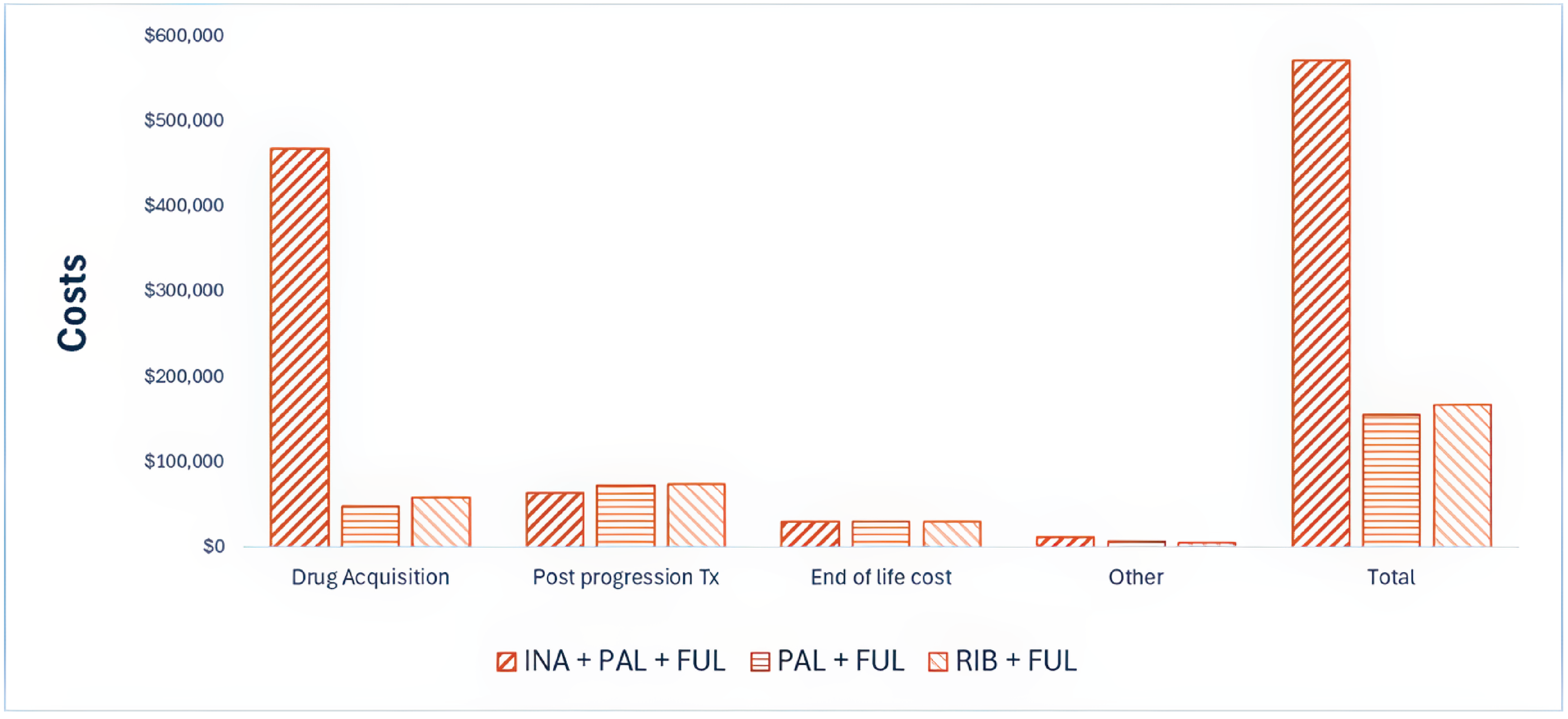
FUL = fulvestrant; INA = inavolisib; PAL = palbociclib; PBO = placebo; RIB = ribociclib; Tx = treatment.
Note: Deterministic results are shown, as the sponsor’s model did not provide disaggregated cost outputs for the probabilistic analysis.
Impact on Health
Relative to PBO + PAL + FUL, INA + PAL + FUL is predicted to increase the time a patient remains in the PFS health state by approximately 1.10 years and extend OS by 0.60 years. Similarly, relative to RIB + FUL, INA + PAL + FUL is anticipated to increase time in the PFS state by approximately 1.34 years and improve OS by 1.02 years. Considering the impact of treatment on both quality and length of life, INA + PAL + FUL is predicted to result in 0.58 and 0.95 additional QALYs per patient compared to PBO + PAL + FUL and RIB + FUL, respectively (refer to Figure 2).
Figure 2: Impact of INA + PAL + FUL on Patient Health
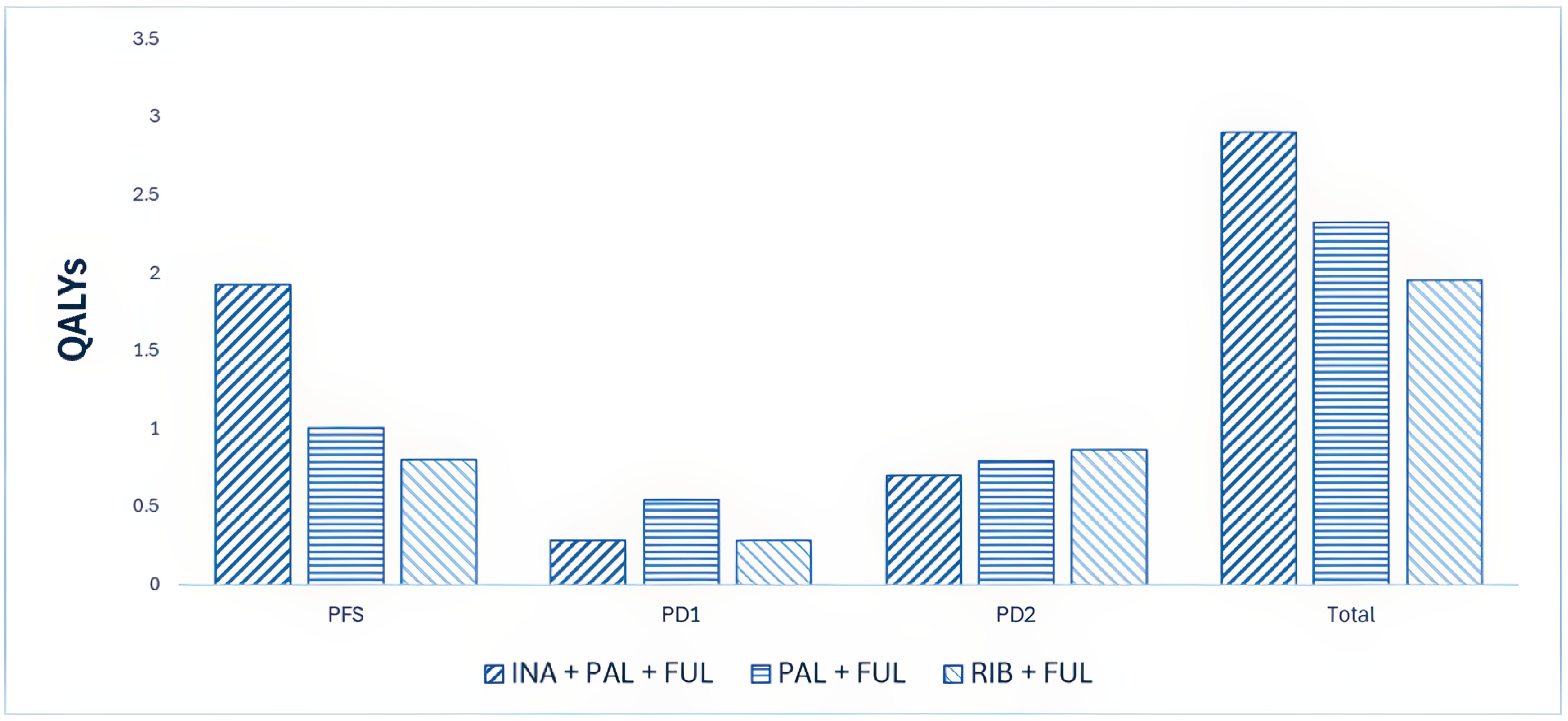
FUL = fulvestrant; INA = inavolisib; PAL = palbociclib; PBO = placebo; PD1 = first progressive disease; PD2 = second progressive disease; PFS = progression-free survival; QALY = quality-adjusted life-year; RIB = ribociclib.
Overall Results
The results of the CDA-AMC base case suggest an ICER of $683,203 per QALY gained for INA + PAL + FUL compared to PBO + PAL + FUL and an ICER of $400,783 per QALY gained for INA + PAL + FUL compared to RIB + FUL (refer to Table 3). Additional details on the CDA-AMC base case are available in Appendix 4.
Table 3: Summary of CDA-AMC Economic Evaluation Results
Drug | Total costs ($) | Total QALYs | Pairwise ICER ($/QALY) |
|---|---|---|---|
INA + PAL + FUL vs. PBO + PAL + FUL | |||
PBO + PAL + FUL | 153,507 | 2.32 | Reference |
INA + PAL + FUL | 548,014 | 2.90 | 683,203 |
INA + PAL + FUL vs. RIB + FUL | |||
RIB + FUL | 165,718 | 1.95 | Reference |
INA + PAL + FUL | 548,014 | 2.90 | 400,783 |
CDA-AMC = Canada’s Drug Agency; FUL = fulvestrant; ICER = incremental cost-effectiveness ratio; INA = inavolisib; PAL = palbociclib; PBO = placebo; QALY = quality-adjusted life-year; RIB = ribociclib; vs. = versus.
Note: Publicly available list prices were used for all comparators.
Uncertainty and Sensitivity
Scenario analyses were conducted to explore key areas of uncertainty in the model (refer to Table 2). First, the impact of an alternative distribution of CDK4/6 inhibitors in the intervention group was assessed, which increased the ICER for INA + PAL + FUL to $713,555 per QALY gained compared to PBO + PAL + FUL and $466,085 per QALY gained compared to RIB + FUL. Due to the lack of long-term clinical evidence, OS extrapolation is uncertain. A scenario analysis was conducted to assess the impact of uncertainty on long-term OS for patients receiving INA + PAL + FUL, which increased the ICER for INA + PAL + FUL to $799,651 per QALY gained compared to PBO + PAL + FUL and $405,847 per QALY gained compared to RIB + FUL. CDA-AMC also explored a scenario in which the treatment effect of INA + PAL + FUL on OS, PFS, and time to end of next-line treatment (used as a proxy measure for second objective disease progression [PFS2]) was assumed to be maintained indefinitely. Based on the results of this analysis, the ICERs for INA + PAL + FUL decreased to $220,618 per QALY gained compared to PBO + PAL + FUL and $266,356 per QALY gained compared to RIB + FUL.
Summary of the Budget Impact
The sponsor submitted a budget impact analysis (BIA) to estimate the 3-year (2026 to 2028) budget impact of reimbursing INA + PAL + FUL for use in adult patients with endocrine-resistant, PIK3CA-mutated, hormone receptor–positive, HER2-negative, locally advanced or metastatic breast cancer, following recurrence on or after completing adjuvant endocrine treatment. The sponsor assumed that the payer would be CDA-AMC–participating public drug plans and derived the size of the eligible population using an epidemiologic approach. The price of INA was aligned with the price in the sponsor’s economic evaluation, while the prices of comparators were based on the publicly available list prices. Additional information pertaining to the sponsor’s submission is provided in Appendix 5.
CDA-AMC identified a number of issues with the sponsor’s estimated budget impact and made changes to model parameters and assumptions in consultation with clinical experts to derive the CDA-AMC base case (Appendix 5). CDA-AMC estimated that 722 patients would be eligible for treatment with INA + PAL + FUL over a 3-year period (year 1 = 238; year 2 = 241; year 3 = 243), of whom 435 are predicted to receive INA + PAL + FUL (year 1 = 72; year 2 = 169; year 3 = 195). The estimated incremental budget impact of reimbursing INA + PAL + FUL is predicted to be approximately $120 million over the first 3 years, with an expected expenditure of $140 million on INA + PAL + FUL. The actual budget impact will depend on the number of people eligible for treatment and its uptake.
Conclusion
Based on the CDA-AMC base case, INA + PAL + FUL would be considered cost-effective at the submitted price if the public health care system was willing to pay at least $683,203 per QALY gained compared to PBO + PAL + FUL and $400,783 per QALY gained compared to RIB + FUL. If the public health care system is not willing to pay those amounts, price reductions should be considered (refer to Figure 3; full details in Table 10). The estimated cost-effectiveness of INA + PAL + FUL compared to PBO + PAL + FUL and RIB + FUL is uncertain due to the lack of long-term clinical evidence.
The budget impact of reimbursing INA + PAL + FUL to the public drug plans in the first 3 years is estimated to be approximately $120 million. The 3-year expenditure on INA + PAL + FUL (i.e., not accounting for current expenditure on comparators) is estimated to be $140 million.
Figure 3: Summary of the CDA-AMC Economic Analysis and Price Reduction

CDA-AMC = Canada’s Drug Agency; FUL = fulvestrant; ICER = incremental cost-effectiveness ratio; INA = inavolisib; PAL = palbociclib; PBO = placebo; QALY = quality-adjusted life-year.
Note: Expenditure includes only the drug cost of INA + PAL + FUL. The ICER results are based on the comparison of INA + PAL + FUL versus RIB + FUL, which is more commonly used in current clinical practice. Full results, including a price reduction analysis for the comparison with PBO + PAL + FUL, are provided in Appendix 4.
References
1.Hoffmann-La Roche Limited. Pharmacoeconomic evaluation [internal sponsor's report]. Drug Reimbursement Review sponsor submission: inavolisib, 3 mg and 9mg, oral tablets. 2025.
2.Itovebi (inavolisib): tablets, 3 mg and 9mg, oral [product monograph]. Hoffmann-La Roche Limited. 2025.
3.Turner NC, Im SA, Saura C, et al. Inavolisib-Based Therapy in PIK3CA-Mutated Advanced Breast Cancer. N Engl J Med. 2024;391(17):1584-1596. doi:10.1056/NEJMoa2404625 PubMed
4.Hoffmann-La Roche Limited. Network meta-analysis of Inavolisib in Hormone Receptor-Positive (HR+), Human Epidermal Growth Factor Receptor 2-Negative (HER2-) Locally-Advanced/Metastatic Breast Cancer [internal sponsor's report]. 2025.
5.pan-Canadian Pharmaceutical Alliance. Verzenio (abemaciclib). 2020. https://www.pcpacanada.ca/negotiation/21141
6.CDA-AMC Provincial Advisory Group. PC0382 Itovebi: CADTH Reimbursement Review Reimbursement Status for Comparators [internal document]. 2025.
7.CDA-AMC. CADTH Reimbursement Recommendation: Capivasertib (Truqap). 2024. https://www.cda-amc.ca/sites/default/files/DRR/2024/PC0341_Truqap-Final_Rec.pdf
8.pan-Canadian Pharmaceutical Alliance. Truqap (capivasertib). 2025. https://www.pcpacanada.ca/negotiation/22853
9.Statistics Canada. Deaths and age-specific mortality rates, by selected grouped causes. Accessed 2025. https://www150.statcan.gc.ca/t1/tbl1/en/tv.action?pid=1310039201
10.Lloyd A, Nafees B, Narewska J, Dewilde S, Watkins J. Health state utilities for metastatic breast cancer. Br J Cancer. 2006;95(6):683-90. doi:10.1038/sj.bjc.6603326 PubMed
12.NICE. Alpelisib with fulvestrant for treating hormone receptor-positive, HER2-negative, PIK3CAmutated advanced breast cancer. 2022. https://www.nice.org.uk/guidance/ta816/resources/alpelisib-with-fulvestrant-for-treating-hormone-receptorpositive-her2negative-pik3camutated-advanced-breast-cancer-pdf-82613313714373
13.Dispensing Fee Policies in Public Drug Plans, 2021/22. https://www.canada.ca/en/patented-medicine-prices-review/services/npduis/analytical-studies/supporting-information/dispensing-fee-policies.html
14.Canadian Institute for Health Information. Patient cost estimator. 2024. Accessed 2025. https://www.cihi.ca/en/patient-cost-estimator
15.Slamon DJ, Neven P, Chia S, et al. Phase III Randomized Study of Ribociclib and Fulvestrant in Hormone Receptor-Positive, Human Epidermal Growth Factor Receptor 2-Negative Advanced Breast Cancer: MONALEESA-3. J Clin Oncol. 2018;36(24):2465-2472. doi:10.1200/JCO.2018.78.9909 PubMed
16.Sledge GW, Jr., Toi M, Neven P, et al. MONARCH 2: Abemaciclib in Combination With Fulvestrant in Women With HR+/HER2- Advanced Breast Cancer Who Had Progressed While Receiving Endocrine Therapy. J Clin Oncol. 2017;35(25):2875-2884. doi:10.1200/JCO.2017.73.7585 PubMed
17.Ontario Ministry of Health. Schedule of benefits for laboratory services: (effective July 24, 2023). 2023. Accessed 2025. https://www.ontario.ca/files/2024-01/moh-ohip-schedule-of-benefits-laboratory-services-2024-01-24.pdf
18.Walker H, Anderson M, Farahati F, et al. Resource use and costs of end-of-Life/palliative care: Ontario adult cancer patients dying during 2002 and 2003. J Palliat Care. 2011;27(2):79-88. doi:10.1177/082585971102700203 PubMed
19.Ontario Ministry of Health. Ontario Drug Benefit Formulary/Comparative Drug Index. 2025. Accessed April, 2025. https://www.formulary.health.gov.on.ca/formulary/
20.CDA-AMC. Procedures for Reimbursement Reviews. 2025. https://www.cda-amc.ca/sites/default/files/Drug_Review_Process/Drug_Reimbursement_Review_Procedures.pdf
Appendix 1: Cost Comparison Table
Please note that this appendix has not been copy-edited.
The comparators presented in Table 4 have been deemed to be appropriate based on feedback from clinical experts and CDA-AMC–participating public drug plans. Comparators may be recommended (appropriate) practice or actual practice. Existing Product Listing Agreements are not reflected in the table and as such, the table may not represent the actual costs to public drug plans.
Table 4: Cost Comparison for Treatment of Endocrine-Resistant, PIK3CA-Mutated, Hormone Receptor–Positive, HER2-Negative, Locally Advanced or Metastatic Breast Cancer
Treatment | Strength and/or concentration | Form | Price | Recommended dosage | Average daily cost ($) | Average 28-day cost ($) |
|---|---|---|---|---|---|---|
INA + PAL + FUL | ||||||
INA (Itovebi) | 3 mg 9 mg | Tablet | 298.7857a 597.5714 | 9 mg once daily | 597.57 | 16,732 |
PAL | 75 mg 100 mg 125 mg | Tablet | 126.9562 | 125 mg once daily on days 1 to 21 of each 28-day cycle | 95.22 | 2,666 |
FUL | 50 mg/mL | Prefilled syringe injection | 204.1035b | 500 mg on day 1 and day 15 of cycle 1, and then on day 1 of each subsequent 28-day cyclec | Cycle 1: 29.1 Cycle 2+: 14.6 | Cycle 1: 816 Cycle 2+: 408 |
INA + PAL + FUL | — | — | — | — | Cycle 1: 721.89 Cycle 2+: 707.39 | Cycle 1: 20,214 Cycle 2+: 19,806 |
RIB + FUL | ||||||
RIB | 200 mg | Tablet | 94.1271 | 600 mg once daily for 3 weeks followed by 1 week off | 211.79 | 5,930 |
FUL | 50 mg/mL | Prefilled syringe injection | 204.1035b | 500 mg on day 1 and day 15 of cycle 1, and then on day 1 of each subsequent 28-day cyclec | Cycle 1: 29.1 Cycle 2+: 14.6 | Cycle 1: 816 Cycle 2+: 408 |
RIB + FUL | — | — | — | — | Cycle 1: 240.89 Cycle 2+: 226.39 | Cycle 1: 6,746 Cycle 2+: 6,338 |
PBO + PAL + FUL | ||||||
PAL | 75 mg 100 mg 125 mg | Tablet | 126.9562 | 125 mg once daily on days 1 to 21 of each 28-day cycle | 95.22 | 2,666 |
FUL | 50 mg/mL | Prefilled syringe injection | 204.1035b | 500 mg on day 1 and day 15 of cycle 1, and then on day 1 of each subsequent 28-day cyclec | Cycle 1: 29.1 Cycle 2+: 14.6 | Cycle 1: 816 Cycle 2+: 408 |
PBO + PAL + FUL | — | — | — | — | Cycle 1: 124.32 Cycle 2+: 109.82 | Cycle 1: 3,482 Cycle 2+: 3,074 |
FUL = fulvestrant; INA = inavolisib; PAL = palbociclib; PBO = placebo; RIB = ribociclib.
Note: All prices are sourced from the Ontario Drug Benefit Formulary (accessed March 2025), unless otherwise indicated, and do not include dispensing fees or markups. Wastage was not included in costs. Recommended dosages are based on Cancer Care Ontario monographs, unless otherwise indicated.
aSponsor’s submitted price.
bPrice per injection; unit price of FUL is $40.8027 per 50 mg/mL.
cDosing of FUL, as per the product monograph, is 500 mg on day 0, day 14, and day 28 of cycle 1, and then on day 1 of each subsequent 28-day cycle. The dosing presented in this table reflects the description used in the INAVO120 trial, and there was no feedback received that dosing would differ in practice in Canada.
Appendix 2: Input Relevant to the Economic Review
Please note that this appendix has not been copy-edited.
This section is a summary of the input received from the patient groups, clinician groups, and drug plans that participated in the CDA-AMC review process.
Patient input was received from Breast Cancer Canada’s, the McPeak-Sirois Group, the Canadian Breast Cancer Network, and Rethink Breast Cancer, primarily involving patients with metastatic hormone receptor–positive and HER2-negative breast cancer in Canada. Breast Cancer Canada and the McPeak-Sirois Group conducted surveys with patients on frontline treatment; Rethink Breast Cancer gathered insights through engagement activities, including 1 patient who used INA in a clinical trial; and the Canadian Breast Cancer Network contributed input from previous submissions. Current standard first-line treatment includes CDK4/6 inhibitor with endocrine therapy, but many patients eventually progress to chemotherapy, which is associated with worsening quality of life, increased hospital visits, and severe side effects. Patients value oral targeted therapies that can extend cancer control, delay chemotherapy, and improve quality of life. Financial burden remains a challenge, as many patients lack private insurance and face long-term out-of-pocket costs. Patients prioritize longer recurrence-free survival, extended life, and maintaining quality of life while delaying chemotherapy. Patients prefer oral therapies over IV chemotherapy and are willing to tolerate side effects if it offers improved outcomes. One patient accessed INA as part of a phase I clinical trial in 2018, where it was used as their seventh line of treatment. INA was effective for 18 months, allowing them to continue working and travelling for treatment. They experienced hyperglycemia, which was managed with metformin and a ketogenic diet. Overall, they reported good energy levels and they were able to stay active during treatment.
Clinician input was received from Ontario Health (Cancer Care Ontario) Breast Cancer Drug Advisory Committee and the Research Excellence Active Leadership Canadian Breast Cancer Alliance. Standard first-line treatment for hormone receptor–positive and HER2-negative metastatic breast cancer includes CDK4/6 inhibitor plus endocrine therapy, while PIK3CA-targeted therapies are currently limited to second-line use. Key treatment goals are to extend PFS and OS, minimize adverse events, and delay chemotherapy to preserve quality of life. Clinicians highlighted the value of oral, at-home therapies for patient convenience. The clinician input noted that INA + PAL + FUL may shift first-line treatment for PIK3CA-mutated hormone receptor–positive, HER2-negative metastatic breast cancer by replacing second-line options and offering an alternative for patients without prior adjuvant CDK4/6 inhibitor use. Although toxicity is notable, it is considered manageable with monitoring and dose adjustments. Treatment would be led by oncologists, supported by pharmacists and nurses, with assessments every 3 months and discontinuation upon progression, severe toxicity, or intolerance.
Input from CDA-AMC–participating drug plans raised questions about the need for PIK3CA mutation testing and noted that funding for such testing is not consistent across jurisdictions. Plans questioned whether RIB-containing regimens should be considered as comparators, and whether trial eligibility criteria — such as timing of recurrence, glycemic thresholds, measurable disease, and exclusion of de novo metastatic cases — should be applied to funding decisions. Plans also raised concerns about continuing INA if components are discontinued and suggested aligning with existing CDK4/6 inhibitor prescribing criteria. Plans further questioned whether results apply to other CDK4/6 inhibitor, which patient populations should be eligible (i.e., patients with Eastern Cooperative Oncology Group Performance Status score > 1, central nervous system metastases or prior chemotherapy), and whether patients already receiving treatment should be switched.
Several of these concerns were addressed in the sponsor’s model:
The impact of disease and treatment on patient’s quality of life was captured with utility values.
RIB + FUL was included as a comparator in the sponsor’s model.
CDA-AMC addressed some of these concerns as follows:
Alternative CDK4/6 inhibitor distributions within the intervention group were explored in scenario analysis.
The cost of PIK3CA testing were incorporated in the cost-effectiveness analysis.
CDA-AMC was unable to address the following concern:
The cost-effectiveness of INA + PAL + FUL compared with RIB + FUL is unknown due to the lack of clinical evidence.
Appendix 3: Summary of the Sponsor’s Submission
Please note that this appendix has not been copy-edited.
Summary of the Sponsor’s Economic Evaluation
For the pharmaceutical reviews program, clinical and economic information is submitted to CDA-AMC by the sponsor. The CDA-AMC health economics team reviews the submitted economic information and appraises the information in collaboration with clinical experts and the clinical review team to evaluate key assumptions, influential parameters, and the overall rigour of the economic submission. Based on what the team learns through this process, adjustments may be made to the sponsor’s model to produce the CDA-AMC base case. The CDA-AMC base case represents the team’s current understanding of the clinical condition, clinical evidence currently available, and best interpretation of the economic evidence based on the information provided.
For the review of INA + PAL + FUL, the sponsor provided a cost-utility analysis and a BIA. The sponsor’s economic submission is summarized in Table 5.
Table 5: Key Components of the Sponsor’s Economic Evaluation
Component | Description |
|---|---|
Treatment information | |
Drug under review | Inavolisib (Itovebi), tablets, 3 mg and 9 mg |
Submitted price of drug under review | INA: $298.7857 per 3 mg tablet INA: $597.5714 per 9 mg tablet PAL: $126.9562 per 75 mg, 100mg, or 125 mg tablet FUL: $58.2900 per 50 mg/mL prefilled syringe injection |
Regimen | In each 28-day cycle, INA (9 mg orally once daily) is administered in combination with PAL (125 mg orally once daily for 21 days followed by 7 days off) and FUL (500 mg IV on days 1 and 15, then every 28 days thereafter) |
Per-course cost of drug under review | Inavolisib: $16,732 per 28-day coursea |
Model information | |
Type of economic evaluation | CUA PSM |
Treatment | INA + CDK4/6 inhibitor + FUL The CDK4/6 inhibitor component of the regimen consists of 70% PAL and 30% RIB |
Included comparators |
|
Perspective | Publicly funded health care payer perspective |
Time horizon | Lifetime (46 years) |
Cycle length | 1 week |
Modelled population | Patients with endocrine-resistant, hormone receptor–positive, HER2-negative, locally advanced or metastatic breast cancer with a PIK3CA mutation whose disease progressed following completion of adjuvant endocrine therapy and who had not received prior systemic therapy for locally advanced or metastatic breast cancer |
Characteristics of modelled population | Derived from the INAVO120 trial (mean age = 54 years; sex = 96.9% female, 3.1% male) |
Model health states |
For additional information, refer to Model Structure |
Data sources | |
Comparative efficacy |
|
Natural history and/or clinical pathway |
|
Health-related utilities and disutilities |
|
Costs included in the model |
|
Summary of the submitted results | |
Base case results | Compared to RIB + FUL:
Compared to PBO + PAL + FUL:
Compared to ABE + FUL:
|
Scenario analysis resultsb | Compared to RIB + FUL:
Compared to PBO + PAL + FUL:
Compared to ABE + FUL:
|
ABE = abemaciclib; AE = adverse event; CIHI = Canadian Institute for Health Information; CUA = cost-utility analysis; ECG = electrocardiogram; FUL = fulvestrant; HR = hazard ratio; ICER = incremental cost-effectiveness ratio; INA = inavolisib; LDH = lactate dehydrogenase; NICE = National Institute for Health and Care Excellence; NMA = network meta-analysis; OS = overall survival; PAL = palbociclib; PBO = placebo; PD1 = first progressive disease; PD2 = second progressive disease; PFS = progression-free survival; PSM = partitioned survival model; QALY = quality-adjusted life-years; RDI = relative dose intensity; RIB = ribociclib; TTOT = time-to-off treatment.
aINA + PAL + FUL = $20,214 per patient for the first 28-day cycle and $19,806 for each subsequent cycle.
bResults of scenario analyses that had a meaningful impact on the estimated ICER compared to the sponsor’s base case. Additional scenarios were submitted that had no meaningful impact on the estimated ICER included.
Model Structure
The sponsor submitted a partitioned survival model comprising 4 health states: PFS, first progressive disease (PD1), second progressive disease (PD2), and death. All patients enter the model in the PFS state, representing time on first-line treatment. Transitions between health states are informed by treatment-specific time to event curves derived from the INAVO120 trial and a network meta-analysis (NMA). The proportion of patients in the PFS state over time is determined by the PFS curve. Upon progression, patients transition to the PD1 state and begin second-line treatment. The proportion in PD1 is calculated as the difference between the PFS2 and PFS curves, with time to end of next-line treatment used as a proxy for PFS2. Patients who progress again enter the PD2 state, with the proportion estimated as the difference between the OS and PFS2 curves. Death is modelled as an absorbing state, and the proportion of patients in this state is determined directly from the OS curve. Treatment duration is modelled separately using time to treatment discontinuation curves. A figure of the sponsor’s model structure is available in Appendix 3 (Figure 4).
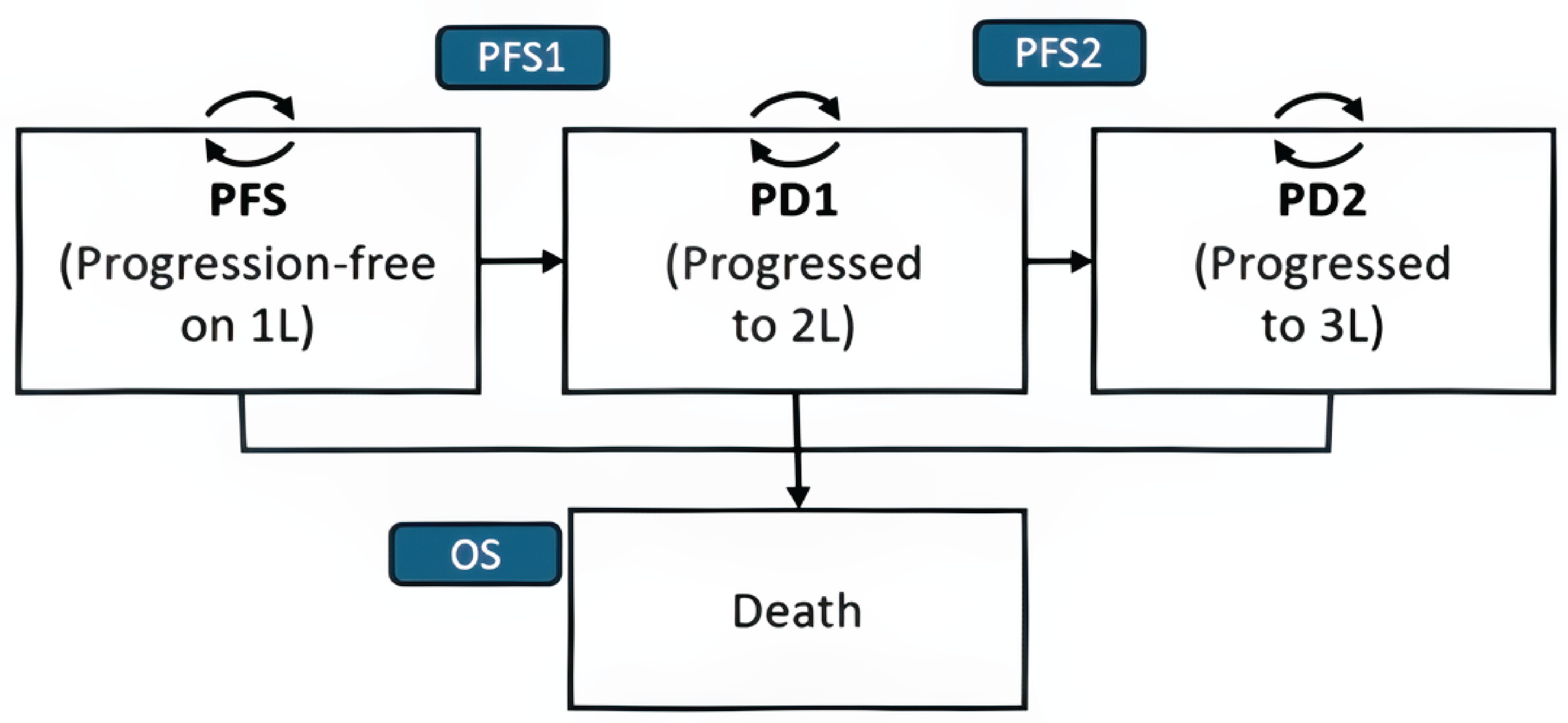
OS = overall survival; PBO = placebo; PD1 = first progressive disease; PD2 = second progressive disease; PFS = progression-free survival; PFS1 = first progression-free survival; PFS2 = second progression-free survival.
Source: Sponsor’s pharmacoeconomic submission.1
Table 6: Summary of the Sponsor’s Economic Evaluation Results
Drug | Total costs ($) | Total LYs | Total QALYs | Pairwise ICER ($/ QALY) |
|---|---|---|---|---|
INA + PAL + FUL vs. PBO + PAL + FUL | ||||
PBO + PAL + FUL | 151,989 | 3.12 | 2.17 | Reference |
INA + PAL + FUL | 561,304 | 3.80 | 2.83 | 625,192 |
INA + PAL + FUL vs. RIB + FUL | ||||
RIB + FUL | 153,643 | 2.79 | 1.83 | Reference |
INA + PAL + FUL | 561,304 | 3.80 | 2.83 | 409,398 |
INA + PAL + FUL vs. ABE + FUL | ||||
ABE + FUL | 135,786 | 2.32 | 1.60 | Reference |
INA + PAL + FUL | 561,304 | 3.80 | 2.83 | 347,807 |
ABE = abemaciclib; FUL = fulvestrant; ICER = incremental cost-effectiveness ratio; INA = inavolisib; LY = life-year; PAL = palbociclib; PBO = placebo; QALY = quality-adjusted life-years; RIB = ribociclib; vs. = versus.
Appendix 4: Additional Details of CDA-AMC Reanalyses
Please note that this appendix has not been copy-edited.
Clinical Data in the Economic Model
The CDA-AMC Clinical Review found that INA + PAL + FUL results in an increase in the probability of being alive and without progression at 6 months and 18 months when compared with PBO + PAL + FUL in patients with endocrine-resistant, PIK3CA-mutated, hormone receptor–positive, HER2-negative locally advanced or metastatic breast cancer, based on findings from the INAVO120 trial. The trial also suggested that INA + PAL + FUL likely results in an increase in the probability of being alive at 12 months and 24 months when compared with PBO + PAL + FUL. However, the clinical review team concluded that the results of OS are confounded when interpreting the effect of the intervention in isolation because at least 50% of patients in the trial received subsequent anticancer therapies during the trial after discontinuing the study treatment. Moreover, the INAVO120 trial did not estimate the between-group difference in the change from baseline in the European Organisation for Research and Treatment of Cancer Quality of Life Questionnaire Core 30 global health status and quality of life score, leaving uncertainty about the effect of INA + PAL + FUL on health-related quality of life throughout treatment compared with PBO + PAL + FUL. The NMA suggested that no treatment was favoured between INA + PAL + FUL and RIB + FUL, based on the outcome of OS, in patients with previously untreated hormone receptor–positive, HER2-negative locally advanced or metastatic breast cancer. NMAs could not be conducted to compare INA + PAL + FUL versus RIB + FUL in the endocrine-resistant network. Hence, the NMA is associated with considerable uncertainty due to clinical differences in PIK3CA mutation, endocrine resistance, and menopausal status at baseline and methodological heterogeneity across the included studies. Importantly, the NMA results are from an interim analysis of OS in the INAVO120 trial and as such, may be considered premature to incorporate the OS data from the study into an NMA.
In the economic model submitted by the sponsor, OS, PFS and PFS2 for INA + PAL + FUL and PBO + PAL + FUL were extrapolated beyond the INAVO120 trial period using survival models that assumed no waning of treatment effect over the 46-year lifetime time horizon. Clinical experts consulted by CDA-AMC indicated that there is no evidence to support this assumption and considered it plausible that treatment effectiveness may diminish earlier than modelled. Notably, 52% of the survival benefit associated with INA + PAL + FUL in the sponsor’s model was accrued beyond the observed trial follow-up, contributing to additional uncertainty in the projected life-years and QALYs gained. Furthermore, the absence of comparative clinical data for relevant nontrial comparators limited the ability of CDA-AMC to validate the sponsor’s results. Consequently, the CDA-AMC reanalysis is subject to a high degree of uncertainty due to the lack of comparative efficacy data for nontrial comparators and the assumptions underpinning long-term survival benefit for INA + PAL + FUL. Taken together, these limitations contribute to considerable uncertainty in the estimated cost-effectiveness of INA + PAL + FUL relative to other treatment options for patients with endocrine-resistant, PIK3CA-mutated, hormone receptor–positive, HER2-negative locally advanced or metastatic breast cancer.
Key Issues of the Submitted Economic Evaluation
CDA-AMC identified the following key issues with the sponsor’s analysis:
The scope of the reimbursement request is broader than the indication approved by Health Canada. The Health Canada–approved indication is for INA in combination with PAL and FUL for the treatment of adult patients with endocrine-resistant, PIK3CA-mutated, hormone receptor–positive, HER2-negative locally advanced or metastatic breast cancer, following recurrence on or after completing adjuvant endocrine treatment. The sponsor has submitted a cost-effectiveness analysis in the requested reimbursement population, defined as patients receiving INA in combination with a CDK4/6 inhibitor and FUL. This reimbursement request is broader than the Health Canada indication, as it includes any CDK4/6 inhibitor, rather than specifically PAL in combination with INA and FUL. In the economic model, the sponsor assumed that the combinability of INA with other CDK4/6 inhibitors would be manageable and consistent with the respective treatments. Therefore, the sponsor defined the intervention group as INA + CDK4/6 inhibitor + FUL, with CDK4/6 inhibitor distribution of 70% of PAL and 30% of RIB. This assumption is not supported by evidence, as INA + RIB + FUL was not studied in the INAVO120 trial, and there are no clinical data to establish the efficacy or safety of this combination relative to comparators.
CDA-AMC conducted a reanalysis assuming that all patients in the intervention group received INA + PAL + FUL to align with the Health Canada indication and the intervention group in the INAVO120 trial.
CDA-AMC also explored a scenario analysis using an alternative CDK4/6 inhibitor distribution (16% PAL and 84% RIB), reflecting anticipated clinical practice as informed by expert consultation.
The comparative effectiveness of INA + PAL + FUL relative to RIB + FUL is highly uncertain. Due to the absence of direct clinical data, the sponsor conducted an NMA to estimate the relative efficacy and safety of INA + PAL + FUL versus RIB + FUL for use in the economic model. However, several limitations were identified in the CDA-AMC Clinical Review report. Notably, the NMA did not compare INA + PAL + FUL and RIB + FUL on PFS or OS within the population who were endocrine-resistant, which is misaligned with both the reimbursement request and the Health Canada–approved indication. The NMA for OS suggested no difference between INA + PAL + FUL and RIB + FUL in patients with previously untreated hormone receptor–positive, HER2-negative locally advanced or metastatic breast cancer, but could not address the relevant subgroup who were endocrine-resistant. The analysis is further limited by clinical heterogeneity (e.g., differences in PIK3CA mutation, endocrine resistance, and menopausal status at baseline), methodological variability (e.g., differential follow-up), and the fact that it relies on interim OS data from the INAVO120 trial. As such, there is uncertainty in the results which does not support a reliable conclusion regarding the direction of treatment effect.
CDA-AMC could not address this limitation in reanalysis owing to the lack of clinical data.
The long-term OS benefit of INA + PAL + FUL relative to comparators is highly uncertain. While final OS data from the INAVO120 trial (data cut-off: November 15, 2024) were available — reporting a median follow-up of 34.2 months and an OS hazard ratio of 0.67 (95% confidence interval, 0.48 to 0.94) versus PBO + PAL + FUL — the sponsor’s model relied on the earlier primary efficacy and safety analysis (data cut-off: September 29, 2023), which had a shorter follow-up period. The sponsor extrapolated this time-varying OS data over a 46-year (lifetime) time horizon. However, given that more than 50% of patients had received subsequent anticancer therapies at the latest cut-off date, the observed OS results are confounded, limiting interpretation of the treatment effect in isolation. CDA-AMC notes that approximately 52% of the modelled incremental survival benefit occurs beyond the observed trial period, adding further uncertainty to the sponsor’s long-term projections.
To address this uncertainty, CDA-AMC conducted a reanalysis using alternative OS distributions — specifically, the exponential distribution for PBO + PAL + FUL and the log-logistic distribution for INA + PAL + FUL — selected based on statistical fit to the Kaplan-Meier data and the clinical plausibility of long-term projections.
Given limited long-term OS data and uncertainty around treatment durability, CDA-AMC conducted a scenario analysis using the gamma distribution for INA + PAL + FUL, informed by clinical expert input, to test the impact of more conservative assumptions on treatment benefit over time.
The long-term PFS benefit predicted for PBO + PAL + FUL is not appropriately characterized. In the PFS analysis, 51% of patients in the INA + PAL + FUL group and 69% in the PBO + PAL + FUL group had experienced a progression or death event at the time of data cut-off, indicating that the trial generated relatively mature PFS data — particularly in the comparator arm. Notably, the sponsor’s economic model extrapolated PFS based on the primary efficacy and safety data cut (September 29, 2023), despite the availability of a later and more mature data cut. As with OS, the sponsor used parametric survival modelling to project PFS beyond the trial follow-up period and selected the log-logistic distribution to extrapolate PFS for patients receiving PBO + PAL + FUL. Among the parametric distributions evaluated, the log-logistic ranked second in statistical fit. Despite this, the sponsor did not provide sufficient justification for choosing it over distributions with better statistical performance. Notably, the log-normal distribution ranked highest in terms of fit to the observed Kaplan-Meier data and would have been the more appropriate choice. Selecting a suboptimal distribution introduces bias and may underestimate the long-term benefit of PBO + PAL + FUL, thereby exaggerating the incremental effectiveness and cost-effectiveness of INA + PAL + FUL.
CDA-AMC conducted a reanalysis using the log-normal distribution to extrapolate long-term PFS for the PBO + PAL + FUL arm. This distribution was selected based on its superior statistical fit to the observed data and greater clinical plausibility, ensuring a more robust and balanced comparison.
The sponsor’s assumption of a sustained treatment effect is highly uncertain and lacks evidentiary support. In the economic model, the sponsor assumed that the treatment effect of INA + PAL + FUL on OS, PFS, and PFS2 is maintained indefinitely over the model’s time horizon. This implies that patients receiving INA + PAL + FUL continue to derive a comparative benefit over PBO + PAL + FUL throughout their lifetime, without any decline in treatment effect. However, this assumption is not supported by clinical evidence. The INAVO120 trial had a median follow-up of approximately 21.3 months, and by the latest data cut, more than 50% of patients had initiated subsequent anticancer therapies, confounding the long-term survival outcomes and making it difficult to isolate the lasting impact of INA + PAL + FUL. Clinical experts consulted by CDA-AMC emphasized that there is no evidence to suggest the treatment effect is sustained indefinitely. While ongoing benefit beyond the trial period is possible, it remains highly uncertain. To reflect this uncertainty, CDA-AMC implemented a time-limited treatment effect in the base case. Specifically, the relative benefit of INA + PAL + FUL was assumed to wane gradually beginning at 21.3 months, with hazards converging at 60 months — after which no further incremental effect was assumed. Importantly, this approach halts further divergence between survival curves beyond 60 months but does not reverse survival gains already accrued. The vertical gap between OS curves at the time of convergence is maintained, consistent with the cumulative benefit achieved before the dissipation of treatment effect. This approach better aligns with clinical expectations and avoids overestimating long-term benefit in the absence of supportive data.
CDA-AMC conducted a reanalysis assuming that the treatment effect of INA + PAL + FUL on OS, PFS, and PFS2 wanes from 21.3 months to 60 months, with no effect beyond 60 months.
CDA-AMC also explored a scenario analysis assuming the treatment effect on OS, PFS, and PFS2 is maintained over time, to explore uncertainty around this key assumption.
The exclusion of PIK3CA testing underestimates implementation costs. The sponsor excluded the cost of PIK3CA mutation testing from the base case, arguing that routine testing is expected to be widely adopted by 2026 due to the emergence of other PIK3CA-targeted therapies, such as capivasertib (CAP) + FUL. However, this assumption is highly uncertain and not reflective of current practice across jurisdictions. All patients enrolled in the pivotal INAVO120 trial were required to have a confirmed PIK3CA mutation, making the diagnostic test a prerequisite for treatment. Clinical experts and patient groups consulted by CDA-AMC noted that PIK3CA testing is not yet part of standard care and remains inconsistently available across provinces, particularly in the public system. Unlike other biomarkers (e.g., HER2, PD-L1), PIK3CA testing is not routinely performed unless a targeted therapy is prescribed, and none of the relevant comparators included in this analysis (i.e., PBO + PAL + FUL or RIB + FUL) require such testing. As a result, excluding this cost underestimates the resources required to implement the intervention and biases the cost-effectiveness results in its favour.
CDA-AMC conducted a reanalysis that incorporated the cost of PIK3CA mutation testing, to reflect the real-world requirements for delivering biomarker-guided therapy and ensure that all relevant implementation costs were captured in the base case.
Drug cost inputs are not accurate. The sponsor sourced unit drug costs of RIB and FUL from IQVIA DeltaPA. However, the prices are not consistent with those listed in the Ontario Drug Benefit (ODB) Formulary. According to CDA-AMC guidelines, drug prices should be sourced from the ODB Formulary when estimating costs in pan-Canadian analyses.19
CDA-AMC also conducted a reanalysis that applied unit drug prices for RIB and FUL from the ODB Formulary, in alignment with recommended jurisdictional pricing.
The selection of comparators does not reflect current clinical practice. The sponsor included ABE + FUL as a comparator in the submitted analysis, despite it not being considered relevant in the Canadian public payer context. Negotiations for ABE + FUL concluded without agreement with the pan-Canadian Pharmaceutical Alliance (pCPA) in 2020, and it is not funded by any of the participating jurisdictions. In addition, the sponsor excluded a relevant comparator — CAP + FUL — from the analysis. CAP + FUL has previously received a positive recommendation from CDA-AMC for the treatment of hormone receptor–positive, HER2-negative locally advanced or metastatic breast cancer, specifically for patients with tumours harbouring PIK3CA, AKT, or PTEN mutations following progression on endocrine therapy. This indication overlaps substantially with the target population for INA + PAL + FUL. Moreover, CAP + FUL successfully concluded negotiations with the pCPA and was granted a Letter of Intent in 2025.
CDA-AMC excluded ABE + FUL from the reanalysis to ensure alignment with jurisdictional funding realities and best practice in comparator selection.
CDA-AMC could not include CAP + FUL as a comparator in reanalysis owing to the lack of comparative clinical data. The cost-effectiveness of INA + PAL + FUL relative to CAP + FUL remains unknown.
CDA-AMC Reanalysis of the Economic Evaluation
The CDA-AMC base case was derived by making changes in model parameter values and assumptions, in consultation with clinical experts (refer to Table 7). The impact of these changes, individually and collectively, is presented in Table 8.
Table 7: Revisions to the Submitted Economic Evaluation
Stepped analysis | Sponsor’s value or assumption | CDA-AMC value or assumption |
|---|---|---|
1. Alignment with the Health Canada indication and the INAVO120 trial | Distribution of CDK4/6 inhibitor in the INA + PAL + FUL group:
| Distribution of CDK4/6 inhibitor in the INA + PAL + FUL group:
|
2. Parametric distributions used to extrapolate OS |
|
|
3. Parametric distributions used to extrapolate PFS | PBO + PAL + FUL = Log-logistic | PBO + PAL + FUL = Log-normal |
4. Assumption on the duration of INA + PAL + FUL treatment effect | Treatment effect on OS, PFS, and PFS2 is maintained over time. | Treatment effect on OS, PFS, and PFS2 is assumed to wane over time, gradually declining from 21.3 to 60 months, with no effect beyond 60 months. |
5. PIK3CA testing costs | Excluded | Included |
6. Drug acquisition costs for RIB and FUL | Sourced from the IQVIA DeltaPA Formulary:
| Sourced from the ODB Formulary:
|
7. Selection of comparators | ABE + FUL included | ABE + FUL excluded |
CDA-AMC base case (health care payer perspective) | ― | Reanalysis 1 + 2 + 3 + 4 + 5 + 6 + 7 |
ABE = abemaciclib; CDA-AMC = Canada’s Drug Agency; FUL = fulvestrant; INA = inavolisib; ODB = Ontario Drug Benefit; OS = overall survival; PAL = palbociclib; PBO = placebo; PFS = progression-free survival; PFS2 = second progression-free survival; RIB = ribociclib.
Note: CDA-AMC was unable to resolve the issues with the lack of clinical evidence for INA + PAL + FUL versus RIB + FUL, and the absence of capivasertib as comparator.
Table 8: Summary of the Stepped Analysis
Stepped analysis | Drug | Total costs ($) | Total QALYs | ICER vs. INA + PAL + FULa ($/QALY) |
|---|---|---|---|---|
Sponsor’s base case | INA + PAL + FUL | 578,626 | 2.79 | Reference |
PBO + PAL + FUL | 155,129 | 2.17 | 683,691 | |
RIB + FUL | 161,043 | 1.79 | 419,214 | |
ABE + FUL | 143,058 | 1.57 | 358,600 | |
CDA-AMC reanalysis 1: Distribution of CDK4/6 inhibitor | INA + PAL + FUL | 558,149 | 2.79 | Reference |
PBO + PAL + FUL | 141,692 | 2.17 | 672,325 | |
RIB + FUL | 161,043 | 1.79 | 398,656 | |
ABE + FUL | 143,058 | 1.57 | 341,741 | |
CDA-AMC reanalysis 2: OS parametric function | INA + PAL + FUL | 630,706 | 3.59 | Reference |
PBO + PAL + FUL | 166,785 | 2.33 | 368,110 | |
RIB + FUL | 184,589 | 2.08 | 295,693 | |
ABE + FUL | 155,306 | 1.72 | 254,879 | |
CDA-AMC reanalysis 3: PFS parametric function | INA + PAL + FUL | 578,626 | 2.79 | Reference |
PBO + PAL + FUL | 158,367 | 2.15 | 637,339 | |
RIB + FUL | 161,043 | 1.79 | 358,600 | |
ABE + FUL | 143,058 | 1.57 | 419,214 | |
CDA-AMC reanalysis 4: Duration of treatment effect | INA + PAL + FUL | 575,141 | 2.71 | Reference |
PBO + PAL + FUL | 155,129 | 2.17 | 773,517 | |
RIB + FUL | 158,339 | 1.75 | 435,128 | |
ABE + FUL | 141,304 | 1.54 | 372,382 | |
CDA-AMC reanalysis 5: PIK3CA testing costs | INA + PAL + FUL | 580,727 | 2.79 | Reference |
PBO + PAL + FUL | 155,129 | 2.17 | 687,082 | |
RIB + FUL | 161,043 | 1.79 | 421,323 | |
ABE + FUL | 143,058 | 1.57 | 360,330 | |
CDA-AMC reanalysis 6: Drug-acquisition costs | INA + PAL + FUL | 576,695 | 2.79 | Reference |
PBO + PAL + FUL | 153,832 | 2.17 | 682,666 | |
RIB + FUL | 162,312 | 1.79 | 416,001 | |
ABE + FUL | 141,266 | 1.57 | 358,485 | |
CDA-AMC reanalysis 7: Comparators | INA + PAL + FUL | 578,626 | 2.79 | Reference |
PBO + PAL + FUL | 155,129 | 2.17 | 683,691 | |
RIB + FUL | 161,043 | 1.79 | 419,214 | |
CDA-AMC base case (Reanalysis 1 + 2 + 3 + 4 + 5 + 6 + 7) (deterministic) | INA + PAL + FUL | 569,969 | 2.82 | Reference |
PBO + PAL + FUL | 154,274 | 2.30 | 792,066 | |
RIB + FUL | 166,494 | 1.83 | 406,574 | |
CDA-AMC base case | INA + PAL + FUL | 548,014 | 2.90 | Reference |
PBO + PAL + FUL | 153,507 | 2.32 | 683,203 | |
RIB + FUL | 165,718 | 1.95 | 400,783 |
ABE = abemaciclib; CDA-AMC = Canada’s Drug Agency; FUL = fulvestrant; ICER = incremental cost-effectiveness ratio; INA = inavolisib; OS = overall survival; PAL = palbociclib; PBO = placebo; PFS = progression-free survival; QALY = quality-adjusted life-year; RIB = ribociclib; vs. = versus
Note: The CDA-AMC reanalysis is based on the publicly available prices of the comparator treatments. Deterministic results are presented, unless otherwise indicated.
aThis is not a sequential analysis.
Table 9: Disaggregated Results of the CDA-AMC Base Case
Parameter | INA + PAL + FUL | PBO + PAL + FUL | RIB + FUL |
|---|---|---|---|
Discounted LYs | |||
Total | 3.97 | 3.42 | 2.88 |
PFS | 2.13 | 1.19 | 0.81 |
PD1 | 0.45 | 0.68 | 0.42 |
PD2 | 1.49 | 1.55 | 1.65 |
Discounted QALYs | |||
Total | 2.82 | 2.30 | 1.83 |
PFS | 1.78 | 1.00 | 0.68 |
PD1 | 0.35 | 0.52 | 0.32 |
PD2 | 0.70 | 0.78 | 0.83 |
Discounted costs ($) | |||
Total | 569,969 | 154,274 | 166,494 |
Drug acquisition | 456,877 | 47,898 | 58,354 |
Diagnostic test | 2,101 | 0 | 0 |
Administration | 872 | 580 | 348 |
Supportive care | 10,637 | 12,870 | 11,961 |
Postprogression treatment | 52,304 | 59,057 | 61,563 |
End of life | 28,758 | 28,998 | 29,250 |
AE | 380 | 245 | 1,882 |
AE = adverse event; CDA-AMC = Canada’s Drug Agency; FUL = fulvestrant; INA = inavolisib; LY = life-year; PAL = palbociclib; PBO = placebo; PD1 = first progressive disease; PD2 = second progressive disease; PFS = progression-free survival; QALY = quality-adjusted life-year; RIB = ribociclib. .
Note: Deterministic results are presented in place of probabilistic results because the sponsor's model did not provide disaggregated outputs across cost categories for the probabilistic analysis.
Price Reduction Analysis
Table 10: Results of the Price Reduction Analysis
Price reduction | Unit drug cost ($) | Cost per 28 days ($) | ICERs for INA + PAL + FUL vs. PBO + PAL + FUL ($/QALY) | ICERs for INA + PAL + FUL vs. RIB + FUL ($/QALY) | ||
|---|---|---|---|---|---|---|
Sponsor base case | CDA-AMC base case | Sponsor base case | CDA-AMC base case | |||
No price reduction | 598a | 16,732 | 624,969 | 683,203 | 410,778 | 400,783 |
10% | 538 | 15,059 | 564,601 | 614,805 | 371,024 | 359,378 |
20% | 478 | 13,386 | 504,234 | 546,408 | 331,271 | 317,973 |
30% | 418 | 11,712 | 443,866 | 478,010 | 291,517 | 276,567 |
40% | 359 | 10,039 | 383,499 | 409,612 | 251,764 | 235,162 |
50% | 299 | 8,366 | 323,131 | 341,215 | 212,011 | 193,757 |
60% | 239 | 6,693 | 262,764 | 272,817 | 172,257 | 152,352 |
70% | 179 | 5,020 | 202,396 | 204,419 | 132,504 | 110,946 |
80% | 120 | 3,346 | 142,029 | 136,022 | 92,750 | 69,541 |
90% | 60 | 1,673 | 81,661 | 67,624 | 52,997 | 28,136 |
CDA-AMC = Canada’s Drug Agency; FUL = fulvestrant; ICER = incremental cost-effectiveness ratio; INA = inavolisib; PAL = palbociclib; PBO = placebo; QALY = quality-adjusted life-year; RIB = ribociclib; vs. = versus.
aSponsor’s submitted price for INA.1
Assessment of Uncertainty
CDA-AMC used the CDA-AMC base case to conduct scenario analyses to address uncertainty within the economic evaluation. The results are provided in Table 11.
Scenario 1: Used alternative CDK4/6 inhibitor distribution within the intervention group (16% PAL and 84% of RIB), reflecting the anticipated clinical practice as informed by expert consultation.
Scenario 2: Selected the gamma distribution to extrapolate long-term OS for INA + PAL + FUL, based on clinical expert input, to test the impact of more conservative assumptions on treatment benefit over time. In this scenario, the OS curves for INA + PAL + FUL and PBO + PAL + FUL converge approximately 9 years after treatment initiation.
Scenario 3: Assumed that the duration of treatment effect of INA + PAL + FUL on OS, PFS, and PFS2 is maintained over the entire model time horizon. This assumes that the hazard ratios observed in the INAVO120 trial remain constant beyond the trial follow-up period and that patients continue to derive a comparative survival advantage over PBO + PAL + FUL throughout their lifetime. This implies ongoing and cumulative divergence of survival curves, with no waning of benefit. This assumption is highly uncertain and lacks evidentiary support.
Table 11: Results of CDA-AMC Scenario Analyses
Analysisa | Drug | Total costs ($) | Total QALYs | ICER ($/QALYs) |
|---|---|---|---|---|
CDA-AMC base case | INA + PAL + FUL | 548,014 | 2.90 | Reference |
PBO + PAL + FUL | 153,507 | 2.32 | 608,203 | |
RIB + FUL | 165,718 | 1.95 | 400,783 | |
CDA-AMC scenario 1: Distribution of CDK4/6 inhibitor in the intervention group | INA + PAL + FUL | 609,763 | 2.90 | Reference |
PBO + PAL + FUL | 194,129 | 2.32 | 713,555 | |
RIB + FUL | 165,722 | 1.95 | 466,085 | |
CDA-AMC scenario 2: Gamma distribution to extrapolate OS of INA + PAL + FUL | INA + PAL + FUL | 537,391 | 2.76 | Reference |
PBO + PAL + FUL | 151,245 | 2.28 | 799,651 | |
RIB + FUL | 154,801 | 1.82 | 405,847 | |
CDA-AMC scenario 3: Duration of treatment effect on OS, PFS, and PFS2 is maintained over time | INA + PAL + FUL | 668,448 | 4.66 | Reference |
PBO + PAL + FUL | 153,506 | 2.32 | 220,618 | |
RIB + FUL | 257,740 | 3.12 | 266,356 |
CDA-AMC = Canada’s Drug Agency; FUL = fulvestrant; ICER = incremental cost-effectiveness ratio; INA = inavolisib; OS = overall survival; PAL = palbociclib; PBO = placebo; PFS = progression-free survival; PFS2 = second progression-free survival; QALY = quality-adjusted life-year; RIB = ribociclib.
aProbabilistic analyses presented.
Pagebreak
Issues for Consideration
In 2024, CDA-AMC issued a recommendation in favour of reimbursing CAP + FUL for the treatment of adults with hormone receptor–positive, HER2-negative locally advanced or metastatic breast cancer characterized by mutations in PIK3CA, AKT1, or PTEN. This recommendation applies to patients who have progressed on at least 1 prior endocrine-based regimen in the metastatic setting or within 12 months of completing adjuvant endocrine therapy, provided certain clinical conditions are met. The target population for CAP + FUL overlaps with that of INA + PAL + FUL. CAP + FUL was successfully negotiated through pCPA and concluded with a Letter of Intent in 2025. However, it was not included as a comparator in the current submission, and as a result, the cost-effectiveness of INA + PAL + FUL relative to CAP + FUL is unknown.
Access to PIK3CA testing varies across and within jurisdictions. While uptake is increasing throughout the country, barriers remain — particularly for individuals in rural or remote communities, where access to biopsy and genomic testing services may be limited. If INA + PAL + FUL is publicly funded, some patients may face access challenges until infrastructure and funding mechanisms are fully established. This raises concerns about equity, as patients living in underserved regions or lower-resource settings may not have timely access to the required companion diagnostic, and thus may be systematically excluded from benefiting from the treatment despite meeting clinical eligibility criteria.
Appendix 5: Budget Impact Analysis
Please note that this appendix has not been copy-edited.
Summary of the Submitted BIA
The sponsor submitted a BIA that estimated the expected incremental budgetary impact of reimbursing INA + PAL + FUL for the treatment of adult patients with endocrine-resistant, PIK3CA-mutated, hormone receptor–positive, HER2-negative, locally advanced or metastatic breast cancer, following recurrence on or after completing adjuvant endocrine treatment.
The BIA was conducted from the perspective of public drug plan payers over a 3-year time horizon (2026 to 2028), with 2025 as the base year. The sponsor’s estimate reflects the aggregated results from the jurisdictional provincial budgets (excluding Quebec) and Non-Insured Health Benefits Program. The sponsor estimated the eligible population using an epidemiological approach. The sponsor’s base case included drug-acquisition costs and testing costs. The market uptake for INA + CDK4/6 inhibitor + FUL was estimated by use of expert opinion obtained by the sponsor. The key inputs to the BIA are documented in Table 12.
The sponsor estimated the 3-year incremental budget impact associated with reimbursing INA + CDK4/6 inhibitor + FUL for the indicated population would be $127,600,144 (year 1 = $20,985,086; year 2 = $49,483,467; year 3 = $57,131,591).
Table 12: Key Model Parameters
Parameter | Sponsor’s estimate (reported as year 1 / year 2 / year 3 if appropriate) |
|---|---|
Target population | |
Breast cancer incidence | 24,718 / 24,971 / 25,217 |
Early–stage breast cancer (stage I-III) | 23,285 / 23,523 / 23,755 |
Hormone receptor–positive, HER2-negative | 17,254 / 17,430 / 17,602 |
Undergo surgery and receive chemotherapy and adjuvant endocrine treatment | 16,391 / 16,559 / 16,722 |
High-risk status | 2,131 / 2,153 / 2,174 |
High-risk patients whose disease relapsed with distant metastasis | 533 / 538 / 543 |
Low-risk patients whose disease relapsed with distant metastasis | 1,426 / 1,441 / 1,455 |
Disease relapse with endocrine resistance | 1,109 / 1,120 / 1,131 |
Nondiabetic | 942 / 952 / 961 |
Undergo somatic molecular biomarker testing for PIK3CA | 754 / 762 / 769 |
Positive for PIK3CA mutations | 271 / 274 / 277 |
Number of patients eligible for drug under review | 238 / 241 / 243 |
Market shares (reference scenario) | |
INA + CDK4/6 inhibitor + FUL | 0% / 0% / 0% |
PBO + PAL + FUL | 16% / 16% / 16% |
RIB + FUL | 84% / 84% / 84% |
Market shares (new drug scenario) | |
INA + CDK4/6 inhibitor + FUL | 30% / 70% / 80% |
PBO + PAL + FUL | 11% / 5% / 3% |
RIB + FUL | 59% / 25% / 17% |
Cost of treatment (per patient per 28-day cycle) | |
INA + CDK4/6 inhibitora + FUL | Cycle 1: 22,028; Cycle 2+: 20,862 |
PBO + PAL + FUL | Cycle 1: 4,415; Cycle 2+: 3,249 |
RIB + FUL | Cycle 1: 7,352; Cycle 2+: 6,186 |
FUL = fulvestrant; INA = inavolisib; PAL = palbociclib; PBO = placebo; RIB = ribociclib.
aCDK4/6 inhibitor was assumed to be comprised of 70% PAL and 30% RIB.
Key Issues of the Submitted BIA
CDA-AMC identified several key issues to the sponsor’s analysis that have notable implications on the results of the BIA:
The scope of the reimbursement request is broader than the indication approved by Health Canada. The Health Canada–approved indication is for INA in combination with PAL and FUL for the treatment of adult patients with endocrine-resistant, PIK3CA-mutated, hormone receptor–positive, HER2-negative locally advanced or metastatic breast cancer, following recurrence on or after completing adjuvant endocrine treatment. The sponsor has submitted a BIA in the requested reimbursement population, defined as patients receiving INA in combination with a CDK4/6 inhibitor and FUL. This reimbursement request is broader than the Health Canada indication, as it includes any CDK4/6 inhibitor, rather than specifically PAL in combination with INA and FUL. In the BIA, the sponsor assumed that the combinability of INA with other CDK4/6 inhibitor would be manageable and consistent with the respective treatments. Therefore, the sponsor defined the intervention group as INA + CDK4/6 inhibitor + FUL, with CDK4/6 inhibitor distribution of 70% of PAL and 30% of RIB. This assumption is not supported by evidence, as INA + RIB + FUL was not studied in the INAVO120 trial, and there are no clinical data to establish the efficacy or safety of this combination relative to comparators.
CDA-AMC conducted a reanalysis assuming that all patients in the intervention group received INA + PAL + FUL to align with the Health Canada indication and the intervention group in the INAVO120 trial.
CDA-AMC also explored a scenario analysis using an alternative CDK4/6 inhibitor distribution (16% PAL and 84% RIB), reflecting anticipated clinical practice as informed by expert consultation.
Drug cost inputs are not accurate. The sponsor sourced unit drug costs of RIB and FUL from IQVIA DeltaPA. However, the prices are not consistent with those listed in the ODB Formulary. According to CDA-AMC guidelines, drug prices should be sourced from the ODB Formulary when estimating costs in pan-Canadian analyses.19
CDA-AMC conducted a reanalysis that applied unit drug prices for RIB and FUL from the ODB Formulary, in alignment with recommended jurisdictional pricing.
The inclusion of PIK3CA testing costs in the submitted BIA base case is inconsistent with CDA-AMC procedures. The sponsor included the cost of PIK3CA testing for all treatment regimens in the base case of the BIA. However, according to the Procedures for Reimbursement Reviews by CDA-AMC, “if there is a companion diagnostic test associated with the drug under review, the BIA (and model) must include a scenario analysis that captures the relevant costs for the companion tests in relation to the drug under review.”20 Therefore, including PIK3CA testing costs in the BIA base case is inconsistent with CDA-AMC procedures and is considered inappropriate.
In addition, the sponsor’s assumptions regarding the eligible testing population may underestimate the number of patients undergoing PIK3CA testing. Specifically, the sponsor assumed that testing occurs at the time of disease relapse in patients with endocrine-resistant, non–diabetes-related disease, resulting in an estimated 747 patients being tested in 2025 (excluding Quebec). However, clinical experts consulted by CDA-AMC indicated that in centres where routine testing is performed, PIK3CA mutation testing typically occurs at the time of diagnosis of hormone receptor–positive, HER2-negative metastatic breast cancer — regardless of diabetes status or endocrine resistance. According to the sponsor’s submission, this broader approach would correspond to approximately 1,940 individuals being tested in 2025, more than double the base case estimate.
CDA-AMC conducted a reanalysis that excluded PIK3CA testing costs from the BIA base case, consistent with the perspective of public drug plans and CDA-AMC procedural guidance.
CDA-AMC also explored a scenario analysis from a broader health care payer perspective that included PIK3CA testing costs. In this scenario, it was assumed that testing would be performed among patients who experience disease relapse with distant metastasis each year. The analysis further assumed that routine PIK3CA testing would be widely adopted by 2026. However, this assumption remains highly uncertain and does not reflect current clinical practice or testing infrastructure across jurisdictions.
CDA-AMC Reanalyses of the BIA
CDA-AMC revised the sponsor’s submitted analyses by making changes in model parameter values and assumptions, in consultation with clinical experts, as outlined in Table 13.
Table 13: Revisions to the Submitted BIA
Stepped analysis | Sponsor’s value or assumption | CDA-AMC value or assumption |
|---|---|---|
1. Alignment with the Health Canada indication and the INAVO120 trial | Distribution of CDK4/6 inhibitor in the INA + PAL + FUL group:
| Distribution of CDK4/6 inhibitor in the INA + PAL + FUL group:
|
2. Drug-acquisition costs for RIB and FUL | Sourced from the IQVIA DeltaPA:
| Sourced from the ODB Formulary:
|
3. PIK3CA testing costs | Included | Excluded |
CDA-AMC base case | ― | Reanalysis 1 + 2 + 3 |
BIA = budget impact analysis; CDA-AMC = Canada’s Drug Agency; FUL = fulvestrant; INA = inavolisib; ODB = Ontario Drug Benefit; PAL = palbociclib; RIB = ribociclib.
The results of the CDA-AMC step-wise reanalysis are presented in summary format in Table 14 and a more detailed breakdown is presented in Table 15. In the CDA-AMC base case, the 3-year budget impact of reimbursing INA + PAL + FUL for patients with endocrine-resistant, hormone receptor–positive, HER2-negative, locally advanced or metastatic breast cancer with a PIK3CA mutation whose disease progressed following completion of adjuvant endocrine therapy and who had not received prior systemic therapy for locally advanced or metastatic breast cancer was $119,805,331 (year 1 = $19,703,154; year 2 = $46,460,632; year 3 = $53,641,545).
Table 14: Summary of the Stepped Analysis of the CDA-AMC Base Case
Stepped analysis | Three-year total ($) |
|---|---|
Submitted base case | 127,600,144 |
CDA-AMC reanalysis 1 | 121,381,212 |
CDA-AMC reanalysis 2 | 126,715,823 |
CDA-AMC reanalysis 3 | 127,600,144 |
CDA-AMC base case: (Reanalysis 1 + 2 + 3) | 119,805,331 |
CDA-AMC = Canada’s Drug Agency.
Note: The CDA-AMC reanalysis is based on publicly available prices of the comparator treatments.
CDA-AMC used the CDA-AMC base case to conduct scenario analyses to explore uncertainty in the estimated budget impact of reimbursing INA + PAL + FUL. The results are provided in Table 15.
Scenario 1: Used alternative CDK4/6 inhibitor distribution within the intervention group (16% PAL and 84% of RIB), reflecting the anticipated clinical practice as informed by expert consultation.
Scenario 2: Included PIK3CA testing costs reflecting the broader health care payer perspective and assumed routine testing would be performed among patients who experienced disease relapse with distant metastasis.
Table 15: Disaggregated Summary of the BIA
Stepped analysis | Scenario | Year 0 (current situation) ($) | Year 1 ($) | Year 2 ($) | Year 3 ($) | Three-year total ($) |
|---|---|---|---|---|---|---|
Submitted base case | Reference total | 11,489,066 | 11,605,012 | 11,727,624 | 11,847,480 | 35,180,116 |
INA + PAL + FUL | 0 | 0 | 0 | 0 | 0 | |
All other comparators | 11,489,066 | 11,605,012 | 11,727,624 | 11,847,480 | 35,180,116 | |
New drug total | 11,489,066 | 32,590,098 | 61,211,091 | 68,979,071 | 162,780,260 | |
INA + PAL + FUL | 0 | 24,296,966 | 57,292,971 | 66,148,112 | 147,738,049 | |
All other comparators | 11,489,066 | 8,293,131 | 3,918,120 | 2,830,959 | 15,042,211 | |
Budget impact | 0 | 20,985,086 | 49,483,467 | 57,131,591 | 127,600,144 | |
CDA-AMC base case | Reference total | 11,032,415 | 11,143,953 | 11,261,904 | 11,377,217 | 33,783,075 |
INA + PAL + FUL | 0 | 0 | 0 | 0 | 0 | |
All other comparators | 11,032,415 | 11,143,953 | 11,261,904 | 11,377,217 | 33,783,075 | |
New drug total | 11,032,415 | 30,847,107 | 57,722,536 | 65,018,763 | 153,588,406 | |
INA + PAL + FUL | 0 | 23,046,340 | 54,343,965 | 62,743,319 | 140,133,624 | |
All other comparators | 11,032,415 | 7,800,767 | 3,378,571 | 2,275,444 | 13,454,781 | |
Budget impact | 0 | 19,703,154 | 46,460,632 | 53,641,545 | 119,805,331 | |
CDA-AMC scenario analyses | ||||||
Scenario 1: Alternative CDK4/6 inhibitor distribution in the intervention group | Reference total | 11,032,415 | 11,143,953 | 11,261,904 | 11,377,217 | 33,783,075 |
New drug total | 11,032,415 | 34,029,301 | 65,226,244 | 73,682,237 | 172,937,782 | |
Budget impact | 0 | 22,885,348 | 53,964,340 | 62,305,020 | 139,154,708 | |
Scenario 2: PIK3CA testing costs included | Reference total | 11,032,415 | $11,143,953 | $11,261,904 | $11,377,217 | $33,783,075 |
New drug total | 11,592,359 | 32,316,165 | 59,206,904 | 66,517,486 | 158,040,261 | |
Budget impact | 559,944 | 21,172,212 | 47,944,706 | 55,140,268 | 124,257,186 | |
BIA = budget impact analysis; CDA-AMC = Canada’s Drug Agency; FUL = fulvestrant; INA = inavolisib; PAL = palbociclib.
Note: The CDA-AMC reanalysis is based on the publicly available prices of the comparator treatments.
ISSN: 2563-6596
Canada’s Drug Agency (CDA-AMC) is a pan-Canadian health organization. Created and funded by Canada’s federal, provincial, and territorial governments, we’re responsible for driving better coordination, alignment, and public value within Canada’s drug and health technology landscape. We provide Canada’s health system leaders with independent evidence and advice so they can make informed drug, health technology, and health system decisions, and we collaborate with national and international partners to enhance our collective impact.
Disclaimer: CDA-AMC has taken care to ensure that the information in this document was accurate, complete, and up to date when it was published, but does not make any guarantee to that effect. Your use of this information is subject to this disclaimer and the Terms of Use at cda-amc.ca.
The information in this document is made available for informational and educational purposes only and should not be used as a substitute for professional medical advice, the application of clinical judgment in respect of the care of a particular patient, or other professional judgments in any decision-making process. You assume full responsibility for the use of the information and rely on it at your own risk.
CDA-AMC does not endorse any information, drugs, therapies, treatments, products, processes, or services. The views and opinions of third parties published in this document do not necessarily reflect those of CDA-AMC. The copyright and other intellectual property rights in this document are owned by the Canadian Agency for Drugs and Technologies in Health (operating as CDA-AMC) and its licensors.
Questions or requests for information about this report can be directed to Requests@cda-amc.ca.