Drugs, Health Technologies, Health Systems
Health Technology Recommendation and Review
Full Gene Sequencing for DPD Deficiency Testing
Executive Summary
What Is DPYD Genotyping Using Full Gene Sequencing?
Dihydropyrimidine dehydrogenase (DPD) deficiency is the partial or complete loss of function of the DPD enzyme. Reduced DPD enzyme activity has an important effect on fluoropyrimidine (FP) treatment metabolism, which can increase the risk of experiencing treatment-related toxicity. DPD deficiency testing methods include DPYD genotyping and DPD phenotyping. Full DPYD gene sequencing is a genotyping approach that provides comprehensive sequencing of the entire DPYD gene rather than a targeted approach that only identifies a select panel of common deficient DPYD variants. Comprehensive DPYD genotyping using full gene sequencing (FGS) provides an opportunity to identify additional rare coding variants with potentially decreased or no functional activity that may not be captured using standard targeted DPYD genotyping.
What Is the Purpose of This Recommendation and Evidence Review?
Canada’s Drug Agency (CDA-AMC) published a Health Technology Review on DPD testing for patients treated with 5-fluorouracil and capecitabine in 2025. Newfoundland and Labrador Health Services subsequently requested updated information and a recommendation to support decision-making for the adoption and implementation of DPYD genotype testing in its jurisdiction. This request is singularly focused on 1 DPYD genotype testing strategy: using FGS through next-generation sequencing, as compared to no testing. The evidence review did not assess the comparative evidence of FGS versus other testing strategies for DPD deficiency (e.g., targeted panels for 4 or 7 common DPYD variants).
How Did CDA-AMC Assess DPYD Genotyping Using FGS?
CDA-AMC conducted a review of the published literature to identify clinical outcomes and provide a simplified economic evaluation associated with DPYD genotype testing using FGS. This evidence review included a description of the context and evidence need; identified, appraised, and summarized the clinical utility, clinical validity, and diagnostic test accuracy evidence; provided considerations for cost outcomes and assessed the economic value; and identified and described some social and ethical considerations related to DPYD genotyping using FGS. This evidence review informed deliberations by the Health Technologies and Systems Expert Committee (HTSEC) to make recommendations on the use of FGS for DPD deficiency testing.
What Did We Find?
Five nonrandomized studies were identified that provided outcomes for the clinical utility and clinical validity of DPYD genotype testing using FGS. Overall, DPYD genotype testing using FGS identified rare and novel DPYD variants, including confirmed pathogenic variants among the cohorts included within the studies, compared with no testing. Rare and novel pathogenic variants were associated with severe adverse events, including FP-related toxicities and mortality. DPYD genotyping using FGS provided predictive value measures for determining individuals at risk for experiencing severe FP-related toxicities and may offer clinical utility above targeted variant panel testing for identifying people who have variants associated with reduced or no DPD enzyme function who are at risk for adverse events. No evidence regarding outcomes associated with diagnostic test accuracy for DPYD genotyping using FGS was identified in the literature.
FGS testing with whole exome sequencing adds modest lifetime costs ($388 per patient) and small (0.0117) quality-adjusted life-year gains compared with no testing. It would be considered cost-effective if the public health care system were willing to pay at least $33,281 per quality-adjusted life-year gained. These results are highly sensitive to assumptions about the prevalence of patients with poor or intermediate FP metabolism and the average intensive care unit use for such patients upon hospitalization. The cost-effectiveness of FGS is expected to improve as additional clinically actionable variants — ones that only FGS can detect — are shown to have clear, useful effects on treatment decisions.
Evidence for the clinical utility of standard targeted DPYD testing is mainly focused on variants that have been most frequently identified in populations with predominately European ancestry. Limiting DPYD genotype testing to a targeted select panel of common DPYD variants based on such evidence has the potential to exacerbate health and racial inequities in populations with racially or ethnically diverse genetic backgrounds.
Adequate and informed consent that outlines possible outcomes of the test, potential harms or benefits for patients and families, and privacy and confidentiality should be required when providing DPD deficiency testing.
What Is HTSEC?
The mandate of HTSEC is advisory in nature and is to participate in the development of guidance or recommendations for CDA‑AMC projects on medical devices, diagnostic tests, and clinical interventions, inclusive of models and programs of care.
HTSEC comprises 7 core members (1 chair, 1 ethicist, 1 health economist, 1 patient member, 2 health care practitioners, and 1 health technology assessment specialist) who serve for all topics under consideration during their term of office. In addition to these core members, HTSEC also includes up to 5 expert members appointed to provide their expertise on a specific topic. To develop the recommendations for the use of FGS for DPD deficiency testing uptake, HTSEC appointed 1 clinician with expertise in oncology, 1 with expertise in pathology and laboratory medicine, and 1 member who was able to speak to the perspective of a patient with lived experience.
Abbreviations
5-FU
5-fluorouracil
AE
adverse event
CDA-AMC
Canada’s Drug Agency
CI
confidence interval
CPIC
Clinical Pharmacogenetics Implementation Consortium
CUA
cost-utility analysis
DPD
dihydropyrimidine dehydrogenase
FGS
full gene sequencing
FP
fluoropyrimidine
HRQoL
health-related quality of life
HTA
health technology assessment
HTSEC
Health Technologies and Systems Expert Committee
ICER
incremental cost-effectiveness ratio
ICU
intensive care unit
NGS
next-generation sequencing
NPV
negative predictive value
OR
odds ratio
PPV
positive predictive value
QALY
quality-adjusted life-year
RoBANS
Risk of Bias Assessment Tool for Nonrandomized Studies
RR
relative risk
WES
whole exome sequencing
HTSEC Recommendation
The HTSEC recommendation is singularly focused on 1 DPYD genotype testing strategy: using FGS through next-generation sequencing (NGS), as compared to no testing. The recommendation does not imply that FGS is the optimal testing strategy, as the Canada’s Drug Agency (CDA-AMC) evidence review did not examine the comparative clinical utility, validity, or economic value of different testing approaches.
Rationale for the Recommendation
To make this recommendation, HTSEC considered the following information:
a CDA-AMC evidence review
input from experts in medical oncology, molecular genetics, and pathology and laboratory medicine, who were invited to attend HTSEC discussions
input from an individual who shared information about their family’s lived experience on this topic.
The following summary provides an overview of the rationale for the HTSEC recommendation based on the CDA-AMC deliberative framework.
Unmet Clinical Need
FP chemotherapy (e.g., 5-fluorouracil [5-FU], capecitabine) is associated with a risk of severe and potentially fatal toxicity. Severe FP toxicity occurs in approximately 10% to 40% of patients; mortality is estimated at 0.1% to 1%. Some individuals have a genetic susceptibility to FP toxicity due to DPD enzyme deficiency and experience higher risks for treatment-related morbidity and mortality.
Failure to conduct DPYD testing before planned treatment puts patients at risk for potentially avoidable FP toxicity and death. Among individuals with genetic susceptibility, the toxicity from standard dosing of FP chemotherapy is not readily discernible from the side effects experienced by individuals with fully functioning DPD enzyme metabolisms. At the point at which toxicity produces severe morbidity and risk of death, treatment options are limited, not always accessible (e.g., antidote), and cannot easily reverse the damage already done. Prevention is critical.
The availability of and approaches to DPD deficiency testing vary across Canada. In jurisdictions that conduct testing, some provinces employ targeted panels that assess a specific number of commonly known and clinically actionable genetic variants. These variants represent those most frequently identified to date among tested individuals, who represent populations with predominately European ancestry. However, these populations may not be representative of the diverse population in Canada. Testing for a broader range of variants may identify additional novel, rare, or population-specific variants associated with DPD deficiency that are more likely to occur among people from diverse ethnic backgrounds. The clinical significance of novel and rare variants would need to be established over time.
While some variants identified by FGS will be of unknown significance at present, testing for the full gene and generating real-world evidence can help address gaps in knowledge by offering a better understanding of variants associated with toxicity and helping avoid treatment-related harms for all.
HTSEC notes that FGS may reduce inequities in care by generating knowledge of a broader range of pathogenic DPYD variants, their frequencies, and clinical actionability among diverse populations.
Clinical Value
The CDA-AMC evidence review indicated that FGS enables the identification of a specific number of variants commonly tested for in targeted panels by some provinces, as well as the identification of other known variants classified as being associated with either no function or reduced function or having an unknown impact on function. Having reduced or no DPD enzyme activity has an important effect on FP treatment metabolism, which can increase the risk of FP-related toxicity.
Findings from the CDA-AMC clinical review suggest that DPYD genotype testing using FGS may offer clinical utility for identifying people with confirmed variants associated with reduced or no function who may be at risk for adverse events (AEs), versus limiting testing to a specific number of commonly known DPYD variants. Pooled evidence indicates an absolute increase between 0.41% to 0.62% in the detection of individuals with at least 1 confirmed deficient DPYD variant compared to the standard 7-variant and 4-variant tests.
The functional and clinical effects of many DPYD variants remain uncertain. Testing with FGS may detect a substantial number of variants that are classified as variants of unknown significance. HTSEC acknowledges that the detection of additional rare variants or variants of unknown significance does not necessarily provide added clinical value unless there is evidence linking those variants to DPD enzyme function and guidance on how to use the results in clinical practice.
There is a clear clinical benefit of testing with FGS compared to no testing. However, the CDA-AMC evidence review did not identify studies comparing FGS to other testing strategies for DPD deficiency; therefore, comparative effectiveness could not be assessed. While the current evidence supports the ability of FGS to identify additional variants, it does not establish its superiority over targeted DPYD genotyping in terms of clinical utility or patient outcomes.
HTSEC noted the specificity of DPD testing generally is high for determining individuals at risk for experiencing severe FP-related toxicities, meaning there is confidence in proceeding with FP treatment for cancer in patients found not to carry variants of concern.
HTSEC acknowledges the evidence is limited to nonrandomized, observational studies due to the nature of the topic. However, it would not be ethical to conduct randomized trials comparing DPD testing to no testing given the known benefits of testing.
Distinct Social and Ethical Considerations
Combined with ongoing real-world evidence generation, FGS can support efforts to identify additional rare variants and study variants of unknown significance to determine their clinical actionability. These evidence generation efforts may better address, but are not limited to, the needs of people from Indigenous and ethnically or racially diverse communities, who may be more likely to have rare variants than those with European genetic ancestry.
There is a need for clear informed consent, including regarding the limitations, risks, and results of testing and the interpretation of variants of unknown significance. Adequate and informed consent is required when providing DPD deficiency testing. FGS captures personal and potentially sensitive information about individuals, which may require more safety and ethical requirements than panel testing.
HTSEC acknowledges that people who experience challenges in accessing oncology care may also experience challenges in accessing DPYD testing, including patients from rural and remote geographic locations, as laboratories typically obtain samples through oncologist-led care pathways.
Individuals living outside major urban centres may face additional costs (e.g., travel, accommodation) associated with accessing DPYD testing, more broadly. These may or may not represent additional burdens beyond those common to tertiary centre oncology treatment for people living in rural and remote areas.
Economic Considerations
The CDA-AMC evidence review indicated that implementing FGS testing with whole exome sequencing (WES) would be considered cost-effective if the public health care system is willing to pay at least approximately $33,000 for each additional quality-adjusted life-year (QALY) gained compared to no testing (incremental costs = $382; incremental benefit = 0.0117 QALYs gained, approximately).
There is uncertainty in the CDA-AMC economic analysis related to costing information (e.g., test costs). The analysis results are highly sensitive to assumptions about the prevalence of genetically susceptible individuals and the average length of stay in an intensive care unit (ICU) for individuals who experience severe FP toxicity.
HTSEC notes, based on expert input, that the cost-effectiveness of FGS is context-dependent and is influenced by what testing infrastructure currently exists and what testing strategies are already implemented within a jurisdiction. Its cost-effectiveness may improve over time as researchers identify more clinically significant variants that only FGS can detect and as FGS is integrated into existing NGS workflows rather than used as a standalone test.
Impact on Health System
The anticipated volume of testing in the first year of implementing FGS will be based on both the existing number of patients being considered for FP treatment and new patients. Eventually, only new patients being considered for FP treatment will require DPYD testing.
With finite laboratory capacity and staffing and competing priorities for molecular testing to consider, the implementation of DPD deficiency testing with FGS may have operational implications for health systems (e.g., laboratory capacity) and potential clinical implications for patients and clinicians (e.g., effects on treatment initiation). However, these implications are highly context-dependent based on the existing capacity, operational workflows, and nuances of each laboratory operation, and how they might affect implementation could be considered as part of reflex testing. Of note, a proportion of patients receive the treatment as adjuvant therapy weeks or even months after surgery, so the turnaround time necessary to support clinical decision-making is longer. Additionally, processing and interpreting the bioinformatic data from FGS may take longer than the time required for targeted sequencing or no testing. There are many patients who would require testing in the metastatic setting, with turnaround time ideally being less than 5 to 7 days.
HTSEC notes there is growing importance and strategic value of centralized approaches that facilitate evidence generation, enable improved population-specific care, and contribute to the development of a national data infrastructure.
The identification of variants of unknown significance is common with FGS, but it may not be immediately actionable, indicating a need for the collection of longitudinal data and further evidence generation.
Additional Guidance
HTSEC recognizes there may be challenges with implementing FGS to test for DPD deficiency. HTSEC, therefore, has outlined the following considerations to support health systems’ readiness. This guidance is intended for decision-makers in jurisdictions in which there is currently no testing conducted before treatment and who are interested in the adoption and implementation of DPYD genotype testing using FGS.
If an approach to FGS relies on WES, ensure the DPYD genetic variant c.1129-5923C>G is directly tested. This clinically actionable variant may typically be excluded from approaches that rely on WES.
Establish ongoing real-world data collection and evidence generation initiatives to evaluate and report the clinical importance, value, and impact of variants of unknown significance. A coordinated expert consultation mechanism may support the interpretation of rare variants and timely treatment recommendations until such evidence is better established.
Develop and implement structured reporting standards that would include guidance on which DPYD variants are reportable and support result interpretation (including how to manage uncertain results), and ensure the list is reviewed and updated on a regular basis. The Clinical Pharmacogenetics Implementation Consortium (CPIC) guideline on DPD genotype and FP dosing provides a foundation for such a process.
Develop and implement education programs for health professionals who practise outside oncology regarding FP-associated risks, signs of early toxicity, and which symptoms warrant urgent attention and referral.
Require comprehensive informed consent procedures for DPD deficiency testing, particularly when using FGS, to ensure patients are informed of the possible outcomes of the test, associated harms and benefits, implications for families, and privacy and confidentiality considerations, including whether their test data may be used in the future in ways not directly for their own clinical benefit. Guidance for these processes is found in part within the Tri-Council Policy Statement: Ethical Conduct for Research Involving Humans.
Integrate FGS into existing genomic and NGS testing infrastructure and workflows to facilitate implementation, improve efficiency, maximize feasibility, and minimize operational challenges.
Evidence Review
This CDA-AMC evidence review was used to inform HTSEC deliberations and its recommendation regarding the use of FGS for DPD deficiency testing in people with planned FP treatment. The scope of the evidence review was to compare FGS for DPD deficiency testing versus no testing. The evidence review did not assess the comparative evidence of FGS versus other testing strategies for DPD deficiency (e.g., targeted panels for 4 or 7 common DPYD variants).
Background
Context
CDA-AMC produced a Health Technology Review in 2025 that provided an overview of the status and funding of DPD testing throughout Canada and summarized relevant evidence on the clinical utility, clinical validity, and cost-effectiveness of DPD testing.1 The 2025 report provided an overview of DPD deficiency testing methods, including DPYD genotyping and DPD phenotyping, with the purpose of informing and supporting decision-makers on the adoption and implementation of DPD deficiency testing in Canada.
Following the publication of the 2025 Health Technology Review,1 Newfoundland and Labrador Health Services requested updated information and recommendations to support decision-making for the adoption and implementation of DPYD genotype testing within its jurisdiction. This request is singularly focused on 1 DPYD genotype testing strategy: using FGS through NGS. Additionally, the request also indicated that WES would be integrated within the DPYD genotype testing strategy. Currently in Newfoundland and Labrador, all DPYD testing is sent out of province and DPD deficiency identification is limited to post hoc testing for people who present with severe FP-related toxicity. To address the needs of the scope of this request, this review has prioritized and focused on the clinical and economic evidence related to DPYD genotype testing using FGS, with WES where available, compared to no testing from the jurisdictional perspective of Newfoundland and Labrador.
The focus of this review is on DPYD genotyping using a FGS testing approach, which is a specific testing method that was not captured in the 2025 Health Technology Review.1 Full DPYD gene sequencing using NGS is a genotyping approach that provides comprehensive sequencing of the entire DPYD gene rather than a targeted approach that sequences for a select panel of commonly known and clinically actionable genetic DPYD variants.2 WES targets specific fragments of the protein-coding region of the gene to identify potential variants within the 23 DPYD exons.3,4 FGS with WES can sequence potential variants in both the exon and intronic regions of the DPYD gene, offering better sequencing coverage.5 Comprehensive DPYD genotyping using FGS provides an opportunity to identify additional rare coding variants with potentially decreased or no functional activity that may not be captured using targeted DPYD genotyping.2
DPD Deficiency Testing
FPs, such as 5-FU and capecitabine, are chemotherapy agents used as treatment for people living with solid tumours, including gastrointestinal, breast, and head and neck cancers.2,6 About 10% to 40% of people treated with FP for solid tumours experience severe FP-related toxicities, defined as any grade 3 or higher toxicity according to the Common Terminology Criteria for Adverse Events.2,6 These are mainly reported as hematologic or digestive toxicities and may cause mortality in 0.1% to 1% of people who experience FP-related toxicity.2 FP-related toxicities may also affect quality of life and treatment effectiveness due to discontinuation or postponement of treatment cycles.2 Additionally, FP-related toxicities are typically reported in early treatment cycles and thus support the rationale for DPD deficiency screening before starting FP treatment.2 Currently, uridine triacetate is the only antidote used to treat overdose and acute severe toxicity of FP treatment;7 however, uridine triacetate must be given within 96 hours after the end of the last infusion or dose of FP treatment, and it is only available through Health Canada’s Special Access Program.8,9
DPD deficiency is the partial or complete loss of function of the DPD enzyme. This is often the result of genetic polymorphism in the DPYD gene, which encodes the DPD enzyme.10 The DPD enzyme functions in the metabolization of 5-FU and capecitabine and can metabolize approximately 80% of the treatment dose.10 Reduced DPD enzyme activity has a substantial effect on FP treatment metabolism, which can increase the risk of experiencing treatment-related toxicity.10
Numerous variants in the DPYD gene have been identified; however, not all DPYD variants affect DPD enzyme activity or are not considered clinically actionable.2,10 Evidence supporting DPD functional activity with known DPYD variants has been classified by the CPIC guideline to help guide DPYD genotyping and DPD phenotype interpretation and subsequent treatment dose adjustments.11 Known variants can be classified based on various evidence sources including clinical studies, in vitro studies, and in silico analysis to assign an activity score based on the DPYD variant function.11 Rare and novel DPYD variants often do not have an assigned activity score due to the lack of strong evidence to establish an association with the DPYD variant and potential loss of function.11 The CPIC guideline has identified 82 known DPYD variants, which include 21 variants classified as being associated with no function and 6 as being associated with reduced function.11,12
The 4 most common clinically actionable DPYD variants are c.1905+1G>A (DPYD *2A), c.1679T>G (DPYD *13), c.2846A>T, and c.[1236G>A; 1129-5923C>G] (HapB3) and are foundational for targeted DPYD genotype testing.10 Additional common clinically actionable DPYD variants that can be included in targeted DPYD genotype testing include c.557A>G, c.868A>G, and c.2279C>T.13 These DPYD variants are prioritized because they are represented by a large proportion of global DPYD allele frequencies and are well-established variants associated with reduced or no function that are linked to FP treatment toxicity.12 As a result, many DPYD genotyping strategies focus on detecting these predefined variants to efficiently identify people at risk for FP-related toxicity.12 This targeted approach inherently limits variant detection to a fixed panel of known variants and may miss less common, rare, novel, or population-specific DPYD variants associated with DPD deficiency.14
These common variants can have varying frequencies and clinical actionability across different populations. DPYD variant frequencies can be highly influenced by differences in race and ethnicity.12 The known clinically actionable variants used in targeted DPYD genotyping testing strategies were established using populations that were predominantly white, specifically based on populations from the Netherlands.6,15,16 The presence of common and rare DPYD variants can vary across populations, with some populations reporting an absence of the common DPYD variants and high frequencies of rare DPYD variants.12 Because of this variability in DPYD variant frequencies, it is important to consider the potential consequences of using genotype testing strategies that may be limited across different populations. FGS using NGS can provide a comprehensive analysis of the entire DPYD gene, allowing for the identification of both common and rare DPYD variants beyond standard targeted panels.14
DPD Deficiency Testing in Other Countries
CDA-AMC conducted an informal scan of international drug regulatory agencies for national-level recommendations, mandates, or safety updates published in English or French. In 2020, the European Medicines Agency17 published recommendations to prescreen all patients for DPD deficiency before FP treatment. In response to this report, several countries issued their own national recommendations. Germany18,19 and the UK20 did not specify testing methods in their safety updates; however, France21 mandated phenotype screening for DPD deficiency by uracil level measurement. Within the UK, National Health Service (NHS) England22,23 released its own policy statement in 2020, recommending targeted 4-variant genotyping of DPYD. In 2022, Australia’s Therapeutic Goods Administration24,25 advised that testing for DPD deficiency should be considered before FP therapy, and DPYD genotyping targeting a minimum of 4 variants was added to its Medicare benefits schedule in 2025.26 In 2026, the US FDA27,28 added a boxed warning to capecitabine and 5-FU products advising DPYD genotyping before treatment. Additional details regarding the international status of DPYD testing are presented in Appendix 5, Table 14.
DPD Deficiency Testing in Canada
DPD deficiency testing varies widely across jurisdictions in Canada. Based on evidence from the 2025 Health Technology Review, there are currently no national policies or national guidelines on DPD testing mandated in Canada.1 Results from a jurisdictional survey scan found that, at the time, 5 jurisdictions (New Brunswick, Quebec, Ontario, Saskatchewan, and British Columbia) reported having publicly funded DPD testing — specifically, targeted DPYD genotype testing for the 4 most common DPYD variants. Three of these jurisdictions (Ontario, Saskatchewan, and British Columbia) reported testing for 1 or 2 additional DPYD variants. No jurisdictions reported conducting phenotype testing. Since the jurisdictional survey was conducted, Alberta has implemented DPD testing and is the only jurisdiction to report testing for 7 common DPYD variants.13 The testing platforms were not reported in the survey results.
Purpose and Objectives
This review provides a focused assessment of the clinical and economic evidence related to FGS for DPD deficiency testing in people with planned FP treatment, as compared to no treatment. This review was used to develop a recommendation by HTSEC on the use of FGS for DPD deficiency testing uptake in jurisdictions in which there is currently no testing conducted before treatment.
The objectives of this evidence review were to:
describe the context and assess the value of DPYD genotyping using FGS, compared to no testing
identify, appraise, and summarize the clinical utility, clinical validity, and diagnostic test accuracy evidence of DPYD genotyping using FGS, compared to no testing
provide considerations for cost outcomes and, if possible, the value of DPYD genotyping using FGS
identify and describe any social and ethical considerations of DPYD genotyping using FGS.
Evidence Assessment Methods
Research Questions
What is the clinical utility of DPYD genetic testing using FGS for the diagnosis of DPD deficiency in people with planned FP treatment?
What are the clinical validity and diagnostic test accuracy of DPYD genetic testing using FGS for the diagnosis of DPD deficiency in people with planned FP treatment?
What is the cost-effectiveness of DPYD genetic testing using FGS for the diagnosis of DPD deficiency in people with planned FP treatment in Newfoundland and Labrador?
Clinical Review Approach
An information specialist conducted a customized literature search using key resources, including journal citation databases, and a focused internet search for relevant evidence specific to the indication published between January 1, 2015, and February 26, 2026. One reviewer screened citations and selected studies based on the inclusion criteria and critically appraised the included publications using the Risk of Bias Assessment Tool for Nonrandomized Studies (RoBANS) version 2 checklist.29 Appendix 1 presents detailed descriptions of the methods and selection of included studies.
Economic Evaluation Approach
We conducted a review of economic literature and a simplified economic evaluation concerning the cost-effectiveness of FGS DPYD genotype testing compared to no DPYD genetic testing in patients with planned FP treatment for solid tumours (5-FU or capecitabine).
Call for Community Input
Clinicians, patient groups, and other organizations with a research or clinical interest in DPYD testing and treating people with solid tumours (including colorectal, gastric, breast, and head and neck cancers) and people with direct experience as a patient or carer were identified by the CDA-AMC engagement team. Patient groups were given an opportunity to provide input on the draft recommendations. We also reached out to relevant national organizations in advance to ensure they were fully informed of the opportunity and prepared to answer any questions in advance.
Clinical Review
DPYD genotype testing using FGS was able to identify rare and novel DPYD variants, including confirmed pathogenic variants, among the cohorts included in the studies.
Severe AEs associated with FP-related toxicities, including mortality, were reported among individuals identified with pathogenic common and rare DPYD variants.
DPYD genotype testing using FGS may offer clinical utility for identifying people who have confirmed variants associated with reduced or no function and are at risk for AEs versus limiting testing to the standard 4 or 7 variants used in common DPYD variant panel testing.
DPYD genotype testing using FGS reported consistent predictive value measures for determining individuals at risk for experiencing severe FP-related toxicities.
No outcomes associated with diagnostic test accuracy for DPYD genotype testing using FGS were reported among the identified studies.
This section addresses the following research questions:
What is the clinical utility of DPYD genetic testing using FGS for the diagnosis of DPD deficiency in people with planned FP treatment?
What are the clinical validity and diagnostic test accuracy of DPYD genetic testing using FGS for the diagnosis of DPD deficiency in people with planned FP treatment?
Summary of Evidence
Five nonrandomized studies met the inclusion criteria and were included in this clinical review.14,30-33 The 5 studies included 2 retrospective observational cohort studies14,32 and 3 prospective observational cohort studies.30,31,33 All 5 studies were single-arm, before-and-after analyses of people who received DPYD genotype testing using FGS. Each included study used high-throughput NGS testing platforms to sequence the DPYD gene,14,30-33 with 3 nonrandomized studies using WES within the testing methodology.31-33 One study was conducted in Canada and included people with multiple cancer types who received FP treatment.32 This study also included self-reported ethnicity data, which included 2 (0.6%) people who identified as Asian, 3 (0.9%) as Black, 312 (93.4%) as white, and 6 (1.8%) as unspecified individuals.32 One study was conducted in Saudi Arabia with people who had breast cancer.33 One study was conducted in Japan and included people from East Asian countries with multiple cancer types who received FP treatment.30 Two studies were conducted in France; 1 included people with advanced breast cancer starting FP treatment.31 The other study from France focused on DPYD variant functional outcomes associated with FP treatment and included people from a single hospital setting; however, the authors did not report specific population characteristics.14 Appendix 1 presents the Preferred Reporting Items for Systematic reviews and Meta-Analyses (PRISMA) flow chart of the study selection (Figure 1). Additional details regarding the characteristics of included publications are provided in Appendix 2. Additional clinical references of potential interest are provided in Appendix 6.
Quality of Evidence
The included studies were all critically appraised using the RoBANS version 2 checklist.29 The overall risk of bias for each included study was high.14,30-33 The quality of each included study was limited by the study design, with each study being a before-and-after single-cohort retrospective or prospective observational study.14,30-33 Two major concerns related to risk of bias were potential confounding factors and selection bias. None of the studies included a direct comparison group, which suggested a major risk of bias related to uncontrolled confounding factors, such as differences in cancer type, treatment, population characteristics, and potential comorbidities.14,30-33 Additionally, the potential for selection bias was a concern in each study due to the method of selection used and narrow scope from the overall population of interest.14,30-33 The studies included some methodological strengths, such as clear objectives and outcomes, and validated standardized means for measuring outcomes.14,30-33 Additional details regarding the strengths and limitations of included publications are provided in Appendix 3.
Summary of Findings
Appendix 4 presents the main study findings.
Clinical Utility of DPYD Genotyping Using FGS Testing
Evidence regarding the clinical utility of DPYD genotype testing using FGS was available in each nonrandomized study. The clinical utility outcomes presented across the 5 studies included the identification of DPYD variants and analysis of predicted DPD deficiency.14,30-33 Additionally, 3 studies included an analysis of the association of DPYD variant with FP treatment–related toxicity.30-32 One study reported on 1 case of mortality among 243 individuals (0.41%) associated with FP treatment.31
Predicted DPD Deficiency
Each study reported the number of identified DPYD variants and, when available, the associated functional classification.14,30-33 Functional classification was determined using standardized reported guidelines from CPIC,14 validated star allele matching using Stargazer,33 or in silico or in vitro analysis tools to predict DPYD variant functional activity status.30-32
One study32 identified 6 common and 10 rare DPYD variants among 334 people with cancer who received FP treatment. Among the identified variants, in silico and in vitro analysis suggested that 2 rare DPYD variants (c.257C>T and c.601A>C) are associated with no function and 2 rare DPYD variants are associated with “likely decreased function” (c.1850C>T) or “possible decreased function” (c.2324T>G), indicating that these rare variants are likely pathogenic.32 These likely pathogenic rare variants were reported among 4 individuals (1.19%) who had heterozygous genotypes for these variants.32 One individual self-reported being of “African ethnicity” [wording of original source] and had pancreatic cancer.32 Three individuals self-reported as white and had colorectal cancer.32 All other identified variants were reported as being associated with normal function or the functional status was not reported.32
One study14 identified 51 distinct DPYD variants among 1,145 individuals. Each identified DPYD variant was assigned a functional activity score between 0 and 1 according to the established CPIC guidelines, with 0 indicating no function, 0.5 indicating reduced function, and 1 indicating normal function. DPYD variants with no assigned CPIC functional activity score were reported as “not available.” Among the identified variants, 12 variants were reported as being associated with normal function, 3 variants were reported as being associated with reduced function, and 5 variants were reported as being associated with no function.14 The functional status of all other identified variants was reported as not available.14 Cumulative functional activity scores were used to provide predicted DPD metabolic phenotypes and identify the prevalence of individuals within the study population who have normal FP metabolism (i.e., a cumulative activity score of 2), intermediate FP metabolism (i.e., a cumulative activity score of 1.5 or 1), and poor metabolism (i.e., a cumulative activity score of 0.5 or 0). A total of 73 individuals (6.3%) were identified as carrying at least 1 allele with decreased function and predicted as having intermediate FP metabolism.14 Among those identified as having intermediate FP metabolism, 49 individuals (4.2%) had an activity score of 1.5 and 24 individuals (2.1%) had an activity score of 1.14 No individuals were predicted to have poor FP metabolism.14 The authors found that DPYD genotyping using FGS revealed an additional subset of rare or structural variants that are not covered by standard DPYD panel tests in 2.4% of the study cohort.14 This increased the cumulative proportion of individuals with potentially relevant DPYD variation to 8.7% of the study cohort.14 The authors concluded that targeted DPYD panel tests could underestimate the number of individuals at risk for poor FP metabolism compared to more comprehensive testing strategies using FGS.14
One study33 identified 68 distinct DPYD variants among 220 people from Saudi Arabia with breast cancer, including 9 novel DPYD variants. Three of the novel DPYD variants were identified as missense variants and were present in 4 individuals.33 Based on the validation process using star allele matching, 11 unique DPYD variants were reported, with 10 DPYD alleles classified as being associated with normal function and 1 DPYD variant (c.1905+1G>A) classified as being associated with no function. A total of 37 distinct DPYD allele combinations were identified among the cohort, with 217 individuals classified as having normal FP metabolism (98.6%) and 3 individuals classified as having intermediate FP metabolism (1.4%).33 The 3 individuals with intermediate FP metabolism each carried 1 c.1905+1G>A DPYD allele.33
One study30 identified 15 distinct DPYD variants, including 3 novel variants (c.914C>A, c.1712C>A, and c.1836G>T), among 301 people who were reported as being East Asian and having cancer for which they received FP treatment. In silico functional analysis reported that 11 identified variants were damaging or probably damaging and 3 identified variants were benign.30 The functional analysis for 1 identified variant was not reported.30 Rare pathogenic DPYD variants were identified in 7 individuals (2.33%) who each had heterozygous genotypes.30 Rare variants were classified as variants with a frequency of less than 0.01% in the Japanese population.30
One study31 identified 54 distinct DPYD variants among 243 people with breast cancer starting treatment with capecitabine alone or in combination with antiangiogenic therapy. In vitro functional analysis identified significantly severe reduced DPD enzyme activity in people with 3 identified variants (c.1475C>T, c.1679T>G, c.1774C>T) and moderately reduced DPD enzyme activity in people with 1 identified variant (c.2846A>T).31 The 3 variants associated with significantly severe reduced DPD enzyme activity were predicted to be pathogenic and the 1 variant associated with moderately reduced DPD enzyme activity was predicted to be probably pathogenic.31 Two additional variants (c.1025A>G and c.300C>A) were predicted to be pathogenic by in silico analysis, while 1 identified DPYD variant (c.1905+1G>A) is a known pathogenic variant.31 These 7 identified pathogenic and probably pathogenic variants occurred in heterozygous genotypes and were mutually exclusive among 11 individuals (4.53%) within this cohort.31 All other DPYD variants were reported as resulting in either slight deficiencies or no nonfunctional impact.31
Overall, DPYD genotype testing using FGS was able to identify rare and novel DPYD variants among the cohorts included in the studies.14,30-33
Association of DPYD Variant and FP-Related Toxicity
Three studies reported on the association of identified DPYD variants and FP-related toxicity outcomes, including frequency of toxicity, risk of toxicity, and reported type of toxicity experienced.30-32 Additionally, 1 study reported the patient profiles from 4 individuals who experienced varying grade 4 FP-related toxicities and 1 death due to toxicity.31 No outcomes related to hospitalizations due to FP-related toxicities were reported among the identified studies.
One study32 reported the number of individuals from the cohort who experienced an early severe toxicity and the total number of individuals who experienced a severe toxicity. Early severe toxicity refers to a grade 3 or higher toxicity-related AE that occurred within the first 2 cycles of FP treatment, and total severe toxicity refers to a grade 3 or higher toxicity-related AE that occurred at any point during FP treatment.32 Overall, early severe toxicity was reported in 24% of the cohort and total severe toxicity was reported in 38% of the cohort.32 Ten rare DPYD variants were identified in 15 individuals who all had heterozygous genotypes. Among the 15 individuals with a rare DPYD variant, 7 individuals experienced an early severe toxicity (46.7%) and 8 individuals experienced a total severe toxicity (53.3%).32 The reported associations, measured using odds ratios (ORs), of early and total severe toxicity among individuals with a rare DPYD variant were 2.73 (95% confidence interval [CI], 0.9424 to 8.097) and 1.32 (95% CI, 0.4466 to 3.812), respectively.32 The reported association for rare DPYD variants indicated a trend toward an increased risk of early severe toxicity and total severe toxicity compared to individuals who did not carry variants; however, these findings were not statistically significant.32 All 4 individuals identified with rare DPYD variants that were classified as being associated with no function (c.257C>T and c.601A>C) or decreased function (c.1850C>T and c.2324T>G) experienced early severe toxicities and reported neutropenia as the toxicity type.32 The reported toxicities among all individuals with rare DPYD variants were neutropenia (n = 6; 1.80%), fatigue and nausea (n = 1; 0.30%), and mucositis (n = 1; 0.30%).32 The authors reported no association with risk for early or total severe toxicity for the 6 identified common DPYD variants.32
One study30 reported the number of individuals from the cohort who experienced low FP-related toxicity (i.e., grades 0 to 2) and high FP-related toxicity (i.e., grades 3 to 4). The total number of individuals with a DPYD variant who experienced low FP-related toxicity was 161 (53.49% of the cohort), with 138 identified as having heterozygous genotypes with DPYD variants and 23 identified as having homozygous genotypes with DPYD variants.30 The total number of individuals with a DPYD variant who experienced high FP-related toxicity was 47 (15.61% of the cohort), with 42 identified as having heterozygous genotypes with DPYD variants and 5 identified as having homozygous genotypes with DPYD variants.30 Among the 7 individuals with a rare pathogenic DPYD variant, 2 experienced low FP-related toxicity and 5 experienced high FP-related toxicity.30 The reported toxicity experienced and grade of toxicity among the 7 individuals with a rare pathogenic DPYD variant are outlined in Table 1.
Table 1: Reported Toxicities Among Individuals With a Rare DPYD Variant
Outcome | Grade 1, n (%) | Grade 2, n (%) | Grade 3, n (%) |
|---|---|---|---|
Diarrhea | 1 (0.29) | — | 3 (0.89) |
Hand-foot syndrome | 1 (0.29) | — | — |
Mucositis | 2 (0.59) | — | — |
Nausea | 3 (0.89) | 1 (0.29) | 1 (0.29) |
Neutropenia | 2 (0.59) | 1 (0.29) | 3 (0.89) |
Vomiting | 1 (0.29) | 1 (0.29) | 1 (0.29) |
Source: Yokoi et al. (2020).30
One study31 reported an association between individual DPYD variants and FP-related toxicity, including hematotoxicity, digestive toxicity, and neurotoxicity. Among the 54 DPYD variants identified in the cohort, 2 variants (c.1905+1G>A and c.2846A>T) were reported to be statistically significantly associated with an increased risk of developing grade 3 to 4 toxicity (relative risk [RR] = 5.69; 95% CI, 2.38 to 13.6; P = 0.041), but no significant association was found when focusing only on grade 4 toxicity.31 The authors assessed the predictive value of grade 3 to 4 toxicity and only grade 4 toxicity with a subset of 3 known actionable DPYD variants (c.1905+1G>A, c.2846A>T, and c.1679T>G), 7 in vitro pathogenic DPYD variants, and 11 in silico pathogenic or probably pathogenic DPYD variants. It should be noted that the 7 in vitro pathogenic variants included the 3 known actionable variants, and the 11 in silico pathogenic or probably pathogenic variants included the 7 in vitro variants. The authors reported that:
The presence of 1 deficient allele among the subset of the 3 known DPYD variants was statistically significantly associated with grade 3 to 4 toxicity (RR = 6.71; 95% CI, 3.7 to 12.2; P < 0.001) but not associated with only grade 4 toxicity.31
The presence of any of the 7 in vitro DPYD variants was statistically significantly associated with grade 3 to 4 toxicity (RR = 7.6; 95% CI, 4.44 to 13.0; P < 0.001) and grade 4 toxicities (RR = 31.4; 95% CI, 5.8 to 168.9; P = 0.001).31
The presence of any of the 11 identified in silico deleterious variants was statistically significantly associated with grade 3 to 4 toxicity (RR = 5.48; 95% CI, 2.95 to 10.16; P < 0.001) and only grade 4 toxicity (RR = 22.6; 95% CI, 4.08 to 125.1; P = 0.002).31
The assessment of the 7 in vitro pathogenic DPYD variants reported the strongest association with grade 3 to 4 toxicity and with only grade 4 toxicity, relative to the 3 known DPYD variants and the 11 in silico DPYD variants. The study also reported the patient profiles for 4 individuals who experienced grade 4 FP-related toxicities and 1 death due to FP-related toxicities. The reported type of toxicities, mean treatment dosages, and identified DPYD variants are outlined in Table 2. One individual with FP-related toxic death was 80 years old and presented with grade 4 thrombopenia, grade 4 diarrhea, grade 4 renal failure, grade 5 dyspnea, and hypovolemic shock 20 days after starting capecitabine monotherapy.31 This individual had a lower mean initial treatment dosage (1,530 mg/m2/day) compared to the mean cohort initial treatment regimen (1,942 mg/m2/day).31 The individual carried 1 DPYD variant allele (c.2846A>T) that was reported to be probably pathogenic through in silico analysis, moderately deficient through in vitro analysis, and significantly associated with DPD deficiency and greater FP-related toxicity.31
Table 2: Summary of Patient Profiles With Grade 4 or Higher FP-Related Toxicities
Outcome | Patient 1 | Patient 2 | Patient 3 | Patient 4 | Patient 5 |
|---|---|---|---|---|---|
Reported toxicity (treatment cycle) | Toxic death (cycle 1) | G4 anemia, G4 thrombopenia, G3 neutropenia (cycle 1) | G4 thrombopenia, G3 asthenia (cycle 1) | G3 neurotoxicity (cycle 1); G4 thrombopenia, G4 neutropenia, G4 leucopenia (cycle 2) | G4 diarrhea (cycle 2) |
Mean capecitabine dosage (mg/m2/day), cycle 1a | 1,530 | 2,030 | 1,790 | 2,490 | 2,170 |
DPYD variants identified (heterozygous or homozygous genotypes) |
|
|
|
|
|
FP = fluoropyrimidine; G3 = grade 3; G4 = grade 4.
aThe mean capecitabine dose for the entire cohort at cycle 1 was 1,942 mg/m2/day (median 1,964 mg/m2/day; range, 65 mg/m2/day to 2,590 mg/m2/day).
Source: Etienne-Grimaldi et al. (2017).31
Severe AEs associated with FP-related toxicities, including mortality, were experienced among individuals identified with common and rare or novel DPYD variants.30-32
Clinical Validity and Diagnostic Test Accuracy of DPYD Genotyping Using FGS Testing
Evidence regarding the clinical validity of DPYD genotype testing using FGS was available in each nonrandomized study. Each study provided the prevalence of the DPYD variants that were identified among each cohort.14,30-33 One study31 reported clinical validity measures for the predictive value of DPYD genotype testing for the association between variants and FP-related toxicities. Clinical validity measures included:
sensitivity (i.e., the proportion of individuals found to have DPD deficiency among those experiencing toxicity)
specificity (i.e., the proportion of individuals without DPD deficiency among those without toxicity)
positive predictive value (PPV) (i.e., the proportion of individuals experiencing toxicity among those with a DPYD variant)
negative predictive value (NPV) (i.e., the proportion of individuals without toxicity among those without a DPYD variant).
No outcomes associated with diagnostic test accuracy for FGS were reported among the identified studies.
Prevalence of DPYD Variants
Across the 5 included nonrandomized studies, 117 distinct DPYD variants were identified with varying prevalence ranging from 0.04% (n = 1) to 29.42% (n = 660) among 2,243 cumulative individuals.14,30-33 A total of 13 DPYD variants with confirmed CPIC classification associated with reduced function or no function were identified across the 5 included studies.14,30-33
We used the cumulative data from the 5 included studies to identify the prevalence of people with DPYD variants who would be identified through the standard genotype testing methods that use 4 common DPYD variants or 7 common DPYD variants. The test for 7 common DPYD variants includes the standard 4 common DPYD variants. Three of the studies identified a total of 79 individuals (3.52% of the cumulative population) with heterozygous genotypes that included a DPYD variant included in the genotype testing method for the standard 4 DPYD variants.14,31,33 One study identified 1 additional DPYD variant included in the genotype testing method for the 7 common DPYD variants.14 A total of 84 individuals (3.74% of the cumulative population) had a heterozygous genotype with a DPYD variant included in the genotype test for the 7 common DPYD variants.14 Four of the studies identified 8 additional DPYD variants that are not captured in the genotype testing methods for the 4 or 7 common DPYD variants.14,30-32 A total of 9 individuals (0.40% of the cumulative population) were identified with 1 of the 8 additional DPYD variants,14,30-32 resulting in a total of 93 individuals (4.15% of the cumulative population) with at least 1 confirmed deficient DPYD variant across the 5 studies. All 8 additional DPYD variants were classified as being associated with no function and presented in individuals with heterozygous genotypes.
These findings suggest that DPYD genotype testing using FGS may offer better clinical utility for identifying people with confirmed variants associated with reduced or no function who may be at risk for AEs, versus limiting testing to the standard 7 variants or 4 variants used in common DPYD variant panel testing.
Sensitivity, Specificity, PPV, and NPV Associated With Toxicity
One study31 assessed clinical validity outcomes for the predictive value of FP-related grade 3 to 4 toxicity and only grade 4 toxicity with a subset of 3 known actionable DPYD variants, 11 in silico pathogenic or probably pathogenic DPYD variants, and 7 in vitro pathogenic DPYD variants. When assessing the association between FP-related toxicities and the presence of 1 of the 3 known actionable DPYD variants, the authors reported:
sensitivity = 16.7% (grade 3 to 4 toxicity);31 20% (only grade 4 toxicity)31
specificity = 99.1% (grade 3 to 4 toxicity);31 97.5% (only grade 4 toxicity)31
PPV = 71.4% (grade 3 to 4 toxicity);31 14.3% (only grade 4 toxicity)31
NPV = 89.4% (grade 3 to 4 toxicity);31 98.3% (only grade 4 toxicity).31
When assessing the association between FP-related toxicities and 11 in silico pathogenic or probably pathogenic DPYD variants, the authors reported:
sensitivity = 26.7% (grade 3 to 4 toxicity);31 60% (only grade 4 toxicity)31
specificity = 96.7% (grade 3 to 4 toxicity);31 94.9% (only grade 4 toxicity)31
PPV = 53.3% (grade 3 to 4 toxicity);31 20% (only grade 4 toxicity)31
NPV = 90.3% (grade 3 to 4 toxicity);31 99.1% (only grade 4 toxicity).31
When assessing the association between FP-related toxicities and 7 in vitro pathogenic DPYD variants, the authors reported:
sensitivity = 26.7% (grade 3 to 4 toxicity);31 60% (only grade 4 toxicity)31
specificity = 98.6% (grade 3 to 4 toxicity);31 96.6% (only grade 4 toxicity)31
PPV = 72.7% (grade 3 to 4 toxicity);31 27.3% (only grade 4 toxicity)31
NPV = 90.4% (grade 3 to 4 toxicity);31 99.1% (only grade 4 toxicity).31
The authors reported that extended DPYD genotype test strategies that include known in vitro deficient variants improve the clinical performance for identification of individuals at risk for experiencing severe FP-related toxicities.31
Despite the relatively low clinical sensitivity reported among each assessment, DPYD genotyping using FGS reported consistent predictive value measures for determining individuals at risk for experiencing severe FP-related toxicities.
Economic Review
Implementing FGS testing with WES would be considered cost-effective if the public health care system were willing to pay at least $33,281 for each additional QALY gained compared to no testing (incremental costs = $382; incremental benefit = 0.0117 QALYs gained, approximately).
Two assumptions — aside from the test cost itself — had the strongest impact on the results and influence the results in opposite directions:
If individuals with poor or intermediate FP metabolism spend a large share of their hospital stay in the ICU after a severe reaction (about 85% of inpatient days, on average), FGS testing becomes less costly and more effective.
If the overall prevalence of individuals with poor or intermediate FP metabolism in the population is lower (down to 4.15%), the test becomes less cost-effective ($76,086 per QALY gained).
Assumptions about whether the additional patients identified only through FGS all have intermediate FP metabolism or are a mix of individuals with intermediate or poor FP metabolism have a small impact on the overall cost-effectiveness.
It’s uncertain whether FGS testing is cost-effective compared with other targeted DPYD testing strategies. FGS testing can find more genetic variants, but the number of patients who actually benefit from those extra findings is small, so it may not be considered cost-effective today compared with other targeted DPYD testing. Over time, as research identifies more clinically significant variants that only FGS can detect, its cost-effectiveness may improve.
This section addresses the following research question:
What is the cost-effectiveness of DPYD genetic testing using FGS for the diagnosis of DPD deficiency in people with planned FP treatment in Newfoundland and Labrador?
Literature Review
The medical literature was searched for economic evaluations comparing DPYD genetic testing using FGS to alternative DPYD genetic testing (targeted testing) or no DPYD genetic testing in patients treated with FPs (Appendix 1). No new economic evaluations conducted in Canada were identified besides the decision analytic model (i.e., decision tree) developed by Ontario Health in 2021.34 This model was previously described in the 2025 Health Technology Review conducted by CDA-AMC,1 and it considered the cost-effectiveness of DPYD genotyping with the 4-variant panel compared to usual care (no testing). Within this report, this economic evaluation will be referred to as the Ontario cost-utility analysis (CUA).
Primary Economic Analysis
Given the lack of published literature addressing the decision problem specific to DPYD testing using FGS in Canada, the Ontario CUA was adapted to assess the short-term costs and health outcomes associated with FGS testing. CDA-AMC updated parameters specific to the FGS test cost; costs and assumptions around hospitalizations and ICU use due to severe toxicity; and updated health care and treatment costs where possible. Further, to capture the potential long-term benefit of testing due to avoided deaths, the overall time horizon of the analysis was extended to be that of a lifetime of those surviving treatment (i.e., the expected survival of someone who received FP treatment). Scenario analyses with alternative values for other key parameters of interest specific to FGS testing were conducted (e.g., the prevalence of patients with actionable variants detected and categorization as having intermediate or poor FP metabolism, alternative test costs, alternative assumptions about ICU utilization). Full details are available in Appendix 7.
Type of Economic Evaluation
Due to the impact of treatment-related AEs on quality of life in individuals with intermediate or poor metabolism of FPs, and due to the potential of FGS testing to identify DPYD variants and avoid fatal AEs specifically in individuals with poor FP metabolism, a CUA was deemed more appropriate. Health outcomes were expressed as QALYs to capture the impacts of the condition and treatment options. The primary outcome of the economic evaluation was the incremental cost per QALY gained in the form of the incremental cost-effectiveness ratio (ICER).
Target Populations and Setting
This economic analysis used the same target population as the clinical review and the previous Ontario CUA: patients with planned treatment with FP (5-FU or capecitabine) for solid tumours. Population characteristics remained the same as assumed in the Ontario CUA, including a mean age of 63.6 years at model entry and cancer type distribution (colorectal 40%; breast 20%; upper gastrointestinal 10%; and other cancers, such as pancreatic, prostate, skin, and lymphoid, 28%). A clinical expert consulted by CDA‑AMC confirmed that this remains the appropriate target population for evaluating the FGS testing.
Intervention
This economic evaluation aimed to compare FGS testing versus usual care (no testing). In the FGS testing strategy, all individuals with planned FP treatment would receive upfront FGS testing for DPYD. The result of the FGS test would classify individuals as having normal, intermediate, or poor FP metabolism — and changes in treatment decisions would be made accordingly, as described in Appendix 7, Table 15).
Perspective
We adopted the perspective of the Newfoundland and Labrador publicly funded health care system (i.e., the Newfoundland and Labrador Department of Health and Community Services), capturing only direct medical costs. These included costs related to FGS testing, inpatient and outpatient visits, medical services, and publicly covered medications.
Time Horizon and Discounting
Because treatment-related toxicity in patients with poor FP metabolism can be fatal, a lifetime horizon (20 years) was selected to capture long-term costs and benefits arising from avoided deaths. Potential long-term consequences of nonfatal AE were not included. A 1-year cycle length was used, as testing, treatment, and AEs occur within the first year. Costs and health outcomes accrued beyond the first year were discounted at 1.5% annually, consistent with the CADTH Guidelines for the Economic Evaluation of Health Technologies: Canada.35
Model Structure
The overall model structure is depicted in Appendix 7, Figure 2. For the short-term costs and effects of testing (i.e., during FP treatment) the Ontario decision tree model structure was reused to compare FGS testing with usual care (no testing), in which all patients received a standard FP dose. In this model portion, a proportion of severe toxicities are fatal. The terminal nodes of the Ontario decision tree (death and alive) were then used as inputs to a cohort-level state-transition (Markov) model developed by CDA-AMC. This extension estimated long-term patient trajectories after surviving FP treatment and any FP-related toxicities. All-cause mortality was incorporated into the Markov model to capture the long-term benefits for patients who avoided treatment-related death. Patients who survived treatment remained alive and could die at any cycle for the remainder of the time horizon. Overall, these models reflect current clinical guidelines in Canada36 and were used in other published economic studies from other countries.16,37
Inputs, Data Sources, and Model Assumptions
The input parameters and sources used in the base-case analysis are detailed in Appendix 7. The CDA-AMC base case used a simplified approach that assumes that FGS testing for DPYD demonstrates test performance at least comparable to the 4-variant panel — in terms of detection of prevalent patients with an actionable variant (an overall average 6.6% of patients have intermediate FP metabolism and 0.19% have poor FP metabolism) — and most assumptions and parameters remained the same as those used in the Ontario CUA. CDA-AMC updated or added some key input parameters for this analysis:
Cost of FGS testing: A midpoint estimate of $750 was assumed for the cost of DPYD genotyping using WES ($500 to $1,000 based on input from multiple clinical experts).
Posttreatment mortality risk: Long-term risk of death was incorporated to reflect expected survival at 5, 10, and 20 years.
Hospitalization cost refinement: ICU stays were included to more accurately capture costs for patients experiencing severe toxicities.
Unit costs: Daily ICU and general ward hospitalization costs were updated and sourced from the Canadian Institute for Health Information.
Posttreatment utility: Utility after treatment was assumed to return to baseline, recognizing that patients with early-stage cancer are more likely to be cured and regain higher HRQoL, while those with advanced disease may experience declines in HRQoL.
Cost inflation: When required, costs were adjusted to 2025 values using the Consumer Price Index.
Analysis
This analysis is based on the most likely set of input parameters and model assumptions. A probabilistic analysis was conducted to capture parameter uncertainty using 5,000 simulations to estimate the expected values of costs and outcomes for each strategy in the decision tree. When possible, distributions around input parameters were specified using the mean and standard error. Selected cost parameters were characterized by gamma distributions, and probabilities were characterized by beta distributions (refer to Appendix 7, Table 16, Table 17, and Table 18). Transition probabilities in the posttreatment phase (i.e., mortality risk) were deterministic only.
Scenario analyses explored how changes in input parameters and model assumptions influenced the results (summarized in Appendix 7, Table 19). The original decision tree model was based on the prevalence of individuals with poor or intermediate FP metabolism based on the 4-variant test as the intervention (mean = 6.79%). However, pooled evidence from the CDA-AMC clinical review indicates that FGS testing could detect an additional 0.62% of individuals with at least 1 confirmed deficient DPYD variant compared with the standard 4-variant panel test. Therefore, several scenarios were incorporated, assuming a higher prevalence of patients with actionable variants. Given that the available data do not allow for the estimation of how many of these additional individuals would have intermediate versus poor FP metabolism due to limited and unknown information regarding the true diplotype combinations of DPYD variants identified from the pooled clinical evidence, 2 scenarios were incorporated into the analyses: 1 scenario assumed all additional patients had intermediate FP metabolism, and another assigned proportions with poor to intermediate FP metabolism consistent with the Ontario CUA (based on pooled results of the 4-variant test). An additional scenario applied a lower overall prevalence of individuals with intermediate or poor FP metabolism, reflecting the absolute prevalence findings from the CDA‑AMC clinical review of FGS testing. Additional scenario analyses also varied test costs to reflect known differences across sequencing platforms and assumptions of higher ICU utilization among individuals with intermediate or poor FP metabolism.
Results
Base-Case Analysis
In the base-case analysis (Table 3), FGS testing with WES was associated with incremental costs of approximately $388 and 0.0117 incremental QALYs gained relative to no DPYD genotyping. This resulted in an ICER of $33,281 per QALY gained. Approximately 90.1% of the incremental QALY benefit was predicted to be accrued after 6 months of chemotherapy. FGS testing was associated with 0.0158 incremental life-years, resulting in an ICER of $24,593 per life-year gained. Additional information is summarized in Appendix 8, Table 20.
Table 3: Summary of CDA-AMC Economic Evaluation Results (Probabilistic)
Intervention | Total costs ($) | Total LYs | Total QALYs | ICER vs. no testing ($/QALY) |
|---|---|---|---|---|
No testing | $36,575 | 4.7024 | 3.5014 | Reference |
FGS testing | $36,963 | 4.7182 | 3.5131 | 33,281 |
CDA-AMC = Canada’s Drug Agency; FGS = full gene sequencing; ICER = incremental cost-effectiveness ratio; LY = life-year; QALY = quality-adjusted life-year; vs. = versus.
Uncertainty and Sensitivity
Detailed results of the uncertainties explored in the scenario analyses are provided in Appendix 8, Table 21. Overall, the cost-effectiveness of FGS testing relative to no testing was most sensitive to 2 key assumptions: higher ICU utilization following AEs among individuals with poor or intermediate FP metabolism, and lower overall prevalence of individuals with poor or intermediate FP metabolism in the tested population. When ICU use among individuals with poor or intermediate FP metabolism was assumed to be substantially higher (i.e., 85% of inpatient days spent in the ICU instead of the 5% used in the base case), FGS testing became dominant (less costly and more effective). Conversely, when the combined prevalence of individuals with poor or intermediate FP metabolism was reduced to 4.15% (found in the FGS studies14,30-33), the ICER increased to $76,085 per QALY gained.
In the other scenarios in which FGS was assumed to identify more patients with actionable variants than the 4-variant test would have (overall prevalence of 7.41%), the ICERs ranged from $28,293 to $29,202 per QALY gained, depending on whether the additional patients detected had intermediate metabolism of FP only or were a mix of patients with intermediate or poor FP metabolism.
When varying the test costs alone, the ICERs ranged from $17,265 per QALY gained (if the FGS test cost was reduced by 25% relative to the base case) to $55,953 per QALY gained (if the FGS test cost increased to $1,000 per test).
Conclusion
Based on the CDA-AMC base case, implementing DPYD testing with FGS for patients referred for treatment with FPs would be considered cost-effective if the public health care system were willing to pay at least $33,281 for each additional QALY gained, compared to no testing. If the public health care system is not willing to pay that amount, a reduced test cost would be necessary.
The uncertainty explored in the scenario analyses demonstrated that the cost-effectiveness of FGS testing is highly variable and included the possibility of FGS testing being a less costly and more effective strategy (if most of the inpatient days among individuals with poor or intermediate FP metabolism were spent in ICUs). However, the ICER would rise to $76,085 per QALY gained if the prevalence of individuals with poor or intermediate FP metabolism among the target population were as low as 4.15%. Alternative assumptions about whether the additional patients with actionable variants identified through FGS — rather than a targeted test — are exclusively those with intermediate FP metabolism or a mix of individuals with intermediate or poor FP metabolism produced ICERs ranging from $28,293 to $29,202 per QALY gained.
The cost-effectiveness of FGS testing compared with other targeted DPYD testing strategies is uncertain. Although FGS testing can identify additional DPYD variants, it may not be cost-effective relative to targeted tests because the prevalence of actionable variants (i.e., those for which treatment can be modified) — and corresponding improvement in patient outcomes — is low. The cost-effectiveness of FGS testing may increase over time as emerging evidence clarifies additional relationships between variants and metabolism of FP and expands the set of clinically significant variants that can only be identified through FGS testing.
Limitations
Evidence Gaps
The included studies are all considered to be low-quality with high risk of bias that may have influenced outcomes. No other study designs that may offer stronger evidence — such as health technology assessments (HTAs), systematic reviews, or case-control studies — met the inclusion criteria, and therefore the clinical evidence is limited by study design.
Some clinical outcomes were not identified within the evidence and therefore no summaries or conclusions can be presented within this report. For example, clinical utility evidence regarding hospitalizations due to FP treatment–related toxicities and the association of identified DPYD variants was not identified in this review. Additionally, evidence regarding the diagnostic test accuracy of DPYD genotype testing using FGS was not identified in this review. The identified literature did not include a direct comparison between the testing methods for DPYD genotype testing, and as a result no outcomes associated with diagnostic test accuracy measurements were identified. Based on input provided by clinical experts in pathology and laboratory medicine consulted for this report, the accuracy of FGS for identifying potential DPYD variants is reliable and no concerns were expressed.
The purpose of DPYD genotyping is to identify patients who carry DPYD variants that may increase the risk of severe or potentially fatal toxicity and to guide the individualization of FP treatment regimens.10 None of the identified studies presented outcomes related to FP treatment dose adjustments based on identified DPYD variants or associated FP-related toxicity, which presents a key evidence gap within this review. Without adequate data related to FP treatment adjustment due to DPYD genotype status, it is difficult to directly assess or make conclusions about the clinical utility of DPYD genotyping using FGS.
The testing platforms that were used to sequence the DPYD genes were not consistent across the included studies. This reflects the heterogeneity in how DPYD genotype testing may be performed. For example, DPYD gene sequencing was performed using NGS with the Illumina NovaSeq 6000 sequencing platform in 1 study32 and with the MiSeq Illumina platform in 4 studies.14,30,31,33 Additionally, 3 of the studies included WES as part of the testing strategy.31-33 These differences in testing strategy may influence clinical validity outcomes such as test sensitivity and scope of variant detection because more comprehensive techniques are capable of identifying rare or novel variants in the DPYD gene. This creates a challenge when comparing clinical outcomes like test performance and capabilities in DPYD variant identification.
Generalizability
Because of the nature of the study designs used for the included studies (i.e., single cohort, before-and-after analysis), risk of bias from several domains may have influenced the analysis and reporting of outcomes. The outcomes reported in these studies may not be generalizable to the broader population of interest, and any outcomes reported should be interpreted based on the context of the study.
The objective of this review is to identify and assess the clinical and economic evidence of DPYD genotype testing using FGS compared to no testing, with a specific focus on providing information for decision-making in the context of Newfoundland and Labrador. The applicability of the available clinical evidence is limited by the geographic and population demographic relevance to Newfoundland and Labrador. The presence and identity of DPYD variants can be highly influenced by factors such as race and ethnicity. Only 1 included clinical study was conducted in Canada;32 however, this study was conducted using genetic information from a population in London, Ontario, which is likely not relevant or reflective of the demographic makeup of the population in Newfoundland and Labrador. Additionally, health system factors presented in the identified studies, such as testing infrastructure and available resourcing, may not apply across jurisdictions, even in the context in Canada. Because of these limitations in generalizability of findings to the context of Newfoundland and Labrador, interpretation of the clinical outcomes should be made based on the context of the identified studies.
Economic Assessment
There are other testing options available that were not considered, as this analysis was conducted to answer the specific question of FGS testing with WES versus no testing. The results are specific to this comparison only, and the incremental cost-effectiveness of FGS testing versus other targeted DPYD test strategies is uncertain. If a sequential analyses including more targeted and less costly tests strategies were performed, it is likely that FGS testing with WES would not be considered cost-effective. This is due to fact that additional genes captured by the FGS that have clinical significance (i.e., for which treatment can be modified) are very rare and only a very small incremental number of patients would be identified as having intermediate or poor FP metabolism in the tested population, which would increase the ICER of FGS testing versus other available targeted tests.
The cost-effectiveness of FGS testing hinges on 2 critical factors: the prevalence of variants with clinical significance and their association with metabolization of FPs. One of the most important factors that impact the prevalence of variants in a population is their ethnic background. FGS becomes more cost-effective when the population is ethnically diverse and has a higher prevalence of variants with established clinical significance, and its value is expected to increase further as emerging evidence clarifies additional variant-metabolizer relationships and expands the set of variants considered to be of clinical significance.
The classification of DPYD variants as clinically actionable has evolved over time and continues to change as new evidence emerges on the association of these variants and FP metabolism. The use of FGS sequencing is still expanding, and only FGS tests could help identify additional variants. Variants that are currently classified as being of unknown importance may become clinically actionable variants in the future, and therefore the prevalence of individuals with intermediate or poor FP metabolism may change as science evolves.
Using FGS DPYD genotyping with WES could lead to incidental findings in the population. No costs or consequences related to incidental findings from the WES are included in any analysis. The impact of incidental findings is unknown, as these would increase health care costs due to additional treatment or prevention measures for other conditions, which may or may not be associated with improved clinical outcomes.
If not conducted in a timely manner, FGS may delay treatment, and this may affect the effectiveness of treatment with FP. FGS will likely have a longer turnaround time than other tests available (e.g., 4-variant or 7-variant panel tests). This analysis did not incorporate any impact of capacity restraints that could delay the start of chemotherapy.
Patients who experience severe toxicities with FP therapy can be treated with uridine triacetate, which is highly effective if administered in a timely manner.7 Treatment with uridine triacetate was not considered in this analysis given that the drug is not marketed in Canada and is only available through Health Canada’s Special Access Program; therefore, access to the drug may be inconsistent across Canada.8-9 The impact of considering treatment with uridine acetate in the cost-effectiveness of DPYD genotyping is uncertain, given that there are costs but also improved clinical outcomes associated with the treatment. The lower risk of treatment-related AEs and deaths that could be expected from using uridine triacetate in the strategy without DPYD genotyping would decrease the impact of DPYD genotyping on clinical outcomes.
Implications for Decision-Makers
Current Evidence on DPYD Genotype Testing Using FGS
No evidence was identified regarding the diagnostic test accuracy of DPYD genotype testing using FGS.
The clinical evidence summarized in this review found that DPYD genotype testing using FGS was able to identify rare and novel DPYD variants among the cohorts included in the studies.14,30-33 Many of these were determined to be variants associated with reduced or no function through additional analysis.14,30-33 These variants would likely not have been captured using standard panel testing methods for common DPYD variants. Additionally, 3 studies reported outcomes for the association between severe FP-related toxicities that individuals experienced and the presence of rare or novel DPYD variants.30-32 These outcomes indicate that despite the relatively low frequency of the rare or novel DPYD variants identified, there is still potential for severe AEs associated with FP-related toxicities, including death (reported for 1 individual).31
The prevalence of DPYD variants was used to assess the clinical validity of DPYD genotype testing using FGS. When assessing the prevalences of the identified DPYD variants across the 5 included studies, we reported that 4.15% of the cumulative population were identified as having at least 1 confirmed deficient DPYD variant compared to 3.52% when only considering DPYD variants in the standard panel test for 4 common variants and 3.74% using the panel test for 7 common variants.14,30-33 Furthermore, 8 additional DPYD variants confirmed to be associated with no functional activity were identified in 4 included studies.14,30-32 Only variants with confirmed CPIC functional classifications were used to determine the prevalence of individuals with at least 1 confirmed deficient DPYD variant. The true prevalence of individuals with a deficient DPYD variant may be higher, but this could not be confirmed due to lack of functional status information for all the identified variants. These findings suggest that DPYD genotype testing using FGS may offer clinical utility to determine the risk for AEs among people with planned FP treatment versus limiting testing to the standard 4-variant or 7-variant panels used in common DPYD variant testing.
Additional clinical validity measures were reported in 1 included study.31 Clinical validity outcomes for the predictive value of FP-related toxicities were assessed and measurements for sensitivity, specificity, PPV, and NPV were used to report the accuracy of toxicity experiences among a subset of individuals with certain DPYD variants.31 Overall, extended DPYD genotype test strategies that include known in vitro deficient variants improved the clinical ability to identify individuals at risk for experiencing severe FP-related toxicities. The reported sensitivity values were considerably higher among the FGS findings compared to the sensitivity value from the included 2021 HTA34 from the previous Health Technology Review1 when considering similar clinical validity outcomes. The reported specificity, PPV, and NPV values were comparable between the FGS findings and the previously included HTA.31,34 Low clinical sensitivity can be attributed to a high volume of individuals with wildtype DPYD genes who also experienced severe FP-related toxicity. The higher clinical sensitivity would indicate that more individuals found to have DPD deficiency among those experiencing toxicity were likely identified using FGS compared to standard common DPYD variant panel testing.
Social and Ethical Considerations
Because of the ethical nature of the exposure to DPYD genotype testing, clinical outcomes are limited to nonrandomized studies and can carry an increased risk of bias. A randomized controlled trial of DPYD genotype testing would require a control arm that includes patients with potential pathogenic variants who may be exposed to substantial preventable harm from FP-related toxicities. Therefore, it would be unethical to conduct this type of research.
The common DPYD variants that are typically used in standard targeted DPYD genotype testing strategies may not be adequate for all populations. Evidence for the clinical utility of standard targeted DPYD testing is mainly focused on variants that have been most frequently identified in populations with predominately European ancestry.12 DPYD variant frequencies are variable and highly influenced by race and interethnic differences across populations.12 Common DPYD variants that are often present in populations with European ancestry have been reported to be absent in populations from East and Southern Africa (including Kenya, Somalia, and Zimbabwe) and from East Asia (including China and Japan).12,30 Additionally, DPYD variants that are not reported in European populations may be present and impactful in non-European populations [wording of original source].12 Limiting DPYD genotype testing to a targeted select panel of common DPYD variants has the potential to exacerbate health and racial inequities in populations with racially or ethnically diverse genetic backgrounds.12 Newfoundland and Labrador census data from 2021 reported approximately 3.4% of the population identified as a “visible minority” [wording of original source] and 9.3% of the population identified as Indigenous, with 5.7% identifying as First Nations, 1.5% identifying as Inuit, and 1.5% identifying as Métis.38 Despite the generally large homogeneity in population and demographic characteristics in Newfoundland and Labrador, a growing proportion of the population may be differentially affected and potentially overlooked if comprehensive methods of DPYD genotype testing are not used. Additionally, this may have extending implications for other jurisdictions across Canada considering the implementation of comprehensive DPYD genotyping methods with varying population and demographic characteristics.
There are additional ethical considerations regarding genetic testing in Canada, specifically when assessing comprehensive genetic testing techniques like NGS that have the potential for high-volume genetic sequencing. The focus of DPYD genotype testing through FGS is to analyze and provide interpretations for clinically actionable variants of the DPYD gene; however, using additional methods such as WES may produce secondary or incidental findings not associated with DPD deficiency.11 Additionally, many rare or novel DPYD variants may be reported as variants of unknown significance due to limited evidence of functional impact, which may complicate treatment decisions. Individuals who are identified with heterozygous genotypes that contain a DPYD variant may carry a gene that codes for an inborn metabolism error that could affect biological offspring.11 In addition, individuals with homozygous genotypes with 2 copies of DPYD variants may have complete DPD deficiency that can put biological offspring at risk for a clinical heterogeneous autosomal recessive disorder with wide variability of clinical presentations ranging from no symptoms to severe convulsive disorders.11 These ethical considerations highlight the need for adequate and informed consent that outlines possible outcomes of the test, potential harms or benefits for patients and families, and privacy and confidentiality matters.39 Additional consideration and support may be needed for individuals who have heterozygous or homozygous genotypes with DPYD variants.
Key Findings and Uncertainties
Table 4 provides a summary of the key findings and uncertainties from the evidence review in relation to the domains of the HTSEC deliberative framework.
Table 4: Summary of Key Findings and Uncertainties
Domain | Description | Key findings from evidence review | Key uncertainties from evidence review |
|---|---|---|---|
Clinical value | The value that patients derive from a health technology in terms of its effect on their health and health-related quality of life. The determination of the clinical value of a health technology requires the measurement of its clinical benefits and harms and an assessment of the impact of these effects on patients. Clinical benefits and harms are assessed against relevant comparators. | The clinical evidence summarized in this review found that DPYD genotype testing using FGS was able to identify rare and novel DPYD variants among the cohorts included in the studies. Outcomes related to severe AEs associated with FP-related toxicities, including mortality, were reported among individuals identified with pathogenic common and rare DPYD variants. DPYD genotype testing using FGS may offer better clinical utility to determine risk for AEs among people with planned FP treatment vs. limiting testing to the standard 7 variants or 4 variants used in common DPYD variant panel testing. DPYD genotyping using FGS reported consistent predictive value measures for determining individuals at risk for experiencing severe FP-related toxicities, including higher clinical sensitivity using FGS vs. limiting testing to the standard common DPYD variant panel testing. | Clinical outcomes are limited to nonrandomized studies and may be subject to increased risk of bias. The outcomes reported within these studies may not be generalizable to the broader population of interest due to the nature of the study designs, and any outcomes reported should be interpreted within the context of the study. |
Unmet clinical need | Morbidity and/or mortality arising from a condition or symptom that is not addressed effectively by available treatments. | No evidence regarding the diagnostic test accuracy of DPYD genotype testing using FGS was identified. No clinical utility evidence regarding hospitalizations due to FP treatment–related toxicities and the association of identified DPYD variants was identified. No evidence regarding FP treatment dose adjustments based on identified DPYD variants or associated FP-related toxicity was identified. Lack of comprehensive DPYD genotype testing using FGS may affect the ability to adequately identify patients who may be at risk for AEs, such as FP-related toxicity and mortality. | NA |
Distinct social and ethical considerations | This domain addresses the social and ethical implications of health technologies not already assessed in the other domains and how they affect patients, caregivers, populations, and the organization of health systems. It includes nonclinical needs, which are the social, psychological, and logistical factors that influence the appropriateness, accessibility, and acceptability of a health technology beyond its direct clinical outcomes. It also examines the broader social and ethical considerations related to the design, evaluation, and implementation of health technologies. | It would be unethical to use a randomized controlled trial study design to determine the clinical utility or clinical validity outcomes of DPD deficiency testing (i.e., providing DPYD genotyping for a portion of the study cohort). Therefore, clinical outcomes are limited to nonrandomized studies. Evidence for the clinical utility of standard targeted DPYD testing is mainly focused on variants that have been most frequently identified in populations with predominately European ancestry.12 Limiting DPYD genotype testing to a targeted select panel of common DPYD variants has the potential to exacerbate health and racial inequities in populations with racially or ethnically diverse genetic backgrounds. Adequate and informed consent that outlines possible outcomes of the test, potential harms or benefits for patients and families, and privacy and confidentiality matters should be required when providing DPD deficiency testing. | NA |
Economic considerations | This domain addresses economic evidence to inform the financial, human, or other resource implications associated with the technology under review, and whether it is worthwhile to allocate resources to the technology under review given its expected clinical benefits. Considerations may include the potential resource or cost impacts of the technology under review vs. relevant comparators. | Over a lifetime horizon, FGS testing with WES for patients referred for FP treatment results in approximately $388 in additional costs to the public health care payer and an incremental gain of 0.0117 QALY per patient compared to no testing. Implementing FGS testing with WES would be considered cost-effective if the public health care system were willing to pay at least $33,281 for each additional QALY gained compared to no testing. | Cost-effectiveness is most sensitive to ICU use after AEs and the prevalence of individuals with poor or intermediate FP metabolism (FGS testing ranges from being less costly and more effective to having an ICER of $76,085 per QALY gained). Assumptions about the FP metabolism status of additional actionable variants identified by FGS yield ICERs in a similar range (approximately $28,293 to $29,202 per QALY). Cost-effectiveness of FGS vs. targeted DPYD testing remains uncertain due to the low prevalence of actionable variants; FGS value may increase as evidence expands the set of clinically significant variants detectable only by FGS. Potential incidental findings from WES were not included; their cost and health impacts are unknown. Longer turnaround times for FGS (vs. targeted tests) may delay chemotherapy initiation; capacity constraints and treatment delays were not modelled. Treatment of severe toxicities with uridine triacetate was not considered due to limited access in Canada; including it could reduce adverse outcomes without DPYD testing and attenuate the incremental benefit of genotyping. |
Impacts on health systems | This domain comprises 2 distinct but interrelated components: organizational feasibility of adoption is the ease with which the health technology can be implemented in the health system, while realizing its clinical value and assessing the economic feasibility of adoption examine how the adoption of a health technology will affect the payer or budget holder economically. | NA | Health system factors presented within the identified studies, such as testing infrastructure and available resourcing, may not be transferable across jurisdictions, even in the context in Canada. |
AE = adverse event; FGS = full gene sequencing; FP = fluoropyrimidine; ICER = incremental cost effectiveness ratio; ICU = intensive care unit; NA = not applicable; QALY = quality-adjusted life-year; vs. = versus; WES = whole exome sequencing.
Committee Members and Acknowledgements
HTSEC Core Members
Leslie Anne Campbell, Chair, Nova Scotia
Brian Chan, Health Economist, Ontario
Sandor Demeter, Health Care Practitioner, Manitoba
Prachi Khanna, Patient Member, British Columbia
Aude Motulsky, Health Technology Assessment Specialist, Quebec
Tasleem Nimjee, Health Care Practitioner, Ontario
Duncan Steele, Ethicist, Alberta
No conflicts of interest were identified or reported by the core members.
Acknowledgements
CDA-AMC acknowledges Ontario Health and Chunmei Li from its Health Economics team for sharing its economic model with the CDA-AMC team. Having permission from Ontario Health to reuse and adapt the model was essential to producing a timely updated review, and we appreciate the agency’s collaboration and expertise.
References
1.Canada’s Drug Agency (CDA-AMC). Dihydropyrimidine Dehydrogenase Deficiency Testing for Patients Treated With 5-Fluorouracil and Capecitabine. Can J Health Technol. 2025;5(7). doi:10.51731/cjht.2025.1360
2.Etienne-Grimaldi MC, Pallet N, Boige V, et al. Current diagnostic and clinical issues of screening for dihydropyrimidine dehydrogenase deficiency. Eur J Cancer. 2023;181:3-17. doi:10.1016/j.ejca.2022.11.028 PubMed
3.García-González X, López-Tarruella S, García MI, et al. Severe toxicity to capecitabine due to a new variant at a donor splicing site in the dihydropyrimidine dehydrogenase (DPYD) gene. Cancer Manag Res. 2018;10:4517-4522. doi:10.2147/cmar.S174470 PubMed
4.Bartha Á, Győrffy B. Comprehensive Outline of Whole Exome Sequencing Data Analysis Tools Available in Clinical Oncology. Cancers (Basel). 2019;11(11). doi:10.3390/cancers11111725 PubMed
5.Pratt VM, Cavallari LH, Fulmer ML, et al. <em>DPYD</em> Genotyping Recommendations: A Joint Consensus Recommendation of the Association for Molecular Pathology, American College of Medical Genetics and Genomics, Clinical Pharmacogenetics Implementation Consortium, College of American Pathologists, Dutch Pharmacogenetics Working Group of the Royal Dutch Pharmacists Association, European Society for Pharmacogenomics and Personalized Therapy, Pharmacogenomics Knowledgebase, and Pharmacogene Variation Consortium. The Journal of Molecular Diagnostics. 2024;26(10):851-863. doi:10.1016/j.jmoldx.2024.05.015 PubMed
6.Henricks LM, Opdam FL, Beijnen JH, Cats A, Schellens JHM. DPYD genotype-guided dose individualization to improve patient safety of fluoropyrimidine therapy: call for a drug label update. Ann Oncol. 2017;28(12):2915-2922. doi:10.1093/annonc/mdx411 PubMed
7.Thompson JT, Wood DM, Dargan PI. Review of the fluoropyrimidine antidote uridine triacetate. Br J Clin Pharmacol. 2025;91(3):615-627. doi:10.1111/bcp.16319 PubMed
8.Ison G, Beaver JA, McGuinn WD, Jr., et al. FDA Approval: Uridine Triacetate for the Treatment of Patients Following Fluorouracil or Capecitabine Overdose or Exhibiting Early-Onset Severe Toxicities Following Administration of These Drugs. Clin Cancer Res. 2016;22(18):4545-9. doi:10.1158/1078-0432.Ccr-16-0638 PubMed
9.Government of Canada. Special Access Program for drugs: Guidance document for industry and practitioners. Government of Canada. Accessed April 28, 2026. https://www.canada.ca/en/health-canada/services/drugs-health-products/special-access/drugs/guidance.html#a11
10.Salama S, Gallo-Hershberg D, Forbes L. Fluoropyrimidine Treatment in Patients with Dihydropyrimidine Dehydrogenase (DPD) Deficiency, Guidance for Clinicians. Ontario Health, Cancer Care Ontario; 2023. https://www.cancercareontario.ca/en/guidelines-advice/types-of-cancer/73951
11.Amstutz U, Henricks LM, Offer SM, et al. Clinical Pharmacogenetics Implementation Consortium (CPIC) Guideline for Dihydropyrimidine Dehydrogenase Genotype and Fluoropyrimidine Dosing: 2017 Update. Clin Pharmacol Ther. 2018;103(2):210-216. doi:10.1002/cpt.911 PubMed
12.Chan TH, Zhang JE, Pirmohamed M. DPYD genetic polymorphisms in non-European patients with severe fluoropyrimidine-related toxicity: a systematic review. Br J Cancer. 2024;131(3):498-514. doi:10.1038/s41416-024-02754-z PubMed
13.Alberta Precision Laboratories. Availability of Dihydropyrimidine Dehydrogenase Genotyping (DPYD) Testing. Alberta Precision Laboratories. Accessed April 8, 2026. https://albertahealthservices.ca/assets/wf/lab/if-lab-hp-bulletin-2025-12-08-revised-availability-of-dihydropyrimidine-dehydrogenase-genotyping-dpyd-testing.pdf
14.Sourdioux M, Ksentini M, Chastagner D, Tron C, Picard N. Dihydropyrimidine dehydrogenase testing: capturing what standard genotyping misses with next-generation sequencing. Pharmacogenomics. 2025;26(17-18):741-746. doi:10.1080/14622416.2026.2613869 PubMed
15.Meulendijks D, Henricks LM, Sonke GS, et al. Clinical relevance of DPYD variants c.1679T>G, c.1236G>A/HapB3, and c.1601G>A as predictors of severe fluoropyrimidine-associated toxicity: a systematic review and meta-analysis of individual patient data. Lancet Oncol. 2015;16(16):1639-50. doi:10.1016/s1470-2045(15)00286-7 PubMed
16.Deenen MJ, Meulendijks D, Cats A, et al. Upfront Genotyping of DPYD*2A to Individualize Fluoropyrimidine Therapy: A Safety and Cost Analysis. J Clin Oncol. 2016;34(3):227-34. doi:10.1200/jco.2015.63.1325 PubMed
17.European Medicines Agency. EMA recommendations on DPD testing prior to treatment with fluorouracil, capecitabine, tegafur and flucytosine. Accessed March 10, 2026. https://www.ema.europa.eu/en/news/ema-recommendations-dpd-testing-prior-treatment-fluorouracil-capecitabine-tegafur-and-flucytosine
18.Bundesinstitut für Arzneimittel und Medizinprodukte (Germany). Direct Healthcare Professional Communication 5-Fluorouracil (i.v.), capecitabine and tegafur containing products: Pre-treatment testing to identify DPD-deficient patients at increased risk of severe toxicity Accessed March 10, 2026. https://www.bfarm.de/SharedDocs/Risikoinformationen/Pharmakovigilanz/EN/RHB/2020/rhb-fluorouracil.pdf?__blob=publicationFile
19.Bundesinstitut für Arzneimittel und Medizinprodukte (Germany). Risk Information Fluorouracil,capecitabine, tegafur and flucytosine: Recommendation for testing and treatment. Accessed March 10, 2026. https://www.bfarm.de/SharedDocs/Risikoinformationen/Pharmakovigilanz/EN/RV_STP/a-f/fluorouracil-neu.html
20.Medicines and Healthcare products Regulatory Agency (UK). Drug Safety Update 5-fluorouracil (intravenous), capecitabine, tegafur: DPD testing recommended before initiation to identify patients at increased risk of severe and fatal toxicity. Accessed March 10, 2026. https://www.gov.uk/drug-safety-update/5-fluorouracil-intravenous-capecitabine-tegafur-dpd-testing-recommended-before-initiation-to-identify-patients-at-increased-risk-of-severe-and-fatal-toxicity
21.Agence nationale de sécurité du médicament et des produits de santé (France). Informations de sécurité Médicaments à base de 5-fluorouracile (voie parentérale), capécitabine, tegafur et flucytosine - recommandations européennes concernant la recherche du déficit en dihydropyrimidine déshydrogénase (DPD). Accessed March 10, 2026. https://ansm.sante.fr/informations-de-securite/medicaments-a-base-de-5-fluorouracile-voie-parenterale-capecitabine-tegafur-et-flucytosine-recommandations-europeennes-concernant-la-recherche-du-deficit-en-dihydropyrimidine-deshydrogenase-dpd
22.NHS England. National Genomic Test Directory. Accessed March 10, 2026. https://www.england.nhs.uk/publication/national-genomic-test-directories/
23.British Oncology Pharmacy Association. DPYD Testing Policy Published by NHS England and NHS Improvement. Accessed March 10, 2026. https://www.bopa.org.uk/dpyd-testing-policy-published-by-nhs-england-and-nhs-improvement/
24.Australian Government Therapeutic Goods Administration. Advisory Committee on Medicines: meeting statement, Meeting 30, 2-3 December 2021. Accessed March 10, 2026. https://www.tga.gov.au/resources/publication/meeting-statements/acm-meeting-statement-meeting-30-2-3-december-2021
25.Australian Government Therapeutic Goods Administration. Safety Update Fluorouracil and capecitabine - DPD deficiency. Accessed March 10, 2026. https://www.tga.gov.au/news/safety-updates/fluorouracil-and-capecitabine-dpd-deficiency
26.Australian Government Department of Health DaA. Medicare Benefits Schedule - Item 73322. Accessed March 10, 2026. https://www9.health.gov.au/mbs/fullDisplay.cfm?type=item&q=73322&qt=item&criteria=73322
27.U.S. Food and Drug Administration. Safety announcement: FDA highlights importance of DPD deficiency discussions with patients prior to capecitabine or 5FU treatment. Accessed March 10, 2026. https://www.fda.gov/drugs/resources-information-approved-drugs/safety-announcement-fda-highlights-importance-dpd-deficiency-discussions-patients-prior-capecitabine
28.U.S. Food and Drug Administration. Safety labeling update for capecitabine and fluorouracil (5-FU) on risks associated with dihydropyrimidine dehydrogenase (DPD) deficiency. Accessed March 10, 2026. https://www.fda.gov/drugs/resources-information-approved-drugs/safety-labeling-update-capecitabine-and-fluorouracil-5-fu-risks-associated-dihydropyrimidine
29.Seo HJ, Kim SY, Lee YJ, Park JE. RoBANS 2: A Revised Risk of Bias Assessment Tool for Nonrandomized Studies of Interventions. Korean J Fam Med. 2023;44(5):249-260. doi:10.4082/kjfm.23.0034 PubMed
30.Yokoi K, Nakajima Y, Matsuoka H, et al. Impact of DPYD, DPYS, and UPB1 gene variations on severe drug-related toxicity in patients with cancer. Cancer Sci. 2020;111(9):3359-3366. doi:10.1111/cas.14553 PubMed
31.Etienne-Grimaldi MC, Boyer JC, Beroud C, et al. New advances in DPYD genotype and risk of severe toxicity under capecitabine. PLoS ONE [Electronic Resource]. 2017;12(5):e0175998. doi:10.1371/journal.pone.0175998 PubMed
32.Cui E, Medwid S, Schwarz UI, Kim RB. Potential clinical relevance of rare dihydropyrimidine dehydrogenase genetic variants identified using whole-exome NextGen sequencing in cancer patients with severe fluoropyrimidine toxicity. Cancer Chemother Pharmacol. 2025;95(1):121. doi:10.1007/s00280-025-04839-9 PubMed
33.Alsulaiman A, Chu H, Al-Jumaan M, et al. Profiling of pharmacogenomic variants in CYP2D6 and DPYD in indigenous Arab breast cancer patients. Pharmacogenomics. 2023;24(7):411-423. doi:10.2217/pgs-2023-0029 PubMed
34.Ontario Health (Quality). DPYD Genotyping in Patients Who Have Planned Cancer Treatment With Fluoropyrimidines: A Health Technology Assessment. Ont Health Technol Assess Ser. 2021;21(14):1-186. https://pmc.ncbi.nlm.nih.gov/articles/PMC8382304/pdf/ohtas-21-14.pdf
35.CADTH. Guidelines for the economic evaluation of health technologies: Canada. 4th ed. 2017. Accessed Apri 1, 2026. https://www.cda-amc.ca/guidelines-economic-evaluation-health-technologies-canada-0
36.Cancer Care Ontario. Fluoropyrimidine Treatment in Patients with Dihydropyrimidine Dehydrogenase (DPD) Deficiency: Guidance for Clinicians. 2025. Accessed April 20, 2026. https://www.cancercareontario.ca/en/guidelines-advice/types-of-cancer/73951
37.Henricks LM, Lunenburg C, de Man FM, et al. A cost analysis of upfront DPYD genotype-guided dose individualisation in fluoropyrimidine-based anticancer therapy. Eur J Cancer. 2019;107:60-67. doi:10.1016/j.ejca.2018.11.010 PubMed
38.Government of Canada. Census Profile, 2021 Census of Population. Accessed April 8, 2026. https://www12.statcan.gc.ca/census-recensement/2021/dp-pd/prof/details/page.cfm?Lang=E&GENDERlist=1,2,3&STATISTIClist=1,4&HEADERlist=0&DGUIDlist=2021A000210&SearchText=Newfoundland%20and%20Labrador#Note117
39.CADTH. Genome-Wide Sequencing: Ethical Considerations. CADTH; 2024. Accessed April 7, 2026. https://www.cda-amc.ca/sites/default/files/hta-he/he0020-genome-wide-sequencing-ethical-considerations.pdf
40.New Zealand Medicines and Medical Devices Safety Authority. Prescriber Update: Role of dihydropyrimidine dehydrogenase deficiency in systemic fluoropyrimidine-related toxicity. Accessed March 10, 2026. https://www.medsafe.govt.nz/profs/PUArticles/March2023/Role-of-DPD-deficiency-in-systemic-fluoropyrimidine-related-toxicity.html
41.ClinPGx. Gene-specific Information Tables for DPYD. Accessed April 20, 2026. https://www.clinpgx.org/page/dpydRefMaterials
42.ClinPGx. Annotation of CPIC Guideline for capecitabine and DPYD. Accessed April 20, 2026. https://www.clinpgx.org/guidelineAnnotation/PA166109594
43.Douillard JY, Siena S, Cassidy J, et al. Final results from PRIME: randomized phase III study of panitumumab with FOLFOX4 for first-line treatment of metastatic colorectal cancer. Ann Oncol. 2014;25(7):1346-1355. doi:10.1093/annonc/mdu141 PubMed
44.Modi S, Jacot W, Iwata H, et al. Trastuzumab deruxtecan in HER2-low metastatic breast cancer: long-term survival analysis of the randomized, phase 3 DESTINY-Breast04 trial. Nat Med. 2025;31(12):4205-4213. doi:10.1038/s41591-025-03981-4 PubMed
45.Al-Batran SE, Homann N, Pauligk C, et al. Perioperative chemotherapy with fluorouracil plus leucovorin, oxaliplatin, and docetaxel versus fluorouracil or capecitabine plus cisplatin and epirubicin for locally advanced, resectable gastric or gastro-oesophageal junction adenocarcinoma (FLOT4): a randomised, phase 2/3 trial. Lancet. 2019;393(10184):1948-1957. doi:10.1016/s0140-6736(18)32557-1 PubMed
46.Janjigian YY, Shitara K, Ajani JA, et al. Nivolumab plus chemotherapy as first-line treatment for advanced gastric, gastroesophageal junction, and esophageal adenocarcinoma: 5-year follow-up results from CheckMate 649. Ann Oncol. 2026; 37(6):787-797. doi:10.1016/j.annonc.2026.02.003 PubMed
47.Conroy T, Desseigne F, Ychou M, et al. FOLFIRINOX versus gemcitabine for metastatic pancreatic cancer. N Engl J Med. 2011;364(19):1817-25. doi:10.1056/NEJMoa1011923 PubMed
48.Tentoni N, Combs R, Hwang M, et al. Long-Term Outcomes of 5-Fluorouracil-Related Early-Onset Toxicities: A Retrospective Cohort Study. Cancers (Basel). 2024;16(23). doi:10.3390/cancers16234050 PubMed
49.Lunenburg CATC, Henricks LM, Dreussi E, et al. Standard fluoropyrimidine dosages in chemoradiation therapy result in an increased risk of severe toxicity in DPYD variant allele carriers. Eur J Cancer. 2018;104:210-218. doi:10.1016/j.ejca.2018.07.138 PubMed
50.Statistics Canada. Table 18-10-0005-01 Consumer Price Index, annual average, not seasonally adjusted. Accessed April 20, 2026. https://www150.statcan.gc.ca/t1/tbl1/en/tv.action?pid=1810000501
51.de Oliveira C, Pataky R, Bremner KE, et al. Phase-specific and lifetime costs of cancer care in Ontario, Canada. BMC Cancer. 2016;16(1):809. doi:10.1186/s12885-016-2835-7 PubMed
52.Canadian Institute for Health Information. Full inpatient ICU cost per day and full inpatient general ward cost per day. 2026.
53.Ontario Ministry of Health. Ontario drug benefit formulary/comparative drug index. Accessed April 20, 2026. https://www.formulary.health.gov.on.ca/formulary/
54.IQVIA. DeltaPA. 2026. Accessed March 20, 2026. https://www.iqvia.com/
55.Alberta Health Services. Alberta Blue Cross® Drug Price List (ABCDPL). Accessed March 20, 2026. https://www.ab.bluecross.ca/provider/type/pharmacy/price-files.php
56.Garcia JJ, Beers A, Reid P, et al. Economic Model of Uridine Triacetate Versus Supportive Care for the Treatment of Patients with Life-Threatening Early-Onset Severe Toxicity. Clin Drug Investig. 2025;45(3):111-123. doi:10.1007/s40261-025-01426-x PubMed
Appendix 1: Selection of Included Studies
Please note that this appendix has not been copy-edited.
Information Sources and Search Strategies
An information specialist conducted a literature search on key resources including MEDLINE and Embase via OVID, the Cochrane Database of Systematic Reviews, the International HTA Database, the websites of health technology assessment agencies in Canada and major international HTA agencies, as well as a focused internet search. The search approach was customized to retrieve a limited set of results, balancing comprehensiveness with relevance. The search strategy comprised both controlled vocabulary, such as the US National Library of Medicine’s MeSH (Medical Subject Headings), and keywords. Search concepts were developed based on the elements of the research questions and selection criteria. The main search concepts were DPD deficiency or DPYD and gene sequencing. The search was completed on February 26, 2026, and limited to English-language documents published since January 1, 2015. The search strategy is available on request.
Selection Criteria
The following criteria, delineated by research question (i.e., Q1, Q2, Q3), were to inform the selection and inclusion of sources and information from the literature.
Table 5: Criteria to Inform the Selection of Relevant Sources From the Literature
Criteria | Inclusion | Exclusion |
|---|---|---|
Population | Adult or pediatric patients with planned treatment with fluoropyrimidine treatment for solid tumours (5-fluorouracil or capecitabine) | Adult or pediatric patients with an alternative planned treatment or condition |
Intervention | DPYD full gene sequencing testing
|
|
Reference standard | Q2: Targeted single gene DPYD genotype testing (e.g., PCR or Sanger sequencing) | NA |
Comparator | No DPYD genetic testing or any alternative DPYD genetic testing method | NA |
Outcomes | Q1: Clinical utility outcomes including but not limited to:
Q2 - Clinical validity and diagnostic test accuracy outcomes including but not limited to:
Q3 – Cost-effectiveness in Canada including but not limited to:
| Recommendations regarding type of DPYD genetic testing method Clinical outcomes not associated with FP-related treatment or DPYD genetic testing Economic studies from countries or regions other than Canada |
Study designs | HTAs/SRs/MA, RCTs, nonrandomized studies (including single-arm comparative studies), full economic evaluations (e.g., cost-minimization analysis, cost-consequence analyses, cost-effectiveness analyses, cost-utility analyses) | Evidence-based guidelines, case reports, or case series |
Time frame | Updated literature search from RC1575 using a targeted search strategy since 2015 | NA |
Language | English (to enable feasibility) | Reports in languages other than English |
FP = fluoropyrimidine; HTA = health technology assessment; MA = meta-analysis; NA = not applicable; NGS = next-generation sequencing; PCR = polymerase chain reaction; RCT = randomized controlled trial; SR = systematic review.
Source Screening
One reviewer reviewed the results of the searches, selecting relevant sources based on the criteria outlined in Table 5. The first phase of screening was limited to titles and abstracts with potentially relevant studies undergoing a second phase of screening by full-text publication. The reasons for full-text exclusions will be documented and reported using PRISMA guidelines.
Covidence software was used to support screening and study selection to address the clinical research questions.
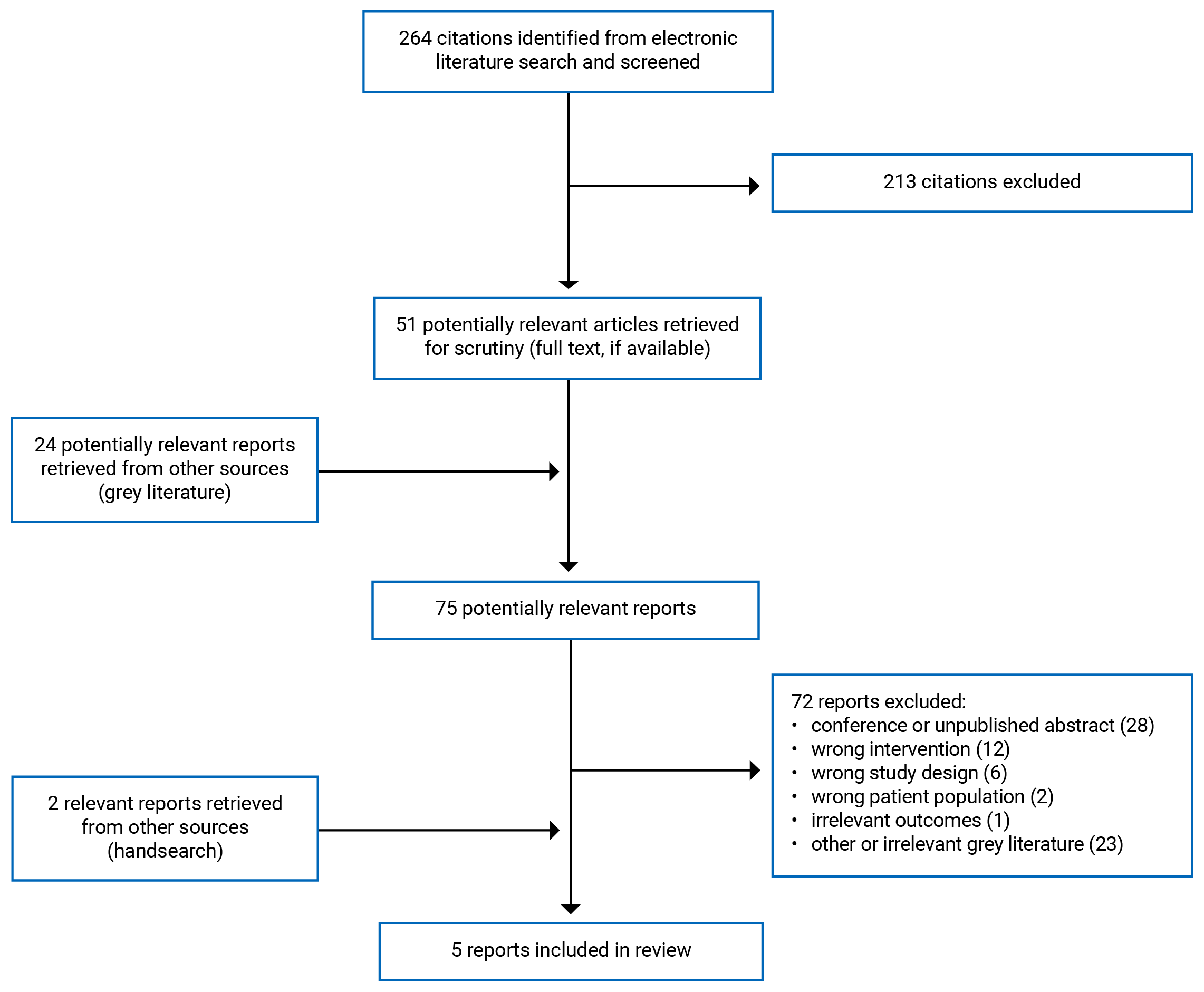
Appendix 2: Characteristics of Included Clinical Publications
Please note that this appendix has not been copy-edited.
Table 6: Characteristics of Included Primary Clinical Studies
Study citation, country, funding source | Study design | Population characteristics | Intervention and comparator(s) | Clinical outcomes, length of follow-up |
|---|---|---|---|---|
Cui et al. (2025)32 Canada Funding source: Ontario Institute of Cancer Research | Retrospective single-arm cohort of a subset of FP-treated patients from a previously published single-centre observational cohort | Inclusion criteria: Patients who were pre-emptively genotyped and found to be wildtype for c.1905+1G>A (*2A), c.2846A>T, c.1679T>G (*13), and c.1236G>A and treated with FOLFOX, FOLFIRI, or FOLFIRINOX regimens Cancer type, n (%): Colorectal 235 (70.4%); Pancreas 69 (20.7%); Gastric and Esophagus 11 (3.3%); Other 13 (3.9%); Unknown 6 (1.8%) Number of participants: 334 Age (years), median (range): 62 (21 to 80) Male sex, n (%): 179 (53.6%) Ethnicity groups, self-reported, n (%):a African/African-American 3 (0.9%); Asian 2 (0.6%); Caucasian 312 (93.4%); Unknown/Other 6 (1.8%) Other PROGRESS-Plus criteria: NRb | Intervention: Whole exome NGS with the Illumina NovaSeq 6000 sequencing platform Intron variants were excluded Reference genome: GRCh38 Comparator: NA | Outcomes: Frequency of unique DPYD variants Severe toxicity (grade ≥ 3), total and early (within the first 2 cycles of FP-based chemotherapy) events Follow-up: NR |
Sourdioux et al. (2025)14 France Funding source: None | Retrospective single-arm cohort of patients who underwent sequencing between November 2020 and July 2025 at a single centre in France | Inclusion criteria: NR Cancer type: NR Number of participants: 1,145 Age: NR Male sex: NR Ethnicity groups: data not available Other PROGRESS-Plus criteria: NRb | Intervention: Full gene sequencing with SOPHiA GENETICS PGx Community Panel conducted on a MiSeq Illumina platform Variants within coding exons or ± 15 base pairs of an exon-intron junction were included Reference genome: GRCh38/hg38 Comparator: NA | Outcomes: Frequency of DPYD variants Functional classification of DPYD variants (normal, reduced, or no DPD enzyme function) Predicted phenotype per individual (normal, intermediate, or poor FP metabolism) Follow-up: NA |
Alsulaiman et al. (2023)33 Saudi Arabia Funding source: King Abdulaziz City for Science and Technology | Prospective single-arm cohort of patients at 2 centres in Saudi Arabia | Inclusion criteria: Female breast cancer patients unselected for early disease or family disease history Number of participants: 220 Age (years), mean (standard deviation): 47.8 (10.1) Male sex, n (%): 0 (0%) Ethnicity groups: Arab 220 (100%) Other PROGRESS-Plus criteria: NRb | Intervention: Whole exome sequencing using the NovaSeq S2 to 300 platform Variants within introns were included Reference genome: hg38 Comparator: NA | Outcomes: Identification and frequency of unique DPYD variants Follow-up: NA |
Yokoi et al. (2020)30 Japan Funding source: NR | Prospective single-arm cohort of patients at a single centre in Japan between 2018 and 2020 | Inclusion criteria: Patients who received or were receiving FP-based chemotherapy Cancer type, n (%): Stomach 70 (23.2%); Colorectal 205 (68.1%); Other tumours 26 (8.6%) Number of participants: 301 Age (years), median (range): 67 (22 to 85) Male sex, n (%): 179 (59.5%) Ethnicity groups:a East Asian 301 (100%) Other PROGRESS-Plus criteria: NRb | Intervention: Custom AmpliSeq panel using a MiSeq sequencing platform Coding exons and flanking intron regions (± 10 base pairs) were included Reference genome: GRCh37/hg19 Comparator: NA | Outcomes: Frequency of unique DPYD variants Toxicity events, low (grade 0 to 2) and severe (grade 3 to 5) within the first 2 cycles of FP-based chemotherapy Follow-up: NR |
Etienne-Grimaldi et al. (2017)31 France Funding source: French National Cancer Institute | Prospective single-arm cohort of patients treated between February 2009 and February 2011 in 12 French institutions | Inclusion criteria: Women aged older than 18 years with advanced breast cancer starting capecitabine treatment Number of participants: 243 Age (years), mean (range): 61.2 (30 to 88) Male sex, n (%): 0 (0%) Ethnicity groups: NR Other PROGRESS-Plus criteria: NRb | Intervention: Full sequencing of the DPYD exome using MiSeq Illumina Variants within exons, flanking intronic regions (20 bp), 3'UTR, and part of 5'UTR (580 bp upstream transcription initiation) were included Reference genome: HG19 Comparator: NA | Outcomes: Frequency of unique DPYD variants Toxicity (digestive, hemato-, and neurotoxicity, grade ≥ 3) Sensitivity, specificity, PPV, and NPV for toxicity events Follow-up: Up to 21 days after the end of the second cycle |
FOLFIRI = folinic acid, fluorouracil, and irinotecan; FOLFIRINOX = folinic acid, fluorouracil, irinotecan, and oxaliplatin; FOLFOX = folinic acid, fluorouracil, and oxaliplatin; FP = fluoropyrimidine; NA = not applicable; NGS = next-generation sequencing; NPV = negative predictive value; NR = not reported; PPV = positive predictive value.
aEthnic categories used in the table are as reported in the source and may not align with Canada’s Drug Agency inclusive language guidelines.
bThe main PROGRESS-Plus criteria include place of residence, race, ethnicity, culture, language, occupation, gender, sex, religion, education, socioeconomic status, and social capital, personal characteristics associated with discrimination (e.g., age, disability), features of relationships, and time-dependent relationships.
Appendix 3: Critical Appraisal of Included Publications
Please note that this appendix has not been copy-edited.
Summary of Critical Appraisal
Additional details and summary of the strengths and limitations of the included studies are presented in Table 7 and Table 8.
The risk of bias was assessed using the RoBANS 2 checklist and showed an overall high risk of bias across the 5 included nonrandomized cohort studies. Each study was a single-arm cohort observational study that assessed the outcomes associated with DPYD genotype testing.14,30-33 Because of the study designs, no direct comparison was included; however, risk of bias related to inappropriate comparison may be mitigated because the cohorts within the studies were the same before and after exposure to DPYD genotype testing.14,30-33 Two of the included studies used a retrospective cohort of individuals with previously sequenced genetic information to assess outcomes associated with DPYD genotype testing which likely introduced selection bias and may impact interpretability or generalizability of findings.14,32 Three of the included studies assessed cohort outcomes using a prospective design; however, each cohort was included from a preselected population which may introduce selection bias.30,31,33 A major source of bias across the 5 included studies was related to confounding factors, including treatment regimen, type of cancer, patient characteristics, or reported comorbidities. None of the included studies reported or attempted to control for confounding factors that may have influenced outcomes related to DPYD variant prevalences or association of FP-related toxicities.14,30-33
Despite the overall high risk of bias, the included studies reported methodological strengths. The authors of the studies provided clear descriptions of the study objective, outcomes of interest, methods for DPYD sequencing and analysis, and summaries of main findings.14,30-33 Only 1 study included clinical validity measurements to report outcomes associated with FP-related toxicity.31 Despite the lack of control for major confounding factors, 2 studies included cohorts that were ethnically homogeneous,30,33 while 2 studies included cohorts from 1 disease-specific population (i.e., people with breast cancer).31,33 No blinding was used in the included studies; however, lack of blinding was not likely to impact reported outcomes because most outcomes were objectively measured or patient reported.14,30-33 Four studies reported either no missing data or data that was removed was done before analysis and likely did not influence outcomes.14,31-33 One study reported data that was removed after the analysis and provided no justification for removal which may indicated attrition bias.30
Because of the nature of the study designs used for the included studies (i.e., single cohort, before and after analysis), risk of bias from several domains may have influenced the analysis and reporting of outcomes. This indicated that the outcomes reported within these studies may not be generalizable to the broader population of interest, and any outcomes reported within should be interpreted within the context of the study.
Table 7: Strengths and Limitations of Nonrandomized Intervention Studies Using the RoBANS 2 Checklist29
Risk of bias domain | Description | Risk of bias judgment |
|---|---|---|
Cui, 202532 | ||
Comparability of the target group (selection bias due to the selection of an inappropriate comparison target group) | No direct comparison group was included, but the populations group is the same for before and after receiving DPYD genotyping | Low |
Target group selection (selection bias due to inappropriate intervention or inappropriate selection of exposure group or patient group) | The population group was recruited based on pre-emptive DPYD genotyping outcomes and included for further genotyping. The population included may have been enriched for rare variants or related outcomes based on pre-emptive DPYD genotyping assessment. | High |
Confounders (selection bias due to inappropriate confounder confirmation and consideration) | Main confounders were not controlled for and did not impact selection into study and likely influenced main outcomes during analysis | High |
Measurement of intervention or exposure (performance bias due to inappropriate intervention or inappropriate exposure measurement) | Outcome measurements were clearly indicated with justification for analysis using standardized measurements | Low |
Blinding of assessors (detection bias due to inappropriate blinding of assessors) | No blinding was used to assess outcomes, but lack of blinding is likely not an affecting factor for outcomes | Low |
Outcome assessment (detection bias due to inappropriate outcome assessment methods) | Outcomes were collected using standardized measurements, but the accuracy of measurements were not reported | High |
Incomplete outcome data (attrition bias due to inappropriate handling of incomplete data) | No missing data were reported and had no apparent effect on outcomes | Low |
Selective outcome reporting (reporting bias due to selective outcome reporting) | Expected main outcomes of interest were clearly stated and analysis for outcomes was provided | Low |
Overall risk of bias | Major sources of risk of bias are related to potential selection bias from the retrospective cohort analysis and potential for uncontrolled confounding factors to influence outcomes | High |
Sourdioux, 202514 | ||
Comparability of the target group (selection bias due to the selection of an inappropriate comparison target group) | No direct comparison group was included, but the population group is the same for before and after receiving DPYD genotyping | Low |
Target group selection (selection bias due to inappropriate intervention or inappropriate selection of exposure group or patient group) | The population group was identified through a retrospective analysis of previously collected genetic information | High |
Confounders (selection bias due to inappropriate confounder confirmation and consideration) | Confounding factors were not reported or controlled for and may likely influence main outcomes | High |
Measurement of intervention or exposure (performance bias due to inappropriate intervention or inappropriate exposure measurement) | Outcome measurements were clearly indicated with justification for analysis using standardized measurements | Low |
Blinding of assessors (detection bias due to inappropriate blinding of assessors) | No blinding was used to assess outcomes, but lack of blinding likely not an affecting factor for outcomes | Low |
Outcome assessment (detection bias due to inappropriate outcome assessment methods) | Outcomes were collected using standardized measurements, but the accuracy of measurements were not reported | High |
Incomplete outcome data (attrition bias due to inappropriate handling of incomplete data) | Some data were not used due to insufficient quality, but is not likely to affect the outcomes | Low |
Selective outcome reporting (reporting bias due to selective outcome reporting) | Expected main outcomes of interest were clearly stated and analysis for outcomes were provided | Low |
Overall risk of bias | Major sources of risk of bias are related to potential selection bias from the retrospective cohort analysis and potential for uncontrolled confounding factors to influence outcomes | High |
Alsulaiman, 202333 | ||
Comparability of the target group (selection bias due to the selection of an inappropriate comparison target group) | No direct comparison group was included, but the population group is the same for before and after receiving DPYD genotyping | Low |
Target group selection (selection bias due to inappropriate intervention or inappropriate selection of exposure group or patient group) | The population group was prospectively recruited from regional hospitals and data were collected and sequenced prospectively, but inclusion criteria may have been biased toward a preselected set of patients | Low |
Confounders (selection bias due to inappropriate confounder confirmation and consideration) | The patient population included female patients with breast cancer from 2 similar regional hospitals; however, other confounding factors were not controlled for or reported and may likely have influenced main outcomes | High |
Measurement of intervention or exposure (performance bias due to inappropriate intervention or inappropriate exposure measurement) | Outcome measurements were clearly indicated with justification for analysis using standardized measurements | Low |
Blinding of assessors (detection bias due to inappropriate blinding of assessors) | No blinding was used to assess outcomes, but lack of blinding was likely not an affecting factor for outcomes | Low |
Outcome assessment (detection bias due to inappropriate outcome assessment methods) | Outcomes were collected using standardized measurements, but the accuracy of measurements was not reported | High |
Incomplete outcome data (attrition bias due to inappropriate handling of incomplete data) | No missing data were reported and had no apparent effect on outcomes | Low |
Selective outcome reporting (reporting bias due to selective outcome reporting) | Expected main outcomes of interest were clearly stated and analysis for outcomes was provided | Low |
Overall risk of bias | Despite the lack of control for potential confounding factors, the analysis of the outcomes was clearly presented and justified for the methodological approach taken | High |
Yokoi, 202030 | ||
Comparability of the target group (selection bias due to the selection of an inappropriate comparison target group) | No direct comparison group was included, but the population group is the same for before and after receiving DPYD genotyping | Low |
Target group selection (selection bias due to inappropriate intervention or inappropriate selection of exposure group or patient group) | The population group was prospectively recruited from regional hospitals and data were collected and sequenced prospectively, but inclusion criteria may have been biased toward a preselected set of patients | Low |
Confounders (selection bias due to inappropriate confounder confirmation and consideration) | All patients included in the study were of East Asian ethnicity; however, confounding factors were not reported or controlled for and may likely influence main outcomes | High |
Measurement of intervention or exposure (performance bias due to inappropriate intervention or inappropriate exposure measurement) | Outcomes were collected using standardized measurements, but the accuracy of measurements were not reported | Low |
Blinding of assessors (detection bias due to inappropriate blinding of assessors) | No blinding was used to assess outcomes, but lack of blinding likely not an affecting factor for outcomes | Low |
Outcome assessment (detection bias due to inappropriate outcome assessment methods) | Outcome were collected using standardized measurements, and when appropriate, clinical validity measures were used to assess the accuracy of the DPYD genotyping | Low |
Incomplete outcome data (attrition bias due to inappropriate handling of incomplete data) | The authors reported data for a DPYD variant were removed after the analysis, but justification for removing the data was not reported | High |
Selective outcome reporting (reporting bias due to selective outcome reporting) | Expected main outcomes of interest were clearly stated and analysis for outcomes was provided | Low |
Overall risk of bias | Major sources of risk of bias are related to potential selection bias in the patient population, reporting bias for data that were removed, and potential for uncontrolled confounding factors to influence outcomes | High |
Etienne-Grimaldi, 201731 | ||
Comparability of the target group (selection bias due to the selection of an inappropriate comparison target group) | No direct comparison group was included, but the population group is the same for before and after receiving DPYD genotyping | Low |
Target group selection (selection bias due to inappropriate intervention or inappropriate selection of exposure group or patient group) | The population group was prospectively recruited from regional hospitals and data were collected and sequenced prospectively, but inclusion criteria may have been biased toward a preselected set of patients | Low |
Confounders (selection bias due to inappropriate confounder confirmation and consideration) | Confounding factors were not reported or controlled for and may likely influence main outcomes | High |
Measurement of intervention or exposure (performance bias due to inappropriate intervention or inappropriate exposure measurement) | Outcome measurements were clearly indicated with justification for analysis using standardized measurements | Low |
Blinding of assessors (detection bias due to inappropriate blinding of assessors) | No blinding was used to assess outcomes, but lack of blinding was likely not an affecting factor for outcomes | Low |
Outcome assessment (detection bias due to inappropriate outcome assessment methods) | Outcome were collected using standardized measurements, and when appropriate, clinical validity measures were used to assess the accuracy of the DPYD genotyping | Low |
Incomplete outcome data (attrition bias due to inappropriate handling of incomplete data) | The authors reported on patient data that were removed before the analysis due to unavailable data and insufficient quality; however, data that were removed were not likely to affect the outcomes | Low |
Selective outcome reporting (reporting bias due to selective outcome reporting) | Expected main outcomes of interest were clearly stated and analysis for outcomes were provided | Low |
Overall risk of bias | Major sources of risk of bias are related to potential selection bias in the patient population and potential for uncontrolled confounding factors to influence outcomes | High |
Table 8: Summary of Risk of Bias for Nonrandomized Intervention Studies Using the RoBANS 2 Checklist29
Citation | Risk of bias domain | ||||||||
|---|---|---|---|---|---|---|---|---|---|
Comparability of the target group | Target group selection | Confounders | Measurement of intervention/exposure | Blinding of assessors | Outcome assessment | Incomplete outcome data | Selective outcome reporting | Overall | |
Cui, 202532 | Low | High | High | Low | Low | High | Low | Low | High |
Sourdioux, 202514 | Low | High | High | Low | Low | High | Low | Low | High |
Alsulaiman, 202333 | Low | Low | High | Low | Low | High | Low | Low | High |
Yokoi, 202030 | Low | Low | High | Low | Low | Low | High | Low | High |
Etienne-Grimaldi, 201731 | Low | Low | High | Low | Low | Low | Low | Low | High |
Appendix 4: Main Study Findings
Please note that this appendix has not been copy-edited.
Table 9: Frequency and Prevalence of All Identified DPYD Variants
Identified DPYD variant | Total variant frequency (N = 2,243), n | Total variant prevalence, % | Cui, 2025 (N = 334)32 | Sourdioux, 2025 (N = 1,145)14 | Alsulaiman, 2023 (N = 220)33 | Yokoi, 2020 (N = 301)30 | Etienne-Grimaldi, 2017 (N = 243)2 | ||||||
|---|---|---|---|---|---|---|---|---|---|---|---|---|---|
Heterozygous variants, n (%) | Homozygous variants, n (%) | Heterozygous variants, n (%) | Homozygous variants, n (%) | Heterozygous variants, n (%) | Homozygous variants, n (%) | Heterozygous variants, n (%) | Homozygous variants, n (%) | Heterozygous variants, n (%) | Homozygous variants, n (%) | ||||
c.162A>G | 795 | 35.44 | 113 (33.83) | 11 (3.29) | 363 (31.70) | 47 (4.10) | 39 (17.73) | 6 (2.73) | 108 (35.88) | 27 (8.97) | 73 (30.04) | 8 (3.29) | |
c.85T>C(*9A) | 424 | 18.90 | 97 (29.04) | 9 (2.69) | 160 (13.97) | 53 (4.63) | — | — | 23 (7.64) | 1 (0.33) | 74 (30.45) | 7 (2.88) | |
c.496A>G | 323 | 14.40 | 48 (14.37) | 2 (0.59) | 176 (15.37) | 12 (1.05) | 24 (10.91) | 2 (0.91) | 14 (4.65) | 0 (0) | 42 (17.28) | 3 (1.23) | |
c.2194G>A(*6) | 201 | 8.96 | 32 (9.58) | 0 (0) | 111 (9.69) | 3 (0.26) | 39 (17.73) | 3 (1.36) | 13 (4.32) | 0 (0) | — | — | |
c.*768G>A | 157 | 7.00 | — | — | — | — | — | — | — | — | 122 (50.21) | 35 (14.40) | |
c.1896T>C | 146 | 6.51 | 29 (8.68) | 1 (0.29) | 90 (7.86) | 2 (0.17) | 8 (3.64) | 0 (0) | — | — | 15 (6.17) | 1 (0.41) | |
DPYD*1 | 114 | 5.08 | — | — | — | — | 59 (26.82) | 55 (25.00) | — | — | — | — | |
c.1601G>A(*4) | 97 | 4.32 | 12 (3.59) | 1 (0.29) | 57 (4.98) | 0 (0) | 18 (8.18) | 1 (0.45) | — | — | 8 (3.29) | 0 (0) | |
c.*780C>T | 91 | 4.06 | — | — | — | — | — | — | — | — | 78 (32.10) | 13 (5.35) | |
c.*274T>C | 84 | 3.74 | — | — | — | — | — | — | — | — | 75 (30.86) | 9 (3.70) | |
c.1740+40A>G | 75 | 3.34 | — | — | — | — | 60 (27.27) | 15 (6.82) | — | — | — | — | |
c.1129-15T>C | 65 | 2.90 | — | — | — | — | 14 (6.36) | 0 (0) | — | — | 46 (18.93) | 5 (2.05) | |
c.483+1344T>A | 51 | 2.27 | — | — | — | — | — | — | — | — | 48 (19.75) | 3 (1.23) | |
c.483+837A>G | 47 | 2.10 | — | — | — | — | — | — | — | — | 44 (18.11) | 3 (1.23) | |
c.483+1342T>A | 41 | 1.83 | — | — | — | — | — | — | — | — | 40 (16.46) | 1 (0.41) | |
c.1236G>A | 35 | 1.56 | — | — | 31 (2.71) | 0 (0) | — | — | — | — | 4 (1.65) | 0 (0) | |
c.-477T>G | 28 | 1.25 | — | — | — | — | — | — | — | — | 27 (11.11) | 1 (0.41) | |
c.1218G>A | 24 | 1.07 | — | — | 11 (0.96) | 2 (0.17) | 9 (4.09) | 1 (0.45) | — | — | 1 (0.41) | 0 (0) | |
c.1905+1G>A(*2A) | 20 | 0.89 | — | — | 14 (1.22) | 0 (0) | 3 (1.36) | 0 (0) | — | — | 3 (1.23) | 0 (0) | |
c.*900T>C 3 | 20 | 0.89 | — | — | — | — | — | — | — | — | 19 (7.82) | 1 (0.41) | |
c.2846A>T | 16 | 0.71 | — | — | 13 (1.14) | 0 (0) | — | — | — | — | 3 (1.23) | 0 (0) | |
c.775A>G | 16 | 0.71 | 6 (1.79) | 0 (0) | 10 (0.87) | 0 (0) | — | — | — | — | — | — | |
c.2197G>A(*6) | 16 | 0.71 | — | — | — | — | — | — | — | — | 16 (6.58) | 0 (0) | |
c.483+1366A>G | 11 | 0.49 | — | — | — | — | — | — | — | — | 11 (4.53) | 0 (0) | |
c.2303C>A | 11 | 0.49 | — | — | — | — | — | — | 11 (3.65) | 0 (0) | — | — | |
c.3067C>A | 10 | 0.45 | 1 (0.29) | 0 (0) | 8 (0.70) | 0 (0) | 1 (0.45) | 0 (0) | — | — | — | — | |
c.483+1360_483+1361dup | 10 | 0.45 | — | — | — | — | — | — | — | — | 10 (4.12) | 0 (0) | |
c.1679T>G(*13) | 8 | 0.36 | — | — | 7 (0.61) | 0 (0) | — | — | — | — | 1 (0.41) | 0 (0) | |
c.557A>G | 5 | 0.22 | — | — | 5 (0.44) | 0 (0) | — | — | — | — | — | — | |
c.1494A>G | 4 | 0.18 | — | — | 4 (0.35) | 0 (0) | — | — | — | — | — | — | |
c.1371C>T | 4 | 0.18 | — | — | 4 (0.35) | 0 (0) | — | — | — | — | — | — | |
c.483+18G>A | 4 | 0.18 | — | — | — | — | — | — | — | — | 4 (1.65) | 0 (0) | |
c.*1062A>G 3 | 4 | 0.18 | — | — | — | — | — | — | — | — | 4 (1.65) | 0 (0) | |
c.772G>A | 3 | 0.13 | — | — | 3 (0.26) | 0 (0) | — | — | — | — | — | — | |
c.2324T>G | 2 | 0.09 | 1 (0.29) | 0 (0) | 1 (0.09) | 0 (0) | — | — | — | — | — | — | |
c.1774C>T | 2 | 0.09 | — | — | 1 (0.09) | 0 (0) | — | — | — | — | 1 (0.41) | 0 (0) | |
c.1140T>C | 2 | 0.09 | — | — | 2 (0.17) | 0 (0) | — | — | — | — | — | — | |
c.768T>G | 2 | 0.09 | — | — | 2 (0.17) | 0 (0) | — | — | — | — | — | — | |
c.2948C>T | 2 | 0.09 | — | — | 2 (0.17) | 0 (0) | — | — | — | — | — | — | |
c.1089C>T | 2 | 0.09 | — | — | 2 (0.17) | 0 (0) | — | — | — | — | — | — | |
c.1128+3A>G | 2 | 0.09 | — | — | 2 (0.17) | 0 (0) | — | — | — | — | — | — | |
c.1613C>A | 2 | 0.09 | — | — | — | — | 2 (0.91) | 0 (0) | — | — | — | — | |
c.483+47A>G | 2 | 0.09 | — | — | — | — | 2 (0.91) | 0 (0) | — | — | — | — | |
c.483+834A>G | 2 | 0.09 | — | — | — | — | — | — | — | — | 2 (0.82) | 0 (0) | |
c.483+1345_483+1346dup | 2 | 0.09 | — | — | — | — | — | — | — | — | 2 (0.82) | 0 (0) | |
c.*432T>A | 2 | 0.09 | — | — | — | — | — | — | — | — | 2 (0.82) | 0 (0) | |
c.596G>A | 2 | 0.09 | — | — | 1 (0.09) | 0 (0) | — | — | 1 (0.33) | 0 (0) | — | — | |
c.2476G>A | 2 | 0.09 | — | — | — | — | — | — | 2 (0.66) | 0 (0) | — | — | |
c.257C>T | 1 | 0.04 | 1 (0.29) | 0 (0) | — | — | — | — | — | — | — | — | |
c.601A>C | 1 | 0.04 | 1 (0.29) | 0 (0) | — | — | — | — | — | — | — | — | |
c.807C>T | 1 | 0.04 | 1 (0.29) | 0 (0) | — | — | — | — | — | — | — | — | |
c.1307G>A | 1 | 0.04 | 1 (0.29) | 0 (0) | — | — | — | — | — | — | — | — | |
c.1850C>T | 1 | 0.04 | 1 (0.29) | 0 (0) | — | — | — | — | — | — | — | — | |
c.2658C>T | 1 | 0.04 | 1 (0.29) | 0 (0) | — | — | — | — | — | — | — | — | |
c.2806G>T | 1 | 0.04 | 1 (0.29) | 0 (0) | — | — | — | — | — | — | — | — | |
c.799A>G | 1 | 0.04 | — | — | 1 (0.09) | 0 (0) | — | — | — | — | — | — | |
c.2766+1G>A | 1 | 0.04 | — | — | 1 (0.09) | 0 (0) | — | — | — | — | — | — | |
c.2223G>C | 1 | 0.04 | — | — | 1 (0.09) | 0 (0) | — | — | — | — | — | — | |
c.1645G>C | 1 | 0.04 | — | — | 1 (0.09) | 0 (0) | — | — | — | — | — | — | |
c.1181G>A | 1 | 0.04 | — | — | 1 (0.09) | 0 (0) | — | — | — | — | — | — | |
c.2915A>G | 1 | 0.04 | — | — | 1 (0.09) | 0 (0) | — | — | — | — | — | — | |
c.703C>T(*8) | 1 | 0.04 | — | — | 1 (0.09) | 0 (0) | — | — | — | — | — | — | |
c.1280T>C | 1 | 0.04 | — | — | 1 (0.09) | 0 (0) | — | — | — | — | — | — | |
c.525G>A | 1 | 0.04 | — | — | 1 (0.09) | 0 (0) | — | — | — | — | — | — | |
c.299_302del | 1 | 0.04 | — | — | 1 (0.09) | 0 (0) | — | — | — | — | — | — | |
c.2820C>T | 1 | 0.04 | — | — | 1 (0.09) | 0 (0) | — | — | — | — | — | — | |
c.95C>T | 1 | 0.04 | — | — | 1 (0.09) | 0 (0) | — | — | — | — | — | — | |
c.704G>A | 1 | 0.04 | — | — | 1 (0.09) | 0 (0) | — | — | — | — | — | — | |
c.2023A>G | 1 | 0.04 | — | — | 1 (0.09) | 0 (0) | — | — | — | — | — | — | |
c.966C>T | 1 | 0.04 | — | — | 1 (0.09) | 0 (0) | — | — | — | — | — | — | |
c.2283A>G | 1 | 0.04 | — | — | 1 (0.09) | 0 (0) | — | — | — | — | — | — | |
c.286G>C | 1 | 0.04 | — | — | 1 (0.09) | 0 (0) | — | — | — | — | — | — | |
c.2475T>G | 1 | 0.04 | — | — | 1 (0.09) | 0 (0) | — | — | — | — | — | — | |
c.1931G>C | 1 | 0.04 | — | — | 1 (0.09) | 0 (0) | — | — | — | — | — | — | |
c.1775G>C | 1 | 0.04 | — | — | 1 (0.09) | 0 (0) | — | — | — | — | — | — | |
c.767T>C | 1 | 0.04 | — | — | 1 (0.09) | 0 (0) | — | — | — | — | — | — | |
c.2622+14T>C | 1 | 0.04 | — | — | — | — | 1 (0.45) | 0 (0) | — | — | — | — | |
c.1975-22C>A | 1 | 0.04 | — | — | — | — | 1 (0.45) | 0 (0) | — | — | — | — | |
c.1579C>T | 1 | 0.04 | — | — | — | — | 1 (0.45) | 0 (0) | — | — | — | — | |
c.1403C>G | 1 | 0.04 | — | — | — | — | 1 (0.45) | 0 (0) | — | — | — | — | |
c.850+74C>G | 1 | 0.04 | — | — | — | — | 1 (0.45) | 0 (0) | — | — | — | — | |
c.763-24del | 1 | 0.04 | — | — | — | — | 1 (0.45) | 0 (0) | — | — | — | — | |
c.39+81_39+89dup | 1 | 0.04 | — | — | — | — | 1 (0.45) | 0 (0) | — | — | — | — | |
c.733A>T | 1 | 0.04 | — | — | — | — | — | — | 1 (0.33) | 0 (0) | — | — | |
c.914C>A | 1 | 0.04 | — | — | — | — | — | — | 1 (0.33) | 0 (0) | — | — | |
c.1003G>A | 1 | 0.04 | — | — | — | — | — | — | 1 (0.33) | 0 (0) | — | — | |
c.1156G>T | 1 | 0.04 | — | — | — | — | — | — | 1 (0.33) | 0 (0) | — | — | |
c.1666A>C | 1 | 0.04 | — | — | — | — | — | — | 1 (0.33) | 0 (0) | — | — | |
c.1712C>A | 1 | 0.04 | — | — | — | — | — | — | 1 (0.33) | 0 (0) | — | — | |
c.1863G>T | 1 | 0.04 | — | — | — | — | — | — | 1 (0.33) | 0 (0) | — | — | |
c.2678A>G | 1 | 0.04 | — | — | — | — | — | — | 1 (0.33) | 0 (0) | — | — | |
c.-672T>C | 1 | 0.04 | — | — | — | — | — | — | — | — | 1 (0.41) | 0 (0) | |
c.-18G>A | 1 | 0.04 | — | — | — | — | — | — | — | — | 1 (0.41) | 0 (0) | |
c.40-69_4059del | 1 | 0.04 | — | — | — | — | — | — | — | — | 1 (0.41) | 0 (0) | |
c.76G>A | 1 | 0.04 | — | — | — | — | — | — | — | — | 1 (0.41) | 0 (0) | |
c.194C>T | 1 | 0.04 | — | — | — | — | — | — | — | — | 1 (0.41) | 0 (0) | |
c.300C>A | 1 | 0.04 | — | — | — | — | — | — | — | — | 1 (0.41) | 0 (0) | |
c.483+563T>C | 1 | 0.04 | — | — | — | — | — | — | — | — | 1 (0.41) | 0 (0) | |
c.483+729G>A | 1 | 0.04 | — | — | — | — | — | — | — | — | 1 (0.41) | 0 (0) | |
c.483+128A>G | 1 | 0.04 | — | — | — | — | — | — | — | — | 1 (0.41) | 0 (0) | |
c.483+1345_483+1354del | 1 | 0.04 | — | — | — | — | — | — | — | — | 1 (0.41) | 0 (0) | |
c.483+1346A>T | 1 | 0.04 | — | — | — | — | — | — | — | — | 1 (0.41) | 0 (0) | |
c.483+1354_483+1355insAA | 1 | 0.04 | — | — | — | — | — | — | — | — | 1 (0.41) | 0 (0) | |
c.483+1689G>A | 1 | 0.04 | — | — | — | — | — | — | — | — | 1 (0.41) | 0 (0) | |
c.851-22T>C | 1 | 0.04 | — | — | — | — | — | — | — | — | 1 (0.41) | 0 (0) | |
c.1025A>G | 1 | 0.04 | — | — | — | — | — | — | — | — | 1 (0.41) | 0 (0) | |
c.1053T>C | 1 | 0.04 | — | — | — | — | — | — | — | — | 1 (0.41) | 0 (0) | |
c.1098C>T | 1 | 0.04 | — | — | — | — | — | — | — | — | 1 (0.41) | 0 (0) | |
c.1475C>T | 1 | 0.04 | — | — | — | — | — | — | — | — | 1 (0.41) | 0 (0) | |
c.1524+16C>A | 1 | 0.04 | — | — | — | — | — | — | — | — | 1 (0.41) | 0 (0) | |
c.1740+82del | 1 | 0.04 | — | — | — | — | — | — | — | — | 1 (0.41) | 0 (0) | |
c.1905+17A>G | 1 | 0.04 | — | — | — | — | — | — | — | — | 1 (0.41) | 0 (0) | |
c.1906-24G>A | 1 | 0.04 | — | — | — | — | — | — | — | — | 1 (0.41) | 0 (0) | |
c.2087G>A | 1 | 0.04 | — | — | — | — | — | — | — | — | 1 (0.41) | 0 (0) | |
c.2179+28C>T | 1 | 0.04 | — | — | — | — | — | — | — | — | 1 (0.41) | 0 (0) | |
c.2179+29G>A | 1 | 0.04 | — | — | — | — | — | — | — | — | 1 (0.41) | 0 (0) | |
c.*1189G>A | 1 | 0.04 | — | — | — | — | — | — | — | — | 1 (0.41) | 0 (0) | |
Table 10: Frequency and Prevalence of Confirmed Deficient DPYD Variants
Identified DPYD variant | Total variant frequency (N = 2243), n | Total variant prevalence, % | Reported CPIC functional classification | Cui, 2025 (N = 334)32 | Sourdioux, 2025 (N = 1,145)14 | Alsulaiman, 2023 (N = 220)33 | Yokoi, 2020 (N = 301)30 | Etienne-Grimaldi, 2017 (N = 243)31 |
|---|---|---|---|---|---|---|---|---|
Heterozygous variants, n (%) | Heterozygous variants, n (%) | Heterozygous variants, n (%) | Heterozygous variants, n (%) | Heterozygous variants, n (%) | ||||
c.1236G>Aa,b | 35 | 1.56 | 0.5 | — | 31 (2.71) | — | — | 4 (1.65) |
c.1905+1G>A(*2A)a,b | 20 | 0.89 | 0 | — | 14 (1.22) | 3 (1.36) | — | 3 (1.23) |
c.2846A>Ta,b | 16 | 0.71 | 0.5 | — | 13 (1.14) | — | — | 3 (1.23) |
c.1679T>G(*13)a,b | 8 | 0.36 | 0 | — | 7 (0.61) | — | — | 1 (0.41) |
c.557A>Gb | 5 | 0.22 | 0.5 | — | 5 (0.44) | — | — | — |
c.1774C>T | 2 | 0.09 | 0 | — | 1 (0.09) | — | — | 1 (0.41) |
c.257C>T | 1 | 0.04 | 0 | 1 (0.29) | — | — | — | — |
c.601A>C | 1 | 0.04 | 0 | 1 (0.29) | — | — | — | — |
c.703C>T(*8) | 1 | 0.04 | 0 | — | 1 (0.09) | — | — | — |
c.299_302del | 1 | 0.04 | 0 | — | 1 (0.09) | — | — | — |
c.1775G>C | 1 | 0.04 | 0 | — | 1 (0.09) | — | — | — |
c.1156G>T | 1 | 0.04 | 0 | — | — | — | 1 (0.33) | — |
c.1475C>T | 1 | 0.04 | 0 | — | — | — | — | 1 (0.41) |
CPIC = Clinical Pharmacogenetics Implementation Consortium.
Note: All identified variants occurred in heterozygous genotypes.
aThese variants are typically included in the 4 common DPYD variant genotype test.
bThese variants are typically included in the 7 common DPYD variant genotype test.
Table 11: Frequency and Prevalence of DPYD Variants Associated With Grade 3 or Higher FP Treatment Toxicity
DPYD variant | Reported ethnicitya | Heterozygous frequency, n/N (%) | Homozygous frequency, n (%) | FP treatment cycle (n) | All reported severity and toxicity type(s) (n) | Number of reported grade 3 to grade 4 events, n (%) | Number of reported grade 4 or higher events, n (%) |
|---|---|---|---|---|---|---|---|
Cui, 202532,b | |||||||
c.85T>C(*9A) | NR | 40/97 (41.24) | 3/9 (33.33) | Cycle 1 and 2 (26) Any cycle (43) | NR | NR | NR |
c.496A>G | NR | 23/48 (47.92) | 1/2 (50.00) | Cycle 1 and 2 (15) Any cycle (24) | NR | NR | NR |
c.1601G>A | NR | 2/12 (16.67) | 0/1 (0) | Cycle 1 and 2 (1) Any cycle (2) | NR | NR | NR |
c.1627A>G | NR | 41/113 (36.28) | 4/11 (36.36) | Cycle 1 and 2 (31) Any cycle (45) | NR | NR | NR |
c.1896T>C | NR | 9/29 (31.03) | 0/1 (0) | Cycle 1 and 2 (7) Any cycle (9) | NR | NR | NR |
c.2194G>A | NR | 14/32 (43.75) | 0/0 (0) | Cycle 1 and 2 (5) Any cycle (14) | NR | NR | NR |
c.257C>T | African | 1/1 (100) | 0/0 (0) | Cycle 1 and 2 (1) Any cycle (1) | Neutropenia (1) | NR | NR |
c.601A>C | Caucasian | 1/1 (100) | 0/0 (0) | Cycle 1 and 2 (1) Any cycle (1) | Neutropenia (1) | NR | NR |
c.775A>G | Caucasian | 2/6 (33.33) | 0/0 (0) | Cycle 1 and 2 (2) Any cycle (2) | Neutropenia (1) Fatigue and nausea (1) | NR | NR |
c.807C>T | Caucasian | 1/1 (100) | 0/0 (0) | Cycle 1 and 2 (1) Any cycle (1) | Neutropenia (1) | NR | NR |
c.1850C>T | Caucasian | 1/1 (100) | 0/0 (0) | Cycle 1 and 2 (1) Any cycle (1) | Neutropenia (1) | NR | NR |
c.2324T>G | Caucasian | 1/1 (100) | 0/0 (0) | Cycle 1 and 2 (1) Any cycle (1) | Neutropenia (1) | NR | NR |
c.2658C>T | Caucasian | 1/1 (100) | 0/0 (0) | Cycle 1 and 2 (0) Any cycle (1) | Mucositis (1) | NR | NR |
Yokoi, 202030 | |||||||
c.85C>T | East Asian | 6/23 (26.09) | 0/1 (0) | NR | NR | NR | NR |
c.496A>G | East Asian | 5/14 (35.71) | 0/0 (0) | NR | NR | NR | NR |
c.596G>A | East Asian | 1/1 (100) | 0/0 (0) | NR | G3 Diarrhea (1) G3 Neutropenia (1) G3 Vomiting (1) | NR | NR |
c.733A>T | East Asian | 1/1 (100) | 0/0 (0) | NR | G3 Diarrhea (1) G2 Nausea (1) G2 Vomiting (1) | NR | NR |
c.1156G>T | East Asian | 1/1 (100) | 0/0 (0) | NR | G3 Neutropenia (1) G1 Nausea (1) | NR | NR |
c.1627A>G | East Asian | 19/108 (17.59) | 5/27 (18.52) | NR | NR | NR | NR |
c.1712C>A | East Asian | 1/1 (100) | 0/0 (0) | NR | G3 Diarrhea (1) G3 Nausea (1) G1 Neutropenia (1) | NR | NR |
c.1863G>T | East Asian | 1/1 (100) | 0/0 (0) | NR | G3 Neutropenia (1) G1 Nausea (1) | NR | NR |
c.2194G>A | East Asian | 4/13 (30.77) | 0/0 (0) | NR | NR | NR | NR |
c.2303C>A | East Asian | 3/11 (27.27) | 0/0 (0) | NR | NR | NR | NR |
Etienne-Grimaldi, 201731 | |||||||
Any 3 known actionable variantsc | NR | NR | NR | NR | NR | 30 (12.4) | 5 (2.1) |
Any 7 in vitro pathogenic variantsd | NR | NR | NR | NR | NR | 30 (12.4) | 5 (2.1) |
Any 11 in silico pathogenic variantse | NR | NR | NR | NR | NR | 30 (12.4) | 5 (2.1) |
FP = fluoropyrimidine; G = grade; NR = not reported.
aEthnic categories used in the table are as reported in the source and may not align with Canada’s Drug Agency inclusive language guidelines.
bAll toxicities were grade 3 or higher, but specific toxicity severity for toxicity types were not reported.
cThe 3 known actionable DPYD variants were reported to be c.1905 + 1G > A (*2A), c.1679T > G (*13), and c.2846A > T.
dThe 7 in vitro pathogenic variants included the 3 known actionable variants plus c.300C>A, c.1025A>G, c.1475C>T, and c.1774C>T.
eThe 11 in silico pathogenic variants included the 3 known actionable variants and 4 additional in vitro variants plus c.76G>A, c.194C>T, c.1098C>T, c.2087G>A.
Table 12: Association of DPYD Variants With FP Treatment Toxicity
DPYD variant | Cui, 202532 | Etienne-Grimaldi, 201731 | ||
|---|---|---|---|---|
Association between variant and early severe toxicity,a OR (95% CI); P value | Association between variant and total severe toxicity,b OR (95% CI); P value | Association between variant and grade 3 to 4 toxicity, RR (95% CI); P value | Association between variant and only grade 4 toxicity, RR (95% CI); P value | |
c.85T>C(*9A) (heterozygous carriers) | 0.9917 (0.5567 to 1.728); 0.9770 | 1.186 (0.7212 to 1.939); 0.4991 | — | — |
c.85T>C(*9A) (homozygous carriers) | 1.638 (0.3336 to 6.526); 0.4993 | 0.8561 (0.1746 to 3.399); 0.8313 | — | — |
c.496A>G (heterozygous or homozygous carriers) | 1.441 (0.7193 to 2.780); 0.2865 | NR | — | — |
c.496A>G (heterozygous carriers) | NR | 1.591 (0.8467 to 2.983); 0.1461 | — | — |
c.496A>G (homozygous carriers) | NR | 2.443 (0.0953 to 62.60); 0.5308 | — | — |
c.1601G>A (heterozygous or homozygous carriers) | 0.2497 (0.0136 to 1.313); 0.1875 | 0.2764 (0.0419 to 1.70); 0.1012 | — | — |
c.1627A>G (heterozygous carriers) | 1.084 (0.6290 to 1.845); 0.7670 | 0.8876 (0.5473 to 1.429); 0.6258 | — | — |
c.1627A>G (homozygous carriers) | 1.203 (0.2538 to 4.393); 0.7924 | 0.8630 (0.2168 to 3.004); 0.8212 | — | — |
c.1896T>C (heterozygous or homozygous carriers) | 1.012 (0.3863 to 2.362); 0.9796 | 0.712 (0.2990 to 1.586); 0.4238 | — | — |
c.2194G>A (heterozygous carriers) | 0.5822 (0.1914 to 1.456); 0.2861 | 1.386 (0.6472 to 2.923); 0.3917 | — | — |
All rare DPYD variant carriersc | 2.793 (0.9424 to 8.097); 0.0566 | 1.320 (0.4466 to 3.812); 0.6052 | — | — |
Any 3 known actionable variantsd | — | — | 6.71 (3.69 to 12.2); < 0.001 | 8.39 (1.07 to 65.7); 0.14 |
Any 7 in vitro pathogenic variantse | — | — | 7.60 (4.44 to 13.0); < 0.001 | 31.36 (5.8 to 168.9); 0.001 |
Any 11 in silico pathogenic variantsf | — | — | 5.48 (2.95 to 10.16); < 0.001 | 22.6 (4.08 to 125.1); 0.002 |
CI = confidence interval; NR = not reported; OR = odds ratio; RR = risk ratio.
aEarly severe toxicity was reported as any experience of a grade ≥ 3 toxicity during treatment cycles 1 and 2.
bTotal severe toxicity was reported as any experience of grade ≥ 3 toxicity at any point during treatment.
cRare variants were reported as any variant with a mean allele frequency of < 1% and included c.257C>T, c.601A>C, c.775A>G, c.807C>T, c.1850C>T, c.2324T>G, c.2658C>T, c.1307G>A, c.2806G>T and c.3067C>A.
dThe 3 known actionable DPYD variants were reported to be c.1905+1G>A (*2A), c.1679T>G (*13), and c.2846A>T.
eThe 7 in vitro pathogenic variants included the 3 known actionable variants plus c.300C>A, c.1025A>G, c.1475C>T, and c.1774C>T.
fThe 11 in silico pathogenic variants included the 3 known actionable variants and 4 additional in vitro variants plus c.76G>A, c.194C>T, c.1098C>T, c.2087G>A.
Table 13: Predictive Value Measurements of DPYD Variant Association With FP Treatment Toxicity
DPYD variant | Etienne-Grimaldi, 201731 | |||||||
|---|---|---|---|---|---|---|---|---|
Association between variant and grade 3 to 4 toxicity | Association between variant and only grade 4 toxicity | |||||||
Sensitivity, % | Specificity, % | PPV, % | NVP, % | Sensitivity, % | Specificity, % | PPV, % | NPV, % | |
Any 3 known actionable variantsa | 16.7 | 99.1 | 71.4 | 89.4 | 20 | 97.5 | 14.3 | 98.3 |
Any 7 in vitro pathogenic variantsb | 26.7 | 98.6 | 72.7 | 90.4 | 60 | 96.6 | 27.3 | 99.1 |
Any 11 in silico pathogenic variantsc | 26.7 | 96.7 | 53.3 | 90.3 | 60 | 94.9 | 20 | 99.1 |
NPV = negative predictive value; PPV = positive predictive value.
aThe 3 known actionable DPYD variants were reported to be c.1905+1G>A (*2A), c.1679T>G (*13), and c.2846A>T.
bThe 7 in vitro pathogenic variants included the 3 known actionable variants plus c.300C>A, c.1025A>G, c.1475C>T, and c.1774C>T.
cThe 11 in silico pathogenic variants included the 3 known actionable variants and 4 additional in vitro variants plus c.76G>A, c.194C>T, c.1098C>T, c.2087G>A.
Appendix 5: Status of DPYD Testing in Other Countries
Please note that this appendix has not been copy-edited.
Table 14: Summary of DPYD Testing Status by Country
Country or countries | Regulatory organization or agency | Safety reports, mandates, and recommendationsa |
|---|---|---|
Type of testing not specified | ||
US | FDA | February 06, 202628
January 24, 202527
|
European Union | EMA | April 30, 202017
|
UK | MHRA | October 22, 202020
|
NICE | No information identified | |
Germany | BfArM | August 4, 202019
July 4, 202018
|
Full gene sequencing | ||
No information identified | ||
Targeted testing | ||
England | NHS England | July 10, 202522
November 202023
|
Australia | Australian Government Department of Health, Disability, and Ageing | November 1, 202526
|
TGA | September 14, 202225
| |
ACM | March 24, 202224
| |
Phenotype testing | ||
France | ANSM | September 13, 202121
|
No testing | ||
New Zealand | Medsafe | March 2, 202340
|
Pharmac | No information identified | |
5-FU = fluorouracil; ACM = Advisory Committee on Medicines (Australia); ANSM = Agence nationale de sécurité du médicament et des produits de santé (France); BfArM = Bundesinstitut für Arzneimittel und Medizinprodukte (Germany Federal Institute for Drugs and Medical Devices); EMA = European Medicines Agency; INESSS = Institut national d’excellence en santé et en services sociaux; MHRA = Medicines and Health care products Regulatory Agency (UK); NHS England = National Health Service England; NICE = National Institute for Health and Care Excellence (UK); TGA = Therapeutic Goods Administration (Australia).
aSafety reports, mandates, and recommendations were limited to those published in English or French only. The following countries were considered but did not have information available in English or French: Austria, Finland, Iceland, Japan, Sweden, and Switzerland.
bThe policy statement is no longer available on the NHS website.
cAlthough DPYD targeted testing has been added to the public reimbursement schedule, no official mandate or recommendation from TGA/ACM regarding DPYD testing has been released since 2022
Appendix 6: References of Potential Interest
Please note that this appendix has not been copy-edited.
Previous CDA-AMC Reports
Canada’s Drug Agency (CDA-AMC). Dihydropyrimidine Dehydrogenase Deficiency Testing for Patients Treated With 5-Fluorouracil and Capecitabine. Can J Health Technol. 2025;5(7). doi:10.51731/cjht.2025.1360
Guidelines
Amstutz U, Henricks LM, Offer SM, et al. Clinical Pharmacogenetics Implementation Consortium (CPIC) Guideline for Dihydropyrimidine Dehydrogenase Genotype and Fluoropyrimidine Dosing: 2017 Update. Clin Pharmacol Ther. 2018;103(2):210-216. doi:10.1002/cpt.911
Reviews
Chan TH, Zhang JE, Pirmohamed M. DPYD genetic polymorphisms in non-European patients with severe fluoropyrimidine-related toxicity: a systematic review. Br J Cancer. 2024;131(3):498-514. doi:10.1038/s41416-024-02754-z
Appendix 7: Methods for the Economic Evaluation
Please note that this appendix has not been copy-edited.
Intervention
The FGS test can provide a comprehensive analysis of the entire DPYD gene allowing for the identification of both common and rare DPYD variants beyond standard targeted panels, which only cover the most common clinically actionable variants of the DPYD gene. Therefore, FGS testing is potentially more effective than targeted testing in identifying poor and intermediate metabolizers and preventing treatment-related toxicities, but it is also more expensive. The CDA-AMC base case assumed a midpoint estimate of the costs of FGS with WES of $750 (range available in Table 18). Lower and higher test costs within the range were explored in scenario analyses (Table 19).
The result of the FGS testing would classify individuals without causative genetic variants for DPD deficiency as “normal” metabolizers, whereas the presence of causative variants would classify individuals as “intermediate” or “poor” metabolizers, as per CPIC’s allele clinical functional status table (last updated on November 1, 2024)41 and phenotype definitions (Table 15). Patients classified as normal metabolizers would receive the label-recommended dose of FP, intermediate metabolizers would receive a reduced dose of FP, and poor metabolizers would receive an alternative treatment, as per the CPIC DPYD dosing guideline, last updated in November 2018.42
Table 15: Phenotype Determination and Treatment Adjustments
Likely phenotype | GAS | DPYD genotype | Treatment adjustment |
|---|---|---|---|
Normal metabolizer | 2.0 | 2 normal function alleles | Label-recommended dosage and administration |
Intermediate metabolizer | 1.5 | 1 normal function allele and 1 decreased function allele | Reduce starting dose by 50% followed by titration of dose based on toxicity or therapeutic drug monitoring |
Intermediate metabolizer | 1.0 | 1 normal function allele and 1 no function allele | Reduce starting dose by 50% followed by titration of dose based on toxicity or therapeutic drug monitoring |
Intermediate metabolizer | 1.0 | 2 decreased function alleles | Reduce starting dose by 50% followed by titration of dose based on toxicity or therapeutic drug monitoring |
Poor metabolizer | 0.5 | 1 decreased function allele and 1 no function allele | Alternative chemotherapy regimen |
Poor metabolizer | 0.0 | 2 no function alleles | Alternative chemotherapy |
GAS = Genetic Activity Score.
Model Structure
We reused the Ontario decision tree model structure (refer to the Ontario HTA for details) to compare FGS testing with usual care (no testing) and its short-term (6 months) costs and effects. In the usual care strategy, no DPYD genotyping was conducted and all patients received a standard fluoropyrimidine dose regardless of their underlying potential DPYD deficiency. In the FGS testing strategy, all patients received genotyping test with FGS with WES before the start of treatment with FP. Patients were then classified into 1 of 3 groups based on their test results and treatment adjustments were made for intermediate metabolizers and poor metabolizers (Table 15). Each group of patients might experience severe (grade ≥ 3) or nonsevere (grade 0 to 2) toxicities at different rates of occurrence, different probabilities of hospitalization and fatality (Table 16) as originally assumed in the Ontario CUA.
The terminal nodes of the Ontario decision tree (death and alive) were then used as an input to a cohort-level state-transition (Markov) model developed by CDA-AMC to describe the patient trajectory after surviving FP treatment and any FP-related toxicities until death. The overall model structure is depicted in Figure 2.
Figure 2: Conceptual Design of the Overall Economic Evaluation Model
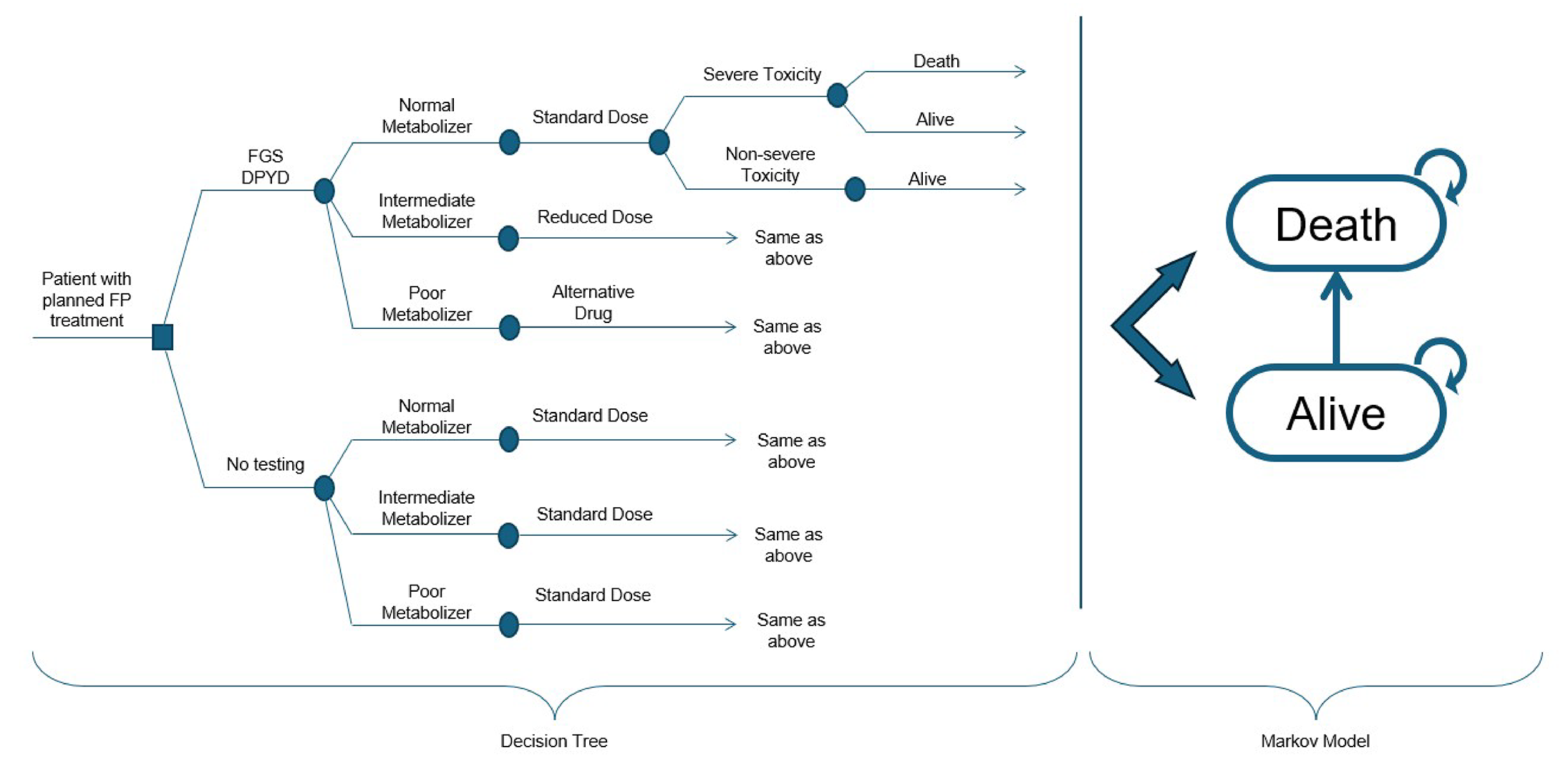
FGS = full gene sequencing; FP = fluoropyrimidine.
Inputs
The main clinical parameters used in the model are presented in Table 16, Table 17, Table 18. Most of the clinical parameter values remained the same as in the Ontario CUA unless otherwise indicated (further details can be found in their original publication34).
Long-Term (Posttreatment) Mortality
Annual risks of deaths were estimated for 3 different periods (1 to 5, 6 to 10, and 11 to 20 years), informed by the clinical expert consulted for this review - according to the main pivotal trials in each disease area43‑48 — with gaps in data filled by their clinical expertise. Parameters used in the calculation of the 5- and 10-year overall survival for each cancer type can be found in Table 17. Overall survival at 20 years was estimated as a probability applied to the population surviving at 10 years, calibrated so that only 1% of the original cohort remained alive at the end of the model time horizon. The annual probability of death for each cancer was calculated assuming the risk remain constant within each period. One Markov trace was built for each subpopulation; these models were then pooled together to obtain 1 final model. These weighted survival estimates were assumed to be equal among all patients that survived treatment in the cohort model, regardless of experiencing treatment-related toxicity.
Table 16: Clinical Inputs Used in the Economic Evaluation
Model parameter | Mean | Distribution | Reference/source |
|---|---|---|---|
Prevalence of DPYD phenotypes | |||
Intermediate metabolizer | 6.6% | Betaa | Ontario 2021 HTA34 |
Poor metabolizer | 0.19% | Betaa | Ontario 2021 HTA |
Normal metabolizer | 93.21% | — | Calculated |
Genotype testing parameters | |||
Test failure | 1.5% | Betaa | Ontario 2021 HTA |
Probability of overall severe toxicity in all patients | |||
Normal metabolizer | 13.62% | Beta | Ontario 2021 HTA |
Intermediate metabolizer, standard dose | 23.53% | Beta | Ontario 2021 HTA |
Intermediate metabolizer, reduced dose | 22.73% | Beta | Ontario 2021 HTA |
Poor metabolizer, standard dose | 100% | — | Ontario2021 HTA |
Poor metabolizer, alternative treatment | 13.62% | — | Ontario 2021 HTA |
Probability of treatment-related hospitalization in all patients | |||
Normal metabolizer | 7.8% | Beta | Ontario 2021 HTA |
Intermediate metabolizer, standard dose | 17.6% | Beta | Ontario 2021 HTA |
Intermediate metabolizer, reduced dose | 18.2% | Beta | Ontario 2021 HTA |
Poor metabolizer, standard dose | 66.7% | Beta | Ontario 2021 HTA |
Poor metabolizer, alternative treatment | 7.8% | — | Ontario 2021 HTA |
Days of hospitalization for patients who were hospitalized | |||
Normal metabolizer | 13 | Lognormala,b | Ontario 2021 HTA |
Intermediate metabolizer, standard dose | 23 | Lognormala,b | Ontario 2021 HTA |
Intermediate metabolizer, reduced dose | 4 | Lognormala,b | Ontario 2021 HTA |
Poor metabolizer, standard dose | 29 | — | Ontario 2021 HTA |
Poor metabolizer, alternative treatment | 13 | — | Ontario 2021 HTA |
Proportion of days in ICU | 5%b | — | Clinical Expert Opinion |
Probability of treatment-related death among patients with severe toxicities (in the first 6 months of the model) | |||
Normal metabolizer | 1.3% | Beta | Ontario 2021 HTA |
Intermediate metabolizer, standard dose | 14.3% | Beta | Ontario 2021 HTA |
Intermediate metabolizer, reduced dose | 1.3% | — | Ontario 2021 HTA |
Poor metabolizer, standard dose | 66.7% | Beta | Ontario 2021 HTA |
Poor metabolizer, alternative treatment | 1.3% | — | Ontario 2021 HTA |
Average number of severe toxicities per patient who had severe toxicity | |||
Normal metabolizer | 1.3b,c | Lognormala,b | Lunenburg et al., 201849 |
Intermediate metabolizer, standard dose | 2.1b,c | Lognormala,b | Lunenburg et al., 2018 |
Intermediate metabolizer, reduced dose | 1.2b,c | Lognormala,b | Lunenburg et al., 2018 |
Poor metabolizer, standard dose | 2.1b | — | Assumed to be similar to intermediate metabolizer |
Poor metabolizer, alternative treatment | 1.3b | — | Assumed to be similar to normal metabolizer |
CDA-AMC = Canada’s Drug Agency; CUA = cost-utility analysis; HTA = health technology assessment; ICU = intensive care unit.
aAssumed standard error to be 20% of mean in the original Ontario CUA.
bInputs added, or value or distribution updated by CDA-AMC. Some normal distributions originally used in the Ontario CUA were changed to lognormal to avoid negative values during probabilistic sampling resampling. Long-term mortality was modelled deterministically.
cDerived by dividing the total number of adverse events reported (which were broken down by type of adverse event) by the number of patients who experienced an adverse event.
Table 17: Long-Term Survival Parameters
Cancer type | Proportion of population | 5-year OSa | 10-year OSa |
|---|---|---|---|
Utilities | |||
Colorectal stages II-III | 26.67% | 82.50% | 70% |
Colorectal stage IV | 13.33% | 15% | 5% |
Breast stage stage IV | 22% | 10% | 5% |
Early gastrointestinal | 5% | 45% | 35% |
Advanced gastrointestinal | 5% | 12% | 3% |
Pancreatic | 28% | 2% | 1% |
OS = overall survival.
aEstimates elicited by clinical expert, based on main pivotal trials in each disease area43-48
Utilities
The utility and disutility parameters used in the model are presented in Table 8. For patients who survived treatment, it was assumed that on average they would return to their baseline utility, reflecting the fact that patients in early stages of cancer (mainly colorectal stages II-III) are more likely to get cured and have better HRQoL than at baseline, but patients in more advanced stages are more likely to have a decrement in their HRQoL as their disease progresses.
Costs
All costs are reported in 2025 Canadian dollars (Table 8). When necessary, costs were inflated to 2025 values using the general Canadian Consumer Price Index.50
Drug unit costs were informed by multiple sources. Total drug costs per 21-day cycle were based on dosages in the most common regimens for the population of interest. The average cost of the drugs was then weighted by the proportions of patients receiving 5‑FU, capecitabine, and both in the ON cohort, to calculate the cost of chemotherapy per cycle. Finally, the per-cycle cost was multiplied by the average number of cycles and the actual dose received (mean dose intensity).
Inpatient costs for severe toxicities were included in the analysis. The Ontario CUA used costs per day in the general ward to estimate hospitalization costs for patients who were hospitalized due to severe toxicity. The total duration of a hospitalization remained as originally estimated by the Ontario CUA. However, in this analysis, ICU stay was incorporated and assumed to represent on average for the cohort, 5% of all inpatient days for every hospitalization.
Annual treatment maintenance and monitoring costs were incorporated for the proportion of the cohort that remained alive post FP treatment. These costs were obtained from Oliveira et al.51 The “continuing costs” from this published study were weighted by the proportions of colorectal, breast and upper gastrointestinal cancers in the model (40%, 22%, and 10%, respectively). For gastric and colorectal cancers, it was assumed an equal distribution of females and males, and for breast cancer only females.
All other costs were the same used in the Ontario 2021 HTA and updated to 2025 values.
Table 18: Utilities and Costs Parameters Used in the Economic Evaluation
Model parameter | Mean | Distribution | Reference |
|---|---|---|---|
Utilities | |||
Baseline utility of patients with planned treatment with FP | 0.744 | Betaa | Ontario 2021 HTA34 |
Disutility of severe toxicity | −0.131 | Betaa | Ontario 2021 HTA |
Duration of adverse events (days) | 28 | — | Ontario 2021 HTA |
Posttreatment utility | 0.744 | Betaa,b | Assumed QoL, on average, returns to baseline utility pre-treatment — clinical expert opinion |
Health care costs | |||
FGS test | 750 | Gammaa,b | Range from $500 to $1,000 depending on which NGS platform is used and volume of patients accumulated to tests in batches — multiple clinical expert inputs |
Nonsevere toxicities | 173.67 | Gammaa,b | Henricks 201937 |
Outpatient costs for severe toxicities | 472.54 | Gammaa,b | Henricks 2019 |
Inpatient costs for severe toxicities | |||
Inpatient hospital cost per day (general ward) | 1,606.46 | Gammab | CIHI, 202652 |
Inpatient hospital cost per day (ICU) | 5,617.92 | Gammab | CIHI, 2026 |
Chemotherapy costs (per 21 days)c | |||
Capecitabined | 175.07 | Gammaa,b,e | ODB53 |
5-FUf | 250.04 | Gammaa,b,e | DeltaPA54 |
Raltitrexedg | 973.86 | Gammaa,b,e | Alberta Blue Cross55 |
Additional chemotherapy parameters | |||
Number of 21-day cycles | 5 | — | Ontario 2021 HTA |
Dose Intensity for normal metabolizers | 97% | — | Ontario 2021 HTA |
Dose Intensity for intermediate metabolizers receiving standard dose | 91% | — | Ontario 2021 HTA |
Dose Intensity for intermediate metabolizers receiving reduced dose | 61% | — | Ontario 2021 HTA |
Long-term costs | |||
Maintenance treatment and monitoring costs (per year) | 7,858.11 | Gammaa,b | Oliveira et al., 201651 |
5-FU = 5-fluorouracil; CIHI = Canadian Institute for Health Information; FP = fluoropyrimidine; HTA = health technology assessment; ICU = intensive care unit; NGS = next-generation sequencing; ODB = Ontario Drug Benefit; QoL = quality of life.
aAssumed standard error to be 20% of mean in the original Ontario CUA.
bInputs added or value updated by CDA-AMC.
cCalculations assumed a body surface area of 1.85 m2.
dCapecitabine costs per 21 days are an average between a lower dose of 825 mg/m2 twice daily for 14 days in a 21-day cycle, and a higher dose of 1,250 mg/m2 twice daily for 14 days in a 21-day cycle. Capecitabine is available as 150 mg and 500 mg tablets costing $0.4575 and $1.525, respectively.
eThe probabilistic analysis sampled the mean total costs to reflect variability in patient weight and doses across the different types of cancer. The drug price was not probabilistic.
fFluorouracil costs per 21 days are based on a dose of 400 mg/m2 IV bolus on day 1 then 2,400 mg/m2 IV continuous over 46 hours in a 14-day cycle. Fluorouracil is available as a multiuse vial with 5,000 mg costing $160.90.
gRaltitrexed costs are based on a dose of 3 mg/m2 on day 1 in a 21-day cycle. Raltitrexed is available as a single-use vial with 2 mg costing $324.62.
Uncertainty
CDA-AMC conducted the following scenario analyses to address uncertainty within the economic evaluation.
Scenario 1: Increased prevalence of intermediate metabolizers. The Ontario CUA used prevalence estimates of intermediate and poor metabolizers based on the 4-gene targeted panel, in which 6.6% of the population would be identified as intermediate metabolizers. Pooled results from the clinical review indicate that an additional 0.62% of individuals could have additional variants identified with FGS genotyping, however the exact prevalence of intermediate and poor metabolizers cannot be determined with the data available. In this scenario, the additional 0.62% of the population identified with a DPYD variant was assumed to be intermediate metabolizers, and added to the original model prevalence, resulting in a new prevalence of intermediate metabolizers of 7.22%.
Scenario 2: Increased prevalence of intermediate and poor metabolizers. In this scenario, the additional 0.62% of individuals that could be identified with FGS genotyping are distributed in the same poor-to-intermediate ratio as the base-case analysis, for a new prevalence of 7.2% intermediate and 0.21% poor metabolizers.
Scenario 3: Lower prevalence of intermediate and poor metabolizers. The number of individuals identified as poor or intermediate metabolizers will depend on the true prevalence of variants in the population of interest. Pooled results from the clinical review estimated the overall prevalence of DPYD variants as 4.15% of the tested population. In this scenario, these 4.15% of patients were distributed in the same poor-to-intermediate ratio as the base-case analysis, for a new prevalence of 4.03% intermediate and 0.12% poor metabolizers.
Scenario 4: Lower FGS testing costs assuming. FGS testing costs vary depending on the NGS platform used and volume of patients accumulated in a timely manner (i.e., without delaying treatment significantly) to perform the test in batches. In this scenario, a 25% reduction in the test cost was assumed ($562.50).
Scenario 5: Higher FGS testing costs. This scenario assumed the upper range of the test cost ($1,000).
Scenario 6: Higher proportion of inpatient days in ICU. The proportion of days patients stay in an ICU has a large impact on the hospitalization costs for those patients who experience severe toxicities. A higher proportion of inpatient days spent in ICU (85% instead of 5% assumed in the base-case analysis) was applied for intermediate and poor metabolizers who had severe toxicities after receiving a standard dose of FP in the model. Similar assumptions were used on another published economic evaluation;56 however, these were based on a case series of 4 patients and may not represent the average intermediate and poor metabolizers requiring hospitalization.
Table 19: Base-Case and Scenario Analyses
Parameter | Base case | Sensitivity analysis |
|---|---|---|
Scenario1: Higher prevalence of DPYD intermediate metabolizers | 6.6% | 7.22% (0.62% added to the base-case prevalence) |
Scenario 2: Higher prevalence of DPYD intermediate and poor metabolizers | Intermediate: 6.6% Poor: 0.19% | Intermediate: 7.2% Poor: 0.21% |
Scenario 3: Lower absolute prevalence of DPYD intermediate and poor metabolizers | Intermediate: 6.6% Poor: 0.19% | Intermediate: 4.03% Poor: 0.12% |
Scenario 4: Lower cost of FGS testing | $750 | $562.5 (25% lower than base case) |
Scenario 5: Higher cost of FGS testing | $750 | $1,000 (upper range) |
Scenario 6: Higher proportion of inpatients days spent in ICU for intermediate and poor metabolizers who have severe toxicity after receiving a standard dose of FP | 5% | 85% |
FGS = full gene sequencing; FP = fluoropyrimidine; ICU = intensive care unit.
Appendix 8: Detailed Economic Results
Please note that this appendix has not been copy-edited.
The cost-effectiveness plane with the probabilistic results of the CDA-AMC base-case analysis is presented in Figure 3.
Figure 3: Probabilistic Results of the CDA-AMC Base-Case Analysis
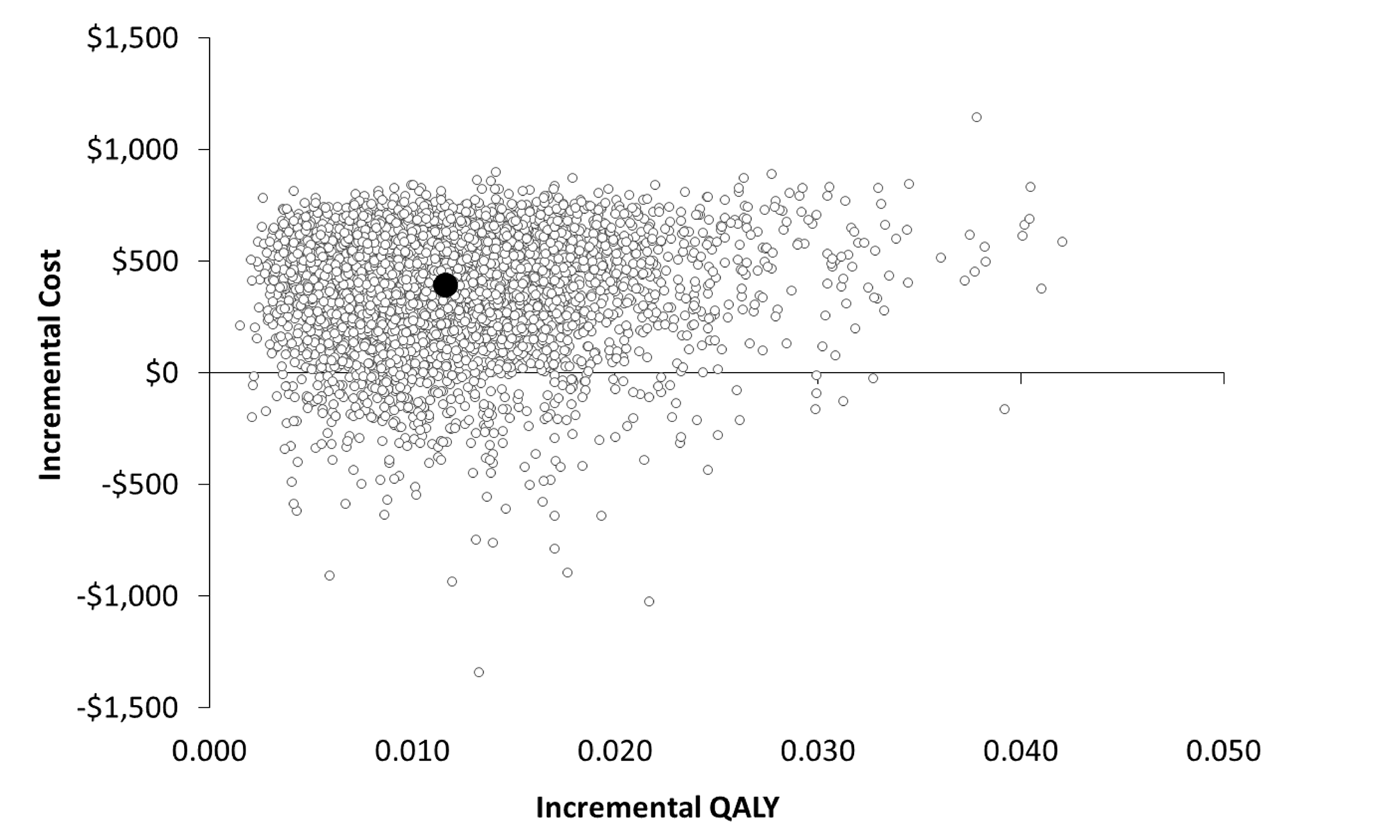
CDA-AMC = Canada’s Drug Agency; QALY = quality-adjusted life-year.
Disaggregated results of the base-case analysis are provided in Table 20.
Table 20: Disaggregated Results of the CDA-AMC Base-Case Analysis
Parameter | FGS testing | No testing | Incremental |
|---|---|---|---|
Clinical outcomes | |||
Proportion with severe toxicities (%) | 14.27% | 14.48% | −0.20% |
Treatment-related mortality (%) | 0.19% | 0.52% | −0.33% |
Long-term mortality | 99.017% | 99.020% | −0.003% |
Discounted LYs | |||
Total | 4.7182 | 4.7024 | 0.0158 |
Short-term (≤ 6 months) | 0.4991 | 0.4974 | 0.0017 |
Long-term (> 6 months) | 4.2191 | 4.2050 | 0.0141 |
Discounted QALYs | |||
Total | 3.5131 | 3.5014 | 0.0117 |
Short-term (≤ 6 months) | 0.3700 | 0.3689 | 0.0012 |
Long-term (> 6 months) | 3.1431 | 3.1326 | 0.0105 |
Discounted costs ($) | |||
Total | 36,963 | 36,575 | 388.26 |
DPYD testing | 761.24a | 0.00 | 761.24 |
Cost of treatment of severe toxicities – Hospital General Ward | 1,517.97 | 1,907.36 | −389.39 |
Cost of treatment of severe toxicities – Hospital ICU | 277.86 | 349.57 | −71.71 |
Cost of treatment of severe toxicities – Nonhospital | 48.93 | 57.50 | −8.56 |
Cost of treatment of nonsevere toxicities | 148.28 | 147.93 | 0.35 |
Cost of chemotherapy drugs | 1,164.76 | 1,178.93 | −14.17 |
Cost of maintenance treatment and monitoring (> 6 months) | 33,043.85 | 32,933.35 | 110.50 |
Cost-effectiveness results | |||
Cost per QALY gained | $33,281 | ||
Cost per LY gained | $24,593 | ||
Cost per patient with severe AE avoided | $189,756 | ||
Cost per death avoided | $115,149 | ||
CDA-AMC = Canada’s Drug Agency; FGS = full gene sequencing; ICU = intensive care unit; LY = life-year; QALY = quality-adjusted life-year.
Note: Probabilistic results are presented.
aIncludes 1.5% as the extra cost of failed tests.
Assessment of Uncertainty
Results of the scenario analyses are provided in Table 21.
Table 21: Results of CDA-AMC Scenario Analyses
Analysis | Intervention | Total costs ($) | Total QALYs | ICER ($/QALYs) |
|---|---|---|---|---|
CDA-AMC base case | No Testing | $36,575 | 3.5014 | Reference |
DPYD Testing | $36,963 | 3.5131 | $33,281 | |
CDA-AMC scenario 1: Prevalence of intermediate metabolizers = 7.22% | No Testing | $36,716 | 3.4979 | Reference |
DPYD Testing | $37,071 | 3.5101 | $29,202 | |
CDA-AMC scenario 2: Prevalence of intermediate metabolizers = 7.2% and poor metabolizers = 0.21% | No Testing | $36,719 | 3.4977 | Reference |
DPYD Testing | $37,074 | 3.5103 | $28,293 | |
CDA-AMC scenario 3: Prevalence of intermediate metabolizers = 4.03% and poor metabolizers = 0.12% | No Testing | $36,535 | 3.5002 | Reference |
DPYD Testing | $37,069 | 3.5072 | $76,085 | |
CDA-AMC scenario 4: 25% lower FGS testing costs ($562.5) | No Testing | $36,684 | 3.4982 | Reference |
DPYD Testing | $36,882 | 3.5097 | $17,265 | |
CDA-AMC scenario 5: upper range of FGS testing costs ($1,000) | No Testing | $36,684 | 3.4982 | Reference |
DPYD Testing | $37,326 | 3.5097 | $55,953 | |
CDA-AMC scenario 6: 85% of the inpatient days spent in ICU (vs. 5% from base case) for intermediate and poor metabolizers receiving standard dose and with severe toxicitya | No Testing | $37,661 | 3.4982 | Reference |
DPYD Testing | $37,073 | 3.5097 | Dominant |
CDA-AMC = Canada’s Drug Agency; FGS = full gene sequencing; ICER = incremental cost-effectiveness ratio; QALY = quality-adjusted life-year.
Note: Deterministic results are presented.
aBased on a case series of 4 patients. It may not represent the average ICU use among intermediate and poor metabolizers requiring hospitalization in Canada.
ISSN: 2563-6596
Canada’s Drug Agency (CDA-AMC) is a pan-Canadian health organization. Created and funded by Canada’s federal, provincial, and territorial governments, we’re responsible for driving better coordination, alignment, and public value within Canada’s drug and health technology landscape. We provide Canada’s health system leaders with independent evidence and advice so they can make informed drug, health technology, and health system decisions, and we collaborate with national and international partners to enhance our collective impact.
Disclaimer: CDA-AMC has taken care to ensure that the information in this document was accurate, complete, and up to date when it was published, but does not make any guarantee to that effect. Your use of this information is subject to this disclaimer and the Terms of Use at cda-amc.ca.
The information in this document is made available for informational and educational purposes only and should not be used as a substitute for professional medical advice, the application of clinical judgment in respect of the care of a particular patient, or other professional judgments in any decision-making process. You assume full responsibility for the use of the information and rely on it at your own risk.
CDA-AMC does not endorse any information, drugs, therapies, treatments, products, processes, or services. The views and opinions of third parties published in this document do not necessarily reflect those of CDA-AMC. The copyright and other intellectual property rights in this document are owned by the Canadian Agency for Drugs and Technologies in Health (operating as CDA-AMC) and its licensors.
Questions or requests for information about this report can be directed to Requests@CDA-AMC.ca.