Drugs, Health Technologies, Health Systems
Horizon Scan
2025 Watch List: Artificial Intelligence in Health Care
Key Messages
What Is the 2025 Watch List?
The Watch List is an annual Horizon Scan report from Canada’s Drug Agency that presents emerging technologies and issues that have the potential to shape the future of health care in Canada.
The 2025 Watch List focuses on the use of artificial intelligence (AI) technologies in health care and the issues that may arise with the implementation of these technologies.
AI technologies have the potential to significantly transform health care systems. These technologies could increase efficiency by reducing administrative burden, improve patient outcomes, and enhance patient experience by creating more access points to the health care system. However, there are also legal, ethical, environmental, and social implications with the rollout of these technologies.
Why Is This an Issue?
Substantial public and private investments are being made in AI technologies for health care. AI technologies are already being implemented in some parts of the Canadian health care system. Commercial options, such as ChatGPT, allow AI technologies to be used by patients to assist with their health care journeys. Because they are readily available and easy to use, these same tools are sometimes used by clinicians and, in some cases, without sanction or training from employers or regulators.
AI health care technologies also present an opportunity to fundamentally change health care by their ability to replace, displace, or augment tasks that have traditionally required human cognition. The potential health human resources impact of machines taking on some this load is significant given the increasing demand for health care services and the finite capacity of health care systems in Canada.
What Is the Potential Impact?
The Watch List signals which technologies are poised to make an impact and the policies, regulatory or organizational enablers, and/or guardrails that are needed to optimize the proliferation of these technologies in the health care system.
The 2025 Watch List also focuses on considerations for optimizing and accelerating implementation, such as the massive potential impact on operations, clinical outcomes, and staff and patient experience, while minimizing risks.
What Else Do We Need to Know?
The 2025 Watch List of AI technologies and issues in health care was developed through consensus-based decision-making at a workshop in November 2024 including individuals from across Canada with experience and expertise in AI.
The 2025 Watch List identifies and describes the top 5 new and emerging AI technologies in health care. Examples include AI for notetaking and AI for disease detection and diagnosis. We also explore some considerations for health care decision-makers about the impact these technologies may have on health human resources, health care infrastructure, and health equity.
The 2025 Watch List also identifies the top 5 issues related to AI technologies in health care. Examples include the importance of establishing guidelines around what data are used to train AI algorithms and how that might contribute to bias as well as considerations about the liability and accountability of health care providers and systems that use these technologies. These are key issues that warrant more attention and will influence the wider adoption, diffusion, and implementation of new and emerging AI technologies.
Monitoring ongoing developments and evidence related to the top technologies and issues highlighted in the 2025 Watch List can help guide health system planning in Canada and improve access to high-quality care.
Abbreviations
AI
artificial intelligence
CDA-AMC
Canada’s Drug Agency
HCP
health care professional
JLA
James Lind Alliance
LLM
large language model
Definitions
Term | Definition used by project |
|---|---|
AI agent | A system or program that can independently plan its workflow and utilize resources to carry out tasks on behalf of a user or another system. AI agents can perform various functions, including decision-making, problem-solving, interacting with external environments, and executing actions.1 |
AI technology in health care | Technologies that include interventions that incorporate AI-based computational methods within a product, process, or service that supports health care delivery directly to the patient, health care provider, and/or to institutions. This may include AI-driven medical devices, algorithms, software applications, and other systems; technologies without direct patient- or health system–related outcomes (e.g., AI to facilitate clinical research, data extraction processes in reviews) are not included. |
Artificial intelligence (AI) | An umbrella term used to describe a variety of approaches (e.g., machine learning, natural language processing) that allow computer programs to perform tasks that have been traditionally done by humans.2 |
Bias | “A conscious (explicit) or unconscious (implicit) opinion, preference, prejudice, or inclination, formed without reasonable justification, that prevents a balanced or even-handed judgement.”3 |
Clinical decision-making | The process by which health care professionals evaluate and choose interventions based on evidence, patient preferences, and other contextual factors. This includes gathering information, ordering tests, interpreting results, and suggesting treatments.4 |
Deep learning | A type of machine learning that uses multilayered neural networks (deep neural networks) to replicate the intricate decision-making capabilities of the human brain. These networks are composed of numerous interconnected layers of nodes, with each layer refining and enhancing predictions or classifications based on the previous layer.5 |
Environmental costs | Negative environmental impacts associated with the development, deployment, and operation of AI technologies, such as energy consumption, resource usage, and e-waste generation.6 |
Generative AI (gen AI) | A subset of AI capable of generating new text, images, videos, or audio. It accomplishes this by extracting patterns and structures from large databases to create fresh data with similar properties. Generative AI is usually based on deep learning methods, including large language models and other technologies to generate new context.7 |
Human-in-the-loop | A collaborative approach that integrates human input and expertise into the life cycle of machine learning and artificial intelligence systems. Humans participate in the training, evaluation, and operation of machine learning models and provide valuable feedback. This collaborative approach aims to enhance the accuracy, reliability, and adaptability of ML systems by harnessing the unique capabilities of both humans and machines.8 |
Issues relating to AI in health care | Broader considerations (e.g., clinical, health systems planning, social, ethical, legal, or regulatory) that crosscut the implementation and use of AI in health systems and may affect how these technologies are developed or adopted in Canada. |
Large language models (LLMs) | Advanced computational models designed to understand, generate human language, and perform a wide range of tasks. LLMs use deep learning techniques to learn statistical relationships between words and phrases, enabling them to perform tasks like language translation, text summarization, and question answering. Examples of LLMs include OpenAI’s GPT-4, Google’s BERT and PaLM, and Meta’s LLaMA.9 |
Machine learning | AI and machine learning are frequently used synonymously, but machine learning is technically a specific branch within the broader field of AI. Machine learning involves implementing automatic processes that move away from traditional procedural software programs toward problem-solving approaches based on learning models. These models are related to computational statistics and data mining techniques.2 |
Natural language processing | A branch of computer science and AI that uses machine learning to enable computers to understand and communicate in human language. It combines computational linguistics with statistical modelling, machine learning, and deep learning to recognize, understand, and generate text and speech. Natural language processing research has advanced generative AI, including large language models and image generation models.10 |
New or emerging technologies | Technologies that are not yet available in Canada or have been available for clinical use for 1 to 2 years with limited use and are in the launch or early postmarketing stage. It also refers to technologies available in Canada but with diffusion or availability limited to a few health care facilities or centres. |
Opportunity costs | The allocation of resources to a specific use, resulting in the loss of potential benefits that the resources could have generated if they had been used for their next-best alternative. This represents the missed opportunity to invest in that alternative.11 |
Public health surveillance | The continuous and organized gathering, analysis, understanding, and sharing of health information to guide the planning, execution, and assessment of public health measures. It is widely recognized as a crucial public health activity and a key tool in preventing epidemics.12 |
Quality improvement in health care | Systematic efforts aimed at enhancing the delivery of health care services, improving patient outcomes, lowering the cost, and optimizing the overall quality of health care.13 |
Shared decision-making | A collaborative process in which health care professionals and patients collaborate to make decisions about patient care. This approach ensures that medical decisions align with the patients’ preferences, values, and individual circumstances.14 |
Introduction
Through horizon scanning, Canada’s Drug Agency (CDA-AMC) routinely identifies new and emerging technologies that are likely to have a significant and meaningful impact on Canada’s health care systems. This work supports decision-makers by informing them about emerging health technologies and their related issues to prepare for the introduction and wider adoption of these new technologies. CDA-AMC (formerly CADTH) releases an annual Watch List15,16 to identify technologies that have the most potential to transform health systems and shape the future of health care in Canada. The annual list signals how technology innovations may affect future health system needs and provides early assessments to help guide health system planning. In recent years, the Watch List has focused on a particular theme or area of medicine. In keeping with this trend, the 2025 Watch List focuses on the use of artificial intelligence (AI) technologies in health care.
What Is AI?
AI is an umbrella term used to describe a variety of approaches (e.g., machine learning, natural language processing) that allow computer programs to perform tasks that have been traditionally done by humans, such as large language models (LLMs) (e.g., ChatGPT) that generate answers to specific text prompts.18 AI is a fast-growing economic sector, particularly AI technologies related to health care.17 AI technologies in health care include interventions that incorporate AI-based computational methods within a product that supports health care delivery directly to the patient, health care provider, and/or health care institution. This may include AI-driven medical devices, algorithms, software applications, and other systems. Technologies without direct patient-, health system–, or health human resources–related outcomes (e.g., AI in evidence generation) were excluded from consideration in this report.
The Promise of AI in Health Care
Canada’s health care systems are in need of improvement: wait times for some services are too long,19 many health care workers experience administrative burdens and related burnout in the profession,20 and there is a mismatch in supply and demand for some health care professionals (HCPs). AI technologies have been proposed as a solution to address some of these issues. For example, AI technologies that undertake administrative tasks such as notetaking21 and scheduling22 have already been launched in Canada and show promise in increasing efficiency so that health care provider time can be redeployed to other parts of the system, such as direct patient care. AI is also being used in patient care to improve diagnostic accuracy in the area of medical imaging.23 For improving timely access to health care, there are app-based AI mental health supports24 available 24 hours a day 7 days a week used as part of a patient’s overall treatment plan.
These are only a small sample of the exciting developments in the uses of AI for health care. Advancements in the development and training of LLMs (such as GPT-4o which ChatGPT is based on) along with significant financial investment are accelerating the pace of innovation in Canada and abroad. According to a 2023 report by the Commonwealth Fund, Canada’s annual health care spending has steadily increased as a percentage of the gross domestic product since 1980; health care spending now makes up 11.3% of the gross domestic product.25 However, according to the same report, Canada’s performance is considered “modest to poor,” with Canada ranking very low on 4 indicators related to the timeliness of care.25 Integrating AI solutions that replace, displace, or augment tasks that have traditionally required human cognition will result in major changes to the health care systems. In particular, the introduction could allow systems to reap the benefits of AI, such as cost reduction, and optimize system management by redirecting workers to other parts of the system.26
The increased use of AI technologies in health care raises an appealing proposition for delivering more efficient, accurate, and accessible care to people living in Canada; however, the use of AI in health care has also raised some unique questions around the readiness of the system to adopt these potentially disruptive technologies. The introduction of such quickly evolving technologies brings significant complexity to health systems. If AI technologies are adopted into routine use, they are likely to change multiple aspects of care, including resource utilization, health human resources, health care delivery and organization, patient and caregivers’ outcomes and experiences, as well as raising equity and ethical considerations. AI technology comes with some challenges associated with other digital health care technologies, such as concerns around the safety of private patient health data,27 and more unique considerations, such as the liability for health care providers28 relying on the judgment of an AI technology.
CDA-AMC has recently published 2 reports that discuss considerations for digital health and AI. One provides recommendations for data privacy and digital equity in the context of remote monitoring for cardiac conditions.29 The other is about the implementation of AI-enabled medical devices that identified 8 Canadian and 5 international guidance documents on how to implement AI in health care, including considerations for inclusivity, data quality testing, transparency, data governance, privacy, and security.30 Implementation considerations in this report included clinical safety; data protection; technical security; interoperability; usability and accessibility; transparency, explainability, and intelligibility; inclusiveness, equity, and minimizing bias; responsibility and accountability; user buy-in and organizational readiness; and monitoring, maintenance, and sustainability. Further recommendations on implementing AI ethically can be found in work by WHO,31 the United Nations Educational, Scientific and Cultural Organization (UNESCO),32 and the European Commission,33 and on using AI responsibly in systematic review research from Europe.34,35
To alert decision-makers to innovations within AI technologies used in health care as well as the possible implications for health systems, the 2025 Watch List identifies new and emerging AI technologies and the issues related to the implementation of these technologies that are likely to have a significant impact on health care systems in Canada over the next 5 years.
Developing the 2025 Watch List
A short list of emerging technologies and issues was identified through a literature search of published medical literature, news articles, and industry reports with input from an expert advisory group (refer to Appendix 1 for detailed information about Advisory Group members and workshop participants). Early on, the Advisory Group recommended that, due to the fast-moving nature of this field, we should work with categories of technologies rather than individual technologies. However, even in the time frame of this project, a category of AI technology emerged that was not considered by our workshop participants: AI agents (sometimes known as autonomous AI). AI agents are significant advancements in AI because they work independently to carry out tasks on behalf of a user. AI agents are beginning to appear in several categories on the 2025 Watch List, from notetaking to clinical training and education to disease detection and diagnosis. We acknowledge that the research and development of AI agents are progressing rapidly, and the implementation of AI agents must consider the issues outlined in the 2025 Watch List.
The final items on the 2025 Watch List were selected at a workshop through a consensus-based decision-making process. CDA-AMC has a partnership with the James Lind Alliance (JLA) and the 2025 Watch List was developed using a modified JLA priority-setting approach. The workshop brought together diverse views and experiences, and included patient partners, caregivers, policy experts, researchers, members of industry, and HCPs from across Canada. Further details about the selection and identification process of the items are described in Appendix 2.
The outcome of this process is a final Watch List that reflects the values and experiences of the diverse group of workshop participants. The goal of the 2025 Watch List is to contribute to a larger conversation about what uses AI technologies should be put toward in our health care systems and what that may mean for people who work in or seek care from these systems. To paraphrase one of the workshop participants: the [Canadian health care] system needs whatever efficiencies it can get, and [decision-makers] need guidance about how and where to make those efficiency gains.
Watch List Objectives
The 2025 Watch List aims to highlight the AI technologies that are poised to have the most significant and meaningful impact on health care systems and that are likely to shape the future of health care in Canada over the next 5 years. It also serves as a guide to separate the hope, or promise, from the hype and extensive publicity about AI technologies. It describes considerations for their implementation. Contextualizing the technologies alongside the broader issues can provide insight about the future of AI technologies used for health care and support health systems planning. Collectively, the top 5 technologies and top 5 issues constitute the 2025 Watch List.
The 2025 Watch List
The workshop to arrive at the final Watch List took place in November 2024. Although the Watch List is enumerated, the list is not ranked; the fifth item is not more or less important than the first. The workshop group was clear that all items on the draft list were important. Items that did not make the final list are listed in Appendix 3.
The top 5 AI technologies in health care are:
AI for notetaking
AI tools to accelerate and optimize clinical training and education
AI for disease detection and diagnosis
AI for disease treatment
AI for remote monitoring
The top 5 issues related to AI technologies in health care are:
Privacy and data security
Liability and accountability
Data availability, quality, and bias
Data sovereignty and governance
Environmental costs
Top Technologies Related to AI in Health Care to Watch
1. AI for Notetaking
Context
Health care providers spend a significant amount of time managing health records and taking notes to document patient history, physical examinations, test results, referral reports, and other administrative tasks.36 Because these data are often unstructured, health care providers have to spend excessive time on notetaking. This increased time negatively impacts their workflows and workloads, potentially resulting in burnout.37 Furthermore, when health care providers are documenting patient information on paper or computers during consultations, they tend to have decreased eye contact with their patients.38 This can create communication barriers and reduce overall patient satisfaction. The considerable time additionally spent on documentation outside of direct patient interactions can feel tedious or as an increased workload, leading to feelings of burnout and professional dissatisfaction for health care providers.38
Definition
AI-powered notetaking applications use advanced technologies, such as automatic speech recognition and natural language processing (which enables machines to understand, interpret, and generate human language) to transcribe conversations between patients and health care providers and to generate clinical notes.39 These technologies work by automatically creating notes from conversations, which simplifies the notetaking process, and by converting patient data into structured information from unstructured sources. Health care providers can then edit, review, and sign the generated note.38
Examples
AI scribes use machine learning technologies to create written summaries of conversations between patients and health care providers.21 These are capable of producing conversation transcripts, medical notes, and referral letters.
Using AI scribes significantly reduced the time spent on administrative tasks: a reported 69.5% reduction in laboratory settings and an average of 3 hours less per week in routine practice settings in Ontario.21 Primary care providers using AI scribes have reported reduced administrative burden, lower cognitive load, and less after-hours work. They also noted improved efficiency, increased job satisfaction, and enhanced quality of care.21
A 10-week pilot study also demonstrated that AI scribes could decrease the time physicians spend on documentation during appointments. The authors of the study noted that this technology is capable of generating high-quality clinical notes, facilitating more meaningful interactions with patients, and reducing the workload that often extends beyond office hours.40 Patients reported feeling comfortable with AI scribes and observed that health care providers spent less time on their computers.40
Current studies and reports indicate that AI scribes are imperfect and can have errors or omissions that require a review of notes by HCPs.41
Other AI tools are used for notetaking.
PhenoPad is an open-source interface for clinical notetaking that captures both free-form notes and standardized phenotypic data (e.g., information captured on a tablet by clinicians) through various methods, such as speech recognition, natural language processing, and handwriting recognition.38
Tali AI technologies integrate AI scribes, medical dictation, and medical information retrieval to enhance clinical documentation and streamline clinical workflows.
Potential Positive Impacts
AI for notetaking could reduce the administrative burden by streamlining notetaking, minimizing errors, and enhancing overall efficiency in health care systems.42
Implementing AI for notetaking could potentially decrease the time spent on documentation, thereby enhancing patient-provider interactions.43,44
Accurate notetaking could enhance health outcomes and improve patient experiences.44
By consolidating patient data into high-quality medical notes, health care providers could gain a comprehensive view of the patient’s medical history, which may lead to better access to critical information for care teams.45
It can also improve health care provider satisfaction, potentially reducing burnout rates.45
Additional Insights
The workshop participants mentioned that AI for notetaking is essential for successfully implementing other AI technologies. High-quality clinical notes and structured data are critical for facilitating discussions between patients and health care providers about their concerns, laying the groundwork for disease detection and diagnosis, treatment optimization, and other AI technology categories discussed in the 2025 Watch List.
The workshop participants also emphasized efficiency gains associated with AI for notetaking because clinical notetaking consumes a significant amount of health care providers’ time. Most health care providers, whether in primary care, specialized fields, or other areas, need to complete clinical notes based on conversations with patients, physical examinations, and other information. As a result, there was considerable enthusiasm and demand among health care providers about adopting AI technologies for notetaking. Furthermore, some participants pointed out that various AI technologies for notetaking are already being used in health care in Canada, which could help alleviate health care provider burnout. A crucial insight shared at the workshop was that using AI for notetaking may be a safer early adoption of AI in health care than other applications (e.g., diagnosis and treatment).
AI can enhance notetaking efficiency, but accuracy is critical in health care because errors may lead to significant risks in diagnosis and treatment. However, using AI for notetaking can lead to errors, such as AI hallucinations (instances when AI generates distorted or inaccurate information).46 In the context of notetaking, AI tools may record events that did not happen or leave out important information. AI may have difficulties with various languages and may not accurately document physical examinations.41 To prevent errors and AI hallucinations, and to ensure inclusivity in various languages, AI tools should incorporate strong error-checking measures and support multilingual capabilities. This includes providing comprehensive user training, ensuring that clinicians review AI-generated documents, and having developers focus on producing accurate AI outputs. Further research is needed to explore the trade-offs between administrative gains (i.e., efficiency) and the risks of bias or errors.47
Additionally, there is a need to integrate AI for notetaking into electronic health records to assist health care providers in eliminating the need to copy and paste clinical notes from various applications.48 The integration of AI and electronic health records is a challenging endeavour, potentially requiring coordinated efforts from multiple teams. If AI-generated notes can be securely integrated into electronic health records, it will further enhance workflow efficiency and reduce manual entry errors.
2. AI Tools to Accelerate and Optimize Clinical Training and Education
Context
Clinical training and education enable HCPs to gain the knowledge and skills necessary for diagnosing and effectively treating patients. A common approach in medical education for health care providers emphasizes knowledge retention and relies heavily on memorizing evidence, procedures, and guidelines.31,49 Using AI tools to accelerate and optimize clinical training and education may significantly enhance personalized learning, real-time feedback, skill development, and objective, automated assessment.50 This could potentially transform the current medical education system, including both medical school and continuing medical education.51
Integrating AI into clinical training and education offers the potential to reduce health care costs, enhance the quality of care, and broaden access to care by empowering health care providers with advanced technological AI tools.52,53 This includes incorporating AI-powered learning resources within the medical curriculum and continuing medical education as well as training health care providers to understand and effectively apply AI tools in diagnosis, treatment, and care delivery. These 2 areas are interconnected because it is necessary to understand the particulars of AI technology to make the best use of AI in clinical education.
In addition to AI tools supporting education, HCPs require training and education that equips them with the necessary skills to effectively implement AI into clinical practice. This could include understanding the language of AI and developing the technical skills to operate AI-driven tools by gaining knowledge of how these tools work and familiarity with basic concepts and principles behind AI technologies.49 Additionally, training may need to address other considerations related to AI, such as maintaining critical thinking abilities when using AI tools.49
Both the Royal College of Physicians and Surgeons of Canada and the College of Family Physicians of Canada acknowledge the importance of AI in health care. For example, the Royal College of Physicians and Surgeons of Canada has made recommendations regarding implementing AI and digital technologies in residency training and health care delivery.54 The recommendations emphasize the potential impacts of AI on both clinical practice and medical education, not just AI-specific skills. For example, the recommendations propose introducing a new discipline focusing on clinical informatics to equip physicians with AI tools for practice, encouraging collaboration with medical schools in Canada to promote AI through MD and PhD programs, and fostering “clinical innovators” as emerging careers in AI-driven health care.54 The College of Family Physicians of Canada has also published a statement supporting AI research and development in family medicine and primary care.55
Definition
AI tools to accelerate and optimize clinical training and education could summarize available evidence for physicians, medical students, and patients, providing general background knowledge and the latest evidence regarding interventions.56 AI technologies should support upskilling and reskilling for both health care providers and patients.57
Examples
OpenEvidence is a language model specifically designed for medicine to aggregate and synthesize clinically relevant evidence in formats that are understandable and accessible, enabling more evidence-based decision-making and improving patient outcomes.58 The tool has demonstrated significant accuracy in answering the US medical licensing examination questions. Health care providers and learners can set up an account for unlimited, free access to the tool. This tool offers a distinct advantage over other models by providing citations for its responses, allowing users to validate the information quickly. However, it was designed for targeted point-of-care clinical use, so its short responses may make it less useful as a comprehensive information resource.58
ChatGPT, a generative LLM, presents numerous opportunities for enhancing clinical training and education. Although some AI tools do not explicitly mention ChatGPT, they may use ChatGPT to generate their response. ChatGPT can be used to create virtual patient simulations and quizzes for medical students.59 It can also critique simulated doctor-patient communications, summarize research articles, and generate a curriculum for health professionals. However, when using ChatGPT for medical education, it is important to use proper prompting and to be aware of the issue of AI hallucinations, particularly when ChatGPT fabricates references or contents.59
AI-VSP (Artificial Intelligence Virtual Simulated Patients) can be used in clinical teaching as a complementary learning tool. This technology represents an advancement in health care education, providing a powerful tool for training future HCPs.60 By combining AI and virtual reality, the technology can create immersive, interactive, and personalized learning experiences that improve clinical skills and enhance decision-making abilities.60
Potential Positive Impacts
AI could enhance the learning experience and improve training efficiency by summarizing large amounts of information and reducing the training burden on health care systems and easing the research burden on individual HCPs.53
AI technologies may help address health care resource crises by promoting innovative solutions and encouraging curiosity among HCPs by providing opportunities for personalized educational materials, novel solutions, and data-driven insights. AI could facilitate the exploration and adoption of other technologies and support more efficient resource allocation and problem-solving strategies.61
Training health care providers to effectively use AI in their practice and incorporating these technologies into clinical training and medical education could ultimately improve the quality and efficiency of patient care and contribute to positive health outcomes.53
Additional Insights
During the workshop, participants highlighted how AI can serve as a tool to enhance clinical training and medical education overall. For example, one workshop participant mentioned that trainees have already begun using ChatGPT to support their clinical education, help them prepare presentations, and facilitate their learning processes.
The discussion also touched on the need for health care providers to receive education on how to effectively use AI technologies in their clinical practice within the health care system (training in AI or AI as a training subject). This education is essential for successfully implementing other technologies, including AI Technology 1: Notetaking, AI Technology 3: Disease Detection and Diagnosis, AI Technology 4: Disease Treatment, and AI Technology 5: Remote Monitoring. For instance, health care providers need to understand what AI is, how to interact with AI systems, how to use them to solve problems, and how to critically appraise AI models. The dual role of AI as both a training subject and as a tool to accelerate clinical training highlights the importance of integrating these 2 aspects.
Participants emphasized the importance of involving patients in this educational process, recognizing that AI has the potential to enhance patient engagement. AI technologies could offer more accessible and personalized materials for patients as well. Educating patients about AI tools in health care could encourage them to take more responsibility for their health and improve proactive self-management skills. Health care providers should actively support patients and caregivers to help facilitate the process.
3. AI for Disease Detection and Diagnosis
Context
Disease detection and diagnosis are essential for timely treatment. Early detection and effective treatment are the most important solutions to reduce the death rates caused by chronic diseases.62 Health care providers typically need to consider and interpret various pieces of information, including clinical manifestations, physical examinations, and other relevant data, making the diagnosis process quite complex. Given the dynamic and changing environment of the health care system and the limited time that HCPs are in clinical practice, making accurate disease detection and diagnosis can become a cognitively challenging task.63 AI technologies offer potential advantages in supporting this process. As of August 2024, the US FDA had authorized approximately 950 medical devices that use AI or machine learning.64 Most of these devices are designed to assist in the detection and diagnosis of treatable diseases.64 The top 5 medical specialties using AI technologies are radiology (e.g., Overjet Image Enhancement Assist), cardiology (e.g., EchoGo Heart Failure 2.0), neurology (e.g., BrainSee), hematology (e.g., AI-4510 Urine Particle Analysis System), and gastroenterology and urology (e.g., EndoScreener).64
Definition
AI for disease detection and diagnosis refers to using AI technologies, such as machine learning models, to assist health care providers in improving disease detection and diagnosis based on various data, such as medical images, physical examinations, family history, environmental factors, and dietary habits.65 Radiology has been leading the way in AI for disease detection and diagnosis.66 In recent years, there has been an explosion of AI technologies for analyzing medical images (e.g., radiology, pathology) to make faster and more accurate diagnoses.
Examples
ASIST-TBI was developed to quickly identify traumatic brain injuries by screening the CT scans of patients with head injuries in the emergency department. If the model indicates the need for surgery, the physician can consult a neurosurgeon directly, bypassing the wait for a radiologist review. The model showed accurate prediction for neurosurgical intervention with an area under the receiver operating characteristic curve of approximately 0.90, with accuracy, sensitivity, and specificity all exceeding 80%.67
LumeNeuro uses machine learning techniques to detect neurodegenerative brain diseases at an early stage by screening for retinal protein biomarkers. This technology is low cost and noninvasive, using polarimetric imaging to identify retinal amyloid deposits without dyes. The machine learning models developed by the researcher from the University of Waterloo can predict thioflavin positivity with high accuracy, sensitivity, and specificity, which is an indicator of amyloid presence and potentially Alzheimer disease.68
Potential Positive Impacts
AI for disease detection and diagnostics may improve health systems by enhancing diagnostic accuracy and making advanced diagnostic tools accessible (e.g., AI tools could detect patterns that human health care providers might miss).69 However, one workshop participant highlighted that AI technologies might increase the demand for diagnostic tests (e.g., lab workload), which could increase the burden on our health care system. The Advisory Group experts recognized that leaving conditions undiagnosed over several years can negatively impact health care resources, which often leads to a need for more invasive tests, specialized care, and greater costs. It is important to find a balance between early disease diagnosis and the risk of overdiagnosis and misdiagnosis (e.g., false positives and false negatives), with the primary goal of minimizing potential harm.
AI could enhance care pathways by identifying diseases or conditions earlier, which may reduce the waiting time for interventions or enable health care providers to assess and manage patients more efficiently.69
A recent randomized controlled trial conducted in the US found that the LLM ChatGPT Plus alone demonstrated higher performance in diagnostic reasoning compared with physicians, even when the LLM was available to them. However, when physicians used the LLM as a diagnostic aid, it did not statistically significantly enhance their clinical reasoning or reduce time spent per case compared with using traditional resources, such as UpToDate or Google.70 The study only focused on diagnostic reasoning, but did not focus on other critical clinical skills (e.g., patient interaction or data collection) and the authors noted that LLMs should not be used for autonomous diagnosis without physician oversight. Although LLM shows promise in diagnostic reasoning, further research and development are needed to determine their real-world impacts on patient care.
Additional Insights
During the workshop, participants agreed that there is a high demand for AI in disease detection and diagnosis. Progress in machine learning models, particularly deep learning models, has made these AI tools for disease detection and diagnosis more accurate. Early disease detection and diagnosis support disease prevention, which keeps people healthy and out of the queue for intensive medical care. In addition, a vast amount of data are available for training these models in disease detection and diagnosis. However, participants noted that this category includes a broad range of AI technologies, related to both radiology and other medical areas. These technologies may have different timelines for significantly impacting the health care system. Concerns about the readiness of the health care system to implement AI technologies for disease detection and diagnosis were raised during the discussions.
Using AI technologies to enhance disease detection and diagnosis could negatively impact health care system capacity due to increased demand for follow-up testing and interventions, potentially exceeding the current health care system capacity in Canada. There is a need to apply appropriate methods to identify the right populations for further diagnostic testing to mitigate these negative impacts. For example, colorectal cancer screening was suggested for high-risk populations (i.e., 15-year risk of colorectal cancer greater than 3%) while it was suggested against for low-risk populations (i.e., 15-year risk of colorectal cancer less than 3%) based on absolute risk reductions at population level.71 In addition to traditional methods for identifying high-risk populations, AI technologies using advanced machine learning models may help detect the right populations more accurately and efficiently for further screening, reducing the screening burden on our health care system. Another method to reduce the burden of screening or testing is to systematically use incidental data, often referred to as “opportunistic screening.”72 For instance, researchers have developed an AI-powered approach for detecting pancreatic cancer, which can accurately identify and classify pancreatic lesions using noncontrast CT scans that are routinely performed for other clinical purposes (i.e., not for screening purposes).73
4. AI for Disease Treatment
Context
Clinical treatments, including pharmacological and nonpharmacological interventions, are a critical component of health care and are central to the clinical decision-making process. Disease treatment is the process of selecting the most appropriate and effective treatment based on available evidence, individual patient clinical needs, patient values, and other factors (e.g., costs).74 This approach aims to achieve the best clinical outcomes while minimizing unnecessary interventions and side effects. Treatment is closely related to health care resource allocation and clinical results. Health care providers require various data and information to make informed decisions about treatment options.
Definition
AI technologies for disease treatment offer a new way for patients to access the most appropriate and effective treatment, complementing traditional in-person health care and digital options such as telemedicine. The potential roles of AI in treatment optimization include:
Identifying optimal treatment plans: AI can assist health care providers in determining the best medication, dosage, and treatment plan for each patient.75 This involves considering potential drug interactions and customizing the treatment plan according to the patient’s unique genetic profile and medical history.76 Additionally, AI has the potential to continuously update treatment plans based on new evidence and patient responses, which could enhance the overall patient experience.77
Assisting the triage process (especially in the emergency department): AI has the potential to enable earlier intervention. It may enhance health care decision-making by improving discrimination capabilities and predictive accuracy, leading to better risk assessments. This could help assess the need for hospitalization and optimize resource allocation.78
Examples
Kaia Health is a digital therapeutics company offering accessible, evidence-based treatments for disorders such as musculoskeletal pain, chronic obstructive pulmonary disease, and osteoarthritis. Using machine learning, it delivers interventions to help patients self-manage their conditions. Kaia Health is a member of the Digital Therapeutics Alliance, a nonprofit organization focused on advancing digital therapeutics.
Wysa is an AI mental health chatbot for stress, anxiety, depression, self-care, and sleep disorders.79 It offers a conversational AI tool that provides mental health support, guiding users through both cognitive behavioural therapy programs and on-demand assistance with a therapist.79 The platform supports individuals experiencing subclinical symptom levels and helps them establish proactive prevention routines. The technology is especially beneficial because an AI chatbot can be available 24 hours a day.
Valence Labs offers AI tools and software for drug discovery, such as LOWE — an LLM-orchestrated workflow engine designed to execute complex drug discovery workflows using natural language. It aims to provide an easy-to-use tool for drug discovery. LOWE may serve as a foundation model that accurately represents or simulates the biological and chemical aspects of drug discovery. It could assist people in formulating hypotheses, learning from results, and designing and executing experiments for hypothesis testing.80
Potential Positive Impacts
AI for disease treatment could support a more efficient and sustainable health care system, enhance health care provider and patient satisfaction, and improve overall population health by focusing on the most appropriate and effective treatment.81
Using AI technologies to optimize treatment plans, health care providers could improve clinical outcomes, minimize adverse effects, reduce unnecessary interventions, and promote cost-effective care.82
Additional Insights
During the workshop, participants engaged in a similar discussion about using AI for disease detection and diagnosis. Patients need the most effective treatment for their condition. Using AI for treatment allows for assessing personalized treatment plans rather than using one-size-fits-all strategies. It also helps mitigate the health care human resource crisis, particularly for primary care providers in the community,83 by providing physician decision support and improving operational efficiencies and patient self-management. However, the health care system may require significant resources to incorporate AI for treatment and other technology categories included in this Watch List, such as financial investment, training for HCPs, and ongoing technical support and updates.51 Concerns about the readiness of the health care system to implement AI technologies for treatment optimization were raised during the workshop discussions. These concerns included insufficient funding, disparities in technology adoption across geographic regions in Canada, and other issues discussed in the 2025 Watch List (e.g., privacy and data security and data availability, quality, and bias).
5. AI for Remote Monitoring
Context
Remote monitoring uses various biomedical sensors to collect health-related data outside of hospitals, typically in patients’ homes.84 Health care providers can access these data wirelessly to make informed decisions about patient care, such as heart rate, respiration rate, temperature, blood pressure, and oxygen saturation. AI-powered analytics or machine learning algorithms can then process the collected data to identify risk factors and patterns, predict potential health issues, and provide clinicians with actionable insights beyond data. This system enables patients to maintain their usual activities while being monitored, potentially reducing health care costs, the inconvenience of in-person visits, and traffic congestion associated with hospital or clinic visits.84
Definition
AI for remote monitoring refers to using AI technologies to collect, analyze, and interpret patient health data remotely and provide real-time data to health care providers in other locations to ensure appropriate and timely interventions without frequent in-person visits.84 AI could use different types of data for remote monitoring, including information from wearable devices, smart home sensors, and smartphones. For instance, AI can track heart rate, blood pressure, respiratory rate, temperature, and physical activity.84 These data can be collected in real time to identify any deviations from typical patterns or specific thresholds. AI for remote monitoring combines remote monitoring data and health care providers’ clinical judgment with machine learning algorithms. Potential roles of AI for remote monitoring include:
generating alerts and notifications for health care providers, allowing for timely interventions and reducing the risk of adverse events84,85
predicting potential health issues or adverse events based on the analysis of both historical and real-time data, enabling proactive interventions84,85 and, because AI algorithms can learn over time, their predictive ability may improve.84
Examples
AlayaCare offers software solutions that include remote patient monitoring, clinical documentation, and patient and family portals. These solutions empower care providers, particularly for home care providers, to achieve better health outcomes through AI technologies and data insights. According to research conducted by AlayaCare, its technology with machine learning could improve event predictions by 11% while reducing overdiagnoses by 54%. A clinical study in Canada reported that implementation of the AlayaCare program reduced both the number and cost of emergency department visits and hospitalizations for patients with chronic obstructive pulmonary disease or chronic heart failure.86 Specifically, when the technology was implemented for 3 months, the number of emergency department visits was reduced by 68% and hospitalizations decreased by 35% compared to baseline before using the technology.86 The average cost of emergency department visits fell from $243 at baseline to $67, and the average cost of hospitalizations dropped from $3,842 to $1,399 during the 3-month period.86
Coughy uses AI-based sound analysis technology to analyze digital audio biomarkers to assist patients and health care providers in making smarter, faster, and more informed decisions. It offers an AI-powered real-time remote cough monitoring solution that provides objective measurements for tracking chronic coughs. Patients can record their cough sounds using smartphones or smartwatches. Health care providers can monitor these recordings remotely and in real time.
Potential Positive Impacts
AI-powered remote monitoring could increase monitoring capabilities to expand access to health care by facilitating continuous, real-time monitoring of patient health and minimizing the need for frequent in-person visits, especially for those living in remote and rural areas.87
AI-powered remote monitoring could enable patients to receive medical and health care in their homes, reducing the need for hospitalization, allowing more efficient allocation of medical resources, and saving costs for both patients and health systems.88 However, this is closely related to the accuracy of the AI tools.88 If AI tools produce false positives or false negatives or overdiagnoses, it could increase costs or impose a greater burden on patients and the health care system. AI for remote monitoring is closely linked to AI Technology 3: Disease Detection and Diagnosis discussed in this Watch List.
AI for remote monitoring could impact health care human resources by improving efficiency and allowing medical staff to concentrate on their core medical tasks.88 By analyzing monitoring data, AI algorithms can evaluate patient flow, resource utilization, and staffing patterns, enabling better resource allocation.88
AI-powered remote monitoring could use algorithms that analyze large, real-time datasets to identify patterns and trends that allow for adjustments to treatment plans as necessary, resulting in more dynamic and responsive care.88 Implementing AI for remote monitoring can enhance the quality of life for patients and help prevent potential adverse outcomes.88
Additional Insights
The workshop participants highlighted the importance of including AI for remote monitoring in the 2025 Watch List for several reasons. There are abundant data available from various wearable devices, and increasingly advanced machine learning models are being developed for data analysis. The shift in demographics toward an aging population and the growing prevalence of chronic diseases and comorbidities are generating increasingly large health care datasets. This increases the need for AI technologies in remote monitoring, especially for patients in rural and/or remote areas and underrepresented populations, such as Indigenous communities. Additionally, AI for remote monitoring can improve community-based and home-based care by prioritizing the needs of patients, caregivers, and health care providers, thus enhancing clinical outcomes and quality of life. However, implementing AI technologies for remote monitoring must consider challenges such as limited internet access in rural and/or remote areas, the populations’ technical literacy, and technical issues, particularly for older adults who may experience issues if technologies are not intuitive or do not accommodate their needs.
The accuracy and quality of these measurements are crucial, and it is important to be aware of any AI limitations in measurement. For example, studies have shown that the accuracy of pulse oximetry can be decreased in patients with darker skin tones.89 Future research is needed to comprehensively assess the accuracy of these measures that contribute to AI technologies.
Top Issues Related to AI in Health Care to Watch
The following are the top 5 issues selected by the 2025 Watch List workshop participants through the priority-setting process of the JLA90 detailed in Appendix 2. The issues selected by the participants in this project may differ from those selected by experts of other AI guidance documents being used globally.31-33
1. Privacy and Data Security
AI in the health care system can learn patterns from large dynamic multidimensional datasets that include patient, provider, and health system data.66 Because these databases contain personal health information that is used to make recommendations or predictions for patient care, there is concern about how this information can remain private and secure (i.e., safeguarding sensitive medical information to ensure it remains confidential and in secure locations) and how exactly it will be used (i.e., will its use be beneficial or harmful to patients).27,66
Examples of recent AI privacy and data security concerns in Canada:
A 2024 survey of physicians in Canada showed that 21% were confident about AI and patient confidentiality, whereas 79% were either not confident or unsure.91
Canada ranks 10th in number of security breaches worldwide. From 2015 to 2023, there were at least 14 reported major cyberattacks on Canadian hospitals, labs, and health networks, including blocking services, using ransomware to lock access to personal health information, and compromising personal health information by removing it from health systems and sharing it illegally.92,93
In the global market, not all AI technologies are designed to be applied in Canada. As described in the CDA-AMC report on the implementation of AI-enabled medical devices and other digital health technologies,30 Canadian legislation for the private sector’s collection, disclosure, and use of personal information for commercial and for-profit endeavours falls under the Personal Information Protection and Electronic Documents Act (PIPEDA);94 for the public health care sector (e.g., hospitals, long-term care facilities), it is under local provincial and territorial laws.94,95 This includes jurisdictional-specific legislation, such as the Personal Health Information Privacy and Access Act in New Brunswick; the Personal Health Information Acts in British Columbia, Newfoundland and Labrador, Nova Scotia, and Manitoba; and the Freedom of Information and Protection of Privacy Act and the Personal Health Information Protection Act in Ontario.94-96
It may be unclear to what extent AI technologies, such as scribes, comply with these legislative protections; therefore, it may be difficult for HCPs, patients, and decision-makers to know what is legally and ethically required to safeguard patient, provider, and health system information. For example, some publicly available AI scribe technologies that HCPs currently use to summarize conversations with patients may store data securely within Canada but their use by HCPs is still not regulated in Canada. Some local provincial colleges of physicians and surgeons (e.g., College of Physicians and Surgeons of British Columbia) have advised physicians to be cautious and risk-aware when using these tools.41,96,97 There are other technologies (e.g., ChatGPT) that patients may use to understand their personal health information that are also not regulated in Canada and do not comply with security or privacy laws in the US (i.e., The Health Insurance Portability and Accountability Act [HIPAA]) where the data are stored.96,98
Some patients may have concerns about privacy and consent when using AI. A 2024 scoping review99 of 37 studies on patient perspectives on the use of AI in health care found that patients were concerned about the use of AI, such as informed consent, regulation, and trustworthiness. Patients were interested in knowing how AI tools were being applied, how they were developed, and whether their data would be used anonymously. There were also questions about who they could approach if errors were made.99 As the use of AI becomes more integrated into the health care system in Canada, it will be important to consider privacy concerns, whether patients have fully consented to include their data in AI databases and understand the potential uses of their data in AI algorithms, and what different care pathways could look like for patients who opt in or out of AI processes.
Workshop participants stated that there is a strong need for privacy guardrails related to the use of AI in health care. They highlighted how this issue is related to AI Issue 4: Data Sovereignty and Governance because how data are managed can set the stage for its security. They mentioned how establishing clear privacy and security measures can create trust and help build support for the adoption of new AI technologies. An example of trust in action is Quebec’s Bill 64, An Act to modernize legislative provisions as regards the protection of personal information which received royal assent in 2021. This legislation requires that patients know how medical decisions using their personal information were made (i.e., if they were made exclusively using automated processes such as AI or in conjunction with physicians) and gives them the right to request to have these decisions reviewed, including review by a human if the decision was fully automated.100,101
Solutions can include:
proactive adoption of data privacy and security protocols for encryption, secure storage, access control, data anonymization and de-identification, and data transmission51
frameworks and guidance to train HCPs and patients on using AI securely with a focus on patient care51
compliance with local privacy laws51
policies to allow patients to withdraw or grant informed consent about AI tools being used for their health, have access to their data, and have information about how AI uses their data.51
2. Liability and Accountability
Issues of liability (legal responsibility) and accountability (moral, legal, procedural, or organizational responsibility) arise from the use of AI in health care.28,102 The use of AI in health care can take many forms and may include interpretation of data by AI and/or a human (i.e., the HCP) at various stages of the AI feedback loop, which is known as “human-in-the-loop.”
HCPs do not control how a particular AI system’s functionality was developed, the decisions it makes, or the recommendations it provides. As a result, it can be difficult for HCPs to understand how an AI system came to certain conclusions based on their input.102 This challenge relates to both explainability and transparency in AI. Explainability refers to how well an AI system’s reasoning, validation, and reliability can be communicated to users.31
However, AI systems can be so complex that they are not easily explainable or understandable for nontechnical users. They are sometimes referred to as “black boxes” because their processes are opaque. Therefore, HCPs may be using AI in their practice but not have the expertise to comprehend how the AI works or makes decisions.31,103
There are different ways that humans can work with AI systems. There are some approaches that employ human-in-the-loop AI in which humans actively provide feedback on AI outputs that the AI learns from and incorporates into future predictions; this is an example of collaborative decision-making between AI and humans.104 Other approaches may use predefined algorithms designed by AI developers and engineers and the static AI outputs are then checked by humans. In the case of health care, an HCP may check an AI application’s output to determine whether it will be useful and safe for patients.104 In either approach, the design of AI systems that include human involvement is complex given the variations of human understanding of AI functions.
Where does the responsibility for the actions of AI lie, especially in the event AI makes errors or causes patient harm in ways that are potentially unknown or hidden to HCPs?102 If HCPs use an AI system’s suggestions and a patient is harmed, who would be held legally liable — AI developers, the health care system, or HCPs?103 The Canadian legal system does not have clear-cut answers to these questions because broad legislation for AI regulation is still being discussed in parliament (i.e., Bill C-27, Digital Charter Implementation Act, 2022).101,105 Therefore, there will be challenges in dealing with these issues in the coming years.28
Examples of recent AI liability and accountability concerns in Canada include the following:
Outside of health care, AI chatbots have come under scrutiny. In 2022, Air Canada was liable for damages relating to an AI chatbot promising a discount that did not exist to a customer.106
Several organizations have joined Canada’s Voluntary Code of Conduct on the Responsible Development and Management of Advanced Generative AI Systems.107
On November 12, 2024, Canada launched the Canadian Artificial Intelligence Safety Institute to invest $50 million over 5 years to support AI research, including cybersecurity. This is linked to AI Issue 1: Privacy and Data Security and with managing risks to the development of AI that can be a danger to human insight.108,109
Workshop participants expressed that both developers and users of AI need to be clear about accountability. Also, when HCPs use AI, it is currently still viewed as something that the HCP is ultimately responsible for. They expressed that it may not be appropriate to place this burden on HCPs and patients who are the end-users of AI and not experts on AI development and regulation. These concerns overlap with concerns raised about overreliance on AI by clinicians and health systems (Appendix 3).
Ways that developers can work in collaboration with health care providers, patients, and HCPs in a shared decision-making process to manage issues such as explainability, intelligibility, transparency, accountability, responsibility, and liability include:
minimizing liability risks through agreements or predefining who is liable in certain scenarios28
establishing disclosure requirements28
improving hospital policies that help HCPs use AI tools safely28
providing guidance and support for HCPs on using AI to make decisions within health care system and legislative policies51
providing guidelines on how HCPs can communicate with patients about AI use and how to incorporate recommendations from AI (i.e., informed consent)28
ensuring algorithm transparency so that AI systems are explainable to end-users such as HCPs and patients.51
3. Data Availability, Quality, and Bias
To be useful, AI in health care will require a high volume of data to train algorithms or generate new information. Data availability, quality, and bias are closely related and are factors that must be considered for its use.
Data availability: The reliable access to and use of data without interruptions to performance and functionality, including considerations for data validation and integrity, storage and retrieval of information, network responsiveness, and system performance.110-112
Data quality: The accuracy, reliability, completeness, and relevance of data that can lead to effective learning and decision-making by AI systems.113
Data bias: The perpetuation of existing social biases by inaccurate and unreliable AI systems that can cause inequities, discrimination, and inaccurate decisions.114 AI bias can occur along the different stages of AI development — from data collection to model deployment and evaluation. This can include data bias (unrepresentative, skewed, and inaccurate data being put into AI systems), algorithmic bias (errors in machine learning algorithms because of how the data were coded and trained), or user bias (who gets to use AI and how they interpret AI outputs to make decisions).114-116
There are already concerns about the quality and bias of AI. One study found that AI chatbots that use LLMs propagated inaccurate and harmful race-based medical content furthering existing biases, had different responses for the same clinical questions, and provided incorrect responses about already debunked or outdated information depending on when and how the information databases were updated.117,118 AI can easily perpetuate incorrect notions about underserved communities that experience inequities because it may learn incorrect ideas about how health conditions are currently understood and treated by the health care system and HCPs. Examples of this can include making assumptions about 1 group of people having higher rates of a disease, forming recommendations based on datasets that are misrepresentative of those affected by the health condition (e.g., missing data from equity-deserving groups), providing predictions with a one-size-fits-all approach when some groups may have different outcomes and needs, and using proxy variables based on correlations in models that are inaccurate (e.g., conflating an individual’s neighbourhood with their race, their health care spending with their need for complex care, their income with their knowledge, or their spending patterns with their medical conditions).116,119,120
Examples of the concerns about data availability, quality, and bias include:
Availability: Canadian health data are currently fragmented across jurisdictions and health systems. Although 93% of physicians in Canada use an electronic medical record in their local context, there have been challenges with coordination of care, including scheduling referrals, sharing information, and receiving reports from other HCPs.121,122 This lack of harmonization within local systems and across the country can make it difficult to establish large central datasets with information from a variety of sources. This results in challenges when clinically and technically validating AI models that require seamless inputs of large volumes of data. Leaders across Canada have been addressing this issue in the following ways:
Canada Health Infoway and jurisdictional leaders have developed the Shared Pan-Canadian Interoperability Roadmap, which is a framework that promotes interoperability (i.e., communication, collaboration, and connection between HCPs, facilities, and health systems across geographies). The application of this framework can guide the seamless flow of information between different parts of the health care system.123 This sharing of information can be used for patient care, health system planning, and research.123
In June 2024, the Parliament of Canada established Bill C-72, the Connected Care for Canadians Act. In practice, patients and providers would be able to easily access patient data and health information, and technology vendors would be prevented from “data blocking” (interfering with the access or exchange of electronic health information) or incur financial penalties if its software does not meet policy requirements, which allows for patient health to remain a priority over AI vendor interests.124 In this way, health data can be safely shared and accessed across systems and HCPs to promote timely and coordinated patient care, facilitate easier access and exchange of data, and drive health system innovation.125,126
Quality: Poor quality data (i.e., have errors or are imprecise, unvalidated, incomplete, or unreliable) can occur when the training data used to teach AI and build algorithms does not structurally match the new inputs it receives for processing.127-129 This can cause direct harm to patients when AI systems use this incorrect data to make decisions about patient health and treatment. The decisions can be harmful, discriminatory, and ultimately may infringe on human rights or right to receive health care (e.g., being denied care based on AI outputs).127-129
Bias: The data that AI uses should be representative of the population it will serve. Systemic biases in health care have historically omitted or misrepresented various equity-deserving groups based on factors such as sex, gender, race, and disability.130 Existing health care data, ways that medical technologies are used, and current human health care practices can lead to AI systems perpetuating biases and exacerbating disparities, which can cause misdiagnoses, fatal outcomes, and issues with generalizability.131 Algorithmic bias has already been observed in current uses of AI that show racial bias against Black communities and perpetuate debunked assumptions about races being biologically different from one another. Some clinical algorithms have been harmful by falsely assuming that individuals who are Black have different muscle mass than those from other racial groups. Other algorithms have used health care spending as a proxy for care, leading to the flawed assumption that patients who are Black do not need as much care as those who are white because they have historically spent less on health care and they need to be sicker to be recommended for care.132-135 There is evidence that medical devices such as pulse oximeters, scalp electrodes, and thermal thermometers are biased against groups with higher melanin concentrations in the skin which can compound potential harm to patients when combined with biased AI algorithms.132-135
AI algorithms become biased if they do not include data from diverse populations, their data are influenced by human subjectivity, their design is not regulated from inception, or they repeat inequities from historically discriminatory human practices.131 If equity-deserving groups are not included in datasets and models are not trained appropriately, algorithms will not be able to recognize patterns for these groups or be able to diagnose or treat these patients. Biases need to be actively prevented during the early stages of AI development because they can be difficult to recognize later on.131 For example, some studies have shown that there are differences in how chest pain is reported by women and how women are diagnosed with heart attacks.136,137 Because symptoms were historically documented based on men, coronary symptoms in women are often labelled as “atypical” and can be missed or misdiagnosed by HCPs. If AI models use historical electronic medical record data based on the “typical” symptoms in men, they may not catch cardiac symptoms in women that require further testing.136,137 This can harm women who need life-saving treatment but may have to wait longer because their symptoms were not recognized.136,137
The methods for preventing algorithm and other biases for new technologies are extremely complex and may require different equity-based approaches. For data and algorithm biases used to train AI, the first step is to ensure the appropriate collection of diverse data in a comprehensive data collection before deciding the appropriate approach for using — or not using — these data in AI models.130
Workshop participants noted that this issue is related to AI Issue 1: Privacy and Data Security and AI Issue 4: Data Sovereignty and Governance. They expressed that data are a foundational part of how AI technologies work and that this needs to be set right from the beginning. High-quality data are essential, otherwise there can be harmful, irrelevant, and biased data going into and out of AI systems on a widespread scale (referred to by participants as “garbage in, garbage out”).
Participants highlighted there are gaps in our current health care system and the existing data are of poor quality; there is a lack of information on social demographics, patient-reported experiences, and economic factors. It is difficult to measure how algorithms can be biased across race, language, and many other factors. Participants suggested that people know these factors are important; however, they are not well measured and thus de-emphasized. It is also unclear whether the health care system should wait for validated thresholds for patient data that are not well measured or continue to use AI in its current state with the information that is available to take advantage of this emerging technology. For example, data from patients with rare diseases or those living with disabilities are very limited. Workshop participants highlighted that AI technology is highly developed and progressing faster than the health care system’s capacity to produce high-quality datasets.
Participants discussed how there is already a combination of biases in existing data (e.g., from medical research) that can give rise to potentially toxic feedback loops that perpetuate the status quo. Biased information is being put into an AI “black box,” and it is hard to identify how the data are being used to make decisions or where the flaws are. This black box issue is referred to as opacity and is discussed as part of AI Issue 2: Liability and Accountability. Workshop participants also noted that electronic medical records are optimized for health care transactions (lab and medication information) and billing documentation but not to understand data at the level that research studies would use (e.g., including longitudinal data; documenting risk factors, socioeconomic status, education levels).138
Participants indicated that there may be a delay between clinical practice and AI development. As an example, the Ontario Renal Network and the Ontario Association of Medical Laboratories recommended the removal of a race-based variable in the equation for estimated glomerular filtration rate.139 This change was disseminated through a memo to HCPs in Ontario and not through more widely available evidence sources, such as clinical practice guidelines or randomized controlled trials, which are developed by clinicians and researchers; this makes it unclear if the developers of the original AI algorithm were aware of the practice modifications at the same time that the HCPs stopped adjusting the rate for patients. This example speaks to the need for strong partnerships between the health care system and AI developers to ensure that when practice standards are made by frontline workers who use AI tools, AI developers are also aware.
Furthermore, race-based data are not routinely collected in Canada; therefore, it is unclear how our health care system would be able to implement this so that patients would be able to give appropriate consent for the use of this information in AI models in scenarios that require knowledge about demographic information and whether the data could be collected without measurement bias.
Solutions can include:
Increasing data availability by
collaborating and sharing health information across Canada under the Shared Pan-Canadian Interoperability Roadmap
Improving data quality with
Mitigating algorithmic bias by
framing the problem for AI prediction models correctly (diversity in the development team and design of the AI model including assumptions)120
combining multiple datasets to capture diversity and representation120
identifying sources of bias based on populations, settings, and demographics and managing bias in the preprocessing of data, such as standardized data collection (e.g., how it is measured and labelled) and the processes for how missing data are handled51
reducing bias when models are developed and validated (e.g., assessing training data, applying real-world testing, assessing generalizability and reproducibility when using models in different settings, investigating whether bias adjustments are appropriate)120
postimplementation monitoring and managing of AI models to assess bias and user feedback (e.g., review and correct data, manage historical biases)119,120
establishing bias and fairness guidelines51
4. Data Sovereignty and Governance
The use of large datasets in AI systems has led to discussions about ownership and management of data. Data sovereignty refers to the rights a group of people have to control their own data, including how it is collected, stored, and interpreted.141 Data governance defines who has the authority and control to manage the data.142 Designing AI systems and their datasets requires working together with equity-deserving groups so they have control over their data and consent over how AI-enabled technologies interpret their data and generate new information from it. The goal is not just to collect data from these groups but to actively work to represent the data correctly, allow equity-deserving groups to have autonomy in how the data are used, and work toward a reduction of health inequities to dismantle structural racism.
Some communities have created frameworks to address the ownership of and the rights to their health data; examples include:
As a result of colonialism, the government in Canada has historically collected, held, and destroyed data from Indigenous Peoples about their health care, demographics, and Residential School records.143 The Access to Information Act, which has mechanisms to allow individuals and corporations to request access to information held by the federal government,144 continues to have barriers for Indigenous Peoples in how their data are stored, preserved, and archived.143 Indigenous data sovereignty is the fundamental right of Indigenous Peoples to control data about their lands, communities, and cultures, which are principles described in
the United Nations Declaration on the Rights of Indigenous Peoples145
CARE Principles for Indigenous Data Governance (collective benefit, authority to control, responsibility, ethics) from the Global Indigenous Data Alliance146
Canada’s Tri-Agency Research Data Management Policy147
OCAP principles for First Nations communities (ownership, control, access, possession) from the First Nations Information Governance Centre148
Inuit Qaujimajatuqangit and the National Inuit Strategy on Research from the Inuit Tapiriit Kanatami and Inuit Qaujisarvingat National Committee149-151
OCAS principles for Métis governance practices (ownership, control, access, stewardship) from the Manitoba Métis Federation.152,153
The COVID-19 pandemic revealed existing disparities due to structural and institutional anti-Black racism: Black communities were disproportionately exposed to COVID-19, experienced more infections, had lower rates of screening, and had lower uptake of COVID-19 vaccines.154,155 In Ontario, these inequities have resulted in calls for the responsible collection of race-based data; however, this must be done appropriately.156,157
One group working on this is the Black Health Equity Working Group in Ontario that developed the EGAP (engagement, governance, access, and protection) framework for the sovereignty of data for Black communities so they have control over and can make decisions related to their data collection, use, management, and analysis.154
In the context of AI, these frameworks can allow equity-deserving groups the opportunity to ensure that AI correctly understands information about them and generates outputs that can help improve the health of their communities, rather than perpetuating known historical biases. Ways of referring to equity-deserving groups, as well as the language they use to understand and communicate their health needs, are also evolving. AI technologies must stay up-to-date with these ways of knowing.
At our workshop, participants expressed the need for trust and governance of data especially for pan-Canadian clinical decision-making including a structure on how to use AI data in the health care system, clarity on who owns the data, and guidance for users of these systems. They also noted that this issue along with alignment with societal values, sets the stage for other issues such as AI Issue 1: Privacy and Data Security and AI Issue 3: Data Availability, Quality, and Bias.
Solutions can include:
policies to empower patients to be involved in the use of their data, including control, access, and interpretation51
participatory approaches to AI development between equity-deserving groups and AI developers to establish control of data at the beginning of the AI loop.158
5. Environmental Costs
Climate change is causing floods, droughts, and heat waves that affect the Earth’s biodiversity as well as human health — and often the most vulnerable people are the most affected.159 Although AI can provide potential benefits in the health care sector, it can also affect the environment negatively in several ways:
AI systems use high amounts of energy because the data centres they require run on electricity. These centres also need water for cooling, a process that is increasingly difficult to maintain given rising worldwide temperatures.6 This infrastructure contributes to carbon emissions as algorithms train and become more advanced.6,160 As of October 2024, there were 239 data centres in Canada and the number was increasing.161 In Ontario, electricity demand is projected to increase 75% by 2050 because of electric vehicle manufacturing and AI data centres; by 2035, 16 large data centres are projected to be in service.162
Rare earth-derived metals are being used to develop the hardware for AI (e.g., fuel cells, insulation, capacitors), its energy sources (i.e., batteries, devices), and its miniaturization for portability.6 Extraction of these metals harms the environment and humans; the process is dangerous, results in toxic waste, and is not sustainable because most of the materials are not recycled.6
The physical devices that run AI do not last forever and the eventual electronic waste is often discarded in resource-poor settings and landfills or is incinerated in pits. These sources of pollution expose animals and humans to toxic waste.6
Workshop participants expressed that the environment should be top of mind so that the health care system does not contribute further harm to the planet, noting that this issue was related to AI Issue 2: Liability and Accountability. They highlighted there were not enough discussions about the environmental costs of AI, which can sometimes be an afterthought, and noted the need for environmental advocacy. Other participants acknowledged that AI could potentially reduce environmental costs in some cases (e.g., helping to optimize energy use). Participants were worried about devastating forest fires in Canada in 2023 and flooding in Europe in 2024 due to climate change. They were also concerned about the private sector’s role in purchasing nuclear reactors to fund AI; for example, Microsoft, Google, and Amazon have recently made nuclear energy deals to meet the high demands of AI use (e.g., data centres with routers, severs, cooling devices).163 If AI in health care is here to stay, developers and the health care system need to work together to balance the expected benefits to patients with the potential harms to the environment to ensure AI technologies are sustainable.
Solutions can include:160
building energy-efficient models
establishing green computing systems
integrating routine life cycle assessments for appropriate ecodesign
optimizing how data are managed and stored
implementing workflows that reduce waste and energy consumption
using low-carbon energy solutions
practising sustainability with regards to AI hardware and the disposal of electronic waste
increasing awareness among the health care sector, HCPs, AI developers, policy-makers, patients, researchers, and sustainability experts.
Final Thoughts
The items on the 2025 Watch List were selected by people with lived experience using AI in a health care context as patients, caregivers, health care providers, members of industry, and health care decision-makers. The strength of this work is our ability to bring together multiple perspectives to discuss AI both where it might bring major benefits to the Canadian health care systems and where there is a need for caution.
The 2025 Watch List encompasses categories of technologies and associated issues that are interconnected and require systems-level thinking to enhance health care and avoid unintended effects. Adding AI technologies into the health care system without first establishing robust liability and accountability structures, for example, could lead to delayed uptake by some health care providers. However, delaying rollout of these powerful tools until conditions are perfect could also potentially cause harm to people who would not be able to reap the benefits of these technologies in a timely fashion.
There was a feeling shared in the workshop that the widespread use of some AI technologies in the health care system is inevitable — particularly the consumer-led technologies. These technologies will be added to the system whether the system is ready for them or not. As a result, the issues that made the 2025 Watch List emphasize investing in system readiness: ensure that foundational elements related to governance, privacy, and liability are in place to build trust, support the introduction and uptake of these powerful technologies, and lay the necessary groundwork for future developments in this rapidly evolving space.
References
1.Gutowska A. What are AI agents? Armonk (NY): IBM; 2024: https://www.ibm.com/think/topics/ai-agents. Accessed 2025 Jan 22.
2.Mich L. Artificial Intelligence and Machine Learning. Handbook of e-Tourism. Cham (CH): Springer Nature Switzerland AG; 2020:1-21.
3.Glossary of IDEA terms: a reference tool for inclusion, diversity, equity, and accessibility terminology. Toronto (ON): Canadian Centre for Diversity and Inclusion; 2023: https://ccdi.ca/media/4005/20230509-glossary-of-idea-terms-en.pdf. Accessed 2025 Jan 15.
4.Mandell BF. Introduction to Clinical Decision Making. Merck Manual. Rahway (NJ): Merck & Co., Inc; 2024: https://www.merckmanuals.com/professional/special-subjects/clinical-decision-making/introduction-to-clinical-decision-making. Accessed 2025 Jan 22.
5.Holdsworth J, Scapicchio M. What is deep learning? Armonk (NY): IBM; 2024: https://www.ibm.com/think/topics/deep-learning. Accessed 2025 Jan 22.
6.Katirai A. The Environmental Costs of Artificial Intelligence for Healthcare. Asian Bioeth Rev. 2024;16(3):527-538. PubMed
7.Stryker C, Scapicchio M. What is generative AI? . Armonk (NY): IBM; 2024: https://www.ibm.com/think/topics/generative-ai. Accessed 2025 Jan 22.
8.Google Cloud. What is Human-in-the-Loop (HITL) in AI & ML? Mountainview (CA): Google https://cloud.google.com/discover/human-in-the-loop. Accessed 2025 Jan 15.
9.What are large language models (LLMs)? Armonk (NY): IBM; 2023: https://www.ibm.com/think/topics/large-language-models. Accessed 2025 Jan 22.
10.Stryker C, Holdsworth J. What is NLP (natural language processing)? Armonk (NY): IBM: https://www.ibm.com/think/topics/natural-language-processing. Accessed 2025 Jan 22.
11.Russell LB. Opportunity costs in modern medicine. Health Aff (Millwood). 1992;11(2):162-169. PubMed
12.Choi BC. The past, present, and future of public health surveillance. Scientifica (Cairo). 2012;2012(1):875253. PubMed
13.Backhouse A, Ogunlayi F. Quality improvement into practice. BMJ. 2020;368:m865. PubMed
14.Stiggelbout AM, Pieterse AH, De Haes JC. Shared decision making: Concepts, evidence, and practice. Patient Educ Couns. 2015;98(10):1172-1179. PubMed
15.2024 Watch List: Care for Children and Youth With Medical Complexity. Ottawa (ON): CADTH; 2024: https://www.cda-amc.ca/2024-watch-list-care-children-and-youth-medical-complexity. Accessed 2024 Nov 25.
16.Basharat S, Smith A, Darvesh N, Rader T. 2023 Watch List: Top 10 Precision Medicine Technologies and Issues. Can J Health Technol. 2023;3(3). https://canjhealthtechnol.ca/index.php/cjht/article/view/ER0013. Accessed 2024 Nov 25.
17.Billions of dollars have been invested in healthcare AI. But are we spending in the right places? Cologny (CH): World Economic Forum; 2024: https://www.weforum.org/stories/2024/11/healthcare-health-ai/. Accessed 2024 Nov 25.
18.Mason J, Brundisini F, Hill S, Kumar D, Rader T. 2022 Health Technology Trends to Watch: Top 10 List. Can J Health Technol. 2022;2(3). https://canjhealthtechnol.ca/index.php/cjht/article/view/er0012/er0012. Accessed 2024 Nov 25.
19.CADTH Health Technology Review: Emergency Department Overcrowding: An Environmental Scan of Contributing Factors and a Summary of Systematic Review Evidence on Interventions. Can J Health Technol. 2023;3(11). https://www.cda-amc.ca/sites/default/files/pdf/htis/2023/OP0553-ED-Overcrowding-Report.pdf. Accessed 2024 Nov 25.
20.2024 National Survey of Canadian Physicians: Physician Burnout and Administrative Burden. Toronto (ON): Canada Health Infoway; 2024: https://insights.infoway-inforoute.ca/2024-cma-administrative-burdens/2024-national-physician-survey. Accessed 2024 Nov 25.
21.Centre for Digital Health Evaluation, Women's College Hospital, Institute for Health System Solutions and Virtual Care. Clinical Evaluation of Artificial Intelligence and Automation Technology to Reduce Administrative Burden in Primary Care. Toronto (ON): OntarioMD; 2024: https://www.ontariomd.ca/documents/ai%20scribe/ai%20scribe%20evaluation_final%20report_vf.pdf. Accessed 2024 Nov 25.
22.Unity Health Toronto developed AI tools to ease administrative burdens. New funding is helping to scale them. Toronto (ON): Unity Health Toronto; 2024: https://unityhealth.to/2024/10/ai-tools-ease-administrative-burdens/. Accessed 2024 Nov 25.
23.Zhan Y, Wang Y, Zhang W, Ying B, Wang C. Diagnostic Accuracy of the Artificial Intelligence Methods in Medical Imaging for Pulmonary Tuberculosis: A Systematic Review and Meta-Analysis. J Clin Med. 2022;12(1). PubMed
24.Wysa. Boston (MA): Wysa Ltd: https://www.wysa.com/. Accessed 2024 Nov 25.
25.Blumenthan D, Gumas ED, Shah A, Gunja MZ, Williams RD. Mirror, mirror: A Portrait of the Failing U.S. Health System - Comparing Performance in 10 Nations. New York (NY): The Commonwealth Fund; 2024: https://www.commonwealthfund.org/publications/fund-reports/2024/sep/mirror-mirror-2024. Accessed 2025 Jan 13.
26.The potential benefits of AI for healthcare in Canada. McKinsey & Company; 2024: https://www.mckinsey.com/industries/healthcare/our-insights/the-potential-benefits-of-ai-for-healthcare-in-canada. Accessed 2025 Jan 6.
27.Hlávka JP. Security, privacy, and information-sharing aspects of healthcare artificial intelligence. In: Bohr A, Memarzadeh K, eds. Artificial intelligence in healthcare. Cambridge (MA): Academic Press; 2020:235-270.
28.Mello MM, Guha N. Understanding Liability Risk from Healthcare AI. Policy brief. Stanford (CA): Stanford University Human-Centered Artificial Intelligence; 2024: https://hai.stanford.edu/sites/default/files/2024-02/Liability-Risk-Healthcare-AI.pdf. Accessed 2024 Nov 21.
29.Canada's Drug Agency. Remote Monitoring Programs for Cardiac Conditions. Health Technology Review. Ottawa (ON): CDA-AMC; 2021: https://www.cda-amc.ca/remote-monitoring-programs-cardiac-conditions. Accessed 2024 Dec 3.
30.RapidAI for Stroke Detection: Main Report. Can J Health Technol. 2024;4(11). https://www.cda-amc.ca/sites/default/files/hta-he/OP0556-Combined_Report.pdf. Accessed 2024 Nov 21.
31.Health Ethics & Governance (HEG). Ethics and governance of artificial intelligence for health. Geneva (CH): World Health Organization; 2021: https://www.who.int/publications/i/item/9789240029200. Accessed 2025 Jan 15.
32.UNESCO. Recommendation on the Ethics of Artificial Intelligence. Paris (FR): The United Nations Educational, Scientific and Cultural Organization; 2021: https://www.unesco.org/en/artificial-intelligence/recommendation-ethics. Accessed 2025 Jan 15.
33.Independent High-Level Expert Group on Artificial Intelligence. Ethics guidelines for trustworthy AI. Brussels (BE): European Commission; 2019: https://digital-strategy.ec.europa.eu/en/library/ethics-guidelines-trustworthy-ai. Accessed 2025 Jan 15.
34.Papagiannidis E, Mikalef P, Conboy K. Responsible artificial intelligence governance: A review and research framework. The Journal of Strategic Information Systems. 2025;34(2):101885.
35.Siala H, Wang Y. SHIFTing artificial intelligence to be responsible in healthcare: A systematic review. Soc Sci Med. 2022;296:114782. PubMed
36.Pinevich Y, Clark KJ, Harrison AM, Pickering BW, Herasevich V. Interaction Time with Electronic Health Records: A Systematic Review. Appl Clin Inform. 2021;12(4):788-799. PubMed
37.Rotenstein LS, Torre M, Ramos MA, et al. Prevalence of Burnout Among Physicians: A Systematic Review. JAMA. 2018;320(11):1131-1150. PubMed
38.Wang J, Yang J, Zhang H, et al. PhenoPad: Building AI enabled note-taking interfaces for patient encounters. NPJ Digit Med. 2022;5(1):12. PubMed
39.Balloch J, Sridharan S, Oldham G, et al. Use of an ambient artificial intelligence tool to improve quality of clinical documentation. Future Healthc J. 2024;11(3):100157. PubMed
40.Tierney AA, Gayre G, Hoberman B, et al. Ambient Artificial Intelligence Scribes to Alleviate the Burden of Clinical Documentation. NEJM Catalyst. 2024;5(3):CAT.23.0404.
41.Agarwal P, Lall R, Girdhari R. Artificial intelligence scribes in primary care. CMAJ. 2024;196(30):E1042. PubMed
42.Bundy H, Gerhart J, Baek S, et al. Can the Administrative Loads of Physicians be Alleviated by AI-Facilitated Clinical Documentation? J Gen Intern Med. 2024;39(15):2995-3000. PubMed
43.Bohr A, Memarzadeh K. The rise of artificial intelligence in healthcare applications. In: Bohr A, Memarzadeh K, eds. Artificial Intelligence in Healthcare. Cambridge (MA): Academic Press; 2020: https://www.sciencedirect.com/science/article/pii/B9780128184387000022. Accessed 2024 Nov 22.
44.Biswas A, Talukdar W. Intelligent Clinical Documentation: Harnessing Generative AI for Patient-Centric Clinical Note Generation. arXiv preprint. 2024;2405.18346.
45.Albrecht M, Shanks D, Shah T, et al. Enhancing Clinical Documentation Workflow with Ambient Artificial Intelligence: Clinician Perspectives on Work Burden, Burnout, and Job Satisfaction. medRxiv. 2024:12.24311883.
46.Sun Y, Sheng D, Zhou Z, Wu Y. AI hallucination: towards a comprehensive classification of distorted information in artificial intelligence-generated content. Humanities and Social Sciences Communications. 2024;11(1):1278.
47.Seth P, Carretas R, Rudzicz F. The Utility and Implications of Ambient Scribes in Primary Care. JMIR AI. 2024;3:e57673. PubMed
48.Zafar A. Why family doctors across Canada are turning to AI scribes — and what it means for patients. 2024: https://www.cbc.ca/news/health/ai-scribe-second-opinion-1.7390574. Accessed 2024 Dec 4.
49.Soleas EK, Dittmer D, Waddington A, van Wylick R. Demystifying Artificial Intelligence for Health Care Professionals: Continuing Professional Development as an Agent of Transformation Leading to Artificial Intelligence-Augmented Practice. J Contin Educ Health Prof. 2024. PubMed
50.Masters K, Herrmann-Werner A, Festl-Wietek T, Taylor D. Preparing for Artificial General Intelligence (AGI) in Health Professions Education: AMEE Guide No. 172. Med Teach. 2024;46(10):1258-1271. PubMed
51.Yelne S, Chaudhary M, Dod K, Sayyad A, Sharma R. Harnessing the Power of AI: A Comprehensive Review of Its Impact and Challenges in Nursing Science and Healthcare. Cureus. 2023;15(11):e49252. PubMed
52.Paranjape K, Schinkel M, Nannan Panday R, Car J, Nanayakkara P. Introducing Artificial Intelligence Training in Medical Education. JMIR Med Educ. 2019;5(2):e16048. PubMed
53.Charow R, Jeyakumar T, Younus S, et al. Artificial Intelligence Education Programs for Health Care Professionals: Scoping Review. JMIR Med Educ. 2021;7(4):e31043. PubMed
54.Reznick RK, Harris K, Horsley T, Hassani MS. Task force report on artificial intelligence and emerging digital technologies. Ottawa (ON): Royal College of Physicians and Surgeons of Canada; 2020: https://www.royalcollege.ca/content/dam/document/membership-and-advocacy/2020-task-force-report-on-ai-and-emerging-digital-technologies-e.pdf. Accessed 2024 Nov 22.
55.Kueper JK, Emu M, Banbury M, et al. Artificial intelligence for family medicine research in Canada: current state and future directions: Report of the CFPC AI Working Group. Can Fam Physician. 2024;70(3):161-168. PubMed
56.Bird M, Carter N, Lim A, et al. A Novel Hospital-to-Home System for Children With Medical Complexities: Usability Testing Study. JMIR Form Res. 2022;6(8):e34572. PubMed
57.Alowais SA, Alghamdi SS, Alsuhebany N, et al. Revolutionizing healthcare: the role of artificial intelligence in clinical practice. BMC Med Educ. 2023;23(1):689. PubMed
58.Wu V, Casauay J. Book and Media Reviews: OpenEvidence. Fam Med. 2024;56(X):1-2. http://journals.stfm.org/familymedicine/online-first/br-wu-0348.
59.Eysenbach G. The Role of ChatGPT, Generative Language Models, and Artificial Intelligence in Medical Education: A Conversation With ChatGPT and a Call for Papers. JMIR Med Educ. 2023;9:e46885. PubMed
60.De Mattei L, Morato MQ, Sidhu V, et al. Are Artificial Intelligence Virtual Simulated Patients (AI-VSP) a Valid Teaching Modality for Health Professional Students? Clinical Simulation in Nursing. 2024;92:101536.
61.Huang H, Lin H-C. ChatGPT as a life coach for professional identity formation in medical education. Educational Technology & Society. 2024;27(3):374-389.
62.Battineni G, Sagaro GG, Chinatalapudi N, Amenta F. Applications of Machine Learning Predictive Models in the Chronic Disease Diagnosis. J Pers Med. 2020;10(2). PubMed
63.Mirbabaie M, Stieglitz S, Frick NRJ. Artificial intelligence in disease diagnostics: A critical review and classification on the current state of research guiding future direction. Health and Technology. 2021;11(4):693-731.
64.Artificial Intelligence and Machine Learning (AI/ML)-Enabled Medical Devices. Silver Spring (MD): U.S. Food and Drug Administration; 2024: https://www.fda.gov/medical-devices/software-medical-device-samd/artificial-intelligence-and-machine-learning-aiml-enabled-medical-devices. Accessed 2024 Dec 19.
65.Mishra S, Dash A, Jena L. Use of Deep Learning for Disease Detection and Diagnosis. In: Bhoi AK, Mallick PK, Liu C-M, Balas VE, eds. Bio-inspired Neurocomputing. Singapore: Springer Singapore; 2021:181-201.
66.Bajwa J, Munir U, Nori A, Williams B. Artificial intelligence in healthcare: transforming the practice of medicine. Future Healthc J. 2021;8(2):e188-e194. PubMed
67.Smith CW, Malhotra AK, Hammill C, et al. Vision Transformer-based Decision Support for Neurosurgical Intervention in Acute Traumatic Brain Injury: Automated Surgical Intervention Support Tool. Radiol Artif Intell. 2024;6(2):e230088. PubMed
68.Qiu Y, Jin T, Mason E, Campbell MCW. Predicting Thioflavin Fluorescence of Retinal Amyloid Deposits Associated With Alzheimer's Disease from Their Polarimetric Properties. Transl Vis Sci Technol. 2020;9(2):47. PubMed
69.Shulka T. Beyond Diagnosis: AI’s Role in Preventive Healthcare and Early Detection. Iconic Research and Engineering Journals. 2024;8(5):53-63. https://www.irejournals.com/paper-details/1706485. Accessed 2024 Dec 14.
70.Goh E, Gallo R, Hom J, et al. Large Language Model Influence on Diagnostic Reasoning: A Randomized Clinical Trial. JAMA Netw Open. 2024;7(10):e2440969. PubMed
71.Helsingen LM, Vandvik PO, Jodal HC, et al. Colorectal cancer screening with faecal immunochemical testing, sigmoidoscopy or colonoscopy: a clinical practice guideline. BMJ. 2019;367:l5515. PubMed
72.Pickhardt PJ, Summers RM, Garrett JW, et al. Opportunistic Screening: Radiology Scientific Expert Panel. Radiology. 2023;307(5):e222044. PubMed
73.Cao K, Xia Y, Yao J, et al. Large-scale pancreatic cancer detection via non-contrast CT and deep learning. Nat Med. 2023;29(12):3033-3043. PubMed
74.Khinvasara T, Cuthrell KM, Tzenios N. Harnessing Artificial Intelligence in Healthcare Analytics: From Diagnosis to Treatment Optimization. Asian Journal of Medicine and Health. 2024;22(8):15-31.
75.Milne-Ives M, de Cock C, Lim E, et al. The Effectiveness of Artificial Intelligence Conversational Agents in Health Care: Systematic Review. J Med Internet Res. 2020;22(10):e20346. PubMed
76.Hayawi K, Shahriar S. AI Agents from Copilots to Coworkers: Historical Context, Challenges, Limitations, Implications, and Practical Guidelines. 2024.
77.Batra P, Dave DM. Revolutionizing healthcare platforms: the impact of AI on patient engagement and treatment efficacy. International Journal of Science and Research (IJSR). 2024;13(10.21275):613-624.
78.Tyler S, Olis M, Aust N, et al. Use of Artificial Intelligence in Triage in Hospital Emergency Departments: A Scoping Review. Cureus. 2024;16(5):e59906. PubMed
79.Haque MDR, Rubya S. An Overview of Chatbot-Based Mobile Mental Health Apps: Insights From App Description and User Reviews. JMIR Mhealth Uhealth. 2023;11:e44838. PubMed
80.Recursion Unveils LOWE Drug Discovery Software at the J.P. Morgan Healthcare Conference. Recursion Pharmaceuticals; 2024: https://ir.recursion.com/news-releases/news-release-details/recursion-unveils-lowe-drug-discovery-software-jp-morgan. Accessed 2024 Nov 22.
81.Prabhod KJ. The Role of Artificial Intelligence in Reducing Healthcare Costs and Improving Operational Efficiency. Quarterly Journal of Emerging Technologies and Innovations. 2024;9(2):47-59.
82.Aluru KS. Transforming Healthcare: The Role of AI in Improving Patient Outcomes. International Journal of Machine Learning Research in Cybersecurity and Artificial Intelligence. 2023;14(1):451-479.
83.Appoo J, Sumner G, Appoo AS. Commentary: AI could help solve Canada’s shortage of family doctors. . Vancouver (BC): Fraser Institute; 2024: https://www.fraserinstitute.org/commentary/ai-could-help-solve-canadas-shortage-family-doctors. Accessed 2024 Dec 4.
84.Pulimamidi R, Ravichandran P. Enhancing Healthcare Delivery: AI Applications In Remote Patient Monitoring. Tuijin Jishu/Journal of Propulsion Technology.44(3):3948-3954.
85.Dogheim GM, Hussain A. Patient care through AI-driven remote monitoring: Analyzing the role of predictive models and intelligent alerts in preventive medicine. Journal of Contemporary Healthcare Analytics. 2023;7(1):94-110.
86.Isaranuwatchai W, Redwood O, Schauer A, Van Meer T, Vallee J, Clifford P. A Remote Patient Monitoring Intervention for Patients With Chronic Obstructive Pulmonary Disease and Chronic Heart Failure: Pre-Post Economic Analysis of the Smart Program. JMIR Cardio. 2018;2(2):e10319. PubMed
87.Yadav V. AI-assisted Remote Patient Monitoring for Rural Areas: Exploring the Use of AI in Enhancing Remote Patient Monitoring Systems to Improve Healthcare Access in Rural Communities. Journal of Scientific and Engineering Research. 2021;8(12):300-310.
88.Tsvetanov F. Integrating AI Technologies into Remote Monitoring Patient Systems. Engineering Proceedings. 2024;70(1):54.
89.Al-Halawani R, Charlton PH, Qassem M, Kyriacou PA. A review of the effect of skin pigmentation on pulse oximeter accuracy. Physiol Meas. 2023;44(5). PubMed
90.James Lind Alliance. Southampton (GB): University of Southampton: https://www.jla.nihr.ac.uk/. Accessed 2024 Dec 6.
91.Crist C. Canada: Physicians and AI Report 2024. MedScape: WebMD, LLC; 2024: https://www.medscape.com/slideshow/2024-Canadian-docs-and-AI-6017628?src=mkm_ret_240920_mscpmrk_ca_doctorsandai&faf=1#17. Accessed 2024 Nov 21.
92.Harish V, Ackery A, Grant K, Jamieson T, Mehta S. Cyberattacks on Canadian health information systems. CMAJ. 2023;195(45):E1548-E1554. PubMed
93.Rana U. Canada in global top 10 for cyber breaches, report finds amid health hack. Toronto (ON): Global News: https://globalnews.ca/news/9989008/canada-global-top-10-cyber-breaches-report-health-hack/. Accessed 2024 Nov 21.
94.PIPEDA requirements in brief. Ottawa (ON): Office of the Privacy Commissioner of Canada; 2024: https://www.priv.gc.ca/en/privacy-topics/privacy-laws-in-canada/the-personal-information-protection-and-electronic-documents-act-pipeda/pipeda_brief/. Accessed 2024 Nov 21.
95.The Application of PIPEDA to Municipalities, Universities, Schools, and Hospitals. Ottawa (ON): Office of the Privacy Commissioner of Canada; 2015: https://www.priv.gc.ca/en/privacy-topics/privacy-laws-in-canada/the-personal-information-protection-and-electronic-documents-act-pipeda/r_o_p/02_05_d_25/. Accessed 2024 Nov 21.
96.Ethical Principles for Artificial Intelligence in Medicine. Vancouver (BC): College of Physicians and Surgeons of British Columbia 2024: https://www.cpsbc.ca/files/pdf/IG-Artificial-Intelligence-in-Medicine.pdf. Accessed 2025 Jan 15.
97.AI Scribes: Answers to frequently asked questions. Ottawa (ON): Canadian Medical Protective Association; 2023: https://www.cmpa-acpm.ca/en/advice-publications/browse-articles/2023/ai-scribes-answers-to-frequently-asked-questions. Accessed 2024 Nov 21.
98.Alder S. Is ChatGPT HIPAA Compliant? Lansing (MI): The HIPAA Journal; 2023: https://www.hipaajournal.com/is-chatgpt-hipaa-compliant/. Accessed 2024 Nov 21.
99.Moy S, Irannejad M, Manning SJ, et al. Patient Perspectives on the Use of Artificial Intelligence in Health Care: A Scoping Review. J Patient Cent Res Rev. 2024;11(1):51-62. PubMed
100.National Assembly of Quebec. An Act to modernize legislative provisions as regards the protection of personal information. Quebec (QC): Quebec Official Publisher; 2021: https://www.publicationsduquebec.gouv.qc.ca/fileadmin/Fichiers_client/lois_et_reglements/LoisAnnuelles/en/2021/2021C25A.PDF. Accessed 2025 Jan 6.
101.The medico-legal lens on AI use by Canadian physicians. Ottawa (ON): Canadian Medical Protective Association; 2024: https://www.cmpa-acpm.ca/en/research-policy/public-policy/the-medico-legal-lens-on-ai-use-by-canadian-physicians. Accessed 2025 Jan 6.
102.Habli I, Lawton T, Porter Z. Artificial intelligence in health care: accountability and safety. Bull World Health Organ. 2020;98(4):251-256. PubMed
103.Smith H. Clinical AI: opacity, accountability, responsibility and liability. Ai & Society. 2020;36(2):535-545.
104.clanX. Human-in-the-loop AI. Kocoa Technologies Private Limited; 2024: https://clanx.ai/glossary/human-in-the-loop-ai. Accessed 2024 Dec 6.
105.The State of AI Regulation in Canada (2024). Calgary (AB): Field LLP; 2024: https://www.fieldlaw.com/News-Views-Events/237102/The-State-of-AI-Regulation-in-Canada-2024. Accessed 2024 Nov 21.
106.Yagoda M. Airline held liable for its chatbot giving passenger bad advice - what this means for travellers. London (GB): BBC; 2024: https://www.bbc.com/travel/article/20240222-air-canada-chatbot-misinformation-what-travellers-should-know. Accessed 2024 Nov 21.
107.Innovation, Science and Economic Development Canada. Even more organizations adopting Canada’s voluntary code of conduct on artificial intelligence development. Ottawa (ON): Government of Canada; 2024: https://www.canada.ca/en/innovation-science-economic-development/news/2024/11/even-more-organizations-adopting-canadas-voluntary-code-of-conduct-on-artificial-intelligence-development.html. Accessed 2024 Nov 21.
108.Innovation, Science and Economic Development Canada. Canadian Artificial Intelligence Safety Institute. Ottawa (ON): Government of Canada; 2024: https://ised-isde.canada.ca/site/ised/en/canadian-artificial-intelligence-safety-institute. Accessed 2024 Nov 21.
109.Innovation, Science and Economic Development Canada. Canada launches Canadian Artificial Intelligence Safety Institute. Ottawa (ON): Government of Canada; 2024: https://www.canada.ca/en/innovation-science-economic-development/news/2024/11/canada-launches-canadian-artificial-intelligence-safety-institute.html. Accessed 2024 Nov 21.
110.What is Availability? San Jose (CA): Securiti; 2024: https://securiti.ai/glossary/availability/#:~:text=Availability%20refers%20to%20an%20indication,interrupting%20their%20functionality%20and%20performance. Accessed 2025 Jan 15.
111.Managing data availability. Newari (DE): University of Delaware; 2020: https://www1.udel.edu/security/data/availability.html#:~:text=Data%20availability%20is%20about%20the,considered%20supplementary%20rather%20than%20necessary. Accessed 2025 Jan 16.
112.Timonera K. What Is Data Availability? Best Practices and Challenges. Datamation; 2024: https://www.datamation.com/big-data/data-availability/#:~:text=As%20such%2C%20data%20availability%20encompasses,network%20responsiveness%20and%20system%20efficiency. Accessed 2025 Jan 16.
113.Zdrok O. The Critical Role of Data Quality in AI Implementations. 2024; https://shelf.io/blog/data-quality-in-ai-implementations/#:~:text=Data%20quality%20refers%20to%20the,that%20are%20accurate%20and%20beneficial. Accessed 2025 Jan 16.
114.Rogers J, Jonker A. What is data bias? Armonk (NY): IBM; 2024: https://www.ibm.com/think/topics/data-bias#:~:text=Data%20bias%20within%20AI%20systems,needs%20of%20the%20actual%20population. Accessed 2025 Jan 16.
115.Ferrara E. Fairness and bias in artificial intelligence: A brief survey of sources, impacts, and mitigation strategies. Sci. 2023;6(1):3.
116.Gichoya JW, Thomas K, Celi LA, et al. AI pitfalls and what not to do: mitigating bias in AI. Br J Radiol. 2023;96(1150):20230023. PubMed
117.Omiye JA, Lester JC, Spichak S, Rotemberg V, Daneshjou R. Large language models propagate race-based medicine. NPJ Digit Med. 2023;6(1):195. PubMed
118.Burke G, O'Brien M. Health providers say AI chatbots could improve care. But research says some are perpetuating racism. Associated Press; 2023: https://apnews.com/article/ai-chatbots-racist-medicine-chatgpt-bard-6f2a330086acd0a1f8955ac995bdde4d. Accessed 2025 Jan 23.
119.Roselli D, Matthews J, Talagala N. Managing Bias in AI. Companion Proceedings of The 2019 World Wide Web Conference; 2019; San Francisco, USA.
120.Nazer LH, Zatarah R, Waldrip S, et al. Bias in artificial intelligence algorithms and recommendations for mitigation. PLOS Digit Health. 2023;2(6):e0000278. PubMed
121.Akler H. 'What am I supposed to do with these CD-ROMs?': The benefits and challenges of implementing electronic medical records in Canada. CTV News; 2024: https://www.ctvnews.ca/health/what-am-i-supposed-to-do-with-these-cd-roms-the-benefits-and-challenges-of-implementing-electronic-medical-records-in-canada-1.6993517. Accessed 2024 Nov 21.
122.Canadian Institute for Health Information. Improved use of information technology can result in more coordinated care for patients. Ottawa (ON): CIHI: https://www.cihi.ca/en/improved-use-of-information-technology-can-result-in-more-coordinated-care-for-patients. Accessed 2024 Nov 21.
123.InfoScribe. pan-Canadian Interoperability Specifications. Toronto (ON): Canada Health Infoway: https://infoscribe.infoway-inforoute.ca/display/PCI/pan-Canadian+Interoperability+Specifications. Accessed 2024 Dec 17.
124.El Sabawy D, Feldman J, Pinto AD. The Connected Care for Canadians Act: an important step toward interoperability of health data. CMAJ. 2024;196(42):E1385-E1388. PubMed
125.House of Commons of Canada. BILL C-72 An Act respecting the interoperability of health information technology and to prohibit data blocking by health information technology vendors. First Session, Forty-fourth Parliament, 70-71 Elizabeth II – 1-2 Charles III, 2021-2022-2023-2024. Ottawa (ON): Parliament of Canada; 2024: https://www.parl.ca/documentviewer/en/44-1/bill/C-72/first-reading. Accessed 2024 Dec 17.
126.The Connected Care for Canadians Act (Bill C-72). Ottawa (ON): HealthCareCAN; 2024: https://www.healthcarecan.ca/wp-content/themes/camyno/assets/document/PolicyDocs/2024/ConnectedCareforCanadiansAct-BillC72_EN.pdf?target=blank. Accessed 2024 Dec 17.
127.Rahman AU, Saqia B, Alsenani YS, Ullah I. Data Quality, Bias, and Strategic Challenges in Reinforcement Learning for Healthcare: A Survey. International Journal of Data Informatics and Intelligent Computing. 2024;3(3):24-42.
128.Data quality and artificial intelligence – mitigating bias and error to protect fundamental rights. Vienna (AT): European Union Agency for Fundamental Rights; 2019: https://fra.europa.eu/en/publication/2019/data-quality-and-artificial-intelligence-mitigating-bias-and-error-protect. Accessed 2025 Jan 16.
129.Schmidt M, Schmidt SAJ, Adelborg K, et al. The Danish health care system and epidemiological research: from health care contacts to database records. Clin Epidemiol. 2019;11:563-591. PubMed
130.Siddiqi A. When Symbolic Solutions are Offered to Structural Problems: The Case of Racism in Canada. Toronto (ON): Ontario HIV Treatment Network; 2020: https://www.ohtn.on.ca/arjumand-siddiqi-when-symbolic-solutions-are-offered-to-structural-problems-the-case-of-racism-in-canada/. Accessed 2024 Nov 21.
131.Norori N, Hu Q, Aellen FM, Faraci FD, Tzovara A. Addressing bias in big data and AI for health care: A call for open science. Patterns (N Y). 2021;2(10):100347. PubMed
132.Burke G, O'Brien M. Bombshell Stanford study finds ChatGPT and Google’s Bard answer medical questions with racist, debunked theories that harm Black patients. London (GB): Fortune Media IP Limited; 2023: https://fortune.com/well/2023/10/20/chatgpt-google-bard-ai-chatbots-medical-racism-black-patients-health-care/. Accessed 2024 Nov 21.
133.Levi R, Gorenstein D. AI in medicine needs to be carefully deployed to counter bias – and not entrench it. Washington (DC): NPR; 2023: https://www.npr.org/sections/health-shots/2023/06/06/1180314219/artificial-intelligence-racial-bias-health-care. Accessed 2024 Nov 21.
134.Obermeyer Z, Powers B, Vogeli C, Mullainathan S. Dissecting racial bias in an algorithm used to manage the health of populations. Science. 2019;366(6464):447-453. PubMed
135.Grant C. Algorithms Are Making Decisions About Health Care, Which May Only Worsen Medical Racism. New York (NY): American Civil Liberties Union; 2022: https://www.aclu.org/news/privacy-technology/algorithms-in-health-care-may-worsen-medical-racism. Accessed 2024 Nov 21.
136.Canto JG, Goldberg RJ, Hand MM, et al. Symptom presentation of women with acute coronary syndromes: myth vs reality. Arch Intern Med. 2007;167(22):2405-2413. PubMed
137.Parikh RB, Teeple S, Navathe AS. Addressing Bias in Artificial Intelligence in Health Care. JAMA. 2019;322(24):2377-2378. PubMed
138.Gliklich R, Leavy M, Dreyer N. Tools and Technologies for Registry Interoperability, Registries for Evaluating Patient Outcomes: A User’s Guide, Addendum 2. Rockville (MD): Agency for Healthcare Research and Quality; 2019.
139.Revision to the reporting of Estimated Glomerular Filtration Rate (eGFR) – Update. Toronto (ON): Ontario Association of Medical Laboratories: https://oaml.com/revision-to-the-reporting-of-estimated-glomerular-filtration-rate-egfr-update/. Accessed 2024 Nov 21.
140.Kristiansen TB, Kristensen K, Uffelmann J, Brandslund I. Erroneous data: The Achilles' heel of AI and personalized medicine. Front Digit Health. 2022;4:862095. PubMed
141.Data Sovereignty. Bethesda (MD): National Library of Medicine; 2022: https://www.nnlm.gov/guides/data-glossary/data-sovereignty. Accessed 2024 Nov 21.
142.Brous P, Janssen M, Krans R. Data Governance as Success Factor for Data Science. Responsible Design, Implementation and Use of Information and Communication Technology. 2020;12066:431-442.
143.Laboucan A. What is Indigenous data sovereignty and why does it matter? Vancouver (BC): University of British Columbia: https://beyond.ubc.ca/what-is-indigenous-data-sovereignty-and-why-does-it-matter/. Accessed 2024 Nov 21.
144.Parole Board of Canada. Access to Information and Privacy. Ottawa (ON): Government of Canada; 2024: https://www.canada.ca/en/parole-board/corporate/transparency/access-to-information-and-privacy.html. Accessed 2024 Nov 21.
145.United Nations Declaration on the Rights of Indigenous Peoples. New York (NY): United Nations; 2007: https://www.un.org/development/desa/indigenouspeoples/wp-content/uploads/sites/19/2018/11/UNDRIP_E_web.pdf. Accessed 2024 Nov 21.
146.CARE Principles for Indigenous Data Governance The Global Indigenous Data Alliance; 2019: https://www.gida-global.org/care. Accessed 2024 Nov 21.
147.Science and Innovation. Tri-Agency Research Data Management Policy. Ottawa (ON): Government of Canada; 2021: https://science.gc.ca/site/science/en/interagency-research-funding/policies-and-guidelines/research-data-management/tri-agency-research-data-management-policy. Accessed 2024 Nov 21.
148.The First Nations Principles of OCAP®. Awkwasasne (ON): The First Nations Information Governance Centre; 2024: https://fnigc.ca/ocap-training/. Accessed 2024 Nov 21.
149.National Inuit Strategy on Research. Ottawa (ON): Inuit Tapiriit Kanatami; 2018: https://www.itk.ca/wp-content/uploads/2018/04/ITK_NISR-Report_English_low_res.pdf. Accessed 2024 Nov 21.
150.Canadian Institute of Health Research. Government of Canada and Inuit Tapiriit Kanatami (ITK) announce new research network to address health priorities of Inuit in Canada. Ottawa (ON): Government of Canada; 2022: https://www.canada.ca/en/institutes-health-research/news/2022/11/government-of-canada-and-inuit-tapiriit-kanatami-itk-announce-new-research-network-to-address-health-priorities-of-inuit-in-canada.html. Accessed 2024 Nov 21.
151.Inuit Qaujimajatuqangit. Cambridge Bay (NU): Nunuvut Impact Review Board: https://www.nirb.ca/inuit-qaujimajatuqangit. Accessed 2024 Nov 21.
152.Indigenous Data Sovereignty. Victoria (BC): University of Victoria https://libguides.uvic.ca/researchdata/indigenous-sovereignty. Accessed 2024 Nov 21.
153.Strayer C, Grebliunas R. Métis Governance Practices. Indigenous Digital Literacies; 2024: https://opentextbc.ca/indigenousdigitalliteracies/chapter/metis-governance/. Accessed 2025 Jan 23.
154.A Data Governance Framework for Health Data Collected from Black Communities in Ontario. Black Health Equity Working Group; 2021: https://blackhealthequity.ca/wp-content/uploads/2021/03/Report_EGAP_framework.pdf. Accessed 2024 Nov 21.
155.Olanlesi-Aliu A, Kemei J, Alaazi D, et al. COVID-19 among Black people in Canada: a scoping review. HPCDP. 2024;44(3):112-125. https://www.canada.ca/en/public-health/services/reports-publications/health-promotion-chronic-disease-prevention-canada-research-policy-practice/vol-44-no-3-2024/covid-19-black-people-canada-scoping-review.html. Accessed 2024 Nov 21.
156.Siddiqi A. The post-pandemic future: Race-based data collection can make our city more equitable. Toronto (ON): Toronto Life; 2020: https://torontolife.com/city/the-post-pandemic-future-race-based-data-collection-can-make-our-city-more-equitable/. Accessed 2024 Nov 21.
157.Government of Ontario Newsroom. Ontario Expanding Data Collection to Help Stop Spread of COVID-19. Toronto (ON): King's Printer for Ontario; 2020: https://news.ontario.ca/en/release/57217/ontario-expanding-data-collection-to-help-stop-spread-of-covid-19. Accessed 2024 Nov 21.
158.Data sovereignty in genomics and medical research. Nature Machine Intelligence. 2022;4(11):905-906.
159.Biodiversity and Health in the Face of Climate Change. Cham (CH): SpringerOpen; 2019: https://link.springer.com/book/10.1007/978-3-030-02318-8. Accessed 2024 Nov 21.
160.Ueda D, Walston SL, Fujita S, et al. Climate change and artificial intelligence in healthcare: Review and recommendations towards a sustainable future. Diagn Interv Imaging. 2024;105(11):453-459. PubMed
161.Regulator CE. Market Snapshot: Energy demand from data centers is steadily increasing, and AI development is a significant factor. Ottawa (ON): Government of Canada; 2024: http://www.cer-rec.gc.ca/en/data-analysis/energy-markets/market-snapshots/2024/market-snapshot-energy-demand-from-data-centers-is-steadily-increasing-and-ai-development-is-a-significant-factor.html. Accessed 2024 Dec 3.
162.Jones A. EVs and AI will send Ontario's electricity demand soaring, system operator says. Toronto (ON): CBC News; 2024: https://www.cbc.ca/news/canada/toronto/ontario-electricity-demand-outlook-ieso-1.7353584. Accessed 2024 Dec 3.
163.Mazhar M. Microsoft, Google and Amazon turn to nuclear energy to fuel the AI boom. CBC Radio; 2024: https://www.cbc.ca/radio/thecurrent/generative-ai-and-nuclear-energy-1.7362127. Accessed 2024 Nov 21.
164.Position Statement release: Disruptive Technologies. Edmonton (AB): INAHTA; 2022: https://www.inahta.org/2022/03/position-statement-release-disruptive-technologies/. Accessed 2024 Dec 6.
165.Canada's Drug Agency. Ahead of the curve: Shaping future-ready health systems. Ottawa (ON): CDA-AMC: https://www.cda-amc.ca/2022-2025-strategic-plan. Accessed 2024 Dec 6.
166.First Nations Information Governance Centre. 2024; https://fnigc.ca/. Accessed 2024 Dec 6.
167.First Nations Data Governance Strategy. Akwasasne (ON): First Nations Information Governance Centre; 2020: https://fnigc.ca/what-we-do/first-nations-data-governance-strategy/. Accessed 2024 Dec 6.
168.Alnsour Y, Johnson M, Albizri A, Harfouche AH. Predicting patient length of stay using artificial intelligence to assist healthcare professionals in resource planning and scheduling decisions. Journal of Global Information Management (JGIM). 2023;31(1):1-14.
169.Garcia P, Ma SP, Shah S, et al. Artificial Intelligence-Generated Draft Replies to Patient Inbox Messages. JAMA Netw Open. 2024;7(3):e243201. PubMed
170.Beaulieu-Jones BK, Yuan W, Brat GA, et al. Machine learning for patient risk stratification: standing on, or looking over, the shoulders of clinicians? NPJ Digit Med. 2021;4(1):62. PubMed
171.Feng J, Phillips RV, Malenica I, et al. Clinical artificial intelligence quality improvement: towards continual monitoring and updating of AI algorithms in healthcare. NPJ Digit Med. 2022;5(1):66. PubMed
172.Abbasgholizadeh Rahimi S, Cwintal M, Huang Y, et al. Application of Artificial Intelligence in Shared Decision Making: Scoping Review. JMIR Med Inform. 2022;10(8):e36199. PubMed
173.Rilkoff H, Struck S, Ziegler C, Faye L, Paquette D, Buckeridge D. Innovations in public health surveillance: An overview of novel use of data and analytic methods. Can Commun Dis Rep. 2024;50(3-4):93-101. PubMed
174.Roberts MC, Holt KE, Del Fiol G, Baccarelli AA, Allen CG. Precision public health in the era of genomics and big data. Nat Med. 2024;30(7):1865-1873. PubMed
175.Taherdoost H, Ghofrani A. AI's role in revolutionizing personalized medicine by reshaping pharmacogenomics and drug therapy. Intelligent Pharmacy. 2024;2(5):643-650.
176.Mehdi T, Morissette R. Experimental Estimates of Potential Artificial Intelligence Occupational Exposure in Canada. Ottawa (ON): Statistics Canada; 2024: https://www150.statcan.gc.ca/n1/pub/11f0019m/11f0019m2024005-eng.htm. Accessed November 21, 2024.
177.Morandini S, Fraboni F, De Angelis M, Puzzo G, Giusino D, Pietrantoni L. The Impact of Artificial Intelligence on Workers’ Skills: Upskilling and Reskilling in Organisations. Informing Science 2023;26:39-68. https://www.informingscience.org/Publications/5078. Accessed 2024 Nov 21.
178.Lee D, Yoon SN. Application of Artificial Intelligence-Based Technologies in the Healthcare Industry: Opportunities and Challenges. Int J Environ Res Public Health. 2021;18(1):271. PubMed
179.Goddard K, Roudsari A, Wyatt JC. Automation bias: a systematic review of frequency, effect mediators, and mitigators. J Am Med Inform Assoc. 2012;19(1):121-127. PubMed
180.Quinn TP, Senadeera M, Jacobs S, Coghlan S, Le V. Trust and medical AI: the challenges we face and the expertise needed to overcome them. J Am Med Inform Assoc. 2021;28(4):890-894. PubMed
181.Sekhar MS, Vyas N. Defensive medicine: a bane to healthcare. Ann Med Health Sci Res. 2013;3(2):295-296. PubMed
182.Korkmaz S. Artificial Intelligence in Healthcare: A Revolutionary Ally or an Ethical Dilemma? Balkan Med J. 2024;41(2):87-88. PubMed
183.Larsen B, Dignum V. AI value alignment: How we can align artificial intelligence with human values. Cologny (CH): World Economic Forum; 2024: https://www.weforum.org/stories/2024/10/ai-value-alignment-how-we-can-align-artificial-intelligence-with-human-values/#:~:text=Artificial%20intelligence%20(AI)%20value%20alignment,cultural%2C%20legal%20and%20societal%20contexts. Accessed 2024 Nov 21.
184.Dwork C, Minow M. Distrust of Artificial Intelligence: Sources & Responses from Computer Science & Law. Daedalus. 2022;151(2):309-317. https://www.amacad.org/sites/default/files/daedalus/downloads/Daedalus_Sp22_AI-and-Society.pdf. Accessed 2024 Nov 21.
185.Global Future Councils. AI Value Alignment: Guiding Artificial Intelligence Towards Shared Human Goals. Cologny (CH): World Economic Forum; 2024: https://www3.weforum.org/docs/WEF_AI_Value_Alignment_2024.pdf. Accessed 2024 Nov 21.
186.McMaster Industry Liaison Office (MILO). What is Copyright? Hamilton (ON): McMaster University; 2024: https://research.mcmaster.ca/mcmaster-industry-liaison-office-milo/ip-education/intellectual-property-guides/what-is-copyright/. Accessed 2024 Nov 21.
187.Lucchi N. ChatGPT: A Case Study on Copyright Challenges for Generative Artificial Intelligence Systems. European Journal of Risk Regulation. 2023;15(3):602-624.
188.Generative artificial intelligence. Waterloo (ON): University of Waterloo; 2024: https://uwaterloo.ca/copyright-at-waterloo/teaching/generative-artificial-intelligence. Accessed 2024 Nov 21.
Appendix 1: List of Advisory Group Members and Workshop Participants
Advisory Group
Canada’s Drug Agency is grateful to the Advisory Group for the 2025 Watch List. They provided project oversight and considerations about items to include, helped refine the short list, and reviewed earlier versions of the draft report.
Sandra Holdsworth Patient partner
Zayna Khayat University of Toronto, Deloitte Canada, Teladoc Health Canada
Muhammad Mamdani Unity Health Toronto
Daniel Raff Fraser Health Authority
Duncan Steele Alberta Health Services
Workshop Participants
Canada’s Drug Agency is grateful to the workshop participants for their time, sharing their expertise and experiences, and selecting the final items included in the 2025 Watch List. Their participation, insights, and willingness to collaborate were integral to developing the list. Participants were generous with their ideas and their time — we thank you for your collaboration and expertise.
Arun Bala Patient partner
David Beyer Health care provider, Alberta Precision Labs
Jaron Chong Health care provider, London Health Sciences Centre
Marcia Clark President Elect, Royal College of Physicians of Canada
Anne Dabrowski Director of Information Services, Centre for Effective Practice
Moushir M. El-Bishouty Senior Innovation Technology Consultant, Alberta Health Services
Monica Field Executive Director Health Informatics Branch, Saskatchewan Ministry of Health
Simon Hagens Vice President Performance, Canada Health Infoway
Ron Johnson Vice President and Chief Operating Officer – Eastern Urban, Newfoundland Health Services
Amy Ma Patient caregiver
Glenda O’Hara Patient partner
Donna Rubenstein Patient partner
Bryan Santone Vice President, Centre for Effective Practice
Eleftherios Soleas Director, Lifelong Learning, Queen’s Health Sciences
Lisa Tang Computer Scientist, British Columbia Centre for Disease Control
Carla Velastegui Parent caregiver
Amol Verma Health care provider, St. Michael’s Hospital
Conflicts of Interest
Advisory group members declared the following conflicts:
Sandra Holdsworth indicated she has worked with various research institutions to evaluate AI technologies, such as Centre for Digital Health Evaluation to evaluate AI scribe and using AI in equalizing the MELD score in end-stage liver disease for research at the University Health Network.
Dr. Zayna Khayat indicated financial interests from Teladoc Health Canada Inc. and Deloitte Canada.
Dr. Muhammad Mamdani indicated financial interests from Eli Lily, and is in an advisory role with 2 artificial intelligence start ups: Signal 1 and Mutuo Health.
Dr. Daniel Raff indicated financial interests from UBC Digital Emergency Medical Group, Tenzr Group, Doctors of BC.
Workshop participants declared the following conflicts:
Dr. Jaron Chong declared the following financial interests: Deputy Editor of JMRI, Board of Directors for AMS Healthcare, and Radiologist and Assistant Professor at London Health Sciences Centre and Western University. He declared financial and nonfinancial interests as the Chair of the Canadian Association of Radiologists AI working group as well as nonfinancial interests relating to his work as an ad hoc member of Health Canada’s Scientific Advisory Committee, Digital Health.
Dr. Marcia Clark declared nonfinancial interests relating to her work as an advisor for a medical device start up, Prova, and declared financial interests relating to grants received from the department of surgery for studies on gender as well as imposter syndrome in surgeons.
Anne Dabrowski disclosed financial interests from the Ontario College of Family Physicians for presenting on AI.
Donna Rubenstein declared she was a patient advisor on many digital and virtual health initiatives, including an Ontario Ministry of Health project on AI scribe.
Eleftherios Soleas reported financial interests from Queen’s University in the capacity of his role as Director, Lifelong Learning, relating to the use of AI in teaching and education.
Carla Velastegui declared her participation from 2022 to present as a caregiver advisor for The Ontario Caregiver Organization.
Dr. Amol Verma indicated financial interests in an AI early warning system, Signal1.
Appendix 2: Approach Used to Create the 2025 Watch List
Project Overview
Advisory Group
In July 2024, we invited 5 experts (external to CDA-AMC) to participate as members of the Advisory Group to guide the project. The Advisory Group brought diverse perspectives and expertise on the applications of AI in health care as patients, caregivers, health care providers, researchers, innovators, and health care decision-makers. We sought experts with experience in developing and applying clinical AI tools, health system transformation, policy and ethics, as well as those who could provide input from the patient and/or caregiver point of view. Roles of this group included:
providing guidance and input on the project scope, including validating the definitions and selection criteria
helping to identify and refine items for the draft Watch List
suggesting potential workshop participants
reviewing the content of the draft report.
Key Steps
The key steps in developing the 2025 Watch List are briefly described in Figure 1.
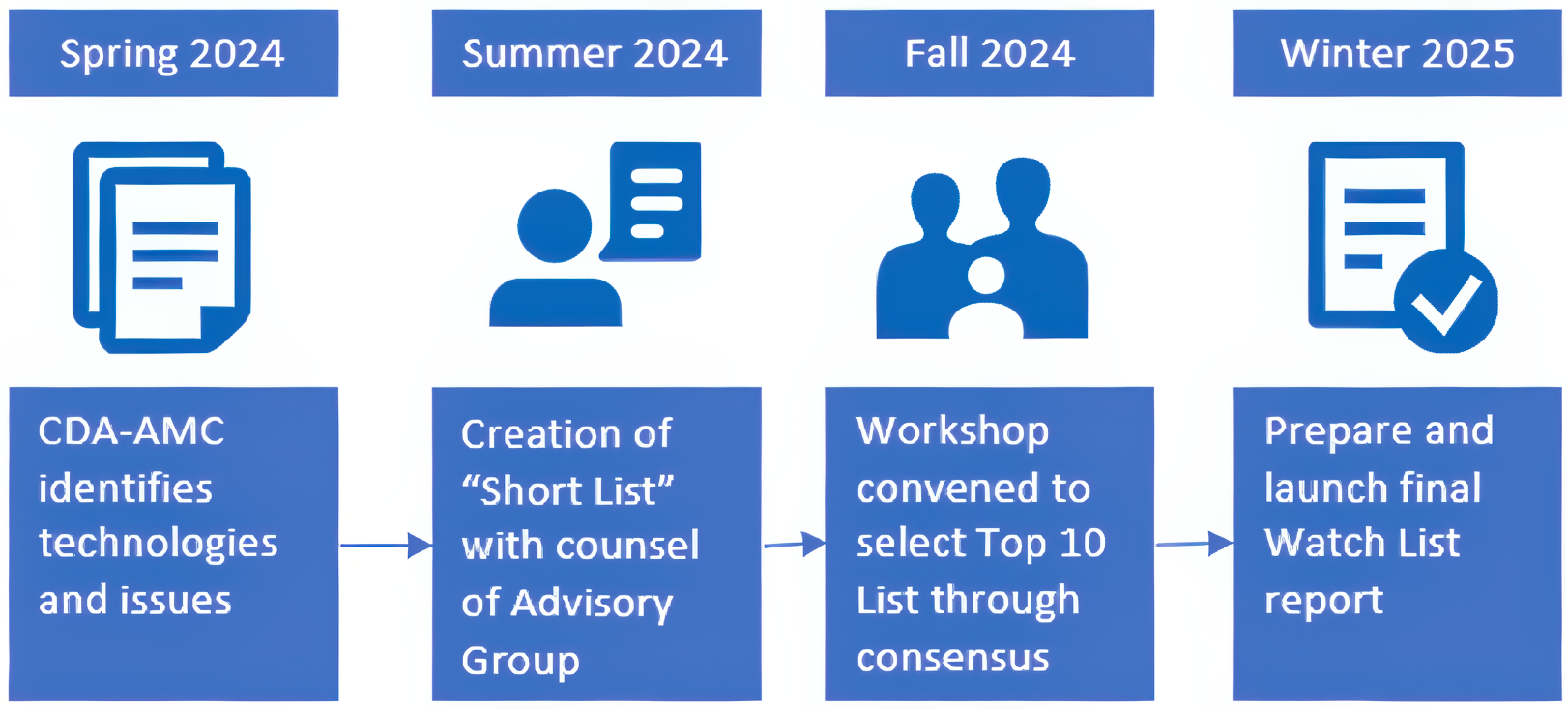
Step 1. Identifying Items for the Long List
The goal was to identify and describe new and emerging AI technologies and related issues in the health care setting with the potential to substantially impact health care delivery and planning in Canada in the next 5 years. The project team considered impact to be significant and meaningful changes in health and human resources, patients’ and caregivers’ experiences and health care outcomes, pathways of health care delivery, and health care equity and access. These areas of change were selected because they are relevant to health care policy and planning and support system readiness for integrating new technologies.
A 5-year time frame was chosen to identify technologies that were further along in the research phase or that have the potential for greater adoption in Canada or similar health care contexts. This time period was intended to limit the technologies that were still in the early development phase in which their potential value proposition remained largely uncertain or those that were unlikely to achieve substantial adoption outside of limited research settings. Early on, the Advisory Group recommended that, due to the rapid advancements in this field, the list should focus on categories of technologies rather than individual technologies. However, even within the time frame of this project, a new technology category emerged that was not considered by our workshop participants: AI agents.
For clarity, significant and meaningful change was defined as that which would require the addition of new, or modification of existing, resources, policies, or procedures to successfully adopt and implement technologies.
Domains for criteria for selecting items for the Watch List were identified using the International Network of Agencies for Health Technology Assessment (INHATA) position statement on disruptive technologies,164 the CDA-AMC Strategic Plan,165 health system priorities as determined by CDA-AMC intelligence gathering, as well as past Watch Lists. We identified relevant and common criteria across these documents to build domains with prompts and key items that included health system–, health care facility–, and patient- and/or caregiver–level issues. The criteria were circulated to the Advisory Group for their input to ensure its accuracy and relevance.
Table 2: Criteria for Selecting Items for the Long List
Domains | Area of significant and meaningful change |
|---|---|
Resource utilization (technical, environmental, and health human resources) |
|
Patients’ and caregivers’ experiences and outcomes |
|
Health care delivery and organization |
|
Health equity and access |
|
Step 2. Preparing the Draft Watch List
Once approximately 30 items were identified, the project team reviewed the draft list and reflected on the project scope, definitions, and selection criteria. Through discussion the items and their labels and definitions were revised, including collapsing, separating, and removing some items. The draft list was then shared with the Advisory Group for validation and to assess the credibility of items. Based on the written and oral input of the Advisory Group, items were once again added, removed, and modified. The final draft list was used in Step 3.
Step 3. Workshop to Select the Top 5 Technologies and Top 5 Issues for the 2025 Watch List
We adapted the transparent and inclusive priority-setting process of the JLA90 to guide the online workshop and the selection of the top 10 items for the 2025 Watch List. The JLA principles align with CDA-AMC priorities of equal involvement and inclusivity (e.g., balanced representation from patients, health care providers, and other impacted parties), transparency (e.g., visible audit trail of submitted technologies and trends), and a commitment to using and contributing to the evidence base (e.g., using technologies and trends to inform future products produced by CDA-AMC.
Identifying and Recruiting Workshop Participants
We identified potential participants through project scoping, a literature review, CDA-AMC networks, and the Advisory Group’s recommendation. There was also an open call for participation on the CDA-AMC website from August to November 2024. Interested individuals completed a web form describing their connection to the topic and how their experiences could add to the diversity of ideas being shared. Members of the project team selected and invited 19 individuals to participate (2 participants were unable to attend on the day). The goal was to select a group of participants with a wide range of experience and backgrounds. Selection of participants emphasized the need for a range of geographical settings (i.e., jurisdictions in Canada), diversity of professional and personal experiences, and expertise as patient partners, caregivers, policy experts, researchers, members of industry, and HCPs.
Engagement With Indigenous Peoples and Organizations
CDA-AMC recognizes the sovereignty and jurisdiction of First Nations, Métis, and Inuit Peoples over community well-being. We understand that Indigenous Peoples’ experiences, values, needs, and priorities are important for understanding and improving the use of AI in health care in Canada. In particular, organizations representing Indigenous Peoples, such as the First Nations Information Governance Centre,166 are leading the way in the development of principles and guidance around data sovereignty. The OCAP principles148 establish how First Nations’ data and information will be collected, protected, used, or shared, and the First Nations Data governance strategy167 highlights what steps should be taken to best serve the data and statistical needs of First Nations in an increasingly complex digital environment, including digital health care. In conjunction with our Strategic Partner, Indigenous Engagement and Partnerships, CDA-AMC is currently fostering relationships with Indigenous Peoples and organizations. Over the course of this project, our Strategic Partner, Indigenous Engagement and Partnerships, reached out to organizations such as the Association of Fist Nations (AFN), the Canadian Institute of Health Information (CIHI), First Nations Information and Governance Centre (FNIGC), and Inuit Tapiriit Kanatami (ITK) to participate in the workshop. However, we were unable to partner with these groups on this project. CDA-AMC acknowledges the lack of engagement and inclusion of Indigenous Peoples’ perspectives and voices as a major limitation and gap of this work.
The Half-Day Workshop to Select the Top 10 Technologies and Issues
Before the workshop, we provided participants with a hardcopy or electronic workshop guide, the draft list with summaries about each technology and issue, and a participant worksheet. Before attending the workshop, participants were asked to individually review and rank the technologies and issues in the short list using the participant worksheet.
The half-day virtual workshop occurred November 5, 2024. The workshop was led by a CDA-AMC staff member who is a JLA Advisor. Two additional team members facilitated the small group workshop sessions. The facilitators used a facilitation guide to ensure that all participants were actively included in the discussion, so the JLA principles of equal involvement were upheld. Additional CDA-AMC team members participated in the workshop as observers and to provide technical support and/or take notes.
The workshop had 2 parts. In the first part, participants were split into 3 smaller groups for a listening exercise in which each participant was asked to share their top-ranked and lowest-ranked items and their rationale. Responses were recorded by the facilitator to form a draft list that reflected the individual choices shared in each group. In the second part of the workshop, the draft rankings of the groups were combined and used as a starting point in a facilitated discussion toward consensus. The group selected the top 5 technologies and top 5 issues that reflected the diverse perspectives and discussion of the group.
Step 4. Preparing the Final Report
We prepared a final report that described the top 10 technologies and issues and their impact on patients, caregivers, and health systems. Descriptions and examples were based on the published literature (identified during the list generation stage and/or by supplemental searching as needed), additional targeted internet searches, and discussions from the workshop. A draft version of the report was shared with the Advisory Group, and the report was revised based on their input.
Appendix 3: Technologies and Issues Not Included in the Watch List
Table 3: List of Technologies Not Included in the Watch List
Technology (category or intervention) | Description | Insights from the workshop |
|---|---|---|
AI for human resource scheduling |
| During the workshop, participants mentioned that using AI for human resource scheduling could improve response rates, especially in high-demand situations, such as in emergency departments. However, some participants expressed concerns about the trustworthiness of the technology and its efficiency, which may be limited due to existing technological constraints. They expressed that our health care system is not currently prepared to implement this technology. Additionally, some pointed out that human resource scheduling may not be a significant challenge for the health care system. |
AI for optimization of other administrative tasks |
| During the workshop, participants noted that using AI to assist with administrative tasks is safe because most data can be controlled. Additionally, these tools can help alleviate the triage and administrative burden in health care. However, participants also noted that addressing these tasks may not be the top priority. |
AI for prognosis and risk stratification |
| During the workshop, participants highlighted that the accuracy of AI for prognosis and risk stratification has improved through deep learning models, and the necessary data are available. AI has the potential to be beneficial for the health care system by identifying high-risk patient groups for intervention and proactive strategies. It is important to note that the prediction models are not always stable. Additionally, the discrimination and calibration of clinical prediction models may sometimes be inadequate. |
AI for error reduction and quality improvement |
| During the workshop, participants expressed several concerns about using AI for error reduction and quality improvement:
|
AI for enhancing shared decision-making process between clinicians and patients |
| During the workshop, participants discussed the importance of enhancing the shared decision-making process between health care providers and patients. This generalized technology is related to a wide range of topics and aims to make medical information more accessible and focus on enabling and empowering patients in their health care. However, considering the current state of a development, this technology category may have a significant impact, but the implementation seems far off, and our health care system is not currently prepared to adopt it. |
AI for public health surveillance and response |
| During the workshop, participants discussed the potential of using AI for public health surveillance and response. They mentioned that it could assist in redeploying health care resources and managing situations similar to the COVID-19 pandemic in the future, and there are already some relevant large datasets and improved models. However, they noted that our health care system currently lacks interagency coordination, which is essential for effective responses. There are many missing components needed to support this initiative, and the quality of the data also needs to be improved. |
AI for personalized medicine |
| During the workshop, participants expressed several concerns about using AI for personalized medicine. They noted that:
|
Table 4: List of Issues Not Included in the Watch List
Issue | Description | Insights from the workshop |
|---|---|---|
Redeployment of health care resources | AI can affect workflows and the allocation of resources in the health care system176 through the following potential changes in workforce roles and responsibilities:
| Participants in the workshop noted the distinction between resources in terms of human resources (i.e., the health care workforce) and nonhuman resources (e.g., physical supplies the workforce needs) Participants had different views on the relative importance of this issue:
|
Overreliance on AI by clinicians or health systems | Because AI can be used at any point in the clinical pathway, there is a need to balance its functions with the value of human presence and expertise.
Training HCPs to work together with AI, rather than AI working autonomously, can ensure humans are part of decision-making for patients.182 This training involves continuously learning about both the technical aspects and ethical limitations of an AI system so that the powerful and efficient capabilities of AI can be combined with the valuable judgment and critical thinking skills of HCPs.182 | Participants in the workshop spent a long time discussing this issue. They expressed how this issue related to 1 of the top issues, AI Issue 2: Liability and Accountability. For example, with 1 of the top technologies included in the 2025 Watch List, AI Technology 1: Notetaking, HCPs are still responsible for notes and need to review and confirm that they are accurate. However, if they use AI to free up time in their schedule for other activities while relying solely on its interpretation, there is a risk of harm. Using AI could also become a burden on HCPs to be accountable for the technology. Participants had different views on the relative importance of this issue:
|
Alignment with societal values | AI value alignment is when AI systems perform in ways that match the ethical principles and human values in society.183 These values can differ across jurisdictions and cultures, meaning alignment depends on the context in which AI is used and can make it more challenging to implement.183 Patients, HCPs, and society at large may not trust AI or be willing to adopt it in light of questions about its usefulness, biases, or potential for errors and misinformation.184 The implementation of AI should include explicit alignment with ethical principles and societal values with a process for auditing.185 Patient values, such as privacy, fairness, and autonomy, should be taken into account and can affect their trust and willingness to adopt AI.185 | Participants in the workshop spent a long time discussing this issue and felt that it related to 1 of the top technologies, AI Technology 2: Tools to Accelerate and Optimize Clinical Training and Education, and is a bounding principle that underpins most of the other top issues (e.g., privacy and data security; data availability, quality, bias; data sovereignty and governance, and environmental costs). Participants had different views on the relative importance of this issue:
|
Copyright | Copyrights are the legal rights to produce, publish, or prepare derivative works of all or part of an original work.186 Generative AI systems use data inputs from multiple sources to create new outputs; therefore, there are questions about who owns the copyright to its outputs. The data inputs themselves, which come from large databases, may or may not have their own copyrights and are not originally sourced from the AI system that is using them.187 The legal status of generative AI in Canada is currently unclear,188 and there remain questions about:
| Most participants in the workshop agreed that copyright was not a top issue to watch for relative to the others. They expressed that copyright in fields such as art and journalism may be a concern, but not in medicine. One participant noted that when working with developers using a value-based procurement approach, both sides were working together to achieve gains. Other participants mentioned that there are currently mechanisms and laws in place to deal with copyright issues that can happen quickly and that the concern or risk is not as high as it was 2 years ago. |
AI = artificial intelligence; ECG = electrocardiogram; HCP = health care professional.
ISSN: 2563-6596
Canada’s Drug Agency (CDA-AMC) is a pan-Canadian health organization. Created and funded by Canada’s federal, provincial, and territorial governments, we’re responsible for driving better coordination, alignment, and public value within Canada’s drug and health technology landscape. We provide Canada’s health system leaders with independent evidence and advice so they can make informed drug, health technology, and health system decisions, and we collaborate with national and international partners to enhance our collective impact.
Disclaimer: CDA-AMC has taken care to ensure that the information in this document was accurate, complete, and up to date when it was published, but does not make any guarantee to that effect. Your use of this information is subject to this disclaimer and the Terms of Use at cda-amc.ca.
The information in this document is made available for informational and educational purposes only and should not be used as a substitute for professional medical advice, the application of clinical judgment in respect of the care of a particular patient, or other professional judgments in any decision-making process. You assume full responsibility for the use of the information and rely on it at your own risk.
CDA-AMC does not endorse any information, drugs, therapies, treatments, products, processes, or services. The views and opinions of third parties published in this document do not necessarily reflect those of CDA-AMC. The copyright and other intellectual property rights in this document are owned by the Canadian Agency for Drugs and Technologies in Health (operating as CDA-AMC) and its licensors.
Questions or requests for information about this report can be directed to Requests@CDA-AMC.ca.