Drugs, Health Technologies, Health Systems
Health Technology Review
ALS in Focus: Canada’s Systems for ALS Care and Support
Key Messages
What Is the Issue?
Amyotrophic lateral sclerosis (ALS) is a rare, progressive, nervous system disease that causes loss of movement, functional impairment, and eventual paralysis requiring continuous care for daily activities and functions such as breathing and eating. There is no cure, and 80% of people with ALS die within 5 years of diagnosis.
ALS creates challenges and significantly impacts individuals, families, caregivers, and health systems in Canada due to its complex and evolving diagnostic and care pathways, high mortality burden, and reliance on coordinated multidisciplinary care. There is also variability in the organization and funding of ALS services across provinces and territories, alongside differences in access to timely diagnosis, treatment, and supportive care.
This report provides a pan-Canadian overview of ALS care pathways and experiences, including diagnosis, treatment, supportive care, and ethical considerations. Federal, provincial, and territorial health system decision-makers can use this report to understand what areas of ALS care require further attention or resources, and to collaborate on health system planning and resource allocation.
What Did We Do?
We conducted a scan of the ALS literature to understand the clinical pathway (i.e., diagnosis, treatment, and supportive care for people living with ALS) and ethical considerations that may arise from how ALS care and support are organized and coordinated across Canada.
We supplemented this information with real-world health care administrative data, registry data, and public and private drug claims and drug cost data. We also engaged with people living with ALS, caregivers, ALS clinic coordinators, and representatives from ALS societies across Canada.
We formed an advisory group (the ALS in Focus Advisory Group) to inform and review our work. The group included people living with ALS, caregivers, physicians specializing in the management and treatment of ALS, an ALS clinic coordinator and nurse, a clinical ethicist, and leaders from provincial ministries of health responsible for health system planning and service delivery.
What Did We Find?
The ALS care pathway in Canada involves a complicated and lengthy diagnostic process, few disease-modifying drugs, and a complex array of health care and support services (e.g., multidisciplinary care provided at specialized ALS clinics, community-based home care services, and ALS societies). There is also wide variability in access to the full spectrum of services available across jurisdictions, making it challenging to navigate for people living with ALS and caregivers.
Registry data from 7 provinces indicate that the average time to receive an ALS diagnosis is 15 months, and that it is longer for those in rural communities. Time to diagnosis is an important metric in ALS care, as a delayed diagnosis may impact eligibility for some disease-modifying drugs and may result in delayed access to multidisciplinary care for people living with ALS.
In Canada, there are currently 3 disease-modifying drugs used to treat ALS: riluzole, edaravone, and tofersen. All public drug plans provide coverage for riluzole, and most provide coverage for edaravone. At the time of report publication, tofersen is under negotiation with the pan-Canadian Pharmaceutical Alliance (pCPA) and is not yet covered by any public drug plans. Tofersen is used to treat a specific subtype of ALS (SOD1 ALS), which makes up approximately 2% of people living with ALS worldwide.
Drug claims data for 10 provinces and territories indicate that the use of disease-modifying drugs for ALS increased over the past 6 years. Data also indicate both an increased number of people receiving ALS drugs from public plans and a rising share of drug costs covered by public plans.
Some people living with ALS have difficulties covering the costs of drugs, devices, and other supportive care that may not be fully covered by public plans. They may also experience challenges related to accessing certain therapies and navigating various health systems to receive health care.
Disparities in the ALS care experience for people living with ALS across Canada can be exacerbated for those with limited financial means and for those in rural or remote locations. Engagement activities with a First Nations and Métis couple reiterated long-standing challenges of systemic discrimination experienced by Indigenous Peoples in Canada that can be intensified in the context of ALS care.
What Does This Mean?
Opportunities for improving care for people living with ALS in Canada may exist around reducing diagnostic and treatment delays, increasing access to supportive therapies, and improving coordination between different parts of health care systems.
Health system decision-makers can consider where attention or resources are needed for improving:
timely diagnosis and referral to an ALS clinic
equitable access to genetic testing and counselling
access to supportive therapies (including access to ALS clinics, multidisciplinary care, and services from ALS societies)
coordination and standardization between different parts of health care systems (e.g., to address ALS and non-ALS symptoms and to improve capacity for long-term care homes to accommodate advanced respiratory and feeding needs)
supports for caregivers (e.g., health care system navigation, mental health, respite, and medical and home care supports)
health system data to better understand challenges in ALS diagnosis, access, and care.
Health system decision-makers can consider options for reducing disparities for people living with ALS who are also part of equity-deserving groups, including:
those living in rural and remote areas who have difficulty accessing care or cannot get care at all
those who do not have the financial or job stability to afford the many out-of-pocket costs required to maintain quality of life
those who do not have caregivers to support them physically, medically, and emotionally
Indigenous individuals who have described the importance of training health care professionals in culturally safe care.
Abbreviations
ALS
amyotrophic lateral sclerosis
ALSFRS-R
Revised Amyotrophic Lateral Sclerosis Functional Rating Scale
CALS
Canadian ALS Research Network
CCRS
Continuing Care Reporting System
CDA-AMC
Canada’s Drug Agency
CIHI
Canadian Institute for Health Information
CNDR
Canadian Neuromuscular Disease Registry
EMG
electromyography
FVC
forced vital capacity
IRRS
Integrated interRAI Reporting System
LTC
long-term care
MAID
medical assistance in dying
NIHB
Non-Insured Health Benefits
NPDUIS
National Prescription Drug Utilization Information System
Key Terms
Amyotrophic lateral sclerosis: Amyotrophic lateral sclerosis (ALS), also known as Lou Gehrig disease or motor neuron disease, is a chronic, progressive disease that causes degeneration of nerve cells in the brain and spinal cord. This leads to muscle breakdown and weakness, and ultimately, death.1
Caregiver: A caregiver is someone (typically a family member or friend) who provides informal and unpaid care to individuals needing support as they navigate life with a medical condition. They perform many duties, including assisting and performing activities of daily living, providing emotional and physical support, managing devices and equipment, and providing coordination across all care (e.g., transportation to and from appointments). A caregiver’s role is vital, as they help to maintain the quality of life and functioning of the person living with ALS.2
Care pathway or clinical pathway: The care pathway or clinical pathway is the pathway of care that a person living with ALS experiences, from diagnosis, treatment, and support (e.g., drugs, devices, supportive care, and home care) to palliative and end-of-life care.
Cultural safety: In the context of this report, cultural safety refers to the experience of the person receiving care, and it is an outcome, based on respectful interactions, which recognizes and strives to address power imbalances inherent in the health care systems. It results in an environment free of racism and discrimination, wherein people feel safe when receiving health care.3
Disease-modifying therapy: A disease-modifying therapy is a treatment that changes the progression of a disease.4
Dysarthria: Dysarthria is a reduced ability to communicate verbally because of weakness or stiffness in the muscles responsible for producing speech.1
Dysphagia: Dysphagia refers to difficulty swallowing.1
Electrodiagnostic tests: Electrodiagnostic tests are tests used to evaluate and diagnose disorders involving muscles and motor neurons. Examples include electromyography and nerve conduction studies. They involve electrodes being inserted into a muscle or placed on the skin over a muscle, and electrical activity and muscle responses being recorded.1
Electroencephalogram: An electroencephalogram (EEG) is a test used during the ALS diagnostic process that captures the continuous electrical activity of the brain using electrodes placed on the scalp.1
End-of-life care: In the context of this report, end-of-life care is care intended to provide comfort and improve the quality of life of people with ALS who have a prognosis of 6 months or less, and their caregivers.5
Equity-deserving group: An equity-deserving group is a group of people who, because of systemic discrimination, face barriers that prevent them from having the same access to the resources and opportunities that are available to other members of society, and that are necessary for them to attain just outcomes. In Canada, these groups include, but are not limited to, 4 designated groups (women, racialized groups, Indigenous Peoples, and people with disabilities), as well as people in the 2SLGTBQ+ communities or people with diverse gender identities and sexual orientations.6
Fasciculation: Fasciculation refers to minor, uncontrolled, abnormal, and visible contractions of muscle fibres seen in the legs, arms, and shoulders.1
Fiscal year: Health care administrative data (e.g., hospitalization and drug data) are reported by fiscal year, defined as April 1 of a given calendar year to March 31 of the following calendar year, reflecting provincial and territorial health systems funding and reporting cycles.
Health equity: Health equity refers to the distribution of health care resources and arranging of health care practices and systems to minimize unfair or avoidable disparities in health outcomes and experiences of care across populations.7
Home care: Home care refers to nonmedical care for daily activities such as bathing, toileting, and dressing; nursing care, such as medication administration or wound care; and other clinical care, such as physiotherapy, which is provided in the home.8
Interested parties: In the context of this report, interested parties are individuals or groups with a personal or professional interest in ALS and its care delivery in Canada. This may include people with lived experience, caregivers, patient groups, health care professionals, clinical societies, health care decision-makers, pan-Canadian health organizations, and other communities with a direct interest in ALS.
Interventions in development: For this report, interventions in development are new drugs, devices, technologies, supportive programs, and multidisciplinary care for people living with ALS that have the potential for impact in Canada. These interventions may include those that are in late-stage development that have not received regulatory approval, and those that have been approved or are available for clinical use but have had limited application.
Intrathecal: An intrathecal injection is an injection into the fluid-filled space around the brain or spinal cord to provide medication to the deepest membrane surrounding the central nervous system. If delivered to the spine, it is also referred to as a lumbar puncture or spinal tap.1
Jurisdiction: In the context of this report, a jurisdiction is an organization or level of government (e.g., provincial, territorial, or federal) with responsibility for making decisions about funding or delivering health care.
Long-term care: Long-term care (LTC) facilities are those that provide 24-hour nursing care, personal support, and other services, primarily to older adults. These facilities may also be referred to as nursing homes, personal care homes, or residential care facilities. While residents are often required to contribute a copayment toward their accommodation and meals, the care component is publicly funded. In this report, long-term care refers to publicly funded long-term care homes that share data with the Canadian Institute for Health Information and does not include private retirement homes, which are funded primarily through resident payments.9
Off-label use: Off-label use occurs when a drug or medical device is being used for a condition or indication other than what it was designed and approved for.10
Palliative care: Palliative care is a type of supportive care that focuses on improving the quality of life of people with a serious illness (such as ALS), their caregivers, and their family members; it can be delivered at any stage of ALS, from diagnosis onward.6
PROGRESS-Plus: PROGRESS-Plus is a framework that identifies elements affecting health equity.
PROGRESS refers to: place of residence, race/ethnicity/culture/language, occupation, gender/ sex, religion, education, socioeconomic status, social capital. Plus refers to: (1) personal characteristics associated with discrimination (e.g., age, disability), (2): features of relationships (e.g., smoking parents, excluded from school), (3) time-dependent relationships (e.g., leaving the hospital, respite care, other instances where a person may be temporarily at a disadvantage).11
Pseudobulbar affect: Pseudobulbar affect refers to uncontrollable emotional outbursts, including laughing, crying, and excessive yawning.12
Resource: In the context of this report, resources are physical materials or humans, and the systems or structures that organize them, to support the care and treatment of people living with ALS. This can include equipment, facilities, programs, funding, or health care staff.
Sialorrhea: Sialorrhea is excessive drooling.1
Special Access Programs: Special Access Programs are programs through which health, dental, and veterinary practitioners can access nonmarketed drugs and medical devices that are not yet authorized for sale in Canada. These programs are for other treatments that have failed, are unsuitable, or are unavailable.13
Supportive care: In the context of this report, supportive care refers to various types of care that are delivered by specialists in different fields and aim to reduce ALS symptoms and improve functioning and quality of life.14 Supportive care includes both pharmacological and nonpharmacological therapies for people living with ALS and their families, and can address symptom management; physical function; and emotional, social, and spiritual well-being.15
Background
Issue
Amyotrophic lateral sclerosis (ALS) is a fatal nervous system disease that leads to muscle breakdown and paralysis.16,17 One of the main causes of death with ALS is respiratory failure.18 In Canada, 80% of people with ALS will die within 5 years of diagnosis.16 ALS presents challenges for health systems in Canada due to its complex and evolving diagnostic and care pathways, high mortality burden, and reliance on coordinated multidisciplinary care. Initial scoping of the evidence conducted by Canada’s Drug Agency (CDA-AMC) identified variability in the organization and funding of ALS services across provinces and territories in Canada, alongside differences in access to timely diagnosis, treatment, and supportive care. These challenges may contribute to delays in care, unmet clinical and supportive care needs for people living with ALS, and, in some cases, the pursuit of medical tourism or use of unregulated treatment options. At the same time, ongoing clinical development and the introduction of novel drug and supportive care interventions is expected to further shape the ALS care landscape across Canada. Taken together, these factors highlight the need for a comprehensive overview of current ALS management in Canada to support more coordinated, equitable, and timely decision-making regarding care delivery and resource allocation.
Objective
The purpose of this report is to provide a pan-Canadian, systems-level overview of the current landscape of ALS care, including diagnosis, treatment, and supportive care. This report is intended to support health system decision-makers (e.g., at the federal, provincial, and territorial levels) and other interested parties by highlighting key features, challenges, and variations in ALS care across jurisdictions.
Specifically, this work aims to:
identify and describe challenges and opportunities in the management of ALS in Canada to inform sustainable systems planning in the context of evolving care needs and therapies in development
support shared understanding across jurisdictions and among interested parties to enable more coordinated and informed decision-making.
This report does not include:
a detailed analysis of factors associated with health systems challenges
cost-effectiveness assessments
linkages between registry data and other sources of health care data
in-depth analyses of medical assistance in dying (MAID) considerations or the use of MAID
recommendations from CDA-AMC committees to address ALS systems challenges
evaluation of ALS drug access in Canada
examination of clinical criteria impacting drug utilization and access.
Research Questions
For people of any age living with ALS, as well as their caregivers, what is the care pathway across Canada, and what interventions for diagnosis, treatment, and supportive care are currently available in Canada?
How is ALS care delivered and coordinated within and across provinces and territories in Canada?
What do health care administrative data, registry data, and public and private drug plan market data show about health care service use, clinical characteristics, and drug utilization among people living with ALS in Canada?
What are the interventions in development for ALS diagnosis, treatment, and supportive care?
What social and ethical considerations arise from how ALS care and support are organized and coordinated across Canada?
Approach
We assembled an advisory group of experts and people with lived experience (the ALS in Focus Advisory Group) to inform the approach to addressing the research questions, and to review the project activities. To understand contextual factors and help interpret project input, we also engaged a range of people with personal and professional experiences with ALS. The engagement was iterative and discussion topics were adapted as we gathered information about the care pathway. In addition, we reviewed the published and grey literature, conducted analyses of health care service use and drug use, and summarized clinical and demographic characteristics of people living with ALS to understand the ALS care pathway.
Engagement activities included:
assembling an advisory group in January 2026, including members with personal or professional experience as a clinical ethicist, a health care policy expert or decision-maker, a clinician, an interdisciplinary health professional, a person living with ALS, or a person caring for someone living with ALS currently or in the past
creating a summary of patient group input previously submitted to the CDA-AMC pharmaceutical review programs (the Perspectives of People Living With ALS and Caregivers: Summary of Patient Group Input Submitted to CDA-AMC Review Programs is available in a separate document and referenced throughout this report)19
engagement with ALS societies that previously submitted to the CDA-AMC pharmaceutical review programs to confirm that the summary of previous input was accurate and complete; we also engaged the other ALS societies that provide services and support to people living with ALS in their regions to understand the scope of their services and share the opportunity to provide feedback
engagement with people living with ALS and caregivers to determine how care is coordinated and delivered across provinces and territories and to understand the experiences and challenges of living with ALS in Canada and accessing care20
engagement with ALS clinic coordinators from several provinces to understand the ALS care pathway, jurisdictional variations, and challenges across Canada
creating a survey aimed at ALS clinic coordinators as an option for clinicians to share details about the population seen at their ALS clinic, details about the structure of care at their ALS clinic, a review of a figure on the organization of ALS care in their local area, and questions about the organization of care in general
engagement with people living with ALS from Indigenous communities to understand the unique considerations, priorities, and needs of First Nations, Inuit, and Métis people in the ALS care pathway. This engagement was designed and facilitated by Sage Solutions with support from CDA-AMC.21 It was developed as an integral first step, recognizing that deeper engagement with First Nations, Inuit, and Métis communities would be necessary to understand the diverse perspectives and experiences of Indigenous individuals living with ALS.
Analyses included the following:
Health services use analyses: In collaboration with the Canadian Institute for Health Information (CIHI) we examined health services use, including hospitalizations, day surgeries and procedures, emergency department visits, continuing care, and drug use across available provinces and territories.
Registry analyses: In collaboration with the Canadian Neuromuscular Disease Registry (CNDR), we analyzed ALS registry data, including time to diagnosis and other clinical information not captured in administrative health care data.
National public and private drug plan market analyses: We analyzed IQVIA data from public and private drug plans to estimate the proportion of ALS drug costs (for riluzole and edaravone) attributable to public and private sources of payment.
Appendix 1 describes the detailed methods for identifying and summarizing evidence, and Appendix 2 describes the methods for engagement activities. Appendix 3 describes detailed methods for health care services analyses. Appendix 4 describes detailed methods for the registry analyses and Appendix 5 describes detailed methods for the national public and private drug plan market analyses.
Living With ALS
ALS is an incurable motor neuron disease that causes a person’s muscles to become weak. They gradually lose the ability to speak, swallow, move their body, and breathe, which leads to eventual death, typically within 2 to 5 years of diagnosis.
There is no single diagnostic test for ALS, and the diagnostic process involves eliminating other conditions using several methods. ALS is difficult to diagnose because it is a rare disease, symptoms mimic other conditions, and many professionals working in primary care rarely encounter ALS in their practice. This can lead to a lengthy diagnostic testing process and delayed ALS diagnosis and treatment.
ALS treatment options include 3 drugs to slow disease progression (i.e., riluzole, edaravone, and tofersen) and supportive therapies to maintain quality of life. Tofersen is used to treat a specific subtype of ALS (SOD1 ALS), which makes up approximately 2% of people living with ALS worldwide. Supportive therapies can include:
drugs to manage symptoms
devices to support physical limitations
specialist care to address respiration, swallowing, nutrition, communication, muscle weakness and movement, pain, cognition and behaviour, mental health, home care, long-term care (LTC), and palliative and end-of-life care.
Multidisciplinary care, in which multiple specialists work together to support a person living with ALS, is an integral part of ALS care and can prolong survival and quality of life.
ALS reshapes daily life for people living with ALS, their caregivers, and their families more generally. The progressive physical decline associated with ALS affects people’s ability to move freely and communicate, and can severely impact their sense of identity, autonomy, emotional well-being, relationships, and family finances. These experiences can vary widely depending on access to social, financial, and health care supports. As such, the burdens of ALS are not experienced evenly, and differences in available supports can influence how safely and independently — and with what degree of dignity — people living with ALS are able to live over their disease course.
This section describes the general ALS care pathway; details about health care services in this pathway specific to Canada are described in the section titled Organization of ALS Care in Canada.
Information in this section was summarized using input from people living with ALS and their caregivers (including engagement with Indigenous individuals), ALS in Focus Advisory Group members, and literature searches.
What Is ALS?
ALS is a rare, fatal, and progressive nervous system disease that causes degeneration of motor neurons, leading to muscle weakness, loss of voluntary movement, difficulty eating and breathing, paralysis, and death.16,17 It is the most common type of motor neuron disease. In some parts of the world, it is referred to as Lou Gehrig disease or used interchangeably with the term motor neuron disease (although there are other types of motor neuron diseases).22 People living with ALS experience symptoms such as slurred speech, tripping, difficulty swallowing, weakness, fatigue, shortness of breath, and muscle cramping and twitching.16
ALS is an adult-onset disease and people diagnosed with ALS are generally between the ages of 40 and 70 years.23 The mean age at diagnosis was 62 years among people living with ALS enrolled in the CNDR between 2012 and 2017.24 In Canada, there are approximately 4,000 people living with ALS, with an estimated 1,000 people diagnosed annually. The prevalence of ALS is projected to increase in the future due to population aging and improvements in disease management that may help people live longer.23
Overall, 5% to 10% of ALS cases are familial (i.e., these people living with ALS have a family member who also has ALS, meaning a genetic mutation has likely been inherited).25 More than 40 genes are associated with ALS, with common genes including C9orf72, TARDBP, FUS, and SOD1; mutations in these 4 genes occur in approximately 48% of people with familial ALS.26,27 Among people living with familial ALS, approximately 22.5% have mutations in the C9orf72 gene, while 18.9% have mutations in the SOD1 gene.26
According to published estimates, the average time from symptom onset to diagnosis of ALS in Canada was 21 months among people living with ALS enrolled in the CNDR between 2012 and 2017, with 80% of people with ALS dying within 5 years of diagnosis.16,24,28,29 In the US and Europe, the average time from symptom onset to diagnosis ranges from 8 months to 18 months,30-36 although data are not directly comparable across countries.
There is no cure for ALS. In Canada, an estimated 1,000 people living with ALS will die every year.16 Once someone is diagnosed, the disease can progress quickly with a severe loss of daily life functions before death. Treatment options for ALS include drugs to slow disease progression and supportive therapies to maintain quality of life (e.g., drugs for symptom management, devices to support physical changes, and specialist care for nervous system degeneration).16,17
Appendix 6 outlines Canadian and international guidelines that provide recommendations on the detection, treatment, and management of ALS.
The Impact of ALS
ALS can have a profound impact on the lives, emotional well-being, and sense of personal identity for people living with ALS, their caregivers, and their family members more generally.19,37 People living with ALS experience progressive changes in strength, mobility, communication, bodily functions, ability to work, and participation in leisure activities.19,38,39 Disease progression and its impacts vary across individuals; some experience slower progression and can maintain activities of daily living for longer periods of time, while others face rapid and unpredictable changes in health (e.g., paralysis) requiring them to quickly adapt their lives (e.g., with wheelchairs, feeding tubes, and mechanical ventilation for breathing).19 This unpredictability can contribute to a sense of anxiety for people living with ALS, their caregivers, and their family more generally.19
Beyond this sense of unpredictability, people living with ALS have identified that ALS has an impact on their sense of autonomy, dignity, and meaning in life.19 Mobility and communication challenges may contribute to an increased sense of social isolation, with some people living with ALS reporting that they feel like a burden to loved ones.19 Loss of employment and the costs associated with ALS care can also create significant financial vulnerability for people living with ALS and their families, particularly when caregivers are forced to reduce their hours or leave paid work altogether due to the constant care needs of the person they are caring for.19 At the same time, some people living with ALS described gaining a sense of strength due to the support they received from caregivers, family members, assistive devices (e.g., communication devices), and broader support networks.19
The experience of living with ALS is also shaped by broader social and structural conditions. Income, geography, housing, transportation, existing disabilities, and access to informal caregiving can all impact whether people living with ALS are able to access specialized care, obtain necessary supportive equipment, and remain at home. Disparities in social and structural determinants of health may not only affect access to services, but may also affect the degree of independence, dignity, and continuity of care that people living with ALS and caregivers are able to maintain over the disease course. This may be exacerbated for people already experiencing systemic discrimination within health care systems. Noting the importance of culturally safe care, a First Nations and Métis couple engaged for this project indicated that some health care professionals may cling to harmful stereotypes of Indigenous Peoples and become “dismissive and condescending once they see we are Indigenous.”40
Early Symptoms
ALS is characterized by the part of the body in which clinical symptoms originate (e.g., bulbar onset [in the brain], respiratory onset, or limb onset) and by whether its occurrence is sporadic or familial (based on more than 40 inherited genes).41 Early symptom presentation varies depending on the type of ALS but generally includes some form of muscle weakness, categorized by whether it impacts upper or lower motor neurons.
Potential cases of ALS can be challenging for primary care practitioners to accurately identify, as it is a rare condition with broad variability in early symptom presentation. This may lead to delayed referrals to other health care specialists (e.g., neurologists) and can have wide-ranging ramifications for the diagnostic journeys, time to diagnosis, access to timely treatment options, and long-term prognosis of people living with ALS.41
Diagnostic Testing and Diagnosis
There is no single diagnostic test for ALS. Once a person is referred for diagnostic testing, the process of attaining an official diagnosis of ALS is complex and resource-intensive. This can delay treatment initiation and increase the burden on people living with ALS and the health systems.17,42
Given the differing presentation of symptoms across people living with ALS, similar symptoms for ALS as for many other neurologic conditions, and absence of any specific diagnostic markers of disease,43 clinicians typically diagnose ALS through a process of elimination, using a mixture of diagnostic methods.27,41,44 Key diagnostic methods are outlined in Table 1.
Table 1: Key Diagnostic Testing Methods for ALS
Method | Purpose | Examples |
|---|---|---|
To detect electrical responses in nerves and muscles, specifically lower motor neurons, to confirm active and chronic lower motor neuron involvement and exclude other conditions | Nerve conduction studies, electromyography | |
To image the brain and spine and exclude structural causes of symptoms that point to other conditions (e.g., disc herniation) | MRI | |
To detect certain proteins, antibodies, and other components in the blood and other bodily fluids to support a diagnosis of ALS and rule out other diseases (e.g., high creatine phosphokinase can signal motor neuron damage) | Blood, urine, cerebrospinal fluid testing | |
To identify breathing capacity | Forced vital capacity, peak cough flow | |
To help identify people who are at risk for ALS, confirm a diagnosis and the type of ALS, and aid clinicians in providing personalized treatments | SOD1 genetic testing |
ALS = amyotrophic lateral sclerosis.
Assessing the prognosis of the disease and performing regular monitoring can help people living with ALS, their families, caregivers, and their care practitioners to discuss care options and plan for future needs. Clinicians can leverage scoring and staging systems to inform the ALS prognosis; these can include the ALS Functional Rating Scale – Revised (ALSFRS-R)12,50,51 and the King’s Staging System to monitor disease progression.50,51
Treatment and Supportive Care
Therapies for ALS either treat the underlying causes of ALS by slowing disease progression (called disease-modifying therapies) or are supportive therapies used to manage ALS symptoms.
Disease-Modifying Therapies
For the purposes of this report, we have defined disease-modifying therapies as treatments that change the progression of a disease.4 Currently, there are 3 disease-modifying drug therapies for ALS that are approved and marketed in Canada:
Riluzole (Rilutek,52,53 Apo-Riluzole,54,55 Mylan-Riluzole56,57) is a drug that can help to protect nerve cells by reducing damage caused by excess glutamate in people living with ALS.43
Edaravone (Radicava58,59) is a drug that can help to protect nerve cells from oxidative damage in people living with ALS.43
Tofersen (Qalsody60,61) is a drug that targets the genetic cause of SOD1-related ALS (which makes up approximately 2% of people living with ALS worldwide26,62). It works to lower production of the SOD1 protein, which reduces the damage to motor neurons.63
Two other disease-modifying therapies, IV edaravone (Radicava) and sodium phenylbutyrate and ursodoxicoltaurine (Albrioza), were previously available in Canada and received Reimburse With Conditions recommendations from CADTH in 201964 and 2022,65 respectively. IV edaravone was discontinued by the manufacturer in 2025.66 Sodium phenylbutyrate and ursodoxicoltaurine was withdrawn postmarket in 2024.67
The route of drug administration of disease-modifying drugs may impact overall patient experience, access, and ability to adhere to a dosing regimen.68 Riluzole and edaravone can be administered orally or via a feeding tube.63 Conversely, tofersen is administered via intrathecal injections (i.e., an injection into the spine, also referred to as a spinal tap or lumbar puncture),69 which requires equipment such as an exam room, sterile lumbar puncture kit, and pharmacy cold-chain storage.70 The procedure is usually performed in outpatient procedure rooms, day surgery units, or community hospitals, and can be administered by any clinician trained to perform this procedure (e.g., neurologists, anesthesiologists, radiologists).70
Supportive Therapies
There are various supportive therapies for managing symptoms of ALS, including drugs, devices, and specialist care. Supportive therapies for ALS have several purposes, including:42
managing ALS symptoms, including comorbidities
addressing functions of daily living
improving quality of life
providing ongoing assessments of disease progression and symptoms so that health care professionals can reassess therapies and make referrals when necessary
delivering information and resources so people living with ALS and their caregivers can plan their ALS journey.
Multidisciplinary care is a special type of supportive therapy that is an integral part of treatment for people living with ALS and involves several health care professionals working together. It can provide benefits that include:71
prolonged survival
lessened and shortened hospital admissions
increased use of adaptive equipment and assistive devices
improved quality of life.
Table 2 describes the main components of multidisciplinary supportive care based on information from Canadian and international evidence-based guidelines, ALS in Focus Advisory Group member input, clinical experts, and the ALS Society of Canada’s ALS Guide.72 Each row is intended to highlight a specific health care domain; however, rows are not mutually exclusive and care definitions, components, and health care professionals may overlap across rows.
Table 2: Supportive Therapies and Symptom Management
Care domain | Nonpharmacological therapies | Pharmacological therapiesb | ||
|---|---|---|---|---|
Health care professionals | Supportive therapies | Devicesa | ||
Respiratory therapy | Respirologist, respiratory therapist71 | Techniques for clearing airways, swallowing, and breathing71,73-75 | Noninvasive ventilator (e.g., BiPAP), invasive ventilator (tracheostomy tube), suction devices, cough assist machines71,73-75 | For airway clearance management: mucolytics (i.e., guaifenesin or N‑acetylcysteine), Beta‑receptor antagonists (e.g., metoprolol or propranolol), nebulized saline, nebulized ipratropium71 |
Swallowing and nutrition management | Speech-language Pathologist, occupational therapist, dietitian, gastroenterologist, radiologist71,73,75-78 | Management of saliva accumulation, impaired swallowing, and malnutrition;71,73,75-78 salivary gland radiation therapy | Feeding tubes (i.e., gastrostomy tubes, PEG, RIG)71,73,75-78 | Muscle relaxants (i.e., anticholinergics, botulinum toxin injections), dextromethorphan and quinidine, mucolytics71,73,77,78 |
Communication support and environmental controls | Augmentative and alternative communication supports such as communication boards, preprogrammed messages, hands-free communication, voice amplification devices, speech-generating devices, text-to-speech devices, message or voice banking, eye-gaze technologies71,73,77 | No pharmacological therapies identified | ||
Rehabilitation therapy | Physiatrist, physiotherapist, occupational therapist, orthopedic specialist,71,73,75,77,78 speech-language pathologist | Techniques for managing mobility and reducing fatigue, including stretching exercises, body positioning, home modifications, and equipment advice71,73,75,77,78 | Orthoses, canes, walkers, wheelchairs, lift devices, stair glides, bathroom supportive devices71,73,75,77,78 | No pharmacological therapies identified |
Pain management | Physiotherapist, physiatrist, palliative care physician71,73,75,77,78 | Robotic cushions, air beds, neck braces | Tailored to the specific cause:71,73,75,77,78 Nociceptive pain: NSAIDs Neuropathic pain: gabapentin, pregabalin, antidepressants Joint pain: steroid injections Advanced disease, in inpatient or palliative care setting: morphine Other: acetaminophen, lidocaine injections, cannabinoids, opioids (e.g., hydromorphone) | |
Involuntary muscle movement management | Physiotherapist, physiatrist, palliative care physician,71,73,75,77,78 occupational therapist | Exercise for preventing and managing involuntary muscle movements71,73,75,77,78 | Not applicable | Tailored to the specific cause:71,73,77,78 Cramps: gabapentin, baclofen, quinine, levetiracetam, mexiletine Muscle spasticity (i.e., stiff or tight muscles): baclofen, tizanidine, botulinum toxin, benzodiazepines, cannabinoids, magnesium supplements Fasciculations: gabapentin |
Cognitive and behavioural carec | Occupational therapist, psychologist, psychiatrist, neurologist, social worker71,79 | Behavioural therapy, environment modifications, caregiver education71,79 | Not applicable | For Alzheimer disease and related dementia:79 General: cholinesterase inhibitors, memantine Moderate agitation: citalopram Severe agitation: aripiprazole, brexpiprazole, risperidone, quetiapine, cannabinoids, carbamazepine Agitation if other drugs are ineffective or not tolerated: typical antipsychotics Emergency treatment of severe agitation: short-acting antipsychotics, short-acting benzodiazepines Other: SSRIs |
Mental health therapy, emotional support, counselling, and spiritual care | Therapist, counsellor, psychologist, psychiatrist, social worker, pastoral care worker71,73,77 | Emotional support, community resources, financial and legal advice, spiritual care, and planning for the future71,73,77 | Not applicable | Tailored to the specific cause:71,73,75,77,78 Pseudobulbar affect: drugs that co-treat concomitant symptoms (e.g., amitriptyline for sleep and mood effect, SSRI for depression), dextromethorphan with quinidine Anxiety or depression: tricyclic antidepressants (amitriptyline, nortriptyline, imipramine), benzodiazepines, gabapentinoids (gabapentin, pregabalin), SSRIs, SNRIs |
Home care and long-term care | Nurse, personal support worker, dietitian, physiotherapist, social worker, occupational therapist,77 speech-language pathologist, physical therapist | Supports to perform activities of daily life at home or in a 24-hour long-term care home77 | Devices from each care domain, as applicable to individual needs (i.e., respiratory therapy, swallowing and nutrition management, communication support and environmental controls, rehabilitation therapy) | No pharmacological therapies identified |
Telehealth | Not applicable | No pharmacological therapies identified | ||
Alternative medicine | Massage therapist, reflexologist, aromatherapist, naturopathic doctor, therapist71,73,77,78 | Therapies to complement conventional health care (e.g., meditation, reflexology, massage, aromatherapy)71,73,77,78 | Not applicable | No pharmacological therapies identified |
Palliative and end-of-life care | Palliative care team (e.g., palliative care physician, nurse)71,75,77,78 | Support to relieve symptoms, improve emotional well-being, and maintain coordination of care71,75,77,78 | Devices from each care domain, as applicable to individual needs (i.e., respiratory therapy, swallowing and nutrition management, communication support and environmental controls, rehabilitation therapy) | |
ALS = amyotrophic lateral sclerosis; BiPAP = bilevel positive airway pressure; NSAID = nonsteroidal anti-inflammatory drug; PEG = percutaneous endoscopic gastrostomy; RIG = radiologically inserted gastrostomy; SNRI = serotonin-norepinephrine reuptake inhibitor; SSRI = selective serotonin reuptake inhibitor.
aDevices refer to health technologies.
bWe were unable to identify detailed information on the specific health care professionals that prescribe specific pharmacological therapies.
cFrontotemporal dysfunction can occur in about half of all people living with ALS. It often presents with cognitive and behavioural impairment, sometimes severe enough to be classed as dementia. Canadian and international guidelines provide limited recommendations on the treatment of cognitive and behavioural impairment for people living with ALS. Therefore, Canadian guidelines on frontotemporal dementia have been used to outline supportive therapies, devices, and pharmacological therapies for this care domain.79
Note: Information in this table is not exhaustive and may differ due to heterogeneous disease progression across people living with ALS.
Caregiver Support
Caregivers are central to the lives and care of people living with ALS. They are typically individuals close to the person, such as a spouse, partner, adult child, parent, sibling, or close friend.72,80 As ALS progresses, caregivers take on increasing responsibilities, including supporting and performing activities of daily living (e.g., eating, walking, bathing, and using the toilet), coordination of medical care (e.g., scheduling and providing transportation for appointments), managing medical care (e.g., delivering infusions, supporting physiotherapy exercises, administering oral drugs, handling mechanical ventilation for breathing and feeding tubes for eating), and providing emotional support.19,72,81-84 During later stages of ALS, when mechanical ventilation is required, caregivers may provide round-the-clock care with the person with ALS totally dependant on them; some international data suggest that caregiver time can reach upwards of an estimated 130 hours per week.85,86
Caregivers have described their role as life-changing, all-consuming, and overwhelming.19,81-84 As caregiving requires constant adaptation to the needs of the person living with ALS, caregivers may have limited time or capacity to attend to their own physical, emotional, and social needs:19,84 “You basically give up your own life to care for ALS patients.”19
Caregivers commonly report experiencing anxiety, physical and emotional exhaustion, grief, helplessness, burnout, and compassion fatigue.19,69,72,87-89 These impacts may intensify as they witness the progressive decline of the person with ALS, navigate communication challenges, and approach end-of-life care and bereavement.19,69,82,90 Caregivers and people living with ALS may also experience shared and individual psychological distress as both parties adjust to changing roles and relationships following diagnosis.19,91,92 Although caregivers may emphasize the importance of making the most of the remaining time with the person with ALS, the substantial physical, emotional, and psychological burdens of providing ongoing care can contribute to feelings of loss of control or, at times, a wish for their caregiving role to end.82,84
Caregiving can result in significant financial impacts, as caregivers often reduce work hours or leave employment entirely, contributing to financial strain that may disproportionately affect those with fewer socioeconomic resources.69,83 Caregivers’ ability to provide care may be also shaped by factors such as age, physical capacity, employment demands, geographic location, language, and socioeconomic status. These pressures are not experienced equally and may contribute to inequities in both caregiver well-being and the care available to people living with ALS.
Organization of ALS Care in Canada
There are differences in the organization of ALS care based on province, territory, and specific region. Twenty-four ALS clinics located in provincial urban centres provide specialized, multidisciplinary care for people living with ALS in Canada.
Registry data in Canada suggest time to diagnosis may be improving. The average time from symptom onset to diagnosis is 15 months, and is longer for people living in rural communities.
All jurisdictions provide coverage for riluzole and most provide coverage for edaravone, although some have restrictions (e.g., clinical criteria). Real-world data from CIHI show that the use of riluzole and edaravone increased over the past 6 years, alongside increased coverage by public drug plans based on data from CIHI and IQVIA.
Supportive care in Canada for people living with ALS may be accessed through the public health care systems, private companies, and not-for-profit programs.
Some people living with ALS described challenges in accessing some drugs (e.g., if they did not meet the criteria or if in-person visits to a specialist are needed), covering costs for drugs and some supportive therapies, and navigating ALS care across a variety of programs and settings.
Opportunities remain to expand the collection and availability of health care data relevant to ALS and ALS care in Canada.
The organization of ALS care in Canada is complex. ALS care in Canada is implemented differently across provinces and territories, as each has its own health care infrastructure, resources, and governance. This can result in different care experiences for people living with ALS across the country. Not-for-profit provincial ALS societies also offer services outside of the publicly funded health care systems. Some people living with ALS also travel to other countries for ALS services (e.g., genetic testing, participation in clinical trials).
This section describes how ALS care in Canada is organized and delivered, based on information available at the time of the writing of this report (2026). Information in this section was summarized using input from people living with ALS and their caregivers (including engagement with Indigenous individuals), ALS clinic coordinators, representatives from ALS societies, ALS in Focus Advisory Group members, literature searches, real-world data accessed from CIHI, registry data from the CNDR, and private and public drug plan market data from IQVIA.
Specific aims of this section are to illustrate:
what ALS services are provided, where they are provided, and by whom
how care may be delivered differently in different provinces, territories, and regions
how inequities can impact how care is received
challenges that people living with ALS and their caregivers experience when accessing care.
By understanding how ALS care is organized in Canada and examining commonalities and variations within and across jurisdictions, decision-makers can better understand the ALS experience and identify opportunities for improving care delivery in Canada for people living with ALS.
Overview
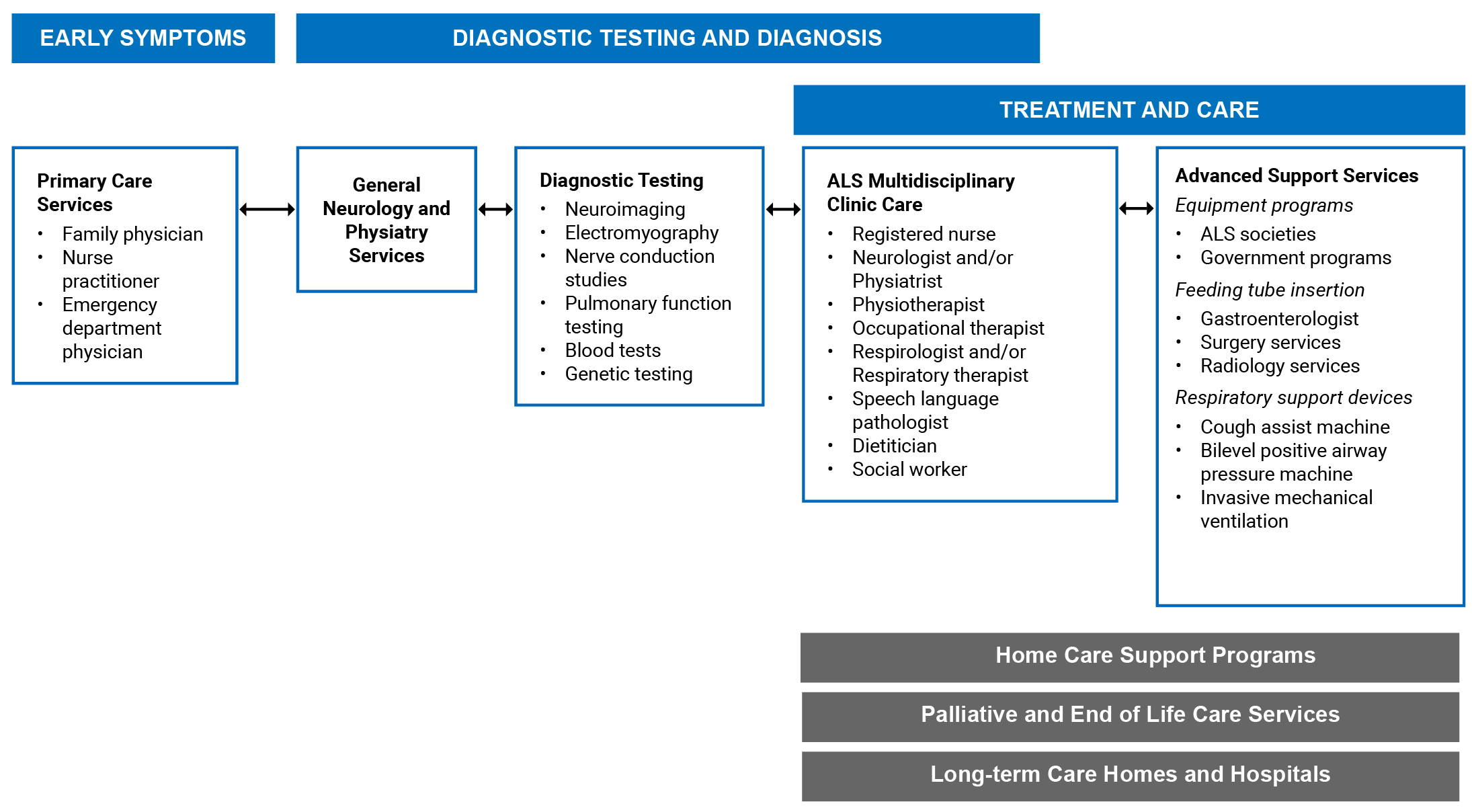
Figure 1 illustrates the overall organization of ALS care in Canada. Each component is either part of the public health care systems or works alongside them. This figure represents the core care pathway that people living with ALS will generally encounter or should encounter; however, there are differences at each stage depending on the province or territory where a person lives.71 This may be a result of the way health care systems are organized locally, or the availability of health care professionals and resources. These variations are described in more detail throughout this section.
There are 3 main stages of the ALS journey depicted in Figure 1:
early symptoms (detected by professionals working in primary care)
diagnostic testing and diagnosis (conducted by general neurology or physiatry services, or ALS multidisciplinary clinics)
treatment and care (delivered by ALS multidisciplinary clinics and/or other publicly funded health care programs, individual specialists, ALS societies, or private care services).
As a person moves through these 3 stages, there are several care professionals they will see who perform different functions and who may work together to deliver care. The double arrows between boxes illustrate that care is not necessarily linear from left to right, and that people may need to move back and forth between care services. Detailed information about ALS clinics is provided in the ALS Multidisciplinary Clinics section.
Early Symptoms
In Canada, the first health care professionals that may recognize and address early symptoms of ALS are often part of primary care services, and can include family physicians, nurse practitioners, and emergency department physicians. These health care professionals can initiate referrals to a general neurologist or physiatrist for diagnostic testing if a neurologic condition is suspected.93 Other clinicians that may recognize ALS symptoms can include ear nose and throat physicians, speech-language pathologists, internists, physiotherapists, occupational therapists, nurses, and spinal surgeons. In addition to referrals to general neurologists or physiatrists, primary care practitioners can also refer individuals directly to ALS clinics when ALS is suspected, to support timely diagnosis and treatment by the neurologists, physiatrists, and other health care professionals who specialize in ALS care at these clinics.
Depending on the province or territory in which a person resides, there may be variations in the specific health care professional that recognizes early symptoms of ALS, the time it takes for them to refer someone to a specialist for diagnostic testing, and whether they refer them to a general neurologist or physiatrist for testing versus a specialist at an ALS clinic.
Experiences in Canada: Challenges and Opportunities
Accessing Primary Care
There are equity challenges in accessing primary care for those who do not have a family physician or access to a nurse practitioner, are geographically far from a physician or nurse (e.g., living in rural and remote areas), do not have the financial or logistical resources to visit a primary care practitioner, or are experiencing physical ALS symptoms that make it challenging to travel to an appointment. For example, a 2025 CIHI report showed that 1 in 5 adults in Canada do not have a regular health care practitioner,94 and a 2024 report indicated that only 7% of physicians in Canada were working in rural communities.95 Patient groups reported to CDA-AMC that some people living with ALS had difficulty accessing primary care practitioners and allied health professionals.19 For people experiencing ALS symptoms, not having access to a primary care practitioner can lead to delayed diagnoses, which can delay treatment and impact the quality and length of life.
Recognizing ALS Symptoms
Because ALS presents as a range of symptoms that overlap with other conditions, there are challenges for both the individual experiencing symptoms and their practitioner in recognizing that the symptoms align with ALS. We heard from ALS experts, people living with ALS, and their caregivers that primary care practitioners in Canada may only see 1 or 2 patients with ALS in their career, so they may not think of ALS first when seeing symptoms; this scenario has also been reported in the literature.96 The lack of familiarity with ALS symptoms can result in inappropriate diagnostic or treatment decisions and may lead to a sense of dismissal for some people living with ALS.40 For example, we heard that some clinicians without ALS experience or training may give oxygen to patients with breathing issues; however, this may cause a harmful increase in levels of carbon dioxide in the blood for people living with ALS who have weakened respiratory muscles. Some people living with ALS described having limited initial knowledge of ALS and that they were not aware that the early symptoms they were experiencing were related to ALS until they received their diagnosis.19
The ReferALS Tool
Given that early diagnosis is important for timely and appropriate provision of care, it is important that health care professionals have the tools to conduct investigations in a timely and thorough manner.12 The ReferALS Early Referral Tool is a resource developed by the ALS Society of Canada and the Canadian ALS Research Network (CALS) that can help clinicians (e.g., primary care practitioners and general neurologists or physiatrists without ALS experience) and people experiencing ALS symptoms recognize ALS signs and understand referral options; it is a 4-page document that has text and visuals that guide the reader through symptom recognition and next steps.47 It points out the other conditions that resemble ALS, and encourages clinicians to refer people with symptoms to ALS clinics in Canada even while they are waiting for an official diagnosis.47 Similar tools have been used in other countries such as the US.97,98 For those who do have ALS, early referral can provide the essential multidisciplinary care that they need.47
Diagnostic Testing and Diagnosis
After referral from primary care services to general neurologists or physiatrists, individuals undergo various tests to determine the cause of symptoms to confirm ALS and rule out other conditions. This approach is needed because there is no reliable biomarker (i.e., blood or spinal fluid test) that can definitively diagnose most people with ALS symptoms. Diagnostic testing can include MRI, electromyography (EMG), nerve conduction studies, blood or urine tests, and genetic testing.
We heard from ALS clinics in Canada that diagnostic testing may be repeated at multiple points in the process. For example, in Ontario, a general neurologist may have already ordered an EMG, MRI, and blood work for their patient with suspected ALS, but the ALS clinic neurologist may order these tests again when this patient is referred to the ALS clinic to confirm the results. We heard that the type of clinician at ALS clinics that confirms diagnosis and implements a care plan differs across provinces (e.g., a neurologist or a physiatrist). In some cases, a person experiencing symptoms may independently seek out a second opinion from another general neurologist before they are referred to an ALS clinic. Taken together, the repeated diagnostic tests can impact health care system resource use, create delays in the care pathway, and increase burdens on people who must attend several diagnostic test appointments.
Experiences in Canada: Challenges and Opportunities
Time to Diagnosis
Our advisory group and others we engaged for this work emphasized that because ALS progresses quickly, time is a major challenge for people living with ALS. This includes time to diagnosis, time to receive drug treatments, time to receive referrals and approvals, time with loved ones, and time to receive assistive devices (e.g., wheelchairs, feeding tubes).20,40 The consideration of time at all stages of ALS is extremely important to people living with ALS, and any delay can drastically affect the trajectory of their journey clinically and emotionally.20,40 Our advisory group expressed that the time between experiencing early symptoms and receiving a diagnosis can also affect a person’s eligibility for drugs and clinical trials99 and their access to multidisciplinary care, which affects their quality of life.
Among 616 people living with ALS diagnosed between 2018 and 2025 across 7 provinces included in the CNDR, 85% were diagnosed within 2 years of symptom onset. The average time from symptom onset to diagnosis was 15 months among people living with ALS diagnosed between 2018 and 2025. The time from onset to diagnosis was, on average, 3 months longer among people living with ALS in rural communities (with an average of 18 months in rural communities and 15 months in urban communities). Refer to Appendix 4 for detailed methods and Table 40 for detailed results. Our analysis suggests improvements in time to diagnosis, with an average time to diagnosis of 15 months versus 21 months in a prior analysis of people living with ALS in the CNDR (from 2012 to 2017).24
The time to diagnosis decreased (improved) over time between 2018 and 2025 (refer to Figure 2 and Table 42 in Appendix 4). Following changes in recruitment strategies at some clinics participating in the CNDR in 2022, people living with ALS receiving drugs for ALS were disproportionately represented. This may partly explain the lower average time to diagnosis in 2023 and 2024, as the eligibility criteria for some drugs for ALS require initiation within 2 years of symptom onset, and thus people receiving drugs for ALS may have received an earlier diagnosis. Overall, time to diagnosis among people living with ALS diagnosed between 2018 and 2021 was similar compared to people diagnosed between 2022 and 2025, in sensitivity analyses (data not shown).
Figure 2: Average Time Between Symptom Onset and Diagnosis of ALS in Canada, by Year of Diagnosis
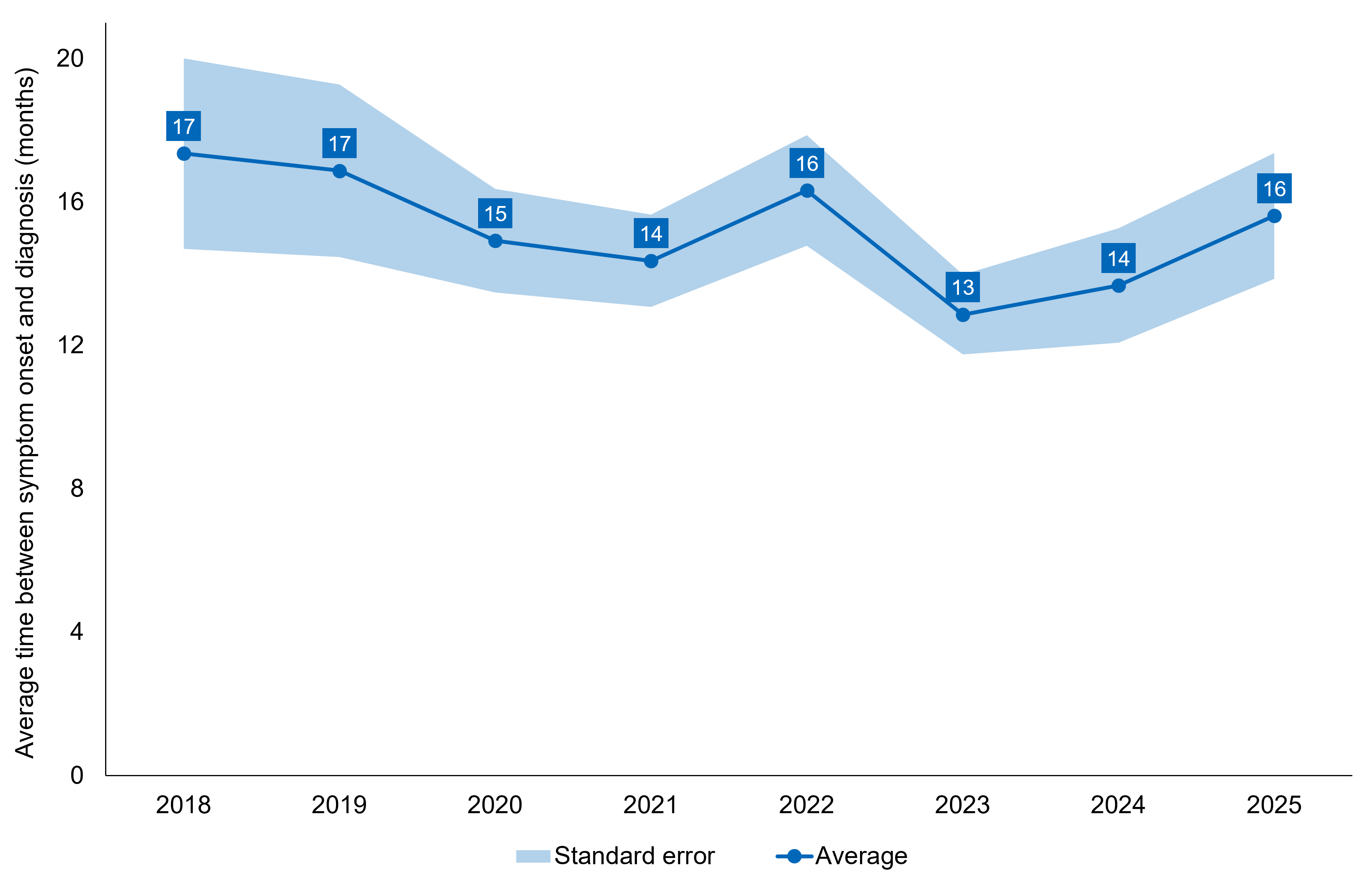
AB = Alberta; ALS = amyotrophic lateral sclerosis; BC = British Columbia; CNDR = Canadian Neuromuscular Disease Registry; NB = New Brunswick; ON = Ontario; PEI = Prince Edward Island; QC = Quebec; SK = Saskatchewan.
Note: The blue line represents the average time from symptom onset to diagnosis over time. The blue shaded area represents the standard error (a measure of variation) around the mean time from symptom onset to diagnosis. Data reflect time to diagnosis among people living with ALS from CNDR-affiliated clinics in PEI, NB, QC, ON, SK, AB, and BC.
Source: CNDR.
Characteristics at Diagnosis
Among 681 people living with ALS diagnosed between 2018 and 2025 included in the CNDR, at the time of diagnosis:
the average age was 63 years (range, 20 years to 95 years)
53% were aged 65 years or older
58% were male and 42% were female
81% lived in urban communities
65% had any genetic test performed
10% had a family history of ALS
4% had an SOD1 mutation
6% required noninvasive ventilation for ALS
66% had a forced vital capacity (FVC) greater than or equal to 60% of the predicted value
51% had an FVC greater than or equal to 80% of the predicted value.
Refer to data shown in Table 43 in Appendix 4 for further detail. Characteristics of people living with ALS at diagnosis included in the CNDR may not be representative of all people living with ALS in Canada, as the registry captures data from a subset of clinics and a subset of people living with ALS within those clinics.
Specialist Availability
The ALS diagnostic process relies on general neurologists or physiatrists to conduct tests. We heard from engagement with people living with ALS that challenges can arise due to the number of these specialists who are available to administer testing and recognize ALS symptoms.20,40 If there are a limited number of general neurologists or physiatrists in a particular region (e.g., in rural and remote areas), some people may need to spend more time waiting for an appointment and travelling to urban centres to see specialists and have tests ordered (e.g., to receive an MRI test in a hospital far from their place of residence). Wait times for referrals can also be a barrier to getting treatment as early as possible. For example, a 2020 survey showed that the median wait time for a neurology consult in Canada was approximately 3 to 4 months.100 Table 3 shows the distribution of neurologists and physiatrists across provinces. These data do not reflect ALS-specific expertise or capture differences in the locations where specialists practice or their clinical capacity, but the data do highlight where further jurisdiction-specific assessment may be warranted.
Table 3: Specialists for ALS Treatment per 100,000 Population by Province, 2024
Specialty | NL | PEI | NS | NB | ON | MB | SK | AB | BC | Canada |
|---|---|---|---|---|---|---|---|---|---|---|
Neurology | 2.20 | 1.68 | 3.07 | 2.69 | 3.11 | 2.88 | 2.82 | 4.21 | 4.09 | 3.34 |
Physiatry | 1.28 | 0.56 | 1.67 | 1.76 | 1.43 | 1.34 | 1.45 | 2.31 | 2.00 | 1.57 |
AB = Alberta; ALS = amyotrophic lateral sclerosis; BC = British Columbia; CIHI = Canadian Institute for Health Information; MB = Manitoba; NB = New Brunswick; NL = Newfoundland and Labrador; NS = Nova Scotia; ON = Ontario; PEI = Prince Edward Island; SK = Saskatchewan.
Note: There were no neurologists or physiatrists in the territories.
Source: CIHI.101
Imaging Capacity
The diagnostic process, which usually involves the use of MRI, can vary by province, territory, geography, and staff availability. The greatest number of MRI machines are in Quebec and Ontario, and the areas with the highest density of MRI machines are Quebec and Yukon; however, the values do not reflect accessibility, because some provinces and territories have extensive remote and rural areas and people may need to travel long distances to access MRI.102 Eighty percent of MRI facilities are in urban areas, 19% are in rural areas, and 1% are in remote areas.102 In addition, Canada also has staffing shortages for medical radiation technologists, radiologists, and medical physicists, and the number of staff has not grown with the increasing volume of MRI exams.103 This may lead to delays in accessing diagnostic imaging; a CIHI report highlighted that the median wait time for MRI scans in Canada increased from 2019 to 2024.104
Long Wait Times and Coordination Between Clinicians
Coordination between clinicians is an important part of timely diagnosis. There may be long wait times during the diagnostic testing phase for people experiencing ALS symptoms, with several iterative cycles of physician referrals, testing, and waiting for test results (e.g., MRI, blood tests, or EMG).96 The referral process for diagnostic testing includes paperwork (referral forms) and multiple appointments and travel time for people living with ALS.96
Challenges related to wait times and coordination include:96
primary care practitioners identifying specialists for referrals (especially if the physician receiving the referral is new or works in a rural area)
specialists having appropriate information to triage people experiencing ALS symptoms
clinicians’ familiarity with the clinical presentation of ALS.
Time and Cost of Lengthy Diagnosis for People Experiencing Symptoms
People experiencing poverty or those with low incomes face additional difficulties if they cannot afford transportation or take time off work to undergo diagnostic testing. Other populations that may experience disparities in accessing diagnostic testing can include people experiencing addictions, as well as racialized individuals who may experience discrimination or racism, those who may have a lack of trust and support in the health care systems, or those who may have language barriers when describing complicated ALS symptoms. Overall, these disparities in access can result in delayed diagnoses, which can lead to delayed ALS treatment and poor outcomes for people living with ALS.
Genetic Testing
Genetic testing involves taking a sample of blood or saliva, which is sent to a lab for processing. At the lab, DNA is isolated and tested for mutations in genes known to be linked to ALS.105 Genetic testing can complement the diagnostic process and help confirm an ALS diagnosis. It can also help clinicians provide personalized treatments for people living with ALS. For example, the drug tofersen is specifically used for people living with ALS who have mutations in the SOD1 gene. People living with ALS emphasized the importance of early and accessible genetic testing for timely diagnosis and treatment.19
Genetic tests can cover a single gene or several genes; if several genes are being assessed, the number of genes tested can vary.93 Across Canada, testing for SOD1 mutations is part of regular diagnostic work for all people being assessed for ALS.70 In most jurisdictions, this is tested through a panel of ALS genes.70
Genetic testing for genes linked to ALS is currently available in Canada, but ALS clinics and people living with ALS reported variation in referral processes to obtain a test.70 The process for acquiring genetic testing typically begins with a referral from a primary care practitioner or neurologist to an ALS clinic. From the engagement sessions, people living with ALS reported that they required a referral to a genetic counsellor from their neurologist.19 ALS clinics (from Nova Scotia, New Brunswick, Ontario, Saskatchewan, and Alberta) also reported to CDA-AMC in a survey that the referrals to a geneticist or genetic counsellor can come from family physicians, neurologists, and physiatrists.
Across jurisdictions, there are different logistical processes (e.g., ordering and processing tests), approvals for tests, and resources available within certain regions. For example, clinics may vary in where they ship samples to get them tested; processing can be done in province, or the sample may be sent out of province or to the US. Through CDA-AMC engagement sessions and survey responses, ALS clinics reported where they send genetic samples for testing. ALS clinics in Quebec and Nova Scotia reported that genetic testing is done in province, while Saskatchewan requires all samples to be sent to the US. ALS clinics in Alberta have different policies for handling testing procedures, wherein processing may be either in province or in the US. Manitoba reported that they conduct in-province, out-of-province, and out-of-country testing. In Ontario, testing for mutations in the C9orf72 gene is available in province, but clinics reported that most of their patients get a panel test that assesses multiple genes, including SOD1, which requires samples to be sent to the US. Lastly, New Brunswick clinics reported that they typically send samples to IWK Health Centre (in Nova Scotia).
In a survey conducted in 2025, clinicians at ALS clinics in Canada varied in the types of genetic testing they reported offering. Types of genetic testing offered included:106
comprehensive gene panels (testing more than 5 genes)
limited gene testing
tiered testing (clinicians first order a limited gene test; if the result is negative, the clinician then orders a comprehensive gene panel).
Some clinicians reported that the type of testing they offered (i.e., comprehensive, limited, or tiered testing) was influenced by whether the person was being tested for familial ALS or sporadic ALS.106 Some clinicians within the same clinic also reported different practices. The survey publication noted that, compared to 2022, more clinics reported using comprehensive gene panels. Physicians also reported that the approval of tofersen directly influenced genetic testing practices.106
Among people living with ALS diagnosed between 2018 and 2025 from 7 provinces in the CNDR, 65% had genetic testing performed, and 4% of these people living with ALS had an SOD1 mutation (detailed methods provided in Appendix 4). The proportion of people living with ALS who underwent genetic testing may be overestimated in the CNDR, following changes in 2022 with which there was targeted recruitment of people living with ALS receiving drugs for ALS in some clinics, a population that may be more likely to have received genetic testing.
Typically, people living with ALS are referred to a geneticist and genetic counsellor outside their ALS clinic, although ALS clinics may have a geneticist or genetic counsellor as part of their multidisciplinary team. In a 2025 survey, most ALS clinics in Canada reported that an ALS physician conducts the pretest genetic counselling and post-test genetic counselling if the result is negative.106 If the test is positive for a known ALS gene or a variant of uncertain significance, the post-test counselling is done by an ALS physician or clinical genetics professional (i.e., a geneticist or genetic counsellor), or both. Among the ALS clinics surveyed by CDA-AMC, only 1 ALS clinic in Alberta reported having a genetic counsellor on their team. To provide broader support services across Canada, a pilot program for a National Genetic Counsellor was established by the ALS Society of Canada.107 The program aims to help people living with ALS by connecting them to local genetic counsellors and experts and delivering pretest counselling.107 We also heard from some ALS clinics that referrals need formal approval (i.e., approval from their province or territory’s Ministry of Health), but this varied between provinces, as well as between clinics within the same province.
Experiences in Canada: Challenges and Opportunities
Cost
Most provinces in Canada have publicly funded genetic testing programs.108 However, some people living in Canada may need to pay out of pocket for genetic testing or pursue genetic testing independently through private or commercial programs. This may include people who do not meet their province’s eligibility criteria for genetic testing.109
While most people living with ALS described genetic testing costs as being covered by the public health care system and noted that there were no financial barriers to access testing, others reported paying out of pocket.19 According to ALS clinic coordinators who spoke to CDA-AMC, the reported cost of genetic testing can range from approximately $1,300 to $4,000, depending on factors like whether the test is for a single gene or a panel of genes, as well as where the sample is processed. Hence, ALS clinics reported that they encourage people living with ALS to get a genetic test done if it is covered by the province. Clinics also reported challenges accessing genetic testing for people who are not on their province’s health insurance plan, such as refugees and other newcomers. Moreover, 1 person living with ALS accessed free genome sequencing in the US. They were aware that their genetic data would be owned by the corporation, but they felt it was a minor risk given their prognosis. Genomic data governance can be an additional consideration that factors into a person’s decision-making around sponsored testing.
Geographic Variations in Availability and Timely Access
Currently, the availability and accessibility of genetic testing for ALS varies across jurisdictions.70 In our survey of ALS clinics, we received responses from clinics in Nova Scotia, New Brunswick, Ontario, Manitoba, Saskatchewan, and Alberta; we did not receive responses from Newfoundland and Labrador, Prince Edward Island, Quebec, and British Columbia, and there are no ALS clinics in Yukon, Northwest Territories, or Nunavut. Although ALS clinics in Nova Scotia, New Brunswick, Ontario, Manitoba, Saskatchewan, and Alberta reported in their survey responses that they offer genetic testing, access in some areas remains inconsistent.70 Depending on the province, people living with ALS may have additional options outside the publicly funded health systems to access genetic testing. For example, people living with ALS in Alberta may have the option to pay out of pocket for genetic testing, given that testing is processed within the province.20 People in rural and remote areas can experience additional access barriers because they often travel long distances to provide genetic samples. In cases in which facilities do not have testing capacity, the individual must collect the sample at home and wait for the collection kits to be mailed to their homes.
While most ALS clinics in Canada report routinely offering genetic testing for ALS, wait times remain a concern.106 As provinces with ALS clinics vary in where they send samples for processing, wait times to receive genetic testing results can depend on where people living with ALS reside. Sending samples out of country can lead to longer wait times for people living with ALS to learn if they have a genetic mutation associated with ALS. This may be due to the time required to coordinate logistics (e.g., shipping samples) and obtain approval from the Ministry of Health for funding to send the sample out of province or out of country.48 Depending on how quickly samples are processed, this can lead to wait times of up to 3 or 4 months.70 This can impact the ability of people living with ALS to participate in a clinical trial or their access to tofersen.48 Conducting in-province testing can help to reduce wait times: an ALS clinic in Quebec reported that since they started doing genetic testing onsite, wait times had reduced from 3 or 4 months to less than 1 month. Furthermore, 1 ALS clinic reported that having a dedicated geneticist (who was based in a different province but provided virtual appointments) to help coordinate between the ALS clinic and the US laboratory helped to reduce wait times.
This geographic variation across Canada in access to genetic testing is not unique to ALS; for example, jurisdictions in Canada have different approaches to decision-making for biomarker testing related to cancer.110 Variation in access to precision medicine technologies in general could exacerbate existing health disparities.111 Reducing barriers to access by addressing genetic testing restrictions and regulations in Canada could improve the organization of ALS care by improving time to diagnosis and/or access to genetic counselling, interventions, and new therapies. Some potential methods to reduce barriers include addressing genetic testing restrictions and regulations, developing travel support programs, and developing a standardized framework for decision-making related to genetic testing for ALS to help ensure consistency in approaches across Canada.110,111
Lack of Genetic Counselling Services
Despite the availability of genetic testing, the number of genetic counsellors in Canada is limited. We heard that some people living with ALS had to wait several months between receiving test results and meeting with a genetic counsellor, or that they received little guidance on how to access genetic counsellors.20 Some felt that counselling should occur much sooner to help people living with ALS process their results, understand the treatment pathways, and be connected with support services.20
Concerns Related to Familial Inheritance
Genetic testing poses a unique set of psychological and relational challenges for people living with ALS and their genetic relatives. For some people living with ALS, undergoing genetic testing may have a positive psychological impact, as it provides an increased sense of clarity and control in connection with life-planning, including treatment-related decision-making.69,112 Some people living with ALS have suggested that undergoing genetic testing may be particularly valuable in the context of treatments targeting known ALS genetic variants (e.g., tofersen for SOD1 ALS)19 It also allows them to inform family members about ALS so they can make their own treatment decisions.19 However, waiting for the results of genetic tests can cause psychological distress, due to the worry that genetic relatives may be at risk of developing ALS, as well as the responsibility of having to decide whether to inform family members of their results.19
Lack of Genetic Testing Recommendations
Several countries, including Canada, have yet to develop ALS-specific recommendations on genetic testing.71,75,77,78 This may change with the next iteration of the Canadian best practice recommendations for the management of ALS, as CALS has recently published a commentary advocating for genetic testing that comprehensively assesses known ALS genes.48 Currently, there are no Canadian recommendations on how genetic testing can be made more equitable for people living with ALS across provinces and territories so that individuals receive the same access to care irrespective of where they live, and to align with international standards.48 The lack of ALS-specific Canadian recommendations for genetic testing poses a challenge to people living with ALS, their families, and clinicians.
Some people living with ALS have expressed in engagement sessions wanting expanded access to genetic testing for people who do not have symptoms (e.g., family members of a person living with ALS).113 They expressed that access to testing, resources, and information for themselves and their presymptomatic family members who are at risk would allow them to plan for their care if they start to show symptoms.19 This may include standard ALS testing to receive diagnosis and treatment (e.g., tofersen) earlier and more quickly. According to a 2025 survey, the proportion of ALS clinics in Canada offering predictive genetic testing to asymptomatic family members has increased since 2022, from 27% to 61%.106 However, follow-up with asymptomatic individuals varied between physicians, including within the same clinic, with differences in frequency of follow-up and what tests are conducted. In addition, some ALS clinicians have raised concerns regarding a lack of clarity on how to develop treatment plans for people who are asymptomatic.93 The ALS in Focus Advisory Group also noted that it is unclear how health care professionals should screen people who have family members with ALS, including when to start genetic or diagnostic testing, how often to provide testing, and how to provide prescreening education to prepare for potential positive results for asymptomatic individuals.
Currently, genetic testing in Canada typically focuses on SOD1 (to determine eligibility for tofersen) or other common gene mutations (e.g., C9orf27) as reported by people living with ALS.20 People living with ALS emphasized the need to test more ALS genes, as it could improve diagnosis (e.g., if someone with ALS is seeking a diagnosis and has a mutation in an ALS gene but that gene is not tested, this may delay their ALS diagnosis).20 Testing for more genes related to ALS may also allow for quicker access to clinical trials that are assessing drugs targeting other ALS gene mutations (e.g., a trial is currently ongoing that is assessing an antisense oligonucleotide [ION363] for people living with ALS who have mutations in the FUS gene [NCT04768972]114).
Treatment and Care
Care for people living with ALS differs greatly based on individual disease trajectory, variability in access to care, and lack of standardization of ALS care across Canada. Care variation is impacted by:
geographical location
availability of health care professionals and therapies
referral and approval processes
funding and reimbursement of drugs and supportive care services and devices
whether people living with ALS can afford to pay out of pocket for services.
We heard from patient group engagement that there is an urgent need for access to care and equipment. This section discusses the therapies available to people living with ALS in Canada, variations across provinces and territories, and challenges that people living with ALS experience as they navigate care.
ALS Multidisciplinary Clinics
ALS clinics across Canada provide comprehensive, multidisciplinary, longitudinal, and individualized care for people experiencing ALS symptoms and those who are diagnosed with ALS.63 Given that ALS is a rare disease that requires complex and well-coordinated care, these specialty clinics have health care professionals who have expertise and experience with ALS and can give people living with ALS the care they need. During our engagement, people living with ALS and their caregivers described appreciation for these clinics and said that they met their changing needs.20 We heard from people living with ALS, ALS clinic coordinators, and experts that early referral to an ALS clinic by a primary care practitioner or general neurologist may reduce diagnostic delays, prevent psychological effects of delayed diagnosis, increase opportunities for clinical trial participation, and improve health and quality of life outcomes. ALS clinic coordinators across the country reported that people living with ALS are seen within 2 to 4 weeks of clinic registration to start care as soon as possible.
In Canada, there are 24 ALS clinics; 22 are associated with CALS, which is a network of physicians that work in ALS clinical care and research to improve patient and clinic participation in research and clinical trials.72 As of 2025, there were approximately 55 neurologists and physiatrists across ALS clinics that were part of CALS.106 ALS clinics differ in the catchment area they serve; some are open to anyone in the province in which the clinic is located, while others cover only certain areas within a province. In addition, some provincial clinics serve people living with ALS from the territories. Of the 24 ALS clinics, the CNDR collects prospective clinical data from 14 university-affiliated active ALS clinics in 7 provinces in Canada (details in Appendix 4). As participation in the CNDR is voluntary and requires patient consent, the registry does not include all people living with ALS seen in participating clinics.
Figure 3 shows a map of Canada with pins showing approximate locations of the 24 ALS clinics, differentiating between general ALS clinics and CNDR-affiliated ALS clinics. Each province has at least 1 ALS clinic and most clinics are located near urban centres; across Canada they tend to be toward the southern part of the country. No territories have ALS clinics, highlighting a gap in care access. Table 51 in Appendix 7 lists the multidisciplinary care practitioners in ALS clinics and Table 52 in Appendix 7 lists the services that ALS clinics provide.
Figure 3: Map of ALS Clinics in Canada
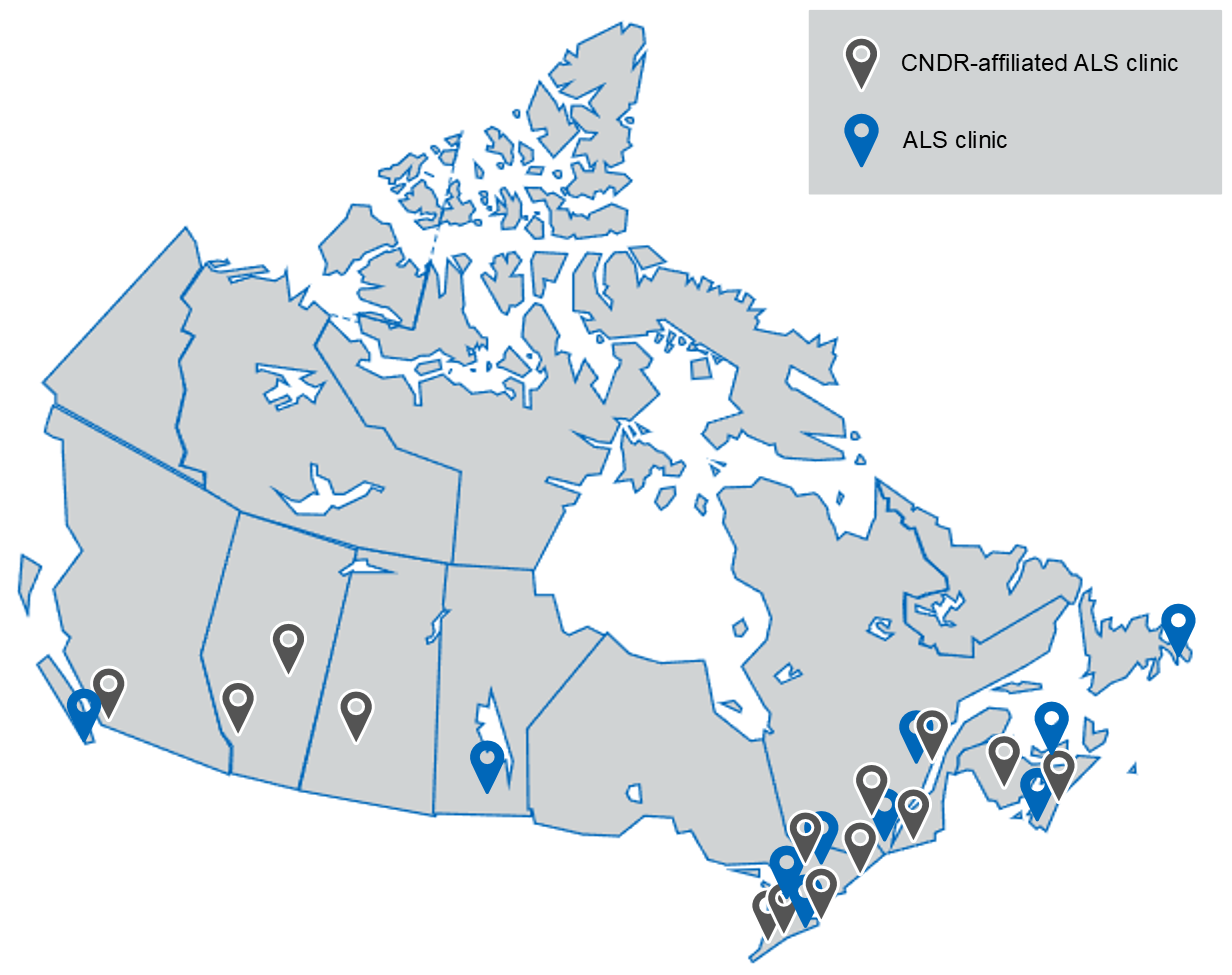
ALS = amyotrophic lateral sclerosis; CNDR = Canadian Neuromuscular Disease Registry.
Most ALS clinics contain a core group of health care professionals:
nurses who coordinate the full spectrum of the patient’s experience, including triage, education, navigation, and all stages of care
neurologists or physiatrists who confirm an ALS diagnosis and provide a care plan, with regular follow-ups every 3 to 4 months
professionals that provide clinical care in specific care domains (e.g., physiotherapists, occupational therapists, speech-language pathologists, dietitians, respiratory therapists, social workers)
Beyond this core group, individual ALS clinics in Canada may differ in terms of any additional health care professionals who are available at clinics, or whether certain services are performed within the clinic or externally (e.g., at a nearby hospital or at a person’s home). For example, some clinics have psychologists, palliative care physicians, respirologists, spiritual care workers, or genetic counsellors as part of the multidisciplinary care team. For clinics that do not have these additional health care professionals, people living with ALS would need to find this care outside of the clinic, which may or may not be coordinated by ALS clinics. People living with ALS may see multiple health care professionals during 1 visit, while at other ALS clinics, they might work separately (on different days) and in separate locations.20 Some clinics are not open every day, so people living with ALS may need to plan appointments around health care professionals’ schedules. In certain provinces, some specialist services are performed in a person’s home rather than in the ALS clinic.
ALS clinics can play an important role in providing people living with ALS with resources, access, and referrals to clinical trials. During engagement, we heard that some ALS clinics in Ontario actively conduct clinical trials within their practice, whereas an ALS clinic in New Brunswick is affiliated with a research centre that may have active clinical trials running. In cases where the ALS clinic in New Brunswick does not have active clinical trials, the clinic refers their patients to other trial sites. We also learned from ALS clinics in Ontario that clinicians proactively discuss clinical trial opportunities with their patients at the time of diagnosis or provide a list of clinical trials that are revisited throughout the individual’s treatment pathway.
Experiences in Canada: Challenges and Opportunities
Distance to ALS Clinics
Some places in Canada (e.g., the territories) do not have ALS clinics at all or are far away from them; people living with ALS from these areas or in rural and remote parts of Canada may have to make decisions about whether and how to travel to the nearest ALS clinic (which may include a long travel time) to receive care. For example, Newfoundland and Labrador, Prince Edward Island, New Brunswick, Manitoba, and Saskatchewan each have only 1 ALS clinic to service their entire provinces. In some rural areas of Alberta and the Northwest Territories, there may be rare instances of a general neurologist caring for someone with ALS if there are no ALS clinics nearby. We heard from people living with ALS that ALS can be more isolating for those in rural areas who cannot travel to an urban centre where multidisciplinary clinics are located.20
The additional distance to ALS clinics and travel time required may also put financial strain on people living with ALS and their families. This may result from a need to make extensive travel arrangements, especially if their family members and/or caregivers are taking time off work. Some families may not be able to afford these out-of-pocket costs, and some people living with ALS may not have access to a caregiver to support their care and take them to appointments.40 People with lower incomes or those affected by poverty may be even more burdened by these challenges.40 Some ALS clinic coordinators suggested that there can be delays in accessing reimbursement for the travel costs related to visiting ALS clinics in person. For many people living with ALS, this may result in difficult trade-offs; they may stay in their home community with the limited resources they have, without getting the full scope of treatment that they need, because of the many challenges that they face getting care.115
Attending ALS Clinic Appointments in Person
There may be barriers to attending ALS clinics in person, such as whether modes of transportation, infrastructure, and physical buildings can accommodate people with disabilities (e.g., having enough space for someone in a wheelchair, ramps to help with moving from 1 place to another).
People living with ALS may decide to seek virtual care through multidisciplinary ALS clinics, if available, but they might still be required to present to the clinic for a certain number of appointments or for certain symptoms (e.g., spasticity). During our engagement activities, we heard that ALS clinic-led virtual care could be 1 way to improve access to care, especially in rural areas. People living with ALS who participated in our engagement sessions noted that having the ability to address some of their concerns through a phone call, video call, or email could be convenient and reduce burden. A person’s decision to choose virtual appointments may depend on their physical capabilities, financial situation, travel needs, and availability of caregivers to assist them.
Navigating the Health Care Systems for ALS and Non-ALS Services
During patient group engagement, we heard that people living with ALS and their caregivers experience challenges with keeping track of all of their appointments and knowing which services are and are not provided in their area.20 They also described how some parts of their overall health were managed separately from their ALS care, so that if they needed a vaccine, blood test, or service related to preventive health care, they would have to go back to their primary care practitioner instead of receiving all of their care at an ALS clinic.20 Some expressed that having a patient navigator from diagnosis onward to support the person living with ALS and their caregiver would be helpful because the health care systems are complex and fragmented (e.g., there may be inconsistency with paper and electronic records across practitioners and systems).20 Others expressed that clearer communication between health care professionals, and between professionals and people living with ALS and their families, was important.40 Referring to the coordination required to navigate the various health care systems and programs, 1 person living with ALS said, “It just is layered like a… bad onion.”20
Lack of Dedicated Cognitive and Mental Health Services
We heard from ALS clinic coordinators that there are some services that they are not structured to provide but that may be needed by people living with ALS and their families or caregivers. This can include dementia care or psychotherapy and counselling services for people living with ALS, and emotional support for caregivers who experience burnout. Some clinics have social workers, but the specific psychologist expertise is not available and generally accessed through private health care. People living with ALS who can pay out of pocket or have insurance benefits may be able to access mental health supports, but those who cannot afford this service are not able to get help to guide them through their ALS journey. Access to mental health care is therefore inequitable in the ALS community. We also heard from people living with ALS and their caregivers that mental health counselling is limited, that there are long wait times, and that mental health supports are urgently needed; some expressed that their mental health appointments needed to be conducted in person, and it was difficult for those who live hours away from a mental health professional to attend these appointments.20,40
Pharmacological Care
Overview of Drug Access Pathways in Canada
Drug manufacturers conduct research to develop new drugs, including overseeing clinical trials for the drugs. If results from a clinical trial are promising, the drug manufacturer may submit a drug for regulatory approval, which in Canada is done by Health Canada. Health Canada performs a regulatory review to ensure drugs authorized for sale in Canada meet standards of safety, efficacy, and quality. Once drugs are approved by Health Canada, they have market authorization, typically for specific indications.
If a manufacturer is interested in public drug plan reimbursement, they will make a submission to CDA-AMC and the Institut national d'excellence en santé et en services sociaux (INESSS) for a reimbursement recommendation before the completion of the review by Health Canada to facilitate timely access. Manufacturers may also make a submission to CDA-AMC and INESSS after a drug has received market authorization. CDA-AMC and INESSS conduct health technology assessments to determine how a drug compares to existing therapies in terms of effectiveness, safety, and value. When evaluating drugs and health technologies at CDA-AMC, committees are asked to consider the following 5 domains of value, using a deliberative framework: clinical value, unmet clinical need, distinct social and ethical considerations, economic considerations, and impacts on health systems.7
Public drug plans have their own processes that are used to determine if they will reimburse a drug and how they negotiate pricing with the manufacturer.116 To establish prices and reimbursement terms for public plans, manufacturers negotiate through the pan-Canadian Pharmaceutical Alliance (pCPA).
Patients may be able to access drugs that are approved by Health Canada but are not available through public plans or private plans, or in hospitals, by paying out of pocket, participating in clinical trials, or through compassionate supply from manufacturers.
Not all drugs developed to treat ALS are available to people living with ALS across all health care systems in Canada. Some drugs may not become available in Canada (e.g., if a manufacturer does not submit a drug for regulatory approval in Canada) or may take time before they become available in Canada. Medications that are unavailable for sale in Canada (i.e., those that do not have market authorization) can be requested by health care professionals through Health Canada’s Special Access Program.13 The requested medication must be for serious or life-threatening conditions for which conventional treatments have failed, are unsuitable, or are unavailable in Canada.
Regulatory Approvals and Reimbursement Recommendations
In Canada, federal, provincial, and territorial public drug plans provide coverage for eligible drugs to eligible populations.117 Each publicly funded drug plan maintains a list of medications that they reimburse for the eligible population and determines the criteria that the eligible population must meet to obtain access, as well as any cost-sharing parameters associated with the programs (e.g., premiums, deductibles, or copayments).117 CDA-AMC issues drug reimbursement recommendations to participating federal, provincial, and territorial publicly funded drug programs (outside Quebec) as nonbinding guidance for decision-making.118 As such, the final decision to pay for a drug lies with the public drug programs based on the plan’s mandate, jurisdictional priorities, financial resources, and the CDA-AMC recommendation.116
Riluzole (oral tablet), edaravone (oral suspension), and tofersen (intrathecal solution) are disease-modifying therapies that have received market authorization from Health Canada for the treatment of ALS and have undergone either an Evidence Review (riluzole in 2023) or a Reimbursement Review (oral edaravone in 2023; tofersen in 2025) by CDA-AMC. Additional details regarding these drugs are available in Appendix 8 (Table 53). Notably, tofersen is used specifically for people living with SOD1 ALS, which makes up approximately 2% of people living with ALS globally;26,62 therefore, most people living with ALS would only be able to use riluzole or edaravone. As previously noted, 2 other disease-modifying therapies (IV edaravone [Radicava] and sodium phenylbutyrate and ursodoxicoltaurine [Albrioza]) were previously available in Canada but were subsequently discontinued66 or cancelled post-market.67
Drug Access and Funding Across Jurisdictions
Publicly funded drug plans list prescription medications in categories based on how they are reimbursed. Broadly, they can be categorized as unrestricted or restricted benefits.119 An unrestricted benefit relates to drugs that do not have use restrictions related to clinical criteria, while a restricted benefit refers to drugs that have use restrictions related to specific clinical criteria or defined patient subgroups. Drugs that are not listed on a public drug plan formulary are typically not provided as a benefit to a patient, although there may be exceptions (e.g., Exceptional Access Programs).
For the 3 disease-modifying drugs for ALS in Canada, public coverage is mostly aligned across public drug plans, as outlined in Table 4. All public drug plans provide coverage for riluzole. While some provinces provide riluzole as an unrestricted benefit (i.e., with no restriction for reimbursement), all other drug plans require people living with ALS to meet reimbursement criteria specific to each drug plan. Similarly, most publicly funded drug plans provide coverage for oral edaravone.
Table 4: Overview of Listing Status for ALS Drugs in Canada
Drug | AB | BC | SK | MB | ON | QC | NB | NS | NL | PEI | YK | NIHB | VAC | CAF | CSC |
|---|---|---|---|---|---|---|---|---|---|---|---|---|---|---|---|
Riluzole | RB | UB | RB | RB | RB | RB | UB | RB | RB | UB | RB | UB | UB | RB | UB |
Edaravone, oral | RB | RB | RB | RB | RB | RB | RB | RB | RB | RB | Non-benefit | RB | UB | RB | Non-benefit |
Tofersen | Under neg. | Under neg. | Under neg. | Under neg. | Under neg. | Under neg. | Under neg. | Under neg. | Under neg. | Under neg. | Under neg. | Under neg. | Under neg. | Under neg. | Under neg. |
ALS = amyotrophic lateral sclerosis; AB = Alberta; BC = British Columbia; CAF = Canadian Armed Forces; CSC = Correctional Services Canada; MB = Manitoba; NB = New Brunswick; neg. = negotiation; NIHB = Non-Insured Health Benefits; NL = Newfoundland; NS = Nova Scotia; ON = Ontario; PEI = Prince Edward Island; QC = Quebec; RB = restricted benefit; SK = Saskatchewan; UB = unrestricted benefit; VAC = Veterans Affairs Canada; YK = Yukon.
Patient Support Programs
Aside from accessing drugs through public reimbursement or private insurance, some patients may also get help with accessing drugs through special programs such as patient support programs (or patient assistant programs).40 Patient support programs are sponsored by pharmaceutical companies and help patients access specific medications, such as high-cost drugs that require specific types of administration, such as infusion.120 These programs may assist by helping patients to navigate reimbursement options (e.g., working with private insurance or public programs to find coverage).
ALS clinics reported to CDA-AMC that edaravone has a patient support program that assists people living with ALS who need support with navigating insurance coverage options or financial support for copayments.121 Our advisory group reported that people living with ALS also access tofersen through the manufacturer’s patient support program.
Utilization of Riluzole, Edaravone, and Tofersen
Building on the overview of regulatory approval, funding pathways, and access across jurisdictions, this section examines how ALS therapies are being used in practice. This analysis provides insight into patterns of use over time and whether observed utilization may be consistent with barriers to access or inequities across populations. We conducted 2 analyses of ALS drugs using the National Prescription Drug Utilization Information System (NPDUIS): an analysis of publicly funded drug claims across available provinces and territories (Public Drug Plans analysis), and a second analysis of all drug claims (public, private, and self-paid) in Manitoba, Saskatchewan, and British Columbia (Three Provinces analysis). Detailed methods are described in Appendix 3. Findings are described sequentially.
Public Drug Plans Analysis
A total of 2,483 individuals received riluzole, edaravone (oral or IV), or both drugs through the public drug plans in Canada between the 2019–2020 fiscal year (the first fiscal year edaravone was available in Canada) and the 2024–2025 fiscal year, providing context for the overall volume of publicly funded use and patterns (alone or in combination). Recipients of drugs for ALS are shown in Figure 4. Volumes of people receiving each drug in available provinces and territories can be found in Appendix 3. Because public coverage for edaravone was introduced at different times across jurisdictions, and people living with ALS could access edaravone through alternative pathways (including Health Canada's personal importation pathway) until October 31, 2022,122 individuals receiving edaravone had fewer opportunities to be identified in public drug plan data during the observation period than those receiving riluzole. Consequently, edaravone recipient counts should not be directly compared with riluzole recipient counts. Albrioza (sodium phenylbutyrate and ursodoxicoltaurine) was not included in the main analyses because it was withdrawn from the market in 2024.
Figure 4: Patterns of Use of ALS Drugs: Riluzole and Edaravone Use in 10 Public Drug Plans, 2019–2020 to 2024–2025
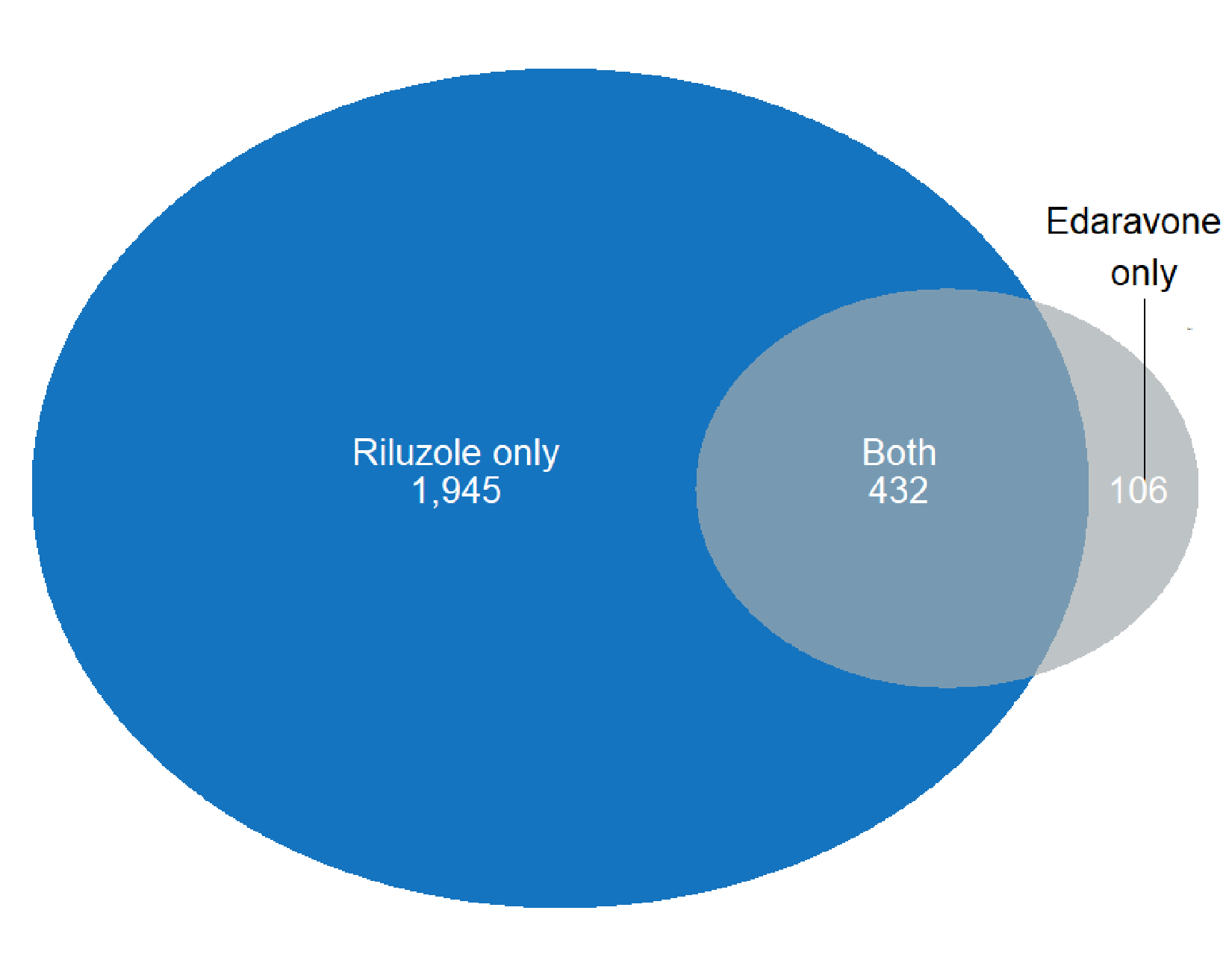
ALS = amyotrophic lateral sclerosis.
Notes: Health Canada allowed personal importation of edaravone from outside of Canada until October 31, 2022; therefore, individuals receiving edaravone may have been undercounted in the data.
Of the 432 recipients who received both drugs, 388 met the definition for concurrent use during the observation period (Appendix 3).
Source: National Prescription Drug Utilization Information System.
The number of individuals with claims for riluzole, edaravone, or both drugs increased during the 6 years we analyzed (Figure 5). This trend may reflect a combination of factors, including increased access to publicly funded medication, increased survival, and earlier diagnosis, as observed in the registry analysis described elsewhere in this report. The oral formulation of edaravone began to appear in public drug claims in the second half of 2023 (data not shown) and may have contributed to the increased use of edaravone observed after the 2022–2023 fiscal year. However, our analyses did not assess the impact of the transition from IV to oral administration.
Figure 5: Number of People Receiving Riluzole or Edaravone Each Year From 10 Public Drug Plans in Canada
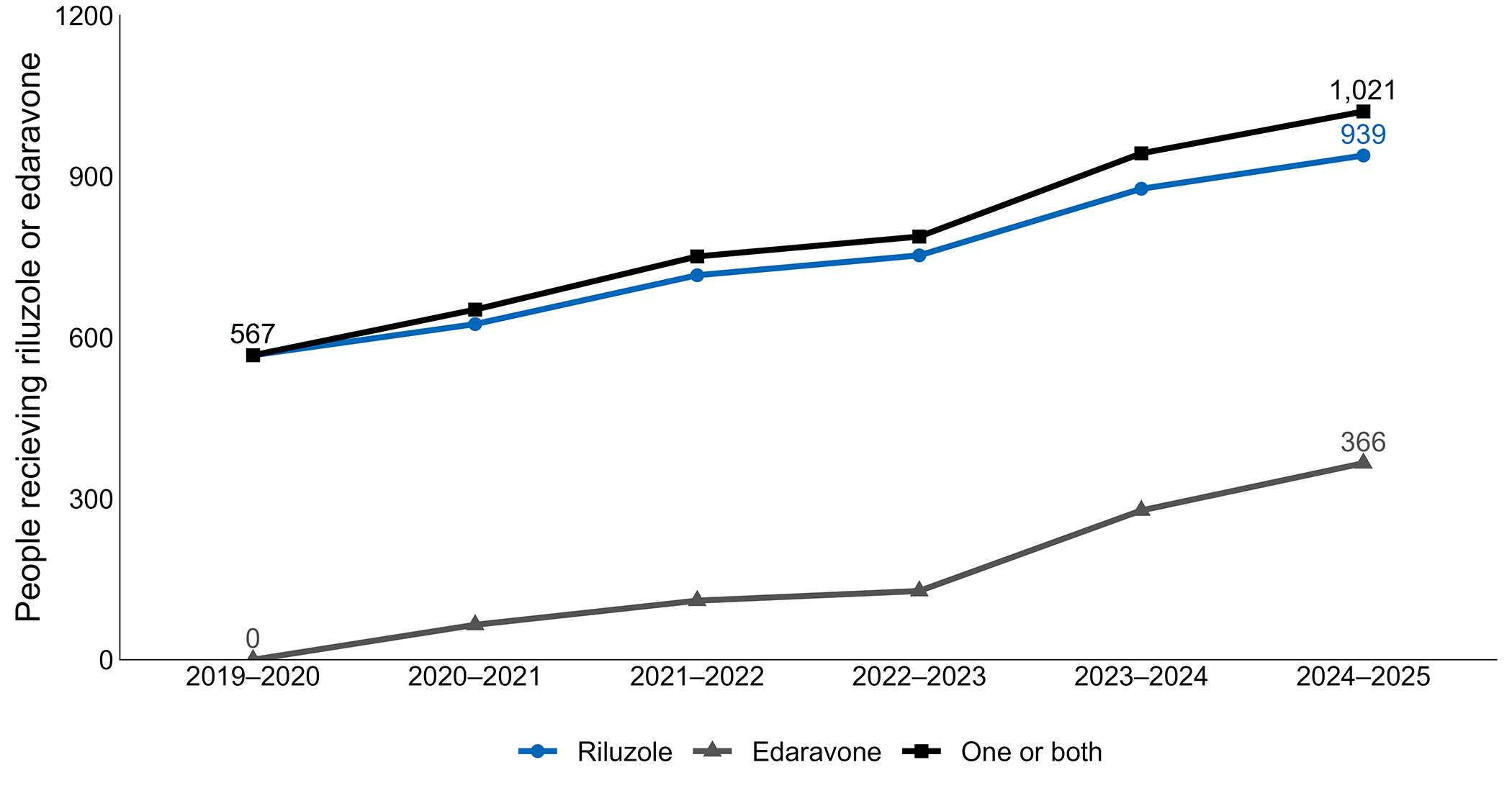
CIHI = Canadian Institute for Health Information.
Notes: Health Canada allowed personal importation of edaravone from outside of Canada until October 31, 2022; therefore, individuals receiving edaravone may be underrepresented in the data.
The 2019–2020 total for all drug claims was suppressed in accordance with the CIHI privacy policy related to residual disclosure; however, a nominal value of 0 was used for illustration and does not impact the trend visible in the figure.123
Source: National Prescription Drug Utilization Information System.
In 2024–2025, among the 1,021 individuals receiving riluzole, edaravone, or both through public drug plans:
56% were male and 44% were female
71% were aged 65 years or older
82% lived in urban areas, similar to the overall population.
A relationship was observed between income and receipt of ALS drugs (Figure 6), with higher income associated with greater use. Income groups are a way of grouping people by income within a defined geographic region, where the population is divided into 5 groups (also referred to as quintiles) from the lowest income group (group 1) to the highest income group (group 5). The groups do not represent a specific income band; they show a person’s relative position in the overall income distribution within the specific area. If there were no relationship with income, we would expect an equal distribution of drug recipients (20%) in each group. Income groups serve as a proxy for socioeconomic circumstances. This pattern may signal potential inequities in access to ALS drugs, even among people covered by public drug plans. This may reflect differences in an individual’s ability to navigate health systems, access to specialists, geographic barriers, application processes required to access coverage in public drug plans both for those younger than 65 years of age and those aged 65 years or older in provinces or territories requiring an application for drug plans for older adults, and residual out-of-pocket costs.
Figure 6: Individuals Receiving Riluzole, Edaravone, or Both From 10 Public Drug Plans by Income Group, 2024–2025
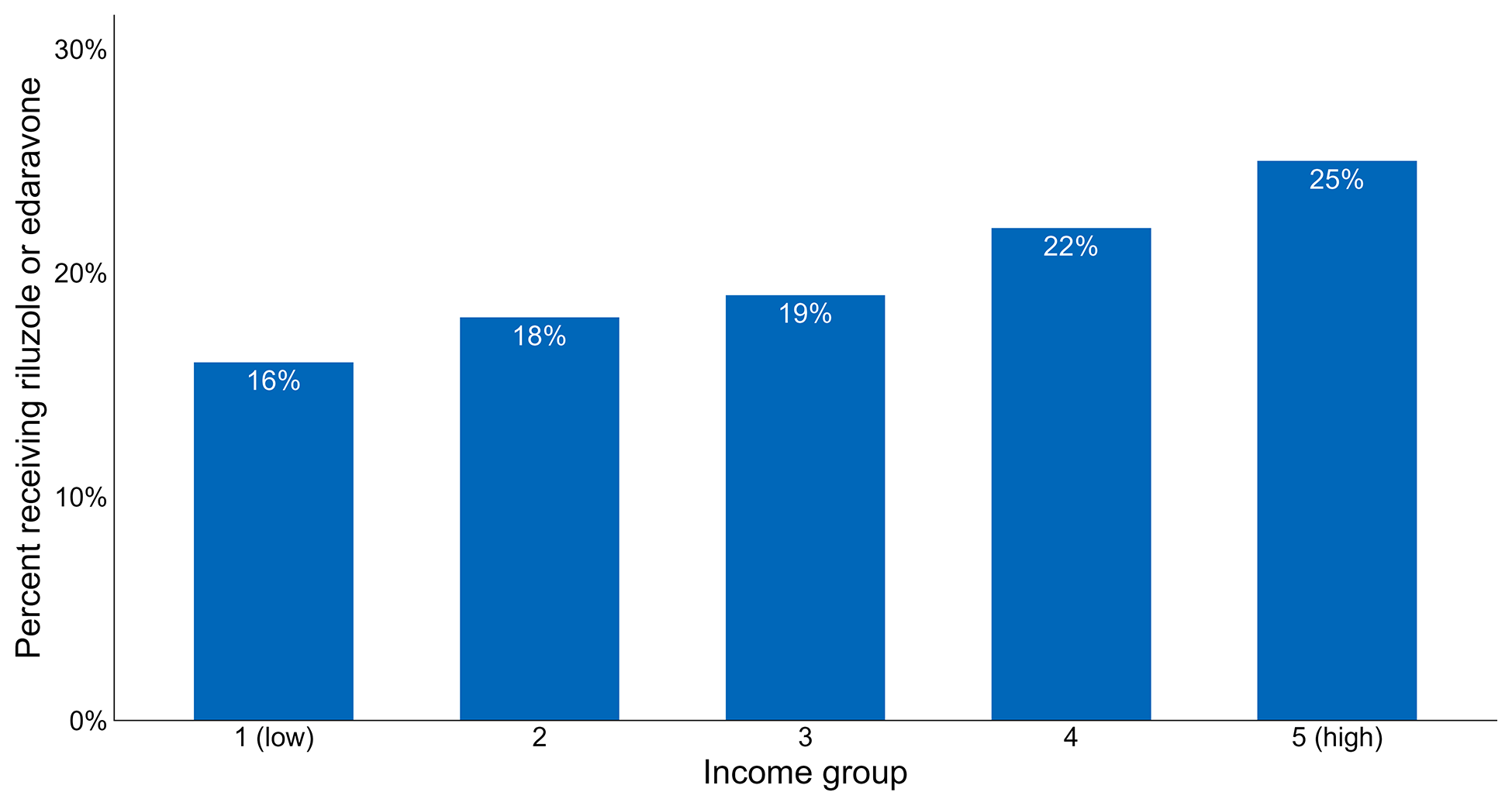
Notes: Health Canada allowed personal importation of edaravone from outside of Canada until October 31, 2022; therefore, individuals receiving edaravone may be underrepresented in the data.
Source: National Prescription Drug Utilization Information System.
People receiving riluzole or edaravone often used other medications. In 2024–2025, the average number of additional unique drugs per individual was 8, with use ranging from none to more than 16. The most commonly used drug was hydromorphone (22% of those receiving ALS drugs), which is indicated for pain management. Rosuvastatin (19%), a drug for cholesterol, likely reflects the treatment of age-related health conditions. Atropine (19%) and baclofen (19%) were also common and were likely being used for the management of ALS-related symptoms. Other commonly used therapies are listed in Appendix 3.
Three Provinces Analysis: Public and Private Drug Coverage in Manitoba, Saskatchewan, and British Columbia
In Manitoba, Saskatchewan, and British Columbia, the proportion of individuals receiving ALS drugs from public drug plans has increased over time (Figure 7).
In these 3 provinces, drug claims data were available for all people, regardless of the payer. For the same 6-year period (2019–2020 to 2024–2025), 764 people had drug claims for 1 or more of the ALS drugs (riluzole, edaravone, and tofersen [for 2025 only]) and 79% of the 764 people received drugs from public drug programs.
Possible reasons for this observed trend of increased public drug plan use in these provinces may include greater awareness, potential variability in eligibility for provincial exceptional access (and similar) programs, greater need to access public plans, and changes to private drug plans, although this analysis was not designed to assess this.
Figure 7: Distribution of People Receiving Riluzole, Edaravone, or Tofersen in Manitoba, Saskatchewan, and British Columbia
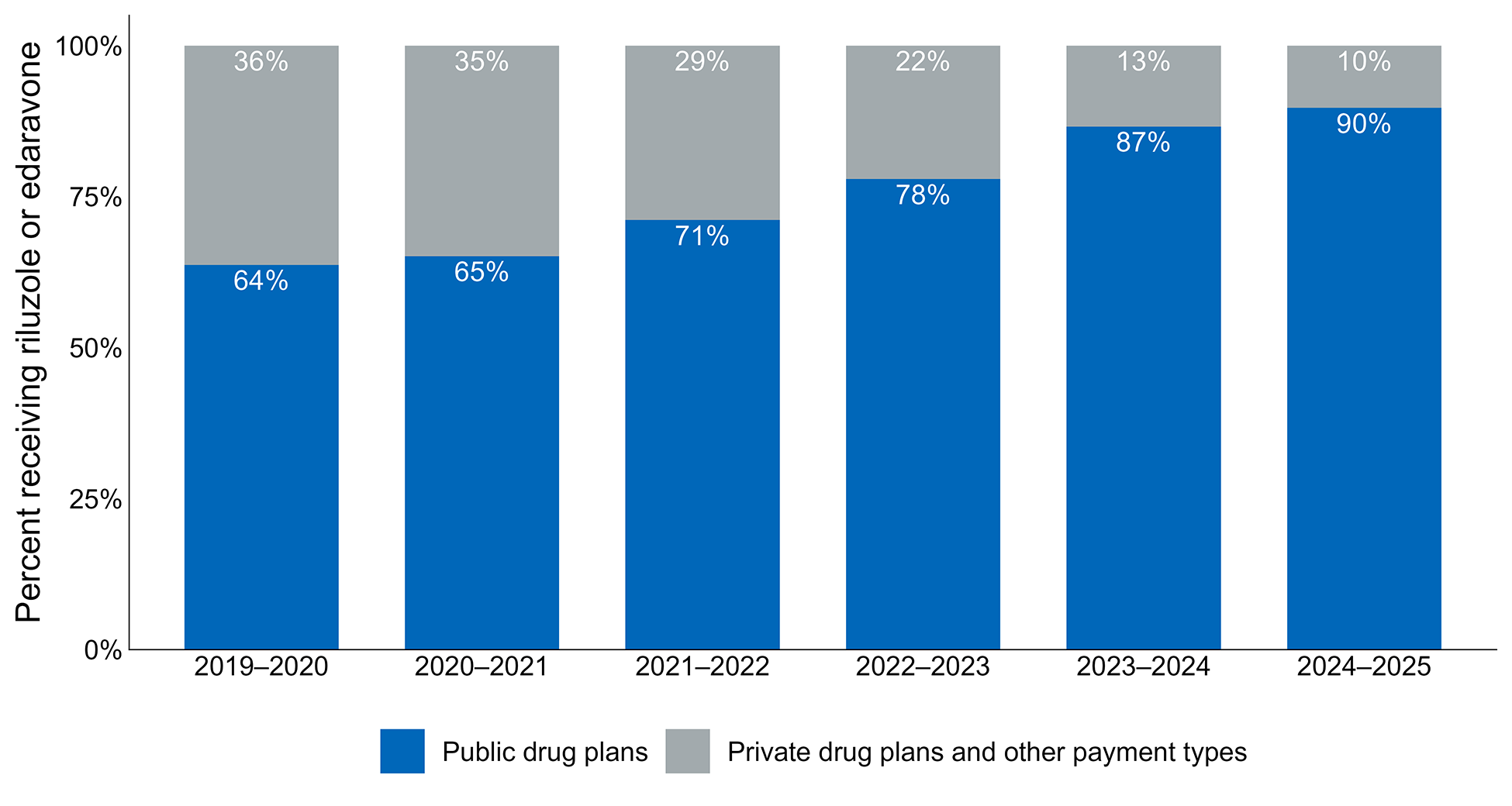
Notes: Health Canada allowed personal importation of edaravone from outside of Canada until October 31, 2022; therefore, individuals receiving edaravone may be underrepresented in the data.
Source: National Prescription Drug Utilization Information System.
Some variation in the proportion of ALS drugs funded through public drug plans was observed among the provinces. For the most recent fiscal year available (2024–2025), 84% of the 140 people with drug claims who were younger than 65 years of age and 94% of the 170 people aged 65 years or older accessed riluzole or edaravone through public drug plans. By province, the publicly funded proportions observed were as follows.
Manitoba: 82% of 79 recipients
Saskatchewan: 82% of 45 recipients
British Columbia: 95% of 186 recipients
Possible reasons for observed differences may include individual variation in awareness of how to access public plan options, interprovincial variation in population demographics (e.g., age and urban-rural split), eligibility criteria for public drug plans, underlying financial need for public coverage, private drug coverage differences, and funding criteria for the drugs. It is unclear whether these findings reflect broader patterns across Canada, given that proportions covered by public drug plans may also be influenced by how public and private drug plan coverages are coordinated, including whether public drug plans are the first payer for people with more than 1 drug plan.
In addition to variation across provinces, a rural-urban gap was observed in public drug coverage. In 2024–2025, 80% of people living in rural areas who received ALS drugs obtained them through public drug plans, compared with 92% of those living in urban areas. This may reflect differences in enrolment in public drug plans, including awareness of eligibility criteria (e.g., catastrophic coverage programs), as well as access to care teams and clinic-based supports that often help people living with ALS navigate public coverage and apply for reimbursement. Improving access to specialist care and coordinated ALS services in rural areas — including virtual care models — may help ensure more equitable support for navigating and accessing public drug coverage.
An increase in people receiving riluzole, edaravone, and tofersen over time was observed, similar to what was seen in the Public Drug Plans analysis. The sex distribution and proportion of people living with ALS in urban areas were similar to the proportions found in the Public Drug Plans analysis. The average age of this group was younger, as expected, with 55% aged 65 years or older, versus 71% in the public drug plan group. A relationship was observed between income and receipt of ALS drugs (Figure 11 in Appendix 3), similar to that seen in the Public Drug Plans analysis, suggesting that access to ALS drugs may be influenced by income and may reflect potential inequities in access.
The average number of different drugs taken by people receiving ALS drugs was larger in the Three Provinces analysis for all claims (10 drugs) than in the subset of public drug plan recipients in the same provinces (8 drugs). This difference likely reflects incomplete capture of medications among public drug plan users, as drugs covered by private plans or paid out of pocket were not included in the public plan drug count. The types of drugs prescribed were similar to the list in the Public Drug Plans analysis, although the order of the top 10 differed. A notable addition to the list was zopiclone (which is used to help people sleep), which was used in 18% of those receiving ALS drugs in the Three Provinces analysis but was not in the top 10 drugs in the Public Drug Plans analysis, likely reflecting policies in place for access to this drug on public drug plans. The top 10 drugs and volumes are presented in Appendix 3.
There are limited data on tofersen because it first became commercially available in Canada in March 2025, the same month when the drug utilization analyses ended. Five people from Saskatchewan received tofersen in the 2024–2025 fiscal year, and all initiated treatment before March 31, 2025. Early data from 2025–2026 (to the end of June 2025) show continued claims for 5 people in Saskatchewan. The claims were paid by private drug plans or other payment types (NPDUIS claims records do not differentiate among other payment types). No claims were observed in British Columbia (data available until the end of June 2025) or Manitoba (data available until the end of October 2025). There were no claims for tofersen in the public plans in Canada to the end of June 2025.
Drug Costs Covered by Public Drug Plans in 8 Provinces
As information on public and private drug coverage was only available from 3 provinces (Manitoba, Saskatchewan, and British Columbia) in administrative health data, we also analyzed drug cost data from IQVIA PharmaStat in 8 provinces (Newfoundland, Nova Scotia, New Brunswick, Ontario, Manitoba, Saskatchewan, Alberta, and British Columbia) to examine payment activities of public and private drug plans, including public formulary sales, sales for the NIHB program, and direct payment activities of 80% of private drug plans in Canada (detailed methods in Appendix 5). Our analyses were limited to examining the proportion of costs covered by public drug plans, as the unique number of people receiving drugs through public or private plans is not available on an annual basis from the data. Cash payments made in full or in part (i.e., deductibles) are not reflected in PharmaStat.
The proportion of costs covered by public drug plans increased for riluzole and edaravone between 2020 and 2024, from 38% to 71% (Figure 8). As edaravone first became available in Canada in 2020, estimates for 2020 should be interpreted with the consideration that they reflect a partial year of utilization and reflect differences in the timing of the introduction of public coverage for edaravone across jurisdictions. Edaravone accounted for 92% of combined total public drug plan costs for edaravone and riluzole in 2024, up from 81% in 2021 and 47% in 2020 (Table 48 in Appendix 5).
Figure 8: Percent of Total Drug Costs for Riluzole and Edaravone Covered by Public Drug Plans in Canada, 2020 to 2024
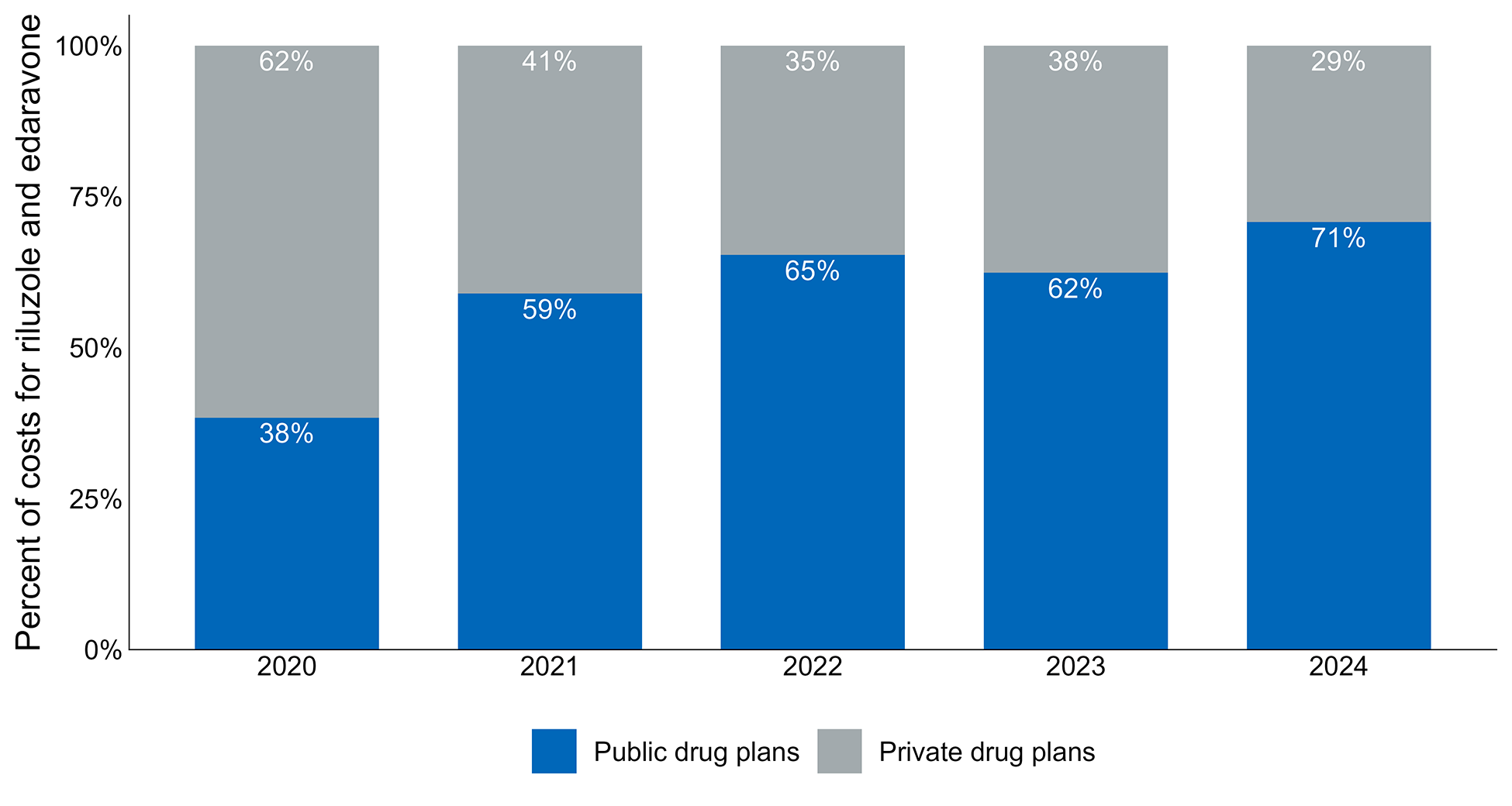
Source: This is information licensed from IQVIA PharmaStat for the period 2020 to 2024 reflecting estimates of real-world activity.
The proportion of costs covered by public drug plans varied by province, with lower proportions in Atlantic provinces (New Brunswick, Newfoundland and Labrador, Nova Scotia) and overall higher proportions in Western provinces (Alberta, British Columbia, Manitoba, Saskatchewan) (Table 5). This may reflect differences in public drug plan design (e.g., whether the public plan or an individual’s private drug coverage is treated as the first payer, and differences in required copayments or deductibles in each plan). Proportions by province over time are available in Table 49 in Appendix 5.
Table 5: Proportion of Total Drug Costs Covered by Public Drug Plans, by Province, 2024
Drug | NL | NS | NB | ON | MB | SK | AB | BC | Canada |
|---|---|---|---|---|---|---|---|---|---|
Riluzole | 39% | 52% | 46% | 66% | 58% | 92% | 72% | 72% | 66% |
Edaravone | 41% | 39% | 35% | 69% | 100% | 100% | 79% | 88% | 71% |
Riluzole and edaravone | 41% | 39% | 36% | 69% | 93% | 99% | 79% | 87% | 71% |
AB = Alberta; BC = British Columbia; MB = Manitoba; NB = New Brunswick; NL = Newfoundland and Labrador; NS = Nova Scotia; ON = Ontario; SK = Saskatchewan.
Note: In Manitoba and Saskatchewan, there were no claims for edaravone in private drug plans in 2024 at the time of analysis.
Source: This is information licensed from IQVIA PharmaStat for 2024 reflecting estimates of real-world activity.
Drug Utilization and Discontinuation in the CNDR
We examined the use of drugs for ALS among people living with ALS diagnosed between 2018 and 2025 included in the CNDR, defined as any documented use at diagnosis or during follow-up between 2018 and March 2026 (detailed methods provided in Appendix 4). The description of the use of drugs for ALS in the CNDR may not be representative of the broader population of people living with ALS in Canada. This is because the registry captures a subset of people living with ALS and following changes in 2022 there was targeted recruitment of people living with ALS receiving drugs for ALS in some clinics.
Among 681 people living with ALS diagnosed between 2018 and 2025 in the CNDR:
85% received 1 or more drugs (riluzole, edaravone, tofersen)
78% received riluzole
41% received edaravone
36% received 2 or more drugs concurrently (riluzole, edaravone, tofersen)
15% had no drug exposure.
Our analysis suggests increases in the proportion of people living with ALS receiving riluzole (78%), compared to 68% receiving riluzole in a prior analysis of people living with ALS enrolled in the CNDR from 2012 to 2017.24 There are several potential reasons why riluzole use may have increased, which may include earlier diagnosis, increased use of disease-modifying therapies, and differences in the subset of people living with ALS captured in the registry over time.
Among 529 people living with ALS diagnosed between 2018 and 2025 who received riluzole, 18% discontinued use of riluzole; reasons for discontinuation included adverse effects (63%), disease progression (6%), patient preference (5%), and other reasons not specified (25%).
Among 277 people living with ALS who received edaravone, 15% discontinued use of edaravone; reasons for discontinuation included adverse effects (26%), patient preference (26%), other reasons not specified (29%), and drug access or coverage (19%).
Compared to 105 people living with ALS with no drug exposure, 576 people living with ALS who received 1 or more drugs for ALS:
were more likely to be in the top 2 most affluent income groups (45% receiving 1 or more drugs for ALS versus 35% with no drug exposure)
had a shorter time from symptom onset to diagnosis (average of 13 months versus 18 months)
were more likely to have bulbar-onset ALS (24% versus 17%), a subtype of ALS with a faster rate of disease progression
had better functioning as assessed via the ALSFRS-R (average score of 42 versus 36)
had a higher FVC percent of the predicted value (average 96% versus 84%) (refer to Table 46 and detailed methods in Appendix 4).
Considerations for Treatment Administration
There are distinct challenges with accessing pharmacological therapies that require administration by a specially trained clinician (e.g., trained in lumbar puncture) or require additional testing and monitoring. As riluzole requires frequent monitoring of liver enzymes, people living with ALS may face additional barriers related to geography, wait times, differential access to ALS specialists, availability of local clinics, and out-of-pocket costs.
Tofersen requires genetic testing for an SOD1 mutation before treatment eligibility. As previously discussed, equitable access to genetic testing and counselling remains an important consideration for genetic-based treatments like tofersen. People living with ALS emphasized the impact of accessing genetic testing earlier to be eligible for tofersen and the need for timely access to tofersen to slow disease progression as early as possible.19
A significant consideration for people living with ALS receiving treatment is the way a drug is administered, as it impacts their experience. For example, we heard from people living with ALS that they prefer oral administration (including through a feeding tube) of edaravone in comparison to IV edaravone (no longer available in Canada): in comparison to other treatments, the oral formulation is less demanding, requires fewer clinic visits, and offers more independence.19 Some people living with ALS identified strategies to facilitate oral intake when they have difficulty swallowing.19 For people living with ALS that need intrathecal (lumbar) injections to receive tofersen, they described treatment administration as physically burdensome (e.g., intrathecal side effects) and time-consuming (e.g., scheduling demands and travel with mobility restrictions).19 This raises concerns around equity of access for people who live far from clinics that are able to provide intrathecal injections, as some people living with ALS must travel long distances to the clinic every 4 weeks. One person living with ALS who was receiving tofersen reported that they considered the long-distance travel worthwhile, considering the benefit they felt they received from this drug.19 However, others receiving tofersen emphasized the need for locally available clinics to improve access to intrathecal injections, which could help to improve quality of life for people living with ALS (e.g., less time travelling to allow more quality time with family).19
Experiences in Canada: Challenges and Opportunities
People living with ALS who provided input to CDA-AMC reported using available disease-modifying therapies (i.e., riluzole, edaravone, tofersen) through publicly funded programs and accessing new treatments through compassionate care or clinical trials.19 However, tofersen is specifically used for SOD1 ALS, which makes up approximately 2% of people living with ALS.26,62 People living with ALS reported to CDA-AMC that there remains an unmet need, as existing drug treatments provide limited benefits.20
People living with ALS also expressed concerns that they might not qualify for reimbursement due to eligibility limitations for public coverage, limiting available treatment options.20 For example, the pivotal trial for edaravone was conducted in a specific patient population. The recommendation was based on the provided evidence to ensure the drug is covered for people living with ALS who are most likely to benefit, and where the economic value has been assessed. Due to this, it is estimated that 10% of people living with ALS meet the inclusion criteria of the pivotal trial for edaravone.124 Some people living with ALS reported difficulties in covering all treatment costs (e.g., those with partial or no private insurance coverage, or with health insurance plans that have high deductibles and/or copayments).19 ALS clinics reported to CDA-AMC that they apply for access to restricted benefit ALS drugs for people living with ALS. Clinics and people living with ALS also reported that specialized programs (e.g., patient support programs) helped to reduce the financial burden of paying for medications and emphasized the need for comprehensive medication coverage.40
Some people living with ALS commented on the eligibility requirements for reimbursement of some therapies, including limits based on time since symptom onset and disease progression scores.19 They also worried about discontinuation of treatment once they no longer meet eligibility criteria.19 Additionally, people living with ALS noted the difficulty in navigating information to access public coverage (e.g., interaction between private health insurance and public coverage).20 People living with ALS also noted the taxing nature of applying for exceptional access, as it requires regular paperwork on the part of the clinician and the family.20
For people with private insurance, navigating the drug access system has its own administrative and financial challenges. Some people living with ALS reported that maintaining disability benefits at work is burdensome, as workplaces can require monthly submissions of medical certificates.20 People living with ALS also reported frustration in understanding the financial structure of private plans, which involve deductibles and nonintuitive coverage periods.20 Additionally, people living with ALS worried about paying high deductibles for therapies without fully benefiting from coverage before the cycle restarted.20 Many experienced difficulties in finding information when applying for additional government support (e.g., signatures required to complete disability tax credit forms).20 Overall, the administrative burden of understanding complex public and private reimbursement systems without a patient navigator was stressful to some people living with ALS.20
Some people living with ALS reported using off-label or nonmarketed treatments (e.g., tirasemtiv, darifenacin, human growth hormone, or stem cell treatments), which require out-of-pocket payments.20 People living with ALS expressed frustration that Canada offers fewer opportunities for compassionate access to investigational drugs compared with the US, including dextromethorphan with quinidine (Nuedexta).20 Moreover, some people living with ALS reported to CDA-AMC that they have requested access for drugs through the Special Access Program, as well as through other methods (e.g., compounding pharmacy).20 In our analysis of registry data (from the CNDR) among 681 people living with ALS diagnosed between 2018 and 2025, 27% participated in a Special Access Program; however, this is likely overestimated compared to the entire population with ALS due to the targeted recruitment of people living with ALS receiving drugs for ALS in some clinics in the registry. People living with ALS also expressed frustration in dealing with delays in obtaining medications due to shipping problems, insurance approvals, and the burden of completing administrative paperwork.20
During our engagement sessions, people living with ALS expressed concerns over timelines for drug approval and reimbursement.20 Considering the limited treatment options for ALS, including the fact that there is no cure, people living with ALS expressed to CDA-AMC in patient group engagement that shortening the timeline for Health Canada approval and reimbursement by plans could significantly benefit people living with ALS.20
Supportive Care Services
Outside of the multidisciplinary care in ALS clinics, people living with ALS in Canada need supportive care services for medical needs, devices, and comprehensive daily care, which could be publicly funded (with a referral from the ALS clinic), funded by not-for-profit organizations, privately insured, community-organized, or paid out of pocket by people living with ALS.72 Some of these services can complement or overlap the care being received at ALS clinics.
Essential supportive care services include:
devices to support physical movement (e.g., wheelchairs, spasticity clinics)
programs and devices to support communication (e.g., augmentative communication clinics)
nutrition services (e.g., feeding tube insertions)
respiratory devices and services, such as BiPAP machines, cough assist machines, invasive mechanical ventilation (e.g., tracheostomy tubes), and in-home respiratory programs125-127
home care supports for clinical and nonclinical needs (e.g., access to personal support workers)
home modifications (e.g., handrails)
LTC (can be referred to in different ways across provinces, such as nursing homes, residential care facilities, personal care homes, supportive housing, lodges, assisted living facilities, hospital-based continuing care, chronic care, extended care, or complex continuing care)9
palliative care, end-of-life care, and MAID services.
Supplementary services can include:
massage therapy or osteopathy
informal peer support (e.g., online groups on social media)20
alternative medicine (e.g., naturopathy).
It is important that equipment used to help people living with ALS with physical movements is designed to be equitable and that it can be used by those with diverse needs. For example, devices that support the body (e.g., wheelchairs), attach to the body, or go inside the body may need to accommodate people with different body sizes. It is also important that communication devices are accommodating. For example, culturally informed design of these devices may promote use by people living with ALS who are from different cultures, who speak different languages, and who have different communication styles. There may be barriers to using devices such as geography (e.g., whether devices that use the internet are in areas with limited access to Wi-Fi), poverty (e.g., whether people living with ALS can afford to pay for devices), houselessness (e.g., having the physical space to accommodate devices), technical issues (e.g., devices breaking down), and comfort with using new technologies (e.g., understanding how they work, and whether data are handled securely and privately for sensitive conversations).
During engagement sessions, people living with ALS expressed that when pursuing supportive services outside of ALS clinics, such as from massage therapists, having a practitioner who had experience with ALS was important. For example, experienced practitioners are able to provide seated massage treatments for people with feeding tubes; however, locating practitioners with ALS knowledge and who also operate close to people living with ALS can be challenging.20
ALS Societies
ALS societies are not-for-profit organizations providing advocacy, support, resources, and programs to people living with ALS to complement health care systems. In Canada, a primary care practitioner, general neurologist, or ALS clinic can refer someone to an ALS society, or a person with ALS symptoms can self-refer. Table 54 in Appendix 9 lists the 9 ALS societies in Canada and their varying services. No territories have their own ALS society; however, the ALS Society of Alberta supports people living with ALS from the Northwest Territories, and the ALS Society of British Columbia supports people living with ALS in the Yukon with equipment programs.
Services and supports provided by ALS societies can be broad in scope given the variety of changes people living with ALS and their families face, and they aim to support quality of life overall. Their work extends beyond health care–related services, helping people and families focus on what remains meaningful in their lives and creating opportunities for connection and shared experiences. ALS society services and initiatives can include:
equipment programs
financial resources for home modifications
support groups for people living with ALS, their caregivers, and families
home visits with families by community leads or client service coordinators
youth support programs for those with parents or grandparents living with ALS
financial support to organizations and institutions that conduct or fund ALS research (e.g., ALS clinics, Canadian universities, the ALS Society of Canada).
Home Care Support Programs
Home care includes a range of health and support services delivered in a person’s home to help people living with ALS remain independent for as long as possible. These services may include assistance with daily activities, such as personal hygiene and meal preparation, as well as nursing care, such as wound care, postsurgical care, or palliative care. Care may also be provided by other health professionals, such as physiotherapists, occupational therapists, dieticians, and respiratory therapists. Access may vary across provinces and territories, and specific services that are medically necessary for ALS may not be consistently available. This care may be provided by public health systems, private programs, or not-for-profit organizations.
Some examples of provincial home care programs are listed subsequently (the list is not comprehensive of all provincial or territorial services in Canada):
Nova Scotia: Continuing Care128
New Brunswick: Extra-Mural program129
Quebec: Centre local de services communautaires (CLSC)130
Ontario: Ontario Health atHome131
Manitoba: Home Care Services132
Alberta: Alberta Health Services home care133
Home care utilization data could provide important insight into the use, intensity, and timing of community-based services for people living with ALS, particularly given the progressive functional decline and reliance on supportive care over the disease course. However, national home care data available through CIHI did not support reliable identification of people living with ALS. As a result, jurisdiction-level analyses of home care utilization specific to ALS were not feasible for this project. In April 2026, the home care reporting system at CIHI (Integrated interRAI Reporting System – Home Care [IRRS-HC]) was updated to begin collecting ALS diagnosis information. As data accumulate following this change, future analyses will be able to identify people living with ALS in the database and support more comprehensive assessments of access, continuity, and coordination of care across the disease trajectory in future years.
Government Strategies and National Advocacy
In addition to equipment program resources from ALS societies, people living with ALS may also be supported through dedicated provincial ALS strategies, governmental benefits for anyone experiencing disabilities, advocacy from the All-Party Parliamentary ALS Caucus, and patient- and caregiver-led charities like ALS Action Canada.
Governmental Strategies
Dedicated ALS strategies from provinces and territories can also help to support the physical, emotional, and financial burdens that people living with ALS face by focusing on areas that need additional investment. For example, in October 2024, the government of Ontario committed $13 million over 3 years to the newly created Ontario Provincial ALS Program.134 The commitment was a collaboration between the ALS Society of Canada and 5 ALS clinics (in Hamilton, Kingston, London, Ottawa, and Toronto). The goal was to:134
improve multidisciplinary care standards and care models
develop a regional strategy for northern and rural Ontario
allocate funds to the ALS Society of Canada’s community services and equipment programs
form a secretariat that would coordinate ALS care, collect data to make decisions and allocate resources, perform systems planning, and conduct knowledge dissemination.
A report from the ALS Society of Canada135 showed that after 1 year of this program:
4,000 pieces of equipment were given to people living with ALS
704 people living with ALS received equipment
the turn-around for equipment was 10 to 14 days.
Government Benefits for People With Disabilities
Informed by policies and legislation in Canada that protect people with disabilities, these benefits can provide financial relief and physical resources (e.g., equipment, funding for home restructuring) to people living with ALS, their caregivers, and families. In Appendix 10, Table 55 lists legislation that protects the rights of people with disabilities and the government initiatives to address these rights, Table 56 provides details on federal benefits, and Table 57 provides details on provincial and territorial benefits. The types of benefits include those for disabilities, caregivers, medical expenses, home renovations, and home purchases.
All-Party Parliamentary ALS Caucus
Canada also has a forum for advocates to bring ALS issues to the government. The All-Party Parliamentary ALS Caucus is a group of members of parliament and senators in Canada that champion the needs of the ALS community within parliament. The caucus provides a forum where people in parliament can:136
hear from people living with ALS and experts, including the ALS Society of Canada
learn about the challenges that people living with ALS and their families face
address gaps in access to care, therapies, and research.
The priorities of the All-Party Parliamentary ALS Caucus include calling for a national strategy to ensure people living with ALS in Canada have equitable access to therapies, care, and clinical trials.136 This can provide an opportunity for policy-makers to discuss unmet needs for people living with ALS in Canada and come together to share information, resources, and opportunities to collaborate on this important issue.
ALS Action Canada
ALS Action Canada is a patient- and caregiver-led organization that aims to increase ALS initiatives related to treatments, research, advocacy, and collaboration.137,138
Experiences in Canada: Challenges and Opportunities
ALS Societies
During our engagement sessions, we heard from people living with ALS and their caregivers that they received excellent support from ALS societies, including navigating services, home visits, and assistive devices (such as wheelchairs, mattresses, and walkers).20 However, session participants noted that there can also be barriers to accessing their services depending on where a person lives, administrative delays, availability of equipment, and available financial supports.
We also heard from engagement that not all programs available through ALS societies are equally accessible to people living with ALS in Canada, and that there are large variations by region.20 Most ALS societies are in cities with higher populations, meaning people in rural and remote communities would have to travel longer distances to access their services, some paying out of pocket if they are able to afford it.
Geographic barriers to ALS societies can also cause delays in equipment delivery to the home. As most ALS societies are in urban centres, shipping equipment to cities that are further away can cause delays in equipment access. For example, it can take longer to deliver equipment to people living with ALS on Vancouver Island in British Columbia, because of the availability of ferries to make deliveries from the mainland. People living with ALS in Nunavut do not have access to equipment programs at all, as there are no ALS societies in the territory and the societies in other jurisdictions do not provide equipment coverage for Nunavut.
ALS clinic coordinators also noted that formal processes required to access ALS society equipment programs may cause delays in accessing care. For example, in Edmonton, people living with ALS cannot get equipment from ALS societies until they are registered with home care services and have received a home care assessment. We heard from experts that in Ontario, people living with ALS must be assessed by an occupational therapist or physical therapist at an ALS clinic who then orders the necessary equipment from ALS societies. There may be barriers to timely access to these assessments at an ALS clinic related to therapist availability and/or a person’s geographic proximity to the clinic. These barriers can be particularly challenging for those who continue to experience physical symptoms (such as falls) in the interim. One potential outcome in this situation for people living with ALS is to pay out of pocket for equipment so that they can start using something sooner. Similar processes to access equipment exist in other provinces, but at a smaller scale.
Furthermore, because ALS societies are not-for-profit organizations, they rely on fundraising and private donations, and there is a limited amount of equipment and services available for all people living with ALS across Canada to benefit from. This means people living with ALS who cannot afford equipment on their own may need to wait longer to access these resources.
Home Care
We heard from engagement sessions that there may be challenges with the capacity of home care services and the availability of certain clinical care services. This reveals areas of opportunity for further investment.
Familiarity with ALS and its related specific care needs by health professionals is important. As provincial home care programs are intended for anyone who needs clinical care at home, and home care professionals are not necessarily ALS specialists, people living with ALS may not be receiving care that is specific to their ALS needs and the way the disease presents and progresses. For example, in-home care professionals are not commonly trained to support the advanced care needs of people living with ALS (such as using, monitoring, and managing cough assist machines and mechanical ventilation devices, given that these machines are typically used in acute care settings). We heard from our advisory group that this lack of expertise specific to ALS may cause frustration among people living with ALS.
Home care services are not consistent across health authorities within provinces, and this affects whether and how people living with ALS receive care based on where they live. We heard from ALS clinic coordinators that there are differences in how staffing is organized and which health care professionals are available within and between provinces. For example, there are inconsistencies accessing home care services (e.g., respiratory therapists, nurses, occupational therapists) in some communities in some provinces (e.g., Ontario, Saskatchewan, and British Columbia). There is also a lack of respiratory therapists in many rural and remote communities (e.g., in rural and northern areas in Alberta and Saskatchewan), leading to difficulties accessing respiratory care at home in these regions. This can make it difficult for people living with ALS to receive timely care and to access the benefits for which they are eligible.139 There is also variation in how service expenses are paid (e.g., reimbursed or out of pocket), and how they are organized (e.g., by ALS clinics or through self-referral by people living with ALS).
Quebec provides an example of successful home care service organization to support respiratory care. Quebec has standard infrastructure for respiratory therapist services in the community for those needing long-term ventilation, with continuity of care regardless of where someone lives, and collaboration to provide consistent clinical care. This model provides equal access across the province.139
Even when services are technically available for provision at home, wait times may be a barrier to access for some people living with ALS. In 2025, while people in Canada waited a median of 3 days for government-provided home care services from a health care professional for personal care and household support services, 10% of people waited a month.140 During our engagement sessions, people living with ALS expressed that there are long wait times for home care services in semirural areas in Canada.20
Government Benefits
People living with ALS may experience challenges when accessing government services, such as eligibility for programs, wait times, unplanned out-of-pocket costs for nonsubsidized services, health care workers’ experience with ALS-specific needs, and living in rural or remote areas. We heard from people living with ALS that there is an administrative burden that comes with government disability benefits, such as submitting paperwork, getting signatures from ALS clinics or primary care practitioners, and coordinating among different parts of the health care systems to apply for a single benefit.20 People living with ALS shared that the process is lengthy and difficult to navigate, and that even with some government benefits (such as those intended for home modifications like stairlifts), insurance and government benefits often do not cover the full cost of these expenses, and there are many personal expenses that still need to be covered.20 This can prevent those with lower incomes or those experiencing poverty from accessing services.
Advanced Care Needs and Resource Use
As ALS progresses and leads to muscle loss, respiratory failure, and paralysis, people living with ALS eventually need special procedures and devices such as feeding tube insertions for nutrient intake and respiratory machines for breathing, and can require special end-of-life care and supports in LTC homes.
Feeding Tube Insertions
There are different ways people living with ALS can get a feeding tube, and some have described the process as confusing and complicated.20 ALS clinics in Canada can refer people living with ALS to approved clinical settings (e.g., a hospital or clinic) for feeding tube insertion; depending on province, the referral may be to different health care professionals (such as gastroenterologists or radiologists) or to surgical services. This is because the procedure to insert a feeding tube or to address any tube complications can require surgical services. We heard from people living with ALS that in other cases, their primary care practitioners can refer for feeding tube insertion if they have hospital admitting privileges.20 When people living with ALS do not have primary care practitioners, the ALS clinic may provide a letter to an emergency department describing the urgency of getting a feeding tube.20 Other people living with ALS may experience long wait times for this procedure if other surgical procedures are scheduled that require the same operating room or other surgical unit resources and take priority over feeding tube insertions. In some cases, people living with ALS may be sent out of province for this procedure. We heard from experts that this can delay treatment, reduce quality of life and the ability to safely ingest food, and can also lead to unnecessary medical complications.
Our analysis of outpatient surgeries and day procedures in Canada — in which feeding tubes may be inserted — identified a decline in procedures among people living with ALS over the past 6 years (refer to Figure 9 and methods in Appendix 3). In the 2024–2025 fiscal year, there were 121 day procedures or day surgeries among people living with ALS, 50% of which included feeding tube insertions. The proportion varied across provinces and the territories (reported as a combined group), with 92% of day procedures in Manitoba including a feeding tube insertion, while some provinces and territories had no cases or counts too small to report (1 to 4 cases are suppressed for privacy reasons). The rate of feeding tube insertions was 2.3 per 1 million population aged 18 years or older in Canada in 2024–2025, and the rate varied across the provinces and territories. Saskatchewan and Manitoba exceeded 10 per million, while Ontario and British Columbia had rates below 2 per million. Rates in other provinces and in the territories are not reported due to small patient volumes.
The reason for the observed decline over time and variation across provinces and territories is unknown. It may reflect prioritization of procedures or patients, clinical practice patterns, or diagnostic coding practices at the hospital or jurisdictional level (ALS diagnostic coding is not mandatory in health care administrative data). Changes in supportive care practices, including support from dietitians, speech-language pathologists, occupational therapists, and others, may help some people living with ALS maintain adequate nutrition for longer, potentially influencing the timing and need for feeding tube placement. The decline may also reflect a shift toward performing these procedures during inpatient hospitalizations rather than in day surgery settings. In 2024–2025, 211 inpatient hospitalizations in people living with ALS included feeding tube insertions across Canada.
Figure 9: Day Procedures and Day Surgeries in People Living With ALS
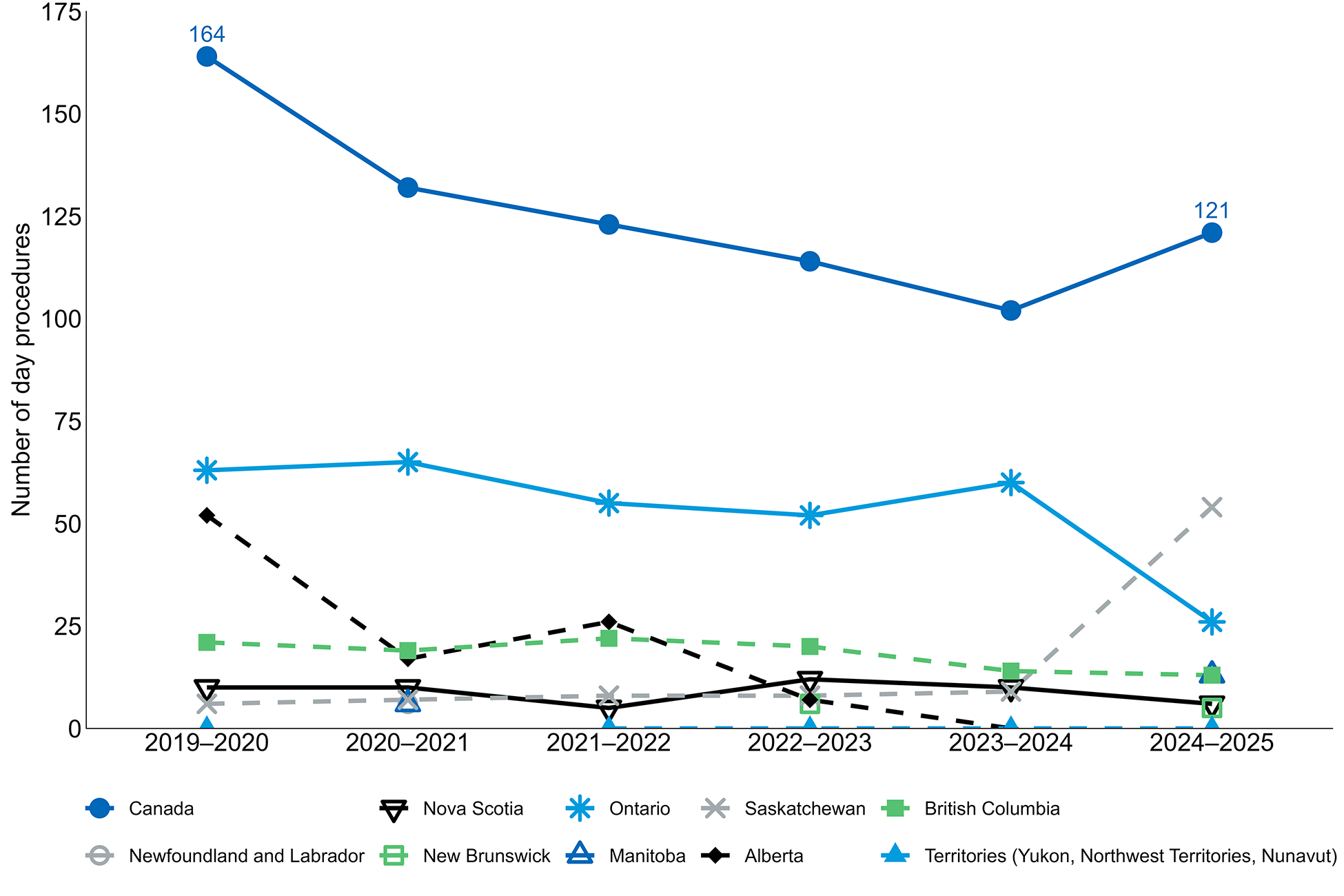
ALS = amyotrophic lateral sclerosis.
Note: Some provincial and territorial data points are suppressed for patient privacy reasons. Refer to Table 24 in Appendix 3 for more detail.
Source: Discharge Abstract Database, National Ambulatory Care Reporting System.
Respiratory Care
As ALS progresses, respiratory muscle functions deteriorate, and the respiratory needs of people living with ALS advance. They can require noninvasive ventilation (e.g., BiPAP machines), cough assist machines, or mechanical ventilation, as well as associated tracheotomy procedures to insert a tube into the trachea (also referred to as invasive ventilation). An essential part of respiratory device use is the support from respiratory therapists and other health care professionals to:139
manage devices and ensure they are being used safely
improve device adherence and optimization
ensure people living with ALS are well informed about their devices and connected to health professionals or programs in their community
meet high respiratory care needs in a timely way to reduce transfer to acute care settings (e.g., preventable hospitalizations, emergency department visits) and poor outcomes.
Among 651 people living with ALS diagnosed between 2018 and 2025 from 7 provinces in the CNDR, and with available data on ventilation status, 6% received full-time invasive or noninvasive ventilation, defined as ventilation at least 16 hours per day (detailed methods in Appendix 4). The average time between diagnosis and full-time ventilation was 16 months. The number of people living with ALS with full-time ventilation and the time to full-time ventilation is likely underestimated because people diagnosed more recently have not been followed as long in the registry; therefore, full-time ventilation use may not have yet occurred, as the follow-up period was too short.
Experts we engaged with reported that, in Canada, there are challenges with the availability and cost of respiratory devices.139 Equipment is not funded consistently across the country, with differences in eligibility criteria, proportion of coverage, and program infrastructure.139 In some provinces, there is partial or full coverage of devices, which can cost more than $5,275 per month for equipment, supplies, personnel, and associated medications.85 There may also be financial barriers to accessing these machines that include not only the cost of the machine itself, but also the consumable parts such as tubing, masks, and filters, which people often have to pay for out of pocket.139,141
Experts also reported that access to community respiratory therapists who have been trained to operate respiratory devices safely is inconsistent across Canada.139 Respiratory devices require constant clinical supervision, maintenance, and expert judgment to ensure that they are effective and safe.139 Clinical knowledge and experience is required to troubleshoot device malfunctions, address customization when patient needs change, maintain optimal device settings, and replenish consumables.139 However, people living with ALS often need to use ventilators at home. Personal support workers visiting a home for basic services and those visiting for palliative care services are not consistently trained on how to use this machinery. Also, some people living with ALS may not have a caregiver or privately paid health care professional (e.g., a nurse or respiratory therapist) to help them use and monitor these machines. Safe device operation requires someone with professional training (such as a respiratory therapist), but not all health regions have community respiratory therapist services and ventilation infrastructure (e.g., rural areas have fewer health care professionals like respiratory therapists and personal support workers).139 Further physical challenges may arise when people living with ALS using these ventilation machines need to go to the hospital for acute health reasons, or because of complications arising from improper use at home.
There are no national standards on long-term home ventilation programs.139 Some provinces do not have provincial funding for home ventilation, and others have limited funds available through social development funding programs.139 In these cases, people living with ALS may need to pay out of pocket for equipment and respiratory support if they can afford it.139 Other provinces have long-term ventilation programs and device pools that are publicly funded by their respective Ministries of Health. These programs may remove some of the burden of decision-making from people living with ALS and their families regarding equipment purchasing, logistical maintenance, and technical expertise in device operation.139 For example, Quebec’s program (through the Centre universitaire de santé McGill and Institut universitaire de cardiologie et de pneumologie de Québec) has full coverage for all ventilators and equipment at no cost to patients.139 Ontario’s Provincial Long-Term Ventilation Strategy142 includes facilities with LTC beds for people on ventilation, the Ontario Ventilator Equipment Pool program,143 Ontario’s Provincial Cough Assist Program (which funds cough assist devices),139 and the Ontario Assistive Devices Program (which partially funds ventilator supplies, such as masks).139,144 British Columbia has a nonprofit Provincial Respiratory Outreach Program,145 which is funded by the Ministry of Health and distributes equipment at no charge to patients.139
Hospitalizations and Emergency Department Use
Hospital and emergency department use among people living with ALS is not always a central feature of care, and may vary depending on disease course, care models, and access to community-based supports (e.g., home care). While some individuals can require hospitalization for acute complications or procedures, others may have limited or no interaction with inpatient care services. Understanding patterns of hospital use can help situate the role of acute care within the broader continuum of ALS management, which often emphasizes outpatient and supportive care. Methods are described in Appendix 3.
Hospitalizations
Across Canada (excluding Quebec), there were 1,082 hospitalizations of people with an ALS diagnosis in the 2024–2025 fiscal year, representing 829 unique people. While most (78%) had only a single admission, 22% had 2 or more admissions. For 28% of people admitted to hospital with ALS, their hospital stay also included time in the intensive care unit. Nationally, both the number of people living with ALS with a hospitalization and the number of hospitalizations declined in 2020–2021, coinciding with the COVID-19 pandemic. Although both measures fluctuated over time, both were 7% higher in 2024–2025 than in 2019–2020. At the provincial level, year-to-year patterns varied across jurisdictions (Appendix 3). The observed changes likely reflect multiple factors, and may include year-to-year variation, changes in hospital diagnostic coding practices, longer survival among people living with ALS, pandemic-related disruptions with downstream effects on disease management, and changes in regional availability of LTC or home care.
In 2024–2025, the average age of people living with ALS with a hospitalization was 68 years; 59% were male and 41% were female. Eighty percent lived in urban areas, similar to the overall population, but proportions of urban and rural residents varied by province (data from the territories were suppressed for privacy reasons). There were no obvious differences in hospitalizations across neighbourhood income groups, suggesting no evident income-related inequities in access to or need for inpatient care.
The main reasons for hospitalizations of people living with ALS are diverse. We found that ALS was the diagnostic code identified as the main reason for hospitalization in 38% of the 1,082 people living with ALS hospitalized in 2024–2025. Ten percent were identified as requiring hospitalization for supportive care, rather than acute management of a disease process or event. Nine percent had respiratory failure, 4% had pneumonitis (inflammation in the lungs), and 3% had dysphagia (difficulty swallowing). The top 10 reasons accounted for 75% of the reasons for hospitalizations (Appendix 3), indicating that most admissions were concentrated among a relatively small number of clinical conditions.
When people with ALS left a hospital, 47% went home (with or without support), and 24% were transferred to other inpatient care, LTC, or group or supportive living. Twenty-three percent died in hospital (non-MAID) and 5% received MAID in hospital.
Emergency Department Use
Emergency department use among people living with ALS was examined using data from Ontario, Saskatchewan, and Alberta. In the 2024–2025 fiscal year, there were 440 emergency department visits among 360 people living with ALS, and 17% of those had 2 or more visits. Small numerical increases occurred in Ontario and Alberta since 2019–2020. In the 3 years of data that were available for Saskatchewan, a decline in visits was observed; however, this should be interpreted with caution due to the small number of people involved. Volumes by province are reported in Appendix 3.
In 2024–2025, the average age of people living with ALS visiting the emergency department was 66 years; 60% were male and 40% were female across the 3 provinces analyzed. Most people (83%) lived in urban areas, consistent with the general population. There were no obvious differences in emergency department use across neighbourhood income groups, suggesting no evident income-related inequities in access or use.
Emergency department visits were categorized by Canadian Triage and Acuity Scale (CTAS) level to assess the urgency of presentations among people living with ALS.146 The majority (94%) of visits were triaged as higher acuity (CTAS levels 1 to 3), suggesting that care needs are typically urgent, with few visits for lower-acuity concerns. Consistent with higher acuity, 62% of visits resulted in hospital admission. The main problems addressed in each visit were ALS (38%) and respiratory-related issues or dysphagia (difficulty swallowing) in 22%. The top 10 reasons for emergency department visits accounted for 66% of all visits. Compared with hospitalizations, reasons for emergency department visits were more broadly distributed, with one-third of visits attributable to a wide range of less common diagnoses; however, these findings are based on emergency department data from 3 provinces and may not be generalizable to the rest of Canada.
Refer to Appendix 3 for detailed hospital and emergency department findings.
End-of-Life Care Pathways and Outcomes
Long-Term Care
People living with ALS who are at an advanced stage of the disease or are dying, and need 24-hour nursing care, comfort, and management of quality of life, may need to move to LTC facilities, hospitals, or hospice residences.72 We heard from our advisory group that, in many cases, people with advanced ALS may be unable to remain in their home, given increased medical needs and insufficient home care supports to relieve caregivers.
We analyzed the publicly funded LTC data in Canada for the 8 provinces and 1 territory that reported data to CIHI. Ontario and Manitoba also provide hospital-based continuing care for people living with ALS, which we analyzed separately. Detailed methods are provided in Appendix 3.
There were 336 people living with ALS in LTC facilities in the 2024–2025 fiscal year (similar to the 341 people in 2019–2020). There were 119 people living with ALS in hospital-based continuing care in 2024–2025, with the majority (104) in Ontario. People were identified as having ALS at the time of analysis; the analytic approach did not assess whether ALS was diagnosed before or after admission to these settings. Refer to Appendix 3 for data by province and year for both LTC facilities and hospital-based continuing care. Due to the low number of people reflected in the data, small year-to-year differences may reflect random variation rather than true changes, and trends should be interpreted with caution.
In 2024–2025, half of the 336 people living with ALS in LTC had stays shorter than 1.5 years while half had longer stays, with 10% having been there for more than 7 years. There was a high rate of transitions among people in LTC, with 40% experiencing death, transfer, or discharge in 2024–2025 (Appendix 3).
Among the 336 people in LTC, the average age was 76 years, 56% were female and 44% were male, and 92% lived in urban areas before admission. The higher proportion of females relative to our other analyses, in which males slightly outnumbered females, may reflect differences in the availability of informal caregivers, including partners, which can be influenced by demographic factors such as differences in life expectancy, as well as variation in the capacity to provide care.
A greater proportion of people living with ALS in LTC were from lower neighbourhood income groups. Income groups, also referred to as quintiles, classify people based on their relative income within a geographic area. The population is divided into 5 equal-sized groups, ranging from the lowest income group (group 1) to the highest income group (group 5). These groups do not correspond to specific income ranges; rather, they reflect a person's position relative to others living in the same area. If income were not associated with receipt of the drug, approximately 20% of recipients would be expected in each income group. Income groups serve as a proxy for socioeconomic circumstances. Percentages in Figure 10 are presented across income groups. This pattern may reflect differences in access to informal caregivers, financial resources, and community-based supports, which can affect the ability to remain in the community as care needs increase. People from higher-income neighbourhoods may also select fully private retirement homes if they require more care than what is available in the community.
Figure 10: Distribution of People Living With ALS in Long-Term Care Across Income Groups, 2024–2025
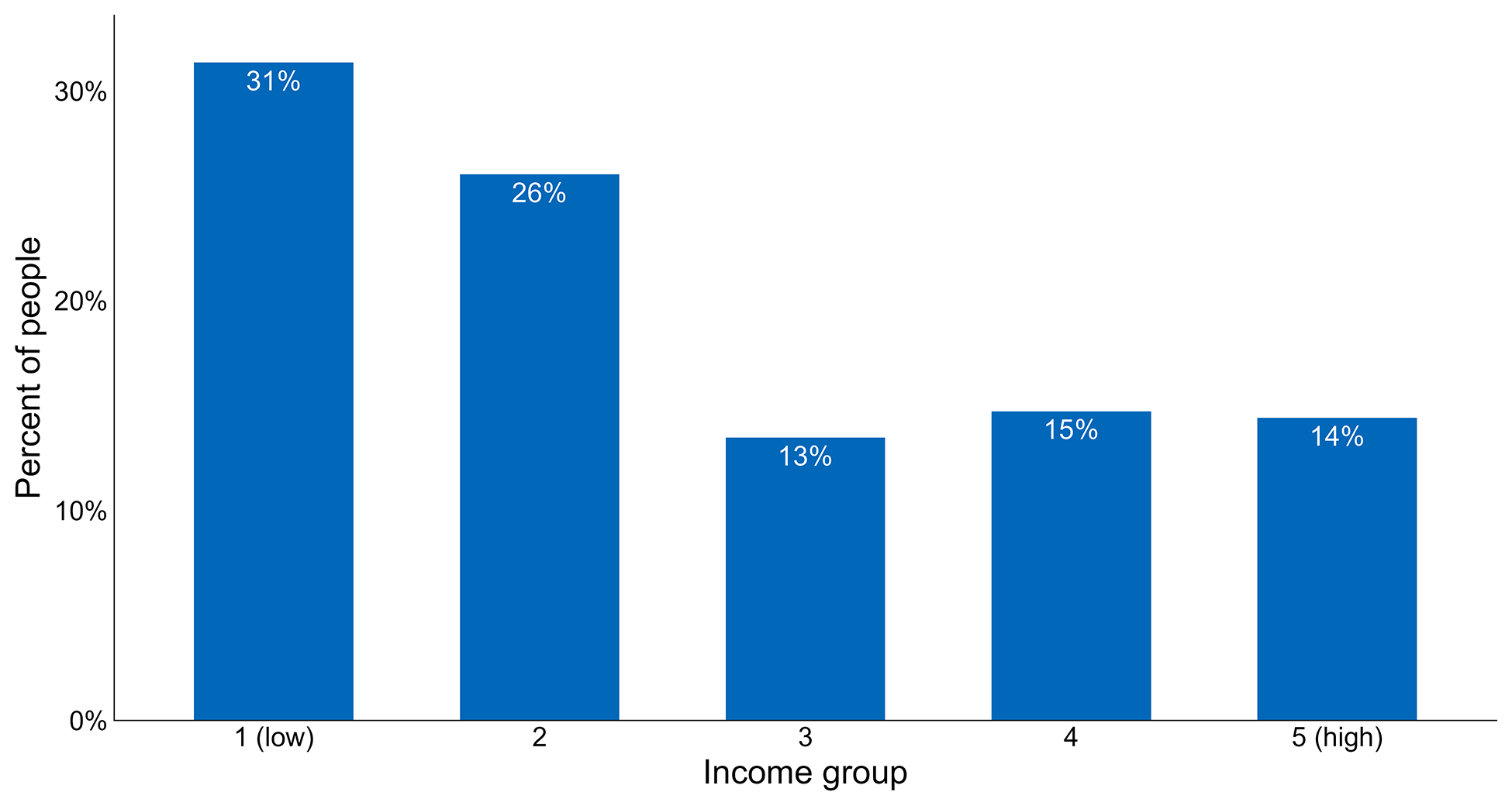
ALS = amyotrophic lateral sclerosis.
Note: Income groups are based on the person’s postal code before admission.
Sources: Continuing Care Reporting System and Integrated interRAI Reporting System – Long-Term Care Facilities.
Palliative Care
Because ALS can progress quickly and is a fatal disease, people with an ALS diagnosis often begin planning for palliative care early in the course of the disease. Depending on province or territory, this care may be available within an ALS clinic, through other areas of the public health systems, or privately. For example, in Saskatchewan, ALS clinics refer people living with ALS to palliative home care as early as the time of diagnosis, given that there are no palliative care physicians within the clinics and individuals cannot self-refer for this service. We heard from clinics in Ontario and Quebec that, for people living with ALS who are physically unable to leave bed and need care at home, there are not enough palliative care workers to support them.
In addition to these services, several palliative care programs and resources exist to provide support to individuals, caregivers, and families in Canada who need or are affected by palliative care (some examples highlighted in Table 6). Palliative care was introduced in 2017 as a credentialed specialty in Canada; current specialist numbers are very low in most jurisdictions and do not reflect the availability of physicians providing palliative care.147 An Ontario study found that 40% of people living with ALS received a palliative physician home visit in the last year of their life.148
Table 6: National Palliative Care Programs and Resources
Organization | Description of program or initiative |
|---|---|
Palliative Care Coalition of Canada149 | 30 national organizations working to improve palliative care through collaborative, well-funded, sustainable strategies for hospice, palliative, and end-of-life care |
Pallium Canada150 | Registered charitable organization working to improve quality and accessibility of palliative care through educating health systems and health care organizations |
Canadian Hospice Palliative Care Association151 | Registered charitable organization working to ensure equitable access to quality palliative care through education, raising awareness, influencing public policy, and collaborating with provincial hospice palliative care associations |
Canadian Virtual Hospice152 | Web-based platform through which people without access to palliative care specialists can ask questions of specialists and find resources related to managing symptoms, caregiving, and financial benefits |
Canadian Grief Alliance153 | More than 170 health organizations, professionals, and members of the public advocating for a proactive approach to support grieving Canadians through engagement with policy- and decision-makers |
End of Life
Time From Diagnosis to Death
In our analysis of people with ALS diagnosed between 2018 and 2025 from 7 provinces in the CNDR, 295 of 681 people (43%) died (detailed methods in Appendix 4). The average time from diagnosis to death was 21 months (1.8 years), which may be lower than the true value because people diagnosed more recently have not been followed as long in the registry (data shown in Table 44 in Appendix 4). Among people with an ALS diagnosis who died, 75% died within 28 months (2.3 years) of diagnosis. Time from diagnosis to death was similar across provinces (data shown in Table 44 in Appendix 4).
In the current analysis, people living with ALS may be living longer after diagnosis compared to a prior analysis of people living with ALS in the CNDR in 2012 to 2017, although data were not directly comparable.24 Potential reasons why people living with ALS may be living longer could include earlier diagnosis, creation of multidisciplinary ALS clinics, increased availability and use of disease-modifying therapies, differences in the subset of people living with ALS captured in the registry over time, improvements in data capture over time, and the targeted recruitment of people receiving drugs for ALS after 2022 in some clinics.
Medical Assistance in Dying
MAID is an end-of-life care consideration for people with ALS. Data on the proportion of people with ALS who receive MAID in Canada are limited. In 1 ALS clinic in Alberta, approximately 1 in 5 patients (20%) died with MAID between 2019 and 2024.154 Across Canada, in 2024, 450 people with ALS died with MAID at a median age of 70 years, accounting for 3% of all people who received MAID and 20% of people with a neurologic condition who received MAID.155 This reporting is based on data submitted to Health Canada by provincial and territorial health officials, physicians, nurse practitioners, pharmacists, and pharmacy technicians.155
Experiences in Canada: Challenges and Opportunities
People living with ALS may experience difficulties accessing LTC related to the availability of desired setting, wait times, and high costs. Different provinces and territories have different types of homes with different enrolment procedures, as well as wait times that can average 3 months to 2 years, depending on the region.156 In Alberta, home care services or primary care practitioners can refer people living with ALS to LTC. As of 2026, 50,000 people are waiting for an LTC home in Ontario, and 50% of those entering a home have waited more than 6 months.157 In British Columbia, it has been reported that 7,000 people are waiting for LTC, and the average wait time is 10 months.158 For people living with ALS, this wait time may be too long, given their prognosis. People living with ALS who are experiencing poverty may not be able to afford these homes, depending on what kind they choose; private options may cost $1,300 to $6,000 per month in Canada.159 Many LTC homes also have health human resource challenges, such as staff retention, the need for more personal support workers and nurses, and the need to account for increased hours of care required by residents.157
We heard from clinical experts that another challenge that people living with ALS face when considering LTC is that LTC systems may not be able to accommodate patients with complex care needs, such as mechanical ventilation machines and professionals (e.g., respiratory therapists) who have the experience to operate these machines safely.139 Across Canada, it is unlikely for people living with ALS who require these sophisticated machines to be accepted into LTC; this may result in emergency department visits and preventable hospital admissions.139 Some provinces have complex care facilities that can provide this level of support, such as Bruyère Health in Ontario160 and Riverview Health Centre in Manitoba.161 However, this level of care is not available in all provinces, and there are few locations that support people who require mechanical ventilation.139 We also heard from clinical experts that funding and management of ventilation devices can vary by setting (i.e., home or LTC). For example, some provincial programs may not be able to continue covering the cost of ventilation equipment if a person living with ALS moves from their own home into an LTC home.139 As few LTC homes are able to accommodate ventilators and the staff training to manage them, people living with ALS may need to transfer to LTC but pay for their equipment out of pocket, remain at home with their publicly funded ventilator but without a health care professional to assist them, or rely on acute care settings (e.g., hospitals) for an extended period of time.139 We heard concerns from the ALS community that people with ALS may die in the intensive care unit in a hospital or ask for MAID because they were unable to reside in their own homes and LTC homes were not a feasible option.
Overall, people living with ALS may be faced with a challenging situation in which access to an LTC home is limited by geographical distance, cost, wait times, or an LTC home’s ability to accept people with complex respiratory needs. At the same time, staying in their own homes with their own equipment is hindered by inadequate respiratory therapist or caregiver support to manage their respiratory devices and other needs. This may lead to people living with ALS requiring emergency department visits and hospital admissions, putting a strain on them, their families, and health care systems. There is an opportunity to consider how advanced respiratory needs can be improved to support people living with ALS as their care needs advance.
Interventions in Development for ALS
Several ALS research initiatives are being conducted internationally and within Canada to understand ALS and find treatment options.
Drug therapies in development have varying drug target classes, drug modalities, and routes of administration. Many of the identified drugs were initially developed for the treatment of other diseases.
Nondrug interventions in development include assistive devices and robotics to enhance body functions, fluid biomarkers and neuromuscular imaging for diagnosis and prognosis, magnetic stimulation for measuring brain function, and machine learning and artificial intelligence (AI) models for assisting with all stages of ALS. While these interventions may show promise, further research is needed to establish their effectiveness, feasibility, and applicability for widespread use.
Across Canada, a range of research initiatives are under way to investigate the origins of ALS and find improvements for diagnosis, treatment, and quality of life. These initiatives include grants and funding, clinical trials, and research studies; many initiatives remain in early stages of development, and their future availability is currently unknown.
As new therapies are being developed, drug administration and genetic testing will be additional considerations for resource and infrastructure planning for health systems.
Access to interventions in development is currently limited by several factors, such as delayed diagnosis leading to ineligibility, limited awareness of active clinical trials, and financial and geographic barriers to trial participation.
This section provides an overview of ongoing research in ALS, focusing on interventions in development for ALS, the research landscape in Canada (including grants and funding initiatives, ongoing clinical trials, and other research studies), and potential health system implications for adoption of new interventions. Interventions in development are new or investigational drugs, devices, technologies, supportive programs, and multidisciplinary care for people living with ALS that have potential for impact in Canada. These may include interventions in late-stage development that have not received regulatory approval, and those that have been approved or are available for clinical use but have had limited application. The information in this section is intended to highlight the types of therapies that may impact future clinical practice, recognizing that their market approval and implementation remain uncertain. We also provide an overview of some research initiatives taking place across Canada that aim to broaden our understanding of ALS and how to diagnose, monitor, and treat it. Although specific examples of technologies, ongoing clinical trials, and other initiatives are provided to illustrate interventions in development, these examples are intended for general awareness, are not exhaustive, and do not represent endorsements by CDA-AMC.
Information in this section was summarized using input from people living with ALS, ALS in Focus Advisory Group members, and literature searches.
Drug Therapies
Patient groups have expressed to CDA-AMC that there is a significant unmet need for more treatment options.19 People living with ALS have reported a desire for a treatment that would slow or halt disease progression, maintain or improve function, reverse symptoms, and extend survival.19 By scanning narrative reviews identified from a literature search, we identified several drugs in development internationally that have published findings on clinical effectiveness and/or safety. Additional details are provided in Table 58 in Appendix 11.
The identified drugs in development cover a variety of drug target classes (i.e., biological molecules in the body that the drug interacts with to produce an effect) and drug modalities (i.e., type or class of therapeutic agent), highlighting the diversity of treatments in development for people living with ALS. Several identified drugs use administration methods other than oral or IV delivery, including intramuscular injection and subcutaneous injection. Some of the identified drugs under investigation (which have published findings on clinical effectiveness and/or safety) are continuing to be assessed in active trials (e.g., masitinib in NCT03127267162 and NCT07174492163) or have additional trials announced (e.g., PrimeC [combination celecoxib-ciprofloxacin]).164
Nondrug Interventions
Alongside pharmacological therapies for ALS, nondrug interventions are becoming more available to people living with ALS to detect ALS earlier, slow disease progression, and improve quality of life by providing increased mobility. Table 7 provides examples of these interventions. Research is needed to ensure these interventions are effective and feasible enough to be used widely.
Table 7: Potential Impact of Nondrug Interventions in Development
Intervention | Description | Potential impact in care for people living with ALS |
|---|---|---|
Neuroprosthetics, assistive devices, and robotics | Neuroprosthetics are devices that enhance or restore the body’s functions; they receive neural signals from the brain, process them, and translate them to outputs, such as prosthetic limbs or cochlear implants.165 Custom assistive devices can be created by 3D printing, which is a tool that creates 3D objects from various materials, including plastics, metals, and biological materials.166 Robotics, exoskeletons, or robotic exoskeletons can help people with body movements that have been restricted by weakness or loss of function.41,167 | In ALS care, neuroprosthetics and brain-computer interfaces are designed to help people living with ALS communicate more effectively. Brain-computer interfaces use implanted electrodes in the brain to translate electroencephalographic activity from a computer into words.63 This can allow people living with ALS to save time when communicating and to complete routine activities that were previously challenging, such as typing.168 3D printing, as well as robotics, exoskeletons, and robotic exoskeletons, can be used to help those living with disabilities by providing a more individualized approach to creating protheses, orthoses, and other tools to help with movement.169 For example, people living with ALS can have more customized assistive devices to provide them better support. |
Neurofilaments and fluid biomarkers | Neurofilament light chains are proteins that are released into cerebrospinal fluid and blood plasma when neurons become damaged.170 | In ALS care, neurofilaments are currently being used in Europe in clinic settings as a tool for diagnosis together with other diagnostic tests, and for prognosis. In Canada, they can be considered developing interventions for diagnosis and prognosis. As a potential prognostic biomarker,a they may be able to detect levels of neurofilaments to indicate how fast the disease is progressing.171 Neurofilaments may be able to measure how ALS is being treated in an individual and may provide more support to a person so that they can get the care they need based on their stage of ALS progression. |
Neuromuscular system imaging | Imaging technologies, such as MRI and PET, are used to visualize structural changes in people with neurologic disorders.172,173 | Currently, MRI is being used to rule out other diseases in the ALS diagnostic process. MRI and PET can also be used as prognostic biomarkers by quantifying shrinkage in brain areas of people living with ALS to determine how fast the disease is progressing.174 Neuromuscular imaging may help specialists determine appropriate treatment pathways for people living with ALS based on their stage of ALS progression. |
Transcranial magnetic stimulation | Transcranial magnetic stimulation is a noninvasive technique used to provide magnetic pulses to the brain.175 | In ALS care, transcranial magnetic stimulation is being investigated to reduce motor neuron hyperexcitability.176,177 If found to be effective, transcranial magnetic stimulation may improve neurochemical balances in the brain and slow disease progression.178 |
Machine learning or AI | AI and machine learning are tools that can simulate human intelligence, learn patterns from data, and solve problems.179 | AI and machine learning may be used to augment assistive tools, such as voice cloning technology. AI and machine learning may also be applied to diagnostic tools to provide faster detection of ALS, prognostic tools to provide faster detection of disease progression, and therapeutic methods.180,181 |
AI = artificial intelligence; ALS = amyotrophic lateral sclerosis.
aA biomarker that is used to identify the likelihood of disease recurrence, progression, or a clinical event in patients who have the disease.182
Canadian Research Landscape
Across Canada, there are several ALS initiatives with researchers working collaboratively to pursue advancements in ALS care. These research initiatives range from large, nationwide clinical trials to smaller-scale graduate student projects. Overall, research initiatives aim to study the causes of ALS, as well as treatments and tools to improve the quality of life of people living with ALS in Canada. In this section, we showcase some of these projects occurring across Canada. In comparison to the drug and nondrug interventions in development described previously, the interventions highlighted in this section are specific to Canada. They are also early in development and have little effectiveness data available, and the likelihood of future availability in Canada is unknown.
Grants and Funding Initiatives
Many research initiatives are made possible because of grants and funding provided to organizations and researchers. For ALS research, grants and funding can be provided by a variety of sources, including ALS societies, charities, and various levels of government in Canada. Table 59 in Appendix 12 provides examples of ALS grants and funding in Canada.
Clinical Trials
We identified several clinical trials assessing interventions for ALS in Canada. These trials include drug, nondrug, and other supportive interventions. Some trials are investigating new interventions and others assess expanded uses of existing ALS drugs, including tofersen for people who have a mutation in the SOD1 gene but are not presenting with ALS symptoms. Our advisory group noted that if the clinical trials show that tofersen is effective for presymptomatic SOD1 ALS, it could lead to improved outcomes for people living with ALS, as starting tofersen earlier could lead to better health outcomes. Table 60 in Appendix 12 provides a more detailed list of identified clinical trials with locations in Canada.
Research Studies
Beyond clinical trials, there is ongoing interest in ALS research in Canada in the form of observational studies, graduate student projects, and nationwide database projects. Table 61 in Appendix 12 provides more details on these collaborative research initiatives.
Health System Considerations for New Interventions
Accessing Clinical Trials
In engagement sessions with people living with ALS, some described accessing ALS treatments under investigation through clinical trials. In our analysis of registry data (from the CNDR) among 681 people living with ALS diagnosed between 2018 and 2025, 19% had participated in a clinical trial; however, this may not be representative of the broader population of people living with ALS in Canada, given that clinical trial participation may not be comprehensively captured in clinical records and given the targeted recruitment of people receiving drugs for ALS in the registry. In engagement sessions with people living with ALS, they reported that they expect that most people living with ALS would want to participate in trials due to the limited number of treatment options for ALS, with the hope that the treatments under investigation might help manage their symptoms and/or slow or halt their disease progression.20 However, several factors may hinder participation in clinical trials for people living with ALS, including:
geographic barriers (i.e., distance from ALS clinic or research centre183)
clinical trial eligibility criteria
diagnostic delays
limited trial spots; a member of our advisory group reported that the number of people living with ALS far exceeds the number of trial spots available in Canada.
Access to clinical trials may be impacted by the location where a person living with ALS resides. Clinical trials in Canada are largely concentrated in urban areas. Most active clinical trials for ALS are available in Quebec and Ontario, while a few are available in Saskatchewan and Alberta (refer to Table 61 in Appendix 12). In engagement sessions, people living with ALS reported that some provinces do not offer clinical trials, and that there are limited spots.20 While we identified 23 active trials for ALS in Canada at the time of writing this report, this represents approximately 10% of the ALS trials being conducted worldwide. Investing in more clinical trials for ALS in Canada could improve access to treatment for people living with ALS.
Another barrier reported by people living with ALS was clinical trial criteria. Our advisory group, as well as people living with ALS who spoke to CDA-AMC, reported that many ALS clinical trials exclude people living with ALS who have had symptoms for more than 2 years, and based on FVC thresholds (e.g., FVC ≥ 80% of the predicted value). A systematic review with meta-analysis found that most people living with ALS would not qualify for clinical trials, with an average of 60% being excluded from participating.184
Diagnostic delays have implications for access to clinical trials, given these eligibility criteria, yet people living with ALS reported that receiving an ALS diagnosis takes an average of 1 year. This was further supported in our analysis of the ALS registry held within the CNDR, where the average time from symptom onset to diagnosis was 15 months, 85% of people living with ALS were diagnosed within 2 years of symptom onset, and 51% of people living with ALS had an FVC greater than or equal to 80% of the predicted value at diagnosis (refer to Table 43 and detailed methods in Appendix 4). Estimates from the CNDR may not be representative of the broader population of people living with ALS and may overestimate the proportion of people diagnosed with ALS within 2 years of onset, and proportion with FVC greater than or equal to 80% of the predicted value, due to the targeted recruitment of people living with ALS receiving drugs for ALS after 2022 in some clinics. Therefore, it is possible that fewer people living with ALS would meet common clinical trial eligibility criteria than estimated based on data from the CNDR.
Other barriers to accessing clinical trials reported in the literature include:
burden of in-person visits183
rapid disease progression185
logistical barriers (e.g., transportation access, internet access, language barriers, need for a caregiver to attend research visits)183
costs (e.g., to travel to research centres).185
Demand for Genetic-Based Therapies
Researchers have discovered more than 40 genes linked to ALS,27 and ongoing research is investigating other potentially linked genes.19 If treatments are developed for these newly discovered genetic variations, this may increase demand for genetic testing and genetic-based therapies. Demand may also increase with expanded uses for existing genetic-based therapies (e.g., researchers are currently assessing tofersen for presymptomatic ALS among people with the SOD1 mutation186). As a result, people living with ALS will require increased access to genetic testing services, including expansion of the gene panel for testing.
The use of genetic-based therapies has important potential implications for health systems. Timely genetic testing supports people living with ALS in accessing specialized treatments that require prerequisite genetic testing and potentially facilitate earlier participation in clinical trials. As more people living with ALS seek genetic testing, demand may strain existing genetic services (e.g., neurologists with genetic expertise, genetic counsellors, and laboratory expertise and capacity), potentially leading to longer wait times to access treatments.
Differences in access to genetic testing and counselling across jurisdictions — which is often limited in rural, remote, and First Nations, Inuit, and Métis communities — can raise concerns about potential differential access to genetic-based interventions in development for ALS. For example, access to clinicians who can provide referrals for genetic testing is not readily available to people living with ALS across all provinces and territories. People living with ALS from some parts of the country also experience lengthy approval processes and complex testing procedures that require genetic samples to be shipped to the US. These geographical variations may lead to delayed access to treatment and additional support services. As new genetic-based therapies are being developed, this highlights the need for increased health system coordination and planning to adjust for the potential increases in demand.
Health System Capacity Considerations
Drug Route of Administration
The way that drugs are administered has implications for health system capacity planning. Drug administration determines the level of clinical support, resources, and infrastructure involved in treatment delivery.
Drugs that require administration in specialized clinics (e.g., IV infusions, intrathecal injections) require trained health care professionals to administer them to patients. These therapies also require increased training requirements and other physical resources (e.g., specific storage for the drugs, tools needed to administer the drugs). For example, tofersen, which is given intrathecally, increases demand for specialists’ time, clinic space, equipment, and postadministration monitoring. Tofersen administration requires an exam room, a sterile lumbar puncture kit, pharmacy cold-chain storage, and specialist time (e.g., neurologists, anesthesiologists, radiologists).70 Our advisory group noted an appointment for tofersen administration would be at least 2.5 hours to 3 hours, including 1 hour for preparation before the injection and 1 hour after the injection. They expressed that it can be challenging for people living with ALS to find a clinic and clinician who can provide the monthly injections.
Drugs that require administration in a specialized clinic may impact the overall quality of life for people living with ALS and their caregivers, as they require travel to specialized clinics and physically burdensome procedures. Our advisory group noted that specialists who provide intrathecal treatments could face a surge in the volume of patients:
if tofersen use expands (e.g., to people who have a mutation in the SOD1 gene but are currently not presenting with ALS symptoms)
as new drugs are developed that are effective for ALS and need intrathecal administration
as people living with ALS live longer.
While intrathecal administration can be done by any clinician trained in lumbar puncture, increased demand for intrathecal administration could lead to logistical challenges, particularly in areas that have limited access to clinicians proficient with lumbar puncture as well as other resources (e.g., specialty pharmacies). In contrast, drugs that can be self-administered at home may have less impact on health system capacity and may support overall quality of life for people living with ALS. However, they may also require additional patient support and education.
As new therapies are being developed, drug administration will be a key consideration for resource and infrastructure planning for health systems. Capacity challenges are most likely to arise from the expanded use of existing therapies that require complex treatment administration (e.g., tofersen). The physical resources needed to administer these drugs may increase overall costs and complexity for the health systems, highlighting the need for increased health system planning and coordination.
Imaging Capacity
As with other diseases for which new interventions are in development in Canada, some new interventions for ALS will involve using existing diagnostic tests (e.g., MRI, PET) in novel ways (e.g., for prognosis). This can require health care systems in Canada to increase capacity as the demand for imaging increases. Current staffing shortages may affect the use of MRI and PET for both diagnosis and prognosis, if the number of staff who are involved in imaging does not grow with the increasing demand for exams; this may lead to longer wait times for people experiencing ALS symptoms.
Cost of New Interventions
For people living with ALS who have lower incomes, the cost of new interventions may be a significant barrier to access. Not all people living with ALS may be eligible for drug reimbursement through publicly funded drug programs, in which case other avenues for drug access could include private insurance, out-of-pocket payments, and patient support programs. As observed in the drug utilization analysis presented in the previous section of this report, where higher incomes were associated with greater receipt of ALS drugs (Figure 6), this reliance on alternative pathways may introduce equity concerns, which may persist or increase with the introduction of newer therapies. In addition, supportive care interventions like augmentative and alternative communication devices or new housing solutions may not be reimbursed by federal or provincial insurance plans. It should be clear whether people living with ALS would be expected to pay out of pocket for new interventions, and strategies to improve access may need to be considered to ensure interventions are equitable.
At a systems level, new interventions, programs, and devices may also lead to significant costs for health care systems (e.g., related to resources for implementation and supporting infrastructure). The value for money of any new intervention would need to be considered alongside other health care budget priorities.
Geographic Access to New Interventions
People living with ALS in urban centres may have improved access to certain new interventions compared to those living in rural or remote communities. For example, neuromuscular system imaging and 3D printing devices may be more likely to be available in urban hospitals with the capacity to house and pay for technologies; they will likely not be available in rural hospitals and clinics. People living with ALS may have to travel to urban clinics to access new interventions. In addition to geographic disparities, these new technologies may place additional financial, physical, and time burdens on caregivers who are often responsible for travel arrangements.
Usability of New Interventions
Many new interventions are complex and will require training and education if introduced in Canada, not only for people living with ALS but also for caregivers, to ensure appropriate use. For example, learning how to use brain-computer interface devices may pose a significant challenge for clinical teams and people living with ALS who have not used them before. This access barrier could be magnified when taking language and knowledge barriers into consideration. Depending on the intervention and how it was designed, some people living with ALS and their caregivers may be at an advantage or disadvantage when using a certain device (e.g., if they speak the language that the device was created in, or if they have a level of technical understanding needed to use the device). To ensure equitable access to new interventions, these factors will need to be taken into consideration.
Social and Ethical Considerations
ALS clinic coordinators, ALS societies, and caregivers play a critical role in making the ALS care pathway function as intended. Their work helps to coordinate care across different practitioners, resolve practical challenges between health care systems, and sustain LTC for people living with ALS. Although it is valuable, overreliance on this connective work may also create inequities when care depends so heavily on the availability of caregivers, the local knowledge and advocacy of clinic coordinators, and the ability to access resources provided through ALS societies.
Timing is part of what makes ALS care usable. Supportive care must often be arranged before needs are fully present, because waiting until a need is obvious can mean care arrives too late to preserve what it was meant to support. At the same time, decisions made in advance need to remain open to revision, as people living with ALS and their caregivers may understand interventions and treatment goals differently as ALS progresses.
Choices in ALS are not isolated or 1-time decisions. Decisions about treatment, supportive care, or end-of-life care become part of care arrangements that need to be sustained, adapted, or reconsidered as ALS progresses. Supporting people’s ability to make choices regarding their care therefore depends on whether the surrounding care pathway can deliver what follows from those decisions.
Care in ALS extends beyond the formal availability of services. Decision-makers may want to consider whether the care pathway reduces, or instead depends on, the extra work required for people living with ALS and caregivers to turn available services into usable care.
Overview
ALS raises several ethical considerations across the care pathway, including diagnosis and treatment access, advanced care planning, caregiver support, palliative care, and end-of-life decision-making.187,188 Rather than treating these as separate issues, this section considers the ethical considerations associated with the ALS care pathway itself.
Previous sections described how ALS care is organized in Canada, including where people living with ALS and caregivers encounter delay, fragmentation, and uneven access to care. These encounters are not simply gaps in care. They also reflect challenges in how services, settings, responsibilities, and supports are arranged across the care pathway. A service may exist, or a technology may be available, without being usable for people living with ALS and caregivers as they try to live with changing function, make decisions, and plan for the future. This section considers what these arrangements make possible or constrain, and how responsibility for coordinating and sustaining care is distributed.
To inform this work, we have drawn on a relational ethics approach that understands personhood, autonomy, and justice, as shaped through relationships and social conditions. From this perspective, people’s ability to live and make decisions is shaped by social relationships, material conditions, institutional arrangements, and policy decisions, rather than by individual preferences alone.189 This framing is especially useful in ALS, with which decisions about care are made as functioning changes, communication may become more difficult, caregiver involvement often intensifies, and responsibility for care is distributed across clinics, homes, community services, and care settings.
ALS Care Depends on Connective Work Across the Pathway
The care pathway described throughout this report and detailed in Figure 1 helps make the complexity of ALS care across Canada visible. It clarifies key stages, health care professionals, services, and supports across the ALS trajectory that need to be examined when considering how best to support sustainable system planning in the context of evolving ALS care needs and therapeutic options. As thorough as Figure 1 may be, however, it cannot fully account for the work required to make various elements of that pathway connect and function as an integrated care pathway. In ALS, much of the pathway is made in these connective spaces.
Some of the work happening across the care pathway is publicly funded and formally recognized. Specialized ALS clinics employ clinic coordinators (and, at times, social workers) who connect people living with ALS to the necessary services within the clinic itself and in the larger health care systems. However, according to ALS clinic coordinators consulted for this report, this is not as simple as filling out referral forms or scheduling appointments, especially in the context of care provided outside of the ALS clinic. When describing the challenge of connecting people living with ALS to services that exist outside of specialized clinics, coordinators emphasized the translational work required to fit the complex and progressive care needs of people living with ALS into eligibility criteria and referral streams created with different needs in mind. As 1 coordinator put it, “It’s not just the disease. It’s the system that does not support a disease like ALS, which is an outlier and doesn’t fit in the other boxes they’ve designed.”
ALS is not the only progressive, rare, or complex condition that can strain service pathways. However, ALS clinic coordinators used the term “outlier” to describe how intensive ALS-specific needs cut across categories organized with a broader mandate than ALS-specific care, including home care, equipment access, and LTC. These services may each have their own thresholds of urgency, eligibility, funding, and staffing, all while ALS can require several of them to respond together and within a shorter or less predictable time frame. ALS clinic coordinators suggested that making ALS fit within these different pathways may require them to leverage personal relationships with community service providers and to develop a comprehensive understanding of the multiple home care processes, equipment pathways, and service streams that exist across their catchment areas. This work sits between the clinic and the wider health care systems controlling (at least in part) whether treatment, equipment, or support becomes usable in time. While this may well be the responsibility of their role, relying on an individual coordinator’s personal capacity and knowledge rather than consistent and structurally reinforced procedures can create challenges if that particular individual leaves their role (temporarily or permanently).
Charitable ALS societies also act as visible components of the connective tissue surrounding ALS care pathways. They are important sources of support equipment, advice on system navigation, peer support, and other practical resources.190 While they provide services free of cost to people living with ALS and their caregivers, ALS societies are variably located throughout Canada and may not always be accessible to people living in rural or remote locations. Their role can be valuable, while also making visible how much of ALS care becomes usable outside formal clinical encounters and publicly funded service delivery.
Caregivers are also deeply entrenched in the connective work of existing ALS care pathways. Patient group input indicated that caregivers may support daily care, medical equipment, appointment logistics, transportation, communication, emotional support, and coordination as ALS progresses.19 These tasks are not simply added to family life; they can reorganize it. Caregivers may become responsible for sustaining the practical conditions of care while also trying to remain present as spouses, partners, adult children, parents, siblings, or friends.81-84
In neurodegenerative illness, care can be part of how people living with ALS and caregivers preserve shared life, identity, intimacy, and continuity as the disease changes what daily living requires.191 At the same time, ALS caregiving can involve morally difficult work: interpreting wishes; supporting communication; managing distress; and participating in decisions about feeding, ventilation, medication, and end-of-life care.82 When care is provided at home, family members may also find the home increasingly organized around clinical needs, even as they try to preserve it as a familiar and personal space.192
Framing these demands only as “caregiver burden” can obscure how much of the pathway depends on caregivers as informal infrastructure. As caregiver work occurs through family or close personal relationships, it can be treated as a natural extension of love or obligation. Published literature suggests that recognizing and supporting caregivers can still leave the assumption intact that families and friends will continue to provide care.193 When caregiver capacity is absent, limited, or exhausted, the person living with ALS may not simply receive less informal support. Their ability to access, sustain, and act on formal care may also be weakened.
A pathway that relies heavily on connective work will not operate the same way for everyone. People living with ALS differ in whether they have a caregiver, whether their home can be modified, whether travel to a clinic is possible, whether equipment is available when needed, and whether someone can continue pursuing services through administrative barriers. Under these conditions, the formal availability of services may translate into very different possibilities for living with ALS, depending on who is available to make the pathway work.
Timing Shapes What Care Can Mean
ALS care often must reach toward a future that people living with ALS and caregivers may not yet be ready, or able, to inhabit.19,194,195 People may need to consider equipment, home care, communication supports, feeding tubes, respiratory interventions, and palliative care before those needs are fully present. This anticipatory work is not only about planning ahead, but also about creating enough room for people living with ALS and caregivers to continue living in the present while not losing access to supports they may soon need.194-196
ALS clinic coordinators engaged for this report described anticipation as a core element of ALS care. One coordinator described referring people living with ALS into palliative home care pathways before palliative care had necessarily been discussed in depth, because this placed them in “the right stream” for services they were likely to need later. Another described a similar approach to occupational therapy in rural communities, where a person may not need support immediately but may need it within weeks. As 1 coordinator explained, “You might not need it right now, but like if you’re going to need it in eight weeks, we’re going to put it in now so you’re not waiting.” In this sense, looking ahead is not a failure to respect the person’s present. It is 1 way of trying to keep the future from arriving only as a crisis.
The difficulty is that service pathways may not recognize urgency in the same way ALS care does. One coordinator described equipment access as connected to home care registration. If a person living with ALS was referred because they “just” needed equipment, the referral could be routed into a lower-urgency stream, even when the equipment was needed to prevent falls and could be “life or death” for some people living with ALS. The coordinator then had to monitor the referral, pull it back, make calls, and find ways to secure a home safety assessment. The delay was not simply a matter of waiting, but a reflection of a mismatch between how a program classified need and how ALS made that need urgent.
Patient group input indicated that people living with ALS may increasingly rely on assistive devices and home adaptations as functional limitations progress.19 These supports are often described in practical terms, but their role is not only practical. Work on ALS and home modifications has shown how adaptations to the home environment can be tied to independence, social participation, and the ability to continue inhabiting one’s home as part of ordinary life.195 In ALS, equipment and adaptations may therefore help preserve a way of living that the disease is already beginning to threaten. If access depends on the wrong category, stream, or threshold of urgency, support may arrive after the possibility it was meant to protect has already narrowed.
At the same time, people living with ALS may focus on the present and on decisions that have direct meaning for daily life, while health professionals may focus on an uncertain future and the losses they know can come quickly.194 Neither orientation is wrong. The tension is part of ALS care itself. People living with ALS and caregivers need space to live with what is happening now, while health care professionals and systems need to keep enough of the future in view to make future, timely care possible.
This also means that preferences and goals cannot be treated as settled at the moment an intervention is first discussed. A feeding tube, for example, may be experienced at 1 point as an unwanted sign of decline, and at another as a way to reduce the work of eating, conserve energy, or continue living in a way that feels acceptable. Although it is possible that people living with ALS may never come to want interventions they initially refused, keeping space for them to change their minds recognizes the reality that ALS progression continually shifts the frame in which they are making their decisions. What feels frightening, burdensome, useful, dignified, or worth pursuing may shift as daily life changes.196
Advanced care planning and early palliative approaches can help people living with ALS and caregivers prepare for future decline, clarify values, and avoid decisions made only in crisis.197-199However, planning only supports people living with ALS and caregivers if they can return to those decisions as needs and meanings change. Care that arrives too late may still be formally available, but it may no longer support the form of living that it was meant to make possible. Care that arrives early but cannot be revisited may also fail to support people well, because the meaning of an intervention can change as ALS changes the life around it. Where support exists, hospital-based ethicists can offer decision support for people living with ALS, their families and caregivers, as well as clinical teams grappling with ethical complexities and uncertainties. However, according to input from the ALS in Focus Advisory Group, access to ethics services in hospitals remains highly heterogeneous across Canada.
Meaningful Choice and Livable Conditions
If ALS care requires anticipation, ALS clinic coordinators and published literature indicate that it may also require humility about what anticipatory decision-making can resolve on its own. Choices in ALS do not end once an option has been selected or a preference has been documented. A decision becomes part of an ongoing care arrangement that must be sustained across changing bodies, relationships, technologies, and care settings.194-196 In this sense, meaningful choices may depend not only on whether options are available, but also on whether the pathway can support what follows from those choices over time.189,196
Respiratory support makes the connection between choice and care arrangements especially visible. ALS clinic coordinators described how respiratory equipment that was available in the community could become difficult to access if a person moved to LTC or hospice. In some cases, this reflected differences in funding arrangements or uncertainty about which part of the system was responsible for obtaining, maintaining, and paying for equipment as care moved between one’s home, a hospital, LTC, and hospice. When no setting or funding pathway clearly holds this responsibility, the cost and coordination burden may fall to the person living with ALS or their caregivers. In other cases, care settings lacked the staffing or respiratory expertise needed to support people living with the complex respiratory needs associated with ALS. The device has not changed, but the care arrangement has. Respiratory technology that helps sustain life may become a funding problem, a staffing problem, an admission barrier, or a caregiving responsibility when care moves across settings. As such, the choice to use respiratory support is not only a choice about a device. It is a choice that may impact whether later parts of the pathway can continue to support the life that device makes possible.
As ALS clinic coordinators explained, when latter parts of the pathway cannot support this care, the consequences can be significant. Families may be left to fund respiratory equipment themselves when an LTC facility is unable to do so. Some people living with ALS may be admitted to and remain in hospital because other settings cannot support their respiratory needs, including people who ultimately die there. Others may consider MAID if the alternatives are a hospital or LTC, or another setting that cannot support the care arrangement they need or would find acceptable. This is not an argument against MAID, nor does it invalidate people’s choices to pursue MAID. Rather, it underscores the importance of understanding end-of-life choices within the broader care landscape in which some options may be easier to access, support, or sustain than others.
Across these examples, choice is not absent. Rather, the available choices become uneven. A relational account of autonomy helps name what these examples show: people’s ability to choose is shaped by social relationships, material conditions, institutional arrangements, and policy decisions, not by individual preference alone.189 In ALS, respecting choice therefore requires more than offering options or documenting preferences. It requires attention to whether the pathway can support what follows from the decision. This shifts attention from whether a care option is available in principle to whether conditions around that option allow it to remain usable, sustainable, and meaningful as ALS progresses.
Access to Care for ALS Extends Beyond Formal Availability of Services
ALS is often discussed in relation to the urgent need for effective treatments, clinical trials, and research innovation. These remain important, particularly when people living with ALS have described that available therapies may offer limited benefit,20 and when emerging interventions may create new expectations for diagnosis, referral, genetic testing, reimbursement, and access to specialized care. Patient group input indicated that people living with ALS value treatments that may slow progression, maintain function, prolong life, and extend time with loved ones, while also emphasizing symptom management, supportive therapies, and the “best possible quality of life.”19
This section has focused on what allows those possibilities to become livable in practice. Access to a treatment that slows disease progression, a device that supports breathing, a communication aid that preserves participation, or a care plan that enables someone to remain at home all depend on arrangements that extend beyond the intervention itself. They depend on whether care can be coordinated across settings, whether caregivers can be supported, whether equipment can be obtained and maintained, whether health care professionals understand ALS-specific needs, and whether the care pathway can adapt as the disease changes what the person and family require.
A service that requires repeated advocacy, private payment, extensive travel for some, caregiver availability, or local workaround knowledge may technically be available while remaining difficult to use in some of the circumstances where it is needed. Across the pathway, coordination may be produced through unrecognized labour, anticipatory care may depend on care professionals placing people in the right stream before need is fully visible, and choices may depend on whether the pathway can sustain what follows from them.
This is also a question of where ALS-specific capacity is expected to sit. ALS clinics are central sources of expertise, but people living with ALS do not live their illness only in a clinic. Care may move through the home, community services, emergency departments, hospital-based procedures, LTC, hospice, palliative care, complex continuing care, and voluntary-sector supports. These settings may be able to respond to symptoms or care needs shared with other conditions but may not always be equipped for the often-rapid progression and unique needs of ALS.
It may not be realistic or necessary for every setting to hold the same level of ALS-specific expertise as a specialized clinic. However, if ALS-specific knowledge remains concentrated in clinics while much of the work of living, caring, and dying with ALS occurs elsewhere, the pathway can come to depend on how well those settings are connected. Publicly organized care may need to account for what forms of consultation, training, equipment access, respiratory support, human resources, and clinical backup are needed across settings so that people living with ALS are not left without appropriate options when care moves beyond the clinic.
This is not to say that families, ALS clinic coordinators, ALS societies, or community providers should not be involved. Their involvement is central to good ALS care. The question is whether the pathway depends on their capacity to compensate for arrangements that may otherwise be too fragmented, slow, underresourced, or difficult to navigate. ALS societies may provide equipment, navigation, information, peer support, and other resources that people living with ALS and caregivers deeply value.190 Caregivers may sustain daily life, interpret needs, coordinate services, and support decisions in ways no formal system could fully replace. ALS clinic coordinators may use local knowledge and relationships to move people through systems that do not fit ALS well.
Decision-makers will need to consider not only what services are missing, but also how the ALS pathway distributes the work of making services usable, and whether that distribution allows people living with ALS and caregivers to make decisions, prepare for change, and sustain daily life without carrying more of the pathway than they can reasonably manage. Formal availability is an incomplete measure if care still depends on personal advocacy, caregiver capacity, local workarounds, voluntary-sector resources, or private payment to become usable. When that compensatory work depends on household resources, geography, caregiver availability, local relationships, or the ability to persist through administrative barriers, the same formal pathway can create very different possibilities for people living with ALS and caregivers.
Considerations for Policy- and Decision-Making
Summary of Findings
We produced this report by conducting a scan of the literature; by engaging with people living with ALS, their caregivers, ALS clinic coordinators, and ALS societies; and by analyzing Canadian health care and registry data and drug plan market data. This work was informed by an advisory group of experts and people with lived experience (the ALS in Focus Advisory Group). We found information on the ALS clinical pathway (i.e., diagnosis, treatment, and care), organization of care in Canada, interventions in development, and ethical considerations for people living with ALS and their caregivers. This input highlighted the complexity of ALS care in Canada through the following key findings:
ALS symptoms often mimic other conditions, leading to confusion and a lengthy diagnostic process; timely diagnosis is crucial and can dictate a person’s remaining life course, including therapy pathways and end-of-life planning. Data suggest that there have been improvements in the time to diagnosis in recent years. The average time from symptom onset to diagnosis of ALS is 15 months, among those diagnosed between 2018 and 2025.
There are 24 ALS multidisciplinary clinics in Canada where health care professionals with expertise in ALS work together to provide multidisciplinary care. These clinics are generally located in urban centres in southern parts of Canadian provinces, and there is variation in the type of staff available at each clinic.
In Canada, there are 3 disease-modifying therapies for the treatment of ALS, and access to them may vary based on time to diagnosis and public drug plan formulary listing status. People living with ALS can access other supportive therapies through ALS clinics, home care services, or privately; however, there are many out-of-pocket costs associated with these. People living with ALS have expressed the burden of navigating complex reimbursement systems and completing administrative paperwork, as well as challenges accessing drugs that are not available in Canada.
The number of people receiving disease-modifying therapies for ALS has increased over the past 6 years; the proportion receiving these drugs on public drug plans has also increased in the 3 provinces where all drug claims are available for analysis. This was further supported by increases in the proportion of drug costs covered by public drug plans between 2020 and 2024.
Some drugs are complex to administer (e.g., requiring a specially trained clinician), or need testing and/or monitoring. People living with ALS who had received tofersen reported that it slowed down their disease progression, allowing them to spend more quality time with their family; however, it also requires people living with ALS to visit a clinic every 4 weeks for intrathecal administration. People living with ALS have expressed the need for locally available clinics to improve access.
Outside of public health care systems, caregiver labour and not-for profit programs (e.g., ALS societies) are integral components of the ALS care ecosystem; caregivers provide clinical, emotional, and logistical support to people living with ALS, and the 9 ALS societies in Canada have a limited inventory of equipment (e.g., wheelchairs).
ALS care in Canada is not universal. There is inequity in the care people living with ALS in Canada can access based on factors including their geographical location, financial situation, disability status, and whether they have caregiver supports.
Despite the progressive loss of physical function and mental well-being, people living with ALS and their caregivers are expected to move between different parts of the health systems in Canada, which are organized as separate care areas (e.g., acute care, palliative care, respiratory care) but whose services people living with ALS need simultaneously.
People living with ALS can have advanced care needs that often require many resources (e.g., feeding tubes, respiratory machines, LTC homes). These resources require complicated infrastructures to use and access — such as training, maintenance, and accommodations — and the health care systems are not always able to fully address these high-resource needs.
Across Canada, researchers are developing several novel drug and nondrug interventions to improve diagnosis, prognosis, treatment, and quality of life of people living with ALS. More research is needed to establish their effectiveness, feasibility, and scalability for widespread use.
Considerations for Decision-Makers
The following presents considerations for health system decision-makers based on the findings in this report, which are a snapshot of ALS care pathways and organization in Canada at the time of writing this report (2026). Decision-makers can include representatives of federal, provincial, and territorial governments; ministries; health authorities; and service delivery organizations.
These considerations are not recommendations; they are key areas where people living with ALS experience challenges and where policy-makers and health systems can consider how they can improve care for people living with ALS.
Supporting Timely Diagnosis and Referral to an ALS Clinic
Time is a defining pressure across the ALS pathway, and postponing care can have a cascading effect on a person’s ALS care trajectory and reduce therapies’ effectiveness. People experiencing ALS symptoms or who are at risk for ALS (i.e., those who have family members with ALS) need their symptoms to be recognized as soon as possible to start treatment promptly. The average time from symptom onset to diagnosis is 15 months, and this estimate may not be representative of the full population of people living with ALS in Canada.
Considerations for decision-makers to support timely diagnosis and referrals include:
offering more training47 for professionals working in primary care, and general neurologists or physiatrists for what early symptoms look like (e.g., through tools like the ReferALS Early Referral Tool47); improving professional networks between these clinicians and promoting more detailed referral forms can help expedite ALS assessments96
encouraging health care professionals to refer their patients to ALS clinics as soon as there is any suspicion of ALS
improving communication and referrals between health care professionals involved in diagnostic testing.
Providing Equitable Access to Genetic Testing and Counselling
Genetic testing is a critical component in ALS diagnosis and treatment, especially with the advent of genetic-based interventions in development. Improving equitable access to genetic testing and counselling across Canada and streamlining genetic testing processes could facilitate an earlier diagnosis for people living with ALS, which may lead to timelier access to treatments, resources, and support services.
Considerations for decision-makers to support equitable and timely access to genetic testing and counselling include:
expanding access to genetic testing and diagnostic services for those in rural and remote areas to support timely access to disease-modifying therapies
supporting ALS clinics to increase capacity in providing resources and genetic counselling to people living with ALS and their families (e.g., increasing the number of available genetic counsellors and staff that support the collection of genetic samples so that counselling can be provided as soon as people living with ALS receive their genetic testing results)
working with experts to standardize genetic testing for ALS (e.g., establishing national evidence-based guidelines determining populations eligible for screening and establishing a standardized genetic panel)
expanding capacity of existing genetic services within Canada (e.g., refining logistical procedures to reduce the need for sending samples outside of the country and streamlining approval processes).
Supporting Timely Access to Disease-Modifying Therapies and Clinical Trials
People living with ALS expressed significant challenges related to equitable and timely access to disease-modifying therapies. At the same time, drug claims data in Canada show increasing numbers of people living with ALS receiving riluzole and edaravone, indicating that access has increased but may not be equitable or timely for all people living with ALS.
Considerations for decision-makers to increase access to existing and new drug therapies include:
developing approaches and processes to improve collaboration with health system partners to support timely diagnosis that facilitates access to disease-modifying therapies and care for people living with ALS
strengthening the capacity and infrastructure of health systems to support administration and monitoring of available drug products (e.g., specialized clinics that administer intrathecal injections and recurrent monitoring for liver enzymes)
supporting people living with ALS and their families in navigating reimbursement systems by providing comprehensive and centralized information
supporting access to clinical trials for people living with ALS, which are critical for developing treatment options and providing access to potentially beneficial therapies (e.g., funding research initiatives in Canada, developing a centralized online listing of trials being conducted in Canada so ALS clinicians and people living with ALS can easily find ongoing trials near them, providing support to increase ALS clinics’ capacity to access trials).200
Increasing Access to Supportive Therapies
Beyond drug therapies to slow disease progression, supportive therapies are an integral part of ALS care that can help maintain quality of life as needs change. Multidisciplinary care is an important part of the ALS journey, bringing together clinicians who can address different aspects of health and supportive care. However, access to ALS clinics, home care services, and supportive therapies remains a challenge. This can mean that some people do not access care at all, while others may receive supports only after their needs have advanced or changed, limiting what those supports can still make possible.
Considerations for decision-makers to increase access to supportive care include:
improving access to ALS clinics and multidisciplinary care, particularly for those in rural and remote areas
improving timely access to comprehensive home care services and equipment (e.g., respiratory devices), especially for those in rural and remote areas; many do not have adequate respiratory therapists or speech language therapists
strengthening ALS clinical capacity to provide multidisciplinary care and coordinate needed services, equipment, and follow-up (e.g., having a full range of health care professionals available, and easing the referral and coordination process between ALS clinics and community-based services)
supporting ALS societies as they continue to complement health care systems with programs and resources for people living with ALS and their caregivers (e.g., equipment programs, support groups, bursaries and awards).
Better Coordination and Standardization Between Different Parts of Health Care Systems
The health care systems in Canada are separated by setting (e.g., acute care, LTC, end-of-life care), health domain (e.g., respiratory, primary care), funding source of service (e.g., public health systems, not-for-profit, private) and how and where care is delivered (e.g., ALS clinics, home care, virtual care). Different parts of health systems also use different charting and record-keeping practices (e.g., paper or electronic records). This complex organization and delivery of health care also varies within and across provinces and territories. These variations can make it challenging for people living with ALS to receive care for concurrent issues and move between different parts of the systems, and can lead to care delays, clinical complications, distress from coordinating simultaneous health concerns, and confusion about where to get care. These issues affect both people living with ALS and their caregivers, and are further exacerbated for equity-deserving groups (e.g., those who cannot afford private home care and equipment, those without access to provincial insurance plans, those who do not have caregivers, those who experience language barriers).
Considerations for decision-makers to support coordination and standardization for ALS include:
examining how people living with ALS move through parts of the care system to identify where there are bottlenecks that can be improved by increasing resources and clinical training (e.g., patient navigators, options to conduct feeding tube procedures outside of surgical settings)
identifying the baseline level of care that all people living with ALS should be able to access (including availability of clinicians and care workers) regardless of where they live, their income, or their level of need, thereby decreasing disparities between those who can and cannot afford private care
improving how health care information is shared between health care professionals across different parts of the health care systems (e.g., primary care, ALS clinics)
reducing administrative burden for clinicians, people living with ALS, and caregivers (e.g., standardized record-keeping)
improving capacity for LTC homes to accept and support those with advanced respiratory needs and respiratory machines, or feeding tubes for nutritional needs.
Developing Dedicated Supports for Caregivers
Caregivers play a major role in the health of people living with ALS. Many family members or friends who become caregivers will ultimately give up parts of their own lives to attend to the care of their loved one. At times, they may be the only person performing complicated medical care tasks like running and monitoring complex respiratory machines and feeding tubes for people living with ALS at home. They also provide emotional support and address nonmedical needs for people living with ALS, such as the administrative coordination of all aspects of care. As a result, caregivers can experience stress, frustration, fatigue, and burnout.
Considerations for decision-makers to support caregivers include:
developing medical and home care services to relieve caregiver labour and allow people with advanced ALS to remain in their homes
developing dedicated mental health supports, health system navigation support, and respite options for caregivers throughout the ALS journey
coordination and standardization of health system records to ease administrative burden on caregivers
examining how complex advanced care machines (e.g., feeding tubes, respiratory machines) can be accommodated by the health systems and programs rather than being left to caregivers to manage on their own (e.g., training for home care workers, palliative care workers)
Improving Health System Data to Better Understand ALS
Strengthening how ALS-related data are captured and connected could support better measurement of care patterns, disease progression, and outcomes in real-world settings, such as changes in function or need for supportive care. More comprehensive data could also support informed decision-making by improving understanding of challenges in diagnosis, access, and care highlighted in this report. The following areas represent opportunities to enhance the completeness and utility of existing data.
Institutional Health Care Data
Making ALS coding mandatory in hospital, emergency department, hospital-based continuing care, and LTC records would support more consistent identification of people living with ALS and enable more comprehensive measurement of health system use.
Home Care Data
Home care data were not included in our analyses because people living with ALS cannot currently be identified in CIHI-held datasets, despite almost all people living with ALS receiving home care. These datasets include detailed functional and clinical assessments that could provide important insights into disease progression, service needs, and outcomes. The recent improvements to enable identification of people living with ALS in these data may support future analyses.
Physician Billing Data
Physician billing data were also excluded from our analyses, as most jurisdictions do not have diagnosis codes for ALS. Modernizing the diagnostic component of physician billing to the International Classification of Diseases, 11th Revision (ICD-11) standard may support earlier and more complete identification of people living with ALS across care settings.
Prescription Drug Use
Although publicly funded drug plans capture a substantial proportion of ALS drug use, all-payer drug information systems provide a more complete picture of medication use. Broader adoption of these systems across Canada could improve understanding of ALS treatment patterns, use of other medications, and outcomes. While commercial drug data can help address some gaps, differences in data coverage and structure limit their use for comprehensive population-based analyses.
Registry
The ALS registry held within the CNDR captures clinical details not available in health care administrative data, such as time to diagnosis, characteristics of people living with ALS at diagnosis, and time to death. However, the registry does not include all people living with ALS because participation is voluntary, requires patient consent, a subset of ALS clinics is included, a subset of people living with ALS from participating clinics is included, and people living with ALS in rural communities are underrepresented. Further, the collection of registry data relies on dedicated clinic staff resources. Efforts to support more comprehensive enrolment, standardization across clinics, and mechanisms to facilitate linkages between registry and administrative health care data could enhance the overall measurement, completeness, and representativeness of data to support a better understanding of ALS care and outcomes.
Strengths
This report provides an overview of ALS care across Canada including variation across provinces; decision-makers can use this to understand how care is implemented across multiple systems and settings in 1 comprehensive document and use it to consider areas for improvement or where information can be shared across Canada. An advisory group of experts and people with lived experience (the ALS in Focus Advisory Group) guided the work; they provided input on the project plan, an interim version of results, and the final report to ensure that it reflected real-world care in Canada.
We combined information from different sources to describe the continuum of ALS care in Canada from multiple perspectives. Published and grey literature on the ALS clinical pathway and associated ethical considerations for health systems was enhanced by engaging with people living with ALS and ALS clinic coordinators to better understand how ALS care in Canada is organized and experienced.
Finally, this report drew on recent population-based health care administrative data sources in Canada, providing a current view of health services use, treatment, and patient characteristics among people living with ALS. Registry data held in the CNDR and drug cost data from IQVIA were leveraged to supplement information not captured in administrative data, such as time to diagnosis and drug costs paid by public plans.
Limitations
We conducted a high-level scan of the literature and not a formal systematic review of the evidence with critical appraisal. Therefore, we may have missed relevant literature to describe aspects of ALS care, and we also cannot comment on the clinical effectiveness of interventions in development. We are also unable to determine if any interventions in development will become available to people living with ALS in Canada.
As publicly available literature presented limited information on how ALS care is implemented in Canada, we relied on engagement with people with lived experience and ALS clinic coordinators to fill in knowledge gaps; the information in the report is limited by the people who we were able to connect with and does not include information from the full range of people living with ALS and all ALS clinicians. For example, we did not engage with all levels of health care in Canada, such as federal plans that provide health care for specific groups.
The real-world data analysis is limited by gaps in available data, particularly the absence of physician billing and home care data, where much of ALS care occurs. Additional data limitations related to variations in data availability between data sources and between provinces, case identification, coding, and variable availability are described in detail in the appendices.
Opportunities for Future Work
The objective of this report was to provide a high-level overview of ALS in Canada. Thus, some topics were considered beyond the scope of this report and were not discussed. We acknowledge that some of these topics are important to people living with ALS and may represent opportunities for additional work, such as:
future research to estimate the incidence and prevalence of ALS in Canada, which remain uncertain as there is no centralized system that captures all people diagnosed with ALS in Canada; efforts to support more comprehensive enrolment, integration of data from additional ALS clinics, and mechanisms to facilitate linkages between registry and health care data could enhance data available in the CNDR
future research to estimate the distances and travel burden experienced by people living with ALS when accessing multidisciplinary ALS clinics, which may support a better understanding of access to care and could inform considerations for decision-makers to support ALS care pathways and organization in Canada
future research to estimate the proportion of people living with ALS who are eligible for drugs for ALS, which may support further understanding of treatment gaps and inform considerations for policy-makers and health systems
an exploration of the funding and reimbursement processes that can support people living with ALS who need medical devices (e.g., respiratory devices); this may include evaluating how many people living with ALS are eligible and receive funding for these devices and associated services, to support a better understanding of gaps in supportive care and potential opportunities to improve access to care
an assessment of health human resources related to home care supports to better understand constraints and identify improvements to better serve those with less access to these services
deeper engagement with First Nations, Inuit, and Métis communities to understand the diverse perspectives and experiences of Indigenous Peoples.
Conclusion
This report provides decision-makers in Canada with a systems-level overview of ALS care pathways in Canada — from early ALS symptoms to end-of-life care, incorporating data from CIHI, IQVIA, and the CNDR — to support health system planning and resource allocation. It also includes key considerations for decision-makers to focus on, including the lengthy diagnostic process, equitable access to care across Canada, and better coordination of care across different health care sectors, to address the changing and complex needs of people living with ALS and their caregivers.
Acknowledgements
We would like to thank the ALS in Focus Advisory Group members for their careful review and thoughtful discussion of earlier versions of this report. Conflict of Interest declarations for the ALS in Focus Advisory Group members are available in Appendix 13.
Kala Bolt, RN, BSN, CNN (Saskatchewan)
Kathleen Coleman, BSc (Pharm), MAHSR (Nova Scotia)
Andrew Darke, PhD (Ontario)
Gordon Jewett, MD, FRCPC, CSCN (EMG) (Alberta)
Ping Mason-Lai, MA, CMP, PMP (Alberta)
Colleen O’Connell, MD, FRCPC (New Brunswick)
Cali Orsulak (Manitoba)
Joan Paulin (Ontario)
Ruby Rajendra Shanker, MBBS, MHSc (Bioethics), PhD(C) (Ontario)
Christen Shoesmith, MD, FRCPC (Ontario)
Rick Zwiep (Ontario)
We would like to thank the people living with ALS and their family members who attended the engagement sessions and sent in their views and perspectives by email. We would like to thank Rick Zwiep for disseminating our invitation to the community, and Cali Orsulak for supporting people living with ALS to participate.
We would like to thank the ALS clinic coordinators who completed the survey to help us understand the clinical pathway in different regions of Canada. Thank you to Kala Bolt, who facilitated the connection to clinic coordinators who attended engagement sessions or completed the survey to add context and share details about the structure of care at the ALS clinics and the organization of care in general.
Thank you to Jason Nickerson for his valuable insights into respiratory care for people with advanced ALS. We would like to thank leaders from ALS societies across Canada for their perspectives and thoughtful discussion.
References
1.ALS Association. ALS Glossary. Accessed February 23, 2026. https://www.als.org/understanding-als/als-glossary
2.ALS Quebec. The Essential Role of Caregivers for People Living with ALS. 2025. Accessed November 24, 2025. https://sla-quebec.ca/en/news-and-media/role-of-caregivers-als/
3.BC First Nations Health Authority. Creating a Climate for Change: Cultural Safety and Humility in Health Services for First Nations and Aboriginal Peoples in British Columbia. 2016. Accessed August 11, 2026. https://fnha.ca/wp-content/uploads/migrated/Documents/FNHA-Creating-a-Climate-For-Change-Cultural-Humility-Resource-Booklet.pdf
4.European Medicines Agency. Disease-modifying (drugs or therapy). Accessed July 29, 2026. https://www.ema.europa.eu/en/glossary-terms/disease-modifying-drugs-or-therapy
5.Jimenez NG, Quinn C. Overview of the management of amyotrophic lateral sclerosis. UpToDate; 2025. Accessed February 12, 2026. https://www.uptodate.com/contents/overview-of-the-management-of-amyotrophic-lateral-sclerosis
6.Government of Canada. TERMIUM Plus®, the Government of Canada's terminology and linguistic data bank. 2024. Accessed July 31, 2026. https://www.btb.termiumplus.gc.ca/tpv2alpha/alpha-eng.html?lang=eng
7.CDA-AMC. Expert Committee Deliberation at Canada’s Drug Agency. 2025. Accessed August 11, 2026. https://www.cda-amc.ca/sites/default/files/MG%20Methods/expert_committee_deliberation.pdf
8.Your ALS Guide. Home Care for ALS. Accessed November 25, 2025. https://www.youralsguide.com/home-care.html
9.Canadian Institute for Health Information. Long-term care. Accessed September 02, 2026. https://www.cihi.ca/en/topics/long-term-care
10.Government of Canada. Approved and off-label use of prescribed psychotropic medications among federal offenders. 2024. Accessed May 12, 2026. https://www.canada.ca/en/correctional-service/corporate/library/research/glance/387.html
11.O'Neill J, Tabish H, Welch V, et al. Applying an equity lens to interventions: using PROGRESS ensures consideration of socially stratifying factors to illuminate inequities in health. J Clin Epidemiol. 2014;67(1):56-64. doi:10.1016/j.jclinepi.2013.08.005 PubMed
12.Feldman EL, Goutman SA, Petri S, et al. Amyotrophic lateral sclerosis. Lancet. 2022;400(10360):1363-1380. doi:10.1016/S0140-6736(22)01272-7 PubMed
13.Government of Canada. Request a drug through the Special Access Program. 2026. Accessed April 21, 2026. https://www.canada.ca/en/health-canada/services/drugs-health-products/special-access/drugs.html
14.Hobson E, McDermott C. Supportive and symptomatic management of amyotrophic lateral sclerosis. Nat Rev Neurol. 2016;12:526-538. doi:10.1038/nrneurol.2016.111 PubMed
15.Oh J, Kim JA. Supportive care needs of patients with amyotrophic lateral sclerosis/motor neuron disease and their caregivers: A scoping review. J Clin Nurs. 2017;26(23-24):4129-4152. doi:10.1111/jocn.13945 PubMed
16.ALS Society of Canada. ALS Quick Facts. 2025. Accessed October 22, 2025. https://als.ca/wp-content/uploads/2024/05/ALS-Canada-Quick-Facts-Fact-Sheet-2025.pdf
17.National Institute of Neurological Disorders and Stroke. Amyotrophic Lateral Sclerosis (ALS). Accessed October 22, 2025. https://www.ninds.nih.gov/health-information/disorders/amyotrophic-lateral-sclerosis-als
18.Rimmer KP, Kaminska M, Nonoyama M, et al. Home mechanical ventilation for patients with Amyotrophic Lateral Sclerosis: A Canadian Thoracic Society clinical practice guideline. Canadian Journal of Respiratory, Critical Care, and Sleep Medicine. 2019;3(1):9-27. doi:10.1080/24745332.2018.1559644
19.Canada's Drug Agency. Perspectives of People Living with ALS and Caregivers. 2026. Accessed October 9, 2026. https://www.cda-amc.ca/als-focus-canadas-systems-als-care-and-support.
20.Canada's Drug Agency. Engagement With People Living With ALS: What We Heard. 2026. Accessed October 9, 2026. https://www.cda-amc.ca/als-focus-canadas-systems-als-care-and-support.
21.Sage Solutions. Sage Solutions. Accessed June 4, 2026. https://www.sagesolutionsmb.com/
22.MND Australia. Types of MND. 2020. Accessed October 22, 2025. https://www.mndaustralia.org.au/mnd-connect/what-is-mnd/types-of-mnd
23.Rizea RE, Corlatescu AD, Costin HP, Dumitru A, Ciurea AV. Understanding Amyotrophic Lateral Sclerosis: Pathophysiology, Diagnosis, and Therapeutic Advances. Int J Mol Sci. 2024;25(18). doi:10.3390/ijms25189966 PubMed
24.Hodgkinson VL, Lounsberry J, Mirian A, et al. Provincial Differences in the Diagnosis and Care of Amyotrophic Lateral Sclerosis. Can J Neurol Sci. 2018;45(6):652-659. doi:10.1017/cjn.2018.311 PubMed
25.ALS Association. Familial vs. Sporadic ALS. Accessed October 22, 2025. https://www.als.org/understanding-als/who-gets-als/familial
26.Zou ZY, Zhou ZR, Che CH, Liu CY, He RL, Huang HP. Genetic epidemiology of amyotrophic lateral sclerosis: a systematic review and meta-analysis. J Neurol Neurosurg Psychiatry. 2017;88(7):540-549. doi:10.1136/jnnp-2016-315018 PubMed
27.Ilieva H, Vullaganti M, Kwan J. Advances in molecular pathology, diagnosis, and treatment of amyotrophic lateral sclerosis. BMJ. 2023;383:e075037. doi:10.1136/bmj-2023-075037 PubMed
28.ALS Society of Canada. Improving ALS Care Across Ontario. 2023. Accessed October 22, 2025. https://als.ca/wp-content/uploads/2023/02/ALS-Society-of-Canada-Ontario-PreBudgetSubmission-2023.pdf
29.Garcia-Casanova PH, Vazquez-Costa JF. Advances in the early diagnosis of amyotrophic lateral sclerosis. Expert Rev Neurother. 2025;25(4):415-425. doi:10.1080/14737175.2025.2471556 PubMed
30.Househam E, Swash M. Diagnostic delay in amyotrophic lateral sclerosis: what scope for improvement? J Neurol Sci. 2000;180(1-2):76-81. doi:10.1016/s0022-510x(00)00418-4 PubMed
31.Palese F, Sartori A, Logroscino G, Pisa FE. Predictors of diagnostic delay in amyotrophic lateral sclerosis: a cohort study based on administrative and electronic medical records data. Amyotroph Lateral Scler Frontotemporal Degener. 2019;20(3-4):176-185. doi:10.1080/21678421.2018.1550517 PubMed
32.Vázquez-Costa JF, Martínez-Molina M, Fernández-Polo M, Fornés-Ferrer V, Frasquet-Carrera M, Sevilla-Mantecón T. Analysis of the diagnostic pathway and delay in patients with amyotrophic lateral sclerosis in the Valencian Community. Neurologia (Engl Ed). 2021;36(7):504-513. doi:10.1016/j.nrleng.2018.03.023 PubMed
33.Galvin M, Ryan P, Maguire S, et al. The path to specialist multidisciplinary care in amyotrophic lateral sclerosis: A population- based study of consultations, interventions and costs. PLoS One. 2017;12(6):e0179796. doi:10.1371/journal.pone.0179796 PubMed
34.Goyal NA, Bonar K, Savic N, et al. Misdiagnosis of amyotrophic lateral sclerosis in clinical practice in Europe and the USA: a patient chart review and physician survey. Amyotroph Lateral Scler Frontotemporal Degener. 2024;25(1-2):16-25. doi:10.1080/21678421.2023.2260808 PubMed
35.Fang T, Pacut P, Bose A, et al. Clinical and genetic factors affecting diagnostic timeline of amyotrophic lateral sclerosis: a 15-year retrospective study. Neurol Res. 2024;46(9):859-867. doi:10.1080/01616412.2024.2362578 PubMed
36.Falcao de Campos C, Gromicho M, Uysal H, et al. Trends in the diagnostic delay and pathway for amyotrophic lateral sclerosis patients across different countries. Front Neurol. 2022;13:1064619. doi:10.3389/fneur.2022.1064619 PubMed
37.ALS Society of Canada. Living with ALS. 2026. Accessed February 12, 2026. https://als.ca/managing-als/living-with-als/
38.Gonzalez-Sanchez M, Ramirez-Exposito MJ, Martinez-Martos JM. Pathophysiology, Clinical Heterogeneity, and Therapeutic Advances in Amyotrophic Lateral Sclerosis: A Comprehensive Review of Molecular Mechanisms, Diagnostic Challenges, and Multidisciplinary Management Strategies. Life (Basel). 2025;15(4):14. doi:10.3390/life15040647 PubMed
39.Your ALS Guide. Transferring with ALS. 2026. Accessed February 13, 2026. https://www.youralsguide.com/transferring-with-als.html
40.Canada's Drug Agency. Indigenous Engagement Summary Report: What We Heard. 2026. Accessed October 9, 2026. https://www.cda-amc.ca/als-focus-canadas-systems-als-care-and-support.
41.Riva N, Domi T, Pozzi L, et al. Update on recent advances in amyotrophic lateral sclerosis. J Neurol. 2024;271(7):4693-4723. doi:10.1007/s00415-024-12435-9 PubMed
42.ALS Society of Canada. A Guide to ALS Patient Care for Primary Care Physicians. Accessed February 15, 2026. https://www.alsbc.ca/wp-content/uploads/2017/02/A-Guide-to-ALS-Patient-Care-For-Primary-Care-Physicians-English.pdf
43.Brotman RG, Moreno-Escobar MC, Joseph J, Munakomi S, Pawar G. Amyotrophic Lateral Sclerosis. StatPearls Publishing LLC.; 2025. Accessed October 07, 2026. https://www.ncbi.nlm.nih.gov/sites/books/NBK556151/?report=classic
44.Shoesmith CL, Strong MJ. Amyotrophic lateral sclerosis: update for family physicians. Can Fam Physician. 2006;52(12):1563-9. PubMed
45.Perkins B, Bril V. Electrophysiologic testing in diabetic neuropathy. Handb Clin Neurol. Elsevier; 2014:235-248:chap 17.
46.Elman L, McCluskey L. Diagnosis of amyotrophic lateral sclerosis and other forms of motor neuron disease. UpToDate; 2025. Accessed January 21, 2026. https://www.uptodate.com
47.ALS Society of Canada. Don't Delay, Refer ALS. Accessed April 28, 2026. https://als.ca/wp-content/uploads/2024/05/ReferALS-Early-Referral-Tool.pdf
48.Breiner A, Schellenberg KL, Shoesmith C. Integrating genetic testing into management of all patients with amyotrophic lateral sclerosis: a critical juncture. CMAJ. 2025;197(31):E1006-E1007. doi:10.1503/cmaj.250257 PubMed
49.Goutman SA, Hardiman O, Al-Chalabi A, et al. Recent advances in the diagnosis and prognosis of amyotrophic lateral sclerosis. Lancet Neurol. 2022;21(5):480-493. doi:10.1016/S1474-4422(21)00465-8 PubMed
50.Genge A, Chio A. The future of ALS diagnosis and staging: where do we go from here? Amyotroph Lateral Scler Frontotemporal Degener. 2023;24(3-4):165-174. doi:10.1080/21678421.2022.2150555 PubMed
51.Goutman SA, Savelieff MG, Jang DG, Hur J, Feldman EL. The amyotrophic lateral sclerosis exposome: recent advances and future directions. Nat Rev Neurol. 2023;19(10):617-634. doi:10.1038/s41582-023-00867-2 PubMed
52.Sanofi-Aventis Canada Inc. Rilutek. 2010. Accessed January 27, 2026. https://www.sanofi.com/assets/countries/canada/docs/products/prescription-products/rilutek-en.pdf
53.Government of Canada. Notice of Compliance Information: Rilutek. 2026. Accessed June 3, 2026. https://health-products.canada.ca/noc-ac/nocInfo?no=1442
54.Apotex Inc. Apo-Riluzole. 2012. Accessed March 16, 2026. https://pdf.hres.ca/dpd_pm/00017738.PDF
55.Government of Canada. Notice of Compliance Information: Apo-riluzole. 2026. Accessed June 3, 2026. https://health-products.canada.ca/noc-ac/nocInfo?no=13671
56.Mylan Pharmaceuticals. Mylan-Riluzole. 2012. Accessed March 16, 2026. https://pdf.hres.ca/dpd_pm/00018412.PDF
57.Government of Canada. Notice of Compliance Information: Mylan-riluzole. 2026. Accessed June 3, 2026. https://health-products.canada.ca/noc-ac/nocInfo?no=13736
58.Tanabe Pharma Corporation. Radicava. 2026. Accessed March 16, 2026. https://pdf.hres.ca/dpd_pm/00083763.PDF
59.Government of Canada. Notice of Compliance Information: Radicava. 2026. Accessed June 3, 2026. https://health-products.canada.ca/noc-ac/nocInfo?no=29406
60.Biogen. Qalsody. 2025. Accessed February 27, 2026. https://www.biogen.ca/content/dam/corporate/americas/canada/en-ca/medicines/qalsody/QALSODY_PM_EN.pdf
61.Government of Canada. Notice of Compliance Information: Qalsody. 2026. Accessed June 3, 2026. https://health-products.canada.ca/noc-ac/nocInfo?no=34928
62.Brown CA, Lally C, Kupelian V, Flanders WD. Estimated Prevalence and Incidence of Amyotrophic Lateral Sclerosis and SOD1 and C9orf72 Genetic Variants. Neuroepidemiology. 2021;55(5):342-353. doi:10.1159/000516752 PubMed
63.Ravits J, Ferrey D, Gundogdu B, Qayoumi W, Zale C. Amyotrophic Lateral Sclerosis: A Review. JAMA. 2026. doi:10.1001/jama.2026.6385 PubMed
64.CDA-AMC. Edaravone. 2018. Accessed June 26, 2026. https://www.cda-amc.ca/edaravone
65.CDA-AMC. CADTH Reimbursement Reviews and Recommendations Albrioza. Canadian Agency for Drugs and Technologies in Health. 2022;08:08.
66.Mitsubishi Tanabe Pharma Canada. Mitsubishi Tanabe Pharma Canada, INC. to Discontinue Radicava® IV (edaravone) 2024. Accessed March 10, 2026. https://www.mt-pharma-ca.com/wp-content/uploads/2024/10/Mitsubishi-Tanabe-Pharma-Canada-Inc.-To-Discontinue-RADICAVA%C2%AE-IV-edaravone-1.pdf
67.Government of Canada. Important Safety and Efficacy Information on ALBRIOZA (sodium phenylbutyrate and ursodoxicoltaurine) – Market Withdrawal and Continued Restricted Access. 2024. Accessed March 10, 2026. https://recalls-rappels.canada.ca/en/alert-recall/important-safety-and-efficacy-information-albrioza-sodium-phenylbutyrate-and
68.Kim J, De Jesus O. Medication Routes of Administration. StatPearls; 2023. Accessed May 20, 2026. https://www.ncbi.nlm.nih.gov/books/NBK568677/?report=classic
69.CDA-AMC. Tofersen. 2025. Accessed December 1, 2025. https://www.cda-amc.ca/tofersen
70.CDA-AMC. Tofersen (Qalsody). 2026. Accessed April 8, 2026. https://www.cda-amc.ca/sites/default/files/DRR/2026/SR0883-Qalsody_Combined_Review.pdf
71.Shoesmith C, Abrahao A, Benstead T, et al. Canadian best practice recommendations for the management of amyotrophic lateral sclerosis. CMAJ. 2020;192(46):E1453-E1468. doi:10.1503/cmaj.191721 PubMed
72.ALS Society of Canada. ALS guide: A guide to Amyotrophic Lateral Sclerosis (ALS). 2020. Accessed February 18, 2026. https://als.ca/wp-content/uploads/2024/01/ALS-guide-ON-EN-WEB.pdf
73.Boostani R, Olfati N, Shamshiri H, et al. Iranian clinical practice guideline for amyotrophic lateral sclerosis. Front Neurol. 2023;14:1154579. doi:10.3389/fneur.2023.1154579 PubMed
74.Georges M, Perez T, Rabec C, et al. Proposals from a French expert panel for respiratory care in ALS patients. Respir Med Res. 2022;81:100901. doi:10.1016/j.resmer.2022.100901 PubMed
75.Urushitani M, Warita H, Atsuta N, et al. The clinical practice guideline for the management of amyotrophic lateral sclerosis in Japan-update 2023. Rinsho Shinkeigaku. 2024;64(4):252-271. doi:10.5692/clinicalneurol.cn-001946 PubMed
76.Burgos R, Breton I, Cereda E, et al. ESPEN guideline clinical nutrition in neurology. Clin Nutr. 2018;37(1):354-396. doi:10.1016/j.clnu.2017.09.003 PubMed
77.Van Damme P, Al-Chalabi A, Andersen PM, et al. European Academy of Neurology (EAN) guideline on the management of amyotrophic lateral sclerosis in collaboration with European Reference Network for Neuromuscular Diseases (ERN EURO-NMD). Eur J Neurol. 2024;31(6):e16264. doi:10.1111/ene.16264 PubMed
78.Vucic S, Shahrizaila N, Kano O, et al. Pan-Asian consortium for treatment and research in ALS (PACTALS) guidelines for management of amyotrophic lateral sclerosis. Lancet Reg Health West Pac. 2025;62:101684. doi:10.1016/j.lanwpc.2025.101684 PubMed
79.Canadian Coalition for Seniors' Mental Health. Canadian Clinical Practice Guidelines for Assessing and Managing Behavioural and Psychological Symptoms of Dementia (BPSD). 2024. Accessed May 12, 2026. https://ccsmh.ca/wp-content/uploads/2024/03/CCSMH-BPSD-Clinical-Guidelines_FINAL_March-2024.pdf
80.Rush CL, Lester EG, Mehta K, Seward M, Vranceanu AM. Patient and Care-Partner Voices in ALS: Shaping Behavioral Health and Collaborative Care. J Pain Symptom Manage. 2026;71(2):e145-e155. doi:10.1016/j.jpainsymman.2025.10.020 PubMed
81.Bolmsjo I, Hermern G. Conflicts of interest: experiences of close relatives of patients suffering from amyotrophic lateral sclerosis. Nurs Ethics. 2003;10(2):186-98. doi:10.1191/0969733003ne593oa PubMed
82.Bublitz S, Littger B, Tsitsinias A. “Every Day Was the Same, Equally Difficult”--A Qualitative Exploration of Bereaved Caregivers' Ethical Dilemmas in Caring for a Family Member with Amyotrophic Lateral Sclerosis. Neuroethics. 2025;18(1). doi:https://doi.org/10.1007/s12152-025-09597-2
83.Herz H, McKinnon PM, Butow PN. Proof of love and other themes: a qualitative exploration of the experience of caring for people with motor neurone disease. Progress in Palliative Care. 2006;14(5):209-214. doi:10.1179/096992606x146354
84.Olesen LK, la Cour K, With H, Handberg C. Reflections of family caregivers and health professionals on the everyday challenges of caring for persons with amyotrophic lateral sclerosis and cognitive impairments: a qualitative study. Palliat Care Soc Pract. 2022;16:26323524221077702. doi:10.1177/26323524221077702 PubMed
85.Nonoyama ML, McKim DA, Road J, et al. Healthcare utilisation and costs of home mechanical ventilation. Thorax. 2018;26:26. doi:10.1136/thoraxjnl-2017-211138 PubMed
86.López-Bastida J, Perestelo-Pérez L, Montón-Alvarez F, Serrano-Aguilar P, Alfonso-Sanchez JL. Social economic costs and health-related quality of life in patients with amyotrophic lateral sclerosis in Spain. Amyotroph Lateral Scler. 2009;10(4):237-43. doi:10.1080/17482960802430781 PubMed
87.Aoun SM, Noonan K, Thomas G, Rumbold B. Traumatised, angry, abandoned but some empowered: a national survey of experiences of family caregivers bereaved by motor neurone disease. Palliat Care Soc Pract. 2021;15:26323524211038584. doi:10.1177/26323524211038584 PubMed
88.Flemming K, Turner V, Bolsher S, Hulme B, McHugh E, Watt I. The experiences of, and need for, palliative care for people with motor neurone disease and their informal caregivers: A qualitative systematic review. Palliat Med. 2020;34(6):708-730. doi:10.1177/0269216320908775 PubMed
89.Winther D, Kirkegaard Lorenzen C, Dreyer P. Everyday life experiences of close relatives of people with amyotrophic lateral sclerosis receiving home mechanical ventilation-A qualitative study. J Clin Nurs. 2020;29(13-14):2306-2316. doi:10.1111/jocn.15239 PubMed
90.Schischlevskij P, Cordts I, Gunther R, et al. Informal Caregiving in Amyotrophic Lateral Sclerosis (ALS): A High Caregiver Burden and Drastic Consequences on Caregivers' Lives. Brain sci. 2021;11(6):04. doi:10.3390/brainsci11060748
91.Rush CL, Lyons C, Gittle J, et al. Clinician Perspectives Highlight the Need for Early Dyadic Coping Skills for People Living With Amyotrophic Lateral Sclerosis. J Pain Symptom Manage. 2025;69(3):236-242 e4. doi:10.1016/j.jpainsymman.2024.12.010 PubMed
92.Bassola B, Cilluffo S, Lusignani M. Going inside the relationship between caregiver and care-receiver with Amyotrophic Lateral Sclerosis in Italy, a Grounded Theory study. Health Soc Care Community. 2021;29(4):1083-1090. doi:10.1111/hsc.13142 PubMed
93.Salmon K, Anoja N, Breiner A, et al. Genetic testing for amyotrophic lateral sclerosis in Canada - an assessment of current practices. Amyotroph Lateral Scler Frontotemporal Degener. 2022;23(3-4):305-312. doi:10.1080/21678421.2021.1980890 PubMed
94.Canadian Institute for Health Information. Most Canadians have a regular health care provider. 2025. Accessed February 23, 2026. https://www.cihi.ca/en/taking-the-pulse-measuring-shared-priorities-for-canadian-health-care-2025/primary-health-care-2025/most-canadians-have-a-regular-health-care-provider
95.Canadian Institute for Health Information. A profile of physicians in Canada. 2024. Accessed September 09, 2026. https://www.cihi.ca/en/a-profile-of-physicians-in-canada
96.Ofosu NN, Luth W, Genuis SK, et al. Challenges and opportunities for expediting ALS diagnosis in Alberta, Canada: a human-centred design approach. BMJ Open. 2025;15(9):e104139. doi:10.1136/bmjopen-2025-104139 PubMed
97.The ALS Association. thinkALS™ Tool. 2026. Accessed August 4, 2026. https://www.als.org/thinkals/thinkals-tool
98.Dave KD, Oskarsson B, Yersak J, et al. Contributions of neurologists to diagnostic timelines of ALS and thinkALS as an early referral instrument for clinicians. Amyotrophic Lateral Sclerosis and Frontotemporal Degeneration. 2025;26(3-4):215-224. doi:10.1080/21678421.2024.2432034 PubMed
99.CDA-AMC. CADTH Reimbursement Recommendation Edaravone Oral Suspension. CDA-AMC; 2022. Accessed June 30, 2026. https://www.cda-amc.ca/sites/default/files/DRR/2022/SR0727%20Radicava%20-%20Draft%20CADTH%20Recommendation%20for%20posting%20November%2024%2C%202022.pdf
100.Fereshtehnejad SM. Distribution, Demography and Migration Pattern of Neurologists in Canada, 1971–2022. Can J Neurol Sci. 2025;52(6):1028-1032. doi:10.1017/cjn.2025.23 PubMed
101.Canadian Institute for Health Information. Supply, Distribution and Migration of Physicians in Canada, 2001 to 2024 — Historical Data. 2025. Accessed February 11, 2026. https://www.cihi.ca/en/access-data-and-reports/data-tables
102.CDA-AMC. Canadian Medical Imaging Inventory 2022-2023: MRI. 2024. Accessed April 28, 2026. https://www.cda-amc.ca/sites/default/files/hta-he/HC0024-006-CMII4-MRI.pdf
103.CDA-AMC. Medical Imaging Workforce. 2024. Accessed April 28, 2026. https://www.cda-amc.ca/cmii-medical-imaging-workforce
104.Canadian Institute for Health Information. Wait Times for Priority Procedures in Canada 2025. 2025. Accessed September 09, 2026. https://www.cihi.ca/en/wait-times-for-priority-procedures-in-canada-2025
105.ALS Association. Genetic Testing for ALS. Accessed June 2, 2026. https://www.als.org/understanding-als/who-gets-als/genetic-testing
106.Binet M, Jewett G, Breiner A, et al. A changed landscape: five-year retrospective on the paradigm shift in genetic testing practices for ALS in Canada. Eur J Hum Genet. 2026. doi:10.1038/s41431-026-02171-1 PubMed
107.ALS Society of Canada. ALS Canada announces first-of-its-kind National ALS Genetic Counsellor with funding from TD Bank Group. 2024. Accessed March 9, 2026. https://als.ca/news/als-canada-announces-first-of-its-kind-national-als-genetic-counsellor-with-funding-from-td-bank-group/
108.Canadian Cancer Survivor Network. Genetic testing. Accessed August 10, 2026. https://survivornet.ca/learn/patient-challenges/genetic-testing/
109.Sunnybrook Health Sciences Centre. Cancer Genetics and High Risk Program. Accessed August 10, 2026. https://sunnybrook.ca/departments/cancer-genetics-and-high-risk-program/
110.CDA-AMC. Environmental Scan of Genetic and Genomic Biomarker Testing Assessment Frameworks, Processes, and Inventories in Cancer Care. 2025. Accessed June 23, 2026. https://www.cda-amc.ca/sites/default/files/hta-he/CP0037-000-GG-Test-Frameworks-Report_revised.pdf
111.CDA-AMC. 2023 Watch List: Top 10 Precision Medicine Technologies and Issues. 2023. Accessed June 23, 2026. https://www.cda-amc.ca/sites/default/files/Tech%20Trends/2023/ER0013%20-%202023%20Watch%20List%20Final.pdf
112.Eisen A, Krieger C. Ethical considerations in the management of amyotrophic lateral sclerosis. Prog Neurobiol. 2013;110:45-53. doi:10.1016/j.pneurobio.2013.05.001 PubMed
113.Nijs M, Van Damme P. The genetics of amyotrophic lateral sclerosis. Curr Opin Neurol. 2024;37(5):560-569. doi:10.1097/WCO.0000000000001294 PubMed
114.Hop PJ, Kooyman M, Kenna BJ, et al. Large-scale exome analyses reveal new rare variant contributions in amyotrophic lateral sclerosis. Nat Genet. 2026;58(4):717-725. doi:10.1038/s41588-026-02535-9 PubMed
115.ALS Society of Canada. Ontario Provincial ALS Program: Enhancing Care & Quality of Life of People Living with ALS. 2024. Accessed October 9, 2026. https://als.ca/wp-content/uploads/2024/03/2024Budget.pdf
116.CDA-AMC. Drug Access in Canada: Understanding the System. 2025. Accessed June 24, 2026. https://www.cda-amc.ca/sites/default/files/pdf/htis/2025/DS0101-Drug_System101_e.pdf
117.CDA-AMC. Overview of Formulary Management Practices of Publicly Funded Provincial and Territorial Drug Plans. 2021. Accessed June 24, 2026. https://www.cda-amc.ca/overview-formulary-management-practices-publicly-funded-provincial-and-territorial-drug-plans
118.CDA-AMC. Participating Drug Programs. 2020. Accessed June 24, 2026. https://www.cda-amc.ca/participating-drug-programs
119.CDA-AMC. Formulary Management of Sodium-Glucose Cotransporter-2 Inhibitors and Glucagon Like Peptide-1 Receptor Agonists. 2024. Accessed June 30, 2026. https://www.cda-amc.ca/sites/default/files/ES/ES0370-SGLT2-Inhibitor.pdf
120.Innomar Strategies. Insight Series: Value of Patient Support Programs for Specialty Medications in Canada. 2018. Accessed April 29, 2026. https://www.innomar-strategies.com/insights/insight-series-value-of-patient-support-programs
121.Radicava. Getting Started. Accessed June 3, 2026. https://www.radicava.ca/en/oral/patient/home
122.Government of Canada. Prescription status of edaravone and personal importation: Notice of update. 2022. Accessed June 22, 2026. https://www.canada.ca/en/health-canada/services/drugs-health-products/compliance-enforcement/importation-exportation/prescription-edaravone-importation-notice.html
123.Canadian Institute for Health Information. Privacy Policy on the Collection, Use, Disclosure and Retention of Personal Health Information and De-Identified Data. 2026. Accessed May 8, 2026. https://www.cihi.ca/sites/default/files/document/privacy-policy-en.pdf
124.Breiner A, Zinman L, Bourque PR. Edaravone for amyotrophic lateral sclerosis: barriers to access and lifeboat ethics. CMAJ. 2020;192(12):E319-E320. doi:10.1503/cmaj.191236 PubMed
125.Somerset West. Complex Respiratory Care Program. Accessed May 14, 2026. https://www.swchc.on.ca/programs/complex-respiratory-care-program
126.ProResp. Helping People Breathe. Accessed May 14, 2026. https://www.proresp.com/
127.Medigas. Medigas. Accessed May 14, 2026. https://www.medigas.com/en/
128.Nova Scotia Health Authority. Continuing Care Services. 2026. Accessed August 4, 2026. https://www.nshealth.ca/clinics-programs-and-services/continuing-care-services
129.New Brunswick Extra-Mural Program. The New Brunswick Extra-Mural Program. 2026. Accessed May 13, 2026. https://extramuralnb.ca/en/
130.Government of Quebec. Local community services centre (CLSC). 2023. Accessed June 26, 2026. https://www.quebec.ca/en/health/health-system-and-services/service-organization/clsc
131.Ontario Health atHome. Getting Started. Accessed February 24, 2026. https://ontariohealthathome.ca/getting-started/
132.Government of Manitoba. Home Care Services in Manitoba. Accessed August 4, 2026. https://www.gov.mb.ca/health/homecare/
133.Alberta Health Services. Programs & Services. Accessed May 14, 2026. https://www.albertahealthservices.ca/findhealth/Service.aspx?id=1783&serviceAtFacilityID=1092043
134.Government of Ontario. Highlights of the 2024 Economic Outlook and Fiscal Review: Building Ontario for You. 2024. Accessed March 9, 2026. https://budget.ontario.ca/2024/fallstatement/highlights.html
135.ALS Society of Canada. From Investment to Impact: Ontario Provincial ALS Program. 2026. Accessed April 23, 2026. https://als.ca/wp-content/uploads/2024/05/ALS-Canada-2026-ON-Pre-Budget-Submission.pdf
136.ALS Society of Canada. The All-Party Parliamentary ALS Caucus. 2025. Accessed April 27, 2026. https://als.ca/resource/the-all-party-parliamentary-als-caucus/
137.ALS Action Canada. Who We Are. 2026. Accessed August 4, 2026. https://www.alsactioncanada.org/about/
138.ALS Action Canada. STRATEGIC PLAN 2026-2029. Accessed August 4, 2026. https://www.alsactioncanada.org/wp-content/uploads/2026/06/ALS-Action-Canada-Strategic-Plan-2026-2029.pdf
139.Canadian Society of Respiratory Therapists. Closing the Gap in Access to Respiratory Devices, Respiratory Therapy Services, and Care for Canadians Requiring Long-Term Ventilatory Support [unpublished policy brief]. 2026.
140.Canadian Institute for Health Information. Wait Times for Home Care Services. 2025. Accessed February 23, 2026. https://www.cihi.ca/en/indicators/wait-times-for-home-care-services
141.Saskachewan Health Authority. BiPAP Education for ALS/MND Patients. 2025. Accessed May 13, 2026. https://www.saskhealthauthority.ca/sites/default/files/2025-02/CS-PIER-0224-BiPAP-Education-ALSMND-Clinic.pdf
142.Ontario Provincial Long-Term Ventilation Strategy. About. Accessed September 09, 2026. https://ontariolongtermventilation.com/about.html
143.Ontario Ventilator Equipment Pool. Ontario’s Ventilator Equipment Pool. Accessed May 14, 2026. https://ontvep.ca/
144.Government of Ontario. Assistive Devices Program. 2026. Accessed February 18, 2026. https://www.ontario.ca/page/assistive-devices-program#section-0
145.Technology for Living. Provincial Respiratory Outreach Program. Accessed April 23, 2026. https://www.technologyforliving.org/provincial-respiratory-outreach-program-prop/
146.Hall JN, McCarron J, Toarta C, McLeod SL, Committee CNA, Committee NT. Canadian Emergency Department Triage and Acuity Scale (CTAS) Guidelines 2025. CJEM. 2025;27(10):774-777. doi:10.1007/s43678-025-00996-1 PubMed
147.Canadian Society of Palliative Medicine. Credentials. Accessed February 23, 2026. https://www.pallmed.ca/credentials/
148.Zwicker J, Qureshi D, Talarico R, et al. Dying of amyotrophic lateral sclerosis: Health care use and cost in the last year of life. Neurology. 2019;93(23):e2083-e2093. doi:10.1212/WNL.0000000000008582 PubMed
149.Pallium. The Quality End-of-Life Care Coalition of Canada relaunches as the Palliative Care Coalition of Canada. 2023. Accessed February 20, 2026. https://www.pallium.ca/the-quality-end-of-life-care-coalition-of-canada-relaunches-as-the-palliative-care-coalition-of-canada/
150.Pallium. About Pallium Canada. Accessed March 6, 2026. https://www.pallium.ca/about-pallium/
151.Canadian Hospice Palliative Care Association. About the Canadian Hospice Palliative Care Association (CHPCA). Accessed March 6, 2026. https://www.chpca.ca/about-us/
152.Canadian Virtual Hospice. About Us. Accessed March 6, 2026. https://www.virtualhospice.ca/en_US/Main+Site+Navigation/Home+Navigation/About+Us.aspx
153.Canadian Grief Alliance. About the Canadian Grief Alliance. Accessed March 6, 2026. https://aboutgrief.ca/about/
154.Zhu RH, Kalra S, Dobrowolski P, et al. Medical Assistance in Dying in ALS: Frequency, Survival, and Associations With Patient Characteristics in a Canadian Clinic. Neurology. 2026;106(10):e218032. doi:10.1212/WNL.0000000000218032 PubMed
155.Health Canada. Sixth Annual Report on Medical Assistance in Dying in Canada. 2025. Accessed October 9, 2026. https://www.canada.ca/en/health-canada/services/publications/health-system-services/annual-report-medical-assistance-dying-2024.html
156.Island Health. Current Average Wait Times for Island Health Long-Term Care Homes. 2026. Accessed February 23, 2026. https://www.islandhealth.ca/sites/default/files/long-term-care/documents/current-average-wait-times-long-term-care-homes.pdf
157.Ontario Long Term Care Association. The Data: Long-Term Care in Ontario. 2026. Accessed February 23, 2026. https://www.oltca.com/about-long-term-care/the-data/
158.Global News. Wait Times for Long-Term Care Beds Continues to Grow in B.C. January 28, 2026. Accessed September 09, 2026. https://globalnews.ca/video/11641675/wait-times-for-long-term-care-beds-continues-to-grow-in-b-c
159.Fairstone. The real cost of long-term care in Canada. 2025. Accessed February 23, 2026. https://www.fairstone.ca/en/learn/budgeting-and-saving/how-much-does-long-term-care-cost
160.Bruyere Health. Complex Care. Accessed June 10, 2026. https://www.bruyere.org/en/complex-continuing-care
161.Riverview Health Centre Inc. Riverview Health Centre. 2026. Accessed August 4, 2026. https://rhc.mb.ca/
162.ClinicalTrials.gov. Efficacy and Safety of Masitinib Versus Placebo in the Treatment of ALS Patients. 2025. Accessed May 11, 2026. https://clinicaltrials.gov/study/NCT03127267
163.ClinicalTrials.gov. Efficacy and Safety of Masitinib in Combination With SoC Versus Placebo in the Treatment of ALS Patients. 2025. Accessed June 23, 2026. https://clinicaltrials.gov/study/NCT07174492
164.Neurosense Therapeutics. PrimeC. Accessed September 03, 2026. https://www.neurosense-tx.com/primec/
165.Wolpaw JR, Birbaumer N, McFarland DJ, Pfurtscheller G, Vaughan TM. Brain–computer interfaces for communication and control. Clin Neurophysiol. 2002;113(6):767-791. doi:10.1016/S1388-2457(02)00057-3 PubMed
166.Jadhav A, Jadhav VS. A review on 3D printing: An additive manufacturing technology. Materials Today: Proceedings. 2022;62(4):2094-2099. doi:10.1016/j.matpr.2022.02.558
167.Tzeplaeff L, Wilfling S, Requardt MV, Herdick M. Current State and Future Directions in the Therapy of ALS. Cells. 2023;12(11):31. doi:10.3390/cells12111523 PubMed
168.ALS Society of Canada. Inside the Science: Brain-Computer Interface and ALS. 2025. Accessed March 6, 2026. https://als.ca/news/inside-the-science-brain-computer-interface-and-als/
169.Lunetta C, Crea D. 3D Printing: New Tool for ALS Upper Limb Orthosis. Neurol Sci. 2024;45(S1):S259-S260. doi:10.1007/s10072-024-07787-z
170.Bono N, Fruzzetti F, Farinazzo G, Candiani G, Marcuzzo S. Perspectives in Amyotrophic Lateral Sclerosis: Biomarkers, Omics, and Gene Therapy Informing Disease and Treatment. Int J Mol Sci. 2025;26(12). doi:10.3390/ijms26125671 PubMed
171.Mayo Clinic Labratories. Neurofilament light chain test helps in diagnosis, treatment, and prognosis of ALS and MS. Accessed March 6, 2026. https://news.mayocliniclabs.com/2025/04/14/neurofilament-light-chain-test-helps-in-diagnosis-treatment-and-prognosis-of-als-and-ms/
172.National Institute of Biomedical Imaging and Bioengineering. Magnetic Resonance Imaging (MRI). Accessed February 20, 2026. https://www.nibib.nih.gov/science-education/science-topics/magnetic-resonance-imaging-mri
173.NIH Clinical Center. Positron Emission Tomography (PET). Accessed February 20, 2026. https://www.cc.nih.gov/pet
174.ALS Society of Canada. Inside the Science: Imaging and ALS. 2025. Accessed March 6, 2026. https://als.ca/news/inside-the-science-imaging-and-als/
175.Siebner HR, Funke K, Aberra AS, et al. Transcranial magnetic stimulation of the brain: What is stimulated? - A consensus and critical position paper. Clin Neurophysiol. 2022;140:59-97. doi:10.1016/j.clinph.2022.04.022 PubMed
176.Vucic S, Ziemann U, Eisen A, Hallett M, Kiernan MC. Transcranial magnetic stimulation and amyotrophic lateral sclerosis: pathophysiological insights. J Neurol Neurosurg Psychiatry. 2013;84(10):1161-70. doi:10.1136/jnnp-2012-304019 PubMed
177.Benussi A, Vucic S. Emergent technologies and applications of TMS and TMS-EEG in clinical neurophysiology for early and differential diagnosis: IFCN handbook chapter. Clin Neurophysiol. 2026;182:2111459. doi:10.1016/j.clinph.2025.2111459 PubMed
178.ALS Society of Canada. Novel Repetitive Transcranial Magnetic Stimulation Paradigm to reduce cortical hyperexcitability in patients with ALS. Accessed April 17, 2026. https://als.ca/funded-project/novel-repetitive-transcranial-magnetic-stimulation-paradigm-to-reduce-cortical-hyperexcitability-in-patients-with-als/
179.Sun K, Roy A, Tobin JM. Artificial intelligence and machine learning: Definition of terms and current concepts in critical care research. J Crit Care. 2024;82:154792. doi:10.1016/j.jcrc.2024.154792 PubMed
180.Arnold WD, Castoro R, Saxena S. Innovations In Physical Medicine and Rehabilitation: Advances in the Diagnosis, Treatment, and Care of Amyotrophic Lateral Sclerosis. Mo Med. 2025;122(3):199-205. PubMed
181.Wunsch DC, Hier DB, Wunsch DC. Artificial Intelligence and Neuromuscular Diseases: A Narrative Review. AI in Medicine. 2026;1(1):5.
182.FDA-NIH Biomarker Working Group. BEST (Biomarkers, EndpointS, and other Tools) Resource. U.S. Food and Drug Administration; 2016. Accessed September 09, 2026. https://www.ncbi.nlm.nih.gov/books/NBK402289/
183.Giacomelli E, Scirocco E, Higgins M, Pilja A, Paganoni S, Ho D. Research access barriers in amyotrophic lateral sclerosis. Amyotroph Lateral Scler Frontotemporal Degener. 2026;27(1-2):207-214. doi:10.1080/21678421.2025.2539900 PubMed
184.van Eijk RPA, Westeneng HJ, Nikolakopoulos S, et al. Refining eligibility criteria for amyotrophic lateral sclerosis clinical trials. Neurology. 2019;92(5):e451-e460. doi:10.1212/WNL.0000000000006855 PubMed
185.Scirocco E, Pogemiller Bulat A, Carey JR, et al. Bridging the gap: understanding participation barriers in ALS clinical trials through on-the-ground insights. Amyotroph Lateral Scler Frontotemporal Degener. 2026:1-8. doi:10.1080/21678421.2026.2640126 PubMed
186.Biogen. A Study of BIIB067 (Tofersen) Initiated in Clinically Presymptomatic Adults With a Confirmed Superoxide Dismutase 1 Mutation (ATLAS). 2026. Accessed April 8, 2026. https://clinicaltrials.gov/study/NCT04856982
187.Seitzer F, Kahrass H, Neitzke G, Strech D. The full spectrum of ethical issues in the care of patients with ALS: a systematic qualitative review. J Neurol. 2016;263(2):201-209. doi:10.1007/s00415-015-7867-4 PubMed
188.McCluskey L. Amyotrophic Lateral Sclerosis: ethical issues from diagnosis to end of life. NeuroRehabilitation. 2007;22(6):463-72. PubMed
189.Baylis F, Kenny NP, Sherwin S. A Relational Account of Public Health Ethics. Public Health Ethics. 2008;1(3):196-209. doi:10.1093/phe/phn025
190.Ahmad M, Genuis SK, Luth W, Bubela T, Johnston WS. Amyotrophic lateral sclerosis (ALS) health charities are central to ALS care: perspectives of Canadians affected by ALS. Amyotroph Lateral Scler Frontotemporal Degener. 2023;24(3-4):246-255. doi:10.1080/21678421.2022.2119869 PubMed
191.Warren N, Sakellariou D. Neurodegeneration and the Intersubjectivities of Care. Med Anthropol. 2020;39(1):1-15. doi:10.1080/01459740.2019.1570189 PubMed
192.Harris DA, Jack K, Wibberley C. Making her end of life her own: further reflections on supporting a loved one with motor neurone disease. Int J Palliat Nurs. 2019;25(6):284-292. doi:10.12968/ijpn.2019.25.6.284 PubMed
193.Funk LM, Klostermann J, Symonds-Brown H, Aubrecht K, Giguère L. Producing the public caregiver: the discursive politicization of family caregiving by Canadian caregiver organizations. International Journal of Care and Caring. 2025;9(4):792-809. doi:10.1332/23978821y2024d000000079
194.Hogden A, Greenfield D, Nugus P, Kiernan MC. Engaging in patient decision-making in multidisciplinary care for amyotrophic lateral sclerosis: the views of health professionals. Patient Prefer Adherence. 2012;6:691-701. doi:10.2147/PPA.S36759 PubMed
195.Sakellariou D. Home Modifications and Ways of Living Well. Med Anthropol. 2015;34(5):456-69. doi:10.1080/01459740.2015.1012614 PubMed
196.Pols J, Limburg S. A Matter of Taste? Quality of Life in Day-to-Day Living with ALS and a Feeding Tube. Cult Med Psychiatry. 2016;40(3):361-82. doi:10.1007/s11013-015-9479-y PubMed
197.Danel-Brunaud V, Touzet L, Chevalier L, et al. Ethical considerations and palliative care in patients with amyotrophic lateral sclerosis: A review. Rev Neurol (Paris). 2017;173(5):300-307. doi:10.1016/j.neurol.2017.03.032 PubMed
198.Munan M, Luth W, Genuis SK, Johnston WSW, MacIntyre E. Transitions in Amyotrophic Lateral Sclerosis: Patient and Caregiver Experiences. Can J Neurol Sci. 2021;48(4):496-503. doi:10.1017/cjn.2020.240 PubMed
199.Mercadante S, Al-Husinat L. Palliative Care in Amyotrophic Lateral Sclerosis. J Pain Symptom Manage. 2023;66(4):e485-e499. doi:10.1016/j.jpainsymman.2023.06.029 PubMed
200.Cosijn FS, van Unnik JWJ, Exalto LG, et al. Clinical drug development in amyotrophic lateral sclerosis: industry-reported challenges and opportunities. Amyotroph Lateral Scler Frontotemporal Degener. 2026:1-10. doi:10.1080/21678421.2026.2671167 PubMed
201.Statistics Canada. Population estimates on July 1, by age and gender. 2026. Accessed May 28, 2026. https://www150.statcan.gc.ca/t1/tbl1/en/tv.action?pid=1710000501
202.Statistics Canada. Population and dwelling counts by the Statistical Area Classification. 2026. Accessed June 1, 2026. https://www150.statcan.gc.ca/t1/tbl1/en/tv.action?pid=9810001601
203.World Health Organization. Anatomical Therapeutic Chemical (ATC) Classification. Accessed June 1, 2026. https://www.who.int/tools/atc-ddd-toolkit/atc-classification
204.Government of Canada. Drug product database: Terminology. 2025. Accessed June 1, 2026. https://www.canada.ca/en/health-canada/services/drugs-health-products/drug-products/drug-product-database/terminology.html
205.Statistics Canada. Postal Code OM Conversion File Plus (PCCF+). 2026. Accessed June 24, 2026. https://www150.statcan.gc.ca/n1/en/catalogue/82F0086X
206.Canadian Institute for Health Information. Measuring Health Inequalities: A Toolkit. 2018. Accessed June 24, 2026. https://www.cihi.ca/sites/default/files/document/toolkit-area-level-measurement-pccf-en.pdf
207.Canadian Institute for Health Information. Indicator Library General Methodology Notes — Clinical Indicators. 2025. Accessed June 24, 2026. https://www.cihi.ca/sites/default/files/document/general-methodology-notes.pdf
208.Canadian Institute for Health Information. Privacy and security. Accessed June 1, 2026. https://www.cihi.ca/en/about-cihi/privacy-and-security
209.Canadian Institute for Health Information. Indicator Library: Peer Group Methodology, November 2019. 2019. Accessed October 9, 2026. https://www.cihi.ca/sites/default/files/document/peer-group-methodology_en.pdf
210.Canadian Institute for Health Information. Canadian Classification of Health Interventions (CCI): Alphabetical Index and Tabular List. 2022. Accessed June 30, 2026. https://secure.cihi.ca/estore/productFamily.htm?pf=PFC4851
211.Roggenbuck J, Eubank BHF, Wright J, et al. Evidence-based consensus guidelines for ALS genetic testing and counseling. Ann Clin Transl Neurol. 2023;10(11):2074-2091. doi:10.1002/acn3.51895 PubMed
212.Nova Scotia Health. QEII Health Sciences Centre. Accessed February 6, 2026. https://www.nshealth.ca/locations-and-facilities/qeii-health-sciences-centre
213.Horizon Health Network. Stan Cassidy Centre For Rehabilitation. Accessed February 6, 2026. https://horizonnb.ca/horizon-services/provincial-program/stan-cassidy-centre-for-rehabilitation/
214.CHU de Quebec. Hôpital de l'Enfant-Jésus. Accessed February 6, 2026. https://www.chudequebec.ca/centre-hospitaliers/hopital-de-l-enfant-jesus.aspx
215.CHUM. Neurologie. Accessed February 6, 2026. https://www.chumontreal.qc.ca/repertoire/neurologie
216.Government of Quebec. CIUSSS de l'Estrie - CHUS. Accessed February 6, 2026. https://www.santeestrie.qc.ca/accueil
217.Neuro. ALS Programme. Accessed February 6, 2026. https://www.mcgill.ca/neuro/people/field_mprofile_location/als_program
218.Clinique Neuro-Lévis. Clinique Neuro-Lévis. Accessed September 01, 2026. https://cliniqueneurolevis.com/
219.Barrie Neurology Clinic. About. Accessed February 6, 2026. https://barrieneurologyclinic.com/
220.Hamilton Health Sciences. ALS Clinic (4U). Accessed February 6, 2026. https://www.hamiltonhealthsciences.ca/areas-of-care/neurosciences-and-trauma/clinics/als-clinic/
221.London Health Sciences Centre. Motor Neuron Diseases Clinic (MND Clinic). Accessed February 6, 2026. https://www.lhsc.on.ca/motor-neuron-diseases-clinic/motor-neuron-diseases-clinic-mnd-clinic
222.Providence Care. Neuromuscular Clinic. Accessed February 6, 2026. https://providencecare.ca/services-referrals/neuromuscular-clinic/
223.Sunnybrook Health Sciences Centre. Amyotrophic Lateral Sclerosis (ALS) Clinic. Accessed February 6, 2026. https://sunnybrook.ca/clinics/als-clinic/
224.The Ottawa Hospital. ALS Clinic. Accessed February 6, 2026. https://www.ottawahospital.on.ca/en/clinical-services/deptpgrmcs/departments/rehabilitation-centre/our-programs-and-services/neuromuscular-care-stream/als-clinic/
225.Trillium Health Partners. Patient Services. Accessed February 6, 2026. https://www.thp.ca/patientservices/Pages/Overview.aspx
226.Deer Lodge Centre. Motor Neuron Disease Clinic. Accessed February 6, 2026. https://deerlodge.mb.ca/clinics-at-dlc/motor-neuron-disease-clinic/
227.Saskachewan Health Authority. ALS/Motor Neuron Disease Clinic. Accessed February 6, 2026. https://www.saskhealthauthority.ca/sites/default/files/2023-12/CS-PIER-0131-ALS-Motor-Neuron-Disease-Clinic-Brochure.pdf
228.University of Alberta. ALS Clinic. Accessed February 6, 2026. https://sites.ualberta.ca/ALS/
229.Vancouver Coastal Health. Amyotrophic Lateral Sclerosis (ALS) and Related Disorders Clinic. Accessed February 6, 2026. https://www.vch.ca/en/ubc-hospital-ubch/amyotrophic-lateral-sclerosis-als-and-related-disorders-clinic
230.Government of Canada. Product information. 2024. Accessed January 27, 2026. https://health-products.canada.ca/dpd-bdpp/info?lang=eng&code=66576
231.CDA-AMC. Riluzole for Amyotrophic Lateral Sclerosis Treatment. 2023. Accessed June 30, 2026. https://www.cda-amc.ca/riluzole-amyotrophic-lateral-sclerosis-treatment
232.Mitsubishi Tanabe Pharma America. Radicava. 2021. Accessed January 27, 2026. https://www.radicava.ca/static/pdf/Radicava_Product_monograph_EN.pdf
233.CDA-AMC. CADTH Canadian Drug Expert Committee Recommendation Edaravone. 2019. Accessed June 30, 2026. https://www.ncbi.nlm.nih.gov/books/NBK542405/pdf/Bookshelf_NBK542405.pdf
234.CDA-AMC. Reimbursement Recommendation Tofersen (Qalsody). 2025. Accessed June 30, 2026. https://www.cda-amc.ca/sites/default/files/DRR/2025/SR0883-Qalsody-Recommendation.pdf
235.ALS Society of Canada. ALS Society of Canada. Accessed February 5, 2026. https://als.ca/
236.ALS Society of Newfoundland and Labrador. Services. Accessed February 5, 2026. https://alsnl.ca/services-2/
237.ALS Society of PEI. Services. Accessed February 5, 2026. https://sites.google.com/view/alspei/services
238.ALS Society of New Brunswick and Nova Scotia. Services. Accessed February 5, 2026. https://www.alsnbns.ca/services
239.ALS Quebec. Services. Accessed February 5, 2026. https://sla-quebec.ca/en/services-and-resources/services/
240.ALS Society of Manitoba. Services and Programs. Accessed February 5, 2026. https://alsmb.ca/als-manitoba/services/
241.ALS Society of Saskatchewan. ALS Society of Saskatchewan Programs and Services. Accessed February 5, 2026. https://alssask.ca/en/programs-and-services
242.The ALS Society of Alberta. How we help. Accessed February 5, 2026. https://www.alsab.ca/our-impact/how-we-help/
243.ALS Society of British Columbia. ALS Society of British Columbia, Accessed February 5, 2026. https://www.alsbc.ca/
244.BDO Canada. Accessibility legislation, standards, and regulations in Canada. 2025. Accessed April 24, 2026. https://www.bdo.ca/insights/accessibility-legislation-standards-and-regulations-in-canada
245.Accessibility Services Canada. ACA – Accessible Canada Act. Accessed April 24, 2026. https://accessibilitycanada.ca/legislation/aca-accessible-canada-act/
246.Government of Canada. Canada Disability Benefit. 2025. Accessed February 18, 2026. https://www.canada.ca/en/services/benefits/disability/canada-disability-benefit.html
247.Government of Canada. Canada caregiver credit. 2026. Accessed February 18, 2026. https://www.canada.ca/en/revenue-agency/services/tax/individuals/topics/about-your-tax-return/tax-return/completing-a-tax-return/deductions-credits-expenses/canada-caregiver-amount.html
248.Government of Canada. EI caregiving benefits. 2025. Accessed February 18, 2026. https://www.canada.ca/en/services/benefits/ei/caregiving/after-applying.html#wb-cont
249.Government of Canada. Amount for an eligible dependant. 2026. Accessed February 23, 2026. https://www.canada.ca/en/revenue-agency/services/tax/individuals/topics/about-your-tax-return/tax-return/completing-a-tax-return/deductions-credits-expenses/line-30400-amount-eligible-dependant.html
250.Government of Canada. Spouse or common-law partner amount. 2026. Accessed February 18, 2026. https://www.canada.ca/en/revenue-agency/services/tax/individuals/topics/about-your-tax-return/tax-return/completing-a-tax-return/deductions-credits-expenses/line-30300-spouse-common-law-partner-amount.html
251.Government of Canada. Disability tax credit (DTC). 2026. Accessed February 18, 2026. https://www.canada.ca/en/revenue-agency/services/tax/individuals/segments/tax-credits-deductions-persons-disabilities/disability-tax-credit/about-dtc.html#wb-cont
252.Government of Canada. Disability-Related Information 2025. 2026. Accessed February 18, 2026. https://www.canada.ca/en/revenue-agency/services/forms-publications/publications/rc4064/disability-related-information.html#toc32
253.Government of Canada. Line 21500 – Disability supports deduction. 2026. Accessed February 18, 2026. https://www.canada.ca/en/revenue-agency/services/tax/individuals/topics/about-your-tax-return/tax-return/completing-a-tax-return/deductions-credits-expenses/line-21500-disability-supports-deduction.html
254.Government of Canada. Medical Expenses 2025. 2026. Accessed February 18, 2026. https://www.canada.ca/en/revenue-agency/services/forms-publications/publications/rc4065/medical-expenses.html#toc7
255.Government of Canada. Multigenerational home renovation tax credit (MHRTC): Personal income tax. 2026. Accessed February 18, 2026. https://www.canada.ca/en/revenue-agency/services/tax/individuals/topics/about-your-tax-return/tax-return/completing-a-tax-return/deductions-credits-expenses/line-45355-mhrtc.html
256.Government of Canada. Canada Pension Plan disability benefits. 2026. Accessed February 18, 2026. https://www.canada.ca/en/services/benefits/publicpensions/cpp-disability-benefit.html#wb-cont
257.Government of Canada. Canada Pension Plan Post-Retirement Disability Benefit. 2026. Accessed February 18, 2026. https://www.canada.ca/en/services/benefits/publicpensions/cpp/cpp-post-retirement-disability-benefit.html
258.Government of Canada. Registered disability savings plan rules. 2025. Accessed February 18, 2026. https://www.canada.ca/en/revenue-agency/services/tax/individuals/topics/registered-disability-savings-plan-rdsp.html
259.Government of Canada. Canada disability savings grant and Canada disability savings bond. 2025. Accessed February 18, 2026. https://www.canada.ca/en/revenue-agency/services/tax/individuals/topics/registered-disability-savings-plan-rdsp/canada-disability-savings-grant-canada-disability-savings-bond.html
260.Government of Canada. Non-Insured Health Benefits Program for First Nations and Inuit: Medical Supplies and Equipment Guide and Benefit Lists. 2025. Accessed February 9, 2026. https://sac-isc.gc.ca/eng/1585320116553/1585320137871
261.Government of Ontario. Ontario Disability Support Program eligibility for income support. 2023. Accessed February 18, 2026. https://www.ontario.ca/page/ontario-disability-support-program-eligibility-income-support#section-5
262.March of Dimes Canada. Ontario Home & Vehicle Modification Program. 2015. Accessed February 18, 2026. https://www.marchofdimes.ca/en-ca/programs/am/hvmp
263.Government of Canada. Ontario tax information for 2025. 2026. Accessed February 18, 2026. https://www.canada.ca/en/revenue-agency/services/forms-publications/tax-packages-years/general-income-tax-benefit-package/ontario/5006-pc.html
264.Government of Ontario. Ontario Tax Reduction. 2024. Accessed February 18, 2026. https://www.ontario.ca/page/ontario-tax-reduction#section-2
265.AccessAtCanada. Amyotrophic Lateral Sclerosis (ALS) Canada Equipment Program – Ontario Funding Assistance Program for Leases of Assistive Devices Program (ADP) Equipment – ADP for Electric/Power Wheelchairs. 2020. Accessed February 9, 2026. https://www.accessassistivetech.ca/programs/detail/amyotrophic-lateral-sclerosis-(als)-canada-equipment-program-lease-funding-program—high-technology-wheelchairs-power-wheelchairs-(centralized-equipment-pools-for-adp-devices)?jurisidictions=34eeb5e0-c085-40c5-bdfe-d5dba9b3e667&conditions=4d60d0fd-807f-446f-87fd-aec57b7bde9c
266.AccessAtCanada. Amyotrophic Lateral Sclerosis (ALS) Canada Equipment Program – Ontario Funding Assistance Program for Leases of Assistive Devices Program Equipment – Centralized Equipment Pool Communication Devices. 2020. Accessed February 9, 2026. https://www.accessassistivetech.ca/programs/detail/amyotrophic-lateral-sclerosis-(als)-canada-equipment-program-lease-funding-program—communication-devices-(centralized-equipment-pools-for-adp-devices)?jurisidictions=34eeb5e0-c085-40c5-bdfe-d5dba9b3e667&conditions=4d60d0fd-807f-446f-87fd-aec57b7bde9c
267.AccessAtCanada. Amyotrophic Lateral Sclerosis (ALS) Canada Equipment Program – Ontario Funding Assistance Program for Rented Equipment. 2020. Accessed February 9, 2026. https://www.accessassistivetech.ca/programs/detail/amyotrophic-lateral-sclerosis-(als)-canada-equipment-program—rental-funding-program?jurisidictions=34eeb5e0-c085-40c5-bdfe-d5dba9b3e667&conditions=4d60d0fd-807f-446f-87fd-aec57b7bde9c
268.Ontario Health atHome. Family-Managed Home Care. Accessed April 22, 2026. https://ontariohealthathome.ca/home-care/family-managed-home-care/
269.Centre for Independent Living in Toronto. Direct Funding. Accessed April 22, 2026. https://cilt.ca/programs-and-services/direct-funding/
270.Régie de l’assurance maladie. Devices that compensate for a physical deficiency. Gouvernement du Québec. 2020. Accessed August 4, 2026. https://www.ramq.gouv.qc.ca/en/citizens/aid-programs/devices-compensate-a-physical-deficiency
271.Communication Assistance for Youth and Adults. Home. Accessed March 5, 2026. https://cayabc.net/
272.Government of Yukon. Get help with costs if you have a chronic disease or disability. 2026. Accessed August 4, 2026. https://yukon.ca/en/get-help-costs-if-you-have-chronic-disease-or-disability
273.Cudkowicz M, Drory VE, Chio A, et al. Safety and Efficacy of PrimeC in Amyotrophic Lateral Sclerosis: The PARADIGM Randomized Clinical Trial. JAMA Neurol. 2026;83(5):471-480. doi:10.1001/jamaneurol.2026.0230 PubMed
274.Mora JS, Genge A, Chio A, et al. Masitinib as an add-on therapy to riluzole in patients with amyotrophic lateral sclerosis: a randomized clinical trial. Amyotroph Lateral Scler Frontotemporal Degener. 2020;21(1-2):5-14. doi:10.1080/21678421.2019.1632346 PubMed
275.Oki R, Izumi Y, Fujita K, et al. Efficacy and Safety of Ultrahigh-Dose Methylcobalamin in Early-Stage Amyotrophic Lateral Sclerosis: A Randomized Clinical Trial. JAMA Neurol. 2022;79(6):575-583. doi:10.1001/jamaneurol.2022.0901 PubMed
276.Cudkowicz ME, Lindborg SR, Goyal NA, et al. A randomized placebo-controlled phase 3 study of mesenchymal stem cells induced to secrete high levels of neurotrophic factors in amyotrophic lateral sclerosis. Muscle Nerve. 2022;65(3):291-302. doi:10.1002/mus.27472 PubMed
277.Miller TM, Cudkowicz ME, Genge A, et al. Trial of antisense oligonucleotide Tofersen for SOD1 ALS. N Engl J Med. 2022;387:1099-1100. doi:10.1056/NEJMoa2204705 PubMed
278.Miller TM, Cudkowicz ME, Shaw PJ, et al. Long-Term Tofersen in SOD1 Amyotrophic Lateral Sclerosis. JAMA Neurol. 2026;83(2):115-125. doi:10.1001/jamaneurol.2025.4946 PubMed
279.HEALEY ALS Platform Trial, HEALEY ALS Platform TRIAL Study Group. Safety and efficacy of trehalose in amyotrophic lateral sclerosis (HEALEY ALS Platform Trial): an adaptive, phase 2/3, double-blind, randomised, placebo-controlled trial. Lancet Neurol. 2025;24(6):500-511. doi:10.1016/S1474-4422(25)00173-5 PubMed
280.Writing Committee for the HEALEY ALS Platform Trial, Shefner JM, Oskarsson B, et al. Pridopidine in Amyotrophic Lateral Sclerosis: The HEALEY ALS Platform Trial. JAMA. 2025;333(13):1128-1137. doi:10.1001/jama.2024.26429 PubMed
281.Paganoni S, Chibnik L, Quintana M, Macklin E, Detry M, Vestrucci M. DNL343 in amyotrophic lateral sclerosis: results from the doubleblind, placebo controlled, randomized HEALEY ALS platform trial Amyotroph Lateral Scler Frontotemporal Degener. 2025;26(sup2):10-11. doi:10.1080/21678421.2025.2564539
282.Paganoni S, Fournier CN, Macklin EA, et al. Efficacy and Safety of Zilucoplan in Amyotrophic Lateral Sclerosis: A Randomized Clinical Trial. JAMA Netw Open. 2025;8(2):e2459058. doi:10.1001/jamanetworkopen.2024.59058 PubMed
283.Writing Committee for the HEALEY ALS Platform Trial. CNM-Au8 in Amyotrophic Lateral Sclerosis: The HEALEY ALS Platform Trial. JAMA. 2025;333(13):1138-49. doi:10.1001/jama.2024.27643 PubMed
284.Writing Committee for the HEALEY ALS Platform Trial. Verdiperstat in Amyotrophic Lateral Sclerosis: Results From the Randomized HEALEY ALS Platform Trial. JAMA Neurol. 2025;82(4):333-343. doi:10.1001/jamaneurol.2024.5249 PubMed
285.Cedarbaum JM, Stambler N, Malta E, et al. The ALSFRS-R: a revised ALS functional rating scale that incorporates assessments of respiratory function. BDNF ALS Study Group (Phase III). J Neurol Sci. 1999;169(1-2):13-21. doi:10.1016/s0022-510x(99)00210-5 PubMed
286.Government of Canada. Government of Canada Supports Brain Canada’s Research Programs to Improve Brain Health $80 million over four years would support the advancement of brain research in Canada. 2024. Accessed February 4, 2026. https://www.canada.ca/en/environment-climate-change/news/2024/05/government-of-canada-supports-brain-canadas-research-programs-to-improve-brain-health-80-million-over-four-years-would-support-the-advancement-of-b.html
287.ALS Society of Canada. Celebrating ALS Research Funding: 2025 CIHR Grants Announcement. 2025. Accessed February 12, 2026. https://als.ca/news/celebrating-als-research-funding-2025-cihr-grants-announcement/
288.Brain Canada Foundation. Terms of Reference: ALS Canada-Brain Canada Discovery Grant Program 2026. 2026. Accessed May 15, 2026. https://braincanada.ca/files/als-canda-brain-canada-discovery-grant-2026-tor-en.pdf
289.ALS Society of Canada. ALS Canada and Brain Canada award $1.5 million to six research teams driving discovery in ALS research. 2026. Accessed March 5, 2026. https://als.ca/news/als-canada-and-brain-canada-award-1-5-million-to-six-research-teams-driving-discovery-in-als-research/
290.Brain Canada Foundation. Terms of Reference: ALS Canada-Brain Canada Clinical Research Fellowship 2026. 2026. Accessed February 12, 2026. https://braincanada.ca/wp-content/uploads/2026/01/ALS-Canada-Brain-Canada-Clinical-Research-Fellowship-2026-ToR-EN_Final.pdf
291.ALS Action Canada. Our Impact. Accessed September 09, 2026. https://www.alsactioncanada.org/our-impact/#research
292.Government of Canada. Grants and Contributions. Accessed April 29, 2026. https://search.open.canada.ca/grants/record/cihr-irsc%2C236-2016-2017-Q2-00430%2Ccurrent
293.Government of Quebec. Biotechnology Innovation Organization (BIO) International Congress 2019 - Life Sciences Industry Raises Over $109 Million in Investments. 2019. Accessed February 5, 2026. https://www.quebec.ca/nouvelles/actualites/details/congres-international-de-la-biotechnology-innovation-organization-bio-2019-lindustrie-des-sciences-de-la-vie-recolte-plus-de-109-m-en-investissements
294.ALS Action Canada. Super Fund. Accessed September 03, 2026. https://www.alsactioncanada.org/super-fund/
295.ClinicalTrials.gov. FUSION: A Study to Evaluate the Efficacy, Safety, Pharmacokinetics and Pharmacodynamics of ION363 in Amyotrophic Lateral Sclerosis Participants With Fused in Sarcoma Mutations (FUS-ALS). 2026. Accessed April 30, 2026. https://clinicaltrials.gov/study/NCT04768972
296.ClinicalTrials.gov. Pridopidine Phase 3 Study to Evaluate Efficacy and Safety in ALS (PREVAiLS). 2026. Accessed April 30, 2026. https://clinicaltrials.gov/study/NCT07322003
297.PR Newswire. AL-S Pharma Reports Positive Results from Phase 2 Study of AP-101 for the Treatment of ALS, Supporting Plans for a Confirmatory Phase 3 Study. 2025. Accessed April 22, 2026. https://www.prnewswire.com/news-releases/al-s-pharma-reports-positive-results-from-phase-2-study-of-ap-101-for-the-treatment-of-als-supporting-plans-for-a-confirmatory-phase-3-study-302634133.html
298.ClinicalTrials.gov. A Study to Evaluate, Safety, Tolerability, Pharmacodynamic (PD) Markers and Pharmacokinetics (PK) of AP-101 in Participants With Amyotrophic Lateral Sclerosis (ALS). 2025. Accessed April 22, 2026. https://clinicaltrials.gov/study/NCT05039099
299.ClinicalTrials.gov. Evaluation of MN-166 (Ibudilast) for 12 Months Followed by an Open-label Extension for 6 Months in Patients With ALS (COMBAT-ALS). 2026. Accessed April 21, 2026. https://clinicaltrials.gov/study/NCT04057898
300.ClinicalTrials.gov. Dazucorilant in Patients With Amyotrophic Lateral Sclerosis (DAZALS). 2026. Accessed April 30, 2026. https://clinicaltrials.gov/study/NCT05407324
301.ClinicalTrials.gov. A Safety and Efficacy Study of ARGX-119 in Adult Patients With Amyotrophic Lateral Sclerosis (ALS) (ReALiSe). 2026. Accessed April 30, 2026. https://clinicaltrials.gov/study/NCT06441682
302.ClinicalTrials.gov. A Study to Assess the Safety, Tolerability, and Pharmacology of Darifenacin in Patients With ALS. 2025. Accessed April 30, 2026. https://clinicaltrials.gov/study/NCT06249867
303.ClinicalTrials.gov. A Clinical Trial to Learn About the Effects of VHB937 in People With Amyotrophic Lateral Sclerosis (ALS) (ASTRALS). 2026. Accessed April 30, 2026. https://clinicaltrials.gov/study/NCT06643481
304.ClinicalTrials.gov. Study of COYA 302 for the Treatment of ALS (ALSTARS). 2026. Accessed April 30, 2026. https://clinicaltrials.gov/study/NCT07161999
305.ClinicalTrials.gov. First in Human (FIH) Study of ALN-SOD in Adult Participants With Amyotrophic Lateral Sclerosis Associated With Mutation in the SOD1 Gene (SOD1-ALS). 2026. Accessed April 30, 2026. https://clinicaltrials.gov/study/NCT06351592
306.ClinicalTrials.gov. A Clinical Trial to Evaluate NB-4746 in Participants With Amyotrophic Lateral Sclerosis. 2026. Accessed June 3, 2026. https://clinicaltrials.gov/study/NCT07369076
307.ClinicalTrials.gov. A Study to Evaluate the Safety and Pharmacokinetics of Single and Multiple Doses of Prosetin in Healthy Volunteers and Participants With ALS (PRO-101). 2026. Accessed April 30, 2026. https://clinicaltrials.gov/study/NCT05279755
308.ClinicalTrials.gov. A Study Evaluating the Safety and Tolerability of QRL-201 in ALS. 2025. Accessed April 30, 2026. https://clinicaltrials.gov/study/NCT05633459
309.ClinicalTrials.gov. A Study of LY4256984 in Participants With Sporadic Amyotrophic Lateral Sclerosis. 2026. Accessed April 30, 2026. https://clinicaltrials.gov/study/NCT07100119
310.ClinicalTrials.gov. A Master Protocol (OLMP): A Study of LY4256984 in Participants With Amyotrophic Lateral Sclerosis (ALS). 2026. Accessed June 3, 2026. https://clinicaltrials.gov/study/NCT07571200
311.ClinicalTrials.gov. A Substudy of LY4256984 in Participants With Sporadic Amyotrophic Lateral Sclerosis. 2026. Accessed June 3, 2026. https://clinicaltrials.gov/study/NCT07571174
312.ClinicalTrials.gov. AMX0114 in Adult Participants With Amyotrophic Lateral Sclerosis (LUMINA). 2026. Accessed April 30, 2026. https://clinicaltrials.gov/study/NCT06665165
313.ClinicalTrials.gov. Intravenous Immunoglobulin (IVIG) and Blood-Brain Barrier Disruption in Amyotrophic Lateral Sclerosis (ALS) (ALSFUS003). 2026. Accessed April 30, 2026. https://clinicaltrials.gov/study/NCT07193953
314.ClinicalTrials.gov. Effects of Probiotics in Amyotrophic Lateral Sclerosis-Frontotemporal Dementia Spectrum Disorder (ALS-FTDSD) Patients (PROBIOTIC). 2026. Accessed April 30, 2026. https://clinicaltrials.gov/study/NCT06051123
315.ClinicalTrials.gov. Safety and Dosimetry of a New Radiotracer to Detect Misfolded SOD1 Associated With Amyotrophic Lateral Sclerosis. 2025. Accessed April 30, 2026. https://clinicaltrials.gov/study/NCT05974579
316.ClinicalTrials.gov. Quantitative and Repetitive TMS in ALS - Recruiting for Stage 2 (QuARTS-ALS). 2024. Accessed April 30, 2026. https://clinicaltrials.gov/study/NCT05983211
317.ClinicalTrials.gov. CAN-PRIME: Precise Robotically Implanted Brain-Computer Interface for the Control of External Devices (CAN-PRIME). 2025. Accessed April 30, 2026. https://clinicaltrials.gov/study/NCT06700304
318.ACCESS ALS. Accelerating Amyotrophic Lateral Sclerosis Research for Better Care Across Canada. Accessed October 08, 2026. https://www.accessals.ca/
319.ALS Society of Canada. ALS Canada launches national study to capture social and financial impacts of an ALS diagnosis in Canada. 2026. Accessed April 8, 2026. https://als.ca/news/als-canada-launches-national-study-to-capture-social-and-financial-impacts-of-an-als-diagnosis-in-canada/
320.ALS Society of Canada. Canadian Collaboration to Cure ALS. 2025. Accessed April 17, 2026. https://als.ca/resource/canadian-collaboration-to-cure-als/#1773250741729-e6611f25-d48d
321.CaptureALS. About. Accessed February 12, 2026. https://captureals.ca/
322.The Globe and Mail. How a Canadian AI program is helping doctors detect early symptoms of ALS. 2024. Accessed April 28, 2026. https://www.theglobeandmail.com/life/adv/article-how-a-canadian-ai-program-is-helping-doctors-detect-early-symptoms-of/
323.Project MinE. Project MinE. Accessed August 28, 2026. https://projectmine.com/
324.CBC News. N.B. rehab centre makes inexpensive device for ALS patients to use computers, phones. 2021. Accessed February 5, 2026. https://www.cbc.ca/news/canada/new-brunswick/stan-cassidy-centre-als-patients-1.6290688
325.CHUM. ALS: decoding its molecular mechanisms to improve treatment. 2021. Accessed October 7, 2026. https://www.chumontreal.qc.ca/en/actualites/als-decoding-its-molecular-mechanisms-improve-treatment
326.Global News. Canadian researchers look at targeting inflammation as possible treatment for ALS. 2024. Accessed February 5, 2026. https://globalnews.ca/video/10239043/canadian-researchers-look-at-targeting-inflammation-as-possible-treatment-for-als
327.ClinicalTrials.gov. Diagnosing Frontotemporal Lobar Degeneration. 2025. Accessed May 11, 2026. https://clinicaltrials.gov/study/NCT02964637
328.University of Waterloo. Trojan horse treatment for neurodegenerative disease. 2024. Accessed February 5, 2026. https://uwaterloo.ca/science/news/trojan-horse-treatment-neurodegenerative-disease
329.Western University. Western researchers’ breakthrough paves way for ALS cure. 2024. Accessed February 5, 2026. https://news.westernu.ca/2024/05/dr-michael-strong-als-cure/
330.CityNews. Manitoba researcher receives national award for breakthrough in ALS discovery. 2025. Accessed March 5, 2026. https://winnipeg.citynews.ca/2025/11/19/manitoba-researcher-molecule-als-discovery/
331.Hansen G, Shaw A, Bolt K, Verity R, Nataraj RT, Schellenberg KL. Thoracic Electric Impedance Tomography Detects Lung Volume Changes in Amyotrophic Lateral Sclerosis. Muscle Nerve. 2025;71(4):552-557. doi:10.1002/mus.28354 PubMed
332.Jewett G, Ferber R, Josephson CB, Korngut L, Lee J. Comparison of Consumer Smartwatch and Research-Grade Accelerometer-Derived Step Counts in Amyotrophic Lateral Sclerosis. Muscle Nerve. 2026;74(3):580-589. doi:https://doi.org/10.1002/mus.70323 PubMed
333.BRANCH-ALS Launch Press Release. 2026. Accessed September 15, 2026. https://www.alsab.ca/our-impact/news/2026/09/branch-als-launch-press-release/
334.ALS Society of BC. Project Hope ALS BC. Accessed August 31, 2026. https://projecthopealsbc.ca/
335.ClinicalTrials.gov. ARTFL LEFFTDS Longitudinal Frontotemporal Lobar Degeneration (ALLFTD). 2025. Accessed May 11, 2026. https://clinicaltrials.gov/study/NCT04363684
336.ClinicalTrials.gov. Novel MRI Biomarkers for Monitoring Disease Progression in ALS. 2026. Accessed May 11, 2026. https://clinicaltrials.gov/study/NCT03362658
337.Genuis SK, Luth W, Bubela T, Johnston WS. What do people affected by amyotrophic lateral sclerosis want from health communications? Evidence from the ALS Talk Project. Muscle Nerve. 2023;68(3):286-295. doi:10.1002/mus.27935 PubMed
338.University of Alberta. A revelation in protein folding offers hope for potential ALS medicines. 2024. Accessed February 5, 2026. https://www.ualberta.ca/en/folio/2024/06/a-revelation-in-protein-folding-offers-hope-for-potential-als-medicine.html
339.University of Prince Edward Island. UPEI researchers collaborating with partners to develop novel drug therapy to potentially slow ALS. 2025. Accessed April 8, 2026. https://www.upei.ca/communications/news/2025/10/upei-researchers-collaborating-research-institute-mcgill-university
Appendix 1: Evidence Summary Methods
Please note that this appendix has not been copy-edited.
Appendix 1 contains the approach to gathering and summarizing publicly-available literature to inform report sections on living with ALS, Organization of ALS Care in Canada, Interventions in Development, and Social and Ethical Considerations.
Literature Search Methods
An information specialist conducted a series of targeted literature searches to retrieve information relevant to the research questions. For all searches, the search approach was customized to retrieve a limited set of results, balancing comprehensiveness with relevance. The search strategies were comprised of both controlled vocabulary, such as the National Library of Medicine’s MeSH (Medical Subject Headings), and keywords. Search concepts were developed based on the elements of the research questions and selection criteria. Unique details related to search strategies for each section of this report are provided subsequently. All search strategies are available on request.
Living With ALS
An information specialist conducted a literature search to retrieve guidelines related to the diagnosis, treatment, and care of ALS. Searches were run on key resources including MEDLINE as well as a focused internet search. The main search concept was ALS. Search filters were applied to database searches to limit retrieval to guidelines. The search was completed on December 17, 2025, and limited to English language publications published since January 1, 2015.
Additionally, targeted searching was conducted in PubMed for recent high-level narrative reviews on ALS. Retrieval was limited to English language publications published since January 1, 2024, due to the abundance of recent and comprehensive narrative reviews. An information specialist screened these results and shared selected key reviews with the research team. Reviews were selected based on whether they comprehensively described ALS and the full spectrum of its management including how it is diagnosed, what the treatment options are (drug, devices, supportive care), approaches for palliative and end-of-life management, and which clinicians and specialists may be involved in care.
Organization of ALS Care in Canada
An information specialist conducted literature searches to retrieve information related to the ALS care pathway in Canada. Searches were run on key resources including MEDLINE, Canadian Newsstream Collection, Google News, the websites of health technology assessment agencies in Canada, as well as an internet search. The main search concept was ALS. A modified version of the CDA Canada-Standard search filter was applied to the MEDLINE search to limit retrieval to the Canadian context. The search was completed on December 23, 2025, and limited to English and French language publications.
Grey literature (literature that is not commercially published) was also searched. This search focused on Canadian sources including government websites, policy reports, and news items. The Overton database was searched for policy documents, with results limited to Canadian sources. In addition, to address the drug component of this research question, the websites of Health Canada’s drug product database, patent register, and data protection register; the CDA-AMC website; and Canadian public drug plan formulary databases were searched.
Regular database and media monitoring alerts were conducted until June 26, 2026. The grey literature search was also updated on April 10, 2026.
Interventions in Development
An information specialist conducted literature searches to retrieve information related to interventions in development for the diagnosis and treatment of ALS. Searches were run on key resources including MEDLINE, Embase, the Cochrane Database of Systematic Reviews, the International HTA Database, ECRI, the websites of major international HTA agencies, as well as a focused internet search. The main search concepts were ALS and interventions in development. The search was completed on January 9, 2026, and limited to English language documents published since January 1, 2020, to focus on new and developing technologies.
Regular database and media monitoring alerts were conducted until June 26, 2026. The grey literature search was also updated on April 10, 2026.
Social and Ethical Considerations
An information specialist conducted literature searches to retrieve information related to the ethics and equity considerations relating to ALS. Searches were run on key resources including MEDLINE, Philosopher’s Index, the Cumulative Index to Nursing and Allied Health Literature (CINAHL), and Emcare. A targeted Google Scholar search was also performed to identify additional ethical and equity considerations relating to ALS. The main search concepts were ALS and ethics or equity considerations. The search was completed on January 14, 2026, and limited to the English language.
An additional follow-on search was conducted on February 17, 2026, to retrieve citations related to ALS and resource allocation. This search was run on MEDLINE and limited to the English language.
Selection Criteria and Summary Methods
Living With ALS
One reviewer screened titles and abstracts of the citations of potentially relevant guidelines, guidance, and recommendation documents in the first level of screening. The full texts of relevant citations were then retrieved and assessed for inclusion. Narrative reviews identified from the literature search were also assessed and selected if they comprehensively described ALS and the full spectrum of care. No further targeted searches were conducted. The final selection of full-text guideline and narrative review articles were based on the inclusion criteria in Table 8.
We summarized the recommendations from Canadian and international guidelines for supportive therapies and symptom management in Table 2. If the Canadian guideline did not have a recommendation for a particular care area, then we consulted international guidelines for information on that topic. An overview of the topics covered by these guidelines is available in Table 50 in Appendix 6.
Using the relevant guidelines and narrative reviews identified from the literature search, the People Living with ALS and Caregiver Input Summary and Engagement document,19 and additional input from the Advisory Group, we performed a narrative synthesis of the information to address the research question for this section.
Table 8: Inclusion Criteria for the Living With ALS Section
Criteria | Inclusion | Exclusion |
|---|---|---|
Population | People of any age seeking diagnosis, treatment, or supportive care for ALS Caregivers as persons receiving support as a caregiver, and also when they are receiving support or benefits when acting on behalf of people living with ALS | NA |
Concept | Clinical interventions for the diagnosis, treatment, and ongoing management of ALS including drugs, devices, multidisciplinary therapies, home care interventions, and supportive care interventions (e.g., physical and occupational therapy, psychological counselling and social work support, palliative or end-of-life care planning and support). Includes devices approved in Canada (if found) Includes any type of clinical care services (e.g., primary care, specialist care) from any health care professional (e.g., neurologist, nurse, speech pathologist, mental health therapist) Includes interventions to inform treatment decisions (e.g., genetic testing for SOD1 mutations, procedures and tests to determine drug eligibility criteria) Include therapies and devices that are not specifically designed for ALS or limited for ALS use (i.e., approved for different or broader conditions) but may be used by people living with ALS as therapy or supportive care (e.g., assistive care devices such as ventilation machines, ergonomic aids, feeding tubes, speech and communication aids) Includes guidance and recommendations (e.g., from evidence-based guidelines, guidance documents, and recommendation documents) on the full spectrum of care for people living with ALS | Interventions that do not specify use for ALS/MND or ALS/MND symptom management |
Context | General ALS care pathway information from any setting including rural, urban, remote (to understand ALS broadly) | Interventions that are not available or applicable in Canada |
Study designs | Guidelines, narrative reviews | Other study designs |
Publication dates | Guidelines: Past 10 years (2015-present) Narrative reviews: Past 2 years (2024-present) | NA |
Language of publication | English only | All other languages |
ALS = amyotrophic lateral sclerosis; MND = motor neuron disease; NA = not applicable.
Organization of ALS Care in Canada
One reviewer screened citations or articles and selected information documents in an iterative process to include information from sources that address the research question(s). For citations, 1 reviewer screened the titles and abstracts in the first level of screening; the full texts of relevant citations were then retrieved and assessed for inclusion. The final selection of full-text articles was based on the inclusion criteria in Table 9. Additional searching (e.g., scanning reference lists of potentially relevant articles, handsearching, snowball searching) was conducted to gather further information.
Acknowledging that some information on ALS resources across Canada was not available through the published and grey literature, some work was supplemented by information from the Advisory Group, jurisdiction consultations, the People Living with ALS and Caregiver Input Summary and Engagement document,19 and other consultations with key interest holders.
Using the relevant information identified from the literature search, the People Living with ALS and Caregiver Input Summary and Engagement document,19 and additional input from the Advisory Group, we performed a descriptive synthesis of the information using text, tables, and/or visuals to answer research questions for this section.
Table 9: Inclusion Criteria for the Organization of ALS Care in Canada Section
Criteria | Inclusion | Exclusion |
|---|---|---|
Population | People of any age seeking diagnosis, treatment, or supportive care for ALS Caregivers as persons receiving support as a caregiver, and also when they are receiving support or benefits when acting on behalf of people living with ALS (e.g., interventions for caregiver emotional well-being, relief programs, mental health and family dynamic resources) | NA |
Concept | Information about the care pathway and order of care within regions and jurisdictions in Canada. This can include how people living with ALS receive diagnoses, treatments, and ongoing management of ALS including which types of clinical care services they receive (e.g., primary care, specialist care) from any health care professional or multidisciplinary teams (e.g., neurologist, nurse, speech pathologist, mental health therapist, respiratory therapy, speech-language therapy, physiatrist services, social worker services, dietitian services, or palliative care) Includes jurisdictional ALS strategies, clinics, and services Includes public reimbursement status of pharmacologic treatments, including pathways for access and criteria and conditions for reimbursement specific to each jurisdiction Includes physical and financial access to or benefits for both people living with ALS and caregivers (e.g., devices, mental health supports, travel, home care services, end-of-life services) | Interventions that do not specify use for ALS or ALS symptom management |
Context | Canada including regions within such as rural, urban, remote, and other regional variations | Interventions, supports, or programs that are not available in Canada |
Study designs | Any | NA |
Publication dates | All | NA |
Language of publication | English, French | All other languages |
ALS = amyotrophic lateral sclerosis; NA = not applicable.
Interventions in Development
One reviewer screened articles and selected studies on new and developing clinical interventions that have potential for impact on ALS care in Canada. This was done in an iterative process based on the inclusion criteria presented in Table 10. The iterative process included additional searching (e.g., scanning reference lists of potentially relevant articles, hand-searching, snowball searching) to gather further information.
Pharmaceutical interventions in development for ALS were identified through online database searches (2020-present), recent narrative reviews (2025-present), and targeted searches of internal and external pipeline resources. Duplicates were removed and interventions were screened against prespecified eligibility criteria: interventions that had completed at least phase 2 with published evidence (i.e., journal articles or conference abstracts) since 2020 or were in early post-marketing (≤ 1 to 2 years) with limited use. Selection was results-agnostic (i.e., trials with negative results were retained if they met inclusion criteria). The final list highlights interventions with mid-to-late phase results that could have near-term implications for care in Canada. Authors accessed and derived information from additional relevant databases and resources on new and investigational pharmaceutical therapies to supplement the literature search.
The description of the Canadian research landscape includes grants and funding initiatives, clinical trials, and other research studies that are available or ongoing in Canada. Grants and funding initiatives and other research studies were identified through grey literature searching of news articles, ongoing studies at universities, and key Canadian ALS websites (e.g., ALS Canada). We summarized high-level objectives of these research initiatives in the main text and included detailed tables of the Canadian research landscape in Appendix 12. One reviewer searched on for active clinical trials assessing interventions for ALS with locations in Canada. Active trials were defined as trials that were looking for participants (not yet recruiting, or recruiting) or active but not recruiting. One reviewer extracted information about these trials into Table 60 in Appendix 12.
Using the relevant articles identified from the literature search, the People Living with ALS and Caregiver Input Summary and Engagement document,19 and additional input from the Advisory Group we performed a narrative synthesis of the information to address the research question(s) for this section, using the same approach as described for the narrative synthesis of the section titled Living With ALS.
Table 10: Inclusion Criteria for the Interventions in Development Section
Criteria | Inclusion | Exclusion |
|---|---|---|
Population | People of any age seeking diagnosis, treatment, or supportive care for ALS | NA |
Concept | New and developing clinical interventions that may be promising for use in Canada for the diagnosis, treatment, and ongoing management of ALS including drugs, devices, multidisciplinary therapies, home care interventions, and supportive care interventions (e.g., physical and occupational therapy, psychological counseling and social work support), palliative or end-of-life care planning and support. New and in-development ways to inform treatment decisions (e.g., new genetic tests to determine mutation status, procedures and tests to determine drug eligibility criteria) For pharmaceutical interventions, the scope will be limited to drugs which have completed Phase IIa with published evidence. Includes any type of clinical care services (e.g., primary care, specialist care) from any health care professional (e.g., neurologist, nurse, speech pathologist, mental health therapist) ‘In development’ definition: New drugs, devices, technologies, supportive programs, and multidisciplinary care for people living with ALS that have potential for impact in Canada. These interventions are promising and may include those with likelihood of market entry in Canada, and may also include those that have been approved or are available for clinical use but have had limited application. Research initiatives in Canada (i.e., grants and funding initiatives, active clinical trials, and research studies and initiatives). | Interventions that do not specify use for ALS/MND clearly Drugs that have not completed phase IIa of clinical development Interventions in animal models or cell cultures that are not tested in humans yet Negative trialsb |
Context | Any country and any setting including rural, urban, remote | NA |
Study designs | Any | NA |
Publication dates | Past 5 years (2020-present) | NA |
Language of publication | English | All other languages |
ALS = amyotrophic lateral sclerosis; MND = motor neuron disease; NA = not applicable.
aA phase of research to describe clinical trials that gather preliminary data on whether a drug works in people who have a certain condition/disease (that is, the drug's effectiveness). For example, participants receiving the drug may be compared to similar participants receiving a different treatment, usually an inactive substance (called a placebo) or a different drug. Safety continues to be evaluated, and short-term adverse events are studied.
bClinical trials where the primary efficacy outcome is not met and therefore further development and/or regulatory approval may be considerably less promising.
Social and Ethical Considerations
This analysis was conducted iteratively alongside the development of the broader report and drew on input from 6 main sources of data related to social and ethical considerations relevant to the research question.
The reviewer considered the following sources:
Evidence from a search of published literature;
A summary of patient group input previously submitted to CDA-AMC’s pharmaceutical review programs.19
Input derived through engagement activities with (details in Appendix 2):
Engagement with the larger project team to identify domains of ethical interest arising from their respective sections and to identify relevant questions and sources to further pursue in this report.
Relevant material was reviewed to identify social and ethical considerations related to access, coordination, timing, caregiver involvement, decision-making, and the distribution of responsibility across care settings. These considerations were interpreted using a relational ethics lens, which understands autonomy, care, and justice as shaped by social relationships, material conditions, institutional arrangements, and policy decisions. The analysis focused on how the organization of ALS care may affect whether services, supports, and choices are usable and sustainable for people living with ALS and caregivers as the disease progresses.
Appendix 2: Engagement Methods
Please note that this appendix has not been copy-edited.
Overview of Engagement Activities
The purpose of our engagement activities was to help ensure that the report reflects the needs and values of those affected by ALS and to strengthen relevance for health systems decision-making. Engagement inputs were used alongside the literature findings to help refine scope, contextualize findings, and highlight considerations not reflected in the literature.
Engagement activities included:
Informing decision-makers in Canadian jurisdictions (provinces and territories) that we are undertaking this work to ensure the deliverables will be useful for their needs and keep them updated on progress.
Forming an Advisory Group of experts to orient the research team on the management and care of people living with ALS and ALS in Canada, whose input was discussed in this report.
Developing a document that summarizes patient group input previously submitted to the CDA-AMC pharmaceutical review programs focused on ALS-related therapies. The Perspectives of People Living with ALS and Caregivers: Summary of Patient Group Input Submitted to CDA-AMC Review Programs is available in a separate document and cited in this report when we describe perspectives from that document.19
Meeting with representatives of 4 ALS groups who previously submitted input to CDA-AMC pharmaceutical review programs to validate the summary of previous input19 and offer any additional context.
Engaging with people living with ALS and caregivers in an online meeting, or by email to determine how care is coordinated and delivered across provinces and territories, including access to drugs, devices, supportive therapies, and LTC.
Engaging Sage Solutions to facilitate interviews with 1 to 2 people living with ALS from First Nations, Inuit, and Métis communities to address questions about experiences with the ALS care pathway
Meeting with clinic coordinators in ALS Clinics from several provinces to understand the ALS care pathway, jurisdictional differences, and challenges across Canada. We offered the option of a survey for those who could not attend a meeting or wanted to add detail. Details on who participated in a meeting and/or completed the survey are available under Engagement with ALS clinics.
Meeting with ALS Societies across Canada to confirm and discuss what services and support are provided by ALS Societies in different parts of Canada, and how they address local needs.
Engaging a Range of Diverse Perspectives
Given the organization’s commitment to the guiding principles of equity, diversity, and inclusion (refer to the CDA-AMC IDEA Statement), and to reconciliation with First Nations, Inuit, and Métis communities (refer to CDA-AMC Reconciliation Statement), efforts to identify and invite relevant individuals were designed to reflect a wide range of perspectives. These perspectives include those of people who live with ALS and their families or caregivers, clinicians and interdisciplinary health professionals in the field of ALS care, patient groups and clinical societies, administrators or decision-makers in ALS programs, and experts in clinical ethics, systems coordination, and health care delivery across Canada.
To be as inclusive as possible, CDA-AMC posted a call for statements of interest from November 2025 to August 2026. The open call was shared with those who subscribe to CDA-AMC Weekly Alerts and Newsletters, which are time-sensitive alerts about CDA-AMC, input and feedback opportunities, and corporate news. The call for Statements of Interest was also shared through CDA-AMC social media channels to help identify individuals, patient groups, clinical societies, pan-Canadian health organizations, and communities with a direct interest in ALS. About 60 statements of interest were received from people living with ALS, family members, health professionals, government agencies, and industry representatives. The respondents were kept informed of opportunities to be involved and about the progress of the project.
Informing and Consulting Activities With Senior Decision-Makers
CDA-AMC Regional Leads proactively introduced the topic of ALS and provided a brief overview of the project plan at regularly scheduled meetings with senior decision-makers (e.g., Assistant Deputy Ministers, Directors) from Ministries of Health and service delivery organizations across all jurisdictions, with the exception of Quebec, to help ensure the project was responsive to jurisdictional needs and aligned with broader health systems objectives. CDA-AMC also kept Pharmaceutical Advisory Committee members updated on the progress of the ALS in Focus project.
Collaboration With Advisory Group Experts
External Advisory Group members were selected on the basis of experience, expertise, and diversity (such as geography, setting, clinical discipline, gender and other domains of diversity) to bring a range of perspectives relevant to this review of the current and developing landscape and issues related to ALS care in Canada. Advisory Group perspectives are presented in Table 11. Membership was via invitation by CDA-AMC to clinical leaders and care professionals from ALS clinics and programs, people living with ALS, caregivers, academic researchers, clinical ethicists, and representatives of federal, provincial, and territorial drug plans and other programs. The Advisory Group was recruited during December 2025 and January 2026.
Eleven advisory group members were recruited to ensure this work was done in a meaningful way by including the perspectives of different interest holders, being relevant to the needs of health care decision-makers in Canada and validating the report for accuracy and completeness. Over the course of 3 meetings held from January to July 2026 and related document review activities, the advisory group helped orient the CDA-AMC project team to the rising issues of ALS and context in Canada; ensured project scope was relevant for health system decision-making; provided input on definitions and methods that the CDA-AMC team used; shared information about networks, content experts, and decision-makers who could provide additional input or otherwise contribute to the work; reviewed the report for accuracy; and were available for questions or consultation throughout the duration of the project.
Overall, this working group of advisors served as a valuable resource for refining ideas, solving problems, providing expertise and ensuring that the project plan, approach, and findings were rigorous and appropriate.
Table 11: Advisory Group Perspectives
Perspective | Examples | Rationale for Advisory Group participation |
|---|---|---|
Person with lived experience | Individuals with lived experience of having ALS | To share their own lived experiences with ALS diagnosis, treatment, and management and to highlight potential gaps and opportunities in ALS care. |
Caregiver | Caregiver for a person living with ALS | To present their own lived experiences and perspectives of supporting and caring for people living with ALS, including perspectives on ALS health care delivery and coordination. |
Policy/decision-maker | Senior leader within the federal, provincial, or territorial governments who is responsible for developing and implementing ALS-related policies or budget decisions related to drug plans or program delivery. This may include representatives from ministries of health, provincial and territorial health authorities, and other organizations involved in ALS system planning and service delivery. | To provide operational insight on program and policy development related to ALS care delivery in Canada, including budget considerations and implementation strategies at a regional, jurisdictional, or national system level. Also, to provide information on current and future initiatives taken on by the federal, provincial, and territorial governments to support people living with ALS. |
ALS specialist (neurologist) | Neurologists who have experience treating people living with ALS in Canada | To provide clinical expertise and insight on interventions and care pathways related to the diagnosis, treatment, and management of ALS. |
ALS health care professional (supportive care specialist) | Nurses, physical, occupational, or respiratory therapists, speech-language pathologists, physiatrists, social workers, dietitians, personal support workers, or palliative care workers who have experience providing supportive care delivery to people living with ALS in Canada | To provide clinical expertise and insight on interventions and care pathways for people living with ALS, especially related to management of symptoms and quality of life. |
Clinical ethicist | Ethicists with expertise in clinical ethics—including expertise in ethical issues raised by the care of people with complex chronic illnesses, organizational ethics, and if possible, neuroethics. | To provide ethics expertise and insight related to the ethical issues raised by the diagnosis and care for people living with ALS, caregivers, health care professionals, and health systems including ethical issues raised for clinical decision-making, patient autonomy, and the benefits and harms associated with current and emerging treatments. |
ALS = amyotrophic lateral sclerosis.
Patient and Caregiver Input Summary and Engagement
To supplement the evidence identified from the literature, we developed a document that summarizes patient group input previously submitted to CDA-AMC’s pharmaceutical review programs focused on ALS-related therapies. The Perspectives of People Living with ALS and Caregivers: Summary of Patient Group Input Submitted to CDA-AMC Review Programs is available in a separate document and cited in this report when we describe perspectives from that document.19 We used a deductive-inductive analytical descriptive qualitative content analysis approach to produce the narrative summary and description of inputs from people living with ALS and caregivers that remain close to the content of the original inputs. We incorporated the lived experience and perspectives of people living with ALS and caregivers from the Perspectives Summary throughout this report to contextualize the evidence and fill gaps in the identified literature on current and emerging developing interventions and ethical considerations for ALS and ALS care pathways.
The domains of the CDA-AMC deliberative framework were used to help identify and highlight people living with ALS and their caregivers’ needs, concerns, and values that can inform each section of this review7 by considering:
The physical, emotional, and psychological impacts of the disease and existing treatments on the health and lives of people living with ALS and their caregivers, the clinical outcomes and improvements that matter most to them along with the burdens and challenges they experience when seeking and using currently available treatments and interventions for ALS (e.g., availability, accessibility, and acceptability of existing interventions).
The logistical and financial considerations related to navigating ALS-related care and resources (e.g., continuity of care considerations, availability of health care professionals and public funding).
Clinical and non-clinical issues and expectations associated with interventions in development, including clinical and non-clinical unmet needs people living with ALS and caregivers expect emerging interventions to address.
How experiences of the disease as well as those of treatment and management interventions may vary across ALS socio-demographic groups and what structural and systemic inequities may disproportionately impact diverse groups of individuals living with ALS and their caregivers
The summary was shared with the Advisory Group and with the ALS groups who provided the original input to the ALS Reimbursement Reviews (February 2026):
ALS Action Canada
ALS Society of Canada
ALS Society of British Columbia
ALS Society of Alberta
An engagement session was held with representatives of these patient groups and CDA-AMC team members to validate the summary report, and to give groups the opportunity to make any additions or clarifications relevant to the summary, before sharing with the Advisory Group.
Engagement With People Living With ALS
With the support of the Advisory Group members and ALS Societies, CDA-AMC identified and invited people living with ALS to share their views by email, by recorded video message, or in an online group discussion.
We sought their views and perspectives specifically on medication access and use. We asked about their concerns related to harms, mode of administration with respect to disability, managing multiple medications, and the need for a treatment that slows or reverses progression. We asked about non-clinical needs such as financial, access to testing, or other barriers.
We asked about their experiences of other types of care, such as home care resources, long-term care and complex care facilities or medications that are used for supportive care (but not directly for ALS).
We asked about their experience with their local ALS Society in accessing any supportive care, or assistive devices.
The engagement (sessions and email input) took place in April and May 2026. We summarized the perspectives shared in this document for the CDA-AMC research team and the Advisory Group without interpretation or analysis. People living with ALS and caregivers who participated reviewed and validated the summary of the engagement.
Engagement Session Agenda and Discussion Questions
Thinking of the medications you are taking for ALS, can you comment on your experience of accessing these medications? (such as unmet clinical need (harms, mode of administration, managing multiple medications, the need for a treatment that slows or reverses progression) or non-clinical need, (financial, or access to testing, or other barrier).
Do you have experience with your local ALS Society in accessing any supportive care, or assistive devices?
Does anyone have any experience with other types of care? (such as home care resources, Long-term care and complex care facilities or medications that are used for supportive care (not directly ALS)?
Engagement With People Living With ALS From Indigenous Communities
In May 2026 the engagement process was designed and facilitated by Sage Solutions, under guidance from CDA-AMC staff. This engagement reflects the experiences of 2 Indigenous adults. Their insights provide useful considerations but are not intended to represent all Indigenous Peoples.
Participants were recruited through broad outreach, leveraging existing networks and social media to reflect a cross-section of Indigenous perspectives from both urban and rural or remote contexts.
A total of 4 participation inquiries were received. After confirmation of eligibility, 3 prospective participants remained. One interview was conducted with a Métis man living with ALS and his First Nations spouse, who serves as his primary caregiver. The participants provided detailed reflections on their experiences navigating diagnosis, treatment, caregiving, support services and daily life with ALS.
The virtual engagement was grounded in respectful dialogue and guided by a facilitation approach that centred Indigenous knowledge systems and lived experience. The interview was guided by 4 open-ended questions and additional prompts. These interview questions, and a full summary of the engagement findings, are available in the What We Heard: Indigenous Engagement document.40
Engagement With ALS Clinics
While publicly available sources can provide information about the ALS clinics (who is involved, what services they provide), we invited coordinators from ALS Clinics across Canada to virtual meetings in April and May 2026 to confirm public information and understand any additional considerations about how ALS care is organized and delivered in Canada. Examples include regulatory requirements, provincial funding or commitments related to ALS, referral pathways, genetic testing and counselling practices, as well as hospice, palliative, and end-of-life care services.
For ALS clinic coordinators who could not attend a discussion, a survey was made available to collect input. Information derived from the engagement sessions and the survey was summarized for internal use, and authors integrated considerations and insights from ALS clinic coordinators throughout the report.
Participants included clinics from:
Nova Scotia (1 survey respondent, representing 1 clinic)
New Brunswick (1 survey respondent and discussion participant, representing 1 clinic)
Quebec (2 discussion participants, representing 2 clinics)
Ontario (5 survey respondents and discussion participants, representing 4 clinics)
Manitoba (1 survey respondent, representing 1 clinic)
Saskatchewan (1 survey respondent and discussion participant, representing 1 clinic)
Alberta (2 survey respondents and 1 engagement participant, representing 2 clinics)
We did not have meeting participants or survey respondents from ALS clinics in Newfoundland and Labrador, Prince Edward Island, or British Columbia. Note that there are no ALS clinics in the Yukon, Northwest Territories, or Nunavut.
Survey Questions:
This survey for ALS clinic coordinators was organized into 4 sections:
a background section about ALS clinic coordinators and the population seen at their ALS clinic
details about the structure of care at the ALS clinic they work at
questions about a figure on the organization of ALS care in their context (Figure 1)
questions about the organization of care in general
Background Questions
Name: [open text response]
Job Title: [open text response]
ALS Clinic you work at: [open text response]
Who is eligible to attend or be referred to your ALS clinic (e.g., patient age, place of residence)? [open text response]
Which province or territory is your ALS Clinic in? Please select 1. Your responses will reflect ALS care in your province or territory.
Newfoundland and Labrador
Prince Edward Island
Nova Scotia
New Brunswick
Quebec
Ontario
Manitoba
Saskatchewan
Alberta
British Columbia
Yukon
Northwest Territories
Nunavut
ALS Clinic Structure
Please indicate which of the following multidisciplinary care providers are a part of your ALS clinic. Select all that apply: [multiple selections]
Neurologist
Nurse
Respirologist
Respiratory therapist
Rehabilitation specialist
Dietitian
Physical therapist
Occupational therapist
Speech therapist
Clinical psychologist
Neuropsychologist
Social worker
Palliative care physician
Other (please specify)
Please indicate which services your clinic provides. Select all that apply: [multiple selections]
Diagnosis/diagnostic testing
Genetic testing
Patient education
Disease monitoring
Symptom management
Pharmaceutical treatment
Rehabilitation therapy
Mental health counselling
Home care visits or supports
Palliative care
End-of-life care
Other (please specify)
Organization of Care – Feedback on Figure
Our report includes a draft figure of the organization of care for ALS in Canada (Figure 1).
We developed this figure based on limited information from the published and grey literature. We need your expertise to get a more complete picture of the overall organization of care in Canada, including any variations in how care is coordinated and delivered in different provinces and territories.
Does this figure accurately capture the pathway of care (presentation with symptoms and referrals all the way through to palliative care services) for people living with ALS in your province/territory?
Yes
No
[if No]
Which steps ought to be clarified in our current representation of the care pathway? [open response]
Which steps ought to be removed from our current representation of the care pathway? [open response]
Which steps ought to be added to our current representation of the care pathway? [open response]
Does this figure accurately identify which providers are involved in the care services offered through ALS clinics in your province/territory?
Yes
No
[if No]
Which providers are missing? [open response]
Which providers ought to be identified as providing services outside of ALS Clinics instead? [open response]
Beyond providers specifically identified under ALS clinics, does this figure accurately capture all relevant providers involved in the care of people living with ALS in your province/territory?
Yes
No
[if No]
Which providers are missing? [open response]
Which providers are overrepresented? [open response]
Does this figure use the appropriate terminology to identify service providers in your province/territory?
Yes
No
[if No]
Which terms need to be adjusted for accuracy in your setting? [open response]
Are any of providers identified in this figure required to perform services outside the traditional remit of their discipline due to existing resourcing challenges in your province/territory?
Yes
No
[if Yes]
Which services, and their associated providers, are currently under resourced in your province/territory? [open response]
Which providers are covering these services and acting in multiple roles due to existing under resourcing? [open response]
Do any of the providers identified in this figure perform overlapping services in your province/territory (e.g., speech-language pathologist and occupational therapist may both provide services oriented toward swallowing functionality)?
Yes
No
[if Yes]
Which services tend to have multiple providers involved in their delivery? [open response]
Which providers tend to be involved in delivering services that overlap with other providers? [open response]
We are interested in understanding which services are provided at no cost to patients versus those that require paying out of pocket or through private insurance plans in your province/territory. In addition to services provided through the public health care system, our understanding is that some people living with ALS may be able to access health care services and equipment through not-for-profit organizations like the ALS Society. In the questions that follow please select which elements in the figure are available through the public health care system, not-for-profit organizations, or through private insurance/as out-of-pocket costs.
Please select the parts of the figure that are part of the public health care system in your province/territory [multiple selections]
Family Physician, Emergency Department Physician
General Neurologist
General Physiatrist
ALS Multidisciplinary Clinic
Respirologist, Respiratory Therapist
Dietician
Speech Language Pathologist
Physiotherapist, Occupational Therapist, Orthopedic Specialist
Psychologist, Therapist, Social Worker, Pastoral Care Worker
Massage Therapist, Reflexologist, Aromatherapist, Naturopathic Doctor
Gastroenterologist, Surgery Services
Geneticist
Genetic Counsellor
Genetics Department
ALS Society
Genetic Testing in the US
Clinical Trials
Long-term Care Home
Home Care Workers
Palliative Care Team
Other (please specify)
None
Please select the parts of the figure that are part of the private health care system in your province/territory [multiple selections]
Family Physician, Emergency Department Physician
General Neurologist
General Physiatrist
ALS Multidisciplinary Clinic
Respirologist, Respiratory Therapist
Dietician
Speech Language Pathologist
Physiotherapist, Occupational Therapist, Orthopedic Specialist
Psychologist, Therapist, Social Worker, Pastoral Care Worker
Massage Therapist, Reflexologist, Aromatherapist, Naturopathic Doctor
Gastroenterologist, Surgery Services
Geneticist
Genetic Counsellor
Genetics Department
ALS Society
Genetic Testing in the US
Clinical Trials
Long-term Care Home
Home Care Workers
Palliative Care Team
Other (please specify)
None
Please select the parts of the figure that are part of the not-for profit sector in your province/territory [multiple selections]
Family Physician, Emergency Department Physician
General Neurologist
General Physiatrist
ALS Multidisciplinary Clinic
Respirologist, Respiratory Therapist
Dietician
Speech Language Pathologist
Physiotherapist, Occupational Therapist, Orthopedic Specialist
Psychologist, Therapist, Social Worker, Pastoral Care Worker
Massage Therapist, Reflexologist, Aromatherapist, Naturopathic Doctor
Gastroenterologist, Surgery Services
Geneticist
Genetic Counsellor
Genetics Department
ALS Society
Genetic Testing in the US
Clinical Trials
Long-term Care Home
Home Care Workers
Palliative Care Team
Other (please specify)
None
Organization of Care – Additional Feedback (Not Specific to Figure)
Which parts of ALS care require referrals? [multiple selections]
Note: A ‘referral’ is when a referring physician requests that a patient is seen by a specialist, as part of standard health care system processes.
From practitioners seeing patients with early ALS symptoms to neurologist
From practitioners seeing patients with early ALS symptoms to physiatrist.
From family physician to ALS Clinic
From neurologist to ALS Clinic
From physiatrist to ALS Clinic
From other practitioners seeing patients with early ALS symptoms to ALS Clinic
From family physician to other specialists or care providers
From neurologist to other specialists or care providers
From physiatrist to other specialists or care providers
From family physician to geneticist
From neurologist to a geneticist
From physiatrist to a geneticist
From family physician to a genetic counsellor
From neurologist to a genetic counsellor
From physiatrist to a genetic counsellor
From family physician to clinical trials
From neurologist to clinical trials
From physiatrist to clinical trials
Other (please specify)
Which parts of ALS care require formal approvals? [multiple selections]
Note: A ‘formal approval’ is when a referring physician requests that a patient is seen by a specialist, and this requires Ministry of Health approval.
From practitioners seeing patients with early ALS symptoms to neurologist
From practitioners seeing patients with early ALS symptoms to physiatrist
From family physician to ALS Clinic
From neurologist to ALS Clinic
From physiatrist to ALS Clinic
From other practitioners seeing patients with early ALS symptoms to ALS Clinic
From family physician to other specialists or care providers
From neurologist to other specialists or care providers
From physiatrist to other specialists or care providers
From family physician to a geneticist
From neurologist to a geneticist
From physiatrist to a geneticist
From family physician to a genetic counsellor
From neurologist to a genetic counsellor
From physiatrist to a genetic counsellor
From family physician to clinical trials
From neurologist to clinical trials
From physiatrist to clinical trials
Other (please specify)
Where are genetic tests for people living with ALS in your province/territory processed?
In province
Out of province
Out of country
Which agencies or programs provide at-home support services for people living with ALS in your province/territory? [open response]
Which agencies or programs support enrolment in long-term care homes for people living with ALS in your province/territory? [open response]
ALS Clinics Meetings
Discussion Questions
What is the order of referrals or the approval process in your province/territory for people living with ALS to access care (including diagnosis, genetic tests, specialists, ALS Clinic care, ALS Society care)?
Are any of these processes outside of Canada’s health care system or require out-of-province coordination? For example, some provinces process genetic tests in the US, while others have in-province infrastructure. How do these processes work and what are the financial and access considerations?
Are there any equity considerations for these processes? For example, physical, financial, or social barriers, or differences in the process by the age of the person living with ALS, or the type of ALS they have? What types of populations are served through the referrals and approvals processes in your territory or within your ALS Clinic?
What is the enrolment process for at-home support services for people living with ALS? How are at-home support services funded for people living with ALS?
How do people living with ALS enrol in long-term care homes in your province/territory? Does this differ depending on age of the person living with ALS?
How is enrolment in long-term care homes funded for people living with ALS in your province/territory? Does this differ depending on age (e.g., youth versus older adults)?
Where would clinical trials fit into the organization of care in the figure? How and when do people living with ALS access them? Does participation in a clinical trial affect the organization or timing of care?
What are the challenges faced by your ALS Clinic or ALS Clinics in your province?
Prompt: Are there administrative challenges related to approvals?
Prompt: Are there resourcing constraints (including staffing)?
Prompt: What is 1 thing you would want decision-makers to be aware of that would help people living with ALS?
Engagement With ALS Societies Across Canada
Publicly available information from the websites of ALS Societies across Canada was collated in Table 54 in Appendix 9, and the societies were engaged by online meeting and email to confirm the information about their role in providing services and support to people living with ALS and their families. Through conversation, we were able to hear how these services were coordinated with the ALS Clinics and about any local needs of people living with ALS in their region. (May-June 2026)
Engagement With the Wider ALS Community
Everyone who expressed interest in this project (by completing the statement of interest or through direct outreach) was made aware of opportunities to become involved with the work (e.g., in an engagement session or as a content expert at the discretion of CDA-AMC with direction from the Advisory Group). They were informed of the project progress and input and feedback period, and the publication of the final report. (November 2025 to 2026).
Responding to Public Feedback
The draft ALS in Focus report was posted on the CDA-AMC website for public feedback from August 17 to 28, 2026. We invited feedback from interested parties through an online survey with open-ended questions. Survey questions sought feedback on the report’s completeness, accuracy, clarity, and anticipated usefulness, or other comments on the report.
We received 5 unique submissions from a community member (1), consultant (1), and representatives of a patient group (1), clinical society (1), and provincial health ministry (1).
We reviewed and considered each of the feedback submissions in light of the project scope and objectives. In response to the feedback, some language and tables were edited for accuracy, clarity, and/or consistency. Information was also added where appropriate to provide relevant detail on the ALS care pathways in Canada (e.g., respiratory therapy supports and challenges).
Appendix 3: Health Care and Drug Utilization Analyses: Methods and Additional Findings
Please note that this appendix has not been copy-edited.
Methods
Data Sources
Multiple analyses were conducted in collaboration with CIHI to describe drug utilization, hospitalizations, emergency department visits, day procedures or surgeries, and long-term care among people living with ALS in Canada. Analyses used several administrative data sources at CIHI:
National Prescription Drug Utilization Information System (NPDUIS) contains all prescription drug claims from community pharmacies in British Columbia, Saskatchewan and Manitoba, regardless of payer, and publicly funded prescription drug claims in most other provinces and Yukon.
Discharge Abstract Database (DAD) is a national database that captures administrative, clinical and demographic information on patients discharged from hospital in all provinces and territories except Quebec. Some provinces and territories also use the DAD to report day surgeries.
The National Ambulatory Care Reporting System (NACRS) contains administrative, clinical and demographic information on ambulatory care visits; these analyses used emergency department and day surgery records. Ontario, Alberta, Saskatchewan and Yukon have relatively complete emergency department data, supporting analyses of patients with specific diseases or conditions.
The Continuing Care Reporting System (CCRS) and Integrated interRAI Reporting System (IRRS) are national information systems used to capture demographic, clinical, functional, and resource utilization information for individuals receiving continuing care in long-term care homes and in hospital-based continuing care (Ontario and Manitoba). CCRS is being phased out and replaced by IRRS; data for these analyses were drawn from both systems.
Drug Utilization Analysis
Two drug utilization analyses were conducted – 1 using public drug plan claims from all available provinces and territories, and a second analysis using claims from Manitoba, Saskatchewan and British Columbia where NPDUIS contains all prescription drug claims (private drug plans and other payment types in addition to public drug claims). The analyses are described in Table 12. Additional concepts that are relevant to these analyses are described in Table 13. Health Canada allowed importation of edaravone for personal use until October 31, 2022; therefore, edaravone recipients are undercounted in this data.
Table 12: Overview of Drug Utilization Methods and Specifications
Analysis | Public drug plans analyses | Three provinces analyses |
|---|---|---|
Population | People 18 years of age and older in Newfoundland, Nova Scotia, Prince Edward Island, New Brunswick, Ontario, Manitoba, Saskatchewan, Alberta, British Columbia and Yukon. | People 18 years of age and older in Manitoba, Saskatchewan and British Columbia. |
Data source | NPDUIS | NPDUIS |
Exposure | Riluzole (ATC code N07XX02), edaravone IV and oral formulations (ATC code N07XX14), tofersen (ATC code N07XX22) | Riluzole (ATC code N07XX02), edaravone IV and oral formulations (ATC code N07XX14), tofersen (ATC code N07XX22). Albrioza (sodium phenylbutyrate and ursodoxicoltaurine, ATC code N07XX19 was included in one analysis) |
Outcomes | Number of:
Top 10 medications received (ATC level 5), by number of recipients. Demographics. Geography stratifications used the recipient’s province or territory. | Number of:
Top 10 medications received (ATC level 5), by number of recipients. Demographics. New recipients of any ALS drug by year (defined as no prior ALS drug in the lookback window beginning in fiscal year 2017–2018; could include Albrioza in addition to the others). Geography stratifications used the recipient’s province or territory. |
Study design | Retrospective descriptive study. | Retrospective descriptive study. |
Time | Fiscal years 2019–2020 to 2024–2025 And first quarter of next fiscal year for tofersen only (April 1 to June 30, 2025) | Fiscal years 2019–2020 to 2024–2025 And first quarter of next fiscal year for tofersen only (April 1 to June 30, 2025) |
ALS = amyotrophic lateral sclerosis; ATC = Anatomic Therapeutic Chemical classification; NPDUIS = National Prescription Drug Utilization Information System.
Table 13: Additional Concepts Descriptions
Concept | Description |
|---|---|
Adjustment for population differences across provinces and territories | The July 1 Statistics Canada population for adults 18 years and older was used to provide a rate per 100,000 population.201 Statements comparing the overall proportion of urban population to study findings were based on Statistics Canada 2021 Population and dwelling counts by the Statistical Area Classification.202 No age or sex adjustment could be made for these numbers. |
Amyotrophic lateral sclerosis ICD‑10‑CA code | ALS has a specific code in both Canadian and US adaptations of ICD-10, but the codes differ: G12.20 in ICD-10-CA (Canada) and G12.21 in ICD-10-CM (US). The international ICD-10 classification does not include a code specific to ALS. We used G12.20 for the analyses in this report. |
ATC codes | A hierarchical drug classification system maintained by the World Health Organization that categorizes medications according to the organ or system on which they act and their therapeutic, pharmacological, and chemical properties.203,204 ATC codes are structured across 5 levels. In this analysis, drugs were identified using level 5 codes, which correspond to specific chemical substances. |
CCI sections 2 and 3 | The Classification of Health Interventions (CCI) is a coding system designed to classify therapeutic, diagnostic, and other health care interventions in health care records. Section 2 covers diagnostic interventions (excluding imaging), while Section 3 covers diagnostic imaging Interventions. |
Concurrent use of riluzole and edaravone | A claim for the target drug (either riluzole or edaravone) in the 150 days prior as well as 150 days after a claim. |
Feeding tube procedure | The following CCI codes were used to identify a feeding tube procedure in hospitalizations and day surgeries: 1.NF.53.CA-TS, 1.NF.53.BT-QB, 1.NF.53.BT-TS, 1.NF.53.DA-QB, 1.NF.53.DA-TS, 1.NF.53.HA-TS, 1.NF.53.LA-QB, 1.NF.53.LA-TS, 1.NK.53.BT-TS, 1.NK.53.CA-TS, 1.NK.53.DA-TS, 1.NK.53.HA-TS, 1.NK.53.LA-QB, 1.NK.53.LA-TS |
ICU admission | FIRST_SCU_CODE was used to indicate that the patient was treated on a Special Care Unit during their hospitalization. This can include step down units. When a patient had multiple ICU admissions in the same hospital stay, they were counted once toward having an ICU admission. |
Long-term care homes | Data from CIHI reflects facilities with publicly funded or subsidized beds. Results for Newfoundland and Labrador, Nova Scotia, New Brunswick, Ontario, Saskatchewan, British Columbia and the Yukon reflect full coverage in that province/territory. Results for Manitoba, Alberta and Yukon are based on partial coverage of facilities. Long-term care homes in Canada are currently transitioning to a modern reporting system (Integrated interRAI Reporting System — Long-Term Care) while some continue to report into the legacy system, the Continuing Care Reporting System. Data reported in this report were drawn from both systems. |
Neighbourhood income quintiles or groups | Patients were categorized using the full patient postal code and the PCCF+ algorithm.205 First or lowest neighbourhood income quintile represents the bottom 20% of the population within the person’s local area (census metropolitan area, census agglomeration, or provincial residual area); fifth or highest neighbourhood income quintile represents the top 20% of the population within that area.206,207 Neighbourhood income quintiles are designed to account for differences in income distributions across geographic areas and provide a relative measure of neighbourhood income. Records without a usable postal code were not assigned a neighbourhood income quintile; if missing values represented between 1 and 4 people, they were included in income quintile 3. Otherwise, they were reported separately in data tables. When data were presented graphically, missing values of 5 or larger were not included in the percentage calculation. |
New users of ALS drugs | New or incident recipients were defined as having no ALS drug in the look back period starting April 1, 2017 – a minimum 2-year lookback for recipients identified beginning April 1, 2019. |
Palliative care | Any of the following codes in their respective fields in DAD were used to identify people who were hospitalized with a palliative care diagnosis: ICD-10-CA: Z51.5 (any diagnosis code position) Main patient service: 58 (palliative care) Provider service: 00121 (palliative medicine) |
Patient triage level in the emergency department | Triage Level categorizes the patient according to the type and severity of the patient’s initial presenting signs and symptoms. The Canadian Triage Acuity Scale (CTAS) is a scale used to determine the triage level.146 1 – Resuscitation 2 – Emergent 3 – Urgent 4 – Less-urgent (Semi-urgent) 5 – Non-urgent 9 – Unknown Less-urgent (Semi-urgent) and Non-urgent were grouped for reporting. |
Other payment type | In Manitoba, Saskatchewan and British Columbia, NPDUIS includes all prescriptions dispensed, not only those reimbursed by public drug plans. These additional claims may include private drug plan claims, out-of-pocket payments, patient support program reimbursements and other forms of payment. NPDUIS does not identify the source of payment for these claims. |
Suppressed values | When the number of patients or drug recipients was between 1 and 4 for a given stratification, the number and its associated metrics were suppressed to ensure confidentiality, in accordance with the CIHI privacy policy.208 To avoid re-calculation of the suppressed value, additional values may also require secondary suppression. In some cases, provinces or territories were grouped to avoid suppression as described in the data tables. |
Teaching hospital and community hospital | Determined by CIHI using their peer group methodology.209 Teaching hospitals are those with confirmed teaching status from the provincial ministry or were identified as teaching hospitals in the provincial ministry’s submission to CIHI. Community hospitals are classified as large, medium and small, although this analysis grouped all community hospitals together. |
Urban and rural place of residence | Determined by CIHI using the full patient postal code and the PCCF+ algorithm.205 Urban was defined as: SAC type 1, 2, 3. Rural was defined as: SAC type 4, 5, 6, 7, 8.206,207 Records without a usable postal code were not assigned to either category; if missing values represented between 1 and 4 women, they were included in the rural category. Otherwise, they were reported separately in the data tables. When data were presented graphically, missing values of 5 or larger were not included in the percentage calculation. Statements comparing the overall proportion of urban population to study findings were based on Statistics Canada 2021 Population and dwelling counts by the Statistical Area Classification.202 No age or sex adjustment could be made for these numbers. |
Ventilation, invasive | The following CCI codes were used to identify invasive ventilation in hospitalizations and day surgeries: Invasive ventilation less than 96 hours (excludes ventilation for general anesthesia): 1.GZ.31.CA-ND, 1.GZ.31.CA-EP, 1.GZ.31.CR-ND, 1.GZ.31.GP-ND Extent Attributes: CN Ventilation use over 96 hours: 1.GZ.31.CA-ND, 1.GZ.31.CA-EP, 1.GZ.31.CR-ND, 1.GZ.31.GP-ND Extent Attributes: EX |
Ventilation, non-invasive | The following CCI codes were used to identify non-invasive ventilation in hospitalizations and day surgeries: CCI: 1.GZ.31.CB-ND, 1.GZ.31.JA-NC, 1.GZ.31.CB-EP |
ALS = amyotrophic lateral sclerosis; ATC = Anatomic Therapeutic Chemical classification; CCI = Canadian Classification of Interventions; CIHI = Canadian Institute for Health Information; CTAS = Canadian Triage Acuity Scale; DAD = Discharge abstract database; ICD-10 = International Statistical Classification of Diseases and Related Health Problems, Tenth Revision; ICD-10-CA = International Statistical Classification of Diseases and Related Health Problems, Tenth Revision, Canada; ICD-10-CM = International Classification of Diseases, Tenth Revision, Clinical Modification; ICU = intensive care unit; NPDUIS = National Prescription Drug Utilization Information System; PCCF+ = Postal Code Conversion File Plus; SAC = Statistical Area Classification.
Hospitalizations, Emergency Department Visits, and Day Procedures or Surgeries
We analyzed hospital discharges, emergency department visits and day procedures or surgeries and summarized findings for patients with an ALS diagnosis recorded during the encounter. As ALS may not be recorded for all encounters, these findings may underestimate the true number of cases. The analyses are described in Table 14 and additional relevant concepts are described in Table 13.
Table 14: Overview of Health Services Use Methods and Specifications
Analysis | Hospitalizations | Emergency department visits | Day procedures or surgeries |
|---|---|---|---|
Population | All patients hospitalized in Canada except Quebec | All patients visiting an emergency department in Ontario, Saskatchewan and Alberta | All patients with day procedures or day surgeries in Canada except Quebec |
Data source | DAD | NACRS | DAD day surgery records and NACRS day surgery records |
Exposure | People with an ALS diagnostic code in any diagnosis field (ICD‑10-CA code G12.20) | People with an ALS diagnostic code in any diagnosis field (ICD-10-CA code G12.20) | People with an ALS diagnostic code in any diagnosis field (ICD-10-CA code G12.20) |
Outcomes | Number of:
Top 10 most responsible diagnosis codes at the 3 digit level, except for ALS (G12.20) and MAID (Z51.81). Demographics. Discharge disposition. Geography stratifications used the reporting facility’s province or territory. Demographics requiring postal code (urban or rural, and income groups) used the patient’s postal code. | Number of:
Acuity of each visit (CTAS score). Top 10 main problems (ICD‑10-CA diagnosis codes) at the 3 digit level, except for ALS (G12.20) and MAID (Z51.81). Demographics. Visit disposition. Geography stratifications used the reporting facility’s province or territory, except if noted differently on the data table. Demographics requiring postal code (urban or rural, and income groups) used the patient’s postal code. | Number of:
Top 10 most responsible diagnosis codes at the 3 digit level, except for ALS (G12.20) and MAID (Z51.81). Demographics. Geography stratifications used the reporting facility’s province or territory. Demographics requiring postal code (urban or rural, and income groups) used the patient’s postal code. |
Study design | Retrospective descriptive study. | Retrospective descriptive study. | Retrospective descriptive study. |
Time | Fiscal years 2019–2020 to 2024–2025 | Fiscal years 2019–2020 to 2024–2025 Note: Saskatchewan provided data starting in the 2022–2023 fiscal year | Fiscal years 2019–2020 to 2024–2025 |
ALS = amyotrophic lateral sclerosis; CCI = Canadian Classification of Health Interventions; CTAS = Canadian Triage and Acuity Scale; DAD = Discharge Abstract Database; ICD-10-CA = International Statistical Classification of Diseases and Related Health Problems, Tenth Revision, Canada; ICU = intensive care unit; MAID = medical assistance in dying; NACRS = National Ambulatory Care Reporting System
Long-Term Care and Continuing Care (CCRS, IRRS-LTC)
We analyzed data from long-term care homes and hospital-based continuing care and summarized findings for people with an ALS diagnosis recorded in these systems. As long-term care facilities transition to a new reporting system, data were drawn from both the legacy Continuing Care Reporting System (CCRS) and newer Integrated interRAI Reporting System – Long-Term Care (IRRS-LTC). CIHI is monitoring the use of the ICD-10-CA diagnosis code for ALS in the new system and suspects it may be lower than ALS identification in the legacy CCRS where an ALS diagnosis could be selected within the reporting system. As a result, the volumes identified may underestimate the number of people living with ALS. The analyses are described in Table 15, and additional relevant concepts are described in Table 13.
Table 15: Overview of Continuing Care Methods and Specifications
Analysis | Long-term care homes | Hospital-based continuing care |
|---|---|---|
Population | All residents in long-term care homes that report to CIHI in Newfoundland and Labrador, Nova Scotia, New Brunswick, Ontario, Manitoba, Saskatchewan, Alberta, British Columbia and Yukon. | All patients in hospital-based continuing care in Ontario and Manitoba. |
Data source | Continuing Care Reporting System and Integrated interRAI Reporting System — Long-Term Care Facilities | Continuing Care Reporting System |
Exposure | Diagnosis of ALS in CCRS data based on item I1Q – Amyotrophic Lateral Sclerosis. Diagnosis of ALS in IRRS-LTCF data based on submission of ICD-10-CA code G12.20. | Diagnosis of ALS in CCRS data based on item I1Q – Amyotrophic Lateral Sclerosis. |
Outcomes | Number of residents. Demographics at first assessment in fiscal year 2024 to 2025. Length of stay to the end of 2024 to 2025. Discharge disposition. | Number of patients. Demographics at first assessment in fiscal year 2024 to 2025. Length of stay to the end of 2024 to 2025. Discharge disposition. |
Study design | Retrospective descriptive study. | Retrospective descriptive study. |
Time | Fiscal years 2019 to 2020 to 2024 to 2025 | Fiscal years 2019 to 2020 to 2024 to 2025 |
ALS = amyotrophic lateral sclerosis; CIHI = Canadian Institute for Health Information; CCRS = Continuing Care Reporting System; ICD-10-CA = International Statistical Classification of Diseases and Related Health Problems, Tenth Revision, Canada; IRRS-LTCF = Integrated interRAI Reporting System – Long-Term Care Facilities.
Limitations
Findings are based on administrative data collected for billing and reporting purposes, not research, and are therefore subject to limitations in coding accuracy and completeness. Results should be interpreted as conservative estimates of health system use among people living with ALS, given the consistent potential for under-identification across data sources.
Despite these limitations, the analyses provide system-level insights into patterns of care and access, which are not available from other sources at a national scale. More analysis-specific detail is provided subsequently.
Drugs
Drug analyses are limited to community pharmacy claims data, which do not capture medications provided in other settings, prescriptions that were written but not filled, or drugs accessed through clinical trials or the Special Access Program.13 In addition, Health Canada permitted personal importation of edaravone until October 31, 2022 and therefore use of edaravone may be underestimated.122 Drug data do not include diagnosis or indication, meaning off-label use of riluzole, edaravone and tofersen cannot be identified.
Most individuals with ALS are diagnosed before the age of 65, before eligibility for age-based public drug plans. As a result, observed utilization patterns in public plans depend on program enrolment, and variation in eligibility criteria for those under 65 may influence findings. Utilization patterns are also shaped by formulary design, reimbursement criteria and policy changes over time, which may affect interpretation of trends and differences across jurisdictions.
Day Procedures or Surgeries, Emergency Department Visits, Hospitalizations
Analyses of day procedures, emergency department visits, and hospitalizations rely on ALS diagnosis codes to identify people living with ALS; however, coding of ALS is not mandatory and may not be recorded if it is not central to the encounter. As a result, findings likely underestimate patient volumes across all care settings. Differences in coding completeness and practices across jurisdictions may also affect comparability of results. For emergency department analyses, data are currently available for 3 provinces only, and it is uncertain whether these findings are generalizable to other jurisdictions.
Long-Term Care and Hospital-Based Continuing Care
Analyses used both the newer Integrated interRAI Reporting System (IRRS) and legacy Continuing Care Reporting System (CCRS), as care homes are currently in transition between systems. Under IRRS, identification of ALS requires manual entry of an ICD-10 code, whereas CCRS included a predefined pick list; as a result, the IRRS may capture fewer residents living with ALS in more recent data. Data completeness also varies across provinces, territories, and care homes, particularly during this transition period, which may affect comparability. In addition, residents may have developed ALS after admission to long-term care, and this analysis did not distinguish timing of diagnosis. Finally, variation in the availability of community supports may influence admission to long-term care and should be considered when interpreting findings.
Additional Findings
The following tables and figures are provided for reference and contain supporting data to supplement the findings presented in the main report. Tables and figures are organized in the following order, which may not match the order in the main report:
Drugs: Public Drug Plan analyses and Three Provinces analyses
Day procedures or surgeries
Emergency department visits
Hospitalizations
Long-term care and hospital-based continuing care
Public Drug Plans Analyses
Table 16: Recipients of Riluzole and Edaravone From 10 Public Drug Plans in Canada, 2019–2020 to 2024–2025
Province | Riluzole | Edaravone | Riluzole and edaravonea | One or both drugsb |
|---|---|---|---|---|
Atlantic Canadac | 227 | 55 | 40 | 238 |
Ontario | 1,287 | 295 | 224 | 1,338 |
Manitoba | 157 | 8 | 8 | 157 |
Saskatchewan | x | 10 | 8 | x |
Alberta | 274 | 102 | 64 | 298 |
British Columbia | 318 | 68 | 44 | 338 |
Yukon | x | 0 | 0 | x |
Canada | 2,377 | 538 | 388 | 2,483 |
Fiscal year (all 3 provinces) | ||||
2019–2020 | 567 | 0 | 0 | 567 |
2020–2021 | 625 | 65 | 34 | 652 |
2021–2022 | 716 | 110 | 70 | 751 |
2022–2023 | 753 | 128 | 88 | 788 |
2023–2024 | 877 | 278 | 200 | 943 |
2024–2025 | 939 | 366 | 272 | 1,021 |
CIHI = Canadian Institute for Health Information; x = suppressed in accordance with CIHI privacy policy.
aConcurrent use defined as the presence of the target drug (either riluzole or edaravone) in the 150 days before as well as 150 days after a claim for the other drug and could occur at any time during the 6-year period for the provincial total, and in the specific year for the year total.
bIncludes recipients who took a drug alone, concurrently with the other drug, or who switched therapies during the observation period; therefore, the totals of each of the preceding columns do not add to this total.
cAtlantic Canada = Newfoundland and Labrador, Prince Edward Island, Nova Scotia and New Brunswick. They were combined for recipient privacy reasons.
Note: Health Canada allowed importation of edaravone until October 31st of 2022; therefore, edaravone recipients are undercounted in this data.
Each province total represents the number of unique recipients in the 6-year period. The same recipient may appear in more than one fiscal year.
Source: National Prescription Drug Utilization Information System
Table 17: Recipients of Riluzole or Edaravone From 10 Public Drug Plans in Canada, 2024–2025
Characteristics | N = 1,021 |
|---|---|
Province or territory contributing | |
Newfoundland and Labrador | 15 |
Prince Edward Island | 11 |
Nova Scotia | 35 |
New Brunswick | 30 |
Ontario | 510 |
Manitoba | 65 |
Saskatchewan | 37 |
Alberta | 142 |
British Columbia | 176 |
Yukon | 0 |
Canada | 1,021 |
Sex | |
Female | 445 |
Male | 576 |
Age | |
18 to 64 years | 299 |
65 years or older | 722 |
Residence | |
Urban (SAC type 1 to 3) | 835 |
Rural or remote (SAC type 4 to 8) | 178 |
Unknown or missing | 8 |
Neighbourhood income quintile | |
1 (lowest) | 165 |
2 | 186 |
3 | 183 |
4 | 225 |
5 (highest) | 254 |
Unknown or missing | 8 |
SAC = Statistical Area Classification.
Note: Health Canada allowed importation of edaravone until October 31, 2022; therefore, edaravone recipients are undercounted in this data.
Source: National Prescription Drug Utilization Information System.
Table 18: Additional Drugs Taken by Recipients of Riluzole or Edaravone in 10 Public Drug Plans in Canada, 2024–2025
Characteristics | N = 1,021 |
|---|---|
Number of unique drugs per recipient | |
Mean (SD) | 8.4 (6.1) |
Minimum | 0 |
10th percentile | 1 |
25th percentile | 4 |
50th percentile (median) | 7 |
75th percentile | 12 |
90th percentile | 16 |
Maximum | x |
Top 10 medications received (ATC code) | |
Hydromorphone (N02AA03) | 222 |
Rosuvastatin (C10AA07) | 198 |
Atropine (S01FA01) | 197 |
Baclofen (M03BX01) | 196 |
Lorazepam (N05BA06) | 183 |
Pantoprazole (A02BC02) | 178 |
Fat/Carbohydrates/Proteins/Minerals/Vitamins (V06DB) | 166 |
Amlodipine (C08CA01) | 145 |
Salbutamol (R03AC02) | 142 |
COVID-19, RNA-Based Vaccine (J07BN01) | 127 |
ATC = Anatomic Therapeutic Chemical classification; CIHI = Canadian Institute for Health Information; SD = Standard Deviation; x = suppressed in accordance with CIHI privacy policy.
Note: Drug counts were in addition to riluzole and edaravone and were based on public drug claims only.
Source: National Prescription Drug Utilization Information System
Three Provinces Analyses
Table 19: Recipients of Riluzole, Edaravone, and Tofersen in Manitoba, Saskatchewan, and British Columbia, 2019–2020 to 2024–2025
Province | Riluzole | Edaravone | Tofersena | Riluzole and edaravoneb | One or more drugs | One or more drugs, public drug plans only |
|---|---|---|---|---|---|---|
Manitoba | 198 | 9 | 0 | 9 | 198 | 157 |
Saskatchewan | 125 | 12 | 5 | 11 | 128 | 112 |
British Columbia | 427 | 75 | 0 | 58 | 438 | 338 |
Total | 750 | 96 | 5 | 78 | 764 | 607 |
Fiscal year (all 3 provinces) | ||||||
2019–2020 | 155 | 13 | NM | 10 | x | 100 |
2020–2021 | 190 | 24 | NM | 18 | 195 | 127 |
2021–2022 | 219 | 25 | NM | 17 | 225 | 160 |
2022–2023 | 212 | 20 | NM | 14 | 217 | 169 |
2023–2024 | 251 | 43 | NM | 34 | 261 | 226 |
2024–2025 | 299 | 60 | 5 | 50 | 310 | 278 |
CIHI = Canadian Institute for Health Information; NM = not marketed; x = suppressed in accordance with CIHI privacy policy.
aTofersen was marketed in Canada starting March 14, 2025.
bDefined as the presence of the target drug (either riluzole or edaravone) in the 150 days before as well as 150 days after a claim for the other drug and could occur at any time during the 6-year period for the provincial total, and in the specific year for the year total.
Note: All claims from public drug plans, private drug plans and other payment types are included.
Health Canada allowed importation of Edaravone until October 31, 2022; therefore, edaravone recipients are undercounted in this data.
Each province’s total represents the number of unique recipients in the 6-year period. The same recipient may appear in more than one fiscal year.
Source: National Prescription Drug Utilization Information System
Table 20: Recipients of Riluzole, Edaravone, or Tofersen in Manitoba, Saskatchewan, and British Columbia, 2024–2025
Characteristics | Recipients – all payment types N = 310 | Recipients – public drug plan recipients only N = 278 |
|---|---|---|
Province or territory contributing | ||
Manitoba | 79 | 65 |
Saskatchewan | 45 | 37 |
British Columbia | 186 | 176 |
Total | 310 | 278 |
Sex | ||
Female | 127 | 113 |
Male | 183 | 165 |
Age | ||
18 to 64 years | 140 | 118 |
65 years or older | 170 | 160 |
Residence | ||
Urban (SAC type 1 to 3) | 245 | 226 |
Rural (SAC type 4 to 8) | 65a | 52a |
Neighbourhood income quintile | ||
1 (lowest) | 38 | 33 |
2 | 48 | 43 |
3 | 66a | 56a |
4 | 71 | x |
5 (highest) | 87 | 78 |
SAC = Statistical Area Classification; CIHI = Canadian Institute for Health Information; x = suppressed in accordance with CIHI privacy policy.
aIncludes a small number of recipients (1 to 4) with missing values for this variable.
Note: All claims from public drug plans, private drug plans and other payment types are included, except as noted.
Health Canada allowed importation of Edaravone until October 31, 2022; therefore, edaravone recipients are undercounted in this data.
Source: National Prescription Drug Utilization Information System.
Table 21: Additional Drugs Taken by Recipients of Riluzole, Edaravone, or Tofersen in Manitoba, Saskatchewan, and British Columbia, 2024–2025
Characteristics | Recipients – all payment types N = 310 | Recipients – public drug plan only N = 278 |
|---|---|---|
Number of unique drugs per recipient | ||
Mean (SD) | 9.6 (7.4) | 7.8 (6.2) |
Minimum | 0 | 0 |
10th percentile | 1 | 1 |
25th percentile | 4 | 3 |
50th percentile (median) | 8 | 7 |
75th percentile | 14 | 10 |
90th percentile | 20 | 17 |
Maximum | x | x |
Top 10 medications received (ATC code) | ||
Lorazepam (N05BA06) | 79 | 70 |
Hydromorphone (N02AA03) | 73 | 67 |
Atropine (S01FA01) | 63 | 57 |
Zopiclone (N05CF01) | 56 | a |
Salbutamol (R03AC02) | 51 | 41 |
Rosuvastatin (C10AA07) | 50 | 45 |
Pantoprazole (A02BC02) | 49 | 36 |
Gabapentin (N02BF01) | 47 | 42 |
Baclofen (M03BX01) | 46 | x |
Amlodipine (C08CA01) | 43 | 37 |
ATC = Anatomic Therapeutic Chemical classification; CIHI = Canadian Institute for Health Information; SD = Standard Deviation; x = suppressed in accordance with CIHI privacy policy.
aZopiclone was not one of the top 10 drugs among the public plan recipients in the 3 provinces. The additional drug for public drug plan recipients was levothyroxine sodium (H03AA01) and 36 people received it.
Note: All claims from public drug plans, private drug plans and other payment types are included in the “all payment types” column. Only drugs covered by the public drug plans were included in the public drug plans only column. Baclofen is suppressed in the public drug plan column because the difference between that value and the one in the “all payment types” is between 1 and 4.
Drug counts were in addition to riluzole, edaravone and tofersen.
Source: National Prescription Drug Utilization Information System.
Figure 11: People Receiving Riluzole, Edaravone, or Tofersen in Manitoba, Saskatchewan, and British Columbia by Income Group, 2024–2025
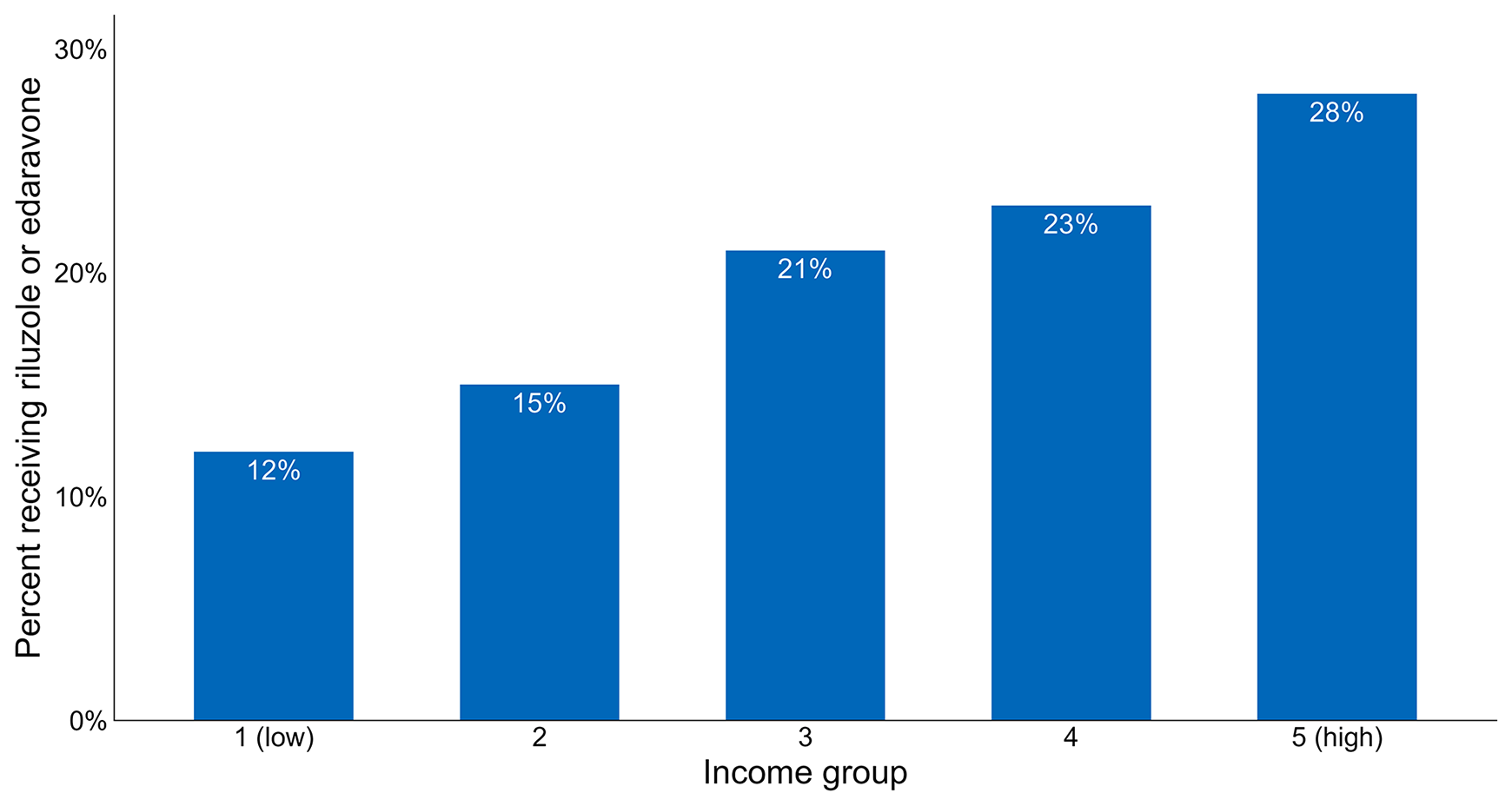
Note: People with prescription drugs from all payment types (public drug plans, other payment types) are included.
Source: National Prescription Drug Utilization Information System.
New Recipients of ALS Drugs
Table 22 presents the number of new recipients of ALS drugs annually for the past 6 fiscal years in Manitoba, Saskatchewan and British Columbia, where all drug claims are captured regardless of payment type. These counts may provide a partial proxy for the number of people newly diagnosed people living with ALS who go on to receive disease-modifying drug therapy; however, they are not a direct measure of incidence of ALS, and the data were not collected for that purpose. These counts do not capture all people living with ALS. In addition, drugs obtained through Health Canada’s Special Access Program, clinical trials, or importation of edaravone (permitted until October 31, 2022) are not captured in these data.
Table 22: New ALS Recipients of ALS Drugs in Manitoba, Saskatchewan, and British Columbia from 2019–2020 to 2024–2025
Characteristics | New ALS drug recipients |
|---|---|
Manitoba | 184 |
Saskatchewan | 112 |
British Columbia | 418 |
Total | 714 |
Fiscal year (all 3 provinces) | |
2019–2020 | 92 |
2020–2021 | 105 |
2021–2022 | 110 |
2022–2023 | 114 |
2023–2024 | 141 |
2024–2025 | 152 |
ALS= amyotrophic lateral sclerosis.
Note: ALS drugs included riluzole (N07XX02), edaravone (N07XX14), tofersen (N07XX22, first marketed in Canada March 14, 2025) and Albrioza (sodium phenylbutyrate and ursodoxicoltaurine, N07XX19, which was discontinued in 2022).
New or incident recipients were defined as having no ALS drug in the look back period starting April 1, 2017 – a minimum 2-year lookback for recipients identified beginning April 1, 2019.
All claims from public drug plans, private drug plans and other payment types are included.
Health Canada allowed importation of edaravone until October 31, 2022; therefore, edaravone recipients are undercounted in this data.
Each province’s total represents the number of unique recipients in the 6-year period. An individual appears in only one fiscal year.
Source: National Prescription Drug Utilization Information System.
Day Procedures or Surgeries
Table 23: Number of People Living With ALS With at Least 1 Day Procedure or Surgery
Jurisdiction | 2019–2020 | 2020–2021 | 2021–2022 | 2022–2023 | 2023–2024 | 2024–2025 |
|---|---|---|---|---|---|---|
Newfoundland and Labrador | x | 5 | x | x | x | x |
Prince Edward Island | x | x | 0 | x | x | x |
Nova Scotia | 9 | 10 | 5 | 12 | 7 | 6 |
New Brunswick | x | x | x | 5 | x | x |
Ontario | 59 | 64 | 54 | 47 | 55 | 24 |
Manitoba | x | 6 | x | x | x | 13 |
Saskatchewan | 6 | 6 | 7 | 8 | 7 | 14 |
Alberta | 15 | 17 | 25 | 7 | 0 | x |
British Columbia | 20 | 19 | 22 | 19 | 13 | 12 |
Territories (Yukon, Northwest Territories, Nunavut) | 0 | x | 0 | 0 | 0 | 0 |
Canada | 121 | 129 | 119 | 106 | 91 | 77 |
ALS = amyotrophic lateral sclerosis; CIHI = Canadian Institute for Health Information; x = suppressed in accordance with CIHI privacy policy.123
Note: Geography is based on facility.
The territories are combined in accordance with CIHI privacy policy.123
Source: Discharge Abstract Database, National Ambulatory Care Reporting System.
Table 24: Volumes of Day Procedures or Surgeries in People Living With ALS
Jurisdiction | 2019–2020 | 2020–2021 | 2021–2022 | 2022–2023 | 2023–2024 | 2024–2025 |
|---|---|---|---|---|---|---|
Newfoundland and Labrador | x | 6 | x | x | x | x |
Prince Edward Island | x | x | 0 | x | x | x |
Nova Scotia | 10 | 10 | 5 | 12 | 10 | 6 |
New Brunswick | x | x | x | 6 | x | 5 |
Ontario | 63 | 65 | 55 | 52 | 60 | 26 |
Manitoba | x | 6 | x | x | x | 13 |
Saskatchewan | 6 | 7 | 8 | 8 | 9 | 54 |
Alberta | 52 | 17 | 26 | 7 | 0 | x |
British Columbia | 21 | 19 | 22 | 20 | 14 | 13 |
Territories (Yukon, Northwest Territories, Nunavut) | 0 | x | 0 | 0 | 0 | 0 |
Canada | 164 | 132 | 123 | 114 | 102 | 121 |
ALS = amyotrophic lateral sclerosis; CIHI = Canadian Institute for Health Information; x = suppressed in accordance with CIHI privacy policy.123
Note: Geography is based on facility.
The territories are combined in accordance with CIHI privacy policy.123
People living with ALS could contribute more than once to the volumes in this table.
Source: Discharge Abstract Database, National Ambulatory Care Reporting System.
Table 25: Volumes of Selected Types of Day Procedures or Surgeries Across 121 Visits in People Living With ALS, 2024–2025
Jurisdiction | Feeding tube insertion | Invasive ventilationa | Non-invasive ventilation | Diagnostic interventionb | No listed procedure |
|---|---|---|---|---|---|
Newfoundland and Labrador | x | 0 | 0 | x | 0 |
Prince Edward Island | x | 0 | 0 | x | 0 |
Nova Scotia | x | 0 | 0 | x | x |
New Brunswick | x | 0 | 0 | x | x |
Ontario | 20 | 0 | 0 | 16 | x |
Manitoba | 12 | 0 | 0 | 9 | 0 |
Saskatchewan | 10 | 0 | 0 | 20 | 32 |
Alberta | x | 0 | 0 | x | x |
British Columbia | 9 | 0 | 0 | 6 | x |
Territories (Yukon, Northwest Territories, Nunavut) | 0 | 0 | 0 | 0 | 0 |
Canada | 60 | 0 | 0 | 58 | 40 |
ALS = amyotrophic lateral sclerosis; CIHI = Canadian Institute for Health Information; x = suppressed in accordance with CIHI privacy policy.123
aCodes for less than 96 hours and 96 hours or greater were combined.
bSection 2 and 3 from Canadian Classification of Health Interventions210
Note: Geography is based on facility.
The territories are combined in accordance with CIHI privacy policy.123
People living with ALS could contribute more than once to the volumes in this table and each day procedure visit could have more than 1 procedure code.
Source: Discharge Abstract Database, National Ambulatory Care Reporting System.
Table 26: Top 10 Diagnoses in 121 Day Procedure or Surgery Visits in People Living With ALS, Canada, 2024–2025
ICD-10-CA code and description | N = 121 |
|---|---|
G12.20 (Amyotrophic lateral sclerosis) | 92 |
R13 (Dysphagia) | 10 |
Z51 (Other medical care, excluding Z51.81 MAID) | 7 |
Z43 (Attention to artificial openings) | 5 |
Z45 (Adjustment and management of implanted device) | x |
K22 (Other diseases of esophagus) | x |
R33 (Retention of urine) | x |
N21 (Calculus of lower urinary tract) | x |
R63 (Symptoms and signs concerning food and fluid intake) | x |
S82 (Fracture of lower leg, including ankle) | x |
N20 (Calculus of kidney and ureter) | x |
ALS = amyotrophic lateral sclerosis; DAD = Discharge Abstract Database; ICD-10-CA = International Statistical Classification of Diseases and Related Health Problems, Tenth Revision, Canada; MAID = medical assistance in dying; NACRS = National Ambulatory Care Reporting System; x = suppressed in accordance with CIHI privacy policy.123
Note: People living with ALS could have only one diagnosis code (main problem for NACRS or most responsible diagnosis for DAD) per visit, but people living with ALS could contribute multiple visits.
Source: Discharge Abstract Database, National Ambulatory Care Reporting System.
Emergency Department Visits
Table 27: Number of People Living With ALS Who Had Least 1 Emergency Department Visit
Jurisdiction | 2019–2020 | 2020–2021 | 2021–2022 | 2022–2023 | 2023–2024 | 2024–2025 |
|---|---|---|---|---|---|---|
Ontario | 251 | 209 | 238 | 221 | 263 | 257 |
Saskatchewan | — | — | — | 24 | 12 | 14 |
Alberta | 82 | 82 | 78 | 81 | 82 | 89 |
Total | 333 | 291 | 316 | 326 | 357 | 360 |
— = data not available; ALS = amyotrophic lateral sclerosis; CIHI = Canadian Institute for Health Information.
Note: Geography is based on facility.
The territories are combined in accordance with CIHI privacy policy.123
Data were not available for Saskatchewan until 2022–2023.
Source: National Ambulatory Care Reporting System.
Table 28: Characteristics of People Living With ALS With an Emergency Department Visit, 2024–2025
Characteristics | Ontario N = 257 | Saskatchewan N = 14 | Alberta N = 89 | Total of 3 provinces N = 360 |
|---|---|---|---|---|
Sex | ||||
Female | 108 | 5 | 31 | 144 |
Male | 149 | 9 | 58 | 216 |
Age | ||||
Mean (SD) | 67 (12) | 62 (16) | 66 (11) | 66 (12) |
Minimum | 22 | 20 | 37 | 20 |
10th percentile | x | x | x | x |
25th percentile | 60 | x | 59 | 59 |
50th percentile (median) | 68 | x | 69 | 68 |
75th percentile | 75 | x | 73 | 75 |
90th percentile | x | x | x | x |
Maximum | 94 | 84 | 90 | 94 |
Residence | ||||
Urban (SAC type 1 to 3) | 214 | 8 | 76 | 298 |
Rural (SAC type 4 to 8) | 43 | 6 | 13 | 62 |
Neighbourhood income quintile | ||||
1 (lowest) | 56 | x | x | 73 |
2 | 57 | x | x | 80 |
3 | 43 | x | x | 63 |
4 | 59 | x | x | 77 |
5 (highest) | 42 | x | x | 67 |
Number of visits per person | ||||
1 visit | 222 | x | x | 300 |
2 or more visits | 35 | x | x | x |
Mean (SD) | 1.2 (0.6) | 1.2 (0.6) | 1.2 (0.6) | 1.3 (0.5) |
10th percentile | x | x | x | x |
25th percentile | 1 | 1 | x | 1 |
50th percentile (median) | 1 | 1 | x | 1 |
75th percentile | 1 | 1 | x | 2 |
90th percentile | x | x | x | x |
Maximum | 5 | 5 | 3 | 3 |
ALS = amyotrophic lateral sclerosis; SAC = Statistical Area Classification; SD = Standard Deviation; x = suppressed in accordance with CIHI privacy policy.
Note: Province is based on the facility location. Place of residence and income quintiles are based on the person’s postal code. If there were multiple visits, demographics are based on the first visit.
Source: National Ambulatory Care Reporting System.
Table 29: Volume of Emergency Department Visits in People Living With ALS
Jurisdiction | 2019–2020 | 2020–2021 | 2021–2022 | 2022–2023 | 2023–2024 | 2024–2025 |
|---|---|---|---|---|---|---|
Ontario | 319 | 238 | 297 | 276 | 318 | 308 |
Saskatchewan | — | — | — | 32 | 13 | 17 |
Alberta | 124 | 130 | 177 | 99 | 105 | 115 |
Total | 443 | 368 | 474 | 407 | 436 | 440 |
— = data not available; ALS = amyotrophic lateral sclerosis.
Note: Geography is based on facility location.
Data were not available for Saskatchewan until 2022–2023.
Source: National Ambulatory Care Reporting System.
Table 30: Characteristics of Emergency Department Visits in People Living With ALS in Ontario, Saskatchewan, and Alberta, 2024–2025
Characteristics | Ontario, Saskatchewan and Alberta N = 440 |
|---|---|
Patient triage level | |
Resuscitation (CTAS level 1) | 55 |
Emergent (CTAS level 2) | 138 |
Urgent (CTAS level 3) | 219 |
Less urgent and non-urgenta (CTAS level 4 and 5) | 28 |
Visit disposition | |
Admitted to hospital | 274 |
Transferred to another facility | 14 |
Homeb | 125 |
Home with support | 15 |
Long-term care or Group/Supportive Living | 6 |
Died in Facility (non-MAID) | 6 |
MAID in facility | 0 |
ALS = amyotrophic lateral sclerosis; CTAS = Canadian Triage and Acuity Scale; MAID = medical assistance in dying.
aThe less urgent and non-urgent triage levels were grouped to prevent residual disclosure in accordance with the CIHI privacy policy.123
bThe number of people who left before receiving treatment was between 1 and 4 and was grouped with Home to avoid multiple suppressions in accordance with the CIHI privacy policy.123
Note: Place of residence and income quintiles are based on the person’s residence.
Source: National Ambulatory Care Reporting System.
Table 31: Top 10 Main Problems in 440 Emergency Department Visits in People Living With ALS in Ontario, Saskatchewan, and Alberta, 2024–2025
ICD-10-CA code and description | N = 440 |
|---|---|
G12.20 (Amyotrophic lateral sclerosis) | 168 |
J96 (Respiratory failure, not elsewhere classified) | 30 |
R06 (Abnormalities of breathing) | 17 |
J18 (Pneumonia, organism unspecified) | 16 |
R13 (Dysphagia) | 15 |
J69 (Pneumonitis due to solids and liquids) | 12 |
Z51 (Other medical care, excluding Z51.81 MAID) | 10 |
R53 (Malaise and fatigue) | 9 |
R09 (Other symptoms and signs involving the circulatory and respiratory systems) | 6 |
T17 (Foreign body in respiratory tract) | 6 |
ALS = amyotrophic lateral sclerosis; ICD-10-CA = International Statistical Classification of Diseases and Related Health Problems, Tenth Revision, Canada; MAID = medical assistance in dying; NACRS = National Ambulatory Care Reporting System.
Note: People could have only one diagnosis code (main problem in NACRS) per visit, but people could contribute multiple visits.
Source: National Ambulatory Care Reporting System.
Hospitalizations
Table 32: Number of People Living With ALS Who Had at Least 1 Hospitalization
Jurisdiction | 2019–2020 | 2020–2021 | 2021–2022 | 2022–2023 | 2023–2024 | 2024–2025 |
|---|---|---|---|---|---|---|
Newfoundland and Labrador | 21 | x | x | 16 | 20 | 23 |
Prince Edward Island | x | x | x | 6 | x | x |
Nova Scotia | 30 | 37 | 39 | 32 | 37 | 32 |
New Brunswick | 37 | 25 | 31 | 31 | 31 | 23 |
Ontario | 394 | 324 | 362 | 377 | 454 | 387 |
Manitoba | 27 | 24 | 22 | 23 | 24 | 43 |
Saskatchewan | 20 | 23 | 23 | 42 | 24 | 32 |
Alberta | 112 | 100 | 132 | 112 | 117 | 134 |
British Columbia | 122 | 120 | 147 | 115 | 144 | 144 |
Territories (Yukon, Northwest Territories, Nunavut) | x | 0 | x | 0 | x | x |
Canada | 774 | 678 | 776 | 754 | 855 | 829 |
ALS = amyotrophic lateral sclerosis; CIHI = Canadian Institute for Health Information; x = suppressed in accordance with CIHI privacy policy.123
Note: Geography is based on facility.
The territories are combined in accordance with CIHI privacy policy.123
Quebec hospitalization data are not included in the Canada total; all other provinces and territories are included.
Source: Discharge Abstract Database.
Table 33: Characteristics of People Living With ALS With Hospitalizations, Canada, 2024–2025
Characteristics | N = 829 |
|---|---|
Sex | |
Female | 340 |
Male | 489 |
Age | |
Mean (SD) | 68 (12) |
Minimum | 15 |
10th percentile | 53 |
25th percentile | 62 |
50th percentile (median) | 70 |
75th percentile | 76 |
90th percentile | 82 |
Maximum | 94 |
Residence | |
Urban (SAC type 1 to 3) | 665 |
Rural (SAC type 4 to 8) | 164 |
Neighbourhood income quintile | |
1 (lowest) | 160 |
2 | 174 |
3 | 166 |
4 | 173 |
5 (highest) | 156 |
Number of hospital discharges per person | |
1 visit | 645 |
2 or more visits | 184 |
Mean (SD) | 1.3 (0.7) |
10th percentile | 1 |
25th percentile | 1 |
50th percentile (median) | 1 |
75th percentile | 1 |
90th percentile | 2 |
Maximum | 6 |
ICU | |
At least 1 ICU admission, n | 228 |
Hospital stays with at least 1 ICD admission, mean (SD) | 1.2 (0.5) |
ALS = amyotrophic lateral sclerosis; ICD = International Statistical Classification of Diseases and Related Health Problems; ICU = intensive care unit; SAC = Statistical Area Classification; SD = standard deviation.
Note: Health Canada allowed importation of Edaravone until October 31, 2022; therefore, edaravone recipients are undercounted in this data.
Place of residence and income quintiles are based on the person’s residence.
Quebec hospitalization data are not included in the data; all other provinces and territories are included.
Source: Discharge Abstract Database.
Table 34: Volume of Hospitalizations in People Living With ALS
Jurisdiction | 2019–2020 | 2020–2021 | 2021–2022 | 2022–2023 | 2023–2024 | 2024–2025 |
|---|---|---|---|---|---|---|
Newfoundland and Labrador | 23 | x | x | 24 | 24 | 33 |
Prince Edward Island | x | x | x | 6 | x | x |
Nova Scotia | 39 | 49 | 48 | 39 | 46 | 41 |
New Brunswick | 47 | 32 | 43 | 36 | 39 | 27 |
Ontario | 508 | 396 | 453 | 494 | 592 | 517 |
Manitoba | 33 | 29 | 26 | 31 | 31 | 57 |
Saskatchewan | 25 | 28 | 28 | 60 | 29 | 46 |
Alberta | 159 | 130 | 162 | 147 | 148 | 171 |
British Columbia | 154 | 158 | 180 | 147 | 179 | 178 |
Territories (Yukon, Northwest Territories, Nunavut) | x | 0 | x | 0 | x | x |
Canada | 1,012 | 853 | 966 | 984 | 1,094 | 1,082 |
ALS = amyotrophic lateral sclerosis; CIHI = Canadian Institute for Health Information; x = suppressed in accordance with CIHI privacy policy.123
Note: Geography is based on facility.
The territories are combined in accordance with CIHI privacy policy.123
People living with ALS could contribute more than once to the volumes in this table.
Quebec hospitalization data are not included in the Canada total; all other provinces and territories are included.
Source: Discharge Abstract Database.
Table 35: Characteristics of 1,082 Hospital Stays in People Living With ALS, Canada, 2024–2025
Characteristics | N = 1,082 |
|---|---|
Admitted from | |
Emergency department | 803 |
Direct admission | 248 |
Other | 31 |
Type of hospital | |
Community | 633 |
Teaching | 449 |
Select diagnoses and procedures | |
Palliative care diagnosis | 379 |
Feeding tube insertion | 211 |
Invasive ventilation less than 96 hours | 40 |
Invasive ventilation for 96 hours or more | 74 |
Non-invasive ventilation | 37 |
Discharge disposition | |
Home | 213 |
Home with support | 292 |
Other inpatient care | 171 |
Long-term care or group/supportive living | 94 |
Died in facility (non-MAID) | 249 |
MAID in facility | 56 |
Left against medical device or missing discharge location | 7 |
ALS = amyotrophic lateral sclerosis; MAID = medical assistance in dying.
Note: Quebec hospitalization data are not included in the totals; all other provinces and territories are included.
Source: Discharge Abstract Database.
Table 36: Top 10 Main Reasons for Hospitalization (Most Responsible Diagnoses) in 1,082 People Living With ALS, Canada, 2024–2025
ICD-10-CA code and description | N = 1,082 |
|---|---|
G12.20 (Amyotrophic lateral sclerosis) | 407 |
Z51 (Other medical care, excluding Z51.81 MAID) | 113 |
J96 (Respiratory failure, not elsewhere classified) | 101 |
J69 (Pneumonitis due to solids and liquids) | 43 |
R13 (Dysphagia) | 33 |
Z51.81 (Medical Assistance in Dying - MAID) | 29 |
J18 (Pneumonia, organism unspecified) | 26 |
Z54 (Convalescence) | 21 |
U07.1 (COVID-19, virus identified) | 19 |
J15 (Bacterial pneumonia, not elsewhere classified) | 15 |
ALS = amyotrophic lateral sclerosis; DAD = Discharge Abstract Database; ICD-10-CA = International Statistical Classification of Diseases and Related Health Problems, Tenth Revision, Canada; MAID = medical assistance in dying.
Note: People could have only one diagnosis code (most responsible diagnosis in DAD) per visit, but people could contribute multiple visits.
Quebec hospitalization data are not included in the totals; all other provinces and territories are included.
Source: Discharge Abstract Database.
Long-Term Care Homes and Hospital-Based Continuing Care
Table 37: Volumes of People Living With ALS in People in Long-Term Care Homes and Hospital-Based Continuing Care
Province | 2019–2020 | 2020–2021 | 2021–2022 | 2022–2023 | 2023–2024 | 2024–2025 |
|---|---|---|---|---|---|---|
Long-term care homes | ||||||
Newfoundland and Labrador | 6 | x | x | x | 8 | 5 |
Nova Scotia | — | — | — | 0 | 0 | 0 |
New Brunswick | — | 0 | x | x | 0 | 0 |
Ontario | 200 | 149 | 159 | 179 | 197 | 211 |
Manitoba | 6 | 6 | x | 8 | 11 | 13 |
Saskatchewan | — | x | 0 | 0 | 0 | 0 |
Alberta | 55 | 58 | 64 | 61 | 55 | 36 |
British Columbia | 62 | 75 | 82 | 71 | 71 | 71 |
Yukon | 0 | 0 | x | 0 | 0 | 0 |
Total residential care | 341 | 299 | 312 | 325 | 342 | 336 |
Hospital-based care | ||||||
Ontario hospital-based continuing care | 91 | 88 | 98 | 84 | 106 | 104 |
Manitoba hospital-based continuing care | x | 6 | 6 | 6 | 7 | 15 |
Total hospital-based continuing care | x | 94 | 104 | 90 | 113 | 119 |
— = data not available; ALS = amyotrophic lateral sclerosis; x = suppressed in accordance with the CIHI privacy policy.123
Note: Counts may reflect reporting limitations in some provinces and territories.
Sources: Continuing Care Reporting System (CCRS) and Integrated interRAI Reporting System — Long-Term Care Facilities (IRRS-LTCF).
Table 38: Characteristics of People in Long-Term Care Homes and Hospital-Based Continuing Care, 2024–2025
Characteristics | Long-term carea N = 336 | Hospital-based continuing careb N = 119 |
|---|---|---|
Sex | ||
Female | 189 | 53 |
Male | 147 | 66 |
Age | ||
Mean (SD) | 76 (12) | 66 (13) |
10th percentile | 59.5 | 50 |
25th percentile | 69 | 59 |
50th percentile (median) | 77 | 67 |
75th percentile | 85 | 75 |
90th percentile | 90 | 82 |
Less than 65 years of age | 57 | 49 |
65 years of age or older | 279 | 70 |
Residence before admission | ||
Urban (SAC type 1 to 3) | 297 | 107 |
Rural (SAC type 4 to 8) | 25 | 12 |
Missing values | 14 | xc |
Neighbourhood income quintile before admission | ||
1 (lowest) | 100 | 28 |
2 | 83 | 30 |
3 | 43 | 21 |
4 | 47 | 19 |
5 (highest) | 46 | 21 |
Missing values | 17 | xd |
Length of stay, years | ||
Mean | 2.7 | 1.8 |
10th percentile | 0.3 | 0.1 |
25th percentile | 0.6 | 0.2 |
50th percentile (median) | 1.5 | 0.6 |
75th percentile | 3.5 | 2.0 |
90th percentile | 7.3 | 4.8 |
Discharge disposition | ||
Total residents discharged in fiscal year 2024–2025 | 136 | 78 |
Died | 81 | 22 |
Hospital | 49 | 35 |
Home (with or without home care) | 6e | 14 |
Long-term care | — | 7f |
— = not applicable; CIHI = Canadian Institute for Health Information; SAC = Statistical Area Classification; SD = standard deviation; x = suppressed in accordance with the CIHI privacy policy.123
aData from 9 provinces and territories.
bData from 2 provinces.
cThe supressed missing values were added to the rural residence group to minimize cell suppression.
dThe suppressed missing values were added to income quintile 3 to minimize cell suppression.
eDischarge disposition to home (with or without home care) and other or unknown were combined to minimize cell suppression.
fDischarge disposition to long-term care and other or unknown were combined to minimize cell suppression.
Note: Place of residence and income quintiles are based on the person’s postal code before admission.
Sources: Continuing Care Reporting System (CCRS) and Integrated interRAI Reporting System — Long-Term Care Facilities (IRRS-LTCF).
Parts of this material are based on data and information provided by the Canadian Institute for Health Information. However, the analyses, conclusions, opinions, and statements expressed herein are those of the author and not necessarily those of the Canadian Institute for Health Information.
Appendix 4: Canadian Neuromuscular Disease Registry Analyses: Methods and Additional Findings
Please note that this appendix has not been copy-edited.
Methods
In collaboration with the CNDR, we analyzed ALS registry data to capture outcomes not captured in administrative health care data, including time from symptom onset to diagnosis, time from diagnosis to death, characteristics of people living with ALS at diagnosis, and characteristics of people living with ALS based on drug exposure. Analyses were conducted among people living with ALS diagnosed between 2018 and 2025, as an update to a prior a prior analysis of people living with ALS enrolled in the CNDR from 2012 to 2017.24 For these analyses, data were available from 7 provinces, including people living with ALS living in Prince Edward Island, New Brunswick, Quebec, Ontario, Saskatchewan, Alberta, and British Columbia.
Overview of the CNDR and the ALS Registry Held in the CNDR
The CNDR (cndr.org) is a pan-Canadian registry established in 2010 with the aim of collecting high-quality real-world data on neuromuscular diseases in Canada, including ALS. The CNDR is led by investigators at the University of Calgary (national office) and is governed by an advisory committee. The CNDR national office compensates clinics on a per patient per visit basis to support the administrative costs associated with obtaining consent and data collection. The CNDR collaborates with patient organization partners including but not limited to, ALS Society of Canada, ALS Action, the ALS Alliance of Canada, ALS Society of New Brunswick, ALS Society of Quebec, ALS Society of Saskatchewan, ALS Society of Alberta, and ALS Society of British Columbia.
People with a confirmed genetic or clinical diagnosis (e.g., muscle biopsy, physician confirmed clinical presentation) of ALS are approached for informed consent and participation in the CNDR during clinic visits at affiliated clinics. People living with ALS consenting to inclusion must have clinical information submitted by a physician licensed and practising in Canada. Individuals who are not routinely followed at specialty clinics may self-register electronically with the CNDR national office and then are directed to the nearest CNDR-affiliated clinic whenever possible. If this is not feasible, people living with ALS are sent a consent form to enable them to be registered through their physician’s office with a release of medical information. During 2018 to 2025, there were no self-registered individuals represented that did not attend a CNDR-affiliated clinic.
The CNDR collects an ALS-specific dataset that was developed using expert consensus meetings with ALS clinicians, geneticists, and researchers from across Canada. The ALS dataset was expanded in 2022 to collect effectiveness and safety data for novel therapies. Trained clinic staff abstract data from clinical charts into the CNDR database. Longitudinal data are updated at routine clinic visits which can be approximately every 3 to 12 months.
CNDR data collection follows rigorous standards, with built-in coding structures and validation boundaries to minimize errors. The CNDR National Office conducts routine centralized quality control cycles, including systematic checks for inconsistencies, missing data, and completeness, and requires sites to reconcile queries against source documentation. Ongoing data quality is supported through quarterly feedback to sites, along with targeted follow-up and training where issues are identified.
A total of 2,019 people living with ALS were registered in the CNDR with clinical data entered at the time of analysis (April 16, 2026) through participating clinics. Of the 24 ALS neuromuscular clinics in Canada, the CNDR collects prospective clinical data from 14 university-affiliated active ALS clinics in 7 provinces in Canada (Table 39). People living with ALS in Newfoundland and Labrador and Prince Edward Island travel to CNDR-affiliated clinics in other provinces. People living with ALS from the territories are followed at affiliated provincial clinics (Yukon in Vancouver; Northwest Territories in Edmonton; Nunavut in Ontario). People living with ALS followed at clinics in Newfoundland and Labrador and Manitoba are not included in the registry. For analyses included in this report, data were available from 7 provinces, including people living with ALS living in Prince Edward Island, New Brunswick, Quebec, Ontario, Saskatchewan, Alberta, and British Columbia.
Table 39: List of Clinics Participating in the CNDR
Province | City | Hospital name | Site status |
|---|---|---|---|
British Columbia | Vancouver | GF Strong Rehabilitation Centre, which was subsequently integrated into the Djavad Mowafaghian Centre for Brain Health | Active |
Alberta | Calgary | South Health Campus (ALS and Motor Neuron Disease Clinic) | Active |
Alberta | Edmonton | Kaye Edmonton ALS Clinic | Active |
Saskatchewan | Saskatoon | Saskatoon City Hospital (ALS/Motor Neuron Disease Clinic) | Active |
Ontario | Hamilton | Hamilton Health Sciences Centre (The ALS Clinic) | Onboarding |
Ontario | London | London Health Sciences Centre (Motor Neuron Disease Clinic) | Active |
Ontario | Toronto | Sunnybrook Hospital (ALS Clinic) | Active |
Ontario | Kingston | Kingston General Hospital / The Neuromuscular Clinic Providence Care Hospital | Active |
Ontario | Ottawa | The Ottawa Hospital Rehabilitation Centre | Active |
Quebec | Montréal | Centre hospitalier de l’Université de Montréal (CHUM) | Active |
Quebec | Quebec City | Centre Hospitalier Universitaire de Quebec-Laval (CHUQ-CHUL) | Active |
Quebec | Sherbrooke | Sherbrooke Clinique maladies neuromusculaire (CIUSSS de L'Estrie - CHUS) | Active |
New Brunswick | Fredericton | Stan Cassidy Rehabilitation Centre (ALS) | Active |
Nova Scotia | Halifax | Halifax Infirmary, Queen Elizabeth II Health Sciences Centre | Active |
ALS = amyotrophic lateral sclerosis; CIUSSS de L'Estrie - CHUS = Centre intégré universitaire de santé et de services sociaux de l'Estrie – Centre hospitalier universitaire de Sherbrooke; CNDR = Canadian Neuromuscular Disease Registry.
Time From Symptom Onset to Diagnosis
We analyzed the time from symptom onset to diagnosis among people living with ALS diagnosed between 2018 and 2025. All data are abstracted from patient clinical records. People living with ALS missing date of symptom onset or date of diagnosis were excluded (overall 10% of people living with ALS). Missing data can occur if date of symptom onset or diagnosis are not noted in the clinical record, or if people living with ALS are referred from another clinic and the initial clinical record is not accessible.
Symptom onset was defined as the date of the first patient-reported symptom attributable to ALS, as determined during clinical assessment and documented in the patient’s clinical record. Date of symptom onset was assessed at the first clinic visit or diagnostic visit through retrospective patient recall, with a lookback period of 10 years. Date of diagnosis is defined as the date of the clinic visit where diagnosis was provided by the treating clinician at each site or as the date of the EMG.
Time from symptom onset to diagnosis was examined by jurisdiction based on the people living with ALS’ location of residence and by place of residence (urban or rural). Place of residence was defined using the participant’s postal code at time of diagnosis and then mapped to the Postal Code Conversion File Plus (PCCF+) Statistical Area Classification type (SACtype), where SACtype 1 to 3 denote urban and SACtype 4 to 8 denote rural. If people living with ALS move after their first clinic visit, postal code is not updated.
Time From Diagnosis to Full-Time Ventilation
We analyzed the time from diagnosis to full-time ventilation among people living with ALS diagnosed between 2018 and 2025. All data are abstracted from patient clinical records. People living with ALS missing date of ventilation status or ventilation status were excluded (overall 4% of people living with ALS). Full-time ventilation was defined as ventilation use of at least 16 hour per day, and could include invasive ventilation and non-invasive ventilation. Use of full-time ventilation is assessed at the first clinic visit and subsequent follow-up visits. There was variability in the availability and documentation of time to full-time ventilation, including differences in recording practices between clinics and retrospective capture of ventilation initiation for historical cases.
Time From Diagnosis to Death
We analyzed the time from diagnosis to death among people living with ALS diagnosed between 2018 and 2025. People with ALS missing date of diagnosis or date of death were excluded (overall < 3% of people living with ALS). Death data for people with ALS who withdrew from the registry was not available. Date of death is obtained from family report or clinic chart ascertainment. There is some variability in the availability of death documentation between clinics. If the exact date of death is unknown, the date of notification of death was used. Date of death is not confirmed through medical records or provincial administrative health data.
Clinical Characteristics at Diagnosis
We examined the characteristics of people living with ALS at the time of diagnosis among people living with ALS diagnosed between 2018 and 2025. People living with ALS missing date of diagnosis or characteristics of interest were excluded (overall < 15% of people living with ALS). All data are abstracted from patient clinical records at the first clinic visit, except ALSFRS-R and FVC, which may be assessed at subsequent clinic visits. Where appropriate, a 3-month window from the index date (e.g., diagnosis) will be applied for data capture, and values may be imputed if available within 1 year to improve completeness. Age at diagnosis was defined as the participant’s age in years at the time of confirmed ALS diagnosis, calculated using date of birth and diagnosis date. Sex is defined as the biological sex recorded in the clinical record at the time of enrolment. Income quintile is defined using the participant’s postal code linked to area-level census data, assigning individuals to a neighbourhood income quintile using the Postal Code Conversion File Plus (PCCF+) tool. Place or residence (urban or rural) was previously defined as previously outlined in the time from symptom onset to diagnosis section.
Region of onset is defined as the initial anatomic region in which ALS symptoms first appeared, categorized as limb, bulbar, respiratory, or other. The ALS Functional Rating Scale–Revised (ALSFRS-R) score at diagnosis is defined as the total score (0 to 48) from the assessment closest to the diagnosis date. Scores are recorded by clinicians or trained personnel as part of routine clinical care. Forced Vital Capacity (FVC) at diagnosis is defined as the percent predicted FVC value measured at the clinic visit closest to the diagnosis date, based on standardized pulmonary function testing. Family history of ALS is defined as a reported history of ALS in a first- or second-degree relative, as documented in the clinical record based on patient report and clinician assessment.
Utilization of Drugs for ALS and Characteristics of People Receiving Drugs for ALS
We analyzed the utilization of riluzole, edaravone, tofersen, and use of other disease-modifying investigational products in Canada among people living with ALS diagnosed between 2018 and 2025. Use of 1 or more drugs (riluzole, edaravone, and tofersen) was defined as any documented exposure to the drug the index date (i.e., at diagnosis) or at subsequent follow-up clinic visits. Use of investigational product was defined as any documented exposure to an investigational product during a clinical trial or AMX0035 [also known as sodium phenylbutyrate and ursodoxicoltaurine (Albrioza)]) through clinical trials, special access programs, or other mechanisms. Drug exposure was identified through clinical records. No drug exposure was defined as people living with ALS who did not receive any drugs (riluzole, edaravone, toferson) during recorded follow-up between 2018 to March 2026 and excluded people living with ALS who received a drug but then discontinued in the follow-up period.
Use of 2 or more concurrent drugs for ALS (riluzole, edaravone, tofersen) was defined as use of 2 or more drugs for ALS concurrently at any time, at diagnosis or throughout recorded follow-up between 2018 and March 2026, based on overlapping treatment intervals derived from start and stop dates. No investigational products were included in this category.
Discontinuation and reasons for discontinuation are collected among people living with ALS receiving rilzuole, edaravone, and tofersen. Standardized reasons for discontinuation were collected, including adverse effects, patient preference, disease progression, access/coverage, and other (free text). Free text responses were converted to standardized reasons, where possible.
We examined characteristics of people living with ALS by drug exposure (use of at least 1 drug for ALS compared to no drug exposure). People living with ALS receiving drugs for ALS may differ systematically from untreated people living with ALS (e.g., earlier diagnosis, progression rate, better functional status, genetic status, access to specialist care), which may influence observed characteristics at diagnosis and outcomes. Characteristics (e.g., ALSFRS-R, FVC) may not be recorded exactly at the time of drug initiation or diagnosis of ALS, and were recorded based on the measurement closest to time of diagnosis.
Limitations
The CNDR includes people living with ALS from 14 university-affiliated ALS clinics across 7 provinces, however, it does not capture all individuals with ALS. Participation is voluntary and requires patient consent, which could introduce selection bias if a subset of people living with ALS are less likely to consent or be recruited. Additionally, people living with ALS who are not referred to or do not have access to CNDR-affiliated clinics are not represented. People living with ALS in rural communities are underrepresented in the registry. The registry does not include any people living with ALS from clinics in Newfoundland and Labrador and Manitoba. In our analyses, there was a low number of people living with ALS from Saskatchewan and British Colombia (30 people combined), which may limit representativeness and the reliability of province-specific estimates. As a result, findings may not reflect the broader population with ALS in Canada.
While the registry uses standardized data dictionaries, centralized training, and ongoing query resolution, there may be temporal differences in clinical assessment and data completeness (i.e., timing of diagnosis, functional testing) which may impact estimates and observed differences between provinces. As a result, province-level analyses should be interpreted with caution.
Time of symptom onset relied on patient recall and is subject to measurement error. People living with ALS seen at ALS clinics may experience shorter time to diagnosis and longer survival due to earlier recognition and access to multidisciplinary care. Furthermore, targeted recruitment of people receiving drugs for ALS in some clinics following changes implemented in 2022 may have influenced the composition of the registry and associated estimates (e.g., use of drugs for ALS or outcomes), particularly in more recent years.
Despite these limitations, the CNDR remains a unique source of detailed clinical data not available elsewhere in administrative health data or drug market data in Canada, including measures such as time to diagnosis, survival, ventilation use, treatment patterns, characteristics of people not receiving drugs for ALS, and clinical trial participation.
Additional Findings
The following tables are provided for reference and contain supporting data to supplement the findings presented in the main report. Tables are organized in the following order, which may not match the order in the main report:
Time from symptom onset to diagnosis
Clinical characteristic at diagnosis
Time from diagnosis to death
Utilization of drugs for ALS
Clinical characteristic among people who received at least 1 drug for ALS compared to people living with ALS with no drug exposure
Discontinuation and reasons for discontinuation of drugs for ALS.
Table 40 presents the time between symptom onset and diagnosis of ALS in Canada and by place of residence. Estimates may not be representative of the broader population with ALS in Canada as the registry captures people living with ALS from a subset of ALS clinics and from a subset of people living with ALS at represented clinics. The median may provide a better reflection of time to diagnosis compared to the average/mean, as the average can be strongly influenced by outliers (i.e., people with estimates that are much lower or higher compared to the majority of other people living with ALS).
Table 40: Time Between Symptom Onset and Diagnosis of ALS in Canada, by Place of Residence, Among People Living With ALS Diagnosed Between 2018 and 2025
Place of residence | Number of people living with ALS with available data | Mean (SD), months | Median (Q1 to Q3), months | Range (min to max), months |
|---|---|---|---|---|
Canada | 616 | 15 (15) | 11 (7 to 18) | 0 to 137 |
Urban place of residence | 460 | 15 (15) | 11 (7 to 17) | 0 to 137 |
Rural place of residence | 82 | 18 (20) | 12 (7 to 23) | 0 to 115 |
Missing place of residence | 74 | 15 (12) | 12 (7 to 18) | 1 to 72 |
ALS = amyotrophic lateral sclerosis; SD = standard deviation; Q1 = Lower quartile (25th percentile, 25% of the data are at or below Q1); Q3 = Upper quartile (75th percentile, 75% of the data are at or below Q3). Data reflect time to diagnosis among people living with ALS living in PEI, NB, QC, ON, SK, AB, and BC and enrolled in CNDR-affiliated clinics.
Table 41 presents the time between symptom onset and diagnosis of ALS by province among people living with ALS diagnosed between 2018 and 2025. Given the small number of people living with ALS in some provinces, and considering some people living with ALS may have time to diagnosis estimates that are much higher or lower compared to other people living with ALS, the average can be distorted and may not accurately represent most observations. As a result, the median is shown in Table 41 as it provides a better reflection of time to diagnosis compared to the average/mean.
The median time from symptom onset to diagnosis varies across province, ranging from 10 months in BC to 12 months in Atlantic provinces, Quebec, Ontario, and Saskatchewan. However, findings should be interpreted with caution given the small number of people living with ALS represented in these provinces. Further, estimates may not be representative of the broader population with ALS in Canada as the registry captures people living with ALS from a subset of ALS clinics and from a subset of people living with ALS at represented clinics.
Table 41: Time Between Symptom Onset and Diagnosis of ALS in Canada, by Province, Among People Living With ALS Diagnosed Between 2018 and 2025
Province | Number of people living with ALS with available data | Median (Q1 to Q3), months | Range (min to max), months |
|---|---|---|---|
Atlantic (NB and PEI) | 70 | 12 (8 to 19) | 4 to 121 |
QC | 74 | 12 (7 to 16) | 0 to 37 |
ON | 168 | 12 (8 to 20) | 0 to 115 |
SK | 24 | 12 (8 to 24) | 4 to 95 |
AB | 274 | 11 (7 to 16) | 2 to 137 |
BC | 6 | 10 (8 to 15) | 6 to 20 |
Canada | 616 | 11 (7 to 18) | 0 to 137 |
AB = Alberta; ALS = amyotrophic lateral sclerosis; BC = British Columbia; NB = New Brunswick; ON = Ontario; PEI = Prince Edward Island; Q1 = Lower quartile (25th percentile, 25% of the data are at or below Q1); Q3 = Upper quartile (75th percentile, 75% of the data are at or below Q3); QC = Quebec; SK = Saskatchewan.
Province is based on participants location of residence.
Table 42: Time Between Symptom Onset and Diagnosis of ALS in Canada, by Year of Diagnosis, Among People Living With ALS Diagnosed Between 2018 and 2025
Year | Number of people living with ALS with available data | Mean (SD), months | Median (Q1 to Q3), months | Range (min to max), months |
|---|---|---|---|---|
2018 | 75 | 17 (23) | 11 (7 to 17) | 2 to 137 |
2019 | 58 | 17 (18) | 12 (7 to 21) | 2 to 121 |
2020 | 73 | 15 (12) | 13 (7 to 17) | 0 to 78 |
2021 | 94 | 14 (12) | 10 (7 to 18) | 0 to 72 |
2022 | 104 | 16 (16) | 12 (7 to 19) | 2 to 121 |
2023 | 79 | 13 (10) | 11 (6 to 15) | 3 to 67 |
2024 | 65 | 14 (13) | 10 (7 to 15) | 2 to 75 |
2025 | 65 | 16 (14) | 12 (7 to 18) | 0 to 75 |
AB = Alberta; ALS = amyotrophic lateral sclerosis; BC = British Columbia; CNDR = Canadian Neuromuscular Disease Registry; NB = New Brunswick; ON = Ontario; PEI = Prince Edward Island; Q1 = Lower quartile (25th percentile, 25% of the data are at or below Q1); Q3 = Upper quartile (75th percentile, 75% of the data are at or below Q3); QC = Quebec; SK = Saskatchewan; SD = standard deviation.
Data reflect time to diagnosis among people living with ALS living in PEI, NB, QC, ON, SK, AB, and BC and enrolled in CNDR-affiliated clinics.
Table 43: Characteristics of People Living With ALS at Diagnosis in Canada, Among People Living With ALS Diagnosed Between 2018 and 2025
Characteristics at time of diagnosis | Value |
|---|---|
Number of people living with ALS diagnosed between 2018 and 2025 | 681 |
Age (years) | |
N with available data | 590 |
Mean (SD) | 63 (11) |
Median (Q1 to Q3) | 65 (57 to 71) |
Range (min–max) | 20 to 95 |
Age 18 to 64, N (%) | 276 (47%) |
Age 65+, N (%) | 314 (53%) |
Sex, n (%) | |
N with available data | 605 |
Female | 256 (42%) |
Malea | 349 (58%) |
Region of onset, n (%) | |
N with available data | 674 |
Limb | 442 (66%) |
Bulbar | 152 (23%) |
Limb and Bulbar | 59 (9%) |
Limb and Respiratory | 7 (1%) |
Respiratory / Other | 14 (2%) |
Place of residence, n (%) | |
N with available data | 577 |
Rural | 112 (19%) |
Urban | 465 (81%) |
Income quintile, n (%) | |
N with available data | 577 |
Q1 (least affluent) | 93 (16%) |
Q2 | 131 (23%) |
Q3 | 103 (18%) |
Q4 | 113 (20%) |
Q5 (most affluent) | 137 (24%) |
Family history of ALS, n (%) | |
N with available data | 681 |
Yes | 71 (10%) |
No | 521 (77%) |
Unknown | 89 (13%) |
Time from symptom onset to diagnosis (months) | |
N with available data | 616 |
Mean (SD) | 15 (15) |
Median (Q1 to Q3) | 11 (7 to 18) |
Range (min–max) | 0 to 137 |
People living with ALS symptoms for less than or equal to 2 years | |
N with available data on symptom onset | 616 |
N (%) | 525 (85%) |
ALSFRS-R score | |
N with available data | 647 |
Mean (SD) | 39 (7) |
Median (Q1 to Q3) | 40 (36 to 43) |
Range (min–max) | 3 to 48 |
FVC (% predicted) | |
N with available data | 639 |
Mean (SD) | 86 (22) |
Median (Q1 to Q3) | 88 (73 to 101) |
Range (min–max) | 10 to 148 |
N (%) with FVC ≥ 60% of predicted | 420 (66%) |
N (%) with FVC ≥ 80% of predicted | 324 (51%) |
Ventilation status, n (%) | |
N with available data | 604 |
Not yet indicated | 517 (86%) |
Any use of non-invasive ventilation recommended /recommended and used for ALS | 38 (6%) |
Any use of non-invasive or invasive ventilation (for pre-existing condition, before diagnosis of ALS) | 26 (4%) |
Unknown | 23 (4%) |
Genetic testing, n (%) | |
N with available data | 681 |
N with any genetic test performed | 445 (65%) |
N with SOD1 mutation n (%) | 19 (4%) |
N with no genetic test performed | 187 (27%) |
N where genetic test information was unknown | 49 (7%) |
AB = Alberta; ALS = amyotrophic lateral sclerosis; ALSFRS-R = The Revised Amyotrophic Lateral Sclerosis Functional Rating Scale; BC = British Columbia; CNDR = Canadian Neuromuscular Disease Registry; FVC = forced vital capacity; NB = New Brunswick; ON = Ontario; PEI = Prince Edward Island; Q1 = Lower quartile (25th percentile, 25% of the data are at or below Q1); Q3 = Upper quartile (75th percentile, 75% of the data are at or below Q3); QC = Quebec; SK = Saskatchewan; SD = standard deviation.
Characteristics reflect people living with ALS living in PEI, NB, QC, ON, SK, AB, and BC and enrolled in CNDR-affiliated clinics.
aThe number of people where sex was other or unknown was between 1 and 4 and was grouped with male to avoid multiple suppressions.
Displayed percentages were calculated among people living with ALS with available data, and did not include people with missing data.
Table 44 presents the number of people with ALS who died and the time between diagnosis of ALS and death among people with ALS diagnosed between 2018 and 2025. Differences in the proportion of people who have died between provinces likely reflect differences in when people with ALS were diagnosed (i.e., people with ALS with earlier diagnosis can contribute more follow-up time), rather than true differences between provinces. In provinces with more recently diagnosed people living with ALS, fewer deaths will be observed due to shorter follow-up time (i.e., death has not yet occurred). In addition to differences in follow-up time, several other factors may contribute to differences between provinces, including variations in referral and recruitment practices, completeness of follow-up, differences in patient characteristics that may influence mortality (e.g., disease stage, age at diagnosis), and the small number of people living with ALS in some provinces. As a result, difference between provinces should be interpreted cautiously, as they likely reflect a combination of differences in follow-up time, recruitment patterns, and underlying cohort characteristics rather than true differences in survival between provinces.
Table 44: Time Between Diagnosis of ALS And Death, by Province, Among People With ALS Diagnosed Between 2018 and 2025
Province | Number of people with ALS with available data | N (%) of people with ALS who died | Number of people with ALS with available data | Median (Q1 to Q3), months | Range (min to max), months |
|---|---|---|---|---|---|
Atlantic provinces | 72 | 47 (65%) | 47 | 16 (10 to 26) | 1 to 74 |
QC | 92 | 25 (27%) | 25 | 19 (9 to 28) | 3 to 54 |
ON | 193 | 56 (29%) | 37 | 19 (11 to 28) | 2 to 62 |
Western provinces | 324 | 167 (52%) | 167 | 20 (11 to 27) | 1 to 68 |
Canada | 681 | 295 (43%) | 276 | 20 (11 to 28) | 1 to 74 |
AB = Alberta; ALS = amyotrophic lateral sclerosis; BC = British Columbia; NB = New Brunswick; ON = Ontario; PEI = Prince Edward Island; Q1 = Lower quartile (25th percentile, 25% of the data are at or below Q1); Q3 = Upper quartile (75th percentile, 75% of the data are at or below Q3); QC = Quebec; SK = Saskatchewan.
Notes: Atlantic provinces = NB and PEI; Western provinces = SK, AB, and BC.
Province is based on participants’ location of residence.
The number of people with missing data on province was between 1 and 4 and was grouped with Ontario for the number of people with available data to avoid multiple suppressions.
Given the small number of people living with ALS in some provinces and considering some people with ALS may have time to death estimates that are much higher or lower compared to other people with ALS, the average can be distorted and may not accurately represent most observations. As a result, the median is shown in Table 44 as it provides a better reflection of time between diagnosis and death compared to the average/mean.
Table 45: Use of Drugs for ALS in Canada, by Province, Among 681 People Living With ALS Diagnosed Between 2018 and 2025
Province and Canada total | Number of people living with ALS with available data | N (%) ever received riluzole | N (%) ever received edaravone | N (%) ever received ≥ 2 concurrent drugs (riluzole, edaravone or tofersen) | N (%) ever received investigational product |
|---|---|---|---|---|---|
Atlantic provinces | 72 | 63 (88%) | 26 (36%) | 26 (36%) | 21 (29%) |
QC | 92 | 86 (93%) | 66 (72%) | 58 (63%) | 58 (63%) |
ON | 193 | 149 (77%) | 65 (34%) | 56 (29%) | 78 (40%) |
Western provinces | 324 | 231 (71%) | 120 (37%) | 103 (32%) | 153 (47%) |
Canada | 681 | 529 (78%) | 277 (41%) | 243 (36%) | 310 (46%) |
AB = Alberta; ALS = amyotrophic lateral sclerosis; BC = British Columbia; NB = New Brunswick; ON = Ontario; PEI = Prince Edward Island; QC = Quebec; SK = Saskatchewan.
Atlantic provinces = NB and PEI; Western provinces = SK, AB, and BC.
Data reflect use of drugs for ALS among people with ALS living in Prince Edward Island, New Brunswick, Quebec, Ontario, Saskatchewan, Alberta, and British Columbia and enrolled in CNDR-affiliated clinics. Use of investigational product is defined as any documented exposure to an investigational product during a clinical trial or AMX0035 [also know as sodium phenylbutyrate and ursodoxicoltaurine (Albrioza)] through clinical trials, special access programs, or other mechanisms. Displayed percentages were calculated among people with ALS with available data, and do not include people with missing data.
The number of people with missing data on province was between 1 and 4 and was grouped with Ontario to avoid multiple suppressions.
Table 46: Characteristics of People at ALS Diagnosis in Canada, by Exposure to at Least 1 Drug for ALS, Among People Living With ALS Diagnosed Between 2018 and 2025
Characteristic at time of diagnosis | People living with ALS who received ≥ 1 drug for ALS (riluzole, edaravone or tofersen) (N = 576) | People living with ALS with no drug exposure (N = 105) | ||
|---|---|---|---|---|
Number with available data | Value | Number with available data | Value | |
Age | 497 | 93 | ||
Age at diagnosis in years, mean (SD) | 63 (11) | 64 (11) | ||
Age at diagnosis in years, median (Q1 to Q3) | 64 (55 to 67) | 64 (57 to 72) | ||
Age 18-64, N (%) | 231 (46%) | 45 (48%) | ||
Age 65+, N (%) | 266 (54%) | 48 (52%) | ||
Sex | 507 | 96 | ||
Female, n (%) | 211 (42%) | 45 (47%) | ||
Place of residence | 497 | 96 | ||
Urban, n (%) | 369 (74%) | 75 (78%) | ||
Income, n | 487 | 90 | ||
Q1 (least affluent), n (%) | 75 (15%) | 18 (20%) | ||
Q2, n (%) | 111 (23%) | 20 (22%) | ||
Q3, n (%) | 83 (17%) | 20 (22%) | ||
Q4, n (%) | 100 (21%) | 13 (14%) | ||
Q5 (most affluent), n (%) | 118 (24%) | 19 (21%) | ||
Time from symptom onset to diagnosis | 525 | 91 | ||
Time from symptom onset to diagnosis in months, mean (SD) | 13 (8) | 18 (22) | ||
Time from symptom onset to diagnosis in months, median (Q1 to Q3) | 11 (7 to 17) | 12 (7 to 18) | ||
Time from symptom onset to diagnosis in months, range (min–max) | 2 to 60 | 0 to 137 | ||
Family history of ALS, n (%) | 576 | 105 | ||
Yes | 58 (10%) | 13 (12%) | ||
Region of onset, n | 571 | 103 | ||
Limb onset, n (%) | 374 (65%) | 68 (66%) | ||
Bulbar onset, n (%) | 135 (24%) | 17 (17%) | ||
ALSFRS-R score | 557 | 90 | ||
ALSFRS-R at diagnosis, mean (SD) | 42 (4) | 36 (8) | ||
ALSFRS-R at diagnosis, median (Q1 to Q3) | 43 (40 to 45) | 37 (33 to 42) | ||
ALSFRS-R at diagnosis, range (min‑max) | 10 to 48 | 3 to 47 | ||
FVC (% predicted) | 404 | 67 | ||
FVC % predicted, mean (SD) | 96 (18) | 84 (23) | ||
FVC % predicted, median (Q1 to Q3) | 95 (85 to 107) | 83 (67 to 102) | ||
FVC % predicted, range (min-max) | 13 to 144 | 35 to 148 | ||
AB = Alberta; ALS = amyotrophic lateral sclerosis; ALSFRS-R = The Revised Amyotrophic Lateral Sclerosis Functional Rating Scale; FVC = forced vital capacity; BC = British Columbia; CNDR = Canadian Neuromuscular Disease Registry; NB = New Brunswick; ON = Ontario; PEI = Prince Edward Island; Q1 = Lower quartile (25th percentile, 25% of the data are at or below Q1); Q3 = Upper quartile (75th percentile, 75% of the data are at or below Q3); QC = Quebec; SK = Saskatchewan; SD = standard deviation.
Characteristics reflect people living with ALS living in PEI, NB, QC, ON, SK, AB, and BC and enrolled in CNDR-affiliated clinics.
No drug exposure is defined as people living with ALS who did not receive any drug (riluzole, edaravone, toferson) during recorded follow-up between 2018 to March 2026. If a person received a drug, but then discontinued during the follow-up period, they are not counted in the no drug exposure group. Displayed percentages were calculated among people living with ALS with available data, and do not include people with missing data.
Table 47: Discontinuation and Reasons for Discontinuation of Drugs for ALS, Among People Living With ALS Diagnosed Between 2018 and 2025
Drug | Number of people living with ALS ever treated | N (%) discontinued drug at any time during follow-up (2018 to March 2026) | Reason for discontinuation | N (%) discontinued for each reason |
|---|---|---|---|---|
Riluzole | 529 | 96 (18%) | Adverse effects | 60 (63%) |
Patient preference | 5 (5%) | |||
Disease progression | 6 (6%) | |||
Other/unknown | 25 (26%) | |||
Edaravone | 277 | 42 (15%) | Adverse effects | 11 (26%) |
Patient preference | 11 (26%) | |||
Access or coverage | 8 (19%) | |||
Other/unknown | 12 (29%) |
AB = Alberta; ALS = amyotrophic lateral sclerosis; BC = British Columbia; CNDR = Canadian Neuromuscular Disease Registry; NB = New Brunswick; ON = Ontario; PEI = Prince Edward Island; QC = Quebec; SK = Saskatchewan.
Data reflect people living with ALS living in PEI, NB, QC, ON, SK, AB, and BC and enrolled in CNDR-affiliated clinics.
For riluzole, reason for discontinuation of other/unknown includes a suppressed amount of people who discontinued due to access or coverage.
For edaravone, reason for discontinuation of other/unknown includes a suppressed amount of people who discontinued due to disease progression.
Appendix 5: IQVIA PharmaStat Analyses: Methods and Additional Findings
Please note that this appendix has not been copy-edited.
Methods
IQVIA PharmaStat
IQVIA PharmaStat captures payment activities of participating public and private drug plans in Canada, including public formulary sales, sales for the NIHB program, and direct payment activities of 80% of private drug plans in Canada. Costs reflect the total drug cost allowable are not intended to represent the actual amount reimbursed by the payer. Private drug plan costs represent the total drug cost allowable by participating private drug plans and may include a portion of costs related to patient support program reimbursements administered through private drug plan programs. PharmaStat does not include out-of-pocket cash payments, paper-based claims submitted to private plans following upfront cash payment, public claims from Prince Edward Island, public claims from federal plans (i.e., Veterans Affairs, Correctional Services), Alberta Health and Wellness Social Services plan (approximately 15-20% of public data in Alberta), Nova Scotia Social Services Plan (approximately 15-20% of public data in Nova Scotia), public claims data in the Territories not covered by NIHB, non-retail claims (i.e., hospital), claims that were submitted but not paid, or claims that were reversed.
Overall PharmaStat data capture rates of public plans are reported as 100% in British Columbia, Manitoba, Saskatchewan, Ontario, Newfoundland and Labrador and New Brunswick, 82% in Nova Scotia, and 80% in Alberta. For estimates up to December 31, 2024, data capture of private plans is reported to be 80% in Canada, ranging from 66% to 96% across provinces. Specific data capture rates for riluzole were not available, but were reported to be comparable to overall rates by the IQVIA Support Team. Specific data capture rates for edaravone were not available.
In this report, PharmaStat data were included for 8 provinces, including Newfoundland and Labrador, Nova Scotia, New Brunswick, Ontario, Manitoba, Saskatchewan, Alberta, and British Columbia. Data were analyzed for the calendar year period 2019 to 2024 for riluzole and 2020 to 2024 for edaravone. As edaravone was first introduced in Canada in 2020, cost estimates and the proportion of costs covered by public and private plans in 2020 reflect a partial year of data, as well as variations in the timing of public coverage across jurisdictions. Data were retrieved from the IQVIA Customer Portal on May 12, 2026.
In public drug plans, drug cost definitions vary by province. In Ontario, Manitoba, Saskatchewan, and Alberta cost is defined as the sum of ingredient costs and markup costs. In Nova Scotia, Manitoba, and British Columbia cost is defined based on only ingredient costs. In Newfoundland and Labrador, cost is defined as the sum of ingredient costs, markup costs, and dispensing fees. In private drug plans, cost definitions vary across provinces as markup costs may or may not be included in total costs.
The proportion of drug costs covered by public plans was estimated based on the total drug costs paid by public plans divided by the total drug costs (drug costs paid by public and private plans).
At the time of analysis, in Manitoba, there were no claims for edaravone in public or private drug plans for the period 2020 to 2023 and no private drug claims in 2024. In Saskatchewan, there were no claims for edaravone in public or private drug plans for the period 2020 to 2022 and no private drug claims in 2023 and 2024. In Newfoundland and Labrador, there were no claims for edaravone in public drug plans for 2020 to 2023. Results were consistent in sensitivity analyses of trends restricted to the 6 provinces with activity from both public and private payers for the period 2020 to 2024 for riluzole and edaravone.
Limitations
PharmaStat captures the total drug cost associated with prescription claims processed by participating public and private drug plans. Costs reflect the total drug cost allowable are not intended to represent the actual amount reimbursed by the payer. Our analyses were limited to examining the proportion of costs covered by public drug plans, as the unique number of people receiving drugs through public or private plans is not available on an annual basis from the data. PharmaStat does not capture out-of-pocket cash payments, including copayments. While out-of-pocket cash payment are expected to be low for edaravone due to its high cost, out-of-pocket payments are expected for riluzole, and therefore the proportion of total costs covered by public drug plans may be overestimated for riluzole.
Data capture rates specific to riluzole and edaravone were not available. While capture of riluzole was reported to be comparable to overall rates by the IQVIA Support Team, this was uncertain for edaravone. PharmaStat does not capture non-retail claims (e.g., hospital-administered treatments), which may impact the capture of edaravone in the data. Edaravone may have been administered in hospital or clinic settings (e.g., earlier versions of edaravone required IV infusion) and have been funded through mechanisms not captured in data available in PharmaStat. Further enhancements in the capture of data for edaravone, which may be distributed through several channels including retail pharmacies, specialty pharmacies, and in hospital, could support more comprehensive insights.
Costs are reported as adjudicated by plans without standardization across jurisdictions. For example, markup costs are only included for some public and private payers, which may impact the comparability of results between provinces. Findings should be interpreted in consideration of these differences.
Data disclaimer
The statements, findings, conclusions, views, and opinions expressed in this presentation are based in part on data obtained under license from IQVIA Solutions Canada Inc. concerning the following information service(s): PharmaStat, from 2019 to 2024. All Rights Reserved. The statements, findings, conclusions, views, and opinions expressed herein are not necessarily those of IQVIA Solutions Canada Inc. or any of its affiliated or subsidiary entities.
Additional Findings
The following tables are provided for reference and contain supporting data to supplement the findings presented in the main report.
Table 48 presents the proportion of total public drug plan costs for combined costs of edaravone and riluzole that are attributable to edaravone between 2020 and 2024.
Table 48: Proportion of Total Public Drug Plan Costs for Riluzole and Edaravone Attributable to Edaravone in Canada, 2020 to 2024
Measure | 2020 | 2021 | 2022 | 2023 | 2024 |
|---|---|---|---|---|---|
Proportion of public drug plan costs attributable to edaravone | 47% | 81% | 83% | 86% | 92% |
Note: This is information licensed from IQVIA: PharmaStat for the period 2020 to 2024 reflecting estimates of real-world activity.
Table 49 presents the proportion of total costs for riluzole, edaravone, and combined (riluzole and edaravone) covered by public drug plans by province between 2019 and 2024. For edaravone, and combined (riluzole and edaravone), data are presented for the time period 2020 to 2024. As edaravone first became available in Canada in 2020, the overall costs and proportion of costs covered by public and private plans in 2020 are reflective of a partial year of data and reflects differences in when public coverage for edaravone was introduced across jurisdictions. Given that edaravone has a much higher cost compared to riluzole, the proportion of combined (riluzole and edaravone) total drug costs covered by public drug plans are largely driven by the costs of edaravone.
Table 49: Proportion of Total Drug Plan Costs for Edaravone and Riluzole Covered by Public Drug Plans, by Province, 2019 to 2024
Province | Drug | 2019 | 2020 | 2021 | 2022 | 2023 | 2024 |
|---|---|---|---|---|---|---|---|
NL | Riluzole | 60% | 45% | 42% | 37% | 39% | 39% |
NL | Edaravone | — | 0% | 0% | 0% | 0% | 41% |
NL | Riluzole and edaravone | — | 9% | 7% | 10% | 11% | 41% |
NS | Riluzole | 49% | 60% | 52% | 44% | 56% | 52% |
NS | Edaravone | — | 50% | 55% | 69% | 60% | 39% |
NS | Riluzole and edaravone | — | 52% | 55% | 67% | 59% | 39% |
NB | Riluzole | 48% | 50% | 52% | 41% | 37% | 46% |
NB | Edaravone | — | 29% | 56% | 68% | 39% | 35% |
NB | Riluzole and edaravone | — | 32% | 56% | 64% | 39% | 36% |
ON | Riluzole | 59% | 64% | 65% | 65% | 63% | 66% |
ON | Edaravone | — | 20% | 54% | 64% | 59% | 69% |
ON | Riluzole and edaravone | — | 37% | 56% | 64% | 60% | 69% |
MB | Riluzole | 47% | 45% | 45% | 38% | 35% | 58% |
MB | Edaravone | — | — | — | — | — | 100% |
MB | Riluzole and edaravone | — | — | — | — | — | 93% |
SK | Riluzole | 94% | 96% | 92% | 96% | 92% | 92% |
SK | Edaravone | — | — | — | — | 100% | 100% |
SK | Riluzole and edaravone | — | — | — | — | 99% | 99% |
AB | Riluzole | 55% | 74% | 67% | 70% | 71% | 72% |
AB | Edaravone | — | 39% | 61% | 68% | 69% | 79% |
AB | Riluzole and edaravone | — | 44% | 61% | 68% | 69% | 79% |
BC | Riluzole | 42% | 41% | 45% | 59% | 61% | 72% |
BC | Edaravone | — | 39% | 82% | 75% | 80% | 88% |
BC | Riluzole and edaravone | — | 39% | 77% | 72% | 77% | 87% |
Canada | Riluzole | 57% | 62% | 62% | 63% | 62% | 66% |
Canada | Edaravone | — | 27% | 58% | 66% | 62% | 71% |
Canada | Riluzole and edaravone | — | 38% | 59% | 65% | 62% | 71% |
— = Data are not available as there were no claims for edaravone in this year from public or private drug plans at the time of analysis.
AB = Alberta; BC = British Columbia; MB = Manitoba; NB = New Brunswick; NL = Newfoundland and Labrador; NS = Nova Scotia; ON = Ontario; SK = Saskatchewan.
Note: This is information licensed from IQVIA: PharmaStat for the period 2019 to 2024 reflecting estimates of real-world activity.
Appendix 6: Overview of Evidence-Based Guidelines
Please note that this appendix has not been copy-edited.
This appendix gives overview of the relevant care domains covered by the guidelines we identified in our literature search. While all guidelines used evidence-based methods, some of their recommendations were based on expert opinion when evidence was unavailable. A “yes” indicates that the corresponding guideline provides recommendations on the care domain. An em dash (—) indicates that the corresponding guideline has no specific recommendations for that care domain or therapy.
Table 50: Recommendations From Identified Evidence-Based Guidelines
Care domain | Canada71 | Europe (EAN)77 | Pan-Asia78 | Iran73 | Japan75 | US211 | France74 | Europe (ESPEN)76 |
|---|---|---|---|---|---|---|---|---|
Early symptoms and initial referral | — | — | Yes | — | — | — | — | — |
Diagnostic criteria tools | — | — | Yes | Yes | Yes | — | — | — |
Confirmation of diagnosis | Yes | — | — | — | — | — | — | — |
Genetic testing | — | — | — | Yes | — | Yes | — | — |
Prognosis | Yes | — | — | — | — | — | — | — |
Disease monitoring | ||||||||
Respiratory monitoring | Yes | — | — | — | — | — | Yes | — |
Nutritional monitoring | Yes | — | Yes | Yes | Yes | — | — | Yes |
Caregiver needs and well-being | Yes | — | — | — | — | — | — | — |
Disease-modifying pharmacological therapies | ||||||||
Riluzole | Yes | Yes | Yes | Yes | Yes | — | — | — |
Edaravonea | Yes | Yes | Yes | Yes | Yes | — | — | — |
Tofersen | — | Yes | Yes | Yes | — | — | — | — |
Multidisciplinary care | Yes | Yes | Yes | Yes | — | — | — | — |
Respiratory therapy | ||||||||
Non-invasive ventilation | Yes | — | — | — | — | — | Yes | — |
Invasive ventilation (tracheotomy) | Yes | — | — | Yes | Yes | — | — | — |
Swallowing and Nutrition Management | ||||||||
Swallowing safety monitoring | Yes | — | — | — | — | — | — | Yes |
Dietary modifications (composition, frequency) | Yes | Yes | Yes | — | Yes | — | — | — |
Feeding tube | Yes | Yes | Yes | Yes | Yes | — | — | Yes |
Communication Support and Environmental Controls | ||||||||
Speech-language therapy | Yes | Yes | — | Yes | — | — | — | — |
Augmentative alternative communication devices | Yes | Yes | — | — | — | — | — | — |
Pharmacological treatment for sialorrhea | Yes | Yes | Yes | Yes | — | — | — | — |
Rehabilitation therapy | ||||||||
Exercise programs | Yes | Yes | Yes | Yes | Yes | — | — | — |
Orthoses | — | Yes | Yes | Yes | — | — | — | — |
Wheelchair support | — | — | — | Yes | — | — | — | — |
Pain management | ||||||||
Physical therapy | Yes | Yes | Yes | Yes | Yes | — | — | — |
Pharmacological treatment | — | Yes | Yes | Yes | Yes | — | — | — |
Involuntary muscle movement management | ||||||||
Physical therapy | Yes | Yes | Yes | Yes | Yes | — | — | — |
Pharmacological treatment for spasticity | Yes | Yes | Yes | Yes | Yes | — | — | — |
Pharmacological treatment for cramps | Yes | Yes | Yes | Yes | — | — | — | — |
Pharmacological treatment for fasciculations | Yes | — | — | Yes | — | — | — | — |
Cognitive and Behavioural Care | ||||||||
Behavioural therapy | Yes | — | — | — | — | — | — | — |
Pharmacological treatment for cognitive and behavioural care | — | — | — | Yes | — | — | — | — |
Mental health therapy, emotional support, counselling, spiritual care | ||||||||
Psychological therapy | Yes | Yes | — | Yes | — | — | — | — |
Spiritual care | Yes | — | — | — | — | — | — | — |
Relaxation techniques for insomnia | — | Yes | — | — | — | — | — | — |
Drug therapies for mental health-related conditions | ||||||||
Pseudobulbar affect | Yes | Yes | Yes | Yes | Yes | — | — | — |
Anxiety | Yes | Yes | Yes | Yes | Yes | — | — | — |
Depression | Yes | Yes | Yes | Yes | — | — | — | |
Insomnia | Yes | Yes | Yes | Yes | — | — | — | — |
Home care and long-term care homes | — | Yes | — | — | — | — | — | — |
Telehealth | Yes | — | Yes | — | — | — | — | — |
Alternative and allied medicine | Yes | Yes | Yes | Yes | — | — | — | — |
Cannabinoids | Yes | Yes | Yes | — | — | — | ||
Ultrahigh-dose methylcobalamin | — | — | Yes | — | — | — | — | — |
Palliative care | Yes | Yes | Yes | — | Yes | — | — | — |
EAN = European Academy of Neurology; ESPEN = European Society for Clinical Nutrition and Metabolism.
aThe Canadian guideline provides recommendations specific to IV edaravone. The European and Pan-Asian guidelines provide recommendations specific to oral and IV edaravone. The Iranian and Japanese guidelines provide recommendations for edaravone but do not specify IV or oral administration.
Appendix 7: ALS Clinics in Canada
Please note that this appendix has not been copy-edited.
Table 51 and Table 52 present information on multidisciplinary care practitioners and services provided at ALS clinics in Canada, available as of the time of writing (2026). We gathered the information in both tables from ALS clinic websites and through targeted engagement with ALS clinic coordinators, when possible. A province was included in the tables if we were able to retrieve information from at least 1 clinic in that province. Both Newfoundland and Labrador and Prince Edward Island have 1 ALS clinic; however, we were unable to retrieve information from their ALS clinic websites or through engagement, hence they have not been included in the tables.
A “Yes” in the table cell indicates the multidisciplinary care practitioner or service is available at all clinics within the corresponding province.
“Yes (x/y)” indicates the care practitioner or service is available at x of y clinics in that province, where y is the total number of clinics in that province.
“No” indicates the multidisciplinary care practitioner or service is not currently available at the clinic within the corresponding province.
“No (x/y)” indicates the care practitioner or service is not available at x of y clinics in that province, where y is the total number of clinics in that province.
“—” indicates that no information was found from the clinics’ website or from engagement.
We were unable to retrieve information from 6 clinics in Canada due to lack of information on clinic websites and/or inability to retrieve information from clinic coordinators through engagement activities. This does not indicate that these clinics do not have these health care professionals or services available.
Table 51: Multidisciplinary Care Practitioners in ALS Clinics
Multidisciplinary care practitioner | Province | |||||||
|---|---|---|---|---|---|---|---|---|
NS (n = 2)212 | NB (n = 1)212 | MB (n = 1)226 | SK (n = 1)227 | BC (n = 2)229 | ||||
Neurologist | Yes (1/2) | No | Yes (2/5) | Yes (6/8) | Yes | Yes | Yes | Yes (1/2) |
Physiatrist | Yes (1/2) | Yes | — | Yes (3/8) | No | Yes | Yes | — |
Nurse | Yes (1/2) | Yes | Yes (2/5) | Yes (6/8) | Yes | Yes | Yes | Yes (1/2) |
Respirologist | Yes (1/2) | No | — | Yes (3/8) | Yes | Yes | Yes | — |
Respiratory therapist | — | Yes | Yes (2/5) | Yes (2/8) | Yes | Yes | Yes | — |
Dietician | Yes (1/2) | Yes | Yes (2/5) | Yes (4/8) | Yes | Yes | Yes | Yes (1/2) |
Physical therapist | Yes (1/2) | Yes | Yes (2/5) | Yes (3/8) | Yes | Yes | Yes | Yes (1/2) |
Occupational therapist | Yes (1/2) | Yes | Yes (2/5) | Yes (4/8) | Yes | No | Yes | Yes (1/2) |
Speech-language pathologist | Yes (1/2) | Yes | Yes (2/5) | Yes (4/8) | Yes | Yes | Yes | Yes (1/2) |
Clinical psychologist | Yes (1/2) | Yes | — | No (5/8) | No | No | No | — |
Neuro-psychologist | — | Yes | — | Yes (1/8) | No | No | No | — |
Social worker | Yes (1/2) | Yes | Yes (2/5) | Yes (5/8) | Yes | No | Yes | Yes (1/2) |
Palliative care physician | — | No | — | Yes (2/8) | Yes b | No | Yes | — |
Othera | ||||||||
Genetic counsellor | — | — | Yes (1/5) | — | — | — | Yes (1/2) | — |
Psychiatrist | — | — | — | Yes (1/8) | — | — | — | — |
Administrative team | — | Yes | — | — | — | Yes | Yes (1/2) | — |
AB = Alberta; ALS = amyotrophic lateral sclerosis; BC = British Columbia; MB = Manitoba; NB = New Brunswick; NS = Nova Scotia; ON = Ontario; QC = Quebec; SK = Saskatchewan.
Note: the total number for each province (n) refers to the number of ALS clinics in that province.
aOther multidisciplinary care practitioners were input by survey respondents.
bSurvey respondent stated that they are in the process of starting outpatient palliative care.
Table 52: Services Provided at ALS Clinics
Services provided | Province | |||||||
|---|---|---|---|---|---|---|---|---|
NS (n = 2)212 | NB (n = 1)213 | MB (n = 1)226 | SK (n = 1)227 | BC (n = 2)229 | ||||
Diagnostic testing/ diagnosis | Yes (1/2) | Yes | Yes (2/5) | Yes (6/8) | — | Yes | Yes (1/2) | — |
Genetic testing | Yes (1/2) | Yes | Yes (2/5) | Yes (5/8) | — | Yes | Yes | — |
Patient education | Yes (1/2) | Yes | Yes (2/5) | Yes | Yes | Yes | Yes | Yes (1/2) |
Disease monitoring | Yes (1/2) | Yes | Yes (2/5) | Yes | Yes | Yes | Yes | Yes (1/2) |
Symptom management | Yes (1/2) | Yes | Yes (2/5) | Yes (5/8) | Yes | Yes | Yes | Yes (1/2) |
Drug treatment | Yes (1/2) | Yes | Yes (2/5) | Yes (5/8) | — | Yes | Yes | Yes (1/2) |
Rehabilitation therapy | Yes (1/2) | Yes | Yes (1/5) | Yes (2/8) | Yes | Yes | Yes | Yes (1/2) |
Mental health counselling | Yes (1/2) | Yes | — | Yes (2/8) | — | — | Yes | Yes (1/2) |
Home care visits or supports | Yes (1/2) | Yes | — | Yes (1/8) | — | — | Yes (1/2) | — |
Palliative care | — | — | — | Yes (2/8) | — | Yes | Yes | — |
End-of-life care | Yes (1/2) | — | — | Yes (1/8) | — | — | Yes (1/2) | — |
AB = Alberta; ALS = amyotrophic lateral sclerosis; BC = British Columbia; MB = Manitoba; NB = New Brunswick; NS = Nova Scotia; ON = Ontario; QC = Quebec; SK = Saskatchewan.
Note: the total number for each province (n) refers to the number of ALS clinics in that province.
Appendix 8: Health Canada–Approved Drugs for ALS and Reimbursement Recommendations
Please note that this appendix has not been copy-edited.
Table 53: Health Canada–Approved Drugs for ALS and Reimbursement Recommendations
Drug, route of administration | Health Canada approval date | Health Canada indication | CADTH or CDA-AMC review |
|---|---|---|---|
Riluzole (Rilutek, Apo-Riluzole, Mylan-Riluzole) Oral administration (film-coated tablet, 50 mg) | 2000 (Rilutek)53 2012 (Apo-Riluzole)55 2012 (Mylan-Riluzole)57 | To extend survival and/or time to tracheotomy in some patients with ALS52,230 | A 2023 Evidence Review231 conducted by CADTH found that, compared to no treatment or placebo, treatment with riluzole may provide clinical benefits to people living with ALS, including prolonged survival time, reduced risk of disease progression, and minor reversible adverse events. CDA-AMC has not conducted a reimbursement review of riluzole. Riluzole received regulatory approval in 2000, which predated a centralized HTA and national CADTH Common Drug Review (CDR) process for novel brand name drugs. |
Edaravone (Radicava) Oral administration (oral suspension, 105 mg/5 mL) | 202259 | For the treatment of patients with ALS.232 | 2023 Reimbursement Recommendation:99 CADTH issued a Reimburse with Conditions recommendation for oral edaravone for the treatment of people living with ALS. The IV formulation, which has been discontinued by the manufacturer, was previously reviewed by CADTH and received a positive recommendation.233 The recommendation for the oral formulation is conditional on oral edaravone being listed in a similar manner to the IV formulation for initiation, renewal, discontinuation and prescribing. Initiation Criteria: people with a diagnosis of probable or definite ALS who meet specified criteria on the ALS Functional Rating Scale, forced vital capacity measurement, have had symptoms for ≤ 2 years, and are not on permanent non-invasive or invasive ventilation). Patients must be under the care of a specialist with experience in the diagnosis and management of ALS. |
Tofersen (Qalsody) Intrathecal administration (solution, 100 mg/ 15 mL [6.7 mg/mL]) Health Canada issued a market authorization with conditions i.e., Notice of Compliance with Conditions (NOC/c) pending the results of trials to verify the clinical benefit. | 202561 | Treatment of adults with ALS associated with a mutation in the SOD1 gene.60 | 2025 Reimbursement Recommendation:234 CDA-AMC issued a Reimburse with Conditions recommendation for tofersen for the treatment of adults with ALS associated with a documented mutation in the SOD1 gene. Initiation Criteria: People living with SOD1-ALS who are aged 18 years or older and have weakness attributable to ALS and a documented mutation in the SOD1 gene. Tofersen must be prescribed and overseen by an ALS specialist neurologist or physiatrist in a multidisciplinary care clinic and lumbar puncture administration must be performed by a clinician trained in intrathecal delivery. |
ALS = amyotrophic lateral sclerosis; CDA-AMC = Canada’s Drug Agency.
Note: This table does not include drugs that are not longer available in Canada: IV edaravone (Radicava) and sodium phenylbutyrate and ursodoxicoltaurine (Albrioza), which received reimbursement recommendations from CDA-AMC in 201964 and 202265 respectively. IV edaravone was discontinued by the manufacturer in 2025 for reasons unrelated to safety and effectiveness.66 Sodium phenylbutyrate and ursodoxicoltaurine was cancelled post market following results from a phase 3 trial where primary and secondary efficacy end points were not met (NCT05021536).67
Appendix 9: ALS Societies in Canada
Please note that this appendix has not been copy-edited.
Table 54 presents information on supports and services offered by ALS societies in Canada. We gathered this information from ALS society websites and through engagement with ALS society staff, when possible.
“Yes” in a cell indicates that this service is provided by the ALS society
“—” in a cell indicates that either the society does not provide this service or we were unable to find information from the society website or engagement.
Table 54: Supports and Services Offered by ALS Societies in Canada
ALS Society | Support offered | |||||||
|---|---|---|---|---|---|---|---|---|
Equipment loan program | Support groupa | Community leads /client services coordinator | Bursaries/ awards for students | Youth support programsb | Website resources (fact sheets, volunteering opportunities) | |||
Mobility devices | Communication devices | Respiratory devices | ||||||
ALS Society of Canadac235 | Yes | Yes | Yes | Yes | Yes | Yes | Yes | Yes |
ALS Society of NL236 | Yes | — | Yes | Yes | Yes | — | — | Yes |
ALS Society of PEI237 | Yes | — | Yes | — | Yes | — | Yes | — |
ALS Society of NS and NB238 | Yes | Yes | Yes | Yes | Yes | — | Yes | — |
ALS Society of QC239 | —d | —d | —d | Yes | Yes | Yes | Yes | Yes |
ALS Society of MB240 | Yes | Yes | — | Yes | Yes | — | Yes | Yes |
ALS Society of SK241 | Yes | Yes | — | Yes | Yes | — | — | Yes |
ALS Society of AB242 | Yese | Yese | — | Yes | Yes | — | — | Yes |
ALS Society of BC243 | Yesf | Yesf | — | Yes | — | Yes | Yes | Yes |
ALS = amyotrophic lateral sclerosis; AB = Alberta; BC = British Columbia; MB = Manitoba; NB = New Brunswick; NL = Newfoundland and Labrador; NS = Nova Scotia; PEI = Prince Edward Island; QC = Quebec; SK = Saskatchewan.
aA support group offers a space for people affected by ALS, including people living with ALS, caregivers, family members, and friends to share their experiences with one another in an open and respectful environment.
bYouth support programs refer to a variety of programs, services, or resources intended to support children and youth whose families are impacted by ALS, including educational, financial, recreational, and grief or bereavement supports.
cThe ALS Society of Canada provides all services and supports to Ontario.
dThe ALS Society of Quebec does not provide equipment to people living with ALS directly. The request for equipment must be completed at the local Centre local de services communautaires (CLSC). While people living with ALS are waiting for equipment from the CLSC, the ALS Society of Quebec provides financial aid for rental equipment.
eALS Society of Alberta provides an equipment loan program for the Northwest Territories.
fALS society of British Columbia provides an equipment loan program for the Yukon.
Appendix 10: Governmental Strategies and Benefits
Please note that this appendix has not been copy-edited.
Table 55, Table 56, and Table 57 summarize information from publicly available websites on the government legislation and benefits for people with disabilities. These include a non-exhaustive list of government legislation underpinning rights for people with disabilities, federal government benefits, and provincial government benefits. These are not all specific to people living with ALS (e.g., they may be applicable to anyone with a disability) but can be used by people living with ALS who meet certain criteria.
Table 55: Government Legislation and Initiatives for People With Disabilities244,245
Region | Legislation or initiativea |
|---|---|
Canada | Accessible Canada Act Accessibility Standards Canada |
Newfoundland and Labrador | An Act Respecting Accessibility in the Province Disability Policy Office Provincial Advisory Council for the Inclusion of Persons with Disabilities |
Prince Edward Island | [No information found] |
Nova Scotia | An Act Respecting Accessibility in Nova Scotia Accessibility Act General Regulations Built Environment Accessibility Standard |
New Brunswick | New Brunswick Accessibility Act Accessibility Advisory Board |
Quebec | Act to secure handicapped persons in the exercise of their rights with a view to achieving social, school and workplace integration Regulation of the Office des personnes handicapées du Quebec |
Ontario | Accessibility for Ontarians with Disabilities Act Integrated Accessibility Standards |
Manitoba | Accessibility for Manitobans Act Accessible Customer Service Standard Regulation Accessible Employment Standard Regulation Accessible Information and Communication Standard Regulation |
Saskatchewan | The Accessible Saskatchewan Act Saskatchewan Disability Strategy Government of Saskatchewan’s Web Accessibility policy Accessibility Advisory Committee |
Alberta | Advocate for Persons with Disabilities Act Alberta Disabilities Assistance Program Assured Income for the Severely Handicapped Income and Employment Supports Act Office of the Advocate for Persons with Disabilities Premiers Council on the Status of Persons with Disabilities Act |
British Columbia | Accessible British Columbia Act Accessible British Columbia Regulation |
Yukon | Whitehorse Disability Advisory Committee |
Northwest Territories | [No information found] |
Nunavut | Nunavut Disabilities Makinnasuaqtiit Society The Nunavut Solutions Grant |
aIncludes legislation, policies, regulation, and initiatives such as programs and committees.
Table 56: Federal Government Benefits for People With Disabilities
Initiative | Amount | Description |
|---|---|---|
Canada Disability Benefit246 | Up to $2,400 for 1 year based on income, coordination with other credits/benefits | Financial support for people aged 18 to 64 years with disabilities |
Canada Caregiver Benefit247 | Up to $8,601 depending on relationship to dependent, circumstance, income, coordination with other credits/benefits | Non-refundable tax credit to support a caregiver for someone with a mental or physical disability that relies on a caregiver for necessities such as shelter, food, and clothing |
Compassionate Care Benefits248 | For 2026, 55% of earnings up to $729 per week for 26 weeks with EI caregiving benefits | For caregivers who are away from work to provide care to someone who needs end-of-life care |
Family Caregiver Benefits for Adults | For 2026, 55% of earnings up to $729 per week for 26 weeks with EI caregiving benefits | For caregivers who are away from work to provide care to someone who is critically ill or injured |
Canada Caregiver Credit247 | Up to $8,601 | Non-refundable tax credit for supporting family members with a disability or who depend on the recipient |
Eligible Dependent Amount249 | For 2025, claim of $14,538 to $16,129 | Non-refundable tax credit for supporting a live-in dependant |
Spouse or Common-Law Partner Amount250 | [No information found] | For caregivers who supported a spouse whose income was less than the basic personal amount |
Disability Tax Credit251 | For 2025 tax year, $10,138 (plus $5,914 for under 18) | Non-refundable tax credit to reduce income tax that people with disabilities or their family members pay |
GST/HST Exemption252 | Variable | Exemption from paying GST and HST on zero-rated or exempt supplies, for people with disabilities |
Excise Gasoline Tax Refund252 | Variable | Refund on part of the federal excise tax on gasoline due to a permanent mobility impairment preventing the safe use of public transport |
Disability Supports Deduction253 | [No information found] | Deduction of medical expenses paid by people with disabilities |
Medical Expenses Tax Credit254 | $2,834 plus 3% | Non-refundable tax credit to reduce income tax for medical expenses such as attendant care or facility care, medical procedures, construction expenses, medical devices and equipment, gluten-free food, medications, service animals, and travel expenses |
Refundable Medical Expense Supplement252 | Up to $1,504 | Refundable tax credit for people working and with low incomes who have high medical expenses |
Home Accessibility Expenses252 | Claim up to $20,000 | Non-refundable tax credit for homeowners over 65 years who paid for eligible renovations to improve accessibility or safety |
Home Buyers Amount252 | Withdrawal of up to $60,000 from RRSP | For people buying or building a home for a person with disabilities |
Multigenerational Home Renovation Tax Credit255 | Claim up to $50,000 | Refundable tax credit for renovations to create a secondary unit for a someone over 65 or 18 to 64 years with disability to live with relative |
Canada Workers Benefit Disability Supplement252 | [No information found] | Refundable tax credit with a disability supplement if the person is eligible for disabilities benefits and working |
CPP Disability Benefit256 | For 2026, $610.46 plus additional amount based on previous contributions to CPP | Financial support for people aged 18 to 64 years with disabilities, who contributed to the CPP |
CPP Post-Retirement Disability Benefit257 | For 2026, $610.46 | Financial support for people aged 60 to 65 years who become disabled after receiving CPP |
Lifetime limit of $200,000 | A savings plan for someone under 60 years with a disability, to plan for long-term financial security. The federal government may contribute a matching grant of 100%, 200%, or 300% depending on amount contributed and family income. The federal government may contribute a bond of up to $1,000 per year for people with disabilities, with a lifetime bond of $20,000. | |
Benefits for First Nations and Inuit Communities | ||
Non-Insured Health Benefits program for First Nations and Inuit260 | [No information found] | Limb and orthotics equipment, oxygen equipment, respiratory equipment and supplies, mobility equipment and supplies, communication equipment and supplies |
CPP = Canada Pension Plan; EI = employment insurance; GST = goods and services tax; HST = harmonized sales tax; RRSP = registered retirement savings plan.
Table 57: Provincial and Territorial Government Benefits for People Living With ALS or Disabilities
Province or territory | Initiative | Amount | Description |
|---|---|---|---|
ON | Ontario Health atHome131 | [No information found] | Community and home care services such as from PSWs, respite care, and other health care workers (e.g., physiotherapist, occupational therapist) |
Ontario Disability Support Program261 | Up to $1,408 per month plus additional amounts for based on disabilities needs or for those with immediate family members | Financial support for adults with disabilities for living expenses such as rent and food, health benefits (e.g., medication, vision care), or employment support. This can include assistive devices, safety equipment, attendant care, or renovations | |
Home and Community Care Services72 | [No information found] | Funding for PSWs, respite care and access to other workers such as occupational therapists and physiotherapists | |
Assistive Devices Program144 | Up to 75% of price or maximum amount or a grant to pay directly a portion of the cost | For people with long-term physical disabilities to pay for equipment (e.g., hearing aid, wheelchair, ventilators as part of the Ontario Ventilator Equipment Pool) | |
Home and Vehicle Modification Program (March of Dimes)262 | Up to $15,000 per lifetime for home modifications or devise Up to $15,000 for vehicle modifications every 10 years | Funding from the Ontario Government Ministry for Seniors and Accessibility for home and vehicle modifications to address physical and mobility barriers | |
Ontario Caregiver Amount263 | [No information found] | Non-refundable tax credit for supporting an eligible dependent relative over 18 years because of a disability | |
Eligible Dependent Amount263 | [No information found] | Non-refundable tax credit for supporting an eligible dependent | |
Disability Amount Transferred From a Dependant263 | [No information found] | Non-refundable tax credit | |
Medical Expenses Amount for Self, Spouse, Common-Law Partner, or Dependent Children263 | Up to $17,627 or $35,253 in the year of death Up to $8,813 for the cost of a van to transport individual Up to $3,525 for moving expenses to a more accessible home | Non-refundable tax credit | |
Medical Expenses for Other Dependants Amount263 | $15,551 for each dependant | Non-refundable tax credit | |
Spouse of Common-Law Partner Amount263 | [No information found] | Non-refundable tax credit | |
Ontario Tax Reduction274 | [No information found] | Lowers or eliminates how much oncome tax a person pays if they have a dependent with a disability | |
Ontario Funding Assistance Program for Leases of Assistive Devices Program Equipment for Electric/Power Wheelchairs through the ALS Canada Equipment Program265 | [No information found] | Provides new and recycled electric/power wheelchairs and electric/power tilt/recline wheelchairs | |
Ontario Funding Assistance Program for Leases of Assistive Devices Program Equipment – Centralized Equipment Pool Communication Devices through the ALS Canada Equipment Program266 | [No information found] | Provides communication devices | |
Ontario Funding Assistance Program for Rented Equipment through the ALS Canada Equipment Program267 | [No information found] | Provides 1 straight stair glide/lift per client | |
ON | Family-Managed Home Care and the Direct Funding Program from the Centre for Independent Living in Toronto268,269 | [No information found] | Home and community care services (i.e., funding for personal support workers, respite care and access to other workers such as occupational therapists and physiotherapists) |
QC | Provincial government provides funds for equipment through the Régie de l'assurance maladie du Quebec270 | [No information found] | Covers cost of purchase, replacement and repair of devices (e.g., orthoses walking aids, locomotor assists, standing aids, posture assists) |
BC | Communication Assistance for Youth and Adults271 | [No information found] | Provides augmentative and alternative communication systems |
Provincial Respiratory Outreach Program145 | [No information found] | Several services related to respiratory health provided including equipment (BiPAP, ventilator), education for caregivers, 24-hour on-call service, installation, and help with transition from hospital to home | |
YT | Chronic Disease and Disability Program through the Government of Yukon272 | [No information found] | Provides financial support for mobility equipment (e.g., manual wheelchair, walking aids, bathroom aids, prosthetics) prescription drugs, medical surgical supplies or food supplements |
ALS = amyotrophic lateral sclerosis; BC = British Columbia; BiPAP = Bilevel Positive Airway Pressure; ON = Ontario; PSW = personal support worker; QC = Quebec; YT = Yukon.
Appendix 11: Detailed Findings on Drug Interventions in Development
Please note that this appendix has not been copy-edited.
This appendix provides an overview of drug interventions in development for ALS that we identified at the time of writing (2026). Drug interventions in development were defined as drugs that have completed at least phase 2 trials and published evidence since 2020. Additional details on how drug interventions in development were searched for and identified are available in Appendix 1.
This is a high-level scan and not a formal systematic review with critical appraisal; therefore, some interventions in development may be missing, and we cannot comment on clinical effectiveness of the drug interventions or whether they will become available to people living with ALS in Canada. This is not intended to be a comprehensive list of all drug interventions being assessed for people living with ALS. Rather, it intends to provide an overview of the wide range of drugs that have recently been assessed for ALS with variations in drug target and modality.
Table 58: Summary of Findings of Included Studies on Drug Interventions in Development
Study name, NCT number, drug, drug target, modality, study status | Study design, objective, intervention(s), comparator(s) | Inclusion criteria, patient characteristics | Main findings | Author conclusions |
|---|---|---|---|---|
PARADIGM273 PrimeC (fixed dose, extended-release celecoxib and ciprofloxacin) Drug target: microRNA maturation, RNA interference processing, anti-oxidant and anti-inflammatory Modality: Combination therapy Study status: Completed November 2024 | Multicentre, double-blind, phase 2b RCT; double-blind period was 6 months, followed by a 12-month open-label extension for an 18‑month follow-up period To assess the safety, tolerability, and potential efficacy of oral celecoxib-ciprofloxacin in treatment of ALS Intervention: oral celecoxib-ciprofloxacin 1,496 mg/day (n = 45) Comparator: placebo (n = 23) | Patients aged 18 to 75 years with definitive or probable ALS (according to revised El Escorial criteria), slow vital capacity > 60%, ALSFRS-R slope from disease onset ≥ 0.3 points per month, ALSFRS-R of ≥ 25 points at screening. Age (years), mean (SD):
Sex – male, n (%):
Sex – female:
| Clinical efficacy: ALSFRS-R total score (between-group difference, celecoxib-ciprofloxacin compared to placebo):
Survival:
Safety Any grade AE, n (%):
Serious AE, n (%):
AE leading to death (authors stated no deaths were considered related to study treatment) at 18 months, n (%):
| “In conclusion, PrimeC was safe and generally well tolerated over 18 months in this study… While this phase 2b trial was not designed to assess clinical efficacy, the observed differences in clinical outcome measures remain compatible with a potentially clinically meaningful treatment effect, supporting further investigation of PrimeC as a disease-modifying therapy for people living with ALS.” (p.478).273 |
AB10015274 Masitinib Protein tyrosine kinases Small-molecule tyrosine kinase inhibitor Completed March 2018 | Multicentre, double-blind, Phase 2/3 RCT To assess masitinib as an add-on therapy to riluzole in the treatment of ALS Interventions:
Comparator: Placebo (n = 133) All participants also received oral riluzole 100 mg/day | Patients aged 18 to 75 years, ALS diagnosis (revised El Escorial criteria), duration ≤ 36 months, forced vital capacity ≥ 60%, stable riluzole (100 mg/d) for > 30 days Age (years), mean (SD):
Sex – male, n (%):
Sex – female: NR | Clinical efficacy ALSFRS-R total score (change from baseline at 48 weeks):
ALSAQ-40 score (change from baseline at 48 weeks):
FVC (change from baseline at 48 weeks):
Safety (at 48 weeks) Any grade AE, n (%)
Severe AE (grade 3 or 4), n (%):
Non-fatal serious AE, n (%):
AE leading to death (authors stated no deaths were considered related to study treatment), n (%):
| “In conclusion, study AB10015 represents the first successful randomized, controlled, phase 2/3 trial in ALS of a tyrosine kinase inhibitor. Results show that masitinib at 4.5mg/kg/d can benefit patients with ALS” (p 13).274 |
Japan Early-Stage Trial of Ultrahigh-Dose Methylcobalamin for ALS275 Methylcobalamin / E0302 Methylmalonyl-CoA mutase, methionine synthase Small molecule vitamin B12 cofactor Completed February 18, 2025 | Multicentre, double-blind, Phase 3 RCT To validate the efficacy and safety of ultra high dose methylcobalamin for patients with ALS enrolled within 1 year of onset Intervention: Methylcobalamin, 50 mg 2 doses per week (n = 65) Comparator: Placebo (n = 64) | Patients aged ≥ 20 years, ALS diagnosis (updated Awaji criteria), duration ≤ 12 months, decrease in total ALSFRS-R score by 1 to 2 points during 12-week run-in phase Age (years), mean (SD): 61.0 (11.7) Sex, n (%):
| Clinical efficacy ALSFRS-R total score (change from baseline at 16 weeks), least square mean difference (SD):
Composite of 24-hour use of noninvasive respiratory support, use of invasive respiratory support, or death, n:
ALSAQ-40 total score (change from baseline at 16 weeks):
Safety All AEs, n (%):
Severe AEs, n (%):
Serious AEs, n (%):
Adverse drug reactions, n (%):
Severe or serious adverse drug reactions, n (%):
| “This phase 3 randomized clinical trial enrolling patients with early-stage ALS and moderate progression rate showed that ultrahigh-dose methylcobalamin significantly slowed clinical progression of the disease as assessed with the ALSFRS-R total score in the 16-week treatment period. The safety of ultrahigh-dose methylcobalamin for patients with ALS was also reproduced.” (p. 581).275 |
BCT-002276 Mesenchymal stem cell-neurotrophic factor cells Multiple CNS neurons and glial pathways via secreted neurotrophic factors Autologous mesenchymal stem cell–based therapy Completed September 29, 2020 | Multicentre, double-blind, Phase 3 RCT To evaluate whether MSC-NTF cells could safely slow ALS disease progression Intervention: 3 repeated intrathecal injections of MSC-NTF every 8 weeks (n = 98) Comparator: Placebo (n = 98) | Patients aged 18 to 60 years, ALS diagnosis (revised El Escorial criteria), duration ≤ 4 months, slow vital capacity ≥ 65%, total ALSFRS-R score ≥ 5, decrease in total ALSFRS-R by ≥ 3 points during 12-week run-in phase Age (years), mean (SD): 49 (NR)
Sex, n (%):
| Clinical efficacy Clinical response (≥ 1.25 points improvement in ALSFRS-R slope at 28 weeks), n (%):
ALSFRS-R total score (change from baseline at 28 weeks), LS mean change (SE):
All-cause mortality (event free probability), % (95% CI):
Safety (n = 189) TEAEs, n (%):
TEAEs related to study medication, n (%):
Severe TEAEs, n (%):
Serious TEAEs, n (%):
AEs leading to death, n (%):
Deaths related to study treatment: 0 | “The study did not reach statistical significance on the primary end point. However, a prespecified subgroup suggests that MSC-NTF participants with less severe disease may have retained more function compared to placebo” (p. 292).276 |
Tofersen SOD1 mRNA Antisense oligonucleotide Completed July 16, 2021 | Multicentre, double-blind, Phase 3 RCT To evaluate the efficacy and safety of tofersen in adults with SOD1 ALS Intervention: Tofersen 100 mg in 15 mL solution, 3 doses once every 2 weeks, followed by 5 doses once every 4 weeks, delivered by lumbar puncture (n = 72) Comparator: Placebo (n = 36) | Patients aged ≥18 years, weakness attributable to ALS and a confirmed SOD1 mutation, slow vital capacity ≥ 50% or ≥ 65% if rapid progression, stable riluzole ≥ 30 days, stable edaravone ≥ 60 days Age (years), mean (SD):
Sex – male, n (%):
Fast progression, n of N:
| Clinical efficacy in faster-progression subgroup ALSFRS-R total score (change from baseline at 28 weeks):
Total SOD1 concentration in CSF (change from baseline at 28 weeks):
Death or permanent ventilation, n (%):
Death due to any cause, n (%):
Safety Any AE, n (%):
AE related to trial agent, n (%):
Serious AE, n (%):
Serious related to trial agent, n (%):
AE with fatal outcome, n (%):
| “In the 28-week VALOR component of this trial of intrathecal administration of the antisense oligonucleotide tofersen in patients with SOD1 ALS, there was not a significant difference in the decline on a composite measure of ALS progression as compared with placebo. Tofersen was associated in a limited number of participants with adverse events, including myelitis.” (p. 1109).277,278 |
Tofersen SOD1 mRNA Antisense oligonucleotide Completed August 12, 2024 | Open-label extension study To evaluate the long-term safety and efficacy of early-start tofersen in adults with SOD1 ALS Intervention: early start tofersen – 100 mg, initiated during VALOR; lumbar puncture (n = 72) Comparator: Placebo then delayed-start tofersen – initiated approximately 6 months later (n = 36) | VALOR trial participants could enrol in the OLE Patients aged ≥ 18 years, weakness attributable to ALS and a confirmed SOD1 mutation, slow vital capacity ≥ 50% or ≥ 65% if rapid progression, stable riluzole ≥ 30 days, stable edaravone ≥ 60 days Age (years), mean (SD):
Sex, n (%):
| Clinical efficacy ALSFRS-R total score (change from baseline at 148 weeks):
Total SOD1 concentration in CSF (relative change in geometric mean ratio from baseline at 148 weeks):
Mortality (time to death from first dose received in VALOR):
Safety (n = 104), n (%):
| “This report demonstrates that both the early-and placebo/delayed-start groups experienced numerically less decline than would be expected in a natural history (NH) cohort, consistent with a slowing of disease progression and prolonged survival in both groups.” (p. 119).277,278 |
HEALEY ALS Platform Trial: Regimen E Trehalose / SLS-005 Protein and autophagy homeostasis pathways Small molecule disaccharide Completed August 25, 2023 | Multicentre, double-blind, Phase 2/3, platform RCT To evaluate the safety, tolerability, and efficacy of trehalose in adults with ALS Intervention: trehalose (n = 120) Comparator: Shared placebo (n = 164) Regimen-specific placebo (n = 41) | Patients aged ≥18 years, ALS diagnosis (revised El Escorial criteria), duration ≤ 36 months, vital capacity ≥ 50%, stable concomitant medications > 30 days Age (years), mean: NR Sex, n (%): NR | Clinical efficacy Disease progression (ALSFRS-R total score + survival, change from baseline to 24 weeks) DRR = 0.87; 95% CRI 0.67 to 1.10 Composite of mortality or permanent assisted ventilation (time-to-event at 24 weeks): Between-group difference 0.94; 95% CI 0.34 to 2.45 Safety Any SAE, n (%):
| “Trehalose was well tolerated but there was no evidence to suggest a difference in ALS disease progression compared with placebo in this study. No statistical benefit was seen in secondary clinical or biomarker measures, suggesting that trehalose at this dosage is unlikely to be efficacious for treatment of ALS” (p. 500).279 |
HEALEY ALS Platform Trial: Regimen D280 Pridopidine Sigma-1 receptor Small-molecule receptor agonist Completed July 14, 2022 | Multicentre, double-blind, Phase 2/3, platform RCT To evaluate the safety, tolerability, and efficacy of pridopidine in adults with ALS Intervention: Oral pridopidine 45 mg twice a day (n = 120) Comparator: Shared placebo (n = 164) Regimen-specific placebo (n = 42) | Patients aged ≥ 18 years, ALS diagnosis (revised El Escorial criteria), disease duration ≤ 36 months, vital capacity ≥ 50%, either no use of riluzole or edaravone or stable dosing of riluzole for more than 30 days or 1 full treatment cycle of edaravone Age (years), mean (SD):
Sex, n (%):
| Clinical efficacy Disease progression (ALSFRS-R total score + survival), rate of change per month from baseline to 24 weeks (95% CrI):
Mortality event rates (events per month), mean (SD):
Composite of mortality or permanent assisted ventilation (time-to-event at 24 weeks):
Safety Any TEAE, n of patients (%):
Severe TEAE, n of patients (%):
Serious TEAE, n of patients (%):
Treatment-related serious TEAE, n of patients (%):
Deaths, n (%):
| “In this 24-week study, pridopidine had no benefit for patients with ALS with respect to the primary outcome of change in disease severity measured by function and survival.” (p. 1135).280 |
HEALEY ALS Platform Trial: Regimen G DNL343 Eukaryotic initiation factor 2B Small molecule activator Completed October 29, 2024 | Multicentre, double-blind, Phase 2/3, platform RCT To evaluate the efficacy and safety of DNL343 in adults living with ALS Intervention: DNL343 oral formulation 200 mg once daily (n = 186) Comparator: Placebo (n = 139) | Patients aged ≥ 18 years, ALS diagnosis (revised El Escorial criteria), disease duration ≤ 36 months, vital capacity ≥ 50%, either no use of riluzole or edaravone or stable dosing of riluzole for more than 30 days or 1 full treatment cycle of edaravone Age: NR Sex: NR | Clinical efficacy Disease progression (ALSFRS-R total score + survival, change from baseline to 24 weeks) DRR = 1.05; 95% CRI 0.84 to 1.35 *Based on conference abstract (full publication available not available) | “DNL343 200 mg once daily oral formulation tested as a regimen of the HEALEY ALS Platform Trial did not meet its prespecified primary efficacy end point and was not significantly different than placebo for secondary end points. DNL343 was generally well tolerated” (p. 11).281 |
Regimen A: HEALEY ALS Platform Trial: Regimen A282 Zilucoplan Complement component 5 Synthetic macrocyclic peptide complement inhibitor Completed May 4, 2022 | Multicentre, double-blind, Phase 2/3, adaptive platform RCT To evaluate the safety, tolerability, and efficacy in adults with ALS Intervention: Zilucoplan 0.3 mg/kg subcutaneously for daily dosing (n = 122) Comparators: Shared placebo (n = 164) Regimen-specific placebo (n = 40) | Patients aged ≥ 18 years, ALS diagnosis (revised El Escorial criteria), disease duration ≤ 36 months, vital capacity ≥ 50%, either no use of riluzole or edaravone or stable dosing of riluzole for more than 30 days or 1 full treatment cycle of edaravone Age (years), mean (SD): 59.6 (11.3) Sex, n (%): female: 63 (38.9%); male: 99 (61.1%) | Clinical efficacy Disease progression (ALSFRS-R total score + survival, change from baseline to 24 weeks) DRR (95% CrI): 1.08 (0.87 to 1.31), posterior probability of superiority = 0.24 Mortality, hazard rate (95% CrI):
ALSFRS-R total score, change from baseline at 24 weeks (SE):
Safety Any TEAE, n of patients (%):
Severe TEAE, n of patients (%):
Any serious TEAE, n of patients (%):
Any treatment-related serious TEAE, n (%):
Deaths, n (%):
| “In this randomized clinical trial of zilucoplan, treatment had a low likelihood of efficacy for ALS. No unexpected treatment-related risks were identified. The prespecified futility analyses reduced risk and burden to study participants and the biomarker data provided confirmation of target engagement.” (p. 11).282 |
HEALEY ALS Platform Trial: Regimen C283 CNM-Au8 Cellular bioenergetic pathways Nano therapy Completed March 7, 2023 | Multicentre, double-blind, Phase 2/3, platform RCT To evaluate the safety, tolerability, and efficacy of CNM-Au8 in adults with ALS Interventions: Oral CNM-Au8 30 mg daily (n = 59) Oral CNM-Au8 60 mg daily (n = 61) Comparators: Shared placebo (n = 164) Regimen-specific placebo (n = 41) | Patients aged ≥ 18 years, ALS diagnosis (revised El Escorial criteria), disease duration ≤ 36 months, vital capacity ≥ 50%, either no use of riluzole or edaravone or stable dosing of riluzole for more than 30 days or 1 full treatment cycle of edaravone Age (years), mean (SD):
Sex, n (%):
| Clinical efficacy Disease progression (ALSFRS-R total score + survival, change from baseline to 24 weeks): DRR (95% CrI): 0.97 (0.78 to 1.18), posterior probability of DRR <1: 0.65 Death (or death equivalent), n (%):
Safety Any TEAE, n (%):
Any serious TEAE, n (%):
Treatment-related serious TEAE, n (%):
Deaths, n (%):
| “In this randomized clinical trial, despite the negative results of this particular regimen, it is worth mentioning that the adaptive platform trial design efficiently answered the important question about clinical efficacy of verdiperstat in ALS. In this respect, the overall platform trial achieved its main objective of rapidly screening experimental drugs for clinical efficacy signal in an adequately powered phase 2 randomized clinical trial and excluding drugs and/or targets if not relevant in ALS.” (p. 1138).283 |
HEALEY ALS Platform Trial: Regimen B284 Verdiperstat Myeloperoxidase Small-molecule enzyme inhibitor Completed December 6, 2022 | Multicentre, double-blind, Phase 2/3, platform RCT To evaluate the safety, tolerability and efficacy of verdiperstat in adults with ALS Intervention: Oral verdiperstat 600 mg twice daily (n = 126) Comparators: Combined placebo (n = 122) Regimen-specific placebo (n = 41) | Patients aged ≥ 18 years, ALS diagnosis (revised El Escorial criteria), disease duration ≤ 36 months, vital capacity ≥ 50%, either no use of riluzole or edaravone or stable dosing of riluzole for more than 30 days or 1 full treatment cycle of edaravone Age (years), mean (SD):
Sex, n (%):
| Clinical efficacy Disease progression (ALSFRS-R total score + survival, change from baseline to 24 weeks) DRR (95% CrI): 0.98 (0.77 to 1.24); posterior probability = 0.57 Mortality, n (%):
Safety Any TEAE, n of patients (%):
Severe TEAE, n of patients (%):
Serious TEAE, n of patients (%):
Treatment-related TEAE, n of patients (%):
Deaths, n (%):
| “Results demonstrate that treatment with verdiperstat was unlikely to alter disease progression in ALS” (p. 340).284 |
AE = adverse events; ALS = amyotrophic lateral sclerosis; ALSAQ-40 = Amyotrophic Lateral Sclerosis Assessment Questionnaire; ALSFRS-R = Amyotrophic Lateral Sclerosis Functional Rating Scale-Revised; CI = confidence interval; CNS = central nervous system; CrI: credible interval; DFSS = Drooling Frequency and Severity Scale; DRR = disease rate ratio; HR = hazard ratio; MSC-NTF = mesenchymal stem cell–neurotrophic factor; NCT = National Clinical Trial number; RCT = randomized controlled trial; SE = standard error; SOD = superoxide dismutase; USFR = unstimulated salivary flow rate.
Note: ALSFRS-R is a scale to monitor the progression of disability in people living with ALS, including gross motor tasks, fine motor tasks, bulbar functions, and respiratory function. Higher scores indicate greater levels of functioning.285
Appendix 12: Canadian Research Landscape
Please note that this appendix has not been copy-edited.
This appendix provides an overview of the Canadian research landscape on ALS, including grants and funding (Table 59), ongoing clinical trials (Table 60), and other research studies (Table 61). It is not intended to be a comprehensive list but rather provides a high-level overview of current opportunities and ongoing ALS research in Canada.
Table 59: Grants and Funding for ALS Research in Canada
Region | Funding body | Amount ($) | Description |
|---|---|---|---|
Canada | Government of Canada | 80 million | Renewed funding to the Brain Canada Foundation, which contributes to the prevention, diagnosis, treatment, and potential cures of brain disorders.286 |
CIHR | 5.86 million | Follow-grants to 5 researchers across Canada. The research covers topics such as tissue engineering, role of genes in brain function, and ALS gene targets.287 | |
ALS Society of Canada and Brain Canada | 1.5 million | Fund projects through the Discovery Grant Program on identifying causes of, or treatments for ALS or related neurologic diseases as well as increasing research on improving function and quality of life and reducing disability for people living with ALS.288 The program includes Seed and Development grants that support early stage and developing research.288 In 2025, 6 research projects were supported across Canada.289 The research projects cover various topics such as ALS genes, accuracy of MRI scans, and novel small molecule treatments.289 | |
ALS Society of Canada and Brain Canada | 200,000 | Clinical research fellowship available to a medical doctor completing their residency in neurology, physiatry, or a related specialty, and have a supervisor who has recognized expertise in ALS research. The purpose of this fellowship is to enable a clinician to become a specialist in ALS.290 | |
ALS Action Canada | NRa | Delivered 10 grants to organizations conducting ALS research.291 | |
Nova Scotia | CIHR | Over 650,000 | Grant to researchers at Dalhousie University to understand mechanisms underlying synaptic dysfunction at the neuromuscular junction in ALS.292 |
Quebec | Government of Quebec | 2 million | Grant to researchers at McGill University to develop precision therapies for ALS and other neurogenerative diseases using patient data.293 |
ALS = amyotrophic lateral sclerosis; CIHR = Canadian Institutes of Health Research; NR = Not reported.
aALS Action Canada reports that nearly $2 million has been raised toward ALS initiatives in North America and provides details on funded projects; however, individual grant amounts are not reported.294
Table 60: Ongoing Clinical Trials With Locations in Canada as of June 3, 2026
Clinical trial phase | Intervention | Clinical trial number | Purpose of intervention/ trial objective | Study locations in Canada | Estimated study completion date |
|---|---|---|---|---|---|
Drug interventions | |||||
Phase 3 | ION363295 | NCT04768972 | To evaluate disease-modifying potential | QC | March 2028 |
Pridopidine296 | NCT07322003 | To evaluate disease-modifying potential | QC | March 2029 | |
Tofersen for pre-symptomatic ALS186 | NCT04856982 | To evaluate disease-modifying potential | QC ON AB | April 2028 | |
AP-101297 | Not yet registered | To evaluate disease-modifying potential | Unknown; previous phase 2 trial included study sites in Canada298 | Unknown | |
Phase 2/3 | MN-166 (Ibudilast)299 | NCT04057898 | To evaluate disease-modifying potential | QC ON SK AB | April 2028 |
Phase 2 | CORT113176 (dazucorilant)300 | NCT05407324 | To evaluate disease-modifying potential | QC ON | November 2027 |
ARGX-119301 | NCT06441682 | To support symptom management | QC AB | August 2026 | |
Darifenacin302 | NCT06249867 | To support symptom management and evaluate safety and tolerability | QC ON | September 2027 | |
VHB937303 | NCT06643481 | To evaluate disease-modifying potential | QC ON AB | July 2028 | |
COYA 302304 | NCT07161999 | To evaluate disease-modifying potential | QC ON BC | August 2027 | |
Phase 1/2 | ALN-SOD for patients with SOD1 mutation305 | NCT06351592 | To evaluate safety and tolerability | QC ON AB | June 2031 |
NB-4746306 | NCT07369076 | To evaluate safety and tolerability | NB QC | February 2028 | |
Phase 1 | Prosetin307 | NCT05279755 | To evaluate safety and tolerability | QC | October 2026 |
QRL-201308 | NCT05633459 | To evaluate safety and tolerability | QC ON AB | October 2026 | |
LY4256984309 | NCT07100119 | To evaluate safety and tolerability | QC ON AB | September 2027 | |
LY4256984310 | NCT07571200 | To evaluate safety and tolerability | QC ON | June 2029 | |
LY4256984311 | NCT07571174 | To evaluate safety and tolerability | QC ON | June 2029 | |
ASO AMX0114312 | NCT06665165 | To evaluate safety and tolerability | QC ON AB | October 2027 | |
IV immunoglobulin with primary motor cortex blood-brain barrier opening using the Next Generation Dome Helmet focused ultrasound313 | NCT07193953 | To evaluate safety and tolerability | ON | May 2027 | |
Not applicable | Probiotics314 | NCT06051123 | To evaluate impact on lipid profiles | QC | February 2027 |
Non-drug interventions | |||||
Phase 1 | Radiotracer ([89Zr]Zr-DFO-AP-101) with PET imaging as a potential biomarker for SOD1 ALS315 | NCT05974579 | To support diagnostic testing | QC | March 2025 |
Not applicable | Accelerated, high dose repetitive transcranial magnetic stimulation (rTMS) using continuous theta-burst stimulation (cTBS)316 | NCT05983211 | To support diagnostic testing | ON | April 2027 |
Not applicable | Robotically implanted brain-computer interface (Neuralink's N1 Implant and R1 Robot) for people with difficulty moving their arms and legs (tetraparesis or tetraplegia; not specific to ALS)317 | NCT06700304 | To help people living with ALS communicate | ON | November 2030 |
AB = Alberta; ALS = amyotrophic lateral sclerosis; ASO = antisense oligonucleotide; BC = British Columbia; NB = New Brunswick; ON = Ontario; QC = Quebec; SK = Saskatchewan.
Note: This list includes clinical trials for ALS with locations in Canada as searched on clinicaltrials.gov on April 30, 2026. This includes trials that are assessing interventions (i.e., excluding non-interventional studies) and are either (1) recruiting participants, or (2) active but not recruiting.
Table 61: Research Studies on ALS in Canada
Region | Name of initiative/researcher | Description of initiative |
|---|---|---|
Canada | Access ALS | Improving Canada’s capacity for early-phase ALS clinical trials318 |
ALS Canada | Using surveys to retrieve information from people living with ALS, caregivers, and bereaved caregivers to better understand the social and financial impact of ALS in Canada319 | |
Canadian ALS Research Network | Group of physicians who work in ALS clinical care and research at health care centres in Canada to improve patient and clinic participation in research72 | |
Canadian Collaboration to Cure ALS | Strategy combining 4 Canadian initiatives – CAPTURE ALS, Canadian Neuromuscular Disease Registry, Access ALS, and the Canadian ALS Research Network320 | |
Canadian Neuromuscular Disease Registry | A pan-Canadian registry collecting real-world data on neuromuscular diseases, including ALS320 | |
CAPTURE ALS | Large, Canada-wide project aims to capture data and bio samples of people living with ALS to better understand the causes, potential biomarkers, and treatments for ALS321 | |
Process for Progress in ALS: An EMR-based practice enhancement initiative | AI program to analyze electronic medical records to alert physicians if a patient has ALS-like symptoms. Being implemented in clinics across Canada.322 | |
Project MinE | Initiative taking place in more than 15 countries aims to map full DNA profiles of 15,000 people living with ALS and 7,500 control subjects. Aim is to determine the genetics behind acquiring ALS and find a potential cause of ALS323 | |
NB | Researchers at Stan Cassidy Rehabilitation Centre | Creating affordable devices to enable people living with ALS to use computers and cellphones. Researchers created 2 types of switches for people living with ALS with very limited motion and those with more movement ability using 3D printers324 |
QC | Researchers at the Centre de Recherche du CHUM and Université Laval | Investigating the potential issues with motor neurons in ALS, such as proteins in the nuclei of ALS motor neurons325 and inflammation in the motor neurons326 |
ON | Researchers at the University Health Network | Clinical trial in Toronto to identify the best diagnostic tools for patients with FTLD symptoms. This includes people living with ALS as well as those with other conditions (e.g., progressive supranuclear palsy)327 |
Researchers at the University of Waterloo | Investigating the use of nanoparticles to deliver antisense oligonucleotides directly to the brains of people living with ALS328 | |
Researchers at Western University | Studying the effect of targeting an interaction between 2 proteins in people living with ALS to stop disease progression329 | |
MB | Researchers at University of Manitoba | Using green chemistry to redesign an existing drug for ALS; creating a new molecule that could delay ALS symptoms330 |
SK | Researchers from the Jim Pattison Children’s Hospital, Saskatchewan Health Authority, and the University of Saskatchewan | Effect of electric impedance tomography to measure lung volume changes in people living with ALS, which does not require extensive effort or strength from people living with ALS331 |
AB | Researchers at University of Calgary | Observational study to monitor motor function in people living with ALS by using consumer-grade smartwatches. Demonstrated that consumer wearable smartwatches can be used for continuous monitoring in ALS332 |
BRANCH-ALS | Documenting the experiences and needs of people living with ALS and caregivers in rural Southern Alberta, led by researchers at the University of Calgary’s Hotchkiss Brain Institute and in partnership with the ALS Society of Alberta.333 The findings will be used to inform clinical care, research priorities, digital health innovation, and advocacy.333 | |
BC | PROJECT HOPE | Create opportunities for people living with ALS to participate in clinical trials. People living with ALS who visit ALS clinics given opportunity to be added to database where their medical information and potentially genetic testing results can influence their ability to participate in local clinical trials334 |
Multiple | Researchers at the Mayo Clinic | Clinical trial with study locations in ON and BC to characterize patients with sporadic FTLD or familial FTLD as well as asymptomatic family members of patients with familial FTLD. over time, collecting multiple types of data (e.g., clinical, functional, imaging, biofluid)335 |
Researchers at the University of Alberta | Clinical trial with study locations in QC, ON, and AB to discover and validate MRI-based biomarkers of cerebral degeneration, which may in turn be used for diagnosis, monitoring of disease progression in people living with ALS or other conditions336 | |
Researchers at the University of Alberta and Simon Fraser University in British Columbia | Determining what people living with ALS would like to achieve from health communications through the ALS Talk Project337 | |
Researchers from the University of British Columbia, University of Alberta, University of Laval, CERVO Brain Research Centre in Quebec, and University Medical Centre in The Netherlands | Examined why 2 proteins involved in ALS were misfolding and if the misfolding was causing the disease. They also determined mechanisms to reduce the misfolding of proteins, a potential treatment for people living with ALS338 | |
Researchers at the University of PEI, McGill University, and Neurodyn Life Sciences Inc. | Investigating the effect of a novel therapy to counteract toxic effects of TDP-43 in ALS progression339 |
AB = Alberta; ALS = amyotrophic lateral sclerosis; BC = British Columbia; BRANCH-ALS = Bridging Rural Access, Navigation, and Community Health; CAPTURE ALS = Comprehensive Analysis Platform To Understand, Remedy, and Eliminate ALS; CHUM = Centre Hospitalier Universitaire de McGill; EMR = electronic medical records; FTLD = frontotemporal lobar degeneration; MB = Manitoba; NB = New Brunswick; ON = Ontario; PEI = Prince Edward Island; QC = Quebec; SK = Saskatchewan.
Appendix 13: Advisory Group Conflict of Interest Disclosures
Please note that this appendix has not been copy-edited.
The following are the disclosures from each of the Advisory Group members as per the CDA-AMC Conflict of Interest Policy:
Kala Bolt is employed by the Saskatchewan Health Authority in the ALS/Motor Neuron Disease Clinic. Kala has also received travel or other expenses from Tanabe Pharma and Amylyx Pharmaceuticals for nursing meetings.
Kathleen Coleman has participated in CDA-AMC advisory committees including the Pharmaceutical Advisory Committee, Formulary Working Group, and Oncology Working Group.
Andrew Darke is a member of the ALS Action Canada Advocacy Committee. Andrew has also published 2 papers on issues of ALS drug access and clinical research.
Gordon Jewett received clinical and research fellowship funding from Tanabe Pharma through ALS Canada in the form of research funding and a clinical fellow salary. Gordon currently receives research funding or grants from Amylyx Pharmaceuticals and the ALS Society of Alberta and receives payments for advising or consulting positions at Argenx Pharmaceuticals. Additionally, Gordon serves as Chair of the Alberta ALS Research Network’s Steering Committee and is a member of the Canadian ALS Research Network. Gordon is a site sub-investigator for the Biogen ATLAS phase 3 study of tofersen in pre-symptomatic SOD1 ALS and was previously a site sub-investigator for Biogen Phase 3 study and open-label extension of tofersen for SOD1 ALS.
Ping Mason-Lai is employed by the Government of Alberta at the Ministry of Primary and Preventative Health Services.
Colleen O’Connell received funding or honoraria for speaking engagements from Tanabe Pharma, and payments for advising or consulting positions at Tanabe Pharma and Amylyx Pharmaceuticals. Additionally, Colleen received funding or grants from Verge Genomics, CNDR, le Centre hospitalier de l’Université de Montréal (CHUM), and ResearchNB and Dalhousie Medicine NB, and anticipates receiving research funding or grants from Nura Bio. Colleen is a member of the Canadian ALS Research Network, a faculty member for Breaking the News in ALS, and Chair of the Canadian Physiatry Research and Development Foundation. Colleen also served as a steering committee member for the World Rehabilitation Alliance at WHO.
Cali Orsulak is a board member of ALS Action Canada and a member of ALS Canada’s Scientific and Medical Advisory Council. Additionally, Cali served as a member of the NeuroSense Patient Advisory Committee, providing advice on patient centric trial design.
Joan Paulin is a board member of the Canadian Association for Population Therapeutics and a former member of the CDA-AMC Post-Market Drug Evaluation Advisory Committee. She received travel funding for participating in the CDA-AMC Appropriate Use Patient Dialogue and honoraria for serving on the CDA-AMC Bulk Purchasing Strategy Advisory Panel and Terms and Conditions Task Force.
Ruby Rajendra Shanker is currently employed by University Health Network and provides decision support for policies and practices related to post-acute/rehab care services. Ruby also serves Ontario Health’s Rehabilitation Care Alliance, providing decision support for deliberating revisions to provincial bedded capacity framework.
Christen Shoesmith receives payments for advising or consulting positions from WCG. She also receives research funding or grants from Regeneron Pharmaceuticals, Amylyx Pharmaceuticals, and Eli Lilly as a site primary investigator for Phase 1 clinical trial in ALS, and from Coya Therapeutics as a site primary investigator for Phase 2 clinical trial in ALS. Christen serves as a member of the Board of Directors at ALS Canada.
Rick Zwiep is a member of the Community Advisory Board at ProJenX and was previously a member of the ALS Community Leadership Council at Amylyx Pharmaceuticals. Additionally, Rick serves as a board member and committee member at ALS Action Canada.
ISSN: 2563-6596
Canada’s Drug Agency (CDA-AMC) is a pan-Canadian health organization. Created and funded by Canada’s federal, provincial, and territorial governments, we’re responsible for driving better coordination, alignment, and public value within Canada’s drug and health technology landscape. We provide Canada’s health system leaders with independent evidence and advice so they can make informed drug, health technology, and health system decisions, and we collaborate with national and international partners to enhance our collective impact.
Disclaimer: CDA-AMC has taken care to ensure that the information in this document was accurate, complete, and up to date when it was published, but does not make any guarantee to that effect. Your use of this information is subject to this disclaimer and the Terms of Use at cda-amc.ca.
The information in this document is made available for informational and educational purposes only and should not be used as a substitute for professional medical advice, the application of clinical judgment in respect of the care of a particular patient, or other professional judgments in any decision-making process. You assume full responsibility for the use of the information and rely on it at your own risk.
CDA-AMC does not endorse any information, drugs, therapies, treatments, products, processes, or services. The views and opinions of third parties published in this document do not necessarily reflect those of CDA-AMC. The copyright and other intellectual property rights in this document are owned by the Canadian Agency for Drugs and Technologies in Health (operating as CDA-AMC) and its licensors.
Questions or requests for information about this report can be directed to Requests@cda-amc.ca.