Drugs, Health Technologies, Health Systems
CDA-AMC Resource Paper
Appropriate Use of Medications in Hospitals
Key Messages
Efforts to improve medication prescribing practices in acute care hospitals represent an opportunity to prevent patient harms from unnecessary treatments and increase the use of effective therapies. However, the degree and impact of inappropriate medication use in acute care hospitals has not been well described in Canada because in-hospital prescribing data have not been readily accessible.
In a first-of-its-kind analysis, the aim of this paper was to provide new, real-world evidence to better describe the magnitude of variation in the use of medications in acute care hospitals. Data analysis of approximately 535,000 hospitalizations across 115 hospitals in Ontario and Alberta through the VITAL research network identified substantial prescribing variation for each of the 4 key medication classes that were analyzed (antibiotics, antipsychotics, sedative-hypnotics [also referred to as sleep aids], and opioids). For example, sleep aid prescribing ranged from 12% to 81% of patients across hospitals. This is particularly striking, given recommendations against the routine use of these medications from the Canadian Society of Hospital Pharmacists, the Canadian Psychiatric Association, the Canadian Academy of Geriatric Psychiatry, and Choosing Wisely Canada, suggesting an opportunity to prevent harm from inappropriate use.
Evidence-based interventions to safely reduce inappropriate prescribing already exist and have been effective in specific settings. Interventions typically involve changes to care protocols paired with practice feedback and/or clinical decision support. Examples include antibiotic stewardship programs that reduced extended-spectrum antibiotic use by 28%, and multicomponent initiatives that reduced sleep medication use by 15%.
Electronic health records and hospital data-sharing networks now enable efficient measurement of in-hospital medication prescribing at a system-level scale for the first time in Canada. This creates an opportunity to identify targets for interventions, deliver point-of-care clinical decision support, and evaluate the effectiveness and safety of interventions across multiple sites.
Policy-makers and hospital leaders can work together to establish networks that harness hospital electronic medical records systems to measure prescribing patterns, identify improvement opportunities, and implement quality improvement interventions. Systematically improving medication appropriateness across hospitals can help address both health care quality and financial sustainability in Canadian health care.
Abbreviations
CADeN
Canadian Medication Appropriateness and Deprescribing Network
CDA-AMC
Canada’s Drug Agency
DASH
Delirium Aware Safer Healthcare
GeMQIN
General Internal Medicine Quality Improvement Network
ICD-10-CA
International Classification of Diseases, 10th Revision, Canada
ICU
intensive care unit
ON-Marg
Ontario Marginalization Index
REB
Research Ethics Board
Executive Summary
About GEMINI and VITAL
The GEMINI Research Network is a collaborative quality improvement and research network comprising more than 40 hospitals across Ontario. GEMINI maintains a robust clinical and administrative database that captures detailed information about hospital encounters, including physician details and medication orders during hospitalization. GEMINI provides data and analytics to support the Ontario Health General Internal Medicine Quality Improvement Network (GeMQIN), which brings together clinicians, researchers, and hospital leaders committed to improving the quality and safety of care delivered to general medical inpatients. The GEMINI team is now helping to lead the development of VITAL, a multiprovincial hospital data platform, including partners in Alberta who participated in this paper. VITAL's unique hospital data and collaborative network position it as a valuable resource for understanding practice variations and identifying opportunities to enhance appropriate medication use in acute care settings.
What Is the Issue?
Inappropriate medication use, which includes overprescribing of unnecessary medications and underprescribing of effective treatments, can occur in hospitals. A combination of factors can lead to inappropriate medication use in hospitals, including patients receiving multiple medications, prescribing criteria evolving over time, and clinical teams juggling many competing priorities.
The degree and impact of inappropriate medication use in acute care hospitals has not been well described in Canada because there have historically been minimal system-level data about medication prescribing in hospitals.
What Did We Do?
This report presents a first-of-its-kind analysis of data from approximately 535,000 hospitalizations at 115 hospitals across 2 provinces, using data from Alberta Health Services and the GEMINI hospital data and analytics network in Ontario.
The hospitals represent a wide range of practice settings, from small rural hospitals to large academic health centres.
The analysis was designed to illustrate the variations in practice that exist across different settings and should not be used to compare provinces directly because the mix of hospital types and types of patients included differ substantially between the datasets in Ontario and Alberta.
The data analysis was informed by expert consultations with a broad range of clinicians, patients and caregivers, administrators, and policy-makers, as well as an environmental scan of the scientific literature, policy documents, and reports.
What Did We Find?
Four classes of medications representing important targets for improving medication prescribing in hospitals were identified in consultations with interested parties and through an environmental scan: antibiotics, antipsychotics, sedative-hypnotics (hereafter referred to as sleep aids), and opioids. These medications were chosen because they can be associated with patient harms, are frequently prescribed across many clinical specialties, and are often initiated in hospital. Therefore, there is value in better understanding the variability in how these medications are used across hospitals.
The variation in medication prescribing in both Alberta and Ontario is striking, and of similar scale despite the different types of hospitals and patients that were sampled. It is therefore likely that such variations exist in other provinces across Canada. Variations in practice may reveal patterns of both underuse and overuse of medications that can harm patients. In the absence of focused efforts to improve and standardize prescribing, wide variations in practice will continue to exist. Percentages presented subsequently reflect all hospitals included in the analysis. A breakdown for each province can be found in the Findings section of the report.
Antibiotics: Overprescribing antibiotics can cause harm from side effects and worsen antimicrobial resistance, whereas delayed antibiotic prescribing contributes to mortality in severe infections. Antibiotics were prescribed in 46% of the analyzed hospitalizations, and prescribing ranged from 11% to 67% of patients across hospitals.
Antipsychotics: Antipsychotic medications can be used in acute care settings for indications other than primary psychiatric problems to manage agitation, confusion, or sleep, and their use is associated with harms including increased mortality in older adults. Antipsychotics were prescribed in 19% of the analyzed hospitalizations, and prescribing ranged from 4% to 35% of patients across hospitals.
Opioids: Inappropriate opioid prescribing in hospital settings contributes to long-term use and the opioid crisis. At the same time, stigma can contribute to the undertreatment of pain in patients considered to be underserved. Opioids were prescribed in 59% of the analyzed hospitalizations, and prescribing ranged from 20% to 75% of patients across hospitals.
Sleep aids: Sedating medications are frequently used to treat insomnia for hospital patients, but they can create long-term dependency and increase the risk of falls and delirium. Sleep aids were prescribed in 38% of the hospitalizations analyzed, and prescribing ranged from 12% to 81% of patients across hospitals.
Similar variations in medication prescribing were observed generally in both male and female patients, and patients from neighbourhoods with greater marginalization, as measured by the Ontario Marginalization Index (ON-Marg). ON-Marg is an area-based index that considers 42 different factors from the Canadian census to understand multiple dimensions of marginalization across Ontario. This suggests that there are opportunities to improve prescribing for patients from various demographic backgrounds.
What Are the Opportunities for Improvement?
Improving medication prescribing can have benefits across all dimensions of the Quintuple Aim of health care improvement, a framework designed to optimize health system performance, which includes:
improving patient outcomes by increasing the use of effective medications and avoiding the harms of unnecessary treatments
improving the patient experience by reducing burdensome interventions
improving the health care provider experience by providing support for treatment decisions and reducing labour-intensive administration
increasing value for money by avoiding unnecessary medications
enhancing health equity by improving prescribing practices in underserved groups.
We identified interventions that have been effective in specific settings to safely reduce overprescribing, creating a strong starting point for scalable solutions that could be implemented in Canada. These interventions typically involve changes to care protocols paired with delivering practice feedback and evidence-based guidance to prescribers to motivate change. Best practices and other real-world examples of select interventions are available on the CDA-AMC Appropriate Use Intervention Summaries web page.
Electronic health records systems can be used to identify targets for interventions and evaluate the effectiveness and safety of interventions. They can also be used to deliver appropriate use interventions (e.g., by providing point-of-care clinical decision support). The use of such systems requires careful attention to data quality, governance, and implementation science. Policy-makers can encourage the adoption of data-sharing networks and support quality-improvement communities of practice to enable the scaling of interventions and learning across sites that take advantage of these digital technologies.
The emergence of electronic health records and hospital data-sharing networks has created an opportunity to improve the appropriate use of medications in hospitals systematically and at a large scale for the first time in Canada. This represents an opportunity to address the joint challenges of health care quality and financial sustainability in hospitals across the country.
Background
It is well established that medications are often prescribed inappropriately.1-4 The inappropriate use of medications can include overuse (medications being prescribed when they are not needed), underuse (medications not being prescribed when they are needed), or misuse (medications being prescribed at incorrect doses or durations, or for indications that are not evidence-based). The cost of potentially inappropriate medications in older adults in Canada has been estimated at $1.5 billion annually.4
Improving medication prescribing represents an opportunity to prevent harm from unnecessary treatments and increase the use of effective therapies. This is increasingly important as the population in Canada is aging and the accumulation of chronic medical conditions leads to the use of multiple medications.5 Among adults aged 40 years and older in Canada, 21% use 5 or more prescription medications.6 Medications are a major expenditure in the health care system — public drug program spending in Canada was $17.2 billion in 20227 — and many people in Canada face the burden of out-of-pocket costs for drugs.8
The degree and impact of inappropriate medication use in acute care hospitals has not been well described in Canada because of gaps in available data. Provincial drug insurance plans capture administrative claims data on outpatient prescribing, enabling detailed analysis of prescribing, whereas hospitals participate in bulk medication purchasing and there have historically been minimal system-level data about medication prescribing in hospitals.
Inappropriate medication use in acute care hospitals results from a combination of factors. Patients often have complex, urgent, and multiple coexisting medical conditions; they receive many medications and have multiple care providers; therapeutics can have evolving criteria for use; clinical teams have competing demands and priorities; and transitions between hospital care and outpatient care can lead to prescribing gaps and errors. Furthermore, a lack of readily accessible hospital data has resulted in limited understanding of inappropriate prescribing practices in this setting. Hospitals represent an important area for focused intervention because they provide care to the most severely ill patients and consume approximately 26% of all health care expenditures in Canada,7 making them critical to the sustainability and resilience of the health systems.9,10
Purpose
The purpose of this resource paper is to provide an overview of the landscape of the appropriate use of medications in acute care settings for health care policy-makers, decision-makers, administrators, clinical leaders, and health system leaders. We aim to stimulate quality improvement initiatives within health care systems by providing a foundation of scientific evidence and data analysis. This includes a novel evaluation of real-world data across 2 provinces to quantify the degree of variability in medication prescribing and an overview of current issues, knowledge gaps, and opportunities for evidence-based interventions to improve appropriate use. This paper demonstrates the potential for harnessing real-world hospital data to identify opportunities for interventions, accelerate change, and monitor progress toward improved medication use in hospitals.
Approach
The development of this resource paper involved 3 main phases and data sources:
consultation with experts in multiple disciplines from across Canada
an environmental scan
an analysis of acute care hospital data from Ontario and Alberta.
The methods for each phase are described briefly here and detailed fully in Appendix 2.
Consultations
Consultations included people with lived experience of being a patient or caregiver, clinicians (including doctors, nurses, and pharmacists), administrators, policy-makers, and quality improvement specialists from across the country. Participants were asked for their input on pressing issues related to the appropriate use of medications in acute care, key medication classes of concern, knowledge gaps, and notable improvement initiatives.
Environmental Scan
An environmental scan of scientific literature, policy documents, and reports was conducted to identify key practices, initiatives, and evidence related to appropriate use interventions for medications in acute care settings, with a primary focus on Canada. The scan focused on 4 classes of medications (antibiotics, sleep aids, antipsychotics, and opioids), which were identified as priorities for appropriate use in the consultations because they may often be used inappropriately, they are broadly used across different clinical specialties, and they are often initiated in hospital.
Data Analyses
Data analyses examining prescribing patterns for the 4 priority medication classes were performed using data from the electronic health records systems of hospitals in Ontario using the GEMINI dataset, and in Alberta using data from Alberta Health Services. These sources were selected because, to our knowledge, they were the largest accessible repositories of data about hospital medication prescribing in Canada.
GEMINI
GEMINI collects detailed clinical data generated through the routine delivery of care, and has rigorous quality control processes that ensure 98% to 100% accuracy compared to data in the electronic patient record used for clinical care at each hospital.11-13 The analysis included more than 210,000 hospital stays of adult patients (aged ≥ 18 years) admitted to any medical inpatient service or intensive care unit (ICU) and discharged between June 1, 2022, and June 30, 2023, across 23 large academic and community hospitals.
Alberta Health Services
Alberta Health Services has implemented the Epic electronic health records system across all hospitals in the province. The analysis included all of the approximately 324,000 hospital stays of adult patients (aged ≥ 18 years) admitted to any of 92 Alberta hospitals between April 1, 2024, and March 31, 2025.
Within each hospital, we calculated the percentage of hospital admissions that received at least 1 physician order for each of the examined medication classes. Across both GEMINI and Alberta Health Services data, we examined differences based on the type of hospital (for example, academic versus community). Within the GEMINI dataset, we were able to further examine patient-level factors, some of which are also available in Alberta Health Services data, but were not analyzed to accommodate predefined project timelines. To provide equity-related insights, we used GEMINI data to examine prescribing patterns in male and female patients separately, and we used neighbourhood-level census data to examine prescribing patterns in patients from more marginalized neighbourhoods compared to less marginalized neighbourhoods, as measured by ON-Marg.
Measuring Appropriateness, Limitations, and Guidance for Interpretation
Defining and measuring the appropriate use of medications is challenging. Recommended prescribing guidelines can change over time, and data about the indications for treatment, patient preference, or a practitioner’s clinical judgment are often not available. While it is sometimes possible to directly measure medication appropriateness,14-16 indirect measures are often used and can support quality improvement initiatives.17-19 For example, there are age-based approaches to identify medications that are potentially inappropriate for older adults, such as the Beers criteria20 and the Screening Tool Of Older People's Prescriptions and Screening Tool to Alert to Right Treatment (STOPP-START) criteria.2 Another approach is to measure variations in medication prescribing, encompassing both overuse and underuse. This approach can be used to provide practice feedback and improve medication appropriateness, which was done in 1 large study that improved antibiotic prescribing in primary care in Ontario18 without the explicit measurement of appropriateness. We adopted this variations-based approach for this report, given its feasibility and ease to scale.
Importantly, the patient populations examined in Alberta and Ontario are different. Alberta included all adults hospitalized in general acute care hospitals with full Epic implementation. The GEMINI dataset in Ontario included only medical and ICU admissions (i.e., no surgical, obstetric, or mental health admissions). As such, prescribing rates across the provinces are not intended to be compared with each other.
The provided estimates are also not risk-adjusted, and thus some of the differences may be driven by differences in the type and complexity of health issues experienced by patients cared for at different hospitals. However, the hospitals included in GEMINI are large urban and suburban hospitals, and previous analyses have shown that in academic and community settings, these hospitals care for similarly complex patients.21 We also disaggregated hospitals in Ontario and Alberta by type of hospital to provide additional insights and assist with comparisons.
Hospitals in Ontario and Alberta do not collect patient-level socioeconomic data in a standardized manner, so we have used neighbourhood-level variables as proxies for equity-related analyses, but these are likely to underestimate socioeconomic gradients. Thus, the reported variations in prescribing should serve to highlight the scale of opportunities for improvement and preliminary insights about equity factors but are not direct measures of inappropriate use.
Finally, the consultations and environmental scan were conducted in a pragmatic fashion to generate key insights for Canada. Consultations included a wide range of perspectives, but we acknowledge that they did not represent the comprehensive perspectives of clinicians, patients, or health care leaders. The environmental scan was a targeted search and not a systematic review of the scientific literature.
Pagebreak
Findings
Our analysis found that there are substantial opportunities to improve the appropriateness of medication use in hospitals. Empirical analysis demonstrated wide prescribing variation across hospital settings, and the expert consultations and environmental scan highlighted actionable opportunities to address existing gaps and meaningfully improve care.
Improving Medication Use as a Quintuple Aim Opportunity
The Quintuple Aim is a framework designed to optimize health system performance by simultaneously pursuing 5 key goals. The expert consultations highlighted that by improving appropriate medication use, there are opportunities to move toward all 5 aims:
improving patient outcomes by increasing the use of effective medications and avoiding the harms of unnecessary treatments
improving the patient experience by reducing burdensome interventions
improving the health care provider experience by providing support for their treatment decisions and reducing labour-intensive administrations
increasing value for money by avoiding unnecessary medications
enhancing health equity by improving prescribing practices in underserved groups.
Environmental impact was also identified as an emerging consideration that can be addressed by reducing overuse or misuse of medications. For example, switching IV to oral antibiotics reduces the greenhouse gas emissions associated with single-use materials.22
High-Priority Medication Classes for Appropriate Use Interventions in Hospitals
The consultations identified a number of medication classes that could be considered as high priorities for appropriate use interventions, based on expert opinions related to impacts on the Quintuple Aim and the environment. These included:
antibiotics
antipsychotics
opioids
sleep aids
anticoagulants
proton pump inhibitors
metred dose inhalers.
The environmental scan also uncovered studies and reports relevant to appropriate use in acute care for many different medication classes, including proton pump inhibitors,23 anticoagulants,24,25 anticholinergics,19 antiseizure medications,23 and antidepressants.19
We focused the data analysis and a more detailed environmental scan on the first 4 medication classes (antibiotics, antipsychotics, opioids, and sleep aids) because of their common use across many clinical specialties and because they are frequently initiated in hospital. These were selected to serve as examples of opportunities for improvement, not necessarily as the most important priorities.
Medication Prescribing in Hospitals in Ontario and Alberta
In Ontario, we analyzed 210,260 hospital admissions across 23 hospitals, and in Alberta, we analyzed 324,281 hospital admissions across 92 hospitals (refer to Appendix 6 for patient characteristics). Medication prescribing varied across hospitals for all 4 medication classes in both provinces (Appendix 7, Figure 5). Although there appeared to be a wider range of variation in medication prescribing in Alberta than in Ontario, this is because of the greater number of hospitals in the Alberta analysis and the wider range of settings, as the GEMINI dataset included only large urban and suburban hospitals in Ontario. The differences between the datasets mean that the 2 provinces should not be compared; rather, this analysis serves to highlight the degree of variation across many practice settings.
Despite the differences in the hospitals analyzed across provinces, it is evident that these 4 classes of medications are used frequently and in a widely varying fashion across hospitals in both provinces, with a relatively similar magnitude of prescribing and variation, suggesting opportunities to standardize care across many settings. A large variation in prescribing highlights an increased likelihood of inappropriate medication use, which can lead to patient harm. Interventions designed to promote standardized prescribing practices are key to reducing variation and ensuring that medications are used appropriately.
Antibiotics
Background
The potentially inappropriate use of antibiotics in acute care settings is a major concern for antibiotic resistance and health care–associated infections,26,27 and is also associated with avoidable adverse drug events, such as dosing errors and complications like Clostridioides difficile–associated diarrhea or skin reactions.28 The National Antimicrobial Prescribing Survey found that nearly 1 in 5 antibiotic prescriptions in hospitals across Canada from 2018 to 2023 were inappropriate or suboptimal.29 A large Ontario-based study also found that antibiotic prescribing varied substantially across physicians in hospitals, with high-intensity prescribers ordering 30% more antibiotics than low-intensity prescribers, with no benefits to patient outcomes.17
In a US study, 20% of patients receiving antibiotic regimens in acute care without clear clinical reason had adverse drug events.28 Overuse of antibiotics accelerates antimicrobial resistance, as bacteria are exposed to selection pressures that favour resistant strains.30 The estimated average cost of treating an antimicrobial-resistant infection in Canadian hospitals is $18,000.26
Analysis
Our data analysis in Ontario (Table 1, Figure 1) showed that antibiotics were prescribed in 52.3% of hospitalizations overall but prescribing ranged from 26.3% to 66.7% across hospitals, and in Alberta, antibiotics were prescribed in 41.7% of hospitalizations overall, ranging from 10.5% to 66.7% across hospitals. Prescribing was similar across hospital type in both Ontario and Alberta. In the Ontario dataset, academic and community hospitals prescribed antibiotics in 54% and 52% of patients, respectively (Figure 7). In Alberta, antibiotic prescribing across regional or rural hospitals was 43.8% and in urban or teaching hospitals was 40.8% (Figure 6). In the Ontario data, antibiotic prescribing varied widely across all of the different patient subgroups (male versus female, and more versus less marginalized) (Figures 8 to 12).
In Ontario, IV antibiotics were prescribed in 49% of hospitalizations, ranging from 28% to 78% across hospitals, and oral antibiotics were prescribed in 12% of hospitalizations, ranging from 8% to 21%. This suggests that there are important opportunities to standardize antibiotic prescribing overall and that there is also an opportunity to switch to oral formulations more frequently, which is less burdensome for patients and providers, less expensive, and has fewer greenhouse gas emissions.
Table 1: Antibiotic Prescribing in Ontario and Alberta
Antibiotic prescribing | Overall | Minimum | Maximum | Range (maximum − minimum) |
|---|---|---|---|---|
Ontario | 52.3% | 26.3% | 66.7% | 41.4% |
Alberta | 41.7% | 10.5% | 66.7% | 56.2% |
Figure 1: Distribution of Antibiotic Prescribing Across Hospitals in Alberta and Ontario
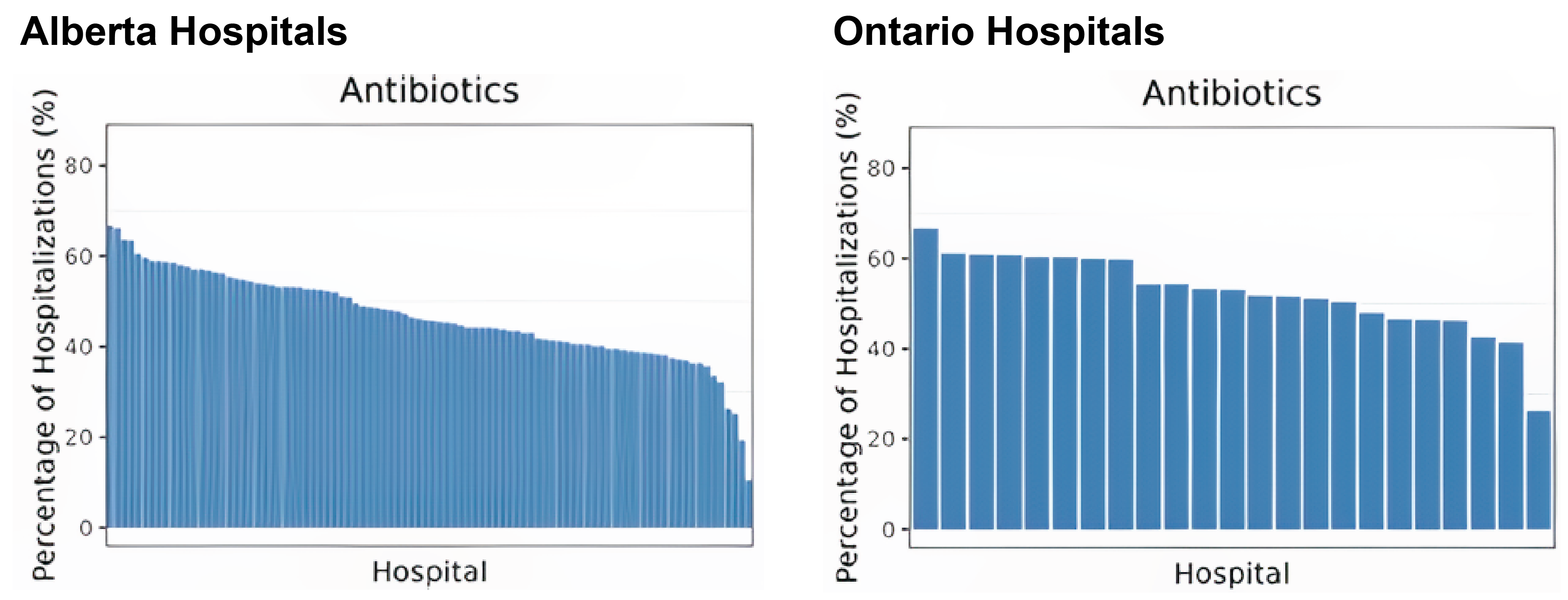
Note: Each bar represents a hospital, and the y-axis represents the percentage of hospitalizations in which the medication was prescribed at least once.
Interventions
Evidence about effective interventions to improve antibiotic appropriateness includes the following:
A 2017 systematic review found that antibiotic stewardship interventions improved adherence to best-practice policies by 15%, and reduced length of hospital stays by 1.1 days, on average, without increasing mortality.31 Interventions were helpful when they enabled clinicians through practice feedback and educational outreach, recommendations, and reminders targeted around individual patients.
Computer systems that provide decision-support prompts can be effective, although interventions must be careful to avoid excessive alerts, which can cause fatigue and complacency in clinicians. A recent trial in 59 US hospitals found that computerized prompts reduced the use of extended-spectrum antibiotics in pneumonia by 28%, without worsening outcomes.32
GEMINI is currently conducting the PEER-AIMS trial in Ontario hospitals to study whether routinely collected data about physicians’ antibiotic prescribing can be used to generate personalized feedback that can safely reduce the total days patients spend on antibiotics.33
Resources
There are many available resources on antimicrobial stewardship in hospitals, including guidance from the Canadian antimicrobial stewardship programs across many provinces,34-37 Choosing Wisely Canada,38 and US Centers for Disease Control and Prevention.39
Antipsychotics
Background
Antipsychotics are often used in acute care settings for indications other than primary psychiatric problems, such as to manage agitation, confusion, or sleep. One academic centre found that two-thirds of antipsychotic prescriptions were inappropriate40 and another found excessive dosing in 16% of patients.41 It is recommended that antipsychotics be avoided for people with dementia except when indicated for specific symptoms,1,42 and that they not be used to treat primary insomnia at any age.25 Multidisciplinary care and nonpharmacological interventions are the first-line treatments for people with behavioural and psychiatric symptoms of dementia, and can be as effective as antipsychotics43 without the harms of these medications (which include an increased risk of fractures, falls, stroke, cognitive decline, and death in patients with dementia).1,43 The COVID-19 pandemic was associated with an increase in antipsychotic prescribing in long-term care and hospital settings.44,45 The cost of the potentially inappropriate use of antipsychotics in Canada was estimated at $123 million in 2021–2022, and was estimated to have increased by 7.2% from 2013 to 2014.4
Analysis
Our data analysis (Table 2, Figure 2) in Ontario found that antipsychotics were prescribed in 21.9% of hospitalizations and ranged from 13.9% to 31.7% across hospitals. In Alberta, antipsychotics were prescribed in 16.7% of hospitalizations overall, ranging from 4.3% to 34.9% across hospitals. In both Alberta and Ontario, academic or teaching hospitals were more likely to prescribe antipsychotics than community and regional or rural hospitals, although the gaps were relatively small (Ontario: 25% versus 20%; Alberta: 17% versus 15%).
In Ontario, the proportion of patients with dementia who were ordered antipsychotics ranged from 43.5% to 68.8% across hospitals, with notably wider prescribing variation across community hospitals (Figure 7). Antipsychotic prescribing was more variable among male patients than among female patients (Figure 8). People living in neighbourhoods with greater marginalization related to housing were more likely to be prescribed antipsychotics (Figure 9).
Table 2: Antipsychotic Prescribing in Ontario and Alberta
Antipsychotic prescribing | Overall | Minimum | Maximum | Range (maximum − minimum) |
|---|---|---|---|---|
Ontario | 21.9% | 13.9% | 31.7% | 17.8% |
Alberta | 16.7% | 4.3% | 34.9% | 30.9% |
Figure 2: Distribution of Antipsychotic Prescribing Across Hospitals in Alberta and Ontario
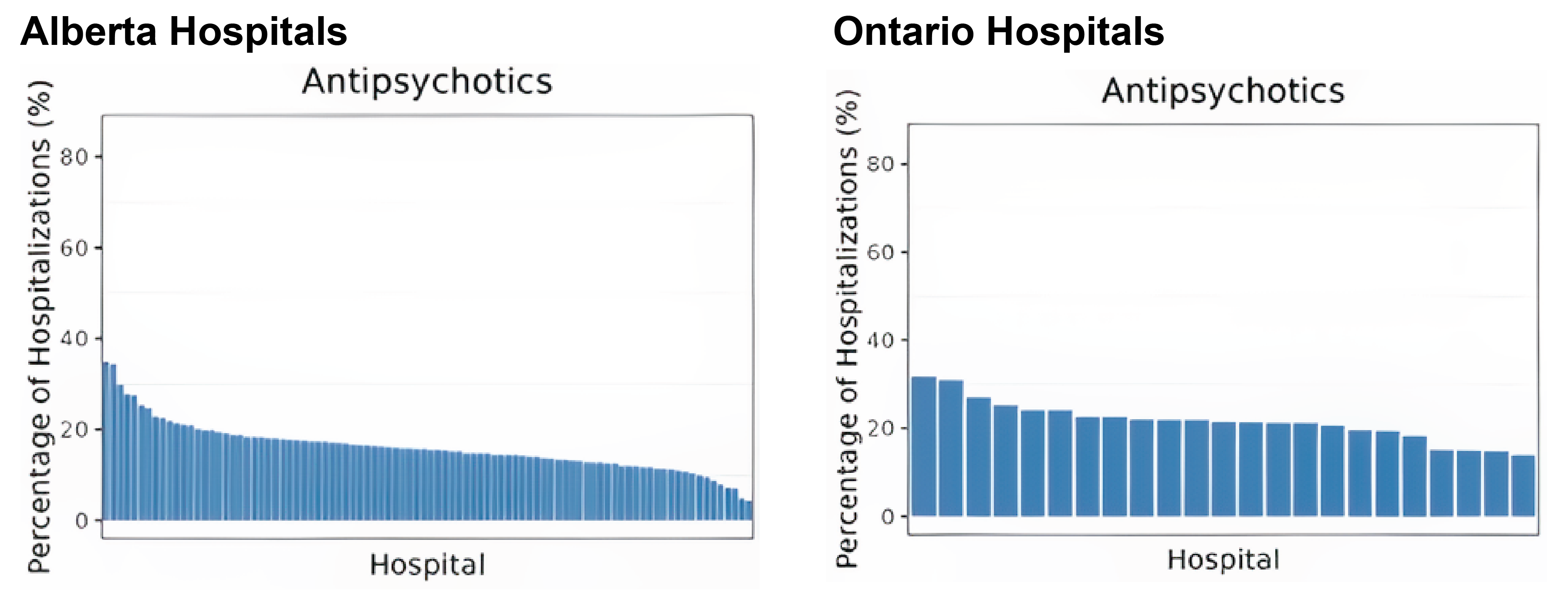
Note: Each bar represents a hospital and the y-axis represents the percentage of hospitalizations in which the medication was prescribed at least once.
Interventions
Evidence about effective interventions to improve antipsychotic appropriateness includes the following:
Interventions to reduce the use of antipsychotics in Canada have been developed in long-term care settings,46-51 and early evidence suggests that they may translate to acute care.
Alberta Health Services implemented a toolkit that reduced antipsychotic use in long-term care from 27% to 17%.48 The toolkit was also implemented in acute care settings through the Elder Friendly Care program;52 in a pilot evaluation at 8 acute care sites, 78% of respondents indicated that they or their unit had changed practices to reduce antipsychotics and other sedating medications.52
Resources
The Canadian Association for Deprescribing Network (CADeN) provides a deprescribing algorithm to assist with stopping or tapering antipsychotics for patients taking them for behavioural and psychiatric symptoms of dementia or primary insomnia.53 The Appropriate Use Coalition, a group of 10 organizations working collectively to improving appropriate prescribing across Canada, is focusing on setting a target for appropriate use of antipsychotics in long-term care.
Opioids
Background
The potentially inappropriate prescribing of opioids in hospital settings has been identified as a contributor to the opioid crisis in North America, as opioid exposure in hospital is associated with long-term opioid use.54-56 A 2014 study of opioid use in nonsurgical admissions to US hospitals found high rates of opioid use, with substantial variation across hospitals.38 Results of a 2018 survey of opioid stewardship practices at 133 primarily US hospitals found that only 23% reported a stewardship program, 14% had a prospective screening process to identify patients at high risk of adverse events related to opioids, and 45% implemented restrictions on the use of patient-controlled analgesia.57 In Canada, the cost of potentially inappropriate prescribing of opioids among patients aged 65 years or older or living in long-term care was estimated at $85 million in the 2021–2022 fiscal year.4 These estimates do not factor in the costs of inappropriate use in younger patients or indirect costs from inappropriate prescribing.
In our environmental scan and analysis, we focused on efforts to reduce inappropriate opioid prescribing. However, it is important to note that opioid stewardship must balance reducing inappropriate prescribing with ensuring adequate analgesia when clinically indicated. This is especially important given the evidence that stigma contributes to the undertreatment of pain among populations who may experience marginalization, including Indigenous patients57 and individuals with sickle cell disease.58 Hospitals also have opportunities to improve the appropriateness of treatments for patients with opioid use disorder by expanding access to opioid agonist therapy, strengthening continuity between hospital and community care, and providing naloxone kits and other harm reduction supports at discharge.59
Analysis
Our data analysis in Ontario (Table 3, Figure 3) found that opioids were prescribed in 50.2% of hospitalizations and ranged from 30.7% to 68.8% across hospitals. In Alberta, opioids were prescribed in 64.9% of hospitalizations overall, ranging from 19.8% to 75.0% across hospitals. In Ontario, opioid prescriptions were more common in academic centres compared to community hospitals (57% versus 46%) whereas prescribing in Alberta was similar between urban or teaching hospitals and regional or rural hospitals (67% versus 66%). In Ontario, male patients were slightly less likely to be prescribed opioids than female patients, but with greater variability in prescribing across hospitals (Figure 8). Prescribing was similarly variable for patients living in more marginalized and less marginalized neighbourhoods.
Opioids remained commonly and variably prescribed even after excluding patients receiving palliative care, where opioids are often used to alleviate end-of-life symptoms. Opioid prescribing after excluding patients receiving palliative care ranged from 26.6% to 66.0% across hospitals (Figure 5).
Table 3: Opioid Prescribing in Ontario and Alberta
Opioid prescribing | Overall | Minimum | Maximum | Range (maximum − minimum) |
|---|---|---|---|---|
Ontario | 50.2% | 30.7% | 68.8% | 38.1% |
Alberta | 64.9% | 19.8% | 75.0% | 55.2% |
Figure 3: Distribution of Opioid Prescribing Across Hospitals in Alberta and Ontario
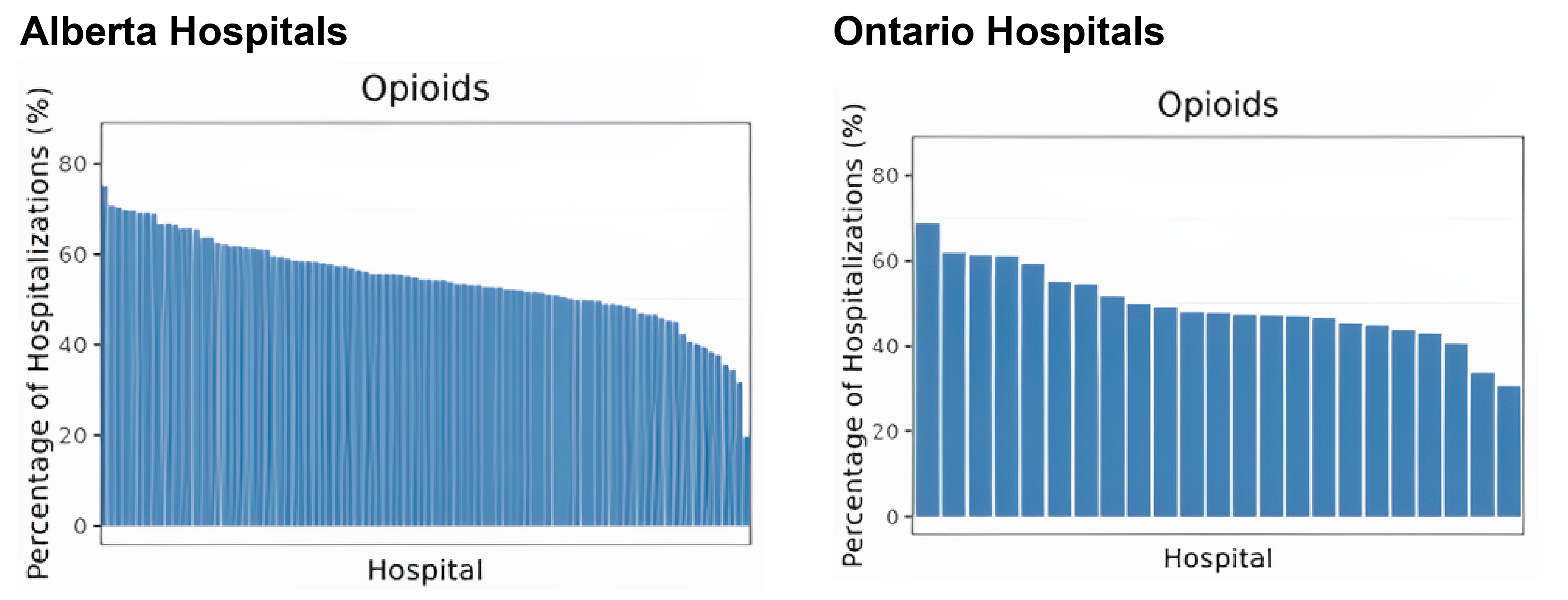
Note: Each bar represents a hospital and the y-axis represents the percentage of hospitalizations in which the medication was prescribed at least once.
Interventions
Evidence about effective interventions to improve opioid appropriateness includes the following:
St. Paul’s Hospital in Vancouver implemented an opioid stewardship program involving education and an audit-and-feedback approach to screen for potentially inappropriate prescription of opioids.60 The program provided 2,207 recommendations for 898 patients, 34% of which were to stop as-needed opioids, 16% were for opioid dose adjustments, and 14% were for addition or dose increases of nonopioid analgesics; 95% of recommendations were accepted.
Ontario Health’s Cut the Count surgical quality improvement campaign achieved a 34% reduction in the number of opioid pills prescribed at discharge.61
Resources
Resources to support opioid stewardship have been developed by initiatives such as Choosing Wisely Canada's Opioid Wisely program, which incorporates recommendations on opioid use for hospital pharmacists, internists, and general surgeons.62 The Institute for Safe Medication Practices Canada and Saskatchewan Health Authority also provide resources on opioid stewardship that are relevant to the acute care setting.62,63 The Saskatchewan Health Authority’s stewardship program has also included the development of a pharmaceutical automated reporting tool to screen acute care visits for opioid-related harm risk factors.
Sleep Aids
Background
Sleep aids are frequently used to treat insomnia for hospital inpatients despite an increased risk of falls, delirium, and other harms,1,64-66 as well as the potential for newly exposed patients to continue use following discharge.67 In Canada, the estimated national cost of potentially inappropriate use of benzodiazepines (commonly used as sleep aids) in older adults was estimated to be $74 million in 2021–2022.4
Analysis
Our data analysis in Ontario (Table 4, Figure 4) found that sleep aids were prescribed in 41.4% of hospitalizations and ranged from 27.9% to 61.2% across hospitals. In Alberta, sleep aids were prescribed in 36.2% of hospitalizations overall, ranging from 11.8% to 81.4% across hospitals. In Ontario, sleep aids were prescribed more commonly in academic hospitals than community hospitals (44.6% versus 39.4%), whereas prescribing in Alberta was more similar between urban or teaching hospitals and regional or rural hospitals (35.4% versus 38.2%).
Prescribing variation was similar for female and male patients and for patients from more and less marginalized neighbourhoods, in Ontario. Prescribing variation remained similar after excluding approximately 10% of patients who had a clear indication for sedative medications other than sleep, ranging from 18.9% to 50.8% across hospitals.
Table 4: Sleep Aid Prescribing in Ontario and Alberta
Sleep aid prescribing | Overall | Minimum | Maximum | Range (maximum − minimum) |
|---|---|---|---|---|
Ontario | 41.4% | 27.9% | 61.2% | 33.3% |
Alberta | 36.2% | 11.8% | 81.4% | 69.6% |
Figure 4: Distribution of Sleep Aid Prescribing Across Hospitals in Alberta and Ontario
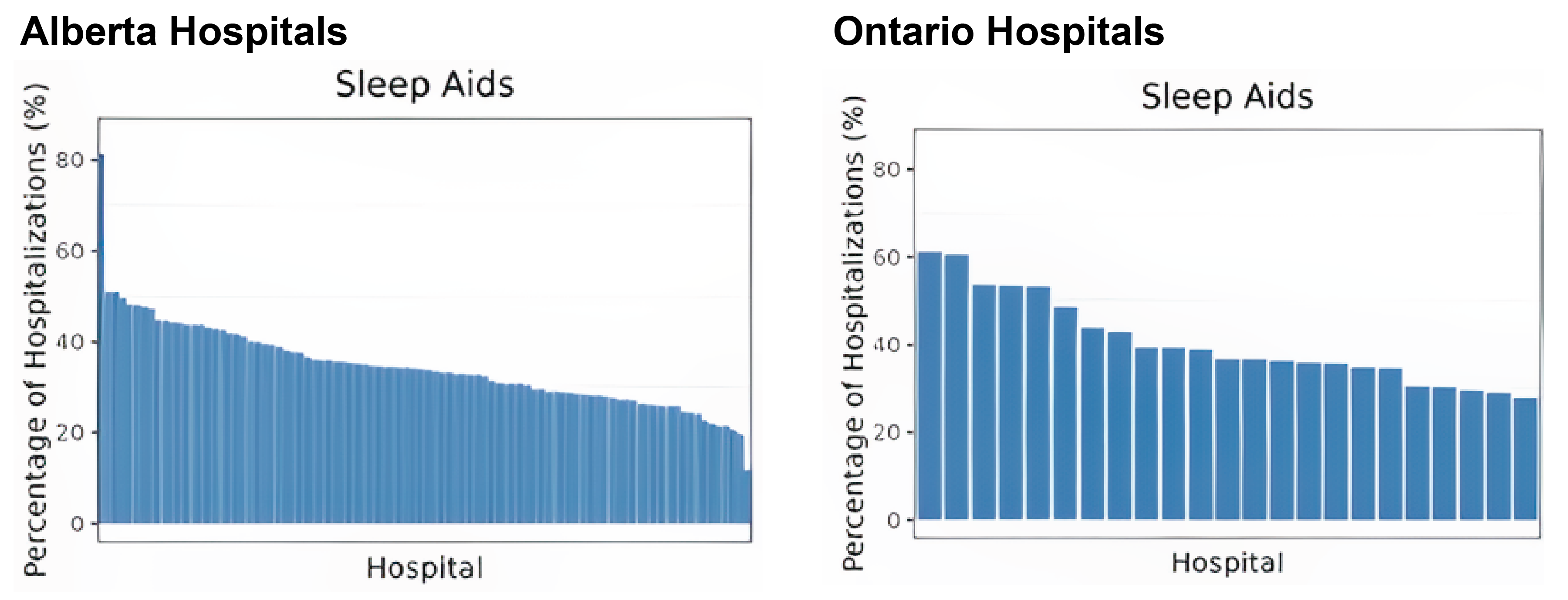
Note: Each bar represents a hospital and the y-axis represents the percentage of hospitalizations in which the medication was prescribed at least once.
Interventions
Evidence about effective interventions to improve sleep aid appropriateness includes the following:
Numerous interventions have been studied to reduce sleep aid prescribing for sleep.68,69 One multicomponent quality improvement initiative in Toronto hospitals reduced sleep aid use by 15% through order set changes, pharmacist-enabled medication review, sleep hygiene, daily sleep huddles, audit and feedback, and education.65
As part of the provincial Delirium Aware Safer Healthcare (DASH) campaign, Ontario Health has been encouraging hospitals to take up that bundle of interventions to reduce unnecessary prescribing of sleep aids.70 This work is supported by individualized feedback data delivered to clinicians and hospitals by GEMINI as part of Ontario Health’s GeMQIN.
A multicomponent intervention in Alberta ICUs was able to reduce the use of midazolam sedation days by 7.6% and reduce the occurrence of delirium.71
Resources
Resources to support this improvement include Choosing Wisely Canada’s toolkit to reduce sleep aid deprescribing64 and a deprescribing algorithm from CADeN.64
Opportunities to Improve Appropriate Medication Use in Acute Care
The significant variations in prescribing rates identified in this paper point to likely gaps in appropriate medication prescribing in hospitals, presenting clear opportunities for improvements. Acute care encounters have been identified as a potential opportunity to implement appropriate use interventions that have effects both in hospital and long-term after the patient returns home.72 A hospital encounter marks a critical point in the patient’s care because it is a time when:
medications are used intensively to treat acute issues
transitions into and out of hospital create opportunities for medication errors
patients and caregivers are experiencing a significant life event that can motivate changes in medication preferences
a multidisciplinary team can perform a comprehensive medication review
treatments are highly protocolized (for example, with patient order sets for specific conditions), creating opportunities to change practice and optimize prescribing.
Many studies have investigated medication review and deprescribing interventions.14-16,19,73-76 Deprescribing algorithms are available for proton pump inhibitors, antiglycemics, and cholinesterase inhibitors and memantine from CADeN,53 and Alberta Health Services provides an extensive resource list for deprescribing many medication types.77 A 2018 systematic review of randomized controlled trials of deprescribing interventions among older hospitalized patients identified 9 randomized trials that used a variety of different deprescribing approaches: physician-led approaches, pharmacist-led approaches, multidisciplinary approaches, prescriber education, and clinical decision support systems.78 The authors found that 7 out of the 9 trials identified statistically significant reductions in potentially inappropriate medications. Successful interventions in hospital must acknowledge that hospital resources are limited, recognize that more pressing acute issues may take priority, and consider how to integrate with medical care after hospital discharge to ensure that changes are durable.72 Best practices and other real-world examples about interventions to improve appropriate use are available in the Appropriate Use Intervention Summaries on the Canada’s Drug Agency (CDA-AMC) website.
It is crucial to consider equity dimensions related to the appropriate use of medications in acute care. Hospital patients in Canada who do not speak English or French and those who have not completed high school experience higher rates of hospital harms.79 It has also been highlighted that there are sex- and gender-specific considerations for potentially inappropriate medication use, as women face elevated risks of drug-related adverse events and may require different doses for medication optimization.80 Furthermore, while much of the literature on deprescribing has focused on older patients, consideration needs to be given to the appropriate use needs of younger patients.81 It is also relevant for appropriate use interventions to consider increasing the use of indicated medications, reducing barriers to uptake in equity-deserving populations. Our analysis shows that prescribing variations are large and are present across a wide range of patient subgroups stratified by equity-related factors.
Evidence Gaps and Emerging Opportunities
There is a growing body of evidence about improving the appropriate use of medications in hospitals. However, several important gaps remain.72,78,82,83 Interventions have mainly shown improvement in short-term measures, like in-hospital prescribing, rather than clinical outcomes or longer-term medication use in the months or years after hospital stays. Often, impactful interventions are conducted in only a small number of sites and it is unclear if the beneficial impacts can be replicated in other settings. Policy-makers and hospital leaders can work together to establish hospital networks that harness electronic medical records systems to measure prescribing patterns, identify improvement opportunities, and implement quality improvement interventions. Such networks can enhance knowledge mobilization to promote uptake of effective interventions across health systems.
One important historical gap has been a lack of data because hospitals do not submit individual insurance claims for medications, so there is an absence of administrative health care data about in-hospital prescribing. The widespread adoption of electronic health records provides an opportunity to overcome this gap.
The analyses presented in this paper show how electronic health records data can be mined across large, multi-institutional settings to provide insights about hospital prescribing. These capabilities are becoming increasingly available across Canadian provinces. Electronic health records can be used for data and analytics but also as a key component of appropriate use interventions (e.g., through point-of-care decision support or audit-and-feedback dashboards). Taking advantage of these systems requires careful attention to data quality and governance and implementation science.
The GEMINI program is currently leading a clinical trial of providing antibiotic prescribing reports to hospital physicians to curb overprescribing, and the entire study is being conducted using routinely collected data. The federal government recently funded the establishment of VITAL,84 a multiprovincial network for research and analytics using hospital electronic health records data that will begin by including 100 hospitals across Alberta, Ontario, and Quebec, representing nearly half of the population in Canada.
Conclusion
Through expert consultations, an environmental scan, and data analysis of approximately 535,000 hospitalizations at 115 hospitals across Alberta and Ontario, this resource paper highlighted the pressing and large-scale opportunity to improve the appropriate use of medications in hospitals in Canada. Our investigation identified antibiotics, antipsychotics, sleep aids, and opioids as promising medication classes to prioritize for appropriate use interventions in hospitals. These medication classes were prescribed with marked variability across different hospital settings and different patient populations due to prescribing practices, highlighting major opportunities to standardize and improve care. One of the widest variations identified by our analyses was in sleep aids, where prescribing ranged from 12% to 81% for patients across hospitals. This is particularly striking in the face of recommendations against the routine use of these medications from the Canadian Society of Hospital Pharmacists, the Canadian Psychiatric Association, the Canadian Academy of Geriatric Psychiatry, and Choosing Wisely Canada.
We identified potentially effective interventions that have been impactful in specific settings, creating a strong starting point for scalable solutions that could be implemented in hospitals across Canada. These interventions commonly involve changes to care protocols paired with delivering practice feedback and evidence-based guidance to prescribers, and electronic health records can be a helpful tool for implementing change.
Importantly, we also demonstrate that data from electronic health records are increasingly ready for large-scale use to support appropriate use interventions across health systems in Canada. Policy-makers can encourage the adoption of data-sharing networks and support quality-improvement communities of practice to enable the scaling of interventions and learning across sites that take advantage of these digital technologies.
Finally, efforts to improve appropriateness should be evaluated rigorously and assessed for unintended consequences, particularly with the involvement of equity-deserving populations and through analysis in disaggregated patient groups to reveal biases. Improving the appropriate use of medications in acute care settings represents a critical opportunity to address the joint challenges of health care quality and financial sustainability in our hospitals.
References
1.American Geriatrics Society Beers Criteria Update Expert Panel. American Geriatrics Society 2023 updated AGS Beers Criteria® for potentially inappropriate medication use in older adults. J Am Geriatr Soc. 2023 Jul;71(7):2052–81. doi:10.1111/jgs.18372 PubMed
2.O’Mahony D, Cherubini A, Guiteras AR, Denkinger M, Beuscart JB, Onder G, et al. STOPP/START criteria for potentially inappropriate prescribing in older people: version 3. Eur Geriatr Med. 2023;14(4):625–32. doi:10.1007/s41999-023-00777-y; PubMed Central PMCID: PMC10447584.PubMed
3.Linkens AEMJH, Milosevic V, van der Kuy PHM, Damen-Hendriks VH, Mestres Gonzalvo C, Hurkens KPGM. Medication-related hospital admissions and readmissions in older patients: an overview of literature. Int J Clin Pharm. 2020;42(5):1243–51. doi:10.1007/s11096-020-01040-1; PubMed Central PMCID: PMC7522062.PubMed
4.Huon JF, Sanyal C, Gagnon CL, Turner JP, Khuong NB, Bortolussi-Courval É, et al. The cost of potentially inappropriate medications for older adults in Canada: A comparative cross-sectional study. J Am Geriatr Soc. 2024 Nov;72(11):3530–40. doi:10.1111/jgs.19164.PubMed
5.Public Health Agency of Canada. Aging and chronic diseases: A profile of Canadian seniors [education and awareness] [Internet]. 2021 [cited 2025 Nov 7]. Available from: https://www.canada.ca/en/public-health/services/publications/diseases-conditions/aging-chronic-diseases-profile-canadian-seniors-report.html
6.Statistics Canada. Prevalence of prescription and non-prescription polypharmacy by frailty and sex among middle-aged and older Canadians [Internet]. 2022 [cited 2025 Nov 18]. Available from: https://www150.statcan.gc.ca/n1/pub/82-003-x/2022006/article/00001-eng.htm
7.Canadian Institute for Health Information. National health expenditure trends, 2024 — Snapshot [Internet]. [cited 2025 Nov 7]. Available from: https://www.cihi.ca/en/national-health-expenditure-trends-2024-snapshot
8.Kemp A, Preen DB, Glover J, Semmens J, Roughead EE. How much do we spend on prescription medicines? Out-of-pocket costs for patients in Australia and other OECD countries. Aust Health Rev Publ Aust Hosp Assoc. 2011 Aug;35(3):341–9. doi:10.1071/AH10906.PubMed
9.Larsen K, Nolan B, Gomez D. A system in crisis: exploring how recent emergency department closures influence potential access to emergency care in Ontario. Cjem. 2023;25(3):218–23. doi:10.1007/s43678-023-00460-y; PubMed Central PMCID: PMC9888742.PubMed
10.Dyer O. Covid-19: Ontario hospitals close wards as nursing shortage bites. BMJ. 2022 Aug 1;o1917. doi:10.1136/bmj.o1917 PubMed
11.Fu A, Shen T, Roberts SB, Liu W, Vaidyanathan S, Marchena-Romero KJ, et al. Optimizing the efficiency and effectiveness of data quality assurance in a multicenter clinical dataset. J Am Med Inform Assoc. 2025 May 1;32(5):835–44. doi:10.1093/jamia/ocaf042 PubMed
12.Verma AA, Pasricha SV, Jung HY, Kushnir V, Mak DYF, Koppula R, et al. Assessing the quality of clinical and administrative data extracted from hospitals: the General Medicine Inpatient Initiative (GEMINI) experience. J Am Med Inform Assoc. 2021 Mar 1;28(3):578–87. doi:10.1093/jamia/ocaa225 PubMed
13.Waters R, Malecki S, Lail S, Mak D, Saha S, Jung HY, et al. Automated identification of unstandardized medication data: a scalable and flexible data standardization pipeline using RxNorm on GEMINI multicenter hospital data. JAMIA Open. 2023 Oct 1;6(3):ooad062. doi:10.1093/jamiaopen/ooad062 PubMed
14.Wright RM, Sloane R, Pieper CF, Ruby-Scelsi C, Twersky J, Schmader KE, et al. Underuse of Indicated Medications Among Physically Frail Older US Veterans at the Time of Hospital Discharge: Results of a Cross-Sectional Analysis of Data From the Geriatric Evaluation and Management Drug Study. Am J Geriatr Pharmacother. 2009 Oct;7(5):271–80. doi:10.1016/j.amjopharm.2009.11.002; PubMed Central PMCID: PMC2929122.PubMed
15.Nardino RJ, Vender RJ, Herbert PN. Overuse of acid-suppressive therapy in hospitalized patients1. Am J Gastroenterol. 2000 Nov;95(11):3118–22. doi:10.1111/j.1572-0241.2000.03259.x PubMed
16.San-José A, Agustí A, Vidal X, Formiga F, Gómez-Hernández M, García J, et al. Inappropriate prescribing to the oldest old patients admitted to hospital: prevalence, most frequently used medicines, and associated factors. BMC Geriatr. 2015 Apr 9;15:42. doi:10.1186/s12877-015-0038-8; PubMed Central PMCID: PMC4403827.PubMed
17.McIntyre MT, Saha S, Morris AM, Lapointe-Shaw L, Tang T, Weinerman A, et al. Physician antimicrobial prescribing and patient outcomes on general medical wards: a multicentre retrospective cohort study. Can Med Assoc J. 2023 Aug 21;195(32):E1065–74. doi:10.1503/cmaj.221732 PubMed
18.Schwartz KL, Shuldiner J, Langford BJ, Brown KA, Schultz SE, Leung V, et al. Mailed feedback to primary care physicians on antibiotic prescribing for patients aged 65 years and older: pragmatic, factorial randomised controlled trial. BMJ. 2024 Jun 5;385:e079329. doi:10.1136/bmj-2024-079329.PubMed
19.Masnoon N, Lo S, Hilmer S. A stewardship program to facilitate anticholinergic and sedative medication deprescribing using the drug burden index in electronic medical records. Br J Clin Pharmacol. 2023 Feb;89(2):687–98. doi:10.1111/bcp.15517; PubMed Central PMCID: PMC10953400.PubMed
20.By the 2023 American Geriatrics Society Beers Criteria® Update Expert Panel. American Geriatrics Society 2023 updated AGS Beers Criteria® for potentially inappropriate medication use in older adults. J Am Geriatr Soc. 2023 Jul;71(7):2052–81. doi:10.1111/jgs.18372; PubMed Central PMCID: PMC12478568.PubMed
21.Colacci M, Loffler A, Roberts SB, Straus S, Verma AA, Razak F, et al. Patient Complexity, Social Factors, and Hospitalization Outcomes at Academic and Community Hospitals. JAMA Netw Open. 2025 Jan 2;8(1):e2454745. doi:10.1001/jamanetworkopen.2024.54745; PubMed Central PMCID: PMC11736502.PubMed
22.Chakravorty AJ, Newman NJ, Veltri C, Spivak ES, Hecker MT, Hojat LS. Estimated greenhouse gas emissions associated with unnecessary intravenous antimicrobials administered in the hospital setting. Antimicrob Steward Healthc Epidemiol ASHE. 2025 Oct 14;5(1):e263. doi:10.1017/ash.2025.10176; PubMed Central PMCID: PMC12538345.PubMed
23.Scarborough Health Network. SHN Achieves Choosing Wisely Canada Hospital Quality Improvement Status [Internet]. [cited 2025 Nov 16]. Available from: https://www.shn.ca/shn-achieves-choosing-wisely-canada-hospital-quality-improvement-status/
24.Mottier D, Girard P, Couturaud F, Lacut K, Le Moigne E, Paleiron N, et al. Enoxaparin versus Placebo to Prevent Symptomatic Venous Thromboembolism in Hospitalized Older Adult Medical Patients. NEJM Evid. 2023 Aug;2(8):EVIDoa2200332. doi:10.1056/EVIDoa2200332 PubMed PMID: 38320142.
25.Ogilvie IM, Newton N, Welner SA, Cowell W, Lip GYH. Underuse of oral anticoagulants in atrial fibrillation: a systematic review. Am J Med. 2010 Jul;123(7):638-645.e4. doi:10.1016/j.amjmed.2009.11.025.PubMed
26.Government Of Canada. Pan-Canadian Action Plan on Antimicrobial Resistance [report on plans and priorities] [Internet]. 2023 [cited 2025 Jan 27]. Available from: https://www.canada.ca/en/public-health/services/publications/drugs-health-products/pan-canadian-action-plan-antimicrobial-resistance.html
27.Malani AN, Richards PG, Kapila S, Otto MH, Czerwinski J, Singal B. Clinical and economic outcomes from a community hospital’s antimicrobial stewardship program. Am J Infect Control. 2013 Feb 1;41(2):145–8. doi:10.1016/j.ajic.2012.02.021 PubMed
28.Tamma PD, Avdic E, Li DX, Dzintars K, Cosgrove SE. Association of Adverse Events With Antibiotic Use in Hospitalized Patients. JAMA Intern Med. 2017 Jun 12;(9):1308–15. PubMed
29.Public Health Agency of Canada. Antimicrobial use: Seasonal update — Canada.ca [Internet]. 2024 [cited 2026 Feb 23]. Available from: https://health-infobase.canada.ca/carss/amu/results.html?ind=02
30.Llor C, Bjerrum L. Antimicrobial resistance: risk associated with antibiotic overuse and initiatives to reduce the problem. Ther Adv Drug Saf. 2014 Dec;5(6):229–41. doi:10.1177/2042098614554919; PubMed Central PMCID: PMC4232501.PubMed
31.Davey P, Marwick CA, Scott CL, Charani E, Mcneil K, Brown E, et al. Interventions to improve antibiotic prescribing practices for hospital inpatients. Cochrane Database Syst Rev. 2017 Feb 9;2017(2). doi:10.1002/14651858.CD003543.PUB4/FULL.PubMed
32.Gohil SK, Septimus E, Kleinman K, Varma N, Avery TR, Heim L, et al. Stewardship Prompts to Improve Antibiotic Selection for Pneumonia: The INSPIRE Randomized Clinical Trial. JAMA. 2024 Jun 18;331(23):2007–17. doi:10.1001/jama.2024.6248 PubMed
33.Razak F. Peer Comparison Feedback As An Antimicrobial Prescribing Intervention To General Medicine Specialists [Clinical trial registration] [Internet]. clinicaltrials.gov; 2025 Sep [cited 2025 Nov 7]. Report No.: NCT07189364. Available from: https://clinicaltrials.gov/study/NCT07189364
34.Health PEI. Antimicrobial Stewardship [Internet]. [cited 2025 Nov 16]. Available from: https://src.healthpei.ca/antimicrobial-stewardship
35.Alberta Health Services. Antimicrobial Stewardship Program [Internet]. [cited 2025 Nov 16]. Available from: https://www.albertahealthservices.ca/info/Page9674.aspx
36.Prairie Mountain Health. Antimicrobial Stewardship Program [Internet]. [cited 2025 Sep 29]. Available from: https://healthprofessionals.prairiemountainhealth.ca/wp-content/uploads/2023-2024-Annual-Report-Acute-Care-Summary-Infographic-_.pdf
37.Saskatchewan Health Authority. Antimicrobial Stewardship Program - Provider Information [Internet]. [cited 2025 Nov 16]. Available from: https://www.saskhealthauthority.ca/intranet/departments-programs/quality-safety-and-information/clinical-standards/clinical-excellence/antimicrobial-stewardship-program-provider-information
38.Choosing Wisely Canada. Recommendations and Resources [Internet]. 2022 [cited 2025 Sep 23]. Available from: https://choosingwiselycanada.org/wp-content/uploads/2022/07/Choosing-Wisely-Canada-collection-of-lists-July-6-2022.pdf
39.US Centers for Disease Control and Prevention. The Core Elements of Hospital Antibiotic Stewardship Programs. 2019.
40.Roth W, Dadiomov D, Chu M. Inappropriate quetiapine use at a large academic medical center: frequency of misuse and associated costs of adverse effects. Ther Adv Drug Saf. 2023 Dec 6;14:20420986231213173. doi:10.1177/20420986231213173; PubMed Central PMCID: PMC10702410.PubMed
41.Herzig SJ, Rothberg MB, Guess JR, Stevens JP, Marshall J, Gurwitz JH, et al. Antipsychotic Use in Hospitalized Patients: Rates, Indications, and Predictors. J Am Geriatr Soc. 2016 Feb;64(2):299–305. doi:10.1111/jgs.13943; PubMed Central PMCID: PMC4762184.PubMed
42.Choosing Wisely Canada. When psychosis isn’t the diagnosis: A toolkit for reducing inappropriate use of antipsychotics in long term care. [Internet]. 2019. Available from: https://choosingwiselycanada.org/wp-content/uploads/2017/07/CWC_Antipsychotics_Toolkit_v1.0_2017-07-12.pdf
43.Watt JA, Thompson W, Marple R, Brown D, Liu B. Managing neuropsychiatric symptoms in patients with dementia. BMJ. 2022 Jan 25;376:e069187. doi:10.1136/bmj-2021-069187.PubMed
44.Canadian Institute for Health Information. Recent staffing and quality indicator trends in Canadian long-term care [Internet]. [cited 2026 Feb 23]. Available from: https://www.cihi.ca/en/recent-staffing-and-quality-indicator-trends-in-canadian-long-term-care
45.Reppas-Rindlisbacher C, Boblitz A, Fowler RA, Lapointe-Shaw L, Sheehan KA, Stukel TA, et al. Trends in Delirium and New Antipsychotic and Benzodiazepine Use Among Hospitalized Older Adults Before and After the Onset of the COVID-19 Pandemic. JAMA Netw Open. 2023 Aug 7;6(8):e2327750. doi:10.1001/jamanetworkopen.2023.27750; PubMed Central PMCID: PMC10407689.PubMed
46.Alberta Health Services. Alberta Health Services [Internet]. [cited 2025 Nov 7]. AUA Toolkit. Available from: https://www.albertahealthservices.ca/scns/auatoolkit.aspx
47.Canadian Institute for Health Information (CIHI). Potentially Inappropriate Use of Antipsychotics in Long-Term Care [Internet]. 2025 [cited 2025 Sep 30]. Available from: https://www.cihi.ca/en/indicators/potentially-inappropriate-use-of-antipsychotics-in-long-term-care
48.Alberta Health Services. Appropriate Use of Antipsychotics (AUA) toolkit: AUA quick facts infographic [Internet]. 2017 [cited 2025 Sep 30]. Available from: https://www.albertahealthservices.ca/assets/about/scn/ahs-scn-srs-aua-infographic.pdf
49.Health Quality BC. It Starts With Asking Why Action Series - Health Quality BC [Internet]. 2025 Nov 26 [cited 2025 Nov 16]. Available from: https://healthqualitybc.ca/improve-care/long-term-care/it-starts-with-asking-why-action-series/
50.BC Patient Safety & Quality Council. Clear Wave 3 Summary Report [Internet]. Available from: https://healthqualitybc.ca/wp-content/uploads/BCPSQC_ClearWaveReport_v5-FINAL.pdf
51.Health Care Excellence. Appropriate Use of Antipsychotics [Internet]. [cited 2025 Nov 18]. Available from: https://www.healthcareexcellence.ca/en/what-we-do/all-programs/appropriate-use-of-antipsychotics/
52.Arain MA, Graham L, Ahmad A, Cole M. Pilot implementation of elder-friendly care practices in acute care setting: a mixed methods study. BMC Health Serv Res. 2020 Apr 24;20(1):347. doi:10.1186/s12913-020-05091-y PubMed
53.Canadian Medication Appropriateness and Deprescribing Network. Do I still need this medication? Is deprescribing for you? [Internet]. [cited 2025 Nov 7]. Deprescribing algorithms. Available from: https://www.deprescribingnetwork.ca/algorithms
54.Barnett ML, Olenski AR, Jena AB. Opioid-Prescribing Patterns of Emergency Physicians and Risk of Long-Term Use. N Engl J Med. 2017 Feb 16;376(7):663–73. doi:10.1056/NEJMsa1610524 PubMed
55.Kim B, Nolan S, Ti L. Addressing the prescription opioid crisis: Potential for hospital-based interventions? Drug Alcohol Rev. 2017;36(2):149–52. doi:10.1111/dar.12541 PubMed
56.Mazurenko O, Andraka-Christou BT, Bair MJ, Kara AY, Harle CA. Clinical perspectives on hospitals’ role in the opioid epidemic. BMC Health Serv Res. 2020 Jun 8;20:521. doi:10.1186/s12913-020-05390-4; PubMed Central PMCID: PMC7281936.PubMed
57.Herzig SJ, Rothberg MB, Cheung M, Ngo LH, Marcantonio ER. Opioid Utilization and Opioid-Related Adverse Events in Non-Surgical Patients in U.S. Hospitals. J Hosp Med Off Publ Soc Hosp Med. 2014 Feb;9(2):73–81. doi:10.1002/jhm.2102; PubMed Central PMCID: PMC3976956.PubMed
58.Ontario Health (Quality). Sickle Cell Disease: Care for People of All Ages [Internet]. 2023. Available from: https://www.hqontario.ca/Portals/0/documents/evidence/quality-standards/qs-sickle-cell-disease-quality-standard-en.pdf
59.Donroe JH, Holt SR, Tetrault JM. Caring for patients with opioid use disorder in the hospital. CMAJ. 2016 Dec 6;188(17–18):1232–9. doi:10.1503/cmaj.160290.PubMed
60.Providence Health Care. Opioid Stewardship Program: Year Four Program Report [Internet]. 2023 [cited 2025 Sep 24]. Available from: https://www.bccsu.ca/wp-content/uploads/2024/07/PHC-Opioid-Stewardship-Program-Y4-Report-Final.pdf
61.Ontario Health. Cut the count: Campaign Results: Reducing Opioids after Surgery [Internet]. [cited 2025 Sep 30]. Available from: https://www.hqontario.ca/Portals/0/documents/qi/onsqin/cut-the-count-campaign-results-en.pdf
62.Choosing Wisely Canada. Opioid Wisely [Internet]. [cited 2025 Sep 30]. Available from: https://www.hqontario.ca/Portals/0/documents/evidence/quality-standards/qs-sickle-cell-disease-quality-standard-en.pdf
63.Institute for Safe Medication Practices Canada. Opioid Stewardship [Internet]. 2025 [cited 2025 Nov 16]. Available from: https://www.ismp-canada.org/opioid_stewardship/
64.Choosing Wisely Canada. Less sedatives for your relatives [Internet]. 2024 [cited 2024 Sep 28]. Available from: https://choosingwiselycanada.org/wp-content/uploads/dlm_uploads/2025/03/CWC_LessSedatives_20252.pdf
65.Soong C, Ethier C, Lee Y, Othman D, Burry L, Wu PE, et al. Reducing Sedative-Hypnotics Among Hospitalized Patients: a Multi-centered Study. J Gen Intern Med. 2022 Aug 1;37(10):2345–50. doi:10.1007/s11606-021-07292-5 PubMed
66.Fan-Lun C, Chung C, Lee EHG, Pek E, Ramsden R, Ethier C, et al. Reducing unnecessary sedative-hypnotic use among hospitalised older adults. BMJ Qual Saf. 2019 Dec;28(12):1039–45. doi:10.1136/bmjqs-2018-009241.PubMed
67.Scales DC, Fischer HD, Li P, Bierman AS, Fernandes O, Mamdani M, et al. Unintentional Continuation of Medications Intended for Acute Illness After Hospital Discharge: A Population-Based Cohort Study. J Gen Intern Med. 2016 Feb;31(2):196–202. doi:10.1007/s11606-015-3501-5; PubMed Central PMCID: PMC4720647.PubMed
68.Soong C. Less Sedatives for your Older Relatives [Internet]. Choosing Wisely Canada; 2019 May [cited 2024 Feb 21]. Report No. Available from: https://choosingwiselycanada.org/wp-content/uploads/2017/07/CWC_BSH_Hospital_Toolkit_v1.3_2017-07-12.pdf
69.Soong C, Burry L, Cho HJ, Gathecha E, Kisuule F, Tannenbaum C, et al. An Implementation Guide to Promote Sleep and Reduce Sedative-Hypnotic Initiation for Noncritically Ill Inpatients. JAMA Intern Med. 2019 Jul 1;179(7):965. doi:10.1001/jamainternmed.2019.1196 PubMed
70.Delirium Aware Safer Healthcare | Ontario Health [Internet]. [cited 2025 Nov 16]. Available from: https://www.ontariohealth.ca/quality/hospital/dash
71.Owen VS, Sinnadurai S, Morrissey J, Colaco H, Wickson P, Dyjur D, et al. Multicentre implementation of a quality improvement initiative to reduce delirium in adult intensive care units: An interrupted time series analysis. J Crit Care. 2024 Jun 1;81:154524. doi:10.1016/j.jcrc.2024.154524 PubMed
72.Should Hospital Admission Be Used as an Opportunity for Deprescribing in Older Adults? Can J Hosp Pharm. 2020;73(4):294–7.; PubMed Central PMCID: PMC7556391.PubMed
73.Marvin V, Ward E, Poots AJ, Heard K, Rajagopalan A, Jubraj B. Deprescribing medicines in the acute setting to reduce the risk of falls. Eur J Hosp Pharm. 2017 Jan;24(1):10–5. doi:10.1136/ejhpharm-2016-001003; PubMed Central PMCID: PMC5284469.PubMed
74.Roberts G, Pegoli M, Grzeskowiak L, Benger S, Forbes H, Hunt K, et al. Hospital admission as a deprescribing triage point for patients discharged to Residential Aged Care Facilities. Age Ageing. 2021 Sep 11;50(5):1600–6. doi:10.1093/ageing/afab082.PubMed
75.McDonald EG, Wu PE, Rashidi B, Forster AJ, Huang A, Pilote L, et al. The MedSafer Study: A Controlled Trial of an Electronic Decision Support Tool for Deprescribing in Acute Care. J Am Geriatr Soc. 2019 Sep;67(9):1843–50. doi:10.1111/jgs.16040.PubMed
76.Petersen AW, Shah AS, Simmons SF, Shotwell MS, Jacobsen JML, Myers AP, et al. Shed-MEDS: pilot of a patient-centered deprescribing framework reduces medications in hospitalized older adults being transferred to inpatient postacute care. Ther Adv Drug Saf. 2018 Jun 15;9(9):523–33. doi:10.1177/2042098618781524; PubMed Central PMCID: PMC6116773.PubMed
77.Alberta Health Services. Deprescribing Resource Guide [Internet]. 2021. Available from: https://www.albertahealthservices.ca/assets/info/phm/info-phm-ds-pub-dtb-deprescribing-resource-guide.pdf
78.Thillainadesan J, Gnjidic D, Green S, Hilmer SN. Impact of Deprescribing Interventions in Older Hospitalised Patients on Prescribing and Clinical Outcomes: A Systematic Review of Randomised Trials. Drugs Aging. 2018 Apr;35(4):303–19. doi:10.1007/s40266-018-0536-4.PubMed
79.Canadian Institute for Health Information. Improving patient safety and quality of care: Applying an equity lens to hospital harm. [Internet]. 2024 Oct 17. Available from: https://www.cihi.ca/en/improving-patient-safety-and-quality-of-care-applying-an-equity-lens-to-hospital-harm
80.Rochon PA, Petrovic M, Cherubini A, Onder G, O’Mahony D, Sternberg SA, et al. Polypharmacy, inappropriate prescribing, and deprescribing in older people: through a sex and gender lens. Lancet Healthy Longev. 2021 May 1;2(5):e290–300. doi:10.1016/S2666-7568(21)00054-4 PubMed
81.Elbeddini A, Sawhney M, Tayefehchamani Y, Yilmaz Z, Elshahawi A, Josh Villegas J, et al. Deprescribing for all: a narrative review identifying inappropriate polypharmacy for all ages in hospital settings. BMJ Open Qual. 2021 Jul 6;10(3):e001509. doi:10.1136/bmjoq-2021-001509; PubMed Central PMCID: PMC8261885.PubMed
82.Aubert CE, Kerr EA, Maratt JK, Klamerus ML, Hofer TP. Outcome Measures for Interventions to Reduce Inappropriate Chronic Drugs: A Narrative Review. J Am Geriatr Soc. 2020 Oct;68(10):2390–8. doi:10.1111/jgs.16697.PubMed
83.Scott IA, Reeve E, Hilmer SN. Establishing the worth of deprescribing inappropriate medications: are we there yet? Med J Aust. 2022 Sep;217(6):283–6. doi:10.5694/mja2.51686; PubMed Central PMCID: PMC9804687.PubMed
84.VITAL: Canada’s Largest Hospital Data Network for Research and Innovation [Internet]. [cited 2026 Jan 22]. Available from: https://geminimedicine.ca/VITAL
85.Canadian Drug Agency. Appropriate Use Advisory Committee [Internet]. [cited 2025 Nov 7]. Available from: https://www.cda-amc.ca/appropriate-use-advisory-committee
86.Ontario Health (Quality). The General Medicine Quality Improvement Network [Internet]. [cited 2025 Nov 7]. Available from: https://www.hqontario.ca/Quality-Improvement/Quality-Improvement-in-Action/The-General-Medicine-Quality-Improvement-Network
87.Government of Ontario. Classification of hospitals [Internet]. 2023 [cited 2025 Nov 7]. Available from: http://www.ontario.ca/page/classification-hospitals
88.Public Health Ontario. 2021 Ontario Marginalization Index (ON-Marg) [Internet]. 2021 [cited 2025 Jan 27]. Available from: https://www.publichealthontario.ca/en/Data-and-Analysis/Health-Equity/Ontario-Marginalization-Index
89.Statistics Canada. Postal Code OM Conversion File Plus (PCCF+) [Internet]. 2017 [cited 2025 Nov 7]. Available from: https://www150.statcan.gc.ca/n1/en/catalogue/82F0086X
Appendix 1: Membership of CDA-AMC–GEMINI Expert Panel on Appropriate Medication Use in Hospitals
Please note that this appendix has not been copy-edited.
Amanda Leong, Critical Care Medicine Pharmacist, Epidemiologist, University of Calgary, Alberta
Braden Manns, Senior Associate Dean, Health Research and the Associate Vice President, Health Research, University of Calgary, Alberta
Stephen Samis, Health Policy Consultant and Director of the Centre for Health Policy, O’Brien Institute for Public Health at the University of Calgary, Alberta
Nabha Shetty, Professor and General Internal Medicine Physician, Dalhousie University, Nova Scotia
Luke Wilmshurst, Patient and Family Partner, Ontario
Wendy Wu, Patient and Family Partner, Ontario
Appendix 2: Detailed Description of Methods
Please note that this appendix has not been copy-edited.
Consultations With Experts
Consultation with a range of experts helped identify key issues related to appropriate use in hospital settings and informed the methods for the environmental scan and data analysis. The groups consulted throughout the paper’s development process included:
The CDA-AMC Appropriate Use Advisory Committee:85 This committee informs the appropriate use strategy and program of the CDA-AMC and its partners by identifying priorities and sharing information about promising practices and opportunities. Its membership is pan-Canadian and includes clinicians, health system leaders, policy experts, and those with lived experience of being a patient/caregiver.
The CDA-AMC-GEMINI Expert Panel on Appropriate Medication Use in Hospitals: This panel was created to advise GEMINI and CDA-AMC at strategic points during the Resource Paper’s development process. Members include patients and caregivers, clinicians, pharmacists and knowledge users/decision makers. The panel was composed to ensure diversity across health system roles, gender, and geography. Refer to Appendix 1 for full membership list.
The General Medicine Quality Improvement Network (GeMQIN) Community of Practice:86 GeMQIN is a provincial program run by Ontario Health and is Canada’s largest hospital-based quality improvement network focused on adult medical inpatient care. GeMQIN includes more than 100 clinicians and hospital leaders from approximately 35 hospitals across all health regions of Ontario. GeMQIN leads provincial quality improvement campaigns, including related to appropriate use of medications, holds regular community of practice webinars for knowledge exchange, and uses GEMINI data to deliver individualized quality reports to more than 600 front line clinicians to catalyze quality improvement.
Expert consultations were conducted through a series of formal meetings with allotted time for questions and discussion. Participants were asked for their input on pressing issues related to appropriate use of medications in acute care, key medications or medication classes of concern, knowledge and evidence gaps, and notable improvement initiatives.
Environmental Scan
An environmental scan was conducted to identify key practices, initiatives, and evidence related to appropriate use interventions for medications in acute care settings, with a primary focus on jurisdictions in Canada. The scan was narrowed to 4 priority classes of medications identified in the consultation process: antibiotics, antipsychotics, opioids, and sleep aids. These medication classes were selected for their broad relevance across clinical domains, because they are frequently initiated in hospital, and to provide concrete examples of the opportunities to improve appropriate use in acute care.
The environmental scan included policy documents and reports as well as scientific literature. Relevant documents were sourced iteratively through a combination of expert input and searching the internet and academic databases, and reviewing the reference lists of relevant documents.
The search strategy involved the use of keywords including: “appropriate use” or “inappropriate use” or “overuse” or “overprescribing” or “underuse” or “underprescribing” or “deprescribing” or “stewardship” AND “medicines” or “medications” or “drugs” or “pharmaceuticals” and “acute care” or “inpatient” or “hospital admission.”
The medical literature was reviewed for publications related to methods for evaluating the appropriateness of medication use, appropriate use of the selected medication classes, and appropriate use of medications in Canadian hospitals and in peer countries.
Data Analysis
Data analyses were performed using GEMINI data on a subset of Ontario hospitals and Alberta Health Services data on a subset of Alberta hospitals to provide insight into the variation in prescribing rates across hospitals for antibiotics, sleep aids, antipsychotics, and opioids.
GEMINI Analysis
GEMINI collects detailed clinical data generated through the routine delivery of care, including rich information about patient diagnoses, diagnostic test results, and medication prescribing in hospitals. GEMINI data undergo rigorous quality control processes that ensure 98% to 100% accuracy compared to manual review of medical records.11,12
The analysis included all adult patients (aged ≥ 18 years) admitted to any medical inpatient service or with an ICU admission, and discharged between June 1, 2022, and June 30, 2023, across 23 GEMINI hospitals. This is the patient cohort that GEMINI includes for historical reasons in its evolution as a data repository, and excludes surgical, obstetrical, and mental health admissions.
GEMINI pharmacy data were used to identify medication orders within 4 medication classes: antibiotics, antipsychotics, opioids, and sleep aids. Inpatient pharmacy data in Canada are stored in different formats across sites and require careful standardization. GEMINI-RxNorm,13 a validated medication data standardization system, was provided a list of predefined medications and used to identify likely matches among pharmacy orders in GEMINI data. (Appendix 4). The GEMINI-RxNorm system captures more than 98.5% of medication orders across all common medication classes. These matches were reviewed and validated by a clinical expert to discard false positives.
We calculated the percentage of hospitalizations that received at least 1 order for each of the examined drug classes at the provincial and hospital level. We present the distribution of hospital-level percentages using bar graphs in the main Resource Paper and boxplots in appendix figures to evaluate the variation in medication use across hospitals (Appendix 7). In each boxplot, the black vertical bar denotes the percentage at the median hospital (i.e., 50th percentile), and either end of the box denotes the 25th percentile and 75th percentile hospitals, respectively. The whiskers denote the range of hospitals with percentages between 1.5 times the distance between the 25th and 75th percentile hospitals. The black dots denote hospitals with percentages beyond this range as outliers.
To provide greater insight related to the appropriateness of medication prescribing, we performed sensitivity analyses, looking at medication prescribing in specific patient subgroups (Appendix 3). Patients’ diagnoses were identified using administrative diagnostic codes as reported by hospitals to the Canadian Institute for Health Information and collected by GEMINI (classified using the ICD-10-CA system), refer to full code lists in Appendix 3, and medication route data were collected from hospital pharmacy orders:
Opioid prescribing – excluded patients receiving palliative care, as these medications are often used to ease end-of-life symptoms.
Sleep aid prescribing – excluded patients with a known indication for these medications:
Panic attacks, anxiety, seizures, catatonia, alcohol withdrawal, benzodiazepines withdrawal, neuroleptic malignant syndrome, serotonin syndrome, intoxication with stimulants, palliative care
Medications ordered in the ICU
Antipsychotic prescribing – examined use in patients with dementia, as it is recommended that these medications be avoided, except where there is a specific need based on behavioural and psychiatric symptoms.1,42
Antibiotic medications – we report the use across different routes of administration (oral/enteral vs IV) as clinical practice guidelines and our expert consultation raised the importance of using oral alternatives to IV antibiotics when possible,38 to reduce the burden on patients and providers as well as reduce environmental impacts.
To provide additional equity-related insights, we conducted a series of analyses. First, we examined whether medication use was different in academic compared to community hospitals, defining “academic” sites as those that are fully affiliated with a university and medical school.87 Second, we analyzed whether medication prescribing differed for patients across biological sex (we did not have access to data about self-reported gender) and across neighbourhoods with the most and least marginalization. We used the Ontario Marginalization Index (ON-Marg)88 to describe a neighborhood’s level of marginalization. ON-Marg considers 42 different factors from the 2021 Canadian census and groups them into 4 key areas: households and dwellings, material resources, age and labour force, and racialized and newcomer populations. Patient postal codes were matched to small census areas using a specialized computer system.89 This process assigned an ON-Marg score to the neighbourhood, which ranks its level of marginalization into population-based quintiles derived from provincial census data, with quintile 1 representing the neighbourhoods with the least marginalization and quintile 5 representing those with the most marginalization. Based on the ON-Marg score, patients were categorized in “less marginalized” (quintiles 1 and 2) and “more marginalized” (quintiles 4 and 5) groups. We then repeated the analyses in each group to examine whether medication use, and variability in that use, differed in patients from more marginalized neighbourhoods.
Ethics approval for GEMINI analysis was obtained from all participating institutions, as per the study protocols approved by Unity Health Toronto's research ethics board (REB) (SMH REB: 20 to 216, CTO ID: 3344) and in full compliance with PHIPA and TCPS2.
Alberta Health Services Analysis
Alberta Health Services has implemented a single instance of the Epic electronic health record system across its hospitals. The analysis included adult patients (aged ≥ 18 years) admitted to 1 of 92 Alberta Hospitals between April 1, 2024, and March 31, 2025. Unlike the GEMINI Ontario cohort, the Alberta data included all types of acute care admissions. Hospitals that serve specialty populations exclusively, did not provide acute care, or had only partial implementation of Epic were excluded (15 out of 107 total hospitals were excluded). Medications were identified from the administration orders in the Epic system according to the specified 4 classes (antibiotics, antipsychotics, opioids, and sleep aids, refer to Appendix 5 for detailed list). To provide additional insights about geographic equity and care settings, hospitals were grouped into large urban teaching hospitals (10) and rural or regional hospitals (82).
Ethics approval for the Alberta analysis was obtained from the University of Alberta’s REB (Pro00157782) under a waiver of consent, in compliance with the Health Information Act.
Methodological Limitations
It is important to note that the provided analyses did not aim to measure appropriateness directly, but rather to identify prescribing variation in contexts where prescribing could be potentially inappropriate. The estimates are not risk-adjusted, however, the hospitals included in GEMINI are large urban and suburban hospitals, and previous analyses have shown that in academic and community settings, these hospitals care for similarly complex patients.21 We disaggregated hospitals in Ontario and Alberta by type of hospital to provide additional insights and assist with comparisons. The reported variations in prescribing should serve to highlight the scale of opportunities for improvement but are not direct measures of inappropriate use. Further, hospitals in Ontario and Alberta do not collect patient-level socioeconomic data in a standardized manner, so we have used neighbourhood level variables as proxies for equity-related analyses, but these are likely to underestimate socioeconomic gradients. As described in the main manuscript, differences in the types of hospitals included (only large urban/suburban hospitals in Ontario vs a broader range in Alberta) and in the patient cohorts (excluding surgical, obstetrical, and mental health admissions in Ontario) preclude direct comparison between provinces. The findings are intended to illustrate the degree of variation in practice across settings.
Appendix 3: Definitions of Clinical Subgroups
Please note that this appendix has not been copy-edited.
Antipsychotics:
Dementia subgroup: Defined using ICD-10-CA codes for dementia (F00, F01, F02, F03) and Alzheimer disease (G30).
Sedative-hypnotics (sleep aids):
Exclusions: Patients were excluded if sedative-hypnotics were initiated only during an ICU stay, or if they had diagnoses for which sedative-hypnotic use may be clinically appropriate.
Clinically appropriate use was identified using the following:
CCSR codes:
Anxiety and fear-related disorders (MBD005)
Epilepsy and convulsions (NVS009)
ICD-10-CA codes:
Panic attack (F410)
Catatonia (F061, F202)
Alcohol withdrawal (F103, F104)
Benzodiazepine withdrawal (F133, F134)
Neuroleptic syndrome (G210)
Serotonin syndrome (T43, T44, F19)
Intoxication (F140, F150)
Palliative care (Z515)
Delirium (F10121, F10221, F10231, F10921, F11121, F11221, F11921, F12121, F12221, F12921, F13121, F13221, F13231, F13921, F13931, F14121, F14221, F14921, F15121, F15221, F15921, F16121, F16221, F16921, F18121, F18221, F18921, F19121, F19221, F19231, F19921, F19931, F05)
Opioids:
Exclusions: Palliative care, defined by ICD-10-CA code Z515.
Appendix 4: Medication Lists in Ontario
Please note that this appendix has not been copy-edited.
Antibiotics: amikacin, amoxicillin, amoxicillin-clavulanate, ampicillin, arbekacin, azithromycin, aztreonam, benzathine-benzylpenicillin, cefaclor, cefadroxil, cefalexin, cephalexin, cefazolin, cefepime, cefiderocol, cefixime, cefotaxime, cefoxitin, cefprozil, ceftazidime, ceftazidime-avibactam, ceftolozane-tazobactam, ceftriaxone, cefuroxime, chlortetracycline, ciprofloxacin, clarithromycin, clavulanic-acid, clindamycin, clomocycline, cloxacillin, colistimethate, colistin, dalbavancin, dapsone, daptomycin, delafloxacin, dicloxacillin, doxycycline, enoxacin, ertapenem, erythromycin, fidaxomicin, fosfomycin, fusidic-acid, gatifloxacin, gentamicin, imipenem-cilastatin, imipenem-cilastatin-relebactam, levofloxacin, lincomycin, linezolid, meropenem, metronidazole, minocycline, moxifloxacin, neomycin, nitrofurantoin, norfloxacin, ofloxacin, oxytetracycline, penicillin g, penicillin v, piperacillin, phenoxymethylpenicillin, piperacillin-tazobactam, pivmecillinam, polymyxin-b, rifabutin, rifampicin, rifaximin, sarecycline, streptomycin, sulfadiazine, sulfamethoxazole-trimethoprim, telavancin, temocillin, tetracycline, ticarcillin, tigecycline, tobramycin, trimethoprim, vaborbactam, vancomycin
Antipsychotics: chlorpromazine, levomepromazine, promazine, fluphenazine, perphenazine, prochlorperazine, trifluoperazine, thioproperazine, periciazine, thioridazine, mesoridazine, pipotiazine, haloperidol, droperidol, flupentixol, zuclopenthixol, tiotixene, fluspirilene, pimozide, penfluridol, loxapine, clozapine, olanzapine, quetiapine, asenapine, risperidone, paliperidone, ziprasidone, lurasidone, aripiprazole, brexpiprazole, cariprazine
Opioids: buprenorphine, butorphanol, codeine, diphenoxylate, fentanyl, hydrocodone, hydromorphone, meperidine, methadone, morphine, nalbuphine, opium, oxycodone, pentazocine, pethidine, remifentanil, sufentanil, tapentadol, tramadol
Sleep aids: lorazepam, diazepam, midazolam, clonazepam, nitrazepam, oxazepam, clobazam, temazepam, bromazepam, chlordiazepoxide, flurazepam, triazolam, clorazepate, zolpidem, alprazolam, zopiclone, trazodone
Appendix 5: Medication Lists in Alberta
Please note that this appendix has not been copy-edited.
Antibiotics: amikacin, amoxicillin, amoxicillin-clavulanate, ampicillin, arbekacin, azithromycin, aztreonam, benzathine-benzylpenicillin, cefaclor, cefadroxil, cefalexin, cephalexin, cefazolin, cefepime, cefiderocol, cefixime, cefotaxime, cefoxitin, cefprozil, ceftazidime, ceftazidime-avibactam, ceftolozane-tazobactam, ceftriaxone, cefuroxime, chlortetracycline, ciprofloxacin, clarithromycin, clavulanic-acid, clindamycin, clomocycline, cloxacillin, colistimethate, colistin, dalbavancin, dapsone, daptomycin, delafloxacin, dicloxacillin, doxycycline, enoxacin, ertapenem, erythromycin, fidaxomicin, fosfomycin, fusidic-acid, gatifloxacin, gentamicin, imipenem-cilastatin, imipenem-cilastatin-relebactam, levofloxacin, lincomycin, linezolid, meropenem, metronidazole, minocycline, moxifloxacin, neomycin, nitrofurantoin, norfloxacin, ofloxacin, oxytetracycline, penicillin g, penicillin v, piperacillin, phenoxymethylpenicillin, piperacillin-tazobactam, pivmecillinam, polymyxin-b, rifabutin, rifampicin, rifaximin, sarecycline, streptomycin, sulfadiazine, sulfamethoxazole-trimethoprim, telavancin, temocillin, tetracycline, ticarcillin, tigecycline, tobramycin, trimethoprim, vaborbactam, vancomycin
Antipsychotics: acepromazine, acetophenazine, amisulpride, aripiprazole, asenapine, benperidol, brexpiprazole, bromperidol, butaperazine, cariprazine, chlorproethazine, chlorpromazine, chlorprothixene, clopenthixol, clotiapine, clozapine, cyamemazine, dixyrazine, droperidol, fluanisone, flupentixol, fluphenazine, fluspirilene, haloperidol, iloperidone, levomepromazine, levosulpiride, loxapine, lumateperone, lurasidone, melperone, mesoridazine, molindone, moperone, mosapramine, olanzapine, olanzapine and samidorphan, oxypertine, paliperidone, penfluridol, perazine, periciazine, perphenazine, pimavanserin, pimozide, pipamperone, pipotiazine, prochlorperazine, promazine, prothipendyl, quetiapine, remoxipride, risperidone, sertindole, sulpiride, sultopride, thiopropazate, thioproperazine, thioridazine, tiapride, tiotixene, trifluoperazine, trifluperidol, triflupromazine, veralipride, ziprasidone, zotepine, zuclopenthixol
Opioids: buprenorphine, butorphanol, codeine, diphenoxylate, fentanyl, hydrocodone, hydromorphone, meperidine, methadone, morphine, nalbuphine, opium, oxycodone, pentazocine, pethidine, remifentanil, sufentanil, tapentadol, tramadol
Sleep aids: lorazepam, diazepam, midazolam, clonazepam, nitrazepam, oxazepam, clobazam, temazepam, bromazepam, chlordiazepoxide, flurazepam, triazolam, clorazepate, zolpidem, alprazolam, zopiclone, trazodone
Appendix 6: Description of Hospital Admission Characteristics in Alberta and Ontario
Please note that this appendix has not been copy-edited.
Table 5: Demographic and Clinical Characteristics of Hospital Admissions in Ontario Cohort
Characteristics | Number of hospital admissions |
|---|---|
Total N | 210,260 |
Age, median (IQR) | 72 (58, 82) |
Female sex, N (%)a | 100,364 (47.7) |
Top 10 Main Diagnoses, N (%) | |
Congestive Heart Failure | 8,896 (4.2) |
Coronavirus Disease 2019 [COVID-19], Virus Identified | 6,875 (3.3) |
Acute Subendocardial Myocardial Infarction | 4,602 (2.2) |
Palliative Care | 4,516 (2.2) |
Urinary Tract Infection, Site Not Specified | 3,676 (1.8) |
Acute Renal Failure, Unspecified | 3,670 (1.8) |
Chronic Obstructive Pulmonary Disease with Acute Exacerbation, Unspecified | 3,565 (1.7) |
Atherosclerotic Heart Disease of Native Coronary Artery | 3,333 (1.6) |
Cerebral Infarction Due to Unspecified Occlusion or Stenosis of Cerebral Arteries | 2,942 (1.4) |
Chronic Obstructive Pulmonary Disease with Acute Lower Respiratory Infection | 2,705 (1.3) |
Top 10 Comorbidities, N (%) | |
Diabetes With Complications | 45,819 (21.8) |
Diabetes Without Complications | 34,587 (16.5) |
Cancer | 31,871 (15.2) |
Congestive Heart Failure | 30,859 (14.7) |
Chronic Pulmonary Disease | 19,090 (9.1) |
Dementia | 15,890 (7.6) |
Cerebrovascular Disease | 14,523 (6.9) |
Renal Disease | 14,476 (6.9) |
Myocardial Infarction | 14,438 (6.9) |
Metastatic Solid Tumour | 13,700 (6.5) |
Charlson Comorbidity Index (CCI), N (%) | |
0 | 108,278 (51.5) |
1 | 38,230 (18.2) |
2 | 30,211(14.4) |
≥ 3 | 33,532 (15.9) |
IQR = interquartile range.
Note: Diagnoses described in this table are based on ICD-10 codes.
aSex data are presented for females, with the remainder of the population representing all other sex or gender designations. Hospital data are primarily based on biological sex but may sometimes include self-reported gender, and thus we have presented the data in this manner to avoid oversimplified binary classification.
Table 6: Demographic and Clinical Characteristics of Hospital Admissions in Alberta Cohort
Characteristics | Number of hospital admissions |
|---|---|
Total N | 324,281 |
Age, median (IQR) | 60 (36, 75) |
Female sex, N (%)a | 187,098 (57.7) |
Top 10 Main Diagnoses, N (%) | |
Labour and Delivery Complicated by Fetal Heart Rate Anomaly, Delivered, With or Without Mention of Antepartum Condition | 6,155 (1.90) |
Congestive Heart Failure | 5,470 (1.69) |
Pneumonia, Unspecified | 5,448 (1.68) |
Maternal Care for Uterine Scar Due to Previous Caesarean Section, Delivered, With or Without Mention of Antepartum Condition | 5,412 (1.67) |
Chronic Obstructive Pulmonary Disease With Acute Exacerbation, Unspecified | 4,510 (1.39) |
Gonarthrosis, Unspecified | 4,283 (1.32) |
Convalescence Following Surgery | 3,825 (1.18) |
Acute Subendocardial Myocardial Infarction | 3,583 (1.10) |
Chronic Obstructive Pulmonary Disease With Acute Lower Respiratory Infection | 3,454 (1.07) |
Urinary Tract Infection, Site Not Specified | 3,414 (1.05) |
Top 10 Comorbidities, N (%) | |
Diabetes With Complications | 43,198 (13.3) |
Chronic Pulmonary Disease | 29,659 (9.2) |
Congestive Heart Failure | 26,871 (8.3) |
Diabetes Without Complications | 21,886 (6.8) |
Cancer | 20,420 (6.3) |
Cerebrovascular Disease | 13,318 (4.1) |
Rheumatic Disease | 12,678 (3.9) |
Myocardial Infarction | 9,797 (3.0) |
Metastatic Carcinoma | 9,246 (2.9) |
Dementia | 7,936 (2.5) |
Charlson Comorbidity Index (CCI), N (%) | |
0 | 190,742 (58.8) |
1 | 50,189 (15.5) |
2 | 33,641 (10.4) |
≥ 3 | 49,709 (15.3) |
IQR = interquartile range.
Note: Diagnoses described in this table are based on ICD-10 codes.
aSex data are presented for females, with the remainder of the population representing all other sex or gender designations. Hospital data are primarily based on biological sex but may sometimes include self-reported gender, and thus we have presented the data in this manner to avoid oversimplified binary classification.
Appendix 7: Alternative Presentation of the Distribution of Medication Use Across Hospitals
Please note that this appendix has not been copy-edited.
In each box plot, the black vertical bar denotes the percentage at the median hospital (i.e., 50th percentile), and either end of the box denotes the 25th percentile and 75th percentile hospitals, respectively. The whiskers denote the range of hospitals with percentages between 1.5 times the distance between the 25th and 75th percentile hospitals. The black dots denote hospitals with percentages beyond this range as outliers.
Figure 5: Distribution of Medication Prescribing Rates Across Hospitals in Alberta and Ontario
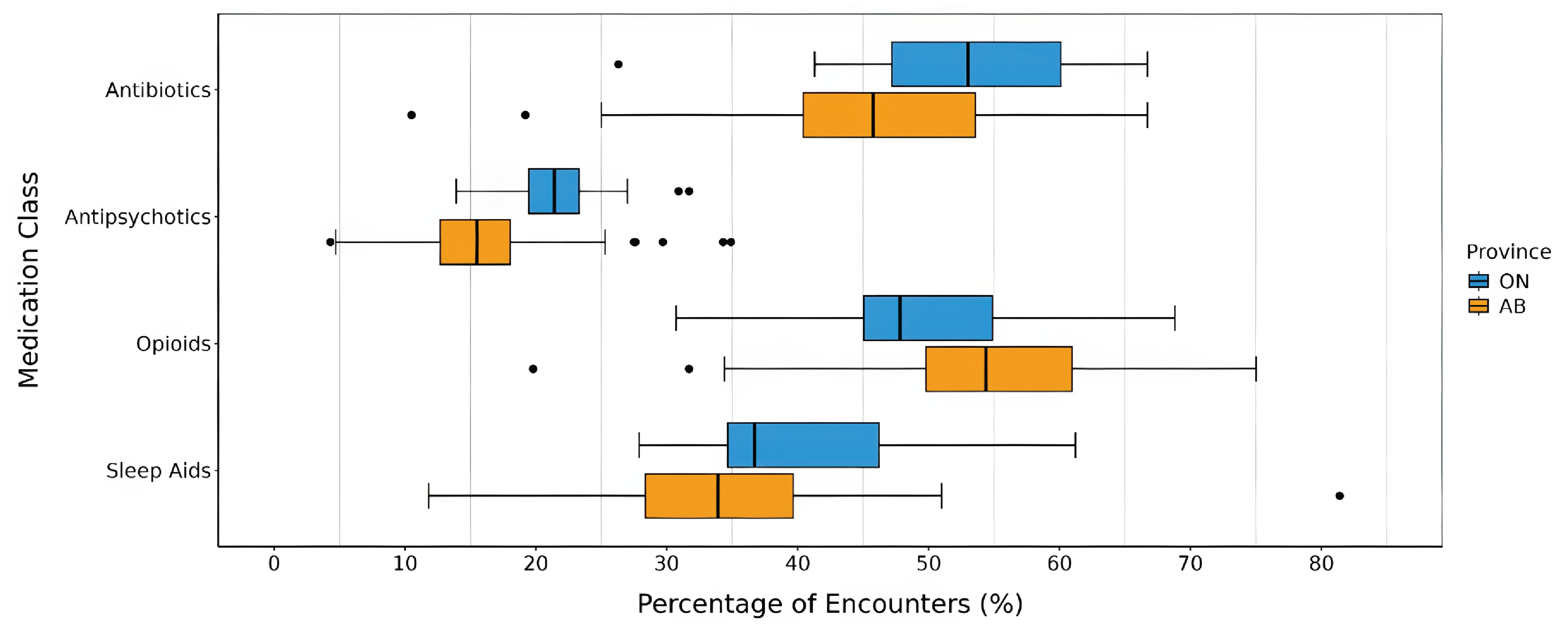
AB = Alberta; ON = Ontario.
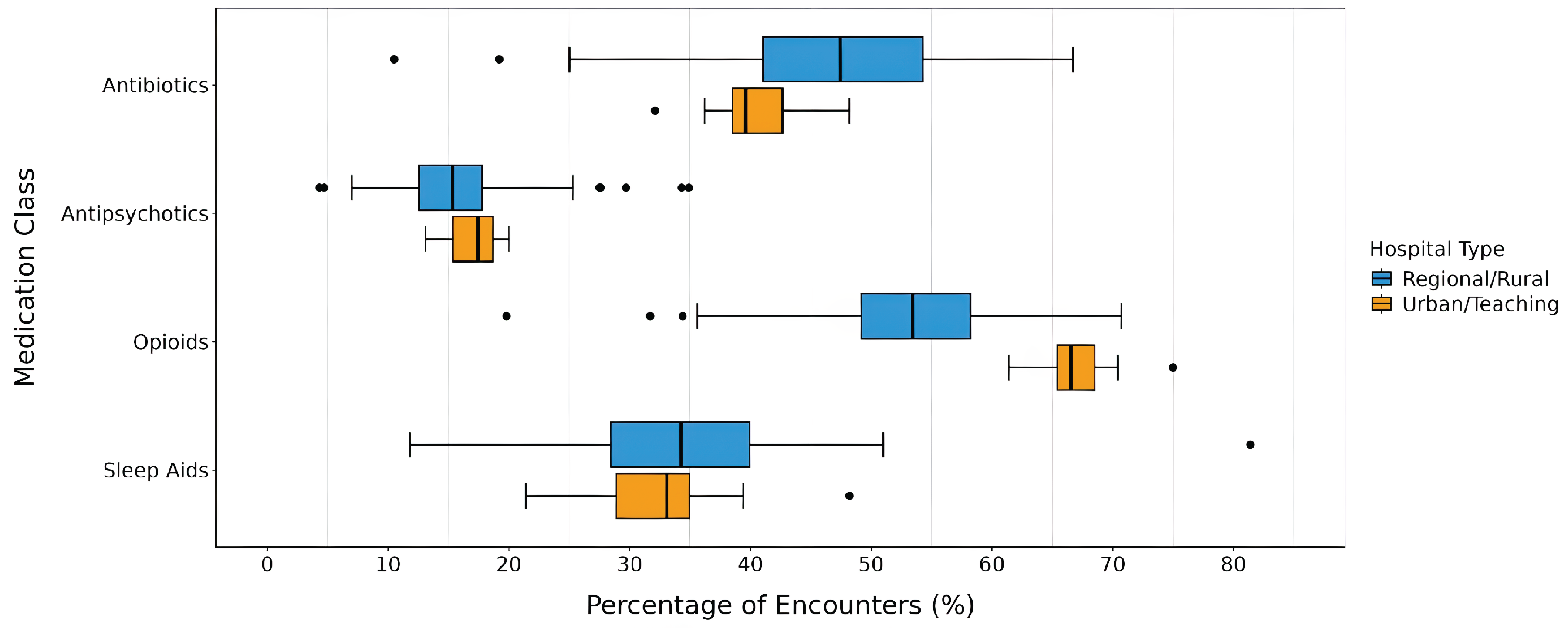
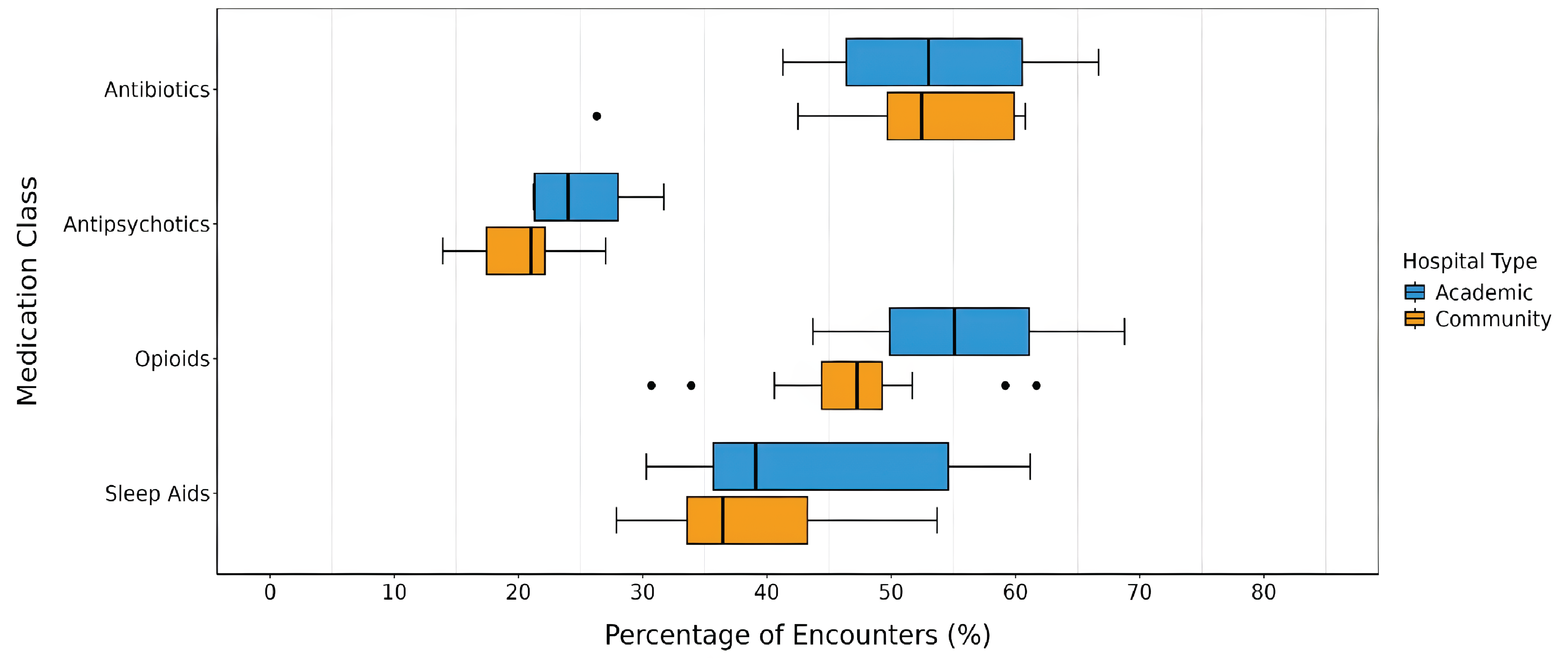
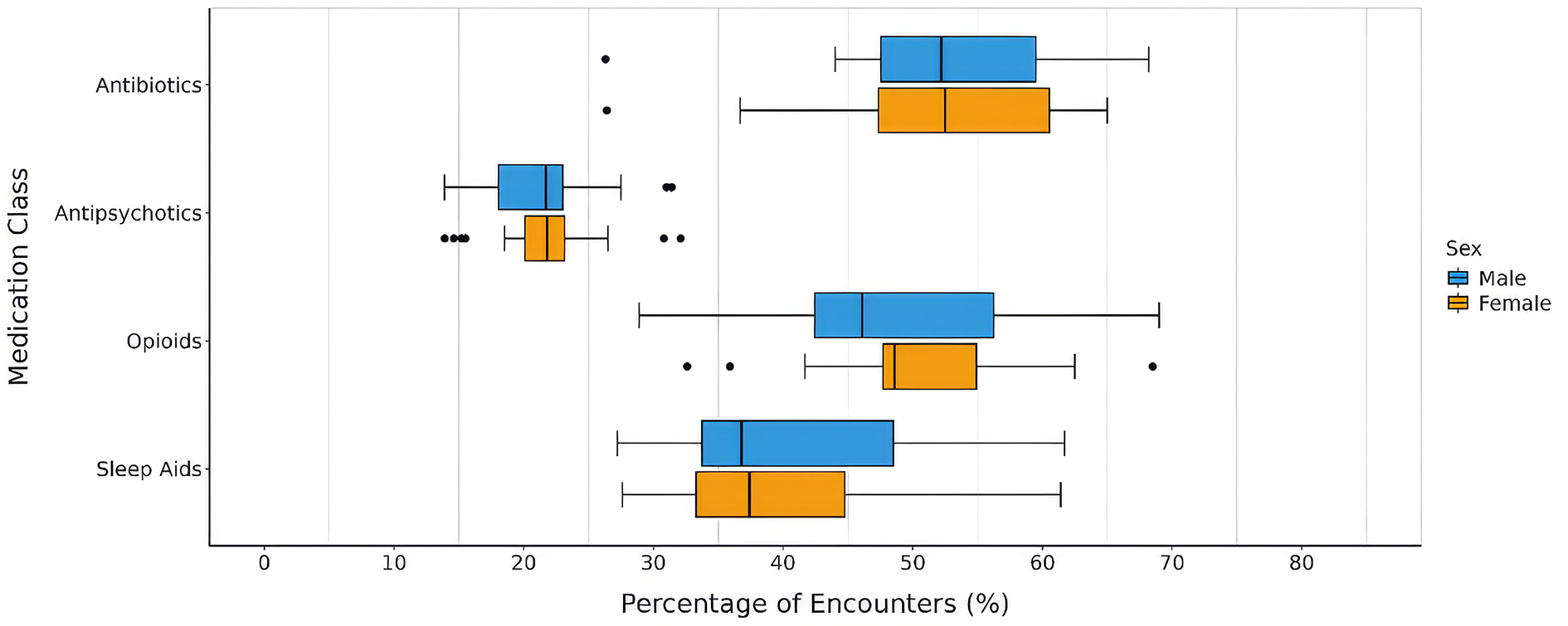
Figure 9: Distribution of Medication Prescribing Rates by Neighbourhood Marginalization Using the Households and Dwellings Dimension of ON-Marg in Ontario Hospitals
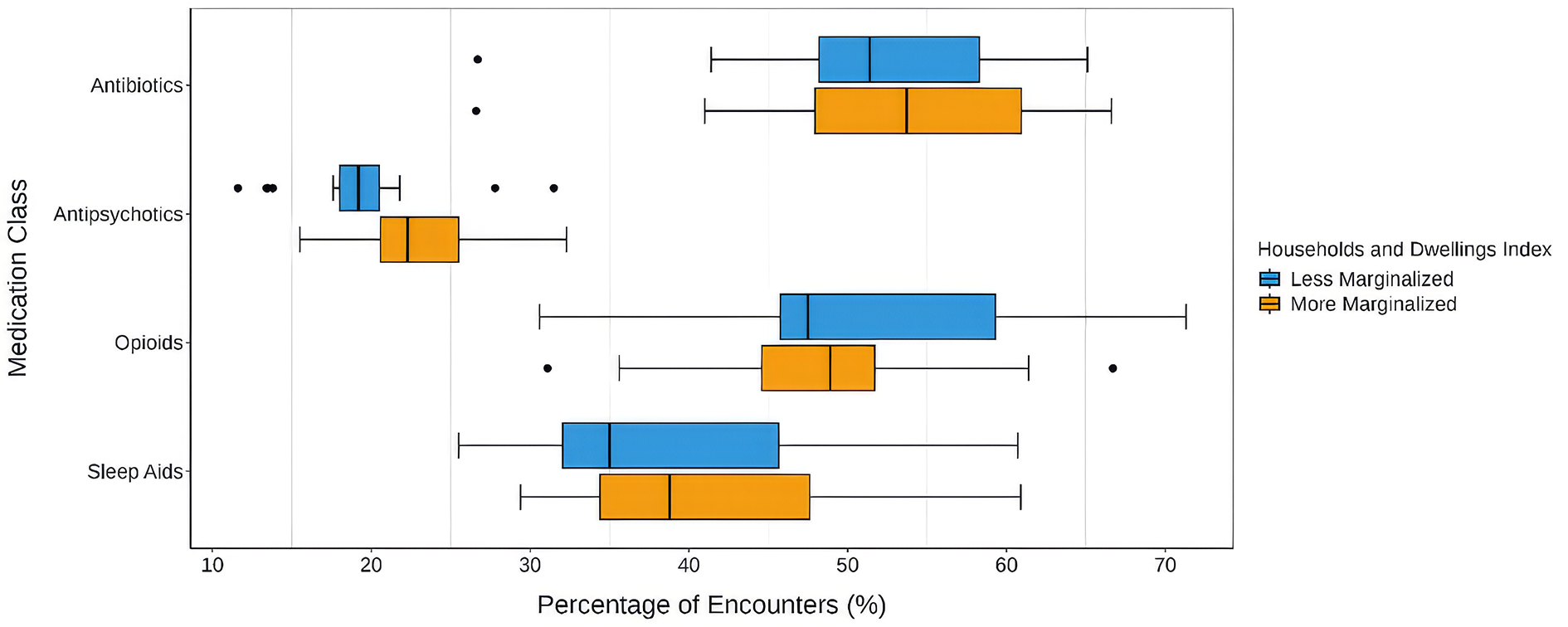
ON-Marg = Ontario Marginalization Index.
Figure 10: Distribution of Medication Prescribing Rates by Neighbourhood Marginalization Using the Age and Labour Force Dimension of ON-Marg in Ontario Hospitals
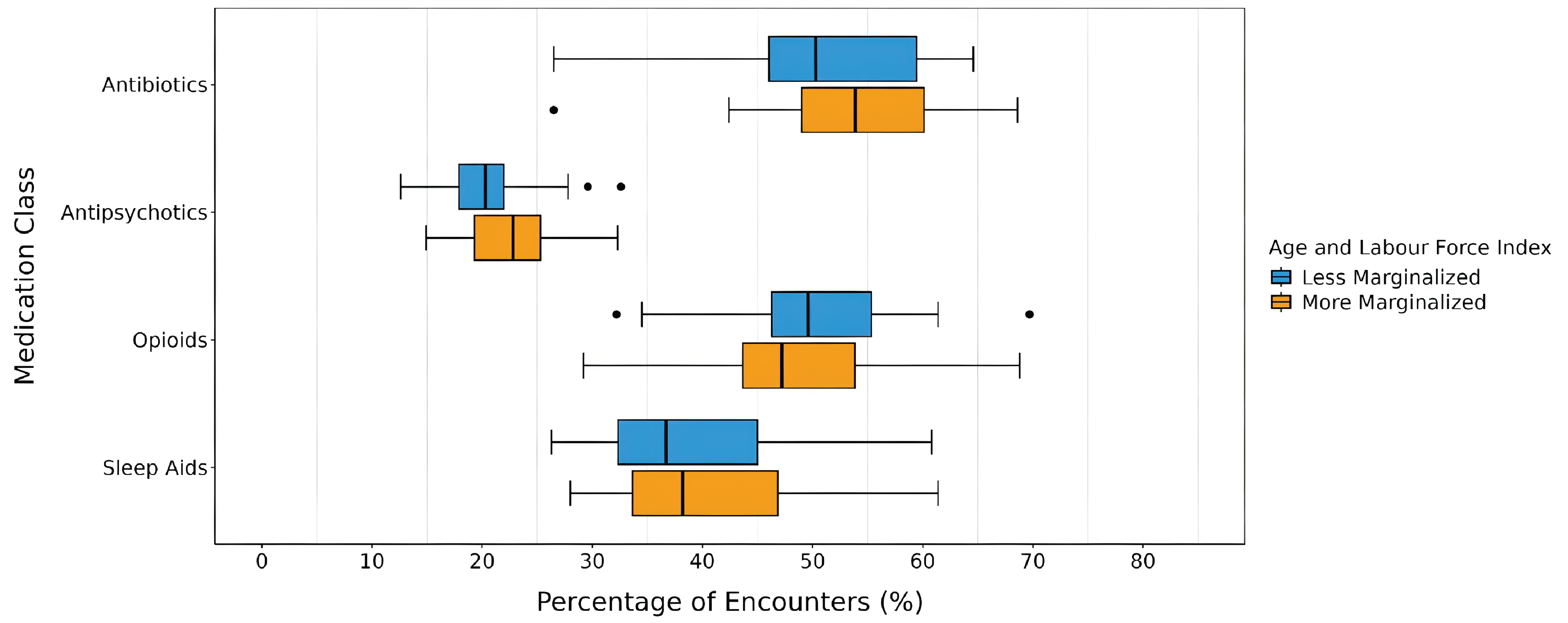
ON-Marg = Ontario Marginalization Index.
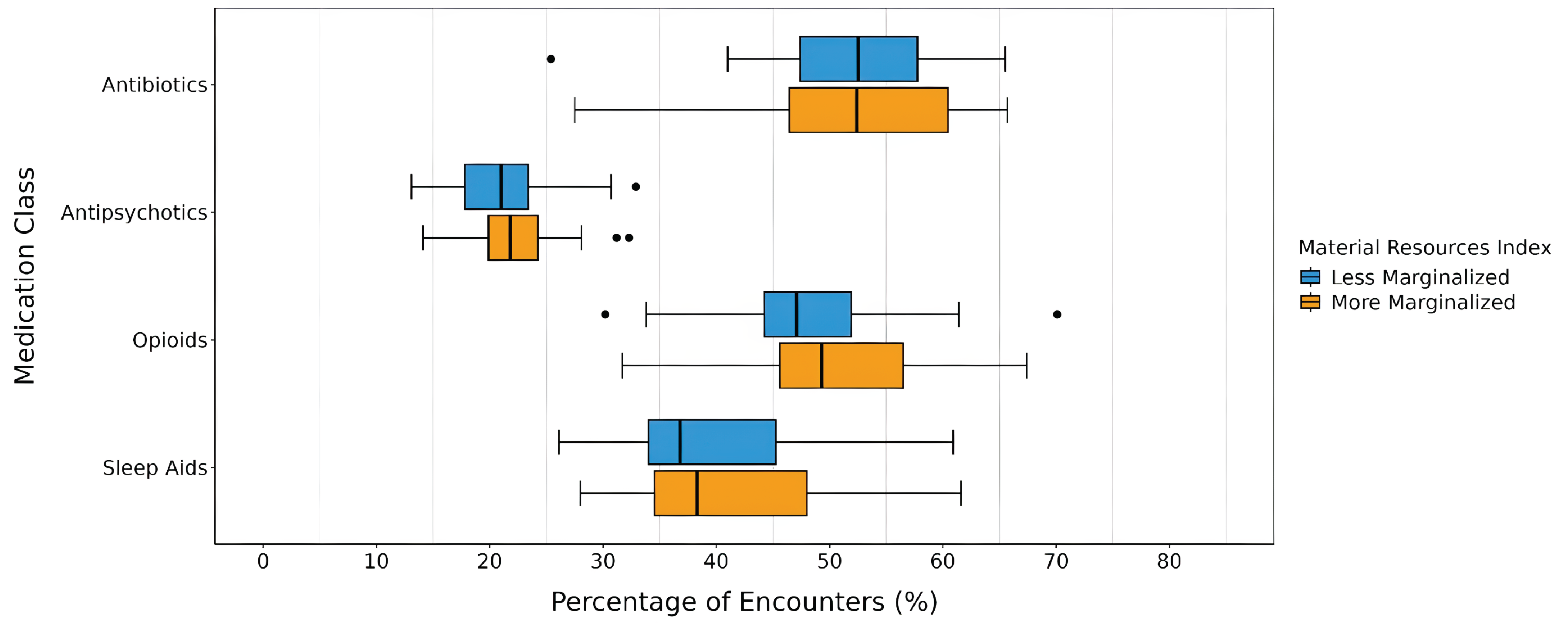
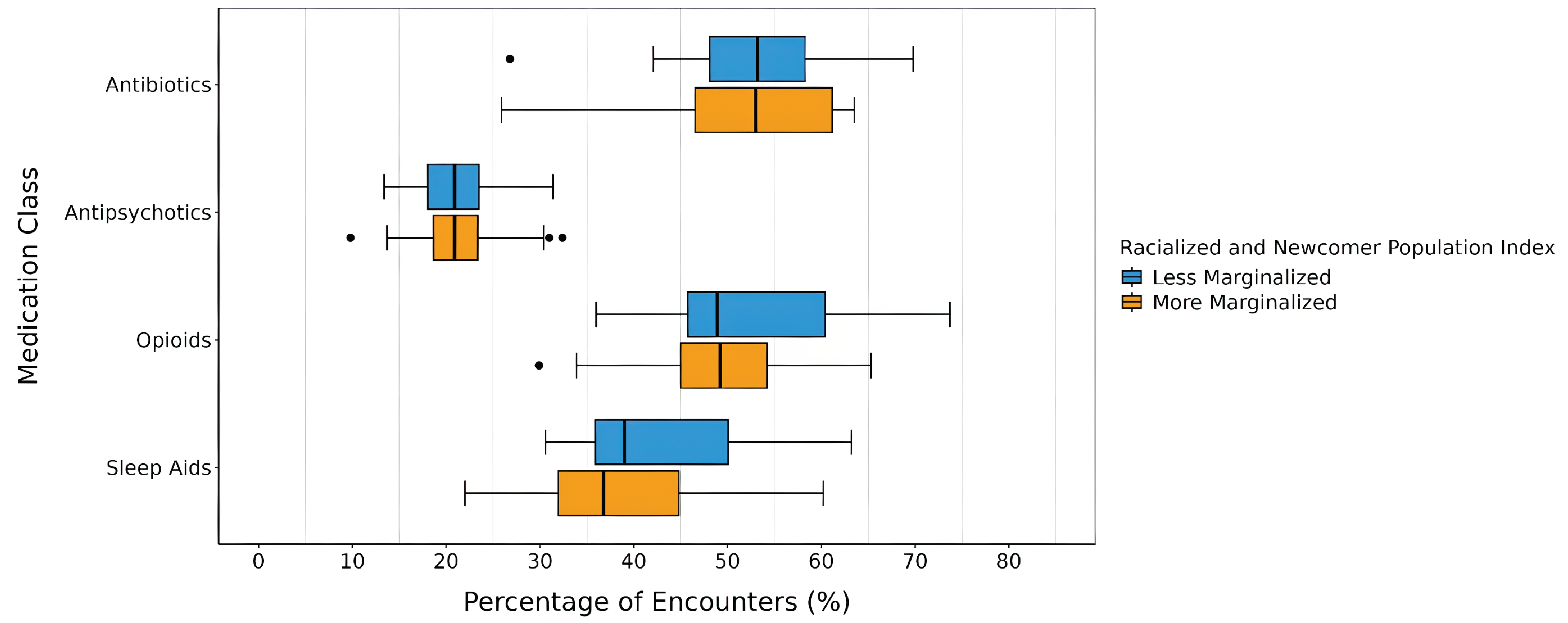
ISSN: 2563-6596
Canada’s Drug Agency (CDA-AMC) is a pan-Canadian health organization. Created and funded by Canada’s federal, provincial, and territorial governments, we’re responsible for driving better coordination, alignment, and public value within Canada’s drug and health technology landscape. We provide Canada’s health system leaders with independent evidence and advice so they can make informed drug, health technology, and health system decisions, and we collaborate with national and international partners to enhance our collective impact.
Disclaimer: CDA-AMC has taken care to ensure that the information in this document was accurate, complete, and up to date when it was published, but does not make any guarantee to that effect. Your use of this information is subject to this disclaimer and the Terms of Use at cda-amc.ca.
The information in this document is made available for informational and educational purposes only and should not be used as a substitute for professional medical advice, the application of clinical judgment in respect of the care of a particular patient, or other professional judgments in any decision-making process. You assume full responsibility for the use of the information and rely on it at your own risk.
CDA-AMC does not endorse any information, drugs, therapies, treatments, products, processes, or services. The views and opinions of third parties published in this document do not necessarily reflect those of CDA-AMC. The copyright and other intellectual property rights in this document are owned by the Canadian Agency for Drugs and Technologies in Health (operating as CDA-AMC) and its licensors.
Questions or requests for information about this report can be directed to Requests@cda-amc.ca.
Canada’s Drug Agency developed this resource paper in partnership with GEMINI and VITAL.